Building Engagement
The Influence of Physical Structure on Social Interaction
By
Lindsey J. Davis
A Master’s Project submitted to the faculty
of the University of North Carolina at Chapel Hill
in partial fulfillment of the requirements
for the degree of Master of City and Regional Planning
in the Department of City and Regional Planning
Chapel Hill
2010
Approved by:
_________________________
______________________
Executive Summary
Green space, common areas, and amenities are expected to encourage social interaction, which in
turn will impact engagement and commitment to community. Student housing is designed to
engage students in a campus community by providing activities that encourage student
Table Of Contents
Introduction
4
Literature Review
5
Research Questions
6
Methodology
7
Review of Variables and Controls
Campus Characteristics
9
Sample Floor plans of Resident Housing
Findings and Discussion
11
Table 1: Student Background
Level of Familiarity with UNC Campus Self-Identification as Extrovert
Intent to Become Involved in an Organization
Satisfaction with Residence Halls
12
Table 2: Satisfaction with Place Corridor-Style Units Suite-Style Units
Regression 1: Satisfaction in College Figure 1: Satisfaction in Residence Hall
Satisfaction with Peers
13
Table 3: Friendliness of Peers Corridor-Style Units Suite-Style Units Regression 2: Friendliness
Figure 2: Friendliness of Building-Mates Figure 3: Friendliness of Floor-Mates
Figure 4: Friendliness of Roommates/Suitemates
Student Involvement
16
Table 4: Student Involvement in January Corridor-Style Units
Suite-Style Units
Regression 3: Frequency of Participation Figure 5: Behavior Since Entering College Figure 6: Report on Participation in January
Conclusion
18
Bibliography
20
Appendix 1:
Surveys
21
Appendix 2:
Variable Construction and Components
35
Appendix 3:
Descriptive Statistics
37
Appendix 4:
Variables Frequency in Relation to Housing Type
38
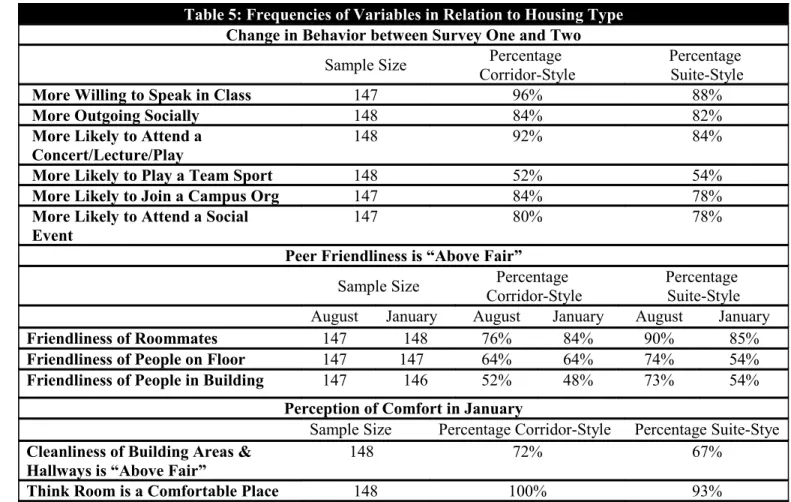
Table 5: Frequencies of Variables in Relation to Housing Type
Appendix 5:
T-Tests
40
Introduction
Enhancing social engagement is a topic that receives attention by scholars and practitioners alike.
Planners, architects, and administrators seek to engage individuals and create active communities through elements of design. As the electronic world becomes a conduit for creating and sustaining social
networks, community organizers strive to respond to this altered definition of ‘connection’ by working with planners to create productive public spaces and opportunities that build community. It has been seen that well-planned spaces can impact engagement and foster or discourage social group formations. Comparable to community involvement, universities thrive on engaged and participative students.i
Social engagement allows individuals to find commonality with larger groups, thus acting as a catalyst to create community, form new ideas, and allow the individual to find comfort with like-minded others. Community engagement is desirable as it not only gives a sense of belonging to an individual, but also allows knowledge sharing, skill collaboration and the creation, definition and affirmation of new ideas.ii
By studying the differences between individual student experience and social interaction in two types of housing on the UNC-Chapel Hill (UNC-CH) campus, this paper presents conclusions on the influence different physical living environments have on engagement and student comfort level. This research is designed to contribute to research focused on university life and community involvement, as well as provide findings that may expand our understanding about the creation of productive and engaged communities, especially as they relate to young adults.
Many administrators see college housing “as a business enterprise, not an educational one,” yet research
is beginning to explore how a college living environment can enhance the education of the student.iii
University residence halls do more than provide students with a “satisfactory place to live.iv Frequency of
personal face to face contact is one of the most important factors in the formation of groups and informal friendships” and the use of color, dimension, and shared space can influence how individuals will interact with their environment.v The “day to day experience of group living is a practical laboratory in human
relations,”vi and sociologists, planners, and student life administrators are pressed to design buildings that
promote student development “academically, socially, physically, and spiritually.”vii On many campuses,
administration encourages the resident to enhance their social network in hopes that individual
networking acts a catalyst for creating a university community. “According to the 2007 National Study of Living Learning Programs, the most successful college students…took advantage of the freshman interest groups available on their campus. These students were less likely to drop out, more likely to graduate and less likely to abuse alcohol.”viii Early resident engagement in a college living situation is believed to help
students escape the potential isolation resulting from a new college living environment and allow them to
develop a level of comfort in their new environment. Studying the physical elements of student housing that evoke positive student response will presumably lead to greater understanding on creating
communities.
Literature Review
Literature on physical space, individual engagement, and community involvement was used to put this study in context of prior research. Most existing research focused on how the college residential living environment affects the academic performance of students, however this paper looks closely at how the living environment affects the social success of students. Reviewed works helped identify the physical features of a residence hall important to student comfort, outlined the affect college housing is projected to have on a student, and identified elements create the relationships necessary for student success.
There is overall consensus amongst researchers that residence halls have an affect on student growth in the areas of values, morals, and personal self-discovery (Winston, Anchors 1993). Group living is beneficial in helping a student develop personal responsibility, participate in group decision making, and contribute towards better citizenship later in life (Riker 1956). Students are believed to be affected both physiologically and psychologically by their living environments and therefore relationships are key for successful housing programs (Riker 1965). In providing suggestions as to how these relationships would form, there is no general consensus amongst researchers, however there is a common belief that
architecture promoting interaction among students through planned and unplanned encounters is beneficial as students have a need for companionship (Gisolfi 2007; Mullins, Allen 1971). Friendship is expected to develop on a floor, not between floors, as those within closer proximity to one another are expected to form bonds (Riker 1956, Gisolfi 2007). Despite this emphasis on encouraging peer
interaction, studies are further conflicted on the integration of suite-style and apartment-style units, which are referred to as “a milestone in residence hall development” because they provide greater privacy and autonomy (Winston, Anchors; 1993).
groupings that would create anonymity (Gisolfi 2007). In addition to shape of residence hall, size of residence hall was also a point of direct contention. Some researchers refer to suite-style units as a less-crowded environment (Valins, Baum 1973; Baum, Harpin, Valins 1975; Baum, David 1980; Huang 1982) while others state that low-rise buildings are more positive, friendlier and less stressful and crowded climates (Winston, Anchors 1993).
The physical elements that make a student feel at home are incorporated into their daily lives: multiple entryways, close attention to materials, finishes, lighting, and furnishings (Gisolfi 2007; McHale, Speek 2934; Riker 1956; Riker 1965). The residence hall should provide a sense of comfort, confidence and protection through these features at first student glance (Riker 1965; Mullins, Allen 1971). Physical elements identified by these studies were considered when evaluating the variations between residence halls on the UNC-CH campus and were integrated into student surveys to gauge satisfaction with particular residence hall characteristics.
Few authors explore the social engagement or overall community engagement of the student, preferring to focus on how to enrich the residential atmosphere for student academic success and intellectual activity (Riker 1965). Obligations to community welfare in group living experiences are briefly mentioned (Riker 1956; Mullins and Allen 1971), thus leaving a gap in a comprehensive knowledge of how a residence hall affects the student experience within the larger community. This gap in research led to the formation of the following study on how a residence hall affects the greater involvement of the college student.
Research Questions
This study was designed to answer three primary questions thought to be most pertinent to existing university goals in creating a satisfactory and participatory campus. Exploring how the physical living environment affects student satisfaction will help to understand what architectural structures and amenities contribute to overall student fulfillment within their living environment. Studying the
relationship between physical space and the perception of peer friendliness will enhance the knowledge of relationships, which researchers imply is key to student happiness. Finally, the correlation between the physical living environment and the rate of student engagement in the greater community will assist in providing student life administrators with data on how to encourage participation and involvement through design.
Methodology
To answer these questions, students in varied types of housing were studied over the first six months of their college experience (a copy of the survey is provided in Appendix 1). With the assistance of the UNC-CH Office of Housing and Residential Education, two surveys were administered to capture experiences of students during their first semester in college.ix Independent variables would be the
Independent Variables Control Variables Dependent Variables
Corridor/Suite-Style Living
• 2-4 person dorms
• Use of Common Areas
Tendency to get involved with extra- curricular activities
- Satisfaction with Living Environment
-Friendships with Neighbors in Hall
-Involvement in Campus Organizations Introvert/Extrovert
Familiarity with Roommate & Current Students
High School & Family Location
Gender, Race
Prior Room-Sharing Experience
The student sample was first-year students who had not previously attended college and were living on campus in co-ed non-specialized residence halls.x Throughout this paper these residence halls will be
referred to as mainstream housing.
The first survey captured the initial feelings students had towards the campus, their residence hall, and each other. This survey asked questions about first impressions of physical and social environment, familiarity with peers and surrounding area, and tendencies to get involved in extra-curricular activities.
The second survey captured how the students’ perceptions of residence hall and peers had changed since coming to campus and allowed the student to reflect on the routine and lifestyle they had created. The second survey assessed how the student had become involved with both peers and campus organizations, allowing insight into where they met individuals comprising their social networks as well as the
frequency they affiliated with various on-campus groups.
The first survey was sent out electronically in August of 2009 to 33 residence halls and three apartment complexes on the UNC-Chapel Hill campus. A total of 1055 total responses were received to survey one, of those, 416 respondents represented first-year students in mainstream housing. Of these 416 respondents 21 different residence halls were represented, 366 students (88%) lived in suite style buildings and 50 students lived in corridor style housing. The disproportionate distribution of respondents living in suite-style units is the result of residence hall size and placement protocol. Upper classmen receive priority when choosing their residence hall and have a heightened demand for housing located on north campus, where corridor-style buildings are located.
The second survey was administered in late January 2009. A total of 711 students responded to the second survey. The final sample was comprised of 148 first-year students in mainstream housing who answered both surveys.xi The behavior of these students was evaluated in correlation with both alternative
architectural living environments (suite-style living and corridor-style) as well as location on the UNC-CH campus (north, middle, and south).
Campus Characteristics
Understanding the physical layout of the UNC-CH campus and residence halls aids in the full
Residence halls on south campus are high-rise buildings and are more physically removed from the academic buildings and student services on campus. South campus residence halls are approximately .6 miles from student stores, which is defined as the center of campus, and .9 miles from Franklin Street. Middle and lower campuses are comprised of suite and semi-suite-style halls. In a suite-style room, three bedrooms surround a single bathroom and common room. These five rooms are independent from other suite-style units and are often accessed through a common open-air balcony. A sample floor plan for a suite-style residence is shown below. The faded blue rooms in the lower right hand corner of each suite indicate the common area for that suite:
Semi-suite-style units are made up of two double rooms sharing one bathroom. Semi-suite units have no adjoining common areas. These residence halls are a hybrid between corridor-style living and suite-style living as they allow interior hallways and common areas to be shared by all building residents, yet provide for more private bathroom access. For the purpose of this study, these halls will be considered ‘suite-style’ and will be grouped with the larger suite-style units on south campus for analysis. The decision to group suite-style and semi-suite-style units together was based on the fact that semi-suite-style units have greater similarity to suite-style housing than to corridor-style housing.
Students express residence hall preference but are assigned randomly to residence halls. Self-selection is not an issue of consideration as the Office of Housing and Residential Education randomly assigns students to residence halls. Historically, most first-year students are assigned to suite-style housing as preferential selection is awarded to upper classmen who frequently choose to live on north campus.
Findings and Discussion
Findings will first be presented on the characteristics of the sample and patterns of behavior exhibited by participants. Next, these patterns of behavior will be explored in connection to involvement and perceived satisfaction as influenced by surrounding environment and peers.
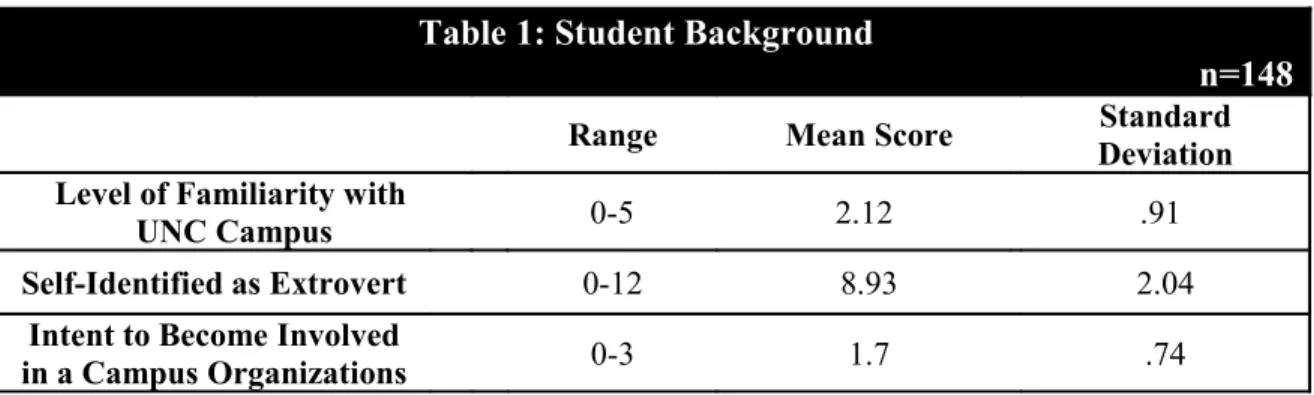
Results indicate that despite similar backgrounds, students exhibit different behaviors when integrated into the campus community. Upon coming to campus, all students presented a median level of familiarity with the campus environment, identified themselves as extroverts, and intended to become involved in campus organizations or clubs (see Table 1):
Table 1: Student Background
n=148
Range Mean Score DeviationStandard Level of Familiarity with
UNC Campus 0-5 2.12 .91
Self-Identified as Extrovert 0-12 8.93 2.04
Intent to Become Involved
in a Campus Organizations 0-3 1.7 .74
academics, the arts, athletics, leadership, service, citizenship, and character.”xii Survey recipients had a
95% participation rate in community service in high school and 68% founded an organization, captained a varsity sport, or served as class, club, or student-body president.xiii Of first-year survey respondents in
mainstream housing, 94% enjoy activities that specify involvement with others and/or held interest in joining the UNC Greek system, campus sporting teams, and other campus related clubs and organizations. This 94% was evenly distributed amongst the sample of individuals living in suite-style and corridor-style units and assigned to halls on north, south and middle campus. There was no concentration of either extrovert or introvert in any particular housing style or location nor were residents in one type of housing deemed more familiar with the campus or with peers than the other.
Satisfaction with Residence Halls
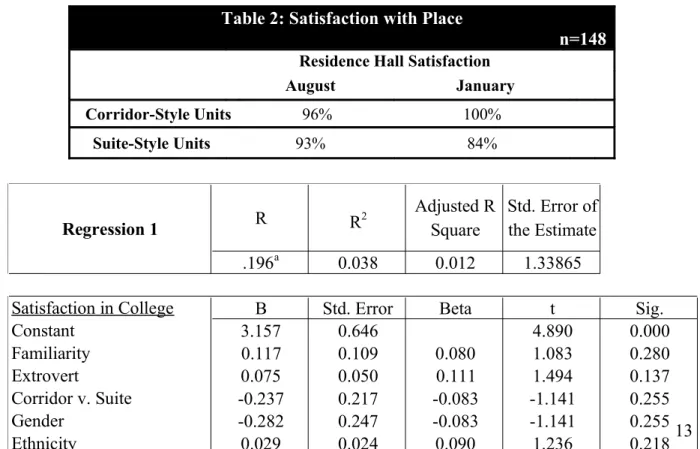
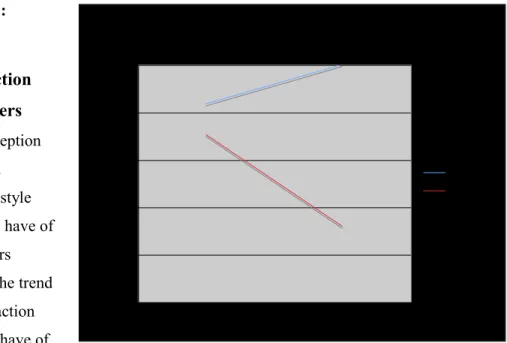
The housing preferences of students prior to August did not seem to influence the initial measure of satisfaction with residence halls. 50% of corridor-style residents had expressed interest in living in suite-style residence halls while only 5% of those assigned to suite-suite-style units indicated preference to live in corridor-style halls. Presumably, this would translate into more corridor-style residents being unsatisfied with placement in corridor-style units both initially and across time, however the data, though not statistically significant, suggests otherwise. In comparing the means, students in corridor-style units have higher average levels of satisfaction. Those in corridor-style units increase in residence hall satisfaction over time, while those in suite-style units decrease in residence hall satisfaction (see Table 2, Regression 1, Figure 1):
Table 2: Satisfaction with Place
n=148
Residence Hall Satisfaction
August January
Corridor-Style Units 96% 100%
Suite-Style Units 93% 84%
13
R R2 Adjusted R
Square
Std. Error of the Estimate
.196a 0.038 0.012 1.33865
Satisfaction in College B Std. Error Beta t Sig.
Constant 3.157 0.646 4.890 0.000
Familiarity 0.117 0.109 0.080 1.083 0.280
Extrovert 0.075 0.050 0.111 1.494 0.137
Corridor v. Suite -0.237 0.217 -0.083 -1.141 0.255
Gender -0.282 0.247 -0.083 -1.141 0.255
Ethnicity 0.029 0.024 0.090 1.236 0.218
Figure 1:
Satisfaction
with Peers
The perception suite and corridor-style residents have of their peers mirrors the trend of satisfaction students have oftheir residence halls. Upon move-in, all respondents were asked to rate the ‘friendliness’ of their building-mates, floor-building-mates, roommates or suite-mates. While the level of satisfaction with building-mates
declines for residents in all housing types, the number of students living in suite-style units who initially felt their building-mates were either ‘very’ or ‘extremely friendly’ decreased to a greater extent compared to residents in corridor-style units. Residents in suite-style units experienced a similar perception of the friendliness of their of floor-mates. The perception of roommate satisfaction among those living in suite-style units decreased slightly more on average than those living in corridor-suite-style units. Suite-suite-style residents experienced a similar reaction when asked about the friendliness of their floor-mates and the perception of roommate satisfaction among suite-style residents increased slightly compared to a reported increase by corridor style residents. While not statistically significant based on a regression analysis containing the control variables, results show behavioral patterns reflecting that corridor style residents may have a more consistent or improving relationship with those around them than suite-style residents (see Table 3, Regression 2, Figure 2,3,4):
Report on Satisfaction in Residence Hall
Regression 2
R
R
2Adjusted
R Square
Std. Error
of the
Estimate
.154*
0.024
0.003
0.37743
Friendliness
B
Std. Error
Beta
t
Sig.
Constant
1.801
0.128
14.019
0.000
Of Building-mates
0.083
0.047
0.192
1.761
0.080
Of Floor-mates
-0.062
0.043
-0.164
-1.416
0.159
Of Roommates/Suitemates
-0.007
0.040
-0.018
-0.184
0.854
Figure 2:
15
Table 3: Friendliness of Peers
n= 148
“Above Fair”
F
riendliness ofRoommates
“Above Fair” Friendliness of
Floor-mates
“Above Fair” Friendliness of Building-Mates August January August January August January
Corridor-Style Units 76% 84% 64% 64% 52% 48%
Suite-Style Units 90% 85% 74% 54% 73% 54%
Friendliness of Building-Mates
.
Figure 3:
Figure 4:
Friendliness of Floor-Mates
10.0% 20.0% 30.0% 40.0% 50.0% 60.0% 70.0% 80.0% 90.0% August January Corridors Suites
Friendliness of Roomate/Suitemate
Student Involvement
Within the first six months at UNC-CH, residents in corridor-style housing became more involved on average within the university than residents of suite-style housing. Results indicate that on average those living in corridor-style units compared to those living in suite-style units were 19% more likely to speak more in class, 2% more outgoing when meeting people socially, 9% more likely to attend a concert, play, or lecture on campus, 6% more likely to join a campus organization, and 2% more likely to attend social events or parties. While the disproportionate representation of respondents in suite-style and corridor-style housing in the sample size made it difficult to find statistical significance, these numbers show behaviors that may indicate different reactions to the built environment and suggests the need for additional research (see Table 4, Regression 3, Figure 5,6):
Regression 3
R
R
2Adjusted
R Square
Std. Error
of the
Estimate
.222
a0.05
0.018
0.851
Frequency of
Participation
B
Std. Error
Beta
t
Sig.
Constant
2.047
0.440
4.650
0.000
Familiarity
0.020
0.069
0.021
0.285
0.776
Happiness
0.091
0.048
0.143
1.917
0.057
Extrovert
0.051
0.032
0.118
1.572
0.118
Corridor v. Suite
-0.119
0.139
-0.063
-0.851
0.396
Gender
-0.083
0.158
-0.039
-0.523
0.601
Ethnicity
-0.013
0.015
-0.065
-0.883
0.378
17
Table 4: Student Involvement in January
Sample Size Campus OrganizationsJoined 1 or more Participate at Least Once a Week
Corridor-Style Units 25 100% 76%
Figure 5:
Figure 6:
Conclusion
Descriptive results
Report on Participation in January
0% 10% 20% 30% 40% 50% 60% 70% 80% 90% 100%
Join one or more UNC Organization Participate at least once/wk No Participation Corridor Suite
Behavior Since Entering College
0%
10%
20%
30%
40%
50%
60%
70%
80%
90%
100%
Willing to Speak
More in Class
More Outgoing
Socially
More Likely to
Attend a
Concert/Play/Lecture
More Likely to Join a
Campus Organization
More Likely to Join a
Team Sport
indicate that on average students in corridor-style units report higher levels of satisfaction and friendliness among peers than those in suite-style units. In addition, initial results suggest that those in corridor-style units may be more likely than those in suite-style units to participate in on-campus activities with regularity. Additional research is needed to further test and explore the patterns of behavior observed from this preliminary study on new students at UNC-CH. Though they are not statistically significant, the results may indicate changes in behavior related to housing design, however there is no certainty that the results are dependent upon design rather than location, or some interaction of the two. The longitudinal study design used in this research was beneficial as respondents in corridor-style units demonstrate a more stable college experience with a higher satisfaction rate of surroundings and peers when compared to residents of suite-style living. Residents of corridor-style units appear to become more social over the course of the year indicating a potential increase in confidence and willingness to actively seek out interests.
This exploratory study presents significant limitations with data and recommends future research to further explore the relationship between design and participation. Future research would benefit from a larger sample size with a more normal distribution as well as research that includes multiple campuses where different types of housing are less geographically isolated and more equally distributed across the campus. The element of a time-series study is important to understanding the impact that intent to participate, architectural structure, and campus location have on behavior.
This study raises questions for both public administrators and planners about the impetus for involvement and environmental factors that lend themselves towards engagement. If the belief that design impacts involvement is further explored, the findings may be applicable for strategic long-term objectives of how to create communities and foster engagement and participation. The repeating patterns of behavior may indicate that physical construction influences satisfaction with surrounding environment, peers, and community engagement leading future researchers to expand this study and further explore the tie between design and socially prosperous communities. By connecting individuals and creating spaces that are conducive to community interaction, cities and towns will further engage citizens, potentially
allowing a productive space for new ideas and invested individuals.
Bibliography
Brown, Kerry and Keast, Robyn (2003) Citizen-Government Engagement: Community Connection Through Networked Arrangements. Asian Journal of Public Administration 25(1):pp. 107-132.
Hurley, Clare G., 1980. Housing Attitudes, Satisfaction, And Perception At Craige Residence College, Or, How A Graduate Dorm Changed My Life "Livable, But Not Desirable."
Jones, Ronald W. 1979. Housing Choice Of College Students. Its Effect On Academic Achievement And Participation In Extracurricular Activities.
McHale, Kathryn; Speek, Frances Valiant, 1934. Housing College Students. American Association of University Women; American Association of University Women, Washington, D.C.
Mullins, William; Allen, Phyllis.1971. Student Housing - Architectural and Social Aspects. New York, Praeger Publishers.
Propst, R.L and Propst, C. G. 1973. Dormitory Experiment. University of Massachusetts, Ann Arbor, Michigan.
Riker, Harold C. 1956. Planning Functional College Housing. Teachers College, Columbia University, New York.
Riker, Harold C. 1961. College Students Live Here; A Study of College Housing. Educational Facilities Laboratories. Educational Facilities Laboratories, New York.
Riker, Harold C. 1965. College Housing as Learning Centers. American College Personnel Association, Washington.
Strickland, William R. 1983. An Analysis Of The Conditions Explaining The Failure Of Living-Learning Programs In Residence Halls In American Higher Education A Comparative Case Study Of Programs At A Major Public University And At A Private Liberal Arts College.
Thielke, Zack. 2009. Freshman Connections Key to College Success. Available, Oct. 6 2009 at http://www.tommiemedia.com/?p=1828
University of North Carolina- Chapel Hill, Office of Undergraduate Admissions. Available Feb. 12 2010 at http://www.admissions.unc.edu/Apply/default.html and http://www.admissions.unc.edu/Academics/Class_Profile_and_Rankings/default.html
Wallin, Jennifer; Aspinwall, Brent; Harrell, Paula; Assessing The 2001 First Year Move-In A Survey Of Parents. East Carolina University Regional Development Services. 2001, East Carolina University, Survey Research Laboratory, Greenville, N.C.
Winston, Roger B.; Anchors, Scott.1993. Student Housing And Residential Life A Handbook For Professionals Committed To Student Development Goals. Jossey-Bass, San Francisco.
Appendix 1: Surveys
Survey #2
Appendix 2: Variable Construction and Components
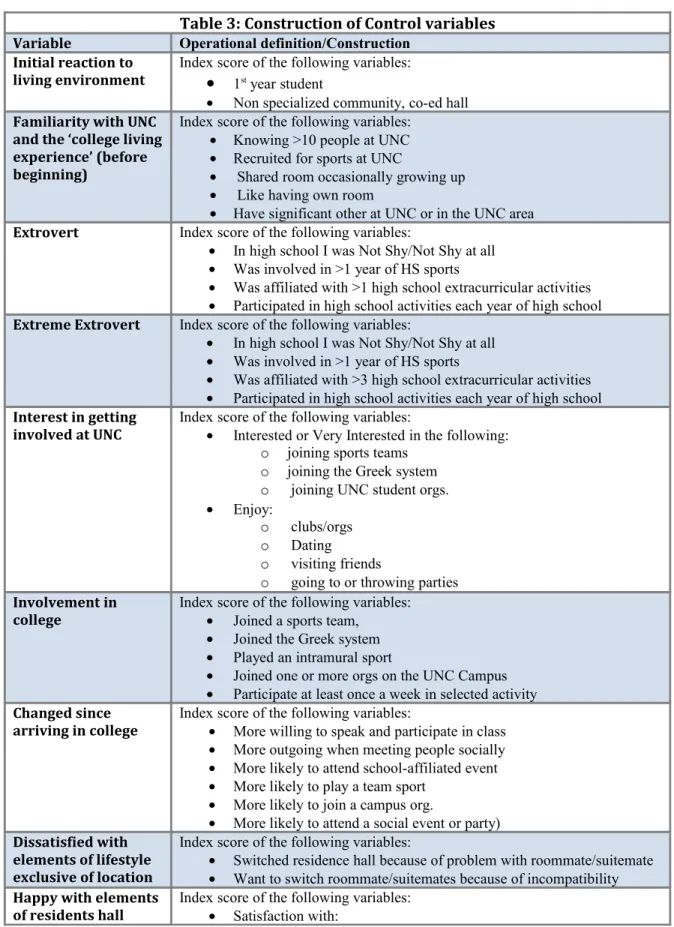
Table 3: Construction of Control variables
Variable Operational definition/Construction
Initial reaction to
living environment Index score of the following variables:
•
1st year student• Non specialized community, co-ed hall
Familiarity with UNC and the ‘college living experience’ (before beginning)
Index score of the following variables:
• Knowing >10 people at UNC
• Recruited for sports at UNC
• Shared room occasionally growing up
• Like having own room
• Have significant other at UNC or in the UNC area
Extrovert Index score of the following variables:
• In high school I was Not Shy/Not Shy at all
• Was involved in >1 year of HS sports
• Was affiliated with >1 high school extracurricular activities
• Participated in high school activities each year of high school
Extreme Extrovert Index score of the following variables:
• In high school I was Not Shy/Not Shy at all
• Was involved in >1 year of HS sports
• Was affiliated with >3 high school extracurricular activities
• Participated in high school activities each year of high school
Interest in getting
involved at UNC Index score of the following variables:• Interested or Very Interested in the following: o joining sports teams
o joining the Greek system o joining UNC student orgs.
• Enjoy:
o clubs/orgs o Dating o visiting friends
o going to or throwing parties
Involvement in
college Index score of the following variables:• Joined a sports team,
• Joined the Greek system
• Played an intramural sport
• Joined one or more orgs on the UNC Campus
• Participate at least once a week in selected activity
Changed since
arriving in college Index score of the following variables:• More willing to speak and participate in class
• More outgoing when meeting people socially
• More likely to attend school-affiliated event
• More likely to play a team sport
• More likely to join a campus org.
• More likely to attend a social event or party)
Dissatisfied with elements of lifestyle exclusive of location
Index score of the following variables:
• Switched residence hall because of problem with roommate/suitemate
• Want to switch roommate/suitemates because of incompatibility
Happy with elements
exclusive of location o Room
o windows/blinds o tv/rec rooms o lounges o lawns
o element of privacy is ‘just right’ o building cleanliness is above fair
• Friendliness of following groups are ‘above fair’: o roommate/suitemate
o floor-mates o building-mates
Diversity of
friendships Index score of the following variables:• Met most friends: o In class
o From student organizations/clubs on or off campus
Diversity of those you
spend time with Index score of the following variables:• People you hang out With: o From classes
o From student orgs. (On or off campus)
Appendix 3: Descriptive Statistics
Sample Size Range Mean Score Standard Deviation Familiarity with UNC before
Beginning in August
Number of People Known Before
Coming to Campus 148 1-2 1.26 .661
Recruited for Sports 147 0-1 .01 .082
Occasionally Shared Room 148 0-1 .70 .462
Like Having Own Room 147 0-1 .97 .182
Significant Other at UNC 147 0-1 .06 .241
Significant Other in UNC Area 148 0-1 .10 .303
Extrovert in High School
Level of Shyness in High School 148 1-4 3.55 .8353
Years Played Sports in High School
148 1-4 1.12 .918
Number of High School Extracurricular activities
147 1-4 1.69 .518
Number of Years Played Sports in High School
145 1-4 2.63 .858
Intent to Get Involved at UNC
Want to do sports at UNC 148 1-4 2.63 1.077
Want to Join the Greek System 145 1-3 1.88 1.027
Want to join other Student Organizations
146 1-4 3.46 .589
Enjoy Dating 148 0-1 .55 .499
Enjoy Clubs and Organizations 148 0-1 .82 .382
Enjoy Visiting Friends 148 0-1 .92 .274
Enjoy Going to and Throwing Parties
148 0-1 .61 .490
Involvement in College
Joined Greek System 24 0-1 1 0.00
Played Intramural Sports 38 0-1 1 0.00
Joined One or More Organizations
on Campus 126 0-1 1 0.00
Joined Sports Team on Campus 13 0-1 1 0.00
Participate at least Once a Week in
Campus Activity 77 0-1 .7013 .46069
Change in Behavior Since Arriving at UNC
More Willing to Speak in Class 147 0-1 .89 .313
More Outgoing Socially 148 0-1 .82 .382
More Likely to Attend a
School-Affiliated Event 148 0-1 .85 .357
More Likely to Play a Team Sport 148 0-1 .54 .500
More Likely to Join a Campus Org 148 0-1 .79 .408
More Likely to Attend a Social Event
Appendix 4: Variable Frequencies in Relation to Housing Type
Table 5: Frequencies of Variables in Relation to Housing Type
Change in Behavior between Survey One and Two
Sample Size Percentage Corridor-Style
Percentage Suite-Style
More Willing to Speak in Class 147 96% 88%
More Outgoing Socially 148 84% 82%
More Likely to Attend a Concert/Lecture/Play
148 92% 84%
More Likely to Play a Team Sport 148 52% 54%
More Likely to Join a Campus Org 147 84% 78%
More Likely to Attend a Social Event
147 80% 78%
Peer Friendliness is “Above Fair”
Sample Size Percentage Corridor-Style
Percentage Suite-Style
August January August January August January
Friendliness of Roommates 147 148 76% 84% 90% 85%
Friendliness of People on Floor 147 147 64% 64% 74% 54%
Friendliness of People in Building 147 146 52% 48% 73% 54%
Perception of Comfort in January
Sample Size Percentage Corridor-Style Percentage Suite-Stye
Cleanliness of Building Areas & Hallways is “Above Fair”
148 72% 67%
Think Room is a Comfortable Place 148 100% 93%
Variable Frequencies in Relation to Housing Type
N Percentage of Occurrence
in Corridor-Style Units Percentage of Occurrence in Suite-Style Units constant
Change In Behavior
More Willing to Speak in Class 147 96% 88%
More Outgoing Socially 148 84% 82%
More Likely to Attend a
Concert/Lecture/Play 148 92% 84%
More Likely to Play a Team Sport
More Likely to Join a Campus Org 147 84% 78%
More Likely to Attend a Social Event 147 80% 78%
Peer Friendliness is “Above Fair” in August
Friendliness of Roommates 147 76% 90%
Friendliness of People on Floor 147 64% 74%
Friendliness of People in Building 147 52% 73%
Peer Friendliness is “Above Fair” in January
Friendliness of Roommates 148 84% 85%
Friendliness of People on Floor 147 64% 54%
Friendliness of People in Building 146 48% 54%
Perception of Comfort in January Cleanliness of Building Areas &
Hallways is “Above Fair” 148 72% 67%
Appendix 5: T-Tests
Group Statistics
MASTER Suite-Style
v. Corridor Style N Mean Std. Deviation Std. Error Mean
College Involvement Corridor-Style 25 1.8400 .85049 .17010
Suite-Style 116 1.9828 .96893 .08996
Change in Behavior Corridor-Style 25 4.8800 1.26886 .25377
Suite-Style 123 4.6341 1.41577 .12766
Overall Satisfaction Corridor-Style 25 3.5200 1.55778 .31156
Independent Samples Test
Levene's Test for Equality of
Variances t-test for Equality of Means
95% Confidence Interval of the Difference
F Sig. t df Sig. (2-tailed)
Mean Difference
Std. Error
Difference Lower Upper
College Involvement
Equal variances assumed .587 .445 -.682 139 .496 -.14276 .20937 -.55673 .27121
Equal variances not assumed -.742 38.673 .463 -.14276 .19242 -.53208 .24656
Change in Behavior
Equal variances assumed 1.093 .297 .805 146 .422 .24585 .30553 -.35799 .84970
Equal variances not assumed .865 37.214 .392 .24585 .28407 -.32962 .82132
Overall Satisfaction
Equal variances assumed 2.725 .101 .192 146 .848 .05659 .29435 -.52515 .63832
Equal variances not assumed .170 31.095 .866 .05659 .33272 -.62191 .73508
Appendix 6: Regressions
R
R
2Adjusted R
Square
Std. Error of
the Estimate
.142
a0.02
-0.02
0.91752
College Involvement
B
Std. Error
Beta
t
Sig.
Constant
1.318
0.500
2.636
0.009
Familiarity
0.000
0.076
0.000
-0.003
0.998
Happiness
0.016
0.054
0.022
0.288
0.774
Extrovert
0.003
0.038
0.005
0.070
0.945
Corridor v. Suite
0.235
0.153
0.119
1.534
0.127
Enjoy Dating?
0.071
0.145
0.039
0.490
0.625
Gender
0.082
0.176
0.036
0.466
0.642
Ethnicity
-0.010
0.017
-0.045
-0.581
0.562
R
R
2Adjusted R
Square
Std. Error of
the Estimate
.222
a0.05
0.018
0.851
Frequency of Participation
B
Std. Error
Beta
t
Sig.
Constant
2.047
0.440
4.650
0.000
Familiarity
0.020
0.069
0.021
0.285
0.776
Happiness
0.091
0.048
0.143
1.917
0.057
Extrovert
0.051
0.032
0.118
1.572
0.118
Corridor v. Suite
-0.119
0.139
-0.063
-0.851
0.396
Gender
-0.083
0.158
-0.039
-0.523
0.601
Ethnicity
-0.013
0.015
-0.065
-0.883
0.378
Model 2
R R2 Adjusted R
Square
Std. Error of the Estimate
.196a 0.038 0.012 1.33865
Satisfaction in College B Std. Error Beta t Sig.
Constant 3.157 0.646 4.890 0.000
Familiarity 0.117 0.109 0.080 1.083 0.280
Extrovert 0.075 0.050 0.111 1.494 0.137
Corridor v. Suite -0.237 0.217 -0.083 -1.141 0.255
Gender -0.282 0.247 -0.083 -1.141 0.255
Ethnicity 0.029 0.024 0.090 1.236 0.218
Model 3
i Bringle and Hatcher. 2002. Campus-Community Partnerships: The Terms of Engagement.
ii Brown and Keast. 2003. Citizen-Government Engagement: Community Connection Through Networked Arrangements iii Riker, 1965. College Housing as Learning Centers
iv ibid, p. v
v Mullins and Allen. 1971. Student Housing - Architectural and Social Aspects. 27 vi
v Riker. 1956. Planning Functional College Housing. 5
vii Roger B Winston Jr., Student Housing and Residential Life. viii viii Thielke, Zack. 2009. Freshman Connections Key to College Success
ix Surveys were distributed on a day and time suggested by the Office of Housing and Residential Education to maximize response rate and avoid interference or overlap with other university-wide emails being distributed. All students were given ample time in which they could complete the survey and reminder emails were distributed to avoid potential sample bias of computer inaccessibility.
x Specialized residence halls include substance free, single gender, or living/learning programs
xi These 148 students fit all predetermined criteria and were individually identifiable as having responded to both surveys. xii UNC Office of Undergraduate Admissions