A
CKNOWLEDGEMENTSI would like to acknowledge Dr. Gavin Smith for his time, guidance, and dedication to my research. This local government emergency management plan quality evaluation tool may not exist had it not been for his interest in my academic career. Dr. Smith was not only my advisor to this Masters Project in the Department of City and Regional Planning, but he also sat on my Capstone Committee at the School of Government and was also my supervisor at the
Department of Homeland Security Center of Excellence – Coastal Hazards Center. I would also like to thank Dr. Ricardo Morse and Norma Houston for their effort and dedication as members of my Capstone Committee. Resources were also provided from the Department of Homeland Security Center of Excellence – Coastal Hazards Center in completing this project. Lastly, I would like to thank those who took the time to review my evaluation tool and provide
TABLE OF CONTENTS
I
NTRODUCTION... 1
L
ITERATURER
EVIEW... 2
M
ETHODOLOGY... 9
A
NALYSIS:
D
EVELOPMENT OF THEP
LANQ
UALITYT
OOL... 11
F
ACTB
ASE... 12
V
ISION ANDG
OALS... 14
P
OLICIES... 14
P
ARTICIPATION... 16
I
NTER-
ORGANIZATIONALC
OORDINATION... 17
I
MPLEMENTATION... 17
M
ONITORING ANDE
VALUATION... 18
I
SSUES ANDL
IMITATIONS... 19
N
EXTS
TEPS ANDF
UTURED
IRECTIONS... 20
F
INALT
HOUGHTS... 24
A
PPENDIXA:
R
EFERENCESB
YT
OPIC... 25
A
PPENDIXB:
E
VALUATIONT
OOL... 28
A
PPENDIXC:
C
RITERIA ANDE
VALUATIONM
EASURES INR
ESPONSEP
LANNING... 119
A
PPENDIXD:
E
VALUATIONT
OOLR
EVIEWERI
NFORMATION... 122
1
INTRODUCTION
We live in a world with increasing threats and vulnerabilities to natural, technological, and manmade disasters. In addition to our Nation’s growing risks, changing demographic and economic characteristics challenge us to be better prepared and more resilient. As disasters become more frequent and severe all levels of government face pressure to respond efficiently and effectively. Local governments in particular are at the forefront. Emergency response begins at the local level with first responders, such as police officers or fire fighters when they arrive on the scene. When an event occurs, the local government is responsible for
coordinating available resources while assessing the needs of the community. Depending on the scale of the event and capabilities of the local community, the state or federal government may be asked for assistance (Haddow, Bullock, & Coppola, 2008). While assistance from the state or federal government may be necessary, local governments lead the response efforts and need to be fully prepared.
Developing high quality emergency management plans to mitigate against, respond to, and recover from disasters can better prepare a community. Berke and Godschalk (2009) state that “if plans are to achieve their full potential, they should reflect the highest quality of thought and practice.” Moreover, researchers argue that inefficient emergency planning can lead to discrepancies in resources and procedures in local government response (Alexander, 2005). Scholars have studied the plan quality of hazard mitigation and recovery plans using principles derived from land use planning literature. However, response plans have not yet been studied using this plan quality analysis approach.
My research addresses the question: What constitutes a high quality local government emergency management response plan? To answer this question, I developed an evaluation tool (see Appendix B) to measure the quality of local government emergency management response plans. This study applies a similar methodology to plan quality studies that have been completed for hazard mitigation and disaster recovery plans (Berke, Smith & Lyles, 2011; Smith & Flatt, 2011). The evaluation tool that I developed is framed using plan quality principles derived from standards used in planning practice. Furthermore, the indicators in each principle were developed through an iterative process which I will explain in the Methodology section.
My research is intended to better inform researchers, practitioners, and policy makers as to what constitutes a high quality response plan. A detailed analysis of local government emergency management response plans has not been done before using this approach. As such, the results of this project will be useful to:
practitioners and local government officials in developing or improving emergency response plans;
scholars in studying the quality of response plans across jurisdictions;
2 policymakers at the local, state, and federal level to develop policies in emergency
management response planning.
Recent response planning initiatives at the federal level indicate that federal support for response planning is increasing. The Post Katrina Emergency Management Reform Act of 2006 (PKEMRA) was enacted in response to the Federal Government’s shortfalls during Katrina. PKEMRA has pushed the federal government to emphasize deliberate (or proactive) planning in responding to catastrophic disasters. New and emerging FEMA doctrine such as the
Comprehensive Preparedness Guide 101 (CPG 101) has provided guidance for state and local governments to develop response plans. Furthermore, Presidential Policy Directive 8 (PPD-8) was established in March 2011 to develop an integrated national planning system that covers preparedness, mitigation, response and recovery at the federal level. As a result, planning doctrine will be revised in the next couple of years to comply with PPD-8. Underlying this push in response planning at the federal level is the increasing importance of having high quality operational plans that enable effective and efficient response in any emergency. Increased preparedness at the local level can also decrease the need for resources from state and federal governments. My research is therefore timely and will further inform FEMA and emergency management practitioners about how to measure the quality of our Nation’s response plans.
LITERATURE REVIEW
RESPONSE PLANNING
Emergency Management is defined by four parts or phases: mitigation, preparedness,
response, and recovery. For the purposes of my research, I have focused on preparedness and response. However, response plans should integrate all phases of emergency management. This concept of integration is reflected in the evaluation tool.
Response includes the actions before and during an event to protect public safety and
infrastructure (Perry & Lindell, 2007). In an event where the local government’s capabilities are insufficient and the costs of the impacts exceed those that the locality is able to bear financially, the state government is asked for assistance. If the state does not have the capacity to
adequately respond to the disaster then a request is made to the President to make a
declaration and provide federal government resources to the communities affected (Haddow, Bullock, & Coppola, 2008). While all levels of government are involved in disasters, my research focuses on local government emergency response plans because they are the first to respond and are responsible for all types of hazards at any scale.
3
communities for response. The written plan should be a dynamic document in which personnel are actively trained on its contents and the plan is exercised. Exercises enable a jurisdiction to evaluate the efficiency and effectiveness of their plan, while testing the systems, facilities, and personnel involved in implementing the plan (Haddow, Bullock, & Coppola, 2008). Lessons learned from exercises should be reflected in an updated planning document to maintain an accurate and reliable plan which will increase the community’s readiness to respond.
Local government response plans are typically called Emergency Operations Plans (EOPs). The Federal Emergency Management Agency’s (FEMA’s) Comprehensive Preparedness Guide 101 (CPG 101) provides guidance to local governments in developing an EOP. CPG 101 outlines the traditional format of an EOP which includes a basic plan and specific annexes or appendices. The basic plan contains the purpose and scope of the plan as well as the jurisdiction’s risk assessment and information on plan development and maintenance. In addition, some details of response are included, such as roles and responsibilities, direction and control, and
communications procedures. The annexes or appendices are varied depending on how the jurisdiction chooses to organize its resources, capabilities, and response operations (FEMA CPG 101, 2010). Furthermore, EOPs may have hazard-specific appendices if a jurisdiction is prone to a specific hazard.
Response planning presents challenges because it is two-fold: it includes both pre-event or deliberate planning and crisis action planning. Deliberate planning is the process of
collaborating with stakeholders to develop and update the plan. In developing the plan, jurisdictions should understand their vulnerabilities and risks to hazards, the available and required capabilities needed for response, and how to fill gaps in resources required to meet local needs in the aftermath of an emergency or disaster. Deliberate planning should influence and inform the policies addressed in the crisis action element. Crisis action planning includes the policies or actions that will be implemented in an event, such as public warning systems or evaluation routes. This also includes continuously updating the community’s situational awareness to create strategic plans during an event as required. Both deliberate and crisis action planning should be adaptable and flexible to meet the varying needs of each event.
PLAN QUALITY
4
maximizing the use and influence of the plan; including the organization and presentation of the plan itself, inter-organizational coordination, and consistency with federal and state mandates.
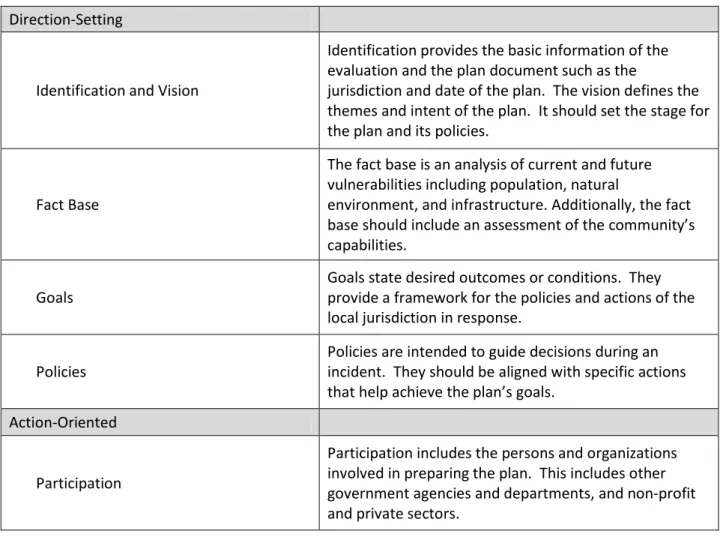
Berke has further brought the concepts of internal and external plan quality dimensions to life by redefining the principles as direction-setting or action-oriented.1 Direction-setting principles are the fundamental aspects of the plan that are driven by the alignment of community
vulnerabilities, capabilities, goals and actions. Action-oriented principles involve plan development (the planning process) and its use. Table 1 outlines the principles within each category based on plan quality literature by Berke & Godschalk (2009); Berke, Smith, & Lyles (2011); and Smith & Flatt (2011). I have explored the applicability of these principles in my research and will further analyze each principle as it relates to response plans in the Analysis
section.
Table 1: Plan Quality Principles
Direction-Setting
Identification and Vision
Identification provides the basic information of the evaluation and the plan document such as the
jurisdiction and date of the plan. The vision defines the themes and intent of the plan. It should set the stage for the plan and its policies.
Fact Base
The fact base is an analysis of current and future vulnerabilities including population, natural
environment, and infrastructure. Additionally, the fact base should include an assessment of the community’s capabilities.
Goals
Goals state desired outcomes or conditions. They provide a framework for the policies and actions of the local jurisdiction in response.
Policies
Policies are intended to guide decisions during an incident. They should be aligned with specific actions that help achieve the plan’s goals.
Action-Oriented
Participation
Participation includes the persons and organizations involved in preparing the plan. This includes other government agencies and departments, and non-profit and private sectors.
1
5 Inter-organizational Coordination
Inter-organizational Coordination is the horizontal and vertical integration of organizations involved in response. This includes organizations on a horizontal axis such as government entities, neighboring
jurisdictions, private sector, non-profit sector, and community organizations and on a vertical axis such as state or federal agencies. In addition, this section includes the alignment of policies and plans across emergency management sectors (hazard mitigation, preparedness, and recovery) and at the federal and state levels.
Implementation
Implementation involves executing the policies and actions outlined in the plan. This is measured through the identification of resources and roles and
responsibilities of different organizations and persons in response. Implementation also includes plan clarity which is measured by the organization and presentation of the plan document.
Monitoring and Evaluation
Monitoring and Evaluation involves exercising or testing the plan to assess the effectiveness and feasibility of response policies. It also includes updating the plan based on changes in the fact base or goals and feedback from exercises or a real-life incident. Furthermore, it involves identifying those responsible for monitoring, evaluating, and updating the plan to increase
accountability in maintaining an accurate and reliable plan document.
As mentioned, the principles defined in Table 1 have been derived from land use planning practices. A disconnect often exists between emergency management and land use planning. Land use planners have tools, methods, and processes that have been refined and shaped overtime, but they are often overlooked when developing emergency plans. This relationship can be improved through collaborative planning practices (Pine, 2009). My research also shows how the field of emergency management can learn from land use planning in developing higher quality plans.
ADDRESSING PLAN QUALITY IN RESPONSE PLANS
6
been done before. In order to develop a sound tool, my research draws on the plan quality literature as well as national response policies and programs.
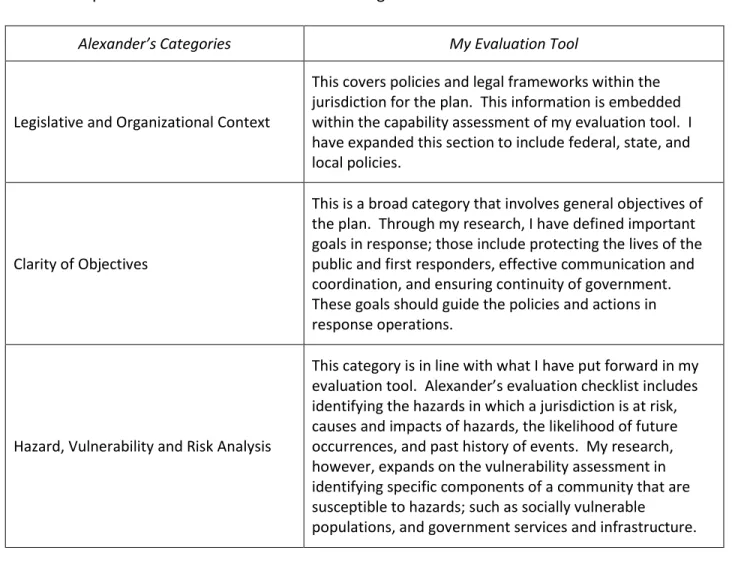
Perry & Lindell (2003) synthesize previous response planning literature in providing guidelines for the response planning process. They argue that practitioners should focus on the planning process, and not simply the plan itself. While my research focuses on the plan document, an evaluation of the planning process is embedded within the principles listed in Table 1 and thus the evaluation tool. Alexander (2005) developed a list of standards for an emergency planning evaluative approach and, based on his criteria, created a list of categories to evaluate the quality of emergency plans (see Appendix C for a description of the standards and categories). My evaluation tool is grounded in Alexander’s proposed standards and principles, but I have further expanded upon his ideas. For example, he argues that the plan must be grounded in research, including the future impacts of hazards and a full audit of capabilities. My evaluation tool expands upon this concept in the Fact Base section by listing specific indicators for a jurisdiction to include in their plan (such as the exposure of socially vulnerable populations and critical infrastructure to hazards). Table 2 outlines the categories in which Alexander developed a checklist to evaluate response plans and how my evaluation tool has built on his research.
Table 2: Expansion of Alexander’s Evaluation Categories
Alexander’s Categories My Evaluation Tool
Legislative and Organizational Context
This covers policies and legal frameworks within the jurisdiction for the plan. This information is embedded within the capability assessmentof my evaluation tool. I have expanded this section to include federal, state, and local policies.
Clarity of Objectives
This is a broad category that involves general objectives of the plan. Through my research, I have defined important goals in response; those include protecting the lives of the public and first responders, effective communication and coordination, and ensuring continuity of government. These goals should guide the policies and actions in response operations.
Hazard, Vulnerability and Risk Analysis
This category is in line with what I have put forward in my evaluation tool. Alexander’s evaluation checklist includes identifying the hazards in which a jurisdiction is at risk, causes and impacts of hazards, the likelihood of future occurrences, and past history of events. My research, however, expands on the vulnerability assessment in identifying specific components of a community that are susceptible to hazards; such as socially vulnerable
7 Logistics
Logistics include command structures, resources,
communications systems, and other critical services. I have portrayed these elements as critical in the capability assessment and the policies section of my evaluation tool. Whereas the capability assessment identifies what the jurisdiction has available or has pre-determined as a need in response, the policies represent the immediate actions of the jurisdiction in response while using those capabilities. Understanding the capabilities will enable effective policies to be made in response, thus these critical logistics are addressed in both sections.
Recovery of Infrastructure and Basic Services (Plans for Specific Sectors)
The restoration of infrastructure and basic services is a critical policy issue in disaster response because it involves the transition from response to recovery. I have expanded this policy to also include transitional housing, reentry policies, and debris removal. In addition, throughout the evaluation tool, I address the coordination of different plans.
Arrangements
Alexander argues that plans need to be tested, updated, and disseminated appropriately. The Monitoring and Evaluation section of my evaluation tool addresses these elements, however I expand on this further to include more detailed information on exercises, plan evaluation, and updating protocols.
Alexander’s research begins to uncover critical elements that should be addressed in a response plan evaluation tool. As discussed in Table 2, my response plan evaluation tool is more comprehensive, but uses Alexander’s research as a foundation.
The federal government has taken some steps to improve and evaluate response plan quality. As mentioned, FEMA doctrine such as the Comprehensive Preparedness Guide 101 has
8
plan can adapt to different incidents, and an accurate identification of available and required resources. My evaluation tool is grounded in these concepts. However, I wanted to create a tool that would provide a more detailed outline of the measures in which a plan should be evaluated.
Moreover, a second review of response plans was completed by the Department of Homeland Security in 2010 (the first review was in 2006). The Nationwide Plan Review covered all states’ and 75 major cities’ emergency operation plans (response plans) and involved two steps: a self-assessment by the state or city and an self-assessment by FEMA regions. The evaluation tool was based on CPG 101. The evaluation asked if different sections of the plan met CPG 101 criteria (“yes” or “no”); those sections include the basic plan, functional appendices (such as warning, health and medical, and recovery), and hazard-specific annexes. However, the CPG 101 criteria are not clear. The questionnaire then asks, on a five point scale, if the plan is adequate,
feasible, or complete. The Nationwide Plan Review is the only response plan review completed at the federal level in which state and local response plans have been measured. The review was comprehensive in that it evaluated plans across the nation and covers critical topics, however, the criteria was unclear, the questions were subjective in nature, and the data could easily be skewed based on the evaluator. My evaluation tool provides specific indicators of those items that a plan should include. I believe that this helps to measure plan quality more objectively and provides clear distinctions on how a plan can be improved.
The Emergency Management Accreditation Program (EMAP) is a non-profit, standard-based voluntary assessment and peer review accreditation process for government programs responsible for coordinating prevention, mitigation, preparedness, response, and recovery activities for natural and human-caused hazards. The EMAP accreditation process is nationally recognized, though few local jurisdictions and state governments have been certified.
Accreditation is based on compliance with a collaboratively developed national standard, titled the Emergency Management Standard. The Emergency Management Standard requires that response plans address plan purpose and scope, authority, situation and assumptions, roles and responsibilities, logistics and resources, concept of operations and plan maintenance. This information is similar to what is outlined in CPG 101. However, this is simply a list of topics to be included. The criteria do not address any specifics to adequately evaluate a response plan. As mentioned, the evaluation tool in which I developed expands on these topics and provides a more in depth look at what local governments should evaluate and depict in their response plans.
9
rather than a tool to evaluate the quality of the plan. However, I have used this literature as a foundation for my evaluation tool. Furthermore, Alexander’s research begins to identify necessary elements of a response plan, but I have taken it a step further, as I discuss in the
Methodology and Analysis sections.
METHODOLOGY
I have developed a tool that measures plan quality in local government emergency
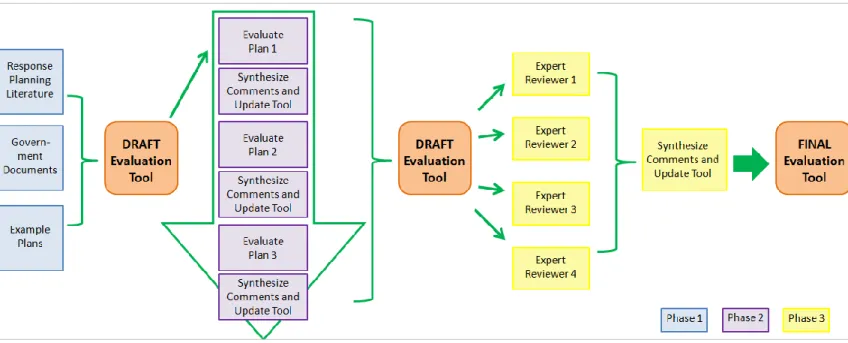
management response plans (see Appendix B). The measurement tool is framed using the plan quality principles described in Table 1. Specific indicators for each principle were developed through an iterative process of synthesizing literature, evaluating existing plans, and collecting expert feedback. Figure 1 depicts the process in which I developed the evaluation tool.
Figure 1: Methodology
10
My evaluation tool applies a research technique called content analysis. Content analysis is an established methodology used in multiple disciplines such as communications, journalism, and social sciences across a variety of means including newspapers and plans (Krippendorf, 2004). My research uses two scales to measure the content of a response plan; a 0 to 1 binary scale or a 0 to 2 ordinal scale. This measurement system has been used in previous plan quality studies (Berke, 1994; Berke, 1996; Berke & Godschalk, 2009; Berke et. al, 2011; Smith & Flatt, 2011). The binary scale is simple: a 0 indicates that the item is present in the plan while a 1 indicates that the item is not present. The ordinal scale involves marking a 0 if the item is not present, 1 if it is mentioned and 2 if the item is provided in detail (Smith & Flatt, 2011).
After the first draft was complete, I tested the evaluation tool on three North Carolina local government response plans. The purpose of using the evaluation tool on three plans was to test its applicability to local government emergency management response plans and its usability among potential evaluators. I used North Carolina plans for the review and testing phases, in part, because North Carolina is nationally recognized as a state with a strong emphasis on training local emergency managers. North Carolina also has frequent flooding, severe storms, and tornadoes and a diverse terrain; the eastern part of the state borders the ocean, the western part is in the mountains, and the central part is the more urbanized
piedmont region. In addition, as a graduate student at the University of North Carolina Chapel Hill, and one that has reached out to the state’s emergency management community while working in the Department of Homeland Security Center of Excellence – Coastal Hazard Center, it has been easier to obtain the plans necessary for my research.
The three plans I chose to test the evaluation tool include Hyde County, Watauga County, and Winston-Salem/Forsyth County. I chose these based on their differing locations throughout the state; Hyde County borders the ocean, Watauga County is in the mountains, and Winston-Salem/Forsyth County is located in the piedmont. I also chose Winston-Winston-Salem/Forsyth County because the City of Winston-Salem Emergency Management Department operates
collaboratively with Forsyth County. Moreover, Winston-Salem is one of the largest urban areas in the state.
I evaluated Hyde County first and then refined the tool based on that experience. I then used the updated tool to evaluate Watauga County and repeated the same process with the third plan. As I marked the indicators in the evaluation tool, I became more confident in the tool itself. After each plan, I developed a list of changes to the tool and items to think about when evaluating the following plan.
In the last phase, I asked four experts in the field to evaluate the tool. (Note: I received a determination from UNC’s Office of Human Research Ethics that my research does not require Institutional Review Board approval). I chose three practitioners with varied experience in the public and private sectors as well as one hazard scholar. The four expert reviewers included:
11 Ellis Stanley: Emergency manager with over 35 years of experience in local governments
including serving as the General Manager of the City of Los Angeles’ Emergency Preparedness Department.
Sandy Sanderson: Emergency Management Coordinator for Dare County, North Carolina.
Dr. David McEntire: Professor at the University of North Texas. His research and classroom teaching focuses on emergency management.
Appendix D includes detailed reviewer biographies, the guidance documents the reviewers received to prompt their feedback, and the reviewer comments on my evaluation tool. During this phase, I also completed an analysis of the tool to understand where concepts overlap and to remove redundancies throughout the evaluation tool (see Appendix 2 of the evaluation tool located in Appendix B). Improvements were made based on the expert feedback and my analysis of the tool, and the evaluation tool was finalized.
ANALYSIS: DEVELOPMENT OF THE PLAN QUALITY TOOL
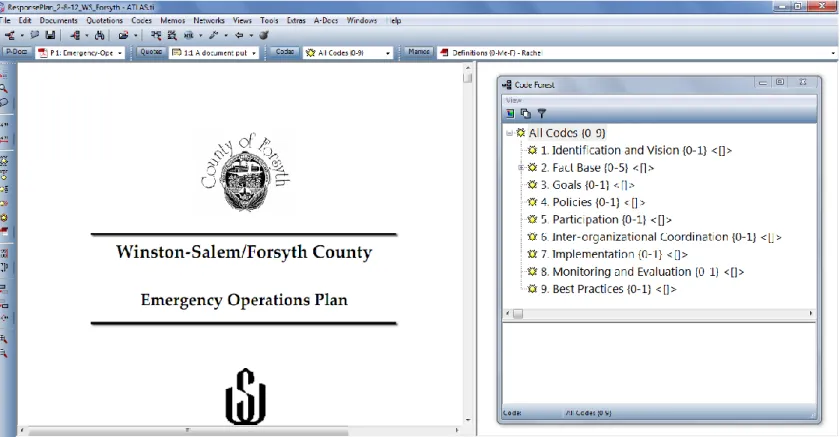
The complete response plan evaluation tool is located in Appendix B. The tool includes a section for each planning principle identified in Table 1. Principles include Identification and Vision, Fact Base, Goals, Policies, Participation, Inter-organizational Coordination,
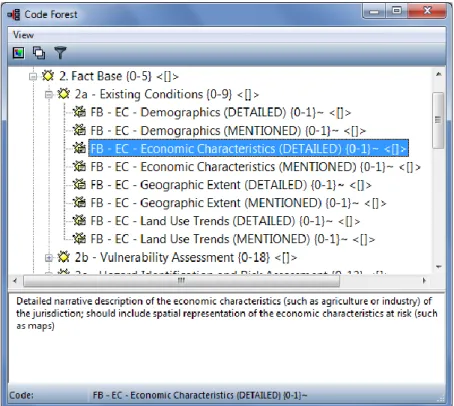
Implementation, and Monitoring and Evaluating. I added a final section for the evaluator to identify any best practices in the plan. The tool also includes general instructions for the plan evaluator, a definitions section to clarify the language used in plans, and a guide that provides information on the indicators that are located in more than one section. Each section has subsections and within those subsections are indicators. For example, Section 2: Fact Base has subsections 2.1 to 2.5. Subsection 2.1: Existing Conditions contains indicators such as
Geographic Extent, General Population and Economic Characteristics. The plan is evaluated based on the indicators present or not present in the plan.
12
The following sections provide an explanation for the specific indicators in the local government emergency management response plan evaluation tool.
D
IRECTION-S
ETTINGFACT BASE
The Fact Base represents foundational elements of the plan which includes the critical
information collected and analyzed on the jurisdiction’s current conditions and future threats. The response planning literature has described this information as ‘understanding the situation’ (FEMA CGP 101 & RPG, 2010) and these elements are typically addressed in the base plan section of an Emergency Operations Plan under ‘Situation.’
The Fact Base (as defined in the plan quality evaluation tool) is divided into four sections: existing conditions, vulnerability assessment, hazard identification and risk assessment, and capability assessment. Perry and Lindell (2003) argue that preparedness results from
understanding a community’s vulnerability to all types of disasters, the potential impacts, and the community’s capabilities to deploy resources for response and recovery. The Fact Base
expands upon these concepts and provides a more detailed list of the information in which a jurisdiction should assess.
Existing Conditions. Existing conditions is an assessment of the jurisdiction’s demographic, geographic, and economic characteristics. Demographic information should include the total population and annual growth rate, age distribution, median income, race and ethnicity. This section should also include a detailed description of the geographic areas affected by hazards. Including maps of those areas provides the jurisdiction with a greater understanding of what happens where, and who and what could be impacted.
The economic characteristics and land use trends of the jurisdiction should also be assessed. What types of industry are located in the community? Does the jurisdiction rely heavily on agriculture or manufacturing? A community also needs to understand the spatial components of population density, major highways and transportation routes, in addition to the location of new development and those areas that are more prone to disasters. This information will be critical in developing transportation, evacuation, and sheltering plans for response.
Vulnerability Assessment. The vulnerability assessment addresses specific components of a community that are susceptible to hazards. A significant concern for communities, and a
13
household pets and service animals. Animals that have been left during evacuations have caused major problems during and after an event (FEMA IS-10.a, 2010). Moreover, persons may not want to evacuate without their pets, thus sheltering should be arranged to
accommodate these persons (McEntire, 2007).
Beyond the population, the vulnerabilities of government services and infrastructure should be analyzed. Are the community’s sanitation and law enforcement services vulnerable to varying levels of disasters? How would critical facilities such as hospitals, bridges, schools, and
treatment plants be impacted? How would the water, sewer, electric power, and
telecommunications systems withstand an event? Furthermore, how does the vulnerability of these systems affect the ability of first responders to perform key response activities such as search and rescue, the delivery of water and food, and the provision of emergency shelter?
Hazard Identification and Risk Assessment. One of the most critical components is identifying the natural, technological, and manmade hazards in which a community is at risk. Those hazards could include flooding, hurricanes, earthquakes, tornadoes, winter storms, pandemic influenza, terrorist attacks, dam failure, and chemical spills. Pine (2009) defines risk as the product of the probability of occurrence and its consequences. A local government should, therefore, assess each identified hazard based on its likelihood of occurrence and the projected estimated impacts on its community (Pine, 2009). Hazards should be prioritized based on this risk assessment. Hazard identification and risk assessment enables the local government to assess the capabilities needed for response, actions taken to offset any cascading effects of the hazard (such as erosion, landslides, and dam or levee failure), and ensure public safety.
Capability Assessment. The capability assessment addresses the legal, administrative, and technical abilities of the local government (Smith, 2011) and the evaluation of existing state, federal, and national policies, programs, and laws and how they effect a local government’s ability to respond to a disaster. In the case of response, the capability assessment also involves the jurisdiction’s analysis of their available and required resources to respond efficiently and effectively in different disaster scenarios (FEMA Regional Planning Guide, 2011). Resources include budgetary allocations such as the general operations budget and reserve funds; equipment, vehicles, and supplies including communications equipment, sandbags, traffic barricades, and environmental monitoring equipment; emergency operations centers, assembly and staging areas, and other facilities; first responder units (police, fire, and emergency medical services) and the vehicles, personnel, and other capabilities of those units; and sheltering capabilities. Assessing the required versus available capabilities will provide a basis for the jurisdiction to determine the resource gaps. The resource gaps should be filled through mutual aid and pre-positioned agreements with other jurisdictions, private sector agencies, non-profit organizations, community organizations, or educational institutions.
14
State and federal governments are involved in response when a local government does not have the capacity to respond with its own resources. Funding, personnel (such as trained emergency response teams), and equipment may be requested from the state and federal government with the appropriate procedures. The jurisdiction should assess the programs and procedures in which it can receive funding prior to, during, or after a disaster. National policies and standards such as the Incident Command System, National Incident Management System, and the Emergency Management Accreditation Program (EMAP) are important to recognize because they provide information on the jurisdiction’s organization during response, their eligibility to apply for specific funding, and whether or not the jurisdiction meets nationally recognized standards.
VISION AND GOALS
For the purposes of this paper, the vision and goals are combined into one section because their explanation is similar. FEMA’s Comprehensive Preparedness Guide 101 states that plans should clearly identify a mission and goals. The mission, or vision, of a response plan should guide the overall response. That vision should be clear and concise and set the stage for the plan. Goals state the desired outcomes or conditions during and after an event. The
stakeholders involved in the planning process should develop the goals to provide a framework for the policies and actions of the local jurisdiction in response (Smith & Flatt, 2011). The goals listed in the evaluation tool progress from immediate response to the community’s transition to recovery and demobilizing response operations or returning back to normal operating
conditions. The response goals include protecting the lives and well being of the public and first responders, maintaining ample communications systems and internal and external
coordination, and collecting information continuously to perform assessments. Other goals include stabilizing the incident, protecting the environment, ensuring continuity of government, supporting transition to recovery, and demobilizing response operations.
POLICIES
The Fact Base, Vision and Goals are the foundational elements of the plan (Berke & Godschalk, 2009). The jurisdiction should collect information, complete an analysis on its current
conditions, potential threats, and projected impacts, and then develop a vision and goals for a positive, effective, and efficient response. Those sections should inform the Policies. The
15
framework for the policies in that the jurisdiction and should be prepared to target specific areas, socially vulnerable persons, or critical infrastructure.
The evaluation tool aligns the goals with the policies to encourage internal consistency in the plan document and provide a basis for the jurisdiction to achieve its goals. At least one policy should exist within each goal. The next several paragraphs describe policies that should be addressed in local government response plans.
Protecting and saving the lives of the public is typically the most important goal of a local government in responding to an incident. The safety and security of the public includes both physical and mental health policies such as evacuation and sheltering, medical care including feeding and hydration, search and rescue, disease prevention and control, and crisis counseling. Evacuation and sheltering should also include procedures for household pets and service
animals.
Efficient and effective communication is imperative during an emergency (FEMA National Preparedness Goal, 2011). Communication systems are used to effectively relay information to the public and emergency management personnel regarding any threat or hazard and, as appropriate, the actions being taken, and the assistance available. The messages should be clear, concise, and accessible to the whole community, including socially vulnerable populations such as persons who do not speak English (FEMA National Preparedness Goal, 2011). Local governments use public warning systems such as sirens, telephones, broadcast media, and emergency alert systems. The jurisdiction should also have procedures in place for emergency personnel to communicate with one another and the emergency operation center. Aside from verbal communication, field guides and checklists can be provided to personnel to ensure their duties are adequately performed. Furthermore, a jurisdiction should have policies in place to manage the media, including controlling rumors. The media can provide a positive outlet for local government during a disaster, however, it can also negatively impact the public if the wrong information is conveyed (Haddow, Bullock, & Coppola, 2008; McEntire, 2007).
Coordination is a critical element of response. For the purposes of my research, coordination includes both internally within the emergency management agency or jurisdiction and
externally to other levels of government and the private and non-profit sectors. Internal coordination involves designating who is in charge, how the operations centers are activated, and what is the command system to be used in response. During response, a jurisdiction needs to match urgent needs with appropriate resources. This can be done through managing the available resources and requesting resources from other jurisdictions, state or federal
governments (if the appropriate declaration protocols are in place), or private and non-profit sectors. Mutual aid and pre-positioned agreements should be made in advance to increase the possibility of acquiring necessary resources during and after an event (McEntire, 2007).
16
and where resources need to go. Continuously collecting the appropriate information will better inform decision-makers ultimately impacting the decisions made in the field during a response.
Emergency management agencies often indicate that response ends and recovery begins when the emergency operation center is deactivated. However, this transition is not necessarily that clear cut. Response plans should specify policies to support a successful transition to recovery. These policies should focus on enabling the community to restore basic services and
community functionality, including the restoration of energy and utilities, debris removal, and stabilizing transportation corridors. Furthermore, the response plan should address short term housing issues such as providing transitional housing and relocation assistance.
The Policies should answer the question: what needs to happen in order for an effective and efficient response operation to take place. While the policies need to be clear and detailed to minimize confusion during a disaster, they also need to be flexible and adaptable to allow for unforeseen contingencies.
A
CTIONO
RIENTEDPARTICIPATION
The planning process is as important as the plan itself and should be described in the plan document. Participation includes the persons and organizations involved in preparing the plan. Stakeholders play a significant role in plan development and implementation. The planning process includes coordinating resources and assigning roles and responsibilities to implement response policies. The appropriate stakeholder involvement will increase the local
government’s access to resources, buy-in of the plan, and better prepare those involved in implementation during response (FEMA CPG 101, 2010).
Participation should include representatives from local government agencies and departments such as emergency management, budget and finance, economic development, fire, police, higher education, emergency medical services, public health, public works, school district, social services, and transportation. State and Federal agencies such as the State and Federal
17
INTER-ORGANIZATIONAL COORDINATION
Inter-organizational Coordination is critical in response operations and thus should be reflected in any response plan (Perry & Lindell, 2003). For the purpose of my evaluation tool, I have defined inter-organizational coordination as the collaboration of efforts within the emergency management organization as well as those outside of the organization on both a horizontal and vertical axis. This phenomenon is typically called horizontal and vertical integration and has been applied to hazard mitigation (Berke, Smith, & Lyles, 2011) and disaster recovery (Smith & Flatt, 2011; Smith, 2011) plan quality studies.
Horizontal coordination refers to relationships across a horizontal axis; those include government entities, neighboring jurisdictions, private sector, non-profit sector, and
community organizations such as faith-based organizations or neighborhood groups (Berke, Smith, & Lyles, 2011; Smith 2011). Developing an understanding for shared resources through mutual aid or pre-positioned agreements will greatly benefit the region as a whole in
responding to a disaster. Neighboring jurisdictions, for example, can provide personnel and equipment to remove debris or restore energy and utility services. Non-profits such as the American Red Cross can have agreements with local governments to manage volunteers and donations. Furthermore, the local government should consider collaborating with these entities on developing emergency plans, training emergency personnel, and completing exercises to further increase community preparedness.
Vertical coordination refers to relationships to the jurisdiction on vertical scale; those include state or federal organizations (Berke, Smith, & Lyles, 2011; Smith & Flatt 2011). State and Federal Governments can provide necessary resources to local governments. Coordinating with State and Federal plans will enable the local government to comply with the appropriate
standards and procedures. In addition, the jurisdiction will have an understanding of the State and Federal Governments’ roles and responsibilities in response. The local government should also coordinate with state agencies such as the State Emergency Management Agency and State Department of Transportation and federal agencies such as FEMA, the National Guard, and the National Weather Service in response.
IMPLEMENTATION
18
National policies such as the National Response Framework (NRF) and Incident Command System (ICS) provide ways in which local communities can organize response efforts and designate responsibilities in their response plans. The NRF groups federal resources and capabilities into functional areas that are most frequently needed in responding to an event. These are referred to as Emergency Support Functions (ESFs). Examples include transportation, communications, emergency management, and public health and medical services. Some local jurisdictions have adopted this format to organize their resources and capabilities. Functional or Support Annexes are similar to ESFs and provide another way in which jurisdictions can organize their response operations. Lastly, the ICS is a standardized organizational structure that is intended to help coordinate response activities among responders. The ICS is divided into four sections (operations, planning, logistics, and administration/finance) and response plans may follow this format.
The evaluation tool recognizes that a jurisdiction will determine how to organize its response plan. The critical element is that the plan designates who is responsible for specific response operations. Furthermore, local governments should provide a list of responsibilities for specific persons such as the sheriff or police chief, emergency management coordinator, public works director, and public health director.
To implement a plan it must be clear and concise for its users. Plan clarity includes plan
contents such as an executive summary, table of contents, plan purpose, glossary of terms, and type of plan or approach (such as an all-hazards or capabilities-based approach). The
distribution and accessibility of the plan enables those responsible in response operations as well as the general public to be able to read the plan. Plan implementation also involves training administration and personnel, elected officials, first responders, the general public, and volunteer groups on the plan and its policies (Perry & Lindell, 2003).
MONITORING AND EVALUATION
Including procedures to monitor, evaluate, and update the plan will increase its applicability and use. Moreover, developing clear measures of plan implementation allow for the tracking of compliance over time. In the response planning field, exercising or testing a response plan ensures that roles and responsibilities are clear and concise, policies and procedures are effective, and shortfalls in capabilities are addressed. Exercises range from small scale drills to discussion-based procedures called tabletop exercises, and to more comprehensive and time intensive functional and full-scale exercises (Haddow, Bullock, & Coppola, 2008). Feedback and lessons learned from these exercises should be incorporated into the plan.
In addition to completing exercises, a plan should have procedures in place to evaluate its progress over time. Changes in a community’s threats to hazards, vulnerabilities, and
19
the response plan should be updated after a disaster. The event will enable the local
government to evaluate its response operations during a real-life situation and provide valuable feedback to the response plan. Monitoring and Evaluation bring the plan to life, making it a dynamic document that does not collect dust on a shelf.
ISSUES AND LIMITATIONS
Developing an evaluation tool to measure the quality of local government emergency
management response plans presents a number of issues and challenges. To begin with, the quality of the plan document does not necessarily indicate a high or low success rate in response operations as the tool has not been used to assess the relationship between plan quality and the quality of response operations (a potential area of future study). A number of factors contribute to a successful response and a single assessment of a jurisdiction’s response plan may not adequately reflect all of these elements during a real-life incident. For example, a community may have a detailed plan, but no capacity to implement the policies. Or a
community may not have a written plan, but due to strong leadership and cooperation it may be more resilient and able to adapt during a disaster. However, this evaluation tool is designed to include all aspects of response. The tool evaluates whether response plans include
participants in the planning process, roles and responsibilities in implementation,
inter-organizational coordination, and protocols to exercise and update the plans. These elements, along with policies that are grounded in the fact base, all have an impact on the success of response and should be included in the plan document.
A second issue with the evaluation tool is the weighting of indicators. As mentioned in the
Methodology section, my tool uses binary and ordinal scales. While the scaling may imply that each item is of equal weight, this is not the case. However, as discussed in the Next Steps and Future Directions section, more empirical data (such as example response plans) and resources would be required to develop a scale that would adequately prioritize the critical elements in a response plan. I chose to simplify my approach to avoid random or arbitrary decision making in creating the tool. The use of these two scales has been successful in previous plan quality studies and it serves the purposes of this evaluation tool. In addition, practitioners will use this evaluation tool as a checklist to measure the quality of their own plans. The equal weighting enables the tool to provide a comprehensive set of indicators which will help practitioners understand the strengths and shortfalls of their response plans.
In scoring the indicators it also appears that the absence of an item would indicate that the plan is of poor quality. While in many cases this may in fact be true, this is not always the case. Each section needs to be reviewed as a whole because some items relate to one another. For
20
plan is of poor quality since the plan indicated that a vulnerability assessment was completed in another plan (the same is true for the Hazard Identification and Risk Assessment section). The question then becomes, is the referenced information used to guide the development of appropriate response policies? And are those assigned this task held accountable as part of a rigorous monitoring and implementation process? In addition, the community’s assets need to be taken into consideration. For example, a community might not be eligible for an Urban Areas Security Initiative grant from the federal government and therefore would not receive a score for that indicator.
Through my research I uncovered the complexities of developing an evaluation tool for local government response plans. I developed my tool based on the principles derived from planning practice. The specific indicators in the evaluation tool were developed through a synthesis of response planning literature, evaluation plans, and expert input. This was successful for the purposes of my research. However, I have considered other ways to organize a response plan evaluation tool if given the time and resources to continue this further. The first would include developing an evaluation tool based on the traditional organization of Emergency Operations Plans (as described in the Literature Review section). I would develop the tool to include sections for each part of the plan - the Base Plan, ESF Annexes, Support Annexes, and Hazard Specific Annexes. The same indicators would be used, but some would be repeated in each section and others would be section specific (such as certain policies). Another way in which a tool could be organized would require more empirical data and resources to define the most important components of a response plan. This approach would be more concise and succinct, focusing on critical elements that should be addressed rather than a comprehensive list of indicators.
NEXT STEPS AND FUTURE DIRECTIONS
The purpose of the response plan evaluation tool is to better inform researchers, practitioners, and policy makers as to what constitutes a high quality response plan. I intentionally developed a comprehensive tool that includes the development, implementation, and revision of the plan document itself in addition to critical response policies. All aspects of response planning are included to broaden the scope of the tool’s potential. The following sections outline future research opportunities and practical applications of the evaluation tool and my research.
RESEARCH
21
to the field in that the results would capture the weaknesses and strengths in response plans across a geographic region and allow for statistical inferences across identified variables. Using the tool in this manner requires an appropriate research design and the training of individuals responsible for plan coding.
As mentioned in the Methodology section, the tool uses a binary and ordinal scale which has been used in previous plan quality studies (Berke, 1994; Berke, 1996; Berke & Godschalk, 2009; Berke et. al, 2011; Smith & Flatt, 2011) to objectively analyze the plan’s content. The
researcher will need to determine how to best reconcile the data. In previous plan quality studies, the results from the ordinal scale were either collapsed to a 0 to 1 scale (Smith & Flatt, 2011) or the items on the binary scale were doubled (Berke et. al, 2011). Both studies resulted in an equal weighting of all the indicators. Statistical analysis (such as mean, standard
deviation, t-test, analysis of variance or ANOVA) can be used to compare the data across jurisdictions (Berke & Godschalk, 2009).
To increase the reliability of the plan quality assessment, the study should be designed for two persons to evaluate each plan. With a sufficient number of persons involved in the study, plans can be evaluated with different sets of evaluators to reduce evaluator bias. Training should include the use of the tool on a few plans to increase the evaluators’ familiarity and clarify questions or concerns with the tool. Each plan should be reviewed independently by the evaluators. The evaluators will then meet to discuss their individual evaluation and create a reconciled evaluation score. An intercoder reliability score should be calculated to understand the percent of agreed upon indicators between the evaluators. Intercoder reliability is a measure of agreement in how the coders evaluate the plan. This percentage helps to validate the analysis because if the evaluators understood the response plan indicators in the tool, the evaluation of the plan would be similar from both persons. Intercoder reliability has ranged from 70 to 97 percent in plan quality studies. Measuring intercoder reliability is critical to the validity of the data generated by the content analysis (Berke & Godschalk, 2009).
I have provided some tools to help guide future evaluators. The introduction sections of the tool (see Appendix B) outline the purpose and organization of the tool and general instructions. In addition, the evaluation tool includes a comprehensive definitions section and a guide which provides information on the indicators that are located in more than one section. This paper can also be used to provide background information and context to the tool.
22
A research study using this evaluation tool would uncover shortfalls in response planning in addition to best practices. Research may indicate that descriptions of the existing conditions or vulnerability assessments may lack depth. In addition, research may imply that policies are not informed by the fact base. Best practices are methods or techniques that are considered to be exemplary practice in emergency management. Researchers may uncover best practices within the response plans, such as exercising practices. Scholars can also use the results from a
content analysis study for further research on the causes of plan quality (such as local capacity or state mandates) and effects of plan quality on response operations or other outcomes (Berke & Godschalk, 2009). As disasters become more frequent and severe, this research could have major implications for policy development at all levels of government and emergency
management practitioners.
POLICY AND PRACTICE
The primary goal of this project is to better connect research to practice by providing a useful tool for local governments to evaluate their response plans and a tool that can be used to conduct future research.
As described in the Methodology section, I used the tool to evaluate three plans. While the purpose of evaluating the plans was to improve the tool itself, I did find three areas which could be further improved in local response plans, including:
The planning process: Elements of the planning process were not included. Including the persons that participated in plan development and information on the process itself can increase buy-in and use of the response plan. Furthermore, collaborating with stakeholders from different sectors will increase the jurisdiction’s capabilities in providing access to various resources. In addition, bringing stakeholders to the table encourages the concept of shared responsibility in response operations. As mentioned in the Literature Review, emergency management practitioners should collaborate with land use planners in the emergency planning process. Land use planners can take an active role in the process by gathering critical information, analyzing spatial data, engaging stakeholders, and developing action-oriented policies (Pine, 2009).
Situational information: The Fact Base lacked depth. A jurisdiction needs to understand its risks and the capabilities and policies it needs for an efficient and effective response. This should be reflected in the plan document.
Alignment of the goals and policies: Alignment of a clear vision, goals, and policies did not exist in the plans reviewed. This alignment can influence the success of response operations.
While local government response plans are typically operations based (referred to as
23
may be true in practice, I would argue that the written plan needs to be more dynamic to stay relevant and active. Including planning elements in response plans would increase its usability, accuracy, and consistency; this includes documenting stakeholders in the planning process, aligning goals to effective response policies, exercising the plans, and providing responsible parties for implementing policies and updating the plans.
The tool can also impact policymakers and practitioners at the state level. While the evaluation tool is exhaustive, it does outline specific sections that should be addressed in plans. States should consider implementing policies that require certain information to be included in response plans. The State of Florida’s emergency management law mandates that the state have an emergency plan that addresses specific sections, including evacuation, sheltering, coordinated deployment of resources, communications and warning systems, and guidelines and schedules for exercises. The Florida law requires that all counties and municipalities with emergency management programs have emergency management plans that are consistent and coordinated with Florida’s State plan. Florida, however, is ahead of the curve and other states can learn from its practices. From my analysis, I would propose that states consider adopting policies that require the following information in state or local response plans:
Vulnerability assessment that identifies threats and impacts of all hazards on the geographic area, physical environment, and population, specifically socially vulnerable populations;
Capabilities assessment of available and required resources available to use during an emergency (facilities, equipment, supplies, personnel) and identify resource gaps and solutions through strategic planning and intergovernmental coordination;
A clear connection between the fact base and adoption of specific policies;
Roles and responsibilities of agencies and organizations involved in a disaster including governmental, non-profit, private, and community organizations;
Evacuation and shelter plans to protect the population;
Communications and warning systems for the emergency operations center, responders, and the public;
Connection between disaster response and recovery to ensure that recovery actions are initiated while response is in progress;
Plans to exercise the emergency management plan to test its functionality; and
Procedures to continuously update the plan.
North Carolina is also well-respected for its Division of Emergency Management (NCDEM). Currently North Carolina State law does not require local governments to have emergency response plans, however it does give NCDEM the authority to review local plans biennially and provide State financial assistance to local plans that meet State standards. NCDEM’s standards are measured using a checklist that was developed from the FEMA’s Comprehensive
24
My evaluation tool can also be used to better inform national standards and policies. As mentioned in the Literature Review section, the National Response Framework, Nationwide Plan Review, and Emergency Management Accreditation Program Standards provide
frameworks and general criteria for local and state response plans. However, they are not comprehensive. My findings can educate policy makers on ways to improve response plan criteria and evaluation standards, adding detail to their broad categories. Furthermore, this research could influence state and federal policies to provide pre-event support to local governments to develop higher quality local response plans.
F
INALT
HOUGHTSThe increasing frequency and severity of disasters continue to cause physical, social, and economic impacts to our local communities. Local governments have an obligation to protect the health, safety, and welfare of the public. They need to be fully prepared for any disaster by developing high quality emergency response plans. Good planning can help increase a local government’s capabilities to respond efficiently and effectively to a disaster. Currently, an evaluation tool that determines the quality of local government response plans does not exist. My research is intended to fill this gap. The tool has been developed using response plan literature, existing plans, and expert feedback. It will help improve response plans across jurisdictions and could have major implications for emergency management policies at all levels of government, furthering the development of standards, requirements, and funding
25
APPENDIX A:
R
EFERENCESB
YT
OPIC
GOVERNMENT DOCUMENTS
Dare County, North Carolina. (2007). Dare County Emergency Operations Plan.
Department of Homeland Security. (2011). National Preparedness Goal, First Edition. Washington, D.C.: U.S. Department of Homeland Security.
Federal Emergency Management Agency. (2010). Comprehensive Preparedness Guide 101: Developing and Maintaining Emergency Operations Plans (Version 2.0). Washington, D.C.: U.S. Department of Homeland Security.
Federal Emergency Management Agency. (2011). FEMA Strategic Plan: Fiscal Years 2011-2014
(FEMA Publication P-806). Washington, D.C.: U.S. Department of Homeland Security.
Federal Emergency Management Agency. (2010). Independent Study 10.a - Animals in Disasters: Awareness and Preparedness. Washington, D.C.: U.S. Department of Homeland Security.
Federal Emergency Management Agency. (2008). National Response Framework (FEMA Publication P-862). Washington, D.C.: U.S. Department of Homeland Security.
Federal Emergency Management Agency. (2010). Nationwide Plan Review: Fiscal Year 2010 Report to Congress. Washington, D.C.: U.S. Department of Homeland Security.
Federal Emergency Management Agency. (2011). Regional Planning Guide, Second Edition Draft. Washington, D.C.: U.S. Department of Homeland Security.
Hyde County, North Carolina. (2004). Hyde County Emergency Operations Plan and Emergency Guidelines.
Jenkins, W.O. (2010). Disaster Response: Criteria for Developing and Validating Effective Response Plans (GAO-10-969T). Washington, D.C.: U.S. Government Accountability Office.
North Carolina Division of Emergency Management. North Carolina Emergency Management Central Branch: EOP Review.
The White House. (2011). Presidential Policy Directive/PPD-8. Washington, D.C.: Barack Obama.
26
Winston-Salem/Forsyth County, North Carolina. (2006). Winston-Salem/Forsyth County Emergency Operations Plan.
PLAN QUALITY
Baer, W.C. (1997). General plan evaluation criteria: An approach to making better plans.
Journal of the American Planning Association, 63 (3): 329 – 45.
Berke, P. (1996). Enhancing Plan Quality: Evaluating the Role of State Planning Mandates for Natural Hazard Mitigation. Journal of Environmental Planning and Management. 39:1, 79-96.
Berke, P. (1994). Evaluating environmental plan quality: the case of planning for sustainable development in New Zealand. Journal of Environmental Planning and Management.
37:2, 155-169.
Berke, P. & Godschalk, D. (2009). Searching for the Good Plan: A Meta-Analysis of Plan Quality Studies. Journal of Planning Literature, 2 (3); 227-240.
Berke, P., Godschalk, D., Kaiser, E., & Rodriguez, D. (2006). Urban Land Use Planning 5th Edition.
Urbana and Chicago: University of Illinois Press.
Berke, P., Smith, G., & Lyles, W. (2011). Planning for Resiliency: An Evaluation of State Hazard Mitigation Plans under the Disaster Mitigation Act. (accepted Natural Hazards Review).
Smith, G. (2011). Planning for Post-Disaster Recovery: A Review of the United States Disaster Assistance Framework. Washington, D.C.: Island Press.
Smith, G. & Flatt, V. (2011). Assessing the Disaster Recovery Planning Capacity of the State of North Carolina. Research Brief. Durham, North Carolina. Institute for Homeland Security Solutions.
RESPONSE PLANNING
Alexander, D. (2005). Towards the development of a standard in emergency planning. Disaster Prevention and Management, 14 (2), 158-175.
Auf der Heide, E. (1989). Disaster Response: Principles of Preparation and Coordination. St. Louis, Missouri: the C.V. Mosby Company.
27 Programs. Hoboken, N.J.: John Wiley & Sons, Inc.
Emergency Management Accreditation Program. (2010). Emergency Management Standard. Lexington, KY: Emergency Management Accreditation Program.
McEntire, D.A. (2007). Disaster Response and Recovery. United States: John Wiley & Sons, Inc.
Haddow, G. D., Bullock, J. & Coppola, D. (2008). Introduction to Emergency Management, 3rd Edition. Oxford, UK: Elsevier Inc.
Perry, R.W. & Lindell, M.K. (2007). Emergency Planning. United States: John Wiley & Sons, Inc.
Perry, R.W. & Lindell, M.K. (2003). Preparedness for Emergency Response: Guidelines for the Emergency Planning Process. Disasters, 27 (4), 336-350.
Pine, J. C. (2009). Natural Hazard Analysis: Reducing the Impact of Disasters. Boca Raton, F.L.: Taylor & Francis Group.
Smith, G. (2009). Chapter 9: Planning for Sustainable and Disaster Resilient Communities.
Natural Hazard Analysis: Reducing the Impact of Disasters. Boca Raton, F.L.: Taylor & Francis Group.
Smith, G. and Flatt, V. (2011). Assessing the Disaster Recovery Planning Capacity of the State of North Carolina. Research Brief. Durham, North Carolina. Institute for Homeland Security Solutions.
Smith, G. (2011). Planning for Recovery: A Review of the United States Disaster Assistance Framework. Washington, D.C.: Island Press.
Tierney, K.J., Lindell, M.K., & Perry, R.W. (2001). Facing the Unexpected: Disaster
Preparedness and Response in the United States. Washington, D.C.: Joseph Henry Press.
28
P
LAN
Q
UALITY
E
VALUATION
T
OOL FOR
L
OCAL
G
OVERNMENT
E
MERGENCY
M
ANAGEMENT
R
ESPONSE
P
LANS
B
YR
ACHELM
EYERSONMCRP/MPA
C
ANDIDATE2012
T
HEU
NIVERSITY OFN
ORTHC
AROLINA ATC
HAPELH
ILLT
ABLE OFC
ONTENTSPurpose and Organization of the Plan Quality Evaluation Tool ... 31
General Instructions for the Plan Evaluator ... 33
Plan Quality Evaluation Tool ... 34
Section 1: Identification and Vision ... 34 Section 2: Fact Base ... 36 Section 3: Goals ... 49 Section 4: Policies ... 50 Section 5: Participation ... 64 Section 6: Inter-organizational Coordination ... 69 Section 7: Implementation ... 77 Section 8: Monitor and Evaluation ... 93 Section 9: Best Practices ... 98
Appendix A: Definitions ... 99
P
URPOSE ANDO
RGANIZATION OF THEP
LANQ
UALITYE
VALUATIONT
OOLThe purpose of this document is to evaluate the content of local government emergency management response plans and inform emergency managers about new ideas and best practices.
The absence of an item does not indicate that the plan is of poor quality. Each section needs to be reviewed as a whole because some items relate to one another. For example, in the Vulnerability Assessment section under Section 2: Fact Base, one indicator reads “Plan references mitigation plan or other relevant resource for a detailed vulnerability assessment.” If the plan does reference another resource that has a detailed vulnerability assessment then the vulnerabilities may not be discussed in the plan at all. The fact that the vulnerability assessment is absent from the plan is not important and does not indicate that this plan is of poor quality since the plan indicated that a vulnerability assessment was completed in another plan (the same is true for the Hazard
Identification and Assessment section). In addition, the community’s assets need to be taken into consideration. For example, a community might not be eligible for an Urban Areas Security Initiative grant from the federal government and therefore would not receive a score for that indicator.
The plan is divided into nine sections. Sections 1 through 8 are defined by the following planning principles: Identification and Vision, Fact Base, Goals, Policies, Participation, Inter-organizational Coordination, Implementation, and Monitoring and Evaluation as defined below:
Identification and Vision – Identification provides the basic information of the evaluation and the plan document such as the jurisdiction and date of the plan. The vision defines the themes and intent of the plan. It should set the stage for the plan and its policies.
Fact Base – an analysis of current and future vulnerabilities including population, natural environment, and infrastructure. Additionally, the fact base should include an assessment of the community’s capabilities.
Goals – state desired outcomes or conditions. They provide a framework for the policies and actions of the local jurisdiction in response.
Policies – intended to guide decisions during an incident. They should be aligned with specific actions that help achieve the plan’s goals.
Participation – includes the persons and organizations involved in preparing the plan. This includes other government agencies and departments, and non-profit and private sectors.