Hazel L Brown. Student Usage of Library Resources at One Academic Library. A Master’s Paper for the M.S. in L.S degree. April, 2004. 70 pages. Advisor: Deborah Barreau
Previous studies suggest that the library environment may influence patron usage. This study addresses the question of whether the environment in one library, the Walter Royal Davis Library at the University of North Carolina at Chapel Hill, influences whether and how students will use the library. Thirty students, two staff members, and two library design experts were interviewed. Students were asked about their usage and opinions of the library environment, staff members were asked about their knowledge of design decisions and their opinion on the success of the design, and library design experts were asked about optimal environmental conditions. Results suggest that the environment plays only a minor role in student usage of the library's resources, and that role is more likely to be positive than negative.
Headings:
College and University Libraries Use Studies
STUDENT USAGE OF LIBRARY RESOURCES AT ONE ACADEMIC LIBRARY
by Hazel L Brown
A Master’s paper submitted to the faculty of the School of Information and Library Science of the University of North Carolina at Chapel Hill
in partial fulfillment of the requirements for the degree of Master of Science in
Library Science.
Chapel Hill, North Carolina April 2004
Approved by
Table of Contents
Overview ... 2
Background ... 3
Studies of Library Environments ... 4
Library Usage Studies ... 7
Library Design... 12
Retail Environments ... 14
Environmental Design... 15
Methodology ... 16
The Environment of Davis Library ... 18
Background History ... 18
Description ... 21
Discussion of Results ... 32
Surveys ... 32
Interviews of Davis Staff... 51
Library Design Experts ... 52
Discussion ... 53
Limitations of Study... 55
Conclusions ... 57
Summary ... 61
References ... 62
Overview
A problem common to most academic libraries is not only how to make students aware of all the library resources available to them, but how to encourage the use of these resources. The library’s environment can affect students’ perceptions of the manner in which they believe they can use the library (Watson 2001:4), and therefore modification of the environment, in some cases, should lead to increased usage of library resources by students. The focus of this study is to determine whether the environment of Walter Royal Davis Library can be improved in order to facilitate student usage of the library.
The Walter Royal Davis Library (hereafter referred to as Davis Library) is the main library on the University of North Carolina’s Chapel Hill campus. It houses the university’s main general, humanities, and social sciences collections. The library encompasses more than 400,000 square feet. It has more than 2,500,000 volumes, 2,000,000 printed government documents, 3,000,000 microforms, and more than 1,000 electronic titles (University of North Carolina 2002).
Reference Desk
This project resulted from the large number of undergraduates telling the
researcher during casual conversations about their “bad” experiences in Davis Library. A significant number of undergraduates refused to set foot in the building. The researcher began to wonder what could be done to combat this negative perception of Davis Library. The main reasons for students not using libraries are typically unfamiliarity with the library, perceived quality of the collection, and the environment of the library (Simmonds & Andaleer 2001:630-633). Davis Library provides access to a vast array of resources, so student avoidance is unlikely due to the perceived quality of the collection. Since the environment can influence familiarity, the researcher decided that the environment of Davis Library warranted further investigation, as it could potentially play a role in student avoidance of the library and the inability of students to locate the library resources and services that they need.
Background
has written several books on how to evaluate libraries and library services, does not include evaluating environmental factors in his books, which highlights the fact that the environment of a library tends to be taken for granted in library literature. There has, however, been much written on library design. Unfortunately, this literature rarely addresses how the design of the library affects library usage. Also, much of the literature does not look at the library as a whole. Instead, it looks at various parts of the library, ignoring the interconnectedness that exists between the different parts of a library (Campbell & Schlechter 1979: 26).
This literature review will be broken into topical sections addressing studies of library environments, library usage studies, library design, environmental design, and retail environments. All these topics are important to understanding the potential role that the environment can play in influencing usage of libraries, and the review also highlights the importance and need for more research to be conducted in this area. In the literature review, relevant studies are described and analyzed, and in addition synopses of the content of relevant books are included.
Studies of Library Environments
David E. Campbell and Theodore M. Shlechter (1979) did the most
design of a library can influence user behavior and satisfaction. Most of the dislikes of the students, they found, dealt with the physical environment and library organization, while most of the favorable comments concerned the staff and materials. The behavioral map indicated that the floors and rooms near the main entrance were the most commonly used; probably due to that fact these areas are convenient and easily accessible. From a library planning viewpoint, central facilities should therefore be located near the
entrance. The conclusion they drew from the results was that the Watson Library was not a particularly successful library and, as a result, students spent relatively little time there. In their article, they point out that there is little in the way of detailed information as to why students use the library and whether rooms are used in the same manner that library planners had intended. This study was done in the late 1970’s, yet very little research of its kind has been done since then despite the apparent need.
although done only on one day, showed what parts of the library were being used and how. They did have students practice creating a behavioral map before conducting the one used in the study. The diaries were an innovative way to gather detailed information as to user satisfaction, movement throughout the library, and the resources being used, along with the thought processes of students as they moved through the library. The problem with the diaries in this study is that they were filled out by psychology students only. These students may be better at staying in touch with their thoughts; however, they are not representative of the student population. The biggest problem with this study is that it is out-of-date, being over twenty years old.
Another important study was done in 1993 by Jan Clee and Ruth Maguire, which specifically focused on the effects of the environment on library usage. Their
information technology that will make it necessary to provide more technology in libraries.
The methodology of the Clee and Maguire study is hard to analyze, since very little information is given about it. No information was given about sample size or how participants were chosen. Also, only three experts were consulted as to the future of libraries. As a result, the findings are difficult to validate.
Outside of these two studies, no other studies were found that have focused on the effects of the environment on student usage. There have been library usage studies that have confirmed that the environment plays a role in usage, but these studies have not sought to identify the factors or describe how these environmental factors influence usage. There is a need to find out more about the effects of the environment, especially as it is now becoming easier for students to do their research from their dorm rooms or homes. The library needs to be a comfortable place, otherwise students will decide to use alternative methods to gather the information that they need. Already academic librarians have begun to voice their concerns over students’ growing dependence on electronic resources, and student lack of understanding that some of the best sources that they could use for research are in print form (Lombardo & Condic 2001:327-337).
Library Usage Studies
students to use the library. Finally, the Lemuel Watson study examines the effect of students’ perceptions of the library on their educational outcomes.
Qun Jiao and Anthony J. Onwuegbuzie (1997) conducted a study on the
prevalence and reasons for university library usage. Jiao and Onwuegbuzie surveyed two universities, one in the mid-south and one in the northeast. Previous studies found that there were few differences in personal characteristics of users and non-users of the library. However, there was a positive relationship found between year of study and library use. The previous studies also found that a majority of students reported using the library at least once a week, and most students use the library as a place to study their textbooks and class notes. Jiao and Onwuegbuzie found that males tend to use the library more for studying, females are more likely to go to the library to obtain a book or article, and they found that libraries are used for a variety of purposes. They reported that 81.3% of students use the library at least once a week with a mean of 2.6 visits a week.
Obtaining a book or article is the most important reason for visiting the library, followed by studying for a test, using the online facilities, and reading a textbook. These four reasons for visiting the library were all cited by more than half of the participants. As obtaining a book or article was the main reason for using the library, Jiao and Onwuegbuzie concluded that the number of course assignments play a role in how frequently the library is visited. Academic achievement, semester course load, number of earned credit hours, computer usage experience, and employment status were found to have no significant influence on how frequently students use the library.
staff, affective barriers, comfort with the library, knowledge of the library, and
mechanical barriers. Jiao and Onwuegbuzie found a positive relationship between age and frequency of library visits, and attribute this to the fact that younger students have higher levels of anxiety regarding the library and middle-aged students do not. However, it was found that frequency of library use did not vary according to year of study. This differed from the results of similar studies that were reviewed. Jiao and Onwuegbuzie attribute this difference in findings to the comprehensiveness of projects assigned to students at all levels of instruction requiring use of the library in order to complete the assignment. Finally, Jiao and Onwuegbuzie found that the students with the highest levels of anxiety tended to use computerized indexes and library facilities more than students with low-level anxiety.
The study had a large sample size and surveyed two universities in different geographical regions. However, the survey was administered during a class period, and this means that the sampling was not random. They did take an interesting approach to examining usage by looking at the data from the Library Anxiety Scale and comparing it to the demographic information form that they had students complete. The demographic information form (DIF) contained questions not only about gender, grade level, where they live, etc., but also questions about how they used the library and how frequently. Though the LAS is an innovative approach to looking at usage, how anxiety correlated with the DIF information was barely discussed in the article.
materials available to clients, the amount of the use of services and resources, and the apparent or quantified satisfaction of clients. Very little research has taken into account the objectives of the client.” (Simmonds and Andaleer 2001:628). Simmonds and Andaleer surveyed 188 students from three different academic libraries in Erie,
Pennsylvania. They found that use of academic libraries is influenced most by a user’s familiarity with the library and its resources. Students who are more familiar with the library will use it more often. Also, the perceived quality of the library’s resources plays a large role in influencing usage. Library usage was also found to be influenced by the environment of the library, which includes such things as cleanliness, visual appeal, and the atmosphere of the library. An interesting trend that they observed was that access to the information provided in libraries is seen as more important than the materials
physically available in a library.
Though the study did have a good sample size, it was administered in the library, which did not allow the researchers access to those that do not use the library or use it often. Also, the surveys were administered over the course of a year. It is unclear if they were trying to see if patterns differed over the period or if it just took a long time. The surveys were pretested.
backgrounds and characteristic information, student perception of and experiences with the library environment, and students’ perceptions of how the library has increased their educational outcomes. The conclusions drawn from the study are that freshmen have a more neutral perception of the library and its effect on their educational outcomes, and that students who feel more comfortable with the library agree more that the library helps them with their academic work. Watson also found that if students dread using the
library, that this negative feeling has a negative effect on academic outcomes; students feel strongly that the library is a place to use technology, but do not correlate this function with their academic success or failure; and students perceive the library as a place to study and in this capacity correlate the library with their academic success. Watson states, “it is clear that the library ecology, design, and layout affect students’ perceptions of the manner in which they believe that they can utilize the library. As would be expected, those students who feel comfortable and self-confident with the library have greater educational outcomes” (Watson 2001: 4). He also indicates that there is a lack of research on the effect that the library environment has on students’
educational outcomes and gains.
Library Design
Lushington wrote two books on library design, Libraries Designed for Users: a 21st Century Guide and Libraries Designed for Users: A Planning Handbook, which take into account the various aspects of an environment of a library, but do not fully take the total environment into consideration. Rather, Lushington focuses on the individual aspects of the library. He states in his book that “properly designed graphics, furniture, lighting, and functional relationships can create a library environment we seek and avoid- inaccessible buildings and materials, long waits, put downs by staff, and bewilderment about where to go” (Lushington 1979:14). He makes the point that “libraries must be designed for the widest possible spectrum of taste, inquiry, and informational and cultural need, and provide assistance in utilizing materials in all formats” (Lushington 1979:12). Individuals use libraries, so libraries should be designed with the individual in mind. One of the major barriers to library use, according to Lushington, is the bad design of facilities and buildings due to faulty symbolization and visualization of what the library has to offer (Lushington 1979:12).
encourages behaviors suitable to a variety of activities, books that look attractive, and machines for use with media that work (Lushington 1979:14).
Philip Leighton and David Weber wrote a book on library planning called Planning Academic and Research Library Buildings. In this book they make the remark
about the environment that “reasonable personal comfort should be achieved by
conditions that enable the occupants to be unaware of such matters as air quality, drafts, lighting, glare, visual and auditory distractions, and chair and table configurations, and to use the library while being oblivious to the physical surroundings (Leighton & Weber 1999:134). Users want an inviting learning environment and will thrive in a library building that successfully meets all the needs of its users. Planning libraries, they acknowledge, is an important and complex undertaking, and no building is perfect (Leighton & Weber 1999:xvii).
Leighton and Weber also point out that the interior design of a library tends to be taken for granted (Leighton and Weber 1999:4). They listed the desired qualities of a library as inviting, stimulating, low-key, quiet, durable, pleasant, easy to maintain, vandal resistant, conducive to research and reading, and comfortable (Leighton and Weber 1999:135). The library is more than a book repository as it provides study places in an environment that is conducive to serious thought and learning, and is symbolic of the process of education (Leighton and Weber 1999:2).
the first few visits (Leighton and Weber 1999:453). Because of the complexities in designing a library, institutions should always be on the alert for opportunities to improve the physical conditions of the library (Leighton and Weber 1999:509).
Retail Environments
Paco Underhill wrote Why We Buy: The Science of Shopping, an interesting book that reviews how the environment of a store can impact retail sales by examining the science of shopping. Many of the environmental factors in stores that can negatively affect sales can also be applied to libraries, which is why this section was included. If shoppers do not feel comfortable, they are less likely to buy, so stores have a strong incentive to learn what it takes to make people comfortable. Underhill stresses the need for retailers to realize the physical limitations of the human body and the common behaviors of people. These limitations and common behaviors need to be taken into consideration when creating a retail environment. For example, people have a short attention span when it comes to reading signs. Signs, therefore, should be brief and the point. They also should be located at eye level or in places where they are easily seen.
Environmental Design
There has been much work done in the field of environmental design in order to determine what kinds of interactions occur between humans and the environment. In Environmental Design and Human Behavior: A Psychology of the Individual in Society, environmental design is defined as the planning of a coherent program and set of
procedures to effect the total human and nonhuman environment in ways that increase the probability that certain goals or “needs” will be achieved (Krasner 1980:3). The book stresses that in the study of environmental design, what is “involved is an interactive and continuous process in which individuals design and influence their physical environment and, in turn, the environment influences their behavior” (Krasner 1980:66). The book points out that it has been proven that the design of buildings has effects on human perception, cognition, emotions, and behavior (Krasner 1980:74). Traditionally, buildings have been evaluated on the basis of cost benefit calculations and their aesthetic
appearance. Also, design ideas are usually generated from functional and aesthetic concepts without regard to existing data that focus on human reactions to the “person-built” environment. It is essential, according to the book, to have a well-fitting physical environment that is adaptive to all the behaviors it supports. Another interesting point made is that what we perceive results from the assumptions we have learned to make while in a particular environment.
environmental factors that can affect student usage of library resources. This research seeks to identify environmental factors and assess their impact. From the information collected in this study, we may determine if the environment of Davis Library could be improved in order to facilitate student usage of library resources.
Methodology
In order to determine whether the environment of Davis library affects student usage of library resources, a telephone survey of 30 University of North Carolina at Chapel Hill students was conducted. This was supplemented by interviewing library design experts and the people involved in the planning of Davis Library to see if goals set when Davis Library was built have been reached and if the library is meeting its current goals in regards to the number of students using the library and the amount of resources being utilized by them.
eight. Some reasons for not being able to reach the 36 students may be that the students were not in very often over the five days period or, that they were screening calls with caller id and not answering calls from unknown callers.
The researcher chose to gather the information by doing a telephone survey versus a mailed survey because more qualitative information was desired. By talking to
participants, it was hoped that more could be learned about their experiences, since the participant was more likely to share stories and opinions during a telephone survey than if they had to write the answers down themselves. A balance between qualitative and
quantitative data was sought.
The survey can be broken down into three basic sections. One section seeks to determine whether the participant had ever used Davis Library, how often, and what they use while there. The second section asks participants about their opinions of the different environmental factors present in the library. Finally, the third section queries participants concerning likes/dislikes about Davis Library and how Davis Library compares to their ideal library. Before the survey was conducted, the survey was tested on five students to see if any of the questions needed to be clarified and/or areas needed to be revised. The pilot test of the survey was done face-to-face and not over the telephone. The information gathered from the surveys were analyzed for content and then for statistical significance via SPSS 11.
staff member was therefore able to answer why they chose that architectural design and interior design. The staff member was also able to answer whether the current design has met the goals that have been set forth for the library. Another staff member was
interviewed for feedback on whether the current design was successful.
The Environment of Davis Library
Background History
Understanding how the current design of Davis Library came into being is important because the planning and building of Davis Library parallels the problems that other libraries face when building a new library. It also highlights the fact that sometimes planners have good intentions of adding user-friendly features, but these never come to fruition because of limited funding or the need for compromise. This section is intended to explain how the current environment of Davis Library came into being.
The project of building a new central library at UNC-Chapel Hill was first requested and approved in 1977. The building was completed in 1983, and it opened on February 7, 1984. The money for building the library came from the university’s sale of the public utilities that it owned for $40 million. Walter Davis worked hard to ensure that most of the money from the sale was given to the university and not spread among the various campuses. The $30 million that Davis ensured for the university was used for three different projects: building a new central library, renovating Wilson Library, and building an addition to the Health Sciences Library (UNC Facility Information 2004).
For example, in Davis, they wanted to have a lot of closed carrels with outside exposure. This led to the creative design of having towers of closed carrels along the outside of one side of the building. Also, they wanted Davis to have large expansive stacks unlike Wilson library (the former main library), which due to its many additions, had stacks that were in broken up spaces (Davis Staff Interview 2004).
There were many state restrictions put on the building that affected its design. When Davis was being built there was concern about energy conservation. The lighting that they had to install in order to meet state regulations was not as good as they would have liked. Also, the stacks were required to be a certain distance apart due to state regulations. This state regulation is no longer in place, but extra shelving in the future cannot be added because the shelves are lined up with the lighting fixtures, making it impossible to shift the stacks closer together to add extra shelving (Davis Staff Interviews 2004).
The percentage of glass that can be on the outside of a building was also controlled by state regulations. This is why the windows in Davis Library tend to be small. Also, in the original plans there was to be a full basement. The current basement is about 70% of the size planned. Bedrock prevented the basement from being able to be built to its full dimensions (Davis Staff Interviews 2004).
constraints, they were not able to install the type of elevators they wanted. The budget problems were exacerbated by the fact that they had to contribute $7 million of their building funds to a chiller plant that was being built to benefit the campus (Davis Staff Interviews 2004).
The exterior design was influenced by the need for it to mesh well with the styles of the buildings in the surrounding area. For the most part, the surrounding buildings have very modern, boxy exteriors. A more historical looking building style would not have been possible for Davis Library due to the awkward size of the building site. The red brick of Davis Library matches the red brick in the adjacent dorms to the north and Lenoir Dining Hall to the west, and the limestone inserts in the brick match the color of the adjacent Student Union (to the south), the R.B. House Undergraduate Library, the Student Stores, and Wilson Library (all to the southwest)(UNC Facility Information 2004).
Mushroom Shaped Window
The building was designed so that the internal walls can be moved to create new spatial arrangement. The planners of Davis Library realized the importance of electronic media so the library was built with a conduit available throughout the building. This conduit would make future installations of computer terminals or other electronic equipment simpler (Davis Staff Interview 2004).
Description
Davis Library is on the southeastern side of campus and contains administrative offices, an acquisitions division, bibliographic services, bindery, mail, receiving, book repair, catalogue department, circulation, interlibrary operations, microfilm
support. Eighty seven percent of the space is used for studying and 5% is used for general use (UNC Facility Information 2004).
Davis Library is a massive building. The building actually looks as if two separate structures have been joined by a low addition (the reference wing and the main wing). The south face of the building has eight study towers that bulge out from the main outside wall at intervals. These towers house all the closed carrels in the library. By having these towers, there is more wall space for studies with windows. On the east face of the
building, the architects devised another way to provide areas for study rooms by having this face of the building fold in to create a court lined with faculty studies with windows. There are also two other towers that are attached to outside wall of Davis Library. There are two study lounges at diagonally opposite corners of each floor that are connected to the floor via passageways. One tower of study lounges is located at the southwest end, and other the northwest end. From the outside the study lounges appear to house balconies because the large windows are glimpsed through brick frames (UNC Facility Information 2004).
The architects were trying to give the building an urban kind of feel, which is why there is a walkway under the towers on the entrance side called “framework openings” by the architects. These framework openings are two stories high and also give the
impression that the building is lower because the two stories are read by the eye as being only one story. Under the framework openings are department store windows that are suppose to give the library some downtown espirit (UNC Facility Information 2004).
The reference wing has another architectural feature beside the mushroom
that are enclosed in glass. These balconies are on the east side of the building (UNC Facility Information 2004). There is white framing between the panes of glass enclosing the balconies.
here is only one entrance into Davis Library, and it is a glass entrance that has doors that open automatically. In the entrance room to the left are more windows that go from floor to ceiling and there is a large plant. To the right are wire rack stands
containing informational packets, a freestanding bulletin board, and another large plant. Directly in front is a changing exhibit display case. It has glass on both sides, so one can see through to the circulation area on the other side of the glass. To enter the library one heads right to go through another set of automatic doors. Directly as one enters there is a display case showing what types of food and drink containers are and are not allowed, along with a computer screen announcing any events happening that day at the library. Beyond that is the staircase leading up to the second floor.
Circulation Desk
Immediately to the right of the entrance is the periodicals reading room. The room is carpeted in a light green. The stacks for the current periodicals are all wooden. The room contains a mixture of study carrels, tables and chairs, and blue upholstered
furniture. The two sides along the outside of the building have two story high windows. The tables have desk lamps. The room has a lot of natural light due to the large windows, but it is also lit by spotlights on the ceiling and by long narrow lights hanging from the ceiling with the light focused upwards.
Moving straight forward from the entrance one sees the stairs leading up to the second floor. To the left are the elevator banks and to the right the information commons area. There are a total of five elevators and all the elevators are located together. The elevators have brown doors and there is a floor directory located between two of the elevators. The information commons has the same green carpeting as the periodicals reading room. There are approximately 90 computers available to students to search the Internet, but there is no printing. Most of the computers are in carrels that are lined up, but several are arranged in a circle. Some of the chairs are wooden, while others are upholstered office chairs. Support poles are the only separators between the hall and the information commons area.
Information Commons
facing the reference area, the reference desk is directly to the right, and the reference desk is visible from the entrance. The desk is made of blonde wood and behind the desk is the entrance to the reference staff area where materials are processed. Directly to the left when facing the reference area are offices for some of the reference staff. There are about 50 computers in the reference area, and there are tables and chairs interspersed between rows of stacks, and the stacks are all wooden. Most of the tables have desk lamps. The shape of the reference area is rectangular, with most of the stacks located in the middle, but there are stacks lining the periphery. The reference area has a double vaulted ceiling that is reminiscent of the reading room in the Bibliothque Saint Genevine, 1850. The vaults are in segments hung from a gable roof with dormers inserted between the segments. There are also huge picture windows at each end of the wing, each framed outside by a freestanding arch. The arch is three feet thick and the arches are located three feet away from the exterior walls. These types of arches appear elsewhere on campus, either in windows or brick, and there is a matching arch in the new art building (Alcott 1986:86-87).
Back in the gallery, if one looks up, the ceiling goes up three stories and there are ten colorful banners hanging from the ceiling. The banners show printer/publisher devices (i.e. trademarks). Farther down the hall are the bathrooms on the left, and offices and a photocopy machine on the right. At the end of the gallery is a three story high window with two large plants in front of it along with brown vinyl chairs.
Gallery Banners
The second floor is a very unusual in shape due to the fact that several areas on the first floor have ceilings that are up two or three floors. It does make the second floor feel very open because one can look down on the periodicals reading room, the gallery, and the reference area. The area near the stairs and the bank of elevators has blue
directory is also on the right on one of the support beams. Further to the right is a classroom. The support beams have black rubber baseboards, but the beams themselves are white. Going forward from the stairs area on the right is the microform area and a continuation of the information commons, and to the left are two soda vending machines and bathrooms. The rest of the floor is mostly stacks. Some of the stacks are lower in height than the standard stacks. The lighting on the second floor is identical to the lighting described in the periodicals reading room.
Second Floor
line of computers to the right has only one printer. Academic Technologies and Networks (ATN) provides these computers and printers, and also provides free printing. The
computer area is carpeted with blue carpet, and the upholstered office chairs that are in front of each computer are purple. There is an attached room to the left that was once a study lounge, but has been converted into a computer lab. There are about 50 rows of stacks and the rows are divided in the middle. On either side of the stacks are track lights running the length of the room. Between the stacks are lights hanging down from the ceiling with the light focused upward.
Stacks ATN Computer Lab
Reading Nook Study Lounge
The forth through eight floors are similar to the third floor except they do not have computers. Three of the floors have two attached lounges; the other two lounges were converted into the Ancient Mapping Center and Epigraphy Room. Where the computers were on the third floor, there are study carrels and tables and chairs on the other floors.
After the third floor the stair well is enclosed. The steps are gray and the stairwell is dim. If one takes the elevators, instead of the stairs, upon exiting the elevator on third through eighth floors there is a map of the stacks for that particular floor in front of them, along with a breakdown of what call numbers occur on each floor. Inside the elevators there is also a small list of what call numbers occur on each floor. The elevators have fake wood paneling on the inside and dark gray carpeting.
Map
Discussion of Results
Surveys
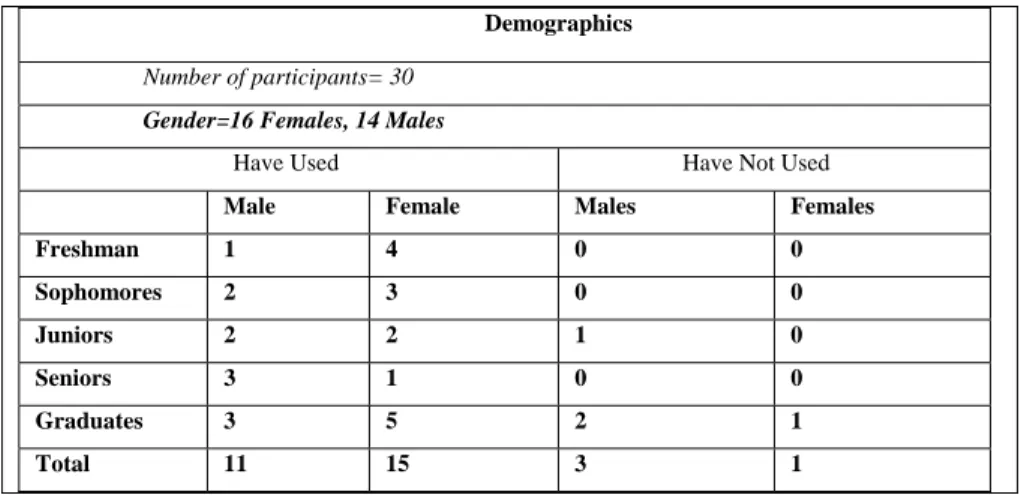
Of the 30 individuals interviewed, 14 were male and 16 were female (for a copy of the interview questions please refer to Appendix A). All but four of the participants had at some point used Davis Library. Three of these four were graduate students that were studying medicine, so they used the Health Sciences Library to find the scientific journals that they needed. The undergraduate who had not used Davis Library was a junior who was a continuing education student and he did most of his research, and could find what he needed, online or at the R.B. House Undergraduate library.
TABLE 1: Demographics of Participants Demographics
Number of participants= 30
Gender=16 Females, 14 Males
Have Used Have Not Used
Male Female Males Females
Freshman 1 4 0 0
Sophomores 2 3 0 0
Juniors 2 2 1 0
Seniors 3 1 0 0
Graduates 3 5 2 1
Total 11 15 3 1
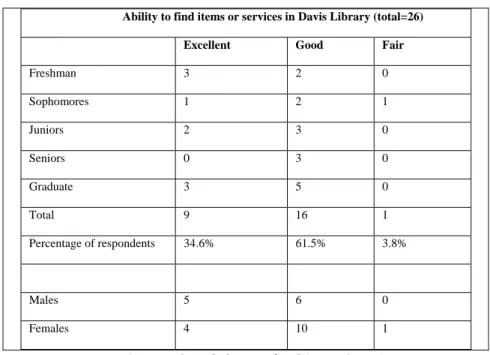
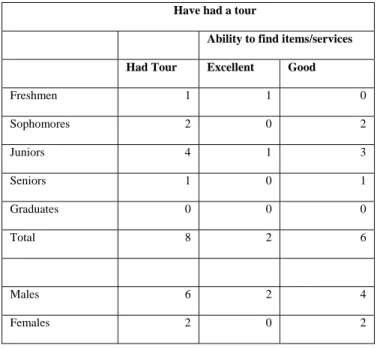
two students who had a tour of Davis Library and who rated their ability to find items or service in Davis Library as excellent were both males. Three (37.5%) out of the eight had used the library within the last seven days (this is comparable to the 38.5% for all the respondents). More male students had a tour of Davis Library, six males compared with two females. Proportionally speaking males were more likely to have had a tour of Davis Library (54.5%), compared to 13.3% of females. Juniors (80%) were the most likely to have had a tour. The average frequency for visits per week to the library for those who had had a tour of Davis Library was 1.0. Most students said that they would rate their ability to find items or services in the Davis Library as good (61.5%), whereas 34.6% rated their ability to find items or services as excellent. Only one person rated their ability to find items/services as fair.
Ability to find items or services in Davis Library (total=26)
Excellent Good Fair
Freshman 3 2 0
Sophomores 1 2 1
Juniors 2 3 0
Seniors 0 3 0
Graduate 3 5 0
Total 9 16 1
Percentage of respondents 34.6% 61.5% 3.8%
Males 5 6 0
Females 4 10 1
Have had a tour
Ability to find items/services
Had Tour Excellent Good
Freshmen 1 1 0
Sophomores 2 0 2
Juniors 4 1 3
Seniors 1 0 1
Graduates 0 0 0
Total 8 2 6
Males 6 2 4
Females 2 0 2
Table 3: Have had a tour
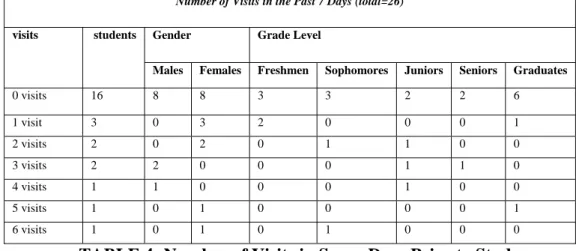
Number of Visits in the Past 7 Days (total=26) Gender Grade Level
visits students
Males Females Freshmen Sophomores Juniors Seniors Graduates
0 visits 16 8 8 3 3 2 2 6
1 visit 3 0 3 2 0 0 0 1
2 visits 2 0 2 0 1 1 0 0
3 visits 2 2 0 0 0 1 1 0
4 visits 1 1 0 0 0 1 0 0
5 visits 1 0 1 0 0 0 0 1
6 visits 1 0 1 0 1 0 0 0
TABLE 4: Number of Visits in Seven Days Prior to Study
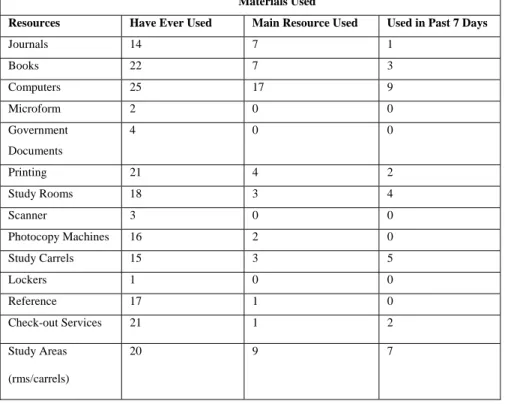
Davis Library is used as a place to study by a large portion of the participants. Eighteen had used the library exclusively for studying at some point (70%), and one of the main reasons for using Davis Library rather than going elsewhere was that it was conducive to studying (i.e. quiet and has plenty of carrels). Many of the students (34.6%) stated that study areas were one of the main resources that they use at Davis Library, and 70% of the students who had visited the library in the seven days prior to the interview cited study areas as one of the resources that they had used.
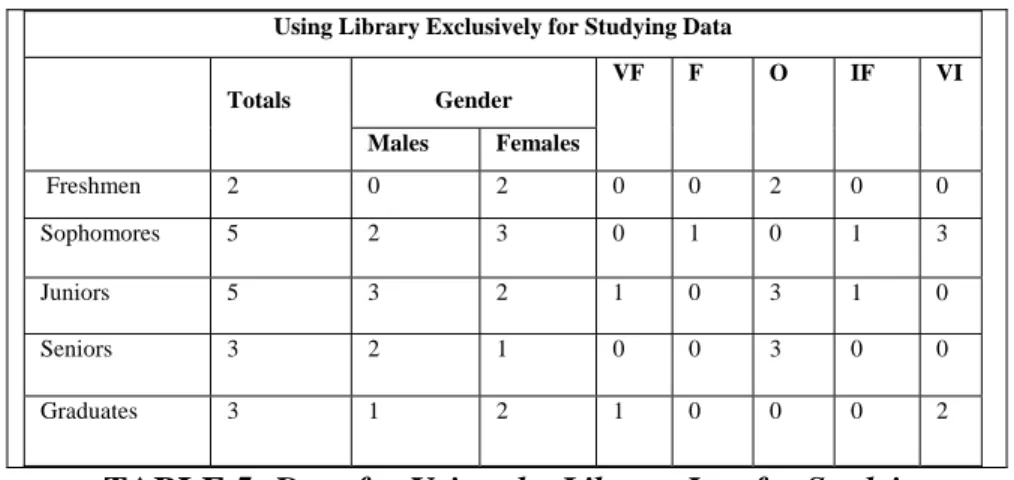
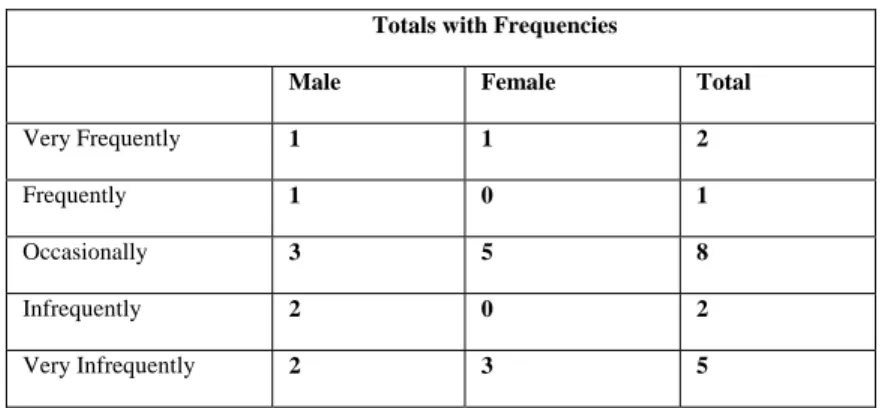
Students were asked if they had ever used Davis Library exclusively for studying at some point and how often (very frequently, frequently, occasionally, infrequently, very infrequently)(See table 5). Of the students that have gone to Davis Library exclusively to study, 39% have only done so occasionally (8) and 44% had used it very infrequently or infrequently (7). Proportionally, seniors use it more occasionally exclusively for studying (100% compared to 60% of juniors).
studying. However, these female students that reported using the library exclusively studying at some point, also reported that they used the library more frequently exclusively for studying compared to males. Only 38% of the males that had used the library exclusively for studying found their room/home comfortable, so this may explain the larger number of males using the library exclusively for studying.
Using Library Exclusively for Studying Data
Gender Totals
Males Females
VF F O IF VI
Freshmen 2 0 2 0 0 2 0 0
Sophomores 5 2 3 0 1 0 1 3
Juniors 5 3 2 1 0 3 1 0
Seniors 3 2 1 0 0 3 0 0
Graduates 3 1 2 1 0 0 0 2
TABLE 5: Data for Using the Library Just for Studying
Materials Used
Resources Have Ever Used Main Resource Used Used in Past 7 Days
Journals 14 7 1
Books 22 7 3
Computers 25 17 9
Microform 2 0 0
Government Documents
4 0 0
Printing 21 4 2
Study Rooms 18 3 4
Scanner 3 0 0
Photocopy Machines 16 2 0
Study Carrels 15 3 5
Lockers 1 0 0
Reference 17 1 0
Check-out Services 21 1 2
Study Areas
(rms/carrels)
20 9 7
TABLE 6: Resources Used at the Library
documents are wonderful resources, but most students, especially undergraduates, do not know about their existence. Government documents are located in the basement of the library and students need to sign in and receive a pass before going to the basement. This may be a barrier to those students that actually know the value of government documents. No one listed the above resources as reasons to use Davis Library versus going elsewhere or as one of the main resources that they use at Davis Library. Davis Library could encourage more people to use government documents and scanners by advertising them more. However, during the interviews, respondents were not asked specifically if they were aware of these resources, so it is possible that they are well advertised, but still not used frequently.
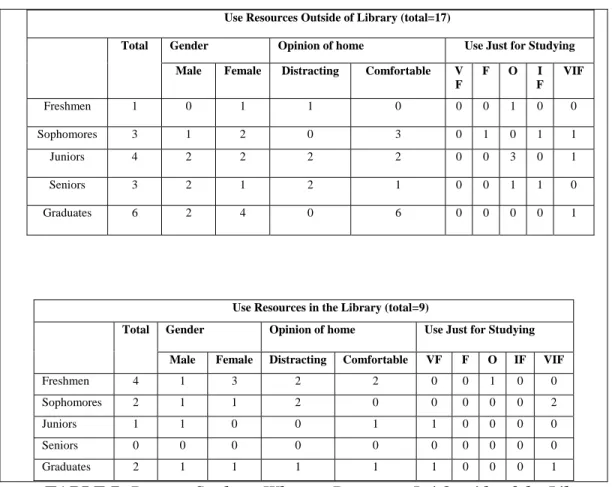
the room or home was distracting and/or uncomfortable. Students that stayed for a significant amount of time were more likely to find their home/dorm distracting (55% compared to 29% of those that used the resources outside of the library).
All of the seniors (100%) used library resources outside of the library (See figure 1). This was followed by 80% of juniors, 75% of graduates, and 60% of sophomores. Eighty percent of freshmen used resources for significant periods of time in the library. It is significant that as the grade level increases for undergraduates, they are more likely to use resources outside of the library.
Use Resources Outside of Library (total=17)
Gender Opinion of home Use Just for Studying Total
Male Female Distracting Comfortable V F
F O I F
VIF
Freshmen 1 0 1 1 0 0 0 1 0 0
Sophomores 3 1 2 0 3 0 1 0 1 1
Juniors 4 2 2 2 2 0 0 3 0 1
Seniors 3 2 1 2 1 0 0 1 1 0
Graduates 6 2 4 0 6 0 0 0 0 1
Use Resources in the Library (total=9)
Gender Opinion of home Use Just for Studying Total
Male Female Distracting Comfortable VF F O IF VIF
Freshmen 4 1 3 2 2 0 0 1 0 0
Sophomores 2 1 1 2 0 0 0 0 0 2
Juniors 1 1 0 0 1 1 0 0 0 0
Seniors 0 0 0 0 0 0 0 0 0 0
Graduates 2 1 1 1 1 1 0 0 0 1
0% 10% 20% 30% 40% 50% 60% 70% 80% 90% 100%
Freshmen Sophomores Juniors Seniors Graduates
Figure 1: Percentage of Students by Grade Level Using Materials Outside of the Library
Totals with Frequencies
Male Female Total
Very Frequently 1 1 2
Frequently 1 0 1
Occasionally 3 5 8
Infrequently 2 0 2
Very Infrequently 2 3 5
TABLE 8: Totals with Frequencies
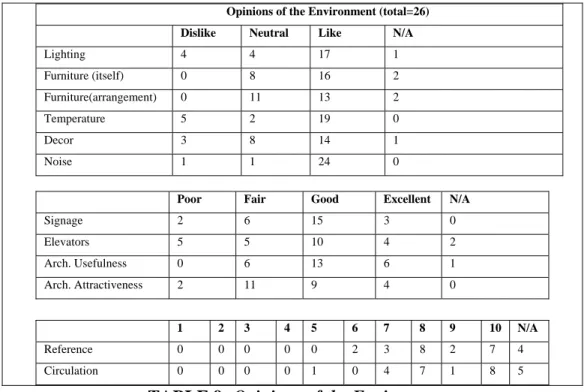
Overall, students liked the environment of Davis Library. Only a small number were neutral or negative on their opinions of the environment. Interestingly, most did not think that the library had to score high on all of the environment questions. Based on their comments, they only expected some aspects of the library to be functional (See table 9). Anything above functional was nice, but not expected.
arrangement. The large percentage of people feeling neutral about the arrangement of furniture is due to the fact that most people do not notice furniture arrangements unless the arrangement is not working. When given the opportunity to choose one thing to change about Davis, only 8% would change the architecture, 8% would change the furniture, and 4% would make the library more aesthetically pleasing. Although these aspects were seen as merely functional, there was no great desire to change them or to make them more aesthetically pleasing or more comfortable.
Several students did not like the lighting (15%), temperature (19%), or décor of the library (19%), but these opinions were in the minority. A good proportion of those who said that they were comfortable temperature-wise in the library, qualified their statements by saying that there had been instances where they were cold in the library. When later asked about what they disliked about Davis Library, only two people specifically said that they disliked the lighting in Davis and one person said that he/she did not like the temperature. However, three people said what they disliked about Davis Library was that it is “ugly,” but the respondents did not specify if they were referring to the interior, exterior, or both.
signage in the elevators being too small, and the writing on handwritten signs being too small and sometimes difficult to read.
Thirty-eight percent (10) thought that the elevators were good. About twenty percent of the students, however, thought that the elevators were poor, so opinions differed widely as to the quality of the elevators. Three students made the comment that they did not feel safe in the elevators, which should cause concern. One student had actually been trapped in the elevator for 45 minutes. Four students (15%) complained that they thought the elevators were slow. A large number (92%) of students liked the noise level in Davis Library (24), saying that it was very quiet in the library every time they went there.
Fifty percent of the participants who had used Davis Library (13) said that they thought the architecture of the Davis, regarding its usefulness, was good. However, the attractiveness of the architecture ranked lower with 42% (11) giving it a rating of fair. Again, most of the answers were qualified with the comment that the architecture was not that impressive, but it works, and that is what matters.
students had said that they had used reference services at some point and 21 students said that they had used checkout services at some point.
Opinions of the Environment (total=26) Dislike Neutral Like N/A
Lighting 4 4 17 1
Furniture (itself) 0 8 16 2
Furniture(arrangement) 0 11 13 2
Temperature 5 2 19 0
Decor 3 8 14 1
Noise 1 1 24 0
1 2 3 4 5 6 7 8 9 10 N/A
Reference 0 0 0 0 0 2 3 8 2 7 4
Circulation 0 0 0 0 1 0 4 7 1 8 5
Poor Fair Good Excellent N/A
Signage 2 6 15 3 0
Elevators 5 5 10 4 2
Arch. Usefulness 0 6 13 6 1
Arch. Attractiveness 2 11 9 4 0
TABLE 9: Opinions of the Environment
Content analysis was conducted for the student ratings of the twelve different environmental factors tested (lighting, furniture, furniture arrangement, temperature, décor, signs, elevators, noise, architectural usefulness, architectural attractiveness, reference staff, and circulation staff). Three different scales were used in measuring the environmental factors. For lighting, furniture, furniture arrangement, temperature, décor, and noise a scale of dislike, neutral, and like was used. For signage, elevators,
about the students’ overall opinion of the environment of Davis Library, so a way had to be devised to determine their opinion. Because different scales were used to test the environmental factors, this made summarizing the factors in a meaningful way much more difficult. Ratings of excellent, good, like, and 7 or above were counted in order to judge satisfaction with the overall environment. All factors were given the same weight, though in reality individuals would likely place more importance on certain factors. This analysis was done to give a rough estimate of the overall satisfaction of students with the environment of Davis Library. A cut-off point of 50% of satisfaction with all the
environmental factors was chosen to determine if students were satisfied, any score lower than 50% was coded to represent dissatisfaction, as the student was either neutral or disliked more than half of the environmental factors. Satisfaction was then divided into very satisfied (score of 75%-100%) and satisfied (50%-74%). Dissatisfaction was divided into dissatisfied (score of 25%-49%) and very dissatisfied (score of 0-24%). The
percentage of satisfaction was determined by finding the percent of satisfied scores (excellent, good like, and 7 and above) for all the environmental factors for each person. For example, if a student’s answers were:
Dislike, Neutral, Like Poor, Fair, Good, Excellent 1,2,3,4,5,6,7,8,9,10
Lighting Like Signage Good Reference 8
Furniture (itself) Neutral Elevators Poor Circulation 8
Furniture (arrangement) Neutral Arch. Usefulness Excellent
Décor Dislike Arch. Attractiveness Fair
Temperature Like
Noise Like
Then satisfied score would be: Like (3), Good (1), Excellent (1), 8 (2). This means that the student was satisfied with seven of the 12 environmental factors tested. The student was therefore satisfied with 58.3% of the environmental factors, and thus would be put in the satisfied category (74-50%).
Only two students were 100% satisfied; one male and one female freshman (See table 11). Eighty-five percent of students were satisfied and 46% of students were very satisfied with the environment of Davis Library. Female students were more likely to be very satisfied with the environment (60%), and a negative correlation was found between overall satisfaction and males (R=-.417). Freshmen were more likely to be very satisfied with the environment (80%). Three out of the four freshmen that were very satisfied were also female.
No correlation was found between overall opinion of the environment and students’ ability to find items/services in Davis Library. However, those who were dissatisfied with the environment of Davis Library, rated their ability to find
to the interview, with a mean average of 1.75 visits to the library per week (which is higher than the 1.1 for all the students that had used Davis Library). For students satisfied or very satisfied, 32% of these students had visited the library in the seven days prior to the study. Therefore, even though some students are not satisfied with various
environmental factors, this is not causing them to avoid the library.
Student Satisfaction
Ability to find Gender Grade Level Total
Excellent Good Fair Past 7
days M F Fresh. Soph. Jr. Sr. Grad.
V.S. 12 4 8 0 4 3 9 4 2 1 1 4
S. 10 5 4 1 3 5 5 1 3 3 1 2
D. 4 0 4 0 3 3 1 1 0 1 1 1
V. D. 0 0 0 0 0 0 0 0 0 0 0 0
TABLE 11: Satisfaction with the Environment of Davis Library
Dislike About Davis (total of 26 comments)
Like About Davis (total of 41 comments)
Physical Environment (62%) Physical Environment (53%)
Study space=1 Furniture=1
Stacks=1 Clean=1
Air conditioning=1 Helpful staff=2
Lighting=2 Study space=1
Color scheme=1 Spacious=5
Elevators=1 Quiet=7
Banners=1 Study rooms=3
Ugly=3 Layout=1
Org. of books=2 Variety of spaces=2 Inefficiency of layout=1
Creepy=1 Frustrating=1
Materials (23%) Materials (34%)
Computers=3 Book swap=1
Materials checked out=3 Computers=1 Collection=11
Operations (12%) Operations (2%)
Hours=1 Hours=1
Location=2
Miscellaneous (4%) Miscellaneous (10%)
Stuff not advertised=1 Convenience=1 Not busy=1 Easy to find books=1 Lack of distractions=1
TABLE 12: Likes and Dislikes About Davis Library
Similar to dislikes, the answers to this question were very diverse and spread out.
Following a change in lighting, was changing elevators, the architecture, furniture, hours, and computer location/layout (each were 7%).
One Thing About Davis They Would Change (total=26)
Physical
Environment (54%)
Materials (15%) Operations (15%) Miscellaneous(15%)
More tables or study carrels=1
Reshelf books faster=1 Open 24 hours=2 Eating=2
Elevator=2 More printers=1 Location=2 Would not change anything=2 Change computer
location/layout=2
Add another computer lab=1
Architecture=2 More archaeology books=1 More aesthetically
pleasing=1
Lighting=3 Temperature=1
Furniture=2
TABLE 13: Data On What Students Would Change About Davis Library
Why Davis? (total of 39 comments)
Physical Environment (51%)
Materials(41%) Operations (3%) Miscellaneous (5%)
Study areas=5 Materials=11 Hours=1 Undergrad Library not open initially=1 Quiet=6 Computer access=1 Change of scenery=1 Space=1 Materials are there=3
Too many people at Undergraduate=3 Printing=1 Not as threatening=1 Lack of distractions=4
TABLE 14: Why Students Chose Davis Library
The ideal library, for most of the respondents, was a quiet library with lots of varied study areas, an extensive collection of materials, good architecture, a lot of computers, bright lighting, and good staff. In many respects, Davis Library corresponds with the list of what students would have in their “ideal” library.
Aspects in Ideal Library Physical
Environment (62%)
Materials (32%) Operations (4%) Miscellaneous (3%)
Study Areas=12 Computers=8 Open 24 Hours=2 Can eat Food=2 Study Areas=12 Printing Available=3 Central Location=1
Bright Lighting=7 Good Collection=11 Good
Architecture=9
Resources Always There=2
Not Crowded=2 Good Signs=1 Aesthetically Pleasing=4 Good Staff=7 Good organization=3 Place to Meet=2
Davis Library is very quiet. Twenty-four of the respondents stated that they thought that Davis Library was very quiet and they were very comfortable with the noise level in the library. The collection of Davis Library is also very highly regarded by students, with 11 (42%) students specifically saying that the collection is one of the main reasons that they like Davis Library.
Davis Library has good staff according to the surveys, with most respondents giving both the circulation and reference staff a rating of 8 or above (62% and 65% respectively). Davis Library has a lot of varied study areas, and three students specifically said that the variety and number of study areas is one of the reasons that they like Davis Library. However, when given the option to change something about the library, one student recommended adding more carrels and another wanted bigger carrels. Overall, students say that Davis Library does a good job with providing study areas.
Computers are the most commonly used resource in the library and the main reason for many students to go to Davis Library. There are certainly plenty of computers, so the library does mesh with the ideal library in this respect. However, there are some changes that could be made to make the computer situation more ideal. One comment was that there should be more computers. Another student thought that the ATN lab should be on the first floor. The layout of the computer labs was also criticized, and two students stated that more printers were needed in the labs.
Regarding the other aspects of the ideal library (architecture and lighting), Davis Library does adequately, but in some cases could do better. The architecture and
this as being an important aspect of their ideal library. Most respondents think that Davis Library is only fairly attractive. Three people stated as one of their dislikes about Davis Library the fact that they thought it was ugly. The décor of the library does not seem to be the main factor effecting this perception of Davis Library as 16 respondents liked the décor and only five disliked it. The problem seems to lie more in the architecture.
Lighting is also a very important aspect of a library. For the most part, students were happy with the lighting in Davis Library. A good portion qualified their statements by saying that the lighting in the stacks could be poor at times. Changes in the lighting in the stacks or marking the light switches to make them more visible, would help to solve this problem. Also, regularly checking the lights in the study carrels so that burnt out bulbs are replaced in a timely manner would help.
.
Interviews of Davis Staff
Interviewing the staff shed light on the decisions that were made that led to the final design of Davis Library. Some of the background information that was obtained during the interviews has been discussed already. The following are opinions of Davis staff about whether the environment of Davis Library is working and about any problem areas that they have noticed.
Staff Member 1
converted into classrooms and training rooms. Two of the lounges that were not being utilized very much were converted into spaces for the Ancient Mapping Center and the Epigraphy Room. Door count statistics show that students are using the library in “great number,” and the initial and current door statistics in Davis Library have been much higher than the statistics for Wilson Library, which shows that library has achieved its goal of encouraging more students to use the library.
Staff Member 2
Overall the layout of Davis Library is pretty workable. The signage is better than it was in the past. The décor, however, has much to be desired. Aesthetically the staff member prefers older buildings, but for buildings this large that kind of design does not work very well. For a post-modern style building, the library is very functional. The staff member really does like the gallery and the reading room. Accessing government
documents can be problematic for students, but as more government documents are being available online, more students are accessing them.
Library Design Experts
Discussion
Many of the findings of this study correlated with the findings of the studies or research mentioned in the background section of the paper (p.4-16), however, differences do exist. A discussion of the similarities and differences between this study and those conducted by others follows.
In the Campbell and Schlechter study, students made more comments regarding their dislike of the physical environment and the organization of the library. They had more favorable comments regarding the staff and the materials, but in this study there were more favorable remarks about the physical environment. The Clee and Maguire study determined from questioning experts that the library would likely be used more for studying in the future and that there would be an increased dependence on information technology. Their 1993 study, seems prophetic in light of these results with 70% of the respondents reporting that they sometimes use the library exclusively of this purpose. As there are not any statistics on how many students were using Davis Library for studying from the 1990’s, it is impossible to determine if an actual increase has occurred, but what is known is that many students are using the library as a place to study. Also, there has been an increase in dependence on information technology, demonstrated by the fact that computers have become such an important and frequently utilized resource in Davis Library.
The findings also correlate with what Jiao and Onwuegbuzie found in their library usage study, but differences do exist. As in the study conducted by Jiao and
use Davis Library at least once a week is much less (38% compared to 81.3%) and the mean average of visits a week is less (1.1 compared to 2.6). This may be significant, but each university and university library is different so it is hard to compare usage. Jiao and Onwuegbuzie conducted their study in 1997, and in the intervening years more and more resources can be accessed remotely, which may explain in part the lower percentage of students using the library on a weekly basis.
Computers often seem to be the main reason for visiting the library. Jiao and Onwuegbuzie found that the main reason for visiting the library was to obtain a book or article for an assignment. This may still hold true for Davis Library. During the
interviews, participants were not asked what they were using the computer for. Given that most articles can now be accessed via electronic databases, it is possible that the
computers are being used to obtain an article. The computers are probably also being used for personal reasons such as email and online shopping.
0
0.5
1
1.5
2
2.5
3
3.5
4
4.5
freshman 1 0.4
sophomore 3.5 1.4
junior 4.5 1.8
senior 3 1
graduate 3 0.75
7 days overall
TABLE 16: Frequency if visits in regards to grade level
When compared with the lists of good and bad aspects of libraries created by Lushington, Davis Library does fairly well. Out of the list of negative aspects that can make a library experience less enjoyable, Davis Library had homemade signs, some worn upholstery, and poor lighting. Concerning the positive aspects that can enhance the library experience, Davis Library has a welcoming staff and comfortable seats.
Limitations of Study
such a small set to a larger population is always risky. It seems that for the most part students were consistent in their opinions, so applying the findings to the larger student body may not be that grievous.
There was only one researcher, who tried to ensure consistency by staying to a prescribed script. The answers were recorded and analyzed by the researcher, which may result in a selective bias as to what was recorded and how it was analyzed. The researcher tried to minimize this bias by writing responses verbatim, even if it seemed off topic and/or not important.
Reported frequency of use may be lower due to the fact that the telephone survey was conducted the first week in February before students start research papers and take exams. The earlier timeframe was chosen in order to ensure ample time to analyze the results. As papers and assignments are not typically due until mid semester, students may not have had much reason to visit the library. Had the survey been done later in the semester when assignments were due, frequency of visits probably would have been higher. The frequency may have been closer to the 81.3% found by Jiao and
Onwuegbuzie for the number of students who visited the library weekly. Another limitation was that observation of library behaviors could not be
Although the survey was pretested, analysis of the data suggest that some of the questions should have been clarified. For example, when asking students if they have ever used government documents, the researcher did not specifically limit the question to the print versions of the government documents, or it ask whether the student even knew of the existence of government documents. Clarification should have been requested for responses such as when students described Davis Library as “ugly.” It is unclear whether these students were referring to the interior, exterior, or both.
Conclusions
The results of this study suggest that the environment of a library does seem to have an impact on student usage, demonstrated by the fact that overall most students are satisfied with the environment and most students rated their ability to find items/services as good or excellent. However, even students who were unhappy with a majority of the environmental factors tested, did not avoid the library. In fact, these students (75%) were more likely to have visited the library in the seven days prior to the interview and had visited with a greater frequency than average (1.75 visits per week compared to 1.1). This apparent anomaly may be due to the fact that these students tend to spend more time in the library and therefore are more familiar with the environmental factors.
environmental factors, such as lighting and noise level. A case in point is that even
though students and staff think that the library could be more aesthetically pleasing, when students were given the opportunity to name one thing that they would change about Davis Library, only one person stated that they would make it more aesthetically pleasing.
Familiarity did not seem to have to have an affect on student usage of library resources. Those students that had a tour, averaged 1.0 visit to the library per week, compared to the average of 1.1 for all the students that had used Davis Library. In one case, familiarity may have had a slightly negative affect on student usage of the library. Students that had a tour were less likely to rate their ability to find items/services in Davis Library as excellent.
The physical environment is seen as important, demonstrated by the fact that most comments regarding likes/dislikes and things they would change regarding Davis Library focused on the physical environment. Concerning the views of staff and library experts on the environment, Davis staff seemed to be pleased with the environment and library experts agree that the environment of a library can affect usage. Students tended to like the same aspects of the library, but had more diverse dislikes. Also, students had more favorable comments about Davis Library compared to negative ones. Davis Library matches students’ description of the “ideal” library fairly well, in that the library has a good collection, a variety of study areas, good staff, and a lot of computers.
conducive to studying. Seventy percent of students had used the library exclusively for studying at some point with 100% of seniors, juniors, and sophomores having had used it exclusively for studying at some point. Also, 70% of the students that had visited the library in the seven days prior to the interview cited using study areas (study carrels/ study rooms) as one of the resources that they had used during their visit(s).
More students tend to use materials outside of the library (65%), and these students said that their dorm room/home environments were more comfortable. Males were more likely to find their dorm rooms/ homes uncomfortable for study, which may explain why proportionally more males had used the library exclusively for studying at some point. Students that liked the environment of their dorm room/ home also liked a majority of the environmental factors in Davis Library (R=.355). Students that used resources outside of the library were more dissatisfied with the environment of Davis Library (R=-.300). The frequency of visits averages 1.1 per week and 38% of students had used the library in the seven days prior to the interview. Frequency of visits also peaks junior year and then decreases.
The most frequently used resource in Davis Library are computers. Computers were the most frequently used resource in the seven days prior to the interview. It was also the resource cited most frequently as the main resource used at Davis Library. The most infrequently used resource were lockers.
There are a few modifications that could be made that would improve the