Anthony
This study compares two sets of finding aids about the same set of collections, written in the early 1990s and updated in 2011, in UNC’s Southern Historical Collection. Instances of race terms, particularly as relating to black people, were compared between the finding aids to discover how representations of race have changed over time. The study revealed a decrease in the use of “negro” with an increase in the use of “African American.” The word “slave” in both sets of finding aids most often identified the presence of black people in the collections. Archivists updated their race terms, but there were ultimately fewer instances of race words, which in some instances lead to a loss of representation.
Headings:
by
Anna B. Loewenthal
A Master’s paper submitted to the faculty of the School of Information and Library Science of the University of North Carolina at Chapel Hill
in partial fulfillment of the requirements for the degree of Master of Science in
Library Science.
Chapel Hill, North Carolina April 2015
Approved by
Table of Contents
Introduction ... 2
Literature Review... 4
Research Question ... 13
Research Methods ... 14
Results & Discussion ... 18
Conclusion ... 38
Introduction
Archives preserve history through selecting and describing records and making them accessible to users. The role of archives has changed over time, from collecting records as evidence to saving for historians to collecting to represent current society. Archivists currently recognize that they cannot be passive and neutral collectors, but must recognize their active, biased role in collecting records that accurately represent society.
Archivists have power over what is saved and how it is interpreted: they choose which records are saved over others, thus dictating importance and influencing memory. Archivists also control how accessible their records are to the public. Archival
descriptions influence what records can be found by searches in addition to affecting how a user understands what is in a collection and interprets those materials. Archivists are inherently biased, which affects the records they save and the social memory they help create.
from the vocabulary of white men, which can be racist or differ from the terms a group prefers. Additionally, accepted and preferred vocabulary changes over time – often faster than archives update their records.
Recently institutions have been working to more accurately represent all aspects of society. There has been increasing acknowledgement of the under- and
misrepresentation of the black community in archives. As archives update finding aids, particularly motivated by the move to digital finding aids, they have the opportunity to change language to more accurately and fairly represent the lives of black people in the collections. This paper analyzes a set of finding aids from the Southern Historical
Collection at Wilson Library, UNC-Chapel Hill, comparing old and updated finding aids to determine if archivists changed the words they used to represent racial groups,
Literature Review
History of Social Justice in Archives
Archives collect and preserve records from throughout history so that they can be used by people in the future. However, it wasn’t until after the French Revolution that the West considered that archives are not just useful for rulers, but that “they were for ‘the people’ rather than for a small elite” (Harris 103). As Kaplan says, “We are what we collect, we collect what we are,” and up to this point in history, only the most elite in society had been collecting records, thus the records preserved in archives were only the ones relevant to the elite, privileged groups of society.
Certain groups have been excluded from archives based on class, race, gender, sexuality, and other factors both consciously and unconsciously. Simply the act of choosing certain records gave those records more validity than ones that were not saved (Jimerson, Archives Power 4). It was only the information preserved in these records that was saved, and thus remembered, by society. Archives have often reflected what we are familiar and comfortable with rather than what is an accurate reflection of society (Cook, “We Are” 174-5). It is therefore essential that we question the stories about the past that archives have created and reevaluate the roles of archives and archivists (Cook,
Traditionally, archivists followed Jenkinson’s idea that archives should preserve records as evidence. Provenance and respect des fonds were crucial principles that allowed archivists to be transparent and neutral, so that records could speak for
themselves. However, at the beginning of the twentieth century more records were being produced than could be saved, so it was no longer possible to be neutral. Instead,
archivists needed appraisal, as Schellenberg argued, and selected records based on what would be needed by future researchers – usually academics and historians. Thus, records were selected with subjectivity and academic bias. Archives moved from evidential records to creating memory resources through appraisal (Cook, “Evidence, memory” 109).
In the 1970s, the role of archivist started being acknowledged as a profession, and archivists recognized that archives were for many types of users and represented many perspectives. Records were collected to reflect current society rather than anticipating future needs. Archives became increasingly concerned with social justice and human rights, including representation of all citizens. Archivists also began developing their own identity, including standards for archives. Verne Harris describes the role of the archivist as moving from “workings with the record” to “keepers of the record” to “narrators of the record” (Archives Power 9). Archivists moved from passive collectors to actively
appraising and describing records for users.
what is most important to them without control from an outside source. Now archivists must become active mediators who encourage archiving as a process that many can participate in rather than a product (Cook, “Evidence, memory” 114). The role of the archivist has continued to evolve, changing focuses and goals. Archivists are now recognizing their bias as a mediator and interpreter who plays an active role in archives (Jimerson, Archives Power 9). By acknowledging that bias, archivists can work toward eliminating it or at least being transparent.
Representation in Archives
Archives can help create a sense of identity by tying people to each other,
constructing “history and historical identity” (Jimerson, Archives Power 217). Archivists hold a power in the construction of identity, recognizing history and providing legitimacy for communities. Community is a difficult term to define, and it is a definition best left open and flexible in terms of archives. Flinn describes communities as “self-identification by the participants” (Flinn, “Archival Activism” 7). However, groups of people are not always described or defined by the members themselves.
Ketelaar says that the common past “is what gives continuity, cohesion and coherence to a community” (Ketelaar 54). Archives and their documents that represent the past help preserve and perpetuate a community. When records about a community like black people are held in an institutional archive, they are being defined by an archive that has discriminated against the group in the past. In contrast, community archives, which are created by and for a certain community, are making archives rethink their principles and standards (Cook, “We Are” 183). Archivists in institutional archives can learn about communities and their unique perspectives, adapting their practices in terms of archival techniques and language. It is important for them to listen to communities and respond and adapt their archiving practices to the community’s needs.
The power that archives have over their documents informs the perspectives that we have of individuals and groups (Jimerson, Archives Power 216). From the documents that are chosen to be preserved to how they are described, archivists influence what is seen and understood about people of the past. Jimerson says that “time and memory shape who we are, both individually and collectively” (Archives Power 192). Saved historical documents continue to inform group identities, and therefore individual identities. Archives support “collective memory,” which is how a group remembers the past, sharing a common perception of historical events. Collective memory can therefore affect a group’s identity. The past, which archivists preserve, continues to influence the present.
groups in society” (Jimerson, Archives Power 205). Archives, collective memory, and society are just as defined by what is forgotten than by what is remembered (Jimerson, Archives Power 220-221). The choices archivists make about what is saved, what is
shared, and what is described affect what is remembered, and what is remembered affects the representation of marginalized groups in archives. While past archivists may not have represented these groups, today’s archivists can. Historians reexamine and rewrite the past through contemporary perspectives (Jimerson 209). Archivists must do the same with archival description. Memory is subjective, and archivists need to try to make it less subjective wherever possible.
Archival Description and Social Justice
The International Council on Archives defines the four purposes of archival descriptive standards:
1. to ensure the creation of consistent, appropriate, and self-explanatory descriptions;
2. to facilitate the retrieval and exchange of information about archival material; 3. to enable the sharing of authority data;
4. to make possible the integration of descriptions from different locations into a unified information system
Jimerson says these standards apply to all types of archives (Archives Power 15). They encourage consistency throughout archives, which can help the user to find
There are several principles archivists follow for description. Archival description traditionally reflects respect des fonds and original order. Archivists keep records from the same creator together and as they were organized by the creator, because reorganizing them can change interpretation. As more records were created and saved in the twentieth century, however, archivists began only describing those records at higher levels as collections. The archivists therefore had to choose what most “important” aspects to highlight. Archivists acted as mediators from creator to content to users, which influences how the records will be interpreted. Archivists should recognize and embrace this bias through careful documentation within description, for it is impossible for archivists to be neutral (Jimerson, Archives Power).
Terry Cook describes just how subjective and nuanced archival description can be. He says “archiving is culturally bound and a product of its environment: all archival records, as a result, have their own story, their own context, their own histories” (“We Are” 178). He aligns such stories to the metadata that describes a record, and states that the stories/metadata bring the artifact alive, and make the archive more useful, “thus offering to society the possibilities for adding subtlety, texture, nuance, and more accurate meaning to information found in documents, thereby enhancing their understanding. This is not subjectivity run amok, but subjectivity recognized, documented, and made accountable” (“We Are” 178). Description impacts
When describing records, archivists should “avoid cultural biases and
assumptions” (Jimerson, Archives Power 233-234). However, archivists cannot always escape their biases. Therefore, they should make the process of description as transparent as possible. The creation of finding aids is always subjective as some things are included and some are not. Context may be left out. The language itself can be subtly biased: “adjectives, adverbs, dependent clauses – can reflect archivists’ own assumptions and biases” (Jimerson, Archives Power 312). Archivists must therefore be clear about what they do or do not know. Recently archivists have also tried to make changes to archival standards that add transparency to finding aids, such as including a colophon for
archivists, annotating the finding aids, or composing essays about the institutional context of the archive (Jimerson, Archives Power 313-314). Descriptive methods are changing in institutional archives to best represent materials, but there is not yet one agreed upon solution.
Holding records about history and life, archives also hold power. Harris argues that while everyone can access that power, they cannot access it equally. Instead access is “determined by the contours of privilege, marked across any number of continua –
their research (Daniel 7). This feedback loop can result in excluding the perspective of people who are neither archivists nor scholars.
On the other side, archival description creates access. The ability to look at files is affected by power because so much process precedes that capability (Harris 107). Latour states, “In our culture’s ‘paper shuffling’ is the source of an essential power, that
constantly escapes attention since its materiality is ignored” (Latour 28). The people who control papers – archivists – can control how they are arranged and interpreted, for there is no inherent, natural order to archives, only those imposed by the archivists. Documents themselves are structured in a certain way, those documents are gathered together, they are classified by an established system, and finding aids are created (Harris 107; Latour 28-29). All of these steps affect what information is represented and can be discovered. The archivists’ choices have relevance down to the word. The words chosen in
description should reflect both what is in the collection and what people will search for when conducting research.
Research Question
Institutional archives have been collecting records for many years and have written and rewritten finding aids over this time, changing standards and styles of archival description. The University of North Carolina at Chapel Hill features the
Southern Historical Collection, which encourages the study of Southern American history and culture. I compared finding aids for the same set of collections, one set updated and written in 2011 and an older set – primarily written between 1990 and 1993.
I focused specifically on examining terminology used to describe race and the frequency of these words as they appeared in each set of finding aids in order to
Research Methods
I analyzed the finding aid documents using mixed methods. I used qualitative methods in conducting content analysis as well as quantitative methods to study frequencies in language use. Qualitative content analysis allowed me to examine the language in the documents themselves as well as the context in which they exist
(Wildemuth 309). Through content analysis I interpreted the meanings and themes of the documents without interrupting their creation and use (Marshall 161). This allowed me to view the documents from both the perspective of an archivist and of a user who is only viewing the finding aid. Mixed methods helped balance the subjectivity of content analysis and the precision of quantitative analysis. This was an unfolding study, and the conceptual framework was developed as I conducted the research (Punch 49). I left room to make decisions based on information I discovered while I researched.
I chose to use the Southern Historical Collection at the University of North Carolina at Chapel Hill based on my location and ability to access the archive as well as the availability of older versions of finding aids, making it an opportunistic sampling (Punch 51). I had access to old finding aids, primarily written between 1990 and 1993, in PDF format, courtesy of the archivists at the Southern Historical Collection. Using grant funds, the archivists updated these finding aids and put them online in 2011. The
Southern Historical website features of a list of the updated finding aids at
collection numbers, creating a list of 242 finding aids pairs. Each one has the same title and number, so I knew I would accurately be comparing finding aids for the exact same collections.
I used quantitative methods to make more objective comparisons between the documents. The sampling was probabilistic, examining representation (Punch 50). I made a list of race words, keeping in mind contemporary vocabulary as well as words that may have been used during the nineteenth century, when many of these collections originated, as well as the years in between, referencing census records (Bennett). While choosing race words, I ran searches on the PDF and online finding aids to find as many terms as possible. I chose the stem of the words for the initial run to avoid missing any instances like singular and plural. For example, I simply searched “African” so that I would get results for “African,” “African American,” and “African-American” and any other combinations I may have missed. I chose not to include results for country names, such as China or Spain, for two reasons: there were too many to run and most of the results (if any) were place names, not about ethnic groups. Additionally, throughout the process as I skimmed, checked, and uploaded finding aids I stayed aware of other race words that might appear and added these to my list. I followed deductive category application during this process (Mayring). My list of words was open to change based on what became apparent as I read. I also excluded words that appeared that were not about race, for example I did not count instances when black appeared as part of “blacksmith,” or when “White” appeared as a family name.
(optical character recognition) to convert the PDFs text into machine-encoded text. I checked each of these PDFs to make sure the text was accurately recognized.
Occasionally words were not captured, especially handwritten notes, so I read those to check for any race words, though none appeared. I ran the old finding aids all together in a ZIP file to get word frequency results through Voyant. For the current finding aids online, I ran the webpages through Voyant. I had to do this in sections as the tool could not handle all of the webpages at once, and I then added up the results.
After I got the word frequency results, I examined where these words were appearing in the finding aids. Comparing the old and new finding aids side by side showed me where words were added and where they disappeared. When there were too many instances to check individually, I looked for where the biggest discrepancies were. I also examined the particular instances of certain words as they appeared in the finding aids to better understand the context. Voyant displays a preview of the surrounding text of a word, but I also checked the actual finding aids, both PDFs and online, to better understand the context of the words. This stratified purposeful sampling helped me find similar samples within my results to compare (Punch 51).
For my qualitative analysis, I followed deductive category application (Mayring). I started with theoretical categories of the different words and word contexts I expected to encounter. While I read through my selected records, I edited my categories. More
further analyzed how words were used. I used this method in conjunction with the differences that showed up in my quantitative analysis in order to explore those differences more thoroughly.
Limitations of this study
Because I am using records from the University of North Carolina at Chapel Hill for my analysis, and all of these records came from the Southern Historical Collection, my sample size is small and may not be representative of archives as a whole. However, I countered that by using a larger sample of finding aids – 242 – to make sure my results would be significant to the Southern Historical Collection, and the Special Collections at UNC.
My own race, gender, sexuality, and socio-economic status undoubtedly
Results & Discussion
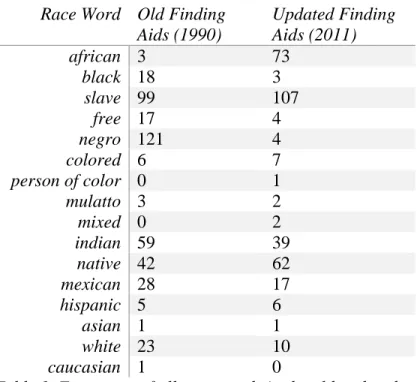
The results of my research revealed that when archivists at the Southern Historical Collection at the University of North Carolina updated finding aids from the early
nineties in 2011, they made significant adjustments to the words they used to describe black people in collections. While the word “negro” fell heavily out of use, “African,” especially as part of “African American,” increased greatly. “Black” was not used to describe race very frequently in the original finding aids, but it was more so than
“African,” and its use dropped to a few instances in the updated finding aids. Meanwhile, the word “slave” continued to be used at a relatively similar frequency. It was the word most often used in both old and new finding aids. In contrast, “free,” including instances of freemen and freedmen, was used less often than “slave” in the old finding aids and dropped even lower with the updates. Several other race words were used less often: the word “colored” was used infrequently in both old and new finding aids, and “person of color” just once in updated finding aids and not the old ones. References to mixed race people were uncommon. “Mulatto” was used three then two times, and “mixed” increase from zero to just two instances.
“oriental” did not appear at all. “Arab” also made no appearances. Meanwhile, “white” decreased from 23 to 10 appearances, and “Caucasian” appeared once in the old finding aids, though the vast majority of the people the finding aids discuss were white.
Race Word Old Finding Aids (1990)
Updated Finding Aids (2011)
african 3 73
black 18 3
slave 99 107
free 17 4
negro 121 4
colored 6 7
person of color 0 1
mulatto 3 2
mixed 0 2
indian 59 39
native 42 62
mexican 28 17
hispanic 5 6
asian 1 1
white 23 10
caucasian 1 0
Table 1. Frequency of all race words in the old and updated finding aids.
I checked the appearances of the words in the finding aids to see where the increases and decreases were happening and in what context.
African
Papers, 1794-1894,” is due to a scanned biography: it is a chapter on John Beauchamp Jones from the Dictionary of Literary Biography, Vol. 202, and it was not added to the online finding aid. Overall, this showed archivists almost never used “African” to describe black people in the finding aids from 1990-1993.
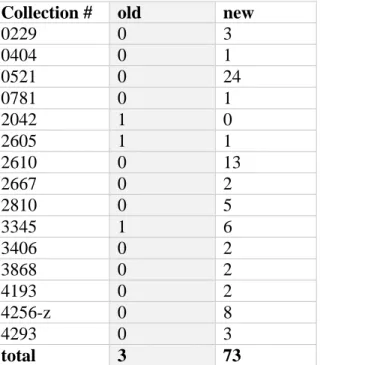
In the updated finding aids, “African” is used as part of “African American” in almost every instance. The exceptions are: #2605, “Tucker Family Papers, 1790-1932,” describing an African Church (the same words used in the old finding aid) and #4256-z, “Edward Augustus Wild Papers, 1861-1864,” describing an African brigade (not
mentioned in the old finding aid). Both of these still refer to black people in the United States – “African Americans” – not Africans who are in Africa. The increase in the use of “African,” especially as part of “African American,” demonstrates that the phrase is being used by archivists to represent black people more often.
Collection # old new
0229 0 3
0404 0 1
0521 0 24
0781 0 1
2042 1 0
2605 1 1
2610 0 13
2667 0 2
2810 0 5
3345 1 6
3406 0 2
3868 0 2
4193 0 2
4256-z 0 8
4293 0 3
total 3 73
Black
The words “black” and “white” were naturally frequently used as color words without any relation to race. I therefore checked each instance of these words to see the context of the word. I eliminated the instances in which the words appeared unrelated to race from my final counts to give a more accurate reflection of race representation in the collection. There were two families featured heavily in the finding aids with the names Black and White. The Black family name accounted for 24 appearances of “black” in the old finding aids and 53 in the updated finding aids. I also eliminated the words in such instances as “black and white photographs” or “blacksmith.” The remaining related to race.
Collection # old new
0229 3 0
0486-z 0 2
1854 2 0
2042 4 0
2636 1 1
3868 1 0
3879 1 0
4256 2 0
4304 4 0
total 18 3
Table 3. Frequency of the word “black” in the old and updated finding aids. The use of the word “black” with regard to race decreased overall with the updating of the finding aids. In the 1990 finding aids, it was used 18 times in regards to race, and in the new finding aids it was used 3 times. Most of the finding aids went from a couple mentions to zero, #2636 stayed the same, and #0486 went from zero to two. None of these would be particularly striking changes due to the small number of
I examined the collections where “black” appeared and then disappeared. “Black” is used to refer to black people as they appear in the contents of letters in collections #229, #3868, and #3879. In #229 they describe “black in the political life of the period,” “blacks and poor whites,” and “black juries and judges.” #3868 describes “Black
servants.” #3879 mentions the “black community of Dallas.” In #1854, “black” is used twice to describe records involving black people, including a “black man” and a “black family.” In #2042, “black” was used four times in the scanned biography from the Dictionary of Literary Biography, including mentions of “Northern blacks,” “free
blacks,” “black slaves,” and “the blacks.” In #4256, “black” is used twice to describe the collection contents, both times mentioning “black [Federal] troops.” In #4304, “black” is used four times in a historical note, discussing the “black population,” a “black caucus,” and “blacks.” When describing black people, the old finding aid descriptions used “blacks” far more often than “black [people].”
Slave
“Slave” was a more complex term to capture. I first wanted to capture the indication of people and individuals through “slave” and “slaves.” However, I also wanted to see how often the concept of “slavery” appeared, for many of these records are from the nineteenth century in the Southern United States. The largest indication of the presence of black people as noted by the record-creating white men is in the topic of slavery.
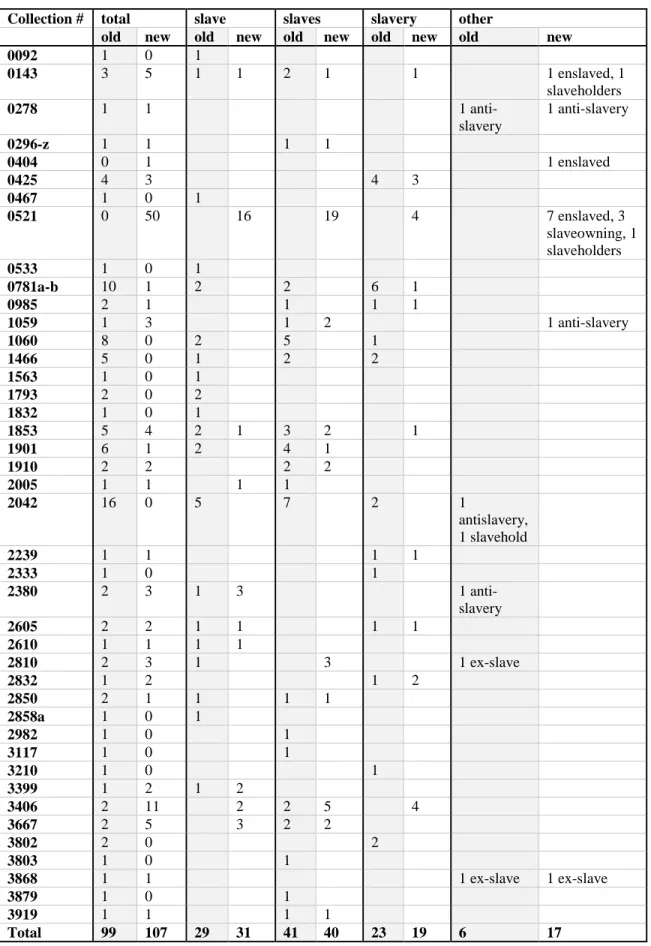
The following forms of the word “slave” appeared in the 1990 finding aids: slave, slaves, slavery, anti(-)slavery, ex-slave, slavehold, and slaves-. In the updated finding aids, the following words were added: enslaved, slave(-)owning. None of the old words disappeared from use. The addition of “enslaved” and “slave-owning” in 2011 adds a layer of understanding that slavery was an act committed against black people.
Particularly in collection #0521, “Moore and Gatling Law Firm Papers, 1788-1921 (bulk 1853-1888)” the collection descriptions discuss “enslaved people” and “slave-owning” people, demonstrating that enslavement was an act by white people on black people rather than the simple existence of slaves. Black people were classified and called “slaves” by white people, by an outside community.
Finding aid #0521, “Moore and Gatling Law Firm Papers, 1788-1921 (bulk 1853-1888)” changed from zero to 50 instances of “slave” words due to the increase in archival description. The original finding aid was fairly short, listing the contents of letters, bills, receipts, and brief descriptions of legal cases although it is a large collection. The updated finding aid is robust, one of the longest in the set examined. Details of the legal case files are much more in depth. Given that this finding aid describes a nineteenth century law firm in the South, that dealt with slavery legalities, this increased detail accounts for the great increase in the appearance of “slave.” In #3406, “Preston Davie Collection, 1560-1903,” “slave” related words increased from two to 11. Like the one for the Moore and Gatling Law Firm Papers, this finding aid was greatly expanded when updated, thus increasing its mentions of slaves and slavery. Also similarly, Preston Davie was a
Southern lawyer. This shows an increase in archival description for legal papers and more frequent mentions of slavery within those collections. Law papers may be one of the ways to seek out the presence of black people in nineteenth century America.
In #1060, “E. V. Howell Papers, 1725-1929,” the volume of descriptions about the contents of the collection also decreased, from eight instances to zero, losing any representation of “slave.” In #2042, “J. B. Jones Papers, 1794-1894 (bulk 1830-1849),” “slave” appears once in the analysis of the collection and 15 times in a scanned excerpt from Dictionary of Literary Biography on John Beauchamp Jones. This scan was not included in the online finding aid, and “slave” made no appearances. Both of these finding aids, #1060 and #2042, described personal papers, and the decrease in amount of archival description for both will result potential researchers unable to find these
Collection # total slave slaves slavery other
old new old new old new old new old new 0092 1 0 1
0143 3 5 1 1 2 1 1 1 enslaved, 1 slaveholders
0278 1 1 1
anti-slavery
1 anti-slavery
0296-z 1 1 1 1
0404 0 1 1 enslaved
0425 4 3 4 3
0467 1 0 1
0521 0 50 16 19 4 7 enslaved, 3
slaveowning, 1 slaveholders
0533 1 0 1
0781a-b 10 1 2 2 6 1
0985 2 1 1 1 1
1059 1 3 1 2 1 anti-slavery
1060 8 0 2 5 1
1466 5 0 1 2 2
1563 1 0 1
1793 2 0 2
1832 1 0 1
1853 5 4 2 1 3 2 1
1901 6 1 2 4 1
1910 2 2 2 2
2005 1 1 1 1
2042 16 0 5 7 2 1
antislavery, 1 slavehold
2239 1 1 1 1
2333 1 0 1
2380 2 3 1 3 1
anti-slavery
2605 2 2 1 1 1 1
2610 1 1 1 1
2810 2 3 1 3 1 ex-slave
2832 1 2 1 2
2850 2 1 1 1 1
2858a 1 0 1
2982 1 0 1
3117 1 0 1
3210 1 0 1
3399 1 2 1 2
3406 2 11 2 2 5 4
3667 2 5 3 2 2
3802 2 0 2
3803 1 0 1
3868 1 1 1 ex-slave 1 ex-slave
3879 1 0 1
3919 1 1 1 1
Total 99 107 29 31 41 40 23 19 6 17
Free
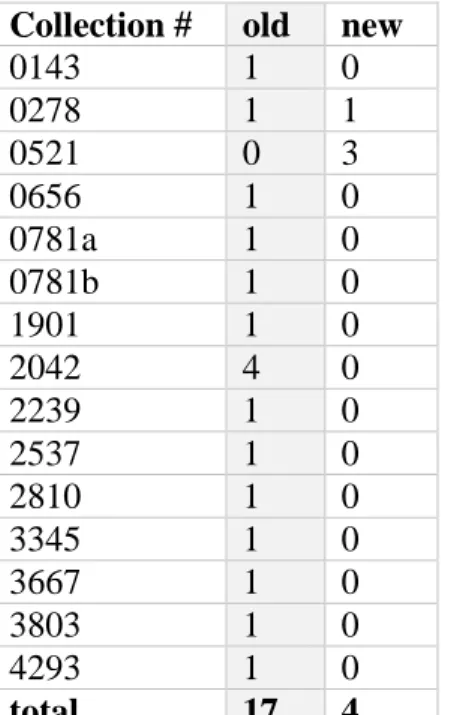
In contrast to slave, the word free appears 17 times in the old finding aids and three times in the updated finding aids. I discounted instances of the last name Freeman as well as free in relation to price instead of people. The totals are times it appeared to describe a person or group of people.
“Free” is used to describe people in the following old finding aids: #0781a, #0781b, #1901, #2042 (2), #2239, #3803, for a total of seven times. It is used to describe people in the updated finding aid #0521 three times. “Free” is used as part of group titles in the following old finding aids: #0143, #0278, #0656, #2042 (2), #2537, #2810, #3345, #3667, and #4293, for a total of ten times. Titles included Freedmen’s Bureau, the Free Soil Party, Freemen of Rockingham County, etc. It is used as part of group titles in the updated finding aid #0278, referencing the Freedmen’s Bureau.
Collection # old new
0143 1 0
0278 1 1
0521 0 3
0656 1 0
0781a 1 0
0781b 1 0
1901 1 0
2042 4 0
2239 1 0
2537 1 0
2810 1 0
3345 1 0
3667 1 0
3803 1 0
4293 1 0
total 17 4
Table 5. Frequency of the word “free” in the old and updated finding aids.
The decrease in the appearance of “free—” is due to descriptions that were
scanned finding aids were not transferred to the updated finding aids. The archivists must have decided not to include these in the updated finding aids, which may have been for several reasons. It could have been to save time or because they were considered outdated by the archivists. They may have been deemed unsuitable to put online, perhaps due to privacy concerns or new standards about what to include in finding aids. Whatever the reason, the lack of inclusion of these analyses resulted in a lack of representation of groups that are in the collections, especially the Freedmen’s Bureau. The paring down of finding aids is necessary so that archivists can work through more finding aids, updating and digitizing them to make more collections more accessible to users. However, paring down necessarily results in certain terms being left out. Archivists should be aware when those terms refer to underrepresented groups so that they can ensure they are represented in the finding aids.
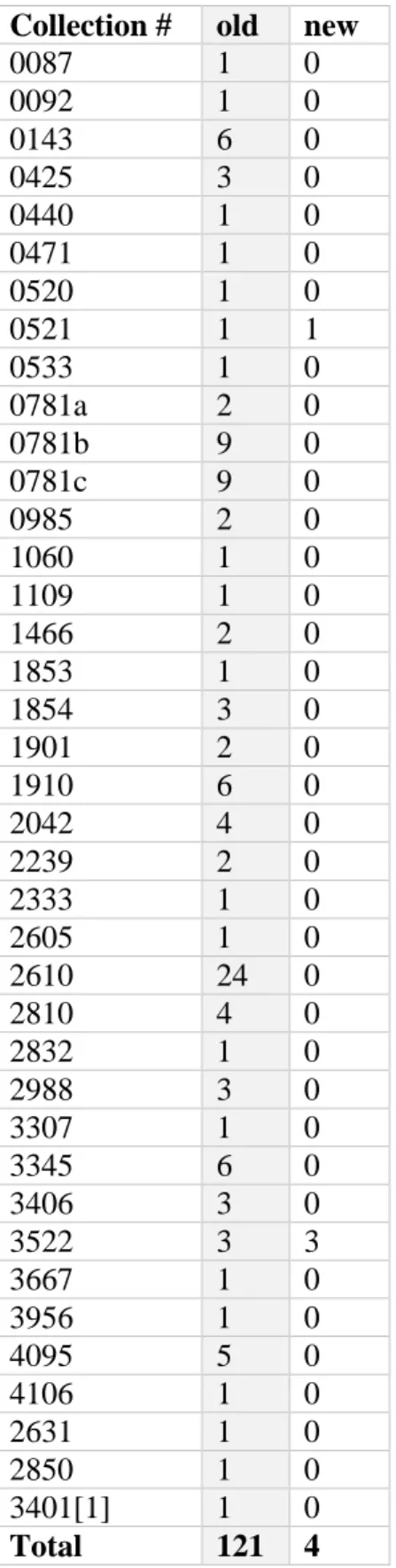
Negro
Collection # old new
0087 1 0
0092 1 0
0143 6 0
0425 3 0
0440 1 0
0471 1 0
0520 1 0
0521 1 1
0533 1 0
0781a 2 0
0781b 9 0
0781c 9 0
0985 2 0
1060 1 0
1109 1 0
1466 2 0
1853 1 0
1854 3 0
1901 2 0
1910 6 0
2042 4 0
2239 2 0
2333 1 0
2605 1 0
2610 24 0
2810 4 0
2832 1 0
2988 3 0
3307 1 0
3345 6 0
3406 3 0
3522 3 3
3667 1 0
3956 1 0
4095 5 0
4106 1 0
2631 1 0
2850 1 0
3401[1] 1 0
Total 121 4
Colored
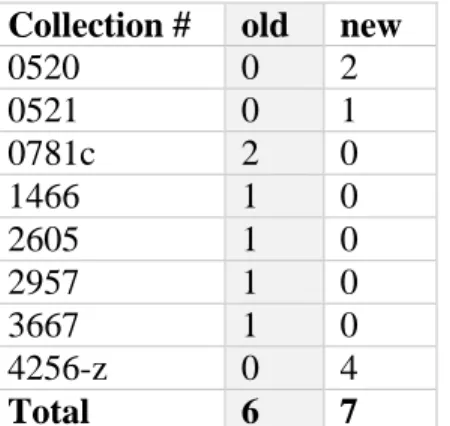
The word “colored” appeared six and seven times in the old and new finding aids, respectively. Although there was almost no change in the number of terms, they were found in entirely different collections. In the old finding aid for collection #0781c, it was used in reference to the group the “Colored Bible Society.” Finding aids #1466, #2605, #2957, and #3667 all describe people as colored, including “colored servant,” “colored regiment,” “colored children,” and “colored people.” In the 1990 finding aids, “colored” is used as a description of black people, though not very often.
In the updated finding aids, “colored” only appears in quotes and is no longer used by archivists to describe the contents of collections. In collection #0521, “colored convict” is in quotes from a letter. In collection #4256-z, “colored” is part of the names of regiments. This demonstrates that when the finding aids were updated in 2011, the
archivists no longer used “colored” as a signifier of race, especially for black people. Similarly to “negro,” it is no longer accepted, and it is not contextually necessary, except in quoted material. The change in its appearance in collection descriptions also
demonstrates that the updates archivists made were not just vocabulary changes but more in depth changes about the contents of the collections.
Collection # old new
0520 0 2
0521 0 1
0781c 2 0
1466 1 0
2605 1 0
2957 1 0
3667 1 0
4256-z 0 4
Total 6 7
The word “color” did appear once in regards to race in the new finding aids, though not the old. In the updated finding aids, “persons of color” appeared in quotes. “People of color” is a more contemporary accepted term to describe non-white people, including black people. It was interesting to note that “persons/people of color” did not appear more often in the updated finding aid, as they were written in 2011. However, this is likely because “people of color” is used to describe a group of people of multiple races. Most often in these collections, only black people are described in a group, making it more precise to simply use “black” or “African (American).” Occasionally Native/Indian Americans are also described in a group as well, but not the two or other races together, which would account for the lack of the use of “people of color.”
Mulatto & Mixed
Collection # old - mulatto new - mulatto old - mixed new – mixed
2042 2 0 0 0
2957 1 2 0 2
Total 3 2 0 2
Table 8. Frequency of the words “mulatto” and “mixed” in the old and updated finding aids.
White
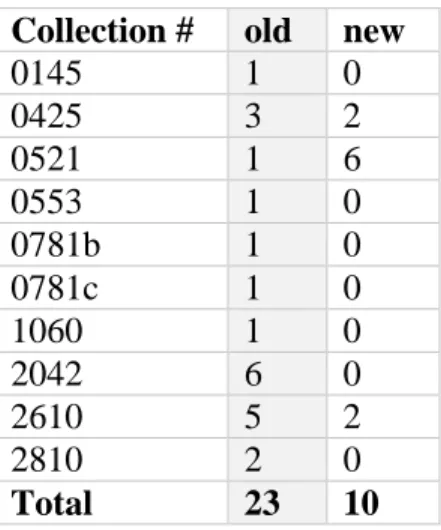
In order to compare to mentions of black people, I searched for the appearance of the words “white” and “Caucasian” I did not expect to see the word “white” appear often because it is expected as default, especially in a collection of papers from the nineteenth century American South. When it is used in relation to race, it is used as an adjective to describe any person or group of people as other race words are. The word “white” appears frequently as a family name, place name, and describing objects, such as White House or white chapel, and I did not count these appearances in the total. Meanwhile, Caucasian only appeared once, in an old finding aid, and was therefore insignificant as a race word for this study.
Collection # old new
0145 1 0
0425 3 2
0521 1 6
0553 1 0
0781b 1 0
0781c 1 0
1060 1 0
2042 6 0
2610 5 2
2810 2 0
Total 23 10
The use of “white” decreased from the old to updated finding aids. In several collections, it simply decreased from one to zero. Collection #2042 decreased from six to zero instances due to the Dictionary of Biography excerpt not being included. In
collections #0425, #0521, and #2610, the word “white” as it related to race appeared in both old and new finding aids. Overall, “white” was not used to describe race very often. When it was, it was usually while also discussing people of color and describing white people in contrast.
Race Words in Comparison
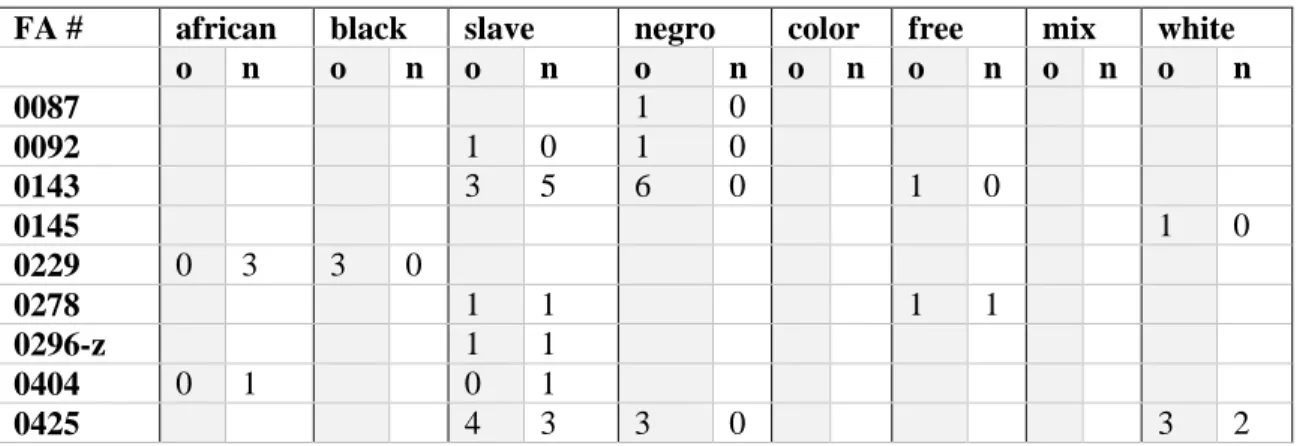
Table 10 shows all the instances of black and white race words. All of the finding aids in which they appear are listed along with frequency in old and new finding aids. Sixty-eight out of 242 finding aids contained words describing black people, or 26%. The majority of these finding aids have no mention of the race terms I searched in my list. Two hundred and forty-one instances of words relating to black people appeared in the original finding aids. One hundred and eighty-seven appeared in the updated finding aids, marking a significant decrease. Overall, there was a large increase in the use of
“African,” a large decrease in the use of “negro,” a smaller decrease in the use of “black,” and a similar number of instances of “slave.” The use of “white” also decreased.
FA # african black slave negro color free mix white
o n o n o n o n o n o n o n o n
0087 1 0
0092 1 0 1 0
0143 3 5 6 0 1 0
0145 1 0
0229 0 3 3 0
0278 1 1 1 1
0296-z 1 1
0404 0 1 0 1
0440 1 0
0467 1 0
0471 1 0
0486-z 0 2
0520 1 0 0 2
0521 0 24 0 50 1 1 0 1 0 3 1 6
0533 1 0 1 0 1 0
0656 1 0
0781a-c 0 1 10 1 20 0 2 0 2 0 2 0
0985 2 1 2 0
1059 1 3
1060 8 0 1 0 1 0
1109 1 0
1466 5 0 2 0 1 0
1563 1 0
1793 2 0
1832 1 0
1853 5 4 1 0
1854 2 0 3 0
1901 6 1 2 0 1 0
1910 2 2 6 0
2005 1 1
2042 1 0 4 0 16 0 4 0 4 0 2 0 6 0
2239 1 1 2 0 1 0
2333 1 0 1 0
2380 2 3
2537 1 0
2605 1 1 2 2 3 0 1 0
2610 0 13 1 1 24 0 5 2
2631 1 0
2636 1 1
2667 0 2
2810 0 5 2 3 4 0 1 0 2 0
2832 1 2 1 0
2850 2 1 1 0
2858a 1 0 1 0
2957 1 0 1 4
2982 1 0
2988 3 0
3117 1 0
3210 1 0
3307 1 0
3345 1 6 6 0 1 0
3399 1 2
3401[1] 1 0
3406 0 2 2 11 3 0
3522 3 3
3667 2 5 1 0 1 0 1 0
3803 1 0 1 0
3868 0 2 1 0 1 1
3879 1 0 1 0
3919 1 1
3956 1 0
4095 5 0
4106 1 0
4193 0 2
4256-z 0 8 2 0 0 4
4293 0 3 1 0
4304 4 0
total 3 73 18 3 99 107 121 4 6 7 17 4 3 4 23 10
o n o n o n o n o n o n o n o n
african black slave negro color free mix white
Table 10. Total instances of race words used on old and new finding aids. (Color=colored, mix=mulatto/mix. o=old, n=new.)
While the changes in word frequencies from old to updated finding aids are important to note, it is also telling to look at those changes within the context of all changes. When one word decreased in a particular finding aid, did another increase to take its place, or did that representation disappear altogether?
Overall, “African” increased use from three to 73 instances, while “negro”
decreased from 121 to four instances. This trend showed up in several of the finding aids. In #2610, “African American” increased from zero to 13 while “negro” decreased from 24 to zero. In #2810, “African American” increased from zero to five while “negro” decreased from four to zero. In #3345, “African American” increased from one to six instances while “negro” decreased from six to zero. All three of these in conjunction with the overall trend demonstrate that during the update archivists replaced the term “negro” with “African American” to describe black people, often directly.
because the finding aid was expanded during the update, increasing the representation of black people. In #3406, “Preston Davie Collection, 1560-1903,” race words also
increased, mostly “slave,” and it was also due to the expansion of the finding aid during the update. The increase in race words for these and other collections identifies the presence of documents regarding black people, and they will be more accessible to researchers who search for those words.
Other finding aids decreased in size with the update. #0781, #1060, and #2042 were significant examples of this. In finding aid #0781, “C. H. Wiley Papers, 1774-1962,” the chronological analysis description was not included in the updated finding aid. In #1060, “E. V. Howell Papers, 1725-1929,” the length of descriptions about the
contents of the collection decreased. In #2042, “J. B. Jones Papers, 1794-1894,” the removal of an excerpt from the Dictionary of Literary Biography accounted for the decrease in race words. Finding aid #0781 retained one instance of the word “slave,” but both #1060 and #2042 lost all race words, thus not representing the black people who were clearly present in the collection, and making those collections inaccessible to users searching for race.
white papers instead. It is archivists’ job to look for and indicate the presence of underrepresented groups, like black people, through archival description.
Archivists engaging in social justice and being critical of racism still need to organize and categorize documents, thus necessarily categorizing people. Since black people came to the United States through enslavement, their community identity was one of compulsion initially. However, contemporary black people can and do choose words to represent themselves. Archivists can use modern, accepted terms like “African
American” when possible, while still using words like “slave” when necessary to the context of documents.
When black people are mostly described as slaves, they are being described in the context of white people. The use of “enslaved” and “slave-owners” can help in
representing white people’s role and responsibility in slavery. While choosing “African Americans” and “black people” over “slaves” demonstrates humanity over a role,
eliminating “slaves” from vocabulary does still eliminate an important context. Slavery is an important part of American history, and to try to hide it would be a disservice to black people. Archivists must try to represent history accurately while maintaining respect and a sense of social justice for oppressed people.
Conclusion
Of the 242 finding aids examined for this study, 26% contained any words relating to people of color, demonstrating an overall lack of representation of these groups within the descriptions of white people’s documents. The comparison of race words between the old and the updated finding aids showed a shift in language usage. “African American” is used far more frequently in the updated finding aids while the use of “negro” dropped off almost entirely. Interestingly, the word “slave” is the term most often used in the updated finding aids to indicate the presence of black people, which is significant to the point in history in which these documents were created. The finding aids update increased some representation of underrepresented groups, but a few finding aids lost all race words and consequently the presence of black groups within the
respective collections.
It was not enough for archivists to modernize their language use; they also need to ensure they are not losing representation of the contents of the collections with updates to finding aids. The appearance and disappearance of race terms in these finding aids raises some important questions. Are there more people of color hidden in these updated histories, not indicated or signified? Lost due to using “white” as a default or perhaps a gap in the knowledge of current archivists? Or is this collection lacking in representation of people of color? Seeking the answers to these questions helps archivists discover how they can improve description of what they have and collect better, representative
Bibliography
Bennett, Claudette. “Racial categories used in the decennial census, 1790 to the present.” Government Information Quarterly 17.2 (2000).
Cook, Terry. “Evidence, memory, identity, and community: four shifting archival paradigms.” Archival Science 13 (2013): 95-120. Web.
Cook, Terry. “‘We are what we keep; we keep what we are’: archival appraisal past, present and future.” Journal of the Society of Archivists 32.2 (2011): 173-189. Web.
Daniel, Dominique, Levi, Amalia S. “Introduction: From containing to shaping to
performing ethnicity in archives.” Identity Palimpsests: Archiving Ethnicity in the U.S. and Canada (2014).
Flinn, Andrew. “Archival activism: independent and community-led archives, radical public history and the heritage professions.” InterActions: UCLA Journal of Education and Information Studies 7.2 (2011): 1-20. Web.
Flinn, Andrew. “Community histories, community archives: some opportunities and challenges.” Journal of the Society of Archivists 28.2 (2007): 151-176. Web. Harris, Verne. “Archons, aliens and angels: power and politics in the archive.” The
Future of Archives and Recordkeeping: A Reader. London: Facet Publishing,
2011. Print.
Ketelaar, E. “Sharing: collected memories in communities of records.” Arch Manuser 33.1 (2005): 44-61.
Marshall and Rossman, “Primary Data Collection Methods.” (2011).
Mayring, Phillip. “Qualitative Content Analysis.” Forum: Qualitative Social Research 1.2 (2000).
Latour, Bruno. “Visualization and Cognition: Thinking with Eyes and Hands.”
Knowledge and Society: Studies in the Sociology of Culture Past and Present 6
(1986): 1-40.
“Legacy finding aids.” Southern Sources: Exploring the Southern Historical Collection, 2011. Web. <http://blogs.lib.unc.edu/shc/index.php/legacy-finding-aids/> Punch, K.F. Developing Effective Research Proposals (2007). Sage.
Wildemuth, Barbara M. “Qualitative analysis of content.” Applications of Social