Hannah D. Pierce. A Content Analysis Study of the Equivalency of Publishers’ Easy Reader Leveling Systems. A Master’s Paper for the M.S. in L.S. degree. March, 2012. 68 pages. Advisor: Brian Sturm
This study examines the book and text features and language and literary features of easy reader books. Leveled easy readers published by HarperCollins, Random House, and Simon & Schuster were analyzed. The results reveal trends in the difficulty of sixteen book characteristics. The coding scores derived from content analysis were used to compare the leveling systems employed by the publishers. The study culminated in the creation of an equivalency chart that can be used to quickly compare the difficulty of easy readers on each level assigned by HarperCollins, Random House, and Simon & Schuster. Children’s librarians, school media specialists, and parents may use the equivalency tool developed during this study to assist them in selecting books for beginning readers.
Headings:
Children--Books and reading
by
Hannah D. Pierce
A Master’s paper submitted to the faculty of the School of Information and Library Science of the University of North Carolina at Chapel Hill
in partial fulfillment of the requirements for the degree of Master of Science in
Library Science.
Chapel Hill, North Carolina March 2012
Approved by
Table of Contents
Introduction ... 2
Literature Review... 4
Evaluation of Existing Leveling Systems ... 4
Criteria for Evaluating Easy Readers ... 7
Use of Easy Reader Books with Beginning Readers ... 15
Content Analysis ... 17
Method ... 19
Content Analysis ... 19
Publisher Selection... 20
Book Selection ... 21
Data Collection Instrument ... 22
Study Procedures ... 29
Advantages and Limitations of Study ... 30
Results ... 32
Publishers’ Leveling Systems ... 32
Analysis of Study Results ... 34
Equivalency Tool ... 50
Summary and Conclusions ... 54
References ... 56
Appendix A: Easy Reader Data Collection Instrument ... 59
Introduction
One important component of the mission of children’s librarians is selecting “the right book for the right child at the right time” (Peterson, 2001, p. 32). This task can be
particularly challenging when the child in question is a beginning reader. Books known as easy readers are written specifically for children who are learning to read. These books generally feature a large font, a controlled vocabulary, and illustrations that support the text, along with other features that aid and challenge beginning readers. Many publishers have attempted to facilitate book selection by assigning levels to the easy readers they publish. However, the variety of leveling systems used by
publishers can compound the challenge of choosing books for children. Since publishers use different leveling systems, a “level 1” book from one publisher may not be analogous to a “level 1” book from another publisher. The differing leveling systems used by
publishers may cause confusion and frustration for librarians and parents as they navigate the easy reader section to select books of appropriate difficulty for particular beginning readers. This content analysis study seeks to facilitate comparison of easy readers from different publishers with the goal of improving readers’ advisory practices in public
libraries and schools. My study was guided by the following research questions: 1. How do three major publishers assign levels to easy reader books?
In addition to answers to these questions, a final product of my study is an equivalency tool that librarians, educators, and parents can use to quickly compare the easy reader leveling systems used by three major publishers.
Literature Review
The goals of this literature review are to provide an overview of the research on easy reader leveling and to reveal a lack of published research on the equivalencies between levels assigned by publishers. Besides the readability formulas commonly used by some publishers, many other text-leveling systems exist. Two well-known holistic systems are the Guided Reading system developed by Irene C. Fountas and Gay Su Pinnell and the Reading Recovery program created by Marie Clay. The first two sections of this literature review present research on the effectiveness of existing easy reader leveling systems and the criteria researchers have used to evaluate these books. The third section of the literature review explores research on the use of easy readers in reading instruction. The literature review ends with a brief discussion of studies that used content analysis as a method for studying children’s literature. Researchers use a variety of terms
to refer to books for beginning readers. For the purposes of this study, the term easy readers refers to these books, while the term beginning readers refers to children who are learning to read.
Evaluation of Existing Leveling Systems
Many researchers have conducted studies of the effectiveness of various text leveling systems. Compton, Appleton, and Hosp (2004) compared readability (as determined by the Flesh-Kincaid and Spache readability formulas) with decodability (using the leveling system developed by Menon and Hiebert) in their study of the reading abilities of low- and average-achieving second-grade students. The researchers
discovered that “leveling variables emphasizing the relative word-recognition difficulties
closely aligned with passage-reading performance compared to readability formulas” (Compton et al., 2004, p. 182).
Hoffman, Roser, Salas, Patterson, and Pennington conducted a similar study, in which they evaluated the validity of the Scale for Text Accessibility and Support--Grade 1 (STAS 1; developed by Hoffman et al.) and the Guided Reading system developed by Fountas and Pinnell. The STAS-1 levels books using two subscales focused on the decodability and predictability of texts, while the Fountas and Pinnell system arranges texts on a continuum of 16 levels. This system considers a variety of book
characteristics, namely, “length, size and layout of print, vocabulary and concepts,
language structure, text structure and genre, predictability and pattern of language, and supportive illustrations” (p. 5). Through analysis of books and study of first-grade students’ reading performances, Hoffman et al. (2000) discovered that though both systems were “validated through student performance” (p. 16), each leveling system has
individual strengths. The researchers also point out that the techniques teachers use in reading instruction have a significant impact on student learning. Reading teachers cannot expect to be effective if they rely solely on text leveling in their classrooms rather than utilizing instruction methods such as pre-reading a book’s illustrations or text with students before they attempt to read the book independently. Both Compton et al. (2004) and Hoffman et al. (2000) note the limitations of readability formulas used by publishers, but they do not offer readers a solution for navigating the publishers’ varying levels.
purported to be at the same level” (p. 222), Dzaldov and Peterson (2005) analyzed 30
texts classified as Level G books by Fountas and Pinnell. Dzaldov and Peterson (2005) discovered “uniformity in many of the book, print, language, and literary features” (p.
227) of the books they analyzed. However, they also found variability in characteristics such as “pattern and repetition, spaces between lines and words, […] sentence structure, and perspective” (Dzaldov & Peterson, 2005, p. 227). The researchers also analyzed the
themes of the books. They noted a wide variety of themes, and believe that most children would find at least one of the thirty books appealing. This research shows that though books on the same Guided Reading level have some characteristics in common, this leveling system is not flawless. Also, the researchers were disappointed to discover that the books they analyzed did not feature characters from lower socioeconomic levels, and that females were represented much less frequently than males. Dzaldov and Peterson (2005) believe that “a student whose sociocultural experience is far removed from that of the characters in the text may feel frustrated when reading it” (p. 227). Such frustration may cause a student’s reading performance to suffer.
(Fry, 2002, p. 287) which is frequently determined by word length. He notes that
readability formulas provide objectivity, while leveling is more subjective. However, Fry (2002) also points out that readability formulas fail to account for factors “inside the reader’s head” (p. 289), such as motivation to read a certain text. He concludes that
readability formulas and leveling systems have different strengths. Though his
discussion of the process of evaluating a book using a readability formula is thorough, Fry (2002) does not note the confusion caused by publishers using different formulas to level their books.
Finally, Brabham and Villaume (2002) explore trends in text leveling and in the use of leveled text in classrooms. They discuss readability formulas, comprehensive leveling systems such as Reading Recovery, and progressions of decodable text based on phonics concepts. They also discuss the confusion caused by the variety of existing leveling systems. They write, “Attempting to match leveled progressions that are
grounded in different instructional paradigms is like trying to compare apples and oranges” (Brabham & Villaume, 2002, p. 440). Brabham and Villaume (2002) note that
though some equivalency charts exist, they contain inconsistencies and should not be blindly accepted. They cite an equivalency chart, but it is no longer available at the URL they provide.
Criteria for Evaluating Easy Readers
dissertation, she selected 88 Reading Recovery books to evaluate “with respect to six
categories: text and illustration layout; sentence length and text length; content and theme; illustrations; narrative form; and language patterns” (Peterson, 2001, pp. 19-20).
Peterson (2001) chose not to consider word choice as an evaluation criterion. She explains this decision by describing her observations of children struggling with “easy” words and reading “challenging” words with no difficulty (Peterson, 2001, p. 20). She also points out that “understanding the meaning of a text is a more complex process than identifying all of the words in the text” (Peterson, 2001, p. 21). Peterson (2001) prefers
to focus on how words work together to create content. She ultimately sorted the books she analyzed into 20 levels. Since she “decided it was impossible to write a description
that would clearly define the characteristics of each level of text” (Peterson, 2001, p. 20), she chose to arrange the levels along a continuum and describe the characteristics of groups of levels. Her continuum is as follows:
Getting Started (Levels 1-4) (p. 79) consistent placement of print
repetition of one or two sentence patterns
oral language structures commonly used by young children vocabulary commonly used by young children
unusual words, if used, are carefully framed in the context of supportive language
structures
familiar objects and actions
a story may have an opening and closing event, but the sequence of most events
could be changed without changing the meaning of the whole book Little Adventures (Levels 5-8) (p. 87)
repetition of two to three sentence patterns (phrases may change) opening, closing structures may vary from the interior text
oral language structures predominate, with a gradual introduction of literary, or
written language structures (“book language”) many familiar objects and actions
illustrations provide high to moderate support for the printed message
most stories have an opening and closing event, but the sequence of the events
between the opening and closing could be changed without affecting the meaning of the whole book
Expanded Narratives (Levels 9-12) (p. 96)
repetition of three or more sentence patterns
varied sentence patterns ([but still] repeated phrases or refrains) blend of oral and written language structures
subjects include familiar experiences and imaginative events illustrations provide moderate support for the printed message
events in many stories follow a sequence in which one event leads to another;
order of events could not be changed without affecting meaning greater vocabulary, more descriptive language, more details
text may have repeated phrases or refrains greater variety of words
specialized vocabulary for some topics (especially nonfiction) written language structures and literary language
oral language typically appears as dialogue conventional story with simple episodes
sequence of events usually occurs within an organizational framework readers can
easily recognize and use as an anchor of support while working with more complex vocabulary, sentence structures, and variations in sentence patterns in fiction, illustrations provide low to moderate support for the printed message;
the flow of events is often illustrated, but not specific words
in nonfiction, meaning of ideas and concepts are enhanced by illustrations,
diagrams, and photographs
Books on Peterson’s Levels 16-20 may fall into any of the following categories (arranged
in order of increasing complexity): One Problem to Solve (p. 118)
readers learn the focus of the book at the beginning of their reading each event shows another route to solving a problem
reader’s attention is always brought back to the problem language is conversational, chatty
natural repetitions of words and phrases that occur in casual speech
illustrations help readers understand and enjoy the story, but are not useful for
Time Marches On (p. 124)
events of a story focus on one theme the events move along in time
story events and nonfiction facts are developed in greater detail
readers need to understand how each new event develops from the previous event written language structures and literary language
vocabulary is more varied, but most words are familiar to readers
illustrations provide useful information for enjoying and understanding the story readers need to understand that some story events take place in the characters’
imaginations The Plot Thickens (p. 130)
plots are simple and straightforward, but episodes have shape and dimension characters have distinctive names and memorable personalities
vocabulary varies greatly, but most words are familiar to readers dialogue advances the plot
illustrations are important for the book as a literary work, but not essential in
helping readers understand the stories A Plethora of Possibilities (p. 135)
elaborated episodes
more descriptive detail fleshes out the plot, giving readers more to follow between
the high points of the action
vocabulary varies; most words are part of the readers’ spoken vocabulary, but
many [may] be new to them in print more sophisticated use of dialogue
nonfiction topics are more detailed, with some specialized vocabulary
Horning (1997) also lists specific characteristics of easy reader books to consider in the evaluation process. She is interested in both book content, which she defines as “what the author and illustrator have created,” and book design, or “how the publisher
has presented the work of the author and illustrator” (Horning, 1997, p. 129). The content characteristics she considers are vocabulary, sentence length, plot, and illustrations, while the design characteristics she discusses are size of typeface, line length, space between words, space between lines, number of lines per page, amount of white space per page, and placement of illustrations (Horning, 1997, pp. 129-137). Horning (1997) developed a three-level system for evaluating easy readers. She
describes the characteristics and audience of books at each level, and provides quotations from easy readers to support her discussion. Texts that Horning (1997) considers Level One books are generally appropriate for children in first grade, while her Level Two and Level Three books are written at a typical second-grade and third-grade level,
respectively.
vocabulary, size and layout of print, predictability, illustration support, and complexity of concepts. Besides creating a detailed list of their leveling criteria, the teachers developed descriptions of the strategies that readers need to use to read books at each level. The teachers realize that their system is not infallible and that students’ background
knowledge affects the appropriateness of books. Rather than a rigid standard, the new leveling system is intended to serve as a “pedagogical and professional development tool to support [teachers] in making informed choices about reading materials” (Rog &
Burton, 2001, p. 352). Rog and Burton (2001) also discuss the issue of publishers using a variety of leveling systems. They note the inconsistency between evaluation methods, and reveal that the challenge of navigating different leveling systems was what led the teachers to create their own system (Rog & Burton, 2001, p. 355).
Though they have not created their own leveling system, Watts and Nisbet (1974) provide a detailed discussion of criteria for evaluating children’s books in Legibility in Children’s Books: A Review of Research. Watts and Nisbet (1974) open their book with a discussion of issues surrounding scientific research on the reading process. They describe the eye movements that are associated with fluent reading, and share the variety of ways researchers have defined and studied “legibility.” Watts and Nisbet (1974) then
provide detailed information on the results of research studies that explored the ways typographic factors and use of color and illustrations affect reading performance. They emphasize that “every decision the publisher makes affects legibility” (Watts & Nisbet,
1974, p. 18). The first typographic factor Watts and Nisbet (1974) discuss is the use of upper and lower case print. They note that researchers have found that “beginners tend to
on graphic cues for word recognition” (Watts & Nisbet, 1974, p. 20). Since words
printed in all capital letters lack a familiar shape, they are more difficult for beginners to read. Other typographic factors Watts and Nisbet (1974) discuss are typeface and the use of serifs; the interrelationship of size of type, leading, length of line, and weight of print; margins; justified versus unjustified composition; numerals; punctuation; form of type used for emphasis; and paper surface. They provide visual representations of many different types of text to support their explanations. Watts and Nisbet (1974) also explore the results of research on the use of color and the size, position, and nature of illustrations in children’s books. Their recommendations for ways to increase legibility include using
high contrast color combinations for text and backgrounds, ensuring that illustrations relate closely to the information presented in text, and carefully choosing unambiguous ways to represent objects in illustrations.
Along with leveling systems, librarians, teachers, and parents may consult award lists as they choose books for beginning readers. Kruse (2007) discusses the Theodor Seuss Geisel Children’s Book Award, which is given to an easy reader book each year by
the Association for Library Service to Children, a division of the American Library Association. As Kruse (2007) shares, the purpose of the award is to honor the authors and illustrators of outstanding easy reader books that “demonstrate creativity and imagination to engage children in reading” (p. 36). Kruse (2007) emphasizes that these
37). Librarians, teachers, and parents who are selecting books for beginning readers should consider book quality in addition to content and design characteristics that may be studied in the leveling process.
Use of Easy Reader Books with Beginning Readers
A third significant area of research explores the use of easy reader books to support beginning readers. A large number of these studies are from the field of education and discuss reading instruction in the classroom. Menon and Hiebert (2005) “examined the effectiveness of a little book curriculum in facilitating the independent
word-solving skills of first-grade readers” (p. 13). For their 15-week quasi-experimental study, the researchers assigned two first-grade classes (“the intervention group”) to use “little books leveled according to features of linguistic content and cognitive load”
(Menon & Hiebert, 2005, p. 13), while two other first-grade classes at the same school (“the comparison group”) continued to use the basal literature program selected by the school district. The researchers chose to use a pretest and posttest to study the children’s
reading abilities. All of the children in the intervention classrooms “performed at significantly higher levels on the posttests than their counterparts in the comparison group” (Menon & Hiebert, 2005, p. 13).
learn how frequently teachers use different kinds of texts (predictable texts, vocabulary-controlled texts, and others) for reading instruction and whether this use is affected by individual factors including the teachers’ “instructional purposes[,] beliefs about
literacy[, and] state residency” (Mesmer, 2006, p. 395). Mesmer’s (2006) results suggest that “instructional purposes, beliefs about phonics instruction, and state residence exerted the greatest impact on reported use” (pp. 412-413). She discovered that many teachers choose genuine children’s literature for reading comprehension practice but prefer to use “texts with systematic attention to words” (Mesmer, 2006, p. 409) to help struggling
readers develop their technical skills. Overall, Mesmer (2006) found that teachers use a variety of text types, including easy reader books, for many different practical purposes. Brown (1999) and Glasswell and Ford (2010) discuss techniques teachers can use when they share easy readers in their classrooms. Brown (1999) shares ideas about using text as scaffolding, which she defines as “an instructional tool […] [that] may take the form of modeling, thinking aloud, reminding, and coaching” (p. 292). She discusses five
types of text--simple predictable text, transitional text, decodable text, easy readers, and authentic literature--and the ways each can be used to help beginning readers develop their skills. She describes three children at different reading levels and the ways teachers used books as scaffolding for these beginning readers. Brown (1999) believes that the question teachers ask should not be “Which text is best?” but rather “What type of text is best suited for achieving which purposes with whom, and when?” (p. 305). Glasswell and
leveled text primarily for guided reading and neglecting its potential usefulness for shared and independent reading. Glasswell and Ford (2010) hope their study will encourage teachers to use leveled books in a variety of innovative ways.
Content Analysis
Reading content analysis studies reveals the variety of ways researchers have used this method to learn about children’s books. The Dzaldov and Peterson (2005) study
discussed in the first section of this literature review uses content analysis to compare books assigned the same level in one leveling system. The researchers developed a system for coding book and print features including size of print, types of punctuation, and relationship of illustrations to print. They also coded language and literary features such as language structure and use of literary devices. The researchers based their coding system on the evaluation criteria used in Fountas and Pinnell’s Guided Reading system.
Additionally, Dzaldov and Peterson (2005) noted the main themes of each easy reader. They also analyzed story content such as setting and the diversity of characters’
sociocultural backgrounds. Their content analysis used both quantitative and qualitative approaches, giving the researchers a rich understanding of the similarities and differences between the books they analyzed.
Another content analysis study of children’s literature was conducted by Sturm,
Bosman, and Lambert in 2008. The researchers investigated the portrayal of secret spaces in 18 pieces of juvenile fiction. After they selected their books, all three
researchers read the novels and made note of all mentions of a secret space in each book. They combined their lists and then analyzed the master list for each book to gather
the secret space[s, and] the experiences of the secret space[s]” (Sturm et al., 2008, p. 87). The results of the researchers’ study “extend existing literature in many respects,
highlighting the potential connection between the location of the secret space and the child’s reason for creating it, and shedding new light on the transformative power of secret spaces” (Sturm et al., 2008, p. 83). Content analysis is a powerful and versatile
Method
Content Analysis
Holsti (1969) defines content analysis as “any technique for making inferences by
objectively and systematically identifying specified characteristics of messages” (p. 14). He notes that “content analysis must be objective and systematic” and that “it must be undertaken for some theoretical reason” in order for this research method to “be
distinguished from information retrieval, indexing, or similar enterprises” (Holsti, 1969, p. 14). Wildemuth (2009) also discusses content analysis, which she describes as “a
systematic approach to learning about particular aspects of a body of text or other messages” (p. 305). She relates this research method’s history in the field of
journalism/mass communication and discusses its use in information and library science (ILS) research. She writes, “The primary foci of [the information and library science
field] are recorded information and people’s relationships with it. […] Since content analysis focuses on the features of recorded information, it has been adopted as a useful ILS research technique” (Wildemuth, 2009, p. 297).
Publisher Selection
I selected three major publishers--HarperCollins, Random House, and Simon & Schuster--for my study. I used a complex process to select these publishers. First, I created a list of all the U.S. publishers of children’s books included in Livres Hebdo’s
2010 Ranking of the World’s Leading Publishers, which was published in cooperation
with Publishers Weekly in the U.S., Buchreport in Germany, and The Bookseller in the U.K. This report lists the “world’s 50 leading publishing conglomerates” as ranked by their “turnover exclusive of tax, as stated in their annual report for the 2009 financial year” (Livres Hebdo, 2010, p. 4). I then used my list of top U.S. publishers that publish children’s books to guide a search for easy reader lines in the online public access
catalogs of two public libraries. Since I conducted the study in central North Carolina, searching the catalogs of Chapel Hill Public Library (Chapel Hill, NC) and Orange County Main Library (Hillsborough, NC) at this point in the study ensured that the selected titles would be easy to access. Also, exploring the catalogs of two public libraries revealed which easy reader lines a public library is likely to have in its collection. Since the goal of the study was to help children’s librarians navigate their
easy reader collections, it was fitting to conduct content analysis of titles that are likely to appear on public library shelves.
During the search process, I noted how many recent easy readers from each publisher were included in the two public library collections. For the purposes of this study, “recent” refers to books published in the last 10 years (2001-2011). Though many
quickly become outdated. Also, catalog searches revealed that Random House publishes many books featuring characters from movies, such as Disney’s Cars and Tangled. The popularity of most movies fades quickly, and it is unlikely that young readers would be interested in movie tie-in books that are more than a decade old. When I completed all the searches, it was apparent that of the publishers on the list, HarperCollins, Random House, and Simon & Schuster were the most popular in the easy reader collections at both libraries. I determined that easy readers from these three publishers would be the artifacts for my collection analysis study.
Book Selection
During this study, I analyzed three books from each level of the leveling systems used by the three selected publishers. The HarperCollins “I Can Read!” series has five levels (HarperCollins, 2011), as does the Random House “Step into Reading” series (Random House Children’s Books, 2009). However, Simon & Schuster’s “Ready-to-Read” series has only four levels (Simon & Schuster, n.d.). Selecting three books from
each level resulted in a total of 42 titles to analyze.
consideration, I was able to compile a list of at least three books on each publisher-assigned level. After I listed enough books for each level, I publisher-assigned numbers to the books. To decrease bias, I then used a random number generator (available at www.random.org) to select three books from each publisher-assigned level.
Data Collection Instrument
I used Dzaldov and Peterson’s (2005) easy reader evaluation system as a model
for the data collection instrument developed for this study. As Dzaldov and Peterson (2005) developed their evaluation system, which considers book and print features and language and literary features, they considered “criteria identified by Fountas and Pinnell” (p. 224) in the 1999 book Matching Books to Readers: Using Leveled Texts in Guided Reading, K-3. In addition to building on Dzaldov and Peterson’s work, my data
collection instrument draws upon research by Horning (1997), Hughes and Wilkins (2000), Nikolajeva and Scott (2000), Tinkel (1996), and Watts and Nisbet (1974).
Like Dzaldov and Peterson’s evaluation system, the data collection instrument I
developed (see Appendix A) considers book and text features and language and literary features of easy readers. My coding system, which assigns smaller numbers to simpler book characteristics, gave me a numerical score revealing the complexity of each book. Each criterion I considered affects the difficulty of easy reader books. I analyzed the following book and text features: number of pages of story text, size of print, amount of leading, number of sentences that bleed over onto two or more lines, number of sentences that do not begin at the left margin, presence of organizational features, placement of sentences and phrases on the page, types of punctuation, number of illustrations,
type. I also considered the following language and literary features: perspective or point of view, language structure, literary devices, and syllables in words. Analyzing these criteria individually reveals how they affect the difficulty of easy readers.
Book and Text Features
The first characteristic considered in my data collection instrument is number of pages of story text. “Story text” refers to pages with words that tell the story. Front and
back matter and pages with only illustrations (even if words appear as part of the illustrations) do not qualify as pages of story text. Horning (1997) explains how book length affects beginning readers. She writes, “Children work hard to decode the text in easy readers” (Horning, 1997, p. 137). Longer books test a child’s endurance as he or she
does the hard work of reading. The second criterion on the data collection instrument is size of print, measured in points. Tinkel (1996) writes, “Common sense tells us that type size affects both legibility and readability, and studies seem to support this view” (p. 43).
She describes a study by Paterson and Tinker that discovered that deviations from “a standard text size (10- or 11-point, depending on typeface)” are difficult for adults to read. Hughes and Wilkins (2000) also discuss the widespread idea that “small print sizes […] make reading increasingly difficult and are more stressful to the visual system” (p. 315). Horning (1997) notes that while “most books for adults are set in typefaces of 10 to 12 points[, …] the standard size typeface for beginning readers is 18 points” (p. 135).
The size of print cannot be considered independently from leading, the third criterion on the data collection instrument. Lead is “a thin strip of metal used to separate lines of type in printing” (Merriam-Webster’s, 2006, p. 706) and for the purposes of this study “leading” refers to the amount of white space between lines of text. I measured leading on a point scale from baseline to baseline. “Baseline” is a typography term referring to “the imaginary line upon which all upper and most lower case letters are positioned” (Ambrose & Harris, 2006, p. 34). I found that the easiest way to measure
leading was to line up the marks on my ruler with serifs at the bases of letters that were resting on baselines. Hughes and Wilkins (2000) discuss research on an interesting phenomenon related to leading. They note that “because text often resembles a pattern of stripes[,] it can have aversive properties similar to patterns that induce illusions” (p. 315).
The researchers point out that some people are more susceptible to visual stress and illusions than others. These individuals may find reading text without enough leading to be especially difficult. Hughes and Wilkins (2000) explain that as leading increases, lines of text are less likely cause visual stress (p. 315). Standard leading for 18-point text is 36 points. However, as Tinkel (1996) discusses, researchers have found that this standard is not as easy to read as text set with two additional points of leading (ex. 18-point text with 38-18-point leading) (p. 43-44). Tinkel (1996) notes that Paterson and Tinker found that text with more or fewer than two additional points of leading was more
difficult to read (p. 43-44). Texts with one or zero additional points of leading are
especially challenging (Tinkel, 1996, p. 44). The coding for leading in my data collection instrument shows the influence of Paterson and Tinker’s research. To facilitate
points using a point ruler, specifically a C-Thru Graphic Art Ruler (3 in. x 13 3/4 in. transparent).
The next criterion on the data collection instrument is the number of sentences in an easy reader that bleed onto two or more lines. Beginning readers may be used to pausing at the end of each line. When sentences bleed onto multiple lines, readers cannot rest. Instead, they must find the beginning of the next line as quickly as possible and continue reading. For this study, I divided the number of bleeding sentences in each book by the number of pages of story text in that book to give an average number of bleeding sentences per page. I also found text-page averages for the next criterion, the number of sentences that do not begin at the left margin. Horning (1997) writes, “You should […] pay attention to where new sentences begin. New sentences beginning at the end of a line are harder for children to read” (p. 136). I counted indents at the beginning
of paragraphs as sentences that did not begin at the left margin. I determined the ranges of text-page averages to use for both of these criteria through experimentation with many of the easy readers selected for the study.
The next criterion is the presence of organizational features, specifically headings, tables of contents, and indexes. The inclusion of these features requires readers to
possess a high level of knowledge about book structure. Division of a book into chapters or inclusion of an index also indicates that a book is somewhat lengthy and complex. I did not consider glossaries or author’s notes as organizational features since they are
page. Consistent placement across a spread or throughout an entire book helps beginning readers stay focused on the challenging task of reading. When text jumps from the top of one page to the bottom of the next, readers must pause, find the beginning of the next section of text, and resume reading. Changing placement of words also contradicts the typical flow of text from the top left to the bottom right of a page, and can make it
difficult for readers to develop a habit of constantly looking ahead as they read. The next evaluation criterion, types of punctuation, was taken verbatim from Dzaldov and
Peterson’s coding instrument. They considered periods, commas, question marks, and quotation marks to be “simple” punctuation, while all other punctuation marks are considered “complex” and result in a higher coding number.
The next three criteria on the data collection instrument explore the use of
illustrations in easy readers. The first criterion is the number of illustrations in a book in comparison to the amount of text. Horning (1997) asserts that “in easy readers
illustrations appear on every double-page spread” (p. 137). However, Dzaldov and Peterson’s evaluation system allows for coding for less frequent illustrations, as does my
data collection instrument. Many easy readers have illustrations on the majority of pages with only one or two exceptions. More complex books contain many pages with no illustrations. I noticed these trends during the testing of my data collection instrument, and chose to give books with up to two pages of only text a smaller coding number (i.e., easier reading) than those with three or more pages without illustrations.
The next criterion, placement of illustrations, also has a considerable influence on the reading experience. Horning (1997) writes, ““[Illustrations] should not […]
the reader by taking over the text’s territory. They are there to complement the text, not compete with it” (p. 137). Also, Watts and Nisbet (1974) note that “the familiarity of
black [text] on white [background] will always be a determining factor in its higher legibility over other [color] combinations” (p. 76). The final criterion about illustrations
considers the amount of support that illustrations provide to print. Peterson (2001) notes that when children do not know the words in a text, they will look at an illustration and choose words that describe it (p. 31). Since children “read” illustrations as well as text,
the strength of the relationship between these two book features has an important effect on an easy reader’s difficulty. I borrowed terms from Nikolajeva and Scott (2000) for
this portion of the data collection instrument. They use five terms to describe types of relationships between text and illustrations. Though their research focuses on picture books, it can be applied to easy readers. Nikolajeva and Scott (2000) write:
In symmetrical interaction, words and pictures tell the same story, essentially repeating information in different forms of communication. In enhancing
interaction, pictures amplify more fully the meaning of the words, or the words expand the picture so that different information in the two modes of
communication produces a more complex dynamic. When enhancing interaction becomes very significant, the dynamic becomes truly complementary. (p. 225-226)
Since the illustrations support the text in all three of these types of word/picture
relationships, books with symmetrical, enhancing, and complementary relationships all received the simplest coding number for this criterion. However, Nikolajeva and Scott also describe two more unusual types of word/picture relationships. They write:
Dependent on the degree of different information presented, a counterpointing
dynamic may develop where words and images collaborate to communicate meanings beyond the scope of either one alone. An extreme form of
between the words and pictures to establish a true understanding of what is being depicted. (Nikolajeva & Scott, 2000, p. 226)
Since counterpointing and contradictory word/picture relationships require more work from the reader, I assigned them a higher coding number on my data collection
instrument.
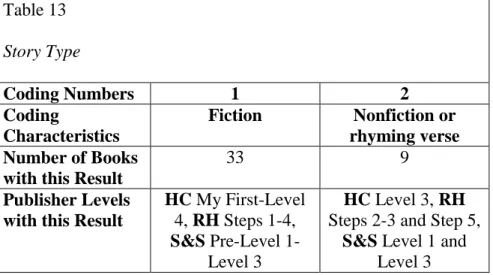
The final book and text feature on my data collection instrument is story type. This term refers to whether a book is fiction, nonfiction, or rhyming verse. Most beginning readers are familiar with story structure because they have been exposed to picture books, fairy tales, cartoons, or other works of fiction. They may not be as comfortable with reading facts. Also, though rhyme and repetition may make poetry easier for children to read, the way poems are structured on a page may initially be difficult for children to approach. These ideas about unfamiliarity led me to decide to give a higher coding score to nonfiction and poetry books.
Language and Literary Features
that “dependent clauses […] [make] the text harder to read” (p. 132). She notes that “‘Sam, a mean dog, bit my sister.’ is much more difficult to read than ‘Sam was a mean dog. He bit my sister’” (Horning, 1997, p. 132).
Next, I considered the use of literary devices, namely metaphor, simile, and onomatopoeia. I chose to keep this list short since literary devices are rare in easy readers, with the exception of onomatopoeia. Figurative language adds an extra layer of difficulty to the process of reading. Finally, I considered the difficulty of words by counting the number of multisyllabic words on the first page of each book. Multisyllabic words are less likely to be “sight words” that children can immediately recognize.
Study Procedures
My advisor and I worked together to revise my coding instrument several times before I began data collection. Part of the revision process was conducting a reliability study. My advisor and I each coded the same three easy readers. We then compared our coding sheets and discussed ways to clarify sections of the data collection instrument. Conducting a reliability study was an important step of my study procedures since the subjectivity of content analysis causes it to carry a greater risk of bias than many other research methods. My advisor and I also worked together to search for additional literature on the criteria listed on the data collection instrument. Our discoveries led to further revisions.
I entered the numerical data into two coding scores charts, one with publisher names and levels included and one with this information removed. I arranged the latter chart in numerical order based on the books’ total scores, and studied this chart as I created my
own system of six levels for data analysis purposes. I then studied the chart with the publisher information included in order to compare the difficulty of books by different publishers. The final step was creating the equivalency tool that is included in the Results section of this paper. I also investigated the leveling systems used by my three selected publishers by reading information provided on the publishers’ websites and in the easy readers themselves. A comparison of the publishers’ systems appears in the
Results section below.
Advantages and Limitations of Study
The design of this study has both advantages and limitations. Using content analysis to learn about easy reader books allowed me to work closely with the texts and understand the wide variety of characteristics that affect a book’s difficulty. Another
strength of my study is that I based my data collection instrument on work by other researchers. Wildemuth (2009) writes:
The first step in developing a coding scheme is to identify the critical variables you wish to examine […]. Ideally, your choice of variables is grounded in prior research and theory. If coding schemes related to your research questions already exist, strongly consider using them in the interest of comparability of results. (p. 300)
A limitation of the study is the subjectivity of my selected research method. Wildemuth (2009) writes:
coder is essential to demonstrate that your results are not skewed by a single coder’s subjective judgments and bias. (p. 301)
In order to fulfill academic requirements, I conducted this study independently. Steps I took to decrease bias include using a random number generator, conducting a reliability study, and frequently discussing my research with my advisor. However, it would be wise for me to work with a partner if I conduct further research in this area. Another limitation of the study is that it analyzes books from only three publishers. Finally, my study and all easy reader leveling research is limited by the fact that each young reader is an individual with different knowledge about reading and about topics on which books are written. Peterson (2001) writes, “There is no formula or system of leveling books
that can take into account the knowledge and experience of all children who read them” (p. 11). Clay (1991) also emphasizes this point, writing, “A difficult text is a text which
Results
Publishers’ Leveling Systems
HarperCollins, Random House, and Simon & Schuster each use their own system to assign levels to the easy readers they publish. My first research question inquires about how the publishers assign these levels. The publishers have anticipated that parents may be curious about the characteristics of books on each level of their systems. They provide limited information about their leveling systems on their websites and in the easy readers themselves. Unfortunately, this information describes the characteristics of books on each level without revealing the specifics of the leveling processes the publishers use. I have learned the following information from the publishers about their leveling systems: HarperCollins “I Can Read!”
My First (“Shared Reading”): “The first step to helping children become great readers is reading aloud to them” (website). “Basic language, word repetition, and whimsical illustrations, ideal for sharing with your emergent reader” (books) Level 1 (“Beginning Reading”): “For readers who are beginning to sound out
words and sentences” (website); “Short sentences, familiar words, and simple concepts for children eager to read on their own” (books)
Level 2 (“Reading with Help”): “For readers who are increasingly confident but still need some help” (website); “engaging stories, longer sentences, and language play for developing readers” (books)
Level 4 (“Advanced Reading”): “Chapter books for kids who are well on the road to becoming book lovers” (website); “Short paragraphs, chapters, and exciting
themes for the perfect bridge to chapter books” (books) Random House “Step into Reading”
Step 1 (“Ready to Read,” “Preschool--Kindergarten”): “Big type and easy words,
rhyme and rhythm, picture clues. For children who know the alphabet and are eager to begin reading” (books)
Step 2 (“Reading with Help,” “Preschool--Grade 1”): “Basic vocabulary, short
sentences, simple stories. For children who recognize familiar words and sound out new words with help” (books)
Step 3 (“Reading on Your Own,” “Grades 1-3”): “Engaging characters,
easy-to-follow plots, popular topics. For children who are ready to read on their own”
(books)
Step 4 (“Reading Paragraphs,” “Grades 2-3”): “Challenging vocabulary, short
paragraphs, exciting stories. For newly independent readers who read simple sentences with confidence” (books)
Step 5 (“Ready for Chapters,” “Grades 2-4”): “Chapters, longer paragraphs,
full-color art. For children who want to take the plunge into chapter books but still like colorful pictures” (books)
Simon & Schuster “Ready-to-Read”
Pre-Level 1 (“Recognizing Words,” “Rising Star Reader!”): “Shared reading,
Level 1 (“Starting to Read,” “Star Reader!”): “Easy sight words and words to sound out, simple plot and dialogue, familiar topics and themes” (website); “Simple stories, increased vocabulary, longer sentences” (books)
Level 2 (“Reading Independently,” “Superstar Reader!”): “Longer sentences,
simple chapters, high-interest vocabulary words” (website); “More-complex stories, varied sentence structure, paragraphs and short chapters” (books) Level 3 (“Reading Proficiently,” “Megastar Reader!”): “Larger, more complex
story plot and character development, challenging vocabulary words, more difficult sentence structure” (website); “Rich vocabulary, more-challenging stories, longer chapters” (books)
These publishers’ descriptions were written to sell books. They are vague, but may give
enough information to satisfy many parents. The descriptions indicate that publishers are considering some of the same criteria I included in my data collection instrument. My content analysis study of easy readers from these publishers sheds light on the
characteristics of books on each level.
Analysis of Study Results
The broadest way to look at the results of my study is to consider the total scores assigned to the books through the coding process. My coding instrument allows for total scores ranging from 16 to 42. The total scores for the easy readers I analyzed range from 21 to 39. This range includes 19 different numerical scores. I divided this range of 19 numbers into 6 levels to facilitate consideration of the difficulty of the publishers’ levels.
Level 2: Total scores 25-27, 11 books Level 3: Total scores 28-30, 2 books Level 4: Total scores 31-33, 9 books Level 5: Total scores 34-36, 8 books Level 6: Total scores 37-39, 4 books
The table below summarizes the levels I assigned using this six-level system. Table 1
How My Six Levels Correspond to Books on Each Publisher-Assigned Level
Publisher-Assigned Level Range of Total Scores My Corresponding Levels
HarperCollins My First 23-26 Level 1, Level 2 HarperCollins Level 1 23-27 Level 1, Level 2 HarperCollins Level 2 27-32 Level 2, Level 4 HarperCollins Level 3 31-34 Level 4, Level 5 HarperCollins Level 4 35-38 Level 5, Level 6
Random House Step 1 21-25 Level 1, Level 2
Random House Step 2 25-27 Level 2
Random House Step 3 27-32 Level 2, Level 4
Random House Step 4 34-36 Level 5
Random House Step 5 37-39 Level 6
Simon & Schuster Pre-Level 1 23-26 Level 1, Level 2 Simon & Schuster Level 1 23-29 Level 1, Level 3 Simon & Schuster Level 2 30-32 Level 3, Level 4 Simon & Schuster Level 3 33-36 Level 4, Level 5
A more comprehensive table of my results, including titles, publishers, publisher-assigned levels, coding scores, and the levels I publisher-assigned is available in Appendix B. Considering the books through the lens of this leveling system made it easy for me to see trends in the publishers’ leveling systems. For example, I quickly noticed that Simon &
within each publisher-assigned level. The books published by Random House are very similar in difficulty within most “Step into Reading” levels. All their Step 2 books are
Level 2 books in my system, and the total coding numbers for these books range from 25 to 27. Also, their Step 4 books (total scores ranging from 34 to 36) and Step 5 books (total scores ranging from 37 to 39) are consistently Level 5 and Level 6 books in my system, respectively. The other two publishers generally do not have such small ranges of total scores within their levels. The total scores for books on HarperCollins’s Level 2
range from 27 to 32, while the scores of the books on Simon & Schuster’s Level 1 range from 23 to 29.
Another way to explore the results of my study is to consider trends in answers to individual criteria on the data collection instrument. Below I have provided a chart for each evaluation criterion I considered. The charts show the number of books that received each coding score and the publisher-assigned levels of these books. I have presented the charts in the order in which the criteria appear on the data collection instrument. All percentages mentioned below have been rounded to the nearest whole number.
Table 2
Number of Pages of Story Text
Coding Numbers 1 2 3
Coding
Characteristics
1-16 pages 17-29 pages 30+ pages
Number of Books with this Result
1 25 16
Publisher Levels with this Result
HC Level 1 HC My First-Level
2, RH Steps 1-4, S&S Pre-Level
1-Level 3
HC Levels 2-4, RH Steps 3-5, S&S
Only one book, My Little Pony: Winter Festival by Ruth Benjamin, had fewer than 16 pages of story text. All the others require more endurance on the part of the beginning reader. It makes sense that the majority of the books have between 17 and 29 pages of story text since, like most picture books, easy readers are typically 32 pages. This standard allows for all of a book’s eight-page signatures to be efficiently printed on one large sheet of paper (Pattison, 2008). Some of these pages in each easy reader are used for front matter, leaving approximately 28 pages for story text and illustrations. Books with text on every page of a 28-page story received a 2 in this coding scheme, as did those with text on only slightly more than half the pages.
Table 3
Size of Print
Coding Numbers
1 2 3 4
Coding
Characteristics
24 pt.+ font 19-23 pt. font 16-18 pt. font <16 pt. font
Number of Books with this Result
13 8 18 3
Publisher Levels with this Result
HC My First-Level 1, RH Steps 1-2, S&S
Pre-Level 1-Level 1
HC Levels 1-3, RH Level 3, S&S Pre-Level
1, Level 1, and Level 3
HC Levels 1-4, RH Steps 3-5, S&S Levels 2-3
HC Level 4
As noted above, Horning (1997) determined that the standard text size for easy readers is 18 pt. My study does not support her assertion. In fact, 50% of the easy readers I coded had fonts larger than 18 pt. The largest font I measured was 28 pt. This text size was used in eight of my easy readers, in books published by Random House and Simon & Schuster. The three books with fonts smaller than 16 pt. were all on
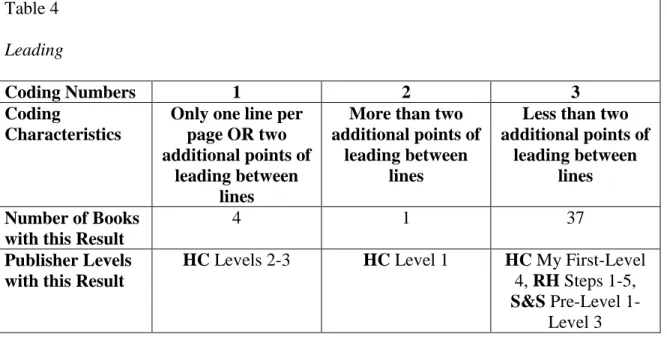
Table 4
Leading
Coding Numbers 1 2 3
Coding
Characteristics
Only one line per page OR two additional points of
leading between lines
More than two additional points of
leading between lines
Less than two additional points of
leading between lines
Number of Books with this Result
4 1 37
Publisher Levels with this Result
HC Levels 2-3 HC Level 1 HC My First-Level
4, RH Steps 1-5, S&S Pre-Level
1-Level 3
Table 5
Number of Sentences That Bleed onto 2 or More Lines (Per Text-Page Average)
Coding Numbers 1 2 3
Coding
Characteristics
0-1.5 1.51-2.5 more than 2.5
Number of Books with this Result
22 9 11
Publisher Levels with this Result
HC My First-Level 3, RH Steps 1-2, S&S Pre-Level
1-Level 3
HC Levels 1-2, RH Step 3, S&S Levels
1-2
HC Level 4, RH Steps 4-5, S&S
Level 3
I was not surprised by the results presented in Table 5. The easiest publisher-assigned levels had small numbers of bleeding sentences, while the most difficult publisher-assigned levels included large percentages of sentences that bled onto two or more lines. I found that even in the most difficult books, single sentences rarely bled onto more than three lines.
Table 6
Number of Sentences That Do Not Begin at the Left Margin (Per Text-Page Average) (Including Indents)
Coding Numbers 1 2 3
Coding
Characteristics
0 0.01-1.0 more than 1.0
Number of Books with this Result
14 16 12
Publisher Levels with this Result
HC My First-Level 1, RH Steps 1-3, S&S Pre-Level
1-Level 1
HC My First-Level 3, RH Steps 1-2, S&S Pre-Level
1-Level 3
HC Level 4, RH Steps 4-5, S&S
Levels 2-3
the left margin per text-page), and 29% earning a 3 (indicating an average of more than one sentence not beginning at the left margin per text-page). Like Table 5, Table 6 shows the highest publisher-assigned levels earning the highest coding number. It is interesting that all the Random House Step 3 books I analyzed did not have any sentences beginning at the left margin, though books on the first two levels of this publisher’s system included
some sentences that begin in the middle of lines. All of the books that earned a 3 for this criterion included indented paragraphs.
Table 7
Presence of Organizational Features (Headings, Table of Contents, Indexes)
Coding Numbers 1 2
Coding
Characteristics
No use of these features
Use of these features Number of Books
with this Result
25 17
Publisher Levels with this Result
HC My First-Level 2, RH Steps 1-4, S&S Pre-Level
1-Level 3
HC Levels 2-4, RH Steps 3-5, S&S
Levels 2-3
Table 8
Placement of Sentences and Phrases on the Page
Coding Numbers 1 2 3
Coding
Characteristics
At the top of the page throughout entire book OR at
the bottom of the page throughout entire book (may be on one or both
pages of each spread)
Changes position throughout the
book, but consistent across
each spread
Changes position throughout the book, including movement within
spreads
Number of Books with this Result
3 1 38
Publisher Levels with this Result
HC Levels 1-2, RH Level 1
S&S Level 1 HC My First-Level
4, RH Steps 1-5, S&S Pre-Level
Table 9
Types of Punctuation
Coding Numbers 1 2
Coding
Characteristics
Simple (period, comma, question
and quotation marks)
Complex (full range of punctuation)
Number of Books with this Result
1 41
Publisher Levels with this Result
S&S Level 1 HC My First-Level
4, RH Steps 1-5, S&S Pre-Level
1-Level 3
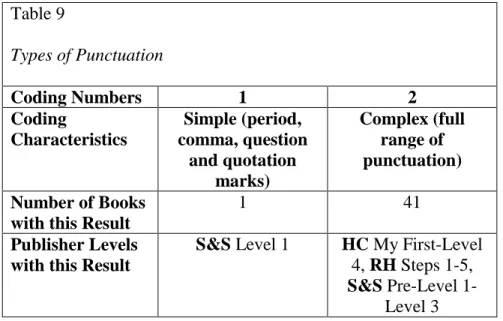
Dzaldov and Peterson (2005) considered only “period[s], comma[s], question and quotation marks” to be “simple” punctuation (p. 224). I borrowed their evaluation
criteria for this question on my data collection instrument. However, all but 1 of the 42 easy readers I coded had “complex” punctuation. The vast majority of these punctuation
Table 10
Number of Illustrations
Coding Numbers 1 2
Coding
Characteristics
Illustrations on every page with 2 or fewer exceptions
Text only on 3 or more pages
Number of Books with this Result
31 11
Publisher Levels with this Result
HC My First-Level 4, RH Steps 1-4, S&S Pre-Level
1-Level 3
HC Levels 2-4, RH Steps 4-5, S&S
Level 3
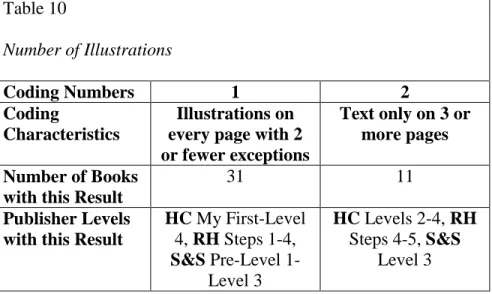
I found that the majority of my easy readers (74%) had illustrations on every page or nearly every page. These books came from a wide range of publisher-assigned levels. Random House Step 5 was the only publisher-assigned level that did have any books that received a 1 in the coding process for this criterion. As I expected, the books with three or more pages of only text were from higher publisher-assigned levels.
Table 11
Placement of Illustrations
Coding Numbers 1 2 3
Coding
Characteristics
Never overlap with text
Overlap with text on some pages
Overlap with text on all pages Number of Books
with this Result
12 27 3
Publisher Levels with this Result
HC My First-Level 1 and Levels 3-4, RH Step 1 and Steps
4-5, S&S Pre-Level 1 and Levels 2-3
HC My First-Level 4, RH Steps 1-5, S&S Pre-Level
1-Level 3
RH Step 2, S&S Pre-Level 1-Level 1
illustrations in only 29% of the books. In some of the books with overlapping
illustrations, the text remained black throughout, but in others, the text color changed as the background color changed. In many of the books, illustrations overlapped with text on only one or two spreads.
Table 12
Amount of Support That Illustrations Provide to Print
Coding Numbers 1 2
Coding
Characteristics
Primarily symmetrical, enhancing, or complementary
word/picture relationships
Primarily counterpointing or
contradictory word/picture relationships
Number of Books with this Result
42 0
Publisher Levels with this Result
HC My First-Level 4, RH Steps 1-5, S&S Pre-Level
1-Level 3
n/a
All 42 books were coded as a 1 for this criterion, meaning that they all have “primarily symmetrical, enhancing, or complementary word/picture relationships.” This
trend speaks to the design of easy readers in general. As discussed in the Method section above, beginning readers use illustrations as scaffolding as they do the hard work of reading. If illustrations have a counterpointing or contradictory relationship with the text, children cannot look at the illustrations for hints of what the text is describing.
Table 13
Story Type
Coding Numbers 1 2
Coding
Characteristics
Fiction Nonfiction or
rhyming verse Number of Books
with this Result
33 9
Publisher Levels with this Result
HC My First-Level 4, RH Steps 1-4, S&S Pre-Level
1-Level 3
HC Level 3, RH Steps 2-3 and Step 5,
S&S Level 1 and Level 3
Table 14
Perspective or Point of View
Coding Numbers 1 2
Coding
Characteristics
Whole text from perspective of 1 character or a 3rd
person narrator
Contains text from perspectives of multiple characters
Number of Books with this Result
40 2
Publisher Levels with this Result
HC My First-Level 4, RH Steps 1-5, S&S Pre-Level
1-Level 3
HC Level 3, RH Step 5
I was curious to see the results for the only poetry book in the study, It’s
Christmas! by Jack Prelutsky. This book received 10 out of 10 possible coding points for language and literary features. While many books scored a 9 for this portion of the data collection instrument, the only books that scored a 10 were the Prelutsky book and
Dinosaurs Alive!: The Dinosaur-Bird Connection by Dennis R. Shealy. These two books were the only easy readers in the study that included text from the perspectives of
multiple characters. The poetry book includes twelve poems, each featuring a different narrator. Prelutsky uses illustrations of different children to help readers differentiate between the many voices. In the Shealy book, comments and questions “from the reader”
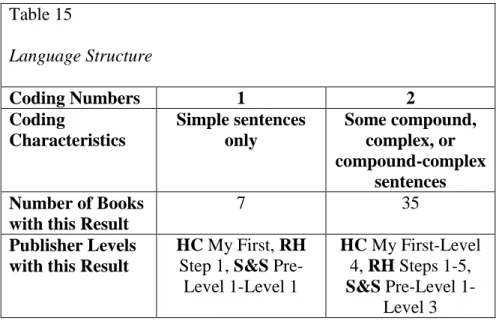
Table 15
Language Structure
Coding Numbers 1 2
Coding Characteristics Simple sentences only Some compound, complex, or compound-complex sentences Number of Books
with this Result
7 35
Publisher Levels with this Result
HC My First, RH Step 1, S&S
Pre-Level 1-Pre-Level 1
HC My First-Level 4, RH Steps 1-5, S&S Pre-Level
1-Level 3
I am not surprised that the books with only simple sentences are on the lower levels of the publishers’ leveling systems. However, I was not expecting these same
levels to also have books with some compound, complex, or compound-complex sentences. Books on every publisher-assigned level received a 2 in the coding process for this criterion. Publishers do not appear to be making simple sentence structure a priority as they produce easy readers.
Table 16
Literary Devices (Metaphor, Simile, Onomatopoeia)
Coding Numbers 1 2
Coding
Characteristics
Not present Present
Number of Books with this Result
20 22
Publisher Levels with this Result
HC My First-Level 2, RH Steps 1-5, S&S Pre-Level
1-Level 1
HC My First and Levels 2-4, RH Steps 2-5, S&S
I found literary devices in slightly more than half of the easy readers I analyzed. The majority of these literary devices were onomatopoeia. Some examples of
onomatopoeia from my easy readers are as follows:
“Hee-haw! Hee-haw!” (Pedro’s Burro by Alyssa Satin Capucilli, p. 32) “CRRRRICCCCCK.” (A Fairy Frost by Tennant Redbank, p. 40)
“Mary Ann used a small hammer and chisel. Tap, tap, tap.” (The Dog That Dug
for Dinosaurs: A True Story by Shirley Raye Redmond)
I also found some appearances of metaphor and simile. Some examples are as follows: “But real happiness is a nice, warm bed!” (Take a Hike, Snoopy! by Judy
Katschke, p. 31)
“‘Noah,’ Aunt Dora said, ‘you are as stubborn as a downhill mule on an uphill road.’” (Prairie School by Avi, p. 17)
“Dad sings like a buffalo and Mother like a moose, my sister sounds like breaking glass, my brother like a goose.” (It’s Christmas! by Jack Prelutsky, p. 35)
Table 17
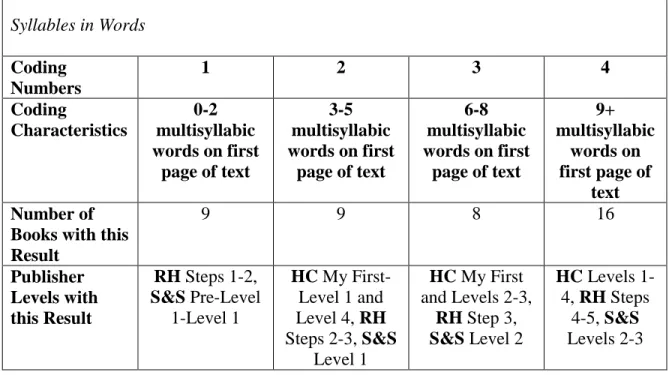
Syllables in Words
Coding Numbers
1 2 3 4
Coding
Characteristics
0-2 multisyllabic words on first
page of text
3-5 multisyllabic words on first
page of text
6-8 multisyllabic words on first
page of text
9+ multisyllabic
words on first page of
text Number of
Books with this Result
9 9 8 16
Publisher Levels with this Result
RH Steps 1-2, S&S Pre-Level
1-Level 1
HC My First-Level 1 and Level 4, RH Steps 2-3, S&S
Level 1
HC My First and Levels 2-3,
RH Step 3, S&S Level 2
HC Levels 1-4, RH Steps 4-5, S&S Levels 2-3
For the most part, these results are what I expected. Books on higher levels of the Random House and Simon & Schuster leveling systems had more multisyllabic words. However, I was surprised by the results of coding the HarperCollins books. One
HarperCollins Level 4 book, Prairie School by Avi, had only five multisyllabic words on its first page of text, while a book on Level 1 of the same system (My Little Pony: Winter Festival by Ruth Benjamin) had nine multisyllabic words, and twelve if the words
associated with rebus symbols were counted. This observation makes me curious how HarperCollins limits vocabulary in its easy reader production process.