ABSTRACT
ELAINE SYfvlANSKI. Time Series Behavior of Occupational Exposures (under the direction of
Professor Stephen M. Rappaport).
Prior studies have observed that exposure variability increased as a function of sampling
duration and attributed this phenomenon to autocorrelation. This study confirmed such behavior in
occupational exposure data after controlling for factors likely to contribute to variability and assessed
the impact of non-stationarity, as well as autocorrelation, on the results. Consecutive shift-long
exposure measurements for 54 workers from five different data sets in 149 time series were analyzed to
evaluate the variance as the interval between measurements increased. When the data were
combined a clear increasing trend in the variance was observed with lag. However, a breakdown by
data set revealed that the trend was present in only one of the five data sets. The effect was further
isolated to 42% of the workers who contributed data and to less than 1 /3 of the total number of time
series analyzed. Autocorrelation and non-stationary behavior explained the increase in 60% of the time
series where the trend was evident. Analysis of the entire database revealed that a small percentage
of time series produced significant first-order autocorrelation coefficients or were non-stationary over
the interval in which sampling was conducted. If these results are typical of other workplaces,
sampling strategies may not need to address problems associated with autocorrelation or
TABLE OF CONTENTS
Introduction
Time Series Analysis
Properties of Time Series 5
Stationarity 6
The Autocorrelation Function 6
Estimation of the Autocorrelation Function 7
Transforming Non-stationary Series 8
Time-Series Models 9
Applications of Time Series Analysis to Occupational Exposures 10
Short-Term Exposures 10
Long-Term Exposures 11
Analysis of the Study of Buringh and Lanting 12
Methods 15
Results 18
Variance versus Lag 18
Analysis of Stationarity and Autocorrelation 26
Conclusions 34
Appendix A
Breakdown of the Interval Between Pairs of Measurements
Appendix B
'--"JViJUXK^SSI^i
ACKNOWLEDGMENTS
I would like to thanl< my research advisor, Professor Stephen Rappaport, for the wisdom
and insight that he has provided during my studies and for his support throughout the duration of
this project. I am grateful for the enthusiasm and critical comments received from my readers,
Professors Michael Flynn and Deborah Amaral.
I owe particular thanks to my sister, Jane Yamashita and dear friend, Jane Tzudiker for
their friendship and support in making the move to North Carolina and in keeping close despite the
distance that separates us. Nearer by have been Kristin Jacobson and Laurie Cone. I am also
indebted to my parents for their unfailing confidence. Lastly, I am especially grateful to Basil
Browne whose support and encouragement made a difficult endeavor easier.
INTRODUCTION
Exposures to airborne contaminants in the workplace vary over time and between workers.
The variability in exposure can be attributed to characteristics related to the work environment such as
process changes, different production schedules, or varying ventilation rates. Differences in tasks or
work practices and the mobility of the worker can also influence exposure. To capture the inherent
variability in exposure, air concentration can be viewed as a continuous random variable whose
distribution is described by a theoretical model using a probability density function. The density
function, which is typically summarized by its first and second moments, i.e., the mean, and variance,
respectively, provides information about the relative likelihood of values the random variable can
assume.
Historically, the lognormal distribution has been used to characterize occupational exposures.
The distribution can be constructed based on information contained in a sample and used to make
inferences about the underlying population of exposures. However, adequate characterization of
exposures using statistical distributions relies heavily on the methods employed in the collection and
analysis of the data. A campaign in which one or more measurements is collected from a few workers
over a brief interval may be biased or otherwise inadequate to permit statistical inference because it
might not represent the full range of exposures. Rather, a random sampling design, where a sufficient
number of workers is sampled repeatedly over an adequate period of time to account for job rotation
and the full range of operations giving rise to exposures, is central to the collection of unbiased data.
Since such a random sample is representative of the underlying population, it should allow the
distribution of exposures received by workers to be defined. Sampling strategies relying on statistical
methods enhance our ability to conduct health effect studies, to evaluate appropriate control
measures, and to determine compliance with exposure limits.
An often overlooked, but potentially important, aspect of exposure assessment concerns the
autocorrelated. If exposures are positively autocorrelated, an observation above the mean is likely to
be followed by another value above the mean and vice versa, whereas negative autocorrelation arises
when consecutive values alternate above and below the mean. Autocorrelated observations are no
longer independent as is often required in statistical testing.
The classical model of occupational exposure views air levels as realizations of mutually
independent random variables in which the serial order of the data is unimportant. In contrast, a
time-series model takes the sequence of the observations into account and recognizes non-random as well
as random components. Both models employ statistical techniques to evaluate the properties of the
exposure distribution and allow for inferences to be made. While application of classical statistical
methods to autocorrelated data might lead to erroneous conclusions, time series analysis enhances
our ability to assess exposures accurately.
Three statistical properties underlie time series analysis, namely, autocovariance,
autocorrelation, and stationarity. The autocovariance function describes the covariance between
values in a time series and provides additional information about the second moment of the
distribution. The closely related autocorrelation function measures the extent to which present values
of a series are predictable from past values. Workplace scenarios depicting autocorrelation are not
difficult to construct. For example, previous exposures may contribute to present levels, particularly
over short sampling periods, or workplace and environmental factors may operate systematically to
dominate variation in exposures day-to-day.
The concept of stationarity refers to the stability of the underlying process over time.
Statistically, stationarity assumptions require unchanging mean, variance, and autocovariance
functions over the period sampled, i.e., the probability laws governing the process are assumed to be
constant over the interval in which data are collected or inferences are drawn. Process, production or
workforce changes may influence the underlying exposure distribution and result in a non-stationary
process. Non-stationary time series exhibiting changes in the mean or variance, seasonal patterns or
Questions about autocorrelation and stationarity are important as they have implications for
sampling and the assessment of dose-response relationships. Strategies to adequately assess
exposures may be compromised if they are autocorrelated over time scales which exceed the period
of sampling (Francis etal., 1989; Buringh and Lanting, 1991). Likewise, non-stationary behavior can
undermine the process of estimating parameters of the exposure distribution (Roach, 1990). Finally,
more variability in exposures is likely to be transmitted to the body burden when air concentrations are
autocorrelated than when levels are purely random. Such an increase in the variance of the series of
burdens may be important if damage is induced by some non-linear process (Rappaport and Spear,
1988).
Autocorrelation and stationarity are difficult to assess because they require relatively long
strings of consecutive measurements. This has led to a paucity of studies which have addressed the
issues directly (Francis etal.; 1989, Roach, 1990). Given the lack of suitable data, investigators have
developed indirect methods to approach the problem. For example, a recent study advanced such
techniques by looking at exposure variability as a function of sampling duration (Buringh and Lanting,
1991). That investigation suggested that the variance of occupational exposures, in a variety of
industries, was greater when based upon intra-week as opposed to inter-week measurements. The
purpose of this study is to determine whether such variance increases can be confirmed in
occupational exposure data after controlling for a number of factors (data set, worker, and number of
measurements) which were not considered in the study of Buringh and Lanting (1991). If such
behavior is revealed, then assumptions related to stationarity and autocorrelation will be examined to
TIME SERIES ANALYSIS
Historically, the 2-parameter log-normal density function (hereafter referred to simply as a
'log-normal' distribution) has been used to describe occupational exposures and is given by:
f(x) =---i5=exp
xcrvv27r
^(ln(x)-//y)
where x >0, -oo < (Xy < oo, and ay > 0.
y
The parameters of the log-normal distribution refer to the mean (ny) and variance (a^) of the
transformed random variable, Y=ln(X).
Application of the log-normal distribution to workplace exposures was reviewed by Rappaport
(1991) who provided empirical and theoretical evidence supporting such use when data are properly
collected. However, the mean and variance provide an inadequate summary of the distribution if
exposures are correlated. A third parameter, the autocovariance function, is necessary to define the
covariance between any two observations in time. When the autocovariance function is standardized
by the variance, the autocorrelation function is produced. The autocorrelation function describes the
proportion of variability that can be attributed to the covariance between sequential observations.
Estimates of the autocovariance and autocorrelation functions are the primary tools to evaluate the
serial correlation of exposure data and can be used to identify the appropriate time series models for
further analyses.
Trends, cycles, and seasonal variations, along with random fluctuations, are typical sources of
but reflect deterministic factors. Irregular fluctuations, which follow no recognizable pattern, are also
observed in exposure data. Thus, time series analysis involves decomposing the sources of variation
into its deterministic and random components and modeling the stochastic element.
Properties of Time Series
Time series models are built upon stochastic processes. A stochastic process is a collection
of time-ordered random variables and can be specified by the joint distribution of
ͣ
p<t}=Xt.|,Xt2...Xt^ for any set of times ti through t^. Each random variable at any time t is defined
by a probability density function describing the relative likelihood of all possible values. Thus the
behavior of a sequence of random variables defining the stochastic process will be determined from a
multivariate joint distribution. Although explicit characterization of the multivariate distribution is
difficult, it is straightforward to describe its parameters. For a stochastic process, the mean, variance,
and autocovariance functions are defined as follows (Chatfield, 1989):
^(t) = E(Xt)
o2(t)=Var(Xt) = E(Xt-^(t))2
r{t^,t2)=Cov[^Xt^,XtJ=E|xt^ -Mti)Jxt^ -Mt2)
An observed time series is only one realization of the process from an infinite number of time
series (called the ensemble) which could have arisen. In time series analysis, inferences are made
from a realization of the stochastic process in much the same manner that inferences in classical
statistics are made from random samples. In order to make inferences, the underlying process must
be ergodic and stationary. Ergodic theorems state that for stationary processes (to be defined
n
is an unbiased and consistent estimate of the population mean, i.e., E(Xn) = n and the variance of the
estimate, Var(Xn), goes to zero as n goes to infinity. Ergodic theorems also apply to the variance and
the autocorrelation functions.
Stationarity
A time series {X^} is said to be strictly stationary if the joint distribution of ^tv^t2'"'^Vi }'s
the same as the joint distribution of ^ttfk'^ta+k'•
ͣ
^Wk ^'°'^ ^" ^^'^^^ of t and time lag k. If a time
series is strictly stationary, the distribution function is the same at every point in time and depends only
on the interval between observations (i.e., the lag) and not on the actual values. This implies that
shifting the time origin by k has no effect on the joint distribution and that the covariance function
depends only on the lag.
Strict stationarity can not be confirmed in practice since knowledge of the complete
distribution function is impossible. A less formal and mathematically weaker definition deals with the
first two moments of the time series. Specifically, a time series is weakly or second-order stationary If
|x(t) is equal to a constant, |i, for all t, i.e., there is no trend, and the covariance matrix of
^tv^ta...^tn }'s the same as the covariance matrix of -P^ti+k'^ta+k'-^tn+k ^- ^^^^' ^°'^ ^ ^'"^^ series
which is second-order stationary, the covariance between two random variables is a function only of
the lag. The autocovariance function, Y(t, t + k), is therefore expressed by:
7(l<) = Cov(x^,X^^J = E{(x^-4Xt^k-/.)}
The Autocorrelation Function
If the joint distribution of -pCtv^ta...^tp }'s multivariate normal for all ti...t^, then the
process is completely specified by its first and second moments, i.e., by n(t) and y(t-| ,t2). The
autocorrelation function, p(k), measuring the relationship between any two observations in a time
series, Xt and X^+i^ and separated by a lag of k time units is given by:
Some important properties of the autocorrelation coefficient include:
1)-U P(k) ^1,
2)p(0) = 1.
3) p(k) = p(-k), and
4) if X^ and X^,,. |^ are independent, then p(k)=0.
Estimation of Autocorrelation Function
Sample statistics can be computed from time series data. The sample autocovariance as a
function of lag k, c^, can be computed by:
N-k,
Ck=-^ MXt-x)(xt*-x)
The sample autocorrelation coefficient, r\^, is estimated from the data according to the following
equation:
rk =
yjxt-xAxt4<-xj
Autocorrelation coefficients are not reliable for values of k larger than 25% of the series length
(Chatfield, 1989).
In order to determine whether there is any evidence of serial dependence, r|^ is plotted against
k in a graph called the correlogram. For a random series (a 'white-noise' sequence) and large n, the
autocorrelation coefficient is normally distributed with mean zero and variance 1/n (Diggle, 1990).
Thus, an approximate 95% confidence interval of the autocorrelation function can be found by:
-1/n ±2/yfn
In practice, the calculation of the interval is simplified to ±2/>Ai^, representing two standard errors from
Secondly, if only one or two coefficients is significant, the magnitudes and lags of the coefficients must
be considered when determining whether a time series is autocorrelated (Chatfield, 1989). Coefficients
far outside the confidence limits suggest an autocorrelated time series as do 'significant' coefficients at
lags that have some physical interpretation.
The pattern of the correlogram can also provide valuable information about the underlying
process (Chatfield, 1989). Autocorrelation coefficients decaying exponentially suggest a first-order
autoregressive process whereas a drop of the autocorrelation function to zero after lag one indicates a
first-order moving average process. It may be difficult, however, to distinguish between exponential
decay and zero autocorrelation if the sample isn't very large. The correlogram may also be useful in
identifying non-stationary behavior if the series of coefficients decays slowly.
Transforming Non-stationary Series
Non-stationary time series exhibiting changes in the mean or variance or seasonal or cyclic
behavior must be transformed before they can be analyzed. Various methods are available to
transform the data and include constructing moving averages, fitting a polynomial to the data, and
differencing. Although a large part of time-series analysis is devoted to transforming a non-stationary
series into a stationary series, recognizing non-stationary behavior may be more important in
exposure assessment than applying methods to make the data suitable for subsequent analysis.
Differencing is typically used to remove a trend and to make a time series stationary.
First-order differencing removes linear trends. The first difference for a time series {X^} for (t-j, t2,... tj
defines a new time series {D^} for (tg, t.|,... tr,.-|) where:
dt=Xt+i-Xt = Vxt^
The autocorrelation function of the differenced data will rapidly decay to zero if the original
time series consists solely of a trend and of a stationary stochastic process. In practice, removal of a
trend may induce spurious autocorrelation into the residual sequence so interpretation of the
transformed series for autocorrelation can be limited (Diggle, 1990).
Time-Series Models
Several probability models have been developed to represent different types of stochastic
processes underlying stationary time series. Two useful models rely on autoregressive (AR) and
moving average (MA) processes. An autoregressive model of order p, abbreviated AR(p), expresses a
current value in a time series as a function of p preceding values plus random error. The dependent
variable is regressed on previous values rather than on independent variables as in a regression model.
MA models relate the current time series value to the random errors from preceding time periods rather
than to previous values as in AR processes. Combining characteristics from both AR and MA
processes defines another set of models for time-series analysis, the autoregressive moving average
APPLICATIONS OF TIME-SERIES ANALYSIS TO OCCUPATIONAL EXPOSURES
The first-order autoregressive process (AR(1) process) has been used to describe
occupational exposures where current values are expressed as a weighted function of the previous
exposure plus random error (Roach, 1977; Spear etjj., 1986; Preat, 1987; Rappaport and Spear, 1988;
Francis eta)., 1989). The model can be specified as follows:
X^ = a Xf.-i + Zi
where X^.i and X^ are sequential air concentrations, a is the autocorrelation parameter, and Z^ is a
variable from a purely random process with mean zero and variance of. The mean and variance of Xj
are given by:
^ = E(Xt) = 0
Var(Xt) = a^ = a^/(1-a2)
The autocorrelation function is:
p(k)=a'< fork > 0.
Short-Term Exposures
The issue is to determine whether occupational exposures are correlated and to apply the
appropriate probabilistic model. A review of the literature suggests that very little data is available to
answer this question (Rappaport, 1991). Some of the earliest work identified time-dependent,
non-random factors influencing occupational exposures measured continuously over short intervals
(Coenen, 1971; Roach, 1977). Theoretical models suggest that significant autocorrelation is likely with
intra-shift exposures. Roach (1977), Spear etal. (1986) and Rappaport and Spear (1988) derived
expressions for the autocorrelation coefficient as a function of the air-exchange rate in short-term data.
with different averaging times using methods developed for geostatistics. These relationships show
that the means of the short- and long-term distributions are the same but that the variances are not.
The variance tends to increase as the averaging time decreases. Secondly, the variance of shift-long
exposures is larger when the shorter-term measurements are serially correlated than it would be in the
absence of any autocorrelation.
Long-Term Exposures
Assessing correlation in day-to-day exposures has been more problematic. The influence of
autocorrelation in estimating the parameters of a distribution of day-to-day exposures was explored by
Francis etal. (1989). Three exposure distributions were simulated using a Ist-order autoregresslve
model with the same mean and variance but with different levels of autocorrelation. In analyzing sets
of five sequential time-measurements sampled from each distribution, they found that higher levels of
autocorrelation were more likely to result in less precise estimates of the mean and to underestimate
the variance. Their findings have particular Implications to sampling campaigns restricted to periods
of a weel< or less where autocorrelation may be more likely, although it may be prudent to consider
serial correlation in data collected over longer periods of time.
Workplace or environmental factors likely to systematically influence shift-long exposures have
been identified (Esmen, 1979; Ulfvarson, 1983; Burlngh and Laming, 1991). Esmen (1979) observed a
higher correlation between exposures resulting from batch processes than with continuous operations.
Ulfvarson (1983) observed a relationship between production and exposure in the dry-cleaning and
metal industries where higher productivity levels mid-week were accompanied by higher exposures.
The Influence of seasonal effects on exposures in outdoor workplaces has also been noted (Ulfvarson,
1983; Burlngh and Lantlng, 1991). "
Buringh and Lanting (1991) evaluated exposure variability in data collected over different
sampling periods. They observed that variance estimates in data collected within a week were smaller
than those from data collected over longer intervals and attributed this to serial correlation. The
authors also argued that their results, coupled with the limited resources usually available for sampling,
provided a rationale for 'worst-case' sampling strategies. This recommendation is in stark contrast to
arguments in favor of strategies based on statistical approaches rather than on conventional methods
(Rappaport, 1991).
Analysis of the Study of Buringh and i-anting
The study of Buringh and l_anting (1991) deserves close scrutiny given the far-reaching
conclusions of the authors. The analysis was based on a large number of data sets (420) from indoor
workplaces. Personal exposure measurements were used, ranging between 3 to 13 observations per
set. The data were assembled into two groups according to the time interval over which the
observations were collected; 249 sets of measurements were collected within a week and 171 sets
spanned more than a week.
When the mean geometric standard deviations (GSDs) for the two groups of data were
compared a larger value was observed for the group containing sets collected between weeks. A
computer simulation was also conducted in which 10,000 data sets, proportional in size and number to
the original data, were drawn equally between a random series and a series following an
autoregressive process (p(1) = .8). The distribution of the GSDs from the simulated data approximated
the values obtained from the actual data. The authors concluded that the workplace exposures were
probably autocorrelated.
A major drawback in the analysis conducted by Buringh and Lanting was the lack of control
for factors likely to contribute to variability. These factors include industry, location, type of exposure,
worker, and number of measurements per sample. Although the data spanned a wide cross-section of
from a battery factory, a printing office, automobile factories, powdered-soap factories, and
dry-cleaning shops contributed entirely to the group whose measurements were collected within a week.
The data were also disproportionately distributed by industry. Notable was the preponderance
of data from the cattle-feed industry (approximately 60%) in the group of data collected over the longer
time period. An unequal breakdown by type of exposure also characterized the two groups. For
example, dust was the predominant exposure evaluated in the data collected over longer sampling
periods (78% of the measurements) compared to the other group (42% of the measurements).
Failure to control for worker may also have confounded the findings. Exposure variability can
be partitioned into two components, a component associated with time (day-to-day variability) and a
component associated with worker (between-worker variability). The between-worker component can
be relatively large among some groups making it an important source of variation (Rappaport, 1991;
Rappaport, et al., submitted, 1992). In those cases where the same workplace but different workers
contributed data in the groups constructed for comparison, it is impossible to isolate the day-to-day
component of variance, which is needed for such comparisons, from the total variance in exposures
(sum of within and between components).
Given the lack of control for worker, industry, location, and type of contaminant, the observed
increase in the variance estimates with sampling period might be a spurious finding or might not be the
result of autocorrelation as suggested by the authors. Since some of the data used in the analysis was
collected over periods of months, a question is raised about the stationarity in the underlying process
giving rise to exposure. Decreasing or increasing trends in exposures due to process or production
changes, for example, would be masked entirely since relatively few measurements were collected.
Yet such trends could contribute to large but unstable variance estimates. It becomes particularly
relevant to the analysis if a workplace contributed data to both groups, reflecting a stationary process
within a week but non-stationary conditions over the longer time interval.
measurements. The group containing data within a week was almost 11/2 times larger than that
containing data between weeks so the precision of the estimates could have differed. Lastly, since the
standard errors of the estimates were not provided, it is difficult to determine if the differences were
significant.
In conclusion, several questions are raised regarding the study of Buringh and l_anting (1991).
Was the analysis rigorous enough to support conclusions that intra-week exposures were likely to be
significantly autocorrelated? If not, how could the design of a study be improved to determine if
day-to-day variability in exposures increases with the sampling period? And, finally, if the observed effect is
real, how might autocorrelation and non-stationarity be evaluated as contributors to the apparent
trend?
METHODS
A database has been constructed of approximately 20,000 exposure measurements collected
by personal sampling from workers in a broad cross-section of industries worldwide (Kromhout et at,
in preparation, 1992). In addition to air concentrations, the database recorded industry, process,
production, sampling, and workplace characteristics for each data set. The database was accessed to
identify workers who contributed at least 30 consecutive measurements. Fifty workers from five data
sets met this criterion. To address problems with missing data and periods of non-exposure due to
absences, intervals of up to seven days between sequential measurements were permitted; however
most sequences had measurements no more than one or two days apart.
The breakdown of data by industry appears in Table 1. There were four workers exposed to
alkyl lead and inorganic lead in an alkyl manufacturing plant, 28 workers exposed to an organic vapor
at a pesticide-production facility, 15 workers exposed to inorganic mercury in a chloralkali- processing
plant, and 3 workers exposed to isopropyl alcohol in an automobile-manufacturing plant. Twenty-five
workers (23 from the pesticide-manufacturing plant and two from the automobile-manufacturing plant)
were sampled over longer intervals and contributed multiple time series. In nine instances, data were
so extensive that six to 14 strings (30 measurements per string) per worker were constructed. Overall,
there were 149 time series analyzed in the study.
Table 1. Breal<down of the data analyzed in the study.
1 Data Set
Exposure
No. ofWorkersNo. of Time 1
Series
Alkyl Lead Manufacturing
Plant
Alkyl Lead
4 41 Alkyl Lead Manufacturing
Plant
Inorganic Lead
4 4Pesticide-Production Facility
Organic Vapor
28 120Chloralkali-Processing Plant
Inorganic Mercury
15 15Automobile-Production Plant
Isopropyl Alcohol
3 6For each time series, the natural logarithms of the air concentrations were computed, i.e.,
yn = ln(Xr,) for (n-], n2...n^QJ. Pairs of measurements (log-transformed data) were obtained at a lag of
1 to 10 days. The lag period dictated the number of pairs that could be formed. For example, 29 pairs
separated by one day could be constructed from a string of 30 measurements by coupling consecutive
values (yn, yn+1) for n=1 to 29. Only 20 pairs could be assembled when lagging values by 10 days
(y^,, yn + io) ^o"" "^ ^ *° 20. Twenty pairs of measurements were randomly selected for each lag period
(except for lag 10) so that an equal number of data points for each lag contributed to the analysis, in
total, there were 200 pairs of measurements associated with each time series grouped by the number
of days separating each pair. At each lag, the mean value of the variances (Sy) for the 20 pairs was
computed. The number of days separating each pair was also averaged by lag period to assess any
unevenness in the spacing of the data.
The relationship between the variance and lag was first examined by combining the data from
all data sets. Subsequent analysis investigated the mean variances by industry, followed by workers in
a given industry, and by individual time series by worker in a given industry. Each level of analysis
included plots of the mean value of the variance by lag period. It was of interest to note what patterns
changed in the plots as the level of analysis was broken down by factors likely to contribute to
variability.
variable for time if the data appear to have a linear trend. The statistic for the estimate of the parameter
for the residual term provides the statistical test for stationarity and has a distribution derived by Fuller
(1976). The null hypothesis assumes non-stationarity so constraints by sample size may limit the
power to reject non-stationarity. To investigate this possibility, longer time series, ranging in size from
61 to 143 measurements, were constructed and examined for non-stationarity.
Non-stationary series were transformed by differencing to attempt to remove linear trends in
the data. The differenced series were examined visually and reanalyzed for stationarity and
autocorrelation. Correlograms were generated and examined to determine if any coefficients were
RESULTS
Variance versus Lag
The results comparing variance to lag for each separate analysis appear in Table 2. Overall,
the variance increased with lag when data from the five data sets, comprised of 54 workers and 149
time series, were combined. The analysis by data set, however, revealed that this effect was present in
only one of the five sets, namely that from the pesticide production facility. Finally, it was further
demonstrated that the trend was evident in only 1 /3 of the time series analyzed among the pesticide
workers.
Table 2. Percentage breakdown from the analysis relating variance to lag
by set, worker, and time series.
1 Data Set
Trend BetweenVariance and
Lag?
% of Workers
Displaying a
Trend*
% of Time Series 1
Displaying a
Trend*
Alkyl Lead Manufacturing
Plant (alkyl lead)
No
0 (0/4)
0 (0/4)
1 Alkyl Lead Manufacturing
Plant (inorganic lead)
No
0 (0/4)
0 (0/4)
1 Chloralkali-Processing Plant
No13 (2/15)
13(2/15)
Automobile-Production Plant
No33(1/3)
17(1/6)
Pesticide-Production Facility
Yes64 (18/28)
35 (42/120)
Total:
42(21/54)
30 (45/149) 1
* Actual numbers out of the total are given in parentheses.
Figure 1 plots the variance versus lag when all of the data is combined. The variance ranges
from about 1.4 to over 2.0 with a clear increasing trend between variance and the lag period
separating pairs of measurements. This result is consistent with the major finding observed in the
2.50
Z.OO
1.00
0 1 2 3 4 S 6 7 8 9 10 11 12 13 14 1$
Lag Period (Days)
Figure 1. The variances between 2,980 pairs of log-transformed
data were averaged at each lag period (20 pairs/lag from
each time series; 149 time series in total from 5 data sets).
A breal<down by industry, however, quickly changes the interpretation of the data and
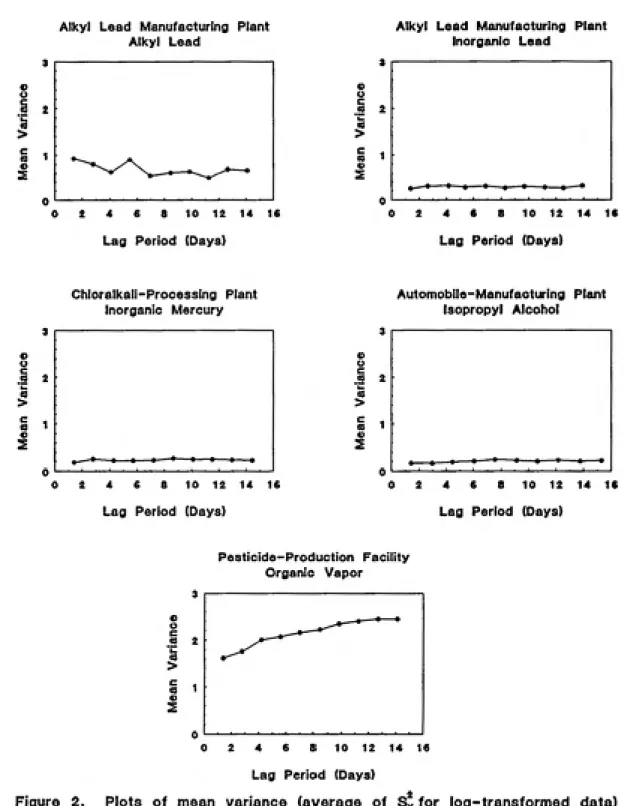
becomes extremely informative. Graphs for each of the five data sets are plotted in Figure 2. Of the
five data sets, only the pesticide-production facility shows a trend between the mean variance and the
lag. The alkyl lead manufacturing plant (alkyl lead and inorganic lead), the chloralkali-processing plant,
and the automobile-manufacturing plant data display no increase in the mean variance with lag.
These four data sets are characterized by relatively stable variances as the lag increases, although the
variance fluctuates slightly in alkyl lead exposures at the lead manufacturing plant. In contrast, the
pesticide-production facility data exhibits a significant increasing trend between variance and lag. Air
concentrations are highly variable, with mean values for the variance among pairs of measurements
from approximately 1.6 at lag 1 to around 2.4 at lag 10. These results indicate that the trend observed
in the combined data sets (Figure 1) arose in fact from the contribution of the pesticide-production
Alkyl Lead Manufacturing Plant
Alkyl Lead
2 4 6 8 10 12 14 Ifi
Lag Period (Days)
Alkyl Lead Manufacturing Plant
Inorganic Lead
2 4 6 8 10 12 14 16
Lag Period (Days)
o c
.3
*c
a
>
c
(0 «
2
2
Chloralkall-Processing Plant Inorganic Mercury
2 4 e 8 10 12 14 16
Lag Period (Days)
Automobile-Manufacturing Plant Isopropyl Alcohol
0 2 4 6 8 10 12 14 16
Lag Period (Days)
Pesticide-Production Facility Organic Vapor
« o
c
« (S
>
c
a 0)
2
0 2 4 6 8 10 12 14 16
Lag Period (Days)
Figure 2. Plots of mean variance (average of Sy for log-transformed data)
In an effort to further isolate the effect, data for each worker was assessed separately. None of
the data from the lead-manufacturing plant showed a discernible pattern between variance and lag.
Two plots shown in Figure 3 provide an illustration of the lack of trend between variance and lag in the
data generated at this facility. Graph A depicts data from Worker 4 exposed to alkyl lead while Graph B
plots the inorganic lead data for Worker 3. Both of these plots appear erratic and are characterized by
mean variances that fluctuate randomly with lag.
. Alkyl Lead Manufacturing Plant
A Alkyl Lead
B
Alkyl Lead Manufacturing Plant
Inorganic Lead
Worker 4
0.80
0.40
o.oo
Worker 3
4)
() /
C * /
Id A /
k. A / \ / 1
a
> 0.40
/ \ / \ 1
c
\ \ /
o 1 \ J* \ -/ 1 4) • w"'''^ \ m'"'^^
S
\J
0 2 4 6 8 10 12 14 16
Lag Period (Days)
0 2 4 6 8 10 12 14 16
Lag Period (Days)
Figure 3. Plots for two workers at the alkyl lead manufacturing plant.
Mean variances (average of Sy for log-transformed data) in both plots
appear to fluctuate randomly with lag.
data for Worker 15 in Figure 4-B at the pesticide plant is characterized by extremely large and variable
exposures, ranging from about 1.6 to over 3, whereas the values for the other two workers (Figures 5-B
and 6-B) are considerably smaller and less variable (ranging from 0.08 to 0.5). Overall, these results
suggest that the trend observed from the combined data set originates in the strings of 18 workers
from the pesticide production facility.
Pesticide-Production Facility
Organic Vapor
B
Pesticide-Production Facility Organic Vapor
Worker 10 Worker 15
8 10 12 14 IS 8 10 12 14 16
Lag Period (Days) Lag Period (Days)
0.20
Chloralkali-Processing Plant
Inorganic Mercury B
Worker 1 1
0.15
10 12 14 16
« o
c
.2
a
>
0.80
0.40
0.20
Chloralkali-Processing Plant
Inorganic Mercury
Worker 2
10 12 14 16
Lag Period (Days) Lag Period (Days)
Figure 5. Plots for two workers at the chloralkaii-processing plant.
Graph A shows no relationship between variance and lag whereas
Graph B displays a trend of increasing variance with lag. Variances
were computed using log-transformed data.
. Automobile-Manufacturing Plant
f^ Isopropyl Alcohol
B
0.20
Worker 1
0.16
Automobile-Manufacturing Plant
Isopropyl Alcohol
Worker 3
0.10
8 10 12 14 IS 18 0 2 4 6 8 10 12 14 16
Since some workers were sampled over longer intervals and contributed multiple strings of
data, the final analysis was conducted by individual time series to decipher differences over time.
Forty-five of the time series showed an increase of variance with lag. The majority (42) were drawn
from the data collected at the pesticide-production facility with the remaining series split between two
workers at the chloralkali-processing plant and one worker at the automobile-production plant.
The contrast between the analyses conducted by worker and by time series focused primarily
upon the pesticide-production plant where the overall trend arose. Although 64% of the workers
displayed an increasing variance with lag, it was found that approximately 2/3 of the data for these
workers showed no such trends. Thus, it appears that relatively few time series per worker dominated
the analysis. Figure 7 provides an illustration by plotting five time series for Worker 13 from the
pesticide facility. Three of the time series, graphs A-C, show no consistent trend between variance and
lag. In contrast, graphs D and E are characterized by marked upward trends, particularly in graph D.
The plot for Worker 13 combining all of the time series, in graph F, also shows a trend of increasing
variance with lag.
The unevenness in the spacing of the data due to absences and days of non-exposure was
assessed by averaging the number of days separating pairs of measurements for each lag period. The
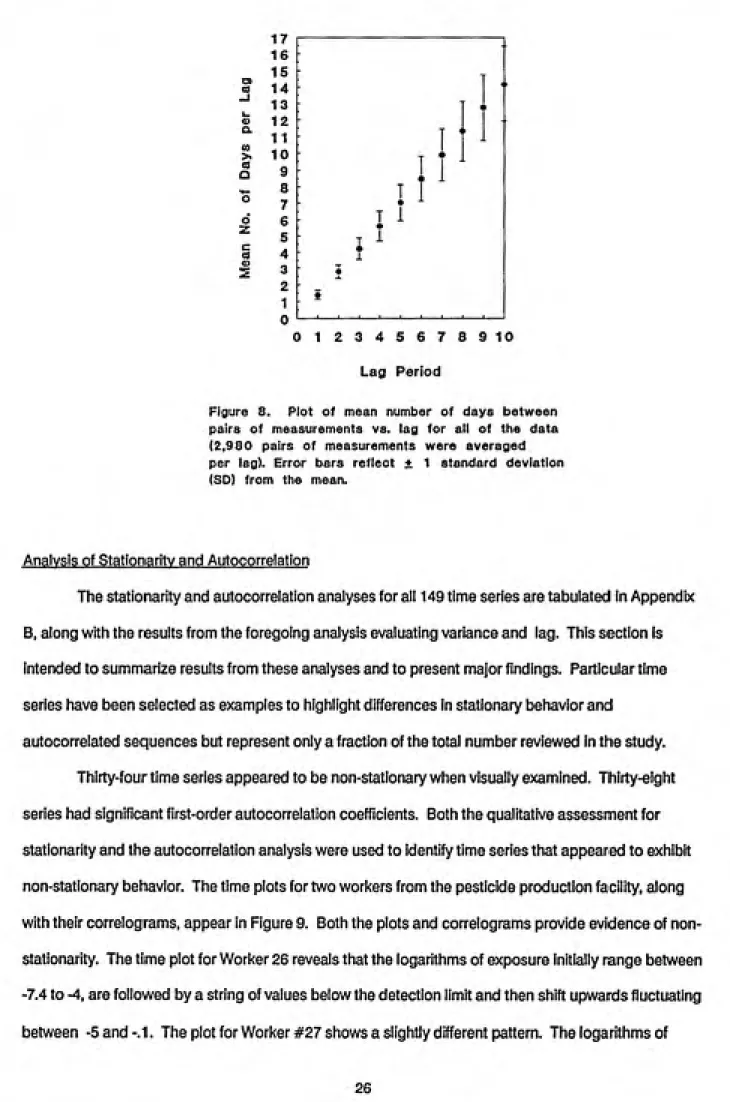
data are tabulated for each analysis and appear in Appendix A. Figure 8 plots the relationship between
lag and the mean number of days for the analysis of the entire data base. For lags 1 and 10, the mean
was approximately 1.4 and 14.2 days, respectively (averaging values for 2,980 pairs of
measurements/per lag). Differences between the mean value and lag are relatively small suggesting
that missing data did not present significant problems. The comparisons were similar for the other
Seri«9 1 Series 2 Series 3
Worker 13 Worker 13 Worker 13
Lag Period (Days)
Series 4
Lag Period (Days) Series 5
Lag Period (Days)
Worker 13 Worker 13
0 2 4 6 S 1012141E1S20
Lag Period (Days)
0 2 4 6 S 10 12 14 1«
Lag Period (Days)
Combined Time Series
n
>
Worker 13
0 2 4 « 8 1012141618
Lag Period (Days)
Figure 7. Graphs A-D display five separate time series for Worker 13
at the pesticide plant. Graph F plots the combined data. Variances were
17 16 15 14 13 12 11 10 9 8 7 6 5 4 3 2 1 0
0123456789 10
Lag Period
Figure 8. Plot of mean number of days between
pairs of measurements vs. lag for all of the data
(2,980 pairs of measurements were averaged
per lag). Error bars reflect ± 1 standard deviation
(SD) from the mean.
Q. IB > CD O o z
: T
•
: T 1
•
•
• 1
1---0---1
1•
Analysis of Stationaritv and Autocorrelation
The stationarity and autocorrelation analyses for all 149 time series are tabulated in Appendix
B, along with the results from the foregoing analysis evaluating variance and lag. This section is
intended to summarize results from these analyses and to present major findings. Particular time
series have been selected as examples to highlight differences in stationary behavior and
autocorrelated sequences but represent only a fraction of the total number reviewed in the study.
Thirty-four time series appeared to be non-stationary when visually examined. Thirty-eight
series had significant first-order autocorrelation coefficients. Both the qualitative assessment for
stationarity and the autocorrelation analysis were used to identify time series that appeared to exhibit
non-stationary behavior. The time plots for two workers from the pesticide production facility, along
with their correlograms, appear in Figure 9. Both the plots and correlograms provide evidence of
non-stationarity. The time plot for Worker 26 reveals that the logarithms of exposure initially range between
-7.4 to -4, are followed by a string of values below the detection limit and then shift upwards fluctuating
exposure remain relatively constant, drop to non-detectable levels and then rise to their highest values.
Note that the autocorrelation functions decay slowly to zero providing additional evidence of
non-stationarity. The correlograms need to be interpreted carefully, however, because of the string of
values in both plots below the detection limit.
Worker 26, Time Series 5
E
I
Worker 26, Time Series 5
ͣ
k o
Lag (k)
Worker 27, Time Series 2
m
ͣ
k 0
Worker 27, Time Series 2
Lag (k)
Figure 9. Time plots for two workers at the pesticide facility
appear on the left. The clashed lines on the correlograms represent
the approximate 9S% confidence limits. The autocorrelation functions
To contrast the trend in exposure seen in Figure 9, the time plot and correlogram for a worker
exposed to alky! lead at the lead-manufacturing plant are shown in Figure 10. The plot of air
concentrations over time shows no upward or downward movement suggesting a constant mean over
the period sampled. There also appears to be relatively little change in the variance. The
autocorrelation function behaves quite differently from the correlograms plotted in Figure 9, with none
of the autocorrelation coefficients significantly different from zero.
Worker 4, Time Series 1
0)
S
c
o
c <0 Q c o
O
Worker 4, Time Series 1
-1
-5 ^—
0 10 20 30 40 SO
012345678
Lag (k) Day
Figure 10. The time plot and correlogram for a worker exposed to
alkyl lead at the lead-manufacturing plant. Both graphs indicate
stationary behavior. Dashed lines on the correlogram represent
the approximate 9 5% confidence limits.
time plots. None of the longer strings from the pesticide-production facility, ranging between 61 and
140 measurements per string, were non-stationary by the formal test, although 36% (12 out of 33 plots)
were non-stationary by visual inspection.
Non-stationary series as assessed formally were transformed by differencing and re-tested. All
of the differenced series exhibited stationary behavior by the formal test; one time series was identified
as non-stationary by visual examination.
When the stationary series were examined for autocorrelation, 29 significant first-order
autocorrelation coefficients were detected. However, most of these (25) were barely significant. Only
four coefficients were larger than 0.5; all of these came from the pesticide-production facility. Figure
11 shows the time plot and correlogram for a series generating the highest coefficient (0.612). It can
be seen from the time plot that consecutive values are likely to be on the same side of the mean
(average value is -5.38). Twenty-six time series had significant coefficients at lags greater than one.
The physical significance of these coefficients is difficult to interpret and will not be considered further.
Worker 19, Time Series 1
y—5.38
Worker 19, Time Series 1
rk 0
012345678
Lag (k)
Figure 11. The time plot and correlogram for a worker exposed to
an organic vapor at the pesticide-production facility. The dashed
lines on the correlogram represent the approximate 95% confidence
Ten of the 14 non-stationary time series identified from the formal test showed no
autocorrelation after differencing. The differenced series producing significant results all had first-order
correlation coefficients that were negative and relatively large, contributing three out of the four highest
values. The significance of these coefficients requires careful interpretation. If a time series consists
purely of a trend and a stationary random component, then taking first differences will remove the
trend and result in a series whose sample autocorrelation function rapidly falls to zero (Gottman, 1981).
Figure 12 illustrates an example. The time plot for Worker 2 at the automobile-manufacturing plant
appears to linearly increase over time. The initial autocorrelation analysis yielded significant serial
coefficients for lags one through three (0.654, 0.485, 0.420, respectively) but this analysis is not valid if
the underlying process is non-stationary. The plot of first differences appears stationary (Figure 12-B);
the autocorrelation analysis on the differenced series produced no significant correlation coefficients.
6.00
Time Plot Worker 2, Series 1
5.50
5.00
4.50
S 4.00
3.50
Plot of First Differences
^ Worker 2, Series 1
E
O
c <u o c
o
o
10 20 30 40 50
Day Day
Figure 12. Time plot for a worker at the automobile plant shows a linear
increase over time. Taking first differences removes non-stationarity
In some instances, first differencing may not be an appropriate remedy for non-stationarity if
the series does not appear to increase linearly over time. To illustrate this point. Figure 13 shows the
time series for Worker 9 at the pesticide-production facility that was assessed as non-stationary by
both the formal test and visual inspection. Here no linear trend is evident (although there appears to
be some cycling) and the variance is not constant over time. Thus, the significant autocorrelation
coefficient obtained from the differenced data is suspect and may not be interpretable.
Time Plot
Worker 9, Series 7
E
c
«
u
+^
c 4> O c o
O
ft/1,
B
CD
E
c
o
c
O c o
O
Plot of First Differences
Worker 9, Series 7
lii /!/! /! li ! TM
10 20 30 40 50
Day
10 20 30 40 50
Day
Figure 13. Non-stationary time plot for a worker at the pesticide plant that
appears to cycle over time. Taking first differences may not be appropriate
as a means to remove non-stationarity.
To determine the extent to which autocorrelation or non-stationarity may explain the trend
between variance and lag among pairs of measurements separated by different intervals, the results
from these two analyses were coupled with the 45 time series displaying an increasing variance with
Dickey-including four negative coefficients obtained from the differenced series. Together non-stationarity and
autocorrelation explain the trend between variance and lag for 60% of the series.
Table 3. Results from the stationarity test and autocorrelation analysis for
time series where the variance increased along with the interval between
measurements.
Data Set Worker Time Test for
ist-Order 1
Series
Stationarity*
Autocorrelation |
Coefficient {
Pesticide-Manufacturing Plant
1 3NS (NS)
-0.537 +
7
NS (NS)
-0.409+
6 3
NS (NS)
1
9 7
NS (NS)
-0.510 +
8
NS(S)
13 4
NS(S)
1
15 4
NS (NS)
1
11
NS (NS)
1
24 1
NS(S)
1
26 2
NS (NS)
-0.571 +
5
NS (NS)
-27 2
NS (NS)
1
Automobile-Manufacturing Plant
2 1NS (NS)
1
*NS = Non-stationary; S = Stationary as assessed formally; values in parentheses are results
from visual inspection of the time plots.
+Autocorrelation performed on differenced series if assessed non-stationary by the formal
test; values in parentheses are results following differencing based on visual inspection of
Table 3 (Continued)
Data Set Worker Time Test for
Ist-Order 1
Series
Statlonarity*
Autocorrelation |
Coefficient |
Pesticide-Manufacturing Plant
6 1S(NS)
0.397 (-0.474)+ 1
7
S(S)
0.45711 3
S(NS)
0.386 (-0.433) +
15 1
S(S)
0.391 1
3
S(S)
0.406 1
13
S(S)
0.38217 2
S(NS)
0.495 (-0.676) +
19 1
S(NS)
0.612 (-0.612) +
26 6
S(NS)
0.367 (-0.451) +
27 1
8(8)
0.451 1
5
S(NS)
0.424 (-)+ 1
28 2
S(8)
0.4384
S(NS)
0.428 (-0.454) +
Chloralkali-Manufacturing Plant
2 1S(S)
0.362 1
|Pesticide-Manufacturing Plant
1 1S(NS)
(-0.389) 1
6
S(S)
1
6 5
S(8)
1
6
S(8)
1
7 7
S(8)
j
9
S(S)
1
11 1
S(NS)
(-0.464)
4
S(NS)
(-0.426) 1
12 2
8(8)
1
13 5
S(S)
1
14 1
8(8)
1
15 5
S(S)
1
10
S(S)
1
21 1
S(8)
1
23 4
S(8)
25 1
S(8)
1
26 4
8(8)
1
26 4
8(3)
1
Chloralkali-Manufacturing Plant
10 1S(S)
1
*NS=Non-stationary; S=Stationary a
s assessed formalv; values in pare
ntheses are resultsCONCLUSIONS
Proper assessment of exposure requires that the variability in air concentration levels be taken
Into account. Specification of the variance Is generally considered In the context of a statistical
distribution of the underlying population of exposures. Such a distribution may be Incorrectly
specified, however, if day-to-day exposures are autocorrelated and this correlation is not statistically
assessed. Indeed significant errors in the estimated parameters can arise from campaigns of a few
days time (Francis etaj., 1989; Buringh and Lanting, 1991). Time-series analysis affords methods to
assess autocorrelation and to build a temporal component into the model describing exposures but
requires relatively long strings of consecutive measurements that are rarely collected In practice.
Given the lack of suitable data. Indirect methods may provide useful alternatives to traditional
time-series analysis (Buringh and Lanting, 1991). Specifically, a statistical property regarding the
variance has been used. Since positively autocorrelated data measured during brief Intervals will
underestimate the variability, differences between estimates of the variances between data collected
over brief intervals compared to longer time periods may provide some evidence of autocorrelation.
This analysis suggests that the validity of this indirect method depends upon careful control of
factors likely to contribute to variability, including industry, location, type of exposure, and worker. The
results confirm the observation of Buringh and Lanting (1991) that the variance tends to increase with
the interval between measurements. However, by controlling for the above confounding factors, this
analysis provided an additional opportunity to isolate the effect by data set, worker, and time series.
Isolation by data set showed that the trend was restricted to only one of the five data sets available for
investigation. Dissecting the data by worker and then by individual time series further revealed that the
trend was due to the influence of less than one-third of the time series.
The data set responsible for the observed trend was the largest both In terms of the number of
workers sampled and the number of time series contributing to the analysis. Besides dominating by
size, the data set was characterized by variances which were much larger than those of the other sets.
more general problem. It is possible that a data set with similar characteristics unduly influenced the
analysis conducted by Buringh and l_anting (1991).
Focusing now on the time series where the variance increased with lag, autocorrelation and
non-stationarity appear to have contributed to 60% of the trends. The significant first-order
autocorrelation coefficients range between 0.362 and 0.612. Some of these coefficients are small and
may have only contributed marginally to the observed trend. It is important to note, however, that over
half of the significant coefficients from the entire analysis were restricted to the series where the
variance increased with lag.
Finally, visual inspection of the plots for non-stationarity in the mean or variance appears to be
fairly robust when compared to the statistical test. The ad hoc method may in fact be preferable since
no underlying model is assumed and it is not constrained by small sample sizes, which can severely
limit the power of formal testing procedures. The percentage breakdown of the stationarity analysis for
the entire data set and for the various subsets of data appears in Figure 14.
VTVTVTVT
Entir* Series Longer Differenced
Data w/Trand Series Series
The issue of stationarity needs to be examined in greater detail. However, If our results are typical of
other workplaces, sampling strategies may not need to address problems associated with
REFERENCES
Buringh, E. and R. Lanting: Exposure Variability in the Workplace: Its Implications for the Assessment
of Compliance. >Am./nof.Hyfif.>Assoc. J. 52:6-13(1991).
Chatfield, C: The Analysis of Time Series: An Introduction. 4th ed. London: Chapman and Hall, 1989.
pp. 51-52.
Coenen, W.: Measurement Assessment of the Concentration of Health-Impairing, Especially
Silicogenic Dusts at Workplaces of Surface Industries. Staub Reinhalt. Luft 31:16-23 (1971).
Dickey, D.A. and W.A. Fuller: Distribution of the Estimators for Autoregressive Time Series with a Unit
Root. J. >Am.Sfaf. Assoc. 74:427-431 (1979).
Diggie, P.J. Time Series: A Biostatistical Introduction. New York: Oxford University Press, 1990. pp.
39-40, 45-46.
Esmen, N.: Retrospective Industrial Hygiene Surveys. Am. Ind. Hyg. Assoc. J. 40:58-65 (1979).
Francis, M., S. Selvin, R. Spear, and S. Rappaport: The Effect of Autocorrelation on the Estimation of
Workers'Daily Exposures. Am./nd. Hyg. Assoc. J. 50:37-43 (1989).
Fuller, W.A.: Introduction to Statistical Time Series. New York: John Wiley & Sons, 1976. pp.373.
Granger, C.W.J, and P. Newbold: Forecasting Economic Time Series. 2nd ed. Orlando: Academic
Press, Inc., 1986. pp. 4-5.
Gottman, J. M.: Time Series Analysis: A Comprehensive Introduction for Social Scientists New York:
Cambridge University Press, 1981. pp.95-96.
Kromhout, H., E. Symanski, and S.M. Rappaport: A Comprehensive Evaluation of Within- and
Between-Worker Components of Occupational Exposure to Chemical Agents. In preparation, 1992.
Preat, B.: Application of Geostatistical Methods for Estimation of the Dispersion Variance of
Occupational Exposures. Am./nd. Hygf. Assoc. J. 48:877-884 (1987).
Rappaport, S.M.: Assessment of Long-Term Exposures to Toxic Substances in Air. Ann. Occup. Hyg.
35(1):61-121 (1991).
Rappaport, S.M., H. Kromhout, and E. Symanski: Variation of Exposure Between Workers in
Homogeneous Exposure Groups. Am. Ind. Hyg. Assoc. J., submitted, 1992.
Rappaport, S.M. and R.C. Spear: Physiological Damping of Exposure Variability during Brief Periods.
Ana Occup. Hyg. 32:21-33 (1988).
Roach, S.A.: A Most Rational Basis for Air Sampling Programmes. Ann. Occup. Hyg. 20:65-84(1977).
Said, S.E. and D. A. Dickey: Testing for Unit Roots in Autoregressive-IVIoving Average Models of
Unknown Order. Biometrika 71:599-607(1984).
SAS, SAS Institute, Gary, NC, 1992.
Spear, R.C., S. Selvin, and M. Francis: The Influence of Averaging Time on the Distribution of
Exposures. Am./nd. Hyg. Assoc. J. 47:365-368 (1986).
APPENDIX A
Appendix A
IBREAKDOWN FOR ALL OF THE DATA
NObs Variable Minimum Maximum Mean Std Dev
149 MEAND1 0.8 2.35 1.387584 0.252816
149 MEAND2 1.8 4.4 2.786242 0.422943 149 MEAND3 2.5 5.9 4.215436 0.655458
149 MEAND4 3.3 8.45 5.613758 0.915332
149 MEAND5 4.2 9.95 7.043624 1.083776
149 MEAND6 4.85 11.8 8.477517 1.333982 149 MEAND7 5.75 14.15 9.891275 1.548678
149 MEAND8 6.55 16.35 11.31745 1.780676
149 MEAND9 7.35 18.45 12.74564 2.013442
149 MEAND10 8.15 21.1 14.18356 2.268173
BREAKDOWN BY DATA SET
Alkyl Leat
Manufacturing Plant (Alkyl Lead)
NObs Variable Minimum Maximum Mean Std Dev
4 MEAND1 1.15 1.55 1.375 0.184842
4 MEAND2 2.5 2.9 2.7875 0.193111
4 MEAND3 3.8 4.4 4.1 0.258199
4 MEAND4 5.1 5.8 5.4625 0.303795
4 MEAND5 6.7 7.25 6.9625 0.256174
4 MEAND6 8 88 8.4625 0.363719
4 MEAND7 9.2 10.3 9.85 0.479583
4MEAND8 10.5 11.7 11.25 0.544671
4 MEAND9 11.8 13 1 12.625 0.618466
4 MEAND10 13.2 146 14.075 0.670199
Alkyl Lead
Manufacturing Plant (Inorganic Lead)
NObs Variable Minimum Maximum Mean Std Dev
4MEAND1 1 3 16 1.3875 0.143614
4MEAND2 2.5 29 2.65 0.173205
4 MEAND3 39 4.45 4.1625 0.256174
4 MEAND4 51 57 5.375 0.25
4 MEAND5 65 72 6.875 0.377492
4MEAND6 8 86 8.275 0.320156
4 MEAND7 93 102 9.6875 0.458939
4MEAND8 106 118 11.1625 0.652399
4 MEAND9 118 132 12.525 0.780491
Appendix A
1 Pesticide-Manufacturing Plant
NObs Variable Minimum Maximum Mean Std Dev
120 MEAND1 0.8 2.35 1.382083 0.274382 120 MEAND2 1.8 4.4 2.779167 0.455433 120 MEAND3 2.5 5.9 4.1975 0.715872 120 MEAND4 3.3 8.45 5.593333 1.000881
120 MEAND5 4.2 9.95 7.003333 1.185694 120 MEAND6 4.85 11.8 8.428333 1.452262 120 MEAND7 5.75 14.15 9.834167 1.683184 120 MEAND8 6.55 16.35 11.25792 1.942374
120 MEANDg 7.35 18.45 12.67875 2.198574
120 MEAND10 8.15 21.1 14.10833 2.484011
|Chloralka
i-Processing Plant
NObs Variable Minimum Maximum Mean Std Dev
15 MEAND1 1.2 1.65 1.413333 0.140746
15 MEAND2 2.5 3.45 2.803333 0.268239
15 MEAND3 4 5.25 4.31 0.319151
15 MEAND4 5.4 6.8 5.71 0.414987
15 MEAND5 7 8.55 7.223333 0.466701
15 MEAND6 8.2 10.75 8.663333 0.742454
15 MEAND7 9.6 12.45 10.11 0.871616
15 MEAND8 11 13.7 11.51333 0.89092
15 MEAND9 12.5 15.4 12.97 0.933082
15 MEAND10 14 16.8 14.44333 0.924057
|Automobi
e-Manufacturing Plant
NObs Variable Minimum Maximum Mean Std Dev
6 MEAND1 1.35 1.55 1.441667 0.073598
6 MEAND2 2.6 3.25 2.975 0.238223
6MEAND3 4.2 4.8 4.45 0.204939
6MEAND4 5.65 6.3 6.041667 0.247824
6MEAND5 7.25 8 7.566667 0.284019
6 MEAND6 8.8 9.45 9.141667 0.26347
6MEAND7 10.05 11.25 10.65 0.475395 6 MEAND8 11.55 13 12.16667 0.564506
6 MEAND9 13 14.55 13.75 0.634035
Appendix A
IDATA SET AND WORKER
Alltyi Lead Manufacturing Plant (Aiityl Lead)
Worlcer=1
NObs Variable Minimum Maximum Mean Std Dev
MEAND1 1.15 1.15 1.15
MEAND2 2.85 2.85 2.85
MEAND3 4 4 4
MEAND4 5.35 5.35 5.35
MEAND5 6.8 6.8 6.8
MEAND6 8.35 8.35 8.35
MEAND7 9.8 9.8 9.8
MEAND8 11.2 11.2 11.2
MEAND9 12.5 12.5 12.5
MEAND10 13.9 13.9 13.9
Worker=2
NObs Variable Minimum Maximum Mean Std Dev
MEAND1 1.5 1.5 1.5
MEAND2 2.9 2.9 2.9
MEAND3 4.4 4.4 4.4
MEAND4 5.6 5.6 5.6
MEAND5 7.1 7.1 7.1
MEAND6 8.8 8.8 8.8
MEAND7 10.1 10.1 10.1 ,
MEAND8 11.6 11.6 11.6
MEAND9 13.1 13.1 13.1
MEAND10 14.6 14.6 14.6
Worker=3
NObs Variable Minimum Maximum Mean Std Dev
MEAND1 1.3 1.3 1.3
MEAND2 2.5 2.5 2.5
MEAND3 3.8 3.8 3.8
MEAND4 5.1 5.1 5.1
MEAND5 6.7 6.7 6.7
MEAND6 8 8 8
MEAND7 9.2 9.2 9.2
MEAND8 10.5 10.5 10.5
Appendix A
1 1
MEAND10 13.2 13.2 13.2Worker=4
NObs Variable Minimum Maximum Mean Std Dev
MEAND1 1.55 1.55 1.55
MEAND2 2.9 2.9 2.9
MEAND3 4.2 4.2 4.2
MEAND4 5.8 5.8 5.8
MEAND5 7.25 7.25 7.25
MEAND6 8.7 8.7 8.7
MEAND7 10.3 10.3 10.3
MEAND8 11.7 11.7 11.7
MEAND9 13.1 13.1 13.1
MEAND10 14.6 14.6 14.6
JAIkyl Lead Manufacturing Plant (Inorganic Lead)
Worker=l
NObs Variable Minimum Maximum Mean Std Dev
MEAND1 1.3 1.3 1.3
IVIEAND2 2.6 2.6 2.6
MEAND3 4 4 4
MEAND4 5.3 5.3 5.3
MEAND5 6.6 6.6 6.6
!VIEAND6 8 8 8
[VIEAND7 9.3 9.3 9.3
MEAND8 10.6 10.6 10.6
MEAND9 11.8 11.8 11.8
MEAND10 13.2 13.2 13.2
Worker=2
NObs
Variable
Minimum Maximum Mean Std DevMEAND1 1.6 1.6 1.6
MEAND2 2.6 2.6 2.6
MEAND3
4.3 4.3 4.3l\/IEAND4 5.4 5.4 5.4
MEAND5 7.2 7.2 7.2
MEAND6 8.5 8.5 8.5