Kimberly D. Edwards. The North Carolina Digital Heritage Center and Collaborative Activities of Contributing Public Libraries. A Master’s Paper for the M.S. in L.S. degree. April, 2012. 98 pages. Advisor: Dr. Christopher A. Lee.
The North Carolina Digital Heritage Center (NCDHC) works with state memory and cultural institutions to provide online access to rare and unique historical materials related to North Carolina. As the archival and historical materials within the scope of the
NCDHC mission are not the typical realm of public libraries, staff of public libraries may not be familiar with the unique concerns related to the appraisal and description of these materials in preparation for digitization. However, the NCDHC allows public libraries to provide remote access to their historical materials even if their experience with
digitization is limited. The results of this study demonstrate that public libraries that wish to contribute materials to a collaborative digital initiative like the NCDHC can participate successfully in digitization projects, despite certain perceived obstacles.
Headings:
Digitization
by
Kimberly D. Edwards
A Master’s paper submitted to the faculty of the School of Information and Library Science of the University of North Carolina at Chapel Hill
in partial fulfillment of the requirements for the degree of Master of Science in
Library Science.
Chapel Hill, North Carolina April 2012
Approved by
Table of Contents
Introduction ... 2
About the North Carolina Digital Heritage Center ... 3
Literature Review ... 7
Public Libraries and Community Relevance ... 7
Collaboration Among Cultural Institutions ... 9
Example Digitization Projects ... 10
Specific Areas of Collaboration ... 13
Methodology ... 20
Results ... 25
Discussion ... 60
Limitations of the Study ... 60
Study Significance and Implications ... 64
Areas for Further Study ... 79
Conclusion ... 82
References ... 84
Appendix A: Metadata Template Spreadsheet Provided by the NCDHC ... 88
Introduction
the NCDHC mission are not the typical realm of public libraries, their staff may not be familiar with the unique concerns related to the appraisal and description of these materials in preparation for digitization. The most successful digitization projects are those completed by institutions that seek out partners with whom they can share resources and expertise (NC ECHO Project, 2007d). This research study seeks to understand the collective experience of public libraries that have contributed historical materials to the NCDHC project and to determine whether those public libraries engaged in increased collaboration, formal or informal, with other cultural institutions to acquire knowledge and skills that would aid them in the process of selecting and describing materials for submission.
About the North Carolina Digital Heritage Center
In general, cultural institutions like libraries and universities are not structured, organized, or funded in a way that lets them take advantage of the collaborative
possibilities that the digital environment provides (Frick, 2011, p. 10). The NCDHC is an attempt to remedy the situation by promoting the sharing of cultural resources in a central digital platform. In order to understand why the NCDHC is well-positioned to promote collaboration and cooperation among cultural institutions, one must first understand the organization of the program and how it operates.
history (UNC University Libraries, 2011; NC ECHO Project, n.d.). The NC ECHO program offers education and outreach opportunities, develops and maintains standards and guidelines for digitization, and oversees a grant program that helps cultural
institutions across North Carolina to create and promote their digital collections (NC ECHO Project, n.d.). The purpose of the NCDHC is to act as a next step for institutions that are unable to digitize their historical materials themselves. The NCDHC does not spare contributing institutions from all expenses associated with a digitization project, but it does take care of a large portion because the NCHDC uses its own equipment to
perform the actual digitization at little to no cost and provide free online hosting services for the digitized materials. The NCDHC receives support from UNC-CH and is funded by the Institute of Museum and Library Services under the provisions of the Library Services and Technology Act (LSTA) (UNC University Libraries, 2011). According to NCDHC staff, the LSTA grant covers staffing and equipment while UNC-CH contributes to the technology infrastructure and administrative costs. The process for contributing cultural and historical materials to the NCHDC is outlined in a document called the Images of North Carolina Contributor’s Manual, which the NCDHC provides to each participating institution during initial communications. The following description of the NCDHC is based on the contents of the Contributor’s Manual as well as discussion with NCDHC staff.
selection, the Contributor’s Manual states that any item relating to or depicting “people, places, or events in North Carolina is eligible for inclusion” (p. 5) and that “[s]election . . . is left to the contributing institutions, who best know what their users would like to see made available online” (p. 5). Beyond this, the only limitations on what contributing institutions may submit are: (1) the materials must be originals that would not be damaged by the digitization process, (2) the contributing institution must own the materials, and (3) the materials must not be subject to any copyright or privacy
restrictions (North Carolina Digital Heritage Center). While the NCDHC is open to the possibility of accepting audiovisual and born-digital content in the future, it has only dealt with print materials so far and determination of copyright status for those materials is the responsibility of the contributing institutions. The Contributor’s Manual briefly addresses some situations in which copyright restrictions will not apply. This includes materials in the public domain, materials created by a government agency, materials for which the contributing institution is both the owner and the rights holder and materials for which the rights holder has authorized the digitization and online publication (North Carolina Digital Heritage Center). The Contributor’s Manual also indicates that all materials published online by the NCDHC must be accompanied by a general
status. Even if restricted material is published in error, the NCDHC provides a way to handle the situation.
Once the materials are selected, the originals are transported to the NCDHC facility at UNC-CH where the staff uses specialized equipment to scan all of the
materials, which are then saved as TIFF files for use as preservation copies. The NCDHC also currently saves a second copy of each file for the purposes of online presentation; photos and images are saved as JPEG2000 files and text-based materials are saved as PDF files. Contributing institutions can request copies of these files, which are returned on external storage devices (CD-ROMs or USB drives) along with the original analog materials.
Description is the other task left to institutions that submit material to the
NCDHC. A contributing institution has two options for creating descriptive metadata for its digital objects. The first option allows the contributing institution to submit a hardcopy template spreadsheet provided by the NCDHC along with its original materials.
descriptive information about each item. The Contributor’s Manual includes a table that lists each metadata field in the spreadsheet along with a brief description and provides examples of a minimum and a full record for reference (North Carolina Digital Heritage Center).
Once the metadata entry is complete, the NCDHC staff imports the scanned images and associated metadata into CONTENTdm, its content management system. Here, NCDHC staff makes final revisions to standardize the supplied metadata so that it conforms to their schema, which maps closely to Dublin Core. The resulting digital materials are available remotely from a centralized website and arranged according to location or material type. The website offers options for browsing the collections by all items, location, item type or recent additions. Keyword searches allow users to sort through the materials. The searches are federated, allowing users to access materials from a variety of cultural institutions at once. The result is thus greater than the sum of the individual parts and users can reap the benefit of this synergy.
Literature Review
Public Libraries and Community Relevance
to for information. In order to maintain relevance and utility for the communities they depend on for support, public libraries have had to embrace a change in their service philosophy. Public libraries are not simply storehouses of published print materials; they also support their communities by providing access to electronic resources and the Internet, hosting educational and cultural programs for all ages, and offering a variety of other services and programs that both inform and entertain (Bourke, 2007). Yet there are still other ways that public libraries can remain relevant to their local communities. Public libraries must continue to innovate and provide new services to support their communities so that the communities in turn remain invested in the success and perpetuation of the libraries (Bourke, 2005). Public libraries can move beyond helping people find books on the shelves or articles in a database and other traditional ideas of service and focus on how they can help enrich their communities through entertainment and education (Stephens, 2011; Bourke, 2005). The public library can take advantage of opportunities to draw attention to what makes it unique and providing online access to rare local history materials is one way to do this (Stephens, 2011).
to act as the custodians of these rare and valuable materials (Steen, 2010). According to Cox (1996), “Understanding local history is basic to individual self-awareness” (p. 7) and this has a great deal to do with community identity. Despite changes in the world with respect to globalization, mass communication, and increased access to information, people still tend to identify closely with their geographic locality (Cox, 1996, p. 3). Public libraries have an opportunity to capitalize on that phenomenon by providing access to local history. In light of this, the success of digital collaboration initiatives that focus on a particular region or locality is unsurprising (Robb & Furl, 2008, p. 10).
Collaboration Among Cultural Institutions
Clearly local history is within the scope of public libraries. Collaboration between public libraries and other cultural institutions has done much to advance this notion. Working with material that borders the missions and expertise of institutions like museums, libraries and archives, these same institutions have an opportunity to work together and these partnerships create opportunities to develop new skills and better serve the community (Steen, 2010; McCook & Jones, 2002). While museums, libraries, and archives have similar missions in terms of education and dissemination of information, they are not identical (McCook & Jones, 2002; Robb & Furl, 2008, p. 10). Each can still learn a great deal from the others because each one takes a different approach in fulfilling its mission (McCook & Jones, 2002; Robb & Furl, 2008). Each type of cultural
description of unique materials, and public libraries are concerned with free, open access to information (Tibbo & Lee, 2010).
Depending on the funding, size and function of libraries, archives, and museums, knowledge about the digitization process can vary widely (Allen, 2000). Therefore, digitization projects offer a unique environment in which collaboration and cooperation are likely to occur because of the variety of skills and knowledge required at each stage of the process. Yet according to Manžuch (2011), a study of collaboration among European cultural institutions with respect to digitization initiatives found that these institutions generally did not take advantage of the collaborative opportunities afforded by the project.This phenomenon was attributed to three reasons: (1) an institution had limited heritage collections and lacked interest in the activity, (2) an institution was in the initial stages of its digitization activities, or (3) the institution did not think that
collaboration would improve the results of such an activity (Manžuch, 2011). On the other hand, the same study also indicated that cultural institutions preferred to collaborate with other cultural institutions of a similar type or with a similar mission, for example, libraries tended to collaborate with other libraries (Manžuch, 2011). The study also found that libraries were the most active collaborators and tended to collaborate with a larger network or more partners than did other cultural institutions (Manžuch, 2011).
Example Digitization Projects
Library (BSBPL) and their Butte Digital Image Project is a prime example. The original project digitized a collection of early 20th century monographs and pamphlets related to Butte, mining, labor, Montana, and Western history and hosted them online through the Montana Memory Project (MMP), a program operated by the Montana State Library (Pierson, 2010). The public response to this project was overwhelming and the Butte Digital Image Project is now collaborating with the World Museum of Mining to provide access to photographs owned by the museum (Pierson, 2010). The museum will digitize the content and upload it to the MMP site and the BSBPL staff will provide access points in the form of catalog records (Pierson, 2010). Crawfordsville District Public Library is another example of more casual collaboration. This public library owned a collection of local history materials that was in danger of permanent loss due to damage, theft, and misplacement (Helling, 2003). According to Helling (2003), the librarians saw digitization as an obvious solution to the problem and they “did their homework by visiting several regional libraries involved in such efforts” (p. 14) before initiating their own project. Even these in-house digitization projects required the project staff to seek information and guidance from outside sources, both formally and informally.
More often, public libraries have contributed to regional or statewide
materials to Rutgers for digitization or to digitize material themselves using loaned scanning equipment (Rogers, 2004). Rutgers offers digitization training sessions and project organizers offer additional training in metadata and copyright issues (Rogers, 2004). Washington Rural Heritage is a collaborative project that specifically targets small, rural cultural institutions and libraries in the state and assists them with creating sustainable digital collections (Robb & Furl, 2008). The Washington State Library offers training and provides the digitization services and contributing institutions partner with local experts or other institutions to select and describe materials (Robb & Furl, 2008). The Ohio Memory Project is a collaborative effort between the Ohio Historical Society and the State Library of Ohio, which allows cultural institutions all over the state to contribute digital cultural materials (Kupfer, 2010). Initially launched in 2002, this project was reorganized in 2008 in response to funding constraints (Kupfer, 2010). The second iteration emphasizes each partner’s unique contributions to the project (Kupfer, 2010). The Ohio Historical Society brings expertise in digitization and content
(Turner, 2006). The Colorado Digitization Project (CDP) also aims to further the practice of collaboration among Colorado cultural institutions by expanding access to unique primary resource collections (Allen, 2000). The CDP steering committee formed a series of task forces that developed guidelines and documentation in the areas of selection, digitization, metadata, and training (Allen, 2000). The CDP also offers training sessions in digital project management and scanning techniques (Allen, 2000).
Similar initiatives exist in Europe as well. People’s Collection Wales is a collaborative digital project that established an all-Wales collection of the people’s history and culture using resources from museums, archives and libraries (Tedd, 2011). Several major national bodies are involved in the project, one of which is Culturenet Cymru, a non-profit company that offers a variety of training and outreach services related to copyright, metadata, scanning techniques, web display, and preservation (Tedd, 2011). On a much larger scale, Europeana is an ambitious project to digitize the complete cultural history of the European Union and make it available online (Levack, 2009). Europeana Local is the branch of the project that reaches out to smaller libraries and museums to digitize their content (Levack, 2009). Europeana’s leadership hopes to eventually partner with other institutions, potentially in the U.S., which would bring collaboration to a truly international scale (Levack, 2009).
Specific Areas of Collaboration
participants, and such formal collaboration activities can include training sessions, workshops, seminars, webinars, conferences, and forums. For projects that do not offer any structured training sessions to its participating institutions, other opportunities exist. Maroso’s (2005) findings of the Basics and Beyond program shed some light on what type of formal collaborative activities might be attractive to institutions involved in digitization initiatives. The purpose of this IMLS grant project run by the University of Illinois at Urban-Champaign was to develop digitization training that would be valuable to cultural institutions both in Illinois and across the country (Maroso, 2005). The program offered three different levels of training: (1) a one-day workshop, (2) a three-week online course, and (3) a combination three-three-week online/two-day in-person intensive workshop (Maroso, 2005). Pre- and post-training quizzes and surveys were administered for each training level and the overwhelming findings reported that while all three sessions were beneficial to attendees, the best training options for staff at cultural institutions are online or short-term one-day workshops located regionally (Maroso, 2005). This is particularly true for smaller institutions with leaner budgets that may not be able to spend money on training or related travel expenses (Maroso, 2005). Moreover, staff at cultural institutions want and need training that fits into a flexible schedule. They have a variety of other responsibilities and duties. Learning a new skill and gaining new knowledge is important but it cannot prevent them from completing their other
obligations (Maroso, 2005).
also provided opportunities for attendees to consult digitization experts and to communicate more casually with each other. These informal opportunities to ask questions, gather information and learn from the experience of others were also seen as valuable by participants. Informal collaboration can also include contacting professionals at other cultural institutions including museums, archives, historic sites, local historical societies, or academic institutions. It can also encompass searching the relevant literature, contacting peer institutions for advice or guidance or making observations at other
institutions, contacting experts in certain relevant fields through professional or personal networking, or requesting information or advice through email listservs or weblogs.
Common obstacles to digitization projects include lack of available expertise or training in the areas of digitization techniques, copyright concerns, selection criteria and metadata (Maroso, 2005; Evens & Hauttekeete, 2011). This research study focuses on a collaborative digitization project that does not require participants to scan or digitize their own materials; therefore, training with respect to digitization techniques is beyond the scope of this paper. Although copyright is an area in which institutions could benefit from training and collaboration, the intricacies of that subject are also out of scope because the project in this study provides recourse for institutions that inadvertently digitize materials protected by copyright.
online. In either case, it is important to understand that selection decisions are based on the mission and documentary goals of the institution (Boles, 2005, p. 43). In many cases, public libraries are collecting institutions whose goal is to document the community, but they often have broad latitude in deciding how to accomplish that goal and what aspects of the community to document (Boles, 2005). As there is no single set of rules or
principles that dictate how selection decisions should be made, a great deal of subjectivity goes into the selection process (Boles, 2005). Those responsible for selection decisions must evaluate the public library’s resources in terms of context, informational content and potential users to make the best possible decisions about what to digitize (Boles, 2005).
Selection covers both physical and intellectual aspects and the physical aspects tend to be easier to evaluate. (NC ECHO Project, 2007a). Many articles concerning digitization projects mention that contributing institutions have prioritized materials that are most fragile, most used, or most rare for digitization. How are selection decisions made beyond those criteria? Public libraries consider a variety of factors when selecting materials to contribute to a collaborative digital project – audience, impact on the institution, intellectual property issues, intellectual control, preservation, and value, to name a few (NC ECHO Project, 2007a).
reference services or other requests. The public library must be prepared for such effects and anticipate those changes (NC ECHO Project, 2007a). Intellectual control addresses whether or not digitizing the materials will improve access to and organization of the materials. Will staff know the collection materials better or will the physical materials be described in more detail or organized more logically after they have been digitized (NC ECHO Project, 2007a)? The intellectual property factor concerns the right to disseminate and replicate the materials or the information contained in them. The public library may own the physical materials, but it may not be legal to reproduce a digital version or share it with the public (NC ECHO Project, 2007a). The preservation factor asks public
libraries to evaluate the physical shape of materials and whether the digitization process will damage them in any way, or if it will help save them in the long run by reducing the need for handling. Compared to most other cultural institutions, public libraries are more concerned with providing access to their materials than preserving them (Allen, 2000); however, in some cases a digitization project spurs institutions to pay more attention to the preservation and conservation of the physical materials (NC ECHO Project, 2007a).
Value is arguably the most important selection factor and the one in which public libraries can benefit most from collaboration with other cultural institutions. This factor asks public libraries to consider whether the materials they are digitizing are rare and unique. It also addresses how the collection will be useful in the long term and whether it will satisfy a community or research need. Will the materials provide value as an
biases in the materials they have selected and are they missing important parts of the story? The final question dealing with value concerns description and metadata. Questions on this point address whether the library has enough information about the object or item to make it worthwhile to add to the digital collection. Another question is whether the library should provide access to certain items if they are not sure exactly what they are or why they are important (Evens & Hauttekeete, 2011). Some of these questions may be familiar to public library staff but others may not. With so many questions to consider, public library staff may be overwhelmed about how to select the most appropriate materials for digitization. This is an area in which guidance and advice could prove useful, if not for making specific choices at least for narrowing the pool using consistent selection criteria.
resources, many public libraries have developed their own local metadata systems that do not conform to any shared standard. Some public libraries do not use any metadata at all and instead they rely on the memory of the employee who has been there the longest and knows the materials from having worked with them, not through any formal system of arrangement or description (Helling, 2003). If public libraries do use standard metadata practices, they may not use those designed for archival or historical materials, instead relying on Library of Congress Subject Headings (LCSH). All of the previously
mentioned example collaborative digitization projects require contributing institutions to provide their own metadata. Unfortunately, many institutions do not have staff with the appropriate experience or knowledge to provide adequate metadata for their digitized collection materials or they have the staff but lack the time to do a good job of assigning metadata (Evens & Hauttekeete, 2011). Public libraries can work with other cultural institutions to learn how to apply descriptive, structural and administrative metadata to digital historical materials.
Public libraries have an opportunity to provide a new service to their communities by highlighting and providing access to their unique historical materials. Contributing to a collaborative digital project is one way to accomplish this and public libraries that may lack expertise or training in certain areas stand to benefit from the knowledge, skills and experience of other cultural institutions. Public libraries can think of these other
Methodology
The purpose of this study was to understand the collective experience of public libraries that have contributed historical materials to the NCDHC project and to determine whether and how those public libraries engaged in increased collaboration, formal or informal, with other cultural institutions to acquire knowledge and skills that would aid them in the process of selecting and describing materials for submission. For the purposes of this research study, the term “public library” refers to a library or library system located in the state of North Carolina that is maintained for the use of the public, operates using public funds, and has already contributed materials to the NCDHC program (“Public Library,” 2012). A list of all NCDHC contributing institutions is available from their website at www.digitalnc.org; the public libraries involved in this study were taken from that list. The term “materials” refers to unique archival or primary source documents or images owned or held by a public library that relate to the history or culture of the state of North Carolina and are distinct from other print or electronic resources the public library may provide like books, magazines, databases, online journals and e-books which are published and widely available. These unique materials have been digitized and are now available from the NCDHC website along with materials contributed by other cultural institutions in the state of North Carolina.
As the focus of this research study is solely on North Carolina public libraries that contributed to the NCDHC, the scope is very limited. At the time this paper was
generalizable to a larger community (Babbie, 2010). Rather than simply quantify the number of public libraries that reported engaging in certain activities, the research methods used in this study are largely qualitative (Babbie, 2010). This type of analysis generally yields richer and more descriptive information because study participants have an opportunity to express their opinions and go into more depth about their motivations and experiences with respect to those activities (Babbie, 2010). Certain relevant data is publicly available from the websites for each public library or from the NCDHC website. Basic information about each contributing public library was obtained from these
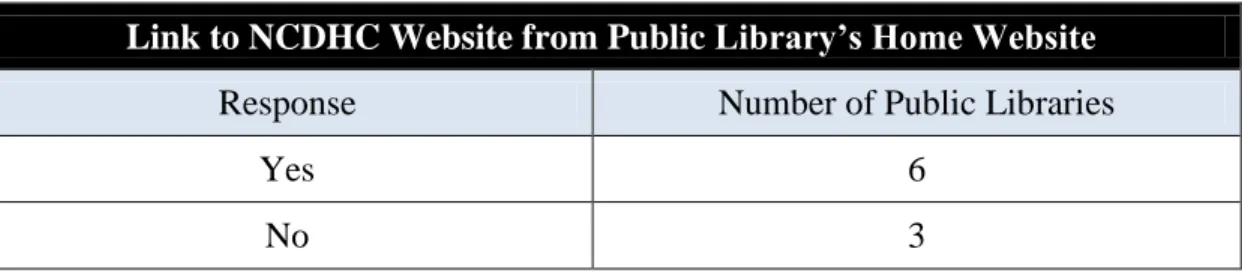
sources, including whether or not public libraries link to the NCDHC website or provide online access to any historical materials from their own homepages.
The data that is not publicly available was obtained from the employee at each public library who acted as the primary contact or liaison for the NCDHC project. Ten of the seventeen public libraries that contributed materials to the NCDHC were contacted to request participation in the study. Based on discussions with NCDHC staff, the other seven public libraries were excluded at the outset of the research project for one of several reasons. Three public libraries were excluded from the study because they had only minimal involvement with the NCDHC. These three libraries submitted nominations for historical newspaper titles to be digitized and included on the NCDHC website but did not contribute any original materials for digitization. Three more public libraries were excluded from the study because, while they do have original materials available from the DigitalNC website, these materials were not digitized by the NCDHC itself. One of these three public libraries contributed nine city directories; however, these items were
allowed the NCDHC to include those city directories on the DigitalNC website. The second public library suggested five local history books for submission but the NCDHC digitized copies of those titles owned by the North Carolina Collection at UNC rather than those belonging to the public library. The third public library was excluded from the study because the photographs it contributed were already available online from the library’s home website as a complete digital collection and the NCDHC merely repurposed the collection as a whole for inclusion on the DigitalNC website. Another public library was excluded from the study because the staff member that acted as project liaison to the NCDHC had retired and could not be contacted.
Interviews were determined to be the best way to gather information for the purposes of this study for several reasons. First, the population of inquiry is very limited and interviews tend to elicit a higher response rate than surveys (Babbie, 2010). Further, the small number of participants meant that the researcher had the time to go into more depth with questions than a survey would have allowed (Babbie, 2010). In addition, semi-structured interviews give the researcher flexibility and freedom to ask follow-up
Once the ten public libraries were selected, the NCDHC staff provided the name and email contact information for each of the project liaisons. The researcher then
contacted each liaison directly via email to request participation and telephone interviews were scheduled in subsequent email correspondence. The interviews consisted of twenty-three open-ended questions; a copy of the interview questions is available in Appendix B. The questions cover five separate areas of focus, the first of which addresses general information about the public library’s involvement with the NCDHC. Questions in this section address the public library’s initial awareness of the NCDHC and its services, the general motivations for participation, the scope of the public library’s contribution, and the number of staff or volunteers who worked on the project.
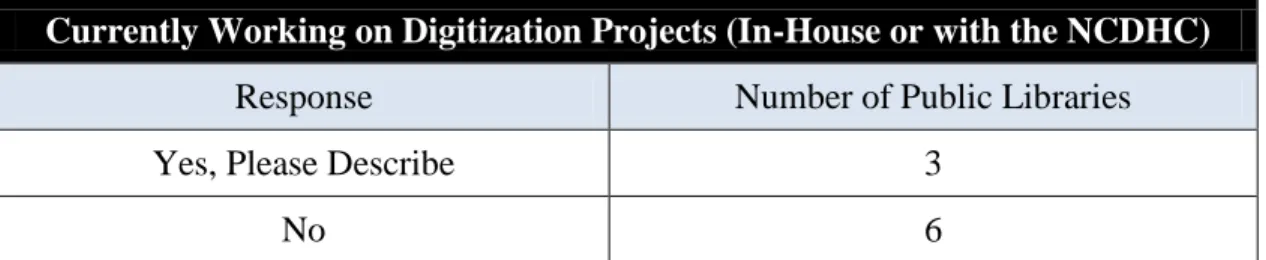
The second area of focus addresses whether the public library and its staff had any previous knowledge of or experience with digitization as well as how that experience or knowledge was obtained. These interview questions address whether the public library owns any digitization equipment or completed any digitization projects prior to its involvement with the NCDHC.
the NC ECHO program, the NC Preservation Consortium, the NC Arts Council, and any other government entity, non-profit organization or grant-funded program whose mission involves the promotion or preservation of the history or cultural heritage of North
Carolina. These interview questions address any formal training that staff attended in preparation for contributing to the project, and any informal information-seeking activities staff used to gain knowledge and skills in preparation for contributing to the project. For the purposes of this research study, collaboration refers to instruction, advice, information or guidance sought or received by project staff from sources outside their own institution in an effort to gain knowledge, skills or experience in order to inform the process of contributing materials to the NCDHC. A public library is considered to have engaged in formal collaboration if staff reported attending structured events such as conferences, workshops, forums, seminars, webinars, or other instructional or
informational training sessions that were hosted or sponsored by cultural institutions. A public library is considered to have engaged in informal collaboration if staff reported engaging in unstructured information seeking activities including informal
communication or meetings with staff at other cultural institutions, reviewing websites or literature produced or suggested by other cultural institutions, or observing the practices of other cultural institutions with respect to digitization.
The fifth and final area of inquiry deals with how the public library evaluated and assessed its involvement with the NCDHC. Questions in this section address whether public libraries received offers of materials or information from the community after digitizing their materials, whether use of the digitized materials has changed or increased, and how the public library has promoted its project with the NCDHC. Questions in this section also address how the public library benefited from its involvement with the NCDHC; the experiences, both positive and negative, of the public library during their participation; and any future plans with respect to digitization projects or activities.
Results
The telephone interviews were conducted during the month of February 2012. Of the ten public libraries contacted for participation in the research study, nine completed interviews and one declined to participate due to time constraints. These semi-structured telephone interviews lasted approximately one hour on average and were audio-recorded with the consent of the participants. Some of the questions lent themselves to yes or no answers and in those instances; the number of responses is given. For the more complex answers, illustrative quotes are provided as evidence of how each public library
responded.
opted to contribute materials after receiving an email request for submissions that the NCDHC sent out via a public library listserv.
One public library had applied to the State Library of North Carolina for an LSTA grant to start a digitization project in-house around the same time that the NCDHC was getting started:
When the state library got my application and looked at the size of my project, they said this is precisely the kind of project that the digital heritage center is looking for and suggested that I contact [the NCDHC] staff.
The remaining six public libraries discovered the NCDHC through other means. Two interviewees first learned of the NCDHC and its services through promotional events or presentations sponsored by the State Library of North Carolina. One interviewee attended a meeting of the North Carolina Public Library Directors
Association, where the NCDHC staff had given a presentation. Three public libraries first became aware of the NCDHC through word-of-mouth because a member of their staff was already familiar with its existence and activities.
After finding out about the NCDHC project and its services, these public libraries then approached the NCDHC with materials or collections they wanted to digitize and some were anxious to get involved quickly. One interviewee said, “we had to strike while the iron was hot” and another added “we wanted to jump on the bandwagon before the schedule might be so full that we might not be able to take advantage of the opportunity.” Another interviewee had this to say:
When [we] found out about the digital heritage center it was like, well this is a no-brainer. Not only did we get somebody to scan the stuff for us, but we also got them to host it, too. It was a win-win situation.
When we did hear about the scope of the NCDHC it was pretty much like a dream come true that, for no expense on our part, we could have our images available for the world to see and for the neighborhood and for [the county] to see these unique items that were in our possession and we didn’t even know about.
The motivations for contributing to the NCDHC were a mixed bag for the public libraries and most of them had more than one. One interviewee indicated that her library was interested in staying up-to-date with current trends. She said, “Our director was into new technologies and staying up on current things and saw that a lot of libraries were doing these types of digital projects.” Another stated that it was more of an experimental undertaking and said, “It was my responsibility to help decide what to do with the materials . . . and I was looking for a good first digital project.” Another interviewee wanted to get involved because “being a public library with this huge collection and not knowing really what to do with it, we needed expertise outside of what we had.”
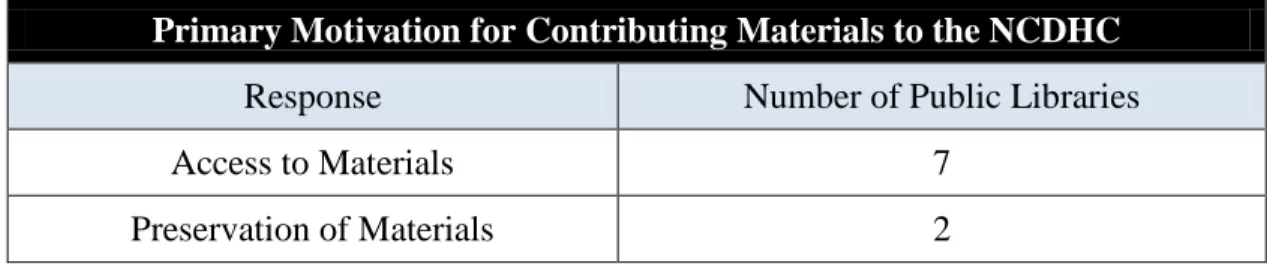
Providing better access to materials was another common motivation for public libraries to get involved with the NCDHC project. Seven of the nine public libraries indicated that providing better access was an important goal in contributing materials to the NCDHC (see Figure 1). One interviewee explained, “From the very beginning, my purpose was to tell the history of [the county] digitally” and “to make the community aware of these wonderful resources that we have here.” Another interviewee added that the ultimate goal was to provide access to historical materials because “that’s what libraries are for.”
services as a way to handle what he referred to as “problem materials.” This included some oversized scrapbooks and maps that were fragile and too large to be digitized with basic scanning equipment. Allowing patrons to use the originals posed a danger because the more the originals are handled, the more at risk they are for loss, theft or damage from general wear and tear. Digitization allowed the public library to provide access to the information without further endangering the original materials.
Primary Motivation for Contributing Materials to the NCDHC
Response Number of Public Libraries
Access to Materials 7
Preservation of Materials 2
Figure 1. Public libraries’ primary motivation for contributing materials to the NCDHC program (Responses to Interview Question 2).
All of the public libraries, while recognizing that either access or preservation was paramount, also recognized that the two are not mutually exclusive. Both of the public libraries that were more interested in preservation wanted to digitize their materials to protect the fragile originals while still being able to provide access. Therefore, the paramount motivation was preservation but access was also seen as an added benefit. As one interviewee put it:
It is hard to say which is more important. Certainly the preservation, but because of and in our attempts to preserve the physical materials, access was certainly the other positive. . . I would have to say that preservation was certainly the
overriding issue, quickly followed by access.
Another interviewee said, “We’re not a museum. If people can’t view these materials, what good are they? Granted it’s archives, but at the same time they should be
way that anybody could look at it but the materials also could be kept preserved and kept from being lost. I’d say it was fifty-fifty, really.”
All seven public libraries that indicated access as the primary motivation for their involvement also mentioned that preservation was a bonus. As one interviewee put it, “Obviously for a public library, access is always the primary concern, the keyword being public [but] it’s a delicate balancing act there.” Another said, “We will continue to always be concerned and mindful regarding preservation but the goal is to make the resources available to people. They have no value if they cannot be used.” Another interviewee stated, “We already had an effort underway for the preservation piece of [the project]. We were already investing in the archival materials in order to better take care of those assets but the digitization project definitely was access-oriented.”
When asked to describe the scope of its project with the NCDHC, each public library mentioned specific materials that it wanted to publish online. For one, it was a collection of memorabilia documenting the history of local World War II veterans. For another, it was materials related to the history of the African-American experience in the county. One project focused on materials related to the urban development and renewal of the community. Three of the public libraries mentioned collections of photographs or negatives related to local history. Other projects involved a series of glass plate images, a set of tax books, and a collection of oversized maps and scrapbooks.
or more people. Others who were mentioned as having assisted with the digitization project in some capacity ran the gamut and included library administrators or directors, librarians or other professional staff, paraprofessionals, student interns, volunteers, or some combination thereof.
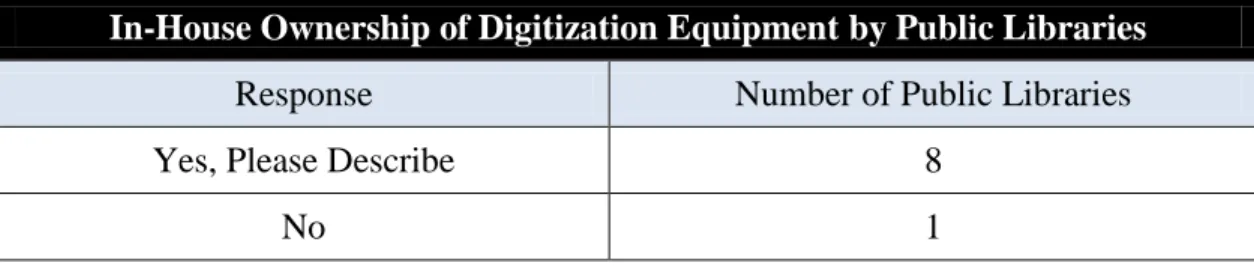
Only one of the public libraries does not own any digitization equipment at all. The other eight indicated that their institutions do own at least some basic digitization equipment (see Figure 2). Low-grade flatbed scanners were mentioned most frequently and two interviewees specifically mentioned other equipment like a drum scanner, a high-quality flatbed scanner, and a digital scanner/microfilm reader. All eight of the public libraries that own digitization equipment indicated that it is generally used to complete one-time requests from patrons for digital copies of photographs, documents, or newspaper clippings. As one interviewee explained:
We get research requests all the time from all over the country asking can you send me an obituary, can you send me what you have in your files on this person. So we pull all of those paper copies that we have on file and we scan them and we email them out.
In-House Ownership of Digitization Equipment by Public Libraries
Response Number of Public Libraries
Yes, Please Describe 8
No 1
Figure 2. In-house ownership of digitization equipment as reported by public library contacts (Responses to Interview Question 4).
capability here unfortunately. [The digitization] took some time because the scanner I have is not exactly fast, either.” Using this type of equipment for even a small in-house digitization project can be time-consuming and the quality of the resulting product is often not worth the effort. As one interviewee pointed out, “our scans are disappointing compared to the work that the digital [heritage] center is doing.” It is interesting to note here that several other interviewees described their digitization equipment as less than satisfactory. One responded that although his public library did own digitization
equipment, it was “nothing more than just your typical scanner” and another said “It’s a little low-grade but we have a scanner.” In fact, when asked whether his institution owned any digitization equipment, one interviewee responded “No, not really” but then went on to describe the library’s equipment, saying, “We have a couple flatbed scanners.”
Involvement by Public Libraries in Any Prior Digitization Project(s)
Response Number of Public Libraries
Yes, Please Describe 5
No 4
Figure 3. Involvement by public libraries in any digitization project(s) prior to their involvement with NCDHC digitization project (Responses to Interview Question 5).
Seven of the nine public libraries had some prior digitization experience or knowledge and were able to apply that to their projects with the NCDHC. Only two public library contacts said that none of their staff had any previous digitization experience or knowledge (see Figure 4). In response to the question, one interviewee replied “Zero! We were neophytes, I didn’t have a clue what metadata was, that was all new to me, and no one else on the staff had any experience either.” One public library contact admitted, “I knew nothing about how you digitized something and cataloged it and defined the facets and the access points that would guide people to it.” One
interviewee, when asked to describe the extent of digitization experience in his
institution, said it was “very rudimentary.” Another interviewee initially said that none of her staff had any knowledge about digitization but did go on to say that some of the employees were aware of the strong need for knowledge about digital resources and had read up on the subject.
Previous Knowledge of or Experience with Digitization in Public Libraries
Response Number of Public Libraries
Yes, Please Describe 7
No 2
The other seven interviewees had at least one staff member with knowledge of or previous digitization experience; however, the extent of that knowledge and the sources of previous experience varied widely. Some prior experience and knowledge was obtained more informally. One interviewee explained that he was self-taught:
What I learned about it, I did it on my own because I was just interested. I had educated myself on all the processes. I have to admit it was a bit scattershot . . . but I learned about archival scanning from reading.
Other interviewees also reported that they engaged in informal means of gathering experience and knowledge about digitization. One public library contact indicated that at a previous job, she “read several articles for evaluation of content management software” and was on “several different [email] listservs like Society of American Archivists and would ask questions on there.” She also consulted with other professionals in the area, especially those at the local university. Several interviewees reached out to other institutions in the past for guidance. One interviewee said that her library “initially contacted UNC” in deciding what to do about digitizing a large collection of photographs and another said “probably once or twice I have called NC ECHO in the past.”
learning on the job and talking to people and networking . . . it was just a growing process, with her and with me.”
Other interviewees indicated that they or their staff had knowledge of or experience with digitization by way of formal training or education. Only one interviewee had an educational background in a related field. She had completed a Master’s in Library Science (MLS) program with a concentration in Archives and Records Management and “took classes that dealt with digitization, EAD, and different metadata types for digital objects.” Another public library contact indicated that “there is a group of librarians, the digital library staff, and they’re familiar with the technology [but] I think the learning curve for all of us is cataloging and access features.”
Other public libraries indicated that they or their staff acquired knowledge and experience with digitization primarily through continuing education programs like webinars, workshops, and conferences. One interviewee stated that she completed a “work at your own pace, continuing education credit web class on doing digitization projects.” Another interviewee had this to say:
I did do a couple of webinars that were very helpful and I learned a lot from them and kept all the notes. What I was particularly interested in was the preservation of images and their degradation depending on how many times they’re scanned. One interviewee said, “I have been to many workshops, I attended the NC ECHO Digitization Institute when they first started that up and a couple of the NC ECHO workshops and things.” Another interviewee said:
One of the early things I did was the state offered week-long digitization
She went on to say that, after attending the workshop, she often referred back to the documentation provided by NC ECHO and the information on their website. She said, “That was a main source if I couldn’t remember something.”
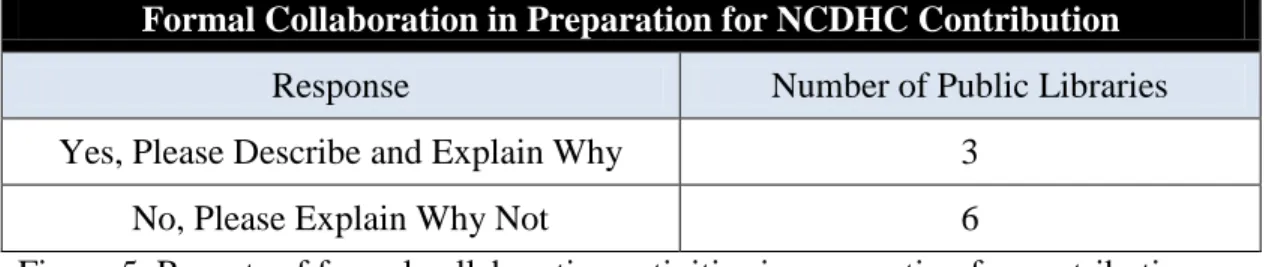
Only three of the nine public library contacts interviewed reported attending any formal training specifically in preparation for the NCDHC project (see Figure 5). One interviewee recalled that he attended a presentation that was hosted by the State Library of North Carolina. Another interviewee attended a digitization workshop as part of the North Carolina Library Association (NCLA) conference and had this to say about it:
I just went to NCLA where they did a workshop or presentation and other libraries spoke [about] projects they had done and that’s where I got a bit of Dublin Core and other things that I’d really never focused on. I just got a chance to see how other library systems were approaching it and what they were getting out of it.
The third interviewee stated that:
For a year leading up to the project, I had gone to a couple of workshops. NC ECHO offered a couple of workshops, when I went to the NCLA conference I attended a couple of sessions related to digitization and then I think that there might have been one other day-long workshop but yes, I did have some workshop education under my belt.
Formal Collaboration in Preparation for NCDHC Contribution
Response Number of Public Libraries
Yes, Please Describe and Explain Why 3
No, Please Explain Why Not 6
Figure 5. Reports of formal collaboration activities in preparation for contributing materials to the NCDHC program (Responses to Interview Questions 9, 11 and 12).
to understand some of the vocabulary.” Another interviewee stated that her goal in attending the workshop was “really a general understanding” of digitization. She added:
[The workshop] talked about digitization projects and how to decide on the scope of the project and what you were going to digitize and all of the things you had to consider, like the underlying database and the metadata and it was really just examining the project components and giving you some background in terms of making those decisions.
Five of the remaining six institutions responded that they or their staff had either not participated in any formal training; the sixth was unsure but her “inclination was that they had not.” The institutions whose staff had not participated in any formal training in preparation for the NCDHC project offered several explanations. One stated that there was “simply no need, [the NCDHC] took care of it.” Another described how
straightforward the process was, saying “We just followed instructions to submit those items that were accepted.” As one interviewee explained, “When I was hired they specifically wanted someone who had experience with archives and digitization so I didn’t do anything special.” Another interviewee said “No, I just knew what needed to be done . . . I know the subject and I know this collection here and I knew what I felt was top priority.”
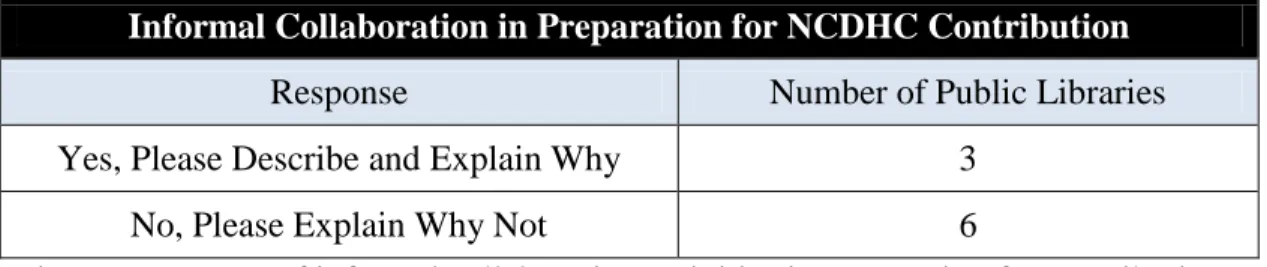
Three of the nine public library contacts indicated seeking informal assistance to help them with their contributions to the NCDHC but interestingly, they were not the same three that attended formal training in preparation for the NCDHC project (see Figure 6). One interviewee had this to say:
Another public library contact knew that the previous library director, who was very involved with the project, used “lots of outside sources” and had reached out to some of the history faculty at the local university in preparation for the NCDHC project.
Another public library contact, when asked if she had reached out to other professionals in the field said “A little. I do have colleagues at nearby libraries. I work very closely with the local history and genealogy librarian there and so when we did start working with the digital heritage center I made her aware of it.”
Informal Collaboration in Preparation for NCDHC Contribution
Response Number of Public Libraries
Yes, Please Describe and Explain Why 3
No, Please Explain Why Not 6
Figure 6. Reports of informal collaboration activities in preparation for contributing materials to the NCDHC program (Responses to Interview Questions 10, 11 and 12).
The six public libraries that did not seek information in informal ways cited similar reasons for not having attending any structured training sessions on digitization. One interviewee explained it this way:
wonderful.” Another interviewee said “[The NCDHC staff] was helpful . . . as far as the images that I sent to the heritage center and as far as the format and certainly things like metadata.” One interviewee summed it up nicely saying, “No, we didn’t. We thought we’d hit the jackpot.”
The criteria used by the public libraries in selecting materials to contribute to the NCDHC project varied widely. The most frequently cited selection factor was rare or unique material that would be of most interest to the local community. One interviewee tried to select “really interesting stuff. Something I think people would find fascinating” and “anything that documents the history of [the county].” Another based selection decisions on “things that were unique to our library” and “what would interest people, what would they be able to get value out of.” The same interviewee also indicated that she “wanted materials that there would be some use for the content.” One interview, in explaining her public library’s selection criteria explained:
We looked for unique items; things that we suspected were not available elsewhere. We sincerely believed we had possibly the last surviving copy of certain things and we thought that this would be the only access point to it. She went on to say she “was thinking that the community could see themselves reflected in these documents and it just brought that whole area back to life, celebrating the county, we were focused on that neighborhood.”
To a certain degree…I was scared to do it truthfully but I took some really, really precious things with me to [the NCDHC facility in] Chapel Hill and a couple of them, in fact, I took and waited while they scanned and brought them back immediately.
Another interviewee said:
We had been accumulating a list of items or resources that we knew needed attention to begin with [because] ours has always been a priority list that takes into consideration both condition for preservation purposes and then how frequently or how readily we need to have the resource or resources available to the public.
Another public library encountered a similar situation with regard to its valuable collection of glass plate photographs and indicated that preserving original material in danger of loss was a critical when it came to selecting those items for digitization.
Some public library contacts also mentioned that they chose frequently requested materials for digitization, regardless of content. One interviewee had this to say:
When you know that you have resources that have been requested and in some cases have been in demand if even for a short period of time, then you know you’ve got an item that’s significant enough hopefully to make it more broadly available.
Another said “being requested was certainly a part of it . . . that’s partly how I know how important they are.
Conversely, based on the nature of the materials they contributed to the NCDHC, other public libraries were not able to base selection decisions on frequently requested materials. One interviewee explained:
No, it wasn’t a matter of putting stuff online that I’d already been getting a lot of requests for because I think, in the cases of most of my things, people didn’t even know we had them.
None of the interviewees specifically identified academic research purposes or classroom use as a selection criteria, although some mentioned that it was incidental. One interviewee said “students and future generations were brought up” in discussions
regarding selection decisions but that it was not a primary concern. Another interviewee added, “I did not make that a high priority. I haven’t worked with the local schools as I should on this type of thing.” With respect to educational purposes, another public library contact said:
I think the resources that we have are underutilized by [teachers]. Part of our frustration and certainly a regret is that I don’t think that our teachers . . . [know] what library resources are available.
None of the interviewees indicated that the NCDHC had requested any specific materials. One interviewee said, “They took what we would give them. . . [The NCDHC] wasn’t exactly too specific but I think [they] just used my judgment in terms of what I thought was significant.” Another interviewee confirmed this, saying “They asked me what I would want to have digitized and they agreed with my assessment.”
When the public libraries indicated that they had an audience in mind for the materials they selected for digitization, it was largely local historians, genealogists, and any member of the general public with in interest in local history or family research. As one interviewee explained:
was a deciding factor.” Another added “we certainly get researchers from across the state and across the country, but my main thinking was local.”
When pressed further about whether other groups or functions played into decisions about selection, several interviewees mentioned that students and academic researchers were a secondary consideration. One interviewee explained:
My first thought was general interest and general researchers but my close second was students because I know the students have a course not only on state history but also on their county history and I thought the kids would really enjoy visually seeing things related to the county history.
While all of the public libraries were able to indicate an intended audience for their materials, some were also curious about potential users they had not anticipated. As one interviewee put it, “We were excited to think about who might stumble upon it” and “since we’d never done a digitization project [we wanted] to wait and see who might find it interesting.” Another added, “it remains to be seen how this information will really be of interest . . . that’s the fun of it really.”
Largely, the public libraries indicated that there was little or no metadata
described her library’s materials as having been organized into file folders that were labeled with certain geographic or subject headings and were further arranged in order of relevance to the city and county so “the librarian had been in there and done some
categorization.” In describing the metadata for this collection, the public library contact said:
We had very little to work with. At times, once [the NCDHC] got the materials, they found things written on the backs of photographs and they graciously included that. I think a lot of the work is ahead of us to find resources to go back in [and insert more metadata].
Another said:
[The photographer] had made notations on the envelope of each negative and we have also solicited input from our community about the images. For the other materials, it varied, but I usually had some provenance information about who had donated it, perhaps the significance to local families.
Another interviewee had this to say when asked whether there was any metadata associated with his library’s materials:
Yes and no. We had things organized in our photographic archives by subject matter [so] I knew exactly what I could get from where. Now, as far as formal metadata was concerned, we really did that as we went. It sounds a little
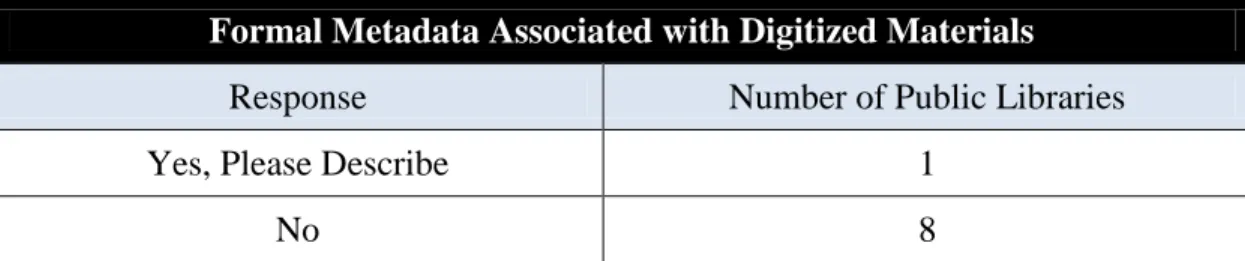
disorganized but we just jumped in with both feet and did it as hard as we could. Formal Metadata Associated with Digitized Materials
Response Number of Public Libraries
Yes, Please Describe 1
No 8
Figure 7. Existence of formal metadata associated with the materials submitted to the NCDHC for digitization (Responses to Interview Question 15).
publishing the materials online greatly improved accessibility and intellectual control because even the minimal description required by the NCDHC was more than what was previously available in most cases. Several respondents indicated that gathering and providing this information was the most time-consuming part of the project, but it is also arguably the most important part because it is what allows users to find the materials online.
Seven of the nine public libraries indicated that they had done some form of promotion or advertisement of their involvement or contributions to the NCDHC and most focused on promoting their participation at the beginning of the project (see Figure 8). As one interviewee said, “We really had a thrust when we first started getting
involved . . . it’s created a whole lot of interest in it.” Another said “We did a big push to get the word out about that. We’ve definitely tried to let the community know that these things are available.”
Promotion/Advertisement of the Public Library’s Project with the NCDHC
Response Number of Public Libraries
Yes, Please Describe 7
No 2
Figure 8. Promotional activities or advertisement of the NCDHC project as reported by public library contacts (Responses to Interview Question 16).
website about the NCDHC project. The interviewee also added that “just recently, there’s a Saturday morning radio program and we were interviewed for that.”
Other public libraries have been less active with promotion but have still taken pains to advertise their projects with the NCDHC. One interviewee said that, after completing renovations on one of its branch libraries, they “highlighted it at the reopening . . . and several people in the community were really impressed and touched because they didn’t know this [collection] existed, it was a surprise. It was very fun to see the reaction.” Another public library contact said “I have not made any promotional materials for DigitalNC in-house” but she did say that her public library made sure to link to the NCDHC website from their home website and that the library put brochures
created by UNC-CH about the NCDHC project out for their patrons to look at. Several of the libraries that have promoted their projects with the NCDHC indicated that they would like to do more to increase awareness about their involvement. As one interviewee stated:
I haven’t systematically marketed it . . . When [the project] first launched, we put some articles in the newspaper and the local historical association announced the launch of the site and that kind of stuff but we haven’t done much since then truthfully.
Another interviewee had this to say about promotion and advertisement:
Marketing and promo plays a real part. We have a really good relationship with our local newspaper so we have a regular weekly column in the newspaper and several columns have been on the digital heritage center and the resources that we were fortunate enough to have accepted and digitized.
The two interviewees who indicated that their libraries have not done any promotion of their involvement with the NCDHC indicated that they intend to do so in the future and they see how it could benefit the library itself. As one interviewee admitted, “We haven’t done that and that would be a very good thing for us to do. We should do that.”
After contributing materials to the NCDHC, six of the public libraries reported that individuals within the local community found ways to contribute to the project, either by offering privately owned materials for digitization as a contribution to the collection or by providing information that helped to identify or describe the materials that were contributed to the NCDHC project (see Figure 9). One interviewee said:
I’ve had several individuals who have photographs . . . ask if I would be interested in adding these things so I’ve taken in a lot of old photographs that people have brought by. The community has bought into this project to a large extent as well. Another interviewee had this to add:
We had some of that going on at the time the project was underway because we would put an old photograph into the paper periodically just saying [the NCDHC] project was underway and if you have old family photographs or other documents that you think would be of interest, please bring them to the library and we can scan them and return them to you immediately. So we sort of put a public appeal out there from time to time and we did get some response, we got some nice things in.
Another interviewee said that in her library, materials were “definitely coming in
constantly” but she also attributed this to the fact that her institution is still advertising the project.
War) veterans the public library had contributed to the NCDHC project. About the experience, the interviewee explained:
After I had digitized that image, somebody came to me and said ‘I know the names of every person in this picture. . . I have the names in my files because I have a copy of that picture’. So yeah, things like that did happen, every so often. Certainly not every day but we did get things like that.
When asked if it had received information from individuals who had seen the materials online, another public library said “One person. They called and said they recognized someone in a picture and could they have a copy.” Another interviewee said:
At one point I did get an email from somebody saying ‘I found my great-great grandfather in your collection’ and then he gave me a couple of sentences of information on him so I did have that happen once or twice.
Offers of Information and/or Materials from the Local Community
Response Number of Public Libraries
Yes (Information and/or Materials), Please Describe 6 No (Neither Information nor Materials) 3
Figure 9. Reports by public library contacts as having received contributions to the NCDHC project in the form of offers of information and/or materials from members of the local community (Responses to Interview Question 17).
Interestingly, one public library received an inquiry from a member of the community that had found materials related to their own family history online and was upset by it. The interviewee had this to say about it: “Among the general public, there is a reticence about . . . having things on the internet. We’ve had some people come in and say ‘Oh here’s a picture of my ancestors, how did you get this?’” The librarian had to explain to the person that the library legally obtained the image from its owner, who was also a descendant of the person in the photograph.
Two public libraries that received offers of materials or information from
to the NCDHC project. One interviewee received offers of material from the community but perhaps “not specifically because of the NC Digital Heritage Center.” Another interviewee explained “I’m not sure sometimes if DigitalNC is what’s sparking an increase or not. I guess I would say not a big increase.” She went on to say that the library has no way of knowing whether people have found the information on the NCDHC website unless the person specifically mentions it. It is important to note that both of these public libraries also link to materials they have digitized in-house from their home website, so members of the public can access to those materials from two different places.
Three of the nine public libraries have not received offers of either materials or information from the community but they are excited about the possibility (see Figure 9). One interviewee said, “No, I have not had anybody offer materials although that would be really cool.” In several cases, the public libraries that have not had much of a response from the community were able to provide some possible explanations. One interviewee attributed this to the nature of the materials her library contributed to the NCDHC. She described them as “very straightforward” and “well explained.” As opposed to
photographs or images, these text documents already contain a great deal of information and do not lend themselves to further description. She went on to say “I’ve had people comment on it [and say] ‘I’m thrilled the [newspaper] is online and I’ve used it for this and this and this.’ I’ve gotten positive comments but not comments that help add to the body of information.”
haven’t been up that long” and another explained that “Everything got finalized not that long ago so I just think they haven’t really had a chance to be up there and we haven’t had a chance to promote them.” These public libraries also had not done a great deal to promote their project with the NCDHC and thought that may have played into why people had not contributed to the project. As one interviewee explained, “Eventually we are going to link to the digital heritage website but we haven’t done much to promote the knowledge that our stuff is on it.” Another said, after explaining that they did not
promote the project, “common sense tells me that we should publicize this.”
Most of the public libraries did not notice a drastic change or increase in use of the materials that were digitized through the NCDHC. One interviewee said that he had noticed a change “in perhaps subtle ways, I can’t really pinpoint anything very specific.” Another said “It’s not like a tidal wave increase or anything like that but I have had several inquiries . . . not huge numbers yet but I think folks are starting to discover it.” One interviewee recognized that, even without examples or evidence to show that use had increased or changed, “there was virtually no access to the material before we put it online. Access has increased 100% for anyone who is online and looks on the website.”
A few public libraries; however, were able to provide concrete examples as evidence of how use of their materials had changed or increased since being made available online. One public library said, “Since we put the material up we’ve been contacted by one textbook manufacturer asking for permission to use one of the pictures in a textbook and another museum in Atlanta wished to use an image in a display so it’s been really interesting.” Similarly, one interviewee said this: