A Review of Process and Outcome Measurements in Community-Level HIV Behavioral Interventions among
Men Who Have Sex with Men
By Karyn Reott
Abstract
Introduction: Many effective HIV behavioral interventions among men who have sex with men (MSM) utilize the Popular Opinion Leader (POL) model of promoting safer sexual behavior, based on Rogers‟ diffusion of innovations theory (Rogers, 2003). This paper reviews the process and outcome measures used in a sample of published POL interventions focused on MSM, and examines best practices in both process execution and in outcome measurement among studies of this type.
Methods: I reviewed six studies selected from a PubMed database search that met the following criteria: HIV community intervention among men who have sex with men, which used or intended to use the popular opinion leader methodology.
The process measures I reviewed include selection of study venue, identification and recruitment of popular opinion leaders within the community, obtaining a critical mass of POLs needed to effect changes in behavioral norms, and effective training of POLs.
Results: Of the six studies I reviewed, four reported statistically significant reductions in sexual risk behavior among the intervention population. Problems in POL identification and recruitment, as well as limitations in the POL training provided, appear to be factors in the lack of successful results for the two other studies. Implementation challenges existed in these two settings, however, which may have reduced the potential for diffusion of innovation.
Discussion: Difficulties experienced by two studies point out the need for additional research in HIV POL interventions in large metropolitan settings, and the need for longer follow up periods to measure any lasting behavioral changes resulting from the
interventions. Measurement of biological outcomes in HIV behavioral interventions in a community setting present ethical and expense issues, with the result that most studies of this type rely on reported behavioral outcomes to define intervention success.
Introduction
Studies among MSM were chosen because HIV/AIDS continues to cause a heavy burden of disease in the United States, especially among men who have sex with men. The Centers for Disease Control and Prevention (CDC) estimates that 53% of all new HIV infections in 2006 in the United States were among MSM, with an estimated 28,720 new cases among MSM that year (CDC, 2008).
Behavioral interventions for MSM are designed to decrease the level of transmission of the HIV virus through a reduction in high-risk sexual behavior, the primary transmission path among MSM. Behavioral interventions for HIV prevention can be at the individual, small group, or community level. Early behavioral interventions for HIV focused on educating individuals or small groups about how HIV transmission occurred, and what steps, such as condom use and a reduction in the number of sexual partners, could be taken to reduce the possibility of virus transmission (National Institutes of Health, 1997). Small group interventions also often focused on skill-building to improve individual capacity to negotiate safer sex practices with partners. These types of interventions at the individual and group level have been shown to be effective among MSM in reducing high-risk sexual behavior (Herbst et al., 2007; Latkin & Knowlton, 2005).
(Herbst et al., 2007). Kelly has argued that properly formulated community-level behavioral interventions are indispensable in the fight to reduce HIV incidence, as face-to-face techniques at the individual and group level cannot reach the large numbers at risk (J. A. Kelly, 1999).
How can community-level interventions best impact HIV incidence? Diffusion of
innovation theory is a conceptual framework for how behavioral innovations are accepted and adopted within a community (Rogers, 2003). First published in book form by Rogers in 1962, early forms of diffusion of innovation research began as early as 1903, with Tarde‟s “laws of imitation.” (Tarde, 1903/1969) Rogers‟ work showed that a transfer of factual information to a community such as through common health education techniques does not always result in lasting behavior change, especially if the goal behavior is at odds with current communal norms. Behavior norms within a community must first be altered, and must become widely accepted within a person‟s social network, before community-level behavior change is significant and long lasting. Rogers showed that this change can be facilitated by working with natural opinion leaders already present within each community. If such POLs within a community adopt and espouse a
Reviewing process and outcome measures used in such POL-based interventions can highlight the most effective measures for use in future similar interventions that attempt to effect community-level behavioral change among MSM through use of the POL methodology. Process evaluation assesses whether the various components of a program or intervention were implemented as intended and designed. Evaluating the processes of an intervention also allows the investigator to determine if any barriers were encountered during execution of the intervention. Poor process implementation can impact
intervention outcomes, as the best designed intervention can fail if not implemented correctly.
Methods
In this paper, I examine how effectively a sample of POL community-level interventions have implemented criteria established for POL interventions. I compare and contrast aspects of the process implementations of the POL interventions and discuss several circumstances where implementation of all primary elements was problematic.
I selected intervention studies for comparison from the PubMed database by searching for HIV studies using popular opinion leaders. Exact search terms were not recorded, but studies selected for inclusion in this review all met the following criteria:
HIV community intervention
Among men who have sex with men
I located six studies that met the criteria, and all were included in the review. Additional studies may exist which meet these criteria, but were not located during the search.
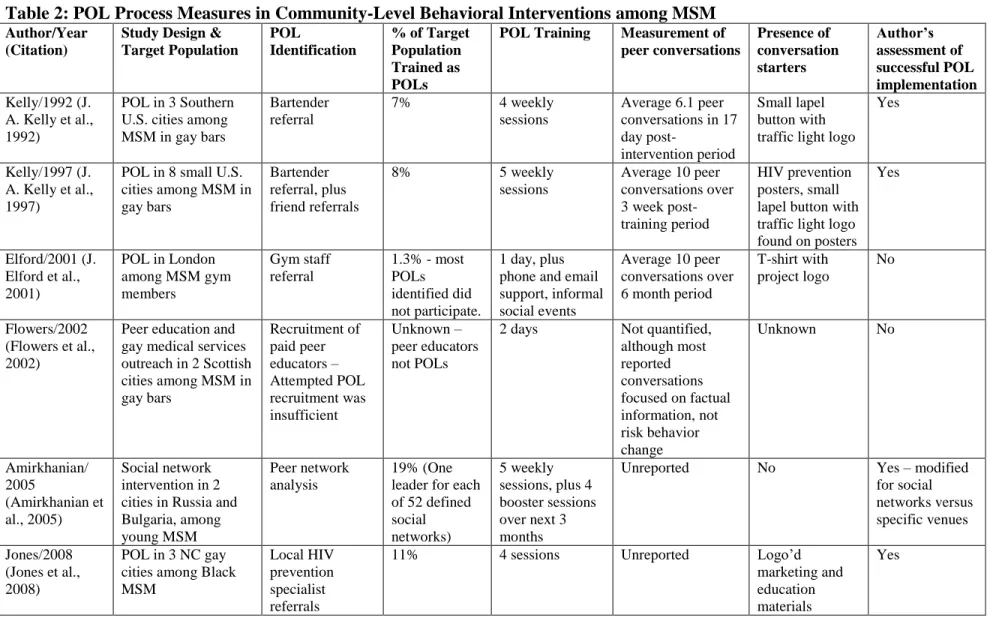
Both Kelly and the National Institute of Mental Health (J. A. Kelly, 2004; NIMH Collaborative HIV/STD Prevention Trial Group, 2007b) have published an identical set of 9 core elements required for successful implementation of the POL methodology in HIV interventions, which are presented in Table 1. I compared process measures, outcome measures, and other study design elements across the 6 studies, using the 9 core elements as a guide. The common features to review were selected based on information availability across at least 4 of the 6 studies, and are shown in Tables 2 and 3. I was not able to compare all facets of the 9 core elements among the studies. Attention is focused on items 1, 2 and 3 among the core elements in Table 1. Additionally, items 4, 5, 6 and 8 are addressed under the general topic of training. All of the POL training core elements could not be addressed point by point, as the published reports do not provide enough detail, but components of each of these elements are discussed.
Table 1: Core elements of the popular opinion leader (POL) model
1. Intervention is directed to an identifiable target population in well-defined community venues and where the population‟s size can be estimated.
2. Ethnographic techniques are systematically used to identify segments of the target population and to identify those persons who are most popular, well-liked, and trusted by others in each population segment.
3. Over the life of the program, 15% of the target population identified in intervention venues are trained as POLs.
4. The program teaches POLs skills for initiating HIV risk reduction messages to friends and acquaintances during everyday conversations.
6. Groups of POLs meet together weekly in sessions that use instruction, facilitator modeling, and extensive role play exercises to help POLs refine their skills and gain confidence in delivering effective HIV prevention messages to others. Groups are small enough to provide extensive practice opportunities for all POLs to shape their
communication skills and create comfort in delivering conversational messages.
7. POLs set goals to engage in risk reduction conversations with friends and acquaintances in the target population between weekly sessions.
8. The conversation outcomes of POLs are reviewed, discussed, and reinforced at subsequent training sessions.
9. Logos, symbols, or other devices are used as „conversation starters‟ between POLs and others.
Additionally, I evaluated the behavioral and biological outcomes measures used in each study. I compared the reporting of various sexual risk behaviors and the behavioral recall period, as well as collection of any biological or self-reported data on HIV and STD diagnoses. Time to follow up is also assessed for each study.
Results
Process Evaluation Measures in Community-Level HIV Interventions
Venue – Core Element #1
reduction of HIV transmission than other segments of the MSM population that do not frequent gay bars, and which may be less likely to have higher risk sex with multiple partners.
In their study, Elford et al (J. Elford, Bolding, & Sherr, 2001) targeted an MSM population of gym clientele at gay and predominately gay gyms in London. This
Table 2: POL Process Measures in Community-Level Behavioral Interventions among MSM Author/Year
(Citation)
Study Design & Target Population
POL
Identification
% of Target Population Trained as POLs
POL Training Measurement of
peer conversations Presence of conversation starters Author’s assessment of successful POL implementation Kelly/1992 (J.
A. Kelly et al., 1992)
POL in 3 Southern U.S. cities among MSM in gay bars
Bartender referral
7% 4 weekly
sessions
Average 6.1 peer conversations in 17 day
post-intervention period
Small lapel button with traffic light logo
Yes
Kelly/1997 (J. A. Kelly et al., 1997)
POL in 8 small U.S. cities among MSM in gay bars
Bartender referral, plus friend referrals
8% 5 weekly
sessions
Average 10 peer conversations over 3 week post-training period
HIV prevention posters, small lapel button with traffic light logo found on posters
Yes
Elford/2001 (J. Elford et al., 2001)
POL in London among MSM gym members
Gym staff referral
1.3% - most POLs identified did not participate.
1 day, plus phone and email support, informal social events
Average 10 peer conversations over 6 month period
T-shirt with project logo
No
Flowers/2002 (Flowers et al., 2002)
Peer education and gay medical services outreach in 2 Scottish cities among MSM in gay bars Recruitment of paid peer educators – Attempted POL recruitment was insufficient Unknown – peer educators not POLs
2 days Not quantified,
although most reported conversations focused on factual information, not risk behavior change
Unknown No
Amirkhanian/ 2005
(Amirkhanian et al., 2005)
Social network intervention in 2 cities in Russia and Bulgaria, among young MSM
Peer network analysis
19% (One leader for each of 52 defined social networks)
5 weekly sessions, plus 4 booster sessions over next 3 months
Unreported No Yes – modified
for social networks versus specific venues
Jones/2008 (Jones et al., 2008)
POL in 3 NC gay cities among Black MSM
Local HIV prevention specialist referrals
11% 4 sessions Unreported Logo‟d
marketing and education materials
Yes
The study population of the Amirkhanian intervention (Amirkhanian et al., 2005) was not based on a specific venue or set of venues, but was a modification of the POL
methodology that selected the intervention and control populations based on membership in social networks. Initial network membership selection and analysis (Amirkhanian, Kelly, Kabakchieva, McAuliffe, & Vassileva, 2003) was conducted among bar and nightclub venues in Russia and Bulgaria.
POL Identification and Recruitment – Core Element #2
Two studies (J. A. Kelly et al., 1992; J. A. Kelly et al., 1997) relied primarily on bartender referrals and one (Jones et al., 2008) used local HIV prevention specialists as the referral source. In the latter study, it is possible that the referred POLs were already active in HIV prevention activities. The POL recruitment efforts of these 3 studies were largely successful.
(J. A. Kelly, 2004), both the Elford and Flowers studies failed to implement core element #2.
Amirkhanian et al (Amirkhanian et al., 2005) conducted a study using a slightly different model. The authors used an existing social network analysis to identify leaders of 52 social networks of young MSM through analysis of the interrelationships among
networks of individuals. This model appeared to be a successful modification of the POL framework, with statistically significant reductions in unprotected anal intercourse among the study population, as well as greater peer acceptance of safer sex norms.
POL Critical Mass – Core Element #3
According to diffusion of innovations theory (Rogers, 2003), diffusion of innovations can best be achieved when an ideal of fifteen percent of the target population is recruited as POL agents of change. The studies reviewed here had POL participation ranging from 1.3% to 18% of the target population. Elford et al (J. Elford et al., 2001) had the lowest participation rate, at 1.3% and Flowers et al (Flowers et al., 2002) did not identify the percentage of the target population used as peer educators. Only the Amirkhanian study met the 15% target threshold, although studies with 7% to 11% of the population
recruited as POLs (Jones et al., 2008; J. A. Kelly et al., 1992; J. A. Kelly et al., 1997) reported statistically significant reductions in sexual risk behaviors at follow up.
for diffusion of innovation was absent, and therefore establishment of population-level behavioral change could not take place. The Flowers study, although designed to use POLs, is not a test of the diffusion of innovations theory as implemented.
POL Training – Core Elements 4, 5, 6 & 8
Several of the POL core elements identified in Table 1 revolve around the training of the POLs for each intervention. It is not possible here to assess how effective the individual trainings were in supporting all of the POL training objectives, but training frequency and duration can be assessed. These represent specific aspects of core elements 6 and 8.
Kelly (J. A. Kelly, 2004) emphasized the need for continuing follow-up and multiple role-playing sessions during training. The multiple week format suggested allows for reinforcement of the communication skills needed for successful implementation. POLs were instructed to have practice conversations among friends between sessions, and could then discuss any difficulties encountered in subsequent trainings. The shortened training exposure in the Elford and Flowers studies may not have allowed for the necessary skills reinforcement over time needed for proper delivery of behavior change messages to their peers (J. A. Kelly, 2004).
Outcome Measures among Community-Level POL Interventions for HIV
I compared several outcome measurements used to evaluate intervention success in the six selected studies. Table 3 summarizes the behavioral and reported biological measures used in each study. No actual biological sampling was conducted in any of the
interventions under comparison. Self-reports of HIV testing were collected in pre- and post-intervention surveys in several studies. Self-reports of STD diagnoses were collected only in the Jones study (Jones et al., 2008).
Table 3: Outcome Measures and Time to Follow Up Among Community-Level HIV Behavioral Interventions Author/Year
(Citation)
Intervention Intervention
Components
Time Post-intervention to Follow up Survey Primary Behavioral Outcome Measures Behavioral Recall Period Biological Outcome Measures – Reported Only Statistically Significant Outcome
Kelly/1992(J. A. Kelly et al., 1992)
POL in 3 Southern U.S. cities among MSM
Trained POLs in gay bars
3 and 6 months
UAI , PAI, # of sexual partners, peer acceptance of safer sex
2 months None UAI,
PAI
Kelly/1997(J. A. Kelly et al., 1997)
POL in 8 small U.S. cities among MSM
Trained POLs in gay bars; free condoms in bars
1 year UAI among
casual partners, PAI, # of sexual partners
2 months HIV status
known or unknown
UAI,
PAI
Elford/2001(J. Elford et al., 2001)
Peer education in London among MSM
Trained POLs in gay or
predominately gay gyms
6, 12, and 18 months
UAI; needle sharing among steroid users
3 months HIV status
known or unknown
UAI – No Change
Flowers/2002(Flowers et al., 2002)
Peer education and gay medical services outreach in 2 Scottish cities among MSM
Peer education in gay bars; gay medical services; free hotline
3 years UAI among
casual partners
1 year HIV status
known or unknown; Hepatitis B vaccination rate;
UAI – No Change
Amirkhanian/2005(Amirkh anian et al., 2005)
Social network intervention in 2 cities in Russia and Bulgaria, among young MSM
Trained POLs among networks of peers
3 months and 1 year UAI, condom use peer acceptance of safer sex Lifetime, 1 year, and 3 months (detailed questioning for 3 month recall)
None UAI,
peer
acceptance of safer sex norms
Jones/2008(Jones et al., 2008)
POL in 3 NC gay cities among Black MSM
Trained POLs in gay nightclubs
At approx. 3, 6, 9, and 12 months
UAI; PAI, # of sexual partners; condom use
1 year HIV status
known or unknown; Diagnosis with any STD
UAI, #
partners, condom use
POL: Popular Opinion Leaders; UAI: unprotected anal intercourse; PAI: protected anal intercourse (indicated by condom use);
whether sexual partners were long-term or casual. The common behavioral outcome used to evaluate results across all interventions reviewed was unprotected anal intercourse.
All six studies reported the behavioral recall period, which varied from two months to one year across the studies. Four of the six studies reviewed here (Amirkhanian et al., 2005; J. Elford et al., 2001; J. A. Kelly et al., 1992; J. A. Kelly et al., 1997) surveyed the sexual behaviors of participants using 2-3 month recall periods. The Flowers and Jones studies (Flowers et al., 2002; Jones et al., 2008), however, asked participants to recall sexual behaviors over a one year period.
The ideal biological outcome measure for any study whose objective is to reduce HIV transmission would be to test individuals for HIV exposure before and after the
STD diagnosis questions were only surveyed in the Jones study (Jones et al., 2008). Although the data was collected, Jones et al did not report on any change in STD
diagnosis rate due to the intervention so I am unable to assess if the intervention had any biological impact, even by proxy.
Time to Follow Up
Time to follow-up is the length of time between the start of the intervention and the post-intervention survey to determine results. Most of the studies reviewed here used multiple post-intervention surveys to assess intervention impacts immediately after the
intervention and again at a later time to measure lasting effects. Time to follow-up varied from 3 months to 3 years.
The Flowers study (Flowers et al., 2002) had the longest follow-up period at 3 years, and conducted only a single follow-up survey at that time, so any shorter-term impacts were unmeasured. The length of the follow-up period, combined with the fact that paid peer educators were used instead of POLs in the intervention, makes it difficult to assess the root causes for the failure of this intervention to measure any positive changes in sexual risk behavior.
Amirkhanian found that the magnitude of some of the positive effects seen at 3 months were somewhat reduced but still present at the 1 year follow-up, indicating that the intervention effects had waned.
The earliest study in the sample, from Kelly in 1992 (J. A. Kelly et al., 1992), performed post-intervention surveys at 3 months and at 6 months. Since that time, subsequent studies by Kelly and others have included longer-term follow-ups in their study designs.
Discussion
Successful implementation of a community-level POL behavioral intervention among MSM requires careful consideration of a number of important factors. This review demonstrates that some studies were less successful than others in meeting the POL core elements outlined in Table 1.
A critical mass of POLs active in the intervention is needed for successful
Elford and Flowers agreed that although their designs intended to deliver a POL intervention, the implementation failed. In response to criticism, Elford (J. Elford, Bolding, & Sherr, 2004) suggested that the „intent to treat‟ was present, and that
something about the locale or population made successful implementation unworkable.
According to Elford, the unsuccessful POL intervention among London gym clientele was caused by a failure of the POL model itself to transfer successfully from the small towns of the U.S. used in the Kelly interventions to the metropolitan environment of London. Elford contends that the London intervention was designed to include all the elements of a successful POL intervention, but that implementation of that design failed due to differences in both the setting and the time.
Although initial identification of POLs by gym staff in London was successful and not deemed difficult, only one in five potential POLs remained with the project throughout the intervention period. Potential POLs cited both a lack of time and a lack of interest in participating. Elford states that cultural differences may exist between the USA and UK, or between smaller towns and a major metropolitan area, that are barriers to participation. In addition, both Elford‟s and Flowers‟ studies were conducted after the broad
According to Elford (J. Elford et al., 2004), the compacted POL training in London was necessitated because the POLs recruited were not available for lengthier commitments, and enforcement of weekly training sessions would have exacerbated the recruitment and retention problems already experienced.
In Rogers‟ diffusion of innovation theory (Rogers, 2003), many factors affect the outcome when attempting to introduce an innovation into a community. In addition to the need for a critical mass of POLs who are sufficiently trained to deliver the innovation, there are other factors to consider. Rogers states that the rate of adoption of an
innovation is dependent on 5 different characteristics of innovation and its relationship with the target community. For rapid adoption, the innovation must have a relative advantage over current practice; it must be compatible with existing values; it must be easy to understand and implement, it must lend itself easily to experimentation and trial, and its use and adoption by others in the community must be visible.
A possible explanation for the difficulties experienced by Elford and Flowers may reflect differences in large metropolitan communities from the smaller communities where POL interventions among MSM have been successful. Perhaps rapid adoption is more
this type of phased implementation of the POL model could work in larger metropolitan areas. This and other modifications of the POL model of behavioral intervention may be needed for successful implementation in larger cities, before the diffusion of this
innovation could successfully percolate through a larger and potentially less homogeneous target community.
In measuring the outcome of POL behavioral interventions among MSM, the studies I reviewed here all used surveys of sexual behaviors, comparing levels of post-intervention behaviors in the intervention communities to either the levels of pre-intervention
behaviors in the same community, or to levels of behaviors among control communities. Measuring self-reported levels of various sexual behaviors which either confer or reduce risk of HIV transmission is the most common method of measuring outcomes among HIV behavioral interventions.
in the Flower and Jones studies (Flowers et al., 2002; Jones et al., 2008) may have reduced the reliability of the behavioral data for relatively frequent behaviors.
While it would be ideal to additionally measure any behavioral intervention intended to prevent HIV transmission using a biological outcome, none of the studies reviewed here included any biological outcome measure in their results. HIV testing of the study populations would be expensive, and may change the demographics of the population set willing to participate. This is confounded further within a community-level study, because randomized testing of the entire target community would raise both practical and ethical issues. HIV testing is voluntary in most community settings in the United States, and lack of participation by those who do not wish to be tested could introduce
significant bias. There are also implications for informed consent as well as how to notify any HIV seropositive cases.
Use of STDs as a proxy for direct HIV measurement has been advocated, although there is some disagreement about how applicable specific STDs or STDs in general may be as a measure of HIV transmission outcome.
The NIMH Collaborative HIV/STD Prevention Trial Group (NIMH Collaborative
as a valid marker of intervention success. The chosen biological indicator for this trial is a combined index of incidence of a set of six STDs, including HIV incidence. This was necessitated by the significant variation seen in prevalence of specific STDs across the different study sites and the desire to compare outcomes among the study sites. The investigators in the NIMH trial acknowledge, however, that STD endpoints are best used in high-prevalence settings, whereas behavioral outcomes may be more appropriate in low-prevalence settings. This is because low-prevalence settings would require very large sample sizes for enough statistical power to evaluate changes in STD incidence, and such large samples may not be economically feasible.
Fishbein and Prequegnat (Fishbein & Pequegnat, 2000) argue for a slightly different approach. Since different STDs have very different transmissibility rates, measurement of certain non-HIV STDs are appropriate as proxies for HIV only when the
transmissibility rates of the STD are similar to those of HIV. Condom use may also impact transmission of HIV more or less than some other STDs, and male-to-female transmission may differ from male-to-male or female-to-male transmission, all of which can reduce the validity of STD outcome measures as a surrogate for HIV incidence.
training for each study, little information was published on the quality of the training content itself, which may have varied considerably.
In this review of community-level POL behavioral interventions among MSM, I have highlighted a number of factors that must be considered in both the process
implementation as well as in measuring the outcomes of such interventions. Despite some hurdles that exist in designing and implementing successful POL interventions, current results indicate that these interventions can be very successful. Additional
References
Amirkhanian, Y. A., Kelly, J. A., Kabakchieva, E., Kirsanova, A. V., Vassileva, S., Takacs, J., et al. (2005). A randomized social network HIV prevention trial with young men who have sex with men in Russia and Bulgaria. AIDS, 19(16), 1897-1905.
Amirkhanian, Y. A., Kelly, J. A., Kabakchieva, E., McAuliffe, T. L., & Vassileva, S. (2003). Evaluation of a social network HIV prevention intervention program for young men who have sex with men in Russia and Bulgaria. AIDS Education and Prevention, 15(3), 205-220.
CDC. (2008). Subpopulation estimates from the HIV incidence surveillance system -- United States, 2006. Mortality and Morbidity Weekly Report, 57(36), 985-989.
Coates, R. A., Calzavara, L. M., Soskolne, C. L., Read, S. E., Fanning, M. M., Shepherd, F. A., et al. (1988). Validity of sexual histories in a prospective study of male sexual contacts of men with AIDS or an AIDS-related condition. American Journal of Epidemiology, 128(4), 719-728.
Elford, J., Bolding, G., & Sherr, L. (2004). Popular opinion leaders in London: A response to Kelly. AIDS Care, 16(2), 151-158.
Fishbein, M., & Pequegnat, W. (2000). Evaluating AIDS prevention interventions using behavioral and biological outcome measures. Sexually Transmitted Diseases, 27(2), 101-110.
Flowers, P., Hart, G. J., Williamson, L. M. M. P., Frankis, J. S., & Der, G. J. B. S. (2002). Does bar-based, peer-led sexual health promotion have a community-level effect amongst gay men in Scotland?[article]. International Journal of STD & AIDS, 13(2), 102-108.
Herbst, J. H., Beeker, C., Mathew, A., McNally, T., Passin, W. F., Kay, L. S., et al. (2007). The effectiveness of individual-, group-, and community-level HIV behavioral risk-reduction interventions for adult men who have sex with men - a systematic review. American Journal of Preventive Medicine, 32(4), S38-S67.
Jones, K. T., Gray, P., Whiteside, Y. O., Wang, T., Bost, D., Dunbar, E., et al. (2008). Evaluation of an HIV prevention intervention adapted for black men who have sex with men. American Journal of Public Health, 98(6), 1043-1050.
Kauth, M. R., St Lawrence, J. S., & Kelly, J. A. (1991). Reliability of retrospective assessments of sexual HIV risk behavior: A comparison of biweekly, three-month, and twelve-month self-reports. AIDS Education and Prevention : Official
Kelly, J. A. (1999). Community-level interventions are needed to prevent new HIV infections. American Journal of Public Health, 89(3), 299-301.
Kelly, J. A. (2004). Popular opinion leaders and HIV prevention peer education: Resolving discrepant findings, and implications for the development of effective community programmes. AIDS Care, 16(2), 139-150.
Kelly, J. A., Murphy, D. A., Sikkema, K. J., McAuliffe, T. L., Roffman, R. A., Solomon, L. J., et al. (1997). Randomised, controlled, community-level HIV-prevention intervention for sexual-risk behaviour among homosexual men in US cities. The Lancet, 350(9090), 1500-1505.
Kelly, J. A., St. Lawrence, J. S., Stevenson, L. Y., Hauth, A. C., Kalichman, S. G., Diaz, Y. E., et al. (1992). Community AIDS/HIV risk reduction: The effects of
endorsements by popular people in three cities. American Journal of Public Health, 82(11), 1483-1489.
Latkin, C. A., & Knowlton, A. R. (2005). Micro-social structural approaches to HIV prevention: A social ecological perspective. AIDS Care-Psychological and Socio-Medical Aspects of AIDS/HIV, 17, S102-S113.
NIMH Collaborative HIV/STD Prevention Trial Group. (2007a). Challenges and processes of selecting outcome measures for the NIMH collaborative HIV/STD prevention trial. AIDS (London, England), 21 Suppl 2, S29-36.
NIMH Collaborative HIV/STD Prevention Trial Group. (2007b). The community popular opinion leader HIV prevention programme: Conceptual basis and intervention
procedures. AIDS (London, England), 21 Suppl 2, S59-68.
Rogers, E. M. (2003). Diffusion of innovations (5th , Free Press trade pbk. ed.). New York: Free Press.