Evaluating Community Medicine Education for
Residents and Medical Students:
A Systematic Review
By
Laura K. House, M.D.
A Master’s Paper submitted to the faculty of
the University of North Carolina at Chapel Hill
in partial fulfillment of the requirements for
the degree of Master of Public Health in
the Public Health Leadership Program
Chapel Hill
2012
Advisor
Date
Second Reader
Abstract:
Purpose.
In recent years, primary care residency teaching has become increasingly
focused on teaching community medicine skills. The approaches for teaching community
medicine to residents are extremely varied and difficult to evaluate. The purpose of this paper is
to explore and summarize the existing methods for the evaluation of community medicine
education of medical students and residents.
Methods.
A PubMed literature search was
undertaken using the following MESH terms: (internship and residency OR medical students OR
graduate medical education OR medical education) AND (curriculum OR models, educational
OR clinical clerkship/methods) AND (program evaluation OR assessment) AND (community
oriented primary care OR community medicine/education) AND (Primary Health Care OR
Family Practice). Evaluation methods were divided into six subtypes based on Kirkpatrick’s four
levels of evaluation adapted for medical education.
Results.
The majority of literature described
programs which used a combination of methods for evaluation, but only four papers indicated
using validated instruments. The three most commonly reported evaluation methods were:
acquisition of knowledge and skills (Kirkpatrick level 2b), reaction/satisfaction data (level 1),
and change in attitudes/perceptions (level 2a). A modest number of papers described measuring a
change in practice (level 4a) or a change in behavior (level 3). Only five studies looked at patient
or community outcome data (level 4b) to determine the efficacy of their community medicine
education.
Conclusions.
Methods currently used for the evaluation of community medicine
education among residents and medical students vary greatly and are of questionable validity.
Further research is necessary to establish an effective and reliable means of assessing community
health education in the medical setting.
Introduction:
Despite huge healthcare expenditures, the population of the United States is no more healthy
than many other poorer nations.
1According to a 2005 report, “American adults receive just half
of recommended health care services, the worst of any industrialized nation.”
2Healthcare in the
United States has long focused on acute and specialty care, using the latest and greatest
One suggested solution to the current healthcare crisis in this country has been to shift the
practice of medicine from specialty and intervention driven towards a more primary care and
prevention-based focus. Furthermore, healthcare providers are being encouraged to take a more
population-based approach to care for people. Community medicine emphasizes prevention,
health promotion, and the care of populations to improve the health of the community being
served.
There is suggestion that increased training in community medicine topics during medical school
and residency may increase the likelihood of physicians entering primary care specialties and
subsequently becoming providers devoted to the health of communities.
3-11Despite this, it is not
clear that current community medicine education initiatives in medical schools and residency
programs are as rigorous or as effective as they need to be to increase the number of primary care
providers or ultimately improve the health of our nation.
One well-known formalized approach to community health is known as community-oriented
primary care (COPC). COPC emphasizes the comprehensive union of primary care with
community medicine. The fundamentals of COPC have been used to care for populations around
the world for over 60 years. Sydney Kark is widely viewed as the originator of this method
which he used in his work in South Africa in the 1940s. He emphasized orientation to the
community, applied research, community diagnosis and a team approach.
12Unfortunately these programs largely failed after federal funding stopped. In 1964, after the
establishment of Medicare and Medicaid government health insurance programs, several
community health centers were created for the underserved in the U.S. throughout the 1960s and
1970s.
12The concept of Clinical Community Health was introduced by McGavran in the 1970s,
suggesting that primary care practitioners view the “community as patient”. This approach
encouraged physicians to use their unique skills of diagnosis and problem-solving to help entire
communities rather than one patient at a time.
13In the late 1970s, the World Health Organization
pushed primary health care to incorporate a broad community medicine focus. There followed
an intensified interest in primary care as well as an increased number of community health
centers being established.
12COPC began to formally enter practice in the United States in the late 1970s.
14Unfortunately,
policy change in the early 1980s brought a marked decline in federal funding for community
health centers. Given the possible decline in the state of community medicine in the country, the
Institute of Medicine sponsored a conference in 1982 to discuss the value of COPC. In the
Institute of Medicine’s 1983 landmark report, COPC was suggested as a means of moving the
United States forward towards better, more equitable healthcare for all. The IOM also
encouraged additional research to examine the costs and outcomes of COPC. Lastly, it urged the
need to make COPC education available to physicians.
12During this conference, the 5 basic
tenets of COPC were described as: 1) The use of epidemiologic and clinical skills as
responsible, 3) the establishment of defined programs (based on epidemiologic findings) to deal
with the health problems of the community, 4) the involvement of the community in the
promotion of its health, and 5) the accessibility of the practice to the community it serves.
15During the 1980s medical schools and primary care residencies, family medicine programs in
particular, began to experiment with ways to teach COPC within medical training.
12Family
Medicine was first established as a primary care specialty in 1969. Historically, Family Medicine
has been very invested in community medicine as a means to improving health. In fact,
community medicine has always been considered an essential part of the training that future
Family Medicine practitioners must master. In the 1990s, the Academic Family Medicine
Organizations and the Association of Family Practice Residency Directors recommended that
family practice residents be formally trained in COPC concepts.
12The 1990s brought a renewed vigor for the concept of improving health through primary care
and community medicine, many new concepts arose, such as “community-responsive
medicine”
16, “population-based medicine,”
17and “service-education.”
18Many papers were
published describing various different programs promoting community medicine education.
3,19-27In the early 2000s, there was a further surge in research investigating the implementation of
community medicine and COPC teaching in residency programs in the U.S.
28-30community medicine, implementation of formalized community medicine teaching in Family
Medicine programs remains low, a 2002 report finding COPC training in residency programs to
be around 38%.
29In 2006, a literature review had similar findings, with only about a 40%
prevalence of Family Medicine programs teaching COPC.
31This may actually be an
overestimate, as a more recent review by Gavagan in 2008 suggested that most practices do not
employ the COPC methodology for teaching as originally described. This means that the actual
number of residencies that have truly implemented COPC as a teaching method may be far lower
than 40%. Although COPC concepts are taught in many residencies, most programs do not use
them in their entirety, and instead employ a wide variety of other community health education
activities more frequently.
32methods, it is not surprising there is scant availability of research attempting to summarize this
topic. While researching this topic, I found only one previous literature review on the topic was
located, published in 2006:
Evaluating Family Medicine Residency COPC Programs: Meeting
the Challenge
.
31Dobbie’s 2006 literature review not only looked at methods for teaching COPC, but also
summarized the existing assessment methods for COPC curricula, and found them to be far from
rigorous, with validated methods being practically nonexistent.
31While Dobbie’s review was a
good starting point, it only addressed Family Medicine residencies teaching formalized
Community Oriented Primary Care within the United States. I hope to build upon the existing
knowledge by looking at other types of community medicine education, other types of learners,
and expanding my search to programs outside of the U.S. I also hope provide an update of the
reviewed literature by looking for newer publications after 2006. The goal of this paper is to
provide an updated systematic review addressing “What are the existing methods to evaluate
community medicine education for medical students and residents?”
Methods:
(internship and residency OR medical students OR graduate medical education OR medical
education) AND (curriculum OR models, educational OR clinical clerkship/methods) AND
(program evaluation OR assessment) AND (community oriented primary care OR community
medicine/education) AND (Primary Health Care OR Family Practice), resulting in 140 results. I
individually reviewed the full-text of the articles, and was the sole decision maker regarding
inclusion or exclusion of the publications. During the review process, other useful appearing
papers that were referenced in the searched articles, but did not appear in the original literature
search were also analyzed for possible inclusion in the review. An additional 14 articles were
hand-selected in this manner for review, resulting in a total of 154 articles reviewed for
inclusion.
As this review is not interested in the education of non-physician health providers, 11 articles
were immediately excluded since they were not about medical students, medical residents or
physicians. The next step was to exclude papers that were not about a specific curricular
intervention or program to teach community medicine education. This excluded an additional 62
publications, leaving 81 papers. Next, all 81 of these papers were reviewed in-depth for any
evidence of evaluation methods used for the described community medicine education program.
evaluation methods, i.e. had no designated evaluation, or evaluation was termed as “planned” but
had not yet been implemented. Papers were, however, included if evaluation was either ongoing
or complete, with or without available results. This final step resulted in the exclusion of an
addition 23 articles from the review. Ultimately, 58 articles were selected for inclusion in this
review (see Figure 1).
Several articles located during the literature search had already been evaluated in the previous
2006 literature review by Dobbie. The 2006 review article, however, did provide a useful
framework for analyzing studies, based on a modified Kirkpatrick’s levels of evaluation.
31Donald Kirkpatrick is widely known for introducing a four-level method of evaluating training
programs which has been adapted to a number of uses. It categorizes the types of evaluation as
one of four types: Level 1 or “reaction,” Level 2 or “learning,” Level 3 or “behavior,” and Level
4 or “results.” Each level is considered equally important, and affects the next level. Each higher
level is generally more technically difficult to achieve, but all are necessary for effective
evaluation.
35“Reaction” refers to the participant’s satisfaction with the program. “Learning”
describes the participants’ change in attitudes, improved knowledge or skills from the course.
“Behavior” refers to a change in behavior on the job after the program. Lastly, “results”
describes the overall changes in the environment that result after the training.
is obtained in a variety of ways, most commonly by survey or questionnaire, but is sometimes
gleaned qualitatively from interviews, focus groups or through review of written responses and
assignments. Level 2 or “learning” is broken up into two different categories. Level 2a data
involves learning either through the modification of the learner’s attitudes or perceptions and
Level 2b implies the actual acquisition of new knowledge or skills. Measurement of learning
may be done in many ways, including through focus groups, interviews, surveys and written
assignments. Level 3 is changed from “behavior” to “transfer” which still indicates a change in
behavior, but is meant to reflect that the medical learner is transferring the knowledge learned to
practice. It can be assessed by multiple methods, including observation, chart review, or
self-reported change. Level 4 or “results/outcomes” is also divided into two levels, level 4a and level
4b. Level 4a indicates a change in practice, for example a residents’ change in career choice after
participation. Level 4b is designed to look at the overall outcomes, benefit to patients and
communities, such as through improved health.
31Level 4a data is typically measured by surveys
or by analyzing project outcomes. Level 4b data can come from patient outcome data, surveys,
chart review, billing data, or project outcomes. It is at times difficult to determine what
represents “behavior change” (level 3) versus what is a “change in practice” (level 4a). I
categorized shorter-term projects as behavior change, while more involved and lasting activities I
classified as being a change in practice. For example, I considered publishing papers or applying
for grants as behavior change, while actually earning an additional degree or choosing to practice
in an underserved community was categorized as a change in practice.
evaluation as well as other notes. Some of the articles, however, described the same program and
evaluation methods, so were grouped together in the evaluation grid during review (table 2).
The articles were in general divided into three blocks during the review process: articles that
were reviewed in the 2006 literature review, articles that were published 2005 and before but not
included in Dobbie’s review, and articles published 2006 and after. Dividing the information in
this manner helped to determine how many articles the 2006 review missed, as well as showed
the general trend in numbers of publications on the subject.
My literature search included an additional 22 articles published from 1979 through 2005 that
were not part of the 2006 review. I also located 24 articles published 2006 and later, after the
publication of Dobbie’s paper. 12 out of the 16 studies reviewed in Dobbie’s 2006 literature
review were also reviewed for this paper, but four articles were excluded for not describing
existing evaluation methods. Since review strategies were very similar, the data obtained on
repeat analysis was largely consistent with what was presented in the original 2006 review.
However, this paper attempts to also define the level of evaluation even when results were not
yet reported, in contrast to the 2006 review, which gives a level of “0” for articles without
available evaluation results.
31Results:
Level 1 Data: Over half (58%, N=34) of the reviewed articles reported level 1 evaluation
data,
3,7-9,19,21,22,24-26,34,36-58mostly in the context of program evaluation to be used for
focus groups or interviews to obtain qualitative data only.
37,48-50,53,54While a few articles reported
only level 1 reaction data,
37,44,50most papers reported this information in addition to other data as
part of more comprehensive assessment. Two papers used level 1 results for purposes other than
pure program evaluation. Omotara indicated that focus groups were used in Nigeria to learn what
community leaders thought of the medical students’ participation in the community, suggesting
that a positive community reaction indicated a successful educational program.
37Glasser
described using reaction data from trainees for the traditional purpose of program evaluation at
the Rockford program, but also pointed out that level 1 data was obtained from patients to
determine their acceptance of the medical student as a primary caregiver in their model.
3Level 2 Data: Level 2a data (attitudes/perceptions) was commonly assessed using a qualitative
evaluation of the student’s performance on written projects, essays or presentations. However,
several articles presented using a survey-type instrument to also quantitatively measure attitudes
and perceptions. Thompson indicated in both his 1996 and 1998 publications that their program
used a survey that assessed attitudes among family medicine residents in Texas.
22,23Donsky in
1998 described using both qualitative data as well as a survey to quantitatively evaluate residents
at UCSF before and after being involved in a COPC project.
20Oandasan also described obtaining
both qualitative and qualitative data using a combination of focus groups and a validated
program.
60The same year, in 2003, at the University of Rochester, Pearson described using the
same instrument in their C-POP curriculum to compare results of Rochester students to the
SUNY students, as well as to compare student’s attitudes before and after the curriculum.
42In
2007, Kai-Kuen Leung also described using a survey on medical students in Taiwan, known as
the “Social Attitude Scale,” which was designed to elicit attitudes towards social issues and
social service. However, this was administered only
before
the curriculum, so there was no
before and after comparison to evaluate the effect of the curriculum on attitudes.
52A year later,
in 2008, Art described using a Likert-scale questionnaire on medical students in Belgium to elicit
students’ attitudes about community medicine and primary care, but it was only used
after
the
students engaged in a COPC exercise.
47In 2010, Dent also describes using a validated
Likert-scale type survey for medical students in Savannah, Georgia.
61This survey was based on the
Community-Oriented Healthcare Competency Scale developed by Chen in 1999.
62among physicians and later in 2
ndyear medical students at the State University of New York
(SUNY) to evaluate the effectiveness of the C-POP curriculum.
60This tool was not meant to be
stand-alone, however, and was later used in combination with methods.
attitudes, but also is designed to test knowledge, and are applied both before and after a
community medicine project.
61Several other programs describe using a combination of methods,
such as modified essay questions, written reports, multiple choice exams, OSCEs, and oral
examinations.
39,41,43Level 2b learning, or knowledge evaluation data is also rarely used alone to evaluate community
medicine teaching, only three papers reviewed presented only level 2b data. In 2005, Belos
described the medical students at the University of Crete that underwent training at one of 4 sites
using similar community-based curricula. A retrospective review of the student case write-ups
was used to obtain qualitative and quantitative indicators of student knowledge. There was no
comparison to a control group, but the study did apparently show differences in knowledge
between students at different sites in a few categories.
63In 2007, a paper published by Wolff
indicated faculty at the Department of Family Medicine at the Medical College of Wisconsin
using a Likert scale to objectively evaluate residents’ performance in seven community medicine
competencies.
64A 2006 paper by Aziz also described only level 2b data, however as noted
previously, Aziz describes student self-assessment rather than an objective measurement of
knowledge and skills.
58students. Leung presented results from questionnaires containing three scales: the Social Attitude
Scale, the Program Characteristic Scale, and the Ability Scale.
52Dent indicated using the
Community-Oriented Healthcare Competency Scale, developed by Chen, et al
62to assess
knowledge, attitudes, and intention to use skills in practice.
61Sutphen described evaluating
medical students taking the C-POP curriculum at SUNY for level 2b (knowledge) data using
well-developed written tests and questionnaires,
38but it is important to note that level 2a
(attitude) data was also obtained concurrently during the same curricular intervention.
60These
same methods of evaluation were also used when the C-POP curriculum was applied to medical
students at the University of Rochester School of Medicine and Dentistry.
42Al-Dabbagh
described the evaluation of a task-based community-oriented curriculum at a medical school in
Iraq. The students were assessed using modified essay questions, multiple choice quizzes, case
management exercises, flowcharts and oral examinations (level 2b). A questionnaire was given
to the intervention group at the end of the training course to solicit their feed-back (level 1). Data
was compared pre- and post-curriculum, and students were also compared to control students
undergoing the standard traditional curriculum. Unfortunately, the knowledge assessed was more
applicable towards general practice skills rather than specifically for community medicine.
39Wong also describes using modified essay questions, multiple choice questions, and oral
Evaluation of graduate medical education also commonly used a similar combination of levels 1
and 2 data. For example, Thompson’s 1996 and 1998 papers described using semi-structured
interviews to obtain evaluation of resident’s learning (levels 2b), while formal program (level 1)
and learner evaluation (2a, 2b) was done by an interdisciplinary team. Surveys given to residents
evaluated satisfaction, attitudes and understanding of COPC (levels 1, 2a, 2b).
22,23Paterniti and
Hufford describe qualitative evaluation of Pediatric residents at UC Davis using semi-structured
interviews with multiple informants. Sequential yearly interviews with residents in the
Communities and Physicians Together (CPT) curriculum were used to show changes in reactions
and attitudes (levels 1 and 2a) as they progressed through the training program.
48,49An internal
medicine residency at Columbia University Medical Center implemented a one week curricular
intervention required for 3
rdyear residents, covering various topics, including public health and
community-oriented primary care. Residents did retrospective analysis of their knowledge (level
2b) as well as completed surveys rating the quality and impact (level 1) of the curriculum.
46Brill described largely qualitative evaluation tools for their longitudinal community medicine
curriculum at St. Luke’s Family Practice Residency, including written portfolios of reflections
(level 2a) and matrix tracking of resident growth in various domains (levels 2a and 2b), but no
results were reported
66Donsky portrayed a combination of quantitative and qualitative
Overall, only a handful (N=10) of publications described obtaining level 3 data. One study
looked at level 3 data in combination with level 1 (reaction) data, while the remainder combined
level 3 data with other types of evaluation. Gofin described Family Medicine residents at
Hebrew University in Jerusalem being sent a structured questionnaire to determine if 2-4 years
after a 45 hour COPC workshop they were using COPC concepts in their current work.
VII grants applied for, proposed curricular innovations, and scholarly publications for
community medicine.
8Only around one quarter of the reviewed papers (N=14) described measuring level 4a data. Quite
frequently among medical schools, this is measured as learner’s choice of specialty. Smilkstein
described the higher likelihood of medical students at the University of Washington to choose
Family Medicine residency if they participated in the school’s “Community Health
programs in other schools.
27A medical school in Bogota, Columbia looked for changes in the
level of community participation and at the development of COPC in local community centers
after restructuring the local medical school’s curriculum.
26Residency programs do not often use specialty choice to evaluate practice change. Lipkin
described metrics such as number of residents from the Bellevue Primary Care Internal Medicine
Residency program in New York doing additional fellowships in fields such as primary care or
other generalist fields such as substance abuse. He also reported on the types of practice entered
by former residents, including primary care, teaching, working with the underserved, advocacy,
etc.
8Strelnick similarly described surveying previous graduates from the Residency Program in
Social Medicine at Montefiore, NY to determine if any earned additional degrees (i.e. MPH), or
served as leaders in organizations, either national or local. He also reported on the number of
graduates that currently practice in medically underserved areas and take care of indigent
populations.
7Fisher described a high number of community focused career choices for former
residents from the University of Pennsylvania’s Family Medicine residency program.
11Steiner
had current practicing primary care physicians fill out a survey regarding the amount of
community involvement they received during training. He found that those with moderate to
extensive community involvement during medical school or residency were much more likely to
have continued current involvement with community medicine.
10approach to preventing and managing childhood illness. The outcomes reported were
improvement in rates of desired health practices (i.e. breastfeeding, sleeping under insecticide
treated nets, etc.) in the families visited by students in the program.
70Generally, level 4b data is
collected along with other types of assessment, and most frequently was collected in the process
of a COPC project. In 2002, Gillam reported primary care teams in the UK undergoing a 4 day
workshop and then undergoing a COPC cycle. They attempted to measure benefits to patients,
such as rates of smoking cessation and vaccinations. They also attempted to develop a
framework for cost-effectiveness, but they weren’t able to show statistical significance during
the time of the intervention.
67In 2000 and 2002, Harper and Baker described improved HIV
screening rates, decreased teen Chlamydia rate after implementation of COPC projects in a
Family Medicine residency clinic in Minneapolis, MN.
71,72Similarly, Fisher reported in 2003
improved vaccination rates for some at-risk patients through a COPC inspired curriculum at the
University of Pennsylvania’s Family Medicine Residency program.
11Discussion:
Unfortunately, I found almost no uniformity among programs as to which types of evaluation
data were measured, and there were an extremely broad range of methods used to obtain that
data. Only two different validated instruments were described. One validated instrument was
described in three publications, used with the C-POP program.
38,42,60The other validated
instrument was used in only one study, despite the fact that it had been developed over a decade
earlier.
61The only different programs that indicated using the same instrument for any data were
SUNY Medical School and the University of Rochester Medical School, who both employed the
C-POP curriculum for medical students.
Level 1 data was commonly collected, and but was usually used as part of a more comprehensive
evaluation strategy in combination with other methods. The most frequent method of obtaining
level 1 data was through questionnaire. No two programs appeared to use the same survey or
method to obtain level 1 reaction data. Level 1 data was typically employed as a method of
feedback into the program to improve the educational interventions being offered to learners.
qualitatively, with written projects, essays or presentations, but was also frequently measured
using surveys. Level 2b data was obtained by the most diverse methods of any type of data,
including surveys, OSCE exams, video review, oral presentations, multiple choice and essay
exams, case write-ups, and preceptor feedback. Several programs employed multiple different
methods concurrently to measure level 2b results. While some data was objectively measured,
some publications reported students’ self-perception rather than performing actual tests. It is not
clear if self-perception of knowledge and skills equates to actual attainment of knowledge and
skills. There was almost no consistency in the manner in which this data was obtained among
programs, excepting 2 programs which both described employing the C-POP curriculum.
38,42The higher levels of evaluation, levels 3 and 4, were much less frequently measured than levels 1
and 2. This may bear out Kirkpatrick’s beliefs that the levels of evaluation are more or less
stepwise, with each higher level being more difficult to measure.
35Level 3, change in behavior
was only described in 10 publications. Most frequently, this data was obtained through learner’s
subjective report via survey. Surveys that were used were inconsistent among programs, and no
validated tools were described. Other objective methods were occasionally described, such as
looking at an increase in student participation in service-learning projects, but this type of
measurement was overall uncommon.
healthcare agencies due to community medicine curricula at the undergraduate level. Graduate
programs did not report specialty choice, likely because residents are already committed to a
specialty. Instead, they usually described the likelihood of residents to obtain additional degrees,
do certain fellowships, or to enter practice in rural and underserved areas.
Level 4b data was the least commonly reported type of results, with only 5 publications
describing these type of outcomes. This is likely due to the long-term nature of outcomes in
medicine, it is very difficult to perceive a change in health status over the short-term with any
type of intervention. Four out of five programs reporting 4b results did so in the context of a
COPC intervention.
11,71,7267Most (83%) of the studies presented a combination of evaluation methods rather than just one
type of evaluation (N=48), but none of them had evidence of using all 6 sublevels from the
modified Kirkpatrick model concurrently. Three programs, however, did present some
combination of all 4 levels of Kirkpatrick’s original paradigm.
7-9It is interesting to note this in
light that Kirkpatrick indicates that
all
levels of evaluation are necessary and depend on one
another.
35The studies that did present all 4 different types of evaluation were more recently
published, all after 2007. This may represent advancement in the state of community medicine
education and evaluation, but it is too early to clearly see a pattern.
Limitations: This review is certainly limited by publication bias, as many programs likely
generate, leading to a skewed misperception that certain types of evaluation are not being
conducted. Some publications did not describe actual results, so it was difficult to determine
what level of evaluation was being performed in these cases. Even when there were published
results, some were very difficult to categorize it into one level or another. For example, I had
difficulty determining if students’ “satisfaction” with their level of knowledge equated to level 1
“satisfaction” data or level 2b “learning” data. I also struggled with drawing the line between
what actions were significant enough to be considered an actual level 4a “change in practice”
versus a level 3 “change in behavior.”
Conclusions:
Figure 1:
N=154
N=143
N=81
Articles
reviewed
N=58
PubMed
Search
N=140
Not
about
medical
students,
residents
or
physicians
N=11
Additional
hand
‐
selected
articles
N=14
No
evaluation
of
said
community
medicine
education
intervention
or
program
N=23
Not
about
a
community
medicine
education
intervention
Table 1:
Kirkpatrick’s Four Levels of Evaluation, Adapted for Medical Education
31Level Description
Example
1 Reaction
Residents
reactions/satisfaction data
Focus groups, semi-structured
interviews, satisfaction surveys,
program evaluation
2a Learning
Modification of resident’s
attitudes/perceptions
Focus groups, semi-structured
interviews, before and after attitude
surveys, reflective essays, journals
2b Learning
Resident’s acquisition of
knowledge
Pre and posttests of community
medicine knowledge, focus groups,
standardized cases, written vignettes
3 Transfer
Change in resident’s
behavior
Chart review, observational studies,
self-reported change surveys,
interviews and focus groups, worked
case studies
4a Results/Outcomes
Change in practice
graduates, residencies or
community agencies
Change in practice due to project
outcomes, permanent adoption into
residency curriculum or agency
activities
4b Results/outcomes
Benefits to patients or
communities
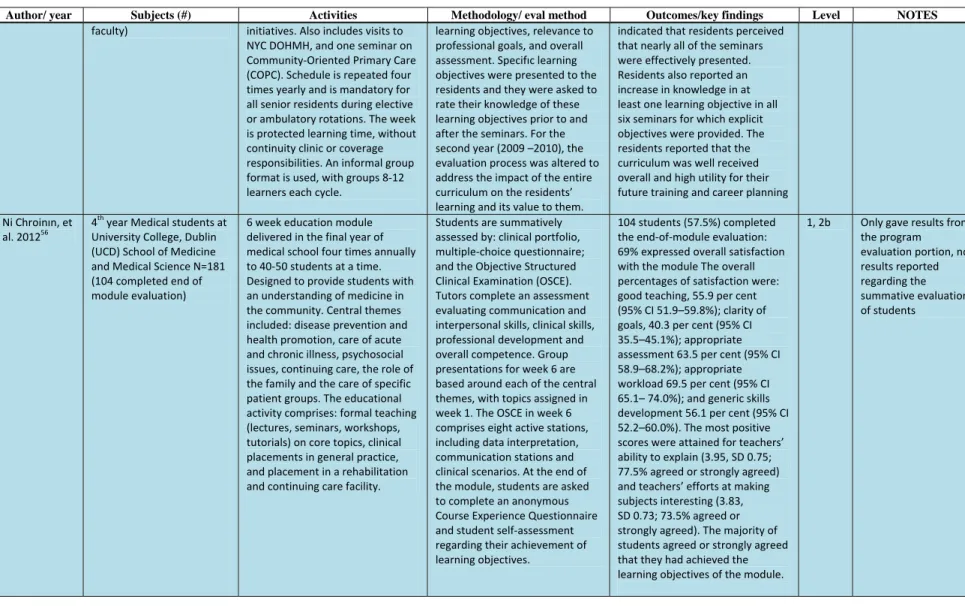
Author/ year Subjects (#) Activities Methodology/ eval method Outcomes/key findings Level NOTES
Klevens, et al
199226
Medical students at
Javeriana University in
Bogota Columbia
Curricular restructure to include a
course emphasizing primary care,
preventive and social medicine as
well as COPC. Over the course of 2
years, 8 groups of 35 students have
participated, each carrying out a
different phase of an ongoing
COPC project.
Student evaluation of content,
teaching methods, pace, and
applicability of acquired
knowledge in the course via
anonymous self‐administered
questionnaire.
Program coordinators ranked
community participation in areas
like leadership, organization,
resource mobilization,
management, and needs
assessment before/after
implementation of curriculum.
Also looked at the development
of COPC functions in the
community centers.
Student evals show fulfillment of
learning objectives and student
satisfaction with program
Greater advances seen in
community participation than in
COPC functions
1, 2b
4a
Self‐evaluated increase
in knowledge, but
mostly reaction type
data
Summerlin,
Landis, Olson
199373
Residents at Asheville, NC
Family Medicine Residency
and UNC SOM medical
students
Residents and students spend one
month in community in western
North Carolina. They live in the
community and provide clinical
care to patients, meet with local
health officials, service agencies,
and community organizations to
learn about the community’s
health system.
Written report by
students/residents
about the
community’s health system, a
community health problem
identified by the trainee, and a
proposal to solve the problem.
Self‐report opportunities to
understand the community, no
results presented
2a, 2b Unclear how reports
analyzed and results
(attitudes and/or
knowledge
acquisition?)
1)Thompson,
et al 199622
1)20 residents at
Department of Family
Medicine, University of
Texas Medical Branch,
Galveston. 7 each PGY1 and
PGY2, 6 PGY3
An interdisciplinary team that
included public health
representatives was created to
teach COPC principles to family
practice residents and supervise
their community projects. Allied
health and nursing graduate
students were also involved in the
process. Projects were
implemented in collaboration with
community representatives. Year 1
orientation one day a week, Years
2‐3 other community
activities/projects ½ day week.
1)Semi‐structured interviews with
community sites by team SW
about resident’s ability to put
learning into practice, perception
of value of projects. Formal
program and learner evaluation
by interdisciplinary team.
Questionnaire for residents to
assess fulfillment of learning
objectives, open ended. Probed
understanding of COPC and
satisfaction, strengths/
weaknesses, perceived
usefulness.
1)Qualitative themes reported
enjoyment of experience, found
exercise useful, etc. by both
residents and community sites.
Felt COPC would be useful for the
future.
1, 2a,
2b
No description of
survey
Author/ year Subjects (#) Activities Methodology/ eval method Outcomes/key findings Level NOTES
Donsky, et al
199820
Residents at the Family
Practice Residency Program
(FPRP), a program of the
University of California, San
Francisco School of
Medicine
Successive groups of residents work with faculty on a single
longitudinal group COPC project,
using a modified incremental COPC
approach. Initial introduction to
COPC and community PGY1, then
allotted time to a COPC project of
2.5 hours per week during the 3‐
month PGY‐2 and PGY‐3
ambulatory blocks, for total of 30
hours each during the PGY‐2 and
PGY‐3 year, project to be
completed over those 2 years.
Each group contains 6 residents (2
each PGY2 and PGY3) and 2‐3
faculty
The COPC curriculum was
evaluated quantitatively
by a pretest and posttest of
residents’ attitudes and
knowledge and qualitatively by
open‐ended questions
posed to the residents about the
COPC curriculum.
Focus group and individual
interviews with some residents
Significant improvement in
knowledge and a small but
significant decline in favorable
attitudes about COPC. However,
residents’ initial attitudes to
COPC were generally favorable, so
attitude scores were still on the
positive end of the scale on post
testing.
Qualitative evaluations revealed
both positive and negative themes,
including frustration with the slow
process, increased interest in
working with the community, etc.
2a, 2b Includes example of
COPC knowledge
questionnaire
Thompson, et
al 199823
35 residents over 3 years at
Department of Family
Medicine, University of
Texas Medical Branch,
Galveston.
An interdisciplinary team that
included public health
representatives was created to
teach COPC principles to family
practice residents and supervise
their community projects. Allied
health and nursing graduate
students were also involved in the
process. Projects were
implemented in collaboration with
community representatives. Year 1
orientation one day a week, Years
2‐3 other community
activities/projects ½ day week.
Post‐test given 10 mos. after
orientation exercises, 5 item
survey, attitudes and self‐
reported behavior change. Chart
review to confirm behavior
change.
Self‐reported behavior change, not
confirmed by chart review.
Reported improved pt. education
skills
2a, 2b,
3
See 1996 Thompson
article22
Steiner, et al
199910
247 (out of 500) practicing
primary care physicians who
graduated from med school
1985‐1990; response rate of
66.6%
Surveys sent to 500 recent medical
graduates practicing primary care
(family physicians, general
internists, and general
pediatricians); sampled from the
American Medical Association’s
master file of US physicians.
8 page questionnaire to determine
current community involvement
based on 4 predefined community
domains of practice. Other
questionnaire items determined
community related training as
students and residents, training
setting (urban vs. rural), personal
background, and current practice
Factor analysis of survey
responses
Descriptive statistics used to
characterize background,
practice, training experience and
current community involvement
Formal community involvement
training overall low with limited
training in rural and underserved
areas. A few with moderate to
extensive training in these settings.
Physicians who reported receiving
more training in a given
community domain reported
significantly greater current
involvement in that community
domain of practice, true for all
domains. Timing of rotations (med
school vs. residency) affected level
of community involvement as did
longitudinal training experiences.
4a Retrospective; risk for
recall bias. Used more
recent grads to try to
combat this. Also
cannot tell if
physicians who were
more likely to pursue
community medicine
training more likely to
practice it, vs. training
leading to practice,
tried to control for this
by looking at
community medicine
interest prior to med
Author/ year Subjects (#) Activities Methodology/ eval method Outcomes/key findings Level NOTES
Oandasan, et
al 200059
Residents at the Toronto
Hospital Department of
Family and Community
Medicine. 27 pretest and 22
posttest
COPC curriculum developed at
stated residency. No specific
activities described.
Qualitative and quantitative data
to measure attitude and attitude
changes. Quasi experimental
control group study. Validated 20
item questionnaire administered
pre and post‐intervention. Focus
groups for R1s.
Study group of 11 R1s pretest and
13 posttest, control of 8 R2s at
same hospital and 8 R1s at
another program pretest, lost 7
of these to follow‐up
Pre‐intervention attitudes in
control and study groups the same.
No statistically significant
difference in attitudes post‐test,
but approached statistical
significance. Slight shift to more
positive attitude towards COPC in
study group before and after.
Qualitative data showed some
positive community experiences
and learning, but concern for
practicality of COPC
2a Very small study with
high loss to follow up
in control group.
Baker 200271
Harper, et al
200072
Patients at Ramsey Family
and Community Medicine
Residency clinic,
Minneapolis, MN
5 COPC projects implemented in
clinic: preschool immunization,
family‐centered birth, intimate
interpersonal violence, teenage
pregnancy‐sexually transmitted
disease prevention, and human
immunodeficiency virus (HIV)
screening
Used clinical indicators:
documented immunization rates
at 24 mos., preterm birth rates
and rates of breastfeeding,
screening rates for IPV, teen
pregnancy and chlamydia rates,
HIV screening rates. Data
obtained by looking at billing
data, chart audits, registry
review, hospital code review, lab
test results data
Improved HIV prenatal screening rates, decreased teen
chlamydia rate, improved domestic
violence screening, teen pregnancy
high but stable. Preschool
immunization rates declined,
preterm births increased
4b No reported
educational program
or resident eval.
Of note, projects
designed by clinic’s
perceived need rather
than community’s
Brill 200266
Residents at St. Luke’s
Family Practice Residency,
University of Wisconsin
Medical School–Milwaukee
Longitudinal community medicine
curriculum designed to teach the
four domains of physician– community involvement: (1)
insight into sociocultural aspects of
patient care, (2) familiarity with
community health resources, (3)
community‐oriented primary
care skills, and (4) community
involvement.
Innovative qualitative evaluation
tools include a written portfolio
of reflections and sequential
‘‘video journaling.’’ An attribute‐
based progression matrix
developed by Alverno College
was adapted to facilitate serial
identification and tracking of
resident growth in eight domains:
communication, analysis,
problem solving, aesthetic
responsiveness, global
perspectives, valuing in decision
making, social interaction, and
effective citizenship
None reported 2a, 2b Unclear level since no
results published, but
can infer that
reflections and
tracking of growth
would assess attitudes
and acquisition of
knowledge (Dobbie did
Author/ year Subjects (#) Activities Methodology/ eval method Outcomes/key findings Level NOTES
Unverzagt, et
al 200257
Medical students at
University of New Mexico
School of Medicine (n=322)
Development of 3rdyear 8 wk.
Family Medicine clerkship centered
on a community oriented
population health curriculum.
Assigned community preceptor
with 50% clinical time, and 50%
spent on population health
project. Prior to rotation students
receive orientation on COPC, basic
epidemiology, and public health
concepts. Community preceptors
helped develop projects in phase
III.
1 page summary of COPC
activities and poster
presentation. Projects graded
pass/fail in phase III
Rotation evaluation with
questionnaire and qualitative
comments
All students passed
Qualitative 62% wholly positive,
14% wholly negative. This was
improved from Phase I/II to III.
Quantitative reflected student
interest in clinical care above
community medicine project.
1, 2a,
2b
Some positive
community preceptor
response to the
projects indicating
benefit to the
practices, not formally
evaluated.
Fisher 200311 Residents at the University
of Pennsylvania’s
Department of Family
Practice and Community
Medicine
Community medicine training in
residency that contains both block
and longitudinal experiences,
including a community medicine
block PGY2 and PGY3. PGY3
residents each complete a
collaborative project with Dept. of
Public Health. Longitudinal
components start during PGY1
orientation and continue
throughout all 3 years, include a
multidisciplinary group project.
1)completed second residency
year individual projects 2)
completed team projects, and 3)
number of residency graduates
pursuing careers with attention
to community medicine.
No completed specific curriculum
eval methods
Qualitative description of
completed projects
Some described project outcomes,
i.e. vaccination rates for at risk gay
men
8/10 residents in first two
graduating classes chose
careers with community foci
4a, 4b Selection of
community oriented
residents more likely
to result in graduation
of community oriented
residents
Davison, et al
199919
Medical students at the
University of Glasgow (N=?)
Exercise in community diagnosis
developed in Glasgow’s new
undergraduate medical curriculum,
involves 3 teaching sessions. 1st
session explores routine statistics,
and discusses information about
individual’s and community’s
health and needs. The 2nd session
is a community based rapid
participatory appraisal thru pt and
key informant interviews. The 3rd
session is back on campus,
students combine and present
their findings.
Group work was assessed using
the final group presentations
which was graded on a scale.
The individual student
assessment was based on two
essays.
Feedback students during pilot
program regarding how well
program meeting stated
objectives.
Evaluation forms on all sessions
attended by 1st year students
completing program.
Not presented
Not presented
Most objectives scored towards 3‐
4 on 5 pt scale with 5 being “fully
achieved.
“Interest” rated at 3.1 and
“relevance” rated at 3.5 on 0‐5
scale, 5 being highest
2b 2b 1 1
Unclear who assessed
individual assessments
and how they were
scored. Unclear if final
evaluation form given
to students was the
same as the form used
for feedback during
ongoing program eval
during the pilot. Also
unclear how they
assessed “interest”
and “relevance” on the
Author/ year Subjects (#) Activities Methodology/ eval method Outcomes/key findings Level NOTES
Stearns, et al
20004
Medical students at RMED
program University of Ill
Rockford, follow‐up
evaluation: All previous
graduates responding to
mailed surveys; (N=347)
(response rate 59%)
Re‐evaluation of RMED Program in
Rockford Ill (1995 Glasser article3)
students complete
all the coursework required of
University of Illinois medical
students but, in addition,
participate in an add‐on curriculum
consisting of monthly sessions
during the first three years (M1,
M2, and M3) of medical school and
a capstone requirement in the
fourth year (M4). A key concept is
the integration of clinical medicine
and population health. From the
M1 to the M4 year, the curriculum
progresses through community
and population health; health care
delivery in rural communities;
understanding and developing a
community‐oriented primary care
(COPC) project; and immersion in a
rural community
Follow‐study of surveys sent out
to all previous graduates to
assess effect of program on
specialty choice, choice of
community for practice, and type
of practice. Also asked about how
well CHC prepared them in terms
of specific skills, including
community medicine
Program’s impact on choice of
specialty 4.3, choice of community
2.9, practice type 3.5 (scale 1to 7,
with 7 being great impact)
4a, 2b Self‐assessment of
learning rather than
objective measure.
Worley, et al
200074
Medical students (N=?) at
Flinders University
1‐week curriculum implemented
and evaluated in 2008–2010. It
included seminars on health policy
and economics, health insurance,
technology and cost assessment,
legal medicine, public health,
community‐oriented primary care,
and local health department
initiatives. Also includes visits to
NYC DOHMH, and one seminar on
Community‐Oriented Primary Care
(COPC). Schedule is repeated four
times yearly and is mandatory for
all senior residents during elective
or ambulatory rotations. The week
is protected learning time, without
continuity clinic or coverage
responsibilities. An informal group
format is used, with groups 8‐12
learners each cycle.
Each subject PRCC students
comprised a synthesis of
continuous assessment by clinical
supervisors; objective written
tests, objective structured clinical
examinations (OSCE), end‐of‐year
written exam and OSCE. All
assessments were tied to the
defined learning objectives.
Identical ‘end of clerkship’ exams
to those of the traditional
students, but staggered
throughout the second half of the
year to reflect the year‐long
integrated curriculum. The PRCC
students sat the end‐of‐year
examinations with their
traditional peers. PRCC formative
assessments were provided every
7 weeks. These comprised broad‐
based multiple‐choice question
tests, clinical scenarios with
short‐answer questions and a
review of each student’s progress
The students developed a high
level of competence in procedural
skills and an increased confidence
with patients. Encouragingly, the
students performed very well
academically. One PRCC student
topped the year, and six were in
the top 15 students. There has
been some indication that
academic respect for the rural
doctors has increased within the
School as a result of the
performance of the PRCC students.
Some of the PRCC initiatives have
now been incorporated into the
traditional teaching programs
2b
2a
Original description of
program which
subsequently became
more focused on
ability to train
community responsive
Author/ year Subjects (#) Activities Methodology/ eval method Outcomes/key findings Level NOTES
O’Keefe, et al
200143
Postgraduate medical
students from the Flinders
University of South Australia
(N=55) and undergraduate
University of Adelaide
students (N=97)
Students from two universities
integrated into a single learning
program in community child
health. Aims were to experience: A
wider spectrum of health problems
than those seen in teaching
hospitals, to learn the importance
of social and environmental factors
in child health, to improve
knowledge of health care delivery,
understanding of the importance
of coordinating care and the
understanding of health
promotion, surveillance and
education. Students were placed in
various agencies, including
community health centers,
agencies providing support
services, mental health services,
etc.
Formal assessment of pediatric
skills and knowledge was
conducted by each university
separately, using objective
structured clinical examinations,
written projects and oral
presentations.
Achievement of the aims of the
program was evaluated using a 6‐
item questionnaire, each item
being scored using a 7‐point
Likert scale. The first 5 questions
related to the specific aims
described earlier, and final
question assessed program
organization. Questionnaires
were completed separately by
students and agency staff at the
end of each placement.
Response rates were 83% for
students (126 responses)
and 64% for agency staff (50
responses). The responses showed
that overall each of the individual
program aims had been achieved
satisfactorily. Agency response
scores were significantly higher
than those of students. regarding a
wider spectrum of health care
problems, the importance of
coordinating care, and the
importance of social and
environmental factors. There was
no difference between the groups
regarding improving knowledge,
understanding health promotion,
surveillance and education or the
organization of the program.
1, 2a,
2b
No comparison to
students not
undergoing the
curriculum. It had
originally been
intended that both
universities conduct
identical assessment
procedures for
community child
health to permit direct
comparison of student
performance, but this
was not possible in the
limited time available.
Gillam 200267
Eleven primary health care
teams at 4 sites—urban and
rural in the UK, teams
varied across sites (N=?)
Teams participate in 4‐day training workshops guiding them through
the conventional COPC cycle. The
teams undertook a community
diagnosis before selecting a
specific health problem against
which to develop intervention
plans
A range of qualitative and
quantitative methods; focused on
4 areas: effectiveness of the
workshop program, progress in
the projects of COPC practices,
comparison of COPC with
alternative initiatives sharing
similar objectives, and the
generalizability of the program,
including its cost‐effectiveness
Quantitative evidence of benefits was obtained in all 11 practices.
Limited gains in terms of
behavioral risk factor reduction;
other benefits were more difficult
to measure, statistically significant
changes in most outcome
measures were unlikely to be
detected
for any but common
conditions. Many outcomes of
were intermediate, like
enhancement of staff
skills, and changes in patient
behavior.
3, 4b Applied to community
practices/teams, but
similar projects being
adapted to use in
undergrad and grad
medical training
Hannay 200340 1st
year medical students at
Sheffield UK (N=183 in
1994, N=176 in 1995, N=547
in 1997‐1999)
(N=18‐20 tutors)
Students were attached in pairs to
the family whom they had
to visit on at least four occasions
during the year. Small groups of
students had tutorials/lectures.
Lectures covered topics: people in
communities; social stratification
and their effects on morbidity and
illness behavior; meanings of
health/illness; medicine, health
and the community, etc.
Written project which reflects
the aims of the course.
As well as the written project
there is also assessment of
students by tutors, agreed by
both, which identifies six
behaviors during tutorials as
taking place rarely, sometimes
and often.
Tutor and student feedback on
None given
Both tutor and student feedback
used to evaluate and improve
2a, 2b
1
Mostly focusing on
biopsychosocial
education of students,
but covers some
community medicine