1) A Longitudinal Medical Spanish Program at One US Medical School.
2) Accuracy of Self-assessed Spanish Fluency among Medical Students
Daniel S. Reuland, MD
Papers submitted to the faculty of the University of North Carolina at Chapel Hill in partial fulfillment of the requirements of the degree of Master of Public Health in the
Public Health Leadership Program. Chapel Hill
March 14, 2008
GIM
JOURNAL OF GENERAL INTERNAL MEDICINE
March 13, 2008
Daniel S. Reuland, MD
University of North Carolina at Chapel Hill
Division of General Internal Medicine and Clinical Epidemiology Campus Box 7110
Chapel Hill, NC 27599-7110
RE: MS #4903r3 Dear Dr. Reuland,
Congratulations. Your manuscript entitled "A Longitudinal Medical Spanish Program at One U.S. Medical School" has been accepted for publication in the upcoming Medical Education special issue of the Journal of General Internal Medicine.
We do not yet know when this supplement will be published, as some manuscripts are still undergoing review and revision. As manuscripts are accepted, they will be sent to the publisher to begin processing for publication and you will receive galley proofs directly from the publisher. However, the manuscripts will not be available online or published until all of the papers accepted for publication have been finalized.
Thank you for giving JGIM the opportunity to publish your work. I hope you consider us when submitting future manuscripts for which JGIM would be appropriate.
Sincerely,
Diane B. Wayne, MD
. . \
A Longitudinal Medical Spanish Program at One U.S. Medical School
DanielS. Reuland, MD1, Pamela Y. Frasier, PhD2· , Lisa M. Slatt, MEd2,
Marco A. Aleman, MD1
Departments of 1Medicine and 2Family Medicine University of North Carolina at Chapel Hill
Corresponding author:
Daniel S. Reuland, MD
University of North Carolina at Chapel Hill
Division of General Internal Medicine and Clinical Epidemiology Campus Box 7110
Chapel Hill, NC 27599-7110
Tel: 919 966 2276 Fax: 919 966 2274 [email protected]
Contents: Abstract: 200 Text: 1999 References: 24 Tables: 2 Figures: 0 Appendix: 1
Abstract
Introduction: Policymakers have recommended recruiting and/or training more
US physicians who can provide care in Spanish. Few longitudinal medical
Spanish programs have been described and evaluated.
Aim: To describe development and evaluation of the preclinical phase of a
four-year program designed to graduate physicians who can provide
language-concordant care in Spanish.
Setting: One public medical school in southeastern US.
Program description: The program targeted intermediate/advanced Spanish
speakers. Standardized fluency assessments were used to determine eligibility
and evaluate participants' progress. Curriculum included didactic coursework,
simulated patients, socio-cultural seminars, clinical skills rotations at sites serving
Latinos, service-learning, and international immersion.
Program evaluation: For the first two cohorts (n=45) qualitative evaluation
identified program improvement opportunities and found participants believed the
program helped them maintain their Spanish skills. Mean interim (two-year)
speaking proficiency scores were unchanged from baseline: 9.0 versus 8.7 at
baseline on 12-point scale (p=.15). Mean interim listening comprehension scores
(second cohort only, n=25) increased from a baseline of 77% to 86% (p=.003).
Proportions "passing" the listening comprehension test increased from 72% to
Discussion: We describe development of a longitudinal Spanish program within a
medical school. Participation was associated with improved Spanish listening
INTRODUCTION/ AIMS
More than one in ten US residents speak Spanish at home, approximately
half of whom report difficulty speaking English (1 ). Having limited English
proficiency is associated with less access to care(2,3), lower visit
comprehension(4), and lower patient satisfaction(5). Language concordance
between clinician and patient appears to mitigate some of these
disparities(4,6-9).
Experts have recommended expanding the Spanish-speaking provider
workforce by training and/or recruiting more bilingual physicians(1 0,11 ). Medical
schools in states such as North Carolina, where Spanish-speaking populations
have grown dramatically (12), are struggling with whether or how they should
teach medical Spanish. While some schools offer courses and/or immersion
experiences, few published program descriptions are available(13, 14). To our
knowledge, no program uses validated standardized Spanish language
proficiency assessments to facilitate teaching or evaluation.
We developed a longitudinal program designed to maintain or improve the
medical Spanish communication skills of medical students entering with
intermediate to advanced proficiency with the goal of graduating cohorts of
physicians who are demonstrably capable of providing language-concordant
clinical care in Spanish. This paper presents the context, rationale, curriculum,
and interim evaluation of the preclinical phase of the program.
Setting and rationale: In 2002 faculty from the Departments of Family
Medicine and Medicine at the University of North Carolina (UNC) convened a
working group to develop a medical Spanish program. We conducted a needs
assessment, soliciting input from faculty, institutional language experts, medical
students, and other sources (Appendix). Among other findings, the assessment
found that medical students were strongly interested in maintaining
previously-acquired Spanish proficiency skills during medical school. The needs
assessment informed the program's guiding principles and rationale, which are
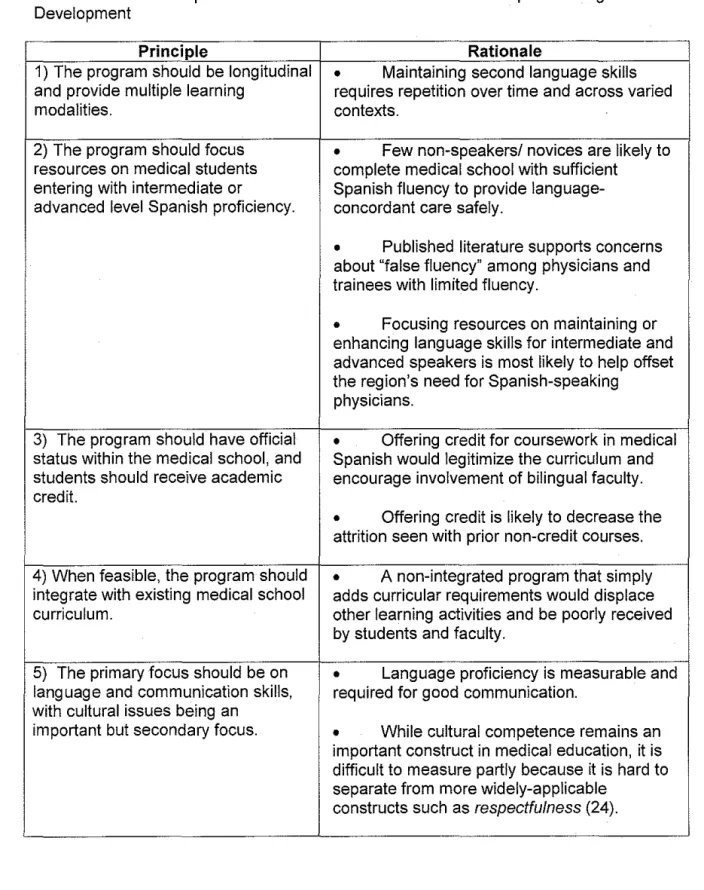
summarized in Table 1.
Recruitment: Beginning in 2004 we included a letter in materials mailed to
all entering students. The letter described the program and encouraged students
rating their Spanish fluency as intermediate or higher to apply.
Language testing: An independent language testing service with over 25
years of experience administered a validated Spanish speaking proficiency test
to all applicants(15). The test was administered at baseline and again in the
student's second year after completing preclinical curriculum. Testing involved a
recorded structured Spanish telephone interview that required subjects to
respond to 12 questions randomly selected from a larger pool. Independent
evaluators were native Spanish speakers who had undergone training to ensure
high inter-rater reliability (>0.8) (16). Scores ranged from 1 (total beginner) to 12
(native speaker); students with scores ranging from 6 to 10 (intermediate to
advanced) met program eligibility requirements. Examples of test items were: 1)
you give him? 2) In your opinion, why do people get flu shots? The items were
designed to prompt respondents to use Spanish in both general and
health-related domains. Evaluators rated the applicants' speed, general vocabulary,
grammar, sentence structure complexity, and ability to express ideas in Spanish.
At matriculation (baseline) students took a listening comprehension test
consisting of health-related Spanish monologues (2) and dialogues (2), each
followed by five multiple choice questions. Scoring was based on the percentage
of questions answered correctly. A score of 70% or higher indicated "passing" at
the advanced listening comprehension level (17). These assessments were
repeated in the second year.
Curriculum: Preclinical curriculum consisted of didactic, experiential, and
evaluative elements (Table 2). As of this writing, the curriculum content has
largely remained constant, though the structure of individual components has
evolved iteratively.
Medical Spanish course: First-year students completed an 80-hour
medical Spanish course organized around two-hour sessions conducted twice
monthly by a Spanish instructor (PhD) and clinician (MD). Grammar and
vocabulary lessons were based on an interactive DVD/workbook program(18).
Students completed workbook assignments outside the classroom, reviewing
them with the instructor via electronic mail. The clinician led clinical role-playing
scenarios, which emphasized material in the students' regular Introduction to
Medical History, etc.). Pertinent cultural issues were included in the cases and
discussed in these sessions.
Socio-cultural seminars: Students participated in a lunch-time series led
by guest faculty or community experts on cultural, psychosocial, or policy topics
relevant to Latinos.
ICM clinical placements: All medical students complete five one-week
clinical rotations in community-based practice sites during their two-year ICM
course. When practical, our program participants were placed in sites serving
Latino populations . This provided language practice while fulfilling a curricular
requirement.
Service learning: Students participated in at least 20 hours of
service-learning activities, such as conducting free health risk appraisals in a large, rural
Latino community, interpreting at a student-run free clinic, or providing blood
pressure and diabetes screening at Latino health fairs.
Immersion: Some students completed optional summer immersion
experiences after their first year. Immersion activities included health-related
service, research, clinical care, language coursework, and/or family homestay.
Modest travel stipends were offered, along with faculty mentoring for students
engaged in service or research projects. Students unable to travel abroad
participated in local community service projects, permitting interaction with native
Spanish speakers.
Simulated patients: During the second year, participants completed a
faculty to correspond with the regular organ system "block" curriculum. Graduate
level Spanish instructors served as SPs. Prior to each SP interview, students
reviewed publicly-available illustrated Spanish language study guides on the
internet(19) as well as supplementary vocabulary material relevant to the specific
case scenario. After each interview, the SPs provided students with feedback on
language skills and communication processes. (This part of the curriculum was
not available to the first cohort of students).
PROGRAM EVALUATION
The program enrolled 48 students in the first two cohorts (n=22, 2004;
n=26, 2005). Of these 48 students, three (6%) withdrew from the program: one
withdrew from medical school; one stated the program did not meet expectations;
and one felt his/her language skills were insufficient.
Qualitative evaluation: At the end of each year, students attended
one-hour focus groups. The focus group protocol (available upon request) addressed
strengths, weaknesses, and suggestions for improvement. Group size ranged
from 10-18 participants. Focus groups were conducted by a faculty member not
directly involved in teaching activities. Students did not identify themselves. A
staff member took notes and recorded the session. Session recordings were
transcribed, and the faculty member conducted a content analysis, identifying
congruent and discordant views.
Focus groups captured approximately 80% of program participants. Nearly
all believed the program helped them to maintain or improve their Spanish
was consensus that the second year case-based series was especially
instructive. There was some discordance on the issue of optimal target learner
groups. A few students thought the program should be geared toward beginner
and intermediate speakers; however, most believed the focus on intermediate to
advanced speakers should continue.
Specific suggestions for improving the program included increasing
contact time with native Spanish speakers rather than with non-native language
instructors, increasing the availability of community-based practices with large
Spanish-speaking populations, using a more concise, clinically-focused medical
Spanish textbook, and grouping program participants together within sections of
the regular ICM course to facilitate language practice.
Speaking proficiency assessment (SPA): Of the 45 students in the first two
cohorts who completed the preclinical curriculum, 7 (15%) did not respond to
requests to complete the interim SPA before beginning their third year rotations.
Among the 38 who did complete the interim SPA, mean (SO) scores were not
significantly changed: 8.7 (1.3) at baseline versus 9.0 (1.6) at two years (p=.15,
alpha=.05, paired t-test) .
Listening comprehension (LC) assessments: An interim LC assessment
was added in the program's second year cohort (n=25). Mean (SE) LC scores
increased from a baseline of 77% (3.0) to 86% (2.2) in the second year (p=0.003,
alpha=.05, paired t-test). The proportion (SE) of students meeting "passing"
DISCUSSION
We describe a longitudinal Spanish program at a medical school in a US
state with a rapidly growing Latino population. This description and interim
evaluation add to a limited body of literature describing medical Spanish curricula
in US medical schools. Our program is novel in its explicit rationale for targeting
intermediate to advanced speakers, its size, and its number of curricular
dimensions and contact hours. Attrition is lower than for previous non-credit
medical Spanish courses at UNC and other institutions(14). To our knowledge,
this program is unique in its use of standardized language fluency assessments,
which provide a means of selecting and grouping learners. The assessments
also provide a reliable means of measuring change in student language fluency
over time. We suggest that employing reliable fluency measures should improve
educators' ability to compare interventions and to generalize program outcomes.
Ultimately, such assessments should also enhance educators' ability to predict
which learners will be capable of providing competent bilingual care upon
completion of training.
Our qualitative findings show that medical students view maintenance of
their previously-acquired Spanish skills as an important programmatic goal. Our
quantitative findings suggest that our program's participants do maintain their
preclinical years. Although the absence of a separate control group precludes
drawing definitive conclusions about the causal effects of this program on
maintenance of language skills, we believe that the program has been a valuable
addition to undergraduate medical education at this institution .
We based our decision to target intermediate to advanced speakers on
input from our institutional experts who judged that, once in medical school,
novice speakers probably lack time needed to acquire the degree of second
language fluency needed to provide competent care without an interpreter. This
view is supported by studies, including one in which novice speakers underwent
an intensive medical Spanish course, showing that clinicians and trainees with
limited Spanish fluency often underutilize interpreters and commit potentially
important communcation errors (20-22). However, we also recognize that efforts
to help novice speakers improve their Spanish skills could potentially lead to
better patient care (e.g. through clinicians' improved understanding of quality of
interpretation and/or improved ability to establish rapport through greetings).
Hence, the optimal target learner fluencies for such programs is uncertain and
may vary depending on program goals.
Despite maintaining their speaking skills, these first two cohorts did not
improve their speaking fluencies. Reasons for this may be that the program
lacked the intensity required to produce measurable increases in speaking
proficiency and/or that we selected many learners whose speaking fluency was
already too high (i.e. we may be observing ceiling effects among the more fluent
This program has limitations. First, this description represents the
experience at just one medical school. Second, the improvements seen in
Spanish listening comprehension could be confounded by test learning since
participants took the same listening test at baseline. Third, we had significant
testing drop out of students from these initial cohorts. Fourth, the speaking
assessment is a measure of general Spanish fluency. How well it measures
language skills that are important for clinicians, such as skill in conducting a
clinical encounter in Spanish, requires further study. Finally, our program
currently depends partly on extramural funds to sustain it.
In order to better understand the relationship between measured Spanish
fluency and clinical capabilities in Spanish, we plan to administer a
clinically-oriented, standardized assessment during the students' fourth year. Other
planned changes in the program include grouping student participants together
into sections of the regular clinical skills (ICM) course, using native Spanish
speakers instead of non-native Spanish instructors as standardized patients, and
using a shorter, more clinically-focused textbook of medical Spanish(23). As
subsequent cohorts matriculate we anticipate examining which proficiency
groups benefit most and which program elements (e.g. international immersion)
are most effective in maintaining or improving Spanish fluency during medical
school.
In summary, this description of one institution's longitudinal medical
Spanish program, including its explicit rationale, pre-specified target learners,
limited body of literature that should help educators seeking to develop medical
Acknowledgements: The authors thank Dr. Beat Steiner for his encouragement
and early work on this project. We also thank Drs. Marschall Runge and Cheryl
McCartney for support during our efforts to obtain external funding. We thank Dr.
Mike Pignone for his helpful comments. We thank the NRSA Primary Care
Research fellows group for their feedback.
External financial support: Major project funding was provided by The Duke
Endowment, Health Care division (all authors). Ms. Slatt and Dr. Aleman were
also supported by the Bureau of Health Professions, D-56HP05213. Dr. Reuland
was also supported by National Research Service Award Fellowship, T32
HP14001.
Prior presentations: Portions of this program description and interim findings
were presented at the Society of General Internal Medicine meeting, Toronto,
Ontario, Canada, April 26, 2007.
Conflicts of Interest: none.
Note: ALTA Language Services, Inc. administered the language tests under a
contract with our program. They provided technical advice about the
administration and interpretation of language tests. They played no role in the
design or funding of the program or in the decision to publish the results of the
Human subjects statement: The University of North Carolina Biomedical
Institutional Review Board approved this study. Written informed consent was
References
1. Shin HB BR. Language use and English-speaking ability; US Census Bureau.
October 2003 .
2. Harlan LC, Bernstein AB, Kessler LG. Cervical cancer screening: who is not
screened and why? American journal of public health. 1991 Jul;81(7):885-90.
3. Greek AA, Kieckhefer GM, Kim H, Joesch JM, Baydar N. Family perceptions of
the usual source of care among children with asthma by race/ethnicity, language,
and family income. J Asthma. 2006 Jan-Feb;43(1):61-9.
4. Wilson E, Chen AH, Grumbach K, Wang F, Fernandez A. Effects of limited English proficiency and physician language on health care comprehension. J
Gen Intern Med. 2005 Sep;20(9):800-6.
5. Morales LS, Cunningham WE, Brown JA, Liu H, Hays RD. Are Latinos less
satisfied with communication by health care providers? J Gen Intern Med. 1999
Jul; 14(7):409-17.
6. Manson A. Language concordance as a determinant of patient compliance and emergency room use in patients with asthma. Medical care. 1988
Dec;26(12):1119-28.
7. Baker OW, Parker RM, Williams MV, Coates WC, Pitkin K. Use and effectiveness
of interpreters in an emergency department. Jama. 1996 Mar 13;275(1 0):783-8.
8. Lee LJ, Batal HA, Maselli JH, Kutner JS. Effect of Spanish interpretation method
on patient satisfaction in an urban walk-in clinic. J Gen Intern Med. 2002
Aug;17(8):641-5.
9. Perez-Stable EJ, Napoles-Springer A, Miramontes JM. The effects of ethnicity
and language on medical outcomes of patients with hypertension or diabetes.
10. Silberman P, Bazan-Manson A, Purves H, et al. North Carolina Latino health,
2003. A report from the Latino Health Task Force. N C Med J. 2003
May-Jun;64(3): 113-21.
11. Flores G, Mendoza FS. Dolor aqui? Fiebre?: a little knowledge requires caution.
Arch Pediatr Adolesc Med. 2002 Jul;156(7):638-40.
12. US Census Bureau; Hispanic Population Passes 40 Million; Available at
http://www.census.gov/ Accessed Nov 15, 2007.
13. Maben K, Dobbie A. Current practices in medical Spanish teaching in US
medical schools. Family medicine. 2005 Oct;37(9):613-4.
14. Nora LM, Daugherty SR, Mattis-Peterson A, Stevenson L, Goodman LJ.
Improving cross-cultural skills of medical students through medical
school-community partnerships. The Western journal of medicine. 1994
Aug;161(2):144-7.
15. ALTA Language Services Inc.; Spoken Language Evaluation (SLE)™; More at
http://www.altalang.com/. Accessed Feb 27, 2008.
16. Roosevelt C. , ALTA Language Services, Inc. (personal communication); Nov 27,
2007.
17. Roosevelt C, ALTA Language Services (personal communication); level 6 on
ALTA Spoken Language Evaluation (SLE) corresponds to level2 on Interagency
Roundtable (ILR) scale. More at: http://www.utm.edu/staff/qlobeg/ilrhome.shtml.
Accessed Feb 27, 2008.
18. Cotton CE, Tolman EE, Cardona Mack J. A su salud. Cuaderno. New Haven,
CT: Yale University Press; 2005. 364 pages.
19. National Library of Medicine; MedlinePius en espaiiol ; Available at
20. Prince D, Nelson M. Teaching Spanish to emergency medicine residents. Acad
Emerg Med. 1995 Jan;2(1):32-6; discussion 6-7.
21. Flores G, Laws MB, Mayo SJ, et al. Errors in medical interpretation and their
potential clinical consequences in pediatric encounters. Pediatrics. 2003
Jan;111 (1 ):6-14.
22. Burbano O'Leary SC, Federico S, Hampers LC. The truth about language
barriers: one residency program's experience. Pediatrics. 2003 May; 111 (5 Pt
1):e569-73.
23. Pilar Ortega Hernaandez MD. Spanish and the medical interview : a textbook for
clinically relevant medical Spanish. Philadelphia: Saunders Elsevier; 2007. xiii,
173 pages.
24. Stewart AL, Napoles-Springer A, Perez-Stable EJ. Interpersonal processes of
Table 1. Principles and Rationale Used to Guide Medical Spanish Program Development
Principle Rationale
1) The program should be longitudinal
•
Maintaining second language skills and provide multiple learning requires repetition over time and across variedmodalities. contexts.
2) The program should focus
•
Few non-speakers/ novices are likely to resources on medical students complete medical school with sufficiententering with intermediate or Spanish fluency to provide language-advanced level Spanish proficiency. concordant care safely.
•
Published literature supports concerns about "false fluency" among physicians and trainees with limited fluency.•
Focusing resources on maintaining or enhancing language skills for intermediate and advanced speakers is most likely to help offset the region's need for Spanish-speakingphysicians.
3) The program should have official
•
Offering credit for coursework in medical status within the medical school, and Spanish would legitimize the curriculum and students should receive academic encourage involvement of bilingual faculty. credit.•
Offering credit is likely to decrease the attrition seen with prior non-credit courses.4) When feasible, the program should
•
A non-integrated program that simply integrate with existing medical school adds curricular requirements would displacecurriculum. other learning activities and be poorly received
by students and faculty.
5) The primary focus should be on
•
Language proficiency is measurable and language and communication skills, required for good communication.with cultural issues being an
important but secondary focus.
•
While cultural competence remains an important construct in medical education, it is difficult to measure partly because it is hard to separate from more widely-applicable6) Validated, reliable measurements of language proficiency should be used for assessment of students and for program evaluation.
• Use of standardized proficiency
measures would facilitate formation of learner groups with similar learning needs, and would eventually permit us to understand which target learner subgroups benefit most from the
program.
• Use of such metrics would permit other educators to compare the effectiveness of multiple programs.
Table 2. Summary of Curriculum and Evaluation Elements of a Longitudinal Medical Spanish Program at One US Medical School
Program Timing Program Element Teaching mode
phase or evaluative
method
Prior to Recruitment & enrollment N/A medical
school Language proficiency assessments SPA, LC
Orientation D
1st year
Medical Spanish course* D,RP,E,SP
Socio-cultural seminars D
iii Clinical skills course (ICM ) CE, CO
.!::! placements
c <:i
' Service learning
co
Q)
..
c..
Summer after Immersion or service project IM or CO
1st year (optional)
2"d year
Service learning
co
Simulated patient series SP,E
Language proficiency assessments SPA, LC
Qualitative evaluation FG
3'0
year Clerkship placements CE
iii Immersion elective (optional) IM .!::! 4th year
c Practical assessment: Spanish SP
()
Language proficiency assessments SPA, LC
Time required or contact hours 2 2 2 80 4-6t 0-40t 1 0-20t 0-160t 15-20t 8-12t 2 1 :j: :j: :j: :j:
*Grammar topic examples include pronouns, adverbs, articles and adjectives; use of past, future, command, and subjunctive verb tenses; preterit versus imperfect; estar versus ser (two forms of the verb "to be") and tener versus hacer ("to have" versus "to do").
t Substantial variation in contact hours among participants in initial cohorts occurred. These numbers represent estimates. Variation has decreased over time. More recent cohorts are receiving more contact hours than the first two cohorts described in this paper.
Appendix. Results of Needs Assessment for Medical Spanish Curriculum at One US Medical School
Information source Problem or Need Identified
(1) Medica/school faculty, including
•
Lack of official recognition of medical advanced or native Spanish speakers, who Spanish as legitimate field of study (e.g. for-credit taught previous medical Spanish courses coursework)•
Lack of clear delineation of goals for learners at different Spanish proficiency levels•
Limited faculty resources for teachinQ(2) Romance Languages Department
•
High attrition for previous non-credit courses faculty who taught medical Spanish in the•
Competing priorities for studentsSchool of Medicine
•
Need for sustained, longitudinal effort tomaintain or improve language skills
•
Lack of involvement of clinicians in curriculum(3) Published articles describing medical
•
Limited contact hoursSpanish programs in other medical schools
•
Limited scope of teaching modalities•
Lack of measures of language proficiency•
Lack of evaluation•
Few programs described(4) Written and verbal student feedback
•
Documented high attrition rates (60-80%) from previous non-credit medical Spanish•
Desire for more clinical content in curriculumcourses
•
Desire for involvement of clinicians inteaching
•
Language skills sometimes poorly matched with other learners within the same course(5) One-hour structured group interview
•
Desire to maintain previously acquired conducted with 9 medical students from a language skills during medical schoolmedical student organization interested in
•
Desire to work with clinicians who speak community service to the Hispanic Spanish and care for Hispanic patientscommunity
•
Desire for clinical language immersion andcommunitv service experiences
(6) Spanish fluency self-assessment data
•
Few native Spanish speakers matriculating from incoming medical student survey* (<1%}, but sizeable numbers (26%, n=161) of self-from 2003 entering class assessed intermediate to advanced speakersAccuracy of Self-assessed Spanish Fluency among Medical Students
DanielS. Reuland, MD1, Pamela Y. Frasier, PhD2, Matthew D. Olson, BA3,
Marco A. Aleman, MD4, Lisa M. Slatt, MEd5, Alicia Fernandez, MD6
Affiliations: University of North Carolina, Division of General Internal Medicine 1.4,
Department of Family Medicine2·3·5, Chapel Hill, NC. Division of General
Medicine, University of California, San Francisco6.
Contents: Abstract:
267
Text:
1909
References:
22
Tables:
1
Abstract
Background: The accuracy of Spanish language fluency self-assessment
among US physicians and medical students is unknown. We aimed to determine
both the accuracy of self-assessed Spanish fluency and the prevalence of
fluency over-estimation among medical students.
Methods: Four consecutive classes of matriculating students at one medical
school assessed their own Spanish fluencies on a written questionnaire.
Students self-assessing as "intermediate" or higher took a voluntary
standardized, oral language fluency test scored from 1 (no ability) to 12 (native
speaker). Students were grouped into three fluency levels based on test scores:
novice (1-5); intermediate (6-8); and advanced/native (9-12). We determined the
positive predictive value (ppv) of self-assessment for predicting the same or
greater fluency level on the language test.
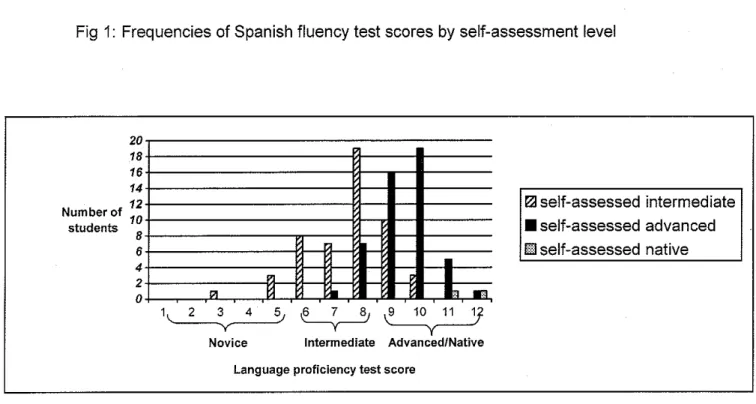
Results: Fluency tests were completed by 102 students. Median (range) test
scores for self-assessed "intermediate" (n=51) and "advanced" speakers (n=49)
were 8 (3-10) and 10 (7-12), respectively ( p <.0001). Two "native" speakers
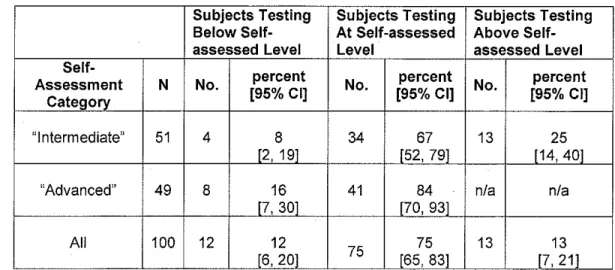
scored 11 and 12. Among self-assessed "intermediate" speakers, 67% (34/51)
tested at the intermediate level and 25% (13/51) tested above that level, yielding
a ppv for having at least intermediate fluency of 92% (95% Cl= 81.1% to 97.8%).
Among self-assessed "advanced" speakers, 84% (41/49) tested at the
advanced/native level (ppv = 84%; 95% Cl=70.3% to 92.7%), and the remaining
Conclusions: Among medical students whose self-assessed Spanish fluency is
"intermediate" or higher, self-assessment is highly predictive of scores on a
standardized Spanish speaking test, although12% scored below their
self-assessed level. These preliminary results suggest that self-assessment may be
an efficient way to measure Spanish language capacity within the future
Introduction
More than one in ten US residents speak Spanish at home, approximately
half of whom report difficulty speaking English 1. Language barriers contribute to
disparities in care that have been documented for patients who are monolingual
Spanish speakers2•3. Having limited English proficiency is associated with less
access to care4·5, decreased use of preventive services6, lower visit
comprehension7, and lower patient satisfaction8·9. Overcoming the challenges
posed by language barriers in health care may require multiple interventions,
including recruiting and training more physicians who are Spanish speakers and
integrating professional interpreter services into routine care.
One promising approach, that has already been adopted by some health
plans, is to match limited English proficient patients with clinicians who speak
their language. This approach is supported by evidence that physician-patient
language concordance is associated with improved outcomes7•10-14.
Implementing this strategy on a large scale will require that health systems
measure the Spanish language capacity of their clinicians. However, other than a
single survey done in one state 15, the Spanish language capacity of the current
or future physician workforce remains largely unknown. For example, the
American Medical Association Physician Master File does not include any
information on physician language abilities and the Association of American
Medical Colleges (AAMC) collects data only on the "dominant" (i.e. native)
the degree of fluency of US physicians and medical students who speak Spanish
(or other common languages) is known.
An important obstacle to obtaining accurate data on the language
capacity in the workforce is uncertainty regarding the optimal strategy for
assessing language fluency. One simple way to determine the proficiencies of
physicians or trainees is to ask them to assess their own fluency. However,
whether clinicians have an accurate understanding of their own .language
proficiencies is unknown. Studies have demonstrated that physicians and
trainees often use their own limited language skills instead of professional
interpreters during encounters with Spanish speaking patients resulting in
potentially important "false fluency" errors and lesser patient satisfaction 11·17•18 19.
While clinicians' reasons for underutilizing interpreters may be multiple,
overestimation of language skills may contribute to this practice.
In this study, we examined the accuracy of self-assessment of Spanish
fluency among medical students who report having at least "intermediate"
Spanish fluency by comparing their self-assessed fluency levels with their
performance on a validated Spanish fluency test. We were particularly interested
in determining if students overestimated their language skills.
Methods
Spanish fluency self-assessment: We collected Spanish fluency
self-assessments from all medical students matriculating at the University of North
Carolina School of Medicine in years 2004 through 2007. Incoming students
you speak Spanish? (yes, no), and If yes, how would you rate your fluency?
(novice, intermediate, advanced, or native speaker).
Language testing: Along with the materials mentioned above, a letter was
included inviting students to apply to a medical Spanish education program
intended for individuals with intermediate or advanced fluency. Students who
applied took a standardized Spanish speaking fluency test administered by an
outside language testing service with more than 25 years of language testing
experience20 The test involved a recorded, structured, telephone interview
during which subjects responded in Spanish to 12 questions that were randomly
selected from a larger pool of 120 items. Examples of actual test items were: 1)
If you had a friend who smoked two packs of cigarettes a day, what advice would
you give him? 2) In your opinion, why do people get flu shots? The items were
designed to prompt respondents to use their language skills in both general and
health-related domains.
Evaluators who were native Spanish speakers rated the applicant's
speaking speed, general vocabulary, grammar, sentence structure complexity,
and ability to express ideas in Spanish. Evaluators did not assess technical
medical vocabulary or knowledge. All evaluators had undergone training to
.
ensure high inter-rater reliability (>0.8) of their assessments21.The test result was scaled from 1 (total beginner) to 12 (native speaker).
This scale has been mapped to other widely-used, validated language fluency
following are descriptions of conversational capacities of speakers at levels 7
(intermediate) and 9 (advanced):
A person at a level 7 cannot easily participate in general conversations. He/She can participate in conversations that are routine or on topics that are well known to the person. He/She will have trouble with a native speaker's normal pace. He/She will use simple tenses with a few errors, but will avoid advanced tenses. A candidate at this level in a general conversation will cause
misunderstandings between himself/herself and the listener based on lack of ability to convey clearly his/her message
A person at a level 9 can successfully handle in-depth conversations in the target language, on a broad range of subjects and at a normal rate of speech. He/She has difficulty understanding some slang or idioms or some advanced grammatical structures, but can figure out what is said by the context of the discussion. When speaking, a person at a level 9 can express
himself/herself over a broad range of topics at a normal speed. He/She may have a noticeable accent and will make grammatical errors, for example with advanced tenses, but the errors will not cause misunderstanding to a native speaker.
Statistical analysis: We grouped subjects into two self-assessment
categories, '1ntermediate" and "advanced". For this analysis, we excluded
self-assessed "native" speakers because of small cell size (2). We tested whether the medians of the test fluency test scores differed significantly by self-assessment
group using the Wilcoxon rank sum test. Analyses were performed using
Stata/IC 10.0 (College Station, TX).
We defined three fluency test result categories based the language
examination score: novice (score 1-5); intermediate (score 6-8); and
advanced/native (score 9-12) using previously established guidelines provided by
the language testing service20. We estimated the positive predictive value (PPV)
of self-assessment for predicting test result category by determining the
proportion of subjects in each self-assessment category whose test result
Results
Self-assessed fluencies were available for 637 (99%) of 644
matriculating students over the four-year period. Of these 45% reported
speaking "no" Spanish, 22% rated their fluency as "novice", 21% as
"intermediate", 10% as "advanced", and 0.8% as "native".
Fluency test scores were available for 102 students who had
self-assessed proficiencies of "intermediate" (n=51), "advanced" (n=49), "native"
(n=22) (Figure 1 ). These subjects represented 50% of matriculating students
with assessed fluencies of "intermediate" or greater. Scores for
self-assessed "intermediates" ranged from 3 (novice) to 10 (high advanced) with a
median 8 and mean (SD) of 7.6 (1.4). Scores for self-assessed "advanced"
speakers were higher: median= 10 (p<0.001), range 7 (intermediate) to 12
(native level), mean (SD) = 9.5 (1.0). The two self reported native speakers
scored 11 and 12.
Of the self-assessed "intermediate" speakers, 67% (34/51) tested at the
intermediate level and 25% (13/51) tested above that level, yielding a positive
predictive value (ppv) for having at least intermediate fluency of 92% [95% Cl=
81.1% to 97.8%] (Table 1). Of students who self-assessed as "advanced"
speakers, 84% (41/49) tested at the advanced/native level [ppv = 84%, 95%
Discussion
We found that medical students who are Spanish speakers are able to
assess their own Spanish fluencies reasonably accurately. Since
self-assessment is considerably less time-consuming and costly than formal
language fluency testing, these results suggest that self-assessment could be
useful as an efficient means of determining the Spanish language capacity in
the current and future physician workforce. We are unaware of other published
studies describing the accuracy of language fluency self-assessment in US
physicians or trainees.
Our study compared self -assessment of Spanish fluency with
performance on a standardized oral test containing both general and
health-related content. However, many questions remain to be answered regarding
the relationship between a clinician's general fluency level and his/her ability to
provide language-concordant clinical care in Spanish. Such questions may
need to specify the general clinical setting and type of scenario. For example,
how well can a clinician with intermediate fluency (e.g. level 7 on this scale)
perform on communication tasks required in the setting of a common, low
complexity, outpatient clinical scenarios? How does this compare with clinical
communication using a trained interpreter ( in terms of clarity, completeness,
patient satisfaction, efficiency?) How would such a clinician perform when faced
with more complex or higher risk scenarios? How fluent must a clinician be in
another language to provide communication that is comparable to what he/she
communication provided by physicians who are non-native Spanish speakers
compare with that of native Spanish speakers? This last question recognizes
that language and cultural proficiency are different, though related, skill sets 14
Though self-assessed fluency generally predicted measured fluency in
our study, we did find that 12% of students overestimated their Spanish
fluencies. This implies that inaccurate self-awareness of Spanish fluency may
contribute to the problem of interpreter under use 11•17-19. However, our finding
that fluency self-assessment is largely accurate also suggests that other factors
besides fluency overestimation (e.g. lack of interpreter availability, lack of
training, inertia, and/or time pressures) are likely to contribute to interpreter
under use.
Our study has limitations: First, our subjects were medical students at
one institution. These findings should be confirmed more widely among
trainees and practicing physicians. Second, we tested students who expressed
interest in a medical Spanish program. Self-assessment accuracy may be
different among those who did not apply to the program. Third, we did not
determine the accuracy of self-assessment among students who reported
speaking
no
or novice-level Spanish. However, since there is wide agreementthat physicians and trainees with little or no Spanish fluency should always use
trained interpreters when providing care to Spanish-speaking patients, knowing
Ultimately, the usefulness of self-assessment as a measure of language
fluency will depend on specific purposes for which self -assessment data are
used. For example, from a patient safety perspective the 12% fluency
overestimation rate found in this study may be unacceptable if self-assessment
is used for the purpose of determining an individual clinician's language
fluency. In contrast, this same accuracy level found in our study may mean that
self-assessment can be useful for estimating numbers of Spanish-speaking
providers at a teaching institution, health care network, state, regional, or
national workforce. The usefulness of self-assessment for these purposes may
be even greater since these estimates could be adjusted when the degree of
inaccuracy is known.
Further research is needed to understand the influence of financial or
non-financial incentives on the accuracy of fluency self-assessment. Our
subjects had no financial incentives to overestimate or underestimate their
Spanish fluency. Self-assessment may be less reliable in circumstances where
there are financial incentives to overestimate one's fluency (e.g. where
differential pay is offered to multilingual providers) or to underestimate it (e.g.
where identifying oneself as fluent in Spanish is perceived as potentially leading
to a less desirable patient mix, for financial or other reasons).
In summary, US physicians are caring for populations that are
increasingly more diverse, both culturally and linguistically. This study suggests
systems could determine the Spanish language capacity in their current or
Table 1: Relationship between Spanish language fluency self-assessment and measured fluency level.
Subjects Testing Subjects Testing Subjects Testing Below Self- At Self -assessed Above Self-assessed Level Level assessed Level
Self-percent percent percent Assessment N No. No. No.
Category [95% Cl] [95% Cl] [95% Cl]
"Intermediate" 51 4 8 34 67 13 25 [2, 19] [52, 79] [14, 40]
"Advanced" 49 8 16 41 84 n/a n/a [7, 30] [70, 93]
All 100 12 12
Fig 1: Frequencies of Spanish fluency test scores by self-assessment level
20
18 16 14
12 ~self-assessed intermediate
Number of
10
students
8 • self-assessed advanced
6 El self-assessed native
•
4
2
"'
j
I1'1 ~
.,..,
0
\
2 3 4 ~~
~
y
Novice Intermediate Advanced/Native
Acknowledgments: We thank Gina Horne and Patricia Neff for their help with data collection for this project. We thank Rosalie Dominik, DrPH, for her biostatistical advice.
Human subjects statement: These data were collected as part of a medical Spanish educational enhancement project at the University of North Carolina (UNC) School of Medicine. The project was approved by the UNC Biomedical Institutional Review Board.
External financial support: Funding for language testing was provided by The Duke Endowment, Health Care division. Ms. Slat! and Dr. Aleman were also supported by the Bureau of Health Professions, D-56HP05213. Dr. Reuland was also supported by National Research Service Award Fellowship, T32 HP14001.
Conflicts of Interest: none.
1. Shin HB BR. Language use and English-speaking ability:. US Census Bureau. October 2003(2000).
2. Nelson A. Unequal treatment: confronting racial and ethnic disparities in health care. Journal of the National Medical Association. 2002 Aug;94(8):666-8.
3. Fiscella K, Franks P, Doescher MP, Saver BG. Disparities in health care by race, ethnicity, and language among the insured: findings from a national sample. Medical care. 2002 Jan;40(1):52-9.
4. Harlan LC, Bernstein AB, Kessler LG. Cervical cancer screening: who is not screened and why? American journal of public health. 1991 Jul;81 (7):885-90. 5. Greek AA, Kieckhefer GM, Kim H, Joesch JM, Baydar N. Family perceptions of
the usual source of care among children with asthma by race/ethnicity, language, and family income. J Asthma. 2006 Jan-Feb;43(1):61-9.
6. Woloshin S, Schwartz LM, Katz SJ, Welch HG. Is language a barrier to the use of preventive services? J Gen Intern Med. 1997 Aug;12(8):472-7.
7. Wilson E, Chen AH, Grumbach K, Wang F, Fernandez A. Effects of limited English proficiency and physician language on health care comprehension. J Gen Intern Med. 2005 Sep;20(9):800-6.
8. Carrasquillo 0, Orav EJ, Brennan TA, Burstin HR. Impact of language barriers on patient satisfaction in an emergency department. J Gen Intern Med. 1999
Feb;14(2):82-7.
9. Morales LS, Cunningham WE, Brown JA, Liu H, Hays RD. Are Latinos less satisfied with communication by health care providers? J Gen Intern Med. 1999 Jul; 14(7):409-17.
10. Manson A. Language concordance as a determinant of patient compliance and emergency room use in patients with asthma. Medical care. 1988
Dec;26(12):1119-28.
11. Baker DW, Parker RM, Williams MV, Coates WC, Pitkin K. Use and effectiveness of interpreters in an emergency department. Jama. 1996 Mar 13;275(10):783-8. 12. Lee LJ, Batal HA, Maselli JH, Kutner JS. Effect of Spanish interpretation method
on patient satisfaction in an urban walk-in clinic. J Gen Intern Med. 2002 Aug; 17(8):641-5.
13. Perez-Stable EJ, Napoles-Springer A, Miramontes JM. The effects of ethnicity and language on medical outcomes of patients with hypertension or diabetes. Medical care. 1997 Dec;35(12):1212-9.
14. Fernandez A, Schillinger D, Grumbach K, et al. Physician language ability and cultural competence. An exploratory study of communication with Spanish-speaking patients. J Gen Intern Med. 2004 Feb;19(2):167-74.
15. Yoon J, Grumbach K, Bindman AB. Access to Spanish-speaking physicians in California: supply, insurance, or both. The Journal of the American Board of Family Practice I American Board of Family Practice. 2004 May-Jun;17(3):165-72.
16. Association of American Medical Colleges, Data Warehouse: Applicant Matriculant File, as of November 26, 2007.
17. Flores G, Mendoza FS. Dolor aqui? Fiebre?: a little knowledge requires caution. Arch Pediatr Adolesc Med. 2002 Jul;156(7):638-40.
18. Burbano O'Leary SC, Federico S, Hampers LC. The truth about language barriers: one residency program's experience. Pediatrics. 2003 May; 111 (5 Pt 1):e569-73.
20. ALTA Language Services Inc.; Spoken Language Evaluation (SLE)™; More at http://www.altalang.com/ Accessed 2008 Feb 28.
21. Roosevelt C. President of ALTA Language Services, Inc. personal communication; Nov 27, 2007.
22. Roosevelt C, President: ALTA Language Services (personal communication); level 6 on ALTA Spoken Language Evaluation (SLE) corresponds to level 2 on Interagency Roundtable (ILR)scale. More at: