Bridging the Gap: The Tribal Community Health Representative Program as a Model for Care: Lessons Learned and Implications for Replication With sub-Saharan African
Refugee Communities in Manchester, New Hampshire
By
Kirsten Joanna Durzy
A Master's Paper submitted to the faculty of the University of North Carolina at Chapel Hill
In partial fulfillment of the requirements for the degree of Master of Public Health in
the Public Health Leadership Program.
ABSTRACT
The increasingly diverse population of health consumers in the United States requires
healthcare systems, organizations and communities to look to new delivery models to improve
healthcare access and outcomes. One example of an ancillary health service program that has
been used in multiple communities is the Lay or Community Health Worker program, which
delivers culturally and linguistically competent care to marginalized populations across the
United States, providing increased health access, education and promotion and advocacy
services.
One of the best known Community Health Worker programs in the United States is
the Indian Health Services Community Health Representative (CHR) program. The CHRs
provide paraprofessional health care, health education and advocacy services to
often-marginalized tribal populations.
This paper will examine the historical and contemporary structure of community
health worker programs with particular focus on the Indian Health Service Community Health
Representative program as a model of care for sub-Saharan refugee populations residing in
the greater Manchester, New Hampshire area
TABLE OF CONTENTS
ABSTRACT . . . ... n
LIST OF TABLES .. . . .. . . .. . . .. . .. . . .. . . .. . . v
LIST OF ABBREVIATIONS .. . . . .. .. . . .. . . .. . . .. . . .. . . VI INTRODUCTION . . . ... 1
PROBLEM DEFINITION AND BACKGROUND . . . .... 2
THE FACE OF A CHANGING COMMUNITY: MANCHESTER, NEW HAMPSHIRE 3 Historical Background . . . 3
Socio-Economic Indicators . . . 4
Refugee Populations- New Hampshire . . . .. . . .. . . .. . . .. . .. . . ... 6
THE NEW HAMPSHIRE HEALTH CARE SERVICE DELIVERY SYSTEM... 12
Health care Access Points . . . ... 12
Strained Safety Net . . . 13
STAKEHOLDER INVOLVEMENT IN THE MANCHESTER AREA . . . .... 13
Manchester Sustainable Access Project . . . .. 17
INCREASED NEED FOR AN ADAPTIVE HEALTH CARE SYSTEM . . .. .. . . . .. . . .. . 18
National CLAS Standards .. . . . .. . . .. . . .. .. . .. . . . .. . . . .. . . .. . . .... 18
A POTENTIAL SOLUTION? THE USE OF LAY HEALTH WORKERS . . . . .. . . ... 21
LITERATURE REVIEW- COMMUNITY HEALTH WORKERS... 22
Tribal Populations and the Community Health Worker Program... 22
Tribal Community Health Worker Program- Current Issues . . . .. . . 25
Funding... 26
Workforce Recruitment, Retention, Training... 26
Evaluation . . . .. . . .. 27
CASE STUDIES IN TRIBAL CHW PROGRAMS . . . ... 28
Tribal Efforts Against Lead (TEAL) Project . . . 28
The Cancer Disparity Research Project, Rapid City, South Dakota . . . .. . . 29
DISCUSSION . . . .. 30
CONCLUSION . . . ... 48
APPENDIX . . . 49
REFERENCES . . . 54
LIST OF TABLES
TABLE PAGE
1 Select Demographics, Manchester, NH . . . 6
2 Refugee Arrivals to NH by Country of Origin, 1997-2008 ... 7
3 NH Refugee Resettlement by Municipality, 2002-2009 . . . 8
4 New Hampshire Minority and Health Equity Resources . . . .. .. . . . .. .. .... 14
5 National Standards on Culturally and Linguistically Appropriate Services (CLAS) ... . 19
6 Community Health Worker Planning Process . . . . .. . . .. .. . . .. . .. .. . . .... 32
7 Stakeholder List for Planning Process, Manchester, NH Area ... .... 35
8 Key Informant Interviews (Kll), Manchester, NH CHW Program . . . 38
9 Key Informant Interviews (Kll), Guiding Questions and Objectives: Community and Target Population Leaders .. .. ... .. .. .. .. .. . .. .. . .. .. .. ... .. 38
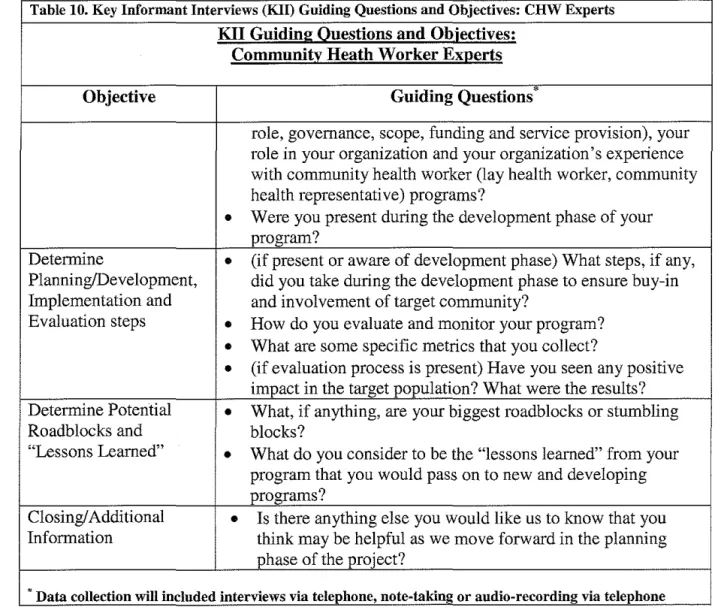
10 Key Informant Interviews (KII), Guiding Questions and Objectives: CHW Experts... 40
11 Community Listening Sessions Structure, Manchester, NH . . . .. 40
LIST OF ABBREVIATIONS
AI/AN- American Indian/Alaskan Native
ASL -American Sign Language
CDC - Centers for Disease Control and Prevention
CLAS- National Standards on Culturally and Linguistically Appropriate Services
CHR- Community Health Worker
CHW - Community Health Representative
D/HH - Deaf and Hard of Hearing
DHHS- Department of Health and Human Services
EFH -Endowment for Health
FHC- Foundation for Healthy Communities
HMLC - Healthy Manchester Leadership Council
HSA - Health Service Area
IHS -Indian Health Services
INA- US Immigration and Nationality Act
LEP - Limited English Proficient
LHA- Lay Health Advisor
LHW - Lay Health Worker
LSS- Lutheran Social Services
MHD - Manchester Health Department
MIAB - Medical Interpretation Advisory Board
MSAP- Manchester Sustainable Access Project
NH- New Hampshire
OMH- Office of Minority Health
ORR- Office of Refugee Resettlement
PN - Patient Navigator
REM - Racial and Ethnic Minority
SD - South Dakota
SNHAHEC- Southern New Hampshire Area Health Education Center
TEAL- Tribal Efforts Against Lead
UNHCR- United Nations High Commissioner for Refugees
Introduction
Recent years have brought intensive introspection from public health professionals to
understand tbe intersection between health and culture in the United States. This interest is
partially explained by the growing diversity of our nation, tbe consequent diversity of the
healtbcare consumer-base, and the desire to bridge the ever-growing chasm of health
inequities present in our nation (Institute of Medicine, 2002).
A growing body of research on health inequalities tells us that cultural and linguistic
differences account for a portion of the inequities experienced by certain healthcare
consumers (Institute of Medicine, 2002). For healthcare consumers from different cultures,
access and health care quality can be compromised by the inability to maneuver successfully
through a complicated and unfamiliar landscape. In response, multiple communities have
established lay health worker programs designed to provide assistance, advocacy, education
and limited direct health services provided in a culturally and linguistically appropriate
manner (Eng & Young, 1992). One of the best known of these models in the United States
(US) is the Indian Health Service's Community Health Representative program (CHR),
established in 1968 to deliver culturally and linguistically competent care to native
populations in US tribal communities (Indian Health Services: A Quick Look, 2010). The
programs supported by CHRs provide paraprofessional health care services, health education
and advocacy services to often-marginalized tribal populations. More recently, otber
communities have developed similar programs intended to improve health outcomes for
linguistically, culturally and geographically marginalized populations (Eng & Young, 1992;
Satterfield, Burd, Valdez, Hosey & Shield, 2002).
In the greater Manchester, New Hampshire (NH) area, a recent influx of refugee
populations from developing nations has put pressure on the healthcare safety net to respond
adequately to greatly divergent needs (Manchester Health Department, 2008). This paper will
examine the potential of utilizing a CHR look-alike program in the Manchester urban area to
improve healthcare access and utilization for sub-Saharan African refugee populations.
Problem Definition and Background
A recent press release from the US Census underscores the pace of the growing
diversity in our nation. According to this press release, "the number of people 5 and older
who spoke a language other than English at home has more than doubled in the last three
decades (1980-2007) and at a pace four times greater than the nation's population growth"
and "the percentage of speakers of non-English languages grew by 140 percent" in the same
time frame (United States Census Bureau, 2010).
Expanding diversity in our conununities bring a richness to our nation that should not
be undervalued. New immigrants have brought along their histories, arts, literature, music and
foods, as well as skill-sets that can greatly benefit our economic base. It cannot be ignored,
however, that increasingly diverse conununities place a strain on certain existing
infrastructures, including the current healthcare delivery system. Often, the existing system is
unable to meet the new need completely and with positive results for the consumers, so the
growth of new and modified complimentary systems becomes necessary.
In New Hampshire, some of our newest state residents are refugees. According to the
US Department of State, a refugee is "A person as defined in INA (the US Immigration and
unable to return because of persecution or a well-founded fear of persecution on one of five
grounds: race, religion, nationality, membership in a particular social group, or political
opinion" (United States Department of State, 2010).
For these community members, the delivery of quality, culturally competent
healthcare is meaningless if they art;: unable to first achieve access to the care delivery
systems including: the ability to locate; reach via some form of transportation; afford and
effectively utilize healthcare. Programs that incorporate culturally and linguistically
appropriate lay health advisors as health care "brokers" may be a potential solution to breaking
through the healthcare access barriers for refugee consumers. These trained advisors may also
provide key insight into the target population's needs, which can be harnessed to improve
quality of care and public policy efforts. But instituting these programs can be complicated
-issues of training, recruitment, retention, evaluation, oversight and funding are daunting
(Witmer eta!., 1995). Organizations are in need of program and policy level guidance before
undergoing such an effort. Perhaps most importantly, program target populations themselves
must be willing to become part of the community level solution - engaging in the
development, implementation, evaluation and leadership of programming.
The Face of a Changing Community: Manchester, New Hampshire
Historical Background
Manchester, New Hampshire (NH), with a population of 108,874 in 2007 is the largest
urban center in Northern New England (US Census Bureau, 2007). Positioned in south central
New Hampshire, Manchester is within a several hours drive of Boston, Massachusetts,
Portland, Maine and Burlington, Vermont. Manchester's moniker the "Queen City'' denotes
not only its central location and population density, but also its role as the center of cultural
and social life in this small state.
Incorporated in 17 51, Manchester has a long and storied history as a center of
manufacturing. Taking full advantage of the Merrimack River, the city of Manchester was a
191h century center of worldwide textile manufacturing. Large mill buildings, many of which
are still standing today, rose up along the banks of the Merrimack River. Increasing numbers
of mostly French-Canadian immigrants traveled to Manchester throughout the late 19th and
early 20th century to seek employment in the mills. By the latter-half of the 201
h century,
Manchester was a working class city with strong ties to its Franco-Canadian roots.
Socio-Economic Indicators
However, starting in the 1980s, the landscape of Manchester began to change with the
influx of immigrant and, later, refugee populations into the city. Both groups brought with
them the complicated needs of new integration into the Manchester community, with the
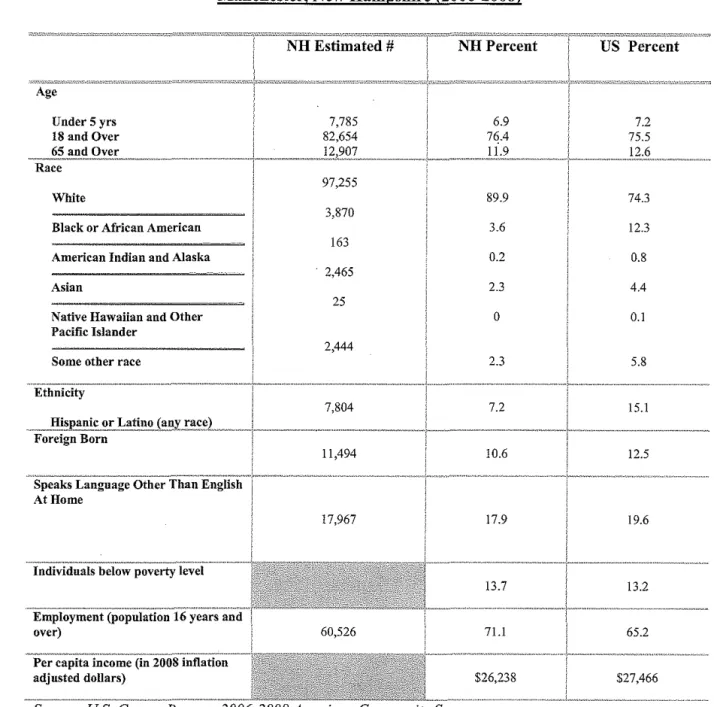
refugee populations bringing an added layer of a history of trauma. As shown in Table 1, the
American Community Survey of 2006-2008 indicates that nearly 20% of Manchester
residents speak a language other than English at home, in addition local school district data
indicates that there are over 70 distinct primary languages, including many tribal dialects
spoken - a significant departure from the homogeneous history of the city (Manchester Health
Department, 2008). Table 2 shows that, while the first waves of refugees were escaping
mainly from the European continent (Bosnia, Croatia, Russia), many of the more recent
refugees have been settled from the Afiican continent (NH Office of Energy and Planning,
2008). Most of these refugees have been settled into the greater Manchester area due to its
and cultural support, in addition to the network systems for other new residents (Manchester
Health Department, 2008).
However, these sub-Saharan refugees in particular face a multitude of adjustment
challenges to their new home in New Hampshire- incidents of trauma and violence have left
many refugees experiencing fear of authority, as well as fear of freedom of movement
(Porche, Fortuna, & Rosenberg, 2009). Add racial biases and discrimination, already in
existence in our American communities, to the mix and these populations are at high-risk of
experiencing marginalization in their new homes. Many organizations have stepped forward
to assist with adjustment issues and many new organizations, such as the Manchester Somali
Development Center, that are led by refugees seeking to provide solutions for their own
communities are in development.
Today, Manchester is the hub of state refugee resettlement. It is recognized as a
vibrant community that takes pride in its multicultural heritage, yet the struggle to excel at
meeting the need of this growing and diverse community continues to put undo strain on
multiple existing safety nets.
Table 1. Sele_ct De_mographics, Manchester, NH_
om,,>7!EJ,,!!_Vf'"7r:-'0?"-"!-!!"-"'11JJJ:K•I!JO;,:·;IS!To;,J!!f10"·'·""''""'""'''"'~''-"·'""''~=I."Oi1"-'·'"''l.V!!!;;,.,-,;;:?.'J•07.I£<IIT~~~"ff,;.'IJCO:!IJC!>i!.'C-'."~'"'"-''-"""'"~'"'''''-'''"'"·"='•7=lf,7!!C."J;,OT,;m,•[]J;-._r-&;;;,;;,•t~~
Manchester, New Hampshire (2006-2008)
Age
Under 5 yrs 18 and Over
White
Black or African American American Indian and Alaska Asian
Native Hawaiian and Other Pacific Islander
Some other race Ethnicity
Foreign Born
NH Estimated #
7,785 82,654 97,255 3,870 163 2,465 25 2,444 7,804 11,494 NHPercent 6.9 89.9 3.6 0.2 2.3 0 2.3 7.2 10.6 17.9 13.7 71.1 $26,238
Source: US. Census Bureau, 2006-2008 American Community Survey
Refugee Populations- New Hampshire
US Percent
7.2 75.5 74.3 12.3 0.8 4.4 0.1 5.8 15.1 12.5 19.6 13.2 65.2 $27,466
In the 1980s, the first wave of refugees arrived inN ew Hampshire. In recent years,
area. According to the NH Office of Refugee Resettlement, nearly 5,000 (1.5% of the total
NH population) refugees have been settled in NH from 37 nations since 1997, as detailed in
Table 2. In Manchester, close to 2,000 refugees have been settled since 2002 (see Table 3).
The 2006-2008 data from the American Community Survey of the US Census indicates that
nearly 2,000 refugees from sub-Saharan Africa are currently living in the Manchester area,
indicating that the majority of the refugee population remains in the greater Manchester area
after their initial resettlement (US Census Bureau, 2007).
Table 2. Refugee Arrivals to NH by Country of Origin, 1997-2008
Manchester, New HamJ!shire (1997-2008)
1997-1999 2000-2007 2008 Total
Totals 1,442 2,889 520 4,851
Europe 1,068 1,167 2 2,237
Africa 218 1,516 140 1,874
Bosnia 868 788 0 1,656
Sudan 92 434 6 532
Asia 126 18 277 421
Somalia (Bantu) .. 0 373 0 373
Middle East 30 186 101 317
Bhutan 277 277
Liberia 27 216 243
Somalia 19 131 43 193
Meskhetian Turks 0 187 0 187
Burundi 0 132 52 184
Iraq 27 59 98 184
Croatia 67 101 0 168
Vietnam 126 18 0 144
Afghanistan 0 99 3 102
Ukraine 56 45 0 101
Congo 0 54 23 77
Rwanda 21 50 0 71
Russia 28 40 2 70
Table 2. Refugee Arrivals to NH by Countrv of OriQin, 1997-2008
Manchester, New Ham11shire (1997-2008)
1997-1999 2000-2007 2008 Total
Nigeria 52 7 8 67
2
Sierra Leone 3 51 56
Kosovo 49 0 0 49
Togo 0 21 6 27
Iran 3 18 0 21
Ethiopia I 19 0 20
Algeria 3 6 0 9
Azerbaijan 0 9 0 9
Cameroon 0 6 0 6
Egypt 0 6 0 6
Zimbabwe 0 5 0 5
Serbia 0 4 0 4
Eritrea 0 4 0 4
Latvia 0 2 0 2
Cuba 0 2 0 2
Ivory Coast 0 I 0 I
Armenia 0 I 0 I
Avazlable at: http://www.nh.gov/oep/programslrefugee/facts.htm
Table 3. NH RefuQee Resettlement bv Municiualitv, 2002-2009
Resettlement by MuniciQalitv 2002-2009
FY02 FY03 FY04 FY05 FY06 FY07 FY08 FY09 TOTAL
Manchester* 182 195 471 165 146 99 246 303 1,807
Concord II 38 75 126 54 94 192 188 778
Laconia 33 5 8 15 55 15 59 70 260
Nashua 0 0 0 2 5 51 12 0 70
Franklin 13 6 0 2 0 0 0 0 21
Boscawen 0 0 I 0 0 0 9 0 10
Haverhill 5 0 0 0 0 0 0 0 5
Milford 4 0 0 0 0 0 0 0 4
Hooksett 3 0 0 0 0 0 0 0 3
0 0 0 0 0 0 3 0 3
Table 3. NH Refu~ee Resettlement by Municipality, 2002-2009
Resettlement bv MuniciJ!alitv 2002-2009
FY02 FY03 FY04 FY05 FY06 FY07 FY08 FY09 TOTAL
Manchester* 182 195 471 165 146 99 246 303 1,807
Hanover 2 0 0 0 0 0 0 0 2
W~er 0 0 0 2 0 0 0 0 2
0 0 I 0 0 0 0 0 I
Peterborough
Total 253 244 556 312 260 259 521 561 2,966
*Resettlement started in Manchester in 1980.
Source: NH Department of Energy and Planning
Sub-Saharan African refugees come to the United States bearing the burdens of their
nation's brutal histories. In many cases, they have moved to the US after extended periods in
refugee camps, where conditions are often atrocious. In fact, many of the youngest members
of refugee families in Manchester were born inside the camps, never living outside of them
until coming to the United States. Many families have experienced violence, trauma and loss,
either in the camps or in their home nations. These experiences can lead to persistent mental
health and safety concerns (Porche, Fortuna, & Rosenberg, 2009).
Access to quality and regular healthcare services are lacking in many of the home
nations of the sub-Saharan African refugees and access to health care in the refugee camps is
not much better. For many, this has allowed chronic illnesses to fester and ailments to go
untreated. For many Manchester African refugees, formal education was not available and
literacy is lacking, even in their native language, and since many tribal dialects have no
written form, the mere concept of literacy is often foreign as well (Porche, Fortuna, &
Rosenberg, 2009).
All refugees entering the US are provided with an initial health screening, typically
within 90 days of arrival, with the purpose of controlling communicable diseases in
resettlement communities. These screenings are conducted across NH; however screening
data are currently not publicly available (New Hampshire Office of Refugee Resettlement,
2010).
According to the State ofNH Office of Refugee Resettlement (ORR), refugees in New
Hampshire are afforded eight months of healthcare coverage through the Refugee Medical
Assistance program (NH ORR, 2010). However, in the first eight months of new settlement,
many healthcare needs do not reach priority status for these new refugees considering the
other critical issues they are facing in the same time period - securing housing, employment,
enrollment in school for children, learning how to navigate the grocery store, bank, and
transportation system, for instance, coupled with facing intense communication barriers
(Porche, Fortuna, & Rosenberg, 2009). Often, by the time refugees are ready to attend to any
existing healthcare needs, assistance from resettlement agencies is no longer available
(Porche, Fortuna, & Rosenberg, 2009).
Perhaps nowhere else in Manchester is the diversity of the community as apparent as
in the public school system, where over 70 different primary languages are spoken, many of
which are African tribal dialects (Manchester Health Department, 2008). These young
community members often are called on to serve as the cultural and communication bridge
between their older family members and the rest of the community. This type of relationship
has the potential to develop into an unusual power disparity in which the child has better
access and control than the parent. These children are often required to serve as brokers for
their parents in accessing health services and may be used inappropriately as language
interpreters by the medical providers (New Hampshire Medical Interpreters Advisory Board
(MIAB), a policy and advocacy coalition, has worked to increase the availability, training,
professionalism and usage oftrained medical interpreters across the state and to dissuade
medical providers from using family members or friends as interpreters (MIAB, 2008).
Currently in New Hampshire, there is a gap in available data concerning the health
status of refugees, with the exception of a small but growing body of locally collected
research, most of which is centered in the Manchester area. Luckily for New Hampshire, the
state is home to two large foundation funding sources, the New Hampshire Endowment for
Health and the New Hampshire Charitable Foundation; both of whom have made financial
and programmatic commitments to understanding the needs of New Hampshire minority
communities and to supporting the development of possible interventions to improve the
state's overall health (Endowment for Health, 2010). Statewide efforts are also underway to
focus resources on identifying and eliminating health disparities in NH, including the
development of the state's first New Hampshire Plan for Achieving Health Equitv. Until such
time that a comprehensive and compelling body of evidence is available at the local level, we
can look to other states that are ahead of NH in the collection of race, ethnicity and refugee
health data.
According to the Manchester Health Department's report Believe in a Healthy
Community: Greater Manchester Community Needs Assessment 2009, not having health
insurance and not being able to access care because of cost is correlated with race and
ethnicity (Manchester Health Department, 2009). In making this conclusion, the report draws
on data gathered in the NH Minority Health Coalition's report The Health of African
Descendents and Latinos in Hillsborough County, which identified several key self-reported
disparities among minority populations in the greater Manchester area. In this report, the term
"African Descendent" is used to describe any person that self-identifies as either African
American, African immigrant or African refugee. Although this categorization makes is
difficult to draw conclusions directly for the African refugee community only, the report does
provide some interesting and useful insight into the disparities present in the Manchester
community. The report concludes that 38% of all African descendent respondents had no
medical coverage and 30% had no regular health provider (NH Minority Health Coalition,
2004).
In another local research effort, the Community Dialogue and Needs Assessment for
Trauma Informed Systems of Care for Resettled African Refugee Youth in New Hampshire.
Porsche, et. a!. assessed the mental health and trauma-related status and needs of African
refugee youth in the Manchester area to determine steps in creating trauma informed systems
of care for refugee youth and their families. This report indicated that there are multiple
stressors, such as the primary need to locate sound and secure housing and employment, are
weighing on refugee families during and after the time of transition to a new community and
culture. It also stated that "there is a need for cultural competence training in health
communication for families and there is a need for refugee family health literacy" (Porche,
Fortuna, & Rosenberg, 2009).
The New Hampshire Healthcare Service Delivery System
Healthcare Access Points
The greater Manchester, NH Health Service Area (HSA) is made up of a mix of
private medical offices, community health centers, free and specialized clinics, mental and
dental health providers, a large regional health department and two mid to large sized
predictable needs- a family primary care doctor, some dental care, an occasional trip to the
emergency room or overnight stay at the hospital. In the years since the modern system was
developed, the demographic shifts of the community have outpaced the growth in the
healthcare system, leaving the existing system outdated and inadequate (Manchester Health
Department, 2008).
Strained Safety Net
While the state of New Hampshire as a whole benefits from higher than average rates
of employment, secure housing, insurance coverage and strong health indicators, the city of
Manchester has within its limits pockets of intense poverty and despair often only found in
larger urban centers (Manchester Health Department, 2008). In these pockets of the
community, increasing poverty rates, decreasing insurance coverage and decreasing
employment rates coupled with growing multiculturalism have all strained the existing health
and social care safety net system (Manchester Health Department, 2008). Providers have
made valiant attempts at strengthening the safety net, but the current system is too often
fragmented and lacking in key ancillary services, such as transportation and language
interpretation services that assist marginalized consumers in accessing care. Some of these
gaps have been addressed in disease or population specific interventions, such as diabetes
home-visiting programs or adolescent-specific clinics, but the city has yet to support the
development of broad-based culturally appropriate programmatic efforts.
Stakeholder Involvement in the Manchester Area
In the greater Manchester area, several organizations are responding to the call for
specialized cultural appropriateness and competency training for medical providers and
developed to respond to the call for state-wide systems level change that will be required to
meet the growing needs of an increasingly diverse populous and to meet the specific needs of
the state's immigrant and refugee populations. Table 4 consolidates information about local
and state resources and provides an overview of the key minority and health equity
stakeholders in the State and City.
These stakeholders and others are routinely called-upon to provide resources, outreach
and advocacy work to address the needs of refugee and other minority consumers in New
Hampshire. They also provide the support and oversight (in a collaborative nature) to the
development of many new programs and projects targeted at increasing health outcomes for
marginalized communities.
Cultural Competence Training for Healthcare Providers
New
Health Coalition
Communities
organization located in Manchester, NH that provides direct service to Limited-English Proficient (LEP) and Racial/Ethnic Minorities (REM) in the areas of diabetes management, HIV-prevention, minority health related research and cultural competency training for healthcare providers. Currently, the organization provides training in the following areas: communication across cultures; recruiting and retention strategies for increasing minority client base; and hiring,
and evaluation
a state-wide 50 organization works to improve health and health care delivery in New Hampshire. The Foundation develops and strengthens partnerships between hospitals, physicians, health plans, home care agencies and other organizations working to improve health in New Hampshire. The FHC has a long-standing commitment to serving
marginalized communities in need, particularly Limited English Proficient and minority healthcare consumers by effecting systems-level change. Under the umbrella of the current Cultural
Awareness Effectiveness Workgroup. This group is a peer-led support and resource-sharing group consisting of medical and health-related care providers that meet periodically to discuss and improve their ability to effectively serve healthcare consumers with diverse needs and cultures.
Racial, Ethnic and Linguistic Minority Data Collection
University of New Hampshire Institute for Health Policy and Practice
In 2009, the Health Policy Institute was contracted by the state Office of Minority Health and the NH Endowment for Health to complete a review of existing data sets related to health disparities in NH, as well as minority and Limited English healthcare consumer data, including gaps in data -sets and inconsistencies in data collection practices. When complete in 2010, the Institute will develop and present a set of
recommendations for data collection methods for use by state public health offices, healthcare providers and healthcare
Medical Interpretation Services I Workforce Development
New Medical
Interpretation Advisory Board
New
Area Health Education Center
Lutheran Social Services
The NH MIAB is a coalition of health care providers, social service agencies, and advocacy organizations that seeks to increase access to, and the quality ofhealthcare services for limited English proficient (LEP) and deaf and hard of hearing (D/HH) healthcare and service consumers in New Hampshire via medical interpretation and cultural competency. Members of this group work to implement their comprehensive strategic plan, with objectives to improve healthcare organizations' ability to identifY the need for medical interpretation services; develop the interpreter workforce and the ability of health care providers to work with interpreters; establish and improve funding for medical interpretation services; and raise awareness regarding the need for effective communication in health care
and placement services for medical and legal language interpreters across New Hampshire.
Refugee Health and Placement Services
LSS works with the U.S. Department of State and the United Nations High Commissioner for Refugees (UNHCR) to resettle refugees in the state of New Hampshire. In addition, Lutheran Social Services time-limited basic need and case
International Institute of New Hampshire
New Hampshire Office of Refugee Resettlement
New Hampshire Endowment for Health
An off-shoot of the International Institute of Boston, the International Institute of New Hampshire provides resettlement services and limited services designed to aid in the adjustment of
new to the state of New
Currently under the umbrella of the NH Office of Energy Planning, but soon to be moved to the NH Office of Minority Health, the New Hampshire Office of Refugee Resettlement provides limited case management, cash assistance, health screening services, and English language assistance to newly
The EFH is the state's largest private health
provides funding to private non-profits, coalitions and public-private partnerships. The Endowment program provides funding specific to refugee populations and other racial, ethnic and linguistic minorities under the umbrella of the Social and Cultural Barriers to Access grant-making theme. The
Endowment provides direct funding and technical assistance for
direct care · and research.
In 2009, the state of New Hampshire began a multi-phase public-private partnership
aimed at the development of a state plan for achieving health equity. The project was partially
funded by the New Hampshire Endowment for Health, the state's largest private health
foundation, and facilitated by the NH Office of Minority Health and the NH Minority Health
Coalition. The project encompasses three distinct phases:
1. Review of Minority Health Data and development of recommendations for data collection
3. Development and publication (by 2010) of a State Plan for Achieving Health
Equity.
Manchester Sustainable Access Project
In 2008, tbe Manchester Health Department (MHD) and the Healthy Manchester
Leadership Council (HMLC), a coalition oflocal healthcare leaders, published tbe report
Manchester's Primary Care Safety Net: Intact but Endangered. The report was one oftbe key
deliverables of multiple years of work on tbe Manchester Sustainable Access Project (MSAP).
The MSAP is a collaborative effort of more than 15 public and private health and social
service community stakeholders that examines and addresses systemic issues present in tbe
Manchester health delivery system, including a lack of accessible and appropriate primary
health care, inappropriate overuse of the Emergency Departments, lack of comprehensive and
consistent data collection, and growing demand for better service to an increasingly
multicultural community (Manchester Health Department, 2008). The report outlined some of
tbe existing gaps in service and makes multiple recommendations, including:
• Development of a formal Strategic Planning Board to guide health improvement processes
• Expansion of existing Manchester Community Health Center • Development of a new Manchester west-side health center • Development of a community oral health plan
• Development of a data gathering and coordination plan.
The MSAP report paid particular attention to refugee residents as a vulnerable population
requiring additional services, including expanded education for medical and social care
providers to increase levels of cultural competency and decrease barriers to accessing
culturally and linguistically appropriate care.
Increased Need for an Adaptive Healthcare System
As communities like Manchester become increasingly diverse, system changes will be
necessary in order for health care organizations to be poised to meet the new demand of an
increasing multicultural community. Adaptations to current systems will be required to ensure
that all consumers are able to access high quality and appropriate care. New systems, such as
targeted community health centers with bi-lingual and bi-cultural staff or centers of integrated
medicine where traditional healing practices are integrated with modern medical practices,
should be developed as new venues for reaching target populations. Of particular importance
is the need to address the cultural and linguistic barriers that contribute to health disparities
and inhibit certain healthcare consumers from achieving their optimum health. The United
States Office of Minority Health defmes culturally competent care as:
A set of congruent behaviors, attitudes, and policies that come together in a system, agency, or among professionals that enables effective work in cross-cultural
situations. 'Culture' refers to integrated patterns of human behavior that include the language, thoughts, communications, actions, customs, beliefs, values, and institutions of racial, ethnic, religious, or social groups. 'Competence' implies having the capacity to JUnction effectively as an individual and an organization within the context of the cultural beliefs, behaviors, and needs presented by consumers and their communities (United States Office of Minority Health, 2000).
National CLAS Standards
In 2000, the US Office of Minority Health (OMH) adopted a set of standards of care
for cultural and linguistic minorities to be used as guidance for healthcare organizations
seeking increases in their organization's level of cultural competence. These National
Standards on Culturally and Linguistically Appropriate Services or CLAS standards are
broken into three broad themes: Culturally Competent Care, Language Access Services and
Organizational Supports for Cultural Competence (United States Office of Minority Health,
As seen in Table 5, the standards are divided by level of flexibility as either: a
mandate (standards 4,5,6, 7), which are required by any recipient offederal funds; a guideline
(standards 1,2,3,8,9,10,11,12,13) which are recommended to be adopted as mandates; or a
recommendation (standard 14) which is suggested for adoption by hea1thcare organizations
but not required by OMH (United States Office of Minority Health, 2000).
National CLAS Standards
Standard 1 (guideline)
Health care organizations should ensure that patients/consumers receive from all staff members effective, understandable, and respectful care that is provided in a manner compatible with their cultural health beliefs and practices and preferred language. Standard 2 (guideline)
Health care organizations should implement strategies to recruit, retain, and promote at all levels of the organization a diverse staff and leadership that are representative of the demographic characteristics of the service area.
Standard 3 (guideline)
Health care organizations should ensure that staff at all levels and across all disciplines receive ongoing education and training in culturally and linguistically appropriate service delivery.
Standard 4 (mandate)
Health care organizations must offer and provide language assistance services, including bilingual staff and interpreter services, at no cost to each patient/consumer with limited English proficiency at all points of contact, in a timely manner during all hours of operation. Standard 5 (mandate)
Health care organizations must provide to patients/consumers in their preferred language both verbal offers and written notices informing them of their right to receive language assistance serv1ces.
Standard 6 (mandate)
Health care organizations must assure the competence of language assistance provided to limited English proficient patients/consumers by interpreters and bilingual staff. Family and friends should not be used to provide interpretation services (except on request by the patient/consumer).
Table 5. National Standards on Culturally_ and Linguistically Appropriate Services (CLAS)
National CLAS Standards Standard 7 (mandate)
Health care organizations must make available easily understood patient-related materials and post signage in the languages of the commonly encountered groups and/or groups represented in the service area.
.. . . . Organizational Supports for Cultural Competence Standard 8 (guideline)
Health care organizations should develop, implement, and promote a written strategic plan that outlines clear goals, policies, operational plans, and management accountability/oversight mechanisms to provide culturally and linguistically appropriate services.
Standard 9 (guideline)
Health care organizations should conduct initial and ongoing organizational self-assessments of CLAS-related activities and are encouraged to integrate cultural and linguistic competence-related measures into their internal audits, performance improvement programs, patient satisfaction assessments, and outcomes-based evaluations.
Standard 10 (guideline)
Health care organizations should ensure that data on the individual patient's/consumer's race, ethnicity, and spoken and written language are collected in health records, integrated into the organization's management information systems, and periodically updated.
Standard 11 (guideline)
Health care organizations should maintain a current demographic, cultural, and
epidemiological profile of the community as well as a needs assessment to accurately plan for and implement services that respond to the cultural and linguistic characteristics of the service area.
Standard 12 (guideline)
Health care organizations should develop participatory, collaborative partnerships with communities and utilize a variety of formal and informal mechanisms to facilitate community and patient/consumer involvement in designing and implementing CLAS-related activities. Standard 13 (guideline)
Health care organizations should ensure that conflict and grievance resolution processes are culturally and linguistically sensitive and capable of identifying, preventing, and resolving cross-cultural conflicts or complaints by patients/consumers.
Standard 14 (recommendation)
Health care organizations are encouraged to regularly make available to the public information about their progress and successful innovations in implementing the CLAS standards and to provide public notice in their communities about the availability of this information.
A Potential Solution? The Use of Lay Health Workers
For populations that are experiencing healthcare barriers and for the organizations trying to serve them better, programs that are targeted at increasing access and utilization of care services in a culturally appropriate manner are needed. In many communities and settings where cultural and linguistic barriers have led to poor health outcomes, lay health worker programs, such as the Indian Health Service's Community Health Representative program, have successfully bridged the gap between consumer and provider (Indian Health Services: A Quick Look, 2010).
These programs fall under many different names (Community Health Workers, Community Health Representatives, Patient Navigators, Lay Health Workers, etc.), but all focus on using culturally appropriate and professionally and paraprofessionally trained staff (most commonly members of the target population) that are likely to have a strong
understanding of the social-cultural aspects of the community, as well as the ability to communicate in the consumer's native language. These programs seek to increase early screening and disease treatment in order to decrease morbidity and mortality rates among marginalized communities, as well as increase healthcare consumers' understanding of the healthcare system (Eng & Young, 1992).
In 2002, the Institute of Medicine published its groundbreaking report on health disparities and inequities in the United States, Unequal Treatment: Confronting Racial/Ethnic
Disparities in Healthcare. In the report, recommendations are made on ways to eliminate
healthcare disparities in areas such as policy, health systems, education and training and data collection.
The report makes this finding, "Community Health Workers offer promise as a
community-based resource to increase racial and ethnic minorities' access to healthcare and to serve as a liaison between healthcare providers and the communities they serve" (Institute of Medicine, 2002). Specifically, Recommendation 5-10 addresses the use of Community Health Workers as a means for reducing health disparity: "Support the use of Community Health Workers. Programs to support the use of Community Health Workers (e.g., as Healthcare Navigators) especially among the medically underserved and racial and ethnic minority populations, should be expanded, replicated and evaluated" (Institute of Medicine, 2002).
Due to the increased need for culturally appropriate and accessible healthcare for the diverse population of Manchester, NH, ancillary programs specifically designed to meet the cultural and linguistic needs of marginalized populations, by instituting a Community Health Workers approach, might provide a key component to increasing health equity and improving health outcomes.
Literature Review- Community Health Workers
Tribal Populations and the Community Health Worker Program
In the United States today, there are over 562 federally recognized American Indian or Alaskan Native (AJJAN) tribes in existence (DHHS, 2010). As the indigenous peoples of the United States, AJJAN make up nearly 2% of the current US population (DHHS, 2010). In 2008, there were nearly 5 million people who self-identified as wholly or partially AJJ AN (Office of Minority Health and Health Disparities, 2010).
Today, with over 500 federally recognized tribes in existence, AI! AN peoples are located in every state and urban center in the nation (Office of Minority Health and Health Disparities, 2010).
In the United States, Native Americans are more likely to be poor, have no usual source of health care; are uninsured, self-report fair or poor health status more often than other races; experience high rates of alcoholism, mental health disorders and diabetes; experience high rates of tobacco use among adult males; and are most likely to die from heart disease, cancer and unintentional injury (Centers for Disease Control and Prevention, 2010).
For American Indians/ Alaskan Natives (AI! AN) re&iding on one of the federally recognized reservations, these health outcomes can be exasperated by a lack of available services due to geographical isolation (Satterfield, Burd, Valdez, Hosey & Shield, 2002). Social, cultural and linguistic isolation can further strengthen the barriers to receiving care. For these communities, the Indian Health Service (IHS) has become the first line of defense in maintaining the tribal health.
American Indians/Alaskan Natives hold varied beliefs about wellness, health and healing, but many commonalities can be found across tribal communities where ties to native healing practices are strongest. Many AI/AN populations believe in a concept of wellness that includes bio-psychosocial as well as spiritual health (Satterfield, Burd, Valdez, Hosey & Shield, 2002). Alternative practices, such as herbal and healing ceremonies are often used in conjunction with more conventional medical practices and multiple partners (medical
providers, family members, elders and tribal spiritual leaders) may play a role in the health and healing process for a tribal member (DHHS, 2010).
According to the US Department of Health and Human Services, the Indian Health Service provides health services for 1.9 million American Indians and Alaskan Natives in the United States (DHHS, 2010). All enrolled or recognized members of the over 500 federally recognized tribes are eligible for IRS services, which are provided at no cost to eligible tribal members (DHHS, 2010). IRS provides direct services (29 hospitals, 63 health centers, and 28 health stations) and contracts services directly to tribal entities (16 hospitals, 250 health centers, 93 health stations, and 166 Alaskan village clinics) (Indian Health Services: A Quick Look, 2010). In addition, 34 urban health centers are also supported by the IRS (Indian Health Services: A Quick Look, 2010). The IRS provides comprehensive medical care services, as well as behavioral health, dental care, vision care, disease-specific interventions and health promotion, as well as disease prevention and health education services (Indian Health Services: A Quick Look, 2010).
The Community Health Representative (CHR) program was established in 1968 under the Federal Office of Economic Opportunity (Department of Health and Human Services [DHHS], 2010). By the mid-1970s, the program was firmly ensconced under the umbrella of the IRS. The CHR program is a lay health advisor program that trains local American
Indians/Alaskan Natives to provide a wide scope of health and health promotion services to members of their respective tribal communities. CHR programs are funded by the IRS and managed through contracted American Indian and Alaskan Native governments (DHHS, 2010).
requirements) (Indian Health Services: A Quick Look, 2010). In some locations, CHR workers are trained to perform direct health services, such as blood pressure and diabetes checks. In other locations, CHR workers may focus on decreasing barriers to care, such as providing transportation or language assistance. Yet other CHR programs may focus on or incorporate advocacy, research or community health education services (DHHS, 2010). Appendix I outlines the minimum standard of practice required of each tribal CHR program, including minimum standards for training, skill and knowledge requirements, scope of service and certification.
Tribal Community Health Worker Program- Current Issues
In the almost fifty years since the establishment of the Indian Health Services Community Health Representative program, many modifications have been made to the structure of the program. In many tribal communities today, the program has been modified or adapted to meet a specific cultural need or health related goal (DHHS, 2010). Evaluation and research studies on the efficacy and reach of CHR efforts can provide developing programs elsewhere in the country with important information on program development related to funding, staffing and evaluation processes. This section will highlight findings and
recommendations in the areas of program structure and development and describe two tribal Community Health Worker program case studies.
Multiple titles such as Community Health Worker (CHW), Community Health Representative (CHR), Patient Navigator (PN) and Lay Health Advisor (LHA) are used interchangeably in this section depending on the language in the literature.
Funding
The 2007 Community Health Worker National Workforce Study noted the "prevalence
of short-term funding and the necessary reliance on multiple funding sources were cited by employers and other observers as major barriers to the development of the CHW workforce". In the case of the Indian Health Services CHW program, the bulk of funding is supplied directly from the federal government through Indian Health Service contracts (Indian Health Services: A Quick Look, 2010). For programs not under the auspices of federal agencies such as the IHS, however, funding and long-term program sustainability is likely to be a major hurdle. In developing financing plans, new CHW programs can look to share evidence of cost-savings with potential funders. In 1995, Witmer et al. indicated that utilization of community health workers is a cost-saving measure for healthcare organizations and
communities, as the workforce is inexpensive to train and supervise (Witmer et a!., 1995). In the 2007 report Community Health Worker National Workforce Study, the authors stated that
"sixty-four percent of the (CHW) positions paid new hires an hourly wage below $13". However, as the scope of services for CHW s expands, training needs will increase, leading to an increase in program costs.
Workforce Recruitment, Retention, Training
The literature points to some key recommendations related to the staffing of CHW programs. According to the 2007 Community Health Worker National Workforce Study,
current demographic landscape of the target community. These workers can bring a level of familiarity with the cultural and linguistic needs of the patients they serve that will help to bridge the gap between the patient and the provider (Witmer eta!., 1995).
Retention strategies are important to consider since CHW have not historically experienced professional recognition outside of their own communities and proper support systems can assist with job satisfaction. Opportunities for fair wages, advancement and professional development are central to retention strategies (Witmer et al., 1995).
Training needs vary from program to program dependent upon the scope of service required by CHW. Guidance available at the Indian Health Service CHW website calls for a
minimum two-week training on health service basics and cultural competence skills, whereas
the Alaska Community Health Aide/Practitioner Program provides more extensive training (including training to perform medical procedures) to CHW workers to provide health care services such as Pap Smears and breast exams for women in remote Alaskan communities (Andrews, Felton, Wewers & Heath, 2004). Calhoun eta!. (2010) evaluated multiple Patient Navigation program curricula and suggest that since the skill level of lay health workers is so varied upon hire (and across programs) a strong training curriculum with an emphasis in core competencies, such as basic medical terminology, services offered and cross-cultural care, combined with a range of continuing education opportunities are required for building and retaining a strong CHW workforce.
Evaluation
The literature provides a strong basis for incorporating monitoring and evaluation plans into the development of any CHW program and suggests that documenting impact and outcomes is crucial to defining the role of CHW in an expanding healthcare system (Turnock,
2004; Witmer, et al., 1995). Witmer eta!. also suggest that healthcare cost-savings may be only one place to measure success, as CHW programs additionally benefit communities by increasing the public's health and contributing to the level of community empowerment. As with any public health effort, it will be critical for new CHW programs to build resource support for on-going monitoring and evaluation strategies into their program development processes.
Case Studies in Tribal CHW Programs
Tribal Efforts Against Lead (TEAL) Project
A lead poisoning prevention, intervention and research project was conducted in Tar Creek region of Oklahoma, where Indian Health Service staff witnessed an alarming rate of anemia and elevated lead blood levels in children residing in the area of a former mine (Kegler & Malcoe, 2004). The Tribal Efforts Against Lead (TEAL) project trained CHWs (called Lay Health Advisors in this program), who were respected members of the local tribal community. The Lay Health Advisors supplied direct educational interventions to tribal children and their families, including basic education about lead dangers and how to mitigate lead exposure. In all, 40 CHWs performed 5,000 hours of service during a two-year period (Kegler & Malcoe, 2004).
In the 2004 report Results From a Lay Health Advisor Intervention to Prevent Lead
Poisoning Among Rural Native American Children, the authors note that lead blood levels
increase in self-efficacy skills, such as how to advocate for themselves, their children and their communities (Kegler & Malcoe, 2004).
Perhaps most importantly, this program highlights the potential to utilize CHW as agents of policy change. The TEAL project is credited with spurring the tribal community into pushing for changes, including mandatory lead level testing for children (Kegler & Malcoe, 2004).
The Cancer Disparity Research Project, Rapid City, South Dakota
In Rapid City, South Dakota, the National Cancer Institute developed the Cancer Disparity Research Partnership, an integrative, culturally sensitive program focused on reducing cancer mortality rates among American Indian patients. American Indians in the Rapid City service area were reported to have a cancer mortality rate approximately 40% higher than that of the overall US population (Rogers & Petereit, 2005). Barriers to receiving early screening and appropriate treatments, such as language, geographic distance and fear of the healthcare system, have led to AI/AN patients presenting with high rates of advanced stage cancers (Rogers & Petereit, 2005). The Cancer Disparity Research Partnership is designed to help providers understand the unique needs of Native American patients and create systems of care that dismantle these barriers and lead to improved health outcomes.
A central element of this program is a CHW component (in this case the CHW are called Patient Navigators or PN). In this program, there were two separate types of CHW: a nurse CHW located at the hospital in Rapid City, and a community CHW located on the home reservations of the patients. The Nurse CHW provided a type of case management for
patients, which included ensuring medical care continuity and logistical oversight (transportation, housing, family coordination, language services, etc). Community CHW
(known as Community Research Representatives in this program), were similar to CHW workers who live on the home reservations (and urban centers) of the patients and are trained in cancer-specific education and care. The Community CHW provide cancer education, assistance with locating local resources that may be available in their home tribal community, help with linking information between the hospital and the local IHS and tribal governments and assist the patient with any type of re-adjustment services they may need when returning home after treatment at the cancer center (Petereit eta!., 2008).
In the 2008 publication Establishing a Patient Navigator Program to Reduce Cancer Disparities in the American Indian Communities of Western South Dakota: Initial
Observations and Results, the authors note that the Patient Navigator role is a critical
component in addressing cancer disparities in this population and that patients who received navigation services during curative radiation treatment had on average 3 fewer days of treatment interruptions compared to patients who did not receive navigation services during curative radiation treatment (Petereit eta!., 2008).
Discussion
Program Planning for Development of CHW Program in Manchester, NH
This section of the paper describes a planning process for the development of a
• Programs should be community-focused and community-based (Witmer et al.,
1995).
• Oversight of programs should have clear expectations and a clear and consistent
chain of command (Witmer et al., 1995).
• Training should be provided based on the requirements of the target population,
workforce make-up (availability, level of training) and availability of resources
(funding for staff, funding for training, and availability of training resources)
(Calhoun eta!., 2010).
• Funding and sustainability is likely to be an issue, so development of an evaluative
process with clear outcome measures is crucial to detennining and proving the
impact of the program in the community and also the potential cost -savings to
community (Turnock, 2004; Witmer, et al., 1995).
This section of the paper will identify four specific steps for developing a CHW
program in Manchester, NH. The CHW program planning process requires thoughtful
consideration and reliance on knowledge and experience gathered from similar ventures in
other locations. Each proposed step in the program development process informs the next and,
ultimately, guides the planning body in creating a program that is specifically designed to
meet the unique needs a community. This section of the paper will outline specific program
development steps.
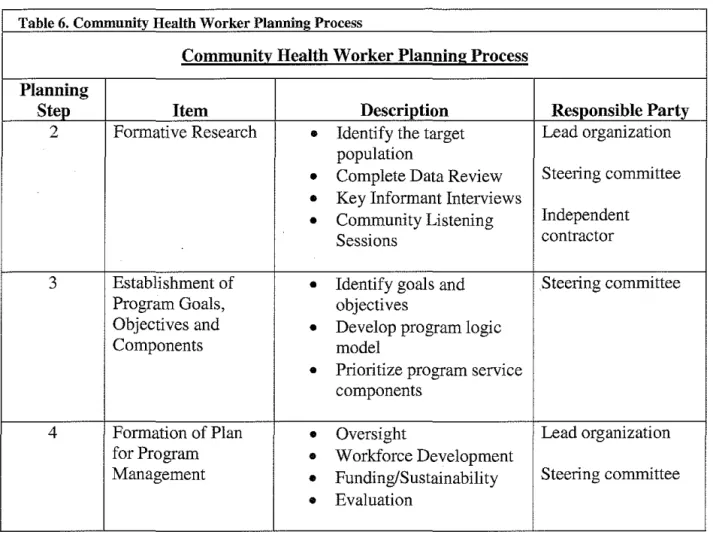
The four program development steps are: (1) Community Engagement, (2) Formative
Research, (3) Establishment of Program Goals, Objectives and Components, and
(4) Formation of Plan for Program Management, including (a) Oversight (b) Workforce
Development (c) Funding/Sustainability and (d) Evaluation.
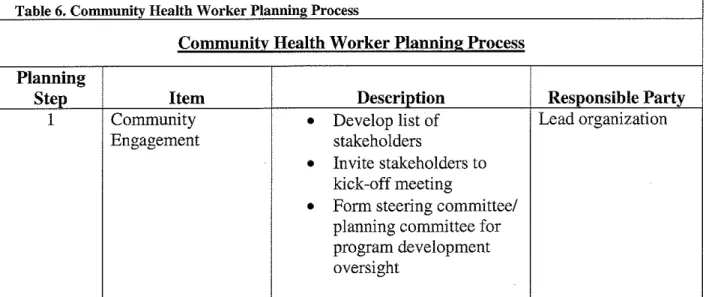
The four steps in the program planning process are listed in Table 6. This planning process has been informed by the review of the literature and each step in the process is meant to support what the literature tells us is important in CHW program structure and focus. The process will help to identify required program components and structure (including
workforce, training, scope of service, etc.). However, this paper will not seek to identify program specifics, but instead will describe issues and provide recommendations for the program planners to consider.
The planning process for a CHW program is multi-layered with many
stakeholders. Stakeholder needs must be considered along with the needs of the community as a whole. A successful program development process requires both visionary leadership and the ability to attend to the smallest of details. Equally important is the ability of the program leadership to engage the target community in full participation in the planning process. It is clear from the literature that because CHW programs are intended to respond to the need of a community, they are rarely static- they may morph and grow as community needs change. Strong community involvement can ensure the ability of the program to respond to changes quick! y and with appropriate modifications.
Table 6. Community Health Worker Plaunin2 Process
Community Health Worker Planning Process
Planning
Step Item Description Responsible Party
1 Community
•
Develop list of Lead organizationEngagement stakeholders
•
Invite stakeholders to kick-off meetingTable 6. Community Health Worker Plaunine Process
Community Health Worker Planning Process
Planning
Step Item Description Responsible Party
2 Formative Research
•
Identify the target Lead organization population•
Complete Data Review Steering committee•
Key Informant Interviews•
Community Listening IndependentSessions contractor
3 Establishment of
•
Identify goals and Steering committeeProgram Goals, objectives
Objectives and
•
Develop program logicComponents model
•
Prioritize program service components4 Formation of Plan
•
Oversight Lead organizationfor Program
•
Workforce DevelopmentManagement
•
Funding/Sustainability Steering committee•
EvaluationPlanning Step 1. Community Engagement. The development and successful implementation of a complex program requires engagement and support from multiple community partners. This is particularly important because no one existing agency can supply all of the needed resources for the development and implementation of a full program. A strong program will necessitate a collaborative effort between multiple agencies, organization and community members. The Manchester, NH community has a history of successfully coordinating public-private ventures, which may provide the best opportunity to engage multiple stakeholders in a program planning, development and implementation process, as well as increase the ability to leverage all available resources in the community. One example of such a collaborative effort that was effective was the push (led by the Manchester Health Department and inclusive of
multiple public and private partners) to fluoridate the public water supply (Association of State and Territorial Dental Directories, 2007).
Engaging multiple stakeholders in a collaborative program building effort can be a complicated process with multiple moving parts. It is important to keep all parties involved and interested to ensure that the process continues to move forward. A few key steps to community engagement are:
1. Convene stakeholder/planning committee under the leadership of a well established community based organization. The lead agency should have experience with the target population, an understanding of healthcare and public health issues, and a history of successful community collaboration. The lead agency will serve as the convener, coordinator, facilitator and grantee for funding purposes. Table 7 outlines the stakeholder categories that should be involved in the planning process.
2. Planning committee will conduct formative research with community and target population and assess readiness for establishing CHW program through formative research process. If interest and resources are available, research will help to guide program structure. If interest and resources are not at a ready-stage for program development, planning committee will determine next steps to prepare for future program development.
4. When funding is established, planning committee will develop into program
steering committee or advisory board. This board will provide assistance to lead
agency in oversight, public relations, evaluation, sustainability and governance.
Table 7. Stakeholder List for Planning Process, Manchester, NH Area
Stakeholder List for Planning Process, Manchester, NH Area
Stakeholder Category Organization Name
Target Population New African Americans Organization, Inc.
Manchester Somali Development Center Healthcare Organizations Elliot Hospital
Catholic Medical Center
Dartmouth Hitchcock- Manchester Manchester Community Health Center Child Health Services
State Health Departments New Hampshire Department of Health and Human Services New Hampshire Office of Minority Health
New Hampshire Office of Refugee Resettlement Local Health Department Manchester Health Department
Local Government Manchester City Office of the Mayor
Manchester Transit Authority
Funding Organizations New Hampshire Endowment for Health New Hampshire Charitable Foundation Advocacy Organizations Minority Health Coalition
New Hampshire Medical Interpretation Advisory Board
Planning Step 2. Formative Research. In preparation for possible development of a CHW
program in the Manchester, NH community, formative research will be conducted to determine
1) the feasibility of program development, 2) the potential program impact and 3) general interest among stakeholders. Formative research is a process by which program developers and planners can examine the program's target population and the surrounding community in order to better understand the strengths and gaps present. With this information, program planners can better design the intervention to meet the specific population and community needs. Rohm Young, et a!. (2006) identifies formative research as a critical step in the development of health behavior change interventions. Since the formative research process is part of the planning process, it is vital that time and resources are appropriately allocated.
For this program, formative research will be completed in four distinct phases:
a. Define the Target Population- Before conducting any formative research
and/or moving forward in program development, a clear and precise definition of the target population will need to be developed. It is important to be specific and to use a common language when referring to the target population (for example, rather than identifying the target population as sub-Saharan African RefUgee population in southern NH, a more specific definition might be adult Sudanese and Somali Bantu refUgees who have a primary residence in the
census tract areas X, Y and Z of the city of Manchester, NH.
b. Data Review of all relevant local research to determine corresponding target population demographics based on geographic location and demographic information (age, gender, family status, insurance status, language capacity). c. Key Informant Interviews (KII) will be conducted with community stakeholder
be conducted with developers and managers of similar national CHW
programs to gather information about development and implementation issues, potential roadblocks and applicable "lessons-learned" (Table 8). Those
interviewed will be asked who else they think would be a candidate for a Key Informant Interview. The list of those interviewed may be expanded to include some or all of the suggested persons. KIT will consist of a series of open-ended questions (Table 9,10). All interviews will be recorded and transcribed from native language into English and results will be analyzed for common themes. d. Target-Population Community Listening Sessions will be conducted to give
voice to target population members (Table 11). Opportunities for consumer feedback, concerns, needs and wants will be afforded during the sessions. Due to the varied linguistic needs of the target population, multiple sessions
utilizing bi-lingual moderators and trained language interpreters will be planned. Groups may also be split by gender if deemed to be culturally appropriate. Moderators will facilitate discussion through a series of open-ended guiding questions (Table 12). Sessions will be recorded and transcribed into English. Analysis will be performed through a simple coding process (using patterns and similarities in the responses, answers will be coded and grouped together based on the questions). Cultural/Linguistic sub-sets will be identified for participation in focus groups based on population density in the greater Manchester area. Depending on resource availability, an incentive may be provided to those that participate in a focus group.