Advisor: Paul Solomon
Many primary sources are digitized and freely available on the Internet. This type of resource represents a valuable opportunity for many social studies educators. This paper reports on the findings of a survey designed to enquire into the use of this type of
resource by educators at the middle and high school level. The survey data indicates that barriers to use include insufficient computer access in the classroom as well as time and curriculum constraints created by end of grade testing and North Carolina curriculum standards.
Headings:
Digital Libraries -- United States
Educational Technology -- Electronic Records
Digitized Archives
BARRIERS TO EDUCATIONAL USE OF DIGITIZED PRIMARY SOURCE DOCUMENTS:
A SURVEY
by Anne McClusky
A Master's paper submitted to the faculty of the School of Information and Library Science of the University of North Carolina at Chapel Hill
in partial fulfillment of the requirements for the degree of Master of Science in
Information Science.
Chapel Hill, North Carolina April, 2003
Approved by:
Table of Contents
Introduction... 2
Literature Review and Study Background... 2
Literature Review... 2
North Carolina Social Studies Curriculum ... 8
Methodology... 10
Data Description ... 12
Demographic Information (teacher and school) ... 12
IT infrastructure ... 14
Data Analysis ... 15
Primary Sources... 15
Internet ... 18
Discussion... 19
Conclusion ... 20
References... 23
Appendix A: Survey ... 25
Table of Figures Figure 1. Grade level and social studies courses in North Carolina ... 10
Figure 2. Break down of age of participants... 12
Figure 3. Student enrollment at participant's schools ... 13
Figure 4. Years of teaching experience of participants... 13
Figure 5. Number of Internet connected computers available in classroom... 14
Figure 6. Participant ranking of instructional value of primary source material ... 15
Figure 7. Frequency of primary source material use per month ... 16
Introduction
The study of history and the cultivation of historians involves the careful consideration and analysis of primary source documents. A primary source records the words of the witness of an event. Primary sources are studied and analyzed to produce secondary sources, which interpret the event recorded in the primary source. There are numerous proven1 advantages to incorporating primary documents into the curriculum. Primary sources can provide a more complete historical picture than the textbook alone, and studying primary source material promotes more critical and analytical thinking skills. Studying primary sources requires students to evaluate information and make reasonable interpretations based upon evidence in the document.
For students studying at large institutions and universities, access to these documents is usually available through local research libraries and archives. However many social studies educators have difficulty accessing these materials. A recent study by Ferenz reports that textbooks are the main curricular components and the students use primary sources as a type of “show and tell” rather than tools to encourage careful analysis and synthesis of information2.
1 Kathleen Carver, “Using Internet Primary Sources to Teach Critical Thinking Skills in History” Westport, CT: Greenwood Press, 1999. pp.10-12.
Cynthia Hynd, “Teaching Students to Think Critically Using Multiple Texts in History” Journal of Adolescent & Adult Literacy 42:6 1999 (March).
Wilson Warren, “Using the World Wide Web for Primary Source Research in High School History Classes” Journal of the Association for History and Computing Volume 2(2), 1999 (August).
The growth of the Internet and the recent proliferation of digitized archives and digital libraries on the World Wide Web have eliminated many traditional barriers to access like proximity to large libraries and museums. Web sites offering digitized archival material abound, examples include the University of North Carolina’s Documenting the American South (http://docsouth.unc.edu), and the Library of Congress’
American Memory (http://memory.loc.gov/ammem/amhome.html). Some sites, like the
National Archives and Records Administration (http://www.archives.gov/ digital_classroom/index.html) have suggestions for classroom instructional activities involving documents available on their site.
Use of the Internet in secondary school social studies curricula remains low. Despite a continuing increase in computer and Internet connectivity at schools nation wide many teachers are still not incorporating the Internet into their curriculum. My research question focuses on the barriers preventing teachers from using digitized archives. Specifically I am interested in middle and high school history teachers and their use or non-use of the Internet in the classroom and as a structured part of their curriculum.
Literature Review and Study Background
Literature Review
classroom3. Other studies focus on barriers to teachers using the Internet in the classroom4. Few studies have looked specifically at barriers to digitized primary source material use in the classroom. This review will briefly discuss each of these areas of literature as well as briefly discuss educational literature discussing primary source use. Following the literature review I will briefly describe the structure of the curriculum in North Carolina middle and secondary schools and how materials available via the internet might be more easily incorporated into instruction.
Craver5 (1999) remarks that textbooks are designed to cover a large period of history in a superficial fashion, and allow the student to learn the basic historical “facts” of an era over the length of a course. The use of primary sources can compensate for some of the weakness of traditional textbooks in several ways. One important benefit of primary source use, especially for teachers using older or outdated history textbooks, is the ability to more thoroughly cover groups traditionally under represented in the historical narrative. Hynd (1999) points to Native American and African American history as two areas where this is potentially useful. Furthermore, because textbooks present history as a narrative, students cannot see the process by which history is “constructed.” The use of primary sources in the classroom gives students a better sense of the process of constructing a historical narrative: “history is not a story, but any number of stories, depending upon which sources are used by historians to reconstruct what took place during a previous era.”6
3 Henry J. Becker, (1999). “Internet use by teachers: Conditions of professional use and student-directed use”. Irvine, CA: Center for Research on Information Technology and Organizations. Accessed at
http://www.crito.uci.edu/TLC/findings/InernetUse/starpage.htm , see also Ferenz.
4 Phillip Vanfossen, “Degree of Internet/WWW Use and Barriers to Use Among Secondary Social Studies Teachers,” International Journal of Instructional Media 28, no.1 (2001)
In addition to engaging students more than instruction based on the standard issue history textbook, student analysis of primary documents also promotes higher level thinking skills7. The study of primary sources allows students to evaluate information and consider how the document’s creator and their biases influence the content: “As students work with primary sources . . . they can analyze, evaluate, recognize bias and contradiction, and weigh the significance of evidence presented by the source.”8 Using primary sources allows students to explore the role of historian, and in the process better understand the biases which impact the textbook they use, and also encourages more critical and analytical thinking skills.
Research describes educator’s use of the Internet as “information gathering”: the Internetused to gather resources for traditional lesson plan development instead of being incorporated into class activities. In a 2001 study of social studies teachers in Indiana, Vanfossen concludes that teachers are not effectively using the Internet to augment instructional activities.9 He characterizes their use of the Internet as “low-order information gathering.” Teachers are not able to take maximum benefit of the Internet, he argues, because they lack both specific technical training and instruction on how to effectively incorporate the Internet into the classroom10
Several reports have focused on the reason that despite the growth of the Internet and usage among the general American population, only a small percentage of teachers
7 Evelyn Holt Otten, “Using Primary Source in the Primary Grades” ERIC Digest, Office of Educational Research and Improvement, Washington, DC, 1998-05-00.
8 Deanne Shiroma, “Using Primary Sources on the Internet to Teach and Learn History” ERIC Document: EDO-S0-2000-5. P:3.
9 Phillip Vanfossen, “Teachers Would Have To Be Crazy Not To Use the Internet!”: A Preliminary Analysis of the Use of the Internet/WWW by Secondary Social Studies Teachers in Indiana,” Paper presented at the Annual Meeting of the National Council for the Social Studies (79th, Orlando, Fl, November 19-21, 1999).
are using the Internet. One of the main reasons pointed to in these studies is lack of technology training among teachers. A nationwide survey of the technology use of teachers completed in 1998 by over four thousand teachers studied the different types of computer uses by teachers, and factors determining type of use. Henry Becker and others conducted this study at the center for Research on Information Technology and Organizations (CRITO) at the University of California, Irvine. They found that educators are lacking the training both to use Internet technology efficiently and to incorporate this new medium effectively into classroom instruction. The Becker et al. study surveyed the type of professional development opportunities offered by a school and found that less than a third of them focused on the effective incorporation of the web in teaching.11
A study completed in 1998 by the New Jersey based Educational Testing Services studied instructional technology use in math classes and student performance on the “The Nation's Report Card,” the National Assessment of Educational Progress or NAEP. The study found that students in the forth and eight grades whose teachers received professional development training in computer technology outperformed students on NAEP whose teachers had not had similar training.12 Another reason cited as a cause for
low use of the Internet for educational purposes is resistance to change and reluctance to adapt new technologies, especially among professional historians.13 One study by Ferenz has pointed to the lack of school librarians and well resourced school media centers as an obstacle to Internet use in the classroom.14 School librarians can serve as a
11 Becker (http://www.crito.uci.edu/tlc/findings/snapshot6/)
12 Jeff Archer, “The Link to Higher Test Scores.” Education Weekly. Available on-line from http://www.edweek.org/sreports/tc98/ets/ets-n.htm
13Anne Wynne, “History Instruction and the Internet: A Literature Review,” in History.edu: Essays on Teach with Technology, ed. Dennis A. Trinkle and Scott A Merriman (Armonk, New York: M.E. Sharpe, 2001), 26-27.
resource to teachers by identifying useful educational websites, and thus alleviate some of the burden on teachers already responsible for formulating lesson plans that incorporate this new media.
Finally, logistical issues and lack of technological expertise and support in the school environment is also a contributing factor.15 For example the Educational Testing Service’s paper “Computers and Classrooms: The Status of Technology in U.S. Schools” reports that the national student to computer ratio is 24:1. This ratio makes teaching with a computer difficult. This study also estimates that 85% of teachers have less than nine hours of computer training, with Internet specific training comprising only a small number of these nine hours.
Formal and informal technology training of pre-service teachers is lacking, and teachers often leave school without the knowledge to adequately incorporate the Internet into their teaching.16 A 1999 report from the Milken Family Foundation reports that, while the technology infrastructure in teaching institutions (schools of education, etc.) is described as “adequate,” teaching faculty do not model technology use. This report suggests, “the technology infrastructure of education has increased more quickly than SCDE (Schools, colleges, and departments of Education) ability to incorporate new tools into teaching and learning. This results from disparities between facilities and integration. The technology infrastructure is generally deemed ‘adequate,’ but many faculty do not model technology use . . .”17 Although teachers receive their training in facilities that offer the most recent technology they are not shown how to effectively use
15 Coley, R. (1997). “Computers and Classrooms: The Status of Technology in U.S. Schools,” Princeton, NJ: Educational Testing Service Policy Information Report. ERIC Document 412893.
16 Milken Excahange on Education Technology (1999). “Will New Teachers be Prepared to Teach in a Digital Age?” 2
these advances in their own teaching. This study reports a low correlation between IT specific instruction of pre-service teachers and their subsequent use of educational technology. One barrier to use of instructional technology of any kind, including Internet archives, is the quality and amount of both formal and informal IT training received by teachers.
The availability of online computers in the classroom for student use has an obvious impact on a teacher’s ability to utilize digitized archives. With the help of government funding through programs like Education Rate (E-Rate), k-12 schools have increased both their numbers of computers and Internet connections.
A nationwide survey by the National Center for Educational Statistics, which tracked Internet access in U.S. public schools, reports that in 2000 ninety-eight percent of all public schools had Internet access, compared to just thirty-five percent in 1994. Internet access is not equal across all schools, however, and schools with a higher concentration of students in poverty have fewer Internet connections. The same survey reports that in schools where 75% or more of students qualify for subsidized lunch, 60% of instructional rooms had Internet connectivity; versus 77% to 82% of rooms in schools with lower percentages of students qualifying for subsidized lunches.18 A study of the instructional technology infrastructure in North Carolina revealed that schools considered to be “high poverty” have an average of 33.5 students per Internet-connected computer, while all other schools have 25.4 students per Internet-connected computer.
A limited amount of research has focused on digitized primary resource materials and their use in educational settings. Anderson notes that a gap exists in the literature in
the area of identifying “critical success factors” for electronic primary source documents.19 The use of primary source documents in history lessons engages students in the subject matter, and also helps develop their interpretive and analytical thinking skills. Teachers traditionally have only limited access to this type of resource, as secondary school libraries typically do not carry this type of material. There are many incentives to increase/introduce the use of primary source material, one of the most important is encouraging independent thought on the subject matter by students. Instruction involving primary sources in a significant way gives students a more active role in the learning process than instruction through textbooks alone.
Several efforts have been made to link schools with digital libraries, and these case studies conclude that future efforts should focus on training teachers to find appropriate resources online, and then incorporate these resources in a meaningful and effective way into their instructional activities.20
North Carolina Social Studies Curriculum
North Carolina has had a Standard Course of Study since 1898. Published by the North Carolina Department of Public Instruction, the Standard Course of Study is a set of objectives defining what areas a student should study in school. These objectives are crafted to reflect “the knowledge, skills, and attitudes needed to function effectively in an industrial age. It also included efforts to develop mature thinkers and problem solvers.”21 Students, teachers, and schools are accountable for thoroughly covering the objectives
19Deborah Lines Andersen, “Academic Historians, Electronic Information Access Technologies, and the World Wide Web,” in History.edu: Essays on Teach with Technology, ed. Dennis A. Trinkle and Scott A Merriman (Armonk, New York: M.E. Sharpe, 2001), 21.
20 Ferenz, 130, and Nuala A. Bennett et. al, “Integration of Primary Resource Materials into Elementary School Curricula.” Museums and the Web 2000 Papers. Available on-line from
outlined in the Standard Course of Study, and End of Grade Testing is one of the tools uses to measure progress. The Department of Public Instruction website states that “These assessments allow for corrections in instructional focus at a program level and are important indicators of the degree to which all students are learning the Standard Course of Study.”22 When designing lesson plans and considering curriculum innovations teachers must always be conscious of covering the objective outlined in the Standard Course of Study; this has become a particularly important issue as the importance of end-of-grade testing has increased as a means of evaluating educational progress. The use of resources like the Internet, and specifically digital archives, relies upon the ability of teachers to use these instructional tools to teach the Standard Course of Study Objectives.
The Social Studies Curriculum in North Carolina is interdisciplinary, building upon numerous subject areas, including law, philosophy, economics, history,
anthropology, and other subject matters.23 North Carolina’s middle grade students build upon the foundation to history that is developed in the primary grade levels. In middle school the curriculum aims to encourage analytical and critical thinking skills. Students “begin to understand and appreciate differences in historical perspectives, recognizing that interpretations are influenced by individual experiences, societal values, and cultural traditions.”24 Use of primary sources can be a powerful tool in the development of this type of skill set. The emphasis on higher level thinking skills continues in the high school grades, and students are also expected to “think systematically about personal, national, and global decisions, interactions, and consequences, including addressing
22 http://www.ncpublicschools.org/curriculum/foreword.html
critical issues such as peace, human rights, trade, and global ecology.”25 The following table summarizes the course progression in social studies in the North Carolina
curriculum.
Grade Course/s
Grade 6 The Eastern Hemisphere: Europe and Former Soviet Republics
Grade 7 The Eastern Hemisphere: Africa and Asia
Grade 8 North Carolina: The History of an
American State
Grades 9-12
Economic, Legal, and Political Systems in Action (required prerequisite to U.S. History) World History
World Geography World Cultures
United States History (required) Government
Economics Psychology Sociology Law and Justice
Figure 1. Grade level and social studies courses in North Carolina
Methodology
A survey instrument was designed (see appendix) to explore the status of use of primary materials in the curriculum. When writing this questionnaire several research questions influenced the development of questions:
1) Do these teachers currently use primary sources?
2) What level of information computer/Internet capability is present in the schools where these teachers work?
3) What factors do the teachers feel are the most significant in determining how much the Internet/primary sources are incorporated into the curriculum? A three-part survey was designed. The first part gathered basic demographic data and the names of the courses taught by the respondent. The second part of the survey inquired about the size and IT characteristics of the respondents’ school. The third and final section of the survey asked about the teacher’s use of technology and primary source material in the classroom, and perceived barriers to the use of both of these things. A copy of the survey may be found in Appendix ?. The questions and responses to the questions will be described later in the paper.
The survey was distributed to seventeen students in the Masters of Education program for experienced teachers at the University of North Carolina. All survey participant’s were enrolled in the Spring 2003 section of EDUC 115E: “Disciplinary Explorations: Social Studies and Humanities for Teaching and Learning.” A focus of this class is the use of digital resources in history instruction. At the time of the survey all students in the class were familiar with the concept of Internet archives, and had explored several as part of the class. The survey was distributed and completed during class time.
The small number of respondents used in this study limits the amount of
Data Description
Demographic Information (teacher and school)
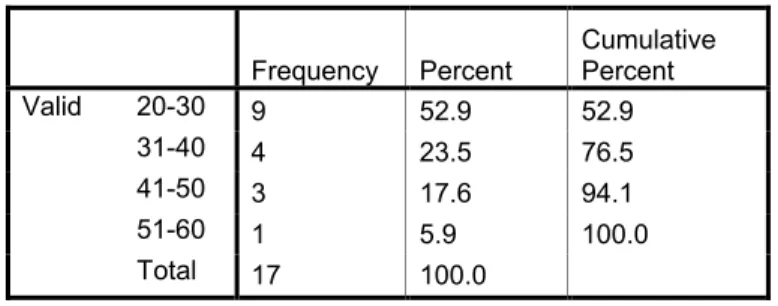
Seventeen teachers participated in the survey, eight male and nine female. The tables below represent this data, and shows that over half of the participants were between twenty and thirty years of age.
Frequency Percent
Cumulative Percent
Valid 20-30 9 52.9 52.9
31-40 4 23.5 76.5
41-50 3 17.6 94.1
51-60 1 5.9 100.0
Total 17 100.0
Figure 2. Break down of age of participants
The table below summarizes enrollment information for the participants’ schools; the average school size across the survey was 1,250 students.
Frequency Percent
Cumulative Percent
Valid 610 1 5.9 5.9
615 1 5.9 11.8
650 1 5.9 17.6
700 1 5.9 23.5
899 1 5.9 29.4
900 1 5.9 35.3
950 1 5.9 41.2
1100 1 5.9 47.1
1150 1 5.9 52.9
1200 1 5.9 58.8
1750 2 11.8 70.6
1789 2 11.8 82.4
1800 3 17.6 100.0
Figure 3. Student enrollment at participant's schools
As all of the teachers surveyed in this study came from the UNC School of Education master’s program for experienced teachers, they all had a minimum of three years of teaching experience.
Years of teaching experience
11.8% 5.9%
35.3%
47.1% 21+ years
11-20 years
6-10 years
3-5 years
Figure 4. Years of teaching experience of participants
All seventeen of the participants regularly use computers for both school related
and personal reasons. All participants reported using the computer for email, word
processing, recording student grades, as well as using the Internet/World Wide Web for
personal tasks. All but five use the Microsoft presentation software PowerPoint. Their
comfort level using various software applications was ranked on the following scale:
“Very Comfortable”, “Comfortable”, “Able to use with some difficulty”,
“Uncomfortable”, and “Difficult, don’t know how to use.” Almost all users were “very
comfortable” with the two applications that all used: email and word processing software.
“Comfortable.” When asked about locating information on the Internet 82% (or 14 of the 17 participants) were either “Comfortable” or “Very Comfortable,” the remaining three participants responded with “Able to use with some difficulty.” The teachers
participating in this survey are all familiar and comfortable with basic computer tasks. IT infrastructure
The classroom environment of the survey participants varied both in average class size, overall school size, and the type of IT infrastructure provided by the school. The questions regarding the computer and Internet capability at the school asked for information such as the number of computers in the classroom, number of Internet connections, as well as inquiring about the teacher’s ability to project material from the computer screen onto a large display for all to see.
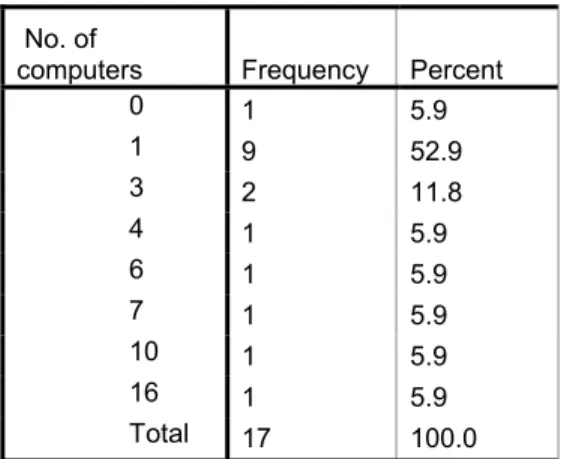
All of the survey participants had at least one computer in their classroom. All classroom computers were also connected to the Internet. While over half of the
participants had only one computer in their classroom, one of the participants had sixteen computers in his/her classroom, or roughly one computer for every two students.
No. of
computers Frequency Percent
0 1 5.9
1 9 52.9
3 2 11.8
4 1 5.9
6 1 5.9
7 1 5.9
10 1 5.9
16 1 5.9
Total 17 100.0
Fourteen of the seventeen surveyed also had the ability to project material from the computer onto a large screen in their classroom (although for many this required checking out a projector from the school audio-visual equipment center).
Data Analysis
This section of the paper will discuss the participants views of the efficacy of primary source based instruction, the Internet as an instructional technology tool, and suggestions given in the survey for enhancing digital archives for teacher’s use. Primary Sources
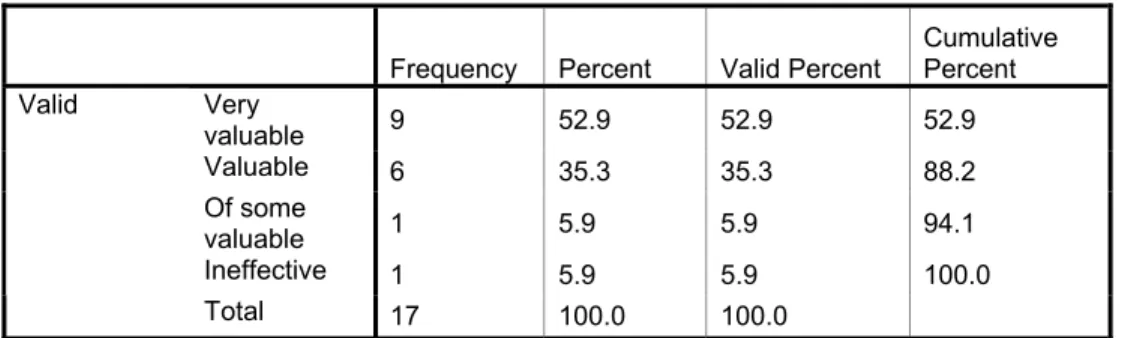
All participants were asked to rank the value of primary source materials at their grade level, and also estimate how many times in a typical month they use this type of material. In addition they were asked about where they obtained this type of material. When asked to “Rate the value of primary source material in Social Studies education at your grade” the majority responded with “Very Valuable.” The table below summarizes the responses to this question.
Frequency Percent Valid Percent Cumulative Percent
Very
valuable 9 52.9 52.9 52.9
Valuable 6 35.3 35.3 88.2
Of some
valuable 1 5.9 5.9 94.1
Ineffective 1 5.9 5.9 100.0
Valid
Total 17 100.0 100.0
Figure 6. Participant ranking of instructional value of primary source material
primary sources happened at higher-grade levels. In an environment of teaching to the test, this may be so. On the other hand, if critical thinking and information analysis skills are a goal, accessing curriculum related primary sources at this level could lead to significant learning achievements. As noted before, this would depend on teachers being able to effectively incorporate primary sources into instruction.
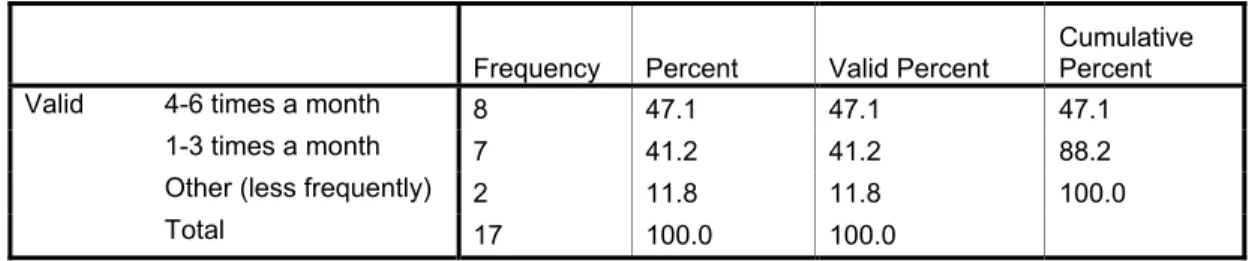
The teachers in this study also reported that they use primary source material frequently. Fifteen of the teachers use primary sources at least one to three times a month. Only two participants responded with “Other.” One was the fifth grade teacher who rarely uses primary sources and the other was a teacher who reported almost daily use of primary sources. In accordance with the mainly positive feelings expressed about the instructive value of primary source materials these teachers also incorporate them regularly into their classroom instruction. See the table below for a summary of use.
Frequency Percent Valid Percent
Cumulative Percent
Valid 4-6 times a month 8 47.1 47.1 47.1
1-3 times a month 7 41.2 41.2 88.2
Other (less frequently) 2 11.8 11.8 100.0
Total 17 100.0 100.0
Figure 7. Frequency of primary source material use per month
Course of Study and time constraints each had either a “Significant” or “Somewhat Significant” affect on their utilization of primary source material in the classroom.
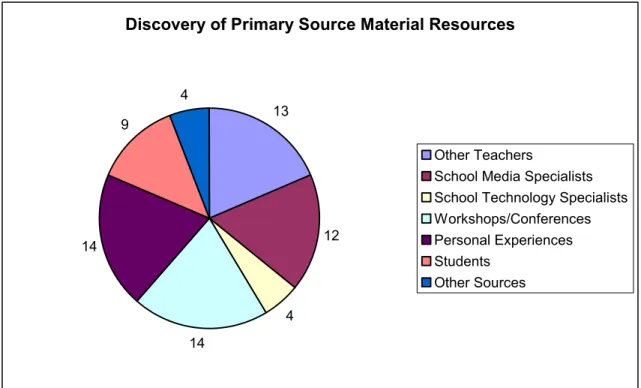
The survey also gathered information about where primary source materials were obtained, and how the teachers discovered these resources. Twelve of the teachers reported using the Internet, mentioning specifically the Library of Congress American Memory web site (http://memory.loc.gov/ammem/amhome.html), university web sites, the History Channel Online (http://www.historychannel.com/), and the Public
Broadcasting Service (PBS) web site (http://www.pbs.org/). One important factor, which could have an impact on the significant usage of the Internet as a source of primary documents, is the enrollment by all participants in the survey in a class focusing
specifically on teaching history using Internet sources. The second most popular source for primary documents was print resources (text book companions and primary document collected in books). Twelve of the participants mentioned using books as a source of primary documents. The table below shows where the participants in this survey
Discovery of Primary Source Material Resources
13
12
4
14 14
9
4
Other Teachers
School Media Specialists School Technology Specialists Workshops/Conferences Personal Experiences Students
Other Sources
Figure 8. Listing of sources used by participant for primary source material discovery
Internet
Although all but one of the teachers participating in the study had access to the Internet from their classroom, less than half used the computer during class time (nine do not, eight do). However the Internet is used by all but one of these teachers for personal research (e.g. online searching for lesson plans), and Internet research is commonly assigned as homework. Ten of the seventeen responded that they assign Internet research for homework.
When asked about factors limiting their use of the Internet the participants cited several. Eleven of the seventeen participants noted lack of computer availability as having a significant or somewhat significant impact on their instructional use of the Internet. Another factor pointed to as having a significant impact on instructional Internet use was technical skill. Fifty-three percent of participants reported that
significant impact. Over half of the participants said that Internet connection speed was not as important a factor, with fifty three percent of respondents indicating that this had either “low” or “no impact” on their use of the Internet.
Discussion
The survey results indicate that while teachers use computer technology, especially the Internet, such technology is not used as an integrated part of classroom instruction on a regular basis. Rather the Internet is used to ease the clerical (e.g. grade recording) aspect of teaching and for professional research (e.g. looking online for lesson plan information). When students use the Internet in coordination with the teacher and curriculum, it is often in the context of homework assignments (almost 60% of teachers assign Internet research based homework, while only 47% report using computers during class). One possible explanation for this is the inconvenience of having many students sharing one computer or having to borrow a projector in order to display the contents of the computer monitor so that whole class can easily view the material.
A comparison of the rating of factors limiting Internet use with factors limiting primary source use reveals that while participants feel that the same factors limit their use of both resources; there are also some noticeable differences. As with use of primary sources End of Grade Testing was the most significant factor impacting instructional use of the Internet. Almost sixty percent of the respondents ranked EOGs as having either “Significant” or “Somewhat Significant” impact on their Internet use.
Factor Primary Sources Internet Use
Time Limitation (in finding resource)
47.1% 52.9%
NC Standard Course of Study 47.1% 52.9%
End of Grade Testing 52.9% 58.8%
Lack of Training (inexperience with this type of resource)
23.5% 52.9%
Figure 9. Factors with a significant or somewhat significant impact
It is also interesting to note that teachers felt handicapped by a lack of technical training in their use of Internet resources. Almost thirty percent fewer participants cited lack of training as impacting their use of primary source materials than impacting their Internet use.
Although this survey indicates that teachers are generally comfortable with using both the Internet and primary sources, the combination of the two can be problematic. Infrastructure, training, and external pressures like state guidelines and EOG testing all contribute to this problem.
Conclusion
The availability of Internet archives alone will not promote the use of primary sources in middle and high school social studies classrooms. More traditional teaching resources like primary source books compiled and annotated for educational use will continue to be heavily used. The strength of digital archives is their potential to increase primary source use in the classroom. Because the majority of these online resources are freely available to the public they are the perfect tools for cash strapped school districts. Furthermore the huge breadth of material available in these digital libraries greatly increases the options available to teachers as they craft lesson plans to meet the
Even among technologically competent educators familiar with digital archives (like those participating in this study) several issues prevent more widespread use of this type of resource. When asked, “How can the digitization and online access to primary source materials alleviate barriers to use of primary source materials in the classroom?” several common themes emerged. One issue, mentioned by many of the teachers, was a concern over equality of access. Almost half (eleven) of the respondents mentioned “access” in their response to this question. As one teacher stated, “Provided that there is clear and fair and equal access to computer and the internet, digitization and online access to primary source materials is a great idea; and will most certainly alleviate
barriers to the usage of primary source materials in the classroom. But this would require and mandate total (across the board ethnically, socially, etc.) access.” Educators are handicapped in their use of the Internet, even when used as a homework assignment, if all of their students do not have online access.
After spending half a semester study digital archives and their educational
applications respondents had several suggestions for more teacher user-friendly design of this type of resource. Nine of the participants specifically mentioned search engines and other information retrieval tools. Access into archives through search engines that allow free text and Boolean searching, as well as author, subject, and title indexes were features that were asked for by several teachers.
plans that could be adapted to their own use to be provided along with the documents in the digital library: “Lesson plans—this takes the bulk of my time, giving lesson plans would help.” Another respondent mentioned lesson plans that were specifically “adjustable, adaptable.” Several teachers also asked about correlating documents with the North Carolina Standard Course of Study. One teacher said they would like to see “top documents requested by other teachers (tailored to NC curriculum),” and others mentioned links between documents and the Standard Course of Study Objectives.
References
Andersen, Deborah Lines “Academic Historians, Electronic Information Access
Technologies, and the World Wide Web,” in History.edu: Essays on Teach with Technology, ed. Dennis A. Trinkle and Scott A Merriman (Armonk, New York: M.E. Sharpe, 2001).
Archer, Jeff “The Link to Higher Test Scores.” Education Weekly. [online]. Available: http://www.edweek.org/sreports/tc98/ets/ets-n.htm. Last accessed April 20, 2003.
Bennett, Nuala A. et. al, “Integration of Primary Resource Materials into Elementary School Curricula.” Museums and the Web 2000 Papers. [online]. Available: http://www.archimuse.com/mw2000/papers/bennett/bennett.html . Last accessed April 20, 2003.
Becker, Henry J. (1999). “Internet use by teachers: Conditions of professional use and student-directed use”. Irvine, CA: Center for Research on Information
Technology and Organizations. [online]. Available:
http://www.crito.uci.edu/TLC/findings/InernetUse/starpage.htm. Last accessed April 20, 2003.
Coley, R. (1997). “Computers and Classrooms: The Status of Technology in U.S.
Schools,” Princeton, NJ: Educational Testing Service Policy Information Report. ERIC Document 412893. [online]. Available:
http://205.146.39.13/learning/COMPCLSS.PDF. Last accessed April 20, 2003.
Craver, Kathleen W. “Using Internet Primary Sources to Teach Critical Thinking Skills in History” Westport, CT: Greenwood Press, 1999
Ferenz, Kathleen “The Bay Area National Digital Library Project and the Library of Congress: A Case Study in Enriching History Classes with the Riches of the Internet” in History.edu: Essays on Teach with Technology, ed. Dennis A. Trinkle and Scott A Merriman (Armonk, New York: M.E. Sharpe, 2001).
Milken Excahnge on Education Technology (1999). “Will New Teachers be Prepared to Teach in a Digital Age?”
Otten, Evelyn Holt “Using Primary Source in the Primary Grades” ERIC Digest, Office of Educational Research and Improvement, Washington, DC, 1998-05-00. Deanne Shiroma, “Using Primary Sources on the Internet to Teach and Learn History”
ERIC Document: EDO-S0-2000-5.
Vanfossen, Phillip “Degree of Internet/WWW Use and Barriers to Use Among
Secondary Social Studies Teachers,” International Journal of Instructional Media 28, no.1 (2001).
Vanfossen, Phillip “Teachers Would Have To Be Crazy Not To Use the Internet!”: A Preliminary Analysis of the Use of the Internet/WWW by Secondary Social Studies Teachers in Indiana,” Paper presented at the Annual Meeting of the National Council for the Social Studies (79th, Orlando, Fl, November 19-21, 1999).
Wynne, Anne “History Instruction and the Internet: A Literature Review,” in
Appendix A: Survey
Part One: General Information
Please answer the following questions by choosing the appropriate response.
1. What is your age? A. 20-30
B. 31-40 C. 41-50 D. 51-60 E. 60+
2. What is your gender? A. Female
B. Male
3. What grade(s) do you teach? Indicate all that apply A. 6th
B. 7th C. 8th D. 9th E. 10th F. 11th G. 12th
4. What is/are the title of the course/s you teach? ____________________________________
____________________________________ ____________________________________ ____________________________________
3. How many years have you been teaching (excluding student teaching)? A. 3-5
B. 6-10 C. 11-20 D. 21+
Part Two: School Information
2. How many teachers in your school teach half time or more? ________________ 3. How many computers are available for use in your classroom? ___________ 4. What number of these (from q. 4) computers have Internet access? _________ 5. Are you able to project material from a computer for all to see? _________
6. If you answered no to the above question, can you arrange to use a facility with this type of capacity? _______
7. Do you have access to a computer lab or classroom with Internet access? __________ 8. If you answered yes to the above question, how often do you use this facility?
_____________
Part Three: Teacher Use of Technology/Primary Source Material
1. For which of the following do you use the computer? (indicate all that apply) A. Email
B. Word processing
C. Personal use of World Wide Web
D. School/work related use of World Wide Web E. Record student grades
F. Presentations (Power Point, etc.) G. Do not use computers
H. Other: _______________________________________ 2. Please rate your comfort level with each of the following:
(1=very comfortable, 2=comfortable, 3=able to use with some difficulty, 4=uncomfortable, 5=difficult, don’t know how to use)
A. Web Browsers: ____ B. Email: _____
C. Word Processing Applications: _____ D. Creating Web Pages: ____
E. Locating information on Internet: ____
3. Where do students use computers during your class? (indicate all that apply) A. Classroom
B. Computer lab C. Media Center
4. How do you use computers in teaching? (indicate all that apply) A. Assign Internet research for homework
B. Educational software (please specify name(s)): ____________________ C. In class use of Internet
D. Teacher research (e.g. looking online for lesson plans)
E. Other (please specify): ________________________________________ F. Computers not used as part of classroom instruction
5. Factors Limiting Educational Use of Internet Significant Impact-1
Somewhat Significant Impact-2 Some Impact-3
Low Impact-4 No Impact-5
Scale 1 2 3 4 5
Need to cover material for End of Grade testing
Need to follow NC mandated “educational objectives”
Unsatisfactory availability of computers in classroom Unsatisfactory Internet connection speed
Inexperience/lack of appropriate Internet/computer skills Personal feelings regarding value of Internet in classroom
Limited time to create lesson plans incorporating the Internet Not aware of appropriate online educational resources
Other factors (please explain):
6. Factors Limiting Use of Primary Source Material Significant Impact-1
Somewhat Significant Impact-2 Some Impact-3
Low Impact-4 No Impact-5
Scale 1 2 3 4 5
Need to cover material for End of Grade testing
Need to follow NC mandated “educational objectives”
No time to identify/locate appropriate material Inexperience/lack of appropriate training
Limited time to create lesson plans using this type of resource
Not aware of appropriate sources of this type of material Other factors (please explain):
7. How often do you have students use primary source materials in a typical month? A. 4-6
B. 1-3
C. Other (please specify): _______________ D. Not at all
8. Rate the value of primary source material in Social Studies education at your grade: A. Very valuable
B. Valuable
C. Of some valuable D. Low/minimal value E. Ineffective
9. Where do you obtain primary source materials?_______________________________ _____________________________________________________________________ _____________________________________________________________________ _____________________________________________________________________
10. How do you find out about computer/online resources for classroom use? A. Other teachers
B. School Media Specialist C. School Technology Specialist D. Workshops/Conferences E. Personal Experience F. Students
G. Other (please specify): __________________________________
12. Are there any features an online source of digitized primary source material could offer to facilitate/increase your instructional use of digitized primary source materials?