2015. 60 pages. Advisor: Steve Weiss
This paper addresses a need for further collection development in the archives community. As more and more items from popular culture are archived (i.e. movies, music, television, etc.) so should the accompanying fan materials. These fan materials provide important contextual information for their source materials, as well as evidence of the rich cultural history surrounding these materials. To get an understanding of these fan communities, this paper focuses on the large and active Star Wars community. In order to explore the potential archival value of the materials produced by these
communities, a qualitative content analysis was conducted of a Star Wars fan fiction, fan podcast, and fan news site. They were analyzed using a contextual entity model designed by Christopher Lee for digital objects, in order to see how the fan materials
contextualized and informed on the source materials or Star Wars films. By doing this study, we hope to encourage archives to expand their collections and consider this new type of material that expands the overall cultural history.
Headings: Archives Archivists
Appraisal of books, manuscripts, etc. Fan fiction
FAN MATERIALS FROM A GALAXY FAR, FAR AWAY:
A STUDY OF THE POTENTIAL USE OF FAN MATERIALS IN ARCHIVES
by Colleen E. Daw
A Master’s paper submitted to the faculty of the School of Information and Library Science of the University of North Carolina at Chapel Hill
in partial fulfillment of the requirements for the degree of Master of Science in
Library Science.
Chapel Hill, North Carolina
April 2015
Approved by
Table of Contents
1. Introduction ... 2
1.1 Research Questions ... 3
1.2 Paper Limitations ... 3
2. Literature Review... 6
3. Methods... 23
4. Findings and Analysis ... 29
4.1 Fanfiction Findings ... 31
4.2 Podcast Findings ... 35
4.3 Fan News Sites Findings ... 40
5. Discussion ... 46
6. Conclusion ... 49
7. Bibliography ... 50
1.
Introduction
For as long as there have been artists and creative works, there have been people who champion them. This support for artists can come in a variety of forms, in the archives field it means preserving and protecting the original work, while providing access to interested parties. However, the average person expresses their support by becoming fans of the work; following artists, purchasing their works, etc. This fan activity around a specific work or artist can naturally progress into forming fan
communities, otherwise known as fandoms. A unique aspect of fandoms is the creation of materials just for these communities. These materials can come in a variety of formats: artwork, fan sites, podcast, home videos, re-cut trailers, and fiction (the most studied format to date). For the purpose of this paper, fan materials will be defined as any creative materials, forums, or news aggregates controlled and disseminated by fans, rather than the corporations/studios or artists associated with the source materials. The other definition that will be crucial is source materials, this refers to creative works made by artists, supported by studios and corporations that inspired said fan materials.
begs the question of whether or not institutions preserving the source materials should also look to the fan materials. The archives that should pay particular attention to this phenomenon are audiovisual archives/collections. Fandoms gather around a variety of creative materials, but are most commonly found within film, television or music communities. These fan materials have the potential to open up collection development opportunities, and provide more information on the source materials.
1.1
Research Questions
1. What archival purpose can fan or fandom materials serve in an archive? 2. Can those same fan materials play a part in the overall cultural history?
1.2
Paper Limitations
Because of the variety of fan materials available, and in various mediums, there are issues archives will have to face. Archivists will have to use different archival methods in order to properly capture these communities’ interactions with materials and each other. This involves a combination of community archiving and web archiving, however this paper will not focus on the technicalities of archiving fan materials but rather the theoretical benefits. This is not meant to be a how-to guide but rather a hypothetical argument.
be addressed in the Literature Review. Beyond the Review, the copyright issues archives and communities will have to address will not be discussed because it is a topic worthy of its own paper.
This master’s paper will serve as a specific case study of one fandom, the relationship between its source materials and the fan materials, the Star Wars fandom. The Star Wars series attracted a huge fan following in the 1970s, reportedly some of the first instances of a widespread fandom, and resulted in a vast and diverse fan community. The community and fandom has gained more attention recently, with the release of the newest installment in the film franchise: Star Wars: Episode VII - The Force Awakens. This fervor both old and new, has resulted in fans creating thousands of works, art and websites thus making this a perfect case study for these research questions.
This particular film franchise was selected due to its large fan community and the wide variety of fan materials produced from them. In addition, this series was selected because the source material (the films) are being stored and archived by the production company Lucasfilm Ltd. The full holdings of the archive remain undisclosed to the public, but it is known that the films in their original format as well as some props, set pieces etc. are held there. There does not seem to be an active collection of fan materials at the archive. In fact, as will be discussed in the Methods section Lucasfilm Ltd.
potential context they provide. We are looking at the large fandom example of Star Wars because there are conclusions drawn that can be applied to smaller groups of fans and collections. Fans and fandoms are a largely untapped group filled with valuable
2.
Literature Review
In order to understand the archival value of various fan materials, we must first get an understanding of fan culture. When trying to understand fan culture the first scholar to look at is Henry Jenkins. Jenkins’ book Textual Poachers was one of the first scholarly works on fans and fan cultures; and he stressed the significance of these populations. In his book Jenkins describes the relationship between fan communities (specifically those of television) and the popular culture at large. What is most important to note is that the book as a whole serves as a defense of fans. As he states in his own words:
The book is written on the assumption that speaking as a fan is a defensible position within the debates surrounding mass culture. Rejecting media-fostered stereotypes of fans as cultural dupes, social misfits, and mindless consumers, this book perceives fans as active producers and manipulators of meanings. (1992, p. 23)
He talks at length about the various negative perceptions of fans, but also how they are a societal group that have a direct affect on the source materials they admire. Jenkins believes these groups should be taken seriously and that they have valuable material and viewpoints to offer. At this time, it is important to note that these writings can be
subjective, Jenkins notes in the introduction to a more recent book Fans, Bloggers and Gamers: Exploring Participatory Culture, “What I write about is deeply personal” (2006,
p. 6). While Jenkins’ works are not wholly objective they still have scholarly merit, Jenkins is not just writing his observations but also draws on other social and
studies of specific fan populations and mediums. Jenkins’ works and continuing research on fan culture has opened the doors for further scholarly research by many professionals who consider themselves fans as well. This lead to some of the most influential writings on fandoms and fan products such as Enterprising Women: Television Fandom and the Creation of Popular Myth by: C. Bacon-Smith and a collection of essays Fan fiction and
fan communities in the age of the Internet, edited by Karen Hellekson and Kristina Busse.
amongst the community and to the world at large. Finally, it allowed for fans to get a stronger foothold in the world of production for television, movies, music, etc. It opened the door for fans to establish blogs and news sites and open the lines of communication amongst themselves and with the creators of source materials (Hellekson 2006). These researchers’ discussion of fan materials as interactive forms, and as communicative materials that flourish online set the stage for further studies, in the case of this paper it provides the bedrock of theory for this paper since all the materials and fandom analyzed are found online.
in some perceived way they risk an army of attorneys coming after them and their creation to protect the creator’s intellectual property.
George Lucas, the creator of Star Wars, is well known for his proclivity for law suits. Most of his successful suits have been against companies or fans 1financially benefitting from his characters. However, Lucasfilm Ltd. has been known to
threaten/attempt to sue people for the perceived misuse of his creations2. So much so, that
1 One of the more famous court cases took place in the UK in 2011: Lucasfilm Ltd. v. Ainsworth. Arnold Ainsworth a model designer on the original trilogy of films, was creating replica models of Storm Trooper helmets and selling them to fans. In 2006, a California court ruled in favor of Lucasfilm, however the court went all the way to the British Supreme Court (Ainsworth’s home country) and ruled in favor of Ainsworth, saying that he was simply recreating a prop which is protected by design right laws allowing him to work off of original plans. For more detail see Lucasfilm Ltd. v Ainsworth (2011); Another potential suit that settled out of court was against a fan Mike Koehler who was planning to create real life AT-AT walkers and had financial backing from fans across the world. However, Lucasfilm got wind of it and out of court were able to talk with the creator through an official “fan liaison.” The creator of the project agreed to suspend all work and return funds. See Koehler (2012) for more information. 2 There have been several infamous lawsuits on the part of Lucasfilm Ltd. One was against a film Space Ballz. It was an anime “hentai” or porn parody on the Star Wars franchise. Lucas and the company saw it as a flagrant violation of their copyright privileges, as well as an affront on the film’s family values. The court went against Lucasfilm, saying that because it was a parody it was within the Fair Use clause. For more information, see Lucasfilm, Ltd. v. Media Mkt. Group, Ltd (2002); The most controversial suit was directed towards the Ronald Raegan government. The government was in the process of developing the Strategic Defense Initiative: a space effort to protect from missile attacks. However, as the project developed press, representatives, even the company behind the project were calling it “Star Wars.” Lucas sued High Frontier for Trademark
Jenkins made a point to reference the company and the affect those threats ultimately had on the communities.
Lucasfilm initially sought to control Star Wars fan publications, seeing them as rivals to their officially sponsored and corporately run fan organizations, merchandise, and extended universe novels. Lucas threatened to prosecute fan editors who published works that violated the “family values” associated with the original films […] This scheme met considerable resistance from the fan-writing community, which generally regarded Lucas’s actions as unwarranted
interference in their own creative activity. […] This conflict is one which has had to be actively fought or at least negotiated between fans and producers in almost every media fandom (Jenkins, 1992, p. 30 – 32)
This contentious relationship between fan communities and source material creators still exists in areas of the Internet, however due to the interpretive nature of copyright and the fluctuating acceptable uses of Fair Use, the likelihood of actual legal action being taken is not very high.
source material is related to the amount of success/popularity of that said source material. Prevalent fan materials throughout the internet and in person with fans invite people into the fandoms, growing a source material’s fan base. Also, a large fan base looking to interact with each other ultimately leads to high production in fan works.
Because there are so many fandoms, and so many people who passionately follow source materials, there is a preponderance of fan materials in the world: re-cut fan
trailers, fan films based on television series or movies, fan fiction, fan art. All of these original fan materials are reimagining the original creations and are being challenged very rarely if at all by the corporations that own rights to the source material. It is important to note that the challenges that do commonly occur are usually when clips of scenes, music, etc. are posted for monetary gain on sites like YouTube. A user can easily sign up for ads to be attached to their videos, if the creator does not have full copyright over all materials posted to their channel than they are within copyright infringement and their video can be removed from the site. However, most of the time corporations simply demand they be credited for the content and that all monetization cease on that specific video. If the fan material in question is seen as original without use of specifically copyrighted elements like a soundtrack, it is less likely to be challenged. Some source materials, especially smaller creations or independent projects with a strong following that have ended, wind up promoting these fan works in order to garner more retroactive attention for the source of inspiration (Barton, 2014). In fact, Abigail De Kosnik, Laurent El Ghaoui, et al. observed in their article “Watching, creating, and archiving”:
[H]igh production rate per fan may indicate a fan community in which fans are more enthusiastic [than other fan communities] about the source text and about other fans’ works and use the archive platforms as sites of meaningful
This article identifies that fan materials are useful to the source material, in the sense that the creative activity of fans promotes that fandom to other potential fans and
communities. In addition, De Kosnik, Ghaoui, et al. observe that if the source material is becoming popular, and the “fan platform” i.e. forum, social media site, etc. also becomes popular amongst fans, the community can attract the public at large. This collision would create a hotbed of fan productivity and only increase a source material’s popularity.
In addition to creative fan production, there has been a growing popularity for fan news sites and forums. A famous example is X-FilesNews.com that became The Official X-Files fan news website. This website was created from the existing fan forums, where people wanted know what was going on with the movie adaptation their favorite series. The production of the XFN website helped create what is now known as fan journalism. The mission of the website was to cover anything and everything related to the television show The X-Files and the subsequent films. While forums were created and expanded to cover other fandoms and genres, this site remained focused on X-Files and in doing so broke through a barrier that fan forums had not at this point. They were welcomed on red carpets, interviewed writers and stars, and were considered real journalists. In fact, they were the only fan site officially recognized by Fox as a journalistic source (Jones, 2014). Since then, more and more people have paid attention to fan journalism,
Podcasts while being their own unique genre of fan material, are often times tied to a specific news site or forum. Other times, they are independent creations disseminated through iTunes, Soundcloud.com, or Stitcher.com. Podcasts in particular carry a great amount of power for their documented ability to straddle the boundaries of fan
communities and the creators of the source material. One example of a podcast that set the stage for many following podcasts were the Lost fan podcasts. The podcast format created a safe location for fans to express their concerns and theories over the show while also giving the moderators an authoritative platform to speak from. Once those fan produced podcasts became widely popular, it gained the attention of producers, which lead to the creation of the “official” podcast run by executive producers and writers that directly addressed fans’ questions. In fact, when asked about changes made to the show (i.e. certain characters being removed or plot points being expanded upon) the producers cited fan feedback from write-ins or podcasts as a directly influence the writing of the show. (Graves, 2014). It is common for producers and writers to read through fan
question for those archiving the source material: Should we also be archiving fan materials? Why haven’t these materials been archived?
First, let us consider archival collection development, specifically appraisal and acquisition of materials. There have been a variety of archival leaders from Jenkinson to Schellenberg with their own definitions of archival collection development. Jenkinson believed we as archivists should keep everything while Schellenberg argued that you only keep materials that have evidential values. These are two very different thoughts and either one seems very tempting to employ either. Writer Timothy L. Ericson in his article “At the ‘rim of creative dissatisfaction’: Archivists and Acquisition Development”
institutions should consider collecting fan materials to fill that gap. Fan materials can provide context in a unique and interesting way that is not completely unheard of in the archival world.
It is important to note that archives, audiovisual ones in particular, have been working with fans for many years. Music collectors make up a large portion of the donors to audiovisual archives collecting music materials. It is common for collectors to donate their collections of records, tapes, other dated recording mediums and memorabilia. Amongst the memorabilia, fan-created materials are not just common but normally expected. For example, many collectors participated in print fanzines and other fan-run communities. Thus, through collectors many archives have collected some level of fan materials. Interestingly, by interacting with collectors the archivist is likely to find recordings of broadcasts, news clippings, or other reports directly referencing a person or item of interest that news industries discarded. Thus, these news pieces and contextual information become as valuable as the items being donated. With the dawn of the Internet the fan materials produced are far more varied and not necessarily in the possession of collectors as they have been in the past. However, with the expansion and development of fan communities, collectors have slowly migrated to the Web for their fan activities as well as for some level of digital collecting rather than hard materials (Burkart, 2008, 247). This migration indicates a need for a shift in collection development for many archivists, since their donors’ collections are fundamentally changing.
are slow to accept fan-generated materials as unique creations with value, but this is slowly changing as exhibited by the Panel at the 2015 Annual SAA conference titled “No More Silence in the Library: Documenting Fandom and Fan Culture in Special
Collections and Archives.” The overall argument made was that fan materials were a resource more and more archives and libraries in the country should be looking into as a way to diversify the existing collections, as well as a way of documenting historical significance of different source materials, and the technological shifts that have taken place. The overwhelming opinion of the panel was that not only do these materials need to be collected, but they need to be collected in more places. The panel had various speakers from institutions across the country describe efforts being made that will be referenced in the following paragraphs. However, with the overwhelming amount of fan materials out there, more institutions need to become involved.
sent to the band over the years. Anything from the Grateful Dead logo, to portraits of band members, to colorful patterns reminiscent of the band’s overall style is seen on these envelopes. This is a perfect example of fan art, and many fans have expressed interest in donating these materials to a professional archive like this one (Egherman, 2009). This interaction shows fan materials as part of a larger archive garnering outside interest.
More examples of direct fan material and archive interaction come from the SAA “No Silence” panel. Heather Fox from the University of Louisville, spoke on the
Louisville Underground Music Project. Through this project they are archiving “hard core musicians within the Midwest on the basis of capturing the region’s unique cultural history. The collection is incredibly diverse, but there is usually a reaction of surprise from the musicians when Fox says she doesn’t just want the official music records, pamphlets, merchandise, etc. As she mentions “Most people are surprised that we ask for business records or correspondence.” These records provide unique information in regards to the overall collection and play a vital interest in portraying why this band was popular, how it resonated with it’s fans. She emphasizes the need to provide outreach in the sense of educating donors about the importance of these “so-called ancillary
materials.” The Public as well as library professionals need to be educated on fan
materials and the informational value there. Thus opening opportunities for an archive to conduct outreach within these communities.
ultimately resulted in online organizations and “archives” such as the Organization for Transformative Works and the site “Archive of Our Own” (AOOO or AO3). The organization advocates for the protection of fan works and created one site/database (AO3) to store all of these works for fans to access (Lothian, 2012). However, proper digital preservation and archiving practices were not put in place, so there is no guarantee these works will last. By offering help as experts, archivists can serve as protectors of these fan materials, thus making the fans comfortable with acquisitioning their
collections. This outreach if conducted appropriately and successfully could garner more attention for an archive, at least amongst the specific fan community.
This type of outreach to fans is just starting to be considered in archives. For example, when archiving fan materials, many archives make an effort to include members of the community on the advisor board for that collection. At SAA, Lauren Algee the representative for the DC Punk Archive notes how with multiple members of the community on the advisory board the punk archive was able to be built from inside the collection. By providing their personal collection of flyers, memorabilia from other bands, etc. they helped form the collection, as well as inform the archives of the current status of the punk community. They guided them on who to contact, materials they were missing, etc. (Balestrieri 2015) This is a wonderful example of outreach because it simultaneously informs the archive and public, as well as appeal to a specific audience to use the archive.
fan material archives are being used. Jeremy Brett, the Processing Archivist and Curator of the Science-Fiction and Fantasy Research Collection at Cushing Memorial Libraries at Texas A&M University had the most to say on the potential for fan collections at the SAA panel. He argued that
“Relics of fandom and popular culture in general are significant historical importance with scholarly significance in a number of fields: this might include the study of the development of social networks, history and the evolution of popular reception of media, the study of popular reception of media, women’s studies this is particularly important since a great majorities of fans, fan activities, and fan fiction like slash fic is written by women.” (Balestrieri 2015)
The relics can serve as primary sources for research on different areas of cultural history. However, fans can also get a great deal of work out of collections like this. Peter
archives, beginning these collections are so surprised by an interest in their materials. Fan materials are important on their own, but also in relation to the original works. They can serve a true archival purpose not only by illustrating a part of the popular cultural history, by putting an archive’s holdings of the original content in a different context.
Context is a concept talked about frequently in the archival literature. It is how archivists determine the appropriate description of a collection or item, a tool we use to appraise collections. However, while it is common now, the idea of contextuality is a recent development in the field with archivists being asked to consider a variety of contexts when making decisions. As Tom Nesmith states in his article “Reopening archives: bringing new contextualities into archival theory and practice” “Archival appraisal should strive to show how the evidence of this longer history (borne by the record we see in the reading room) makes it much more information rich” (2005, p.264). By considering various perspectives and contexts, archivists are improving upon their own collections. As Mary Richardson said in the “No Silence” panel talk “We make sure that history is documented and accessible but we also work to document the creative experience. […] We’re focused on diversifying the archival record. Fandom communities are the definition of diverse.” (Balestrieiri 2015) These diverse perspectives and creative experience have the ability to put the source materials into a whole new context.
serve as contextual information for the original material. A definition of context that would fit this use of fan materials is the following:
the set of symbolic expressions or representations that surround a [target entity] and help one to express, make sense of, translate or otherwise act upon or within it. […] [this] meaning of context […] is about a [target entity’s] place within a larger discourse or information system (Lee, 2015, p. 97).
This type of context, expressions surrounding an item, would show the impact that original work had on these fans and what it inspired. This idea is supported by other theories on context such as activity theory. Activity theory “claims that activity defines context, where an activity comprises a subject (the person or group doing the activity), an object (the need or desire that motivates the activity), and operations (the way an activity is carried out). Artifacts and environment are seen as entities that mediate activity” (Greenberg, 2001, 260).The fan activity of creating works and forums directly influence the targeted object (original creation) giving it unique activity context.
the movies themselves: specific characters, items, world-building elements, or the films as individual units on their own. All of these are independent, act upon each other and can be affected by agents. The agent entity is “different from objects in that they have: some degree of intentionality (see purpose below); and the ability to use that
3.
Methods
The methodology used for this paper is a content analysis of three distinctly separate and unique fan materials within the Star Wars Fandom. As stated earlier in this paper, fan materials can take many different forms, everything from fan fiction, to homemade trailers, cover songs, artwork, etc. For the purposes of content analysis, the materials need to be in text form (or in another form that can be easily transcribed) in order to be coded and analyzed. Thus I examined the following formats: fan fiction, fan news sites and podcasts. These are just a small sample of the possible fan materials out there, but each filled with rich content from fans. The materials to be analyzed are the fan fiction piece “Shadows of the Future”, The Rebel Force Radio Podcast, and TheForce.net a fan news site.
addition to identifying the fan materials, the source materials must be clearly identified for this paper.
The source materials for these fan materials in this paper are the Star Wars films. It is important to note that the one area within the Star Wars universe Lucasfilm does not collect is fan materials. On their website there is an address to send fan mail, however directly beneath the address is this clause: “Lucasfilm does not accept unsolicited submissions of any kind which may contain any product, artwork, story idea, or other creative material. Unsolicited submissions will be returned to sender.” While fan mail is undoubtedly interesting and can be incredibly insightful to the fans, a large majority of fan materials are being overlooked by the official archive. However, if a fan were to go to starwars.com, a site run and trademarked by Lucasfilm, there is a page labeled
“Community” with some hosted materials such as fan films, but mostly links out to a variety of fan materials. This page does not declare ownership over the materials, nor is it a proper archive since hyperlinks and mere existence on the web has proved time and time again as ineffectual methods for archive since there is no guarantees the content will be online forever. This paper again will not focus on how to archive the communities, but rather how fan materials can contextualize and inform the source materials. This
inclusion of fan materials on the official site indicates that even the Star Wars production and promotion team see an importance the fan community and their materials. With the material selected, what remains is to understand the methodology that will be applied to them.
analysis, this means a word, or phrase. I planned to use any text that fits a relevant theme as a unit of analysis. This means the unit of analysis can be from a word to a full page or document, as long as it displays/speaks on the themes being analyzed. I started with deductive reasoning, and apply a set of selected themes to the materials being analyzed. I began with looking for specific contextual entities, from Christopher Lee’s article. These entities are meant to show specific aspects of the overall context of an object. They are best utilized when the selected entity provides more information than the original object in which context is being analyzed. Thus, I started by looking at specific predetermined objects, agents and purposes to start formulating the potential context surrounding an original object.
both series of movies to form the backbone of the saga (The Force, Jedi, Sith, etc.). Finally, I will search for the movie titles. While the characters and items serve as discrete objects the movies themselves serve as a collection of those items talked about as a singular unit in many circles. For example, when someone refers to The Phantom Menace the other fan in the conversation knows they are talking about a specific set of characters, items, and events in the overall fictional universe. Thus the movies themselves serve as discrete objects discussed and analyzed amongst fans. A full coding schema, identifying all characters and objects searched for is attached in Appendix A. The hope is that by identifying these objects and seeing how they are being treated in fan materials, the treatments can provide context to the original material. At the very least, it will be able to convey the fan’s opinions of certain aspects of the source material.
The next entity that will be examined is the “agent” entity. This is anything that can carry out actions that directly effect “objects”, for this study that means anyone or anything that can effect, change or manipulate the characters, story or the movies
themselves. Specifically, we searched for are people or groups that directly influenced the creation of the original materials and fan materials. Thus the agents we are initially looking for are the original cast members (Harrison Ford, Mark Hamil, Hayden Christensen, etc.), crew members (writers, composers, etc.), George Lucas, Lucasfilm Ltd. and other production companies associated, and fan creators. These agents directly affected both the source material and fan materials, and are still relevant within the fan community. This is most likely to reveal contextual information not on the story or mythos of Star Wars, but the physical production and creation of the films and
the fan community can frame fan works in a different light, or perhaps influence the type of content produced. More than anything else tracking how often an agent is mentioned can speak to how much influence they may have over that material.
The last defined contextual entity category that will be investigated is the
“purpose” entity. This category “includes mandates, norms, values, intentions, standards, virtues or function which agents can: advance to or conform with; attempt to advance to or conform with; hope to advance to or conform with; or perceive/expect entities (or sets of entities to advance or conform with.” (Lee 110) Purposes can change over time, and can be embodied by objects. In this case, the purpose behind fan materials can provide context for the source materials. The purposes I looked for at first are the following: act of reinvention, investigation, reporting, speculation, and community building. Each of these purposes can provide unique information, for example if an entire portion of the source material is reinvented that provides context on it’s level of popularity amongst the fans.
4.
Findings and Analysis
As stated earlier, I selected three fan materials for this research. For the sake of time, I picked one example from each category I wanted to be analyzed. The goal in selecting materials was to find examples that reflected the fandom accurately, the tastes of the fans and general opinions. The way this was measured was based on different popularity metrics on each platform hosting the materials. The materials that were not selected but in the same area as the ones that were can also provide a lot of information on the fandom.
The first item for the research selected was a fan fiction titled “Shadows of the Future” by stormqueen873 found on fanfiction.net. The site fanfiction.net is a website that allows fans to post their
fan fiction within the categories from Music, Literature, Anime, etc. For our purposes that meant going to the Movie category, and then the Star Wars
category. It is important to note that Star Wars is the most popular movie category on the site with an estimated 37,100 fictions published on the site. “Shadows of the Future” is the highest “favorite” fiction on the site (4,871 favorites), even though the fiction was
published in 2007 and the most recent update of other Star Wars fictions was Dec. 30, 2007. This indicated that not only was this a popular fiction but one that still resonated with fans, the last review of this fiction posted (as of writing this paper) January 24, 2016.
The second item selected was a podcast Rebel Force Radio. Upon searching for a podcast to analyze I examined the iTunes information on the podcast. Upon searching for Star Wars podcasts Rebel Force Radio is one of the top listed, it’s episodes are also ranked among the most popular according to iTunes ratings and number of downloads. The statistic visible to the user is the number of ratings/reviews for the overall podcast, which is 604 ratings for this podcast, 541 of which were five star ratings. Once selecting the podcast, I had to select one episode to analyze in-depth. When ranking the episodes based on popularity, the most recent episode was always ranked at the top, then followed by the review shows for The Force Awakens Review shows. The reason a review show wasn’t selected, is that I wanted to see what the average show not surrounding a movie release was like, what topics they covered, if they still discussed past movies. After eliminating review shows, and the initial popularity of that week’s episode, the episode that remained the most popular was the Sep. 25, 2015 episode, an average news and speculation episode.
seeing how involved in the fandom the site was, not just posting news. The site
encouraged fan involvement, and promoted other sites and organizations within the Star Wars fandom. They also had a fan forum “The Jedi Council” attached to and promoted by the site. It captured what fans were currently talking about, what they were interested in, and of course the news the site and fans deemed important.
4.1 Fan fiction Findings
Before discussing the initial findings of the fan fiction analysis, we must first discuss what “Shadows of the Future” is about. “Shadows” is a self-identified “Alternate Universe” fiction. This is a term for stories that usually “moves the characters out of their […] settings, physically or in terms of worldview” and “the writing often softens the characterizations and engages a new discourse” (Bacon-Smith 1992, p.60). Many people upon encountering this fiction would not say it is an Alternate Universe since the
reinventing the movie The Phantom Menace, with the question of “What would have happened if Obi-Wan knew about the future?”
The coded 129,321-word long document indicated there were very few mentions of characters that solely existed in the original trilogy; a few references to Luke and Leia in the last paragraphs and to Vader as symbol of Anakin’s transformation. This fiction, as well as three out of the top five favorite works on fanfiction.net, deal with the prequels exclusively and specifically the idea of Anakin Skywalker’s fall. This helped to identify early on the nearly sole “purpose” contextual entity of this fan fiction, an act of
reinvention. In the case of this fiction, it is a direct reaction to the prequels wanting to make the story better than the one seen in the original prequels. In this way one of the coders saw the work with an additional purpose of “speculation.” The fan fiction story plays with a what-if factor. What if Obi-Wan knew what would happen? How would it be different? These questions can be at the crux of an act of reinvention and of course the mere presence of those questions can be read as a speculation exercise. Either way the underlying “purpose” of the fan fiction was to look at the already existent story in the prequels and revise it to address concerns fans had with The Phantom Menace. Those revisions can be seen through the various “object” entities identified in the coding of this work.
disclaimers put at the beginning of story sections saying that all characters and mimicked dialogue belonged to Lucas. These disclaimers unknowingly told us a lot about the fan’s feelings towards Lucas. Many disclaimers included some kind of thank you or
compliment to Lucas on creating these characters and world this fan writer gets to manipulate, showing genuine respect and appreciation to the original creator. Simultaneously, the fan is giving credit to Lucas citing that they did not create these following scenes: “this next chapter contains scenes from both Attack of the Clones and Revenge of theSith, which are the creation of George Lucas and so forth. I am merely reproducing those sections to further my own plot.” (stormqueen873 2007) There is a genuine fear of being misunderstood, or infringing on copyright rights, no doubt because of past issue Lucas has had with fan works. This also indicates, the power that Lucas still has in the fan’s eyes over the franchise and over the characters upon writing this fiction since he is the only potential “agent’ entity mentioned out of all of the production companies involved in the making of Star Wars. However, the bulk of content found in this fan fiction were “object” entities.
upon by the Jedi. However, in this fan fiction the emotions are encouraged saying that it’s those emotions that make him powerful. Also, unlike the prequels Obi-Wan forms a clearer emotional connection to Anakin creating a stronger relationship. These moments when characters comment on these strong relationships seems to be a direct critique of the prequels. Especially, since Obi-Wan constantly makes decisions to change the predicted outcome, The Phantom Menace plot. This can provide interesting context for fan’s opinions on the film. Since so many fan fictions are a rewrite of the films, it would make sense to archive these writings as contextual entities, a form of opinion or reaction to the film.
discrepancy some coders identifying certain actions as Force powers while others did not code them at all. This is because this entity is ultimately hard to identify just as The Force as a concept is hard to identify for fans. This does not stop the use of said entity in works but in fact drives an almost over use of the concept within works.
In conclusion, there are several potential contexts that can be drawn from this fan fiction piece. One is the purpose entity of rewriting the story. The way the fiction is rewritten provides context of how the fans feel about the prequels, specifically The Phantom Menace. The rewrite emphasizes relationships and emotions which are lacking in the first movie. The rewrite outside of being a criticism, can also indicate a passion in the fans to get the story correct, and to properly display their favorite characters. There is also a distinct lack of “agent” entities mentioned that can affect the story. Therefore, a conclusion can be drawn where the only “agent” that directly effects a fan writing fiction is the direct copyright holder. In this way, the context provided is that people revere Lucas for creating Star Wars, but are scared of him or others taking away their personal works.
4.2 Podcast Findings
The Rebel Force Radio Podcast is a weekly podcast reporting news related to the Star Wars universe. This can be anything from new toy releases to casting news to speculation on future movies. The podcast is run by two fans Jason Swank and Jimmy Mack. The podcast is largely a
conversation between the two men with reference out to other articles or fan sites to back up their opinions on matters. They routinely reference the fandom at large, and speak with an authority on fan issues as well as the movies themselves. However, because they are not rewriting or reimagining past films it rules out the “purpose” entity of reinvention. Also, because there’s only two people interacting on the podcast, community building is not a purpose of this material either. The podcast instead fills three “purpose” entities; reporting, investigation, speculation and several inductively discovered entities – advertising and discussion. As stated above, the two hosts mostly report news related to the series, citing outside news sources including Star Wars centric publications. This logically would make them a perfect fit for reporting, but a pattern that emerged in coding was that reporting overlapped with the “speculation” category. Most of the news reported were rumors from sets, fans, etc. that were then discussed at length and dissected for all potential conclusions. This is the great distinctions between journalism and fan journalism, facts are not necessarily the forefront of their reporting but rather rumors with nuggets of truth. In this case, it consisted of the hosts hunting down accurate information (in the end being a video recording) of a director from a separate franchise mentioning off hand at a press conference that the theatrical cut of Star Wars was potentially going to be re-released on Blu-Ray. Rumors are equivalent to news for many fans, and by the nature of speculation quickly fade into oblivion, the only possibility of recording that history is by saving the mediums that reported on the speculation.
They are asking about his background, the goals of the column, etc., investigating into new fan literature. However, after other coders looked at the transcript, the interview was not seen as an act of investigation but rather an extended reporting piece and in-depth discussion. Until this point discussion had not been an established entity, this medium encouraged something beyond mere reporting while not reinventing the material. Thus, it leads to conversations that broke down reports to it’s minutia, parsing together truths and rumors into an hour long show. The interview it can be said was a long form of these discussion conversations. While there was a level of investigation into this particular fan’s endeavors, at its core this was a conversation amongst three fans about a particular corner of the Star Wars fandom and culture.
Unlike the fan fiction analysis, nearly 40% of the notes made on the podcast transcript were “agent” entities. While they discussed characters and objects it was in the context of what these agents were doing to them/thought of the items. The entities mentioned the most were fan communities, George Lucas, Disney and actors within the saga. Actors from the original trilogy were talked of most frequently due to the lengthy discussion on what actors won Academy Awards after and before their careers within Star Wars. However, within the large group of actors, Hayden Christiansen was mentioned the most frequently. This was due to the fact that he was the main focus of one of the news stories, the possibility that he could play Darth Vader in future films and bringing up the old discussion that many fans did not like his portrayal of Anakin (young Darth Vader). The reactions of the hosts were a mix of hope that he would do better in the future franchise, as well as dread that it could all go wrong again. This interaction showed the powerful agency that one actor has in determining the future reception of a character or movie. If Christiansen had done well there would be a whole different context and community around the prequel movies, but because the general community disliked what he had done it colors all future interpretations with that mix of fear and hope.
an old and often repeated discussion on fandom and how their interests are just as acceptable as other fan activities, a common defense that many fans have to have prepared. The fan community was a palpable entity influencing the hosts, as they are members of said community, as well as the stories being discussed. In many ways by listening to these members of such an influential group, an outsider would be given an insight into these specific agents and how their opinions en masse influence outside sources. In fact, while the researcher and one coder found many instances of fan community agency on its own within the podcast, the other only identified specific fan agents when the hosts were speaking of the fan community at large interacting with other agents.
The other “agent” entities discussed at length were George Lucas and Disney. George Lucas was the sole copyright holder and final creative voice over Star Wars until he sold the company Lucasfilm Ltd. to Disney. They each came up in discussion over creative decisions made with the Star Wars franchise. The most interesting being the common complaint of fans over Lucas’s edits of the original film for a special edition Blu-ray and DVD, then to refuse to re-release the theatrical originals. One news story covered how a rumor is circulating that Disney the new copyright holder may decide to finally fulfill fan’s wishes and release the movies. This is a perfect of all three entities interacting together providing valuable context, the language directed towards Lucas is again appreciation for creating this loved world but frustration at this unwillingness to acquiesce to his fans, compare that to the approach given towards Disney as the company to potentially set things right and give fans what they want puts the movies into an
Editions entirely because it ruins the story and/or world. The reverence for the original trilogy can be seen in the clips selected for the podcast, the lines or sound clips leading into weekly segments are largely from the original trilogy of films. Despite the fact that an actor in the prequel films is one of the main stories, it is the characters from the original trilogy that are discussed and referenced most frequently.
As this example shows, there are direct interactions between “agents” “objects” and “purpose” within fan works that display a distinct picture of the Star Wars fan/creator universe. Lucas effected his or arguably the fans’ movies in a negative way, Disney the other agent now has the opportunity to change that through their new movies. While the new objects are being created, the fan community is what is dictating which sets of movies are acceptable or unacceptable. This long discussion establishes how in many ways the very idea or conception of Star Wars is in a tug-of-war situation between “agents” of the films (fans and production teams), each wanting the other to understand their vision and what the films should be. When a fan material with the purpose of reporting and discussing news expresses these conclusions and controversies, it lends a level of seriousness to the interaction. It manages to give the fans (the agents controlling this specific material) an authority to air these grievances. This authoritative voice of fans provides unique context to the overall franchise and future productions.
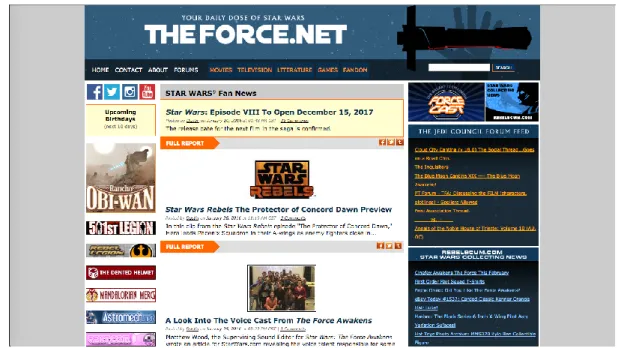
TheForce.net is a unique fan site run by five different fans, and updated daily with news and advertisements directly related to Star Wars. The sections of the site analyzed
were captured January 22nd, 2015. Also, due to the fact that the forums were so
widespread and numerous, we limited our analysis to the main description or “map” of the forums, and then the selected forums thread list titles/subjects rather than in depth analysis of each individual thread. The forum topics analyzed were titled: The Classic Trilogy, the Prequel Trilogy, The Star Wars Saga In-depth, Star Wars Community, and finally Star Wars: The Force Awakens. Because the forums are hosted by theForce.net the analysis will be conducted of these sites as one unit.
Figure 3: TheForce.net Screenshot. This is a screenshot of TheForce.Net’s home page exactly how a web user
Upon investigation, it was discovered that theForce.net and its attached fan forum “Jedi Council Fan Forums” contains a number of “purpose” entities and exposing two other inductive entities. The site itself identified as a news site, or general Star Wars informational website, and thus the reporting “purpose” entity was clearly present
throughout the site. The posts on the main site were broken down into five categories: Movies, Television, Literature, Games and Fandom. The forums have specific threads to report official information, behind the scenes information, etc. There were some
investigative entities, some interviews with community leaders or individual fans. However, the entities that flourish the most on the site in comparison to other materials are “speculation” and “discussion.”
The site itself reports on any rumors that came through much like Rebel Force Radio, as well as opening the forum up for lengthy discussions on details of specific rumors. Unlike a podcast, a forum can serve multiple rumors at once, and constantly Figure 4: Jedi Council Forum Screenshot. This is a screenshot of the front page of TheForce.net’s Jedi Council
update the feeds and posts as new information comes out. In addition, while certain feeds and posts have direct links to sources, much of the speculation on the future of the
franchise is not necessarily from reputable sources like the podcast aims to have. While “speculation” is an essential entity to this site, the purpose entity that is mentioned the most is “discussion.” While the main site remains as solely reporting or investigative works, the forum encourage people to not just share news but discuss its possible implications, serving as the middle ground between straight reporting and wild speculation. And as we have seen in past discussion entities, fans frequently rehash old ideas from past movies, such as wondering “Why is Vader not able to "feel" that Leia is his daughter?” or “Who exactly knew Chancellor Palpatine was Darth Sidious?”
(TheForce.net 2015) However, even more so than the podcast, the site facilitates discussion by allowing multiple fans to participate and introduce new topics.
Another unifying purpose of the forums and site was the newly discovered entity “review.” Many posts both on the main site and on the forums were reviews of specific Star Wars television shows, as well as rankings of the favorite movies, polls on specific characters, essentially inviting fans to express their critical opinions openly and freely. Despite the fact that new movies were being released, past movies in the series are still be reviewed and rated. What is fascinating is all of these different purposes when put
together serve one universal purpose “community building.”
While the “community building” entity may not occur frequently within the code, unlike the other fan materials analyzed, this site encourages fan interaction amongst each other and with the source materials. The forum itself can be argued as the largest
the site and forums is “FanForce” a service that will put Star Wars fans in touch with other fans in their local area. The goal of the service is to encourage meet-ups and
interactions offline in addition to within the online community. This is the first concept of offline interaction of fans promoted by fan materials. But what this particular entity does for the greater context of the Star Wars source material, is show that the movies are not just as something to dissect or analyze but a community activity that brings people together. It puts the films into the larger context of a fan movement, that Star Wars is not just a set of movies to some people, but rather how they identify themselves to the outside world. The other materials show allusions to this kind of community, but the site serves as proof to outsiders such as researchers that the fan community is not just an abstract concept but a living group of people with a culture.
5.
Discussion
As these findings have shown, the results of this study are complicated, messy and up to interpretation; a common issue in qualitative content analysis. In this way there are limits inherent in this study. While these findings were being enumerated and
analyzed, the researcher’s (my) coded materials were compared with the work of the two volunteer coders, in order to verify the results of my findings and to support general interpretations to be applied to a theoretical fan collection. The two women were sent the coding schema that is enclosed in the Appendix of this paper. Looking at their results there are several issues that came up in coding. In several categories there were large number discrepancies between the coders. Upon looking at the code it seems that this is because of a lack of clarity in the schema. While this study a qualitative content analysis, and thus allowing for more subjective interpretation of the materials, this can lead to a lack of reliability in the results and conclusions drawn. For example, when coding for the Rebel Force Radio content, the researcher chose to code the number of times the title of the podcast is mentioned as well as the number of times the “rebels” or “rebel force” is mentioned. The volunteers however, thought that the title was excluded from the count and thus resulted in discrepant numbers.
importance of that category. The general rankings of importance, and the relationship between terms was similar across coders, with similar if not identical observations being made on these terms. In the future, were I to conduct/expand on this research I would change several things. I would simplify the code to fewer categories, and make the boundaries and expectations of the coding clearer so as to have fewer discrepancies in the future. I would also aim to get more than two coders, as to gather more data to support or challenge specific findings. Also, if there was more time to conduct research there would be a greater variety and a greater number in the materials selected. Instead of looking at one example of a fan work, there would be multiple representations of both fan fiction, podcasts and news sites. The lack of variety and amount of items analyzed limits this study but this does not mean that the findings within this study are worthless. Even with these challenges in the study, there are valuable points that can be drawn from the research for future archival endeavors with fan materials.
What these findings did reveal was a wealth of contextual information that if these objects are not archived would be lost to the fandom’s memory. Each fan item had a different emphasis on “purpose,” “agents,” and “objects.” While these emphases made each item unique, when these codes are put together what is revealed is a larger
community context that informs on each other. Each fan work serviced the Star Wars fan community and reflected its views on multiple aspects of the franchise, and the
community’s interactions amongst each other. For example, the fan fiction focuses on the story of the films and re-writing it to communicate fans displeasure or desires, the
6.
Conclusion
The intention of this study was to explore the potential context provided by fan materials for a source material. Star Wars was the selected example because it had such a known and active fan community. This research has shown that this community not only provides contextual information for the specific source material, but the same information also informs our very cultural history. These materials are important not just because they capture the feelings of the fans of a certain source material but the general cultural history produced by that source material.
7.
Bibliography
Bacon-Smith, C. (1992). Enterprising women: Television fandom and the creation of popular myth. Philadelphia: University of Pennsylvania Press.
Barton, K., & Lampley, J. M. (2014). Fan CULTure : Essays on participatory fandom in the 21st century. Jefferson, North Carolina: McFarland & Company, Inc.,
Publishers.
Balestrieri, P., Algee, L., Brett, J., Fox, H., Hecker, J., Lawrimore, E., . . . Stecklein, H. (2015, August 21). No More Silence in the Library: Documenting Fandom and Fan Culture in Archives and Special Collections. Lecture presented at SAA Annual Meeting 2015 in Cleveland Convention Center, Cleveland.
Burkart, P. (2008). Trends in digital music archiving. The Information Society: An International Journal, 24(4), 246-50.
De Kosnik, El Ghaoui, Cuntz-Leng, Godbehere, Horbinski, Hutz, . . . Pham. (2015). Watching, creating, and archiving: Observations on the quantity and temporality of fannish productivity in online fan fiction archives. Convergence: The
International Journal of Research into New Media Technologies, 21(1), 145-164. Retrieved from http://con.sagepub.com/cgi/doi/10.1177/1354856514560313 Egherman, M. (2009). Uses for fan envelopes from the grateful dead archive as digital
and traditional primary research sources Academia.Edu, Retrieved
fromhttp://www.academia.edu/675296/Uses_for_Fan_Envelopes_from_the_Grate ful_Dead_Archive_as_Digital_and_Traditional_Primary_Research_Sources Ericson, T. L. (2000). At the rim of creative dissatisfaction: Archivists and acquisition
development. In R. C. Jimerson (Ed.), American archival studies: Readings in theory and practice (pp. 177-192). Chicago: Society of American Archivists. Graves, M. (2014). “Guys, where are we?” Podcasts, Online Video and Lost’s
Participatory Culture. In Barton, K., & Lampley, J. M. (2014). Fan CULTure : Essays on participatory fandom in the 21st century (173-90). Jefferson, North Carolina: McFarland & Company, Inc., Publishers.
Greenberg, S. (2001). Context as a dynamic construct. Human-Computer Interaction, 16(2-4), 257-68.
Hellekson, K., & Busse, K. (Eds.). (2006). Fan fiction and fan communities in the age of the internet : New essays. Jefferson, NC: McFarland & Co.
Jenkins, H. (2006). Fans, bloggers, and gamers: Exploring participatory culture. New York: New York University Press.
Bibliography Continued
Jones, B. (2014) The Fandom Is Out There: Social Media and The X-FilesOnline. In Barton, K., & Lampley, J. M. (2014). Fan CULTure : Essays on participatory fandom in the 21st century (92-105). Jefferson, North Carolina: McFarland & Company, Inc., Publishers.
Koehler, M. (2012). AT-AT for America. Friends of AT-AT for America.... Retrieved March 24, 2016, from http://atatforamerica.tumblr.com/post/4677107943/friends-of-at-at-for-america
Kuffler, J. (2009). David lemieux and the grateful dead archives ARSC Journal, 40(2), 189-94. Retrieved
from http://search.proquest.com.libproxy.lib.unc.edu/docview/220875402?pq-origsite=summonLothian. (2012). Archival anarchies: Online fandom, subcultural conservation, and the transformative work of digital ephemera. International Journal of Cultural Studies, 16(6), 541-556. Retrieved
fromhttp://ics.sagepub.com/cgi/doi/10.1177/1367877912459132
Lee, C. A. (2015). A framework for contextual information in digital collections. Journal of Documentation, 67(1), 144-158. Retrieved
fromhttp://www.emeraldinsight.com.libproxy.lib.unc.edu/doi/pdfplus/10.1108/00 220411111105470
Lothian. (2012). Archival anarchies: Online fandom, subcultural conservation, and the transformative work of digital ephemera. International Journal of Cultural Studies, 16(6), 541-556. Retrieved
fromhttp://ics.sagepub.com/cgi/doi/10.1177/1367877912459132
Lucasfilm | film and television production. Retrieved from http://lucasfilm.com/ Lucasfilm Ltd. v Ainsworth UKSC 39 (2011).
Lucasfilm Ltd. v. High Frontier, 622 F.Supp. 931 (D.D.C. 1985)
Lucasfilm, Ltd. v. Media Mkt. Group, Ltd., 182 F. Supp. 2d 897, 901 (N.D. Cal. 2002) . Mack, J., & Swank, J. (2015, Sept. 25). Rebel Force Radio. Podcast retrieved from
http://www.rebelforceradio.com/shows/2015/9/25/rebel-force-radio-september-25-2015
Nesmith, T. (2005). Reopening archives: Bringing new contextualities into archival theory and practice. Archivaria, (FallJI: 60) Retrieved
fromhttp://search.proquest.com.libproxy.lib.unc.edu/lisa/docview/57684772/CAD E84D8D5A44A50PQ/2?accountid=14244
Star wars fans, fan sites, and blogs. (2015). Retrieved from http://www.starwars.com/community
stormqueen873. (2006). Shadows of the future chapter 1: Prologue, a star wars fanfic. Retrieved from https://www.fanfiction.net/s/3054756/1/Shadows-of-the-Future TheForce.Net (2015). Retrieved from http://www.theforce.net/
8.
Appendix A
Code Type of
Entity
Definition Subsets Examples
1. “Objects” Original Trilogy Characters
The object entity is a specific entity that has one or more state, exists across multiple spots in time and place, uniquely identified, interacts with other objects and can be acted upon by outside agents. These specific object entities are the primary and significant secondary
characters, as well as certain alien races/groups, featured in the original three Star Wars movies. Instances of
characters in the fan materials, denotes certain opinions, or an indication of a fan’s
view/interpretation of the source text and/or the fan community’s ideas.
A. Luke Skywalker B. Darth Vader C. Han Solo D. Princess Leia
Organa E. R2D2 (Artoo
Detoo) F. C3P0 G. Chewbacca
(Wookiee) H. Yoda I. Obi-Wan
Kenobi J. Boba Fett K. Emperor
Palpatine aka Darth Sidious L. Lando
Calrissian M. Jabba the Hutt N. Galactic
Empire O. Rebel
Alliance, Rebel Force P. Stormtroopers Q. Ewoks
Why does Luke always come off so whiny? 1.A display of popular fan opinion on Luke Skywalker, shows he is not the most fascinating/p opular character. The Rebel Alliance’s most famous headquarters was located on Hoth.
1.O Han Solo swaggered into the Cantina.
2. “Objects” Prequel Characters
These object entities are the primary characters and significant characters of the second set of Star Wars movies known as “The Prequels.” Again, instances of
characters in the fan materials, denotes certain opinions, or an indication of a fan’s
view/interpretation of the source text and/or the fan community’s ideas.
A. Anakin Skywalker B. Obi Wan
Kenobi C. Padme
Amidala (Queen Amidala) D. Yoda E. Darth Maul F. Qui-Gon Jin G. Jar Jar Binks H. Senator
Palpatine (Darth Sidius) I. Mace Windu J. Galactic
Republic K. Clone Army L. RS-D2
(Artoo-Detoo) M. C-3P0
Qui-Gon looked on at the sleeping Obi-Wan Kenobi, thinking on his frustrations with a young impulsive padawan.
2.F
2.B describes a a different side of Obi-Wan, we have not seen. The
transformation from Anakin to Darth Vader is incredible.
3. “Objects” World-building Elements These are fundamental groups/elements throughout the Star Wars series. One part of these entities are either events that have happened in this fictional universe and shaped it. The second part is the fantastical elements of the imaginary society. In this case, this means the Jedi, the Force, and other various “powers,” etc. These entities are the focus of fan debate and
discussion and serve as the basic concepts of the Star Wars world.
A. The Force B. Jedi (The Jedi
Order, Jedi Knight, Light Side, the Code of the Jedi, padawan) C. Sith (The
Dark Side, Darth) D. Force Power
(i.e. Push, Jedi Mind Trick, Force Lightning, Vision, Mental shields, force choke, etc.) E. Naboo Crisis,
Battle of Naboo F. Clone Wars G. Galactic Civil
War
H. Battles (Battle of Yavin, Battle of Hoth, Battle of Endor)
The Dark Side was known as the easier path.
4. “Objects” Items
This object entity denotes
essential/important items in all the movies that play a central role in world-building and driving the plot. The presence of an object in fan material implies an opinion on the technology of the world, but also the world of Star Wars itself by fans or fan communities.
A. Lightsaber B. Blaster
C. Speeder: sand, snow, bike, etc.
D. Pod – pods, podrace, etc. E. droids F. Ships
(X-Wing, TIE fighters, AT-AT etc. )
With a flash the lightsaber flung into the air towards the hooded stranger.
4.A easy indication of Jedi/Sith The TIE fighter chased the X-Wing across the sky.
4.F 4.F
5. “Objects” Movies
This object looks at all of these
characters, objects in a collection sense. The movies distinguish a specific item/entity but also a group of other entities. These are the names or common names of the titles of movies in the franchise.
A. Episode IV: A New Hope B. Episode V:
Empire Strikes back C. Episode VI: Return of the Jedi
D. Episode I: The Phantom Menace E. Episode II:
Attack of the Clones F. Episode III:
Revenge of the Sith
G. Clone Wars H. Rebels I. Episode VII:
The Force Awakens J. Rogue One K. Episode VIII
The main critique of The Force Awakens is that it is too much like A New Hope.
5.I Shows the criticism of new movie 5.A shows they value the original movie This story takes place between the TPM and ROS plotlines.
6. “Agents” An “agents” entity has the ability to carry out actions and directly affect or change other objects they have come into contact with.
This entity denotes the
forces/persons/co-mpanies that directly affect the source material and thus fan materials. The decisions of these agents can ultimately change the materials. Mention of these forces denotes criticism, approval, or other opinions on the franchise
direction/productio n. Especially in the case of fan works that report on or investigate on the Star Wars
franchise.
A. Fan
communities (fans, fangirls, fanboys, etc.) B. Lucasfilms C. George Lucas D. Disney
E. John Williams – Composer F. Lawrence
Kasdan – Writer G. Original
Trilogy Actors (Mark Hamil, Harrison Ford, Carrie Fisher, etc.)
H. Prequel Trilogy Actors (Hayden Christiansen, Natalie Portman, Ewan McGregor, etc.) I. Future
Franchise Actors (Daisy Ridley, John Boyega, Oscar Isaac, etc.) J. Toy
Companies (Kenner, Hasbro)
Did Hayden really do that bad a job as Anakin Skywalker?
6.H Shows the controversy that still surrounds a character’s interpretations I do not own characters they are all the property of George Lucas.
6.C some fear/trepidatio n when it comes to Lucas
Fans of the series, may be upset by recent changes made by Disney.