Elizabeth P. Ward. Do They Still Make Them Like They Used To?: A Content Analysis of Easy Readers from Selected Decades . A Master’s Paper for the M.S. in L.S degree. April, 2009. 73 pages. Advisor: Brian Sturm.
This is an exploratory study to identify and understand changes in the easy reader genre since its inception 52 years ago. Thirty-five easy reader books were analyzed for their content: five from the 1960s, ten from the 1980s, and twenty from the 2000s. Eight Geisel Award medal and honor books were among the books from the 2000s. The books were evaluated for reading level characteristics, aspects of illustrations unique to easy readers, quality of storytelling, topics reflected, and teaching aids included. The study found that newer easy readers have a higher proportion of illustration to text and are shorter than earlier easy readers, meaning they provide less reading material per book. Several minor modifications to easy reader formulas were noted, most notably at the lowest reading level where books to be read with an adult while learning to read have been introduced. Some topics shown to interest young children, such as transportation, were found to be used relatively rarely in easy readers.
Headings:
Children – Books and reading – United States Children’s literature – Evaluation
Children’s literature – History and criticism Picture books – Evaluation
by
Elizabeth P. Ward
A Master’s paper submitted to the faculty of the School of Information and Library Science of the University of North Carolina at Chapel Hill
in partial fulfillment of the requirements for the degree of Master of Science in
LibraryScience.
Chapel Hill, North Carolina April 2009
Approved by
Table of Contents
Introduction... 3
Literature Review... 6
Easy Reader Publishing ... 6
Evaluation of Easy Readers ... 11
Reading Interests and Preferences of Beginning Readers ... 17
Method ... 21
Evaluative Instrument ... 21
Sampling ... 24
Results... 29
Estimated Reading Difficulty ... 29
Illustrations ... 32
Quality of Storytelling ... 36
Characters ... 42
Teaching Aids ... 44
Conclusions... 46
References... 51
Appendix A: Easy Reader Content Analysis Questionnaire... 55
Appendix B: Geisel Award Medal and Honor Books ... 57
Appendix C: Titles Evaluated... 58
Appendix D: Estimation of Difficulty – Leveling Information ... 60
Appendix E: Estimation of Difficulty – White Space and Font Information ... 62
Appendix F: Illustrations ... 64
Appendix G: Quality of Storytelling... 66
Appendix H: Quality of Storytelling - Topics ... 68
List of Tables
Table 1: Reading Interests and Preferences Shown by Young Children ... 20
Table 2: Number of Books Showing One, Two, and Three Reading Levels ... 30
Table 3: Number of Pages in Each Book... 32
Table 4: Matching of Illustrations to Specific Words in the Text ... 33
Table 5: Level of Word and Phrase Repetition... 37
Table 6: Appeal Factors ... 39
Table 7: Distinct Personalities in Characters ... 40
Table 8: Topics in Books Sampled ... 41
Introduction
In the mid-1950s, American trade book publishers noticed a bit of a gap in
children’s literature. There were picture books designed to be read to children who could not read themselves while they enjoyed looking at the illustrations, and there were simple children’s novels designed to be read independently by children who could read fluently, but only a few of these were accessible to children actually in the process of learning to read. A beginning reader had relatively few reading choices outside of the basal readers used in schools. The easy reader was developed to fill this gap. Easy readers were specifically designed to supplement reading instruction and appeal to young readers. They had large print and widely spaced sentences for young eyes learning to process text. They used simple vocabulary consisting of first and second grade sight words and other easily decoded words. Sentences and line lengths were short for ease of comprehension. Illustrations included picture clues for words in the text and portrayed the general action in the book while not distracting from the text. The stories engaged children, helping them to learn why to read as well as how.
The award recognizes quality in books created for this special audience, and publicizes and rewards the efforts of the authors and illustrators that create them. Now that the easy reader has come of age, it is an opportune time to investigate the range and depth of this genre and how it has changed in the 52 years since the first easy readers were published.
Children’s picture book author, journalist, and blogger Erica Perl (2008) recently created a slideshow for the online magazine Slate that compares some of the newest easy reader offerings to several commonly accepted “standards.” The standards she listed all dated from the first few years of easy reader publishing, 1957 through 1961, with the exception of the Frog and Toad series from the period 1970 and 1979. Although she noted some easy readers with classic qualities are still being produced, she also criticized some of today’s offerings as lacking the “educational scaffolding” (p. 4), high quality illustrations (p. 5), strong characterizations, and realistic relationships (p. 6) of classic easy readers. Perl was particularly concerned about easy readers based on PG-13 rated movies, yet aimed at young children. Certainly this indicates that the genre has
undergone some changes, and not all of them positive.
Literature Review
Easy Reader Publishing
Easy readers developed as a distinct genre in American publishing during the 1950s, amid a background of cold war competition between the U.S. and Russia, the post-World War II baby boom, increased affluence, and fears of increased television viewing affecting literacy rates. Well-known author and journalist John Hersey (1954) reported his observations from serving on a committee that studied reading instruction in the Fairfield, Connecticut schools in a Life magazine article, “Why Do Students Bog Down on [the] First R?” The article expressed a growing concern of many Americans. In addition to criticizing teaching methods and priorities, he singled out the lack of literary quality in the reading textbooks of the day, calling them “namby-pamby” (p. 138), with content that was “pallid” and unrelated to children’s actual interests and experiences (p. 147). He said the illustrations were “uniform, bland, idealized, and terribly literal,” and asked why they could not be illustrated by “the wonderfully imaginative geniuses among children’s illustrators, [John] Tenniel, Howard Pyle, ‘Dr. Seuss,’ Walt Disney?” (p. 148).
At the time Hersey issued his challenge Tenniel and Pyle were both dead and Disney was otherwise employed, but Theodor Seuss Geisel, also known by the
illiteracy rate among children that had begun to concern the public. He persuaded Geisel to write a book to address this problem, to be published simultaneously for the
educational market by Houghton Mifflin and for the trade market by Random House. Spaulding gave Seuss a vocabulary list and asked for “a story that first graders can’t put down” (Morgan, 1995, p. 153-154). Geisel worked on the project throughout 1956, struggling with the vocabulary that Spaulding required and the verse format that he chose to use (Morgan, p. 155). The resulting book, The Cat in the Hat, was published in the spring of 1957. It is now widely renowned as the first easy reader.
The immediate and overwhelming success of The Cat in the Hat led to the formation of Beginner Books, a division of Random House, where Geisel served as the primary of three editors. The reminiscences of writers Stan and Jan Berenstain (2002) while working on their first Beginner Book title illustrate the care Geisel took in editing easy readers. They remembered that “Ted took these little 72-page, limited vocabulary, easy-to-read books just as seriously as if he were editing the Great American Novel” (p. 146). Geisel diligently reviewed the books’ format – rhyming schemes, sentence length, line length, vocabulary, font, and illustrations with word/picture clues. He also
considered their content. The Berenstains recalled Seuss saying “these books need to be real page-turners. We’ve got to keep their little eyeballs glued to the page” (p. 149).
to find them, as the relatively few books that a newly independent reader could read to himself were sprinkled throughout picture books and juvenile fiction, with no easily recognizable format or common classification. Haviland later related her experiences to her good friend Ursula Nordstrom, head of the children’s division at Harper & Brothers, and Nordstrom began looking for works to fill this gap (p.207). Meanwhile, as a parent and first grade teacher, Minarik had also noticed the lack of books for newly independent readers and begun writing some of her own (Something About the Author, 2002, p. 159). She submitted a few of her stories to Nordstrom in September of 1956, during the same time period that Geisel was struggling with The Cat in the Hat. In contrast to the controlled vocabulary used by Geisel, Minarik and Nordstrom relied on their own standards of age appropriateness, simplicity, and literary quality (p. 208) to produce Minarik’s Little Bear as the first title under the I Can Read imprint in the fall of 1957.
Ursula Nordstrom’s letters (Nordstrom and Marcus, 1998) further illustrate the criteria she used when developing titles for the I Can Read imprint. In her letters to Syd Hoff, the author of Danny and the Dinosaur, the second title published under this imprint, she insisted on simple wording appropriate for a child finishing the first grade, although she did not suggest using a controlled vocabulary. She also looked for
book, large Times Roman typeface, generous space between lines, line breaks at natural phrases, no strict rules for vocabulary, limits for the number of words per line and lines per page, and illustrations that help readers to decode words and understand the story. This makes it clear that Nordstrom, as well as Geisel, considered both format and content in publishing easy readers.
A few less lasting entries into easy reader publishing were also attempted during the late 1950s and early 1960s. The Follett Corporation created the Follett Beginning-to-Read Award in 1957 in response to the demand for “lively and interesting” books for beginning readers (Weber, 1967, p. 190). The award included a $2,000 cash prize for the author and was given out for only four years from 1958 through 1961. Just one of the winning titles, Nobody Listens to Andrew by Elizabeth Guilfoile, remains in print. In the 1960s Follett also began publishing books with a Beginning-to-Read imprint. These featured one of the first easy reader leveling systems, using first, second, and third grade levels (Guilfoile, 1962, p. 12). Wonder Books, a collaboration of Grosset & Dunlap, Curtis Publishing, and Random House (Marcus, 2007, p. 29), published an easy reader series named simply Easy Reader in the 1960s as well. All of the Easy Reader titles are now out of print and considered collectors items.
things, was “adding some juice to the bland animal/neighborhood fiction diet” (p. 36). In 1984 Random House began publishing the first paperback easy readers under the Step-into-Reading imprint. Other imprints such as Scholastic’s Hello Reader!, Grosset & Dunlap’s All Aboard Reading, Dorling Kindersley’s Eyewitness Readers, and Golden’s Road to Reading were initiated in the 1990s (Maughan, 2000, p. 40-41). Harcourt began publishing Green Light Readers in 1999 and started including story-related activities and a page of reading tips for parents at the back of each book in 2003 (Bean, 2004, p. 30). Many other publishers have added easy reader series and imprints as the demand for this genre has grown over the years.
By the 1990s some of the earlier easy readers had begun to age, and efforts were made to update their content as well as their appearance. In 1992 HarperCollins
Evaluation of Easy Readers
Most of the literature published on the subject of easy readers to date has been primarily concerned with the subject of selecting books for young readers. As a result, it contains many relatively short easy reader bibliographies, perhaps with some
introductory paragraphs about the characteristics and qualities that can be used to evaluate easy readers. A few works of more depth and scope stand out. One of these is Condit’s (1959) scholarly evaluation of trade books that could be read independently by first and second graders. Condit looked at both the format and literary content of hundreds of children’s books to develop a bibliography of trade books for beginning readers. Her study included primarily picture books and short chapter books because few books had been intentionally published as easy readers at the time she wrote. However, all three of the I Can Read titles and all five of the Beginner Book titles then available were listed in her final bibliography. Condit began by surveying children’s book editors for an initial list of 759 potential titles to include in her bibliography. Then she
eliminated titles that did not meet criteria including:
• Simple 12- to 18-point font.
• Familiar vocabulary and short, simple sentences.
• Topics reflecting childrens interests, such as animals and other children. • Smooth narration, simple plots, and clear conversations.
• Elements of surprise, good humor, and liveliness.
• Illustrations with storytelling quality, color, humor, and action.
Condit tested the remaining 246 titles in an elementary school setting, asking at least five children to chose, read, and answer questions about each of them. Based on the children’s reactions to the texts, she eliminated several more titles and produced a
bibliography with 151 books appropriate for beginning readers. Her evaluation criteria and method show a consideration of the format, literary content, and artistic merit of this type of literature.
Guilfoile (1962) compiled a similar bibliography of books for beginning readers that included picture books and short chapter books as well as easy readers. She asked publishers for books with interesting topics, simple vocabulary, and simple sentence structure that could be read independently by first through third graders. She eliminated books with ideas, characters, situations, language patterns, humor, or story lines that she thought would be unfamiliar to young children, and therefore more difficult to
comprehend. She eliminated other titles that she thought were poorly written, inaccurate, or unsubstantial (p. v). Guilfoile then documented and explained several features of texts for beginning readers including appropriate vocabulary, repetition, layout, illustrations, content, and “acceptability factors.” These acceptability factors included aspects of the books that might appeal to or repel young readers, such as characters much younger than themselves. She included reading levels that she determined herself with input from primary grade teachers (p. 14). Interspersing her own observations with reviews of selected titles, Guilfoile commented on both the format and content of the books.
“These books are written as are books for older children and adults – not built around vocabulary to be mastered; they have plot, idea, theme; they deal with situations appreciated by young children, with life as they see it, or fancy as they can take it… Readability at the early levels, of course, depends much on
material into paragraphs or fact units, yet story and fact value, manner of telling, and illustration take precedence over language control and physical make-up. What the reader desires comes first.” (p. 3)
In contrast, Kegley (1989) looked primarily at easy reader vocabulary in her master’s thesis. She compared their vocabulary to the vocabulary used for basal readers. Kegley sampled ten books “at random” (p. 4) from each of three different easy reader imprints: I Can Read, Greenwillow Read-alone, and Macmillan Ready-to-Read. She found a high correlation between the words used in trade easy readers and the word lists used to develop basal readers, and concluded that contrary to her expectations, trade easy readers could therefore be successfully used to supplement reading instruction from schools.
texts, could accommodate great literary depth and richness. She suggested several potential avenues for further research into the literary content and quality of these texts.
Horning (1997) presented detailed guidelines for evaluating easy readers from a professional perspective gained through her experiences as a children’s librarian in a public library and director of the Cooperative Children’s Book Center (CCBC) at the University of Wisconsin-Madison, and her years of service in the children’s division of the American Library Association. She recommended evaluating easy readers based upon their content including:
• Sight word, easily decoded word, and simple compound word vocabulary. • Short, simple, direct sentences.
• Plots with clear, direct action.
• Few main characters, developed through interaction. • Illustrations with word clues.
• Illustrations that do not compete with the text. • Large typeface, typically 18-point.
• Line length of two to ten words. • No more than 15 lines per page.
• Wide clear spaces between words and lines. (p. 129-137)
Barstow, Riggle, and Molnar’s (2008) bibliography of beginning readers. However, both systems determine reading levels based upon the complexity of words and sentences used in the text, plus formatting considerations such as the proportion of text to illustration.
Lambert (2006) summarized Horning’s guidelines in an opinion article, but also clarified the difference in the relationship between illustrations and text in picture books and in easy readers. In a picture book the text and illustrations have equal parts in telling the story. Children look at illustrations as they hear the story being read and create a combined meaning. In easy readers, however, the illustrations are meant to support the text. They should not compete with it or draw attention away from it.
The scientific reasoning behind other typical easy reader features such as short words, wide spacing, repetition and rhyme were explained by Margaret Jenson, a former director of the CCBC (Elias, 1999). Short words are used to accommodate the
neurophysiology of young children, who can typically focus on an area about five letters wide, as opposed to adult readers who can focus on 17 to 18 letters in an “eye span”. Generous space between words also helps children focus on the words better. Repetition, rhythm, and rhyme are psycholinguistic elements that evoke a response from children. Natural language is another psycholinguistic element that makes it easier for children to infer meaning. This confirms the usefulness of the design and formatting standards used in easy readers, and in fact, the basal readers that preceded them.
book must also contain illustrations, which function as keys or clues to the text” (ALSC, 2009b, para. 8). For this reason the award is given to both the author and illustrator of the book. The criteria also state:
“Committee members need to consider the following criteria: Subject matter must be intriguing enough to motivate the child to read; The book may or may not include short "chapters"; New words should be added slowly enough to make learning them a positive experience; Words should be repeated to ensure
knowledge retention; Sentences must be simple and straightforward; There must be a minimum of 24 pages; Books may not be longer than 96 pages; The
illustrations must demonstrate the story being told; The book creates a successful reading experience, from start to finish; The plot advances from one page to the next and creates a "page-turning" dynamic.” (para. 9)
Reading Interests and Preferences of Beginning Readers
The reading interests and preferences of children have been the subject of much scholarly literature and many an opinion article, but relatively few researchers have directly addressed the interests and preferences of the youngest, beginning readers, typically ages four to seven. However, since easy readers are written to appeal specifically to this age group, it is useful to obtain a general, if not comprehensive, background in these interests.
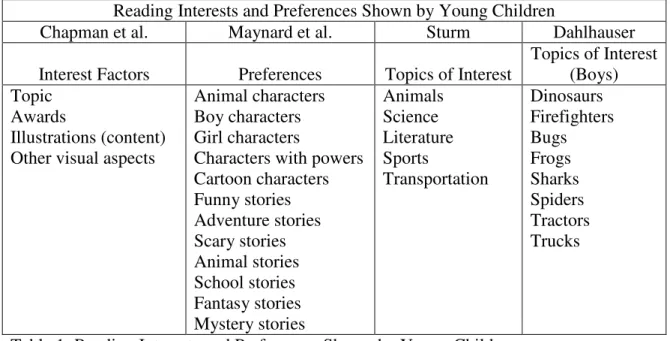
Chapman, Filipenko, McTavish and Shapiro (2007) studied the reading preferences of Canadian first graders. Their research focused on the children’s preferences for fiction or nonfiction, but also displayed the importance of topic and content to young readers. They conducted an experiment asking 40 first graders to perform two book selection tasks. In one they were shown four storybooks and four information books and asked to choose as many as they would like. In the other they were given four pairs of books, a fiction title and a nonfiction title for each of four subjects. They were asked to choose either the story book or the information book in each subject. After both tasks they were asked to talk about their choices. When
amount of color used in illustrations (16% of girls’ comments and 14% of boys’ comments) (p. 542-544).
Maynard, McKay, and Smyth (2008) analyzed the reading preferences shown by British children in a large scale online survey concerning fiction reading conducted by the UK’s National Centre for Research in Children’s Literature in 2005. They reported their results in terms of the UK’s Key Stages, with Key Stage 1 representing four to seven year olds, the typical audience for easy reader books. In their answers to the question, “When you are reading a story, do you often like the main character to be any of the following?” the Key Stage 1 children responded as follows:
• 37.3% liked an animal main character. • 35.7% liked a boy main character.
• 35% liked a character who could use special or magical powers. • 33.6% liked girl main characters.
• 30.2% liked cartoon characters.
• 26.8% liked a monster main character. • 21.6% liked an adult main character.
• 18.9% liked a machine or robot main character.
• 15.9% liked someone from outer space as a main character. (p. 57)
The childrens’ answers to the question, “Do you often enjoy reading any of the following kinds of storybook?” indicated:
• 46.4% enjoyed stories about animals. • 36.7% enjoyed school stories.
• 36.5% enjoyed stories in which make-believe things happened. • 33.4% enjoyed mysteries. (p. 62)
It is interesting to note that a relatively large percentage of the children showed a preference for animal characters as well as animal stories. However, the largest
percentage of children preferred books with humor, adventure, and scariness, which are appeal factors that help to engage children in their reading.
Sturm (2003) analyzed the reading interests of children visiting libraries in North Carolina, categorizing the results by age and gender. He sampled entries from a state library sponsored drawing that required children to answer the question, “What would you like to know more about?” The question itself was phrased by the state library, and one possible limitation of this study is that it might reflect the children’s attitudes towards nonfiction topics more so than fiction. However the study clearly showed that children of all ages were highly interested in animals, and in particular that their interest in animals peaked at around age seven, appealing to over 50% of boys and over 60% of girls (p. 43). Other common interests were science, literature, sports, transportation, and the library collection in general. Biography, history, computers, and careers were mentioned as interests by three percent or less of this age group.
firefighters, bugs, frogs, sharks, spiders, tractors, and trucks, and also commented that boys like crude humor, not “saccharine stories about puppies and kittens” (p. 29).
It should be noted that none of these studies has distinguished between books read to a child and books read by a child, and the books used in Chapman’s experiment were all picture books. However, the studies give a general sense of the reading interests and preferences of children of beginning reader age. Table 1 summarizes these findings.
Reading Interests and Preferences Shown by Young Children
Chapman et al. Maynard et al. Sturm Dahlhauser
Interest Factors Preferences Topics of Interest
Topics of Interest (Boys) Topic
Awards
Illustrations (content) Other visual aspects
Animal characters Boy characters Girl characters
Characters with powers Cartoon characters Funny stories Adventure stories Scary stories Animal stories School stories Fantasy stories Mystery stories
Animals Science Literature Sports
Transportation
Dinosaurs Firefighters Bugs Frogs Sharks Spiders Tractors Trucks
Method
The purpose of my research is to identify and understand changes in the easy reader genre over the years. In order to accomplish this, I have reviewed the literature concerning the production standards used by the creators of the first easy readers, currently accepted evaluation criteria for easy readers, and the type of reading materials shown to interest the easy reader audience. I will now apply this information in a content analysis of fiction easy reader books published over a range of time, from the 1960s, 1980s, and 2000s, in an exploration of the research question, “How have books designed and marketed as easy reader fiction changed since they were first published?”
Evaluative Instrument
manifest coding for visible surface content, rather than latent coding of underlying, implicit meaning.
The questionnaire was divided into six sections, as follows:
• The first section consisted of general identification and description questions, including the title, publication date, and number of pages. Some of this data was used only for descriptive purposes and some of it, such as the number of pages, was used for further analysis.
• The next section addressed the estimated reading level of the book. It was necessary to determine the reading level because it has implications for the other features of the book. For example, it is more critical to include word/picture clues in the illustrations of easy readers at lower reading levels. I chose to use
Horning’s (1997) simple three-tiered leveling system (p. 137-142) rather than the Spache Readability Formula that Condit (1959) used, or more complex criteria such as Pinnell and Fountas’s (2007) Guided Reading Level system, because I was only attempting to determine whether the elements of the book functioned well together, and not assigning reading material to specific students. When I was testing the questionnaire, I noticed two books that seemed to be at a level below the three described by Horning, so I added my own criteria for a fourth, lower reading level. The first five questions in this section determine the reading level. These all use a multiple choice format where answer “a” corresponds to the lower reading level I created and called Level 0, answer “b” corresponds to Horning’s Level 1, answer “c” corresponds to Horning’s Level 2, and answer “d”
actually continuous variables, yet they are customarily measured and reported as if they were ordinal, so I continued that practice. Three additional questions and an open ended question at the end of the section captured information about white space, font, and other comments.
• The third section of the questionnaire captured information about the illustrations. Many evaluators (Condit, 1959; Guilfoile, 1962; Horning, 1997; Kruse, 2007; Chatton, 2007) have stressed the importance of text clues and action in easy reader illustrations, so questions evaluating the illustrations from those perspectives are included. Lambert (2006) explained the importance of illustrations that do not compete with the text, and Perl (2008) commented on the usefulness of
illustrations that show characters’ thoughts and feelings, so I also added questions to evaluate those qualities. I used the ordinal values of “Often”, “Sometimes”, and “Rarely” to measure these qualities based upon the frequency of their occurrence.
• Section four included questions to identify and measure the literary quality and engagingness of the texts. Most of these questions were based upon ideas, such as the use of natural language and repetition in the text, that were all discussed
open-ended question about the topics covered in the books for comparison to the preferences and interests identified by Dahlhauser (2003), Sturm (2003), and Maynard et al. (2008), and a question to capture a brief plot summary for the book for informational purposes.
• The fifth section of questions captured basic information about the characters in the book. I asked how many main characters were used in the book based upon evaluation criteria from Horning (1997). There was also a simple “Yes” or “No” question about whether anthropomorphic characters were used based on the findings of Maynard et al. (2008), and another “Yes” or “No” question about whether licensed characters were used based on my own interest.
• The last section of the questionnaire addressed the number and type of teaching aids included with the texts. These questions were inspired by Lodge’s (1996) description of features that have recently been added to easy readers to appeal to parents and teachers, and all of them have simple “Yes” or “No” answers.
The questionnaire was not tested for inter-coder reliability. There was no opportunity for multiple coders to interpret the questionnaire differently, because I was the only coder in this study. However, for the same reason there was also ample
opportunity for coding bias. The answers to all of the questions reflect my own personal viewpoint and biases. Therefore, the results of this exploratory study should be viewed as tentative.
Sampling
This excludes books that may be appropriate for beginning readers, but that are
considered picture books or transitional readers, and also nonfiction. In order to observe changes in easy readers over time I have chosen to sample titles from decades at the beginning, middle, and most recent period of their history, namely the 1960s, the 1980s, and the 2000s. Since the publication rate of easy readers has grown dramatically over the years, I have determined the number of titles to be sampled from each decade on a sliding scale, with five titles from the 1960s, ten titles from the 1980s, and 20 titles from the 2000s, for a total of 35 books.
Some content analyses have used samples formed by simply selecting books from local public library shelves (Kortenhaus, 1993). However, this method of sampling introduces two elements of sampling bias. There is one level of bias introduced by the book selector that developed the collection, and another level of bias known as “shelf bias.” Shelf bias is introduced with the assumption that the books on the shelf represent the entire collection. This is not true, as a major portion of the collection, perhaps the most interesting part, is normally checked out. I endeavored to use a more scientific sampling method for this study, but still encountered some issues.
Children (Barr, 2008) is somewhat different. It contains a section with 571 easy reader titles, but these are recommended titles only. They have all received positive reviews, and so are biased towards outstanding easy readers. There is no separate subject heading for easy readers that can be used to search public library catalogs, and libraries do not typically allow patrons to search by an easy reader collection name in their advanced search options. WorldCat does not identify easy readers. At least one book jobber website, Baker and Taylor’s TitleSource 3 (2005) supports searching by BISAC (Book Industry Standards and Communications) codes, and there is a code for Juvenile Fiction/ Readers/ Beginner. However, the entries returned from a search with this code contain the same title with several different bindings, and many titles that are not actually easy readers. Therefore, while libraries and also bookstores typically group and separate easy readers for display and shelving due to customer interest, this is not reflected in
bibliographic or search tools.
The only source that I found that identified easy readers separately from other types of beginning readers, used original publication dates, and did not limit itself to positively reviewed titles only was the online database NoveList. NoveList is a large, but also to some degree selective, bibliographical database. However, it provided the best sampling source in this situation. I used the Advanced Search feature of NoveList, specifying “easy reader” (but with no quotation marks) as the subject, “books” as document type, and publication years 1957 to 1969, 1980 to 1989, and 2000 to 2009 in turn to assemble my sample. I chose every 12th title from the 63 titles returned from the years 1957 to 1969 to select five books from the 1960s, and every 27th title from the 275 returned for the 1980s to select 10 books from that period. I included the eight Geisel Award winner and honor titles (ALSC, 2009a; ALSC, 2009c) that could be considered easy readers in my sample for the 2000s. Three of these titles, Cowgirl Kate and Cocoa by Erica Silverman, and both There Is a Bird on Your Head and Are You Ready to Play Outside? by Mo Willems were not designated by their publishers or NoveList as easy readers, but they were placed in the easy reader collections of the three largest public library systems in North Carolina, so I considered them to be easy readers. Appendix B lists all of the Geisel Award medal and honor books and shows which of them I viewed as easy readers. I chose every 100th book from the 1290 titles in NoveList from the 2000s for the remaining 12 books in the sample.
Results
I completed a questionnaire for each book in the sample, and summarized the results in a series of spreadsheets which can be found in Appendices D through I. In order to analyze the results, I counted and compared the number of answers for particular values, and then looked for trends and patterns. While the content analysis technique can uncover the existence of similarities and differences between items sampled, it cannot be used to uncover the causes or implications of these similarities and differences (Neuman, 2007, p. 236). Therefore, I have discussed aspects of easy reader publishing and use that are commonly known or referred to in my literature review that may explain some of my findings.
Estimated Reading Difficulty
I chose to analyze reading level as part of this study because it affected other aspects of the easy readers I examined, such as the amount of illustration, use of
repetition, etc., but the leveling exercise itself also produced some interesting results. I coded variables for items from the questionnaire relating to vocabulary, words per line, lines per page, sentence structure and proportion of illustrations compared to text. Each of these variables had an “a”, “b”, “c”, or “d” value, corresponding to reading levels L0 (Level 0), L1 (Level 1), L2 (Level 2) and L3 (Level 3). Appendix D lists the scores for individual titles for these questions, as well as the number of pages in the book,
Barstow et al. (2008) if available. In addition to determining the overall reading levels of the books, I wanted to see if the books showed similar levels or different levels for each feature. For example, I wanted to see if L3 vocabulary was found in L3 sentences, or if L3 vocabulary was found in L1 sentences. Table 2 summarizes the numbers of books reflecting one, two, and three reading levels.
Number of Books Showing One, Two, and Three Reading Levels Sample Segment
Number of Books
One Reading Level
Two Reading Levels
Three Reading Levels
1960s 5 3 2 0
1980s 10 6 3 1
2000s Random 12 0 6 6
2000s Geisel Award 8 2 4 2
Table 2: Number of Books Showing One, Two, and Three Reading Levels
Since the qualities measured to determine levels actually exist in a continuum, and not as discreet entities, it was reasonable to expect that some of the books might have qualities from one or even two adjacent levels, and therefore it is not remarkable that several books are represented with two or three reading levels. All of the 1960s titles and 90% of the 1980s titles displayed qualities from either one or two reading levels, while half of the randomly selected 2000s titles and a fourth of the Geisel Award titles displayed qualities from three levels. This might have indicated that less attention was paid to leveling by today’s publishers. However, I also observed that three quarters of the randomly sampled 2000s titles and half of the Geisel titles from the 2000s reflected a proportion of illustration to text that was associated with a level lower than their
appears that modern easy readers are more highly illustrated than older easy readers, with a larger portion of the page dedicated to pictures and fewer lines per page. This may be understandable given the higher emphasis on visual content today, and it is responsible for the majority of the situations where I found features from multiple reading levels in one book. I concluded that vocabulary and sentence structure were the primary indicators of reading level, and calculated an overall reading level for each book in the study based upon just those two variables. When the levels matched for these two fields, for instance if they were both L2, I used that as the level. If the levels did not match and there were two reading levels, I used the higher level. I used the middle level if there were three levels. The resulting reading level is shown in the far right column in Appendix D.
The results for the additional reading difficulty questions for each book analyzed are in Appendix E. All of the easy readers used a large clear font and generous wide space between words and lines, and between text and illustrations, although specific formats differed somewhat. I Love My Papi and Buster Changes His Luck from the randomly selected 2000s segment of the sample did not use the Times Roman font typical of most easy readers, which might make them more difficult for some children. Buster Changes His Luck also used multiple fonts, some of which mimicked hand printing. Hi! Fly Guy, a Geisel Award book from the 2000s, used a large hand printed Times Roman font, which might be more difficult for some children to interpret as well. This shows more creativity and more sophisticated printing techniques on the part of current easy reader publishers, although it may affect the usability of these books.
successful than the other because the pictures used did not match the words well, for example a brightly colored tent was used for the word circus. Two of the books, both Mo Willem’s Elephant and Piggie series titles, used speech bubbles and dialog alone, with no descriptive text. Another, Survivors: The Night the Titanic Sank used insets with small illustrations and descriptions to explain some of the more complicated concepts in its historical fiction plot.
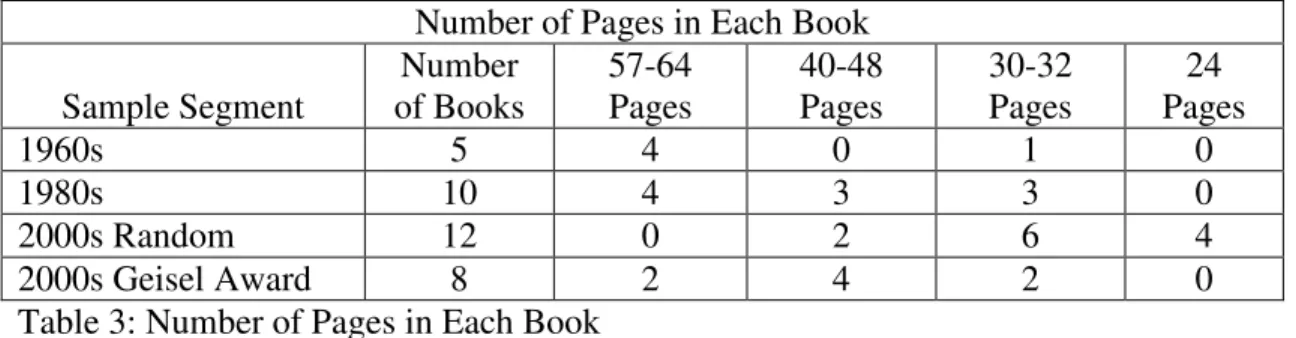
Since the length of a book might also have implications on its reading level, I analyzed the number of pages in the sampled books. I found that Geisel Award books were somewhat shorter and randomly sampled books from the 2000s were noticeably shorter than easy readers from the 1960s and 1980s, as shown in Table 3.
Number of Pages in Each Book Sample Segment
Number of Books
57-64 Pages
40-48 Pages
30-32 Pages
24 Pages
1960s 5 4 0 1 0
1980s 10 4 3 3 0
2000s Random 12 0 2 6 4
2000s Geisel Award 8 2 4 2 0
Table 3: Number of Pages in Each Book
Taken together, the current trends of a higher proportion of illustrations and fewer pages indicate that today’s easy readers, at least as represented by this sample, actually contain less to read than earlier easy readers.
Illustrations
Rarely was used for features that did not occur, or only occurred once or twice in the book. The remaining question was open-ended. Appendix F lists the results of these questions for each book studied.
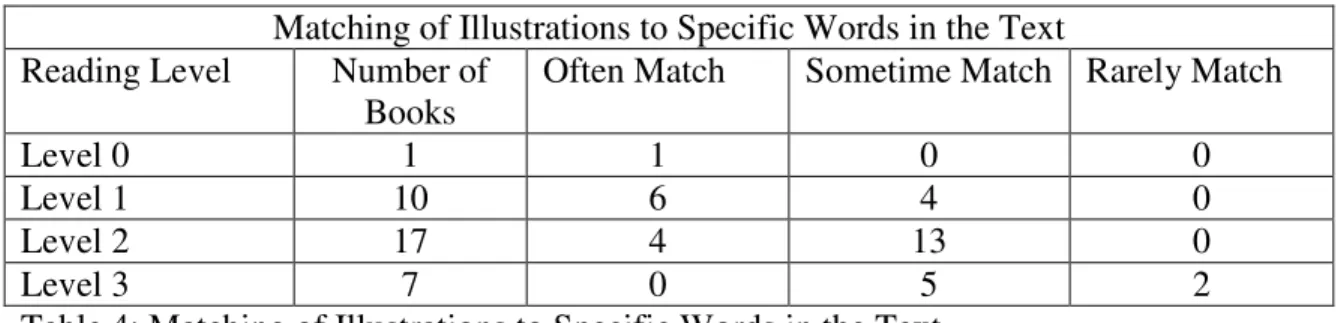
I analyzed illustrations in terms of my own calculated reading level, which was based upon the vocabulary and sentence structure in the Estimated Reading Difficulty portion of the questionnaire. The degree to which illustrations matched specific words in the text did not appear to vary by decade, but it did appear to vary by reading level, as shown in Table 4.
Matching of Illustrations to Specific Words in the Text Reading Level Number of
Books
Often Match Sometime Match Rarely Match
Level 0 1 1 0 0
Level 1 10 6 4 0
Level 2 17 4 13 0
Level 3 7 0 5 2
Table 4: Matching of Illustrations to Specific Words in the Text
Easy reader evaluators have said that illustrations in easy readers “are there to complement the text, not compete with it” (Horning, 1997, p. 137). Their concern is that the illustrations should not draw the attention of the reader away from what he or she is reading. Not one of the 1960s or 1980s easy readers had illustrations that competed with the text to any degree above Rarely, but a few of the newer easy readers did. Some of them displayed humor in illustrations that was not reflected in the text. Best in Show for Rotten Ralph used many detailed illustrations that told parts of the story not reflected in the text, like a picture book. For example, Ralph was shown humorously tangled in a jump rope while the text said only, “Ralph jumped rope” (p. 20). Hi! Fly Guy contained a couple of illustrations that were so hilarious they might have distracted from the text, such as when the text said, “Buzz gave Fly Guy something to eat,” while the illustration showed a huge hot dog with bun shoved in to Buzz’s jar and Buzz staring at it bug-eyed, with his tongue hanging out (p.15). However, these illustrations were fairly simple and may just have added to the enjoyment of the book, rather than distracting readers. Two other books from the 2000s, I Love My Papi and Super Spies, included illustrations that competed for attention with the text just by being too busy, but perhaps this is another indication that our world is more visually oriented today. Once again, current standards seem to have expanded a bit from the 1960s and 1980s, but these innovations might possibly make the books less useful as easy readers.
illustrations the least. These tended to have almost identical versions of the characters printed on each page, perhaps strengthening their brand recognition, but lessening the quality of those books. Among the remaining books, the amount of expression in characters seemed to vary with the general style of illustration, showing no particular trend by reading level or publication date. Almost all of the easy readers had illustrations showing action at an Often level. Only three showed action at a Sometimes level, and none showed action at a Rarely level.
The open ended illustration question showed that some of the illustrations from the 1980s easy readers looked quite dated. Arthur’s babysitter in Arthur’s Loose Tooth wears a pink and white striped dress covered with a ruffled white apron. The illustrations in the 1983 edition of Wait, Skates! are muted and subdued compared to the brightly colored, antic illustrations in the newer edition. I excluded several 1980s books from my sample because they had been re-illustrated, indicating a major effort to keep the
Quality of Storytelling
Perhaps one of the more accurate methods for determining whether individual easy readers actually appeal to children is to have several children read them and observe or discuss their reactions as Condit (1959) and Kruse (2007) have done. However, I have attempted to evaluate the variables related to quality of storytelling in these books myself. I rated features that appeared in or applied to over half of the content of a text as High in these variables. Features that appeared or applied, but in less that half of a text, were rated Medium, and features that did not appear in or apply to a text, or only appeared once or twice were rated Low. Some of the variables in my analysis, such as rhyme, use of natural language, repetition of words and phrases, repetition of events in a plot, and distinct personalities in characters, are fairly straightforward to judge. For more complex variables, such as relating to most children’s knowledge, or being considered humorous by children, etc., I have used my experience as a youth services library assistant, school media center library assistant and parent to complete the evaluation. This makes the results in this part of my analysis more biased, and somewhat tentative. The scores for individual books in this portion of my analysis are listed in Appendix G.
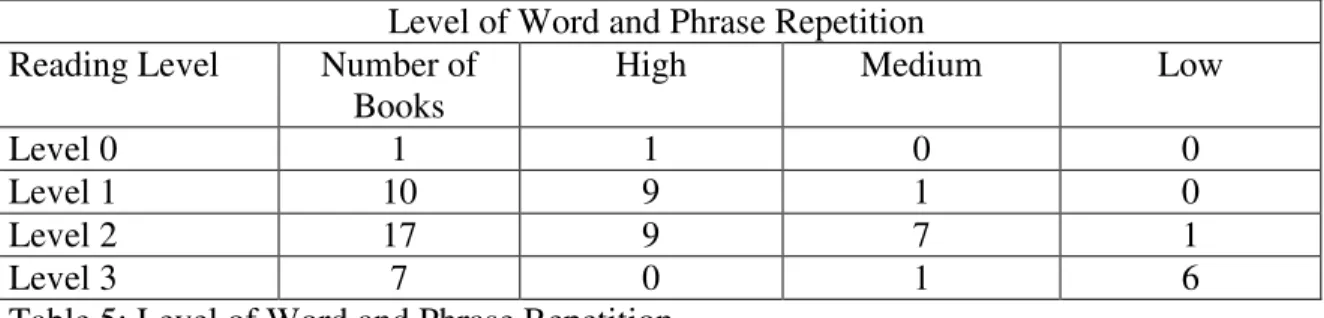
Easy readers at a higher reading level understandably used less repetition of words and phrases, while those at a lower reading level used more, as is illustrated by the results in Table 5.
Level of Word and Phrase Repetition Reading Level Number of
Books
High Medium Low
Level 0 1 1 0 0
Level 1 10 9 1 0
Level 2 17 9 7 1
Level 3 7 0 1 6
Table 5: Level of Word and Phrase Repetition
Repetition of events in a plot is a common feature in children’s books and folk tales. So naturally, many easy readers repeat events in the plot in some way. One example of this is in Sam’s First Halloween, where several groups of children come to the door for Halloween treats and Sam the puppy repeatedly begs for a piece of candy, too. Another example is when Turtle and Snake march through woods, splash through a brook, and row across a pond on their way to a campsite, then row back across the pond, splash through the brook again, and march through the woods on their way home in Turtle and Snake Go Camping. In the sample, fourteen of the books had a high level of event repetition, twelve had a medium level of event repetition, and nine had a low level of event repetition. This did not appear to be related to reading levels or time periods, but to be more of an optional literary device available to the author.
interest topics. In addition, the author of these two books added features to help
familiarize readers with the content. Extra description in the text, plus insets with small illustrations and definitions of terms that might be unfamiliar, such as “maiden voyage,” help to relate the plot and setting of Survivors: The Night the Titanic Sank to children’s experiences. Although the concept of spies and the international settings in Super Spies might be unfamiliar to young children, the basis for the spy mission – food – would be familiar to most of them, and the licensed characters from the Backyardigans television series would probably also be familiar to many. Just over half of the books had a Medium level of content that related to children’s experiences. This enables authors to blend the familiar with something new to create a pleasurable or educational read. School is a familiar setting, but a school for witches is something different in Lulu Goes to Witch School. The remaining fifteen titles feature content that would be very familiar to most children, such as losing teeth or planting seeds.
children with understandable writing, so that every one of them would be understandable and enjoyable to at least some types or levels of beginning readers.
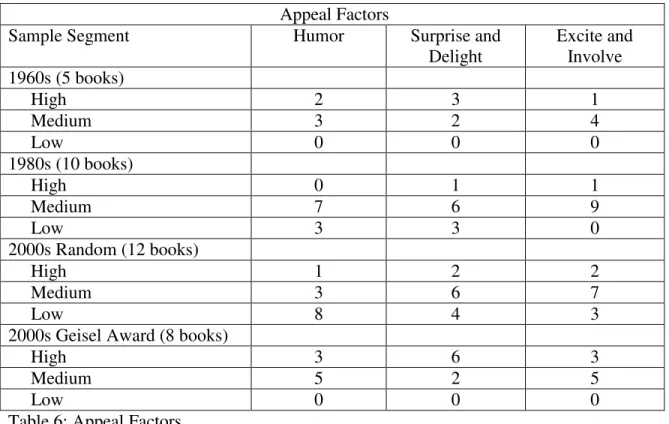
Humor is often mentioned as a popular feature in children’s literature, but the types of humor that will appeal to children as opposed to older readers may be a bit challenging to identify. In evaluating the level of child-friendly humor in these easy readers, I have looked for simple, playful, and slapstick humor, and also for situations that are patently ludicrous, like the idea of a fly eating a hot dog in Hi! Fly Guy. I have also looked for elements that might surprise and delight, or excite and involve young readers. Since these are all appeal factors, it is interesting to evaluate them together as shown in Table 6.
Appeal Factors
Sample Segment Humor Surprise and
Delight
Excite and Involve 1960s (5 books)
High 2 3 1
Medium 3 2 4
Low 0 0 0
1980s (10 books)
High 0 1 1
Medium 7 6 9
Low 3 3 0
2000s Random (12 books)
High 1 2 2
Medium 3 6 7
Low 8 4 3
2000s Geisel Award (8 books)
High 3 6 3
Medium 5 2 5
Low 0 0 0
Table 6: Appeal Factors
higher level of these appeal factors makes them more engaging in general and explains the ongoing success of the classics and the reasons the Geisel Award books were
considered distinguished. The bulk of the titles from the 1980s were rated as Medium for these appeal factors, with only two High scores. The randomly selected titles from the 2000s had a total of only five High scores for appeal factors, and many Low scores, in particular for humor. Collecting leaves for a project, as in Fall Leaf Project, might be familiar and easily understood, but it is not funny, surprising or exciting. The reading level did not seem to be related to the presence or absence of these three appeal factors.
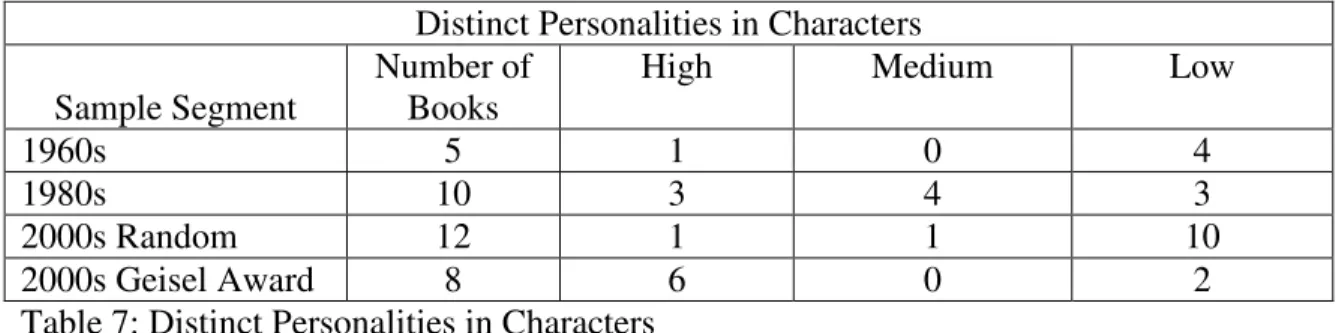
Table 7 summarizes my findings on distinct personalities in characters. Distinct Personalities in Characters
Sample Segment
Number of Books
High Medium Low
1960s 5 1 0 4
1980s 10 3 4 3
2000s Random 12 1 1 10
2000s Geisel Award 8 6 0 2
Table 7: Distinct Personalities in Characters
characterization. However, distinct and memorable characters appear to be one of the features that award committees have considered in deciding whether a book is
distinguished or not.
Appendix H lists the topics actually found in each book evaluated, and Table 8 summarizes those topics by sample segment. Individual books can have multiple topics, and the table shows all of those topics.
Topics in Books Sampled
Topic 1960s 1980s
2000s Random
2000s Geisel
Award Total
Number of Books n=5 n=10 n=12 n=8 n=35
Animals 5 6 7 8 26
Common Experiences 1 6 7 4 18
Families 2 2 3 2 9
Sports 2 1 1 2 6
Weather and Seasons 0 1 3 2 6
School 0 2 2 0 4
TV Shows 0 0 2 0 2
Transportation 1 0 1 0 2
Holidays 0 0 2 0 2
History 0 1 1 0 2
Mystery 0 1 1 0 2
Fantasy 0 1 0 0 1
Table 8: Topics in Books Sampled
I included books with anthropomorphic animal characters in the number of books with the topic of animals for the purpose of this measurement since I thought that
children interested in animals would probably be interested in these books because of those characters. Animals are involved in 26, or 74% of the books overall. They are in 100% of the classic 1960s titles and Geisel Award books. The creators of easy readers seem to be very aware of children’s well documented interest in animals. Plots
stands, and running away. These categories were not measured as children’s reading interests by Sturm (2003), Dahlhauser (2003), or Maynard (2008), but they were noted by Guilfoile (1962). Families, weather, school, holidays, and TV shows were not mentioned as interests in any study that I reviewed, although they might also be considered under the category of children’s experiences. Some of these subjects might be pushed upon
children by parents and school curriculums instead. Weather could also be considered under the topic of science, which was mentioned by Sturm (2003) but was not otherwise observed in any of the easy readers. The absence of science easy readers in this study is most likely explained by the fact that science is seen more frequently in nonfiction titles, but this study was limited to fiction. Although history was identified as an interest by Sturm (2003), it was one of the least mentioned topics of interest by six- and seven-year olds. Overall, this analysis shows that there are a variety of topics included in easy readers, with some attention paid to the topics children have said they liked, but also with enough variety to satisfy a wider spectrum of interests, either on the part of children or their teachers and parents. One aspect of this subject that should not be missed is that different children like to read different things at different times – they do not always have to read about animals – so books about topics that seem less popular can still be
interesting at some point to some children. However, relatively few easy readers have addressed some topics, such as sports and transportation, that have been shown to appeal to young children.
Characters
characters. I considered characters as main characters if they were included in a majority of the action in the book, or if some of the book was written from their viewpoint.
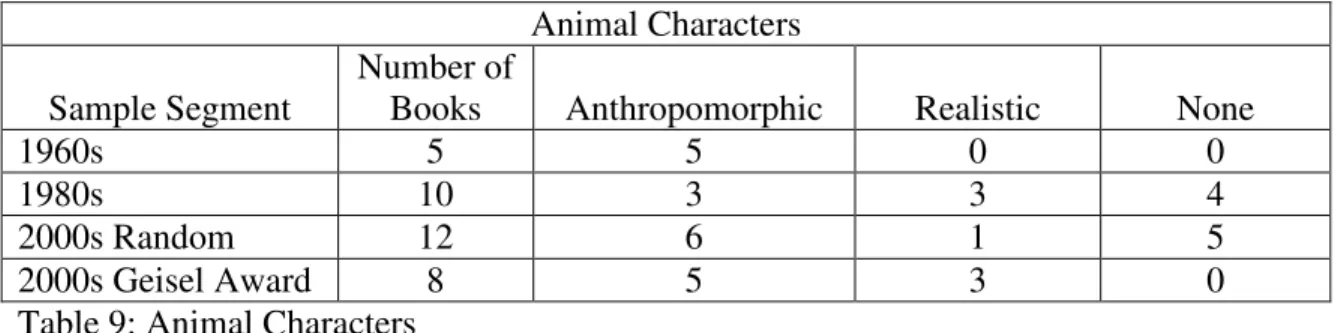
In another reflection of children’s well documented interest in animals, many of the easy readers featured animal characters. I coded animal characters that displayed normal animal behavior as not anthropomorphic, even if the animals’ thoughts were depicted in the book. However animals that did even a few things that only humans normally do, like Ralph in Best in Show for Rotten Ralph, were coded as
anthropomorphic. Although he enters a pet show as a cat, Ralph trains for the show like a human by lifting weights and working on his talent. Table 9 shows the number of books with anthropomorphic animal characters, and also with animal characters that behave more realistically.
Animal Characters Sample Segment
Number of
Books Anthropomorphic Realistic None
1960s 5 5 0 0
1980s 10 3 3 4
2000s Random 12 6 1 5
2000s Geisel Award 8 5 3 0
Table 9: Animal Characters
It is interesting to note that every one of the classic 1960s easy readers has anthropomorphic animal characters, and that all of the Geisel Award books have either anthropomorphic or more realistic animal characters.
interest in television programs and media companies’ interests in extending the reach of their brands.
Geisel Award winner and honor books had only one to three main characters, while the number of characters in the other books varied with no significant trend or pattern. This is very likely linked to the finding that Geisel Award books show more character development than other easy readers. It would be easier to show character development in a short book if fewer characters were included.
Teaching Aids
There were five Yes or No questions at the end of the questionnaire concerning features to aid parents and teachers assisting or instructing beginning readers. I coded these variables with a Yes if there was any example of the feature, no matter how basic or rudimentary, and No if it was simply not present. The results for each book are recorded in Appendix I.
None of my hardcover copies of 1960s easy readers included any type of teaching aid, although reading levels seem to have been added to the paperback editions of some of these titles, as documented by Lodge (1997). Reading levels, and therefore notes explaining leveling systems, were the most common aid in the remaining books in my sample, appearing in half of the 1980s books, and all of the books in the random sample from the 2000s. However, only three of the eight Geisel Award books used reading levels. Can it possibly be a mark of distinction to not include a reading level?
Conclusions
The goal of this study was to identify and understand changes that have occurred in easy reader fiction throughout its 52 year history. Since there has been relatively little scholarly analysis of easy readers to date, this was an exploratory study. The study was limited by various factors. Many of the qualities that I measured in my content analysis were quite subjective, and therefore susceptible to coding bias. As a result, my findings are tentative. The sample I analyzed was not entirely random, because no comprehensive bibliography of easy readers was available, and also because many titles were not
available to me, either because they were out of print or had not been purchased by local libraries. In addition, it is possible that a larger sample size might have produced more significant findings. However, even with these limitations, this study did identify several easy reader features that have remained constant, displayed signs of innovation, or shown interesting trends over the years.
divergence from the original easy reader designs. This may widen the appeal of the book, and perhaps generate more sales, but it also makes the book a bit less suitable for beginning readers. Other aspects of easy reader illustrations, such as the number of clues they contain for specific words in the text, varied more with reading level than
publication timeframe. This is natural and understandable since lower level readers are likely to need more word clues. The amount of word and phrase repetition also varied more by reading level than time period, because lower level readers benefit from more repetition. Many early easy readers, particularly those produced under the Beginner Books imprint and written or edited by Ted Geisel, used rhyming text and controlled vocabularies. These features were much less common in today’s easy readers. Geisel himself struggled with this formula, and it is possible the effort required to produce an engaging, rhyming story with a controlled vocabulary is just not commensurate with the benefits today.
easy readers from the 1960s that did not include animals, for example the books in the Amelia Bedelia series, but these results indicate that including animals in some way in easy readers continues to be successful. It is curious that relatively few easy readers have addressed other topics that have been shown to interest young children, such as
transportation and sports. Perhaps there is an opportunity for publishers here. My study found a clear trend towards a greater proportion of illustration in
comparison to text in newer easy readers. This may be understood given the current high levels of visual content in most media. There was also a clear trend towards fewer pages in newer easy readers. Shorter books might be associated with the shorter attention spans that are sometimes observed in today’s children, but they could also be less expensive and therefore more accessible. This might be a good way to increase profits for
publishers, too. Together, these two trends show that today’s easy readers do not actually provide as much to read as they used to. This may be balanced by the fact that many more easy readers are being published now. Children can get the same amount of reading practice by reading more short books instead of fewer longer books. However, it is also possible that some level of “dumbing down” is occurring, which may or may not be appropriate.
words, allowing a more skilled reader to read more complicated text while a very new reader “reads” the rebus pictures. Both of these books used licensed characters from popular television shows for preschoolers, indicating they were aimed at very young children. Chicken Said, Cluck! is labeled with the level name “my first shared reading” on the cover. It appears to be designed to be read together by both a novice reader and a more experienced reader. Its vocabulary is advanced beyond lower level easy readers, with many compound words and consonant blends, but these words are repeated many times so that children may become familiar with them during the course of the book. Mo Willems’ Elephant and Piggie series books also appeal to lower level beginning readers, with just a few simple words per page and a new comic-like design including speech bubbles. Another motivation for the innovations in lower level easy readers, as well as for including teaching aids in easy readers, is the interest parents are currently showing in teaching their children to read outside of school, instead of just reinforcing what is
learned in school with supplementary reading. As Ellen Kreiger of Simon & Shuster has said,
“In the early days, easy readers weren’t leveled… They were more focused on authors and stories and books for kids to read on their own, not on teaching kids to read. Now parent are more focused on getting their kids to read at a younger age, and they rely on these books to help them teach the kids.” (qtd. in Bean, 2004, p. 31)
evaluators to determine whether they can be updated. My findings indicated that these levels might be determined more accurately from vocabulary and sentence structure than from other features often used to judge easy reader levels, such as the number of lines per page. Perhaps one of the most interesting directions for further easy reader research would be to conduct experiments in a school or library setting, similar to Condit (1959) and Kruse (2007) to determine what types of stories engage beginning readers
References
Association for Library Services to Children. (2009a). (Theodor Seuss) Geisel Award: Medal winners and honor books, 2006 – present. Retrieved January 29, 2009, from http://www.ala.org/ala/mgrps/divs/alsc/awardsgrants/bookmedia/geiselaward/geisela wardpastwinners/index.cfm
Association for Library Services to Children. (2009b). Theodor Seuss Geisel Award: Terms and criteria. Retrieved January 29, 2009, from
http://www.ala.org/ala/mgrps/divs/alsc/awardsgrants/bookmedia/geiselaward/geisela wardtermscriteria/geiselawardtermscriter.cfm
Association for Library Services to Children. (2009c). Welcome to the (Theodor Seuss) Geisel Award home page! Retrieved January 29, 2009, from
http://www.ala.org/ala/mgrps/divs/alsc/awardsgrants/bookmedia/geiselaward/index.c fm
Baker and Taylor. (2005). Title source 3. Retrieved January 29, 2009, from http://www.btol.com/ts3
Barr, C., & Gillespie, J. T. (2007). Best books for children, supplement to the 8th edition : Preschool through grade 6. Westport, Conn.: Libraries Unlimited.
Barstow, B, Riggle, J., & Molnar, L. (2008). Beyond picture books: Subject access to best books for beginning readers. Westport, CT: Libraries Unlimited.
Berenstain, S. & Berenstain, J. (2002). Down a sunny dirt road: An autobiography. New York: Random House.
Chapman, M., Filipenko, M., McTavish, M., & Shapiro, J. (2007). First graders' preferences for narrative and/or information books and perceptions of other boys' and girls' book preferences. Canadian Journal of Education, 30(2), 531-553. Chatton, B. (2007). On beyond "The Cat in the Hat": Theodor Seuss Geisel
award-winning books for beginning readers. Journal of Children's Literature, 33(1), 47-51. Condit, M. O. (1959). Trade books for beginning readers. Wilson Library Bulletin (R),
34, 284-301.
Dahlhauser, J. (2003). Motivating boys as beginning readers. Teacher Librarian, 30(3), 29-31.
Elias, T. (1999). Start at the very beginning: A conversation with Margaret Jensen about books for beginning readers. Retrieved February 12, 2009, from
http://www.education.wisc.edu/ccbc/authors/experts/jensen.asp
Guilfoile, E. (1962). Books for Beginning Readers. Champaign, IL: National Council of Teachers of English. Retrieved March 4, 2009, from
http://eric.ed.gov/ERICDocs/data/ericdocs2sql/content_storage_01/0000019b/80/35/ 01/fd.pdf
Hersey, J. (1954, May 24). Why do students bog down on first R?: A local committee sheds light on a national problem: Reading. Life, 36, 136-152.
Kegley, P. A. (1989). Easy reader books: A viable supplement to today's basals? Unpublished master’s thesis, Kean College of New Jersey.
Kortenhaus, K. M., and Demarest, J. (1993). Gender role stereotyping in children’s literature: An update. Sex Roles, 28(3/4), 219-232.
Kruse, G. M. (2007). Read-alouds? Think again. School Library Journal, 53(6), 36-37. Lambert, M. (2006). InFORMed reading: Evaluating and using picture books, beginning
reader books, and illustrated books. Children & Libraries, 4(3), 31-4, 54.
Lodge, S. A. (1996). Ready-to-read line relaunched. Publishers Weekly, 243(21), 44-45. Lodge, S. A. (1997). 'I can read' books turns 40. Publishers Weekly, 244(44), 33-34. Marcus, L. S. (2007). In Golden times. Publishers Weekly, 254(28), p. 28-30.
Marcus, L. S. (2008). Fun and fear: the 1950s. In Minders of make-believe : idealists, entrepreneurs, and the shaping of american children's literature (pp. 183-217). Boston: Houghton Mifflin Co.
Maughan, S. (2000). Readers for early readers. Publishers Weekly, 247(21), 40-43. Maynard, S., MacKay, S., & Smyth, F. (2008). A survey of young people's reading: Thinking about fiction. New Review of Children's Literature and Librarianship, 14(1), 45-65.
Morgan, J., & Morgan, N. (1995). Dr. Seuss & Mr. Geisel :A biography. New York: Random House.
Neuman, W. L. (2007). Basics of social research: Qualitative and quantitative approaches. Boston, MA: Pearson Education.
Nordstrom, U., & Marcus, L. S. (1998). Dear genius: The letters of Ursula Nordstrom. New York: HarperCollins.
Ozirny, S. (2008). The big shoes of Little Bear: The publication history, emergence, and literary potential of the easy reader. Unpublished master’s thesis, University of British Columbia, Vancouver, British Columbia, Canada. Retrieved March 2, 2009 from https://circle.ubc.ca.libproxy.lib.unc.edu/bitstream/2429/2727/1/ubc_2008_ spring_ozirny_shannon.pdf
Palmer, N. (1982). Winners for beginners. School Library Journal, 28 (February 1982), 36-37.
Perl, E. S. (2008). See Iron Man run: Hollywood wants to teach your kid to read. Slate. Retrieved January 29, 2009, from http://www.slate.com/id/2195585/
Pinnell, G. S., & Fountas, I. C. (2007). The continuum of literacy learning, grades K-2 : A guide to teaching. Portsmouth, NH: Heinemann.
Something about the author: Facts and pictures about authors and illustrators of books
for young people (Vol. 128). (2002). Detroit: Gale Group.
Sturm, B. W. (2003). Dogs and dinosaurs, hobbies and horses: Age-related changes in children's information and reading preferences. Children & Libraries, 1(3), 39-51. Ward, C. (2005). Best of beginning readers: ALSC launches the Theodor Seuss Geisel
award. Children & Libraries, 3(2), 41, 61.
Appendix A: Easy Reader Content Analysis Questionnaire Identification and Description
Title: ____________________ Year Written: ____________________ Author : ____________________ Series: ____________________ Illustrator: ____________________ Stated Level: ____________________ Publisher: ____________________ # of Pages: ____________________ Publisher Location: ______________ # of Chapters: ____________________ Estimated Reading Difficulty(adapted from Horning p. 137-142)
1. Which best describes the vocabulary used in the book? a) Limited set of very simple words
b) Most words are simple sight words, single syllable words, or short (5 letters or less) c) Longer sight words and some unfamiliar multi-syllable words are included
d) More challenging vocabulary
2. Which best describes the number of words per line? a) 5 or less
b) An average of 5
c) An average of 5, with a few longer d) 8 or less
3. Which best describes the number of lines per page? a) 1 or 2
b) 2 to 7 c) 4 to 15
d) 15 or less, with several pages closer to 15 lines 4. Which best describes the sentence structure?
a) 5 or fewer words and possibly not complete sentences b) An average of 5 to 7 words, mainly simple sentences c) Alternating simple and more complex sentences d) Frequent compound and complex sentences
5. Which proportion of white space to text describes the book the best? a) ¾ or more of pages are illustrations
b) Up to 2/3 of pages for illustration and white space c) An even balance of text and illustrations
d) Some pages are ¾ or all text
6. There is wide white space between words and lines. Yes No 7. There is ample white space surrounding illustrations. Yes No
8. A large, simple font is used. Yes No