Medication Adherence in Patients with
Low Health Literacy
By
Jessica C. Fowler
A Master’s paper submitted to the faculty of the University of North Carolina at Chapel Hill in particle fulfillment of the requirements for the
degree of Master of Public Health in the Public Health Leadership Program.
Chapel Hill July 2008
___________________________________ Advisor
___________________________________ Second Reader
Table of Contents
Literature Review Abstract……… p.3
Brief Literature Review………. p. 4
Manuscript Abstract……….. p. 12
Manuscript……… p. 13
Addenda……… p. 27 Literature Review Results Table
Literature Search Table
Literature Review Abstract
Objective: To perform a brief review of interventions designed to improve medication adherence in persons with low literacy.
Data Sources: We searched PubMed up to 2010 and Google Scholar from 2000 to 2010. Search strategies were reviewed with a health sciences librarian and the search results supplemented with recommendations from clinical faculty.
Study Selection: We included published clinical trials and systematic reviews that focused on interventions to improve medication adherence or that studied interventions to
improve health outcomes in low-literacy participants. One reader reviewed each article for inclusion and verified the selection with clinical faculty.
Data Extraction: One reviewer abstracted data from each study into an evidence table. Two appraisal templates were used to guide the abstracter to grade each article based on potential selection bias, measurement bias, confounding, and analysis. Each study was a grade of good, fair, or poor. Final table details were reviewed by clinical faculty.
Data Synthesis: We identified 10 articles for this review, 7 of which examined interventions designed to improve medication adherence and 3 that examined interventions designed to improve health outcomes in low-literacy participants. The results of the studies were mixed with some showing significant improvement in medication adherence and others showing no effect. For interventions targeting low-literacy participants, mixed results were also seen with some interventions working better for low-literacy persons and others having the same effect for high- and low-literacy study participants. Medication adherence was measured in various ways, making it difficult to compare and draw conclusions about effective intervention strategies.
Similarly, the health outcomes measured for interventions targeting low-literacy persons varied and the mixed results made conclusions about the most effective strategies difficult.
Conclusions: Numerous interventions have been developed to try and improve
medication adherence and to improve health outcomes for low-literacy populations. The effects of these intervention strategies are mixed and variations in outcome measures and study methodologies make it difficult to draw conclusions about the best strategies. More standardized methods of measuring medication adherence are needed so that
interventions studies can be compared and the most effective interventions better
Brief Literature Review of Medication Adherence and Health Literacy
Intervention Trials
Introduction
Medication adherence is an important part of individual’s health. It is estimated
that nonadherence to prescribed medications is responsible for nearly 125,000 deaths per
year, and low adherence rates lead to increased ambulatory care visits, ED visits, and
hospitalizations.1, 2 Medication adherence has been defined as how well a person’s
behavior, including taking medications and following dietary or lifestyle change
recommendations, coincides with the medical or health advice he or she has received.1
Research has consistently shown that average medication adherence is 50% for patients
with chronic disease, and patients with low adherence rates are three times less likely to
have good health outcomes.3, 4 The rates and effects of low adherence rates have
prompted studies to explore the causes of medication nonadherence, in the hopes that
increasing medication adherence will lead to improved health outcomes. Key contributors
include the following: adverse effects to treatment, poor instructions, inability to pay for
medications, poor relationships between the patient/care-taker and health professional,
polypharmacy, lack of understanding about disease management, asymptomatic
conditions (such as hypertension), and low literacy.5, 6 Inadequate medication
adherence has been called the most important modifiable aspect of chronic disease
management,4 making it an important target for effective interventions.
In addition to its contribution to low adherence rates, low literacy - described as
the inability to read, write, and use numbers effectively - has been associated with
adherence.3 In the US, more than 1/3 of the residents have low health literacy rendering
them unable to determine things like the timing of their medication from common
prescription drug labels.3 The way in which low health literacy leads to poor health
outcomes is not completely understood. Pignone et al suggest two causal pathways from
low literacy to poor health – direct and indirect (see Figure 1).7 The direct pathway
implies that low literacy may have a direct negative effect on health, potentially for
diseases in which complex self-care is needed. The indirect pathway suggests that low
literacy is commonly associated with poverty and poor health access, which are known to
be associated with poor health. The relationship between medication adherence and
health literacy might imply a joint effect on patient’s poorer health status and health
outcomes, though the association with health outcomes is yet to be established.
In order to attain a greater understanding of the interaction between
low health literacy and medication nonadherene, as well as nonadherence’s effect on
health outcomes, we reviewed current literature on these topics. The aim of this review
was to determine what interventions are effective for improving medication adherence in
patients with low health literacy.
Methods
We searched the PubMed database for peer-reviewed published articles using the
MeSH search terms “medication adherence” and “literacy.” From this initial search, 188
articles were found. We then limited the search to clinical trials, English language, and
study subjects over 19 years age. This search yielded 30 articles. Fifteen abstracts were
reviewed because the title suggested that the article fit the initial selection criteria of an
Figure 1: Conceptual Model for the Relationship Between Health Literacy and Medication Adherence
review of the abstracts, 6 of the 15 articles were selected because they were actual
clinical trials. Those excluded were observational studies looking at associations between
some participant characteristic(s) and nonadherence.
We supplemented the PubMed seach with a search of Google Scholar, as
suggested by a UNC Health Sciences Library health literature search specialist. We
searched Google Scholar using the search terms “medication adherence,” “literacy,”
“interventions,” and “clinical trials” (2000 to June 2010) limited to medicine, pharmacy,
and veterinary science publications and no patents. 1,630 articles were found and 120
titles were reviewed. Due to time restrictions and many of the last 30-40 titles reviewed
not relating much to the topic of interest, all 1,630 titles were not reviewed. 42 abstracts Chronic Disease
Diagnosis (ex. hypertension)
Treatment Plan Initiated
Good Health Outcome (adequate BP
control)
Poor Health Outcome
(poor BP control) Lack of understanding
Lack of access Medication nonadherence
articles were selected. Search strategies utilized prior to the implementation of this final
strategy are detailed in the Literature Search Outcomes table. The strategy outlined above
was chosen because it yielded the best study results for the best defined question, agreed
upon by our clinical faculty advisors.
The quality of each article was given a rating of good, fair, or poor using a
Critical Appraisal of Health Literature tool designed by faculty of the Health Care &
Prevention Program at the UNC Gillings School of Global Public Health for their critical
appraisal courses. This tool is designed for the reviewer to assess potential selection bias,
measurement bias, confounding, and the adequacy of the analysis to determine the overall
internal and external validity of each clinical trial, yielding a final quality grading. A
similar tool for systematic reviews and meta-analyses guides the reviewer through an
evaluation of the search and appraisal strategies utilized, the presence of a focused
question, the authors’ dealings with publication bias and heterogeneity, and statistical
analysis when applicable to yield a quality grading. Each article was read and rated using
these tools by the primary author, with suggestions and corrections from clinical faculty
familiar with health literacy and medication adherence literature.
Results
A total of 21 studies were read to determine the best representative sample for the
answer to our research question. Studies were excluded if they were conducted outside of
the US and if they did not either target low-literacy participants or have medication
adherence as a measured outcome. We also did not include studies that were contained in
systematic reviews that we selected for review. Some articles did not report final study
that targeted low-literacy participants and looked at medication adherence as the primary
outcome. However this scope proved to be too limited and yielded only 3 studies
utilizing our search strategy. We decided to include clinical trials or reviews of clinical
studies that either evaluated the effect of an intervention on some health outcome in
low-literacy participants or looked at interventions for medication adherence, including 7 of
the 21 studies found using our search strategy. Two additional articles were included
from the review of citations for the selected articles, and 1 article was included at the
recommendation of our clinical faculty. Thus, a total of 10 articles were included in this
review.
The studies included were overall of good quality, yielding mixed results for how
interventions affect the health of low-literacy individuals and medication adherence rates
(see Literature Review Table). Seven of the 10 studies focused on medication adherence
as a primary outcome. Three of these studies found that the interventions reviewed or
studied were effective and improved medication adherence.4, 6, 8 Interventions in these
studies included standardized medical education, special medication disposal packaging,
using icons/pictures on medication instructions and containers, written and verbal
instructions, simplifying or modifying dosing regimens, drug and disease education,
review of medications, and side effect management. One of these 3 studies was
randomized controlled trial and 2 were systematic reviews. Participant demographics for
these studies and review varied as did the measures to assess medication adherence. The
other four studies focusing on medication adherence included 2 systematic reviews and 2
randomized controlled trials.1, 3, 5, 9 Neither RCT found that the intervention tested had
pictures to help understanding of heart failure patients’ medication regimen.3, 9 The two
systematic reviews found mixed effects of interventions seeking to improve medication
adherence, among patients with chronic diseases. Interventions included both behavior
and educational approaches to adherence, including pharmacist education, tailored
counseling sessions, and mail and telephone reminders to participants. While
improvements in medication adherence were seen, the significance of the interventions’
impact varied and, for patients with multiple chronic conditions, was weak.5
For the three studies focused on interventions targeting low-literacy individuals,
the results were mixed. One of these studies was randomized controlled trial,10 and two
were systematic reviews.7, 11 The RCT focused on low-literacy patients and did not report
any significant effect on medication adherence or any other primary outcome. This
intervention for adult patients with arthritis included a booklet written at the 5th – 8th
grade reading level and 2 appointments with a health educator.10 No difference in
medication adherence was seen between the intervention and control groups. Both of the
systematic reviews aimed to discuss interventions designed to improve health outcomes
for patients with low health literacy. Mixed intervention effects were reported for various
low-literacy interventions which included the following: brochures, health
education/management interventions, computerized tools, verbal or oral presentations,
simplified language, pictorial information, and attempts to improve access to health
information. In Pignone et al, some interventions benefited low-literacy patients while
others benefited high-literacy patients, and still others had no differential effect.7 Clement
et al found that despite many studies showing beneficial outcomes for the intervention
Discussion
Strategies to improve medication adherence, particularly in individuals with low
health literacy, are diverse and of varied effectiveness. Overall the interventions
discussed in these studies did not demonstrate consistent increases in medication
adherence nor consistent significant improvement in health outcomes for low-literacy
patients. One of the issues continually discussed by study authors was the need for a
better understanding of what effects medication adherence and for a more standard
measure of medication adherence.1 The use of pill counts, self-reports, MEMS caps, and
pharmacy refill records all measure adherence differently, and, in combination with
varied duration of follow-up post-intervention, make it difficult to compare intervention
effects. Poor or inconsistent methodology and participant demographic reporting also
make it difficult for conclusions to be drawn about the most effective interventions.1
There are numerous contributors to medication nonadherence by patients, spanning from
cost of medications to lack of understanding to fear of adverse side effects. Low-health
literacy modifies medication adherence and health outcomes through various means. The
complexity of these two health care challenges make targeted interventions difficult to
develop. Combinations of behavioral and educational strategies seem to be best, although
how and where and how long interventions are delivered make a difference. Educational
interventions are said to be useful in situations with patients who are willing to take their
medication but lack information or understanding of how to do so, and for individuals
whose misunderstanding of their medication makes them nonadherent.1 Behavioral
interventions conducted without direct educational aims do not always increase
said to be more effective for low-health literacy patients, but significant health outcomes
have yet to be consistently demonstrated.11
The best interventions to target low health literacy populations and to improve
medication adherence still need to be determined. Patients with low health literacy are
less likely to understand the effects of their medications and are more likely to make
errors in the dosing and frequency of their medications.12 Over 800 peer-reviewed studies
have demonstrated a mismatch between the literacy skills of most US adults and the skills
needed to understand basic health materials.10 Targeting lower health literacy as a factor
in poor medication adherence is an opportunity for the development of interventions.12
Current interventions benefit patients regardless of literacy level, while others are more
effective for either low or high literacy individuals.11 Future research in this area is
important for potentially improving health outcomes, and needed for effective
Manuscript Abstract
Background: Numerous studies have examined strategies on how best to help patients improve medication adherence for improved chronic disease care. Poor health literacy can have important effects on patient’s understanding of disease and subsequent health outcomes. It is critical to understand how health literacy affects interventions to help improve medication adherence.
Methods: A secondary analysis of a randomized controlled intervention trial conducted at 2 university-affiliated primary care clinics. Primary outcome was self-reported medication adherence at 24 months using a Morisky score. Data was analyzed on 636 adults with hypertension who were followed over 24 months in the Taking Care of Your Blood Pressure (TCYB) study and randomized to one of 4 intervention arms: usual care, home BP monitoring, nurse-tailored behavioral intervention, or a combination of home BP monitoring and nurse-tailored intervention. We evaluated the impact of the intervention on medication adherence using logistic regression and compared treatment effects according to low vs. adequate literacy, as determined by Rapid Estimate of Adult Literacy score (<61 low literacy).
Results: Baseline demographic characteristics for the 636 patients randomized to one of 4 trials arms in the TCYB study varied significantly by literacy status for race (p<0.001), education level (p<0.001), income (p<0.001), hypertension knowledge (p<0.001), and self-reported medication nonadherence (p=0.023). At 24 months, the proportion of nonadherent patients decreased in usual care and all 3 intervention arms, however the odds of nonadherence for each intervention arm relative to usual care, controlling for baseline adherence, was not significant. Evaluation of the interaction between literacy and the intervention effect showed a trend towards significance. Stratified analysis of medication adherence at 24 months for low and high literacy participants demonstrated that nonadherence decreased in each randomization group. The odds of nonadherence were not significant for any intervention arm relative to usual care, controlling for baseline adherence, for the adequately-literate patients. The odds of nonadherence were significant only for the combined intervention group relative to usual care [OR 3.546, 95% CI 1.01 to 12.48, p=0.049].
Manuscript
Introduction
Hypertension is the leading risk factor for cardiovascular disease (CVD), which is
responsible for 1 in 3 deaths in Americans.13 Currently more than 65 million American
adults carry the diagnosis of hypertension, and it is estimated that 50.1% have their blood
pressure (BP) under control.13, 14 Improved BP control has been set as one of the national
health objectives.15, 16 Meeting BP control targets in individuals with hypertension
requires not only adequate recommendations from the physicians treating patients, but
patient understanding of disease, treatment, and adherence to the treatment plan. Barriers
at multiple levels – including patient nonadherence – can prevent good BP control, and
lead to poor outcomes for hypertension patients.
Treatment nonadherence is a significant problem and has been cited as an
important barrier to hypertension management.17 Suboptimal health outcomes and higher
health costs, estimated up to $100 billion annually, result from patients failure to adhere
to medication regiments.17 Patients have reported that lack of understanding about their
condition and prescribed medications are important determinants of medication
adherence.18 To improve adherence, interventions must target the individual patient
barriers.19
Functional health literacy may be one such barrier as it has been shown to have
significant effects on patient medication adherence.18 The American Medical Association
defines health literacy as “a constellation of skills, including the ability to perform basic
reading and numerical tasks required to function in the health care environment.”20
basic health literacy and 14% have below basic health literacy.21 Literacy may modify
adherence through a patient’s lack of understanding of their disease, their medications, or
the importance of following a treatment plan. Health literacy is, therefore, a potential
target for improving adherence to medication regimens.
Low health literacy is associated with poorer patient compliance in medication
adherence and lifestyle improvement, and literature suggests that non-adherence is a
significant problem among patients with chronic disorders, such as hypertension.15, 22 In
fact, survival for patients with hypertension is directly related to their completed
schooling.23 Studies that have targeted patients with low health literacy have
demonstrated mixed results, with some benefiting more low-literacy than high-literacy
patients and others showing no difference in outcomes.7 Interventions that focus on low
literacy affect knowledge and health behavior, which can both improve patient adherence
to medications and lifestyle changes,18, 22 but questions remain about the effect on overall
health outcomes.24
The purpose of this study is to examine the effect of patient-centered interventions
on antihypertensive medication adherence for patients of low and adequately health
literacy. The Taking Care of Your Blood Pressure (TCYB) study was a randomized
controlled intervention trial that tested 3 patient-centered, self-care and behavioral
intervention arms against usual care for patients with hypertension in order to improve
BP control. Previous studies have demonstrated that comprehensive management
programs, such as that used in the TCYB study, benefit patients of low literacy more than
patients with high or adequate literacy.25 Thus the present study evaluates the
adequate and low literacy to determine whether these interventions are an effective
strategy for improving adherence in patients with lower health literacy.
Methods
Study Design
The TCYB study was a 2-year randomized intervention trial. There were four trial
arms: usual care from primary care providers; home BP monitoring; tailored behavioral
intervention delivered by a nurse; and a combined intervention with both home BP
monitoring and the nurse-delivered behavior intervention. The primary outcome for the
TCYB study was the proportion of patients with controlled blood pressure. Study
methods and results have been presented previously and showed the most improvement
in the combined intervention group after 24 months.26 For this analysis, participants from
all 4 trial arms were compared to determine the intervention effect on self-reported
antihypertensive medication adherence. Improvement in self-reported adherence was
compared across all trial arms and stratified by health literacy to determine whether any
intervention showed more improvement for low-literacy participants.
Participants
TCYB was conducted in 2 Duke University Health System (DUHS) primary care
clinics in Durham, NC, and 636 patients were included. To be eligible for participation
individuals had to (1) be enrolled with a primary care physician at the included clinics for
at least 12 months prior to study recruitment, (2) have a diagnosis of hypertension for at
least 12 months, (3) currently report taking antihypertensive medications, and (4) reside
through weekly data extractions from the DUHS billing and appointment database for the
2 selected primary care clinics – one staffed by 7 internal medicine faculty and the other
by 85 internal medicine residents under the supervision of faculty physicians.
Recruitment occurred from May 2004 to December 2005. Letters were mailed to 2060
potentially eligible patients from their primary care provider. Letters included
information about the study and made the patients aware that a member of the study team
might contact them about participation. The study team attempted to contact 1728
individuals by phone, and 656 patients were enrolled and consented. In the recruitment
process, 365 could not be reached by letter or phone, 634 individuals declined, 214 were
deemed ineligible, and 191 were not consented for other reasons. During the baseline
interviews, 20 more patients were excluded. The remaining 636 patients were
randomized to one of the four intervention arms. Randomization was done in block using
consecutively numbered envelopes with sequences maintained by a study statistician
outside of the 2 enrollment clinics. Research assistants were blinded to the number of
blocks, and randomization was stratified by enrollment site and by health literacy.
Measures and Outcomes
For the present study, all randomized groups were used to evaluate improvement
in self-reported medication adherence from baseline to 24 months (or dropout), stratified
by health literacy. Self-reported medication adherence was collected at baseline and at 24
months from participants at follow-up visits during the TCYB study. We collected
demographic information on age, gender, race/ethnicity, marital status, support in the
they only had enough money to pay bills by cutting back on other things, or that they had
difficulty paying bills no matter what they did were defined as having inadequate income.
BP measurements were obtained during the initial visit and subsequent follow-up visits
for all participants. Antihypertensive medication adherence was assessed through 5
questions during the baseline interviews. The questions were as follows: (1) I sometimes
forget to take my BP medicine; (2) I am sometimes careless about taking my BP
medicine; (3) when I feel better, I sometimes stop taking my BP medicine; (4) if I feel
worse when I take the BP medicine, sometimes I stop taking it; and (5) I have skipped
doses in the past month. Participants were characterized as nonadherent by their answers
according to the Morisky scoring method. The Morisky scoring method is an adherence
measure (alpha reliability = 0.61) designed for and tested in patients with HTN.27 It
focuses on barriers to patients taking their medication, and has proved reliable and valid
for initial adherence assessment as well as for monitoring adherence over time.27 Health
literacy was measured using the Rapid Estimate of Adult Literacy in Medicine
(REALM). Patients with a score of 0-60 (below 9th-grade reading level) were considered
low literacy and patients with a score of 61-66 (greater than or equal to 9th-grade reading
level) were considered to have adequate literacy. For the purposes of this study, the
hypertension knowledge variable was created because understanding of disease has been
found to be associated with health literacy. The following questions were used to assess
participants’ knowledge of hypertension: (1) if someone’s blood pressure is 160/100, it is
high, low, or normal; (2) once someone has high blood pressure it usually lasts for a few
years, 5 to 10 years, or for the rest of their life; (3) losing weight and exercising every day
usually makes blood pressure go up, go down, or stay the same; (4) decreasing blood
are at a higher rate of risk for high blood pressure – true or false; and (6) having diabetes
and high blood pressure is not a serious combination – true or false. Each question also
had the option don’t know as a response. The number of overall correct answers was
graphed to evaluate the distribution and a cut-off of 6 correct responses out of the 6
questions was considered adequate disease knowledge.
Intervention
The groups compared in this study were the no intervention/usual care,
nurse-conducted behavioral intervention, home BP monitoring, and the combined intervention
groups from the TCYB trial. Usual care consisted of regular hypertension treatment from
the patient’s primary care provider. Participants in the home BP monitoring intervention
group received a home BP monitor and were trained in home use by 2 research assistants.
Patients were asked to measure their BP 3 times a week on 3 separate days at the same
time of day, to record these values in a log, and to mail the log in every 2 months. The
tailored behavioral self-management intervention was carried out by 1 nurse making
bi-monthly telephone calls to this group of participants. The encounters (telephone
conversations) focused on improving adherence to dietary changes, weight loss, reduced
sodium intake, regular moderate-intensity physical activity, smoking cessation, and
moderation of alcohol intake. A group of modules were implemented during each call,
and information was presented at a less than 9th-grade reading level.28 The combined
intervention consisted of both the home BP monitoring and a nurse-directed behavioral
Demographic information collected during baseline interviews was analyzed to
examine descriptive characteristics by literacy level. Student’s t-test and chi-square
analysis was used to compare the adequate- and low-literacy participants according to
age, gender, race/ethnicity, education, employment, income, smoking status, alcohol
intake, baseline nonadherence, hypertension knowledge, and baseline BP measurement.
Chi-square analyses were run to evaluate self-reported medication adherence by
randomization arm at 24 months and compare to baseline nonadherence. A logistic
regression model was used to estimate the odds of nonadherence for each intervention
group relative to usual care controlling for baseline adherence. A second logistic
regression model adjusting for literacy by intervention, and controlling for baseline
adherence, was used to evaluate whether literacy had an impact on the intervention effect.
Chi-square analysis was run to compare the proportion of nonadherent participants for
both low and adequate literacy at baseline and at 24 months. The odds of nonadherence
for each intervention group relative to usual care and stratified by adequate and low
literacy were estimated using a logistic regression model, adjusted for baseline
adherence.
Results
Results for Demographic Characteristics by Literacy Level
636 patients were enrolled in the TCYB trial, randomized to usual care or 1 of 3
interventions (159 usual care, 158 home BP monitor, 160 nurse-administered behavior
intervention, and 159 combined intervention). Descriptive characteristics were very
similar for each intervention group (previously reported).26 Randomization was stratified
nearly equivalent in each trial arm: 43 usual care, 44 home BP monitor, 44
nurse-administered behavior intervention, and 43 combine intervention. Initial exploratory
analysis looked at differences in the demographic characteristics of adequate- and
low-literacy participants. Participants with low health low-literacy were significantly more likely
to report non-white race, lower educational attainment, inadequate income, lower
hypertension knowledge, higher medication nonadherence, and have higher initial
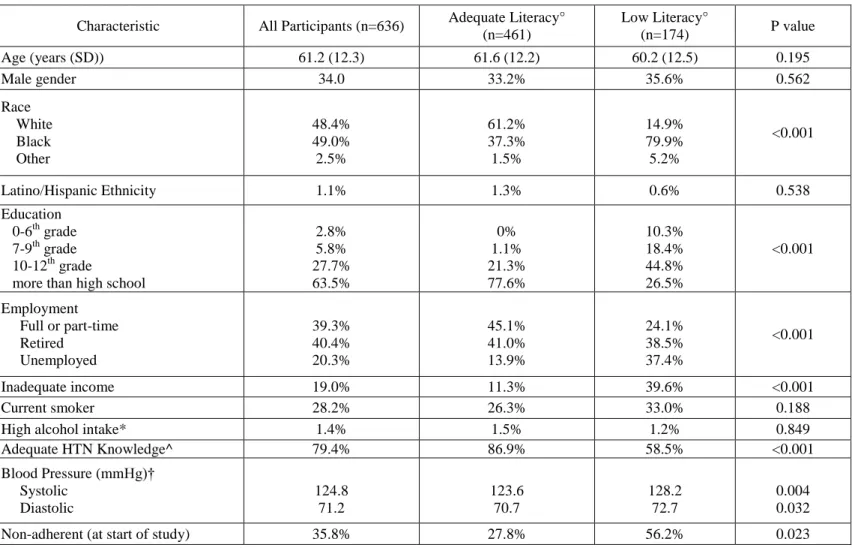
systolic and diastolic BP (p<0.05 for all comparisons, see Table I).
Table I: Descriptive Characteristics
°literacy was randomized by trial arm, table shows general comparison for all participants *high alcohol intake based on individual reporting >14 drinks/wk
^adequate hypertension knowledge defined as participant answering 6/6 questions correctly
†variable created to take the mean of two digital BP measurements taken by research assistants during baseline Characteristic All Participants (n=636) Adequate Literacy°
(n=461)
Low Literacy°
(n=174) P value
Age (years (SD)) 61.2 (12.3) 61.6 (12.2) 60.2 (12.5) 0.195
Male gender 34.0 33.2% 35.6% 0.562
Race White Black Other 48.4% 49.0% 2.5% 61.2% 37.3% 1.5% 14.9% 79.9% 5.2% <0.001
Latino/Hispanic Ethnicity 1.1% 1.3% 0.6% 0.538
Education 0-6th grade 7-9th grade 10-12th grade
more than high school
2.8% 5.8% 27.7% 63.5% 0% 1.1% 21.3% 77.6% 10.3% 18.4% 44.8% 26.5% <0.001 Employment Full or part-time Retired Unemployed 39.3% 40.4% 20.3% 45.1% 41.0% 13.9% 24.1% 38.5% 37.4% <0.001
Inadequate income 19.0% 11.3% 39.6% <0.001
Current smoker 28.2% 26.3% 33.0% 0.188
High alcohol intake* 1.4% 1.5% 1.2% 0.849
Adequate HTN Knowledge^ 79.4% 86.9% 58.5% <0.001
Blood Pressure (mmHg)† Systolic Diastolic 124.8 71.2 123.6 70.7 128.2 72.7 0.004 0.032
Results for Nonadherence by Intervention Arm
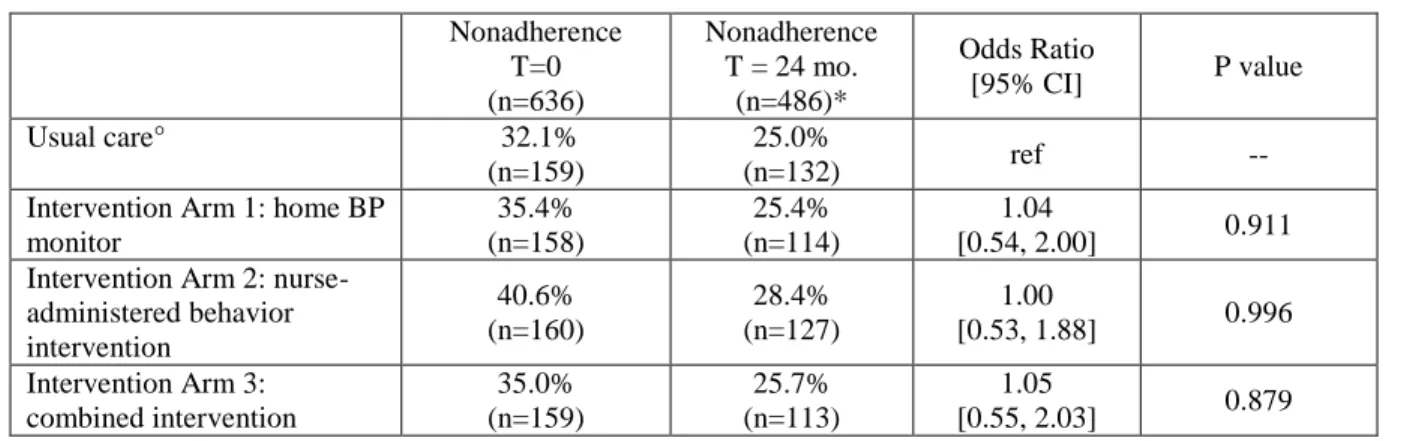
Of the 636 patients enrolled in TCYB, 35.8% were nonadherent at baseline. Over
the 24-month study, self-reported medication adherence decreased in each randomization
arm: from 32.1% to 25.0% in the usual care group; 35.4% to 25.4% home BP monitor
group; 40.6% to 28.4% in the nurse-administered behavior intervention group; and 35.0%
to 25.7% for the combined intervention group (see Table II). 150 participants were lost to
follow-up during the study secondary to withdrawals (n=33), exclusion (n=26) and death
(n=15). We used a logistic model to determine if either intervention had a significant
effect on self-reported medication adherence. None of the intervention arms had a
significant effect on nonadherence relative to usual care. The odds of nonadherence for
each intervention arm relative to usual care, controlling for baseline adherence, were 1.04
[95% CI: 0.54 to 2.00, p=0.911] for home BP monitor, 1.00 [95% CI: 0.53 to 1.88,
p=0.996] for nurse-administered intervention, and 1.05 [95% CI: 0.55 to 2.03, p=0.879]
for the combined intervention (see Table II).
To determine if there was a difference in how the interventions affected
nonadherence for low vs. adequate-literacy participants, we evaluated the interaction
between literacy and intervention on the outcome of 24-month adherence. There was a
trend towards significance for the interaction between literacy and nurse-administered
intervention (p=0.093) and the combined intervention (p-0.023). Because of this trend,
we stratified nonadherence by adequate-literacy participants and low-literacy participants
(see Tables III and IV). For the adequate literacy participants, the odds of nonadherence
were not significant by intervention arm relative to usual care. Nonadherence decreased
increased slightly (23.3% to 24.7%) in the usual care group, but decreased in each
[95% CI: 0.51 to 1.97, p=0.786], 0.689 for the nurse-administered behavior intervention
group [95% CI: 0.32 to 1.47, p=0.326], and 0.646 for the combined intervention group
[95% CI: 0.29 to 1.41, p=0.282].
Table II: Unadjusted evaluation of intervention effect on self-reported medication adherence
Nonadherence T=0 (n=636)
Nonadherence T = 24 mo.
(n=486)*
Odds Ratio
[95% CI] P value
Usual care° 32.1%
(n=159)
25.0%
(n=132) ref --
Intervention Arm 1: home BP monitor
35.4% (n=158)
25.4% (n=114)
1.04
[0.54, 2.00] 0.911 Intervention Arm 2:
nurse-administered behavior intervention
40.6% (n=160)
28.4% (n=127)
1.00
[0.53, 1.88] 0.996
Intervention Arm 3: combined intervention
35.0% (n=159)
25.7% (n=113)
1.05
[0.55, 2.03] 0.879 *change in number of participants due to loss of follow-up
°usual care is referent group
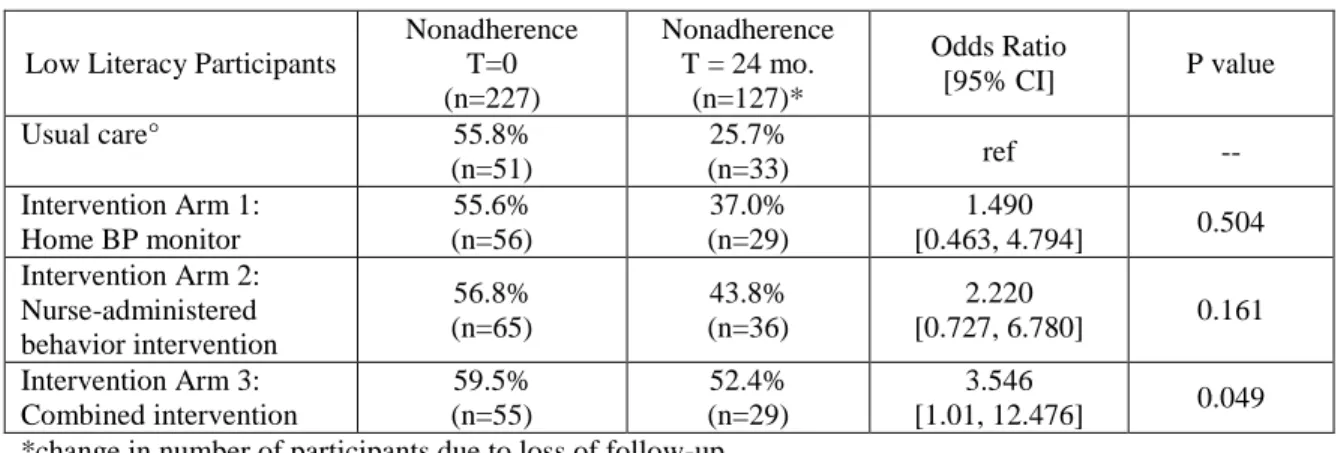
For the low-literacy participants, nonadherence decreased in each randomization
group. The odds of nonadherence at 24 months for each intervention arm relative to usual
care were not significant for home BP monitoring or the nurse-administered intervention,
but they were for the combined intervention group. The odds of nonadherence for
low-literacy participants in the home BP monitor group were 1.49 [95% CI: 0.46 to 4.79,
p=0.504], 2.22 for the nurse-administered intervention group [95% CI: 0.73 to 6.78,
p=0.161], and 3.546 for the combined intervention group [95% CI: 1.01 to 12.48,
p=0.049].
Discussion
In a randomized controlled trial that compared a behavior intervention of home BP
reported antihypertensive medication adherence over 2 years. There was improvement in
self-reported medication adherence for the usual care and intervention groups, and there did
not seem to be any significant difference in the odds of nonadherence over 2 years between
the groups.
Table III: Evaluation of intervention effect on self-reported medication adherence for adequately-literacy participants Adequate Literacy Participants Nonadherence T=0 (n=407) Nonadherence T = 24 mo.
(n=359)*
Odds Ratio
[95% CI] P value
Usual care° 23.3%
(n=108)
24.7%
(n=99) ref --
Intervention Arm 1: Home BP monitor 27.2% (n=102) 21.8% (n=85) 0.897
[0.508, 1.971] 0.786 Intervention Arm 2:
Nurse-administered behavior intervention 34.5% (n=95) 23.2% (n=91) 0.689
[0.315, 1.468] 0.326
Intervention Arm 3: Combined intervention 26.1% (n=102) 19.6% (n=84) 0.646
[0.292, 1.431] 0.282 *change in number of participants due to loss of follow-up
°usual care is referent group
Table IV: Evaluation of intervention effect on self-reported medication adherence for low-literacy participants
Low Literacy Participants
Nonadherence T=0 (n=227)
Nonadherence T = 24 mo.
(n=127)*
Odds Ratio
[95% CI] P value
Usual care° 55.8%
(n=51)
25.7%
(n=33) ref --
Intervention Arm 1: Home BP monitor
55.6% (n=56)
37.0% (n=29)
1.490
[0.463, 4.794] 0.504 Intervention Arm 2:
Nurse-administered behavior intervention 56.8% (n=65) 43.8% (n=36) 2.220
[0.727, 6.780] 0.161
Intervention Arm 3: Combined intervention 59.5% (n=55) 52.4% (n=29) 3.546
[1.01, 12.476] 0.049 *change in number of participants due to loss of follow-up
°usual care is referent group
We also evaluated literacy’s interaction with the intervention effect on 24-month
reported adherence to determine whether medication nonadherence changed differently
difference between groups’ odds of nonadherence over 2 years when evaluating literacy’s
interaction with the intervention effect, though there was a trend toward statistical
significance. All high literacy participant groups had a decrease in adherence over 2
years, and it did not appear that there was a significant difference in the odds of
nonadherence for any group relative to usual care. This finding suggests that for patients
with adequate literacy, the interventions tested do not target medication adherence more
effectively than usual care. Similarly, self-reported medication adherence improved in all
randomized groups for low-literacy participants. There was a significant odds of
nonadherence over 2 years for low-literacy participants receiving the combined
intervention relative to usual care. The usual care group of low-literacy participants
reported the most improvement in adherence over 2 years, suggesting that the home BP
monitoring and nurse-administered behavioral interventions, and those two combined, are
not as effective at increasing medication adherence for low-literacy patients. These
findings support the suggestions from previous research that despite interventions being
effective, they do not seem to lead to large improvements in adherence.6
The findings of this study are consistent with previous randomized controlled
trials and systematic reviews on medication adherence. No interventions have shown
consistent improvements in medication adherence across studies. Combined educational
and behavioral interventions are often utilized and suggested. The nurse-administered
intervention combined both educational and behavioral strategies, targeting
self-management of chronic disease through a tailored intervention. The home BP monitoring
intervention was a behavioral intervention. Research remains inconclusive as to whether
antihypertensive medication adherence. This finding could imply that all interventions
worked equally well or that the interventions are not more effective than usual care at
improving medication adherence. In a review of medication adherence interventions on
participants with multiple chronic conditions, individuals in the control and intervention
group became more adherence suggesting that the Hawthorne effect rather than any
particular intervention leads to improved medication adherence.5
We also evaluated the intervention effect for adequate and low-literacy patients.
The improvement in adherence across trial arms but lack of significant odds of
nonadherence between groups is consistent with current literature. Interventions targeting
low-literacy populations have mixed results. Some interventions are more effective for
either high- or low-literacy groups, while others improve outcomes for patients regardless
of literacy level.11 In this trial the odds of nonadherence were significantly greater for
low-literacy participants in the combined intervention arm. In a recent review of complex
interventions for low-literacy populations, combined interventions were overall more
effective for the intervention group.11 Our findings do not seem to support this
conclusion, however the large improvement in self-reported adherence in low-literacy
participants of the usual care group is not completely understood and this may have
contributed to the significant nonadherence odds ratio in this particular subgroup.
There are a few limitations of this study that should be considered when
interpreting the results of this study. First, the interventions were not designed to improve
medication adherence but to improve blood pressure control. While improvements in
adherence can lead to improved blood pressure outcomes, interventions that improve
medication adherence have shown variable effects on blood pressure outcomes.6 Second,
adherence could not be collected. More of these loss-to-follow-up participants had low
health literacy (n=100), which could have an effect on the stratified nonadherence odds
ratio outcome. Third, low-literacy participants differed from adequately-literate
participants on a number of reported characteristics. This was accounted for in part by
randomization being stratified by literacy level. In stratifying the groups by literacy, we
did not evaluate the effect of these characteristics on effect of the intervention on
24-month medication adherence. Lastly, self-reported medication adherence was the
measure used to assess participants adherence to their antihypertensive medications.
While this measure is commonly used, it may not be accurate or precise in assessing true
adherence compared to pill counts, electronic pill caps, checking pharmacy refill records,
or other less subjective measures. We recognize that a more objective tool for evaluation
medication adherence may affect the outcome measure.
In conclusion, there was little evidence that home BP monitoring, a nurse-tailored
behavioral intervention, or the combination of these two interventions has a significant
effect on medication adherence relative to usual care. Despite the findings in a recent
review that complex interventions are more effective for improving health outcomes in
literacy patients, we found significantly higher odds of nonadherence for
low-literacy patients in the combined intervention group. Further studies are needed to
determine the best strategies to target medication adherence and to improve medication
adherence in low-literacy patients. Given that low health literacy and low medication
adherence rates place individuals at increased risk for poor health outcomes, finding
Addenda
Literature Review Results
Citation
Study Design
Health Literacy
Measure Intervention Setting/Population
Follow-up duration
Outcome
Description Results
Quality Rating
Clement S, Ibrahim S, Crichton N, Wolf M, Rowlands G. Complex interventions to improve the health of people with limited literacy: A systematic review. Patient Education and Counseling June 2009;75(3):340-51.** systematic review REALM, S-TOFHLA, ABLE, WRAT, Ten Have word recognition measure, education level, ESL class attendance, asking about ability to read, a few studies did not assess literacy
2 interventions for health professionals, 1 focused on literacy education, 12 health education/management; most common elements of
interventions (in 3 or more studies): verbal presentation, material in simplified language, pictorial information, checking for participant understanding, spacing information, audiotapes, videotapes, and care management
Adults of mixed literacy levels (health professionals, participant follow-up ranged from immediately following the intervention to 10.5 months
aim of this review was to evaluate the effects of multi-faceted interventions intended to improve health-related outcomes in individuals with limited literacy
knowledge and self-efficacy were most likely to improve with these complex
interventions, 13/15 trials had at least 1 significant different in primary outcomes favoring the intervention group, some decrease in physician satisfaction and potential increased cost of these interventions, qualityof the studies was variable
good/fair
Conn VS, Hafdahl AR, Cooper PS, Ruppar RM, Mehr DR, Russel CL. Interventions to Improve Medication Adherence Among Older Adults: Meta-Analysis of Adherence Outcomes Among Randomized Controlled Trails. The Gerontologist 2009 May meta-analysis not specified, though literacy was one of the patient characteristics considered
interventions in at least 2 of the 33 studies included (frequency): drug education(23), written instructions(10), dose modification(7), disease education(6), medication review(6), packaging(4), succinct written instructions(4), tailored intervention(4), medication self-monitoring(2), written calendar(2), disease symptom self-monitoring(2), intergration of provider care(2)
11,827 participants from RCTs between 1970 and 2007 whose median age was 67
follow-up varied by study from a single intervention session (15minutes) to several weeks primary outcome was medication adherence effect size, secondary outcomes included medication adherence interventions' effects on medication and disease knowledge, health
medication adherence ES = 0.33 (p<0.001); positive moderators from interventions of medication adherence included special packaging of medications, dose
modification, and stimulus prompting; significant ES were also seen for knowledge (ES=0.48, p<0.001) and diastolic BP (ES=0.19, p<0.05); medication adherence was unrelated to participants' age, income, cognitive status, literacy or chronic illnesses
21;49(4):447-62. outcomes, and health service utilization
Cordasco KM, Asch SM, Bell DS, Guterman JJ, Gross-Shulman S, Ramer L, Elkayam U, Franco I, Leatherwood CL, Mangione CM. A low-literacy medication education tool for safety-net hospital patients. Am J Prev Med. 2009
Dec;37(6 Suppl 1):S209-16.
randomized controlled
trial TOFHLA
low-literacy icon- and picture-based medication tool to help with medication regimine schedules given by nurse upon hospital
discharge
Southern California safety-net hospital, patients discharged after evaluation of or treatment for CHF or CAD
2-week and 4-week interviews primary outcome was self-reported medication adherence 2 weeks after hospital discharge
control group: 0.5 doses missed, no correlation between self-reported
adherence and pill count, 78% adherent
intervention group: 1.1 doses missed, correlation between self-reported adherence and pill count, 70% adherent
poor
Mullan RJ, Montori VM, Shah ND, et al. The diabetes mellitus medication choice decision aid: a randomized trial. Archives of internal
medicine randomized
decision aid with 6 cards describing 6 effects (weight change, hypoglycemia, change in HgbA1C, daily routine, monitoring, side effects) of 5 diabetes medications used by
adult diabetes patients with diagnosis at least 1 year taking at most 3 diabetes
medications and with HgbA1C between 7 and 9.5% being seen by clinicians (faculty physicians, resident, physician 1 visit-intervention with 1mo, 3mo, and primary outcomes were: patients feeling involved in the decision-making process, medication adherence at 6 months, and change in
patients in the intervention group did not score higher on the Decisional Conflict Scale, but they did have more knowledge about medications; medication adherence was close to perfect in both groups by self-report and pharmacy records but the control group had a higher adherence rate (81%) vs the decision-aid group
either outpatient or family medicine clinics in the Mayo Clinic or Olmstead Medical Center health systems
intervention on HgbA1C for either gorup
Murray MD, Young J, Hoke S, Tu W, Weiner M, Morrow D, Stroupe KT, Wu J, Clark D, Smith F, Gradus-Pizlo I, Weinberger M, Brater DC. Pharmacist intervention to improve medication aherence in heart failure: a randomized trial. Ann Intern Med. 2007 May
15;146(10):714-25.
randomized controlled
trial none
pharmacist gave written and verbal instructions and was available to answer questions regularly from participants, icons on written instructions and container label and lid, low-literacy timeline for drug regimine
Wishard Health Services primary care and cardiology services and hospital, patients of low-income with state/local assistance to pay for their medications 9-month intervention and 3-month post-intervention observation; 3, 6, and 12 month interviews and monthly telephone survery primary outcome was adherence measured with electronic prescription monitors (MEMS lids) and HF exacerbations requiring ED visits or hospitalization
taken adherence significantly different with 78.8% vs 67.9% for intervention vs usual care group, respectively (95% CI: 5.0, 16.7);
scheduling adherence significantly different at 53.1% vs. 47.2% for intervention vs usual care (95% CI 0.4, 11.5); refill adherence significantly different at 109.4% vs 105.2% for intervention vs usual care (p=.007)
3-mo post intervention: taking adherence and scheduling adherence no longer significantly different between intervention and usual care groups
Peterson AM, Takiya L, Finley R. Meta-analysis of trials of
intervention to improve medication adherence. Am J Health - Syst Pharm 2003 Apr 1;657-65.* meta-analysis (from citation in Conn
article) not discussed
behavioral interventions included dosage schedule change, packaging chance, skill buidling by health care professional, mail or email or telephone reminders,
calendars, pill counting and pillboxes, and rewards; educational interventions included oral education by a physician or nurse or pharmacist, audiovisual education, written instructions, telephone education, and mailed or emailed instructions
patients taking some medication for various diseases, mostly adults aged 19 to 65, males and females, 26% of studies focused on patients with hypertension mean follow-up was 4.5 months, ranged from 14 days to 1 year
aim of this review was to identify and study the effects of tools and methods designed to improve medication adherence in randomized controlled trials
overall adherence improved 4-11%, there was no significant different among behavioral or educational interventions, among the combined intervention trials mail reminders had the largest impact (ES = 0.38)
good
Pignone M, DeWalt DA, Sheridan S, Berkman N, Lohr KN. Interventions to Improve Health Outcomes for Patients with Low Literacy: A
Systematic Review. J Gen Intern Med 2005;20:185-192. systematic review studies included used REALM, WRAT, Adult Basic Learning Examination, Gates-MacGinitie, ABLE, Comprehensive Adult Student Assessment Scale information pamphlets, brochures and forms written for lesser grade level or using photographs; computer-generated discharge instructions; CD-ROM; instructional and interactive videos; package label; verbal teaching; educational classes/programs
included studies were in developing countries, sample sizes ranged from 28-1,744 participants study and trial lengths vavied; all studies reviewed between 1980-2003
aim of this review was to identify and evaluate interventions designed to improve health outcomes that are associated with low literacy
quality ratings: 10 good, 9 fair, and 1 poor studies mixed results with slight improvement or no effect on health knowledge,
biochem/biomarkers, health behavior, preventive services use, and disease
incidence/prevalence/severity; some interventions worked best for low-literacy participants, some for high, and some for both
Rudd RE, Blanch DC, Gall V, et al. A randomized controlled trial of an intervention to reduce low literacy barriers in inflammatory arthritis management. Patient education and counseling 2009;75(3):334-39. randomized controlled trial A-REALM, education level (more vs less than high school education)
individualized intervention including usual care, plain english notebook with information about arthritis and medications and management (5th - 8th grade reading level), and 2 appointments + desired follow-up with arthritis educator; for first year there was a plain english
randomized group that consisted of usual care + plain english notebook (13 patients, added to
individualized intervention group)
127 adult patients with rheumatoid arthritis, psoriatic arthritis, or inflammatory polyarthritis receiving care at large urban teaching hospital clinics by rheumatologist time of intervention unclear but follow-up 6months and 12months post-intervention primary outcomes: medication adherence, self-efficacy, patient satisfaction, and appointment keeping secondary outcomes: health status, mental health
there was no significant difference between the intervention and standard care groups for any of the primary outcomes at 12 months; mental health improved at 6 months for the intervention group (4.56% increase vs. 4.32% decrease for
intervention vs control group on mental health index); of note medication adherence decreased in both groups by 12 months though the
difference between the groups was not significant
fair
Schroeder K, Fahey T, Ebrahim S. How Can We Improve Adherence to Blood Pressure-Lowering Medication in Ambulatory Care? - Systematic Review of Randomized Controlled Trials. Arch Intern Med 2004 Apr 12;164:722-732.*
systematic
review not discussed
simplifying dosing regimens, patient education, patient moviation/support/reminders, and complex or combined interventions
15,519 adults with essential
hypertension
ranged from 2 to 60 months
aim of this review was to determine which types of interventions are most effective to increasing adherent to BP medications
simplifying dosing regimens was the best overall strategy increasing adherence 7 to 19.6% in 7 out of 9 studies; motivational/support and complex interventions led to small increases in adherence; education only interventions were not very successful; poor methodology was noted in most studies and makes definitive conclusions about the best strategies difficult
Williams A, Manias E, Walker R. Interventions to improve medication adherence in people with multiple chronic conditions: a systematic review. Journal of Advance Nursing 2008;63(2):132-43.
systematic
review not discussed
interventions utilized educational and behavioral approaches, 7/8 included studies had a pharmacist-delivered intervention combining adeucation, personal or telephone follow-up, referral or adjusted medication regimens, and reminders to participants to take their medications; 1 intervention used a medication discharge plan and counseling
adults with at least 3 chronic
conditions
follow-up was at least 3 months for
inclusion in this review
aim of this review was to identify research involving medication adherence interventions for people with multiple chronic conditions
periodic reinforcement is needed to maintain medication adherence behavior change,
psychosocial interventions are needed, it is important to assess participants' perspective of adherence outcomes, more valid measures of medication adherence need to be consistently utilied and potentially developed
good
ABLE – Adult Basic Learning Examination
REALM – Rapid Estimate of Adult Literacy (A-REALM is arthritis modification)
TOFHLA – Test of Functional Health Literacy in Adults (S-TOFHLA is shortened version) WRAT – Wide Range Achievement Test
Literature Search Table
Date Database Main search terms Modifiers Yield (articles) Used search?
3/12/2010 Google scholar medication adherence interventions n/a 81300 No
3/12/2010 Google scholar medication adherence low literacy n/a 7820 No
3/21/2010 Google scholar
low literacy hypertension medication
adherence intervention n/a 2870 No
3/28/2010 Google scholar
low literacy hypertension medication
adherence intervention 2005-2010 1150 No
6/12/2010 Pubmed health literacy hypertension clinical trials 51
yes until re-defined question
6/12/2010 Google scholar
health literacy hypertension medication adherence clinical trials
medicine/pharm/vet science;
2001-2010, english language 704
yes until re-defined question
6/17/2010 Google scholar low literacy interventions clinical trials
since 2004; articles only, english language,
medicine/pharm/vet science 1270
yes until re-defined question
6/18/2010 Pubmed educational status hypertension
clinical trials, english languge, adults 19+ years old, since
2004 16 No
6/18/2010 Pubmed
MeSH: health literacy medication
adherence 22 No
6/18/2010 Google scholar
low literacy clinical trials medication adherence hypertension
articles since 2000,
medicine/pharm/vet science,
english language 733 No
6/28/2010 Pubmed
MeSH: educational status medication
adherence 22 No
6/28/2010 Google scholar
medication adherence literacy interventions
medicine/pharm/vet science,
medication adherence literacy interventions clinical trials
medicine/pharm/vet science,
articles only, since 2000 1630 Yes
6/30/2010 Pubmed medication adherence literacy
clinical trials, english
References
1. Peterson AM, Takiya L, Finley R. Meta-analysis of trials of interventions to improve medication adherence. American Journal of Health-System Pharmacy. 2003;60(7):657. 2. Lee JK, Grace KA, Taylor AJ. Effect of a pharmacy care program on medication
adherence and persistence, blood pressure, and low-density lipoprotein cholesterol: a randomized controlled trial. Jama. 2006;296(21):2563.
3. Cordasco KM, Asch SM, Bell DS, et al. A low-literacy medication education tool for safety-net hospital patients. American journal of preventive medicine. 2009;37(6):S209-S216.
4. Conn VS, Hafdahl AR, Cooper PS, Ruppar TM, Mehr DR, Russell CL. Interventions to improve medication adherence among older adults: meta-analysis of adherence outcomes among randomized controlled trials. The Gerontologist. 2009;49(4):447.
5. Williams A, Manias E, Walker R. Interventions to improve medication adherence in people with multiple chronic conditions: a systematic review. Journal of Advanced Nursing. 2008;63(2):132-143.
6. Schroeder K, Fahey T, Ebrahim S. How can we improve adherence to blood pressure-lowering medication in ambulatory care?: Systematic review of randomized controlled trials. Archives of internal medicine. 2004;164(7):722.
7. Pignone M, DeWalt DA, Sheridan S, Berkman N, Lohr KN. Interventions to improve health outcomes for patients with low literacy. Journal of General Internal Medicine.
2005;20(2):185-192.
8. Murray MD, Young J, Hoke S, et al. Pharmacist intervention to improve medication adherence in heart failure. Annals of internal medicine. 2007;146(10):714.
9. Mullan RJ, Montori VM, Shah ND, et al. The diabetes mellitus medication choice
decision aid: a randomized trial. Archives of internal medicine. 2009;169(17):1560-1568. 10. Rudd RE, Blanch DC, Gall V, et al. A randomized controlled trial of an intervention to
reduce low literacy barriers in inflammatory arthritis management. Patient education and counseling. 2009;75(3):334-339.
11. Clement S, Ibrahim S, Crichton N, Wolf M, Rowlands G. Complex interventions to improve the health of people with limited literacy: A systematic review. Patient education and counseling. 2009;75(3):340-351.
12. Kalichman SC, Cherry J, Cain D. Nurse-delivered antiretroviral treatment adherence intervention for people with low literacy skills and living with HIV/AIDS. Journal of the Association of Nurses in AIDS Care. 2005;16(5):3-15.
13. Borrell LN. Race, Ethnicity, and Self-Reported Hypertension: Analysis of Data from the National Health Interview Survery, 1997-2005. American Journal of Public Health.
February 2009;99(2):313-319.
14. Egan BM, Zhao Y, Axon RN. US trends in prevalence, awareness, treatment, and control of hypertension, 1988-2008. JAMA.303(20):2043.
15. Bosworth HB, Olsen MK, Dudley T, et al. The Take Control of Your Blood pressure (TCYB) study: Study design and methodology. Contemporary Clinical Trials. August 9 2006:15.
16. Powers BJ, Oddonne EZ, Grubber JM, Olsen MK, Bosworth HB. Perceived and Actual Stroke Risk Among Men with Hypertension. The Journal of Clinical Hypertension. April 2008;10(4):287-295.
18. Safeer RS, Cooke CE, Keenan J. The impact of health literacy on cardiovascular disease.
Vascular Health and Risk Management. 2006;2(4):457.
19. Bosworth HB, Oddone EZ. A model of psychosocial and cultural antecedents of blood pressure control. Journal of the National Medical Association. 2002;94(4):236-248. 20. Safeer RS, Keenan J. Health literacy: the gap between physicians and patients. Am Fam
Physician. 2005;72(3):463-468.
21. Kutner M, Greenberg E, Jin Y, Paulsen C. The health literacy of America's adults: results from the 2003 National Assessment of Adult Literacy (NCES 2006-483). US Department of Education. Washington, DC: National Center for Education Statistics. 2006;6.
22. Coulter A, Ellins J. Effectiveness of strategies for informing, educating, and involving patients. British Medical Journal. 2007;335(7609):24.
23. Baker D. Reading between the lines. Journal of General Internal Medicine. 1999;14:315-317.
24. Mark V Williams M, David W Baker, MD MPH, Ruth M Parker, MD, Joanne R Nurss, PhD. Relationship of Functional Health Literacy to Patients' Knowledge of Their Chronic Disease: A study of Patients with Hypertension and Diabetes. Archives of Internal
Medicine. 1998;158(2):166-172.
25. Rothman RL, DeWalt DA, Malone R, et al. Influence of patient literacy on the effectiveness of a primary care-based diabetes disease management program. JAMA.
2004;292(14):1711.
26. Bosworth HB, Olsen MK, Grubber JM, et al. Two Self-management Interventions to Improve Hypertension Control: A Randomized Trial. Annals of internal medicine. 2009. 27. Morisky DE, Green LW, Levine DM. Concurrent and predictive validity of a self-reported
measure of medication adherence. Medical Care. 1986;24(1):67.
28. Kincaid J, Fishburne R, Rogers R, Chissom B. Derivation of new readability formulas (Automated Readibility Index, Fog Count, and Flesch Reading Ease Formula) for Navy enlisted personnel. Memphis: Naval Technical Training U.S. Naval Air Station