© 2008, 2005 Thomson Wadsworth, a part of The Thomson Corporation. Thomson, the Star logo, and Wadsworth are trademarks used herein under license.
ALL RIGHTS RESERVED. No part of this work covered by the copyright hereon may be reproduced or used in any form or by any means—graphic, electronic, or mechanical, including photo-copying, recording, taping, Web distribution, information storage and retrieval systems, or in any other manner—without the written permission of the publisher.
Printed in the United States of America 1 2 3 4 5 6 7 1 1 1 0 0 9 0 8 0 7
ExamView®and ExamView Pro®are registered trademarks of FSCreations, Inc. Windows is a registered trademark of the Mi-crosoft Corporation used herein under license. Macintosh and Power Macintosh are registered trademarks of Apple Computer, Inc. Used herein under license.
© 2008 Thomson Learning, Inc. All Rights Reserved. Thomson Learning WebTutorTMis a trademark of Thomson Learning, Inc. Library of Congress Control Number: 2007923679
Student Edition:
ISBN-13: 978-0-495-10288-5 ISBN-10: 0-495-10288-1 Cloth Edition:
ISBN-13: 978-0-495-10289-2 ISBN-10: 0-495-10289-X Loose-leaf Edition:
ISBN-13: 978-0-495-10290-8 ISBN-10: 0-495-10290-3 Acquisitions Editor: Erik Evans
Development Editor: Kirk Bomont
Assistant Editor: Gina Kessler
Editorial Assistant: Christina Ganim
Technology Project Manager: Lauren Keyes
Marketing Manager: Sara Swangard
Marketing Assistant: Melanie Cregger
Senior Marketing Communications Manager: Linda Yip
Content Project Manager: Jerilyn Emori
Director of Design: Rob Hugel
Senior Art Director: Vernon Boes
Senior Print Buyer: Judy Inouye
Permissions Editor: Roberta Broyer
Production Service: Nancy Shammas, New Leaf Publishing Services
Text Designer: tani hasegawa
Photo Researcher: Sabina Dowell
Copy Editor: Frank Hubert
Illustrator: Precision Graphics
Cover Designer: Patrick Devine
Cover Image: Burke/Triolo Productions
Compositor: Graphic World, Inc.
Text and Cover Printer: Courier Corporation/Kendallville
Thomson Higher Education 10 Davis Drive
Belmont, CA 94002-3098 USA
For more information about our products, contact us at: Thomson Learning Academic Resource Center
1-800-423-0563
For permission to use material from this text or product, submit a request online at http://www.thomsonrights.com.
Any additional questions about permissions can be submitted by e-mail to [email protected].
CHAPTER
1
1
What Is Psychology?
M O D U L E 1 . 1
Psychologists’ Goals
General Points About Psychology Major Philosophical Issues in PsychologyFree Will Versus Determinism
CRITICAL THINKING: A STEP
FURTHER Determinism
The Mind–Brain Problem
CRITICAL THINKING: A STEP
FURTHER Mind and Brain
The Nature–Nurture Issue
CRITICAL THINKING: A STEP
FURTHER Nature and Nurture
What Psychologists Do Psychologists in Teaching and
Research
Service Providers to Individuals Service Providers to Organizations
CRITICAL THINKING: A STEP
FURTHER I/O Psychology
Should You Major in Psychology? In Closing: Types of Psychologists Summary
Answers to Concept Checks
M O D U L E 1 . 2
Psychology Then and Now
The Early EraWilhelm Wundt and the First Psychological Laboratory Edward Titchener and
Structuralism
William James and Functionalism Studying Sensation
Darwin and the Study of Animal Intelligence
Measuring Human Intelligence The Rise of Behaviorism
John B. Watson Studies of Learning
From Freud to Modern Clinical Psychology
Recent Trends in Psychology In Closing: Psychology Through the Years
Summary
Answers to Concept Checks
Chapter Ending:
Key Terms and Activities Key Terms
Suggestions for Further Reading
2
❚ Who has the correct answers? None of us do, at least not always. Even when people we trust seem very confident of their opinions, we should ask for their evidence or reasoning.
I
f you are like most students, you start off assuming
that just about everything you read in your textbooks
and everything your professors tell you must be true.
But what if it isn’t? Suppose a group of impostors has replaced the fac-ulty of your college. They pretend to know what they are talking about and they all vouch for one another’s competence, but in fact they are all unqualified. They have managed to find textbooks that support their prejudices, but the information in the textbooks is all wrong, too. If that happened, how would you know?
As long as we are entertaining such skeptical thoughts, why limit ourselves to colleges? When you read advice columns in the newspa-per, read books about how to invest money, or listen to political com-mentators, how do you know who has the right answers?
The answer is that no one has the right answers all of the time.
Pro-fessors, textbook authors, advice columnists, politicians, and others have strong reasons for some beliefs and weak reasons for others, and sometimes, they think they have strong reasons but discover to their embarrassment that they were wrong. I don’t mean to imply that you should disregard everything you read or hear. But you should expect people to tell you the reasons for their conclusions so that you can draw your own conclusions. At least if you make a mistake, it will be your own and not someone else’s.
You have just encountered the theme of this book:
Evaluate the evidence.
You have heard and you will continue to hear all sorts of claims concerning psychology. Some are valid, others are wrong, many are valid under certain conditions, and some are too vague to be either right or wrong. When you finish this book, you will be in a better position to examine evidence and to judge for yourself which claims to take seriously.© AP/Wide W
orld Photos
© AP/Wide W
orld Photos
© Richard Ellis/NEWSMAKERS/Liaison/Getty Images
© Galen Rowell/CORBIS © Mitchell Gerber/CORBIS
• What is psychology?
• What philosophical questions motivate psycholo-gists?
• What do various kinds of psychologists do?
• Should you consider majoring in psychology? The term psychology derives from the Greek roots psyche, meaning “soul” or “mind,” and logos, mean-ing “word.” Psychology is literally the study of the mind or soul. In the late 1800s and early 1900s, psy-chology was defined as the scientific study of the mind. Around 1920, psychologists became disen-chanted with the idea of studying the mind. First, sci-ence deals with what we can observe, and no one can observe a mind. Second, talking about “the mind” seemed to imply that mind is a thing with an inde-pendent existence. Most researchers consider mind a process, more like a fire than like the piece of wood that is undergoing the fire. At any rate, through the mid-1900s, psychologists defined their field simply as the study of behavior.
However, people care about what they see, hear, and think, not just about what they do. When you look at this optical illusion and say that the horizontal part of the top line looks longer than that of the bottom line (although really they are the same length), we want to know why it looks longer to you, not just why you said it looks longer. So for a compromise, let’s de-fine psychology as the systematic study of behavior and experience.The word experiencelets us discuss your perceptions without implying that a mind exists independently of your body.
The kind of psychologist familiar to most people is clinical psychologists—those who try to help worried, depressed, or otherwise troubled people. That field is only part of psychology. Psychology also includes re-search on sensation and perception, learning and memory, hunger and thirst, sleep, attention, child de-velopment, and more. You might expect that a course in psychology will teach you to “analyze” people, to
decipher hidden aspects of their personality, perhaps even to use psychology to control them. It will not. You will learn to understand certain aspects of behav-ior, but you will gain no dazzling powers. Ideally, you will become more skeptical of those who claim to an-alyze people’s personality from small samples of their behavior.
General Points
About Psychology
Let’s start with six general themes that arise repeat-edly in psychology. They may not be the most impor-tant things you learn about psychology; depending on your own interests, something that strikes other peo-ple as a minor detail might be extremely important for you. However, the following points apply so widely that we shall encounter them frequently.
“It Depends”
That is, few statements apply to all people’s behavior at all times. For example, almost any statement de-pends on age. (Newborn infants differ drastically from older children, and children from adults.) Almost any behavior varies among individuals depending on their genetics, health, past experiences, and whether they are currently awake or asleep. Some aspects of behav-ior differ between males and females or between one culture and another. Some aspects depend on the time of day, the temperature of the room, or how re-cently someone ate. The way people answer a ques-tion depends on exactly how the quesques-tion is worded, what other questions they have already answered, and who is asking the question.
When I describe “it depends” as a general truth of psychology, you may think I am making fun of psy-chology, suggesting that psychology has no real an-swers. On the contrary, I believe that “it depends” is a serious point. The key is to know whatit depends on. The further you pursue your studies of psychology, the more you will become attuned to the wealth of influ-ences on our behavior, some of which are so subtle that we might easily overlook them. For one example, decades ago, two psychology laboratories in different parts of the United States were conducting similar studies on human learning but consistently reporting 3
M O D U L E
1.1
contradictory results. Both researchers were experi-enced and highly respected, they thought they were following the same procedures, and they did not un-derstand why their results differed. Eventually, one of them traveled to the other’s university to watch the other in action. Almost immediately, he noticed a key difference in procedure: the chairs in which the par-ticipants sat! His colleague at the other university had obtained some chairs from a dentist who retired. So the research participants were sitting in these dentist’s chairs, which reminded them of visits to the dentist. They were sitting there in a state of heightened anxi-ety, which altered their behavior (Kimble, 1967).
Another way of saying “it depends” is that no one reason explains your behavior fully. To illustrate, you might try listing the reasons you are reading this book right now, such as (a) I like to keep up to date on read-ing assignments, (b) I was curious what psychology is all about, (c) my roommate who is also taking this course read the chapter and said it was interesting, (d) I have about an hour before dinner with nothing else to do, (e) it’s raining outside so I don’t want to go any-where, (f) I want to procrastinate working on a less pleasant assignment for some other course, and so on. In short, people seldom do anything for just one reason. Research Progress Depends
on Good Measurement
Nobel Prize–winning biologist Sidney Brenner was quoted as saying, “Progress in science depends on new techniques, new discoveries, and new ideas, probably in that order” (McElheny, 2004, p. 71). For example, brain scans and other new techniques en-able researchers to measure brain activity in more de-tail and with greater accuracy than in the past, result-ing in rapid increases in our knowledge. Similarly, psychologists’ understanding has advanced fastest on topics such as sensory processes, learning, and mem-ory because researchers can measure these aspects of behavior fairly accurately. On topics such as emotion and personality, research progress has been slower because of the difficulty of measurement. As you pro-ceed through this text, especially in the second half, you will note that we occasionally have to interrupt some discussion to ask, “Wait . . . how well do those scores measure intelligence?” or “When people say they are happy, how do we know whether they really are happy?” Areas of psychology with less certain measurement have only tentative conclusions and slow progress.
Correlation Does Not Indicate Causation
This statement will make more sense to you after you read about correlation in chapter 2. Here, let’s con-sider the idea briefly: A correlation indicates that two things tend to go together. For example, taller people
tend to be heavier than shorter people, on the aver-age. Better educated people tend to have better paying jobs than less educated people. And so forth. Some-times, we are tempted to draw cause-and-effect con-clusions after observing a correlation. For example, people with schizophrenia are more likely than other people to abuse alcohol, tobacco, and marijuana. Al-though we might be tempted to assume that these substances increase the risk of schizophrenia, we can-not draw that conclusion. It is equally plausible that having schizophrenia increases one’s uses of alcohol, tobacco, and marijuana (Degenhardt, Hall, & Lynskey, 2003). That is, a correlation between two items does not tell us which one caused the other or, indeed, whether either of them caused the other. As long as you continue studying psychology or related fields, your instructors and texts will continue emphasizing this point.
Variations Among Individuals Reflect Both Heredity and Environment
Within any group people differ in their interests, pref-erences, abilities, and personalities. What accounts for these differences? Some relate to differences in ex-perience. For example, suppose you enjoy using com-puters. You could not have nurtured that interest if you had lived in some part of the world without elec-tricity. However, experiences and opportunities do not account for all of the differences among people. With regard to almost everything psychologists have mea-sured, identical twins resemble each other more closely than fraternal twins do. The greater similarity between identical twins is taken as evidence of a ge-netic influence on behavior. Environment and hered-ity can also combine their influences in many ways (Moffitt, Caspi, & Rutter, 2006). For example, a gene that enhances fear produces a bigger effect after you have had frightening experiences.
The Best Predictor of Future Behavior Is Past Behavior in Similar Situations
People are fairly consistent in how they act. If in the past you have usually started on every schoolwork task as soon as it was assigned, you will probably do the same this semester. If you have almost always procrastinated your assignments until the last possi-ble minute, you will probably do the same this se-mester, despite your good intentions to the contrary. (If this is you, I shall be delighted if you prove me wrong.)
Similarly, if you consider marrying someone and wonder how that person would treat you after mar-riage, ask how that person treats you now. If we want to predict how dangerous some prisoner will be after release, we should ask how dangerous this person has been in the past. If you wonder whether you can trust
someone to fulfill a promise, ask how well that person has kept promises in the past.
Some Statements in Psychology Reflect Stronger Evidence Than Others
Authors revise psychology textbooks because of new research, and psychologists conduct new research be-cause of the many things we don’t know. Unfortu-nately, people sometimes express strong opinions even when the evidence is weak. Admittedly, we sometimes have to form opinions without complete evidence. For example, parents have to decide how to rear children without waiting for conclusive research about what works best. Still, it is important to know what evidence supports an opinion. For example, solid evidence indicates that a woman who drinks much alcohol during pregnancy risks damage to her infant’s brain. Therefore, we take whatever steps we can to discourage pregnant women from drinking. On the other hand, what are the consequences of letting children watch television all day? Here, opinions run strong, but the evidence is weak. Anyone who ex-presses an opinion should state his or her evidence (or lack of it) so that others can overrule that opinion in the light of newer, better evidence.
Major Philosophical Issues
in Psychology
Many psychological concerns date back to the philoso-phers of ancient Greece. Although psychology has moved away from philosophy in its methods, it contin-ues to be motivated by some of the same
questions. Three of the most profound are free will versus determinism, the mind–brain problem, and the nature–nurture issue.
Free Will Versus Determinism
The scientific approach seeks the immediate causes of an event (what led to what) instead of the final orultimatecauses (the purpose of the event in an overall plan). That is, scien-tists act on the basis of determinism, the as-sumption that everything that happens has a cause, or determinant, in the observable world.Is the same true for human behavior? We are, after all, part of the physical world, and our brains are made of chemicals. According to the determinist assumption, everything we do has causes. This view seems to conflict with the impression all of us have that “I make the decisions about my actions. Some-times, when I am making a decision, like
❚ Behavior is guided by external forces, such as waves, and by forces within the individual. According to the determinist view, even those internal forces follow physical laws.
© Rick Doyle/CORBIS
what to eat for lunch or which sweater to buy, I am in doubt right up to the last second. The decision could have gone either way. I wasn’t controlled by anything, and no one could have predicted what I would do.” The belief that behavior is caused by a person’s in-dependent decisions is known as free will.
Some psychologists maintain that free will is an il-lusion (Wegner, 2002): What you call a conscious in-tention is more a prediction than a cause of your be-havior. When you have the conscious experience of “deciding” to move a finger, the behavior is already starting to happen. Other psychologists and philoso-phers reply that you do make decisions in the sense that something within you initiates the action. Never-theless, your behavior still follows laws of cause and ef-fect. When you order soup and salad for lunch, the de-cision was a product of forces within you, as well as the external situation. The kind of person you are also de-termines what career you will choose, how hard you will work at it, how kind you will be to others, and so forth. However, the “you” that makes all these deci-sions is itself a product of your heredity and the events of your life. (You did not create yourself.) In this sense, yes, you have a will, and you might even call it “free” will depending on what you mean by “free” (Dennett, 2003). If you mean uncaused, then your will is not free. The test of determinism is ultimately empirical: If everything we do has a cause, our behavior should be predictable. In some cases it definitely is. For exam-ple, after a sudden, unexpected, loud noise, I can pre-dict that, unless you are deaf, in a coma, or paralyzed, you will tense your muscles. I can even be more pre-cise and predict you will tense your neck muscles in less than a quarter of a second.
In other cases psychologists’ predictions are more like those of a meteorologist. A meteorologist who wants to predict tomorrow’s weather for some city will want to know the location and terrain of that city, to-day’s weather, and so forth. Even with all that infor-mation, the meteorologist will predict something such as, “High temperature around 30, low temperature around 20, with a 10% chance of precipitation.” The imprecision and occasional errors do not mean that the weather is “free” but only that it is subject to so many influences that no one can predict it exactly.
Similarly, a psychologist trying to predict your be-havior for the next few days will want to know as much as possible about your past behavior, that of your friends and family, your current health, your genetics, where you live, and a great deal more. Even with all that information, the psychologist cannot predict perfectly.
Determinists are unembarrassed by their inability to predict behavior precisely; after all, human behav-ior is subject to a great many influences. Still, the more knowledge we gain, the better predictions we can make. Anyone who rejects determinism must in-sist that predictions of behavior could never become accurate, even with complete information about the person and the situation. To that idea a determinist replies that the only way to find out is to try.
Let’s note an important point here: The assumption that behaviors follow cause and effect seems to work, and anyone planning to do research on behavior is al-most forced to start with this assumption. Still, to be honest, it is an assumption, not a certainty. We can test the assumption only by extensive research, and in a sense all research in psychology tests the assumption. The question of determinism arises explicitly in chap-ter 6 (learning) and module 10.1 (consciousness).
C R I T I C A L T H I N K I N G
A S T E P F U RT H E R
Determinism
What kind of evidence, if any, would support the concept of free will? To support the concept of free will, one would need to demonstrate that no conceivable theory could make correct predic-tions about some aspect of behavior. Should a psychologist who believes in free will conduct the same kind of research that determinists con-duct, a different kind, or no research at all?
The Mind–Brain Problem
Everything we experience or do depends on the physics and chemistry of the nervous system. Then what, if anything, is the mind? The philosophical question of how experience relates to the brain is the mind–brain
problem (or mind–body problem). In a universe
com-posed of matter and energy, why is there such a thing as a conscious mind? One view, calleddualism, holds that the mind is separate from the brain but somehow controls the brain and therefore the rest of the body. However, dualism contradicts the law of conservation of matter and energy, one of the cornerstones of physics. According to that principle, the only way to in-fluence any matter or energy, including the matter and energy that compose your body, is to act on it with other matter or energy. That is, if the mind isn’t com-posed of matter or energy, it can’t do anything. For that reason nearly all brain researchers and philosophers
fa-vormonism,the view that conscious experience is
in-separable from the physical brain. That is, either the mind is something the brain produces, or mind and brain activity are just two terms for the same thing. As you can imagine, the mind–brain problem is a thorny philosophical issue, but it does lend itself to research, some of which we shall discuss in chapter 3 on the brain and chapter 9 on consciousness.
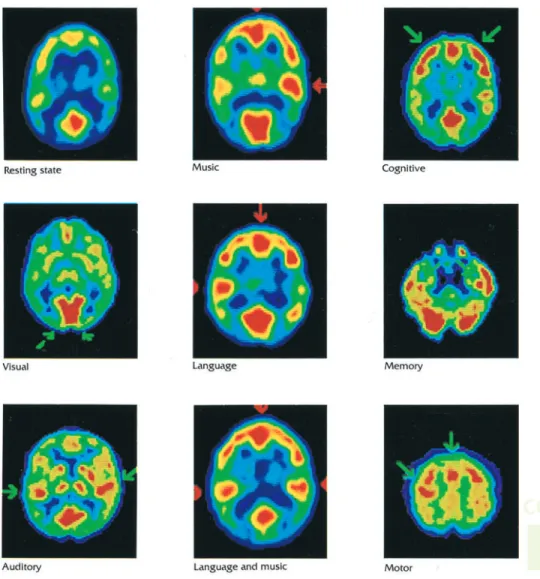
The photos in Figure 1.1 show brain activity while a person is engaged in nine different tasks, as mea-sured by a technique called positron-emission tomog-raphy (PET). Red indicates the highest degree of brain activity, followed by yellow, green, and blue. As you can see, the various tasks increase activity in different brain areas, although all areas show some activity at all times (Phelps & Mazziotta, 1985). Data such as these show a close relationship between brain activity and psychological events. You might well ask: Did the brain activity cause the thoughts, or did the thoughts cause the brain activity? Most brain researchers reply that neither brain activity nor mental activity causes the other; rather, brain activity and mental activity are the same thing (see Dennett, 1991).
Even if we accept this position, we are still far from understanding the mind–brain relationship. Is mental activity associated with all brain activity or just certain types? Why does conscious experience exist at all? Could a brain get along without it? Re-search studies are not about to resolve these ques-tions and put philosophers out of business. But re-search results do constrain the philosophical answers that we can seriously consider.
C R I T I C A L T H I N K I N G
A S T E P F U RT H E R
Mind and Brain
One way to think about the mind–brain relation-ship is to ask whether something other than a brain—a computer, for example—could have a mind. How would we know? If we built a computer that could perform all the intellectual functions that humans perform, could we then decide that the computer is conscious, as human beings are?
The Nature–Nurture Issue
Why do most little boys spend more time than little girls with toy guns and trucks and less time with dolls? Are such behavioral differences mostly the re-sult of biological differences between boys and girls, or are they mainly the result of differences in how soci-ety treats boys and girls?
Alcohol abuse is a big problem in some cultures and a rare one in others. Are these differences entirely a matter of social custom, or do genes influence alco-hol use also?
Certain psychological disorders are more common in large cities than in small towns and in the country-side. Does life in crowded cities somehow cause psy-chological disorders? Or do people develop such dis-orders because of a genetic predisposition and then move to big cities in search of jobs, housing, and wel-fare services?
Each of these questions is related to the
na-ture–nurture issue (or heredity–environment
is-sue): How do differences in behavior relate to dif-ferences in heredity and environment? The na-ture–nurture issue shows up from time to time in practically all fields of psychology, and it seldom has a simple answer. It is the central issue of chapter 5 (development) and also important in chapters 9 (intelligence), 11 (motivation), and 16 (abnormal behavior).
C R I T I C A L T H I N K I N G
A S T E P F U RT H E R
Nature and Nurture
Suppose researchers conclude that alcohol abuse is uncommon in Turkey because of Turkey’s strict legal sanctions against alcohol use. Should we then assume that the differences in alcohol use among people in other countries is also due to nongenetic causes?
FIGURE 1.1 PET scans show the brain activity of normal people engaged in different activities. Left column: Brain activity with no special stimulation, while passively watching something or listening to something. Center column: Brain activity while listening to music, language, or both. Right column: Brain activity during performance of a cognitive task, an auditory memory task, and the task of moving the fingers of the right hand. Red indicates the highest activity, followed by yellow, green, and blue. Arrows indicate the most active areas. (Courtesy of Michael E. Phelps and John C. Mazziotta, University of California, Los Angeles, School of Medicine)
C O N C E P T C H E C K
1. In what way does all scientific research presuppose determinism?
2. What is one major objection to dualism? (Check your answers on page 16.)
What Psychologists Do
We have considered some major philosophical issues related to the entire field of psychology. However, psy-chologists usually deal with smaller, more answerable questions.
Psychology is an academic discipline with special-ties that range from the helping professions to re-search on brain functions. The educational require-ments for becoming a psychologist vary from one country to another. In the United States and Canada, a psychologist starts with a bachelor’s degree (usually requiring 4 years of college) and then probably a PhD degree (at least another 4 or 5 years, often more). A growing number of clinical psychologists (those deal-ing directly with clients) have a PsyD (doctor of psy-chology) degree, which generally requires less re-search experience than a PhD but a similar period of training. Some work with a master’s degree (interme-diate between a bachelor’s degree and a doctorate), but the opportunities are more limited.
Psychologists work in many occupational settings, as shown in Figure 1.2. The most common settings are colleges and universities, private practice, hospitals and mental health clinics, and government agencies.
Psychologists in Teaching
and Research
Many psychologists, especially those who are not clinical psychologists, have positions in colleges and universities where they teach and do research that will ideally lead to a greater understanding of behavior and experience. Here, let’s preview a few major categories of psychological research. To some extent different kinds of psychologists study differ-ent topics. For example, a developmdiffer-ental psycholo-gist might observe children’s attempts to control their emotions, while biological psychologists might examine the consequences of some kind of brain damage. However, different kinds of psychologists sometimes study the same questions but approach them in different ways. To illustrate, let’s consider ❚ Why do different children develop different interests? They
may have had different hereditary tendencies, but they have also experienced different environmental influences. Separating the roles of nature and nurture can be difficult.
© Royalty-Free/CORBIS
© David Y
oung W
olff/PhotoEdit
Hospitals, clinics, businesses
32%
Private practice 17%
Government
11% Other educational
6%
Colleges and
universities 34%
FIGURE 1.2 More than one third of psychologists work in academic institutions; the remainder find positions in a variety of settings. (Based on data of Chamberlin, 2000)
the example of how we select what to eat. How do you know what is edible and what isn’t? We won’t find just one answer; as usual, your behavior has many explanations. Different kinds of psychologists seek different kinds of explanations.
Developmental Psychology
Developmental psychologists study how behavior
changes with age, “from womb to tomb.” For example, they might examine language development from age 2 to 4 or memory from age 60 to 80. After describing the changes over age, they try to explain those changes, frequently dealing with the nature–nurture issue.
With regard to food selection, some taste prefer-ences are present from birth. Newborns prefer sweet tastes and avoid bitter and sour substances. However, they appear indifferent to salty tastes, as if they could not yet taste salts (Beauchamp, Cowart, Mennella, & Marsh, 1994). Toddlers around the age of 11⁄
2 will try
to eat almost anything they can fit into their mouths, unless it tastes sour or bitter. For that reason parents need to keep dangerous substances like furniture pol-ish out of toddlers’ reach. Later, they become increas-ingly selective, even “picky” about what foods they will accept. However, even up to age 7 or 8, about the only reason children give for refusing to eat something is that they think it would taste bad (Rozin, Fallon, & Augustoni-Ziskind, 1986). As they grow older, they
cite more complex reasons for rejecting foods, such as health concerns.
Learning and Motivation
The research field of learning and motivation studies how behavior depends on the outcomes of past be-haviors and current motivations. How often we en-gage in any particular behavior depends on the results of that behavior in the past.
We learn our food choices largely by learning what not to eat. For example, if you eat something and then feel sick, you form an aversion to the taste of that food, especially if it was unfamiliar. It doesn’t matter whether you consciously think the food made you ill. If you eat something at an amusement park and then go on a wild ride and get sick, you may never again like that food. Even though you know the ride was at fault, your brain still associates the food with the sickness.
Cognitive Psychology
Cognition refers to thought and knowledge. A
cogni-tive psychologist studies those processes. (The root
cogn- also shows up in the word recognize, which liter-ally means “to know again.”) Consider the role of cog-nition in food selection: Most animals will eat anything they can find that tastes good and does not make them sick. Humans, however, often refuse an edible food just because of the very idea of it (Rozin & Fallon, 1987; Rozin, Millman, & Nemeroff, 1986). In the United States, most people refuse to eat meat from dogs, cats, or horses. Vegetarians reject all meat and some are dis-tressed even to watch other people eat it. The longer people have been vegetarians, the more firmly they tend to regard meat eating as not only undesirable but also immoral (Rozin, Markwith, & Stoess, 1997). ❚ Infants and young children will try to eat almost anything. As
they grow older, they learn to avoid foods for reasons other than just taste.
© Sally & Richard Greenhill
How would you like to try the tasty morsels de-scribed in Figure 1.3? Most people find the idea of eat-ing insects repulsive, even if the insects were sterilized to kill all the germs (Rozin & Fallon, 1987). Would you be willing to drink a glass of apple juice after a dead cockroach had been dipped into it? What if the cock-roach had been carefully sterilized? Some people not only refuse to drink that glass of apple juice but say they have lost their taste for apple juice in general (Rozin et al., 1986). Would you drink pure water from a brand-new, never-used toilet bowl? Would you eat a piece of chocolate fudge shaped like dog feces? If not, you are guided by the idea of the food, not its taste or safety. Biological Psychology
A biopsychologist (or behavioral neuroscientist) tries
to explain behavior in terms of biological factors, such as electrical and chemical activities in the ner-vous system, the effects of drugs and hormones, ge-netics, and evolutionary pressures. How would a bio-logical psychologist approach the question of how people (or animals) select foods?
A major contributor to food selection is taste, and we have some built-in taste preferences. From birth on, people (and nearly all other mammals) avidly con-sume sweets but spit out anything sour or bitter.
A small part of the difference among people in their taste preferences relates to the fact that some people have up to three times as many taste buds as others do, mostly for genetic reasons. The genes vary within each population, although the relative frequencies of strong tasters and weak tasters are fairly similar for Asia,
Eu-rope, and Africa (Wooding et al., 2004). People with the most taste buds usually have the least tolerance for strong tastes, including black coffee, black breads, hot peppers, grapefruit, radishes, and Brussels sprouts (Bartoshuk, Duffy, Lucchina, Prutkin, & Fast, 1998; Drewnowski, Henderson, Short, & Barratt-Fornell, 1998). They also tend to be satisfied with small por-tions of desserts, as they don’t need much sugar to sat-isfy their craving for sweet tastes.
Hormones also affect taste preferences in several ways. For example, many years ago, a young child showed a strong craving for salt. As an infant he licked the salt off crackers and bacon without eating the food itself. He put a thick layer of salt on everything he ate, and sometimes, he swallowed salt directly from the shaker. When deprived of salt, he stopped eating and began to waste away. At the age of 31⁄
2, he was taken
to the hospital and fed the usual hospital fare. He soon died of salt deficiency (Wilkins & Richter, 1940).
The reason was that he had defective adrenal glands, which secrete the hormones that enable the body to retain salt (Verrey & Beron, 1996). He craved salt because he had to consume it fast enough to re-place what he lost in his urine. (We are often told to limit our salt intake for health reasons, but too little salt can also be dangerous.) Later research confirmed that salt-deficient animals immediately show an in-creased preference for salty tastes (Rozin & Kalat, 1971). Apparently, becoming salt deficient causes salty foods to taste especially good (Jacobs, Mark, & Scott, 1988). People often report salt cravings after losing salt by bleeding or sweating.
Evolutionary Psychology
An evolutionary psychologist tries to explain
behav-ior in terms of the evolutionary history of the species, including reasons evolution might have fa-vored a tendency to act in particular ways. For ex-Crispy Cajun Crickets
Adapted from a recipe in the Food Insects Newsletter, March 1990 Tired of the same old snack food?
Perk up your next party with Crispy Cajun Crickets (“pampered” house crickets, Acheta domesticus, available from Flucker’s Cricket Farm, P.O. Box 378, Baton Rouge, LA 70821, 800-735-8537).
1 cup crickets 1 pinch oatmeal 4 ounces butter, melted Salt
Garlic Cayenne
1.
2.
3.
Put crickets in a clean, airy container with oatmeal for food. After one day, discard sick crickets and freeze the rest. Wash frozen crickets in warm water and spread on a cookie sheet. Roast in a 250-degree oven until crunchy.
Meanwhile heat butter with remaining ingredients and sprinkle this sauce on crickets before serving.
Yield: 1 serving
FIGURE 1.3 People avoid some potential foods because they are disgusted by the very idea of eating them. For example, most Westerners refuse to eat insects, despite assurances that most are nutritious and harmless. (“Recipe for fried crickets” from The Food Insects Newsletter. Reprinted by permission of Douglas Whitman, Illinois State University)
❚ Different cultures have different taboos. Here is an assortment of insect and reptile dishes. (Yum, yum?)
ample, whydo people and other animals crave sweets and avoid bitter tastes? Here, the answer is easy: Most sweets are nutritious and almost all bitter sub-stances are poisonous (Scott & Verhagen, 2000). An-cient animals that ate fruits and other sweets sur-vived to become our ancestors. Any animals that preferred bitter substances, or that chose foods with-out regard to taste, were likely to die before they had a chance to reproduce.
However, although some evolutionary explanations of behavior are persuasive, others are uncertain or de-batable (de Waal, 2002). Yes, the brain is the product of evolution, just as any other organ is, but the question is whether evolution has micromanaged our behavior. The research challenge is to separate the evolutionary influences on our behavior from what we have learned during a lifetime. Chapter 13 on social psychology will explore this question in more detail.
Social Psychology
and Cross-Cultural Psychology
Social psychologists study how an individual
influ-ences other people and how the group influinflu-ences an individual.For example, people usually eat together, and on the average we eat about twice as much when we are in a large group than we do when eating alone (de Castro, 2000). If you invite guests to your house, you offer them something to eat or drink as an impor-tant way of strengthening a social relationship.
Cross-cultural psychology compares the behavior
of people from different cultures.It often resembles so-cial psychology, except that it compares one culture to another. Cuisine is one of the most stable and defining features of any culture. In one study researchers inter-viewed Japanese high school and college students who had spent a year in another country as part of an ex-change program. The satisfaction reported by students with their year abroad had little relationship to the ed-ucational system, religion, family life, recreation, or dat-ing customs of the host country. The main determinant of their satisfaction was the food: Students who could sometimes eat Japanese food had a good time. Those who could not became homesick (Furukawa, 1997).
The similarity between the words culture and agricultureis no coincidence, as cultivating crops was a major step toward civilization. We learn from our culture what to eat and how to prepare it (Rozin, 1996). Consider, for example, cassava, a root veg-etable that is poisonous unless someone washes and pounds it for 3 days. Can you imagine discovering that fact? Someone had to say, “So far, everyone who ate this plant died, but I bet that if I wash and pound it for 3 days, then it will be okay.” Our culture also teaches us good ways of combining foods. American corn (maize) has a deficit of certain nutrients and beans are deficient in other nutrients, but corn and beans
together make a good combination—as the Native Americans discovered long ago.
C O N C E P T C H E C K
3. a. Of the kinds of psychological research just de-scribed—developmental psychology, learning and motivation, cognitive psychology, biological psychology, evolutionary psychology, social psy-chology, and cross-cultural psychology—which field concentrates most on children?
b. Which two are most concerned with how people behave in groups?
c. Which concentrates most on thought and knowledge?
d. Which is most interested in the effects of brain damage?
e. Which is most concerned with studying the ef-fect of a reward on future behavior?
4. Why do many menstruating women crave potato chips? (Check your answers on page 17.)
Service Providers to Individuals
When most people hear the term psychologist, they first think of clinical psychologists, who constitute one type of mental health professionals. Clinical psy-chologists deal with problems ranging from depres-sion, anxiety, and substance abuse to marriage con-flicts, difficulties making decisions, or even the feeling that “I should be getting more out of life.” Some clin-ical psychologists are college professors and re-searchers, but most are full-time practitioners.
It is important to distinguish among several types of mental health professionals. The term ther-❚ Cassava, a root vegetable native to South America, is now a staple food in much of Africa as well. It grows in climates not suitable for most other crops. However, people must pound and wash it for days to remove the cyanide.
apist itself has no precise meaning, and in many places even untrained, unlicensed people can hang out a shingle and call themselves therapists. Some of the main kinds of service providers for people with psychological troubles are clinical psycholo-gists, psychiatrists, social workers, and counseling psychologists.
Clinical Psychology
Clinical psychologists have an advanced degree in
psychology, with a specialty in understanding and helping people with psychological problems. Most have a PhD, which requires research training and the completion of a substantial research dissertation. As part of their training, clinical psychologists undergo at least a year of supervised clinical work called an in-ternship.An alternative to the PhD is a PsyD (doctor of psychology) degree, which requires internship ex-perience but little or no research exex-perience. PsyD programs vary strikingly, including some that are aca-demically strong and others that have low admissions standards (Norcross, Kohout, & Wicherski, 2005).
Clinical psychologists can base their work on any of various theoretical viewpoints, or they can use a prag-matic, trial-and-error approach. They try, in one way or another, to understand why a person is having problems and then help that person overcome the difficulties. Psychiatry
Psychiatry is a branch of medicine that deals with
emotional disturbances. To become a psychiatrist, someone first earns an MD degree and then takes an additional 4 years of residency training in psychiatry. Psychiatrists and clinical psychologists provide simi-lar services for most clients: They listen, ask ques-tions, and try to help. Psychiatrists, however, are med-ical doctors and can therefore prescribe drugs, such as tranquilizers and antidepressants, whereas in most places psychologists cannot. Some states now permit psychologists with additional specialized training to prescribe drugs. More psychiatrists than clinical psy-chologists work in mental hospitals, and psychiatrists more often treat clients with severe disorders.
Does psychiatrists’ ability to prescribe drugs give them an advantage over psychologists in places where psychologists cannot prescribe them? Sometimes, but not always. Some psychiatrists habitually treat anxi-ety and depression with drugs, whereas psychologists treat problems by changing the person’s way of living. Drugs can be useful, but relying on them too exten-sively can be a hazard.
Other Mental Health Professionals
Several other kinds of professionals also provide help and counsel. Psychoanalysts are therapy providers who rely heavily on the theories and methods
pio-neered by the early 20th-century Viennese physician Sigmund Freud and later modified by others. Freud and his followers attempted to infer the hidden, un-conscious, symbolic meaning behind people’s words and actions, and in various ways psychoanalysts today continue that effort.
There is some question about who may rightly call themselves psychoanalysts. Some people apply the term to anyone who attempts to uncover unconscious thoughts and feelings. Others apply the term only to graduates of a 6- to 8-year program at an institute of psychoanalysis. These institutes admit only people who are already either psychiatrists or clinical psy-chologists. Thus, people completing psychoanalytic training will be at least in their late 30s.
A clinical social worker is similar to a clinical
psychologist but with different training. In most cases a clinical social worker has a master’s degree in social work with a specialization in psychological problems. A master’s degree takes less education than a doctorate and requires much less research experi-ence. Many health maintenance organizations (HMOs) steer most of their clients with psychological problems toward clinical social workers instead of psychologists or psychiatrists because the social workers, with less formal education, charge less per hour. Some psychiatric nurses (nurses with additional training in psychiatry) provide similar services.
Counseling psychologists help people with
educa-tional, vocaeduca-tional, marriage, health-related, and other decisions. A counseling psychologist has a doctorate degree (PhD, PsyD, or EdD) with supervised experience in counseling. The activities of a counseling psycholo-gist overlap those of a clinical psycholopsycholo-gist, but the em-phasis is different. Whereas a clinical psychologist deals mainly with anxiety, depression, and other emo-tional distress, a counseling psychologist deals mostly with important life decisions and family or career re-adjustments, which, admittedly, can cause anxiety or depression. Counseling psychologists work in educa-tional institutions, mental health centers, rehabilita-tion agencies, businesses, and private practice.
You may also have heard of forensic psychologists,
those who provide advice and consultation to police, lawyers, courts, or other parts of the criminal justice system.Forensic psychologists are, in nearly all cases, trained as clinical or counseling psychologists with ad-ditional training in legal issues. They help with such de-cisions as whether a defendant is mentally competent to stand trial and whether someone eligible for parole is dangerous (Otto & Heilbrun, 2002). Several popular films have depicted forensic psychologists helping po-lice investigators develop a “psychological profile” of a serial killer. That may sound like an exciting, glam-orous profession, but few psychologists engage in such activities (and the accuracy of their profiles is
uncer-tain, as discussed in chapter 14). Most criminal profil-ers today have training and experience in law enforce-ment, not psychology.
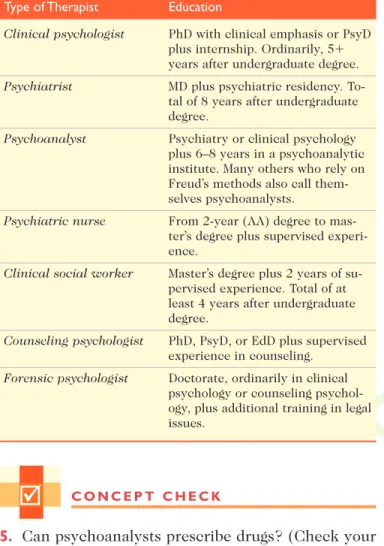
Table 1.1 compares various types of mental health professionals.
C O N C E P T C H E C K
5. Can psychoanalysts prescribe drugs? (Check your answer on page 17.)
Service Providers to Organizations
Psychologists also work in business, industry, and school systems in some capacities that might be unfa-miliar to you, doing things you might not think of as psychology. The job prospects in these fields have been good, however, and you might find these fields interesting.Industrial/Organizational Psychology
The psychological study of people at workis known
asindustrial/organizational (I/O) psychology. It deals
with issues you might not think of as psychology, such as matching the right person with the right job, train-ing people for jobs, developtrain-ing work teams, determin-ing salaries and bonuses, providdetermin-ing feedback to
workers about their performance, planning an organi-zational structure, and organizing the workplace so that workers will be both productive and satisfied. I/O psychologists study the behavior of both the individ-ual and the organization, including the impact of eco-nomic conditions and government regulations. We shall consider work motivation in chapter 11.
Here’s an example of a concern for industrial/ organizational psychologists (Campion & Thayer, 1989): A company that manufactures complex elec-tronic equipment needed to publish reference and re-pair manuals for its products. The engineers who de-signed the devices did not want to spend their time writing the manuals, and none of them were skilled writers anyway. So the company hired a technical writer to prepare the manuals. After a year she re-ceived an unsatisfactory performance rating because the manuals she wrote contained too many technical errors. She countered that, when she asked various engineers in the company to check her manuals or to explain technical details to her, they were always too busy. She found her job complicated and frustrating; her office was badly lit, noisy, and overheated; and her chair was uncomfortable. Whenever she mentioned any of these problems, however, she was told that she “complained too much.”
In a situation such as this, an industrial/organiza-tional psychologist can help the company evaluate the problem and develop possible solutions. Maybe the company hired the wrong person for this job. If so, they should fire her and hire some expert on electri-cal engineering who is also an outstanding writer and likes a badly lit, noisy, overheated, uncomfortable of-fice. However, if the company cannot find or afford such a person, then it needs to improve the working conditions and provide the current employee with more training or more help with the technical aspects of the job.
When a company criticizes its workers, I/O psy-chologists try to discover whether the problem is poor workers or a difficult job. Depending on the answer, they then try to improve the hiring decisions or im-prove the working conditions.
C R I T I C A L T H I N K I N G
A S T E P F U RT H E R
I/O Psychology
Industrial/organizational psychologists usually consult with business and industry, but suppose they were called on to help a university where certain professors had complained that “the students are too lazy and stupid to understand the lectures.” How might the I/O psychologists react?
TABLE 1.1 Several Types of Mental Health Professionals
Type of Therapist Education
Clinical psychologist PhD with clinical emphasis or PsyD plus internship. Ordinarily, 5 years after undergraduate degree.
Psychiatrist MD plus psychiatric residency. To-tal of 8 years after undergraduate degree.
Psychoanalyst Psychiatry or clinical psychology plus 6–8 years in a psychoanalytic institute. Many others who rely on Freud’s methods also call them-selves psychoanalysts.
Psychiatric nurse From 2-year (AA) degree to mas-ter’s degree plus supervised experi-ence.
Clinical social worker Master’s degree plus 2 years of su-pervised experience. Total of at least 4 years after undergraduate degree.
Counseling psychologist PhD, PsyD, or EdD plus supervised experience in counseling.
Forensic psychologist Doctorate, ordinarily in clinical psychology or counseling psychol-ogy, plus additional training in legal issues.
Ergonomics
Many years ago, my son Sam, then about 16 years old, turned to me as he rushed out the door and asked me to turn off his stereo. I went to the stereo in his room and tried to find an on–off switch or a power switch. No such luck. I looked in vain for the manual. Finally, in desperation I had to unplug the stereo.
Learning to operate our increasingly complex ma-chinery is one of the perennial struggles of modern life. Sometimes, the consequences can be serious. Imagine an airplane pilot who intends to lower the landing gear and instead raises the wing flaps. Or a worker in a nuclear power plant who fails to notice a warning signal. In one field of psychology, an
ergono-mist, or human factors specialist, attempts to
facili-tate the operation of machinery so that ordinary peo-ple can use it efficiently and safely. The term ergonomics is derived from Greek roots meaning “laws of work.” Ergonomics was first used in military settings, where complex technologies sometimes re-quired soldiers to spot nearly invisible targets, under-stand speech through deafening noise, track objects in three dimensions while using two hands, and make life-or-death decisions in a split second. The military turned to psychologists to determine what skills their personnel could master and to redesign the tasks to fit those skills.
Ergonomists soon applied their experience not only to business and industry but also to everyday de-vices. As Donald Norman (1988) pointed out, many intelligent and educated people find themselves un-able to use all the features on a camera or a mi-crowave oven; some even have trouble setting the time on a digital watch.
At various universities the ergonomics program is part of the psychology department, engineering, or
both. Regardless of who administers the program, er-gonomics necessarily combines features of psychol-ogy, engineering, and computer science. It is a grow-ing field with many jobs available.
School Psychology
Many if not most children have academic problems at one time or another. Some children have trouble sit-ting still or paying attention. Others get into trouble for misbehavior. Some have specialized problems with reading, spelling, arithmetic, or other academic skills. Other children master their schoolwork quickly and become bored. They too need special attention.
School psychologists are specialists in the
psy-chological condition of students, usually in kinder-garten through the 12th grade. Broadly speaking, school psychologists identify the educational needs of children, devise a plan to meet those needs, and then either implement the plan themselves or advise teachers how to implement it.
School psychology can be taught in a psychology department, a branch of an education department, or a department of educational psychology. In some countries it is possible to practice school psychology with only a bachelor’s degree. In the United States the minimum is usually a master’s degree, but job oppor-tunities are much greater for people with a doctorate degree, and a doctorate may become necessary in the future. Job opportunities in school psychology have been strong and continue to grow. Most school psy-chologists work for a school system; others work for mental health clinics, guidance centers, and other in-stitutions.
Table 1.2 summarizes some of the major fields of psychology, including several that have not been discussed.
Should You Major
in Psychology?
Can you get a job if you major in psychology? Psy-chology is one of the most popular majors in the United States, Canada, and Europe. So if psychology majors cannot get jobs, a huge number of people are going to be in trouble!
The bad news is that few jobs specifically adver-tise for college graduates with a bachelor’s degree in psychology. The good news is that an enormous vari-ety of jobs are available for graduates with a bachelor’s degree, not specifying any major. Therefore, if you earn a degree in psychology, you will compete with history majors, English majors, astronomy majors, and everyone else for jobs in government, business, and industry. According to one survey, only 20 to 25% of people who graduated with a degree in psychology ❚ Ergonomists help redesign machines to make them easier and
safer to use. An ergonomist uses principles of both engineering and psychology.
took a job closely related to psychology, such as per-sonnel work or social services (Borden & Rajecki, 2000). Still, many other jobs were good ones, even if they were not in psychology.
Even if you get a job that seems remote from psy-chology, your psychology courses will have taught you much about how to evaluate evidence, organize and write papers, handle statistics, listen carefully to what people say, understand and respect cultural differ-ences, and so forth. You will, of course, also gain use-ful background in your other courses. Regardless of your major, you should develop your skills in commu-nication, mathematics, and computers. (If you don’t have those skills, you will work for someone who does.)
Psychology also provides a good background for people entering professional schools. Many students
major in psychology and then apply to medical school, law school, divinity school, or other programs. Find out what coursework is expected for the professional program of your choice and then compare the course-work required for a psychology major. You will proba-bly find that the psychology major is compatible with your professional preparation.
If you want a career as a psychologist, you should aspire to an advanced degree, preferably a doctorate. A doctorate will qualify you to apply for positions as a college professor or, depending on your area of spe-cialization, jobs in hospitals, clinics, private practice, school systems, industry, or research. An increasing percentage of doctorate-level psychologists now work in business, industry, and the military doing research related to practical problems. If you are a first- or second-year college student now, it is hard to predict TABLE 1.2 Some Major Specializations in Psychology
Specialization General Interest Example of Interest or Research Topic
Biopsychologist Relationship between brain and behavior What body signals indicate hunger and satiety?
Clinical psychologist Emotional difficulties How can people be helped to overcome severe anxiety?
Cognitive psychologist Memory, thinking Do people have several kinds of memory?
Community psychologist Organizations and social structures Would improved job opportunities decrease psychological distress?
Counseling psychologist Helping people make important decisions Should this person consider changing careers?
Developmental psychologist Changes in behavior over age At what age can a child first distinguish between appearance and reality?
Educational psychologist Improvement of learning in school What is the best way to test a student’s knowledge?
Environmental psychologist How noise, heat, crowding, etc. affect behavior What building design can maximize the productivity of the people who use it?
Ergonomist Communication between person and machine How can an airplane cockpit be redesigned to increase safety?
Evolutionary psychologist Evolutionary history of behavior Why do men generally show more sexual jealousy than women?
Industrial/organizational psychologist People at work Should jobs be made simple and foolproof or interesting and challenging?
Learning and motivation specialist Learning in humans and other species What are the effects of reinforcement and punishment?
Personality psychologist Personality differences Why are certain people shy and others gregarious?
Psychometrician Measuring intelligence, personality, interests How fair are current IQ tests? Can we devise better tests?
School psychologist Problems that affect schoolchildren How should the school handle a child who regularly disrupts the classroom?
Social psychologist Group behavior, social influences What methods of persuasion are most effective for changing attitudes?
what the job market will be by the time you finish an advanced degree. If you are just looking for a safe, se-cure way to make a living, psychology offers no guar-antees. A career in psychology is for those whose ex-citement about the field draws them irresistibly to it.
For more information about majoring in psychol-ogy, prospects for graduate school, and a great variety of jobs for psychology graduates, visit either of these websites:
www.drlynnfriedman.com/ www.apa.org/students/
I N C L O S I N G
Types of Psychologists
An experimental psychology researcher, a clinical psychologist, an ergonomist, and an industrial/organi-zational psychologist are all psychologists, even though their daily activities have little in common. What does unite psychologists is a dedication to progress through research.
I have oversimplified this discussion of the vari-ous psychological approaches in several ways. In par-ticular, biological psychology, cognitive psychology, social psychology, and the other fields overlap signif-icantly. Nearly all psychologists combine insights and information gained from a variety of approaches. To understand why one person differs from another, psychologists combine information about biology, learning experiences, social influences, and much more.
As we proceed through this book, we shall con-sider one type of behavior at a time and, generally, one approach at a time. That is simply a necessity; we cannot talk intelligently about many topics at once. But bear in mind that all these processes do ultimately fit together; what you do at any given moment de-pends on a great many influences. ❚
Summary
The page number after an item indicates where the topic is first discussed.
• What is psychology? Psychology is the systematic study of behavior and experience. Psychologists deal with both theoretical and practical questions. (page 3)
• Six generalities. Almost any statement in psychol-ogy depends on many factors, and few statements apply to everyone all the time. Research progress depends on good measurement. Correlation does not mean causation. People differ from one another because of heredity and environment. The best
predictor of future behavior is past behavior. Some conclusions in psychology are based on stronger ev-idence than others. (page 3)
• Determinism–free will. Determinism is the view that everything that occurs, including human be-havior, has a physical cause. That view is difficult to reconcile with the conviction that humans have free will—that we deliberately, consciously decide what to do. (page 5)
• Mind–brain. The mind–brain problem is the ques-tion of how conscious experience is related to the activity of the brain. (page 6)
• Nature–nurture. Behavior depends on both nature (heredity) and nurture (environment). Psycholo-gists try to determine the influence of these two fac-tors on differences in behavior. The relative contri-butions of nature and nurture vary from one behavior to another. (page 7)
• Research fields in psychology. Psychology as an academic field has many subfields, including bio-logical psychology, learning and motivation, cogni-tive psychology, developmental psychology, and so-cial psychology. (page 8)
• Psychology and psychiatry. Clinical psychologists have either a PhD, PsyD, or master’s degree; chiatrists are medical doctors. Both clinical psy-chologists and psychiatrists treat people with emo-tional problems, but psychiatrists can prescribe drugs and other medical treatments, whereas in most states psychologists cannot. Counseling psy-chologists help people deal with difficult decisions; they sometimes but less often also deal with psy-chological disorders. (page 12)
• Service providers to organizations. Nonclinical fields of application include industrial/organizational psychology, ergonomics, and school psychology. (page 13)
• Job prospects. People with a bachelor’s degree in psychology enter a wide variety of careers or con-tinue their education in professional schools. Those with a doctorate in psychology have additional pos-sibilities depending on their area of specialization. In psychology, as in any other field, job prospects can change between the start and finish of one’s ed-ucation. (page 14)
Answers to Concept Checks
1. Any attempt to make discoveries about nature pre-supposes that we live in a universe of cause and ef-fect. (page 8)
2. Dualism conflicts with the principle of the conser-vation of matter and energy. A nonmaterial mind could not influence anything in the universe. (page 8)
3. a. Developmental psychology. b.Social psychology and cross-cultural psychology. c. Cognitive psy-chology. d. Biological psychology. e. Learning and motivation. (page 11)
4. By losing blood, they also lose salt, and a defi-ciency of salt triggers a craving for salty tastes. (page 11)
5. Most psychoanalysts can prescribe drugs because most are psychiatrists, and psychiatrists are med-ical doctors. However, in most states, those who are not medical doctors cannot prescribe drugs. (page 13)
• How did psychology get started?
• What were the interests of early psychologists?
• How has psychology changed over the years? Imagine yourself as a young scholar in 1880. Enthusi-astic about the new scientific approach in psychology, you have decided to become a psychologist yourself. Like other early psychologists, you have a background in either biology or philosophy. You are determined to apply the scientific methods of biology to the prob-lems of philosophy.
So far, so good. But what questions will you ad-dress? A good research question is both interesting and answerable. (If it can’t be both, it should at least be one or the other!) In 1880 how would you choose a research topic? You cannot get research ideas from a psychological journal because the first issue won’t be published until next year. (And incidentally, it will be all in German.) You cannot follow in the tradition of previous researchers because there haven’t been any previous researchers. You are on your own.
Furthermore, in the late 1800s, psychologists were not sure which questions were answerable. Sometimes, psychologists today are still unsure: Should we study interesting questions about consciousness, or should we concentrate on observable behavior? Many of the
changes that have occurred during the history of psy-chology have reflected investigators’ decisions about which questions are answerable.
In the next several pages, we shall explore some of these changes in psychological research, including projects that dominated psychology for a while and then faded from interest. We shall discuss additional historical developments in later chapters. Figure 1.4 outlines some major historical events inside and out-side psychology. For additional information about the history of psychology, visit either of these websites:
www.cwu.edu/~warren/today.html www.uakron.edu/ahap
The Early Era
At least since Aristotle (384–322 B.C.), philosophers and writers have debated why people act the way they do, why they have the experiences they do, and why one person is different from another. Without dis-counting the importance of these great thinkers, sev-eral 19th-century scholars wondered whether a scien-tific approach would be fruitful. Impressed by the great strides made in physics, chemistry, and biology, they hoped for similar progress in psychology by con-ducting research.
18
M O D U L E
1.2
Psychology Then and Now
World Events
Psychology Events Year
European Renaissance
c. 1000 1400s–1500s 1600s 1649 1740s 1776 late 1700s 1843 1856 1859 1879 1885 1887 1890 1892 1896 1900 1903 1905 1907 1908
Arab philosopher Ibn al-Haythem
discovers that vision depends on light striking the eye, not on sending out sight rays. This is the first discovery about psychology based on scientific research.
Discovery of
color blindness René Descartes’s primary philosophical writings about the mind
David Hume and David Hartley pioneer the British associationist
movement, which formulates questions and theories that mold
much of later psychological research Mesmer introduces hypnosis
Wundt establishes first psychology laboratory
Ebbinghaus’s
Memory
Founding of American Journal of Psychology
William James’s Principles of Psychology First convention of
American Psychological Association
University of Pennsylvania establishes first psychological clinic
Freud’s The Interpretation of Dreams; rise of psychoanalysis
Binet introduces first practical IQ test Dorothea Dix campaigns
for better treatment of the mentally ill U.S. Declaration
of Independence
Mendel discovers principles ofgenetics
Tchaikovsky's
“The Nutcracker” First color motion
picture with sound Model T Ford introduced First airplane flight
Darwin's Origin of Species