Graham County
Community Health Assessment
2008
By Alicia Parham
A Master's Paper submitted to the faculty of the University of North Carolina at Chapel Hill
In partial fulfillment of the requirements for the degree of Master of Public Health in
the Public Health Leadership Program.
Chapel Hill
HEAlTHY CAROLINIANS Graham County
Introduction
Every four years the State of North Carolina Department of Health and Human Services Branch
requires each county public health department to complete a comprehensive community health
assessment (CHA). This cycle is administered by the Healthy Carolinians/Education
Branch/CDI Section. The Graham County Department of Public Health conducted the 2008
community health assessment in collaboration with the Graham County Healthy Carolinians.
The community health assessment is a diagnosis system to determine the greatest indicators
pertaining to the health of the community and what mechanisms and resources are available to
improve on the identified health disparities. The assessment also serves as a guide for the needs
Every four years the State of North Carolina
Department of Health and Human Services
Branch requires each county public health
department to complete a comprehensive
community health assessment (CHA). The
Graham County Department of Public Health
conducted the
2008community health
assessment in collaboration with the Graham
County Healthy Carolinians. The community
health assessment is a diagnosis system to
determine the greatest indicators pertaining to
the health of the community and what
mechanisms and resources are available to
improve on the identified health disparities.
The assessment also serves as a guide for the
needs of innovative new programs that will
enhance the health of the population in
Graham County.
Process/CHA Team
The Graham County Department of Public
Health initiated the process of the community
health assessment in September of
2007.The
community health assessment team was
comprised of staff from the Graham County
Department of Public Health and committee
members from the Healthy Carolinian's of
Graham County. The assessment was created
using both primary and secondary data
collection. Qualitative data was gathered using
listening
sessions
and
key
leadership
interviews. Listening sessions were conducted
on ten different groups in the community. A
survey using a convenience sampling method
provided the quantitative primary data for the
report.
The assessment team and a local
consultant distributed the surveys to several
locations within the community. Over
1,500surveys were given out with a return of
538to
provide for data analysis.
History
Graham County was formed from the eastern
part of Cherokee County in
1872to make
enforcement of the law and access to the courts
more uniform and accessible for the families
helped with the passage of the act to form the
county.
Geography
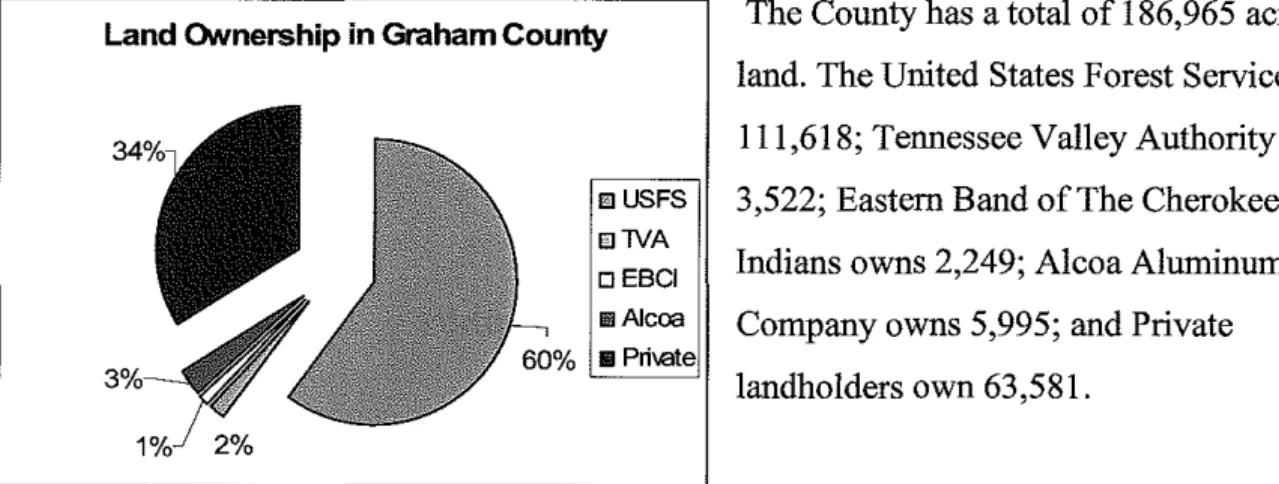
The County has a total of
186,965acres ofland.
The United States Forest Service owns
111,618 (6o%);Tennessee Valley Authority owns
3,522 (2%);Eastern Band of The Cherokee Indians
owns
2,249 (1%);Alcoa Aluminum Company
owns
5,995 (3%);and Private landholders own
63,581 (34%).
Demographics
Graham County is a small rural county with a
population of
7,993according to the
2000U.S.
Census. This increase demonstrates an eleven
percent population growth from
1990to
2000.The majority of the population is white
(91.9%)and American Indian
(6.8%).Fifty-one
percent of the population is female and
forty-nine percent is male. Graham County is seeing
a trend of an increase in the Hispanic or Latino
(of any race) population.
The population
growth increased from
29individuals in the
1990
U.S. Census to
60in the
2000Census and
was estimated to be
72or
0.9%in
2006.Socioeconomics
Graham County is designated by the North
Carolina Department of Commerce as Tier
1(Most Economically Distressed)
and At Risk
(At-Risk counties are those at risk of becoming economically distressed. They rank between the worst 10 percent and 25 percent of the nation'scounties)
by
the
Appalachian
Regional
Commission. Reports for July
2008showed
Graham County ranked as third in North
Carolina for the highest unemployment rate.
This was the second largest concern of survey
respondents. The top three non-seasonal
employers for Graham County are Stanley
Furniture, Graham County Schools, and
Graham County Government.
The median household income for the county
ranked
96thout of
100counties in North
$23,763
with a ranking of
79th.In
2005,North
Carolina reflected that
14.9percent of the
population was in poverty while Graham
County had a
20.2percent poverty level. In
2003,
the county had
25.5%of its children
living in poverty as compared to the
19.1%in
North Carolina.
In
2005,Graham County
Schools reported
52.3%children in the schools
were enrolled in Free/Reduced Price School
Meals. This compared to North Carolina with
47·7%.
Education
Graham County has great confidence in its
schools. Ten licensed Child Care Facilities exist
within the county offering
382slots. Mt. Nebo
Christian Academy is the only private school in
Graham County. Graham County Schools have
two campuses one with Pre-K
-6thgrade and
the other with one Pre-K, Middle
(7-8)and
High
(9-12).Graham County ranked
115Oast)
in local per pupil expenditures for
2005at
$602
as compared to the state average of
$1,636.
The drop-out rate for any reason was
24
in
2004-2005and increased to
30in
2006-2007in the school. Twenty-four of the
30that
dropped out in
2006-2007were due to
attendance issues. The school nurse to student
ratio was
1.5to
1,266including pre-k. In
2006,education levels for ages
25and older were
73%for individuals with at least a High School
Diploma and
12.3%for adults with at least a
Bachelor's Degree.
Tri-County Community College is an accredited
college operating under the North Carolina
Community College System. A satellite campus
is offered in Graham County providing
numerous resources to the community for
residents to obtain a two-year degree,
certificate or diploma in a program of study.
Environment
The natural environment of Graham County
offers an abundance of activities for the
naturalist and for recreationists. For the past
two years, Graham County residents have been
experiencing problems with their water
supplies due to the drought conditions in
Western North Carolina.
In an effort to
enhance the protection of water supplies in the
county, the Graham County Department of
Public Health contracted with the Wastewater
Discharge Elimination Program (WaDE) in
2003
to survey the Tallulah/Sweetwater Water
Shed area to identify failing or straight piping
wastewater systems. Air quality in Graham
County was within normal limits on ozone
violations for
2005-2007.A September,
2008news release from the North Carolina
Department of Health and Human Services
announced that routine sampling of fish from
lakes across the state has found high mercury
levels in Walleye fish in Santeetlah and
Fontana lakes.
Resources
The most pristine resource available in Graham
County is the natural beauty and serenity of the
mountains that encompasses it.
Mountain
culture is another one of the greatest resources.
The natural beauty and abundance of forest
lands offer miles of streams for fishing and
several walking trails.
The walking trails
provide opportunity for most all physical
fitness levels. Another opportunity for walking
includes a one mile walking trail located at the
Graham County Middle/High School campus
and a walking trail at the Stecoah Valley
Center.
Without funds to provide for a full time rescue
squad and fire
department, individuals
volunteer their time in these roles to protect
the citizens of the county.
Graham County lacks sufficient health care
providers and a hospital. A ratio of
1to
2,705individuals for licensed Medical Doctors exists
in the county as compared to North Carolina at
1
to
1,056.In
2007,the EMS received
1,531calls for ambulance requests. Specialty care is
not available in Graham County. With the
current supply of dentists, the ratio for dentist
to the population of Graham County is
1.14to
Mental health and substance abuse services are
provided by Appalachian Counseling in
Graham County.
Opportunities for Service
The faith community is comprised of
46churches
with
denominations
including
Baptist,
Methodist,
Catholic,
Lutheran,
Episcopal and Church of God. Other resources
for
activities
and
membership
include
organized civic groups or organizations and
sporting activities.
The Stecoah Valley Center has expanded to be
one of the richest resources in the county for
cultural and artisan information and events.
The center sponsors
An Appalachian Evening
beginning on the last Saturday in June through
the Labor Day weekend. Tourism is a major
contributor to the economy of Graham County.
Graham County is currently known among
motorcyclists for the beginning of an 11-mile
highways section called "The Dragon's Tail."
Other tourist attractions include national and
state forest land, Cherohala Skyway, some of
the highest and most remote mountains east of
the Mississippi River, Fontana Dam, fall
foliage, and the Chief Junaluska Memorial.
Data Analysis
Insurance
Graham County has a high percentage of
individuals that do not have adequate health
insurance. When an individual does not have
adequate health insurance they are not as likely
to seek preventive medical care as those with
insurance. In the
2004-2005state fiscal year
Graham County had
27%of the total
population enrolled in Medicaid. In addition to
that,
20.8%are uninsured, and
15%are
enrolled in N.C. Health Choice. In
2002,an
estimated
1,707individuals aged and disabled
in Graham County were enrolled in Medicare
Hospital
and/or
Supplemental
Medical
Insurance.
Leading Causes of Death
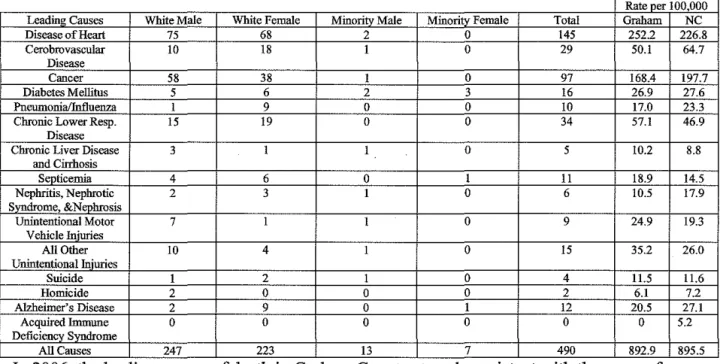
In
2006,the leading causes of death in Graham
and 5· Homicide. The total for
alldeaths from
2001-2005
were
490.Of these disease of the
heart totaled
145.Heart disease, diabetes, and
cerebrovascular disease can often be treated or
prevented with physical activity and nutrition.
Lack of recreation facilities in the county is a
probable contributor to the high rates of these
diseases.
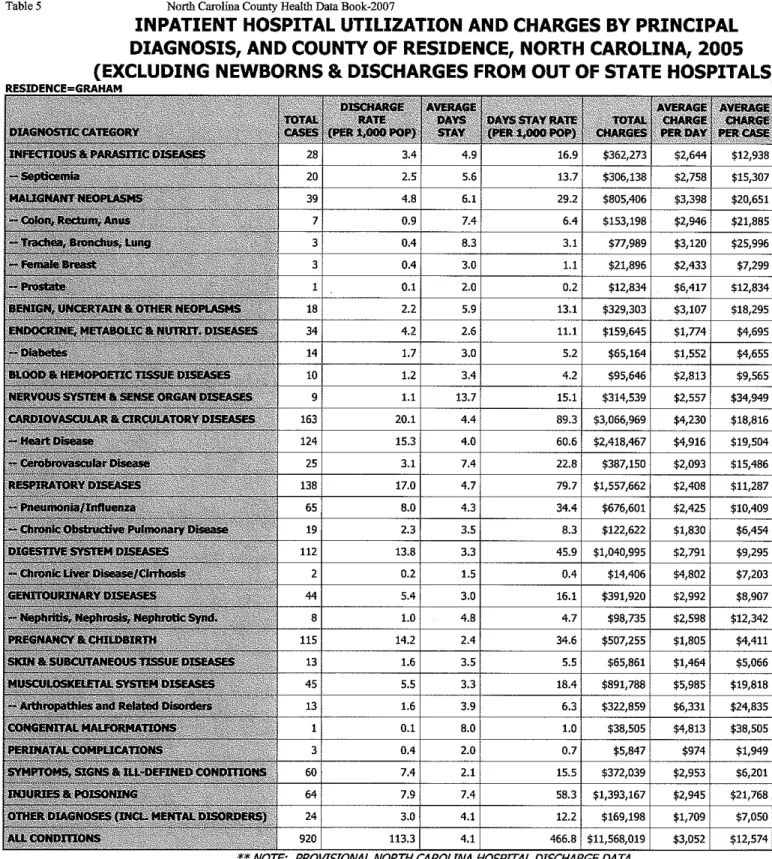
Hospitalizations
Cardiovascular and circulatory diseases are
also the leading cause of hospitalization for
residents in Graham County. These diseases
are mostly preventable. However, low levels of
education, lack of access to health care means
people often do not know how to control their
health problems, resulting in hospitalization
due to poor home care. Respiratory disease is
another primary cause of hospitalization. Poor
home care is often the cause of respiratory
disease exacerbations that then require
hospitalization.
Trends
Graham County has a low prevalence of low
birth weight births as compared to North
Carolina. The pregnancy rate for ages
15-19is
high compared to North Carolina. Graham
County has an average of
95-100live births
each year. With the increase of education and
awareness campaigns for "Back to Sleep" the
infant mortality rates remain low as compared
to North Carolina.
Heart disease rates are higher in Graham
County than in North Carolina, but both heart
disease and diabetes rates have decreased since
1997.
Cancer rates continue to increase in
Graham County except for breast and prostate
cancer incidence which has decreased since
1996.
Although overall cancer incidence has
increased cancer death rates have decreased.
Graham County has one of the highest
unintentional motor vehicle injury death rates
in the state. With only
4.9miles of four lane
road in Graham County most of the roads are
still rural and extremely curvy due to mountain
terrain.
The trend of overweight children in the county
potentially cost Graham County over 174
million dollars by the time they retire in
medical care and lost productivity.
Health
Fairs at the Grallam County Schools show a
peak of overweight in grades
6thand
7th.Listening Sessions
To gain an understanding of the views of the
community the Team facilitated listening
sessions. A Sense of Community was the top
strength listed by the groups. Next was the
natural beauty and resources of the mountains,
public services, small county, county people,
faith, family and the education/school systems
were top on the lists.
In discussion about weaknesses the groups
expressed recreation activities as number one
and second was the need for after-hour care
and better access to medical providers. Next
on the list included affordable health care,
unemployment, rate of salaries, poverty rate,
drug use, county government, and many others
concerns.
In discussion about health issues the groups
each expressed a growing concern. The lack of
affordable available health care was the
number one concern. Other health concerns
imposed the continued use of tobacco products,
substance abuse, and the access to mental
health. Cancer was only mentioned in 4 out of
10 groups.The groups referenced local providers, health
department and other providers from 45
minutes to six hour drives as to how they seek
medical care. Three of the groups referenced
the local prayer chain as an avenue when they
need medical care.
For needed resources the number one request
was for an organized recreation center. Other
resources that were seen as a need included
available, affordable health care, urgent
care/hospital, 24/7 transportation, assistance
for seniors, internet services and affordable
housing.
The most important issues were the need for a
recreation center and access to care.
Disparities
Because Graham County is 92% white, racial
disparities are difficult to identify. Diabetes
mortality rate among American Indians is the
racial disparity that is most obvious. Of
16diabetes deaths in Graham County, 5 of those
(31%) were non-white. Survey responses also
show that 11.4% of Native Americans feel they
are in poor health, compared to
6.6%of
Caucasians.
A disparity is present for the
increasing Latino population due to high rates
of uninsured, limited availability of translation
services, and fear of seeking health care due to
being undocumented. This all leads to high
rates of Emergency Room and public health
use for health care resulting in little case
management and poorly controlled medical
problems, including increased transmission of
communicable diseases.
Other disparities are present in the low income
levels for the population and the education
expenditures per pupil for public schools. Each
limits the levels of education attainment of the
citizens. Low education and low income links
the disparity to low medical care and
inadequate health insurance.
Emerging Issues
With the influx of undocumented Latinos, the
county has seen an increase in need for care at
the public health department, need for
translation services that are often not available,
more people living in poverty, more children
and adults without insurance, and an increase
in transmission of communicable diseases.
Mercury levels in local lakes are an
environmental health concern of the citizens.
Many locals enjoy eating fish from the county's
lakes.
Childhood Obesity has reached epidemic status
nationwide. Graham County is no different.
Asthese children grow into adulthood, they will
have shorter life-spans than that of their
parents.
This is the first time this has
happened in history.
Top Two Identified Priorities
Priorities to be address by community action
teams include:
1) Family Fitness/Recreation
2)Access to Care
Action Teams
Actions Teams will be organized from
volunteers within the community that are
willing to work on the identified priorities. A
Family Fitness Team is already in existence
within the Healthy Carolinians of Graham
County. A team for access to care will be
recruited and organized. The Chair-person of
the team will lead the campaign and approach
of attaching the issue and organizing a strategic
plan to better the health of the population of
Graham County. With the assistance of the
Healthy Carolinians Coordinator the chair will
develop a team of citizens with ambition and
compassion to see change with the identified
priority.
Community Awareness
Results of the Community Health Assessment
have been presented to the community using
newspaper articles, one-on-one meetings with
community leaders and presentations to civic
groups.
Results were presented to the
Community Health Assessment Team for
review and to determine the disparities and
then identify the priorities.
Conclusion
It
is understood that community health
assessment is an ongoing process.
Much
information has been gathered and revelations
have been made.
The Graham County
Table of Contents
1. Community Health Team---5 2. Collecting Data ---7 3. Graham County History---1 0 4. Graham County Geography---1 0 5. Graham County Demographics---12 6. Socioeconomics---14 7. Education---17
-Day Cares and Preschool 17
-Public and Private Schools K-12 17
-Colleges 19
8 . Environment---2 0 9. Resources---2 3
-Natural Beauty and Recreation 23
-Opportunities for Physical Activities 24
-Health Services 25
-Opportunities for Services 28
-Arts 29
-Tourism 29
1 0. Data Analysis---3 0
-Demographic Comparison 30
-Insurance 30
-Leading Causes of Death 32
-Hospitalization 36
-Trends 38
-Live Births and Teen Pregnancy Trends 39
-Death Rate Trends 40
-Cancer Incidence Rates and Death Rates Trends 41 -Medical Provider to Population Ratio Trends 42
-Youth Death Rate Trends 43
-Unintentional Injury and Motor Vehicle Death Rates Trends 44
-Suicide and Homicide Rates Trends 45
-Infant Mortality Rates Trends 46
-Overweight Rates in Children Aged 2-11 Trends 4 7 11. Listening Sessions and Key Informant Interviews---49
-Strengths 49
-Weaknesses 51
-Health 53
-Needed Resources/Activities 55
-Communications 56
-Most Important Issues 57
12. Selecting Health Priorities---58
- Top Two Identified Disparities 59 - Emerging Issues 60 - Identified Priorities 61 - Proposed Actions 61 13. Leadership Actions---62
13. Conclusion---62
14. Appendix---64
15 . Resources---90
List of Appendixes
Appendix A- Community Assessment Team 65
Appendix B-Community Health Assessment Timeline 66
Appendix C-Listening Questions 67
Appendix D-Convenience Surveys Distribution 69
Appendix E-Maps of County 70
Appendix F-Churches in Graham County 71
Appendix G-Civic Groups/Organizations 73
Appendix H-Hiking Trails in Graham County
74
Appendix !-Graham County Department of Public Health 75 Appendix J-NC Statewide County Trends in Key Health Indicators 77
Appendix K-Pride Survey Graphs 80
Appendix L-The Economic Costs ofUnhealthy Lifestyles in Graham 82
Community Health Team
The Graham County Department of Public Health initiated the process of the community health
assessment in September of 2007. The first step in the process was to form an organized assessment team that would represent all aspects of the population including work force,
businesses, schools, government, nationalities, faith base, and civic groups. Healthy Carolinians
of Graham County (HCGC) received certification on September 7, 2007 and was awarded a certificate on October 12. The community health assessment team was comprised of staff from the Graham County Department of Public Health and committee members from the Healthy
Carolinians of Graham County (See Appendix A). The public health department contracted with an individual to administer surveys and input data into Epi Info for analysis.
The Health Director and Health Promotions Coordinator for the public health department
presented the requirements and oriented the Graham County Board of Health and the Graham County Manager on the health assessment. This included explaining to the Board and manager the function of the health assessment, how the community will be involved, how the results will
benefit the health of the county and the requirements of the health department and Healthy
Carolinians. The Board of Health approved the design of the process and surveys.
The Assessment Team met every two months, and at times more frequently, to establish a time
thought to be the most important issues and concerns. Based on findings from the listening
sessions and key leadership interviews the team developed a survey tool for data collection.
Listening session and survey trends were reviewed by the Health Director and Healthy
Carolinians Coordinator. The data was then analyzed and reported in the following document.
Listening session groups were chosen to try to represent all income brackets, education levels,
and races/ethnic groups. A Snowbird Community listening group was planned, but not
completed and no Hispanic listening session was performed. Native Americans were present in
other listening sessions, but racial bias may be a factor in the data because no Hispanics
participated in those. Survey data did not need to be weighted because the demographics of the
surveys so closely matched the demographics ofthe county. The bias in the survey data is the
use of convenience sampling instead of random sampling. Data entry was performed by more
than one person, and answers were entered differently by each. The surveys were not fully
Collecting Data
This report was created using both primary and secondary data collection. Qualitative data was
gathered using listening sessions and key leadership interviews. The listening sessions were
conducted using the same set of questions for each group (See Appendix C). The facilitation and
presentation of the questions changed as the team realized problems and possible ways to
improve on getting better and more qualitative responses from the groups. Listening sessions
were conducted on ten different groups in the community.
Listening Session Groups
1. Community Health Assessment Team
-this included the Healthy Carolinians Committee members 2. Graham Revitalization Economic Action
Team--this was at their annual meeting
3. Graham County Government Department Head Meeting 4. Graham County Board of Health
5. Graham County Department of Public Health Staff Meeting 6. Graham County Elementary, Middle and High School Faculty
-this was based on a volunteer group 7. High School Honor Students
-this group was chosen by faculty at the school 8. Stanley Furniture Employees
-group was chosen by nurse at the facility 9. Beta Sigma Phi civic group
10. Appalachian Regional Commission (Mental Health) Staff
The first session was completed by handing the assessment team the questions and asking for a
response. The facilitators for this session were the Healthy Carolinians Coordinator and
Director. The session allowed for the team to see how the questions will be presented and make
comments or recommendations for change to the questions and presentation style. The next
session was with the Graham Revitalization Economic Action Team (GREAT). The mission for
recreation needs of Graham County residents, while preserving our cultural heritage, natural
resources, and instilling pride in our conununity and place. During their annual membership
meeting the Director and Coordinator for Graham Healthy Carolinians presented the process of a
conununity health assessment and how the report can help all agencies and individuals within the
county. They then distributed a list of the questions and requested each member and guest to
respond by writing their thoughts and conunents to the questions on the questionnaire. Although,
this group provided excellent insight to the questions, the team found that verbalization offered a
better understanding and a more qualitative response from the group.
The next session was with a local civic group during one of their regular scheduled meetings.
During this session one facilitator presented the information by reading the questions and then
writing the responses on post-it pads on the wall. After this meeting the team changed the
presentation style to utilize two facilitators and a power point presentation with the questions on
each slide. With the power point presentation the questions did not have possible probes below
them, but encouraged individual thought processes in the answers. As the facilitator presented
each question and encouraged responses, the other team member typed answers and specific
quotes into the power point for everyone to view. This type of facilitation for the listening
sessions seemed to be the best for ensuring responses were accurately recorded and was used for
the remaining sessions.
The second type of qualitative data collection was with key leadership interviews. These
interviews used the same questions as the listening sessions. The key leadership interviews were
Key Leadership Interviews
1. Graham County Transportation Director 2. Graham County Commissioner
3. Graham County Manager
4. Graham County Schools Superintendent
5. Graham County Agricultural Extension Director 6. Emergency Management Coordinator
7. Tri-County Community College Teacher
A survey using a convenience sampling method provided the quantitative primary data for the
report. The assessment team and a local consultant distributed the surveys to several locations
within the community. A list of where the surveys were given is provided in Appendix D. Over
1,500 surveys were given out with a return of 538 to provide for data analysis. The local
consultant did the input for the survey data into Epi Info (See Appendix M for survey).
Convenience Surveys were distributed to the following locations:
1. Day Care Employees and Parents
2. Anoual Graham County Rescue Squad Ramp Festival and Kids Fest 3. Graham County Meals on Wheels
4. Cedar Cliff Baptist Church 5. Snowbird Senior Center 6. Graham County Senior Center
7. Public Health Clients (including Hispanic with interpreters) 8. Appalachian Counseling Clients and Staff
9. Graham County Employees
10. Tri-County Community College Students and Faculty 11. Stecoah Valley Center and Community
12. Snowbird Health Services
13. Tallulah Valley Health Center Employees and Clients 14. Head Start Program
15. Individual Houses in Snowbird Community 16. Mt. Nebo Church
17. Stanley Furniture Employees 18. Snowbird Logging Employees
19. Dr. Patrick Kelley's Dental Office Employees
Graham County History
Graham County was formed from the eastern part of Cherokee County in 1872 to make
enforcement ofthe law and access to the courts more uniform and accessible for the families
who settled in the mountains ofWNC. It was named for William A. Graham, a senator who
helped with the passage of the act to form the county.
Early history finds only three white families Jiving in Graham County- the Crisps, the Hydes,
and the Rowans. Long before European settlers were given responsibility of governing
themselves, the area that would become Graham County was home to a large group of Cherokee
Indians. Part of the original Trail of Tears still exists in Graham County on a six-mile section of
road called Tatham Gap, which connects Graham and Cherokee counties. Graham County's
most famous Native American, Chief Junaluska, saved the life of President (then General)
Andrew Jackson at Horseshoe Bend. He was awarded 337 acres ofland, made a citizen of North
Carolina, and given$ 100 in recognition of his bravery.
Graham County Geography
Graham County is known for its tranquility, isolation and rugged mountain lands. Nestled in the
Great Smoky Mountains, Graham County offers the beauty and comfort that draw tourist and
new residents to the area. With elevations of the county ranging from I, 177 at the lowest point
to 5,560 feet at the highest point, the topography and slopes can change rapidly in a short
distance (Graham County, 2007). Over 80% of the land has a slope of9% or greater. Graham
County is located in the western part of North Carolina bordering Tennessee, and is surrounded
by mountains with the Unicoi Mountains to the West; the Snowbird Mountains to the South; and
River flows into the Little Tennessee River in the western section of the county
0N
elcome toGraham County, 2008). Appendix E shows a map ofthe county.
The rugged mountains and limited privately-owned land restrict the opportunity for residential
building and developmental business growth. Sixty-three percent of the land in the county is
nontaxable, presenting a small tax base and revenue for county government operations. The
graph below shows the total land ownership percentages for the county.
Land Ownership in Graham County The County has a total of 186,965 acres of
land. The United States Forest Service owns
111,618; Tennessee Valley Authority owns
3,522; Eastern Band of The Cherokee
Indians owns 2,249; Alcoa Aluminum
Company owns 5,995; and Private
landholders own 63,581.
2%
01 USFS
OJ1VA
oEBCI I!!IAlcoa 11 Private
Graph 1 Data Provided by the Graham Cmmty Mapping Department
The net assessed personal and real estate property tax in Graham County for 2005 to 2008
increased by a value of81,977,288. Table I illustrates the changes for each year.
Year
Net Assessed Personal and Real Estate Property
2005 683,601,936
2006 716,660,051
2007 7 46,858,599
2008 765,579,224
Table I Data Provided by the Graham County Tax Department
The small tax base has mixed opinions and views by residents and tourists as to its negative and
of the county allows for increased resources for tourisms and outdoor activities. Others see this
limitation as a negative, prohibiting increase in growth and development for the county. The graph below demonstrates the building permits and value of development from 2004 to 2007.
;:·
:§
·; $
.,
·-~ E
0 ~ ~
..
_go. E ~ z Graph 2Building Pennits 2004-2007 Construction Costs on Pennits
2004-2007 100 80 60 40 20 0
2004 2005 2006 2007
Year
Data from US Census
Graham County Demographics
Graph2a
Graham County is a small rural county with a population of7,993, according to the 2000 U.S.
Census. This increase demonstrates an eleven percent population growth from 1990 to 2000.
The growth rate is expected to be even smaller as indicated by the 2012 estimated population
rates.
Table 2
Year Population Estimates/
Census 1990 7,196
2000 7,993
2006 8,106
2007 8,275
2012 8,466
Median Age of Population N/A 42 43 44 45 Annual Growth Rate 0.5% 0.5%
The majority of the population is white (91.9%) and American Indian (6.8%). Fifty-one percent
of the population is female and forty-nine percent is male. The median age is 41.5 with most of
the population ranging from 25-54 (U.S. Census Bureau, 2000).
Population by Race Census 2000
92°/o .---4
Graph 3
Age 2004
Male
0-4 245
5-9 255
10-14 248
15-19 248
20-34 621
35-54 1101
55-64 562
65-84 584
84+ 54
Total 3918
Total Year 8045
Percent 49 I Table3
Oo/o
El White 7346 Ill Black or African
Arrerican 15 o Arrericcn lnd ian and
AlaskaNative547 OAsian13
• Native !-lawai ian & ot
Pacific Islander 1
E!J Some Other Race 'D
El Two or More Races 61
2000 U.S. Census
Mal e o t F emae a o IRtibA >Y lge
2005 2006
Female Male Female Male Female Male
221 237 213 245 219 246
240 262 243 258 239 266
255 247 248 249 255 248
215 236 224 232 227 230
616 606 596 600 593 597
1116 1095 1112 1098 1107 1112
582 577 595 584 606 580
752 591 757 603 766 614
130 58 133 66 141 68
4127 3909 4121 3935 4153 3961
8030 8088
51 49 I 51 49 I 51 49
h ttn :/I data.osbm. state. nc. us
2007 Female 226 238 251 239 590 1096 618 779 146 4183 8144
I 51
Graham County is seeing a trend of an increase in the Hispanic or Latino (of any race)
population. The population growth increased from 29 individuals in the 1990 U.S. Census to 60
in the 2000 Census and was estimated to be 72 or 0.9% in 2006 (US Census Bureau, Quick
department services due to need for translation and increases in un-reimbursed costs when
Latinos are undocumented.
Socioeconomics
Graham County is designated by the North Carolina Department of Commerce as Tier I (Most
Economically Distressed) and At Risk (At-Risk counties are those at risk of becoming economically
distressed. They rank between the worst 10 percent and 25 percent of the nation's
counties) by the Appalachian Regional
Commission.
Counties VVith Highest Unemployi'T'Jent. Rates July 2008
12.00o/o
10.00°/o
B.OOo/o
6.00°/o
4.00°/o
2.00°/o
Q_()()o/o
NC Employment Security Commission Graph4
Reports for July 2008 showed Graham County ranked third in North Carolina for the highest
unemployment rate. High unemployment rankings have plagued Graham County for years. This
was the second largest concern of survey respondents with 74.7% seeing this as a major problem
and 16.3% as somewhat of a problem. In the past twelve months the trend has held true with a
continuous increase. The July 2007 rate was reported at 6.8% and showed the year-to-date
unemployment insurance benefits paid in Graham County to be $1,912,033. As of September
2008, the total labor force for the county was 5,319 with 520 unemployed and a 9.8%
unemployment rate (The Employment Security Commission of North Carolina, 2008).
High unemployment rates lead to health problems due to higher rates of uninsured in the un- and
preventive care. The chronic stress of not being able to care for loved ones can also lead to
serious health conditions, such as diabetes, heart disease, and stroke. Those who are
underemployed often feel as though they cannot miss work when they are sick, or cannot leave
work for doctor visits. This leads to worsening of illness and spread of illness.
Commission 5
Graham County & North Carolina The top three non-seasonal employers for Graham
Unemployment Rates
10.0% 8.0% 6.0% 4.0% 2.0% 0.0%
s-
s-
ft
_s,"' "'"' ~-,~ 0~ ~ -,1P
# .#'
County are Stanley Furniture with 324 employees,
Graham County Schools with 224 full time
employees, 10 hourly and 60 substitute positions,
and Graham County Government with 117
employees. Fontana Village Resort ranks in the top with their seasonal employment for July at
153, but with a full time employment dropping to 50.
The median household income for the county ranked 96th out of 100 counties in North Carolina
at $28,695 in 2005 (NC Department of Commerce, 2007). In 2000, the per capita personal
income was at $19,587, ranking 91 ''in North Carolina. In 2005, the income was $23,763 with a
ranking of 79th. In 2005, North Carolina reflected that 14.9 percent of the population was in
poverty, while Graham County had a 20.2 percent poverty level (NC Department of Commerce,
2007). In 2003, the county had 25.5% of its children living in poverty as compared to the 19.1%
in North Carolina. In 2005, Graham County Schools reported 52.3% children in the schools
were enrolled in Free/Reduced Price School Meals. This compared to North Carolina with 47.7%
40.00% 30.00% 20.00% 10.00% 0.00%
Percent of Children in Poverty
2001 2002 2003 2004 2005
11!'1 Graham 111 North Carolina
I
The Annie E. Casey Foundation Grnph6
Of those surveyed, 69.2% felt that food assistance was either a major problem or somewhat of a
problem. Also, assistance with paying utilities was a major concern of 44.9% of respondents and
somewhat of a problem for 29.3%. These are both issues that one would expect to see in a
poverty-stricken area, such as Graham County. Graham County Department of Social Services,
the Church Mouse thrift store, Graham Help and Manna Food Bank are all working to combat
these issues.
Another concern expressed in the community was housing. Both Community Health Opinion
Surveys and listening sessions identified availability and use ofland as concerns. Affordable
houses and land are not available for those in the median and lower household income ranges.
Rental properties for those not receiving HUD are also difficult to find. Seasonal residents have
bought properties at much higher prices than most local residents can afford. In turn, appraised
values of neighboring properties to those seasonal homes have increased, creating hardships on
locals for establishing home ownership. The table below shows a median owner-occupied home
value of$97,893. This lower value is likely due to the high number of mobile homes in the area.
Housing Total
2007 Total Housing 5,483
2007 Median Value of Owner Occupied Housing $97,893
2007 Owner Occupied Housing 3,011
2007 Renter Occupied Housing 605
2007 Total Households 3,616
Education
Day Cares and Preschools
Ten licensed Child Care Facilities exist within the county, offering 382 slots (North Carolina
EDIS). In 2001, 160 Graham County children 0-12 were enrolled in regulated child care and in
2005, the enrollment increased to 209 (The Annie E. Casey Foundation). At this point there is
greater childcare capacity than is currently being used. These open slots are found in day care
centers. All pre-schools and after-school programs have waiting lists. Forty-one percent of
survey respondents feel that there is no problem with care for preschool children in Graham
County. The following is a list of licensed Child Care Facilities:
~A Kid's Castle
~A Kid's Place
~Amy's Ark Home (Home Day Care)
~ Backyard Preschool
~Eagle Knob
~Four Square 1
~Four Square 3
~The Haven (Home Day Care)
~ RHS Child Care
~ Snowbird Child Care
Public and Private K-12 Schools
Graham County has great confidence in its schools. Surveys show that 39% of respondents feel
there is no problem with schooling for Kindergarten through high school. Listening sessions
also show great belief in the schools of Graham County, that children are well taken care of and
prepared for college entrance. One teacher expressed his appreciation for Graham County
Mt. Nebo Christian Academy is the only private school in Graham County. The school opened in 2005 and serves grades K-12 and has an enrollment of 59 students. In 2009, the school will
present the first graduate. The school is operated by Mt. Nebo Church; pastor Gary Crisp; located at 343 Dick Branch Road, Robbinsville, North Carolina.
Graham County Schools rank 113 out of 115 for average daily membership. This is one of the
smallest schools in the state. This is logical because Graham is also one of the smallest counties
Graph 7
Average Daily Membership in Public Schools for Graham County
2002 2004
The Annie E. Casey Foundation
in the state. The average daily
membership for the schools for 2005 was 1,196 (The Annie E. Casey Foundation).
A 75.5% Cohort Graduation Rate in 2006 placed the Graham County Schools in 15th place and was higher than the North Carolina rate of 68.1% (The Annie E. Casey Foundation). Graham
County ranked 115 (last) in local per pupil expenditures for 2005 at $602, as compared to the state average of$1,636 (The Annie E. Casey Foundation). It is striking that Graham spends a lot less per pupil than the state average, yet has higher graduation rates. This is an asset. The
Average SAT Scores for 2005 were 1002, a ranking of 48 in the state and just below the state average of 1010 (The Annie E. Casey Foundation). The drop-out rate for any reason was 24 in 2004-2005 and increased to 30 in 2006-2007 in the school. Twenty-four of the 30 that dropped
7.8% single-parent households, which is lower than the 13.1% for North Carolina (School
Matters, 2006). Classroom emollment in 2006, including Pre-K, was 1,266, and 49.2% of the
enrolled were classified as economically disadvantaged. Ethnicity of the students was: White
87.4%; Black 1.3%; Hispanic 0.6%; and American Indian/Alaskan Native 10.7% (School
Matters, 2006). The school nurse to student ratio was 1.5 to 1 ,266 including Pre-K. This ratio is
almost at recommended level of one nurse to 750 students.
Colleges
Tri-County Community College is an accredited college operating under the North Carolina
Community College System. The College is dedicated to serving residents in Cherokee, Clay
and Graham County. A satellite campus is offered in Graham County, providing numerous
resources to the community for residents to obtain a two-year degree, certificate or diploma in a
program of study. Programs of Study include twenty-nine different options. Program examples
are nursing, accounting, welding, electrical, and computer information. Distance Learning
programs are also offered to assist individuals who are unable to travel to other Tri-County
campuses for classes or attend day classes due to work schedule conflicts. Individuals may also
receive continuing education classes, GED and high speed video-conference at the site. To learn
more about the college visit their website at http://www.tricountycc.edu/index.php.
Tri-County Community College has provided the opportunity for Graham County residents to
expand their education beyond a high school diploma. Even with this additional resource the
average education attainment levels in the 2000 U.S. Census were low for populations in the
with at least a High School Diploma and had increased to 12.3 for adults with at least a
Bachelor's Degree. The percent is still low compared to North Carolina with 82.2% High
School and 25.5% with at least a Bachelor's Degree (School Matters, 2006).
2000 U.S. Census Graph 8
Educational Attainment- Population 25 years and older
co.,o-Leso=s:ctha=n""et"'h:-:g=rn:-:;d"'e
111 9th to 12 th grade,
no diplorra 0 HghSchool
Graduate
18o/o 0 Sorre Q:lllege, no degree
111 Associate l:egree
!5I Bachelor's Degree
1!!1 Graduate or Ftofessional Degree
Environment
The natural environment of Graham County offers an abundance of activities for the naturalist
and for recreationists. The majority ( 60%) of the land in the county is controlled by the United
States Forest Service (USPS) and is located within the Nantahala National Forest. This allows
residents and tourists the opportunity to enjoy some of the most pristine forestland in the south.
The Town of Robbinsville (County Seat) provides the county with sewer and public water
services. Sewer services are limited to a narrow margin around the perimeters of the town; in
2007 Graham County had 5,483 total housing units (EDIS). The Town of Robbinsville sewer
services around 606 customers, both commercial and residential. The remainder of the housing
units and businesses, with exception of Fontana Village Resort and Tapoco Lodge Resort, are
serviced by individual subsurface wastewater systems. Fontana Village Resort and Tapoco
treated, but disposed of underground, which leads to higher probability of endangering drinking
water supply. Water quality, however, was not viewed as a major problem by survey
respondents.
For the past two years, Graham County residents have been experiencing problems with their
water supplies due to the drought conditions in Western North Carolina. Several residents are
still continuing to utilize natural spring water as their source for drinking water. These springs
are experiencing low water levels and water quality issues due to the drought. Private wells and
even the Town of Robbinsville water systems are not immune to drought issues. The Town has
had to place restrictions on water usage during the past two summers, and as of September 2008
had a moratorium on new connections to the system. The Environmental Health office is seeing
an increase of approximately 50% in new well permit applications from private owners due to
the drought. Much of this is due to springs and wells going dry or returning non potable water
testing results.
In an effort to enhance the protection of water supplies in the county, the Graham County
Department of Public Health contracted with the Wastewater Discharge Elimination Program
(WaDE) in 2003 to survey the Tallulah/Sweetwater Water Shed area to identifY failing or
straight piping wastewater systems. The WaDE survey teams have been working the area since
that time and have surveyed a total of 861 residents, finding 111 straight pipe sewer lines and
failing systems. The Environmental Health staff of the county has followed the findings, and to
date a total of 88 have been repaired with 23 pending. In 2008, the Clean Water Management
work. The Grant provides funding assistance to homeowners to repair existing wastewater
systems in an effort to eliminate straight piping in the water shed area of Graham County and to
expand this program to other areas of the county.
Graham County, in 2002, screened 121, or 62.1% of children ages 1 and 2 for lead. Zero cases
oflead poisoning were confirmed in Graham County. State average is 36.2% of children
screened (NC Childhood Lead Screening, 2002).
Air quality in Graham County was within normal limits on ozone violations for 2005-2007. In
2008, the US Environmental Protection Agency lowered the acceptable threshold for ozone
standard from 0.085ppm to 0.076ppm. In 2008, Graham County's average 8-hour ozone
readings were 0.078ppm (NC Dept of Environment and Natural Resources, Division of Air
Quality, 2008). The primary manufacturing plant contributing to this air pollution in Graham
County is Stanley Furniture, according to scorecard. com, a website maintained by the US
Environmental Defense Fund. This is disturbing news due to the fact that Stanley Furniture is
the largest employer in Graham County. Toxins released from Stanley Furniture Plant include
Toluene, N-Butyl Alcohol, Xylene, and Lead. Both toluene and lead have been recognized as
being hazardous to human development. Lead is also recognized as a carcinogen and a cause of
reproductive health problems. Other systems suspected to be affected by exposure to toluene,
n-butyl alcohol, xylene, and lead include cardiovascular, blood, gastrointestinal, liver, immune,
kidney, neurological, respiratory, skin/sensory, and endocrine. Although Graham County is
located close to Tennessee Valley Authority's coal-fired plants, TVA is not recognized as a
A September, 2008 news release from the North Carolina Department of Health and Human
Services announced that routine sampling of fish from lakes across the state has found high
mercury levels in Wall eye fish in Santeetlah and Fontana lakes. Mercury is naturally-occurring
in the environment and is also released into the air and water through industrial pollution. The
cause of the high mercury levels in Santeetlah and Fontana lakes has yet to be determined.
Resources
Natural Beauty and Recreation
The most pristine resource available in Graham County is the natural beauty and serenity of the
mountains that encompasses it. Mountain culture is another one of the greatest resources.
Mountain culture flows through the people that make up the county, igniting a tight community
of individuals who are willing to help others with any issue or circumstance.
Recreational activities are available in abundance for the naturalist. Graham County is home to
three dams and four lakes: Calderwood, Cheoah, Fontana, and Santeetlah. Fontana Dam is the
highest dam in the Eastern United States and the fourth highest in the United States. The
classification of the dam brings several tourists to the area each year. The top of the dam is also
a cross section of the Appalachian Trail. The Cheoah River, located at the base of Santeetlah
Dam, offers one of the best whitewater trips in the southeastern United States. Varying flows on
the Cheoah River mean Class I, II and II rapids may be enjoyed by the whole family on some
open to rafts, canoes, and kayaks 19 days within the year. Negotiations are under way to expand
the river for recreation all year.
Opportunities for Physical Activity
The natural beauty and abundance of forest lands offer miles of streams for fishing and several
walking trails. The walking trails provide opportunity for most all physical fitness levels. They
range from a 30 minute hike to the ruggedness of the Appalachian Trail. The trails include
exposures to wooded areas, meandering of streams and lakes and the openness of a panoramic
view from the top of a mountain (See Appendix H). For a list and classification of the trails visit
the Graham County Website at http://www.main.nc.us/grahamlhiking/hiking/htrnl. Most of the
trails are located on USFS land. Another opportunity for walking includes a one mile walking
trail located at the Graham County Middle/High School campus and a walking trail at the
Stecoah Valley Center. The school campus also provides a track for public use. The public
health department offers a free exercise room to anyone 18 and older.
The Graham County Recreational Department and the Snowbird Recreational Department also
provide organized sporting activities for children and adults. These include swimming,
basketball, baseball, softball, tee ball, football, and tennis. Weaknesses within the recreation of
the county include no organized public playgrounds or parks and limited indoor activities. This
was the number one concern heard in listening sessions and a major concern among survey
Health Services
Without funds to provide for a full time rescue squad and fire department, individuals volunteer
their time in these roles to protect the citizens of the county. Two established rescue squad
departments exist; one in Robbinsville and the other in Stecoah. Fire Departments are
Robbinsville and Stecoah. Robbinsville Fire Department has three stations located at Snowbird,
Robbinsville, and Santeetlah.
Graham County lacks sufficient health care providers and a hospital. The county is designated a
health care provider shortage area by the US Department of Health and Human Services.
Graham County has one health clinic, Tallulah Health Center, which is staffed by three
physicians, one family nurse practitioner (FNP), two physician assistants and two physical
therapists. This is a ratio of I to 2, 705 individuals for licensed Medical Doctors compared to
North Carolina at 1 to 1,056. The clinic is open Monday through Friday from 8:00 to 5:00
(closed one hour for lunch), with the exception of Wednesday when it closes at 12:00 pm.
The Graham County Department of Public Health has one FNP. The FNP works four days a
week as the provider for the School Based Health Center located at the Robbinsville
Middle/High School campus and one day a week providing services for the health department.
The public health department offers mostly mandated services to the public. The clinical
services include child health, adult health, family planning, Health Check, STD clinic,
communicable disease, and breast and cervical cancer control program. AdditionalpPublic
health services are child service coordination, maternal care coordination, newbornlpostparturn
promotions, environmental health, children's special health services, WIC program,
immunizations, school health, and general public health needs (See Appendix I for brochure).
Access to childhood immunization services was not viewed as a problem on surveys. The public
health department also provides the service of the Robbinsville School Based Health Center.
The center is a clinical service providing comprehensive medical treatment for middle and high
school students and the faculty of the Graham County Schools.
The Snowbird Indians are served by a FNP located in the Snowbird Indian Health Clinic on the
Snowbird Reservation. Additional services for the Cherokee Indian Nation include a hospital
located on the reservation in Cherokee, North Carolina which is about an hour drive from most
ofthe reservation in the county.
Graham County is one of few counties in the state that does not have a hospital located within
the county. With the limited hours of medical care available in the county, individuals are forced
to drive out of the county to surrounding hospitals or urgent care centers to receive after hour
care. This limitation increases the number of ambulance trips each year for Graham County
Emergency Services. In 2007, they received 1,531 calls for ambulance requests. Other perils
associated with no available after hour care is the postponement of care to individuals that are
not able to travel or elect to wait until the next work day to seek care at a local provider instead
of using an ambulance or emergency room. Distances to hospitals are:
~Swain County Hospital40 minutes
~Harris Regional Hospital 50 minutes
Specialty care is not available in Graham County. There are no eye doctors, ENTs, cardiologists,
orthopedists, pediatricians, OB/GYNS, endocrinologists, etc. Graham County Transit makes it
possible for many residents to be able to see out of town specialists. Transportation is provided
free of charge to those receiving Medicaid or Medicare services. Adolescents 12 and older may
utilize the transportation service without adult accompaniment. Although this service is
available, it is under-utilized by the residents. More than half of survey respondents say public
transportation is a major problem or somewhat of a problem. The real problem seems to be lack
of knowledge of the service in the community or an exhibition of"mountain pride" in not using
public services.
A shortage of dental providers in the county also exists. Dr. Patrick Kelley, DDS is the only
private dental provider in the county. Since October 2007, the Graham County Department of
Public Health also offers a dental program for children and adults with North Carolina Medicaid,
Health Choice, and insurance. This service is available based on Medicaid rates for individuals
with no insurance. As with all public health programs no individual is denied services for lack of
payment. The public health dental program is currently recruiting a dentist for their services.
They are using the local dentist two days a month and a contracted dentist once per week.
Services need to be increased to four days a week to meet the needs of the community. With the
current supply of dentists, the ratio for dentist to the population of Graham County is 1.14 to
8,115 compared to I to 2,302 for North Carolina.
Appalachian hired a substance abuse counselor to work in Graham 2 days per week. The
counselor's caseload continues to increase, suggesting the need for additional days of service in
Graham County. Previously, clients must travel to Cherokee County to receive substance abuse
counseling. There continue to be no inpatient rehabilitation or detoxification programs in the
county. Clients must either be admitted to an area hospital, as listed above for detoxification, or
travel to Haywood County for rehabilitation.
Pharmacy services were not seen as a problem on the survey. However, since the surveys were
completed, one of the two county pharmacies has closed. The one pharmacy that is left is small,
and takes much longer to process prescriptions now.
Opportunities for Service
The faith community is comprised of 46 churches (See Appendix F). The denominations include
Baptist, Methodist, Catholic, Lutheran, Episcopal and Church of God (Faith Guide, 2007). The
community areas of Graham County include: Yellow Creek Community, Town ofSanteetlah,
Stecoah, Tuskegee, Snowbird, Tallulah, Town of Robbinsville, Fontana and the Snowbird Indian
Reservation, which is home to the Snowbird group of the Eastern Band ofthe Cherokee Indians.
Other resources for activities and memberships include organized civic groups or organizations
and sporting activities (For civic groups or organizations see Appendix G). Two senior citizens
centers, one located in Robbinsville and the other in the Massey Branch/Snowbird Area, provide
Arts
The Stecoah Valley Center has expanded to be one of the richest resources in the county for
cultural and artisan information and events. Within the center are a Cultural Arts Center and a
culinary kitchen area. The Artisans Gallery showcases the work of the 50-plus members of the
Stecoah Artisans Guild. The center offers weaving classes and culinary workshops to the public.
The culinary workshops teach participants how to use the customs associated with the heritage of
the Appalachian area to cook using natural herbs, seasonal organic vegetables, and meats. This
includes grinding com, canning foods, making herbal dressings and oils and many other
educational and healthy ideas. The center also offers classes on jewelry making, quilting,
weaving, gourd painting, and watercolor. The center sponsors An Appalachian Evening
beginning on the last Saturday in June through the Labor Day weekend The evenings start with
a traditional Appalachian dinner and then a concert hosting groups presenting bluegrass, gospel
and other cultural music performers. "The series has been selected by The Southeast Tourism
Society as one of its "Top 20 Events" in the region" (Stecoah Valley Cultural Arts Center, 2008).
Tourism
Tourism is a major contributor to the economy of Graham County. Graham County is currently
known among motorcyclists for the beginning of an !!-mile highway section called "The
Dragon's Tail." This 11-mile stretch is home to 318 curves. The Dragon's Tail is the number
one motorcycle and sports car road in America.
The Cherohala Skyway was completed in 1996. It is North Carolina's most expensive highway.
continues into Tellico Plains, Tennessee to complete the 60 mile scenic drive. The Skyway is
becoming well known and is drawing in motorcycling and sports car enthusiasts.
Other tourist attractions include national and state forest land, some ofthe highest and most
remote mountains east of the Mississippi River, Fontana Dam, fall foliage, and the Chief
Junaluska Memorial.
Data Analysis
Demographic Comparison
Demographics of respondents to the Community Health Opinion Survey are comparable to those
of the County Data Book. Therefore, survey results and County Data Book information may be
compared and contrasted without being weighted.
Insurance
One of the growing healthcare crises in North Carolina and in the United States is directly
reflective on the number of individuals that do not have adequate health insurance. Data
collected on Community Health Opinion Surveys (surveys) is reflective of this. Surveys show
families with lower incomes in Graham County do not have adequate health insurance. The lack
of health insurance is usually associated with low-incomes or employment with small companies
that do not provide health insurance to their employees. This is a concern not only to the
uninsured individuals and their families, but also to all of societal factors including employers,
government, schools and medical providers. When an individual does not have adequate health
lack of insurance impacts work productivity, negatively affects the health of children and their
ability to learn, and has unfavorable financial implications for healthcare providers (NC IOM,
2005). Graham County is facing the same issue for a large percent of their population. North
Carolina has seen the greatest increase since 2000 in high uninsured rates, and Graham County
has faced the hardship for years. Table 5 provides data on the number and percent of the
population (0-64 years) without health insurance from 1999-2005, with a comparison to North
Carolina averages. The rank is based on the 100 counties in North Carolina.
Table 5 Health Policv Analysis Unit; Cecil G. Sheps Center for Health Services Research
Ages 0-17 Total Population 0-64
.
Number Percent Number Percent Rank
1999 Graham 209 13.08 1370 22.04 85
1999 NC 210,617 11.38 1,170,451 17.54
2000 Graham 183 10.41 1,241 18.93 78
2000 NC 172,741 9.33 1,100,857 15.55
2001 Graham 210 12.02 1,383 21.06 78
2001 NC 206,033 1Ll3 1,275,150 17.70
2002 Graham 227 12.7 1,435 22 79
2002 NC 260,569 12.3 1,362,044 19
2003 Graham 212 12.5 1,615 24.1 95
2005 Graham 205 11.8 1,375 20.8 80
2005 NC 241,763 11.3 1,314,238 17.2
The Graham County Department ofpublic Health and the School Based Health Center are part
of the Statewide Healthcare Safety Net Task Force dedicated to providing care to patients
regardless of their ability to pay (NC IOM). A total of 1,057 or 60% of children in Graham
County in 2004 used public health services. The usage increased to 1,117 or 63% in 2006. (The