Original Research Article
Race specific nomograms: time for change?
Pearl Mary Varughese
1, Nishanth Rajan
1*, Manikandan Mani
2, Lalitha Krishnan
1INTRODUCTION
Hyperbilirubinemia is a common and, in most cases, benign problem in neonates.1 Physiological jaundice, in
term babies, peaks to 6-8 mg/dl by 3-5 days of age with the maximum level of 12 mg/dl and then falls.
In premature babies, the peak may be 10-12 mg/dl on the fifth day of life, probably rising to >15 mg/dl.2 Although
bilirubin may have a physiological role as an antioxidant, elevations of unconjugated bilirubin are potentially neurotoxic. Kernicterus, which occurs due to severe
hyperbilirubinemia, is the most easily preventable cause of neonatal mortality and brain death.With the increasing demand for shorter length of hospital stay for babies after delivery, there is an increased risk of unrecognised or delayed hyperbilirubinemia resulting in an increase in the incidence of babies affected with kernicterus.4
Wang ML et al suggested that the addition of clinical risk factors, such as gestational age (GA), can significantly increase the predictive accuracy of the pre-discharge bilirubin.5 Gupta P showed that out of 193 babies who
came for follow up, neonatal jaundice was the most
1Department of Pediatrics, Pondicherry Institute of Medical Sciences, Pondicherry, India 2Department of Biostatistics, Pondicherry Institute of Medical Sciences, Pondicherry, India
Received: 24 November 2017
Accepted: 22 December 2017
*Correspondence:
Dr. Nishanth Rajan,
E-mail: [email protected]
Copyright: © the author(s), publisher and licensee Medip Academy. This is an open-access article distributed under the terms of the Creative Commons Attribution Non-Commercial License, which permits unrestricted non-commercial use, distribution, and reproduction in any medium, provided the original work is properly cited.
ABSTRACT
Background: Hyperbilirubinemia is a common problem in neonates. Because of the genetic differences in bilirubin metabolism, an hour specific nomogram is better in each geographical location. No studies in South India for creation and validation of a nomogram for significant hyperbilirubinemia. The aim of this study was to create and validate a bilirubin nomogram in South Indian infants.
Methods: A prospective cross-sectional study. The data was collected in 2 parts, over 18 months (264 infants) and 20 months (450 infants) respectively. Babies with established direct hyperbilirubinemia, polycythemia, hypothyroidism, culture proven sepsis, major congenital anomalies and jaundice on day 1 of life were excluded. For all babies, cord bilirubin (for first set of infants), total serum bilirubin values were sent at 24 hours of life and at the time of discharge. An hour specific nomogram was created with 834 bilirubin values (first set of data). The predictive ability of this nomogram and Bhutani nomogram were tested and compared using 972 total serum bilirubin values (second set of data)
Results: A nomogram was created with serum bilirubin values from the first set of infants and validated it with the serum bilirubin values from the second set of infants. Bhutani nomogram was also validated. Comparing with Bhutani nomogram, our nomogram was better in predicting significant hyperbilirubinemia in our population.
Conclusions: Discharging neonates without risk assessment for severe hyperbilirubinemia may be dangerous. A nomogram generated and validated with our data is an accurate tool for predicting significant hyperbilirubinemia in our population.
Keywords: Nomogram, Phototherapy, Significant hyperbilirubinemia, Serum bilirubin
frequent problem seen in 105 (54.4%) and the most common cause of rehospitalisation in 8.3%.6
Bhutani et al proposed a nomogram for designation of risk in 2840 well newborns at 36 weeks gestational age with birth weight of 2000 g or 35 weeks gestational age and birth weight of 2500 g based on the hour-specific serum bilirubin values.7 It is also known that the
demographics of the study population do not represent Indian population.8
A nomogram was developed in a sample of 625 healthy late preterm and term Indian neonates.9 The predictive
accuracy of the nomogram, performed lower than previous studies. The sensitivity for the 75th percentile
only reached 86.1% with 11 false negative results, and the 50th percentile had 1 false negative (sensitivity
98.7%). Only when the 25th percentile was chosen as the
risk predictor for significant hyperbilirubinemia, defined as the 2004 AAP TSB thresholds for phototherapy, were all false negatives avoided.
Because of the differences in bilirubin metabolism determined genetically and also with the feeding practices followed in the different ethnicities or race, an hour specific nomogram is better in each geographical location. There are no studies done in South India for creation and validation of a nomogram for detecting significant hyperbilirubinemia either with serum bilirubin or with transcutaneous bilirubin measurements. The aim of this study was to create a bilirubin nomogram in South Indian infants and validating this nomogram for the study population.
METHODS
A prospective cross-sectional study was done at a Tertiary Care Hospital, Level II NICU in South India (Pondicherry Institute of Medical Sciences, Pondicherry). The data was collected in 2 parts: first set of data was collected over a period of 18 months (October 2012 to April 2014) from 264 infants. Second set of data was collected during the period of November 2014 to June 2016 from 450 babies.
Exclusion criteria
Babies with established direct hyperbilirubinemia or hemolytic anemia, polycythemia requiring partial exchange, proven hypothyroidism, culture proven sepsis, major congenital anomalies, any known gastrointestinal malformations (from antenatal scans) and all babies who received phototherapy before 24 hours.
Parameters studied were cord blood total bilirubin (first set of infants), 24 hours total serum bilirubin, mother and baby’s blood group, haemolytic work up, when required, which included complete blood count, peripheral smear, reticulocyte count, direct coomb’s test, total and direct serum bilirubin
The study protocol was approved by institutional ethics committee. Written informed consent was obtained from the mothers of all infants who were included in the study, for using their baby’s de-identified data. Gestational age of the mother was determined by dating scan if available or according to the first day of the mother’s last menstrual period or as decided by treating obstetrician. As per hospital policy, blood grouping and typing was also done for all babies and their mothers.
Cord blood was taken for bilirubin values for all infants who were enrolled for first set of data. If there was a setting for haemolysis, haemolytic work up that included complete blood count, peripheral smear, reticulocyte count, direct coomb’s test was also done. If the babies had any evidence of haemolysis (Rhesus haemolytic disease, a positive direct coomb’s test, reticulocytosis or a peripheral smear compatible with haemolysis) they were excluded from the study. All babies received Vitamin K 1 mg intramuscularly immediately after birth. No prophylactic intervention for hyperbilirubinemia was employed. For all babies who were enrolled in the study, cord bilirubin (for first set of infants), total serum bilirubin values were sent at 24 hours of life and at the time of discharge. In between total serum bilirubin levels were sent if the baby was found icteric clinically according to Kramer’s scale. 1 ml of venous blood for serum bilirubin was collected under strict aseptic precautions after the mother was explained about the procedure. The samples were taken immediately to the biochemistry laboratory and measured. Serum bilirubin measurements were measured in a colorimetric method in the INTEGRA 400 machine. The bilirubin levels are plotted in the Bhutani’s nomogram according to the gestational age and a risk zone is assigned accordingly. Further action is done according to Bhutani’s nomogram and/or using bilitool.
The definition of significant hyperbilirubinemia for the new-borns in the study was made on the basis of American Academy of Pediatrics guidelines.10
All newborns with significant hyperbilirubinemia were started on phototherapy. Pre-phototherapy bilirubin levels were considered for analysis for babies who underwent phototherapy. Serum bilirubin values after the initiation of phototherapy were excluded from analysis but were documented and recorded. Sunlight exposure was always constant throughout the study period.
In all cases maternal factors like gestational age, gravidae, mode of delivery were documented. Baby details like birth weight, gender and growth were documented. The babies who had significant hyperbilirubenemia which requires phototherapy was also documented.
using student’s t-test for continuous predictors and chi-square test for categorical data.
Creation of study nomogram
Total serum bilirubin percentiles for each designed time were calculated and these data were used to design an hour specific nomogram with the bilirubin values of 264 infants (first set of data). 40th, 75th and 95th percentile
values were calculated from the bilirubin values for cord, 24 hours, 48 hours, 72 hours and 96 hours respectively. The sensitivity, specificity, positive predictive value, negative predictive value was calculated for the 40th, 75th
and 95th percentile of the nomogram.
Validation of study nomogram
The predictive ability of this nomogram was tested using the total serum bilirubin values, data from 450 babies (second set of data). These values were plotted in the nomogram we created and tested the predictive ability was tested. The sensitivity, specificity, positive predictive value, and negative predictive value were calculated for the 40th, 75th and 95th percentile of the nomogram.
Receiver operating characteristic (ROC) curve analysis was performed with SSPS version 20.0, which was used
to assess the predictive ability of the bilirubin nomogram and was then compared with Bhutani nomogram.
Validation of Bhutani nomogram
The predictive ability of Bhutani nomogram was tested using the total serum bilirubin values from 450 babies were taken (second set of data). The serum bilirubin levels were plotted on the Bhutani nomogram and validated for the population using Receiver Operating Characteristic (ROC) curve separately. The sensitivity, specificity, positive predictive value, negative predictive value was calculated for the 40th, 75th and 95th percentile
of the nomogram using the study data.
RESULTS
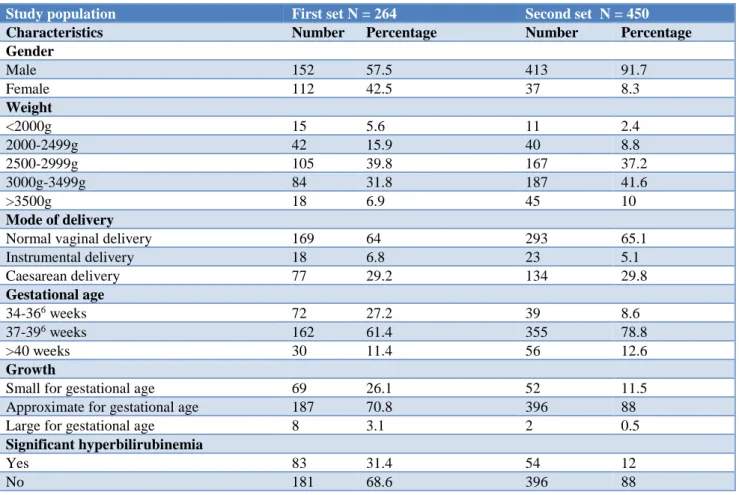
This was a prospective cohort study done in two-time periods: first set of data (834 values from 264 infants) was collected from October 2012 to April 2014 and second set of data (972 values from 450 infants) from November 2014 to June 2016 at Pondicherry Institute of Medical Science, a tertiary care hospital with level II neonatal intensive care. Baseline characteristics of both sets of infants are given in Table 1.
Table 1: Demographic characteristics of the study population.
Study population First set N = 264 Second set N = 450
Characteristics Number Percentage Number Percentage
Gender
Male 152 57.5 413 91.7
Female 112 42.5 37 8.3
Weight
<2000g 15 5.6 11 2.4
2000-2499g 42 15.9 40 8.8
2500-2999g 105 39.8 167 37.2
3000g-3499g 84 31.8 187 41.6
>3500g 18 6.9 45 10
Mode of delivery
Normal vaginal delivery 169 64 293 65.1
Instrumental delivery 18 6.8 23 5.1
Caesarean delivery 77 29.2 134 29.8
Gestational age
34-366 weeks 72 27.2 39 8.6
37-396 weeks 162 61.4 355 78.8
>40 weeks 30 11.4 56 12.6
Growth
Small for gestational age 69 26.1 52 11.5
Approximate for gestational age 187 70.8 396 88
Large for gestational age 8 3.1 2 0.5
Significant hyperbilirubinemia
Yes 83 31.4 54 12
For the first set of data, 76.6% (23/30) of babies who had significant hyperbilirubinemia at 24 hours were near terms. There was no statistically significant difference between the two groups in the mean serum bilirubin values at 24, 48, 72 and 96 hours. Considering the babies who had significant hyperbilirubinemia developed at 24 hours and >72 hours, there was statistically significant difference between two groups (p value = 0.002 and 0.00001 respectively).
This nomogram for predicting significant hyperbilirubinemia was generated using serum bilirubin measurements of first set of infants.
Figure 1: Nomogram made from present study bilirubin levels (mg/dl).
None of the babies had significant birth asphyxia, delayed passage of meconium, cephalohematoma or bruising. This institution is baby friendly, and initiation of breast feeding occurred almost always within one hour of birth in cases and controls.
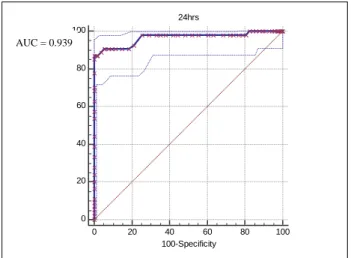
Figure 2: Validation of study nomogram with second set of data. Prediction of significant
hyperbilirubinemia at 24 hours.
The babies included in final analysis were all exclusively breastfed, any baby requiring further care for excessive weight loss (>10% of birth weight) would be admitted in NICU and excluded from study.
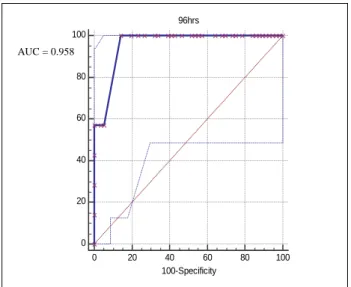
We have created a nomogram with cord blood, 24 hours, 48, 72 and 96 hours serum bilirubin measurements from first set of infants (Figure 1) and validated it with the serum bilirubin values from the second set of infants. The area under the curve in ROC curve at 24 hours, 48 hours, 72 hours and 96 hours are 0.939,0.967,0.993 and 0.958 respectively (Figure 2, 3, 4 and 5).
The area under ROC curve from validation of Bhutani nomogram with our population at 24 hours,48 hours,72 hours and 96 hours are 0.967, 0.939,0.702 and 0.727 respectively (Figure 6).
Figure 3: Validation of study nomogram with second set of data. Prediction of significant
hyperbilirubinemia at 48hours.
Figure 4: Validation of study nomogram with second set of data. Prediction of significant
hyperbilirubinemia at 72 hours.
Nomogram
0.000 5.000 10.000 15.000 20.000 25.000
0 24 48 72 96
Hours of Life
T
o
ta
l
Se
r
u
m
B
il
ir
u
b
in
(m
g
/d
L
)
40th percentile 75th percentile 95th percentile
0 20 40 60 80 100
24hrs
0 20 40 60 80 100
100-Specificity
Se
n
s
it
iv
it
y
0 20 40 60 80 100
48hrs
0 20 40 60 80 100
100-Specificity
Se
n
s
it
iv
it
y
0 20 40 60 80 100
72hrs
0 20 40 60 80 100
100-Specificity
Se
n
s
iti
v
ity
AUC = 0.993 AUC = 0.967
Figure 5: Validation of study nomogram with second set of data. Prediction of significant
hyperbilirubinemia at 96 hours.
Figure 6: Validation of Bhutani nomogram with study data. Prediction of significant hyperbilirubinemia at
24 hours, 48 hours.
Hence comparing with Bhutani nomogram, our nomogram was better in predicting significant hyperbilirubinemia in our population even though predictability of both nomograms was accurate (Table 2).
Table 2: Comparison between the predictive ability of Bhutani versus study nomogram (comparison of area
under the curve (AUC).
Our nomogram Bhutani nomogram
24 hours 0.939 0.967 48 hours 0.967 0.939 72 hours 0.993 0.702 96 hours 0.958 0.728
Figure 7: Validation of Bhutani nomogram with study data. Prediction of significant hyperbilirubinemia at
72 hours, 96 hours.
DISCUSSION
Jaundice in the newborn is a common cause for prolonged stay in hospital as well as hospital readmission during the first two weeks of life. Early discharge is making the management of jaundice quite difficult, since it is one of the cause for hospital readmission.11,12
Hence in 2004, American Academy of Pediatrics recommended all newborn infants be assessed before discharge for the risk of developing significant hyperbilirubinemia subsequently.13
This study was a prospective case control study, which was done in the Department of Pediatrics, Pondicherry Institute of Medical Sciences, Pondicherry. The aim of the study was to create a nomogram for the prediction of significant hyperbilirubinemia and validating this nomogram for the study population from serum bilirubin measurements.
Although the patients are from different socioeconomic status, most of the baseline characteristics are similar. There was no statistical significant difference between the two groups with respect to maternal age, antenatal complications, gravidae and mode of delivery.
Many studies suggest that preterm/near term babies are at higher risk for developing significant hyperbilirubinemia.11-16 In this study, the incidence of
significant hyperbilirubinemia was more in near term/pre
0 20 40 60 80 100
96hrs
0 20 40 60 80 100
100-Specificity
Se
n
s
it
iv
it
y
term infants when compared to term infants at 24 hours and at 72 hours and later.
Bhutani and colleagues created a nomogram and demonstrated the relationship of total serum bilirubin values plotted on an hour specific nomogram and the later risk of significant hyperbilirubinemia.7 This
nomogram was designed to help identify the newborns who are at low, intermediate or high risk for reaching bilirubin levels above the 95th percentile in the first week
of life There are multiple critiques about this nomogram. One study highlighted the false negative results reported with this nomogram. They also mentioned that, the patient in low risk and low intermediate risk as per Bhutani monogram developed significant hyperbilirubinemia later.17 The different performances of
Bhutani nomogram was explained by racial difference, genetic and environmental factors which plays a role or because of the presence of clinical risk factors. There were many other flaws with Bhutani nomogram like follow up was not performed in more than 75% of the study population and they validated the nomogram in the same sample of patients from which the nomogram was created. Bhutani nomogram could not perform well in all settings if there is significant difference between the population. In this study we tried to validate Bhutani nomogram in our population.
We plotted total serum bilirubin measurements of our study population on Bhutani hour specific nomogram and found that it was useful in predicting significant hyperbilirubinemia. 24 hours serum bilirubin values were more accurate in predicting significant hyperbilirubinemia compared with other values. But in the study done by Sarici U, they found that 6th hour serum
total bilirubin value has more predictive ability for the development of significant hyperbilirubinemia in near term babies.
We have developed an hour specific percentile based nomogram using serial measurements of TSB which includes cord blood, 24 hours, 48 hours, 72 hours and 96 hours from first set of our study population (264). We prospectively validated the predictive ability to identify the risk of significant hyperbilirubinemia in second set of infants (450 infants). Even though the sample size was small, we tried to eliminate one major criticism of Bhutani nomogram.8
Costantino et al in their study developed and validated their nomogram in a large neonatal population of Rome.4
Similarly there is nomogram developed and validated for the Chinese, Hispanic and Mongolian population.18-21
There has been paucity of similar studies in India except one done in North India.21
All these studies concluded that the nomograms created for that population will be able to predict significant hyperbilirubinemia in their population more accurately.
CONCLUSION
Discharging neonates without risk assessment for severe hyperbilirubinemia may be dangerous. A nomogram generated and validated with our data proved to be an accurate tool for predicting significant hyperbilirubinemia in our population.
Recommendations
A local nomogram for predicting significant hyperbilirubinemia is ideal. Bhutani nomogram may be used if locally created nomograms are not available.
Funding: No funding sources Conflict of interest: None declared
Ethical approval: The study was approved by the Institutional Ethics Committee
REFERENCES
1. Maisels MJ. Managing the jaundiced newborn: a persistent challenge. CMAJ Can Med Assoc J. 2015;187(5):335-43.
2. Cloherty JP. Manual of neonatal care. 7th edition.
Wolter Kluwer; 2012:1024.
3. Kondekar A, Kondekar S. Unconjugated bilirubin from cord blood; an indicator for prophylactic phototherapy. Pediatr Rev Int J Pediatr Res. 2016;3(04).
4. Romagnoli C, Tiberi E, Barone G, Curtis MD, Regoli D, Paolillo P, et al. Development and validation of serum bilirubin nomogram to predict the absence of risk for severe hyperbilirubinemia before discharge: a prospective, multicentre study. Ital J Pediatr. 2012;38:6.
5. Wang ML, Dorer DJ, Fleming MP, Catlin EA. Clinical outcomes of near-term infants. Pediatr. 2004;114(2):372-6.
6. Gupta P, Malhotra S, Singh DK, Dua T. Length of postnatal stay in healthy newborns and re-hospitalization following their early discharge. Indian J Pediatr. 2006;73(10):897-900.
7. Bhutani VK, Johnson L, Sivieri EM. Predictive ability of a predischarge hour-specific serum Bilirubin for subsequent significant hyperbilirubinemia in healthy term and near-term newborns. Pediatr. 1999;103(1):6-14.
8. Fay DL, Schellhase KG, Suresh GK. Bilirubin screening for normal newborns: a critique of the hour-specific bilirubin nomogram. Pediatr. 2009;124(4):1203-5.
9. Mishra S, Chawla D, Agarwal R, Deorari AK, Paul VK. Transcutaneous bilirubin levels in healthy term and late preterm Indian neonates. Indian J Pediatr. 2010;77(1):45-50.
11. Maisels MJ, Deridder JM, Kring EA, Balasubramaniam M. Routine transcutaneous bilirubin measurements combined with clinical risk factors improve the prediction of subsequent hyperbilirubinemia. J Perinatol Off J Calif Perinat Assoc. 2009;29(9):612-7.
12. Keren R, Bhutani V, Luan X, Nihtianova S, Cnaan A, Schwartz J. Identifying newborns at risk of significant hyperbilirubinaemia: a comparison of two recommended approaches. Arch Dis Child. 2005;90(4):415-21.
13. Maisels MJ, Bhutani VK, Bogen D, Newman TB, Stark AR, Watchko JF. Hyperbilirubinemia in the newborn infant ≥35 weeks’ gestation: an update with clarifications. Pediatr. 2009;124(4):1193-8. 14. Lavanya KR, Jaiswal S, Reddy P, Murki S.
Predictors of significant jaundice in late preterm infants. Indian Pediatr. 2012;49(9):717-20.
15. Newman TB, Xiong B, Gonzales VM, Escobar GJ. Prediction and prevention of extreme neonatal hyperbilirubinemia in a mature health maintenance organization. Arch Pediatr Adolesc Med. 2000;154(11):1140-7.
16. Ip S, Chung M, Kulig J, O’Brien R, Sege R, Glicken S, et al. An evidence-based review of important issues concerning neonatal hyperbilirubinemia. Pediatr. 2004;114(1):e130-53.
17. Slaughter J, Annibale D, Suresh G. False-negative results of pre-discharge neonatal bilirubin screening
to predict severe hyperbilirubinemia: a need for caution. Eur J Pediatr. 2009;168(12):1461-6. 18. Huang HC, Yang HI, Chang YH, Chang RJ, Chen
MH, Chen CY, et al. Model to predict hyperbilirubinemia in healthy term and near-term newborns with exclusive breast feeding. Pediatr Neonatol. 2012;53(6):354-8.
19. Yu Z, Han S, Wu J, Li M, Wang H, Wang J, et al. Validation of transcutaneous bilirubin nomogram for identifying neonatal hyperbilirubinemia in healthy Chinese term and late-preterm infants: a multicenter study. J Pediatr (Rio J). 2014;90(3):273-8.
20. Kolman KB, Mathieson KM, Frias C. A comparison of transcutaneous and total serum bilirubin in newborn Hispanic infants at 35 or more weeks of gestation. J Am Board Fam Med JABFM. 2007;20(3):266-71.
21. Akahira-Azuma M, Yonemoto N, Ganzorig B, Mori R, Hosokawa S, Matsushita T, et al. Validation of a transcutaneous bilirubin meter in Mongolian neonates: comparison with total serum bilirubin. BMC Pediatr. 2013;13:151.