OLD GODS, NEW RELIGIONS, AND MODERN MARRIAGES IN NEPAL
Emily McKendry-Smith
A dissertation submitted to the faculty of the University of North Carolina at Chapel Hill in partial fulfillment of the requirements for the degree of Doctor of Philosophy in the
Department of Sociology.
Chapel Hill 2013
Approved by:
Lisa D. Pearce
Jacqueline Hagan
Kenneth (Andy) Andrews
Philip N. Cohen
ii © 2013
iii
ABSTRACT
Emily McKendry-Smith: Old Gods, New Religions, and Modern Marriages in Nepal (Under the direction of Lisa Pearce)
This dissertation is a set of three papers broadly focused on the role of religion in a
context of rapid social change associated with modernization and development. My research
design comprises two areas of data collection at three Brahma Kumari centers in Chitwan,
Nepal: participant observation at daily religious services and in-depth interviews with female
devotees. I complement this with statistical analyses on spousal choice and religious salience
using survey data from the Chitwan Valley Family Study.
In the first chapter I address the paradox that in Nepal, religion appears to be shifting
from individual to communal worship, in contrast to the belief of many scholars that modernity
has a privatizing and individualizing effect on religion. I find that due to unique features of
Nepali homes, the role of puja in Nepali society, and perceptions of the Brahma Kumaris lead to a case where puja in the home is public and congregational meditation is private.
In the second chapter, I address how the Brahma Kumaris frame their movement in
relation to value-laden ideas about modernity and how this framing influences acceptance of
their “strict” demands. I find that Nepalis tend to accept and follow the group’s strict demands
when those demands have been framed as modern and that framing is resonant with the
iv
modern framing is not resonant, the strict demand is not followed and the frame itself is rejected
in favor of the practice being defined in different terms.
My third chapter employs data from the Chitwan Valley Family Study. I examine the
relationship between education, religious salience, and the practice of arranged marriage, using
interaction terms to examine how religious salience may moderate the relationship between
spousal choice and education, and I find a significant interaction between respondent years of
education and average neighborhood religious salience. I explain this using the “moral
communities thesis,” a theory suggesting a relationship between a community’s religious
v
ACKNOWLEDGEMENTS
First and foremost, although I cannot list them by name, I thank my respondents and all
others attending services at the Brahma Kumari centers in “Subhapur”, “Bistanagar”, and “Gaida
Chowk.” I feel honored to have been welcomed into their religious lives and hope that this
document reflects the sincere esteem I hold them in. Among the Brahma Kumaris, I also thank
Vijaya Sigdel and the other surrendered sisters and brothers who enriched my life and aided me
immeasurably in my research. In addition, I thank all the other surrendered and lay members of
the Brahma Kumaris I met during my stay in Nepal.
I also owe a great debt of thanks to my academic advisor, Dr. Lisa Pearce. Her guidance
and prompting allowed me to take my writing to a higher level than I could have achieved on my
own, for which I am extremely grateful. I also thank my dissertation committee members, Dr.
Jacqueline Hagan, Dr. Kenneth (Andy) Andrews, Dr. Philip Cohen, and Dr. Christian Smith.
I thank the staff of the Institute for Social and Environmental Research in Fulbari,
Chitwan. Among them, I have particular thanks for Raksha Joshi. Without her dedication,
willingness to learn, and quick and creative thinking, the fieldwork portion of this research
would not have been possible. At ISER, I also thank Krishna Ghimire, Bishnu Adhikari, Indra
Chaudhary, Krishna Lama, Rajendra Ghimire, Prem Prakash Pandit, Gita Subedi, Arati Ghale,
Bimala Pokharel, Bhuma Kumar, Sita Chaudary, Bhagawati Neupane, and Debaki Darai. I thank
Bamdev Adhikari, Rishi Ram Neupane, and Bimal Darai for not only supporting my research,
vi
Birkha Raj Ghale for the tea and conversation that went above and beyond their duties as night
gaurds.
I thank Deepa Adhikari and Sabitha Ghimire for the invaluable assistances they rendered
to my research. In particular, I thank Deepa for introducing me to the Brahma Kumaris, letting
me hang out and eat at her shop, and helping me always have the right kurtasurwar for the occasion. I thank Sabitha for accompanying me to the Women’s Empowerment Trainings and
the 7-day class in Bistangar, as well as for letting me spend time in her home.
Finally, I thank all the households in Subhapur and surrounding areas who welcomed me
into their midst, particularly the family of Apana Sharma. I thank the many additional friends I
made over the course of my research, including Anup Ghimire, Kamala Luitel, Kabita
Chaudhary Kabu, Sabitri Chaudhary, Krishna Shrestha, Ram Rijal, and Bhim Bhattarai. I
particularly thank Maya Devi Ale and Chandra Thapa for their help with transportation.
I thank the Society for the Scientific Study of Religion, Religious Research Association,
and University of North Carolina for the grants that allowed me to conduct this research; I thank
the Odum Institute at UNC for managing these grants. I thank Dr. Dirgha Ghimire for
facilitating my involvement with ISER and Dr. Amy Mehreban Pienta, Dr. Arland Thornton, and
Dr. Sarah Brauner-Otto for advising me on my research during their own stays in Nepal. I thank
Cornell University’s Summer Intensive Nepali program and its faculty, Dr. Kathryn March,
Shambhu Oja, and Banu Oja. I thank Dr. Cathy Zimmer for aiding me with statistical analyses
and for providing friendship and tremendous moral support. I thank Lisa Pearce’s other graduate
students who read and provided feedback on these papers, including Jessica Pearlman, Jane Lee,
vii
these papers at the Society for the Scientific Study of Religion and Association for the Study of
Religion annual conferences, as well as members of UNC’s Culture and Politics Workshop.
Finally, I thank my friends and family who supported me throughout my time in graduate
school. These include Kayo Suzuki, Tiantian Yang, Rachana Rao Umashankar, Megan
Goodwin, and Laura Wagner. I thank my Nepali conversation partners, Desh Bandhu Nepal,
Shradha Shrestha, and the Biswa family. Most importantly, I thank Wayne and Peggy Smith,
viii
TABLE OF CONTENTS
LIST OF TABLES...xi
LIST OF FIGURES...xii
INTRODUCTION...1
CHAPTER 1: PUBLIC HOUSEHOLD, PRIVATE CONGREGATION: THE BRAHMA KUMARIS AND PUBLIC/PRIVATE RELIGION IN NEPAL...4
Introduction...4
Theoretical Background...5
The Brahma Kumaris...10
Setting...12
Methods...14
The Centers...14
Center Observations...15
Interviews...16
Results...18
Puja as Public...18
The Brahma Kumaris as Private...23
Discussion...33
ix
CHAPTER 2: “BABA HAS COME TO CIVILIZE US”: DEVELOPMENTAL IDEALISM
AND FRAMING THE STRICT DEMANDS OF THE BRAHMA KUMARIS...39
Introduction...39
Theoretical Background...40
Framing Perspective...44
Modernity and Development as a "Master Frame" in Nepal...47
New Religious Movements and Reactions to Modernity...49
Development of the Brahma Kumaris...53
Religion in Nepal...56
Methods...57
Results...60
Framing the Brahma Kumaris as an Educational Institution...60
The Brahma Kumaris as Egalitarian...64
The Brahma Kumaris as a Solution to the Tension and Stress of Modernity...68
Celibacy as Birth Control: A Nonresonant Frame...71
Discussion...76
CHAPTER 2 REFERENCES...79
CHAPTER 3: “ENJOY THE HEAT OF A LOG, AND HEED THE ADVICE OF THE ELDERS”: RELIGIOUS, EDUCATIONAL, AND NEIGHBORHOOD DETERMINANTS OF PARENTAL INFLUENCE ON SPOUSAL CHOICE IN NEPAL...84
Introduction...84
Theoretical Context: Family Mode of Social Organization...85
Spousal Choice and Religion in Nepal...87
Education and Spousal Choice...92
x
The Nepali Context: The Chitwan Valley...96
Data and Methods...97
Dependent Variable...98
Religious Salience Variables...98
Education Variable...99
Control Variables...99
Analytic Strategy...101
Results...102
Discussion...109
CHAPTER 3 REFERENCES...113
CONCLUSION...120
APPENDIX A: EXTENDED METHODOLOGICAL NARRATIVE...125
APPENDIX B: INTERVIEW GUIDES...134
Oral Consent Script...134
Interview Guide for Women Practicing Om Shanti...135
xi
LIST OF TABLES
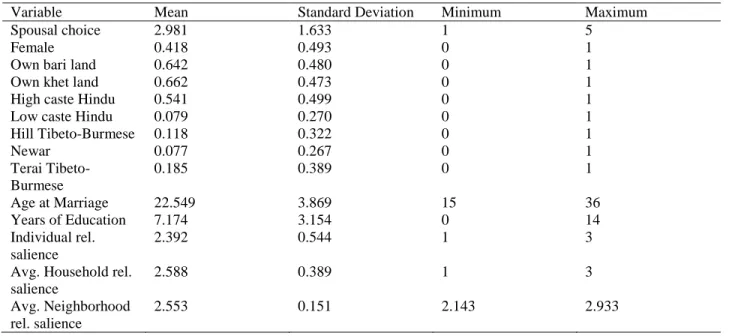
TABLE 1: DESCRIPTIVE STATISTICS...101
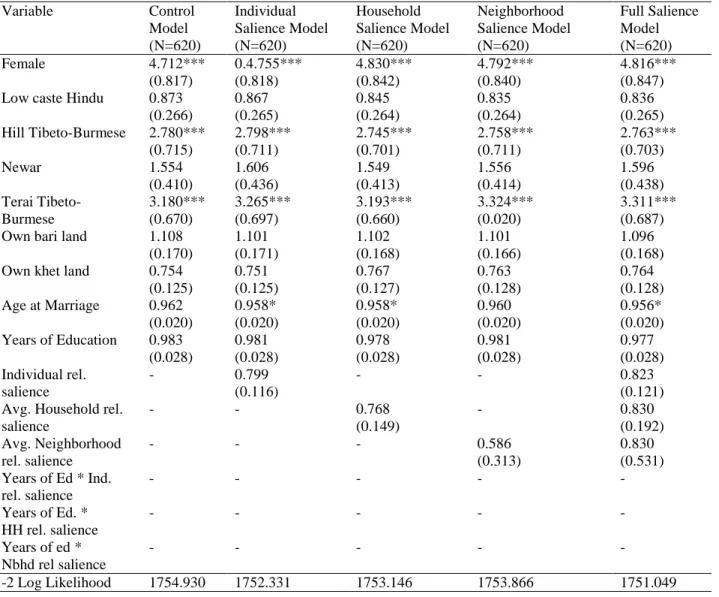
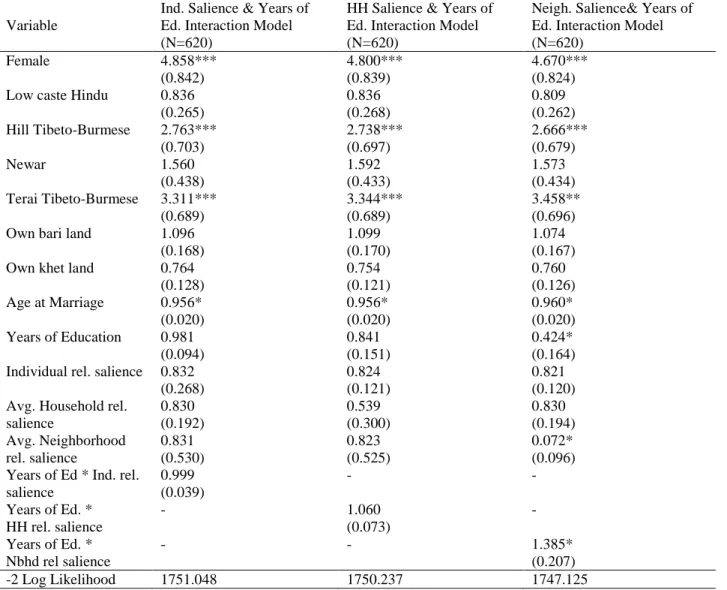
TABLE 2: ORDERED LOGISTIC REGRESSION RESULTS...103
xii
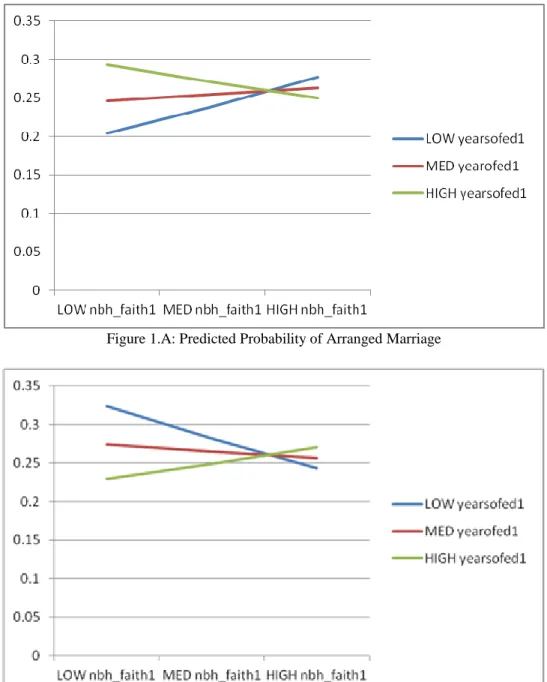
LIST OF FIGURES
2
INTRODUCTION
This dissertation is a set of three papers broadly focused on the role of religion in a
context of rapid social change associated with modernization and development. While a number
of studies have considered how people use religion to respond to the changes and instability of
modernity, studies situated outside the Western world and focusing on non-Abrahamic religious
forms are relatively rare within social science research on religion. My research focuses on the
Chitwan valley in Nepal as a location with rich religious diversity and a place where significant
environmental and social changes are occurring. I examine two examples of religious practice in
Chitwan – the new religious movement the Brahma Kumaris and the more traditional practice of
arranged marriage. By examining the old and new together, I attain a more complete picture of
how people navigate and potentially reconstruct religion in accordance with social changes
around them. My research design comprises two areas of data collection at three Brahma
Kumari centers in Chitwan: participant observation at daily religious services and in-depth
interviews with female devotees. I complement this with statistical analyses on spousal choice
and religious salience using survey data from the Chitwan Valley Family Study.
In my first substantive chapter, I consider the location of religion in the modern world.
While scholarship has shown a number of examples of modern public religion, we often think of
modernity as having a privatizing effect on religion. Religion is removed from public
institutions and is reduced to individual and family practice inside the home. The increasing
3
current understandings of modernity and the movement of religion from the public to the private
realm. In Nepal, the traditional religious practices of puja are typically done individually in
family homes, while the Brahma Kumaris encourage devotees to give up puja in favor of attending daily religious services held in centers. This shift from the home to the congregation
seems to contradict the observations of many scholars that modernity has a privatizing and
individualizing effect on religion. I address this paradox, using Wuthnow’s definition of public
religion, explained in his 1994 book Producing the Sacred, as my theoretical underpinning.
The second substantive chapter focuses on the relationship between the Brahma Kumaris
teachings accepted by Nepali women and the spread of what Thornton (2005) terms
developmental idealism: the idea that social and economic development and associated programs
are value-laden and viewed as goals by many people the world over. I examine the “strict”
teachings of the Brahma Kumaris, the extent to which they are framed as modern by the group,
and the extent to which this framing is resonant among Nepali women. I relate these
observations to rational choice theories about why people adhere to “strict” churches, noting that
while these explanations are useful, they provide little indication as to the kinds of strictness people are willing to accept from religious organizations.
In the third substantive chapter, I examine a practice that is often intertwined with
religion – selection of a spouse for marriage. In the past, the most common form of marriage in
Nepal has been arranged marriage, where an individual’s spouse is selected by his or her parents
and/or other relatives. However, individuals having more of a say in the choice of a spouse is
becoming increasingly prevalent. In this chapter, I use regression models and survey data from
the Chitwan Valley Family Study to first examine the relationship between religious salience and
4
individual’s family’s religious salience and neighborhood’s religious salience. Additionally, I
examine how religious salience modifies the relationship between education and spousal choice,
which has been the focus of other research in this context. This chapter contributes to our
knowledge of family by examining the relationship of religious salience and education to
transformations in marital behavior, an issue that has largely been studied in Western and
Christian contexts thus far. Additionally, as other countries, especially those in South Asia,
undergo similar transformations, it is particularly important to understand how religion and
5
CHAPTER I
PUBLIC HOUSEHOLD, PRIVATE CONGREGATION:
THE BRAHMA KUMARIS AND PUBLIC/PRIVATE RELIGION IN NEPAL
Introduction
Public and private religion and the fate of public religion in modern societies are topics
that have long been central to the sociology of religion. This paper examines the fate of public
and private religion in rural Nepal, a non-Western setting experiencing rapid social change and
modernization. I investigate the Brahma Kumari movement in Nepal as a case of public religion
coming hand-in-hand with modernity, but ultimately conclude that this seemingly public religion
offers more of the private to worshippers than traditional forms of religious practice, which,
although they are undertaken in the home, are remarkably public in nature. This investigation
contributes to the sociology of religion in two primary ways. First, it provides us with a case in
which religion has neither waned nor become less institutionalized in the face of modernity,
outcomes that have been predicted by many scholars both before and after the secularization
hypothesis ceased to serve as a major driving force in the sociology of religion. Second, the
Brahma Kumaris in Nepal illustrate the need for less rigid thinking in terms of defining the
spaces where public and private religion occur. As the juxtaposition of “public” traditional puja
in households and “private” meditation at Brahma Kumari services in ashrams1
illustrates, public
1 While the term “ashram” typically refers to a Hindu hermitage, or a place where a religious has gone to live in
6
and private are best conceptualized as situational and temporary, not defining features of
physical spaces.
Theoretical Background
The dichotomy of private and public has long been of interest to scholars and social
scientists and various ways of comprehending this dichotomy are often used as organizing
principles for understanding our society. In this paper, I narrow and focus my use of the ideas of
public and private by relying on Weintraub’s (1997) typology of the four major ways these ideas
have been conceptualized in social thought. Weintraub divides social thought on public and
private into four schools. The first, based on legal and public policy analyses, understands the
public/private dichotomy in terms of the contrast between governmental administration and the
market economy. The second school of thought, in which thinkers such as Tocqueville, Arendt,
and Habermas can be located, conceives of the “public” as the political community of citizens.
Weintraub’s third school conceptualizes “public” as “a sphere of fluid and polymorphous
sociability” (1997: 7). Last, Weintraub describes a feminist theory of public and private, used to
distinguish the “private” family from “public” political and economic spheres. However, it is
Weintraub’s third school, that of public as sociability, that I draw on for the analyses in this
paper.
Scholarship conceptualizing the public in terms of sociability is rooted in the work of
French historian Philippe Aries and his work on the evolution of families in Europe. Aries
described the evolution of a new private sphere, one of isolation and intimacy, created as people
retreated from the more communal spaces of the street, village, and castle court. The
7
understand them today. Aries writes that “the progress of the concept of the family followed the
progress of private life, of domesticity. For a long time the conditions of everyday life did not
allow the essential withdrawal by the household from the outside world” (375).
In sixteenth and seventeenth century Europe, Aries explains, families did not serve as
“refuges from the invasion of the world but as the centers of a populous society, the focal points
of a crowded social life” (395). Individuals were rarely left alone, and those who sought out
privacy were perceived as deviant (398). Houses consisted of rooms with several functions, and
several couples, as well as groups of unattached men and women, would sleep together in a
single room. This is echoed by Rybczynski (1986) in his history of the idea of “home,” in which
he writes that “houses were full of people, much more so than today, and privacy was unknown”
(18). In the eighteenth century, when families began to retreat from society into the newly
private sphere of the home, the organization of the home was altered in a way conducive to this
new desire. Rooms were linked by a corridor and specialized bedrooms were devoted to
sleeping. Describing these changes, Aries notes that “it has been said that comfort dates from
this period; it was born at the same time as domesticity, privacy and isolation” (399). These
rearranged homes were inhabited by a reduced family, which included parents and children, but
excluded servants, friends, and members of business relationships (400). Rybczynski notes that
as a result of these changes “the house was becoming a more private place. Together with this
privatization of the home arose a growing sense of intimacy, of identifying the house exclusively
with family life” (39).
Focusing on religion, I frame my analyses in terms of the criteria for public and private
religion laid out by Wuthnow in his 1994 text Producing the Sacred: An Essay on Public
8
Weintraub/Aries definition of public as the realm of sociability; Wuthnow notes that in
considering the difference between public and private, public can take on three meanings.
1. Public can be thought of as having to do with “the people.”
2. Public can also refer to “openness or accessibility” (Wuthnow 1994: 9).
3. Finally, Wuthnow assigns to public a third meaning which encapsulates the sense of
responsibility that often comes with the word public. He writes that “in its Latin
derivation, public is associated with the idea of having been altered, probably in the way
that an adult is altered by having gone through puberty. Hence, the term public also connotes the kind of adult responsibility that we do not normally expect of children” (11).
In this paper, I demonstrate that puja, a traditional Hindu religious practice that is typically done
individually and in one’s home, can be considered “public” in that it meets Wuthnow’s criteria of
openness or accessibility and having an association with adult responsibility. In contrast to this,
although they worship in congregations, both the congregational setting of the Brahma Kumaris
and some of their more unconventional (in the Nepali context) practices render the group
somewhat isolated and “unintelligible,” or unreadable.
This research makes two primary contributions – one to studies of religion and one to our
conceptions of public and private more generally. In scholarship on how religion is faring in the
face of modernity, scholars tend to conflate the home and the individual with “private” and
groups and congregations with “public.” I demonstrate that this is not always the case,
particularly depending on how one is conceptualizing public and private. Research on these
topics need to go further in explicating how these terms are being defined and in avoiding
conflation. In this respect, this paper build’s on Regnerus and Smith’s (1998) call for analyses of
9
privatization is occurring. However, Regnerus and Smith largely focus on “public” as referring
to Habermas’s idea of the public as political communities and political discourse. This paper
demonstrates that researchers should go further in their clarifications, specifying which
theoretical conceptions of public and private they are using.
This is related to the second contribution, which is that scholars need to conceptualize
public and private as temporary and situational, not enduring features of physical spaces. This is
acknowledged by Wuthnow himself, writing that notions of public and private vary
cross-culturally and historically. He writes that “what public means is itself a matter of cultural
definition” (Wuthnow 1994: 9) and that “if the public and the private are always connected, it is
nevertheless important to recognize that they are probably more distinct, and problematic, in
modern settings than in most of the societies preceding ours historically” (10). While I do not
suggest “reading history sideways” (Thornton 2005) and comparing present-day Nepal to
Western past, Nepal’s unique developmental trajectory, combined with its background in
Hinduism, a religion that has not traditionally been congregational, renders our usual notions of
public and private religion inapplicable to the Nepali context. Similarly, when considering
public and private in the United States, we must be mindful that American homes have not
always been “haven(s) in a heartless world” (Lasch 1995) but evolved these characteristics over
time. It is further important to note that American homes, and thus our notions of public and
private, continue to evolve.
Scholars of religion have frequently hypothesized that as modernity advances, traditional
and “public” forms of religion, such as worshiping in congregations, will increasingly be
replaced by more individualistic and private forms of religion. This is a contemporary variant of
10
religion would diminish in society in conjunction with the advance of modernity. At the societal
level, both Hammond (1992) and Smith (2003) content that a decrease in public religion has
occurred within the United States with Smith writing that “something real at the level of
macrosocial change, which secularization theory has tried to theorize, has actually happened in
history, and we need to account for and understand that change” (2003: 5). Similarly, on an
individual level, several scholars have observed phenomena akin to Luckmann’s (1967)
prediction that as older, institutional forms of religion decline, new and more personal religions
will arise in their place. Thinkers in this vein include Wuthnow (1998), with his observation that
forms of religion are shifting from “dwelling” to “seeking,” Bellah et al (1985) with their famous
“Sheila-ism” example of personal religion, Davie (1994) and her believing without belonging,
and Chaves’s (1994) contention that secularization refers to the declining scope of religious
authority in social institutions, not to a decline in individual religiosity.
As I began research in rural Nepal, I my first inclination was that what I observed in
terms of religious change was the opposite of these scholars’ ideas – that with the advances of
“development,” religion was, in fact, moving from private to public. This belief was based on
my observation that people were either ceasing or supplementing traditional puja (worship) in the household in favor of, participation in new religious movements such as the Brahma
Kumaris, Sai Baba, or Christianity, where religious activities were done en masse in centers intended for religious activity. However, after five months of observations and an improved
understanding of Nepali households, my eventual conclusion was that the transition from puja to participation in the Brahma Kumaris, despite being a movement from the household to religious
centers, is a transition from public to private. In the text that follows, I explain how, according to
11
public sphere in Nepal. I follow this by discussing how the Brahma Kumaris represent a move
toward a more private form of religion. First, however, I introduce in greater detail the religious
group the Brahma Kumaris, the research setting of Nepal’s Terai and the methods employed in
this research.
The Brahma Kumaris
The Brahma Kumaris are a Hindu2 religious movement that developed in India in the late 1930s. The group’s founder, a Hindu businessman named Dada Lekhraj Kripani received
visions of the Hindu deities Vishnu and Shiva and of the world’s destruction and the subsequent
establishment of an earthly paradise (Babb 1986; Walliss 2002). These visions are believed to
originate from Shiva, the “Supreme Soul,” with Lehkraj as a human medium. Lekhraj later
became identified with Brahma, the Hindu deity of creation, as is referred to within the
movement as Brahma Baba.
The group that emerged around Lekhraj and his visions developed as what we know
today as the Brahma Kumaris, with Lekhraj’s visions becoming their sacred scriptures, or murlis,
that are read aloud at services. Brahma Kumari Raj didi, the head of the Brahma Kumaris in Nepal and senior brother BK Ram Singh bhai explained to me that Raj didi was part of a group
of ten brothers and sisters from India that brought the Brahma Kumaris to Nepal in Nepali year
2023 (1966-1967). The group first held an exhibition in the southern city of Birgunj, then moved
to the capital city of Kathmandu, where services were initially held in a rented room. Raj didi
estimated that the Kathmandu center, the first permanent ashram in Nepal, was established 25
years ago in 1983. The Bistanagar ashram, the third to be established in Nepal, was also founded
2In describing the Brahma Kumaris as Hindu here, I am concurring with Babb’s (1986) assertion that the group can
12
by BK Ram Singh bhai in the early 1980s. Because the Brahma Kumaris greet each other with “Om shanti,” instead of the typical Nepali greeting of namaste, many Nepalis have come to refer to this religious group as “Om Shanti” and to its ashrams as Om Shanti centers.
A key point of Brahma Kumari doctrines3 is the dualist idea that humans are souls, as opposed to bodies. Brahma Kumaris are tasked with forsaking “body consciousness” and instead
developing “soul consciousness” through a type of meditation known as raja yoga and other
behavioral practices. Babb (1986) notes that the practice of raja yoga is “standardized…students
sit in a semidarkened room facing the teacher. Just above and behind the teacher’s head is a red
plastic ovoid that glows from a lightbulb within; at its center is a tiny hole, which appears as a
point of intense white light against the red glow. This device represents the Supreme Soul, Shiv
Baba” (119). At the centers I visited in Nepal, these representations of Shiva were typically
located above portraits of Lekhraj, or Brahma Baba. Those engaged in meditation focus on that
glow while thinking of themselves as a “point of light” and a “peaceful soul.” Brahma Kumaris
are encouraged to begin their days with raja yoga meditation between the hours of 3 AM and 4
AM.
Other behavioral practices proscribed by the Brahma Kumaris stem from the goal of
promoting “soul consciousness” instead of “body consciousness.” In order to minimize “body
consciousness,” these proscriptions are developed so that practitioners avoid “behavior that is an
especially dangerous source of further entanglements with the body and material nature” (118).
Brahma Kumari practitioners are encouraged to follow a sattvik diet and avoid consumption of meat, fish, garlic, onions, and alcohol and tobacco products. Ideally, their food should be
3This is a limited discussion of Brahma Kumari history and teachings as my focus here is on practice in Nepal. For
13
prepared by someone who is “soul conscious” (another Brahma Kumari) and using cookware
and dishes that have not been contaminated by improper foods. However, the most important
means of avoiding “body consciousness” is through abstaining from sexual activity. As Babb
puts it, “more than anything else, lust draws the soul into engagement with the body, thus
entrenching the soul in further ignorance” (119).
The Brahma Kumaris are only one of many religious movements coming out of the
Hindu tradition. Most famously, these groups include the International Society for Krishna
Consciousness (Hare Krishnas), but also lesser known groups such the Radhasoami faith,
Ananda Marga, Arya Samaj, and followers of Mata Amritanandamayi, Sathya Sai Baba, and
Osho. Both the Brahma Kumari and Sai Baba centers are present in the district of Nepal that
served as the field site for this research.
Setting
This research is situated in the Terai, a geographic region located in the south central part
of Nepal. Prior to a deforestation program occurring in the 1950s, this area was a dense jungle,
populated only by the indigenous Tharu ethnic group thought to be immune to malaria.
Following a government program of malaria eradiation, deforestation, and resettlement, the
valley is now a site of agricultural production. As people came from all over Nepal to seek land
in this area, the area is now home to a great variety of religio-ethnic groups, including high caste
Hindus, low caste Hindus, hill Tibeto-Burmese (Tamang, Gurung, Magar), Newars, and Terai
Tibeto-Burmese (Tharu). Schools, health centers, markets, road, and electricity are spreading
throughout the region, radiating from Bistanagar, an urban area in the north end of the district.
14
linking it to other Nepali cities and to India. While life in the Terai had previously been
organized around the family, this proliferation of nonfamily organizations has moved an
increasing number of activities outside the family (Axinn and Yabiku 2001). So during the past
sixty years, the physical landscape has been changed by roads, electricity and hydro-electric
dams, the population has been affected by the spread of Western biomedicine and Western
family ideologies by schools and health clinics, and mode of societal organization in the Terai
has changed to no longer being centered exclusively around the family. The political landscape
of Nepal has also changed during this time as the country experienced a Maoist “people’s war”
and transitioned from a Hindu kingdom to a secular republic in May of 2008.
Nepal historically has strong connections with both the Hindu and Buddhist religious
traditions. Today, most Nepalis are Hindu, but there are also Buddhist ethnic groups (Ortner
1989). Many people also practice both Hinduism and Buddhism, as Buddha is believed to be an
avatar of the Hindu god Vishnu. Religion is a key element of Nepali life. In his book on the
character of Nepal, Bista (1991) writes that “religion has always been a central feature of Nepali
life…Nepalis love colourful rituals of all kinds and have welcomed a variety of religious
traditions” (3). Other religions are also gaining ground in Nepal. Dahal (2003) notes that
Christianity is becoming increasingly popular, particularly after the advent of Nepali democracy.
There are also a number of Muslims and followers of the Kirat religion. In addition to the
Brahma Kumaris, other neo-Hindu religious movements in Nepal include followers of Sathya
Sai Baba and of Osho.
Hindus in Nepal follow what is known as the “householder’s path” (Bennett 1983). This
necessitates following the requirements of traditional Hindu religion, as well as producing sons,
15
Daily religious practice is often considered to be the domain of Nepali women (Bennett 1983:
45). Hindu women practice their religion by performing puja, or making offerings of water,
flowers, fruits, lighted candles, and/or bell ringing to images of gods kept in a special box in their
home. Bennett explains that “puja is a central feature of the householder’s religious life. It is a
means for achieving a good rebirth or entrance to heaven in the afterlife and also a means for
achieving one’s worldly goals in this life” (1983: 48). Women, as well as other family members,
may also visit local temples and perform puja there.
Hinduism in Nepal tends to be more focused on practice than on belief. This focus on
action is in keeping with the fact that the Nepali term for religion, dharma, also means “duty” or
“rules.” Bennett writes that “ritual and belief are still unselfconsciously integrated – so much so
that villagers tend to speak of dharma in terms of action, as something one does (or at least should do), rather than something one believes in” (1983: 34).
Methods The Centers
This study focused on three Brahma Kumaris centers (referred to here as “Om Shanti
centers”) in three different towns in a Terai district of Nepal – Subhapur, Bistanagar, and Gaida
Chowk. There are about 20 Om Shanti centers located in this district. The oldest center was
established in the early 1980s and the newest was constructed in the early 2000s. I selected the
Subhapur center for observations and interviews because it was one of the newest, the Bistanagar
center was as it was one of the oldest, and the Gaida Chowk center because it was founded at an
intermediate time, in the 1990s. In addition to the temporal distribution of their foundings, these
16
large urban area and the juncture between two major highways, making it a transportation hub.
The village of Subhapur, located at a middle distance between Bistanagar and the jungle has a
population of over 12,000 individuals living in about 2,500 households. While many residents of
Subhapur are engaged in farming, it also has a commercial area and is located in close proximity
to an agricultural college. The Subhapur Om Shanti center is located just off the main road on
the outskirts of Subhapur bazaar, the main commercial area. Gaida Chowk, located near the
edge of the National Park, has a population approaching 9,000 individuals living in about 1,700
households. Like Subhapur, Gaida Chowk also has a small bazaar, or commercial area, located
on the main road. The Gaida Chowk Om Shanti center is located some distance away from
Gaida Chowk bazaar at one of the next chowks (locations where roads cross). Sixteen Brahma Kumari sisters and 7 Brahma Kumar brothers live at the Bistanagar center, 2/3 live in Subhapur
(a third sister moved in during my fieldwork period), and two live at the Gaida Chowk center.
While the attendees at the Bistanagar Om Shanti center are largely from Bistanagar itself, people
also come from other nearby communities to attend the Subhapur and Gaida Chowk centers.
Center Observations
At each center, I attended daily services (known as “murli classes”), which are held daily
at all Om Shanti centers starting at 6:30 AM. From November 2008 through April 2009, I
observed a morning murli class at one of these three centers virtually every day.
Although individuals may arrive earlier to sit in the center “classroom” and silently
meditate, the official class begins at 6:30. If there is electricity, which is infrequently, special
Hindi recordings of Brahma Kumari music may be played before the class officially starts. As
17
and then sit, men on one side of the room and women on the other. At 6:30, the Brahma Kumari
sister who is leading the service greets the room by saying “Om shanti,” which the crowd replies
back to her. She then begins reading aloud the murli, which is in Hindi4 and distributed to Brahma Kumari centers worldwide from their headquarters in Mt. Abu, India. Men and some
women will take notes as the murli is read, often in notebooks they have purchased at the Om Shanti center that have images of Dada Lekhraj or the Supreme Soul on them. After the main
text of the murli has been read, everyone will recite a greeting to Shiva Baba together. This is
followed by the sister reading off several numbered points that summarize the main essence of
the day’s murli, followed by the day’s “slogan.” The service concludes with the sister’s “Om
shani” and those assembled replying “om shanti” back to her. On Thursdays, bhog, or holy food,
is offered at the conclusion of services. This consists of the men and women in attendance lining
up place donations on a table in front of the sisters and in return receive tika (red powder applied
to the forehead), a flower, a spoonful of water, and a food item, such as a fruit or rice pudding.
Interviews
From January through March of 2009, I conducted 70 interviews with Nepali women
regarding their religious beliefs, practices, and family life. Forty-seven of these interviews were
with women currently attending services at Om Shanti centers and the remaining 23 were with
systematically matched women who were not. At the two smaller centers, located in Subhapur
and Gaida Chowk, I interviewed the entire population of women who were attending services at
4
18
the time I conducted interviews5 – 13 women in Subhapur and 14 in Gaida Chowk. At the Bistanagar center, which sometimes had over 100 women in attendance at services, I selected
interviewees using stratified random sampling with an oversample of certain ethnic minorities.
Using a list of women members modified to include women who had very recently begun
attending, I identified the 5 women from the center who were Tamang, Gurung, Magar, Rai,
Limbu, Madhesi, or low-caste Hindu. I then took a random sample of 15 interviewees from the
remaining high-caste Hindu and Newar women (there is a sizable number of Newars both in
Bistanagar in general and at the Bistanagar Om Shanti center in particular, rendering
oversampling unnecessary).
I selected women not involved with Om Shanti as interviewees by matching them to Om
Shanti participants in terms of three characteristics – neighborhood of residence, age group, and
marital status. After leaving the homes of certain Om Shanti interviewees, I would go to the next
home not owned by a member of the interviewee’s family and go door-to-door until I found a
woman with the same marital status (ever married or not) and in the same age group (18-30 years
old, 30-50 years old, or 50+ years old) as the Om Shanti interviewee in question. For example,
after interviewing a 20 year old, never married woman participating in Om Shanti in Bistanagar,
I went door-to-door down the same street until I found an 18 year old, never married woman not
currently participating in Om Shanti who was willing to be interviewed. I interviewed 27 of these
“other” women – 10 in Bistanagar, 7 in Subhapur, and 6 in Gaida Chowk. I opted to conduct
fewer of these interviews than those with women involved with the Brahma Kumaris as other
research has well documented the practices of Hindus and Buddhists in Nepal (Bennett, Gray,
5
19
Ortner); these women are included in this study for the purpose of making comparisons with
Brahma Kumaris.
Although I did not record them, I conducted several informal interviews on matters of
religious teachings and practices with sisters living at the Subhapur and Gaida Chowk centers
and both with the head sisters and brother and many of the lower-status sisters living in the
Bistanagar center. I also took the seven-day course required to become a member of the Brahma
Kumaris twice – once entirely in English at the Subhapur center with an English-speaking senior
member of the congregation there and once in both English and Nepali from the senior brother at
the Bistanagar center, along with a female Nepali friend. Finally, I received permission from a
Nepali family to observe their seven-day course, which was given again at the Subhapur center
by the senior sister there.
Results Puja as Public
Family homes in the Terai differ from homes in the United States and other Western
contexts in that they are much more public in nature. Thus, although daily puja is typically
conducted in individuals’ homes, it is a religious practice that is “open and accessible” in nature
and is located in a venue where sociability occurs. Many homes that I observed in the Terai do
not have conventional doors, do not have doors that lock, or have sheets of fabric hanging in
doorways in place of doors. Even when a house has a door fastener, it is not uncommon for
individuals to unlatch this and wander into a home in search of someone. On many instances,
my interview assistant Raksha and I entered a respondents’ homes in search of them, merely
20
previously acquainted with the respondent, and Raksha explained that this is a common practice
in the area. On one occasion in early January, we came unscheduled to the home of Krishna
Kumari, a 65 year old woman from the Subhapur Om Shanti center, to conduct a formal
interview with her. When Krishna Kumari was not home, we entered her property, sitting on a
wooden bench for several hours waiting for her. When Krishna Kumari’s neighbors saw us, they
did not remark on our presence; neither did Krishna Kumari’s husband, who I was not previously
acquainted with, when he eventually returned home.
Family homes in the Terai are also less private than American homes in that outdoor
areas are considered a natural extension of physical houses and that many tasks considered
private both in the United States and Nepal are conducted out of doors. It is not uncommon to
observe people in engaged in laundry, cooking, washing dishes, bathing, or brushing one’s teeth
outside. Just as kitchens are kept ritually pure for Hindus, outside courtyards are also regularly
purified with mixtures of mud and cow dung. Finally, many locales that we think of as being
public spaces, such as stores or restaurants, are attached to people’s homes in the Terai; when I
arrived to interview Isha, a 45 year old Hindu woman living in Subhapur, I found her both
washing her family’s dishes outside at a tap and monitoring the small general store attached to
her house. These observations are consisted with other writings on the nature of Nepali
households. Gaborieau (1991) observes of Indo-Nepali homes that
21
While my respondents may sit on plastic mats, rather than ones made of rice straw, this
description of Nepali homes echoes my experiences in the Terai. Similar to the pre-private
European homes described by Aries, homes in the Terai are a social space occupied by not only
family members, but also neighbors, friends, servants, and members of business relationships.
This sociability is facilitated by fact that a private/public distinction is not necessarily made
between indoor and outdoor household space.
In addition to the public nature of Terai homes, puja, the Hindu religious practice
conducted there within, is traditional and easily recognized and understandable to most Nepalis,
even if they are not Hindu. Thus, puja is “public knowledge,” in keeping with Wuthnow’s
criteria for public religion. Puja is part of public knowledge in two ways. First, at the individual level it is a ritual that individuals are likely to practice, or witness if they do not engage in it
themselves. Second, as Nepal had been a Hindu kingdom for most of its existence as a
nation-state, puja is associated with rituals and ideologies that had until recently been linked with the official State.
Almost all of the women I spoke with in described puja as an important traditional
practice for Nepalis, even if they had joined the Brahma Kumaris and it was no longer something
they practiced themselves. Anusha, a 30 year old woman from Subhapur, said of puja, “our
forefathers have been doing this, so we have to do it.” Similarly, Laxmi, a 40 year old woman
practicing Om Shanti, says that “that’s the culture...doing puja is our culture. It was being followed as culture from a long time ago.” Isha explained the importance of puja as
22
Even among women associated with the Brahma Kumaris, puja remained important as a
traditional Nepali practice. Chandni, a 36 year old woman from Subhapur, explained why she
maintained a than (altar for puja) in her house after joining the Brahma Kumaris by noting “there is nothing to get praying to the stone gods. But it is our culture and tradition. I used to do puja
before marriage…I couldn’t dare to dismantle the than. I still love the traditional gods. Maybe I will quit praying to them in the future.” Similarly, Lata, a 41 year old woman from near
Subhapur practicing Om Shanti said “Om Shanti talks about knowledge and soul. But Hindu
religion… we don’t oppose Hindu religion, we can’t discard our culture.” In some instances, the
continuation of puja practices seems related to women’s understanding of the Brahma Kumaris
as just another form of Hinduism, something compatible with puja and that did not require its discontinuation. However, even women who interpreted the Brahma Kumaris as a distinct
religion that asked its followers to cease doing puja attached importance to this practice and in many instances continued with it. Laxmi explains this, stating “I do daily work getting up early
in the morning. I change the water in the vessel and arrange materials for puja although it is not
done in Om Shanti. They say it is not necessary to do bhakti (devotion) if one has gyan bhakti
(devotion to the knowledge of Om Shanti). But I think our children won’t learn to do pujapath if
we stop doing it.”
As mentioned earlier, religious practices in Hinduism are often referred to as “the
householder’s path.” Many women I spoke with, both those involved with the Brahma Kumaris
and those who were not, spoke of puja as a necessary household task, something that someone in the household must accomplish on behalf of the household, along with other tasks such as
cooking and taking care of animals. When asked if she did daily puja, Jyoti, a 26 year old
23
“Father always does it. I only do (it) when he is not at home. And mother does (it) sometimes. I
do other external works. I (am) busy looking after kids and pets.” Relatedly, many women
mentioned when asked this question that their daughter or daughter-in law did puja. Krishna Kumari, who no longer does puja since her involvement with Om Shanti noted “I am…doing in my own way but I am fulfilling my duties from my side properly.” These statements illustrate
that unlike individual worship in the United States, puja is a form of religious practice that is done by individuals on behalf of the entire household. I interpret this ‘household chore’ of puja
as something that has a connotation of adult responsibility, in line with Wuthnow’s ideas on
public religion. This interpretation of puja as an adult responsibility is further supported in that
respondents spoke of puja as a task they learned and began doing in their adolescence or after they get married. Most women spoke of not doing puja in their child, but of learning the practice when they were between ages 10 to 15 and sometimes only beginning it after getting married.
Finally, and in accordance with households in the Terai serving as public space, the puja
conducted in these houses seems to have a performative element. Puja is done not merely for the
individual and god(s) but also for surrounding observers. Chandni contrasts this to the Brahma
Kumaris, noting that “puja is showing others. Baba is prayed to by heart.” Similarly, Laxmi
states “I have left doing puja. Doing puja is a showy thing…we don’t need to do puja and offer
flowers to god because they are only showy business... we should serve others and do meditation
for gyan so that we can concentrate. We should assimilate ourselves to the supreme spirit.” Later
on in the interview, however, Laxmi admits to sometimes still doing puja, and notes that “I don’t
want my relatives to think that we have forgotten our culture.” This performative element is
noteworthy in that it connects puja to Wuthnow’s first and second definitions of “public” – being
24
audience, even if the audience consists of neighbors who are not overtly watching, renders it an
act that is not purely individual. In addition, because this audience understands the meaning of
puja, and it is done with the knowledge that observers will understand it, puja is clearly open and accessible in its meanings. This is in contrast to practices of the Brahma Kumaris, such as
wearing white clothing, which are inaccessible and subvert traditional meaning systems.
When many women spoke of the performative aspect of puja, they mentioned its
importance as a traditional practice and their desire to pass it on to their children. Maya Devi, a
33 year old woman currently both following traditional Hindu practices and involved with the
Brahma Kumaris (and who had previously explored Christianity and the Radha Swami religious
movement) explained that “if all of the daughters are taught the norms of Om Shanti, I doubt,
they will even forget to light the lamp or religious lights. So, I am trying to teach them by
conducting worshipping…I do the old religious activities, but I remember the Parmatma
(supreme soul) mostly…I am trying to teach only about the culture.”
The Brahma Kumaris as Private
Having demonstrated how traditional Hindu puja in Nepal is public, according to Wuthnow’s criteria for public religion, I now move to consider how the Brahma Kumaris
represent a more private form of religion. In this discussion, I continue to rely on Wuthnow’s
claim that openness and accessibility are characteristics of public religion; I expand on this claim
and contend that isolation and inaccessibility, as the reverse of these, are therefore characteristics
of private religion. This is in line with Aries’s assertion that privacy is found where there is a
lack of sociability, or where socialization and interactions with other do not occur. In what
25
form of religion, when compared with traditional Hindu puja practices of the Terai. First, I
discuss the ways in which worshipping in Om Shanti centers physically isolates Brahma Kumari
members from outsiders while they are engaged in worship, an isolation that is largely perceived
by my respondents as beneficial. Next, I illustrate how the Brahma Kumaris are culturally
isolated from mainstream Nepalis due to their practice of wearing white dress. I use the phrase
culturally isolated because, as I will illustrate, this use of white dress renders the Brahma
Kumaris both distinctive and relatively “illegible” (Butler 1993) in a system where people are
accustomed to using clothing as a means of “reading” the marital status of women. Finally, I
discuss how even within the religious movement, those involved within the Brahma Kumaris are
isolated, both by the individualistic nature of worship and the limited claims of community made
by the organization.
First, the Brahma Kumaris can be considered a more private form of religion than
traditional puja in that the physical location of Om Shanti centers provides worshippers with more opportunity for solitude than does the Nepali home. When asked about the differences
between religious practices at home and in Om Shanti centers, the increased privacy was
consistently one of the first subjects women involved with the Brahma Kumaris mentioned.
Shreya, a 40 year old woman worshipping at the Subhapur Om Shanti center, explains of
meditation that “If we do it at home, we are disturbed; our concentration goes somewhere. But if
we go to the centre, our meditation is concentrated. We can get the silence there but at home, the
children shout.” Renuka, a 29 year old from Bistanagar, notes that “Of course I don’t get a
suitable environment for meditation at home. I get disturbed when my family members call me
for work during meditation. I feel disturbed at that moment. So, I get pleasure to be at the
26
In addition to being physically isolated from the outside world when worshipping in Om
Shanti centers, members of the Brahma Kumaris are also culturally isolated from other Nepalis
by virtue of the group’s unconventional teachings and practices. These include the practices of
vegetarianism, non-consumption of garlic and onions, and celibacy, as well as the white clothing
worn by “surrendered” members who live in ashrams and have devoted their lives to the Brahma
Kumaris. Although practicing a sattvic, or “pure,” diet is common for devout Hindus in India, it
is relatively uncommon for Hindus in the Terai. Bishnu Maya, who is now involved with the
Brahma Kumaris, explains how this diet initially caused her to be suspicious of the group by
stating “one of my friends told me to go to Om shanti religion. I didn’t like it before I followed
this religion. I used to say that I won’t go to follow this religion where people don’t eat garlic,
onion and they wear white cloth.” She later explains that her husband was also wary of the
Brahma Kumaris “because people wear white dress and they leave eating fish, meat, garlic and
onion.” Similarly, Kamala a 44 year old Hindu from Subhapur, explained that although she
appreciated some Brahma Kumari teachings, she was unwilling to commit to the group because
of their dietary practices. Describing her past involvement, she stated that “I got one week
training course from there, I like other things except the foods they prescribe. I can’t avoid eating
anything at home…Maybe I can leave eating meat in future. But I can’t leave onions and garlic.
They are also used as medicines. They make the curry tasty, don’t they?” Rashmi, an 18 year
old Hindu from near Gaida Chowk similarly stated “Getting up early in the morning, taking bath,
are good aspects but leaving meat, fish to eat is a bad aspect… If we leave eating meat, fish, we
can't get the energy as well need in our body. Some girls also go (to the Om Shanti center). I
27
An issue of even greater concern to Nepalis was the white dress worn by members of the
Brahma Kumaris, particularly those who had “surrendered” and become full-time members of
the religious order. “Surrendered” women would commonly wear white saris; while these were
sometimes worn by lay women, they more commonly wore white shawls or cardigans over more
typical colored saris or sulwar kurtas. This white dress violates Nepali norms in that it is customarily only worn by widows, not by unmarried women such as the Brahma Kumari
‘sisters.’ Anusha, a 30 year old Hindu from Subhapur, explained her surprise at seeing young
women in white garb, stating “In this religion, we used to see that the women come to the center
in white saris and we used to be surprised and used to think that how fast they had been widows
– unknowingly, we used to guess it.” Jamuna, a 38 year old Hindu and Buddhist woman from
Bistanagar, when asked how she felt about the Brahma Kumaris, used their wearing of white
dress to justify her dislike. When asked why she disliked the Brahma Kumaris, Jamuna
explained “people wear white dress in this religion but I don’t know more about it… They wear
white dress even though their husbands are alive but only widows wear white dress in our
culture.” Similarly, Shivani, a 37 year old Hindu from Bistanagar, speculated that her husband
would dislike it if she participated in the Brahma Kumaris because “he may object to the dress
up. He may not like the dress, I think…Because the dress is white, you know in our culture, the
white dress is worn by widows… Because of that, I think he won't like this religion, though he
has not said anything on it.”
As is evidenced by these quotes, the use of white dress by the Brahma Kumaris,
particularly “surrendered” members, is concerning because it does not accurately reflect their
marital status. Nepali women customarily wear a variety of clothing and accessories to signify
28
chura (bangles) on their arms, pote (strings of beads) around their necks, and sindoor (vermillion powder) in the parts of their hair. White, on the other hand, is a color typically associated with
widows, as it is worn by women for a period of one year after the deaths of their husbands.
Widows do not wear other signifiers of marriage such as bangles; after the deaths of their
husbands, they undergo a ceremony in which their bangles are broken and other signifiers are
removed. Des Chene (1998) notes that these items and their removal are not purely symbols of
marriage and widowhood, but that wearing them is part of enacting the identity of a married
woman and that their removal is part of the process of becoming a widow. She writes of a
widowed woman that “the breaking of the bangles was, in the doing, not a ‘mere’ symbols of
becoming a widow; it was the act itself” (Des Chene 1998: 30).
“Surrendered” female Brahma Kumaris, as well as non-surrendered married devotees
who wear white clothing, have opted out of symbols that both represent and contribute to
enacting marital status. In this way, they are similar to individuals with ambiguous gender
expression, who Butler notes are “unintelligible,” or cannot be “read” using conventional ideas
about gender. Just as gender ambiguity can lead to feelings of discomfort and wariness for
observers, the Brahma Kumaris precipitate these same emotions by being “unintelligible” in
terms of women’s marital status and sexuality. Surrendered female Brahma Kumaris are further
ambiguous in that Hindu ascetics, who have withdrawn from work and family to pursue a
spiritual life, are typically male (Babb 1984; Khandelwal 2001). Harlan and Courtwright (1995)
write that while they can also be seen as admirable, women, particularly wives, who become
celibates can also be viewed as particularly threatening. This violation of norms also aids in
rendering the Brahma Kumaris private, as their practices are no longer “open and accessible” to
29
and social interaction is public, practices that remove one from typical participation in social life
can be considered private.
This violation of gender and marital norms is further seen in the Brahma Kumaris’
practice of celibacy, which includes unmarried people declining to marry and already married
individuals living celibately, as “brother and sister.” The teaching of the Brahma Kumaris that
married men and women should live as celibate brothers and sisters served to further
symbolically isolate the group and its members from mainstream Terai society. Apana, a 23 year
old Hindu college student from near Subhapur, explained how this practice garnered disapproval,
stating that “I don’t like that…If you’re unmarried from the beginning, that sounds good to live
as brother and sister, but it doesn’t suit to behave like that when you’re married. It doesn’t look
nice to others…our society doesn’t approve that for married couples.” Similarly, Devaki, a 43
year old woman from Bistanagar practicing Om Shanti observed the incredulous reaction of
other Nepalis to this teaching. She explained “That is also an unbelievable thing…Nobody
believes that but they think this is a kind of joke…they think that nobody can live as brother and
sister being a husband and wife.”
In explaining why they disliked this teaching, many women noted that it violated the
natural order of things within the family. While it is viewed as natural in this context for
unmarried women to be celibate, the engagement of married couples in this practice was viewed
as abnormal by many respondents, with potential negative ramifications for family life. Renuka,
a 29 year old woman from Bistanagar practicing Om Shanti, explained why she does not follow
this practice, and maintains a sexual relationship with her husband, even though they are both
heavily involved with the Brahma Kumaris, stating
30
couple and they have their own feeling, thinking and experiences. We can’t blame it as wrong.
Woman both involved and not involved with the Brahma Kumaris expressed concern that
celibacy between married men and women could be detrimental for both families and society in
general. Regarding her concern for the family, Parvati, a 45 year old Buddhist woman from near
Subhapur, stated that “if one has to live as brother and sister even after the marriage, that family
can't be happy. There can't be harmony between them, so I didn't like.” Even women involved
with the Brahma Kumaris who accepted that marital celibacy is necessary for purity expressed
concern that this practice might cause unnecessary and harmful friction in some families.
Bhagwati, a 55 year old woman practicing at the Om Shanti center in Gaida Chowk explained
her concern that this would occur when one family member followed the beliefs of the Brahma
Kumaris but others did not. She observed that “if they maintain their family being together, it is
great thing. It is not necessary to have sex. If they can compromise, it is all right. But there
occurs quarrelling in the family regarding physical relationship, some people are convinced and
some are not.” Bhagwati went on to express concern that the practice of non-marrying and
celibacy might be damaging to society as a whole, stating that “sometimes I think that if people
don’t get married, the world doesn’t run. All the Bahinji (sisters) don’t get married but how will it be possible to run the world when people remain bachelors.”
The wearing of white dress, non-marrying, and celibacy among married men and women
are all of concern to people and serve to symbolically isolate the Brahma Kumaris because they
free women from this society’s conventional sexual and familial trajectories. Both
‘surrendered’ Brahma Kumari sisters who live in ashrams and female lay members resist the
compulsory heterosexuality of their society. Rich’s (1980) assessment that “if we think of
31
are seen as deviant, as pathological, or as emotionally and sensually deprived” (652) holds true
in the rural Nepali context. Women associated with the doctrine of celibacy are seen as
unnatural and potentially threatening to the social order. Further, the Brahma Kumaris are
aware of the isolating nature of these practices and employ them, at least in part, for this reason.
One of the women I interviewed, Bina, is a 21 year old college student who plans in the future to
become a “surrendered” member of the Brahma Kumaris living in an ashram. Regarding the
separating nature of these practices, she explained
The white dress is actually used for dead bodies. It is used for the person who has left this world, separated from normal world, so it is used by the people of Om Shanti as they have been different form the people who live normal lives. It means who live in works and business. We wear white dress because we have already died; (it) means separated from normal people.
As Bina explains, white dress, along with celibacy and somewhat unusual dietary practices, all
represent forms of boundary work that Nepalis involved with Om Shanti engage in. More
specifically, these practices can be conceptualized as drawing symbolic boundaries, or
“conceptual distinctions made by social actors to categorize objects, people, practices, and even
time and space” (Lamont and Molnar 2002: 168). As symbolic boundaries, these practices serve
to identify and demarcate members of the Brahma Kumaris from non-members. The Brahma
Kumaris also employ this created boundary to contest other social boundaries within Nepali
society, such as when they make the claim that all Brahma Kumaris are members of a “Brahmin”
caste instead of the caste or ethnicity they are typically assigned to. One would also expect these
symbolic boundaries to help in producing collective identity, or feelings of similarity and group
membership within the group (Epstein 1992; Jenkins 1996). I explore the extent to which the
Brahma Kumaris cultivate a sense of collective identity in the last section of this paper, focusing
32
The Brahma Kumaris can be considered a private religion in the Terai in that as a group,
they make limited claims of community. While the isolation of Om Shanti centers and their
unique clothing and sexual practices serve to isolate members from others outside the group,
these limited claims of community, along with the individualized understanding of worship,
serve as means of isolating members of the group from one another.
There is minimal interaction between individuals during services at Om Shanti centers.
As discussed earlier, services consist of meditation and listening to a murli, or scriptural reading.
Unlike many religious services that Americans are familiar with, there is no collective singing or
interaction with fellow worshippers. The closest that services come to this sort of interaction is
when attendees collectively recite the following prayer:
To the sweetest, beloved, long-lost and now-found children, love, remembrance and good morning from the Mother, the Father, BapDada6. The spiritual Father says namaste to the spiritual children.
Because there is minimal interaction between attendees at Brahma Kumaris services, and
because meditation, the focal point of the service, is done individually, there is a strong sense at
Om Shanti centers that those present are all worshipping alone, despite physically being in the
same room. The spiritual high point of the service is expected to occur during meditation, during
which individuals have no interaction with each other, either closing their eyes or strongly
concentrating on the image of Shivababa, the supreme soul, which is the focal point of
meditation. After the service, I also observed few interactions between attendees. Thus, a sense
of community is created neither during the “murli class” service itself, nor informally after the service.
6 BapDada is a term referring to both Shiva Baba, the supreme soul, and Brahma Baba, or Lekhraj Kripani, the