COMPARATIVE STUDY OF WOMEN EDUCATIONAL AND AWARENESS INDEX IN INDIA
Dr. Satyavrat Singh Rawat
Associate Professor, Department of Economics
NREC College Khurja
ABSTRACT
This discrimination is a result of the gender bias which forms an inherent part of the Indian society.
There exists inequality and vulnerability of women in all sectors-social, economic, political, health
care and educational etc. Education is milestone of women empowerment because it enables them
to responds to the challenges, to confront their traditional role and redefine their life. Education is
one of the most significant factors which can contribute in removing the inhibiting factors and
institutional biases against women. The capacity to influence the decision making or to participate in
the decision making process at the various level from households to the community can be
enhanced among women through the education.
KEY WORDS: Education, Capacity, Drop Out,
OBJECTIVE, METHODS AND SOURCES
The basic objective of this paper is to analyses the different policies and programmes about the
education of women in India. The Composite Women educational and awareness Index will be
constructed through the help of the various variables. The paper will further investigate the role of
the women awareness and education in the process of women empowerment. Secondary data
collected from internet, newspapers, published papers, books government report and publication
like NFHS -3 and various economic survey and paper published by various intellectuals academician
in various conferences and seminars at the national and international level. This paper used various
statistical techniques to empirically analyse the relationship between the predictor and response
variables. The statistical methods have been analysed by the statistical computer programme as
INTRODUCTION
Education of women is the most powerful tool to change the position in society. Women education
in India has been a need of the hour, as education is a foundation stone for the empowerment of
woman. . Education also brings a reduction in inequalities and functions as a means of improving their status within the family and develops the concept of participation. Education has great role in
the process of women empowerment. Our first Prime Minster Pt. Jawaharlal Nehru had said “If you
educate a man you educate an individual, however, if you educate a woman you educate a whole
family”.
World Economic Forum in its report “women’s empowerment: measuring the global gender gap”
highlighted important dimensions of female empowerment and opportunity actually based mainly
on the findings of United National International Development Fund for Women(UNIFEM),concerning
global patterns of inequality between men and women. According to their report Educational
attainment level of women is major cause of concern for the all global society and there is a high
need of raising educational level among the women for their empowerment.
NEED FOR WOMEN EDUCATION AND AWARENESS
As earlier said the status of women in modern India is a sort of a paradox. If on one hand she is at
the peak of ladder of success, on the other hand she is mutely suffering the violence afflicted on her
by her own family members. As compared with past women in modern times have achieved a lot
but in reality they have to still travel a long way. On one hand she has become Chief Minister, Prime
minister or even President in our country on the other hand she has been victimised by barbarous
Khap panchayat, Talibani Fatwa’s, infanticide, foeticide rape, sexual harassments, owner killing or
even acid attacks cases are very common in our society. Cases of Female foeticide and Female
infanticide are so rampant in India. The gap in the male-female literacy rate is just a simple indicator.
While the male literary rate is more than 82.14% and the female literacy rate is just 65.46%. With
women accounting for nearly 48 per cent of India’s population (Census 2011), there is need to
ensure and safeguard their place in the socio-economic milieu. Gender discrimination still persists in
India and lot more needs to be done in the field of women's education in India.
Indian women suffered from the various kinds of biases and prejudices throughout the history and
still the record of our country is very dismal as far as the women based development indicators
shows. So Government has been taken several initiatives in this regard like Right of children to Free
and Compulsory Education Act 2009 (RTE act) Due to which free and compulsory for all children
The Sarva Shiksha Abhiyan (SSA) is being implemented in partnership of the states for enrolment all
children between the age of 6and 14 years in primary school. Rashtriya Madhyamik Shiksha Abhiyan
(RMSA) was launched in 2009 with the objective of enhancing access to secondary education and
improving its quality. Kasturba Gandhi Balika Vidyalayas (KGBVs) is launched for setting up
residential schools at upper primary level for girls belonging predominantly to the SC/ST, OBC and
minority communities. National programme for Education of Girls at Elementary Level (NPEGEL) is a
focused intervention of the government of India to reach the ‘Hardest to reach girl.
VARIABLES FOR EDUCATION AND AWARENESS INDEX
Education serves as an important instrument for gender-based development and poverty reduction.
It increases overall social welfare by improving life expectancy, lowering crime rates, and promoting
social cohesion. Investment in female education is critical for breaking the cycle of poverty and
equalizing wealth distribution, which in turn reinforces social stability. With increased education,
women have greater access to resources, enhanced opportunity for employment, and improved
abilities to make informed decisions about health, marriage, and parenting. Other social benefits
(e.g., decline in infant mortality and HIV/AIDS infections and greater education opportunities for
children) are positively affected by female education, particularly secondary education. As
macroeconomic studies indicate, marginal returns on education of girls are consistently higher than
those of boys and are even greater when educational attainment of the next generation is
considered (World Bank 2001). Education also enhances the awareness among the women’s. The
variables related to the Education and awareness index have been discussed as below:
Female literacy Rate: Among the educational indicators literacy rates are most commonly used to
measure women’s status and progress of women empowerment.
Gross enrolment ratios: Gross enrolment ratios measure the school system’s capacity relative to the
population’s eligibility to attend. Targeting the School enrolment ratios has been the basic objective
of the Universalization for the primary and secondary education in India. Gross enrolment ratio is
defined as a total number of student has been enrol in the school and divided by the Total number
of children in that particular age group. In these paper Gross enrolment ratios of Girl’s from one to
class eight is considered as a dependent variable.
Drop out ratio: Each education indicator serves different purposes. Higher drop out ratio among the
girl’s explains their low retention in the higher classes and also there is a bias persists in our society
as far as girl’s education is concern.
ways of thinking and doing things. In addition, radio listening, television viewing, and reading
newspapers or magazines are important leisure activities. Both of these characteristics of the media
make access to media an important indicator of women’s empowerment—by providing information
and exposure to worlds outside the home, media exposure has the potential for enabling
empowerment; further, time spent enjoying the media reflects access to leisure time, typically
available to the more empowered who have greater control over their own time. In the present
researcher has taken Percentage of women age 15-49 who usually read a newspaper or magazine,
watch television, or listen to the radio at least once a week, who usually visit the cinema or theatre
at least once a month as a variable for measurement of the exposure to the media.
Awareness: For empowerment efforts to be successful, women must be able to exercise their rights
in the same manner and to the same extent as their male counterparts. Awareness about their
Social-Political rights and developmental programmes of the Government for the women can helps
women in the process of empowerment. The percentage of women who are aware about their
rights and welfare programmes as a study variable.
CONSTRUCTION OF THE AGGREGATE INDEX
The Index is constructed using a four-step process, outlined below:
Conversion of Negative Variable in to Positive variable;
Conversion into standard scale;
Calculating the weighted average of the variables within each index ;
Average of the all index.
CONVERSION OF NEGATIVE VARIABLE IN TO POSITIVE VARIABLE
For the Construction of an Empowerment Index There is need of positive variable in this study.
Positive variable are those which Has a positive relationship with the women empowerment or are
enhance the enabling factors in the process of empowerment like female literacy rate, women
awareness and their decision making capacity. Whereas negative variable are those which can affect
the enabling factor for the women’s empowerment in a negative direction. These negative variables
are subtracted from “Hundred” and then we gets the positive orientation from these variables. In
this paper the “Drop out ratio” is considered as negative variables.
CONVERSION INTO STANDARD SCALE
The variable chosen for working out composite Indices are measured in different units and in
general, not directly additive and comparable. So it is necessary to convert them to some standard
‘units’ so that the initial scale chosen for measuring the variables do not bias the results. It is;
standard scale is never a value free judgement. Standardization methods can improve the indicator
and increase comparability of results across the state. Standardization makes variables scale free
and remove the biasness. Standard scale conversion can be done by Ranking method,
Standardization, Division by mean, standard deviation or by any ideal number.For the construction
of the Women Empowerment Index ‘National Average’ is chosen for the purpose of making
variables scale free. This method not only convert the variable into the standard scale but also very
useful in doing comparable analysis of each state’s Index in terms of National Average.
CALCULATION OF WEIGHT AND INDEX SCORES
Once the bias of unit of measurement is removed from the observation, the next step in the process
involves calculating the weighted average of the variables within each index to create the index
scores. There are various methods used in social research for calculation of weight. Selection of
These methods depends upon the nature of the variables and the objectives of the study.
This paper has used the method for the calculation of weight similar to the method used by World
Economic Forum in the construction of the Global Gender Gap Index in its Global Gender Gap Report
in 2011. Averaging the different variables would implicitly give more weight to the measure that
exhibits the smallest variability or standard deviation. First step in this paper is to convert the
variables in to the standard scale by division of series by the National Average. Then deter-mine
what a 1% point change would translate to in terms of standard deviations by dividing 0.01 by the
standard deviation for each variable.
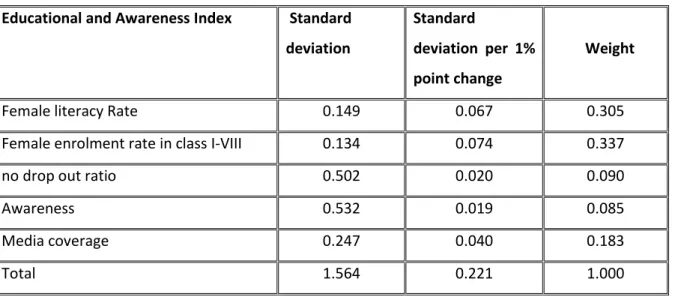
Table 1: Calculation of weight for educational and awareness index
Educational and Awareness Index Standard
deviation
Standard
deviation per 1%
point change
Weight
Female literacy Rate 0.149 0.067 0.305
Female enrolment rate in class I-VIII 0.134 0.074 0.337
no drop out ratio 0.502 0.020 0.090
Awareness 0.532 0.019 0.085
Media coverage 0.247 0.040 0.183
Graph number: 2
In the construction of this index maximum weight has been assigned to the female enrolment rate
from class first to the eighth class (33 percent).While the female literacy rate and their media
coverage have been assigned second and third highest weight i.e. 30 percent and 18 percent
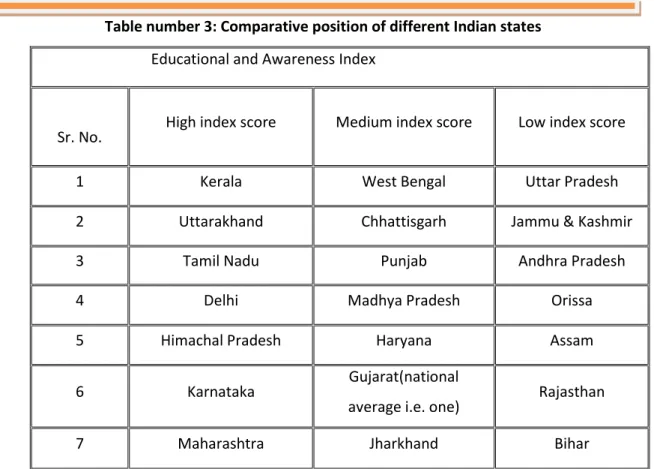
respectively. Kerala, Uttrakhand and Tamil Nadu are the highest ranking states as far as this Index is
concern. The values for this index for these states are 1.32, 1.27 and 1.23 respectively. While the
Assam, Rajasthan and Bihar are the lowest performing states in terms of this economic
empowerment index. The values for this index for these states are 0.91, 0.89 and 0.68 respectively.
If we arrange these states according to their respective index score than we can easily divides
these states in to three different categories as below:
0.00 0.20 0.40 0.60 0.80 1.00 1.20 1.40
Ed
u
ca
ti
on
al
a
n
d
A
w
ar
e
n
e
s
Empo
w
e
rm
e
n
t
In
d
ex
Table number 3: Comparative position of different Indian states
Educational and Awareness Index
Sr. No. High index score Medium index score Low index score
1 Kerala West Bengal Uttar Pradesh
2 Uttarakhand Chhattisgarh Jammu & Kashmir
3 Tamil Nadu Punjab Andhra Pradesh
4 Delhi Madhya Pradesh Orissa
5 Himachal Pradesh Haryana Assam
6 Karnataka Gujarat(national
average i.e. one) Rajasthan
7 Maharashtra Jharkhand Bihar
CONCLUSION AND SUGGESTION
On the basis of the findings of this paper it can be concluded that;
There exists huge disparities among the states as far as the educational development and awareness
index is concerns.
The female literacy and gross enrolment ratio contributing most significantly in the educational
development and awareness index.
Coverage of mass media and awareness contributing insignificantly in the educational development
and awareness index.
There has been significant improvement in the capacity of women through the education.
Social and household variables have a strong relationship with the education and awareness.
Women in India still are suffering from the various kinds of exploitation and inequalities. The
education of women is the most powerful tool to change the position of society. Education also
brings a reduction in inequalities and functions as a means of improving their status within the
family as well as in the society. For this purpose there is a need to create an enabling environment
through adopting various policies and programmes for educational development and enhancing
REFERENCES
Country Report, (1995). Fourth World Conference on Women. International conference on women
empowerment in Beijing.
Basu A.and Ray, B. (2003): Women’s Struggle: A History of the All India Women Conference,
1927-2002.Manohar, Delhi
Jejeebhoy, S. and Sathar, Z. (2001).Women’s Autonomy in India and Pakistan: The Influence of Religion and Region.Population and Development Review, 27(4), 687-712.
Jejeebhoy, Shireen J. (2000).Women’s autonomy in rural India: Its dimensions, determinants, and the
influence of context. (Eds.), Harriet Presser and Gita Sen, New York: Oxford University Press.
Kabeer, N.(2001). Conflicts over credit: re-evaluating the empowerment potential of loans to women
in rural Bangladesh. World Development 29 (1), 63-84.
Malhotra, Meenakshi (2004): Empowerment of Women. Isha Books, Delhi
Robeyns, I. (2006). “ Sen’s Capability Approach and Gender Inequality, Selecting Relevant
Capabilities.” (Eds.) Agarwal, Humphries and Robeyns, pp: 72-98.
Sen, Amartya. (1999). Development as Freedom. Oxford: Oxford University Press.
Schüler, D. (2006).The uses and misuses of the Gender-related Development Index and Gender
Empowerment Measure: a review of the literature. Journal of Human Development, 7 (2),
161–181.
UNDP. (1995). Human Development Report. New York: UNDP.
UNDP. (2001).Gender Development Report.New York: UNDP.
UNICEF, (1994).The Women's Equality and Empowerment Framework. UNICEF Report.
World Bank (2001).Engendering Development: Through Gender Equality in Rights, Resources, and Voice. New York: Oxford University Press.