A Fuzzy-based QoS Maximization Protocol for
WiFi Multimedia (IEEE 802.11e) Ad hoc Networks
Hicham Touil
1and Youssef Fakhri
1,21Laboratory LaRIT, Team Network and Telecommunication, University Ibn Tofaïl, Kenitra, Morocco. 2
LRIT, Unité Associée au CNRST (URAC 29), Faculty of Sciences University, Mohammed V-Agdal, Rabat, Morocco [email protected], [email protected]
Abstract: The Quality of Service (QoS) management within a
multiple-traffic Wi-Fi MultiMedia (WMM) ad hoc network is a tedious task, since each traffic type requires a well determined QoS-level. For this reason, the IEEE Working Group has proposed the IEEE 802.11e Enhanced Distributed Channel Access (EDCA) protocol at the MAC layer of WMM ad hoc networks. However, several studies have shown that EDCA must be further improved for three main reasons. The first reason is the poor performance of EDCA under high traffic conditions due to the high collision rate. The second reason is the need to maximize the traffic performance (delay, throughput, etc.) guaranteed by EDCA, seen the rapid evolution of the applications (multimedia, real time, etc.). The third reason is the need to maximize the energy efficiency of the EDCA, seen its use in battery constrained devices (e.g. Laptop, Smart phone, Tablet computers, etc.). For these three reasons, we propose in this paper a Three-in-One solution MAC protocol called QoS Maximization of EDCA (QM-EDCA), which is an enhanced version of EDCA. Based on the fuzzy logic mathematic theory, QM-EDCA incorporates a dynamic MAC parameters fuzzy logic system, in order to adapt dynamically the Arbitration inter frame Spaces according to the network state and remaining energy. Simulation results show that QM-EDCA outperforms EDCA by reducing significantly the collision rate, and maximizing traffic performance and energy-efficiency. In addition our solution is fully distributed.
Keywords: Wi-Fi Multimedia; IEEE 802.11e; MAC protocol;
Quality of Service; energy efficiency; battery limited devices; fuzzy logic.
1.
Introduction
The large scale use of Wireless Fidelity (Wi-Fi) technology in various fields has led to it rapid evolution. Deployed everywhere (at the office, in the coffee, at the airport, etc.), this technology has known a great success. Wi-Fi is the commercial denomination of the IEEE 802.11 standard [1]. The emergence of multimedia applications has caused a greater need on QoS (in terms of delay, throughput, etc.), because each type of traffic (Voice, Video, etc.) demands a well determined QoS-level according to its priority [2]. The IEEE 802.11 architecture does not distinguish between the different types of traffic (real-time, video, scalar, etc.), and therefore the packets are treated with the same priority, thing that prevents to offer the QoS-level requested by the highest priority traffics (e.g. multimedia traffic). For this reason, the IEEE Working Group has proposed the IEEE 802.11e standard [3] known as Wi-Fi MultiMedia (WMM), which is an enrichment of the IEEE 802.11 standard. The IEEE 802.11e provides service differentiation techniques at the MAC layer level, thing that allows manipulating the traffics
according to their priority level, and thus significantly improves QoS in the network. Nowadays, the IEEE 802.11e (WMM) is the most used and recommended standard for WLAN [3]. The IEEE 802.11e standard defines two MAC protocols: (i) the Enhanced Distributed Channel Access (EDCA) protocol, which is a distributed contention-based channel access mechanism; (ii) and Hybrid Coordination Function (HCF) Controlled Channel Access (HCCA) protocol, which is a centralized polling-based channel access mechanism.
The use of the IEEE 802.11e EDCA protocol at the MAC layer of Wi-Fi Multimedia ad hoc networks has allowed ensuring a good QoS-level [4]. This MAC protocol has the ability to manage multiple traffic types (real-time, video, scalar, etc.) according to their priorities, and thus ensure a good traffic performance [4]. This is due to the Multi-queue/Multi-priority traffic differentiation mechanism on which the architecture of EDCA is based. However, EDCA protocol must be further improved for three main reasons. The first reason is the poor performance of EDCA under high traffic conditions due to the high collision rate [2]. The second reason is the need to maximize the traffic performance (delay, throughput, etc.) guaranteed by EDCA, seen the rapid evolution of the applications (multimedia, real time, etc.) [2] [5]. The third reason is the need to maximize the energy efficiency of the EDCA, seen its use in battery constrained devices (e.g. Laptop, Smart phones, Tablet computers, eBook readers, etc.), and because nowadays, greening the communication protocols is a primordial point that must be kept into account in the design phase [6] [7] [8]. For these three reasons, we propose in this paper an enhanced version of EDCA.
The rest of this paper is organized as follows. In section 2, we address the related work. Section 3 provides an overview of the IEEE 802.11e EDCA MAC protocol. In section 4, we present in detail our proposed QM-EDCA MAC protocol. More exactly, we will describe in detail the mechanism that we have integrated in EDCA to propose QM-EDCA. Performance evaluation is presented in section 5. The last section concludes the paper and gives possible directions for future research.
2.
Related work
802.11e MAC layer of WMM ad hoc networks, seen the ability of MAC protocols to contribute in improving both traffic performance and energy efficiency [9]. Several studies have attempted to improve the traffic performance of the EDCA [10]. We cite as example the study in [11] that has proposed an extended version of EDCA, which incorporates a non-linear dynamic adaptation algorithm of the minimum contention windows, in order to improve throughput and channel utilization, and to reduce packets delay. As well, in [10], the authors have proposed an admission control solution for EDCA, which guarantees a transmission channel access without collisions for stations with high priority traffic.
On the other hand, we clearly see that few studies have attempted to improve the energy efficiency of the EDCA. One of the best improvements of EDCA energy-efficiency is an energy conservation mechanism called Automatic Power Save Delivery (APSD) [7], which was proposed by the IEEE Working Group as an optional extension. The principle of APSD is to allow to the communication interface to avoid the idle listening state by passing to the sleep state. Given that the idle listening is a main source of energy loss [12], the use of ASPD allows improving significantly the energy efficiency of EDCA [7]. But other than the idle listening, there are other sources of energy loss when exchanging traffics, such as collision, overhead, etc. [12]. And thus, to further improve the energy efficiency of EDCA, we must try to reduce at least one of these sources of energy loss. Especially that we see recently the increased use of EDCA at the MAC layer of Wireless Multimedia Sensor Networks [13] [9].
The study in [14] has proved that the dynamic adaptation of EDCA Arbitration Inter Frame Spaces is an effective solution to reduce collisions and increase throughput. In addition, the authors in [15] have showed the existence of clear impact of EDCA Arbitration Inter Frame Spaces values on traffic performance (delay, throughput and packet delivery ratio) and energy consumption, which varies according to the traffic load in the network. These motivating results of these two studies pushed us to investigate the possibility of maximizing the QoS of EDCA, by proposing the three-in-one solution QM-EDCA protocol, which incorporates a new Dynamic Arbitration Inter Frame Spaces Mechanism based on a fuzzy logic system.
Fuzzy logic [16] has been used in several studies to improve QoS in wireless networks. We cite as an example the study done in [17], which proposes a dynamic fuzzy logic control for IEEE 802.11e EDCA to respond the dynamic traffic specification, provide a real time bandwidth allocation and maintain equity. Another study in [18] has proposed a routing strategy that is based on fuzzy logic theory for multi-hop cognitive radio networks. We also find the study [19] that has proposed a mobility prediction method for the IEEE 802.16e (WiMAX) based on fuzzy logic theory. As well, the study in [20] uses also the fuzzy logic theory, to propose a new fuzzy evaluation method to rank the existing Multi-disjoint Paths Selection Algorithms of IP/MPLS networks. So we see that several studies have made of fuzzy logic the basis of their proposed technique, seen its ability to imitate human decisions, and also for its simplicity of use and implementation.
3.
The IEEE 802.11e EDCA MAC protocol
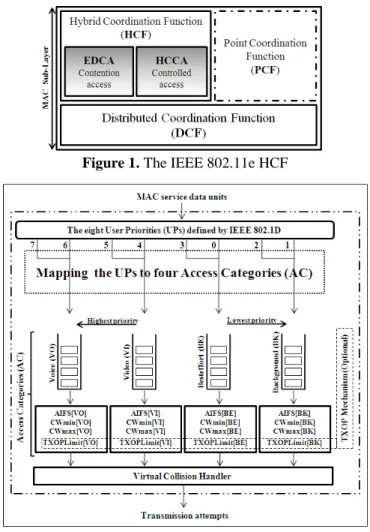
The IEEE 802.11e standard is an enrichment of the IEEE 802.11. This new standard defines a third coordination function called Hybrid Coordination Function (HCF) [3]. As shown in figure 1, the HCF defines two MAC protocols: (i) Centralized polling-based channel access mechanism represented by HCCA MAC protocol, for contention free data transmission, and (ii) Distributed contention-based channel access mechanism represented by EDCA MAC protocol, for contention based data transmission. To ensure traffic differentiation, the EDCA uses four traffic priority classes called Access Categories (AC). The eight user priorities defined by the IEEE 802.11D Bridges Specification [21] are mapped to the four AC (see figure 2).
Figure 1. The IEEE 802.11e HCF
Figure 2. The EDCA structure
Table 1. Default EDCA MAC parameters values
AC AIFSN CWmin CWmax
TXOPLIMIT (ms)
D
S
-C
C
K
(.
1
1
b
)
E
x
te
n
d
ed
R
a
te
/O
F
D
M
(.
1
1
a
/g
)
O
th
er
P
H
Y
s
VO 2 (aCWmin +1) 4-1
(aCWmin +1) 2-1
3.264 1.504 0
VI 2 (aCWmin +1) 2-1
aCWmin 6.016 3.008 0
BE 3 aCWmin aCWmax 0 0 0
BK 7 aCWmin aCWmax 0 0 0
Figure 3. Distributed channel access technique
The distributed channel access technique of EDCA (see figure 3) is based primarily on the two MAC parameters AIFS[AC] and CW[AC]. The AIFS[AC] parameter represents the minimum idle time required before transmission or Backoff, and is calculated at the base of AIFSN[AC] parameter, see (1). The contention window CW[AC] is used in (3) to calculate the Backoff time that represents an additional waiting time before start the transmission, and is determined by CWmin[AC] and CWmax[AC], see (2). The initial value of CW[AC] is CWmin[AC]. Concerning the value of aSlotTime and SIFS, the physical layer determines their values. For example, if the IEEE 802.11b PHY is used so: aSlotTime = 20µs and SIFS = 10µs.
[ ]
[ ]
AIFS AC =SIFS+AIFSN AC ×aSlotTime (1)
[ ]
[ ]
[ ]
CWmin AC ≤CW AC ≤CWmax AC (2) Each station that wants to transmit a packet must first wait a AIFS[AC] time. If during this time the channel has remained free, the station sends the packet directly. Otherwise, the station waits until the channel becomes free, then wait again the AIFS[AC] time, and waits a random time calculated using a Backoff Timer (BT) that uses a random function with uniform distribution on the range (0,CW[AC]), see (3). If during the decrement of BT[AC] the channel becomes busy, the decrement is suspended. Once the channel becomes free, the station waits the AIFS[AC] time, then continues the decrement of the BT[AC] previously suspended. When the BT[AC] expires, the station sends the packet. In the case of a transmission error of the sent packet (e.g. collision), the CW[AC] is doubled according to (4) and by respecting condition (2), and the retransmission of the
packet is scheduled. By cons, if the packet is sent successfully the CW[AC] is reset to the CWmin[AC] value.
[ ]
(0,[ ]
)BackoffTimer AC =Random CW AC ×aSlotTime (3)
[ ]
new 2(
[ ]
old 1)
1CW AC = × CW AC + − (4)
4.
Fuzzy-based QoS Maximization Protocol
In this section, we will describe in details our proposed new dynamic Arbitration Inter Frame Spaces Mechanism that we have integrated in EDCA to propose QM-EDCA protocol. As shown in figure 4, the proposed mechanism is based on a Fuzzy Logic System (FLS) to make suitable adaptation decisions of AIFSNs.
In general, Fuzzy logic [16] is a generalization of the classical logic, which introduces the membership degree notion. Let U be a space of points, x a generic element of U, A is a set in U characterized by the membership functionµA, and B a fuzzy set in U characterized by the membership functionµB. In classical set (5), the membership of x in A is evaluated by 1 (true) or 0 (false). But in fuzzy set (6), the membership of x in B is a real value in [0,1], hence the notion of membership degree in fuzzy logic.
( )
1,
0
A
x A x U x
x A
µ
∈∀ ∈ =
∉
(5)
[ ]
: 0,1
B U
µ
→ (6)Figure 4. The proposed mechanism architecture
FLS. The calculated REL and CR represent the inputs of the FLS. Based on these two inputs, the FLS calculates and makes suitable adaptation decisions of AIFSN values. The decision metric REL is used as preventive solution, by keeping an eye on the battery status, especially when CR is medium or high. With the decrease of REL (Medium or Low), the FLS will look in the predefined rules the optimal configuration of Arbitration inter frame spaces, in order to reduce the probability that a collision occurs, and thus avoid energy loss. The decision metric CR is used as a corrective solution. The CR input allows our system to keep an eye on the network state in terms of collisions number. With the increase of CR, the FLS will look in the predefined rules the optimal configuration of Arbitration inter frame spaces, that will help to solve/reduce the problem of collisions, by reducing the probability that a collision occurs.
The operating mode of the proposed mechanism, and also the steps of measurements, calculations and decisions are as follows:
The mechanism repeats the eight steps detailed below after each period of time P. The value set in this paper for P in (7) and the weight β in (9) are chosen and recommended by the reference [22] (more details in [23]), because these values ensure a good tradeoff between delay and throughput. The value of aSlotTime depends on the used physical layer (e.g. aSlotTime= 20µs if the IEEE 802.11b is used):
5000
P= ×aSlotTime (7) • Pretreatment : Phase of inputs measurement (CC, SPC, and REB) and calculate of decision metrics (CR and REL):
STEP 1: Throughout the period P, the mechanism counts the number of collisions and the number of sent packets, through the inputs CC and SPC
STEP 2: Immediately after the expiry of the period P, the mechanism calculates the collision rate (CR) from CC and SPC, using the following formula:
100%
p new P
p CC CR
SPC
= × (8)
STEP 3: The CR used as input to the FLS must represent the CR recently calculated ( new
P
CR ) and the average CR calculated in the previous period P (
[ ]
oldpreviousP
CR avg ), in order
to have an accurate estimate. For this reason we use an Exponentially Weighted Moving Average (EWMA) as follows:
[ ]
new(
1)
new[ ]
oldP
P previousP
CR avg = − ×β CR + ×β CR avg (9) STEP 4: Directly after step 3, the mechanism calculates the Remaining Energy Level REL, using the REB input and the Total Energy of the Battery (TEB):
100%
new P P
REB REL
TEB
= × (10)
STEP 5: The mechanism applies the two calculated decision metrics new
P
REL and
[ ]
newP
CR avg as inputs to the FLS, to start the steps of the decision phase.
• Decision phase and Post-treatment:
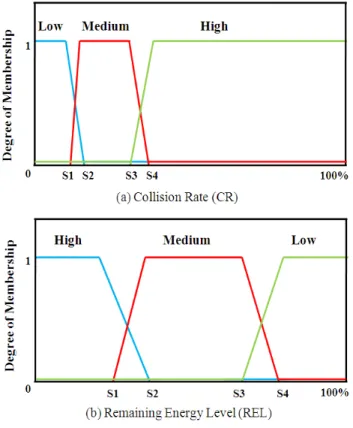
STEP 6: The FLS fuzzifies the values of
[ ]
new PCR avg and new P
REL , using their Membership Functions (see figure 5). In this step, the value of CR avg
[ ]
newP is converted to the corresponding fuzzy set (Low L, Medium M or High H), and the same for newP
REL . The universe of discourse is [0,100]. We use as classical fuzzy operator the Max-Norm:
{
}
[
]
L/M/H(x) = max L(x), M(x), H(x) x 0,100
µ
µ
µ
µ
∀ ∈ (11)Figure 5. Membership functions
STEP 7: Then, by using Table 2 which contains the fuzzy inference rules, the FLS takes a decision by choosing the corresponding rule to the linguistic values of new
P
REL and
[ ]
new PTable 2. The Fuzzy inference rules
IF THEN
Rules CR REL Decisions
R1 LOW LOW Config A
R2 LOW MEDIUM Config A
R3 LOW HIGH Config A
R4 MEDIUM LOW Config C
R5 MEDIUM MEDIUM Config B
R6 MEDIUM HIGH Config B
R7 HIGH LOW Config E
R8 HIGH MEDIUM Config E
R9 HIGH HIGH Config D
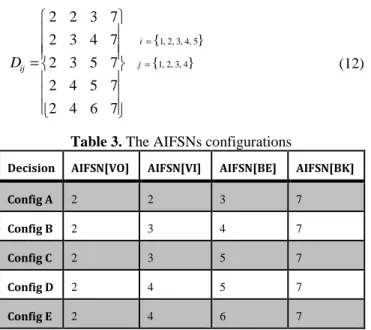
STEP 8: once the corresponding decision to the rule is taken, the FLS defuzzifies the decision to the corresponding Arbitration Inter Frame Space Number (AIFSN) values, using the matrix D detailed in Table 3. In the matrix D each line represents a decision, and the four elements of each line represent the configuration (values) of the four AIFSN.
{ }
{ }
1, 2, 3, 4, 5
1, 2, 3, 4
2 2 3 7 2 3 4 7 2 3 5 7 2 4 5 7 2 4 6 7
ij
i
j
D
=
=
=
(12)
Table 3. The AIFSNs configurations
Decision AIFSN[VO] AIFSN[VI] AIFSN[BE] AIFSN[BK]
Config A 2 2 3 7
Config B 2 3 4 7
Config C 2 3 5 7
Config D 2 4 5 7
Config E 2 4 6 7
The fuzzy inference rules have been chosen in Table 2 such that the FLS uses the best configuration of the four AIFSN according to the two inputs REL and CR, in order to minimize the collision probability. The configurations (decisions) have been associated with the fuzzy rules as follows:
• The configuration A is associated to R1, R2 and R3 (CR=LOW). According to the tests carried out in our previous study [15], the use of a configuration other than Config A when CR=LOW will just increase the packet delay. Config A is the default configuration used by the EDCA protocol [3] regardless of network status.
• When the CR becomes Medium, we use the Config B for R5 and R6 to reduce the collision probability. For the rule R4, we use Config C, which attempts to further reduce the collision probability, to try to ensure a preventive solution of collisions, seen the critical state of the battery (REL=LOW).
•The configuration B is the most appropriate for R9 in order to reduce such high collision rate (CR=HIGH). When the battery state is critical (MEDIUM or LOW) with a CR=HIGH, we use our preventive solution (Config E), to try to further reduce the probability of collisions. The values in Table 3 (Matrix D) have been chosen taking into account the values and recommendations of the IEEE 802.11e [3], and the tested values in [14] and [15]. These values have been selected according to their ability to reduce the collision probability. More exactly, the values have been chosen as follows:
• The values of each configuration depend largely on the collision rate related to the increase of the traffic load and density, and depend also on the battery state.
• The values are chosen from one configuration to another in order to reduce collision probability according to the observed collision rate.
• To avoid increasing the delay of the real-time traffics of AC[VO], we have fixed the value of AIFSN[VO] to 2 in all configurations. AIFSN[VO]=2 is the recommended value used by EDCA [3].
• The value of AIFSN[BK] is fixed to 7 in all configurations, and will not be increased, in order to avoid the penalization of AC[BK] traffics. AIFSN[BK]=7 is the recommended value used by EDCA [3].
• The AIFSN[VI] value is always greater than the AIFSN[BE] value in all configurations, such that the AC[VI] priority remains greater than that of AC[BE], as recommended by the IEEE 802.11e standard [3].
•The values combination of AIFSN[VI] and AIFSN[BE] is fixed in all configurations in such a way as to reduce as much as possible the collision probability, according to the state of CR and REL. After several simulations of several values, and based on the values tested in [14] and [15], we have found these optimal configurations that provide good performance under well-defined collision rates.
5.
Performance evaluation
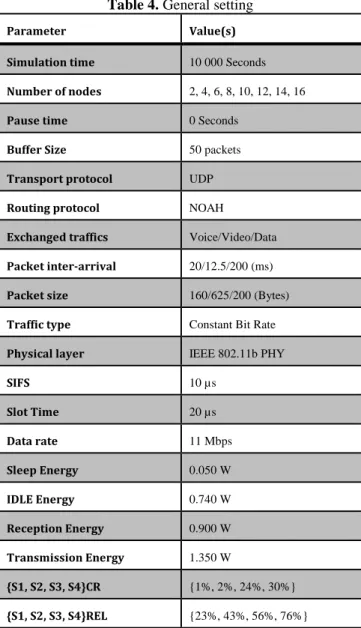
The simulation of different scenarios was carried out with the simulation platform Network Simulator 2 (NS2). Based on the code proposed in [25], we have implemented the EDCA protocol in NS. As shown in the topology (see figure 6), we have realized several scenarios through the variation of the nodes density (and traffic load, see table 6), in order to properly evaluate the QoS level guaranteed by EDCA and QM-EDCA. We have chosen as evaluation metrics the collision rate, the energy-efficiency (in terms of lifetime), and the traffic performance (in terms of delay, throughput and packet delivery ratio), seen that our initial objective was the improvement of these three metrics. The used topology does not contain mobile nodes, and each node can communicate directly with all network nodes (the nodes form one Independent Basic Service Set). Table 4 summarizes the general setting used in our simulation (density, energetic characteristics of the communication interface [8], etc.). In table 5, we find the default values of EDCA parameters which correspond to using the IEEE 802.11b standard at the physical layer [3]. The exchanged traffics are inspired from [5].
Table 4. General setting
Parameter Value(s)
Simulation time 10 000 Seconds
Number of nodes 2, 4, 6, 8, 10, 12, 14, 16
Pause time 0 Seconds
Buffer Size 50 packets
Transport protocol UDP
Routing protocol NOAH
Exchanged traffics Voice/Video/Data
Packet inter-arrival 20/12.5/200 (ms)
Packet size 160/625/200 (Bytes)
Traffic type Constant Bit Rate
Physical layer IEEE 802.11b PHY
SIFS 10 µs
Slot Time 20 µs
Data rate 11 Mbps
Sleep Energy 0.050 W
IDLE Energy 0.740 W
Reception Energy 0.900 W
Transmission Energy 1.350 W
{S1, S2, S3, S4}CR {1%, 2%, 24%, 30%}
{S1, S2, S3, S4}REL {23%, 43%, 56%, 76%}
The {S1, S2, S3 and S4} CR values have been chosen by studying the impact of different AIFSN values on collision
rate for different densities and traffic load. By analyzing these impact results, we have found that there are three levels of impact, from which we have determined approximately the values of S1 S2 S3 and S4. For {S1, S2, S3 and S4} REL values, the lack of standards or methods to determine these intervals pushed us to divide REL into three states, according to our needs in Table 2, in order to incorporate our preventive solution, which consists to try to further reduce the collision probability when the battery state is critical.
Figure 6. Simulation topology
Table 5. Default EDCA MAC parameters values
AC AIFSN CWmin CWmax
VO 2 7 15
VI 2 15 31
BE 3 31 1023
BK 7 31 1023
Table 6. Correspondence between nodes density and traffic load
Nodes density Traffic load
2 8.45%
4 16.9%
6 25.36%
8 33.81%
10 42.27%
12 50.72%
14 59.18%
16 67.63%
5.1. Discussion of the results
In this section, we will analyze and discuss the simulation results in terms of the three points that have motivated us to propose QM-EDCA protocol, which are: the collision rate of EDCA that increases rapidly with the increase of traffic load, the need to maximize traffic performance guaranteed by EDCA (in terms of delay, throughput and packet delivery ratio), and the need to maximize the energy efficiency of EDCA.
5.1.1 Collision rate
Figure 5 represents the collision rate as a function of the nodes density (and traffic load, see Table 6), for EDCA and QM-EDCA protocols. Through this figure we observe two things. Firstly, the problem of the rapid increase in the collision rate of EDCA when traffic load increases. And secondly, the ability of the proposed QM-EDCA to solve (density = 6) and reduce (density >= 6) the problem of the rapid increase in the collision rate of the EDCA.
Figure 7. Collision rate vs. Density/Traffic-load for EDCA and QM-EDCA
Through these preliminary results, we can see that the QM-EDCA protocol solves the collision rate problem of QM-EDCA, for a density equal to 6 (Traffic load = 25.36%). For a density greater than 6 nodes, QM-EDCA cannot completely solve the problem, but can clearly reduce the collision rate compared to EDCA. This significant improvement is due to the ability of the mechanism that we have integrated in QM-EDCA to predict the optimal configuration of the four arbitration inter frame spaces, in order to minimize the probability that a collision occurs.
5.1.2 Traffic performance
Figure 8. Average end-to-end delay vs. Density/Traffic-load for EDCA and QM-EDCA
Figure 8 represents the average end-to-end delay as a function of the nodes density (and traffic load, see Table 6), for EDCA and QM-EDCA protocols. Through these preliminary results, we see that QM-EDCA can significantly reduce the delay compared to EDCA, even if the traffic load increases. As result of the decrease in the number of collisions, the time lost during the collision and the time lost to retransmit the packet after collision are eliminated, thing that explains the ability of QM-EDCA to significantly reduce the delay compared to the EDCA.
Figure 9. Throughput vs. Density/Traffic-load for EDCA and QM-EDCA
Figure 10. Packet delivery ratio vs. density/Traffic-load for EDCA and QM-EDCA
Figures 9 and 10 represent respectively the throughput and Packet Delivery Ratio (PDR) as a function of the nodes density (and traffic load, see Table 6), for EDCA and QM-EDCA protocols. These two figures show clearly that the QM-EDCA protocol provides better performance compared to the EDCA, in terms of throughput and PDR. These improvements are due to the decrease in the number of collisions in the network, which also engenders the decrease in the retransmissions. In addition, the possibility of rejecting a packet due to full queue decreases, seen that packets spend less time in queues due to the improvement in delay, thing that improves the PDR even if the load increases.
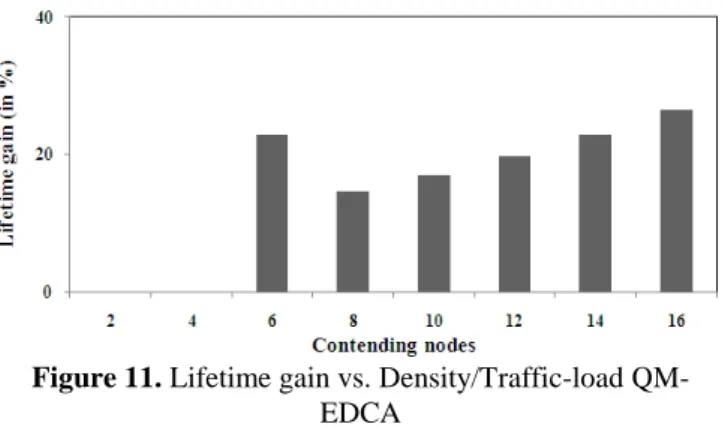
5.1.3 Energy Efficiency
packet after collision are eliminated, And thus, the lifetime improves significantly.
Figure 11. Lifetime gain vs. Density/Traffic-load QM-EDCA
6.
Conclusion and future work
In order to maximize the QoS in IEEE 802.11e (WMM) ad hoc networks, we have proposed in this paper a three-in-one solution MAC protocol called QM-EDCA, which is an enhanced version of EDCA. We have proposed QM-EDCA to solve/reduce the collision rate problem of EDCA, and to improve traffic performance and energy efficiency guaranteed by the EDCA. We have incorporated in QM-EDCA a mechanism that is based on a fuzzy logic system, in order to adapt dynamically the arbitration inter frame spaces parameters of the four AC. The simulation results have clearly shown that QM-EDCA outperforms EDCA by reducing significantly the collision rate, and maximizing traffic performance and energy-efficiency.
Given the effectiveness of the solution proposed in this paper, we will try to expand the principal by defining a FLS that gives also the optimal configuration (at run time) of the contention windows and the transmission opportunity limits of EDCA protocol, in order to try to further maximize the QoS in Wi-Fi Multimedia ad hoc networks.
References
[1] LAN MAN Standards Committee of the IEEE Computer Society ANSI/IEEE Std 802.11, “Wireless LAN Medium Access Control (MAC) and Physical Layer (PHY) Specifications,” IEEE Std. 802.11, Part 11, 1999.
[2] J. Villalón, C. Pedro, O. Luis, G. Antonio, “B-EDCA: A Qos Mechanism for Multimedia Communications over Heterogeneous 802.11/802.11e Wlans,” Computer Communications, Vol. 31, No. 17, pp. 3905-3921, 2008.
[3] IEEE 802 Committee of the IEEE Computer Society, “IEEE 802.11e Amendment to IEEE Std 802.11, Part 11: Wireless LAN Medium Access Control (MAC) and Physical Layer (PHY) Specifications: Medium Access Control (MAC) Quality of Service (QoS) Enhancements,” IEEE Std. 802.11, Part 11, 2005. [4] X. Yang, “IEEE 802.11e: QoS provisioning at the MAC
layer,” IEEE Wireless Communications, Vol. 11, No. 3, pp. 72-79, 2004.
[5] C. Jyh-Cheng, C. Kai-wen, “EDCA/CA: Enhancement of IEEE 802.11e EDCA by Contention Adaption for Energy Efficiency,” IEEE Transactions on Wireless
Communications, Vol. 7, No. 8, pp. 2866-2870, 2008.
[6] A. Garcia-Saavedra, P. Serrano, A. Banchs, M. Hollick, “Energy-efficient fair channel access for IEEE 802.11 WLANs,” IEEE International Symposium on a World of Wireless, Mobile and Multimedia Networks (WoWMoM), Lucca, pp. 1-9, 2011.
[7] X. Costa-Perez, D. Camps-Mur, T. Sashihara, “Analysis of the integration of IEEE 802.11e capabilities in battery limited mobile devices,” IEEE Wireless Communications, Vol. 12, No. 6, pp. 26-32, 2005. [8] D. O. Cunha, L. H. M. K. Costa, O. C. M. B. Duarte,
“Analyzing the energy consumption of IEEE 802.11 ad hoc networks,” Mobile and Wireless Communications Networks, Springer, Vol. 162, pp. 473-484, 2005. [9] H. Touil, Y. Fakhri, “QoS-Aware MAC Protocols Based
on the IEEE 802.11e for Wireless Multimedia Sensor Networks,” International Review on Computers and Software, Vol. 9, No. 3, pp. 440-449, 2014.
[10]A. Hamidian, U. Körner, “An Enhancement to the IEEE 802.11e EDCA Providing QoS Guarantees,” Telecommunication Systems, Vol. 31, No. 2-3, pp. 195-212, 2006.
[11]L. Gannoune, “A Non-linear Dynamic Tuning of the Minimum Contention Window (CWmin) for Enhanced Service Differentiation in IEEE 802.11 ad-hoc Networks,” IEEE 63rd Vehicular Technology Conference, Melbourne Vic, pp. 1266-1271, 2006. [12]I. Demirkol, C. Ersoy, F. Alagoz, “MAC protocols for
wireless sensor networks: a survey,” IEEE Communications Magazine, Vol. 44, No. 4, pp. 115-121, 2006.
[13]O. Alaoui Fdili, Y. Fakhri, D. Aboutajdine, “Impact of queue buffer size awareness on single and multi service real-time routing protocols for WSNs,” International Journal of Communication Networks and Information Security (IJCNIS), Vol. 4, No. 2, pp. 104-111, 2012. [14]S. Gaur, T. Cooklev, “Introducing Finer Prioritization in
EDCA using Random AIFSN,” The 3rd International Conference on Testbeds and Research Infrastructure for the Development of Networks and Communities, Lake Buena Vista FL, pp. 1-6, 2007.
[15]H. Touil, Y. Fakhri, “Energy-efficiency maximization mechanism for IEEE 802.11e contention-based MAC protocols,” International Conference on Multimedia Computing and Systems (ICMCS), Marrakesh, Morocco, pp. 938-941, 2014.
[16]L.A. Zadeh , “Fuzzy sets,” Information and Control, Vol. 8, No. 3, pp. 338-353, 1965.
[17]C. Chao-Lieh, “IEEE 802.11e EDCA QoS Provisioning with Dynamic Fuzzy Control and Cross-Layer Interface,” Proceedings of 16th International Conference on Computer Communications and Networks, Honolulu HI, pp. 766-771, 2007.
[18]A. El Masri, N. Malouch, H. Khalifé, “A Fuzzy-based Routing Strategy for Multihop Cognitive Radio Networks,” International Journal of Communication Networks and Information Security (IJCNIS), Vol. 3, No. 1, pp. 74-82, 2011.
Journal of Communication Networks and Information Security (IJCNIS), Vol. 1, No. 1, pp. 14-19, 2009. [20]H. Naderi, H. Shahosseini, A. Jafari, “Evaluation
MCDM Multi-disjoint Paths Selection Algorithms Using Fuzzy-Copeland Ranking Method,” International Journal of Communication Networks and Information Security (IJCNIS), Vol. 5, No. 1, pp. 59-67, 2013. [21]IEEE 802.1D, “IEEE Standard for Local and
Metropolitan Area Networks – Media Access Control (MAC) Bridges,” IEEE Std. 802.1D, 2004.
[22]L. Romdhani, N. Qiang, T. Turletti, “Adaptive EDCF: enhanced service differentiation for IEEE 802.11 wireless ad-hoc networks,” IEEE Wireless Communications and Networking, New Orleans LA USA, pp. 1373-1378, 2003.
[23]L. Romdhani, N. Qiang, T. Turletti, “AEDCF: enhanced service differentiation for IEEE 802.11 wireless ad-hoc networks,” [online] https://hal.inria.fr/docs/00/07/20/44/ PDF/RR-4544.pdf, report n° 4544, pp. 1-22, 2002. [24]S. Rayanchu, A. Mishra, D. Agrawal, S. Saha, S.
Banerjee, “Diagnosing wireless packet losses in 802.11: Separating collision from weak signal,” IEEE INFOCOM, The 27th Conference on Computer Communications, Phoenix AZ, pp. 735-743, 2008. [25]W. Sven, M. Emmelmann, H. Christian, W. Adam,
![Figure 3. Distributed channel access technique The distributed channel access technique of EDCA (see figure 3) is based primarily on the two MAC parameters AIFS[AC] and CW[AC]](https://thumb-us.123doks.com/thumbv2/123dok_us/8126052.2155140/3.892.481.822.530.974/figure-distributed-channel-technique-distributed-technique-primarily-parameters.webp)