Contents
Key points ... 1
Migration and population growth ... 1
Permanent migration statistics ... 1
Temporary migration statistics ... 1
Other ... 2
Introduction ... 2
Historical overview of Australia’s Migration Program ... 2
Australia’s Migration Program (Table 1) ... 3
Australia’s Humanitarian Program (Table 1) ... 4
Measuring permanent migration ... 6
Migration and population growth (Tables 4 and 5) ... 7
Net overseas migration (NOM) statistics (Tables 3, 4 and 5) ... 7
Settler arrival statistics (Table 6) ... 9
Migration Program statistics (Table 1) ... 10
Humanitarian Program statistics (Table 1) ... 10
Temporary migration statistics (Table 2) ... 11
Statistical appendix ... 13
Table 1: Permanent migrants: migration and humanitarian program visa grants since 1985 ... 13
BACKGROUND
NOTE
Updated
29
October
2010
Migration
to
Australia
since
federation:
a
guide
to
the
statistics
Janet Phillips and Michael Klapdor Social Policy Section
Joanne Simon‐Davies
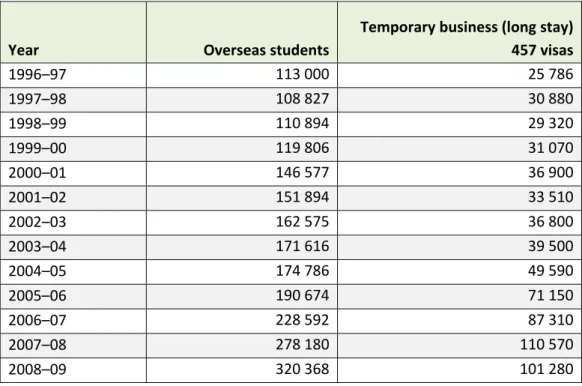
Table 2: Temporary migrants: overseas student and business long stay (subclass 457) visa
grants since 1996 ... 14
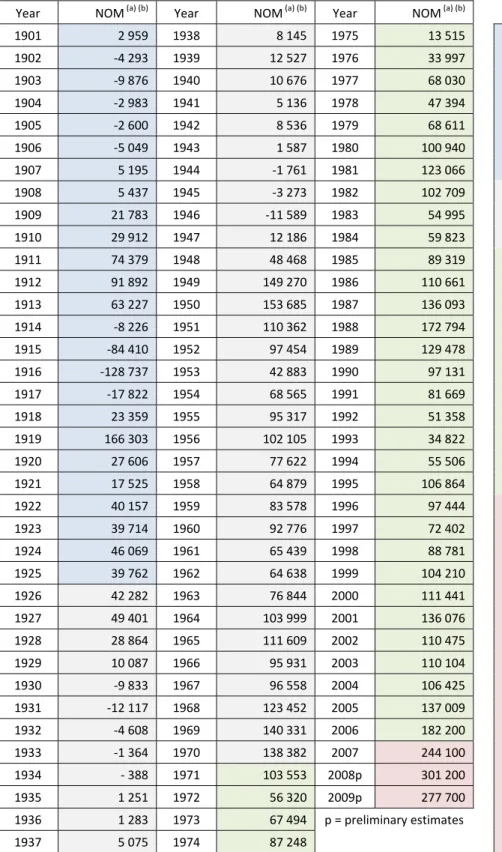
Table 3: Net overseas migration (NOM) since 1901 ... 15
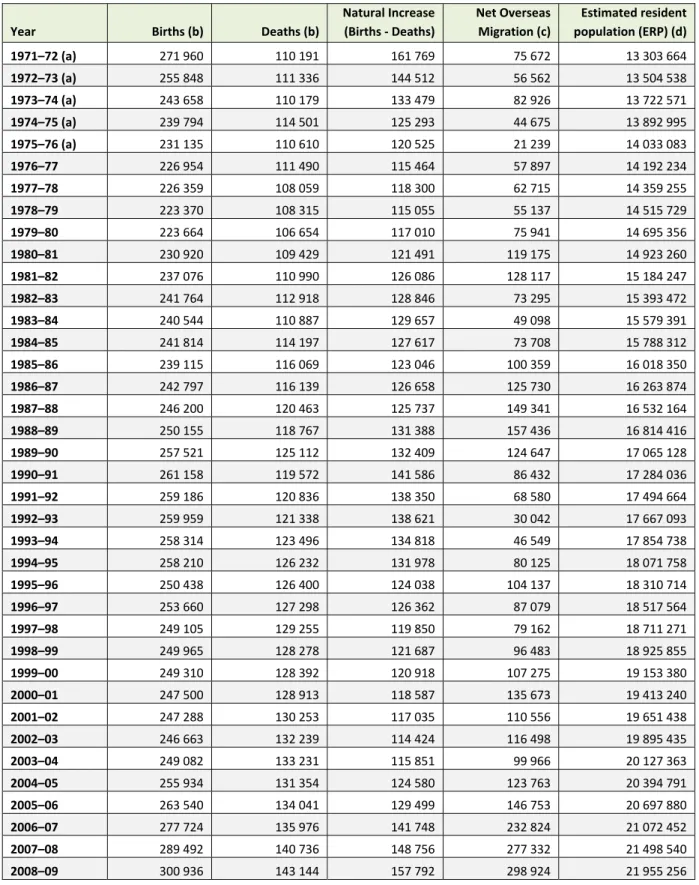
Table 4: Components of population growth since 1972 ... 16
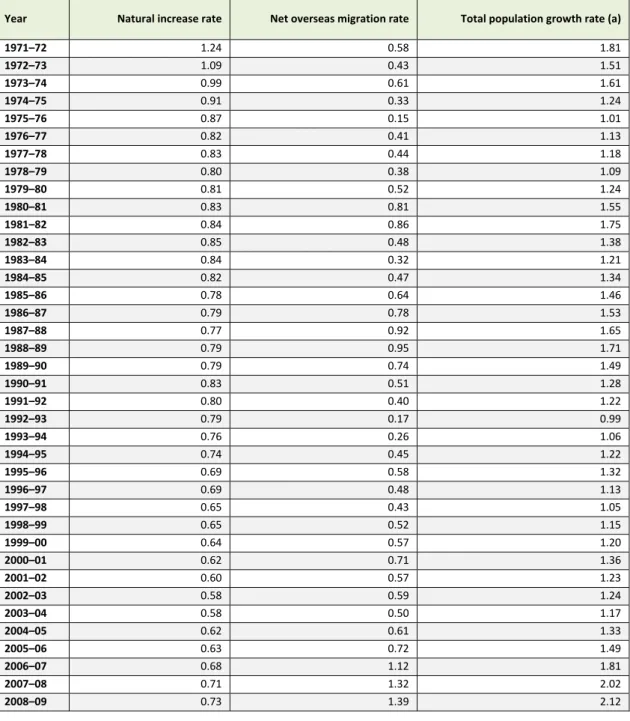
Table 5: Population growth rates since 1972 ... 18
Table 6: Permanent and long‐term overseas movement since 1925 ... 19
Table 7: Top 10 countries of birth for the overseas‐born population since 1901 ... 22
Key
points
Migration
and
population
growth
• The rate of Australia’s population growth has increased significantly over the last five years largely driven by an increase in net overseas migration (NOM). The largest contribution to NOM in recent years has been from people on temporary visas—mostly comprised of overseas students and temporary skilled migrants.
• Although permanent migration intakes over the last few years have been high in comparison to previous years, Australia’s recent population growth predominantly reflects a significant increase in temporary, not permanent migration.
Permanent
migration
statistics
• Net overseas migration (NOM) (Table 3) compiled since 1925 by the Australian Bureau of Statistics (ABS) is not a measure of the number of permanent migrants arriving in any given year as it measures departures and arrivals of both permanent and (long‐term) temporary entrants and the resulting increase or decrease in the population overall. In addition, the methodology for the calculation of NOM has changed significantly over the years and should be used with caution. • Migration Program outcome (visa grant) data (Table 1), currently recorded by the Department of
Immigration and Citizenship (DIAC), provide the most accurate statistics on the number of permanent migrants to Australia—data is available back to the 1980s.
• Humanitarian Program outcome (visa grant) data (Table 1), currently recorded by DIAC, provide the most accurate statistics on refugee and humanitarian intakes to Australia—data is available back to the 1970s (prior to that there are estimates available for the number of post war refugees).
Temporary
migration
statistics
• There has been a significant increase in the number of people entering the country on temporary visas in recent years, particularly overseas students and temporary (long‐term) skilled migrants. However, the number of temporary entrants can fluctuate in response to changing circumstances (for example, changes in immigration policy regarding permanent residency eligibility for
graduating overseas students).1 Data available from DIAC over the last 15 years shows the fluctuations in numbers (Table 2).2
1. For more details see; E Koleth, Overseas students: immigration policy changes 1997–May 2010, Parliamentary Library, Background note, Canberra, 2010, viewed 20 July 2010,
Other
• Settler arrival statistics are a better indication of permanent migration flows than NOM, but include NZ and some other temporary migrants who have indicated an intention to settle—data is available back to the 1920s in the statistical appendix (Table 6).
• It is important to note that ABS data on overseas arrivals and departures in general may relate to the multiple arrivals and departures of individuals in any year and not the number of people. They are not an appropriate source of migration statistics.
Introduction
Since 1945, when Australia’s first immigration department was established, approximately seven million permanent migrants have settled in Australia.3 According to the Department of Immigration and Citizenship (DIAC), the contribution of immigrants from all parts of the world to Australian society, culture and prosperity ‘has been an important factor in shaping our nation’.4
However, while Australia is often described as a ‘nation of immigrants’, there is a great deal of confusion and misinformation in the public debate on how many permanent migrants Australia has actually accepted over the years. In particular, some publicly available statistics on both permanent and temporary migration are often used interchangeably and/or incorrectly with the result that the statistics used to describe migration flows are often inaccurate or misleading.
The purpose of this paper is to provide background information on Australia’s migration programs and to define and present the relevant data in a simplified format. The paper aims to clarify which statistics are the best to use when measuring permanent migration and addresses some of the popular misconceptions that surround the debate on migration flows to Australia. It is envisaged that some of the statistics provided in the appendix will be updated at regular intervals.
Historical
overview
of
Australia’s
Migration
Program
Australia’s immigration program is divided into two distinct programs for permanent migrants—the Migration Program for skilled and family migrants and the Humanitarian Program for refugees and those in refugee‐like situations. There have been many changes to these programs and to data collection over the years making it difficult to compare statistics on permanent migration over time.
2
. DIAC’s statistical publications (in particular Population flows) provide the best sources of information for temporary and permanent migration outcomes since the 1980s. See DIAC’s statistical publication web page
http://www.immi.gov.au/media/publications/statistics/
3
. An additional 700 000 people settled in Australia between 1905 and 1945. Source: Department of Immigration and Citizenship (DIAC), Key facts in immigration, fact sheet no. 2, DIAC, viewed 25 May 2010,
http://www.immi.gov.au/media/fact‐sheets/02key.htm
4
The following background illustrates some of those changes and the corresponding tables are presented in the statistical appendix.
Australia’s
Migration
Program
(Table
1)
At the time of federation in 1901, the states administered their own migration programs, but over time the Commonwealth Government began to assume more and more responsibility for
immigration policy. After World War I the Commonwealth took active control of immigration and encouraged new settlers, with the result that in the 1920s about 300 000 settlers arrived (mostly under assisted schemes such as the Empire Settlement Scheme). Between 1901 and the beginning of World War II, approximately 700 000 new settlers arrived and Australia’s population grew to about seven million.5
Australia’s first federal immigration portfolio was created in 1945. The major impetus for the new portfolio, and for the implementation of a large‐scale migration program, was World War II and its aftermath. After the war the Australian Government was keen to boost the population in order to stimulate post‐war economic development and to increase the numbers of people able to defend the country in the event of another war, with the result that about one million migrants arrived in each of the six decades following 1950.6
• For many years the Australian Government has reviewed and adjusted the number of places available for permanent migrants on an annual basis according to government priorities. As a result, the Government’s planned annual intakes and the numbers of permanent migrants have fluctuated markedly.
• Available data on migration levels prior to the 1980s is patchy. It relies on a variety of ABS data, some of which may also include temporary arrivals; or on government planning figures that only provide an indication of migration outcomes for certain years.7 Prior to 1959 the Government found it difficult to collect figures on permanent or net migration to Australia. Settler arrivals were not recorded separately from temporary and other arrivals.8 In 1959 the Commonwealth Statistician began publishing separate figures for ‘settler arrivals’ and the new system began identifying and recording actual arrivals as distinct from long term visitors, returning Australians and others.9 Similarly, government migration program planning figures were not published
5. Department of Immigration and Multicultural Affairs (DIMA), Immigration–federation to century’s end, Canberra, 2001, pp. 1–3, viewed 25 May 2010, http://www.immi.gov.au/media/publications/statistics/federation/ 6. DIAC, Key facts in immigration, op. cit.
7. DIMA, Immigration–federation to century’s end, op. cit., provides some indication of the planning figures for certain years, but it is not comprehensive.
8. Department of Labor and Immigration, 1788–1975 Australia and immigration, AGPS, Canberra, 1975, p. 7; and Department of Immigration, Local Government and Ethnic Affairs, Australia and immigration 1788 to 1988, AGPS, Canberra, 1988, p. 43.
systematically before the 1980s and are only available for some years in historical departmental reports and records.10
• According to departmental records, the highest number of settlers to arrive in any one year since World War II was 185 099 in 1969–70 under the Gorton Government. The lowest number in any one year was 52 752 in 1975–76 during the Whitlam and Fraser Governments.11 After the peak of 185 000 settler arrivals in 1969, numbers declined and by 1975 the Government’s planned intake for the year was only 50 000. The migration intake gradually climbed again and by 1988 there was another peak under the Hawke Government with a planned intake of 145 000. After 1988, the migration planning levels were gradually reduced, with lows of 60 000 to 80 000 in the early 1990s.12
When the Howard Government came to power in 1996, there was an initial dip, followed by a gradual increase in the planned migration numbers again with an intake of 148 200 in 2006– 07. This increase continued under the Rudd Government, despite some reductions in the skilled migrant intakes due to the economic downturn.13
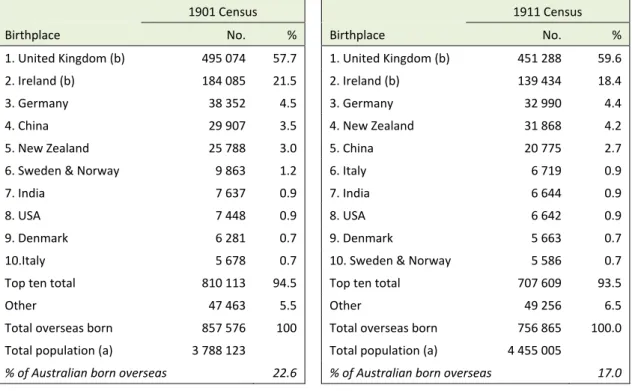
In response to these migration waves, the makeup of Australia’s overseas‐born population has also fluctuated over the years from around 32 per cent in 1891 to 20 per cent in the 1980s. As of 30 June 2009, 27 per cent of the overall resident population was born overseas.14 Statistics on the top ten countries of birth for the overseas‐born population since 1901 are presented in Table 7 of the statistical appendix.
Australia’s
Humanitarian
Program
(Table
1)
After the first federal immigration department was established in 1945, Australia resettled thousands of post‐war refugees and displaced people, and ratified the UN Convention Relating to the Status of Refugees on 22 January 1954. However, it was not until the late 1970s with the arrival of the Indochinese ‘boat people’ seeking asylum, that the government developed a specific refugee policy.15
• Australia’s first planned Humanitarian Program tailored to the special needs of refugees and asylum seekers commenced under the Fraser Government in 1977. Before then, the
10. For some detail on planning intakes prior to the 1980s see Department of Immigration, Local Government and Ethnic Affairs, Australia and immigration 1788 to 1988, op. cit.; and DIMA, Immigration–federation to century’s end, op. cit. 11. DIAC, Key facts in immigration, op. cit.
12. DIMA, Immigration–federation to century’s end, op. cit.
13. C Evans (Minister for Immigration and Citizenship), Migration Program: the size of the skilled and family programs, media release, 12 May 2009, http://www.minister.immi.gov.au/media/media‐releases/2009/ce02‐budget‐09.htm 14. See ABS, Migration Australia, 2008–09, cat. no. 3412.0, Canberra, 2010, pp. 45–47, viewed 2 August 2010,
http://www.ausstats.abs.gov.au/Ausstats/subscriber.nsf/0/3A3EB923A8CBB55CCA25776E001762A6/$File/34120_20 08‐09.pdf
15. J Phillips, Australia’s Humanitarian Program, Research note, no. 9, 2005–06, Parliamentary Library, Canberra, 2005, viewed 25 May 2010, http://www.aph.gov.au/library/pubs/rn/2005‐06/06rn09.pdf
Government’s approach was to respond to international events and crises as they arose. Now there was a program specifically designed to deal with refugee and humanitarian issues and which also included the establishment of mechanisms to determine onshore protection claims.16
• The new program was designed to help Australia respond to the Indochinese humanitarian crisis (and any future crises) in an orderly manner.17 According to departmental records, 108 641 Indochinese refugees were resettled in Australia between April 1975 and June 1988.18 Most were resettled between 1979 and 1982 when there were around 20 000 Indochinese arrivals per year under the new Humanitarian Program.19
By the mid 1980s, the Humanitarian Program intake had reduced to 11 000–12 000 a year and has remained at around 13 000 ever since, with a couple of exceptions—for example, higher numbers of humanitarian visas were granted in 2000–01 due to a wave of boat arrivals carrying asylum seekers from the Middle East.20
By the 1990s, a comprehensive refugee and humanitarian system was in place within the immigration portfolio and in January 1993 a decision was made by the Keating government to separate out the Humanitarian Program from the general Migration Program.21
As with the general Migration Program, the Australian Government reviews and adjusts the number of places available for refugee and humanitarian entrants on an annual basis in response to
humanitarian need and according to government policy. As a result, both government planning figures and the number of humanitarian entrants have fluctuated over the years. However, available data on refugee and humanitarian entrants prior to the 1970s is limited. In the 1970s and 1980s, Humanitarian Program outcomes began to be published more comprehensively. Table 1 provides figures from 1984–85.
In 1996 the Howard Government introduced the practice of separately identifying those granted protection within Australia, or ‘onshore’, from those accepted ‘offshore’.22 This introduced some new confusion in terms of the collection and presentation of Humanitarian Program data. While offshore and onshore components were separately identified for the first time, the data was
16. DIAC, Refugee and humanitarian issues: Australia’s response, June 2009, p. 21, viewed 25 May 2010,
http://www.immi.gov.au/media/publications/refugee/ref‐hum‐issues/pdf/refugee‐humanitarian‐issues‐june09.pdf 17. D McMaster, Asylum seekers: Australia’s response to refugees, Melbourne University Press, 2001, p. 70.
18. Department of Immigration, Local Government and Ethnic Affairs (DILGEA), 'Indochinese Refugees', Statistical Note, no. 37, Statistics Section, Department of Immigration, Local Government and Ethnic Affairs, October 1988.
19. DIAC, Population flows: immigration aspects 2008–09, source data, chapter 4, 2010, viewed 27 July 2010,
http://www.immi.gov.au/media/publications/statistics/popflows2008‐09/ 20. DIAC, Refugee and humanitarian issues: Australia’s response, op. cit.
21. Department of Immigration and Ethnic Affairs, Refugee and humanitarian issues: the focus for Australia, Canberra, 1994; and DIAC, Refugee and humanitarian issues: Australia’s response, op. cit.
22. P Ruddock (Minister for Immigration and Multicultural Affairs), 1996–97 Humanitarian Program, media release, Canberra, 3 July 1996.
numerically linked. Under the Howard Government, this meant that those processed
extraterritorially under the ‘Pacific Solution’ were mostly included and counted under the ‘offshore’ component of the Humanitarian Program. In contrast, under the current Government, places allocated to those processed offshore on Christmas Island are counted under the ‘onshore’ not ‘offshore’ category. To confuse things further, the 7750 planning places currently allocated against the offshore humanitarian category are also shared with those granted onshore protection visas (including those processed on Christmas Island). The annual visa grant outcomes are then broken down and published each year (refugee, humanitarian and onshore) to reflect the actual outcomes.
Measuring
permanent
migration
There are two main sources of immigration related data—DIAC and the ABS—and the limitations of the data sets need to be understood. Changes in government policy and data collection
methodology by these government agencies have also added to the complexity in interpreting this data and make it very difficult to compare migration‐related statistics over time. The following examples illustrate these points.
The annual statistics on Migration and Humanitarian program ‘outcomes’ (visa grants) provided by the Department of Immigration since the 1980s show the number of permanent visas granted in any given year. This is the most accurate measure of the actual number of permanent migrants.
However, one limitation is that offshore visa recipients may not actually arrive and settle in the country in the year the visa was issued.23
The ABS provides a figure for net overseas migration (NOM). However, in September 2006, the ABS changed the methodology for determining what is meant by a ‘long‐term’ arrival or departure. As a result NOM data provided after September 2006 is not strictly comparable with previous years.24 In particular, in 2007 the ABS introduced the ‘12/16 rule’ whereby a traveller is included in the resident population if they are in the country for a total of 12 months or more over a 16 month period and vice versa. Prior to that, a traveller had to be in (or out of) the country continuously for 12 months.25 The following sections describe the more commonly used categories of migration‐related statistics and offer suggestions as to when it may be appropriate to use them. The corresponding tables are presented in the statistical appendix.
23. DIAC, Population flows: immigration aspects, 2006–07, Canberra, 2008, p. 4, viewed 25 May 2010,
http://www.immi.gov.au/media/publications/statistics/popflows2006‐7/
24. ABS, Statistical implications of improved methods for estimating net overseas migration, information paper, Canberra, 2007, viewed 25 May 2010,
http://www.ausstats.abs.gov.au/Ausstats/subscriber.nsf/0/1B5B665D7B575C40CA2572E5002216FD/$File/31070550 05_2007.pdf
Migration
and
population
growth
(Tables
4
and
5)
The rate at which Australia’s population has grown has increased significantly over the last five years—faster than at any other time in the past several decades.26 Population growth is affected by two components; natural increase (the number of births minus the number of deaths); and net overseas migration (NOM). Although Australia’s fertility rate has increased since the early 2000s, it is NOM that has been the main driver of population growth in the last few years.27
The largest contribution to NOM in recent years has been from people on temporary visas—mostly comprised of overseas students and temporary skilled migrants—and Australian residents returning to the country due to the economic downturn.28 So, although permanent migration intakes over the last few years have been high in comparison to previous years, it is important to note that Australia’s recent population growth predominantly reflects a significant increase in temporary, not permanent migration, and that NOM can fluctuate considerably from year to year.
Net
overseas
migration
(NOM)
statistics
(Tables
3,
4
and
5)
Net overseas migration statistics are often used as an indicator of migration flows. However, they should be used with caution as NOM data includes the movements of those who are not permanent migrants or not migrants at all, such as Australian and New Zealand citizens coming and going on a long term basis, and any long term temporary migrants who are intending to stay for a year or more. NOM is calculated by taking into account the addition (or loss) to the population of Australia arising from the difference between those leaving permanently or on a long‐term basis (12 months or longer) and those arriving permanently or on a long‐term basis.29 This data includes:
• people who change their travel intentions, such as those who come to Australia intending to stay short‐term but who actually stay longer than 12 months, and vice versa
• permanent residents and Australian citizens either leaving the country or returning home long‐ term (over 12 months)
• long term arrivals and departures of New Zealand passport holders (New Zealanders are granted a Special Category visa which remains valid for as long as the person remains in Australia), and
26. ABS, ‘Population growth: past, present and future’, Australian social trends 2010, Canberra, 2010, viewed 20 July 2010,
http://www.ausstats.abs.gov.au/ausstats/subscriber.nsf/LookupAttach/4102.0Publication30.06.102/$File/41020_Po pulationGrowth.pdf
27. Ibid. 28. Ibid.
29. DIAC, Population projections, fact sheet no. 15, DIAC web page, viewed 25 May 2010,
• entrants on temporary visas who intend to remain in the country for longer than 12 months, such as international students, people on long‐term temporary (457) business visas and other long term visitors.30
In recent years it has been temporary, not permanent, migration that has contributed significantly to fluctuations in net overseas migration data. The ABS states that:
The largest contribution to NOM in recent years has been from people on temporary visas. In
2007–08, these accounted for 186 500 people or two‐thirds of all net migration. Students made
up the largest category of temporary net migration and 39 per cent of all NOM. The number of
overseas students contributing to NOM has more than doubled from 45 300 in 2004–05 to 108
700 in 2007–08. Over half of the student component of NOM was made up of students who
were citizens of India (33 300) and China (25 600). The third largest source of students in 2007– 08 was Nepal with a NOM contribution of 7300 (equal to 7 per cent of the total NOM of
students).31
Over the past 25 years, the contribution of NOM to population growth has averaged around 39 per cent per year, but has significantly increased in recent years (it has doubled since 2005–06).32 Increases in the migration intakes, along with larger numbers of Australians returning from places like the UK due to the economic downturn, have pushed the average level of NOM up.33 The net number of New Zealand citizens in Australia increased by 75 per cent between 2004–05 and 2007– 08, and New Zealanders contributed 13 per cent to NOM in 2007–08.34
The preliminary NOM estimate for 2008–09 is 298 900 (the highest figure on record) representing 65 per cent of population growth.35 However, NOM can fluctuate considerably from year to year and is estimated to have dropped by around 20 per cent over the last financial year.36
In summary, caution should be used when using NOM—while it may be an indication of changes to the population, it is not a measure of the number of permanent migrants arriving in any given year. Instead, NOM measures departures and arrivals of both permanent and (long term) temporary entrants and the resulting increase or decrease in the population overall. Also, statistics on overseas arrivals and departures relate to the number of movements of individuals and not necessarily the number of people. The ABS states that:
30. DIAC, Population projections, op. cit.; and ABS, Information Paper: Improving net overseas migration estimation, March 2010, viewed 16 July 2010,
http://www.abs.gov.au/AUSSTATS/[email protected]/Lookup/3412.0.55.001Main+Features1Mar%202010?OpenDocument
31. ABS, ‘Population growth: past, present and future’, op. cit. 32. ABS, Migration, op. cit., p. 7.
33. DIAC, Population projections, op. cit. 34. ABS, Migration, op. cit., p. 28. 35. Ibid., p. 7.
36. C Evans (Minister for Immigration and Citizenship), Net overseas migration on track to fall by 20 per cent, media release, 30 June 2010, viewed 16 July 2010, http://www.minister.immi.gov.au/media/media‐
Care should be taken when using permanent and long‐term movement data as it is known that some individuals who travel multiple times in a year are counted each time they cross Australia's
borders.37
It is also important to note that, although ABS net overseas migration data is available back to 1901, the methodologies used to estimate NOM have changed significantly over time and the statistics for different years are not always comparable.38
Settler
arrival
statistics
(Table
6)
The definition of a ‘settler arrival’ for migration purposes is someone arriving in Australia who: • holds a permanent visa
• holds a temporary visa where there is a clear intention to settle • is a New Zealand citizen indicating an intention to settle, and • is any person otherwise eligible to settle.39
Eligible ‘settler arrivals’ may hold a permanent visa under the family, skill or special eligibility streams of the Migration Program or a visa under the refugee, special humanitarian or special assistance streams of the Humanitarian Program. However, others not covered under the Migration or Humanitarian Programs may also be eligible, such as New Zealand citizens; children born to Australian citizens overseas; people granted Australian citizenship overseas; and residents of Cocos (Keeling) Islands and Norfolk Island.40
As noted above, ABS data on arrivals and departures, including settler arrivals, tracks the number of movements not individuals. Prior to 1959, arrivals and departures were only classified as permanent or temporary. The permanent category was subsequently subdivided into permanent and long‐term movement. The data for these categories is based on the stated intentions of travellers. Recent research comparing arrivals and departures data with data obtained using the new ABS
37. ABS, Overseas arrivals and departures, Australia, January 2010, Canberra, February 2010, viewed 25 May 2010,
http://www.abs.gov.au/AUSSTATS/[email protected]/Previousproducts/3401.0Main%20Features2Jan%202010?opendocume nt&tabname=Summary&prodno=3401.0&issue=Jan%202010&num=&view
38. For example, in 2006 the ABS changed its definition of ‘long term’. For a discussion of the complexities affecting the reliability of NOM in earlier periods see: P McDonald, S Khoo and R Kippen, Alternative net migration estimates for Australia: exploding the myth of a rapid increase in numbers, Working papers in demography no. 89, ANU, Canberra, 2003, viewed 20 July 2010, http://dspace.anu.edu.au/bitstream/1885/41502/4/89.pdf. For more information on the 2006 changes and its effects on the final NOM estimate see B Birrell and E Healy, ‘Net overseas migration: why is it so high’, People and Place, vol. 18, no. 2, 2010, pp. 56–65.
39. DIAC, Settler arrivals 2008–2009, Canberra, 2009, p. 62, viewed 25 May 2010,
http://www.immi.gov.au/media/publications/statistics/settler‐arrivals/settler_arrivals0809.pdf 40. Ibid., pp. 62–63.
methodology for calculating NOM (which is able to track travellers’ movement history) indicates that the stated intentions and actual movements of individuals diverge significantly.41
In summary, settler arrival statistics are a better indication of permanent movements than NOM, but include NZ citizens and some other temporary migrants who have indicated an intention to settle. Care should be taken in using these statistics and the ABS does not consider them an appropriate source of migration statistics.42
Migration
Program
statistics
(Table
1)
As part of its planned Migration Program, the federal government allocates places each year for people wanting to migrate permanently to Australia. Migration Program planning numbers fluctuate according to the priorities and economic and political considerations of the government of the day. Since the first federal immigration department was established, immigration policy has become more highly planned and in recent decades has specifically targeted skilled migration while continuing to allow a certain amount of family and humanitarian migration.
In the late 1980s, the federal government introduced the practice of dividing the immigration program into three main streams (family, skill and humanitarian).43 Since then, data on the number of visas granted by category under Australia’s Migration Program each year has been collected and published by the Government.
Although only available since the 1980s, this data provides the best measure of the actual number of permanent migrants planning to settle in Australia.44
Humanitarian
Program
statistics
(Table
1)
As discussed in detail earlier in this paper, over the years policy changes have resulted in changes to the methodology for counting humanitarian entrants. For example, onshore refugees were not counted against the Humanitarian Program until the Howard Government introduced the practice of separately identifying and quantifying offshore and onshore components of the Humanitarian Program in 1996.45
41. B Birrell and E Healy, op. cit. p. 57, 62–63.
42. ABS, ‘Explanatory Notes’, Australian Historical Population Statistics, 2008, cat. no. 3105.0.65.001, Canberra, August, 2008, viewed 27 July 2010,
http://www.abs.gov.au/AUSSTATS/[email protected]/Lookup/3105.0.65.001Main+Features12008?OpenDocument
43. B York, Australia and refugees 1901–2002: an annotated chronology based on official sources, Parliamentary Library, 2003, viewed 1 June 2010, http://www.aph.gov.au/library/pubs/online/Refugees_contents.htm
44. Note: ABS (NOM) data on permanent visa holders does not correlate with DIAC data and should be used with caution. For more detail see ABS, Migration Australia, op. cit., p. 31.
45. P Ruddock (Minister for Immigration and Multicultural Affairs), 1996–97 Humanitarian Program, media release, Canberra, 3 July 1996; and DIAC, Population flows: immigration aspects, 2006–07, op. cit., p. 69.
Despite these discrepancies, Humanitarian Program visa grants are the most accurate statistics available for refugee and humanitarian intakes to Australia back to the 1970s. Prior to the 1970s there are only estimates available for the number of post war refugees.
Temporary
migration
statistics
(Table
2)
Although the rise in permanent migration to Australia is significant, many argue that the greatest change in immigration patterns to Australia in the last decade or so is the change in emphasis from permanent to temporary migration—with temporary migration increasingly becoming the first step towards permanent settlement in Australia for many people.46 According to the ABS, over the last ten years onshore permanent visas have increased fourfold from 15 000 in 1998–99 to 63 400 in 2008–09.47 Over one‐third of the Migration Program in 2007–08 was made up of people granted permanent residence after initial entry to Australia on a temporary basis.48
Unlike the permanent migration program, the level of temporary migration to Australia is usually not determined by government, but rather is demand driven. The two most significant categories
contributing to the rise in temporary migration to Australia in recent years are temporary skilled migrants and overseas students.
The most commonly used visa to sponsor temporary skilled migrants is the (subclass 457) Temporary
business (long stay) visa introduced by the Howard Government in 1996.49 There is no cap set on the
number of 457 visas which may be granted in a particular year. Rather, the number of visas granted is directly related to the level of demand by employers for temporary skilled migrant workers, and their willingness to sponsor such workers. As a result, the temporary skilled migration program is highly responsive to changes in economic conditions and the demand for labour has risen (and fallen) in recent years accordingly.
Overseas students have also contributed significantly to temporary migration figures in Australia in recent years. In 2007–08 international students made up the largest group of temporary visa holders to arrive:
Australia’s immigration program has also seen an exponential increase in overseas student
entrants. Indeed, by 2007 Australia accounted for 11 per cent of the international student
market and had seen a three‐fold increase in student numbers over the previous ten years.
Figures published by the Department of Immigration and Citizenship (DIAC) indicate that the
number of student visa holders in Australia grew at the average annual rate of 13.9 per cent
46. G Hugo, Temporary migration: a new paradigm of international migration, Research note no. 55, Parliamentary Library, Canberra, 2004, viewed 3 August 2010, http://www.aph.gov.au/library/pubs/rn/2003‐04/04rn55.htm 47. ABS, Migration, op. cit., p. 30.
48. DIAC, Population Flows: immigration aspects 2007–08, chapter 2, p.22, 2008, viewed 20 July 2010,
http://www.immi.gov.au/media/publications/statistics/popflows2007‐08/PopFlows_09_chp2.pdf
49. J Phillips, Temporary(long stay) business visas: subclass 457, Research note, Parliamentary Library, Canberra, 2007, viewed 20 July 2010, http://www.aph.gov.au/library/pubs/rn/2006‐07/07rn15.pdf
every year after June 2001, rising to a total of 386 523 student visa holders in the 12 months to the end of June 2009.50
Since the mid 1990s, the number of overseas visitors entering Australia on a temporary long‐term basis (staying for at least one year) has exceeded the number of people arriving for permanent settlement.51 However, it is not easy to provide meaningful statistics for long‐term temporary migration. Researchers McDonald and Withers point out that:
Immigrants are broadly divisible into two categories, permanent and temporary. To be included
in the count of the Australian population, temporary immigrants need to stay in Australia for at
least 12 months within a given 16‐month period ... Statistics for long‐term temporary immigrants
are more difficult to describe. The main categories are overseas students, persons coming to
Australia for specific employment (long stay business visa), working holiday makers, persons on
bridging visas (between other visa types), persons on temporary protection visas and over‐
stayers (those who have remained in Australia illegally after their visa has expired). As most of these people go in and out of the country relatively frequently, statistics on their movements can be misleading. Stock data are possibly more useful than flow data.52
50. E Koleth, op. cit. See also ABS, Migration, op. cit., p. 29.
51. G. Hugo, A new paradigm of international migration: implications for migration policy and planning for Australia, Research paper no. 10, Parliamentary Library 2003–04, p. 19, viewed 20 July 2010,
http://www.aph.gov.au/library/pubs/rp/2003‐04/04rp10.pdf
52. P. McDonald and G. Withers, Population and Australia’s future labour force, 2008, p. 11, viewed 20 July 2010,
Statistical
appendix
Table
1:
Permanent
migrants:
migration
and
humanitarian
program
visa
grants
since
1985
Year
Migration Program
Humanitarian
Program
Family Skill Special Eligibility Total
1984–85 44 200 10 100 200 54 500 14 207
1985–86 63 400 16 200 400 80 000 11 700
1986–87 72 600 28 500 600 101 700 11 291
1987–88 79 500 42 000 600 122 100 11 392
1988–89 72 700 51 200 800 124 700 11 309
1989–90 66 600 52 700 900 120 200 12 415
1990–91 61 300 49 800 1 200 112 200 11 284
1991–92 55 900 41 400 1 700 98 900 12 009
1992–93 43 500 21 300 1 400 67 900 11 845
1993–94 43 200 18 300 1 300 62 800 14 070
1994–95 44 500 30 400 1 600 76 500 14 858
1995–96 56 700 24 100 1 700 82 500 16 252
1996–97 44 580 27 550 1 730 73 900 11 902
1997–98 31 310 34 670 1 110 67 100 12 055
1998–99 32 040 35 000 890 67 900 11 356
1999–00 32 000 35 330 2 850 70 200 15 860
2000–01 33 470 44 730 2 420 80 610 13 733
2001–02 38 090 53 520 1 480 93 080 12 349
2002–03 40 790 66 050 1 230 108 070 12 525
2003–04 42 230 71 240 890 114 360 13 823
2004–05 41 740 77 880 450 120 060 13 178
2005–06 45 290 97 340 310 142 930 14 144
2006–07 50 080 97 920 200 148 200 13 017
2007–08 49 870 108 540 220 158 630 13 014
2008–09 56 366 114 777 175 171 318 13 507
2009–10 60 254 107 868 501 168 623 13 770
2010–11 (planned) 54 550 113 850 300 168 700 13 750
Sources: Migration Program: DIAC advice supplied to the Parliamentary Library in July 2010 taken from Population flows: immigration
aspects, various editions since 1992; web page and C Evans (Minister for Immigration and Citizenship),
, media release, 11 May 2010 for the planning figures.
Table
2:
Temporary
migrants:
overseas
student
and
business
long
stay
(subclass
457)
visa
grants
since
1996
Year Overseas students
Temporary business (long stay)
457 visas
1996–97 113 000 25 786
1997–98 108 827 30 880
1998–99 110 894 29 320
1999–00 119 806 31 070
2000–01 146 577 36 900
2001–02 151 894 33 510
2002–03 162 575 36 800
2003–04 171 616 39 500
2004–05 174 786 49 590
2005–06 190 674 71 150
2006–07 228 592 87 310
2007–08 278 180 110 570
2008–09 320 368 101 280
Sources: DIAC, various years of annual reports, population flows publications and migration statistics web pages; and Senate Legal and Constitutional Committee,report, 2008, pp. 17–18 (for 457 visa grants).
Table
3:
Net
overseas
migration
(NOM)
since
1901
Year NOM (a) (b) Year NOM (a) (b) Year NOM (a) (b) Series Break Information 1901 2 959 1938 8 145 1975 13 515
Prior to July 1922 crew members were included
Prior to July 1925 figures are total overseas arrivals and departures from Australia 1902 ‐4 293 1939 12 527 1976 33 997
1903 ‐9 876 1940 10 676 1977 68 030 1904 ‐2 983 1941 5 136 1978 47 394 1905 ‐2 600 1942 8 536 1979 68 611 1906 ‐5 049 1943 1 587 1980 100 940 1907 5 195 1944 ‐1 761 1981 123 066
1908 5 437 1945 ‐3 273 1982 102 709 From July 1925 figures are Net Permanent and Long Term migration
1909 21 783 1946 ‐11 589 1983 54 995 1910 29 912 1947 12 186 1984 59 823 1911 74 379 1948 48 468 1985 89 319
Break in series from September quarter 1971 to June quarter 2006 inclusive, Net Overseas Migration (NOM) was the difference between permanent and long‐term arrivals and permanent and long‐term departures.
1912 91 892 1949 149 270 1986 110 661 1913 63 227 1950 153 685 1987 136 093 1914 ‐8 226 1951 110 362 1988 172 794 1915 ‐84 410 1952 97 454 1989 129 478 1916 ‐128 737 1953 42 883 1990 97 131 1917 ‐17 822 1954 68 565 1991 81 669 1918 23 359 1955 95 317 1992 51 358 1919 166 303 1956 102 105 1993 34 822 1920 27 606 1957 77 622 1994 55 506 1921 17 525 1958 64 879 1995 106 864 1922 40 157 1959 83 578 1996 97 444
For September quarter 2006 onwards estimates for NOM are the difference between the number of incoming travellers who stay in Australia for 12 months or more and are added to the population (NOM arrivals) and the number of outgoing travellers who leave Australia for 12 months or more and are subtracted from the population (NOM departures)
1923 39 714 1960 92 776 1997 72 402 1924 46 069 1961 65 439 1998 88 781 1925 39 762 1962 64 638 1999 104 210 1926 42 282 1963 76 844 2000 111 441 1927 49 401 1964 103 999 2001 136 076 1928 28 864 1965 111 609 2002 110 475 1929 10 087 1966 95 931 2003 110 104 1930 ‐9 833 1967 96 558 2004 106 425 1931 ‐12 117 1968 123 452 2005 137 009 1932 ‐4 608 1969 140 331 2006 182 200 1933 ‐1 364 1970 138 382 2007 244 100 1934 ‐ 388 1971 103 553 2008p 301 200 1935 1 251 1972 56 320 2009p 277 700 1936 1 283 1973 67 494 p = preliminary estimates 1937 5 075 1974 87 248
(a) Estimates for September quarter 2006 onwards use an improved methodology and are not comparable with NOM estimates prior to this. (b) An adjustment for category jumping (later referred to as migration adjustments) was included for estimates for September quarter 1976 to June quarter 2006, except for September quarter 1997 to June quarter 2001 when it was set to zero.
Sources: Data for 1901–1924: DIAC, , DIAC, Canberra, 2001.
Data for 1925–2005: ABS, , cat. no. 3105.0.65.001, 2008.
Table
4:
Components
of
population
growth
since
1972
Year Births (b) Deaths (b)
Natural Increase (Births ‐ Deaths)
Net Overseas Migration (c)
Estimated resident population (ERP) (d)
1971–72 (a) 271 960 110 191 161 769 75 672 13 303 664
1972–73 (a) 255 848 111 336 144 512 56 562 13 504 538
1973–74 (a) 243 658 110 179 133 479 82 926 13 722 571
1974–75 (a) 239 794 114 501 125 293 44 675 13 892 995
1975–76 (a) 231 135 110 610 120 525 21 239 14 033 083
1976–77 226 954 111 490 115 464 57 897 14 192 234
1977–78 226 359 108 059 118 300 62 715 14 359 255
1978–79 223 370 108 315 115 055 55 137 14 515 729
1979–80 223 664 106 654 117 010 75 941 14 695 356
1980–81 230 920 109 429 121 491 119 175 14 923 260
1981–82 237 076 110 990 126 086 128 117 15 184 247
1982–83 241 764 112 918 128 846 73 295 15 393 472
1983–84 240 544 110 887 129 657 49 098 15 579 391
1984–85 241 814 114 197 127 617 73 708 15 788 312
1985–86 239 115 116 069 123 046 100 359 16 018 350
1986–87 242 797 116 139 126 658 125 730 16 263 874
1987–88 246 200 120 463 125 737 149 341 16 532 164
1988–89 250 155 118 767 131 388 157 436 16 814 416
1989–90 257 521 125 112 132 409 124 647 17 065 128
1990–91 261 158 119 572 141 586 86 432 17 284 036
1991–92 259 186 120 836 138 350 68 580 17 494 664
1992–93 259 959 121 338 138 621 30 042 17 667 093
1993–94 258 314 123 496 134 818 46 549 17 854 738
1994–95 258 210 126 232 131 978 80 125 18 071 758
1995–96 250 438 126 400 124 038 104 137 18 310 714
1996–97 253 660 127 298 126 362 87 079 18 517 564
1997–98 249 105 129 255 119 850 79 162 18 711 271
1998–99 249 965 128 278 121 687 96 483 18 925 855
1999–00 249 310 128 392 120 918 107 275 19 153 380
2000–01 247 500 128 913 118 587 135 673 19 413 240
2001–02 247 288 130 253 117 035 110 556 19 651 438
2002–03 246 663 132 239 114 424 116 498 19 895 435
2003–04 249 082 133 231 115 851 99 966 20 127 363
2004–05 255 934 131 354 124 580 123 763 20 394 791
2005–06 263 540 134 041 129 499 146 753 20 697 880
2006–07 277 724 135 976 141 748 232 824 21 072 452
2007–08 289 492 140 736 148 756 277 332 21 498 540
2008–09 300 936 143 144 157 792 298 924 21 955 256
(a) Between 1971 and 1976 inconsistencies exist between the components of growth of the population and estimates of the population. Estimates of category jumping were made only from September quarter 1976.
(b) Births and deaths figures used to compile natural increase for population estimates are based on year of occurrence and may differ from births and deaths based on year of registration.
(c) Estimates for net overseas migration (NOM) contain a break in time series. Estimates for September quarter 2006 onwards use an improved methodology and are not comparable with NOM estimates prior to this.
(d) The official measure of the population of Australia is based on the concept of usual residence. It refers to all people, regardless of nationality, citizenship or legal status, who usually live in Australia, with the exception of foreign diplomatic personnel and their families. It includes usual residents who are overseas for less than 12 out of 16 months. It excludes overseas visitors who are in Australia for less than 12 out of 16 months. See ABS, ‘Glossary’, Australian Demographic Statistics, cat. no. 3101.0, December 2009, viewed 4 August 2010. For 1994, the sum of the components of population change for Australia does not equal the difference between the 1994 and 1993 ERPs due to the inclusion of the September quarter 1993 populations of Christmas Island (1470 persons) and Cocos (Keeling) Islands (625 persons) in the Australian population for the first time.
Sources: Data for 1971–72 to 2005‐06: ABS, cat. no. 3105.0.65.001, 2008. Data
for 2006–07 to 2008‐09: ABS, cat. no. 3101.0, 2010.
Table
5:
Population
growth
rates
since
1972
Year Natural increase rate Net overseas migration rate Total population growth rate (a)
1971–72 1.24 0.58 1.81
1972–73 1.09 0.43 1.51
1973–74 0.99 0.61 1.61
1974–75 0.91 0.33 1.24
1975–76 0.87 0.15 1.01
1976–77 0.82 0.41 1.13
1977–78 0.83 0.44 1.18
1978–79 0.80 0.38 1.09
1979–80 0.81 0.52 1.24
1980–81 0.83 0.81 1.55
1981–82 0.84 0.86 1.75
1982–83 0.85 0.48 1.38
1983–84 0.84 0.32 1.21
1984–85 0.82 0.47 1.34
1985–86 0.78 0.64 1.46
1986–87 0.79 0.78 1.53
1987–88 0.77 0.92 1.65
1988–89 0.79 0.95 1.71
1989–90 0.79 0.74 1.49
1990–91 0.83 0.51 1.28
1991–92 0.80 0.40 1.22
1992–93 0.79 0.17 0.99
1993–94 0.76 0.26 1.06
1994–95 0.74 0.45 1.22
1995–96 0.69 0.58 1.32
1996–97 0.69 0.48 1.13
1997–98 0.65 0.43 1.05
1998–99 0.65 0.52 1.15
1999–00 0.64 0.57 1.20
2000–01 0.62 0.71 1.36
2001–02 0.60 0.57 1.23
2002–03 0.58 0.59 1.24
2003–04 0.58 0.50 1.17
2004–05 0.62 0.61 1.33
2005–06 0.63 0.72 1.49
2006–07 0.68 1.12 1.81
2007–08 0.71 1.32 2.02
2008–09 0.73 1.39 2.12
(a) Population change over a period as a proportion (percentage) of the population at the beginning of the period. Sources: Data for 1971‐72 to 2005‐06: ABS, cat. no. 3105.0.65.001, 2008. Data for 2006‐07 to 2008‐09: ABS, cat. no. 3101.0, 2010.
Table
6:
Permanent
and
long
‐
term
overseas
movement
since
1925
Arrivals Departures
Year Permanent
Settler Arrivals (a)
Long term: more than one
year TOTAL:
Permanent and Long‐ term Arrivals
Permanent departures (a)
Long term: more than one year
TOTAL: Permanent
and Long‐ term departures
Residents
returning (a)
Visitors arriving (a)
Residents departing (a) Visitors departing (a)
1925 56 477 n/a n/a 56 477 16 715 n/a n/a 16 715
1926 59 464 n/a n/a 59 464 17 182 n/a n/a 17 182
1927 67 078 n/a n/a 67 078 17 677 n/a n/a 17 677
1928 48 233 n/a n/a 48 233 19 369 n/a n/a 19 369
1929 31 698 n/a n/a 31 698 21 611 n/a n/a 21 611
1930 17 537 n/a n/a 17 537 27 370 n/a n/a 27 370
1931 9 441 n/a n/a 9 441 21 558 n/a n/a 21 558
1932 9 868 n/a n/a 9 868 14 476 n/a n/a 14 476
1933 10 749 n/a n/a 10 749 12 113 n/a n/a 12 113
1934 11 778 n/a n/a 11 778 12 166 n/a n/a 12 166
1935 12 608 n/a n/a 12 608 11 357 n/a n/a 11 357
1936 12 653 n/a n/a 12 653 11 370 n/a n/a 11 370
1937 16 291 n/a n/a 16 291 11 216 n/a n/a 11 216
1938 19 548 n/a n/a 19 548 11 403 n/a n/a 11 403
1939 24 068 n/a n/a 24 068 11 541 n/a n/a 11 541
1940 16 152 n/a n/a 16 152 5 476 n/a n/a 5 476
1941 8 940 n/a n/a 8 940 3 804 n/a n/a 3 804
1942 10 145 n/a n/a 10 145 1 609 n/a n/a 1 609
1943 3 516 n/a n/a 3 516 1 929 n/a n/a 1 929
1944 2 511 n/a n/a 2 511 4 272 n/a n/a 4 272
1945 7 512 n/a n/a 7 512 10 785 n/a n/a 10 785
1946 18 217 n/a n/a 18 217 29 806 n/a n/a 29 806
1947 31 765 n/a n/a 31 765 19 579 n/a n/a 19 579
1948 65 739 n/a n/a 65 739 17 271 n/a n/a 17 271
1949 167 727 n/a n/a 167 727 18 457 n/a n/a 18 457
1950 174 540 n/a n/a 174 540 20 855 n/a n/a 20 855
1951 132 542 n/a n/a 132 542 22 180 n/a n/a 22 180
1952 127 824 n/a n/a 127 824 30 370 n/a n/a 30 370
1953 74 915 n/a n/a 74 915 32 032 n/a n/a 32 032
1954 104 014 n/a n/a 104 014 35 449 n/a n/a 35 449
1955 130 795 n/a n/a 130 795 35 478 n/a n/a 35 478
1956 123 822 n/a n/a 123 822 21 717 n/a n/a 21 717
1957 118 695 n/a n/a 118 695 41 073 n/a n/a 41 073
Arrivals Departures
Year
Permanent Settler Arrivals (a)
Long term: more than one year
TOTAL:
Permanent and Long‐
Permanent
departures (a) Long term: more than one year
TOTAL: Permanent
and Long‐
1959 97 777 15 285 10 960 124 022 12 900 21 296 6 248 40 444
1960 110 079 16 495 12 797 139 371 10 853 25 331 10 411 46 595
1961 95 407 18 602 13 577 127 586 14 777 32 157 12 213 59 147
1962 90 464 20 580 13 941 124 985 15 429 31 781 13 137 60 347
1963 108 150 22 205 13 813 144 168 16 278 38 317 12 729 67 324
1964 134 464 23 641 15 020 173 125 15 083 40 958 13 085 69 126
1965 147 507 26 260 17 497 191 264 20 913 46 313 12 429 79 655
1966 141 033 28 292 19 234 188 559 26 308 54 321 11 999 92 628
1967 135 019 35 655 21 637 192 311 30 804 52 148 12 801 95 753
1968 159 270 36 387 23 473 219 130 31 675 51 386 12 617 95 678
1969 183 416 38 308 26 867 248 591 33 631 59 027 15 602 108 260
1970 185 325 42 099 31 194 258 618 37 294 64 215 18 727 120 236
1971 155 525 47 782 30 500 233 807 41 122 67 699 21 433 130 254
1972 112 468 54 278 26 559 193 305 45 881 66 853 24 251 136 985
1973 105 003 65 021 27 370 197 394 43 430 64 964 21 506 129 900
1974 121 324 63 320 26 984 211 628 33 751 66 228 24 401 124 380
1975 54 119 58 354 19 858 132 331 29 084 66 406 23 326 118 816
1976 58 287 59 881 23 312 141 480 26 732 68 527 20 631 115 890
1977 75 640 57 701 27 472 160 813 22 762 64 088 19 181 106 031
1978 68 419 57 938 28 390 154 747 24 961 58 519 19 644 103 124
1979 72 236 61 441 33 450 167 127 23 420 54 266 20 422 98 108
1980 94 503 58 760 31 025 184 288 20 843 50 713 19 306 90 862
1981 118 735 59 401 34 552 212 688 19 852 46 738 19 013 85 603
1982 107 171 53 766 34 265 195 202 22 493 46 892 22 956 92 341
1983 78 392 47 806 27 376 153 574 25 870 48 182 26 455 100 507
1984 73 108 51 556 28 868 153 532 22 311 50 780 23 266 96 357
1985 82 000 55 669 34 883 172 552 18 620 51 027 23 793 93 440
1986 103 326 55 307 38 049 196 682 18 817 48 358 25 269 92 444
1987 128 288 53 590 39 737 221 615 20 415 49 977 27 377 97 769
1988 151 549 54 986 47 327 253 862 20 320 54 118 30 326 104 764
1989 131 064 53 442 53 543 238 049 24 829 59 218 35 993 120 040
1990 121 563 56 365 56 120 234 048 30 365 66 296 40 807 137 468
1991 116 647 61 259 59 326 237 232 29 898 66 127 47 684 143 709
1992 94 246 66 155 60 052 220 453 28 135 66 984 48 540 143 659
1993 65 675 73 428 58 829 197 932 28 074 64 301 48 051 140 426
1994 77 937 78 064 65 912 221 913 27 020 66 365 48 291 141 676
1995 96 969 78 794 78 172 253 935 27 873 69 083 52 406 149 362
1996 92 503 80 004 88 826 261 333 28 479 70 964 58 820 158 263
Arrivals Departures
Year
Permanent Settler Arrivals (a)
Long term: more than one year
TOTAL:
Permanent and Long‐
Permanent
departures (a) Long term: more than one year
TOTAL: Permanent
and Long‐
1998 81 065 75 318 112 000 268 383 33 433 81 057 65 112 179 602
1999 88 010 76 133 125 731 289 874 38 225 83 428 64 011 185 664
2000 97 178 80 306 140 076 317 560 43 824 88 087 74 208 206 119
2001 100 888 85 127 170 393 356 408 47 600 93 457 75 074 216 131
2002 89 348 92 396 180 244 361 988 49 081 89 992 83 867 222 940
2003 103 887 98 835 185 727 388 449 54 119 83 986 86 780 224 885
2004 117 473 98 240 196 851 412 564 61 853 87 626 94 189 243 668
2005 128 753 103 909 209 618 442 280 64 398 94 084 93 302 251 784
2006 133 879 107 035 238 565 479 479 69 399 101 211 94 933 265 543
2007 141 645 108 513 285 569 535 727 74 963 102 250 113 698 290 911
2008 161 520 113 750 358 820 634 090 79 410 100 120 142 070 321 600
2009 148 410 117 120 377 250 642 780 82 710 76 010 180 430 339 150
(a) Prior to 1959, overseas arrivals and departures were classified as either permanent or temporary. Revised questions for travellers were introduced in 1958 which enabled arrivals and departures, previously classified as permanent, to be sub‐ divided (as from 1 January 1959) into two categories: permanent movement; and long‐term movement.
‘Statistics on overseas arrivals and departures (OAD) relate to the number of movements of travellers rather than the number of travellers. Care should be taken when using permanent and long‐term movements data as it is known that some individuals who travel multiple times in a year are counted each time they cross Australia's borders. Permanent and long‐ term movements in this release are not an appropriate source of migration statistics’. For further information see ABS,
cat. no. 3401.0, 2010.
Table
7:
Top
10
countries
of
birth
for
the
overseas
‐
born
population
since
1901
1901 Census 1911 Census
Birthplace No. % Birthplace No. % 1. United Kingdom (b) 495 074 57.7 1. United Kingdom (b) 451 288 59.6 2. Ireland (b) 184 085 21.5 2. Ireland (b) 139 434 18.4 3. Germany 38 352 4.5 3. Germany 32 990 4.4 4. China 29 907 3.5 4. New Zealand 31 868 4.2 5. New Zealand 25 788 3.0 5. China 20 775 2.7 6. Sweden & Norway 9 863 1.2 6. Italy 6 719 0.9 7. India 7 637 0.9 7. India 6 644 0.9 8. USA 7 448 0.9 8. USA 6 642 0.9 9. Denmark 6 281 0.7 9. Denmark 5 663 0.7 10.Italy 5 678 0.7 10. Sweden & Norway 5 586 0.7 Top ten total 810 113 94.5 Top ten total 707 609 93.5 Other 47 463 5.5 Other 49 256 6.5 Total overseas born 857 576 100 Total overseas born 756 865 100.0 Total population (a) 3 788 123 Total population (a) 4 455 005 % of Australian born overseas 22.6 % of Australian born overseas 17.0
1921 Census 1933 Census
Birthplace No. % Birthplace No. % 1. United Kingdom (b) 568 370 67.7 1. United Kingdom (b) 633 806 70.2 2. Ireland (b) 105 033 12.5 2. Ireland (b) 78 652 8.7 3. New Zealand 38 611 4.6 3. New Zealand 45 963 5.1 4. Germany 22 396 2.7 4. Italy 26 756 3.0 5. China 15 224 1.8 5. Germany 16 842 1.9 6. Italy 8 135 1.0 6. China 8 579 0.9 7. India 6 918 0.8 7. Greece 8 337 0.9 8. USA 6 604 0.8 8. India 6 774 0.7 9. Denmark 6 002 0.7 9. South Africa 6 179 0.7 10. South Africa 5 408 0.6 10. USA 6 066 0.7 Top ten total 782 701 93.2 Top ten total 837 954 92.8 Other 56 878 6.8 Other 65 319 7.2 Total overseas born 839 579 100.0 Total overseas born 903 273 100.0 Total population (a) 5 455 136 Total population (a) 6 629 836 % of Australian born overseas 15.4 % of Australian born overseas 13.6