Air Quality
Guidelines
for Europe
Copenhagen
WHO Regional Publications, European Series, No. 91
Second Edition
agency of the United Nations serving as the directing and coordinating authority for international health matters and public health. One of WHO’s constitutional functions is to provide objective and reliable information and advice in the field of human health, a responsibility that it fulfils in part through its publications programmes. Through its publications, the Or-ganization seeks to support national health strategies and address the most pressing public health concerns.
The WHO Regional Office for Europe is one of six regional offices through-out the world, each with its own programme geared to the particular health problems of the countries it serves. The European Region embraces some 870 million people living in an area stretching from Greenland in the north and the Mediterranean in the south to the Pacific shores of the Russian Federation. The European programme of WHO therefore concentrates both on the problems associated with industrial and post-industrial society and on those faced by the emerging democracies of central and eastern Europe and the former USSR.
To ensure the widest possible availability of authoritative information and guidance on health matters, WHO secures broad international distribution of its publications and encourages their translation and adaptation. By helping to promote and protect health and prevent and control disease, WHO’s books contribute to achieving the Organization’s principal objec-tive – the attainment by all people of the highest possible level of health.
Air Quality
Guidelines
for Europe
Air quality guidelines for Europe ; second edition
(WHO regional publications. European series ; No. 91) 1.Air pollution – prevention and control
2.Air pollutants – adverse effects – toxicity 3.Air pollution, Indoor – prevention and control
4.Environmental exposure 5.Guidelines 6.Europe I.Series
ISBN 92 890 1358 3 (NLM Classification: WA 754)
ISSN 0378-2255
Text editing: Frank Theakston
Air Quality
Guidelines
for Europe
Second Edition
WHO Regional Publications, European Series, No. 91
Regional Office for Europe Copenhagen
ISSN 0378-2255
The Regional Office for Europe of the World Health Organization wel-comes requests for permission to reproduce or translate its publications, in part or in full. Applications and enquiries should be addressed to the Publi-cations unit, WHO Regional Office for Europe, Scherfigsvej 8, DK-2100 Copenhagen Ø, Denmark, which will be glad to provide the latest infor-mation on any changes made to the text, plans for new editions, and reprints and translations already available.
©World Health Organization 2000
Publications of the World Health Organization enjoy copyright protection in accordance with the provisions of Protocol 2 of the Universal Copyright Convention. All rights reserved.
The designations employed and the presentation of the material in this publication do not imply the expression of any opinion whatsoever on the part of the Secretariat of the World Health Organization concerning the legal status of any country, territory, city or area or of its authorities, or concerning the delimitation of its frontiers or boundaries. The names of countries or areas used in this publication are those that obtained at the time the original language edition of the book was prepared.
The mention of specific companies or of certain manufacturers’ products does not imply that they are endorsed or recommended by the World Health Organization in preference to others of a similar nature that are not mentioned. Errors and omissions excepted, the names of proprietary prod-ucts are distinguished by initial capital letters.
The views expressed in this publication are those of the participants in the meetings and do not necessarily represent the decisions or the stated policy of the World Health Organization.
– v –
Foreword ...vii
Preface ... ix
PART I. GENERAL 1. Introduction ... 1
2. Criteria used in establishing guideline values ... 11
3. Summary of the guidelines ... 32
4. Use of the guidelines in protecting public health ... 41
PART II. EVALUATION OF RISKS TO HUMAN HEALTH 5. Organic pollutants ... 57
5.1 Acrylonitrile ... 59
5.2 Benzene ... 62
5.3 Butadiene ... 67
5.4 Carbon disulfide ... 71
5.5 Carbon monoxide ... 75
5.6 1,2-Dichloroethane ... 80
5.7 Dichloromethane ... 83
5.8 Formaldehyde ... 87
5.9 Polycyclic aromatic hydrocarbons ... 92
5.10 Polychlorinated biphenyls ... 97
5.11 Polychlorinated dibenzodioxins and dibenzofurans ... 102
5.12 Styrene ... 106
5.13 Tetrachloroethylene ... 109
5.14 Toluene ... 112
5.15 Trichloroethylene ... 115
5.16 Vinyl chloride ... 118
6. Inorganic pollutants ... 123
6.1 Arsenic ... 125
6.2 Asbestos ... 128
6.3 Cadmium ... 136
6.4 Chromium ... 139
6.5 Fluoride ... 143
6.6 Hydrogen sulfide ... 146
6.7 Lead ... 149
6.8 Manganese ... 154
6.9 Mercury ... 157
6.10 Nickel ... 162
6.11 Platinum ... 166
6.12 Vanadium ... 170
7. Classical pollutants ... 173
7.1 Nitrogen dioxide ... 175
7.2 Ozone and other photochemical oxidants ... 181
7.3 Particulate matter ... 186
7.4 Sulfur dioxide ... 194
8. Indoor air pollutants ... 199
8.1 Environmental tobacco smoke ... 201
8.2 Man-made vitreous fibres ... 206
8.3 Radon ... 209
PART III. EVALUATION OF ECOTOXIC EFFECTS 9. General approach ... 219
10. Effects of sulfur dioxide on vegetation: critical levels ... 226
11. Effects of nitrogen-containing air pollutants: critical levels ... 230
12. Effects of ozone on vegetation: critical levels ... 234
13. Indirect effects of acidifying compounds on natural systems: critical loads ... 239
14. Effects of airborne nitrogen pollutants on vegetation: critical loads ... 246
Foreword
– vii –
Clean air is considered to be a basic requirement for human health and wellbeing. In spite of the introduction of cleaner technologies in industry, energy production and transport, air pollution remains a major health risk. Recent epidemiological studies have provided evidence that in Europe hun-dreds of thousands of premature deaths are attributed to air pollution. The World Health Organization has been concerned with air pollution and its impact on human health for more than 40 years. In 1987 these activities culminated in the publication of the first edition of Air quality guidelines for Europe. It was the aim of the guidelines to provide a basis for protecting public health from adverse effects of air pollutants, to eliminate or reduce exposure to hazardous air pollutants, and to guide national and local authori-ties in their risk management decisions. The guidelines were received with great enthusiasm and found wide application in environmental decision-making in the European Region as well as in other parts of the world.
Since the publication of the first edition, new scientific data in the field of air pollution toxicology and epidemiology have emerged and new developments in risk assessment methodology have taken place. It was therefore necessary to update and revise the existing guidelines. Starting in 1993, the Bilthoven Division of the WHO European Centre for Environment and Health under-took this process in close cooperation with WHO headquarters and the Euro-pean Commission. More than 100 experts contributed to the preparation of the background documents or participated in the scientific discussions that led to the derivation of guideline values for a great number of air pollutants. WHO is most grateful for their contribution and expert advice. Financial support received from the European Commission, the Swedish Environmental Protec-tion Agency and the Government of the Netherlands during the preparaProtec-tion of the second edition of the guidelines made this effort possible and is warmly acknowledged.
The guidelines are a contribution to HEALTH21, the health for all policy
framework for the WHO European Region. This states that, by the year 2015, people in the Region should live in a safer physical environment, with exposure to contaminants hazardous to health at levels not exceeding internationally agreed standards. WHO is therefore pleased to see that the revised air quality
guidelines are being used as a starting point for the derivation of legally binding limit values in the framework of the EU Air Quality Directive. Also, the global guidelines for air quality, recently issued by WHO headquarters, are based on the revised guidelines for Europe.
Thus, the work and efforts of everybody who contributed to the revision of the guidelines has already had an important impact. It is expected that the publication of this second edition will provide the Member States with a sound basis for improving human health by ensuring adequate air quality for all. I should like to warmly thank all the WHO staff who made this important endeavour possible.
Marc A. Danzon
– ix –
The first edition of the WHO Air quality guidelines for Europe was pub-lished in 1987. Since then new data have emerged and new developments in risk assessment methodology have taken place, necessitating the updating and revision of the existing guidelines. The Bilthoven Division of the WHO European Centre for Environment and Health has undertaken this process in close cooperation with the International Programme on Chemi-cal Safety (IPCS) and the European Commission.
At the start of the process, the methods to be used in the risk assessment process, the use of the threshold concept, the application of uncertainty factors, and the quantitative risk assessment of carcinogens were discussed, and the approach to be used was agreed on. In setting priorities for the compounds to be reviewed, a number of criteria were established: (a) the compound (or mixture) posed a widespread problem in terms of exposure sources; (b) the potential for personal exposure was large; (c) new data on health or environmental impact had emerged; (d) monitoring had become feasible since the previous evaluation; and (e) a positive trend in ambient air concentrations was evident. Application of these criteria has resulted in the selection of the air pollutants addressed in the review process.
It is the aim of the guidelines to provide a basis for protecting public health from adverse effects of air pollutants and to eliminate or reduce exposure to those pollutants that are known or likely to be hazardous to human health or wellbeing. The guidelines are intended to provide background informa-tion and guidance to (inter)nainforma-tional and local authorities in making risk assessment and risk management decisions. In establishing pollutant levels below which exposure – for life or for a given period of time – does not constitute a significant public health risk, the guidelines provide a basis for setting standards or limit values for air pollutants.
Although the guidelines are considered to be protective to human health they are by no means a “green light” for pollution, and it should be stressed that attempts should be made to keep air pollution levels as low as practi-cally achievable. In addition, it should be noted that in general the guide-lines do not differentiate between indoor and outdoor air exposure because,
although the site of exposure determines the composition of the air and the concentration of the various pollutants, it does not directly affect the exposure–response relationship.
In general, the guidelines address single pollutants, whereas in real life exposure to mixtures of chemicals occurs, with additive, synergistic or antagonistic effects. In dealing with practical situations or standard-setting procedures, therefore, consideration should be given to the interrelation-ships between the various air pollutants. It should be emphasized, however, that the guidelines are health-based or based on environmental effects, and are not standards per se. In setting legally binding standards, considerations such as prevailing exposure levels, technical feasibility, source control meas-ures, abatement strategies, and social, economic and cultural conditions should be taken into account.
It is a policy issue to decide which specific groups at risk should be protected by the standards and what degree of risk is considered to be acceptable. These decisions are influenced by differences in risk perception among the general population and the various stakeholders in the process, but also by differences in social situations in different countries, and by the way the risks associated with air pollution are compared with risks from other environmental exposures or human activities. National standards may there-fore differ from country to country and may be above or below the respec-tive WHO guideline value.
This publication includes an introduction on the nature of the guidelines and the methodology used to establish guideline values for a number of air pollutants. In addition, it describes the various aspects that need to be considered by national or local authorities when guidelines are transformed into legally binding standards. For the pollutants addressed, the sections on “Health risk evaluation” and “Guidelines” describe the most relevant con-siderations that have led to the recommended guideline values. For detailed information on exposure and on the potential health effects of the reviewed pollutants, the reader is referred to the Regional Office’s web site, where the background documents on the individual air pollutants can be accessed.
F.X. Rolaf van Leeuwen and Michal Krzyzanowski WHO European Centre for Environment and Health Bilthoven, Netherlands
– 1 –
Introduction
Human beings need a regular supply of food and water and an essentially continuous supply of air. The requirements for air and water are relatively constant (10–20 m3 and 1–2 litres per day, respectively). That all people should have free access to air and water of acceptable quality is a fundamen-tal human right. Recognizing the need of humans for clean air, in 1987 the
WHO Regional Office for Europe published Air quality guidelines for
Europe(1), containing health risk assessments of 28 chemical air contami-nants.
These guidelines can be seen as a contribution to target 10 of HEALTH21, the
health for all policy framework for the WHO European Region as formu-lated in 1999 (2). This target states that by the year 2015, people in the Region should live in a safer physical environment, with exposure to con-taminants hazardous to health at levels not exceeding internationally agreed standards. The achievement of this target will require the introduction of effective legislative, administrative and technical measures for the surveil-lance and control of both outdoor and indoor air pollution, in order to comply with criteria to safeguard human health. Unfortunately, this ambi-tious objective is not likely to be met in the next few years in many areas of Europe. Improvement in epidemiological research over the 1990s and greater sensitivity of the present studies have revealed that people’s health may be affected by exposures to much lower levels of some common air pollutants than believed even a few years ago. While the no-risk situation is not likely to be achieved, a minimization of the risk should be the objective of air quality management, and this is probably a major conceptual devel-opment of the last few years.
Various chemicals are emitted into the air from both natural and man-made (anthropogenic) sources. The quantities may range from hundreds to mil-lions of tonnes annually. Natural air pollution stems from various biotic and abiotic sources such as plants, radiological decomposition, forest fires, volcanoes and other geothermal sources, and emissions from land and water. These result in a natural background concentration that varies ac-cording to local sources or specific weather conditions. Anthropogenic air pollution has existed at least since people learned to use fire, but it has
increased rapidly since industrialization began. The increase in air pollution resulting from the expanding use of fossil energy sources and the growth in the manufacture and use of chemicals has been accompanied by mounting public awareness of and concern about its detrimental effects on health and the environment. Moreover, knowledge of the nature, quantity, physico-chemical behaviour and effects of air pollutants has greatly increased in recent years. Nevertheless, more needs to be known. Certain aspects of the health effects of air pollutants require further assessment; these include newer scientific areas such as developmental toxicity. The proposed guide-line values will undoubtedly be changed as future studies lead to new information.
The impact of air pollution is broad. In humans, the pulmonary deposition and absorption of inhaled chemicals can have direct consequences for health. Nevertheless, public health can also be indirectly affected by deposition of air pollutants in environmental media and uptake by plants and animals, resulting in chemicals entering the food chain or being present in drinking-water and thereby constituting additional sources of human exposure. Fur-thermore, the direct effects of air pollutants on plants, animals and soil can influence the structure and function of ecosystems, including their self-regulation ability, thereby affecting the quality of life.
In recent decades, major efforts have been made to reduce air pollution in the European Region. The emission of the main air pollutants has declined significantly. The most pronounced effect is observed for sulfur dioxide: its total emission was reduced by about 50% in the period 1980–1995. Re-duction of emission of nitrogen oxides was smaller and was observed only after 1990: total emission declined by about 15% in the period from 1990 to 1995 (3). The reduction of sulfur dioxide emission is reflected by declin-ing concentrations in ambient air in urban areas. Trends in concentrations of other pollutants in urban air, such as nitrogen dioxide or particulate matter, are less clear and it is envisaged that these pollutants still constitute a risk to human health (4).
Many countries of the European Region encounter similar air pollution problems, partly because pollution sources are similar, and in any case air pollution does not respect national frontiers. The subject of the transboundary long-range transport of air pollution has received increasing attention in Europe over the last decade. International efforts to combat emissions are undertaken, for instance within the framework of the Convention on Long-range Transboundary Air Pollution established by the United Na-tions Economic Commission for Europe (5, 6).
The task of reducing levels of exposure to air pollutants is a complex one. It begins with an analysis to determine which chemicals are present in the air, at what levels, and whether likely levels of exposure are hazardous to human health and the environment. It must then be de-cided whether an unacceptable risk is present. When a problem is iden-tified, mitigation strategies should be developed and implemented so as to prevent excessive risk to public health in the most efficient and cost-effective way.
Analyses of air pollution problems are exceedingly complicated. Some are national in scope (such as the definition of actual levels of exposure of the population, the determination of acceptable risk, and the identification of the most efficient control strategies), while others are of a more basic character and are applicable in all countries (such as analysis of the relation-ships between chemical exposure levels, and doses and their effects). The latter form the basis of these guidelines.
The most direct and important source of air pollution affecting the health of many people is tobacco smoke. Even those who do not smoke may inhale the smoke produced by others (“passive smoking”). Indoor pollu-tion in general and occupapollu-tional exposure in particular also contribute substantially to overall human exposure: indoor concentrations of nitrogen dioxide, carbon monoxide, respirable particles, formaldehyde and radon are often higher than outdoor concentrations (7).
Outdoor air pollution can originate from a single point source, which may affect only a relatively small area. More often, outdoor air pollu-tion is caused by a mixture of pollutants from a variety of diffuse sources, such as traffic and heating, and from point sources. Finally, in addition to those emitted by local sources, pollutants transported over medium and long distances contribute further to the overall level of air pollution.
The relative contribution of emission sources to human exposure to air pollution may vary according to regional and lifestyle factors. Although, as far as some pollutants are concerned, indoor air pollution will be of greater importance than outdoor pollution, this does not diminish the importance of outdoor pollution. In terms of the amounts of substances released, the latter is far more important and may have deleterious effects on animals, plants and materials as well as adverse effects on human health. Pollutants produced outdoors may penetrate into the indoor environment and may affect human health by exposure both indoors and outdoors.
NATURE OF THE GUIDELINES
The primary aim of these guidelines is to provide a basis for protecting public health from adverse effects of air pollution and for eliminating, or reducing to a minimum, those contaminants of air that are known or likely to be hazardous to human health and wellbeing. In the present context, guidelines are not restricted to a numerical value below which exposure for a given period of time does not constitute a significant health risk; they also include any kind of recommendation or guidance in the relevant field. The guidelines are intended to provide background information and guid-ance to governments in making risk management decisions, particularly in setting standards, but their use is not restricted to this. They also provide information for all who deal with air pollution. The guidelines may be used in planning processes and various kinds of management decisions at com-munity or regional level.
When guideline values are indicated, this does not necessarily mean that they should be used as the starting point for producing general countrywide standards, monitored by a comprehensive network of control stations. In the case of some pollutants, guideline values may be of use mainly for carrying out local control measures around point sources. To aid in this process, information on major sources of pollutants has been provided. It should be emphasized that when numerical air quality guideline values are given, these values are not standards in themselves. Before transforming them into legally binding standards, the guideline values must be consid-ered in the context of prevailing exposure levels, technical feasibility, source control measures, abatement strategies, and social, economic and cultural conditions (see Chapter 4). In certain circumstances there may be valid reasons to pursue policies that will result in pollutant concentrations above or below the guideline values.
Although these guidelines are considered to protect human health, they are by no means a “green light” for pollution. It should be stressed that attempts should be made to keep air pollution levels as low as practically achievable. Ambient air pollutants can cause a range of significant effects that require attention: irritation, odour annoyance, and acute and long-term toxic ef-fects. Numerical air quality guidelines either indicate levels combined with exposure times at which no adverse effect is expected in terms of noncarcinogenic endpoints, or they provide an estimate of lifetime cancer risk arising from those substances that are proven human carcinogens or
carcinogens with at least limited evidence of human carcinogenicity. It should be noted that the risk estimates for carcinogens do not indicate a safe level, but they are presented so that the carcinogenic potencies of different carcinogens can be compared and an assessment of overall risk made. It is believed that inhalation of an air pollutant in concentrations and for exposure times below a guideline value will not have adverse effects on health and, in the case of odorous compounds, will not create a nuisance of indirect health significance. This is in line with the definition of health: a state of complete physical, mental and social wellbeing and not merely the absence of disease or infirmity (8). Nevertheless, compliance with recom-mendations regarding guideline values does not guarantee the absolute exclusion of effects at levels below such values. For example, highly sensi-tive groups such as those impaired by concurrent disease or other physio-logical limitations may be affected at or near concentrations referred to in the guideline values. Health effects at or below guideline values may also result from combined exposure to various chemicals or from exposure to the same chemical by multiple routes.
It is important to note that guidelines have been established for single chemicals. Mixtures of chemicals can have additive, synergistic or antago-nistic effects. In general, our knowledge of these interactions is rudimen-tary. One exception can be found in a WHO publication on summer and winter smog (9), which deals with commonly recurring mixtures of air pollutants.
In preparing this second edition of the guidelines, emphasis has been placed on providing data on the exposure–response relationships of the pollutants considered. It is expected that this will provide a basis for estimating the risk to health posed by monitored concentrations of these pollutants.
Although health effects were the major consideration in establishing the guidelines, evidence of the effects of pollutants on terrestrial vegetation was also considered and guideline values were recommended for a few sub-stances (see Part III). These ecological guidelines have been established because, in the long term, only a healthy total environment can guarantee human health and wellbeing. Ecological effects on life-forms other than humans and plants have not been discussed since they are outside the scope of this book.
The guidelines do not differentiate between indoor and outdoor exposure (with the exception of exposure to mercury) because, although the sites of
exposure influence the type and concentration of air pollutants, they do not directly affect the basic exposure–effect relationships. Occupational exposure has been considered in the evaluation process, but it was not a main focus of attention as these guidelines relate to the general popula-tion. However, it should be noted that occupational exposure may add to the effects of environmental exposure. The guidelines do not apply to very high short-term concentrations that may result from accidents or natural disasters.
The health effects of tobacco smoking have not been assessed here, the carcinogenic effects of smoking having already been evaluated by IARC in 1986 (10). Neither have the effects of air pollutants on climate been consid-ered, since too many uncertainties remain to allow a satisfactory evaluation of possible adverse health and environmental effects. Possible changes of climate, however, should be investigated very seriously by the appropriate bodies because their overall consequences, for example the “greenhouse effect”, may go beyond direct adverse effects on human health or eco-systems.
PROCEDURES USED IN THE UPDATING AND REVISION PROCESS
The first step in the process of updating and revising the guidelines was the selection of pollutants. Air pollutants of special environmental and health significance to countries of the European Region were identified and se-lected by a WHO planning group in 1993 (11) on the basis of the following criteria:
(a) whether substances or mixtures posed a widespread problem in terms of sources;
(b) the ubiquity and abundance of the pollutants where the potential for exposure was large, taking account of both outdoor and indoor exposure;
(c) whether significant new information on health effects had become
available since the publication of the first edition of the guidelines; (d) the feasibility of monitoring;
(e) whether significant non-health (e.g. ecotoxic) effects could occur; and
(f) whether a positive trend in ambient levels was evident.
During the deliberations of the planning group, compounds that had not been dealt with in the first edition of the guidelines were also
considered, including butadiene, fluoride, compounds associated with global warming and with alterations in global air pollution (and possi-bly with secondary health effects), and compounds associated with the development of alternative fuels and new fuel additives. Other factors affecting selection included the timetable of the project, and the fact that only those substances for which sufficient documentation was available could be considered.
The existence of relevant WHO Environmental Health Criteria docu-ments was of great value in this respect. On the basis of these considerations, the following 35 pollutants were selected to be included in this second edition of the guidelines:
Organic air pollutants Inorganic air pollutants
Acrylonitrile1 Arsenic
Benzene Asbestos1
Butadiene Cadmium
Carbon disulfide1 Chromium
Carbon monoxide Fluoride
1,2-Dichloroethane1 Hydrogen sulfide1
Dichloromethane Lead
Formaldehyde Manganese
Polycyclic aromatic Mercury
hydrocarbons (PAHs) Nickel
Polychlorinated biphenyls Platinum
(PCBs) Vanadium1
Polychlorinated dibenzodioxins
and dibenzofurans Classical air pollutants
(PCDDs/PCDFs) Nitrogen dioxide
Styrene Ozone and other photochemical
Tetrachloroethylene oxidants
Toluene Particulate matter
Trichloroethylene Sulfur dioxide
Vinyl chloride1
Indoor air pollutants
Environmental tobacco smoke Man-made vitreous fibres Radon
In addition to the 35 pollutants listed above, this second edition expands on the ecological effects presented in the first edition in an enlarged section examining the ecotoxic effects of sulfur dioxide (including sulfur and total acid deposition), nitrogen dioxide (and other nitrogen compounds, includ-ing ammonia) and ozone.
To carry out the evaluation process, the planning group established a number of working groups on:
• methodology and format • ecotoxic effects
• classical air pollutants • inorganic air pollutants • certain indoor air pollutants
• polychlorinated biphenyls, dioxins and furans • volatile organic pollutants.
The dates of the meetings of these working groups and the membership are listed in Annex I.
Before the meeting of each working group, scientific background docu-ments providing in-depth reviews of each pollutant were prepared as a basis for discussion. Guidelines were established on the basis of these discussions. After each meeting, a text on each pollutant or pollutant group was drafted on the basis of the amended background documents, incorporating the working group’s conclusions and recommendations. The draft report of the working group was then circulated to all partici-pants for their comments and corrections. A final consultation group was then convened to critically review the documents for clarity of presentation, adequacy of description of the rationale supporting each guideline and consistency in the application of criteria, and with a view to possibly considering newly emerged information. The process con-cluded with a review of the recommendations and conclusions of all the working groups.
It was appreciated, during preparation of this second edition, that the expanded range of pollutants being considered and the considerably ex-panded database available for some pollutants would lead to a significant lengthening of the text. It was therefore decided to publish in this volume summaries of the data on which the guidelines are based. The full back-ground evaluation will become progressively available on the Regional Office’s web site.
As in the first edition, detailed referencing of the relevant literature has been provided with indications of the periods covered by the reviews of indi-vidual pollutants. Every effort has been made to ensure that the material provided is as up-to-date as possible, although the extended period of preparation of this second edition has inevitably meant that some sections refer to more recently published material than others.
During the preparation of the second edition, the Directorate-General for Environment, Nuclear Safety and Civil Protection (DGXI) of the Euro-pean Commission developed a Framework Directive and a number of daughter directives dealing with individual pollutants. It was agreed with the Commission that the final drafts of the revised WHO guideline docu-ments would provide a starting point for discussions by the Commission’s working groups aiming at setting legally binding limit values for air quality in the European Union.
REFERENCES
1. Air quality guidelines for Europe. Copenhagen, WHO Regional Of-fice for Europe, 1987 (WHO Regional Publications, European Se-ries, No. 23).
2. HEALTH21. The health for all policy framework for the WHO
Euro-pean Region. Copenhagen, WHO Regional Office for Europe, 1999 (European Health for All Series, No. 6).
3. Europe’s environment: the second assessment. Copenhagen, European Environment Agency, 1998.
4. Overview of the environment and health in Europe in the 1990s: Third Ministerial Conference on Environment and Health, London, 16–18 June 1999. Copenhagen, WHO Regional Office for Eu-rope, 1998 (document EUR/ICP/EHCO 02 02 05/6).
5. Convention on Long-range Transboundary Air Pollution. Strategies and policies for air pollution abatement. 1994 major review. New York, United Nations, 1995 (ECE/EB.AIR/44).
6. Convention on Long-range Transboundary Air Pollution. Major re-view of strategies and policies for air pollution abatement. New York, United Nations, 1998 (EB.AIR/1998/3, Add.1).
7. WHO EUROPEAN CENTREFOR ENVIRONMENTAND HEALTH. Concern
for Europe’s tomorrow. Health and the environment in the WHO European Region. Stuttgart, Wissenschaftliche Verlagsgesellschaft, 1995.
8. Constitution of the World Health Organization. Geneva, World Health Organization, 1985.
9. Acute effects on health of smog episodes. Copenhagen, WHO Re-gional Office for Europe, 1992 (WHO ReRe-gional Publications, European Series, No. 43).
10. Tobacco smoking. Lyons, International Agency for Research on Can-cer, 1986 (IARC Monographs on the Evaluation of the Carcino-genic Risk of Chemicals to Humans, Vol. 38).
11. Update and revision of the air quality guidelines for Europe. Report of a WHO planning meeting. Copenhagen, WHO Regional Office for Europe, 1994 (document EUR/ICP/CEH 230).
– 11 –
Criteria used in establishing
guideline values
Relevant information on the pollutants was carefully considered during the process of establishing guideline values. Ideally, guideline values should repre-sent concentrations of chemical compounds in air that would not pose any hazard to the human population. Realistic assessment of human health hazards, however, necessitates a distinction between absolute safety and acceptable risk. To produce a guideline with a high probability of offering absolute safety, one would need a detailed knowledge of dose–response relationships in individuals in relation to all sources of exposure, the types of toxic effect elicited by specific pollutants or their mixtures, the existence or nonexistence of “thresholds” for specified toxic effects, the significance of interactions, and the variation in sensitivity and exposure levels within the human population. Such comprehen-sive and conclucomprehen-sive data on environmental contaminants are generally unavail-able. Very often the relevant data are scarce and the quantitative relationships uncertain. Scientific judgement and consensus therefore play an important role in establishing guidance that can be used to indicate acceptable levels of popula-tion exposure. Value judgements are needed and the use of subjective terms such as “adverse effects” and “sufficient evidence” is unavoidable.
Although it may be accepted that a certain risk can be tolerated, the risks to individuals within a population may not be equally distributed: there may be subpopulations that are at considerably increased risk. Therefore, groups at special risk in the general population must be taken specifically into account in the risk management process. Even if knowledge about groups with specific sensitivity is available, unknown factors may exist that change the risk in an unpredictable manner. During the preparation of this second edition of the guidelines, attention has been paid to defining specific sensi-tive subgroups in the population.
INFORMATION COMMON TO CARCINOGENS AND NONCARCINOGENS
Sources, levels and routes of exposure
Available data are provided on the current levels of human exposure to pollutants from all sources, including the air. Special attention is given to
atmospheric concentrations in urban and unpolluted rural areas and in the indoor environment. Where appropriate, concentrations in the workplace are also indicated for comparison with environmental levels. To provide information on the contribution from air in relation to all other sources, data on uptake by inhalation, ingestion from water and food, and dermal contact are given where relevant. For most chemicals, however, data on total human exposure are incomplete.
Toxicokinetics
Available data on toxicokinetics (absorption, distribution, metabolism and excretion) of air pollutants in humans and experimental animals are pro-vided for comparison between test species and humans and for interspecies and intraspecies extrapolation, especially to assess the magnitude of body burden from long-term, low-level exposures and to characterize better the mode of toxic action. Data concerning the distribution of a compound in the body are important in determining the molecular or tissue dose to target organs. It has been appreciated that high-to-low-dose and interspecies extrapolations are more easily carried out using equivalent tissue doses. Metabolites are mentioned, particularly if they are known or believed to exert a greater toxic potential than the parent compound. Additional data of interest in determining the fate of a compound in a living organism include the rate of excretion and the biological half-life. These toxicokinetic parameters should be compared between test spe-cies and humans for derivation of interspespe-cies factors where this is possible.
Terminology
The following terms and definitions are taken largely from Environmental Health Criteria No. 170, 1994 (1).
Adverse effect Change in morphology, physiology, growth, development or life span of an organism which results in impairment of functional capacity or impairment of capacity to compensate for additional stress or increase in susceptibility to the harmful effects of other environmental influences.
Benchmark dose (BMD) The lower confidence limit of the dose calcu-lated to be associated with a given incidence (e.g. 5% or 10% incidence) of effect estimated from all toxicity data on that effect within that study (2).
Critical effect(s) The adverse effect(s) judged to be most appropriate for the health risk evaluation.
Lowest-observed-adverse-effect level (LOAEL) Lowest concentration or amount of a substance, found by experiment or observation, which causes an adverse alteration of morphology, functional capacity, growth, development or life span of the target organism distinguishable from nor-mal (control) organisms of the same species and strain under the same defined conditions of exposure.
No-observed-adverse-effect level (NOAEL) Greatest concentration or amount of a substance, found by experiment or observation, which causes no detectable adverse alteration of morphology, functional capacity, growth, development or life span of the target organism under defined conditions of exposure. Alterations of morphology, functional capacity, growth, de-velopment or life span of the target may be detected which are judged not to be adverse.
Toxicodynamics The process of interaction of chemical substances with target sites and the subsequent reactions leading to adverse effects.
Toxicokinetics The process of the uptake of potentially toxic substances by the body, the biotransformation they undergo, the distribution of the substances and their metabolites in the tissues, and the elimination of the substances and their metabolites from the body. Both the amounts and the concentrations of the substances and their metabolites are studied. The term has essentially the same meaning as pharmacokinetics, but the latter term should be restricted to the study of pharmaceutical substances.
Uncertainty factor (UF) A product of several single factors by which the NOAEL or LOAEL of the critical effect is divided to derive a tolerable intake. These factors account for adequacy of the pivotal study, interspecies extrapolation, inter-individual variability in humans, adequacy of the over-all database, and nature of toxicity. The choice of UF should be based on the available scientific evidence.
CRITERIA FOR ENDPOINTS OTHER THAN CARCINOGENICITY
Criteria for selection of NOAEL/LOAEL
For those compounds reportedly without direct carcinogenic effects, deter-mination of the highest concentration at which no adverse effects are ob-served, or the lowest concentration at which adverse effects are observed in humans, animals or plants is the first step in the derivation of the guideline value. This requires a thorough evaluation of available data on toxicity. The
decision as to whether the LOAEL or the NOAEL should be used as a starting point for deriving a guideline value is mainly a matter of availability of data. If a series of data fixes both the LOAEL and the NOAEL, then either might be used. The gap between the lowest-observed-effect level and the no-observed-effect level is among the factors included in judgements concerning the appropriate uncertainty factor. Nevertheless, one needs to consider that in studies in experimental animals, the value of the NOAEL (or LOAEL) is an observed value that is dependent on the protocol and design of the study from which it was derived. There are several factors that influence the magnitude of the value observed, such as the species, sex, age, strain and developmental status of the animals studied; the group size; the sensitivity of the methods applied; and the selection of dose levels. Dose levels are frequently widely spaced, so that the observed NOAEL can be in some cases considerably less than the true no-adverse-effect level, and the observed LOAEL considerably higher than the true lowest-adverse-effect level (1).
A single, free-standing no-observed-effect level that is not defined in refer-ence to a lowest-observed-effect level or a LOAEL is not helpful. It is important to understand that, to be useful in setting guidelines, the NOAEL must be the highest level of exposure at which no adverse effects are de-tected. It is difficult to be sure that this has been identified unless the level of exposure at which adverse effects begin to appear has also been defined. Opinions on this subject differ, but the working consensus was that the level of exposure of concern in terms of human health is more easily related to the LOAEL, and this level was therefore used whenever possible. In the case of irritant and sensory effects on humans, it is desirable where possible to determine the no-observed-effect level. These effects are discussed in more detail below.
On the basis of the evidence concerning adverse effects, judgements about the uncertainty factors needed to minimize health risks were made. Averag-ing times were included in the specification of the guidelines, as the dura-tion of exposure is often critical in determining toxicity. Criteria applied to each of these key factors are described below.
Criteria for selection of adverse effect
Definition of a distinction between adverse and non-adverse effects poses considerable difficulties. Any observable biological change might be con-sidered an adverse effect under certain circumstances. An adverse effect has been defined as “any effect resulting in functional impairment and/or patho-logical lesions that may affect the performance of the whole organism or
which contributes to a reduced ability to respond to an additional chal-lenge” (3). Even with such a definition, a significant degree of subjectivity and uncertainty remains. Ambient levels of major air pollutants frequently cause subtle effects that are typically detected only by sensitive methods. This makes it exceedingly difficult, if not impossible, to achieve a broad consensus as to which effects are adverse. To resolve this difficulty, it was agreed that the evidence should be ranked in three categories.
1. The first category comprises observations, even of potential health con-cern, that are single findings not verified by other groups. Because of the lack of verification by other investigators, such data could not readily be used as a basis for deriving a guideline value. They do, however, indicate the need for further research and may be considered in deriving an appropriate uncertainty factor based on the severity of the observed effects.
2. The second category is a lowest-observed-effect level (or no-observed-effect level) that is supported by other scientific information. When the results are in a direction that might result in pathological changes, there is a higher degree of health concern. Scientific judgement based on all available health information is used to determine how effects in this category can be used in determining the pollutant level that should be avoided so that excessive risk can be prevented.
3. The third category comprises levels of exposure at which there is clear evidence for substantial pathological changes; these findings have had a major influence on the derivation of the guidelines.
Benchmark approach
The benchmark dose (BMD) is the lower confidence limit of the dose that produces a given increase (e.g. 5% or 10%) in the level of an effect to which an uncertainty factor can be applied to develop a tolerable intake. It has a
number of advantages over the NOAEL/LOAEL approach (2). First, the
BMD is derived on the basis of the entire dose–response curve for the critical, adverse effect rather than that from a single dose group as in the case of the NOAEL/LOAEL. Second, it can be calculated from data sets in which a NOAEL was not determined, eliminating the need for an addi-tional uncertainty factor to be applied to the LOAEL. Third, definition of the BMD as a lower confidence limit accounts for the statistical power and quality of the data; that is, the confidence intervals around the dose–re-sponse curve for studies with small numbers of animals or of poor quality and thus lower statistical power would be wide, reflecting the greater
uncertainty of the database. On the other hand, better studies would result in narrow confidence limits, and thus in higher BMDs.
Although there is no consensus on the incidence of effect to be used as basis for the BMD, it is generally agreed that the BMD should be comparable with a level of effect typically associated with the NOAEL or LOAEL. Allen et al. (4, 5) have estimated that a BMD calculated from the lower confidence limit at 5% is, on average, comparable to the NOAEL, whereas choosing a BMD at 10% is more representative of a LOAEL (6). Choosing
a BMD that is comparable to the NOAEL has two advantages: (a) it is
within the experimental dose-range, eliminating the need to interpolate the dose–response curve to low levels; and (b) it justifies the application of similar uncertainty factors as are currently applied to the NOAEL for interspecies and intraspecies variation. It should be noted, however, that the main disadvantage of the benchmark approach is that it is not applicable for discrete toxicity data, such as histopathological or teratogenicity data.
Criteria for selection of uncertainty factors
In previous evaluations by WHO, uncertainty factors (sometimes called safety factors) have been applied to derive guidelines from evidence that conforms to accepted criteria for adverse effects on health (7–9). Tradition-ally, the uncertainty (safety) factor has been used to allow for uncertainties in extrapolation from animals to humans and from a small group of indi-viduals to a large population, including possibly undetected effects on particularly sensitive members of the population. In addition, uncertainty factors also account for possible synergistic effects of multiple exposures, the seriousness of the observed effects and the adequacy of existing data (1). It is important to understand that the application of such factors does not indicate that it is known that humans are more sensitive than animal species but, rather, that the sensitivity of humans relative to that of other species is usually unknown. It is possible that humans are less sensitive than animals to some chemicals.
In this second edition of the air quality guidelines, the terms “safety factor” and “protection factor” have been replaced by the term “uncertainty factor”. It is felt that this better explains the derivation and implications of such factors. Of course, such a factor is designed to provide an adequate level of protection and an adequate margin of safety, because these factors are ap-plied in the derivation of guidelines for the protection of human health. They are not applied in the derivation of ecological guidelines because these already include a kind of uncertainty factor with regard to the variety of species covered.
A wide range of uncertainty factors are used in this second edition, based on scientific judgements concerning the interplay of various effects. The deci-sion process for developing uncertainty factors has been complex, involving the transformation of mainly non-quantitative information into a single number expressing the judgement of a group of scientists.
Some of the factors taken into account in deciding the margin of protection can be grouped under the heading of scientific uncertainty. Uncertainty occurs because of limitations in the extent or quality of the database. One can confidently set a lower margin of protection (that is, use a smaller uncertainty factor) when a large number of high-quality, mutually support-ive scientific experiments in different laboratories using different approaches clearly demonstrate the dose–response, including a lowest-observed-effect level and a no-observed-effect level. In reality, difficulties inherent in study-ing air pollutants, and the failure to perform much-needed and very specific research, means that often a large uncertainty factor has to be applied. Where an uncertainty factor was adopted in the derivation of air quality guidelines, the reasoning behind the choice of this factor is given in the scientific background information. As previously mentioned, exceeding a guideline value with an incorporated uncertainty factor does not necessarily mean that adverse effects will result. Nevertheless, the risk to public health will increase, particularly in situations where the most sensitive population group is exposed to several pollutants simultaneously.
Individuals and groups within a population show marked differences in sensitivity to given pollutants. Individuals with pre-existing lung disease, for instance, may be at higher risk from exposure to air pollutants than healthy people. Differences in response can be due to factors other than pre-existing health, including age, sex, level of exercise taken and other un-known factors. Thus, the population must be considered heterogeneous in respect of response to air pollutants. This perhaps wide distribution of sensitivity combined with a distribution of exposure makes the establish-ment of population-based thresholds of effect very difficult. This problem is taken up in the section on particulate matter (page 186). Existing infor-mation tends not to allow adequate assessment of the proportion of the population that is likely to show an enhanced response. Nevertheless, an estimate of even a few percent of the total population entails a large number of people at increased risk.
Deriving a guideline from studies of effects on laboratory animals in the absence of human studies generally requires the application of an increased
uncertainty factor, because humans may be more susceptible than labora-tory animal species. Negative data from human studies will tend to reduce the magnitude of this uncertainty factor. Also of importance are the nature and reversibility of the reported effect. Deriving a guideline from data that show that a given level of exposure produces only slight alterations in physiological parameters requires a smaller uncertainty factor than when data showing a clearly adverse effect are used. Scientific judgement about uncertainty factors should also take into account the biochemical toxicol-ogy of pollutants, including the types of metabolite formed, the variability in metabolism or response in humans suggesting the existence of hyper-susceptible groups, and the likelihood that the compound or its metabolites will accumulate in the body.
It is obvious, therefore, that diverse factors must be taken into account in proposing a margin of protection. The uncertainty factor cannot be as-signed by a simple mathematical formula; it requires experience, wisdom and judgement.
Feasibility of adopting a standard approach
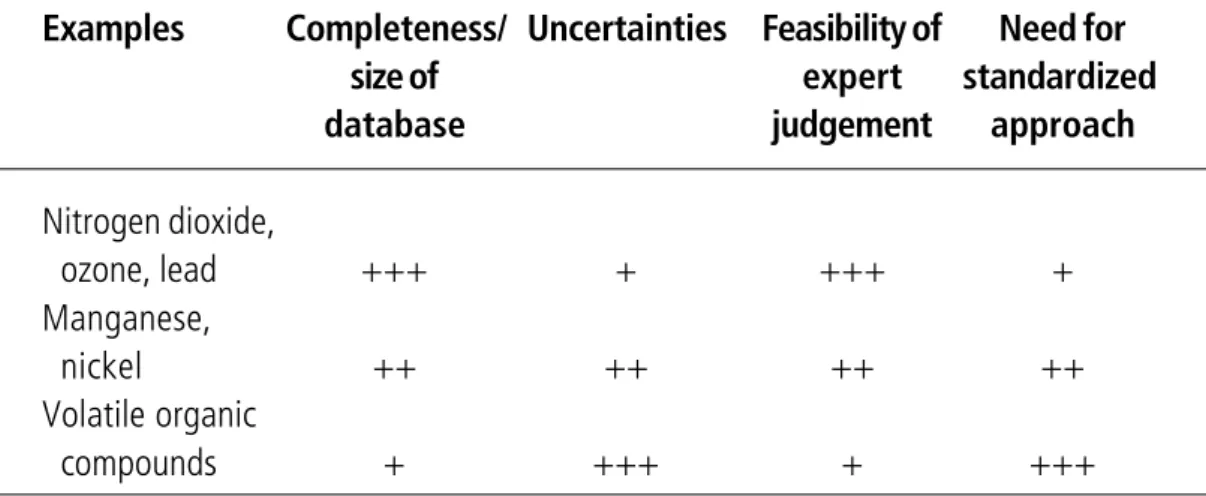
In preparing this second edition of the guidelines, the feasibility of develop-ing a standard methodology for settdevelop-ing guidelines was discussed. It was agreed that Environmental Health Criteria No. 170 (1) was a valuable source of information. On the other hand, it was recognized that large variation in the data available for different compounds made the use of a standard approach impossible. Much of the difficulty concerns the ad-equacy of the database, and this has played a large part in controlling the methods of assessment adopted. This is illustrated in Table 1.
Examples Completeness/ Uncertainties Feasibility of Need for size of expert standardized database judgement approach
Nitrogen dioxide,
ozone, lead +++ + +++ +
Manganese,
nickel ++ ++ ++ ++
Volatile organic
compounds + +++ + +++
Table 1. Size and completeness of database in relation to assessment method
It will be seen that when the database is strong (that is, when a good deal is known about the human toxicology of the compound) it is suggested that expert judgement can be used to set a guideline. In such circumstances the level of uncertainty is low. If, on the other hand, the database is weak, then a larger level of uncertainty will exist and there is much to be said for using a standardized approach, probably involving the application of a substantial uncertainty factor. The dangers of replacing expert judgement and the application of common sense with advanced, complex and sometimes not intuitively obvious statistical methods for deriving guidelines was discussed. It was agreed that a cautious approach should be adopted.
Criteria for selection of averaging times
The development of toxicity is a complex function of the interaction between concentration of a pollutant and duration of exposure. A chemical may cause acute, damaging effects after peak exposure for a short period and irreversible or incapacitating effects after prolonged exposure to lower con-centrations. Our knowledge is usually insufficient to define accurately the relationship between effects on the one hand and concentration and time on the other. Expert judgement must be applied, therefore, based on the weight of the evidence available (10).
Generally, when short-term exposures lead to adverse effects, short-term averaging times are recommended. The use of a long-term average under such conditions would be misleading, since the typical pattern of repeated peak exposures is lost during the averaging process and the risk manager would have difficulties in deciding on effective strategies. In other cases, knowledge of the exposure–response relationship may be sufficient to al-low recommendation of a long averaging period. This is frequently the case for chemicals that accumulate in the body and thereby produce adverse effects. In such cases, the integral of concentration over a long period can have more impact than the pattern of peak exposure.
It should be noted that the specified averaging times are based on effects on health. Therefore, if the guidelines are used as a basis for regulation, the regulator needs to select the most appropriately and practically defined standards in relation to the guidelines, without necessarily adopting the guidelines directly. It was appreciated that monitoring techniques for some pollutants would not allow reporting of data in terms of the averaging times recommended in the guidelines. Under such circumstances, a compromise between the averaging time specified in the guidelines and that obtainable in practice has to be reached in setting an air quality standard.
A similar situation occurs for effects on vegetation. Plants are generally damaged by short-term exposures to high concentration as well as by term exposures to low concentration. Therefore, both short- and long-term guidelines to protect plants are proposed.
Criteria for consideration of sensory effects
Some of the substances selected for evaluation have malodorous properties at concentrations far below those at which toxic effects occur. Although odour annoyance cannot be regarded as an adverse health effect in a strict sense, it does affect the quality of life. Therefore, odour threshold levels have been indicated where relevant and used as a basis for separate guideline values.
For practical purposes, the following characteristics and respective levels were considered in the evaluation of sensory effects:
• intensity, where the detection threshold level is defined as the lower limit of the perceived intensity range (by convention the lowest concentration that can be detected in 50% of the cases in which it is present);
• quality, where the recognition threshold level is defined as the lowest concentration at which the sensory effect, such as odour, can be recog-nized correctly in 50% of the cases; and
• acceptability and annoyance, where the nuisance threshold level is de-fined as the concentration at which not more than a small proportion of the population (less than 5%) experiences annoyance for a small part of the time (less than 2%); since annoyance will be influenced by a number of psychological and socioeconomic factors, a nuisance threshold level cannot be defined on the basis of concentration alone.
During revision of the guidelines, the problems of irritation (for example, of the skin) and headache were also considered as possible problems of annoyance. It was agreed that headache should be regarded as a health endpoint and not merely as a matter of annoyance.
CRITERIA FOR CARCINOGENIC ENDPOINT
Cancer risk assessment is basically a two-step procedure, involving a quali-tative assessment of how likely it is that an agent is a human carcinogen, and a quantitative assessment of the cancer risk that is likely to occur at given levels and duration of exposure (11).
Qualitative assessment of carcinogenicity
The decision to consider a substance as a carcinogen is based on the qualita-tive evaluation of all available information on carcinogenicity, ensuring that the association is unlikely to be due to chance alone. Here the classification criteria of the International Agency for Research on Cancer (IARC) have been applied (Box 1). In dealing with carcinogens, a “general rule” and exceptions from this were defined. The “general rule” states that for com-pounds in IARC Groups 1 and 2A (proven human carcinogens, and car-cinogens with at least limited evidence of human carcinogenicity), guide-line values are derived with the use of quantitative risk assessment with low-dose risk extrapolation. For compounds in Groups 2B (inadequate evi-dence in humans but sufficient evievi-dence in animals), 3 (unclassifiable as to carcinogenicity in humans) and 4 (noncarcinogenic), guideline values are derived with the use of a threshold (uncertainty factor) method. For com-pounds in Group 2B, this may incorporate a separate factor for the possibil-ity of a carcinogenic effect in humans.
In case of sufficient scientific evidence, one may be justified in deviating from the “general rule”. First, a compound classified in Group 1 or 2A may be assessed with the use of the uncertainty factor methodology, provided that there is strong evidence that it is not genotoxic as judged from a battery of short-term test systems for gene mutation, DNA damage, etc. In such cases it can be established with certainty that an increase in exposure to the compound is associated with an increase in cancer incidence only above a certain level of exposure. It was considered that this required a level of understanding of the mechanisms of action not presently available for the compounds classified as Group 1 or 2A on the current list. Second, a compound in Group 2B may be assessed with the use of quantitative risk assessment methods instead of the uncertainty factor approach. This may be considered appropriate where the mechanism of carcinogenesis in ani-mals is likely to be a non-threshold phenomenon as indicated, for example, by the genotoxic activity of the compound in different short-term test systems.
Quantitative assessment of carcinogenic potency
The aim of quantitative risk assessment is to use information available from very specific study situations to predict the risk to the general population posed by exposure to ambient levels of carcinogens. In general, therefore, quantitative risk assessment includes the extrapolation of risk from rela-tively high dose levels (characteristic of animal experiments or occupational exposures), where cancer responses can be measured, to relatively low dose levels, which are of concern in environmental protection and where such
Group 1 – the agent (mixture) is carcinogenic to humans.
The exposure circumstance entails exposures that are carcinogenic to humans. This category is used when there is sufficient evidence of carcinogenicity in humans. Exceptionally, an agent (mixture) may be placed in this category when evidence in humans is less than sufficient but there is sufficient evidence of carcinogenicity in experimental animals and strong evidence in exposed humans that the agent (mixture) acts through a relevant mechanism of carcinogenicity. Group 2
This category includes agents, mixtures and exposure circumstances for which, at one extreme, the degree of evidence of carcinogenicity in humans is almost
sufficient, as well as those for which, at the other extreme, there are no human data but for which there is evidence of carcinogenicity in experimental animals. Agents, mixtures and exposure circumstances are assigned to either group 2A (probably carcinogenic to humans) or group 2B (possibly carcinogenic to humans) on the basis of epidemiological and experimental evidence of carcinogenicity and other relevant data. Group 2A – the agent (mixture) is probably carcinogenic to humans.
The exposure circumstance entails exposures that are probably carcinogenic to humans. This category is used when there is limited evidence of carcinogenicity in humans and sufficient evidence of carcinogenicity in experimental animals. In some cases, an agent (mixture) may be classified in this category when there is inadequate evidence of carcinogenicity in humans and sufficient evidence of carcinogenicity in experimental animals and strong evidence that the carcinogenesis is mediated by a mechanism that also operates in humans. Exceptionally, an agent, mixture or exposure circumstance may be classified in this category solely on the basis of limited evidence of carcinogenicity in humans.
Group 2B – the agent (mixture) is possibly carcinogenic to humans.
The exposure circumstance entails exposures that are possibly carcinogenic to humans. This category is used for agents, mixtures and exposure circumstances for which there is limited evidence of carcinogenicity in humans and less than sufficient evidence of carcinogenicity in experimental animals. It may also be used when there is inadequate evidence of carcinogenicity in humans but there is sufficient evidence of carcinogenicity in experimental animals. In some instances, an agent, mixture or exposure circumstance for which there is inadequate evidence of carcinogenicity in humans but limited evidence of carcinogenicity in experimental animals together with supporting evidence from other relevant data may be placed in this group.
Box 1. Classification criteria of the International Agency for Research on Cancer
Box 1. (contd)
Group 3 – The agent (mixture or exposure circumstance) is not classifiable as to its carcinogenicity to humans.
This category is used most commonly for agents, mixtures and exposure
circumstances for which the evidence of carcinogenicity is inadequate in humans and inadequate or limited in experimental animals. Exceptionally, agents (mixtures) for which the evidence of carcinogenicity is inadequate in humans but sufficient in experimental animals may be placed in this category when there is strong evidence that the mechanism of carcinogenicity in experimental animals does not operate in humans. Agents, mixtures and exposure circumstances that do not fall into any other group are also placed in this category.
Group 4 – The agent (mixture) is probably not carcinogenic to humans.
This category is used for agents or mixtures for which there is evidence suggesting lack of carcinogenicity in humans and in experimental animals. In some instances, agents or mixtures for which there is inadequate evidence of carcinogenicity in humans but evidence suggesting lack of carcinogenicity in experimental animals, consistently and strongly supported by a broad range of other relevant data, may be classified in this group.
Source: IARC (12).
risks are too small to be measured directly, either by animal studies or by epidemiological studies.
The choice of the extrapolation model depends on the current understand-ing of the mechanisms of carcinogenesis (13), and no single mathematical procedure can be regarded as fully appropriate for low-dose extrapolation. Methods based on a linear, non-threshold assumption have been used at the national and international level more frequently than models that assume a safe or virtually safe threshold.
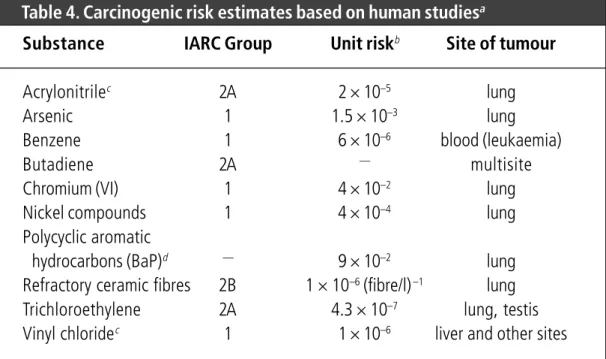
In these guidelines, the risk associated with lifetime exposure to a certain concentration of a carcinogen in the air has been estimated by linear ex-trapolation and the carcinogenic potency expressed as the incremental unit risk estimate. The incremental unit risk estimate for an air pollutant is defined as “the additional lifetime cancer risk occurring in a hypothetical population in which all individuals are exposed continuously from birth throughout their lifetimes to a concentration of 1 µg/m3 of the agent in the air they breathe” (14).
The results of calculations expressed in unit risk estimates provide the opportunity to compare the carcinogenic potency of different compounds and can help to set priorities in pollution control, taking into account current levels of exposure. By using unit risk estimates, any reference to the “acceptability” of risk is avoided. The decision on the acceptability of a risk should be made by national authorities within the framework of risk man-agement. To support authorities in the decision-making process, the guide-line sections for carcinogenic pollutants provide the concentrations in air associated with an excess cancer risk of 1 in a population of 10 000, 1 in 100 000 or 1 in 1 000 000, respectively, calculated from the unit risk. For those substances for which appropriate human studies are available, the method known as the “average relative risk model” has been used, and is therefore described in more detail below.
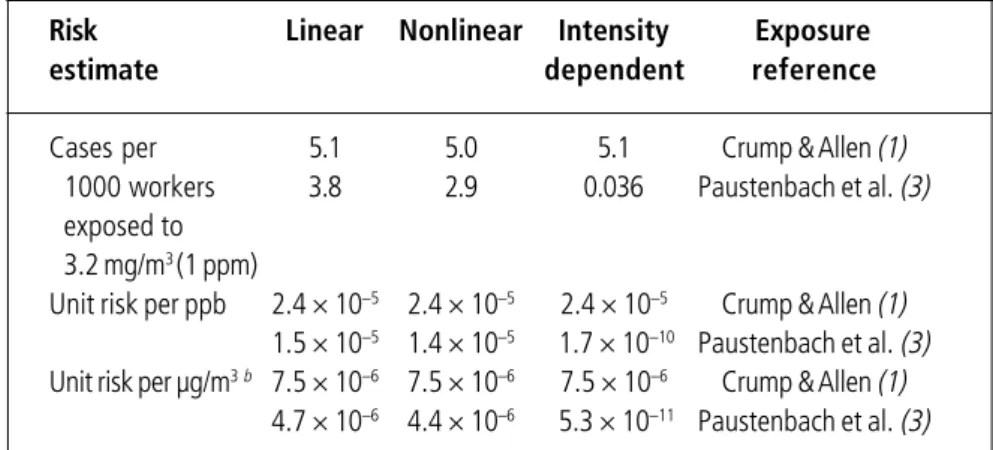
Several methods have been used to estimate the incremental risks based on data from animal studies. Two general approaches have been proposed. A strictly linearized estimate has generally been used by the US Environmen-tal Protection Agency (EPA) (14). Nonlinear relations have been proposed for use when the data derived from animal studies indicate a nonlinear dose– response relationship or when there is evidence that the capacity to metabolize the polluting chemical to a carcinogenic form is of limited capacity.
Quantitative assessment of carcinogenicity based on human data
Quantitative assessment using the average relative risk model comprises four steps: (a) selection of studies; (b) standardized description of study results in terms of relative risk, exposure level and duration of exposure; (c) extrapolation towards zero dose; and (d) application to a general (hypo-thetical) population.
First, a reliable human study must be identified, where the exposure of the study population can be estimated with acceptable confidence and the excess cancer incidence is statistically significant. If several studies exist, the best representative study should be selected or several risk estimates evaluated. Once a study is identified, the relative risk as a measure of response is calculated. It is important to note that the 95% confidence limits around the central estimate of the relative risk can be wide and should be specifically stated and evaluated. The relative risk is then used to calculate the excess lifetime cancer risk expressed as unit risk (UR) associated with a lifetime exposure to 1 µg/m3, as follows: