Ending child poverty by 2020
Progress made and lessons learned
2 Foreword
Alison Garnham
On 14 June the Department for Work and Pensions will release the latest child poverty figures for the period 2010/11 in the form of the Households Below Average Income (HBAI) figures. This data is
released at the half-way point towards achieving the 2020 target to eradicate child poverty. To mark this occasion, CPAG asked a range of leading academics to assess the progress made over the period 1998– 2010, to identify the drivers behind the changes observed, and to reflect on what the future looks like for children in the UK today.
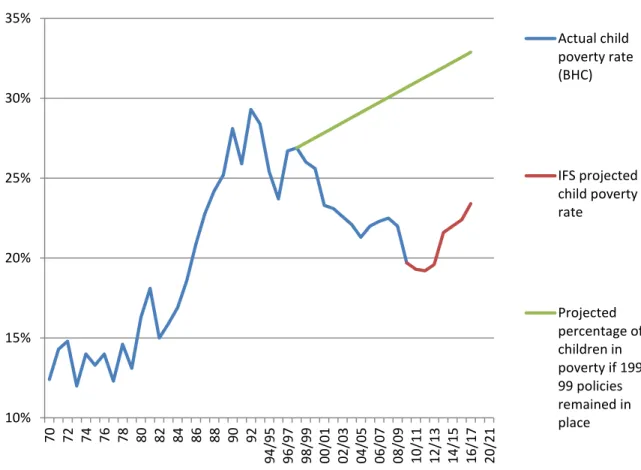
What the contributors show is that significant progress has been made over the last decade. As Kitty Stewart highlights in Chapter One, between 1998 and 2010 child poverty looks set to have reduced by 900,000 children when using a ‘before housing costs’ measure. However, this headline figure
underestimates the actual progress made over the period: if no action had been taken to reduce child poverty in the 2000s, it is projected that an additional 900,000 children would have fallen into poverty during the decade.
In addition, there is conclusive evidence that these gains were real and sustained, and not merely a matter of small improvements occurring at the threshold of poverty. As Mike Brewer shows in Chapter Five, child poverty would have been reduced if the poverty line had been drawn anywhere from 43 to 100 per cent of median income. As a result, the ‘poverty plus a pound’ thesis is decisively disproved.
Alongside the decreases in income poverty, Jonathan Bradshaw’s contribution in Chapter Two shows that child wellbeing improved against a wide range of additional measures over the period. Educational attainment and staying-on rates increased significantly; subjective wellbeing and mental health
indicators all showed a steady upward trend; homelessness and the number of children living in temporary accommodation decreased; and teenage conceptions fell.
Child wellbeing did not improve against all measures however. Some key health indicators including obesity, diabetes and sexually transmitted infections, deteriorated. Likewise, as Jonathan Portes observes in Chapter Four, the evidence with respect to social mobility is inconclusive while Mark
Tomlinson and Robert Walker note in Chapter Three that the downward trend with respect to persistent poverty petered out around 2003.
3
So how have the gains been achieved? Mike Brewer in Chapter Five shows that the decreases in child poverty are due in large part to the more progressive tax and benefits system of the 2000s. Real increases to all benefits, but especially to those targeted at children such as child benefit and child tax credit, played a critical role.
But it is inaccurate to ascribe all the achievements of the 2000s to social security spending. In Chapter Six, Vidhya Alakeson finds that measures designed to encourage parental employment also played a key part in reducing child poverty. Analysis shows that changes in employment contributed 2 percentage points to the reduction in the child poverty rate between 1997/98 and 2008/09, and that the steady rise in the number of lone parents in employment accounted for a significant element of this gain.
In fact, a broad range of interventions designed to benefit low-income families was rolled out between 1998 and 2010. Contributors highlight, for example, the importance of Sure Start (Naomi Eisenstadt in Chapter Eight), early years education provision (Eva Lloyd in Chapter Nine), the Decent Homes
programme (Anne Power in Chapter Thirteen), and investments in education (Donald Hirsch in Chapter Ten).
Again and again, our authors make the point that an adequate income is a necessary if not sufficient condition for reducing child poverty. In Chapter Seven, Edward Melhuish highlights the proven link between low income and poorer cognitive outcomes, as well as the critical importance of the early years; Michael Marmot speaks of the need for a basic income in order for children and parents to enjoy a healthy life in Chapter Eleven; and Lisa Harker warns in Chapter Twelve of a possible link between lack of an adequate income and the mistreatment of children. But it is also clear that income alone is not enough to guarantee a life free from poverty: the communities around us are crucial as both Anne Power’s and Will Horwitz’s contributions in Chapters Thirteen and Fifteen illustrate.
It is noteworthy how many of the contributions end on a sober note and express fears for the future. Most question the efficacy of future policy interventions designed to sustain improvements in child wellbeing at a time when family incomes are under assault. Tess Ridge’s contribution in Chapter Fourteen allows children to tell us what it means for them to grow up in poverty, and is a useful reminder of why we must continue to campaign for an end to child poverty in the UK today.
4 Contents
Introduction Lindsay Judge 6
One Child poverty: what have we really achieved? Kitty Stewart 10
Two Child wellbeing in the 2000s Jonathan Bradshaw 15
Three Things get better (and sometimes worse): poverty dynamics and children Mark Tomlinson and Robert Walker
21
Four Social mobility, poverty, and inequality: policies and prospects Jonathan Portes 26 Five Child poverty and financial support for children Mike Brewer 32
Six Employment and child poverty Vidhya Alakeson 36
Seven The impact of poverty on child development and adult outcomes: the importance of early years education Edward Melhuish
40
Eight Sure Start and child poverty: what have we learned? Naomi Eisenstadt 47 Nine Poor children’s future access to early years provision Eva Lloyd 50
Ten Better off, better educated Donald Hirsch 55
Eleven The health effects of poverty Michael Marmot 59
Twelve Protecting children Lisa Harker 64
Thirteen Housing and communities Anne Power 67
Fourteen Slipping back into the margins? The importance of adequate financial support and welfare services for children in poverty Tess Ridge
73
Fifteen A view from the ground Will Horwitz 77
6 Introduction
Lindsay Judge
June 2012 sees the publication of the Household Below Average Income (HBAI) dataset which will provide us with a snapshot picture of poverty in the UK for 2010/11. While the figures are always of interest, this year’s publication is particularly significant in that it represents the mid-way point between 1999 (the year in which when Tony Blair committed the country to eliminating child poverty within a generation), and 2020 (the anticipated end point for this project). The publication of HBAI requires us to think seriously about a number of points: what has been achieved and what has not; what worked and what did not; where we are and where we are going. To this end, we asked a range of leading academics to reflect on these questions, and their considered answers are collected here.
But first, the facts. In 1999, 3.4 million children lived in poverty in the UK before housing costs, accounting for 26% of all children. Using an after housing costs measure of poverty (CPAG’s preferred metric as it more realistically reflects the income families have at their disposal), these figures increased to 4.3 million or 33% of all children. Such rates of child poverty were high both in historical and
comparative terms: levels had increased rapidly throughout the 1980s and 1990s, and as a result the UK was ranked as having one of the highest rates of child poverty in OECD countries by the end of the nineties.1 The UK in 1999 was, then, a child poverty-producing country.
Achieving the objective of eliminating child poverty in a generation thus required action not just to lift those living in poverty in 1999 out of this condition, but also to stem the rising tide of child poverty in the UK. This makes the achievement of the last 10 years even more considerable: while we await the exact figures for 2010/11, the Institute for Fiscal Studies projects that between 1998/99 and 2010/11, the number of children living in poverty will have reduced by 900,0002, along with an additional 900,000 who have been prevented from falling into poverty during the same period.3 Reducing child poverty on this scale and at this pace has few if any precedents, either over time or across comparable wealthy countries.
It is surprising, then, that we approach the publication of HBAI 2010/11 with some trepidation. Rather than celebrating the progress made to date, and asking how this can be scaled up in the future, debate appears to have imploded into a clamour of assertions that are obscuring, rather than revealing, the fundamental truths about child poverty. A number of arguments about measurement, targets and
7
strategies have emerged that disparage the achievements of the last 10 years, and place a question mark over the future of the child poverty initiative.
To begin, much criticism has recently been directed at the relative poverty measure that we use in the UK as our headline indictor of child poverty. Conceiving of poverty as a relative phenomenon does, indeed, generate what look at first glance like counter-intuitive outcomes under some conditions. In 2009/10, for example, we witnessed declining average incomes in the UK but at the same time, a reduction in the numbers living in poverty. How, some have asked, can there be less poverty in a situation where we are all worse off? The answer, of course, is simple: to achieve decreases in relative poverty we have to increase the income of those at the lower end of the distribution at a rate higher than the average (or, in a period of declining median incomes such as now, protect the incomes of those at the bottom more robustly than those elsewhere in the distribution). No matter how stealthily the incomes of those at the lower end are increased or protected, policy makers are forced by the relative measure to clarify their attitude to inequality. Addressing relative poverty requires, at least to some extent, a redistribution of resources, which is, as we know, contested territory for any government.
But why should we care about relative poverty anyway? Is it not enough to concern ourselves with absolute poverty, and to believe that so long as we ensure that everyone in the UK has enough to hold body and soul together, our job is done. Those who comprehend poverty in this way are unable to see the value of a relative measure. But for those who understand that the experience of poverty goes far beyond the existential basics, and instead is a question of being able to participate in the society within which one is situated, a relative measure is essential. For how can we live our life fully when the vast majority around us can enjoy products, services and experiences which are regarded as the norm, but from which we are banned? To be excluded from the mainstream in this way is the experience of poverty, with all the stigma and shame that is attached to the condition.
Critics of the headline poverty measure do not just object to its relative nature, however, but also to the fact that it measures income alone. Putting aside the fact that we measure numerous other dimensions of poverty in the UK (including material deprivation under the terms of the Child Poverty Act 2010), do the detractors of income measures have a point? After all, money is not the only resource which, when lacking, excludes us from leading a full life: good health, good parenting, education, decent communities
8
all play a role. Given this, can an income measure tell us very much about poverty, or does it simply generate some meaningless numbers that bear no resemblance to the lived experience?
A single measure can, of course, only capture one dimension of any condition but we know that poverty is an experience that is substantially mediated by lack of income. Children do not benefit fully from good educational provision when they cannot afford uniforms, school trips or a computer at home; they do not enjoy good health when their homes are cold and damp, their food is inadequate and their parents are worried sick about debt; they do not enjoy socialising when they lack the ‘right’ clothes, the ‘right’ trainers, the money to join their friends at the cinema. An adequate income is a necessary, if not sufficient condition for eliminating poverty in the UK. Hence, it is perfectly proper that income remains our headline indicator, albeit supplemented by a range of additional measures that capture other key aspects of poverty and life chances with which we are concerned.
Those who dispute the centrality of income to accounts of poverty have a further objection however, arguing that the headline measure distorts strategy. They assert that resources have been unduly focused in recent years on raising incomes through benefits, rather than directed at services and other interventions that enable people to live better lives. This depiction of past strategy is, of course, a misrepresentation: large investments have been made in children’s centres, a national childcare strategy and community regeneration over the last decade, alongside interventions to improve work incentives for key at-risk groups such as lone parents, support disadvantaged children in school and promote greater health equality. Moreover, there is simply no evidence that policies have been (or indeed could be) designed to raise incomes just above the poverty line, giving lie to the ‘poverty plus a pound’ argument that abounds today.
The final charge directed at the child poverty initiative of the last decade is that it has failed because the midway milestone of halving child poverty by 2010/11 will be missed. It is certainly worth asking why the pace of reduction slowed in the mid-2000s, taking the country off-course with respect to the interim target. Furthermore, missing the midway target does make the trajectory towards the 2020 target much more precipitous. That said, if the rate of poverty reduction observed over the past decade could be sustained, the 2020 target of eliminating child poverty in the UK would be achieved only seven years later in 2027. To suggest, then, as some have, that the targets should be scrapped because they are unrealistic misses a crucial point: we choose as a country whether we want the targets to be realistic or
9
not when we decide which types of policies to implement. If we have missed the midway point, or more critically look set to veer dramatically off course with respect to the 2020 target, we should look to the strategies put in place and subject them to critique, rather than dismiss the targets as irrelevant.
In fact, the targets are as relevant today as they were in 1999. Very few people in the UK dispute the need to tackle child poverty: the most recent British Social Attitudes Survey shows that 98% view the reduction of child poverty as important. And crucially, despite the good progress made to date, 2.6 million children still live in poverty in the UK today, a figure that rises to 3.8 million when the after housing costs measure is used. To let the ambition of eliminating child poverty in a generation be diluted would be a monumental failure, and breach the legal commitment all parties made under the terms of the Child Poverty Act 2010. If the gains of the last decade are to be built upon rather than squandered, the expert voices of our contributors must be heard.
Lindsay Judge is Senior Policy and Research Officer at Child Poverty Action Group.
1
UNICEF, Child Poverty in Perspective: an overview of child well-being in high income countries, Innocenti Report Card No. 7, UNICEF Innocenti Research Centre, 2007
2
M Brewer, J Browne and R Joyce, Child poverty and working age poverty from 2010 to 2020, IFS Commentary C121, Institute for Fiscal Studies, 2011
3
M Brewer et al, Child Poverty in the UK Since 1998/99: lessons from the past decade, Working Paper 10/23, Institute for Fiscal Studies, 2010
10 One
Child poverty: what have we really achieved? Kitty Stewart
Tony Blair’s pledge in 1999 that the Labour government would eradicate child poverty in a generation was both unexpected and hugely ambitious. Interim targets were quickly established: to cut the number of children living in poor households by a quarter by 2004/05, and by a half by 2010/11. In practice, despite extensive policy effort, neither target was met. Yet to spin this as just another broken promise is disingenuous, ignoring the real and sustained improvements in living conditions and opportunities enjoyed by hundreds of thousands of children as a result of policies implemented over the last decade.
Did child poverty fall under Labour?
On the official relative poverty measure (60 per cent of household median income before housing costs), child poverty fell by just over a quarter, from 27 per cent in 1996/97 to 20 per cent in 2009/10 (with a predicted further fall to 19 per cent in 2010/11).1 In terms of numbers, this means 900,000 fewer children living below the poverty line when Labour left office than when it arrived. If poverty rates are measured after housing costs have been deducted from income, progress was more modest, but still significant: a drop from 34 per cent to 29 per cent in 2009/10, predicted to fall to 27 per cent in 2010/11; this means 800,000 fewer children in poverty.
These numbers give us a ‘snapshot’ of the number of children living below the poverty line in any particular year. Perhaps even more important are reductions in the number of children living in
persistent poverty (poor in three out of four consecutive years), as persistent poverty is believed to have a greater impact on children’s outcomes than short-term bouts of low income. The rate of persistent poverty fell markedly during Labour’s time in office, from 17 per cent before housing costs in 1998–2001 to 10 per cent in 2004–07, although rising again to 12 per cent in 2005–2008.2
Can we attribute these changes to Labour policy?
Is it such a surprise that child poverty fell during a period of strong economic growth? In some ways, economic conditions certainly made the task easier, with employment expanding and higher tax revenues providing more room for manoeuvre. But we need to remember that the poverty line is a
11
relative one, and therefore a moving target: to keep poverty falling, Labour had not just to increase the incomes of those below the line, but to keep them growing faster than the rise in median income. At the same time, demographic changes, such as increasing numbers of lone parents, put additional upward pressure on poverty. Simulations by the Institute for Fiscal Studies (IFS) indicate that if the 1998/99 tax-benefit system had simply been uprated for price inflation over time, child poverty would have risen by six percentage points while Labour was in office (900,000 children) and there would have been 4.3 million children living below the poverty line by 2010/11, instead of a predicted 2.5 million children.3 Thus, the impact of changes to the tax-benefit system under Labour – notably the tax credit system, with its high coverage and progressive structure – is considerably underestimated rather than overestimated by the actual observed outcomes.
Furthermore, employment changes themselves are partly the result of Labour policy. In particular, employment rates for lone parents have risen more quickly than for other groups – 57 per cent of lone parents were in work in 2010, compared with 45 per cent in 1997 – and studies attribute about half the rise to the effect of the New Deal and tax credit changes.4
What do these changes mean for children?
The use of headcount poverty measures can give rise to concerns that recorded poverty reductions are meaningless, simply reflecting a shift of families from just below to just above an arbitrary line – the ‘poverty plus a pound’ argument. Elsewhere in this book, Mike Brewer emphasises that this is not a fair criticism of Labour policy, under which the entire income distribution for households with children shifted to the right, with income rising most for those in the bottom half of the distribution. As a result, the child poverty rate fell under any reliable poverty line we choose.
We can also look at material deprivation indicators which give us an insight into the real impact on families’ lives and children’s lived experience of changes in income poverty. For example, we know that the percentage of lone parents unable to celebrate with presents on special occasions fell from 27 per cent in 1999 to 10 per cent in 2006, while the share who said they worried about money ‘almost always’ fell from 45 per cent to 29 per cent.5 Wider research provides further evidence of the impact of
increased resources. We know for instance that the extra money low-income families received over this period led to increased spending on fruit and vegetables, children’s clothes and books (while spending
12
on alcohol and cigarettes in these households fell).6 There are also indications that, for teenagers living with lone parents, employment and income changes resulted in better self-esteem and less unhappiness and risky behaviour.7
As well as highlighting improvements in immediate wellbeing, these changes illustrate the way that anti-poverty policy chips away at some of the long-term causes of future disadvantage. Calculations for the Joseph Rowntree Foundation suggest that reducing child poverty is a policy which largely pays for itself with lower long-run spending on benefits and services and higher future tax revenues.8 Thus, while Labour has been accused of throwing money into tax credits for little measurable return, its spending on poverty reduction should instead be seen as an investment with future payoffs still to come.
An impressive record?
There is no doubt that more could have been achieved for children in low-income households during Labour’s three terms in office. Most obviously, it is clear that the government took its foot off the pedal between 2004 and 2008, and poverty rates stagnated as a result during this period. In addition, although the first ever national childcare strategy was put in place, an opportunity was wasted to establish
universal, high quality childcare at low cost to families, which would have transformed work incentives while widening children’s opportunities; progress was made in this area, but the government could and should have aimed much higher. Perhaps most importantly, the strategy of tackling poverty while remaining ‘intensely relaxed‘ about the soaring incomes of the very rich was fundamentally flawed. It placed limits on the resources available for redistribution and public sector investment, while also alienating those in the middle and conceding vital moral high ground to the opposition. Labour tried to achieve too much by stealth, without making the case clearly enough for its progressive agenda, and this may explain why it has received insufficient credit for what it did accomplish.
But these flaws should not be allowed to override the government’s achievements. This short chapter has concentrated on financial resources to households with children, but we should remember the breadth and sweep of the overall strategy, which included substantial investment in all aspects of public services affecting children’s lives and futures. We should also remember the conditions Labour
inherited, in which years of under-investment in public services had damaged both staff morale and public sector infrastructure, and in which child poverty had been allowed to double in eighteen years to
13
the third highest rate in the Organisation for Economic Co-operation and Development, yet had no place on the political agenda.
Where now for children in low-income households?
Leaving the issue of child poverty firmly on the table for the incoming government was one part of the Labour legacy. The Child Poverty Act was passed with cross-party support in 2010, committing future administrations to act to reduce relative child poverty below 10 per cent by 2020/21. In practice, while the coalition government published its first Child Poverty Strategy in 2011 as mandated by the Act, it is clear that reducing income poverty for today’s children (or indeed preventing increases in poverty) is not a current policy priority. The Child Poverty Strategy accuses the previous government of pouring money into short-term fixes because of a narrow focus on income, and emphasises instead the
importance of tackling worklessness, educational failure and family breakdown.9 Coalition budgets have cut resources to low-income households with children (including many working households) through changes in the rules for claiming child tax credit, reductions in the childcare element of working tax credit, caps on overall benefits and changes to the local housing allowance. The IFS projects annual increases in relative child poverty between 2010/11 and 2013/14, despite a falling poverty line.10
The coalition does pledge to measure and act on a wider set of indicators of children’s wellbeing and opportunities, but given what we know about the importance of income to wider child outcomes, it is difficult to see how children’s prospects can be improved against this backdrop. An effective child poverty strategy needs to tackle low income and other causes of disadvantage, not one or the other.
Of course, these are very different times to those a decade ago, and any government in office today would face tough choices. But there are still choices, nonetheless. To date, a disproportionate burden of deficit reduction has been placed onto households with children, and families on the lowest incomes have been hit hardest of all. This is both unfair and short-sighted, and the government should be encouraged to rethink its strategy and to see spending on children as an investment in the future, with long-run consequences for the children themselves (who will not get another shot at childhood in happier economic times), and for the health and prosperity of society as a whole.
14
Kitty Stewart is Lecturer in Social Policy at the London School of Economics and Political Science, and Research Associate at the Centre for Analysis of Social Exclusion.
1
Poverty statistics are from the Institute for Fiscal Studies’ Inequality and Poverty Spreadsheet, which employs the same data (the Family Resources Survey) and the same methodology as the government’s official publication,
Households Below Average Income. Predicted figures are from M Brewer, J Browne and R Joyce, Child and Working-Age Poverty from 2010-2020, Commentary C121, Institute for Fiscal Studies, 2011
2
Department for Work and Pensions, Low Income Dynamics: 1991-2008, Department for Work and Pensions, 2010. There are no consistent data after 2005-08 because of the conversion of the British Household Panel Survey to the new Understanding Society survey.
3
M Brewer, J Browne, R Joyce and L Sibieta, Child Poverty in the UK Since 1998/99: lessons from the past decade, Working Paper 10/23, Institute for Fiscal Studies, 2010
4
For details and references, see P Gregg, S Harkness and S Smith, ‘Welfare Reform and Lone Parents in the UK’,
Economic Journal, Vol. 119, No. 535, 2009
5 Data from the Families and Children Study; see K Stewart. ‘A Scar on the Soul of Britain: child poverty and
disadvantage under New Labour’ in J Hills, T Sefton and K Stewart (eds), Towards a More Equal Society? Poverty, inequality and policy since 1997, The Policy Press, 2009
6 P Gregg, J Waldfogel and E Washbrook, ‘That’s The Way it Goes: expenditure patterns as real incomes rise for the
poorest families with children’ in J Hills and K Stewart, A More Equal Society? New Labour, poverty, inequality and exclusion, The Policy Press, 2005
7
P Gregg, J Waldfogel and E Washbrook, ‘That’s The Way it Goes: expenditure patterns as real incomes rise for the poorest families with children’ in J Hills and K Stewart, A More Equal Society? New Labour, poverty, inequality and exclusion, The Policy Press, 2005
8
See D Hirsch, Estimating the Costs of Child Poverty: reviewing the evidence, Joseph Rowntree Foundation, 2008
9
Department for Work and Pensions and Department for Education, A New Approach to Child Poverty: tackling the causes of disadvantage and transforming families’ lives, 2011
15 Two
Child wellbeing in the 2000s Jonathan Bradshaw
Wellbeing is conventionally understood as multi-dimensional. Many things influence the lives of children – not just their material circumstances, but also their education, health, relationships with parents and friends, home and living environment, and their own behaviour. What they think and feel about their lives – their subjective wellbeing – is also important and, indeed, may be the result of the other dimensions of wellbeing.
At the beginning of the 2000s the wellbeing of children in the UK was poorly rated. Child poverty had increased nearly threefold in the 1980s, and a series of comparative studies representing wellbeing in similar, but not identical, ways found that the UK was not doing well. The UNICEF Innocenti Report Card 7, using data from around 2000, ranked the UK at the bottom of 21 countries – and in the bottom third of countries on all domains except for health and safety.1 A later comparison, using data from around 2005 of 29 European Union countries, had the UK placed at 24, in the bottom third on all domains except relationships, risk behaviour and housing.2 In the same year, the Organisation for Economic Co-operation and Development (OECD) published its league table of child wellbeing, which had the UK placed 20 out of 30 OECD countries and in the bottom third on education, health and safety, and risk behaviour.3
Partly in response to this evidence, the government invested heavily in children throughout the 2000s. There was the Child Poverty Strategy, which resulted in real improvements in the level of in-work and out-of-work incomes for families with children. Surestart was launched in 1998 and early education was extended to three- and four-year-olds and later, in 2009, to two-years-olds from disadvantaged
backgrounds. There were big increases in public spending on health and education, and later childcare. In schools, the standards agenda sought to improve literacy and numeracy and to improve performance at key stages and at GSCE. Policies were introduced to encourage staying on and to expand
opportunities in tertiary education. In addition, there was an institutional transformation with children’s commissioners appointed, a new Department for Children, Families and Schools, a Children’s Plan, and equivalent developments in the devolved administrations and in local government. The high point was the Child Poverty Act 2010.
16
What did all this effort achieve? The dominant rhetoric of the coalition government (supported by the Field and Allen Reviews and, to some extent, by Alan Milburn) is that very little was achieved. They argue that, despite billions of pounds being spent between 2000 and 2010, the child poverty targets were not met.4 Now, in the Child Poverty Strategy, resources are to be concentrated on early years and 120,000 so-called problem families. The agenda has shifted from wellbeing to well-becoming, and from structure to behaviour.
This is a wholly mistaken and potentially disastrous reading of the evidence. It is a pity that the previous government abandoned its annual effort to monitor the Child Poverty Strategy in the Opportunity for All reports.5 This produced a set of indicators that went beyond income poverty and included health, education, personal social services and housing. The last of these reports in 2007 demonstrated that progress was being made – out of 23 indicators covering children and young people, 12 had improved since 1997 and only two had got worse. Some of these indicators re-emerged more informally in a 2009 report on the Children’s Plan progress,6 and some have re-emerged again in the Child Health Strategy indicators,7 and in the proposed Child Poverty Strategy indicators.8 But there is no government series that monitors child wellbeing across the board.
However, in the latest of a series of reviews of child wellbeing, we have attempted to review national trends using 48 indicators, representing the domains of material wellbeing, child health, subjective wellbeing and mental health, education, housing, child maltreatment, children in care, childcare, crime and drugs over the period 1997 to 2010 (see Table 1).9 Out of the 48 indicators, 36 have moved in the right direction and only four have moved in the wrong direction (all in the health domain –
immunisation rates, diabetes, obesity and sexually transmitted diseases). Relative child poverty fell (probably by more than one million) and, although this was not enough to meet the target to halve child poverty by 2010, there was a substantial reduction in the poverty gap. Educational attainment
improved. Housing conditions improved and child homelessness fell. Child maltreatment fell and the stability and educational attainments of children in care improved. Youth crime fell. There was a big increase in participation in formal pre-school childcare. There was even good evidence that adolescent mental health improved, as did the happiness and overall life satisfaction of children.
17 Table 1: Trends in child well-being
1997-2010 Source
Material wellbeing
Relative poverty (BHC) HBAI
‘Absolute’ child poverty (BHC) HBAI
Material deprivation ▪ HBAI
Persistent poverty (BHC) HBAI
Health
Still births ≈ ONS
Infant mortality ONS
Child deaths ONS
Low birth weight ≈ ONS
Breastfeeding ONS
Immunisation rates X DoH
General health HSE
Longstanding illness HSE
Limiting longstanding illness HSE
Diabetes X HSE
Asthma ≈ HSE
Injuries and accidents DoT
Obesity X HSE
Diet (fruit and vegetables) HSE
Alcohol HSE
Smoking HSE
Physical activity ▪ HSE
Sexually transmitted infections X HPA
Teenage conceptions ONS
Subjective wellbeing and mental health
Happiness overall BHPS
Mental health ONS
Suicide ONS
Happiness with friends BHPS
Happiness with family ≈ BHPS
Happiness with school work BHPS
Happiness with appearance ≈ BHPS
18
Happiness with school ▪ BHPS
Education
Key stage 2 attainment DFE
5 GCEs A-C DFE
Level 2 qualifications DFE
Staying-on rates DFE
Exclusions ≈ DFE
Not in employment, education or training
(NEET) ≈
Housing
Homelessness DCLG
Temporary accommodation DCLG
House conditions EHS/EHCS
Child maltreatment
Fatal abuse Home Office
Physical abuse NSPCC
Neglect ≈ NSPCC
Children in care
Length of spells in care ▪ DfE
Placement stability DfE
Education DfE
Childcare
Formal participation Smith/Bryson
Crime and drugs
Proven offences YJB
Arrests YJB
Drug taking DMD
Worry about crime MORI
19 = getting better
X = getting worse ≈ = no clear trend ▪ = missing data
BHC = before housing costs
To see whether the UK has moved up the international wellbeing league table, we will need to await the publication of UNICEF Report Card 11, which will repeat Report Card 7 using more up-to-date data. However, there are some early indications of progress. European Union evidence shows that the UK was one of ten countries with a reduction in child poverty between 2005 and 2010,10 and the OECD has the UK with the largest reduction in child poverty between the mid-1990s and 2008.11 UNICEF Innocenti Report Card 10 ranks the UK ninth out of 29 countries in the league table of deprivation, 22nd out of 35 countries on the relative child poverty rate and 16th out of 35 countries on child poverty gaps.12
Many of these achievements are being reversed by the policies being pursued by the coalition government. It seems families with children (and women) have been singled out to carry the brunt of the deficit reduction. There is no space here to list all the measures that have been taken against the interest of children, 13 but notable among them are the abolition of the education maintenance
allowance, health in pregnancy grants and child trust funds, the freezing of child benefit, the removal of working tax credit from couples working 16–24 hours, and the reneging on the commitment to uprate child tax credit above inflation. Already the number of children living in workless families is on the increase, ‘NEET’ and youth unemployment is at record levels, the living standards of low-income families are falling as benefits and tax credits fail to keep pace with the price increases they face.14 The Institute for Fiscal Studies predicts that absolute poverty is already rising and relative poverty will soon rise as well. We can expect the wellbeing of children to fall.
Jonathan Bradshaw is Professor of Social Policy at the University of York.
1
UNICEF, Child Poverty in Perspective: an overview of child well-being in high income countries, Innocenti Report Card No. 7, UNICEF Innocenti Research Centre, 2007
2 J Bradshaw and D Richardson, ‘An Index of Child Well-being in Europe’, Child Indicators Research, 2, 3, 319, 2009 3 Organisation for Economic Co-operation and Development, Doing Better for Children, OECD, 2009
20
4 ‘This Government is committed to eradicating child poverty but recognises that income measures and targets do
not tell the full story about the causes and consequences of childhood disadvantage. The previous Government’s focus on narrow income targets meant they poured resources into short-term fixes to the symptoms of poverty instead of focusing on the causes. We plan to tackle head-on the causes of poverty which underpin low
achievement, aspiration and opportunity across generations. Our radical programme of reform to deliver social justice will focus on combating worklessness and educational failure and preventing family and relationship breakdown with the aim of supporting the most disadvantaged groups struggling at the bottom of society.’ www.education.gov.uk/publications/eorderingdownload/CM-8061.pdf, para 3
5
It was actually replaced by biennial reports to the European Union (EU) on social inclusion, which covered some of the same ground. But the EU replaced these with a much more useless country report on the National Reform Programme – although in 2012, member states are once again being asked to report on their social progress.
6
Department for Children, Families and Schools, The Children’s Plan Two Years On: a progress report, 2009
7
Department for Health, Public Health Outcomes Framework, 2012, www.dh.gov.uk/en/publicationsandstatistics/ publications/publicationspolicyandguidance/DH_131700
8
A New Approach to Child Poverty: tackling the causes of disadvantage and transforming families’ lives, Cm 8061, 2011
9 J Bradshaw (ed), The Well-being of Children in the United Kingdom, The Policy Press, 2011
10 Social Protection Committee, Third Report on the Social Impact of the Economic Crisis and Ongoing Fiscal
Consolidation, 2011
11 Organisation for Economic Co-operation and Development, Family Database Child Poverty CO2.2.B,
www.oecd.org/document/4/0,3746,en_2649_34819_37836996_1_1_1_1,00.html
12 UNICEF, Child Poverty and Deprivation in Rich Countries, Innocenti Report Card No. 10, UNICEF Innocenti
Research Centre, 2012
13
But see R Joyce, Tax and Benefit Reforms Due in 2012-13, and the outlook for household incomes, Briefing Note BN 126, Institute for Fiscal Studies, 2012, www.ifs.org.uk/bns/bn126.pdf26
14
21 Three
Things get better (and sometimes worse): poverty dynamics and children Mark Tomlinson and Robert Walker
The usual poverty rate statistics are a snapshot, the momentary product of some people entering poverty while others leave. Poverty rates fall if fewer people become poor or if more have increased income that takes them above the poverty threshold. Other things being equal, reducing the time that the typical family remains in poverty lowers the poverty rate.
Children seldom remain poor forever. Mostly their parents find work, increase their hours of work or move to better paid jobs. Sometimes parents re-partner and family finances can improve as a consequence. There is always hope that things can get better and most often they do. Equally, all families risk things going wrong and some are particularly prone to experiencing poverty as a consequence. And for those on the lowest incomes, the stakes are higher, the risks more serious.
This chapter begins by charting the movements in and out of poverty and the reasons for them, noting the changes that have occurred since the 1990s. Only then does it consider the relatively small number of people who remain poor for long periods and attract so much attention in the media.
For the most part, the statistics are drawn from official analyses conducted using the British Household Panel Study (BHPS). BHPS was a pioneering project, now absorbed into the Understanding Society study (USoc), which entailed adults and youth members in a nationally representative sample of households being interviewed each year from 1991 onwards, thereby allowing changes in people’s lives to be directly observed.1 Full official analyses of poverty dynamics based on USoc are not anticipated until 2016 (for 2010 to 2014).
At risk of poverty
No one is immune to the risk of poverty, although, for some, the chances of becoming poor are minimal. In the first ten years of BHPS, from 1991 to 2001, 52 per cent of all British families had poverty level incomes that lasted for at least a year.2 Rather than poverty being rare, it was the experience of the majority. Moreover, while poverty rates have fallen in the last decade, without further policy change between two and three times as many people are likely to become poor in the next decade than would
22
be suggested by the current poverty rate (20 per cent for children; 16 per cent for adults of working age).3
Every year between 1991 and 2008, about 7 per cent of people began a lengthy spell of poverty.4 But the risks were not evenly distributed: twice as many lone parents (14 per cent) became poor as did 17 per cent of people living in households in which no one was employed. Only 4 per cent of people living in households without dependent children risked slipping into poverty.
While employment offers considerable protection against poverty, most spells of poverty are precipitated by negative labour market events; 42 per cent of spells are associated with a fall in the earnings of the household head due, for example, to unemployment or short-time working. Eleven per cent of spells are related to a fall in the income of a second worker, emphasising the fact that many families are dependent on two or more workers to keep them out of poverty, a characteristic of a low-wage economy. People are also vulnerable to falls in benefit income; 27 per cent of all spells of poverty are attributable, in part at least, to this cause.
Of course, events of the kinds associated with poverty do not always result in poverty. Eighty-one per cent of people in households in which the head experiences a drop in earnings greater than 20 per cent do not immediately become poor; they have prior savings, find a different job or accommodate in some other way. Even those who become lone parents mostly avoid poverty, although the risks for this group are particularly high: almost one in three (29 per cent) experience sustained poverty following the onset of lone parenthood, but two out of three do not. People who have been employed for sustained periods face much less chance of being poor; someone employed for at least three consecutive years has only a one in a hundred chance of becoming poor within the year, seven times less than the population at large.
Poverty does not last for ever
Public debate seems frequently to suggest that poverty is more or less a permanent state, with the use of terms such as ‘the poor’ and occasionally ‘the underclass’. The reality is that most spells of poverty are comparatively short. Official analyses show that 32 per cent of people who are in poverty one year are not so the next, but even these statistics overstate the persistence of poverty because short spells of poverty starting and ending between the survey dates are ignored.5
23
Nevertheless, the official analyses are the best available and they indicate that the chances of escaping poverty are uneven. Whereas 45 per cent of couples without children leave poverty between years, only 26 per cent of lone parents and 22 per cent of pensioners manage to do so. Moreover, the chances of people leaving poverty after three years of poverty are much reduced, effectively halving for most groups except those in households in which all adults are employed where the fall is noticeably less, from 40 per cent to 28 per cent.
The decline in the chances of leaving poverty is not necessarily due to people becoming resigned to their status, let alone becoming workshy. The people who remain in poverty for long periods are often people who enter poverty with characteristics that might conspire to make it difficult for them to leave.6 They may live in an area with few job opportunities; they may have limited skills or work experience; they might have health issues. What is notable is that, even after three years of poverty, one in six lone parents or couples with children are still likely to move from poverty within the next year. Mostly, of course, this happens because the earnings of the household rise as a result of someone obtaining a job, moving to a higher paid job or increasing the hours worked. That said, people can do any of these things and still not move out of poverty, such are the limited opportunities available to people who have been poor for long periods. Indeed, only 39 per cent of household heads who manage to secure a 20 per cent increase in wages or greater succeed in getting out of poverty as a consequence; for second earners, the proportion is even smaller, at 29 per cent.
An increase in benefit income, usually the result of receiving a different (and sometimes an additional) benefit, is also a mechanism through which long spells of poverty are brought to an end. Indeed, in numerical terms, this is just as important as increases in the earnings of the household head. What is less clear, however, is whether in the majority of these cases people are finally getting the benefits to which they are entitled or whether it is changes in their circumstances that make them eligible for benefits that take them above the poverty line.
Over a quarter of lengthy spells of poverty end as a result of changes in household composition, including lone parents partnering. Forty-four per cent of people who partner after a spell of poverty lasting at least three years simultaneously move out of poverty.
24 Persistent poverty
While most families move in and out of poverty quite quickly, a minority do not. Official statistics attempt to capture this minority by recording families that are below the poverty line in three years out of four. These statistics reveal a fall in the proportion of individuals experiencing persistent poverty from 15 per cent in the period 1991 to 1994, to 10 per cent between 2005 and 2008, with especially marked improvements for lone parents for whom the rate fell from 50 per cent to 27 per cent, notably in the period between 2000 and 2003. Whereas 25 per cent of all children experienced persistent poverty in the period 1991–1994, by 2005–2008 the figure had dropped to 17 per cent.
These dramatic developments were most likely largely attributable to higher employment rates among lone parents, and increases in benefit and tax credit rates.7 Unfortunately, there has been little, if any, reduction in persistent poverty among children as a group since the early 2000s – continued slight improvements among the children of lone parents have been offset by falls in the earnings of the much larger number of children living with two adults. Moreover, improvements for the latter group were rather marginal over the entire period, such that, on average, no family was lifted above the higher 70 per cent poverty threshold, whereas by 2005–2008, 59 per cent of lone parents had incomes above this threshold in at least two years compared with just 39 per cent in 1991–1994.8
Although most children only experience poverty for short periods, the fact that one child in six does so for a sustained time remains a policy challenge. Lack of income directly affects child wellbeing in the short term and, through its effect on educational orientation, affects child outcomes in terms of
educational attainment and employment status to a degree that research suggests can only be partially offset by good parenting.9
Mark Tomlinson is Senior Lecturer in Sociology and Social Policy at the University of Sheffield and Robert Walker is Professor of Social Policy at the University of Oxford.
1
Department for Work and Pensions, Low-Income Dynamics, 1991-2008 (Great Britain), Information Directorate, Department for Work and Pensions, 2011
2 J Rigg and T Sefton, Income Dynamics and the Life-cycle, CASE Paper 81, Centre for Analysis of Social Exclusion,
25
3 N Adams, A Barton, G Johnson and P Matejic (eds), Households Below Average Income: an analysis of the income
distribution 1994/95 – 2009/10, Department for Work and Pensions, 2011
4 Department for Work and Pensions, Low-Income Dynamics, 1991-2008 (Great Britain), Information Directorate,
Department for Work and Pensions, 2011. Poverty is measured in the month before interview. This means that spells of poverty lasting less than a year that occur between repeated survey interviews will not be counted. Therefore, many more people experience poverty than the Low Income Statistics reports indicate. Jenkins (2011) concludes that there is very little difference in poverty rates and dynamics based on current (monthly) and annual income, such that it may be appropriate to think of the transitions relating to spells of poverty that last for at least a year. All statistics cited in this chapter are taken from Low-Income Dynamics and refer to incomes after housing costs unless stated otherwise.
5
J Hills, A McKnight and R Smithies, Tracking Income: how working families' incomes vary through the year, CASE Report 32, Centre for Analysis of Social Exclusion, London School of Economics, 2006
66
Jenkins (2011) demonstrates that most of the variation in the duration of poverty spells is due to prior
characteristics but that, in small part, something about the experience of poverty serves to reduce the chances of escape.
7
J Jin, R Joyce, D Phillips and L Sibieta, Poverty and Inequality in the UK: 2011, Commentary C118, Institute for Fiscal Studies, 2011
8 Fifty-nine per cent of couples with children had incomes above the 70 per cent threshold in at least two years.
9 M Tomlinson and R Walker, Coping with Complexity: child and adult poverty, CPAG, 2009; M Tomlinson and R
Walker, ‘Poverty, Adolescent Well-being and Outcomes Later in Life’, Journal of International Development, 22(4), 2010, 1162–82
26 Four
Social mobility, poverty, and inequality: policies and prospects Jonathan Portes
According to the Deputy Prime Minister, social mobility – rather than child poverty or inequality – is the ‘overriding social policy priority’ for the current government. But can you tackle social mobility without tackling poverty and inequality?
It is now reasonably well established that countries with higher social mobility are less unequal. Figure 1 shows, looking across countries, that inequality appears to ‘predict’ future levels of social (im)mobility, but this falls far short of establishing a causal relationship.
Figure 1: The Great Gatsby curve
Source: Alan Krueger, Chair, US Council of Economic Advisors, January 2012
This correlation certainly appears to hold for the UK, as Figure 1 shows. The sharp rise in inequality and child poverty between the mid-1970s and the early 1990s appeared to parallel a fall in social mobility for
Denmark Finland
France
Germany
Japan
New Zealand
Norway Sweden
United Kingdom
United States
y = 2.2x -0.27 R² = 0.76
0.1 0.2 0.3 0.4 0.5 0.6
0.1 0.2 0.3 0.4 0.5 0.6
0.15 0.20 0.25 0.30 0.35 0.40
Inequality 1985 Gini co-efficient Inter-generational earnings elasticity
27
those who were children at the time; the much cited paper by Jo Blanden and others, showing that social mobility fell for those leaving school in the late 1980s compared with those who left school in the mid-1970s, has had a huge impact in policy and political circles.1 While the specifics of the paper have been criticised,2 the consensus among economists is that, by any measure, there was a significant fall in inter-generational social mobility (or more precisely, a significant rise in the correlation between the incomes and educational attainment of parents and children) over roughly this period.
There are a number of causal mechanisms by which poverty and inequality could reduce social mobility. One is that it simply seems likely to be harder (so social mobility will be lower) to move from the bottom to the middle or top of a society (or vice versa) when the distance between the bottom and top is farther (i.e. society is more unequal).
Another explanation focuses more directly on poverty, rather than inequality, arguing that poverty is likely to constrain directly the ability of your children to move up. This mechanism clearly matters a lot for mobility in societies where being poor means not having enough to feed your children or send them to school (so they will grow up less healthy and educated). However, it could still operate in developed countries, if poor people, even if not materially deprived in this extreme sense, are constrained by lack of resources from participating fully in society, in turn constraining children living in poverty from moving up the social ladder.
And it could operate through the education system: poorer children generally have worse educational outcomes, and this clearly has a substantial impact on social mobility.
Most analysis has focused on the education system, since the connection is obvious and it seems – potentially at least – amenable to policy. And the evidence does suggest that the connection between parental income and child educational attainment – and hence child income – has got stronger over the period in question. This was not (contrary to frequent assertions in the press) anything to do with the (near) abolition of grammar schools: recent research has shown that for the 1958 cohort,
comprehensive schools performed overall at least as well as grammar schools in terms of social mobility, individual examples to the contrary notwithstanding.3 A more plausible alternative explanation is that
the fall in social mobility was partly due to the increase in higher education participation being focused on those from higher income families.
28
So what do we think has happened to social mobility over the last decade or so? Although inequality overall, as measured by the Gini co-efficient, has been flat, the fall in child poverty should give some cause for optimism, to the extent that this makes it more likely that relatively disadvantaged families can participate fully. The evidence does suggest that increases in income for poorer families did translate into extra spending on child-related goods, which is likely at least to be a necessary
precondition for these increases in income to improve mobility.4 And gaps in educational performance do seem to have narrowed somewhat, as shown by a recent analysis in the Financial Times,5 leading Simon Burgess from the University of Bristol) to conclude: ‘We may have here the first evidence of a turning of the tide… declining social mobility is not an immutable force, but can be changed. Indeed, it seems that it was changed by the education policies of the previous government.’
This may, however, be an optimistic perspective. The government argues instead that the glass is half empty asserting that ‘ Leading indicators of social mobility suggest that, while some progress has been made, the high levels of public investment seen over the last decade are unlikely to lead to significant improvements in mobility in the near future. There have been some signs of progress in recent years in terms of the gap between rich and poor in school attainment at the ages of 11 and 16. But, overall, the gaps in educational performance have narrowed only very slightly despite significant investment.’
Meanwhile, if anything, the youth labour market appears to have become more polarised. So, since 2001, the number of recent graduates (those who graduated in the last six years) has risen from about 1 million to about 1.5 million, but the number of 19–24-year-olds not in education, training or
employment has also increased sharply, from about 500,000 to about 800,000. And qualification levels are key to success in the labour market, both in terms of employment and earnings.
29 Source: Labour Force Survey data
What about the future? With the prospect of a further rise in income inequality and relative child poverty, driven both by structural change and government policies, it is difficult to be optimistic, as these are certainly likely to be negative for social mobility. It is, however, worth setting out the government's counter-arguments. The government argues that the increase in progressivity of the tax and benefit system over the last decade, while reducing measured inequality and child poverty, was just papering over the cracks, and failing to deal with the structural causes of greater inequality and reduced social mobility. They see the priorities as being early years education, reducing educational under-performance among more disadvantaged groups, and tackling entrenched worklessness among some groups, especially young adults with low qualifications.
In principle, leaving aside views on the short-term impact of income inequality, there is much to
commend in this approach. Indeed, it seems plausible that if successful policies could be implemented in these areas, over the longer term they would at least contribute to reducing inequality and child
poverty, and eventually increase social mobility. It is, however, worth noting that, in a number of areas, the specific policy changes announced so far do not seem to be based on strong evidence of what might
0%
10%
20%
30%
40%
50%
60%
70%
80%
Unemployed
Not employed or full-time
student
Employed
Degree level
Higher education
A
-
level equivalent
GCSE A
-
C equivalent
Other qualifications
No qualifications
30 contribute to greater social mobility:
The reduction in funding available for Sure Start does not seem consistent with the priority attached to the early years – a point made strongly by the Frank Field Review.6
By contrast, the extension of childcare to relatively disadvantaged two-year olds may have some positive impact. In both cases, however, it should be noted that, while there is very strong evidence that early outcomes are important for later educational attainment and hence very probably for social mobility, the evidence base for particular interventions is less strong.
The impact of the introduction of free schools is obviously difficult to predict at this stage, but existing evidence suggests it is likely to be negative for social mobility. The Organisation for Economic Co-operation and Development (OECD) argues, citing multiple references, that ‘research has shown that school choice, and by extension school competition, is related to greater levels of segregation in the school system, and consequently, lower levels of equity.’ In Sweden, the closest direct analogy, most evidence suggests it has resulted in some rise in segregation, consistent with the OECD view. This may, however, be countered by the introduction of the pupil premium, although there is little evidence to suggest that simply increasing school expenditure substantially improves the performance of poorer pupils.
The abolition of the education maintenance allowance, despite strong evidence that it
significantly increased staying-on rates and attainment among the target group (16–18-year-olds from poorer families)7 is likely to have a negative impact on social mobility, given the impact both on further educational attainment (eg, university participation) and on earnings.
On a more positive note, the Wolf Report on vocational and technical education recognised that at least 350,000 16–19-year-olds get little or no benefit from the post-16 education system, and makes some important and evidence-based recommendations designed to help, in particular, the most disadvantaged young people.8
To conclude, it is difficult enough to state with any degree of confidence what has happened to social mobility in the last decade, so predicting the future is, at best, courageous. The coalition government
31
has a clear commitment to implementing policies designed to increase social mobility, and its broad policy focus is sound. Nevertheless, at present it is difficult to be optimistic about either broader structural trends or about the majority of the specific policies implemented so far.
Perhaps the most encouraging aspect of the debate is that the government argues that reducing the attainment gap is the best way to produce a fairer society, and has explicitly invited the public to judge it on its achievement in doing so. We should hold them to that commitment.
Jonathan Portes is director of the National Institute of Economic and Social Research.
1
J Blanden et al, Changes in Intergenerational Mobility in Britain, Centre for Economic Performance, LSE 2001
2
P Saunders, Social Mobility Myths, Civitias: Institute for the Study of Civil Society, 2010
3
V Boliverand A Swift, ‘Do comprehensive schools reduce social mobility?’, The British Journal of Sociology Volume 62, Issue 1, 89–110, March 2011
4
P Gregg, J Waldfogel and E Washbrook, ‘Expenditure Patterns Post-Welfare Reform in the UK: Are low-income families starting to catch up?’, CASE paper 99, LSE 2005
5
See www.ft.com/cms/s/0/d82fc3cc-eab3-11e0-aeca-00144feab49a.html#axzz1ZYz7DPD4
6
http://webarchive.nationalarchives.gov.uk/20110120090128/http:/povertyreview.independent.gov.uk/ media/20254/poverty-report.pdf
7
H Chowdry and C Emmerson, ‘An efficient maintenance allowance?’, IFS 2010
32 Five
Child poverty and financial support for children Mike Brewer
Some people within the current government, as well as some outside it, have criticised the previous Labour government’s approach both to measuring child poverty and to reducing it.1 Targeting a measure of poverty defined solely in terms of family income, the story goes, means that governments naturally focus on lifting income through higher welfare payments aimed at children, and gives them an incentive to move people who are just below the line to just above it. Ultimately, the conclusion of some now in government is that the previous strategy was hugely expensive and looks set to have failed.So are these criticisms warranted?
First, it is definitely the case that the previous government massively increased the amount of money – in real terms and as a share of national income – spent on benefits and tax credits, and that those increases were disproportionately aimed at increasing financial support for families with children. Whether because of the over-indexation of the child element of child tax credit from 2003 or ad hoc increases to tax credits or child benefit, core benefit and tax credit entitlement for low-income families with children rose faster than inflation in at least eight of the 13 years of the previous government, and rose more quickly than median income (which is what is required to reduce a relative measure of
poverty) in at least six of these.2 Financial support for a workless lone parent with one child was some 20 per cent higher in real terms in 2010 than in 1997, 36 per cent higher for a lone parent working part time on a low wage, and had grown by even more for an unemployed couple with three children.3 Over the same period, key benefit entitlement for those not in work and without dependent children rose faster than median income just once, in 2009.
So the government did spend a lot more money on welfare benefits, and mainly channelled that through benefits and tax credits aimed at families with children (as well as to pensioners). But did it respond cynically to its targets by moving people who were just below the line to just above it? This seems highly unlikely. First, the main changes to financial support for families with children were not highly targeted on a very specific part of the income distribution, but were spread fairly broadly across workless and low-income working families. As a result, relative poverty fell when measured using all possible poverty lines (expressed as fraction of median income) from 43 per cent of median income all the way up to 100
33
per cent of median income.4 Second, the amount by which families with children benefited from changes to financial support (and other tax reforms) over the period of the Labour government were substantial. Compared with a hypothetical world where benefits had simply risen in line with prices each year, analysis by the Institute for Fiscal Studies (IFS) suggests changes to benefits and tax credits
increased the average income of lone parents by over £2,500 a year – a rise of, on average, 12 per cent among all those in work and 16 per cent for those who were not in work. The previous government’s changes to benefits, tax credits and direct taxes also raised the incomes of unemployed couples with children (by an average of 16 per cent) and of couples with one earner (by an average of 6 per cent), although those with two earners were slightly worse off, on average, mostly because of tax rises on above-average earning individuals.5 These are average changes; the gains were larger, as a percentage of income, for those at the bottom of the income distribution.6 So there was no cynical lifting of incomes from just below to just over an arbitrary line: the beneficiaries from the government’s increases to tax credits for families were spread widely across the bottom half of the income distribution, and the income gains were anything but nugatory.
Work by myself and researchers at the IFS tried to understand what factors led to the fall in child poverty. We found that the increase in financial support for families with children was crucial, although some of the increased spending on benefits and tax credits for families with children acted merely to stop child poverty rising as real earnings grew, something which would otherwise increase the gap between the median households, who get most of their income from the labour market, and those towards the bottom, who get most from the state. Simulations by myself and former colleagues at the IFS suggest that, had financial support merely risen with inflation, child poverty would have risen by over one-quarter to around 4.3 million by 2010.7 This highlights that it is extremely difficult to reduce a relative measure of poverty when the default position is that benefits and tax credits get increased each year by less than average wages.
But the performance of parents in the labour market was important too: about one-quarter of the fall in child poverty since 1998/99 can be linked to higher rates of employment among lone parents,8 and
there are striking regional variations in child poverty trends that match very closely the labour market trends over the past decade. For example, the fall in child poverty between 1998 and 2004 was driven largely by the northern regions of England and by Scotland, and these were the regions of the UK where parental employment rose the most, and the rise in child poverty between 2004/05 and 2007/08 was