A Low-bandwidth Network File System
Athicha Muthitacharoen, Benjie Chen, and David Mazi `eres
MIT Laboratory for Computer Science and NYU Department of Computer Science{athicha,benjie}@lcs.mit.edu, [email protected]
Abstract
Users rarely consider running network file systems over slow or wide-area networks, as the performance would be unac-ceptable and the bandwidth consumption too high. Nonethe-less, efficient remote file access would often be desirable over such networks—particularly when high latency makes remote login sessions unresponsive. Rather than run interac-tive programs such as editors remotely, users could run the programs locally and manipulate remote files through the file system. To do so, however, would require a network file tem that consumes less bandwidth than most current file sys-tems.
This paper presents LBFS, a network file system designed for low-bandwidth networks. LBFS exploits similarities be-tween files or versions of the same file to save bandwidth. It avoids sending data over the network when the same data can already be found in the server’s file system or the client’s cache. Using this technique in conjunction with conventional compression and caching, LBFS consumes over an order of magnitude less bandwidth than traditional network file sys-tems on common workloads.
1
Introduction
This paper describes LBFS, a network file system designed for low-bandwidth networks. People typically run net-work file systems over LANs or campus-area netnet-works with 10 Mbit/sec or more bandwidth. Over slower, wide-area networks, data transfers saturate bottleneck links and cause unacceptable delays. Interactive programs freeze, not re-sponding to user input during file I/O, batch commands can
This research was sponsored by the Defense Advanced Research Projects Agency (DARPA) and the Space and Naval Warfare Systems Center, San Diego, under contract N66001-00-1-8927.
take many times their normal execution time, and other less aggressive network applications are starved for bandwidth. Users must therefore employ different techniques to accom-plish what over the LAN they would do through the file sys-tem.
People often have occasion to work over networks slower than LANs. Even with broadband Internet access, a person working from home usually only has a fraction of a Mbit/sec of upstream bandwidth. A company with offices in sev-eral cities may have many users collaborating over a single 1.5 Mbit/sec T1 line. A consultant constantly traveling be-tween various sites may want to sit down and access the same project files from every location.
In the absence of a network file system, people generally resort to one of two methods of accessing remote data. They either make and edit local copies of files, running the risk of an update conflict, or else they use remote login to view and edit files in place on another machine. If the network has long latency, remote login is particularly frustrating as interactive applications are slow in responding to user input. Worse yet, many graphical applications, such as figure edi-tors and postscript previewers, consume too much bandwidth to run practically over the wide-area network.
Network file systems have the potential to alleviate the in-conveniences associated with remote data access. In addi-tion to offering the interface people already prefer for local-area networks, a file system can provide tight consistency, avoiding the problem of conflicts when two people update the same file. File systems can also better tolerate network latency than remote login sessions. By running interactive programs locally and accessing remote data through a file system, one avoids the overhead of a network round trip on every user input event.
To be practical over the wide-area network, however, a file system must consume significantly less bandwidth than most current file systems, both to maintain acceptable per-formance and to avoid monopolizing network links in use for other purposes. Unfortunately, application writers com-monly assume that file I/O will be no slower than a megabyte or so per second. For instance, an interactive editor will stop to write out 100 KByte “auto-save” files without worrying about delaying a user’s typing or consuming significant re-sources. A traditional file system transmits the entire
con-tents of such files over the network, blocking the editor for the duration of the transfer. In contrast, LBFS often trans-mits far less data than applications write, greatly reducing the time spent waiting for file I/O.
To reduce its bandwidth requirements, LBFS exploits cross-file similarities. Files written out by applications often contain a number of segments in common with other files or previous versions of the same file. Auto-save files are only one example. Object files output by compilers, tempo-rary files used by the RCS revision control system, postscript files, and word processing documents often contain substan-tial similarity from one revision to the next. Any copying or concatenation of files, such as when building program li-braries out of object files, also leads to significant duplication of contents.
To exploit these inter-file similarities, the LBFS file server divides the files it stores into chunks and indexes the chunks by hash value. The LBFS client similarly indexes a large persistent file cache. When transferring a file between the client and server, LBFS identifies chunks of data that the re-cipient already has in other files and avoids transmitting the redundant data over the network. In conjunction with con-ventional compression, this technique saves over an order of magnitude of communications bandwidth on many common workloads.
LBFS provides traditional file system semantics and con-sistency. Files reside safely on the server once closed, and clients see the server’s latest version when they open a file. Thus, LBFS can reasonably be used in place of any other network file system without breaking software or disturbing users. Other file systems have dealt with slow and even in-termittent network connectivity by relaxing file system con-sistency. These techniques largely complement LBFS’s, and could be combined with LBFS for even greater bandwidth savings. However, since altered semantics may not be suit-able for all purposes, we chose to focus on reducing band-width to see just how much we could save without changing accepted consistency guarantees.
The next section describes related work. Section 3 gives LBFS’s algorithm for finding commonality between files and explains how the LBFS protocol takes advantage of it. Sec-tion 4 describes the implementaSec-tion of LBFS. SecSec-tion 5 shows how effective LBFS’s technique for compressing file traffic can be. Finally, Section 6 concludes.
2
Related Work
Past projects have attacked the problem of network file sys-tems on slow networks from several angles. LBFS comple-ments most previous work. Because it provides consistency and does not place significant hardware or file system struc-ture requirements on the server, LBFS’s approach can unob-trusively be combined with other techniques to get additional savings in network bandwidth.
A number of file systems have properties that help them tolerate high network latency. AFS [9] uses server callbacks to inform clients when other clients have modified cached files. Thus, users can often access cached AFS files with-out requiring any network traffic. Leases [7] are a modifica-tion to callbacks in which the server’s obligamodifica-tion to inform a client of changes expires after a certain period of time. Leases reduce the state stored by a server, free the server from contacting clients who haven’t touched a file in a while, and avoid problems when a client to which the server has promised a callback has crashed or gone off the network. The NFS4 protocol [20] reduces network round trips by batching file system operations. All of the above techniques are ap-plicable to LBFS. In fact, LBFS currently uses leases and a large, persistent cache to provide AFS-like close-to-open consistency.
Many file systems use write-behind to tolerate latency. Echo [14] performs write-behind of metadata operations, al-lowing immediate completion of operations that traditionally require a network round trip. In JetFile [8], the last machine to write a file becomes the file’s server, and can transmit its contents directly to the next reader.
The CODA file system [10] supports slow networks and even disconnected operation. Changes to the file system are logged on the client and written back to the server in the background when there is network connectivity. To implement this functionality, CODA provides weaker-than-traditional consistency guarantees. It allows update con-flicts, which users may need to resolve manually. CODA saves bandwidth because it avoids transferring files to the server when they are deleted or overwritten quickly on the client. LBFS, in contrast, simply reduces the bandwidth re-quired for each file transfer. Thus, LBFS could benefit from CODA-style deferred operations, and CODA could benefit from LBFS file transfer compression.
Bayou [18] further investigates conflict resolution for op-timistic updates in disconnected systems, but unlike CODA, it does not provide a file system. Rather, Bayou supplies an API with which to implement application-specific merging and conflict resolution. OceanStore [2] applies Bayou’s con-flict resolution mechanisms to a file system and extends it to work with untrusted servers that only ever see data in en-crypted format. TACT [25] explores the spectrum between absolute consistency and Bayou’s weaker model.
Lee et. al. [12] have extended CODA to support operation-based updates. A proxy-client strongly connected to the server duplicates the client’s computation in the hopes of du-plicating its output files. Users run a modified shell that bun-dles up commands for the proxy-client to reexecute. Using forward error correction, the client and proxy-client can even patch up small glitches in the output files, such as different dates. When successful, operation-based updates deliver a tremendous bandwidth savings. However, the technique is fairly complementary to LBFS. LBFS works well with
in-teractive applications such as editors that would be hard to reexecute on a proxy-client. Operation-based updates can reduce communications bandwidth with command-line util-ities such as image converters for which LBFS offers no sav-ings. Operation-based updates require a dedicated proxy-client machine, making them a bit cumbersome to set up. Perhaps for this reason the technique is not in widespread use by any file system today.
Spring and Wetherall have proposed a protocol-independent technique for eliminating redundant network traffic [21]. They assume two cooperating caches at either end of a slow network link. Both caches store identical copies of the lastnMegabytes of network traffic (for values ofnup to 100). When one end must send data that already exists in the cache, it instead sends a token specifying where to find the data in the cache. To identify redundant traffic, the two ends index cache data by 64-byte anchors [13], randomly chosen based on hash value. When data to be sent has a 64-byte anchor in common with previous traffic, the matching region is expanded in both directions to elide the greatest amount of data. LBFS’s approach is similar in spirit to the Spring and Wetherall technique. However, LBFS supports multiple clients accessing the file file system and even local users changing the file system underneath the server. Thus, it cannot assume that the client and server have identical state.
Rsync [23] copies a directory tree over the network onto another directory tree containing similar files—typically from a previous version of the same tree. Rsync saves band-width by exploiting commonality between files. The prob-lem is similar to synchronizing a client’s file cache with the server or vice versa. In fact, Tridgell suggests applying rsync to a file system in his thesis. Though rsync was one of the inspirations for LBFS, file caching in real time is somewhat different from directory tree mirroring. LBFS thus uses a different algorithm. We discuss the rsync algorithm in more detail and compare it to our approach in Section 3.1.
A number of Unix utilities operate on differences between files. diff computes the difference between two text files. patchapplies the output ofdiffto transform one file into the other. There have been studies of the problem of de-scribing one file in terms of a minimal set of edits to an-other [22]. Mogul et. al. [17] have investigated transmit-ting such deltas to save bandwidth when updatransmit-ting cached web pages. The CVS [1] version management system ships patches over the network to bring a user’s working copy of a directory tree up to date. Unlike CVS, however, a file system cannot store a complete revision history for all files. There-fore, the LBFS server will typically not have an exact old version from which to compute differences.
3
Design
LBFS is designed to save bandwidth while providing tradi-tional file system semantics. In particular, LBFS provides
close-to-open consistency. After a client has written and closed a file, another client opening the same file will always see the new contents. Moreover, once a file is successfully written and closed, the data resides safely at the server. These semantics are similar to those of AFS. Other work exploring relaxed consistency semantics may apply to LBFS, but we wished to build a file system that could directly substitute for a widely accepted network file system in use today.
To save bandwidth, LBFS uses a large, persistent file cache at the client. LBFS assumes clients will have enough cache to contain a user’s entire working set of files (a reason-able assumption given the capacities of cheap IDE disks to-day). With such aggressive caching, most client–server com-munication is solely for the purpose of maintaining consis-tency. When a user modifies a file, the client must transmit the changes to the server (since in our model the client might crash or be cut from the network). Similarly, when a client reads a file last modified by a different client, the server must send it the latest version of the file.
LBFS reduces bandwidth requirements further by exploit-ing similarities between files. When possible, it reconsti-tutes files using chunks of existing data in the file system and client cache instead of transmitting those chunks over the network. Of course, not all applications can benefit from this technique. A worst case scenario is when applications encrypt files on disk, since two different encryptions of the same file have no commonality whatsoever. Nonetheless, LBFS provides significant bandwidth reduction for common workloads.
For the remainder of this section, we first discuss the is-sues involved in indexing chunks of the file system and cache data. We describe the advantages and disadvantages of sev-eral approaches, including LBFS’s particular solution. Then, we describe the actual LBFS protocol and its use of chunk indexes.
3.1
Indexing
On both the client and server, LBFS must index a set of files to recognize data chunks it can avoid sending over the net-work. To save chunk transfers, LBFS relies on the collision-resistant properties of the SHA-1 [6] hash function. The probability of two inputs to SHA-1 producing the same out-put is far lower than the probability of hardware bit errors. Thus, LBFS follows the widely-accepted practice of assum-ing no hash collisions. If the client and server both have data chunks producing the same SHA-1 hash, they assume the two are really the same chunk and avoid transferring its contents over the network.
The central challenge in indexing file chunks to identify commonality is keeping the index a reasonable size while dealing with shifting offsets. As an example, one could index the hashes of all aligned 8 KByte data blocks in files. To transfer a file, the sender would transmit only hashes of the file’s blocks, and the receiver would request only blocks not
c1 c2 c3 c4 c5 c6 c7
a.
c1 c2 c3 c8 c5 c6 c7
b.
c1 c2 c3 c8 c9 c10 c6 c7
c.
c1 c11 c8 c9 c10 c6 c7
d.
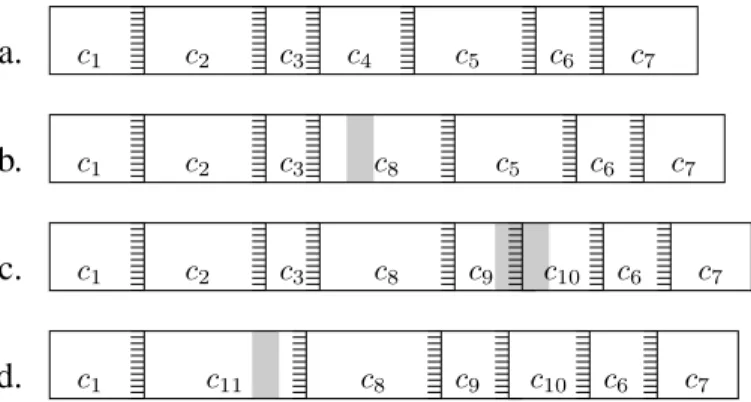
Figure 1: Chunks of a file before and after various edits. Horizontal stripes show 48-byte regions with magic hash values creating chunk boundaries. Gray shading shows regions of the file that were changed by an edit.
already in its database. Unfortunately, a single byte inserted at the start of a large file would shift all the block boundaries, change the hashes of all the file’s blocks, and thereby thwart any potential bandwidth savings.
As an alternative, one might index files by the hashes of all (overlapping) 8 KByte blocks at all offsets. Such a scheme would require storage many times the size of the indexed files (almost one index entry per byte of file data). The size in itself might be tolerable given large enough disks, but ev-ery file modification might require thousands of index inser-tions. The cost of performing so many updates to an index in secondary storage would be prohibitive.
Rsync more practically tackles this problem by consider-ing only two files at a time. When transferrconsider-ing fileF from machineAto machineB, ifB already has a fileF0by the
same name, rsync guesses the two files may be similar and attempts to exploit that fact. A simplified version of the rsync algorithm proceeds as follows. First, the recipient,B, breaks its file F0 into non-overlapping, contiguous,
fixed-size blocks. Btransmits hashes of those blocks toA. Ain turn begins computing the hashes of all (overlapping) blocks ofF. If any of those hashes matches one fromF0,Aavoids
sending the corresponding sections ofF, instead tellingB
where to find the data inF0.
A couple of complications arise when trying to apply the rsync algorithm to a file system, however. First, rsync’s choice of F0 based on filename is too simple. For
exam-ple, when editing file foo, emacs creates an auto-save file named #foo#. RCS uses even less suggestive temporary file names such as 1v22825. Thus, the recipient would have to chooseF0using something other than file names. It
might selectF0 based on a fixed-size “sketch” ofF, using
Broder’s resemblance estimation technique [4]. However, even ignoring the additional cost of this approach, some-timesF can best be reconstructed from chunks of multiple files—considerar, which outputs software libraries contain-ing many object files.
3.1.1
LBFS Solution
In order to use chunks from multiple files on the recipient, LBFS takes a different approach from that of rsync. It con-siders only non-overlapping chunks of files and avoids sen-sitivity to shifting file offsets by setting chunk boundaries based on file contents, rather than on position within a file. Insertions and deletions therefore only affect the surround-ing chunks. Similar techniques have been used successfully in the past to segment files for the purpose of detecting unau-thorized copying [3].
To divide a file into chunks, LBFS examines every (over-lapping) 48-byte region of the file and with probability2−13 over each region’s contents considers it to be the end of a data chunk. LBFS selects these boundary regions—called
break-points—using Rabin fingerprints [19]. A Rabin fingerprint
is the polynomial representation of the data modulo a pre-determined irreducible polynomial. We chose fingerprints because they are efficient to compute on a sliding window in a file. When the low-order 13 bits of a region’s finger-print equal a chosen value, the region constitutes a break-point. Assuming random data, the expected chunk size is
213 = 8192 = 8
KBytes (plus the size of the 48-byte breakpoint window). As will be discussed in Section 5.1, we experimented with various window sizes and found that 48 bytes provided good results (though the effect of window size was not huge).
Figure 1 shows how LBFS might divide up a file and what happens to chunk boundaries after a series of edits. a. shows the original file, divided into variable length chunks with breakpoints determined by a hash of each 48-byte region. b. shows the effects of inserting some text into the file. The text is inserted in chunkc4, producing a new, larger chunk
c8. However, all other chunks remain the same. Thus, one need only sendc8to transfer the new file to a recipient that already has the old version. Modifying a file can also change the number of chunks. c. shows the effects of inserting data that contains a breakpoint. Bytes are inserted inc5, split-ting that chunk into two new chunksc9andc10. Again, the
file can be transfered by sending only the two new chunks. Finally, d. shows a modification in which one of the break-points is eliminated. Chunksc2andc3of the old file are now combined into a new chunk,c11, which must be transmitted to compose the new file.
3.1.2
Pathological Cases
Unfortunately, variable-sized chunks can lead to some patho-logical behavior. If every 48 bytes of a file happened to be a breakpoint, for instance, the index would be as large as the file. Worse yet, hashes of chunks sent over the wire would consume as much bandwidth as just sending the file. Con-versely, a file might contain enormous chunks. In particular, the Rabin fingerprint has the property that a long extent of zeros will never contain a breakpoint. As discussed later in Section 3.2, LBFS transmits the contents of a chunk in the body of an RPC message. Having arbitrary size RPC mes-sages would be somewhat inconvenient, since most RPC li-braries hold messages in memory to unmarshal them.
To avoid the pathological cases, LBFS imposes a mini-mum and maximini-mum chunk size. The minimini-mum chunk size is 2K. Any 48-byte region hashing to a magic value in the first 2K after a breakpoint does not constitute a new break-point. The maximum chunk size is 64K. If the file con-tents does not produce a breakpoint every 64K, LBFS will artificially insert chunk boundaries. Such artificial suppres-sion and creation of breakpoints can disrupt the synchroniza-tion of file chunks between versions of a file. The risk, if this occurs, is that LBFS will perform no better than an or-dinary file system. Fortunately, synchronization problems most often result from stylized files—for instance a long run of zeros, or a few repeated sequences none of which has a breakpoint—and such files do well under conventional com-pression. Since all LBFS RPC traffic gets conventionally compressed, pathological cases do not necessarily translate into slow file access.
3.1.3
Chunk Database
LBFS uses a database to identify and locate duplicate data chunks. It indexes each chunk by the first 64 bits of its SHA-1 hash. The database maps these 64-bit keys to hfile,offset,countitriples. This mapping must be updated whenever a file is modified. Keeping such a database in sync with the file system could potentially incur significant over-head. Moreover, if files exported through LBFS are modi-fied by other means—for instance by a local process on the server—LBFS cannot prevent them from growing inconsis-tent with the database. Even on the client side, an inoppor-tune crash could potentially corrupt the contents of the disk cache.
To avoid synchronization problems, LBFS never relies on the correctness of the chunk database. It recomputes the SHA-1 hash of any data chunk before using it to reconstruct
a file. LBFS also uses the recomputed SHA-1 value to detect hash collisions in the database, since the 64-bit keys have a low but non-negligible probability of collision. Not rely-ing on database integrity also frees LBFS from the need to worry about crash recovery. That in turn saves LBFS from making expensive synchronous database updates. The worst a corrupt database can do is degrade performance.
3.2
Protocol
The LBFS protocol is based on NFS version 3 [5]. NFS names all files by server-chosen opaque handles. Opera-tions on handles include reading and writing data at spe-cific offsets. LBFS adds extensions to exploit inter-file com-monality during reads and writes. Most NFS clients poll the server on file open to check permissions and validate previously cached data. For recently accessed files, LBFS saves this round trip by adding leases to the protocol. Unlike many NFS clients, LBFS also practices aggressive pipelin-ing of RPC calls to tolerate network latency. The system uses an asynchronous RPC library that efficiently supports large numbers of simultaneously outstanding RPCs. Finally, LBFS compresses all RPC traffic using conventional gzip compression.
3.2.1
File Consistency
The LBFS client currently performs whole file caching (though in the future we would like to cache only portions of very large files). When a user opens a file, if the file is not in the local cache or the cached version is not up to date, the client fetches a new version from the server. When a process that has written a file closes it, the client writes the data back to the server.
LBFS uses a three-tiered scheme to determine if a file is up to date. Whenever a client makes any RPC on a file in LBFS, it gets back a read lease on the file. The lease is a commitment on the part of the server to notify the client of any modifications made to that file during the term of the lease (by default one minute, though the duration is server-configurable). When a user opens a file, if the lease on the file has not expired and the version of the file in cache is up to date (meaning the server also has the same version), then the open succeeds immediately with no messages sent to the server.
If a user opens a file and the lease on the file has expired, then the client asks the server for the attributes of the file. This request implicitly grants the client a lease on the file. When the client gets the attributes, if the modification and inode change times are the same as when the file was stored in the cache, then the client uses the version in the cache with no further communication to the server. Finally, if the file times have changed, then the client must transfer the new contents from the server.
GETHASH(fh, offset, count)
Server File not in cache
Client
sha1 not in database, send normal read sha2 not in database, send normal read sha3 in database
Put sha1 in database Put sha2 in database
Break up file into chunks, @offset+count
Return data associated with sha1 Return data associated with sha2 Data of sha1
Data of sha2
READ(fh, sha1_off, size1) READ(fh, sha2_off, size2)
eof = true (sha1,size1) (sha3,size3) (sha2,size2)
File reconstructed, return to user Send GETHASH
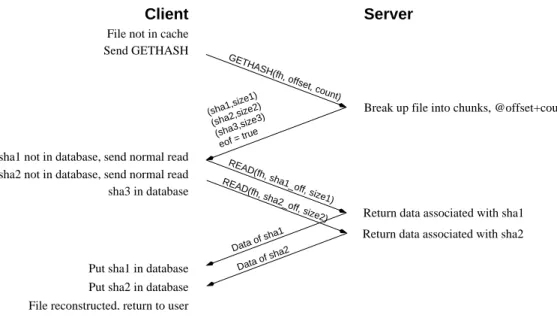
Figure 2: Reading a file using LBFS
Because LBFS only provides close-to-open consistency, a modified file does not need to be written back to the server until it is closed. Thus, LBFS does not need write leases on files—the server never demands back a dirty file. Moreover, when files are written back, they are committed atomically. Thus, if a client crashes or is cut from the network while writing a file, the file will not get corrupted or locked—other clients will simply continue to see the old version. When multiple processes on the same client have the same file open for writing, LBFS writes data back whenever any of the pro-cess closes the file. If multiple clients are writing the same file, then the last one to close the file will win and over-write changes from the others. These semantics are similar to those of AFS.
3.2.2
File Reads
File reads in LBFS make use of one RPC procedure not in the NFS protocol, GETHASH.
GETHASH retrieves the hashes of data chunks in a file, so as to identify any chunks that already exist in the client’s cache. GETHASH takes the same arguments as a READ RPC, namely a file handle, offset, and size (though in practice the size is always the maximum possible, because the client practices whole file operations). Instead of re-turning file data, however, GETHASH returns a vector of hSHA-1 hash,sizeipairs.
Figure 2 shows the use of GETHASH. When download-ing a file not in its cache, the client first calls GETHASH to obtain hashes of the file’s chunks. Then, for any chunks not already in its cache, the client issues regular READ RPCs. Because the READ RPCs are pipelined, downloading a file generally only incurs two network-round trip times plus the cost of downloading any data not in the cache. For files larger
than 1,024 chunks, the client must issue multiple GETHASH calls and may incur multiple round trips. However, network latency can be overlapped with transmission and disk I/O.
3.2.3
File Writes
File writes proceed somewhat differently in LBFS from NFS. While NFS updates files at the server incrementally with each write, LBFS updates them atomically at close time. There are several reasons for using atomic updates. Most importantly, the previous version of a file often has many chunks in common with the current version. Keeping the old version around helps LBFS exploit the commonal-ity. Second, LBFS’s file reconstruction protocol can signif-icantly alter the order of writes to a file. Files being written back may have confusing intermediary states (for instance an ASCII file might temporarily contain blocks of 0s). Fi-nally, atomic updates limit the potential damage of simulta-neous writes from different clients. Since two clients writing the same file do not see each other’s updates, simultaneously changing the same file is a bad idea. When this does occur, however, atomic updates at least ensure that the resulting file contains the coherent contents written by one of the clients, rather than a mishmash of both versions.
LBFS uses temporary files to implement atomic updates. The server first creates a unique temporary file, writes the temporary file, and only then atomically commits the con-tents to the real file being updated. While writing the tempo-rary file, LBFS uses chunks of existing files to save band-width where possible. Four RPCs implement this update protocol: MKTMPFILE, TMPWRITE, CONDWRITE, and COMMITTMP.
MKTMPFILE creates a temporary file for later use in an atomic update. MKTMPFILE takes two arguments: first,
HASHNOTFOUND OK
OK OK OK OK
Server
MKTMPFILE(fd,fhandle)
TMPWRITE(fd,offset2,count2,data) CONDWRITE(fd,offset1,count1,sha1)
CONDWRITE(fd,offset2,count2,sha2)
CONDWRITE(fd,offset3,count3,sha3)
Client User closes file
Put sha2 into database
No error, copy data from tmp file Pick fd
Server needs sha2, send data
File closed, return to user
sha1 in database, write data into tmp file sha2 not in database
sha3 in database, write data into tmp file Create tmp file, map (client, fd) to file
Server has sha3 Server has everything, commit Break file into chunks Send SHA−1 hashes to server
write data into tmp file
into target file
COMMITTMP(fd,target_fhandle)
Server has sha1
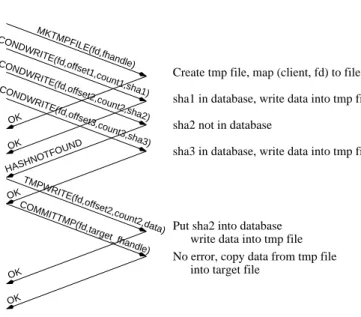
Figure 3: Writing a file using LBFS
the file handle of the file that will eventually be atomically updated, and second, a client-chosen “file descriptor” for the temporary file. After receiving the call, the server creates a temporary file in the same file system as the specified handle and keeps a mapping from the per-client file descriptor to the temporary file. Because clients choose the descriptors for temporary files, they can pipeline operations on temporary files before the MKTMPFILE RPC returns.
TMPWRITE is similar to a WRITE RPC. The only dif-ference is the that a client-chosen temporary file descriptor replaces the NFS file handle in the arguments. An LBFS client sends TMPWRITEs instead of WRITEs to update a file created with MKTMPFILE.
CONDWRITE is similar to a TMPWRITE RPC. The ar-guments contain a file descriptor, offset, and length. Instead of the actual data to write, however, CONDWRITE argu-ments contain a SHA-1 hash of the data. If the server can find the data specified by the hash somewhere in its file sys-tem, it writes the data to the temporary file at the specified offset. If it cannot find the data, but the request would othwise have completed, CONDWRITE returns the special er-ror code HASHNOTFOUND.
COMMITTMP commits the contents of a temporary file to a permanent file if no error has occurred. It takes two argu-ments, a file descriptor for the temporary file, and a file han-dle for the permanent file. For each temporary file descrip-tor, the server keeps track of any errors other than HASH-NOTFOUND that have occured during CONDWRITE and TMPWRITE RPCs. If any error has occurred on the file de-scriptor (e.g., disk full), COMMITTMP fails. Otherwise, the server replaces the contents of the target file with that of the
temporary file and updates the chunk database to reflect the file’s new contents. Since LBFS uses TCP, RPCs are deliv-ered in order. Thus, the client can pipeline a COMMITTMP operation behind TMPWRITE RPCs.
Figure 3 shows the file write protocol in action. When a user closes a file that the client must write back, the client picks a file descriptor and issues a MKTMPFILE RPC with the handle of the closed file. In response, the server creates a temporary file handle and maps it to the speci-fied file descriptor. The client then makes CONDWRITE RPCs for all data chunks in the file it is writing back. For any CONDWRITEs returning HASHNOTFOUND, the client also issues TMPWRITE calls. Finally, the client issues a COMMITTMP.
Pipelining of writes occurs in two stages. First, the client pipelines a series of CONDWRITE requests behind a MK-TMPFILE RPC. Second, as the CONDWRITE replies come back, the client turns around and issues TMPWRITE RPCs for any HASHNOTFOUND responses. It pipelines the COMMITTMP immediately behind the last TMPWRITE. The communication overhead is therefore generally two round trip latencies, plus the transmission times of the RPCs. For large files, the client has a maximum limit on the num-ber of outstanding CONDWRITE and TMPWRITE calls so as not to spend too much time sending calls when it can pro-cess replies. However, the extra network round trips will generally overlap with the transmission time of RPC calls.
3.2.4
Security Considerations
Because LBFS performs well over a wider range of net-works than most file systems, the protocol must resist a
index
NFS
index
server
TCP
xfs client
serverLBFS client
LBFS
chunk chunk
Figure 4: Overview of the LBFS implementation.
wider range of attacks. LBFS uses the security infrastruc-ture from SFS [16]. Every server has a public key, which the client administrator specifies on the command line when mounting the server. In the future, we intend to embed pub-lic keys in pathnames as SFS does and to integrate LBFS into SFS’s auto-mounting system so that unprivileged users on clients can access any server. The entire LBFS proto-col, RPC headers and all, is passed through gzip compres-sion, tagged with a message authentication code, and then encrypted. At mount time, the client and server negotiate a session key, the server authenticates itself to the user, and the user authenticates herself to the client, all using public key cryptography.
Finally, we note that LBFS may raise some non-network security issues. When several users share the same file sys-tem, LBFS could leak information about files a user is not allowed to read. Specifically, through careful use of COND-WRITE, a user can check whether the file system contains a particular chunk of data, even if the data resides in a read-protected file. Though CONDWRITE will fail on chunks the user cannot read, subtle timing differences may still let the user infer that the database contained the hash of the chunk. Nonetheless, LBFS should provide more than adequate secu-rity for most purposes, particularly given how widely users accept file systems that do not even encrypt network traffic.
4
Implementation
Figure 4 shows the architecture of the LBFS implementa-tion. Both the client and server run at user-level. The client implements the file system using xfs, a device driver bun-dled with the ARLA [24] file system. The server accesses files through NFS. The client and server communicate over TCP, using Sun RPC. We used the asynchronous RPC li-brary from the SFS toolkit [15] both for the server’s NFS client and for LBFS client–server communication. The RPC library already had support for authenticating and encrypt-ing traffic between a client and server. We added support for compression.
4.1
Chunk Index
The LBFS client and server both maintain chunk indexes, the server indexing file system contents and the client its lo-cal cache. The two share the same indexing code,
imple-mented using the B-tree from SleepyCat software’s Berke-leyDB package. Since LBFS never relies on chunk database correctness, it also does not concern itself with crash recov-erability. LBFS avoids any synchronous database updates, and the server always replies to clients before inserting new chunks in its database. If the database loses a few hashes, clients will simply use more bandwidth until the database comes back up to date. There is a utility,mkdb, which builds a file system’s database from scratch. However, if an LBFS server is run without a database, the server simply creates the database and populates it as users access files.
The one database operation on the critical path for clients is the lookup done as part of a CONDWRITE RPC. How-ever, for all but the smallest files, CONDWRITEs are pipelined deeply enough to overlap database lookups with the transmission of any write data not found in the chunk index. For 8 KByte or smaller files, LBFS avoids COND-WRITEs and simply writes the files directly to the server in a single RPC. The overhead of multiple round trip times overshadows any potential bandwidth savings on such small files.
4.2
Server Implementation
Our main goal for the LBFS server implementation, other than saving bandwidth and providing acceptable perfor-mance, was to build a system that could unobtrusively be installed on an already running file system. This both iso-lates LBFS’s benefits from physical file system layout and lets users take immediate advantage of LBFS on existing files without dedicating a disk or partition to it.
The LBFS server accesses the file system by pretending to be an NFS client, effectively translating LBFS requests into NFS. Building the LBFS server as an NFS client lets LBFS serve any file system for which an NFS server exists, which includes most file systems on most Unix operating systems.
Of course, the server might alternatively have been imple-mented using regular system calls to access the file system. However, NFS offers several advantages over the traditional system call interface. First, it simplifies the implementation, since the LBFS protocol is based on NFS. Second, NFS saved the LBFS server from the need to implement access control. The server simply maps LBFS requests to user IDs and tags the resulting NFS requests with those IDs, letting the NFS server decide whether or not to grant access.
Fi-nally, NFS allows the chunk index to be more resilient to outside file system changes. When a file is renamed, its NFS file handle remains the same and thus the chunk index does not need to be updated.
The LBFS server creates a “trash directory,” .lbfs. trash, in the root directory of every file system it exports. The trash directory contains temporary files created by MK-TMPFILE RPCs. As explained below, after a COMMIT-TMP RPC, the LBFS server does not delete the committed temporary file. Rather, if space is needed, it garbage-collects a random file in the trash directory. A background thread purges the database of pointers to deleted files.
4.2.1
Static i-number Problem
The one major disadvantage to using NFS is the lack of low-level control over file system data structures. In particular, Unix file system semantics dictate that a file’s i-number not change when the file is overwritten. Thus, when the server commits a temporary file to a target file, it has to copy the contents of the temporary file onto the target file rather than simply rename the temporary file into place, so as to pre-serve the target file’s i-number. Not only is this gratuitously inefficient, but during the copy other clients cannot access the target file. Worse yet, a server crash will leave the file in an inconsistent state (though the client will restart the file transfer after the COMMIT fails).
A related problem occurs with file truncation. Applica-tions often truncate files and then immediately overwrite them with similar versions. Thus, LBFS would benefit from having the previous contents of a truncated file when recon-structing the new contents. The obvious solution is to move truncated files into the trash directory and replace them with new, zero-length files. Unfortunately, the NFS interface will not let the server do this without changing the truncated file’s i-number. To avoid losing the contents of trucated files, then, LBFS delays the deletion of temporary files after COMMIT-TMP RPCs. Thus, many truncated files will still have copies in the trash directory, and new versions can be reconstituted from those copies.
It is worth noting that the static i-number problem could be solved given a file system operation that truncates a fileA
to zero length and then atomically replaces the contents of a second fileBwith the previous contents ofA. We can even afford to lose the original contents of A after an inoppor-tune crash. In the case of COMMITTMP, the lost data will be resent by the client. Such a “truncate and update” opera-tion would be efficient and easy to implement for most Unix physical file system layouts. It might in other situations serve as a more efficient alternative to the rename operation for atomically updating files. Unfortunately, the current LBFS server must make do without such an operation.
4.3
Client Implementation
The LBFS client uses the xfs device driver. xfs lets user-level programs implement a file system by passing messages to the kernel through a device node in/dev. We chose xfs for its suitability to whole-file caching. The driver notifies the LBFS client whenever it needs the contents of a file a user has opened, or whenever a file is closed and must be written back to the server. The LBFS client is responsible for fetching remote files and storing them in the local cache. It informs xfs of the bindings between files users have opened and files in the local cache. xfs then satisfies read and write requests directly from the cache, without the need to call into user-level code each time.
5
Evaluation
This section evaluates LBFS using several experiments. First, we examine the behavior of LBFS’s content-based breakpoint chunking on static file sets. Next, we measure the bandwidth consumption and network utilization of LBFS under several common workloads and compare it to that of CIFS, NFS version 3 and AFS. Finally, we show that LBFS can improve end-to-end application performance when com-pared with AFS, CIFS, and NFS.
Our experiments were conducted on identical 1.4 GHz Athlon computers, each with 256 MBytes of RAM and a 7,200 RPM, 8.9 ms Seagate ST320414A IDE drive. The IDE drives are slower than common SCSI drives, which penal-izes LBFS for performing more disk operations than other file systems. Except where otherwise noted, all file system clients ran on OpenBSD 2.9 and servers on FreeBSD 4.3. The AFS client was the version of ARLA bundled with BSD, configured with a 512 MByte cache. The AFS server was openafs 1.1.1 running on Linux 2.4.3. For the Mi-crosoft Word experiments, we ran Office 2000 on a 900 MHz IBM ThinkPad T22 laptop with 256 MBytes of RAM, Win-dows 98, and openafs 1.1.1 with a 400 MByte cache.
The clients and servers in our experiments were connected by full-duplex 100 Mbit Ethernet through the Click [11] modular router, which can be configured to measure traffic and impose bandwidth limitations, delay, and loss. Click ran on a Linux 2.2.18 Athlon machine.
5.1
Repeated Data in Files
LBFS’s content-based breakpoint chunking scheme reduces bandwidth only if different files or versions of the same file share common data. Fortunately, this occurs relatively fre-quently in practice. Table 1 summarizes the amount of com-monality found between various files.
We examined emacs to see how much commonality there is between files under a software development workload. The emacs 20.7 source tree is 52.1 MBytes. However, if a client already has source for emacs 20.6 in its cache, it
Data Given Data size New data Overlap
emacs 20.7 source emacs 20.6 52.1 MB 12.6 MB 76%
Build tree of emacs 20.7 — 20.2 MB 12.5 MB 38%
emacs 20.7 + printf executable emacs 20.7 6.4 MB 2.9 MB 55%
emacs 20.7 executable emacs 20.6 6.4 MB 5.1 MB 21%
Installation of emacs 20.7 emacs 20.6 43.8 MB 16.9 MB 61%
Elisp doc. + new page original postscript 4.1 MB 0.4 MB 90%
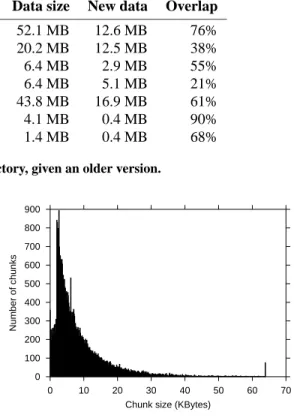
MSWord doc. + edits original MSWord 1.4 MB 0.4 MB 68%
Table 1: Amount of new data in a file or directory, given an older version.
only needs to download 12.6 MBytes to reconstitute the 20.7 source tree—a 76% savings. An emacs 20.7 build tree consumes 20.2 MBytes of disk space, but only con-tains 12.5 MBytes of unique chunks. Thus, writing a build tree, LBFS will save 38% even if the server starts with an empty chunk database. When adding a debugging printf to emacs 20.7 and recompiling, changing the size of the exe-cutable, the new binary has 55% in common with the old one. Between emacs-20.6 and 20.7, the two executables have 21% commonality. A full emacs 20.7 installation con-sumes 43.8 MBytes. However, 61% of this would not need to be transferred to a client that already had emacs 20.6 in its cache.
We also examined two document preparation workloads. When adding a page to the front of the emacs lisp manual, the new postscript file had 90% in common with the previ-ous one. Unfortunately, if we added two pages, it changed the page numbering for more than the first chapter, and the commonality disappeared. From this we conclude that LBFS is suitable for postscript document previewing—for instance tuning a TEX document to get an equation to look right— but that between substantial revisions of a document there will be little commonality (unless the pages are numbered by chapter). We also used Microsoft Word to sprinkle refer-ences to LBFS in a paper about Windows 2000 disk perfor-mance, and found that the new version had 68% overlap with the original.
To investigate the behavior of LBFS’s chunking algorithm, we ran mkdb on the server’s/usr/localdirectory, using an 8 KByte chunk size and 48-byte moving window. /usr/ localcontained 354 MBytes of data in 10,702 files. mkdb broke the files into 42,466 chunks. 6% of the chunks ap-peared in 2 or more files. The generated database consumed 4.7 MBytes of space, or 1.3% the size of the directory. It took 9 minutes to generate the database. Figure 5 shows the distribution of chunk sizes. The median is 5.8K, and the mean 8,570 bytes, close to the expected value of 8,240 bytes. 11,379 breakpoints were suppressed by the 2K mini-mum chunk size requirement, while 75 breakpoints were in-serted because of the 64K maximum chunk size limit. Note that the database does contain chunks shorter than 2K. These chunks come from files that are shorter than 2K and from the ends of larger files (since an end of file is always a chunk
0 100 200 300 400 500 600 700 800 900
0 10 20 30 40 50 60 70
Number of chunks
Chunk size (KBytes)
Figure 5: Distribution of chunk sizes in the /usr/local database. X-axis represents chunk sizes, in KBytes. Y-axis shows the number of chunks having that size.
Exp chunk size % of data in shared chunks 24 B window 48 B window
2 KB 21.33% 21.30%
4 KB 19.29% 19.65%
8 KB 17.01% 18.01%
Table 2: Percentage of bytes in shared chunks in/usr/local for various chunk and window sizes. Minimum chunk size was always1/4the expected chunk size.
boundary).
Table 2 shows the amount of data in /usr/local that appears in shared chunks for various expected chunk sizes and breakpoint window sizes. As expected, smaller chunks yield somewhat greater commonality, as smaller common segments between files can be isolated. However, the in-creased cost of GETHASH and CONDWRITE traffic asso-ciated with smaller chunks outweighed the increased band-width savings in tests we performed. Window size does not appear to have a large effect on commonality.
5.2
Practical Workloads
We use three workloads to evaluate LBFS’s ability to re-duce bandwidth. In the first workload, MSWord, we open a 1.4 MByte Microsoft Word document, make the same
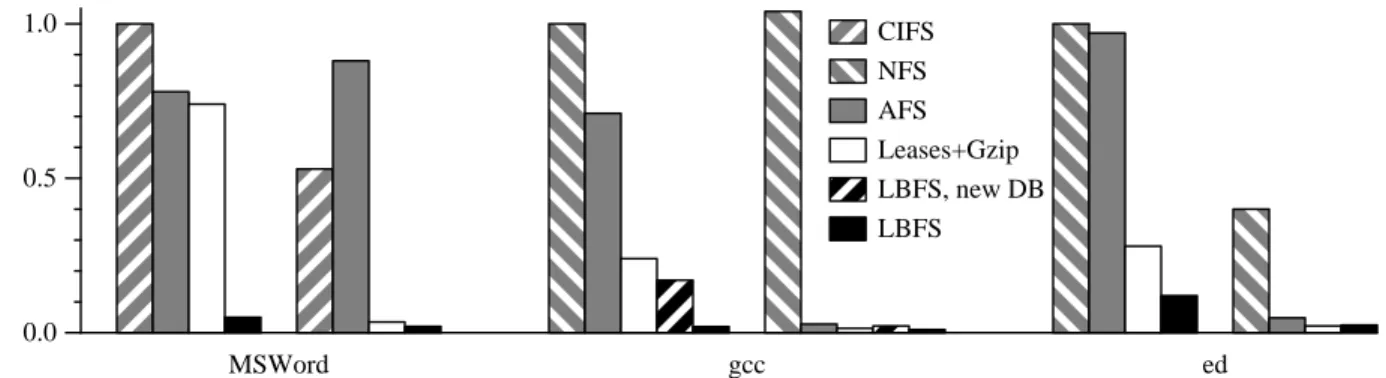
ed-MSWord gcc ed 0.0
0.5 1.0
Normalized bandwidth
CIFS NFS AFS Leases+Gzip LBFS, new DB LBFS
Figure 6: Normalized bandwidth consumed by three workloads. The first four bars of each workload show upstream bandwidth, the second four downstream bandwidth. The results are normalized against the upstream bandwidth of CIFS or NFS.
its as for Table 1, then measure the cost to save and close the file.1 For the second workload, gcc, we simply recompile
emacs 20.7 from source. The third workload, ed, involves making a series of changes to the perl 5.6.0 source tree to transform it into perl 5.6.1. Using theexpectlanguage, we scripted theedtext editor based on the output ofdiff. The benchmark saves files after text insertion operations if there have been 40 or more lines of editing. (For reference, emacs creates auto-save files every 300 characters typed.) These workloads reflect the common activities of document editing and software development.
We ran each benchmark over the client’s native network file system—CIFS for Windows and NFS UDP for Unix.2
We also ran all three benchmarks over AFS. To isolate the benefits of exploiting file commonality, we additionally measured a “Leases+Gzip” file system that uses LBFS’s file caching, leases, and data compression, but not its chunking scheme. Finally, we ran the three workloads over LBFS.
For the MSWord benchmark, because LBFS only runs on Unix, we ran a Samba server on the OpenBSD LBFS client, re-exporting the LBFS file system with CIFS. We saved the Word document from the Windows 98 client to the Samba server over 100 Mbit Ethernet, and measured the traffic go-ing through the Click router between the Samba server and the LBFS server. All MSWord experiments were conducted with a warm cache; the original files had been written on the same client through the file system under test. However, the LBFS server did not have output files from previous runs of the benchmark in its database.
For the gcc benchmark, the emacs sources had been un-packed through the file system under test. Emacs had also previously been compiled on the same file system. The in-tent was to to simulate what happens when one modifies a header file that requires an entire project to be recompiled. Though two successive compilations of emacs do not pro-duce the same executable, there was substantial commonal-1We did not enable Word’s “fast saves” feature, as it neither reduced write bandwidth nor improved running time.
2NFS TCP performs worse than NFS UDP, probably because it has not been as extensively tested and tuned.
ity between object files created by the benchmark and ones in the server’s trash directory. To isolate this benefit, we also measured a compilation of emacs when the LBFS server was started with a new database not containing chunks from any previous compiles.
Because of a bug in expect on OpenBSD, we used a FreeBSD client for all instances of theedbenchmark. Like the MSWord benchmark, we ranedwith a warm client cache to a server that had not previously seen the output files. We also ranedover ansshremote login connection, to compare using a distributed file system to running a text editor re-motely. To simulate some type-ahead, the benchmark sends one line at a time and waits for the line to echo.
5.3
Bandwidth Utilization
Figure 6 shows the bandwidth consumed by the client writ-ing to and readwrit-ing from the server under each of the three workloads. The bandwidth numbers are obtained from byte counters in the Click router. For this experiment, the router did not impose any delay, loss, or bandwidth limitations. (ttcpreported TCP throughput of 89 Mbit/sec between the client and server, and ping reported a round-trip time of 0.2 ms.) In each case, we separately report first the upstream traffic from client to server, then the downstream traffic from server to client. The numbers are normalized to the upstream (client to server) bandwidth of the native file system, CIFS on Windows and NFS on Unix.
Because AFS, Leases+Gzip, and LBFS all have large, on-disk caches, all three systems reduce the amount of down-stream bandwidth from server to client when compared to the native file systems. For upstream bandwidth, the drops from CIFS and NFS bandwidth to AFS bandwidth represent sav-ings gained from deferring writes to close time and eliding overwrites of the same data. The drops from AFS bandwidth to Leases+Gzip bandwidth represent savings from compres-sion. Finally, the drops from Leases+Gzip bandwidth to LBFS bandwidth represent savings gained from the chunk-ing scheme.
MSWord gcc ed 0.0
0.2 0.4 0.6 0.8 1.0
Normalized execution time
a) 6
101
84 86
16
138 1312
470
193 182 113
61 1830
977
340 319
CIFS LAN CIFS NFS LAN NFS AFS Leases+Gzip LBFS, new DB LBFS
MSWord gcc
20% 40% 60% 80% 100%
Uplink utilization
b)
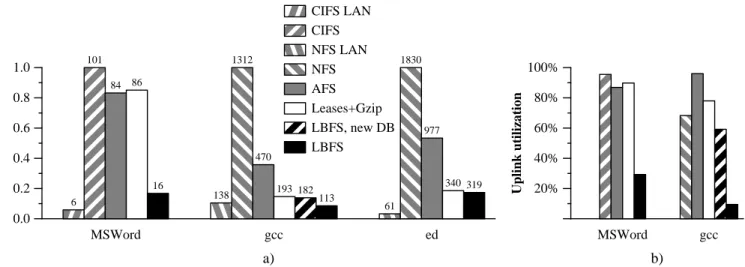
Figure 7: a) Normalized application performance on top of several file systems over a cable modem link with 384 Kbit/sec uplink and 1.5 Mbit/sec downlink. Execution times are normalized against CIFS or NFS results. Execution times in seconds appear on top of the bars. b) Uplink bandwidth utilization of the MSWord and gcc benchmarks.
chunking scheme come not only from commonality between the old and new versions of the document, but also from commonality with large temporary files that Word creates during saves. LBFS is able to reduce the upstream band-width by 15 times over Leases+Gzip, 16 times over AFS, and 20 times over CIFS. More careful analysis reveals that the Unix Samba server closes then reopens temporary files, re-quiring them to be transferred multiple times. These multiple transfers largely negate the benefits of gzip compression in Leases+Gzip. In contrast, LBFS exploits the files’ common contents from one close to the next, consuming very little unnecessary traffic. AFS uses only slightly more bore band-width than Leases+Gzip, either because the extra closes are an artifact of the Unix Samba server, or perhaps because the Windows AFS implementation performs partial file caching. For the gcc benchmark, the savings provided by the chunking scheme come from the fact that many of the com-piled object files, libraries, and executables are similar or identical to files in the server’s trash directory. Chunks only need to be written to the server where object files differ or files have been evicted from the trash directory. In this case, LBFS was able to reduce the upstream bandwidth by 15 times over Leases+Gzip, 46 times over AFS, and more than 64 times over NFS. Even without the benefit of old object files in the database, LBFS still reduces upstream bandwidth utilization because many object files, libraries, and executa-bles share common data. When started with a new and empty chunk database, LBFS still used 30% less upstream band-width than Leases+Gzip.
In the ed case, the savings provided by the chunking scheme come from writing versions of files that share com-mon chunks with older revisions. LBFS was able to reduce the upstream bandwidth by more than a factor of 2 over Leases+Gzip and 8 over AFS and NFS.
5.4
Application Performance
Figure 7a shows the normalized end-to-end application per-formance of the three workloads on a simulated cable mo-dem link, with 1.5 Mbit/sec downstream bandwidth from server to client, 384 Kbit/sec upstream bandwidth from client to server, and 30 ms of round-trip latency. The execution times are normalized against CIFS or NFS results. For com-parison, we also show the execution times of the native file system on a 100 Mbit/sec full-duplex LAN.
For the MSWord workload, LBFS was able to reduce the execution times from a potentially unusable 101 sec-onds with CIFS to a much more tolerable 16 secsec-onds, more than 6 times faster. In fact, AFS takes 16 seconds to run the benchmark on a LAN, though CIFS takes only 6 sec-onds. The gcc workload took 113 seconds under LBFS with a populated database, 1.7 times faster than Leases+Gzip, 4 times faster than AFS, almost 12 times faster than NFS, and 18% faster than NFS on a LAN. With a new server database, LBFS still reduces the execution time by 6% over Leases+Gzip, though it is 32% slower than NFS on a LAN.
For both the MSWord and gcc workloads, Figure 7b shows that LBFS reduces network utilization, or the percentage of available bandwidth used by the file system. Over LBFS, gcc used only used only 9.5% of the 384 Kbit per second up-stream link. In contrast, gcc under NFS used 68% and under AFS used 96%. For the MSWord benchmarks, LBFS was able to reduce the upstream network utilization from 87% and 96% with AFS and CIFS to 29%.
Figure 8 examines the effects of available network band-width on the performance of the gcc workload over LBFS, Leases+Gzip, and AFS. In these experiments, the simulated network has a fixed round trip time of 10 ms. This graph shows that LBFS is least affected by a reduction in avail-able network bandwidth, because LBFS reduces the read and
0 200 400 600 800 1000 1200 1400 1600
0.1 1 10
Execution time (s)
Bandwidth (Mbps) AFS Leases+Gzip LBFS
Figure 8: Performance of the gcc workload over various band-widths with a fixed round-trip time of 10 ms.
0 50 100 150 200 250 300 350 400
20 40 60 80 100
Execution time (s)
Round trip time (ms) AFS Leases+Gzip LBFS
Figure 9: Performance of the gcc workload over a range of round-trip times with fixed 1.5 Mbit/sec symmetric links.
write bandwidth required by the workload to the point where CPU and network latency, not bandwidth, become the limit-ing factors.
Figure 9 examines the effects of network latency on LBFS, Leases+Gzip, and AFS performance. In these experiments, the simulated network has symmetric 1.5 Mbit per second links. Although the gcc workload uses more bandwidth over Leases+Gzip, the performance of the workload over LBFS and Leases+Gzip are roughly the same because the avail-able network bandwidth is high enough. On the other hand, because gcc over AFS uses significantly more bandwidth, it performs worse than both LBFS and Leases+Gzip. This graph shows that the execution time of the gcc workload de-grades similarly on all three file systems as latency increases. Figure 7a also shows LBFS’s performance on the ed benchmark, a 6% improvement over Leases+Gzip, 67% over AFS, and 83% over NFS. However, execution time is not the best measure of performance for interactive workloads. Users care about delays of over a second, but cannot differ-entiate much smaller ones that nonetheless affect the run-time of a scripted benchmark. Long delays are most often caused by TCP entering the backoff state. We therefore ran a shortened version of theedbenchmark over a network with
0 500 1000 1500 2000
0% 2% 4% 6% 8%
Execution time (s)
Loss rate ssh AFS Leases+Gzip LBFS
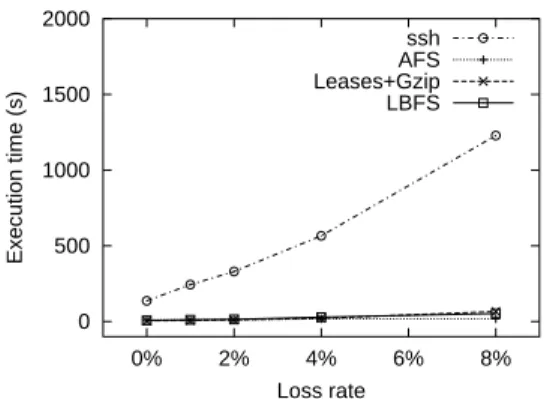
Figure 10: Performance of a shortenededbenchmark over var-ious loss rates, on a network with fixed 1.5 Mbit/sec symmetric links and a fixed round-trip time of 10 ms.
simulated packet loss, comparing the performance of the net-work file systems with thesshremote login program.
Figure 10 compares file systems tosshunder various loss rates. With no packet loss,ssh is slower than any file sys-tem, but the difference would not affect performance at the rate users type. However, as the loss rate increases, delays are imposed by TCP’s backoff mechanism. Asssh never has more than a few packets in flight, every lost packet puts TCP into backoff, imposing a delay of one or more seconds while the user waits for typed characters to echo. The file systems outperform ssh for several reasons. First, LBFS and Leases+Gzip experience fewer losses by sending fewer total packets thanssh; the file systems both consume less bandwidth and send more data per packet. Second, when file systems transfer large files, TCP can get four or more pack-ets in flight, allowing it to recover from a single loss with fast retransmission and avoid backoff. AFS uses UDP rather than TCP, and does not appear to reduce its sending rate as precip-itously as TCP in the face of packet loss. We conclude that for the kind of editing in this benchmark, it is far preferable to use a network file system then to run an editor remotely.
6
Summary
LBFS is a network file system that saves bandwidth by taking advantage of commonality between files. LBFS breaks files into chunks based on contents, using the value of a hash func-tion on small regions of the file to determine chunk bound-aries. It indexes file chunks by their hash values, and subse-quently looks up chunks to reconstruct files that contain the same data without sending that data over the network.
Under common operations such as editing documents and compiling software, LBFS can consume over an order of magnitude less bandwidth than traditional file systems. Such a dramatic savings in bandwidth makes LBFS practical for situations where other file systems cannot be used. In many situations, LBFS makes transparent remote file access a
vi-able and less frustrating alternative to running interactive programs on remote machines.
7
Acknowledgments
We thank Chuck Blake, Frans Kaashoek, Butler Lampson, Robert Morris, Marc Waldman, and the anonymous review-ers for their feedback and suggestions. We thank Chuck Blake and Frank Dabek for help with hardware, Nicko-lai Zeldovich for setting up AFS, and Chuck Blake, Frank Dabek, and Bryan Ford for assistance with xfs.
References
[1] Brian Berliner. CVS II: Parellizing software development. In
Proceedings of the Winter 1990 USENIX Technical Confer-ence, Colorado Springs, CO, 1990.
[2] David Bindel, Yan Chen, Patrick Eaton, Dennis Geels, Ra-makrishna Gummadi, Sean Rhea, Hakim Weatherspoon, Westley Weimer, Westley Weimer, Christopher Wells, Ben Zhao, and John Kubiatowicz. Oceanstore: An exteremely wide-area storage system. In Proceedings of the 9th
Interna-tional Conference on Architectural Support for Programming Languages and Operating Systems, pages 190–201, Boston,
MA, November 2000.
[3] Sergey Brin, James Davis, and Hector Garcia-Molina. Copy detection mechanisms for digital documents. In Proceedings
of the 1995 ACM SIGMOD International Conference on Man-agement of Data, pages 398–409, San Jose, CA, May 1995.
[4] Andrei Broder. On the resemblance and containment of doc-uments. Compression and Complexity of Sequences, pages 21–29, 1997.
[5] B. Callaghan, B. Pawlowski, and P. Staubach. NFS version 3 protocol specification. RFC 1813, Network Working Group, June 1995.
[6] FIPS 180-1. Secure Hash Standard. U.S. Department of
Commerce/N.I.S.T., National Technical Information Service, Springfield, VA, April 1995.
[7] Cary G. Gray and David R. Cheriton. Leases: An
effi-cient fault-tolerant mechanism for distributed file cache con-sistency. In Proceedings of the 12th ACM Symposium on
Op-erating Systems Principles, pages 202–210, Litchfield Park,
AZ, December 1989.
[8] Bj¨orn Gr¨onvall, Assar Westerlund, and Stephen Pink. The de-sign of a multicast-based distributed file system. In
Proceed-ings of the Third Symposium on Operating System Design and Implementation, pages 251–264, New Orleans, LA, February
1999.
[9] John H. Howard, Michael L. Kazar, Sherri G. Menees, David A. Nichols, M. Satyanarayanan, Robert N. Sidebotham,
and Michael J. West. Scale and performance in a
dis-tributed file system. ACM Transactions on Computer Systems, 6(1):51–81, February 1988.
[10] James J. Kistler and M. Satyanarayanan. Disconnected oper-ation in the coda file system. ACM Transactions on Computer
Systems, 10(1):3–25, February 1992.
[11] Eddie Kohler, Robert Morris, Benjie Chen, John Jannotti, and M. Frans Kaashoek. The Click modular router. ACM
Transac-tions on Computer Systems, 18(4):263–297, November 2000.
[12] Yui-Wah Lee, Kwong-Sak Leung, and M. Satyanarayanan. Operation-based update propagation in a mobile file system. In Proceedings of the 1999 USENIX Technical Conference, Monterey, CA, June 1999.
[13] Udi Manber. Finding similar files in a large file system. In
Proceedings of the Winter 1994 USENIX Technical Confer-ence, San Francisco, CA, January 1994.
[14] Timothy Mann, Andrew D. Birrell, Andy Hisgen, Chuck Je-rian, and Garret Swart. A coherent distributed file cache with directory write-behind. ACM Transactions on Computer
Sys-tems, 12(2):123–164, May 1994.
[15] David Mazi`eres. A toolkit for user-level file systems. In
Pro-ceedings of the 2001 USENIX Technical Conference, Boston,
MA, June 2001.
[16] David Mazi`eres, Michael Kaminsky, M. Frans Kaashoek, and Emmett Witchel. Separating key management from file sys-tem security. In Proceedings of the 17th ACM Symposium on
Operating Systems Principles, pages 124–139, Kiawa Island,
SC, 1999.
[17] Jeffrey C. Mogul, Fred Douglis, Anja Feldmann, and Bal-achander Krishnamurthy. Potential benefits of delta
encod-ing and data compression for http. In Proceedings of the
1997 ACM SIGCOMM Conference, pages 181–194, Cannes,
France, September 1997.
[18] Karin Petersen, Mike J. Spreitzer, and Douglas B. Terry. Flex-ible update propagation for weakly consistent replication. In
Proceedings of the 16th ACM Symposium on Operating Sys-tems Principles, pages 288–301, Saint-Malo, France, 1997.
[19] Michael O. Rabin. Fingerprinting by random polynomials. Technical Report TR-15-81, Center for Research in Comput-ing Technology, Harvard University, 1981.
[20] S. Shepler, B. Callaghan, D. Robinson, R. Thurlow, C. Beame, M. Eisler, and D. Noveck. NFS version 4 protocol. RFC 3010, Network Working Group, December 2000. [21] Neil T. Spring and David Wetherall. A protocol independent
technique for eliminating redundant network traffic. In
Pro-ceedings of the 2000 ACM SIGCOMM Conference, pages 87–
95, Stockholm, Sweden, August 2000.
[22] Walter F. Tichy. The string-to-string correction problem
with block moves. ACM Transactions on Computer Systems, 2(4):309–321, November 1984.
[23] Andrew Tridgell. Efficient Algorithms for Sorting and
Syn-chronization. PhD thesis, Australian National University, April 2000.
[24] Assar Westerlund and Johan Danielsson. Arla—a free AFS client. In Proceedings of the 1998 USENIX, Freenix track, New Orleans, LA, June 1998. USENIX.
[25] Haifeng Yu and Amin Vahdat. Design and evaluation of a continuous consistency model for replicated services. In
Pro-ceedings of the 4rd Symposium on Operating Systems Design and Implementation, San Diego, CA, 2000.