How Small System Dynamics Models Can Help the Public Policy Process
Navid Ghaffarzadegan*, John Lyneis**, George P. Richardson** Rockefeller College of Public Affairs and Policy, University at Albany, SUNY ** Sloan School of Management, MIT
Abstract
Public policies often fail to achieve their intended result because of the complexity of both the environment and the policy making process. In this article, we review the benefits of using small system dynamics models to address public policy questions. First we discuss the main difficulties inherent in the public policy making process. Then, we discuss how small system dynamics models can address policy making difficulties by examining two promising examples: the first in the domain of urban planning and the second in the domain of social welfare. These examples show how small models can yield accessible, insightful lessons for policy making stemming from the endogenous and aggregate perspective of system dynamics modeling and simulation.
Introduction
There is an assumption that expensive sponsorship must precede an effort to address important issues. However, if the objective is sufficiently clear, a rather powerful small model can be created, and the insights sharply focused. Often, the consequences of such a book will be so dramatic and controversial that few financial sponsors are willing to be drawn into the fray. However, the task can lie within the resources of an individual. Where are the people who can carry system dynamics to the public?
(Forrester, 2007, p. 362)
Starting with Urban Dynamics (Forrester, 1969), and followed by World Dynamics
(Forrester, 1971a) and The Limits to Growth (Meadows et al., 1972), there is a long tradition of using system dynamics to study public management questions. System dynamics models now cover a wide range of areas in public affairs including public health (Homer et al., 2000, 2004, 2007; Richardson, 1983b, 2007; Cavana and Clifford, 2006; Thompson and Duintjer Tebbens, 2007, 2008), energy and the environment (Fiddaman ,1997, 2002; Sterman, 2008; Ford, 1997, 2005), social welfare (Zagonel et al., 2004), sustainable development (Saeed, 1998; Honggang et al., 1998, Mashayekhi, 1998), security (Weaver and Richardson, 2006; Ghaffarzadegan, 2008; Martinez-Moyano et al., 2008) and many other related areas.
Despite the high applicability to public policy problems, system dynamics is currently not utilized to its full potential in government policy making. The 2008 system dynamics
publications database lists only 94 entries containing the phrase “public policy” out of more than 8800 total entries (System Dynamics Society, 2009). In addition, a search of the top twenty Public Administration journals, ranked by the ISA web of knowledge (Thomson Reuters, 2009) impact factor, reveals very few system dynamics studies published during the past ten years. Of the twenty top journals, fifteen have no published system dynamics articles during the past ten
public administration journals and other means by which system dynamics has influenced public policy, top public administration journals are nevertheless a major source of communication between researchers, analysts, and policymakers. Given Forrester’s opinion that “the failure of system dynamics to penetrate governments lies directly with the system dynamics profession and not with those in government …” (Forrester 2007, p. 361), it is important for the system
dynamics community to discuss how the contribution of system dynamics to policy making might be increased. Moreover, the recent increase in policymakers’ attention to mostly disaggregated, agent based simulation models provides an opportunity to highlight the unique benefits of more aggregated models in the system dynamics tradition.
In the quote used to open this article, Forrester (2007) argues that “powerful small models” can be used to communicate the most crucial insights of a modeling effort to the public. Heeding Forrester’s call, we choose to emphasize here the benefits of small system dynamics models to policy making. By small models we mean models that consist of a few significant stocks and at most seven or eight major feedback loops. Small system dynamics models are unique in their ability to capture important and often counterintuitive insights relating behavior to the feedback structure of the system without sacrificing the ability for policymakers to easily understand and communicate those insights. Below, we argue that both insight generation and communication are essential to the effective use of system dynamics in policy making. While larger or more disaggregated models are appropriate in some circumstances (see Sterman, 2000, Chapter 6 for a discussion of the appropriate model boundary and level of aggregation in system dynamics models), for many public policy problems a small model is sufficient to explain problem
behavior and build intuition regarding appropriate policy responses. Even if greater accuracy or an expanded boundary is ultimately necessary, the success of such efforts will often depend on
the consensus that is first built through a smaller model. To borrow a standard implied earlier by Forrester (Richardson, 1983a), we suggest focusing on models that address a large number of “issues of importance… in few equations” – or in other words, models that maximize the number of “insights per equation.”
To show how small system dynamics models can be useful for policy making, in this paper we first review five characteristics of public policy problems that make resolution difficult using traditional approaches. These characteristics are policy resistance, the need for and cost of experimentation, the need to achieve consensus between diverse stakeholders, overconfidence, and the need to have an endogenous perspective. We next review two important and insightful system dynamics models – a simplified version of Forrester’s Urban Dynamics (Forrester, 1969; Alfeld and Graham, 1976), and a model developed to analyze welfare policy in New York state, termed the “swamping insight model” (Zagonel et al., 2004). Despite addressing diverse policy questions, these models have several common characteristics that illustrate the usefulness of small system dynamics models for policy making more generally. Most notably, both models reveal counterintuitive behavior that is not readily apparent in the absence of an endogenous and aggregate simulation approach. In the last section, we explore these common features and develop a set of arguments about how and why small system dynamics models can uniquely address the characteristics of public policy problems identified in the first section. The review sheds light on the factors that modelers should take into account in order to develop effective models for policymakers.
Public policy problems have several characteristics that impede resolution using traditional non-simulation approaches. We first explore these characteristics, defining and giving examples for each.
Policy Resistance from the Environment
The first characteristic of public policy problems is the complexity of the environment in which problems arise and in which policies are made. Such complexity leaves policies highly vulnerable to “policy resistance” (Forrester, 1971b; Sterman, 2000). Policy resistance occurs when policy actions trigger feedback from the environment that undermines the policy and at times even exacerbates the original problem. Policy resistance is common in complex systems characterized by many feedback loops with long delays between policy action and result. In such systems, learning is difficult and actors may continually fail to appreciate the full complexity of the systems that they are attempting to influence. Often, the most intuitive policies bring immediate benefits, only to see those benefits undermined gradually through policy resistance (e.g. Repenning and Sterman, 2002). As Forrester (1971b) notes, because of policy resistance, systems are often insensitive to the most intuitive policies.
Policy resistance often arises through the balancing feedback loops that numerously exist in social systems. For example, if a policy increases the standard of living in an urban area, more people will migrate to the area (a balancing loop), consuming resources (e.g., food, houses, businesses), thereby causing the standard of living to decline and reversing the effects of the original policy (Forrester, 1971a). Similarly, when police forces are deployed to control an illegal drug market, drug supply decreases leading to higher drug prices, more profit per sale, and greater attractiveness of drug dealing. The number of dealers increases, undermining the original
policy (Richardson, 1983b). Many more examples exist. These examples illustrate how attempts to intervene in complex systems often fail when policymakers fail to account for important sources of compensating feedback from the environment. Traditional tools that lack a feedback approach may therefore fail to anticipate the best policy actions.
Need to experiment and the cost of experimenting
A second characteristic of public policy problems is the importance and cost of
experimentation with proposed solutions. Experimentation is important because the stakes are high, and it is costly because once implemented, policies are often not reversible.
Experimentation is natural to the functioning of all organizations and social systems. People and organizations take actions, evaluate results and learn from results in an attempt to improve future performance (Cyert and March, 1963). Experiential learning (Denrell and March, 2001) is fundamental to public policy as well: policymakers, when dealing with complex problems, will implement policies, observe behaviors, and adjust policies accordingly.
An attitude of experimentation is apparent in a recent response by U.S. President Barack Obama to a question about how he would approach the economic crisis (quoted in Alberts, 2008, p.1435):
“. . . I hope my team can . . . experiment in order to get people working again . . . I think if you talk to the average person right now that they would say, '. . . we do expect that if something doesn't work that they're going to try something else until they find something that does.' And, you know, that's the kind of common-sense approach that I want to take when I take office.’
(16 November 2008 on CBS's 60 Minutes)
most effective policies. Policy resistance and long delays between actions and their consequences make effective experiential learning extremely difficult (Sterman, 2000;
Rahmandad, 2008; Rahmandad et al., 2009). Furthermore, systems are not usually reversible and once an ineffective policy is implemented certain characteristics of the system may change, possibly leading to even worse behavior. For example, interest groups may form surrounding a new policy, making a switch to a new approach exceedingly difficult.
Need to persuade different stakeholders
A third characteristic of public policy problems is the need to generate agreement among diverse stakeholders regarding the merits of a particular approach. Policymaking is not a straightforward process in which a decision maker decides and others immediately implement. Rather, different constituencies, pressure groups and stakeholders in and outside of government all play important roles in developing policies and influencing their effectiveness throughout society. Especially when the best policies are counterintuitive – as is often the case in complex systems – policymakers face an added challenge to generate support from those with diverse and entrenched interests. For exactly this reason, Forrester (2007) argues that the system dynamics profession should strive to build a broad public consensus behind appropriate policy actions. In his words, “there are no decision makers with the power and courage to reverse ingrained policies that would be directly contrary to public expectations. Before one can hope to influence government, one must build the public constituency to support policy reversals.” (Forrester 2007, p. 361) The need to involve and generate consensus among diverse stakeholders is also a
for group model building (Richardson and Andersen, 1995; Vennix, 1996; Andersen and Richardson, 1997).
An effective means to inform and persuade stakeholders is essential to the development of good policy. Otherwise, social pressures from citizens, political opponents, pressure groups, lobbyists, and other constituencies can lead to the enactment of policies focused on short term gain, at the expense of longer term outcomes. In complex systems, often those policies that bring the greatest immediate benefit are detrimental in the long run. Although social pressures are characteristic of most human systems, in the public domain social pressures are especially significant given policymakers’ need to maintain broad coalitions of support.
Overconfident policymakers
Effective resolution of public policy problems is also hindered by the overconfidence of policymakers. Overconfidence among decision makers is widely documented in the psychology and decision science literatures (Lichtenstein and Fischhoff, 1977; Lichtenstein et al., 1982). Individuals tend to be overconfident in their decisions when dealing with moderate or extremely difficult questions, expressing 90% subjective confidence intervals that in fact only contain the true value about 30 to 60 percent of the time (Bazerman, 1994). Overconfidence is common among naïve as well as expert decision makers (Henrion and Fischhoff, 1986; Griffin and Tversky, 1992; McKenzie et al., 2008). In complex systems with long delays and a large degree of uncertainty, overconfidence is especially likely given the difficulty that policymakers have learning about their own performance and capabilities.
overconfidence in the context of government reform. According to Hood and Peters (2004), government administrators often underestimate the limits of their knowledge and display
overconfidence when proposing reforms. In addition, Johnson (2004) argues that states’ positive illusions and overconfidence regarding their own capabilities is important to explaining the occurrence of wars. Finally, several studies have used lab experiments to examine the issue of confidence in the public affairs context (e.g., Bretschneider and Straussman, 1992; Landsbergen
et al., 1997). For example, studies with graduates students of public administration as subjects –
many of them with prior public experience – show that subjects believe more in their own decision making capabilities than in the advice of expert systems in the task of hiring governmental budget officers. (Landsbergen et al., 1997).
Overall, individuals’ general bias toward their own capabilities, combined with the
complexity of the public affairs context, makes overconfidence an important problem in policy making. While overconfidence is not the only bias that exists among decision makers (Tversky and Kahneman, 1974; Bazerman, 1994) (for example, we will also consider self-serving bias below), research suggests that overconfidence has an especially important influence on the ability of policymakers to question their assumptions, models of thinking, and strategies. In addition, due to overconfidence, the job of convincing stakeholders with diverse interests to support policies with often counterintuitive benefits becomes all the more difficult.
Need to have an endogenous perspective
A final characteristic of public policy problems is the tendency that decision makers have to attribute undesirable events to exogenous rather than endogenous sources. In the judgment and decision making literature, such a tendency is usually referred to as “self-serving bias” (Babcock
and Loewenstein 1997). An endogenous perspective is necessary for individual and
organizational learning. Individuals who attribute adverse events to exogenous factors, and believe “the enemy is out there” lack the ability to learn from the environment and improve their behavior (Senge, 1990).
Attributing the shortfalls of policies to oppositional parties, international enemies, and other exogenous forces is very common among policymakers and politicians. To illustrate this point, Senge (1990, p. 69-71) gives the example of the arms race between the Soviet Union and the United States during the Cold War. Rather than viewing actions in the context of the entire feedback system, each party instead focused only on the link between the threat of the other party and its own need to build arms (Threat from the other Need to Build own arms). For both, the arms buildup of the other was viewed as an exogenous threat rather than an endogenous consequence of its own earlier actions. The result was an expensive and dangerous escalation.
Experimental research in the system dynamics tradition has confirmed that the lack of a fully endogenous perspective in decision tasks is both common and also a major reason for sub-optimal performance. Sterman (1989) develops the term “misperception of feedback” to
describe the decision behavior of subjects playing the beer distribution game, a simulated supply chain game. When placing orders from suppliers, subjects are found to routinely “misperceive” feedback through the environment from their own past decisions, resulting in over or under ordering and instability throughout the supply chain system. Following the game, such
instability is almost always attributed to exogenous customer demand and not to subjects’ own decisions (customer demand is in fact flat following a single step increase.) Moxnes (1998) extends the idea of misperception of feedback to explain the problem of overuse of renewable
resources, an important concern of many policymakers. Together, these studies show that an endogenous perspective is essential to the generation of effective policy within complex systems.
In summary, public systems and public policy problems have numerous characteristics that inhibit both the making and implementation of effective policies. In this paper, we argue that small system dynamics models can play a crucial role in overcoming the above issues. In the next section, we review two models as examples of how system dynamics can help policymakers design, communicate and implement effective policies. We then use the examples to develop a set of common characteristics of small system dynamics models that address “the problems” of public policy problems.
A review of two insightful small models
We next review two small system dynamics models that have successfully made critical public policy insights. The first model is a simplified version of Forrester’s Urban Dynamics
(Forrester, 1969) adapted by Alfeld and Graham (1976), and the second is a model developed to analyze welfare policy in New York state, termed the “swamping insight model” (Zagonel et al., 2004).
Model #1: The URBAN1 Model
A classic example of system dynamics applied to public policy is Forrester’s Urban
Dynamics (1969). Urban Dynamics resulted from the collaboration of Forrester with former
Boston mayor John F. Collins, who had direct experience with many of the problems that
plagued and continue to plague American inner cities, including joblessness, low social mobility, poor schools, and congestion. The goal of the study was to understand the causes of urban
decay, evaluate existing policy responses, and generate discussion regarding what form more successful policies might take. Urban Dynamics was highly controversial and generated much public debate.
At the core of Urban Dynamics are the interactions between the housing, business, and population sectors of an urban system. The original model is quite disaggregated, and contains at least nine major stock variables. Specifically, housing and business structures are
disaggregated by age, and the population is disaggregated into managerial-professional, labor, and underemployed groups. Much of the analysis and some of the key insights from the original model depend on the high level of disaggregation. Nevertheless, a simplified version captures the most essential lessons for policymakers, and at a level of detail that is more conducive to developing insight and building intuition regarding the complex nature of urban systems. Here, we present a “small urban” model based on one developed for teaching at the Rockefeller
College of Public Affairs and Policy, University at Albany and adapted from URBAN1 in Alfeld and Graham (1976).
Business Structures Business Construction Land Fraction Occupied Land Area Land per Business
Structure
+
-+
Normal Business Structure Growth Rate
Effect of Land Availability on New
Construction
-Effect of Region Attractiveness on Business Construction + R1 B1 Population Business Demolition Normal Business Demolition Rate + + Net Births Immigration Outmigration Jobs Jobs per Business
Structure + + Labor Force Labor Participation Fraction + +
Labor Force to Jobs Ratio
+
-Effect of Job Availability on Immigration -+ + Normal Immigration Rate + Birth Rate Death Rate -+
Effect of Labor Force Availability on Business
Construction + Housing Outmigration Rate + + Housing Demolition Housing Construction Normal Housing Demolition Rate + +
Land per House
+
-Effect of Region Attractiveness on Housing Construction Effect of Land
Availability on Housing Construction + -Normal Housing Construction Rate Households to Housing Ratio +
-Effect of Housing Availability on
Immigration
+
-Effect of Housing Availability on Construction + People per household + Business Construction Fraction + + + + + + + B3 B5 R2 B2 B4 B6 Housing Construction Fraction + + + + +
Not Enough Space for Business
Not Enough Space for Housing
Businesses bring more businesses
Houses bring more houses
Build when people need jobs
Move in when there are jobs
Build when people need houses
Move in when there are houses
Fig. 1. Feedback Structure of the URBAN1 Model
Figure 1 shows the causal structure of the URBAN1 model. The model has three stock variables, corresponding to the three sectors emphasized in Forrester’s original model. The main feedback relationships between the three sectors are also preserved, although several of the variable names are changed to clarify meaning. The model generates the main behavior mode of growth, stagnation and decay, as shown in Figure 2. During the early years of an urban system when land is plentiful, the two reinforcing loops (labeled R1 and R2) dominate and create exponential growth in housing, business structures, and population. More business structures increase the attractiveness to future builders, and similarly more housing structures increase the attractiveness to future home developers. In turn, the availability of jobs and housing lead to growth in the population via migration, through feedback loops labeled B5 and B6.
The major strength of the URBAN1 model is its ability to illustrate in a concise manner how the feedback structure of an urban system can endogenously generate stagnation and then decay.
As the processes of growth continue, land becomes scarce, leading to a shift in loop dominance from reinforcing loops R1 and R2 to balancing loops B1 and B2. As the stock of housing and business structures grow, the fraction of land occupied increases as before; however, now, the effect of space limitations outweighs the gain from increased regional attractiveness, thereby slowing the rate of housing and business construction until the available land is almost completely full.
Growth does not slow fast enough, though, to prevent overshoot in the population, stock of housing, and stock of business structures. The slowing growth of business structures causes employment opportunities to become scarce, causing population growth through migration to slow. However, housing construction, although also influenced by space limitations, does not slow as quickly, due to a bias for housing over business (job-generating) structures. Excess housing, in turn, creates the conditions for decay: the quantity of housing continues to attract a population beyond that which can be supported by the existing business structures. Eventually, an equilibrium is reached in which “the standard of living declines far enough to stop further inflow (Forrester, 1971b, p. 6).” In Figure 2, evidence for poor living conditions and excess housing is given by a Labor Force to Jobs Ratio well above one, indicating high unemployment, and a Households to Housing Ratio well below one, suggesting abandoned housing. Thus, growth, stagnation, and decay are created entirely endogenously, despite the simplicity of the model and high level of aggregation.
Fig. 2. Base Run of the URBAN1model showing growth, stagnation, and decay
The behavior mode in Figure 2 accurately reflects the experience of many real world cities. Figure 3 shows the population of three prominent U.S. cities over a 200 year period. All three cities show a similar dynamic of growth, stagnation, and decay. (The pattern is the same for most major cities in the U.S.) The small urban model could be easily calibrated to match the experience of any of these cities. Thus, in response to those who might criticize small insight models as too simple to accurately represent real systems, the behavior of the small urban model, when compared with the behavior of real urban systems, suggests that a small model can
replicate the main behavior modes with quite a high degree of accuracy. A focus on small models, we believe, does not preclude close attention to real world data.
Small Urban: Stock Variables
100,000 structures 6,000 structures 400,000 people 50,000 structures 3,000 structures 200,000 people 0 structures 0 structures 0 people 3 3 3 3 3 3 3 3 2 2 2 2 2 2 2 2 1 1 1
1 1 1 1 1
0 15 30 45 60 75 90
Time (Year)
Housing : Base 1 1 1 1 1 1 1 structures
Business Structures : Base 2 2 2 2 2 structures
Population : Base 3 3 3 3 3 3 3 3 people
Business, Housing and Employment Indicators
2 1.5 1 0.5 0 3 3
3 3 3
3 3
3 3 3
2 2
2
2 2 2 2 2 2 2
1 1 1
1 1
1 1 1 1 1 1
0 10 20 30 40 50 60 70 80 90 100
Time (Year)
d
m
n
l
Labor Force to Jobs Ratio : Base 1 1 1 1 1 1
Land Fraction Occupied : Base 2 2 2 2 2 2
0 1000 2000 3000 4000 5000 6000 7000 8000 9000
1800 1850 1900 1950 2000
Philadelphia Chicago New York
Fig. 3. Population of three major U.S. cities (in 1000s), 1800-2000
In addition to generating insight into the causes of urban decay, the URBAN1 model can also help policymakers design policies to improve decaying cities or prevent stagnation and decay in urban areas that are still growing. We argue that an understanding of the main feedback
structure of a system, as provided by a small system dynamics model, is essential to effective policy design. Here, we illustrate the importance of a feedback view to urban policy making through the example of a common policy response to urban decay that has failed in the past. Why do policymakers choose policies that fail? Using the method of partial model testing (Morecroft, 1983; Sterman, 2000), we show that this policy response is in fact intendedly
Thus, by building intuition regarding how feedback affects system behavior, small system dynamics models have a crucial role to play in policymaking.
The policy that we choose is an exogenous increase in the number of jobs available in the region – for example through a government jobs program. Such a policy is also proposed and tested in Forrester’s original Urban Dynamics, and the results presented here are similar. The intuitive appeal of such a policy is clear: as Figure 4 illustrates, a major symptom of urban decay is the large labor force to jobs ratio, indicative of a lack of adequate employment opportunities. Thus, to some, increasing the number of jobs would seem an appropriate policy response.
(a) (b)
Fig. 4. Results of a policy of increasing the number of jobs exogenously when (a) feedback loops B3 and B5 are inactive and (b) all feedback loops are active
The left panel of Figure 4 illustrates that a policy of increasing the number of jobs has more than intuitive appeal: under some assumptions, such a policy is highly rational. Specifically, when feedback loops linking employment to population growth and business construction are inactive (loops B3 and B5 above), the policy achieves its intended result of a reduction in unemployment. The newly added jobs are immediately taken by those in the population who were previously looking for work.
Business, Housing and Employment Indicators
2 1.5 1 0.5 0 3 3 3 3
3 3 3 3 3 3
2 2
2 2 2 2 2 2 2 2
1 1 1
1 1 1 1 1 1 1 1
0 20 40 60 80 100 120 140
Time (Year)
d
m
n
l
Labor Force to Jobs Ratio : Add Jobs - with Feedback 1 1 1
Land Fraction Occupied : Add Jobs - with Feedback 2 2 2 2 Households to Housing Ratio : Add Jobs - with Feedback 3 3 3 Business, Housing and Employment Indicators
2 1.5 1 0.5 0 3 3 3 3 3
3 3 3
3 3
2 2
2 2 2 2 2 2 2 2
1 1 1
1 1 1
1 1 1 1 1
0 20 40 60 80 100 120 140
Time (Year)
d
m
n
l
Labor Force to Jobs Ratio : Add Jobs - No Population Feedback 1 1
Land Fraction Occupied : Add Jobs - No Population Feedback 2 2 Households to Housing Ratio : Add Jobs - No Population Feedback 3 3
Reactivating the two feedback loops, however, illustrates how feedback can undermine even the most well intentioned policies. As before, the exogenous increase in the number of jobs immediately leads to a decrease in the ratio of labor to job opportunities. However, feedbacks B3 and B5 create substantial policy resistance over time. Specifically, the increase in the number of jobs (combined with still plentiful housing) raises the attractiveness of the region, causing an increase in the population that overwhelms the new employment opportunities. At the same time, the initial increase in jobs reduces slightly the pressure to build more business structures, resulting in a decline in the number of jobs available through normal means, thereby undermining any gains in unemployment. Both mechanisms are examples of compensating feedback that returns the system to its original state of stagnation. Thus, the small urban model illustrates clearly how policy resistance, combined with overconfident policymakers who fail to take an endogenous perspective, can lead to suboptimal outcomes.
The central insight of Urban Dynamics, preserved in the small version, is that the total attractiveness of an urban region must be considered relative to the attractiveness of all surrounding regions (Forrester, 1971b). If the attractiveness of a region increases temporarily relative to others – for example if new employment opportunities are added, then somehow attractiveness must fall until equilibrium is again reached. To solve the problem of urban
stagnation and decay, Forrester recommends policies that increase business structures and reduce the stock of available housing, thereby balancing any change to overall attractiveness. In the URBAN1 model, such a policy can be tested by adding a zoning system to the model that reserves land for business structures as needed to support the population. Only by examining such a policy in light of the full set of relationships between housing, population, and business
A second key insight is that the decay phase comes from natural asymmetries in the structure and dynamics of business structures and housing. Housing in URBAN1 is assumed to last longer and to be easier to construct in the built-up city. If those two differences between housing and business structures are eliminated, urban decay does not result in URBAN1 (although
unemployment still rises). This insight, suggesting urban renewal policies that shift the bias away from non-job-generating structures (e.g., housing) to job-generating structures, is reasonably easy to see in URBAN1 and almost impossible to draw out of the full Urban
Dynamics model.
Urban Dynamics remains a classic example of system dynamics successfully applied to an
important public policy problem. A small version of the model can help to build and
communicate insight regarding the complex nature of urban systems, while preserving many of the central lessons that a more disaggregated model would bring.
Model #2: The “swamping insight” model
In 1996, then President Bill Clinton signed the Personal Responsibility and Work Opportunity Reconciliation Act to change the role of the federal government in providing support for poor families. The legislation replaced programs providing the potential of lifetime federal support for indigent families with Temporary Assistance to Needy Families (TANF). Passing this law shifted responsibility to individuals, states and counties, and made many local government agencies more concerned with welfare issues. For policymakers and researchers also, the condition was new and difficult to fully address (Zagonel et al. 2004; Richardson, 2006).
In January of 1997, Aldo Zagonel, John Rohrbaugh, George Richardson and David
Andersen1 were involved in a simulation project with a coalition of New York State agencies and three county governments to address state level policymaking issues in regard to TANF. The project is reported in several articles including Zagonel et al. (2004), Richardson et al. (2002) and Richardson (2006). In addition to playing an important role in developing and testing different policies at the state level, the project was also one of the cases used to develop more general processes of group model building (Richardson and Andersen, 1995; Vennix, 1996; Andersen and Richardson, 1997). Overall, several conceptual and simulation models that address different state level polices were created.
One of the models that emerged is a small system dynamics model that examines the effect of investment in the different parts of the system. This piece, like the other sets of models that were developed, is grounded in the qualitative data extracted through a group model building process. Some insights from the model are reported in Richardson et al. (2002) and Richardson (2006). This model - later referred to as the “swamping insight” model - can be considered a common archetype of systems that include recidivism.
The model, shown in Figure 5, uses an aging chain structure to represent the flow of potential recipients of TANF support, i.e. total families at risk. The chain includes two main stock
variables, Families on TANF and Post TANF employed. Families on TANF receive TANF support, while those in the Post TANF employed stock remain at risk but do not receive direct support. While families on TANF are at the center of the attention of TANF policymakers, a holistic view to the problem suggests that policymakers should consider all at-risk families, including both those that are in the program and those that may return to the program. The
employment and move to the post TANF employed stock. Most of the individuals from post TANF employed families are employed in low wage and temporary jobs. Thus, these families are still at risk of recidivism and can return to the former stage (Families on TANF) if individuals lose their job.
The modelers formulated the flow rates based on two variables representing supportive capacities in the system. TANF support capacity influences the Job finding rate such that as support capacity increases, people find jobs more quickly and move to the next stage. A similar effect exists for the downstream capacity (Post TANF employment support capacity), which captures the economic condition of the region and number of jobs available for post TANF families. Usually post TANF jobs are low wage or temporary jobs, and post TANF families therefore face a high risk of losing employment and returning to a state of need. Alternatively, families may graduate from post TANF employment into mainstream employment, after which they hold much greater job security. We assume that once families enter mainstream
employment they will not need (and will not be eligible for) any future TANF assistance. The model captures the recidivism phenomenon by defining a variable named Probability of
recidivism as a function of the Post TANF employment support capacity. As this capacity
increases more people exit the chain of people at risk and enter mainstream employment and fewer return to the TANF program.2 We will discuss the results of sensitivity analysis regarding the elasticity of the Probability of recidivism later.
2
The outflows from the Post TANF employed stock are formulated as follows:
Recidivism = (Post TANF employed/Time in post TANF employed)* Probability of recidivism
To mainstream employment = (Post TANF employed/Time in post TANF employed)* (1-Probability of recidivism).
Families on TANF
Post TANF employed Job finding rate
Recidivism
Post TANF employment support
capacity Load on employment
support capacity
-Probability of recidivism +
TANF support capacity
Time to find first job Load on TANF
support capacity
-To mainstream employment
-Enter TANF
(R1) (R2)
(B1)
+
+
+
+
+
+
+
Fig. 5. "Swamping insight" model
As stated, the main focus of TANF policymakers was allocating TANF support capacity among families on TANF (the upstream part of the chain). Accordingly, one of the main questions that the model addresses is the effect of increasing upstream capacity. In contrast to what policymakers intuitively expect, a rise in the upstream capacity makes outcomes worse by increasing the number of families on TANF as well as the total number of families at risk (Figure 6a).
(a) 20% increase in the upstream capacity (b) 20% increase in the downstream capacity Fig. 6. The effect of 20 percent change in: (a) upstream (TANF support) capacity; and (b) downstream (Post TANF employment) capacity. (Note: Total families at risk is equal to families on TANF plus post TANF employed)
The reason for such counterintuitive results is as follows. By increasing the upstream capacity more people flow to the downstream and the load on the downstream increases. If we assume limited capacity in the downstream, people may not receive quality downstream services, causing their condition (e.g. their economic condition) to deteriorate. Ultimately, such families return to the TANF program, reloading families on TANF.
In contrast, an increase in the downstream capacity (Post TANF employment support
capacity) has a positive effect on the system by decreasing the number of families on TANF and
the total number of families at risk (Figure 6b). Such a policy decreases the load on downstream as well as decreasing the load on upstream by decreasing recidivism.
In order to understand why the system resists a policy of increasing the upstream capacity, we examine the effects of two important feedback loops: first, the balancing loop B1 from
Families on TANFJob finding rate Post TANF employedLoad on employment support
capacityProbability of recidivismRecidivismFamilies on TANF; and second, the
At risk populations 6,000
4,500
3,000
1,500
0
3 3 3
3 3
3 3 3 3 3 3 3 3
2 2 2
2 2 2 2
2 2
2 2 2 2
1 1
1 1 1
1 1
1
1 1 1 1 1
0 6 12 18 24 30 36 42 48 54 60
Time (Month) fa m il ie s
Families on TANF : tanf 1 1 1 1 1 1 1 1 1
Post TANF employed : tanf 2 2 2 2 2 2 2 2 2
Total families at risk : tanf 3 3 3 3 3 3 3 3 3 3
At risk populations 6,000
4,500
3,000
1,500
0
3 3 3
3 3
3 3
3 3
3 3 3 3
2 2 2 2 2 2 2 2
2 2
2 2 2
1 1 1
1
1 1 1 1 1 1 1 1 1
0 6 12 18 24 30 36 42 48 54 60
Time (Month) fa m il ie s
Families on TANF : tanf 1 1 1 1 1 1 1 1 1
Post TANF employed : tanf 2 2 2 2 2 2 2 2 2
reinforcing loop R2 from Post TANF employedLoad on employment support capacity
Probability of recidivismTo mainstream employmentPost TANF employed. As defined by
these feedback loops, the probability of recidivism is an endogenous variable that changes as a function of load on employment support capacity.
The effect of loops B1 and R2 on system behavior can be illustrated by changing the
functional relationship between the Load on employment support capacity and the Probability of
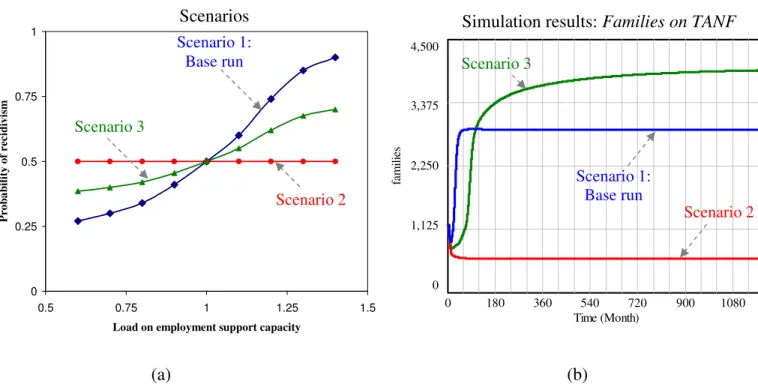
recidivism. Figure 7 shows three different functional forms, listed as scenarios. In Scenario 1
(the base run), the function is formulated based on data from the expert meetings. In Scenario 2, we assume that both feedback loops are broken and that the probability of recidivism is a
constant number. This scenario is equivalent to a partial model test that illustrates the rationality of decision makers assuming an absence of feedback through the probability of recidivism. In Scenario 3, we reintroduce feedback, but decrease the gain of the loops by changing the
sensitivity of probability of recidivism to load on employment. The third scenario shows how the system will behave if the probability of recidivism is not as sensitive to load on employment as in the base run, but still varies endogenously.
(a) (b)
Fig. 7. (a) Different scenarios for how load on employment support capacity influences probability of recidivism and (b) corresponding simulation results for Families on TANF
Figure 7 shows that the above mentioned feedback loops play significant roles in simulation results. When in the second scenario we assume a constant probability of recidivism (no
feedback through this variable), we see that as policymakers expect, an increase in the upstream capacity results in a decrease in Families on TANF. Thus, the reason that the system resists an increase in upstream capacity in the base run is the effect of an increase in probability of
recidivism, which in turn decreases the outflow from Post TANF employed to mainstream
employment (labeled To mainstream employment), and increases the outflow from Post TANF
employed to Families on TANF (labeled Recidivism). Interestingly in the third scenario Families
on TANF ends up in a higher equilibrium.3
3
The system can also produce some interesting oscillatory behaviors under some specific conditions, but discussion 0
0.25 0.5 0.75 1
0.5 0.75 1 1.25 1.5
Load on employment support capacity
P ro b a b il it y o f r ec id iv is m Scenario 1: Base run Scenario 2 Scenario 3 4,500 3,375 2,250 1,125 0
0 180 360 540 720 900 1080 Time (Month) fa m il ie s Scenario 1: Base run Scenario 2 Scenario 3
Simulation results: Families on TANF
Naturally, policymakers are prone to concentrate on the part of the system for which they are most responsible. After focusing more and more people at the upstream and in the absence of a holistic view of the system, policymakers may attribute worsening outcomes to exogenous influences. In reality, it is their own policy that has reduced downstream services and raised the level of recidivism. The final equilibrium level of at-risk families is an important concern for policymakers and this model is able to show how various investments influence that level. To that end, we conduct sensitivity analysis for changes in capacity at upstream and downstream and plot the final equilibrium stage versus changes in these capacities. (Figure 8)
(a) (b)
Fig. 8. The equilibrium stage for (a) families on TANF and (b) total families at risk versus changes in upstream (TANF support) capacity and changes in downstream (post TANF employment) capacity
Figures 8a and 8b show that an increase in downstream capacity always leads the whole system to be better off while a change in the upstream capacity, if is not followed by a proper
0 0.05 0.1 0.15 0.2 0 0.05 0.1 0.15 0.2 0.25 0.3 0.35 0.4 1000 1500 2000 2500 3000 3500 4000 4500 5000 5500
change in downstream capacity
change in upstream capacity Total
families at risk at t = 60 month 0 0.05 0.1 0.15 0.2 0 0.05 0.1 0.15 0.2 0.25 0.3 0.35 0.4 0 500 1000 1500 2000 2500 3000 3500 4000
change in downstream capacity
change in upstream capacity Families
on TANF at t = 60
Overall, this small model shows that adding capacity upstream can swamp downstream resources, increasing the recidivism rate and resulting in still more demand upstream. In other words, adding capacity upstream, by itself, can increase the upstream load and make the entire system worse off (Richardson et al., 2002). This simple model helps policymakers: 1) develop a holistic view of their problem, 2) better understand counterintuitive lessons from the model, 3) experiment to find better policies for implementation in the real world, and 4) learn about swamping insight and the endogenous causes of policy failure.
The Common Characteristics of Small System Dynamics Models
As discussed above, public policy problems have several characteristics (the “problems” of public policy problems) that make effective policy making especially difficult. Yet, by
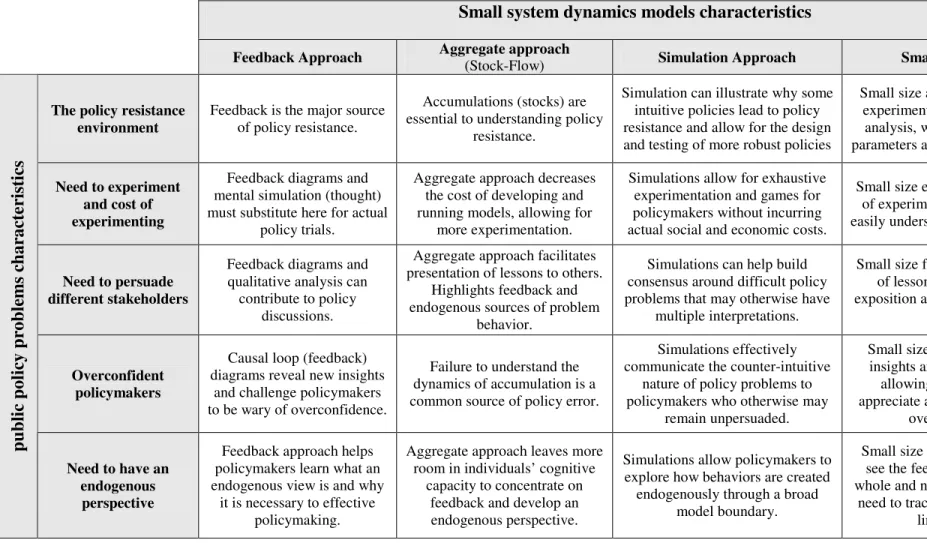
examining small system dynamics models like the URBAN1 model and the swamping insight model, important insights regarding the source of policy failures can be uncovered. In this section, we highlight common characteristics of the two models and discuss how small system dynamics models can contribute to public policy making more generally. The discussion is summarized in Table 1.
We argue that four central characteristics make small system dynamics models especially well suited for learning about and designing effective policies: 1) the feedback approach and emphasis on endogenous explanations of behavior, 2) the aggregate approach, 3) the simulation approach, and 4) the fact that the models are “small” enough such that the structure is clear and the link between structure and behavior can be easily discovered through experimentation. We next explore each of these four characteristics in turn.
Feedback approach
First, both URBAN1 and the swamping insight model share a feedback loop approach to modeling that emphasizes endogenous sources of behavior. The URBAN1 model illustrates how housing and business construction policies that are effective during a period of growth can endogenously create the conditions for decay once land becomes scarce, by causing an excess of housing relative to the region’s employment capacity. Similarly, the swamping insight model shows how increasing resources allocated to upstream welfare services can result in even greater
demand for such services by overloading downstream capacity. In both cases, the problem behavior is endogenously created and is highly counterintuitive.
Such counterintuitive behavior is often an example of policy resistance. Too often, policies fail due to unanticipated compensating feedback. For example, adding jobs to an urban area may fail to improve unemployment if the increased attractiveness causes more people to move into the area. By emphasizing feedback and an endogenous perspective, both models help
policymakers understand how policy resistance can arise. Both models challenge common beliefs about how systems work by revealing feedback loops that can exacerbate the situation, thereby facilitating learning for even the most overconfident users.
Aggregate approach
Second, both URBAN1 and the swamping insight model take an aggregate approach to modeling. More specifically, neither model tracks each individual in the population separately, but instead models groups of individuals in the aggregate. In keeping with the system dynamics modeling tradition, the building blocks of model structure are stocks and flows rather than
and a third for business structures. Likewise, the swamping insight model has one stock each for upstream and downstream welfare service recipients. Both models neglect any more detailed implications that might arise due to agent heterogeneity.
While there is a huge interest among modelers in a disaggregated approach to the modeling of social problems, Rahmandad and Sterman (2008) argue that differential equation-based models – of which the models here are examples – are easier to understand and usually have similar policy implications. In addition, aggregation reduces the size of the model, thereby decreasing the cost of developing and running models and allowing for more experimentation. Given limitations in individuals’ cognitive capacity, aggregation also allows users to focus on feedback ahead of agent level detail and therefore develop a more holistic and endogenous perspective to the problem.
Further, recent research has shown that individuals often fail to understand the dynamics of accumulation (Sterman, 2008), with huge implications for the policies that they will then support. By focusing on stocks and flows as the building blocks of model structure, system dynamics models can directly help policymakers build intuition regarding the dynamics of accumulation and thereby overcome one potential source of policy error.
Simulation approach
Third, both of the reviewed models are running mathematical simulations that provide the opportunity to conduct experiments. While many lessons can be learned from a paper causal loop diagram, other more substantial insights require the development and testing of a simulation model. In both of the above cases, simulation helps to illustrate why intendedly rational policies lead to policy resistance.
Further, simulation models provide learning environments where modelers, policymakers, and others can design and test policies. Given the complexity of many policy environments, experimentation is essential for the design of effective policies. Simulations provide a helpful environment where policymakers can experiment and learn about the effects of different policies without any significant social and economic cost for policymakers.
Finally, simulations can help to build consensus surrounding difficult policy problems. By communicating the counter-intuitive nature of policy problems to policymakers, simulations can encourage dialogue and lead to the development of shared interpretations regarding the source of problem behavior. Even when different goals and value systems persist, simulation can help to focus the discussion on specific variables and outcomes that are the source of divergence.
Small model size
Finally, both of the models are “small.” Here, we define “small” to mean models that consist of a few significant stocks and at most seven or eight major feedback loops. There are two main benefits to a small size. First, a small model size allows for exhaustive experimentation through parameter changes. With lower order models it is much easier to learn from sensitivity analysis (as shown in the swamping insight model, Figures 7 and 8) and examine the interactions among different parameters. Thus, important leverage points in the system can be more easily identified.
Second, a small size ensures that the results of experiments can be fully and easily
understood by policymakers. Short exposition makes a holistic view possible. Due to the small size, individuals can see the feedback structure as a whole and not be frustrated by the need to track many variables and links at once. In addition, short exposition facilitates presentation of
emphasis on small models echoes that of Repenning (2003), who argues that in an academic context as well, small models are necessary to build the intuition of readers who are not accustomed to a dynamic or holistic view of systems.
All told, small system dynamics models bring numerous benefits to the public policy making process. Table 1 summarizes the above discussion by depicting how each of the characteristics of small system dynamics models can help address the challenges inherent in public policy making.
Table 1. The significance of small system dynamics models in addressing public policy problems
Small system dynamics models characteristics Feedback Approach Aggregate approach
(Stock-Flow) Simulation Approach Small Model Size
The policy resistance environment
Feedback is the major source of policy resistance.
Accumulations (stocks) are essential to understanding policy
resistance.
Simulation can illustrate why some intuitive policies lead to policy resistance and allow for the design and testing of more robust policies
Small size allows for exhaustive experimentation and sensitivity
analysis, wise interpretation of parameters and parameter changes.
Need to experiment and cost of experimenting
Feedback diagrams and mental simulation (thought) must substitute here for actual
policy trials.
Aggregate approach decreases the cost of developing and running models, allowing for
more experimentation.
Simulations allow for exhaustive experimentation and games for policymakers without incurring actual social and economic costs.
Small size ensures that the results of experiments can be fully and easily understood by policymakers.
Need to persuade different stakeholders
Feedback diagrams and qualitative analysis can contribute to policy
discussions.
Aggregate approach facilitates presentation of lessons to others.
Highlights feedback and endogenous sources of problem
behavior.
Simulations can help build consensus around difficult policy problems that may otherwise have
multiple interpretations.
Small size facilitates presentation of lessons to others. Short exposition and holistic view made
possible.
Overconfident policymakers
Causal loop (feedback) diagrams reveal new insights
and challenge policymakers to be wary of overconfidence.
Failure to understand the dynamics of accumulation is a common source of policy error.
Simulations effectively communicate the counter-intuitive
nature of policy problems to policymakers who otherwise may
remain unpersuaded.
Small size ensures that model insights are fully understood,
allowing policymakers to appreciate and address their own
overconfidence. p u b li c p o li cy p ro b le m s ch a ra ct er is ti cs
Need to have an endogenous perspective
Feedback approach helps policymakers learn what an endogenous view is and why
it is necessary to effective policymaking.
Aggregate approach leaves more room in individuals’ cognitive
capacity to concentrate on feedback and develop an endogenous perspective.
Simulations allow policymakers to explore how behaviors are created
endogenously through a broad model boundary.
Small size allows individuals to see the feedback structure as a whole and not be frustrated by the
need to track many variables and links at once.
Conclusion and discussion
In this paper we argued that small system dynamics models can be very helpful for policy making. After listing several common difficulties in policy making, we next reviewed two insightful models and used these models as examples to examine how small system dynamics models can address some of the most pressing challenges that policymakers face.
We believe that small system dynamics models can contribute significantly to policy making due to four central characteristics: first, they take a feedback approach; second, they are
aggregated; third, they present simulation runs; and fourth, they are “small.” Because of these characteristics, small system dynamics models can illustrate the sources of policy resistance in the environment, facilitate learning through extensive experiments, overcome the issues of overconfidence, bring different stakeholders to a shared understanding, and help policymakers learn about the importance of an endogenous perspective to problem solving.
Despite these benefits, it is important to mention that small models do also have limitations. First, customers in general and policymakers in particular often demand an exclusive model that considers all possible causal links either observed or contemplated. In such a situation,
policymakers may lose their trust if they see that their hypothesized link or variable does not exist in the model. Further, in many situations, stakeholders may want to see their own organizations, departments, or communities separately represented, increasing the level of disaggregation. In such a case, having an exclusive version of the model and showing that the final behavior is not qualitatively sensitive to the policymakers’ assumed important links or variables can be helpful. Once the insights provided by a small model are well understood, a more detailed model can be constructed to analyze more fine grained policy implications.
A further limitation is that the use of small models may lead modelers to underestimate the role of some feedback loops which may actually be important in reality. It is critical to mention that effective small system dynamics models must not only be simple, but also include all of the most dominant loops. As a result, the process of building small models may in fact be more difficult than building larger models that include multiple feedback loops. In many cases, small models may emerge only after extensive examination of a larger model allows for the
identification and isolation of only the most dominant feedback loops. Once a large model is developed and the modeler gets a clear idea of the dominant loops, he or she can build a smaller version to present for policymakers.
Furthermore, building small models should not impede “operational thinking” and modeling. System dynamics encourages thinking clearly about causalities and how variables actually are connected to produce behavior (Richmond, 2001). Modelers should be clear in how a variable ultimately influences another variable by stating step by step the path of the causal link. Being precise in the formulation of causal links and clarifying important capacity
constraints are essential aspects of good modeling practice. Although small models may omit some of the details behind causal links, variables can and must remain operational at a high level.
Overall, despite these limitations, we argue that small system dynamics models can greatly aid the policymaking process. Small models help policymakers learn about the environment and the sources of policy resistance, build learning environments for experimentation, overcome overconfidence, and develop shared understanding among stakeholders. For all of these reasons, we believe that the system dynamics community should do more to help policymakers
Supporting Information
Supporting information may be found in the online version of this article.
References
Alberts B. 2008. A Scientific Approach to Policy. Science 322(5907): 1435. Alfeld LE, Graham AK. 1976. Introduction to Urban Dynamics. Pegasus
Communications:Waltham, MA.
Andersen DF, Richardson GP. 1997. Scripts for Group Model Building. System Dynamics
Review 13(2): 107-129.
Babcock L, Loewenstein G. 1997. Explaining Bargaining Impasse: the Role of Self-Serving Biases. Journal of Economic Perspectives 11(1): 109-26.
Bazerman MH. 1994. Judgment in managerial decision making, 3rd edition. Wiley: London. Bretschneider S, Straussman J. 1992. Statistical Laws of Confidence Versus Behavioral
Response: How Individuals Respond to Public Management Decisions Under Uncertainty. Journal of Public Administration Research and Theory2(3): 333-34. Cavana RY, Clifford LV. 2006. Demonstrating the utility of system dynamics for public policy
analysis in New Zealand: the case of excise tax policy on tobacco. System Dynamics
Review 22(4): 321-348.
Cyert RD, March JG. 1963. A Behavioral Theory of the Firm. Prentice-Hall: Englewood Cliffs, NJ.
Denrell J, March JG. 2001. Adaptation as Information Restriction: The Hot Stove Effect.
Organization Science 12(5): 523-538.
Fiddaman TS. 1997. Feedback Complexity in Integrated Climate-Economy Models. Doctoral Thesis, Massachusetts Institute of Technology, Cambridge, MA.
Fiddaman TS. 2002. Exploring policy options with a behavioral climate-economy model. System
Dynamics Review 18(2): 243-267.
Ford A. 1997. System Dynamics and the Electric Power Industry. System Dynamics Review
13(1): 57–85.
Forrester JW. 1969. Urban dynamics. MIT Press: Cambridge, MA.
Forrester JW. 1971a. World Dynamics. Wright-Allen Press: Cambridge, MA.
Forrester JW. 1971b. Counterintuitive behavior of social systems. Technology Review 73(3): 52-68.
Forrester JW. 2007. System dynamics - the next fifty years. System Dynamics Review 23(2-3): 359 – 370.
Ghaffarzadegan N. 2008. How a System Backfires: Dynamics of Redundancy Solution in Security. Risk Analysis 28(6): 1669 - 1687.
Griffin D, Tversky A. 1992. The weighing of evidence and the determinants of confidence.
Cognitive Psychology24(3): 411–535.
Henrion M, Fischhoff B. 1986. Assessing uncertainty in physical constants.Journal of Physics
54(9): 791-798.
Homer J, Hirsch G, Milstein B. 2007. Chronic Illness in a Complex Health Economy: The Perils and Promises of Downstream and Upstream Reforms. System Dynamics Review 23(2-3): 313-343.
Homer J, Ritchie-Dunham J, Rabbino H, Puente L, Jorgensen J, Hendricks K. 2000. Toward a Dynamic Theory of Antibiotic Resistance. System Dynamics Review 16(4): 287-319. Homer J, Hirsch G, Minniti M, Pierson M. 2004. Models for Collaboration: How System
Dynamics Helped a Community Organize Cost-Effective Care for Chronic Illness.
System Dynamics Review 20(3): 199-222.
Honggang X, Mashayekhi AN, Saeed K. 1998. Effectiveness of infrastructure service delivery through earmarking: the case of highway construction in China. System Dynamics Review
14(2-3): 221-255.
Hood C, Peters G. 2004. The Middle Aging of New Public Management: Into the Age of Paradox? Journal of Public Administration Research and Theory 14(3): 267–282. Johnson DP. 2004. Overconfidence and war: the havoc and glory of positive illusions. Harvard
University Press: Cambridge, MA.
Landsbergen D, Coursey DH, Loveless S, Shangraw RF Jr. 1997. Decision Quality, Confidence, and Commitment with Expert Systems: An Experimental Study. Journal of Public
Lichtenstein S, Fischhoff B, Phillips LD. 1982. Calibration of probabilities: The state the art to 1980. In D. Kahneman, P. Slovic, & A. Tversky (Eds.), Judgments under uncertainty: Heuristics and biases (pp. 306–334). New York: Cambridge University Press.
Light PC. 1997. The tides of reform: Making government work 1945–1995. Yale University Press: New Haven, CT.
Martinez-Moyano IJ, Rich E, Conrad S, Andersen DF, Stewart TR. 2008. A Behavioral Theory of Insider-Threat Risks: A System Dynamics Approach. ACM Transactions on Modeling
and Computer Simulation, 18(2), Article 7.
Mashayekhi AN. 1998. Public finance, oil revenue expenditure and economic performance: a comparative study of four countries. System Dynamics Review 14(2-3): 189-219. McKenzie CRM, Liersch MJ, Yaniv I. 2008. Overconfidence in interval estimates: What does
expertise buy you? Organizational Behavior and Human Decision Process 107(2): 179-191.
Meadows DH, Meadows DL, Randers J, Behrens WW. 1972. The Limits to Growth. Universe: New York.
Morecroft J. 1983. System Dynamics: Portraying Bounded Rationality. Omega 11(2): 131-142. Moxnes E. 1998. Not only the Tragedy of the Commons: Misperceptions of Bioeconomics.
Management Science 44(9): 1234-1248.
Rahmandad H. 2008. Effect of delays on complexity of organizational learning. Management
Science 54(7): 1297-1312.
Rahmandad H, Repenning NP, Sterman JD. 2009. Effect of Feedback Delays on Learning.
System Dynamics Review25(4): 309-338.
Rahmandad H, Sterman JD. 2008. Heterogeneity and network structure in the dynamics of diffusion: Comparing agent-based and differential equation models. Management Science
54(5): 998-1014.
Repenning NP. 2003. Selling System Dynamics to (Other) Social Scientists. System Dynamics
Review 19(4): 303-327.
Repenning NP, Sterman JD. 2002. Capability traps and self-confirming attribution errors in the dynamics of process improvement. Administrative Science Quarterly 47(2): 265–295. Richardson GP. 1983a. An Interview with Jay Forrester. PLEXUS, System Dynamics News 2.
Richardson GP. 1983b. Heroin Addiction and its Impact on the Community. In Introduction to
Computer Simulation, a System Dynamics Approach, edited by N. Roberts et al.
Addison-Wesley: Reading, MA.
Richardson GP, Andersen DF, Wu YJ. 2002. Misattribution in Welfare Dynamics: the puzzling dynamics of recidivism. In Proceedings of the 2002 International System Dynamics
Conference, Palermo, Italy, 28 July- 1 August.
Richardson GP. 2006. Concept Models, In Proceedings of the 2006 International System
Dynamics Conference, Nijmegen, The Netherlands, 23-27 July.
Richardson GP, Andersen DF. 1995. Teamwork in Group Model Building. System Dynamics
Review 11(2): 113-137.
Richardson GP. 2007. How to Anticipate Change in Tobacco Control Systems, in Greater Than
the Sum: Systems Thinking in Tobacco Control, edited by Best A, Clark PI, Leischow SJ,
Trochim WMK. National Cancer Institute, U.S. Department of Health and Human Services, National Institutes of Health.
Richmond B. 2001. An Introduction to Systems Thinking, (ithink software), High Performance Systems, Inc.
Saeed K. 1998. Towards Sustainable Development, 2nd Edition: Essays on System Analysis of
National Policy. Ashgate Publishing Company: Aldershot, England.
Senge P .1990. The Fifth Discipline: The Art And Practice Of The Learning. Doubleday: New York.
Sterman JD. 1989. Modeling Managerial Behavior: Misperceptions of Feedback in a Dynamic Decision Making Experiment. Management Science 35(3): 321-339.
Sterman JD. 2000. Business dynamics: systems thinking and modeling for a complex world. Irwin/McGraw-Hill: Boston, MA.
Sterman JD. 2008. Risk Communication on Climate: Mental Models and Mass Balance. Science
322 (24 October): 532-533.
System Dynamics Society. 2009. System Dynamics Bibliography. http://systemdynamics.org/biblio/sdbib.html [1 June 2009].
Thompson KM, Duintjer Tebbens RJ. 2007. New Analysis Says Eradicating Polio a Better Option Than Extended Control of the Disease. The Lancet 369:1363-1371.
Thomson Reuters. 2009. ISA web of knowledge. http://www.isiwebofknowledge.com [20 September 2009].
Tversky A, Kahneman D. 1974. Judgment under Uncertainty: Heuristics and Biases. Science
185(4157): 1124-1131
Vennix J. 1996. Group Model Building: Facilitating Team Learning. Wiley: Chichester. Weaver EA, Richardson GP. 2006. Threshold setting and the cycling of a decision threshold.
System Dynamics Review 22(1): 1-26.
Zagonel AA, Rohrbaugh JW, Richardson GP, Andersen DF. 2004. Using simulation models to address ‘What If’ questions about welfare reform, Journal of Policy Analysis and