Table of Contents
Executive Summary
... 1
Introduction
... 3
The Burdens of Disclosure
... 4
Red Tape
... 4
Fear Factor
... 6
Purported Benefits of Disclosure
... 7
Do Voters Want Disclosure Information?
... 8
Does Disclosure Help Voters Vote?
... 9
Would Voters Be Misled Without Disclosure?
... 13
Assessing Disclosure’s Marginal Benefits
... 14
Research Method
... 15
Little Interest in Information, Particularly Disclosure Information
... 16
Virtually No Marginal Benefit from Disclosure
... 18
Conclusion
... 20
Executive Summary
Disclosure, proponents claim, produces a better functioning democracy: By
requir-ing groups that advocate for or against issues on the ballot to reveal their fundrequir-ing
sources and how they spend their money, voters gain valuable insights into the
issues themselves and make more informed voting decisions. Even better, they
say, it is a policy that comes with few costs; it is “merely” disclosure.
But what if these claims are wrong? In fact, as this report shows, the research
on the effects of mandatory disclosure for ballot issue campaigns finds exactly that.
Disclosure does little to help voters and imposes substantial costs on those wishing
to participate in democratic debate.
To assess the informational benefits of disclosure, this report uses an
experi-ment to test whether disclosure improves voters’ knowledge of where interest
groups stand on a ballot issue. Results reveal it does not:
• Voters have little interest in disclosure data. Among 15 information sources a
subset of participants could choose to view—12 newspaper articles, a voter
guide and two campaign ads—those referencing disclosure data were by far
the least viewed.
• Viewing disclosure information had virtually no impact on participants’
knowledge, but viewing the voter guide did.
These results show that voters would be just as capable of voting in ballot
is-sue elections if no disclosure of contributions and expenditures were required. In a
society where information about politics is everywhere, any additional benefit from
disclosure laws is close to zero.
Moreover, earlier research has established that disclosure burdens would-be
speakers with cumbersome and complicated red tape and puts them at risk for
legal sanctions (or worse) for mistakes. Research also shows that loss of privacy
and fear of retribution for backing a controversial position deter contributions to
ballot issue campaigns.
Surprising as it may seem, the current regime of government-forced disclosure
does virtually nothing to improve public discourse on ballot issues. Indeed,
disclo-sure stifles debate by making it harder for people to organize and participate in the
process. If, as even disclosure proponents agree, the goal is a freer, more robust
democratic process, lifting burdensome disclosure laws is the place to start.
Introduction
Imagine that you had to send a government official a note each time you did something political, whether it be attending a rally, volun-teering on a campaign, posting to a blog or even conversing with friends over drinks. Now imag-ine that this information would be made public by the government. Would your conversations with friends change? Would your other political activities change? For many of us, the answer would be yes.
Of course, in most cases you can volunteer on a political campaign without registering with the government. You can talk with friends without registering with the government. But when you decide to spend money on politics, whether by contributing to a candidate or a group or even collaborating with like-minded individuals on political activities, everything changes. You often are required to file complicated forms with the government. Your personal information, includ-ing your home address and employer, is likely to be posted on the Internet in handy searchable databases. The release of this information has led to lost jobs, vandalism and even violence.1
You might think there would be a good reason for collecting this information, but in the case of ballot issues, the justification is surpris-ingly thin. In the case of contributions to the campaigns of candidates for office, the U.S. Supreme Court has determined that the fear of actual or perceived corruption justifies the disclosure of contributions to candidate cam-paigns.2 In the case of ballot issue campaigns, however, the “candidate” is a policy position, and no such anti-corruption rationale exists. Those who want to justify disclosure for ballot issue campaigns instead rely on other rationales, claiming that voters can make bet-ter decisions if they know who supports these campaigns. Disclosure is thought to be the most straightforward way to learn this information. If you know that Pepsi contributed funds to fight the “Ban Soft Drinks” ballot issue, the argument goes, you are now better-positioned to deter-mine where you stand on the measure.
Another, related rationale is that the government must protect voters from mislead-ing information in campaigns. For instance, disclosure proponents would argue that Pepsi should not be able to anonymously create a “shadowy” group with a name like Support Chil-dren’s Health that advocates against the “Ban Soft Drinks” initiative. Disclosure laws allegedly prevent voters from being duped by an ad about the health benefits of soft drinks paid for by Sup-port Children’s Health.
The fundamental premise of disclosure laws is that information about who contributes and spends money for political purposes can only benefit society, improving voter knowledge and holding individuals and groups accountable for their speech. With rare exception, the benefits of disclosure laws are viewed as so self-evident that data pointing to those benefits seems unnecessary.
But, as is so often the case when someone claims something is “self-evident,” there is in fact no evidence to support the benefits of disclosure.
This pattern should be familiar to observ-ers of campaign finance law: The benefits of campaign finance reform are taken to be self-evidently large, when in reality they often approximate zero. Meanwhile, the costs are as-sumed to be nonexistent when in reality they are substantial. This is true of public financing for campaigns, a reform which does little to improve competitiveness or faith in government and can, as in the case of the recently overturned Arizona “Clean Elections” law, impinge on speech in an unconstitutional manner.3 And it is true of disclosure laws for ballot issue campaigns, the topic of this study.
This report is a lesson in contrasts. While the costs of disclosure have been established, the benefits of disclosure have always been assumed to exist. But when actual research on the ben-efits of disclosure is considered, the picture that emerges is very different.
This report is organized into two main parts. The first part discusses several studies demonstrating the costs of campaign disclosure.
It then shows that in a society where information about politics is everywhere, the informational
benefits of disclosure laws are close to zero. The
bottom line: The results do not favor the con-tinuation of disclosure laws for ballot issues.
The Burdens of Disclosure
Red Tape
Campaign finance disclosure laws place burdens on individuals who work together to speak out on a ballot issue. If they spend all but a minimal amount or receive virtually any contributions (monetary or in-kind) in support of their efforts, they enter a byzantine world of complicated paperwork and onerous regulations. Unless they are experts in campaign finance law, or can afford to hire one, these would-be speakers run the risk of making errors that could cost them thousands of dollars and lead to damaging lawsuits.
University of Missouri economist Dr. Jeffrey Milyo demonstrated just how confusing these regulations can be. Milyo asked 255 ordinary citizens to complete the paperwork required to speak as a group on ballot issues in one of three states—Colorado, California or Missouri.4 Participants included non-student adults aged 25 to 64 in Columbia, Mo., as well as graduate and undergraduate students at least 20 years of age at the University of Missouri.
Milyo surveyed participants in advance of the experiment to gauge their knowledge of disclosure requirements. Only seven percent of the respondents were aware that groups of citizens had to file forms with the government to speak as a group on a ballot issue. In other words, citizens wishing to participate in the po-litical process may unwittingly break the law and expose themselves to government fines, govern-ment lawsuits and even lawsuits from political opponents.
This threat is not hypothetical. Six residents of Parker North, Colo., banded together in 2006 to oppose the annexation of their neighborhood
D I S C L O S U R E F A C T S
RED TAPE BURDENS AND DETERS SPEECH
An experiment where 255 people were asked to complete disclosure forms for a grassroots ballot issue campaign found:
Source: Milyo, J. (2007). Red tape: Strangling free speech and political debate. Arlington, VA: Institute for Justice.
Did not know citizen
groups had to file
govern-ment paperwork to speak
about a ballot issue
People correctly
completed the forms
Tasks on forms were
correctly completed
Said red tape and threat
of legal penalties for
mis-takes would deter political
activity
93
%
0
41
%
89
%
4
into a nearby town. They, like the 93 percent of those surveyed in Milyo’s study, were unaware that their loose collaboration required them to register as an “issue committee.” Supporters of the annexation, seeing an opening thanks to Colorado’s campaign finance disclosure laws, sued these residents for failing to register and keep track of their spending on materials like poster board and markers.5
Milyo’s experiment shows that compliance with disclosure laws is challenging even for citizens who are aware of them. Milyo presented the 255 participants with a scenario for a group called “Neighbors United.” This fictional group received a few contributions—some large, some small, some anonymous, some named, some monetary and some non-monetary—and made only one expenditure. This pattern realistically replicates that of a small group of like-minded citizens as opposed to a large interest group. The experiment was not designed to set the par-ticipants up for failure. It asked them to do no more than would be expected of a typical citizen participating in a ballot issue campaign.
Yet fail they did. Overall, the mostly college-educated respondents completed just 41 percent of tasks correctly. Respondents had trouble reporting non-monetary contributions, such as a discount given by a T-shirt maker, as well as handling anonymous donations and aggregating contributions by donor. Only one participant asked to complete the Missouri forms real-ized that a campaign event resulting in $15 of contributions requires the filing of a statement providing details about the event.
In a subsequent debriefing, nearly all par-ticipants expressed frustration with the forms— “Worse than the IRS!” wrote one respondent— and a sizable majority believed that knowledge of the red tape associated with disclosure would deter citizens from participating in the political process.
These results are consistent with a basic te-net of economics: When something is taxed, you get less of it. Disclosure laws that burden citizens with confusing reporting requirements and the
D I S C L O S U R E S T O R I E S
RED TAPE TIES UP FLORIDA CITIZEN GROUP
By Paul Sherman, Institute for Justice staff attorneyShould grassroots groups of citizens have to comply with campaign finance laws that the U.S. Supreme Court has held are unconstitutionally burdensome for corporations like General Motors and unions like the AFL-CIO?
For too many groups, that is the reality of political participation, as Nathan Worley, Pat Wayman, John Scolaro and Robin Stublen learned when they joined together to oppose an amendment to the Florida Constitution in 2010. The target of their concern was Amendment 4, which was popularly known as the “Hometown Democracy Amendment.” Amendment 4 would have required that municipalities that adopt or amend their local comprehensive land-use plan submit the changes to a referendum of the voters.
Nathan, Pat, John and Robin thought Amendment 4 was an affront to property rights that would stifle economic growth in Florida—and they wanted other voters to hear that view. So the group decided to pool their resources and run ads on their local talk radio station, urging the public to vote against the amendment. But, thanks to Florida’s campaign finance laws, such spontaneous political expression is all but impossible.
For Nathan and the others, going forward with their plans would have triggered a mountain of red tape, because under Florida law, anytime two or more people get together to advocate the passage or defeat of a ballot issue and raise or spend more than $500 for the effort, they become a fully regulated “political committee.”1
What does this entail? First, Nathan and the others would have to register with the state and establish a separate bank account.2 Then the group could run its ads, but it would have to keep meticulous financial records and report all activi-ty.3 And unlike most states, Florida does not place any lower limit on contribu-tions and expenditures that have to be reported—even a one-cent contribution must be separately itemized, including the contributor’s name and address, and reported to the state.
Wading into such a complicated area can be dangerous and the penalties can be severe. If Nathan and the others speak without complying with the law, they can face civil or criminal fines of up to $1,000 per violation and even up to one year in jail.4
As Pat Wayman said, “These laws make politics inaccessible to common citizens; you need to hire an attorney to make sure you don’t get in trouble with the government. We shouldn’t have to file any paperwork, or hire accountants or campaign finance lawyers, just to exercise our First Amendment rights.” Rather than remain silent, Pat and the others have chosen to fight back. In October 2010 they filed a federal lawsuit to strike down Florida’s burdensome campaign finance laws, relying on a 2010 Supreme Court decision that held that similar laws were unconstitutionally burdensome for corporations and unions.5
1 Fla. Stat. § 106.011(1). 2 Fla. Stat. §§ 106.03(1)(a), .021(1). 3 Fla. Stat. §§ 106.06(1), .06(3), 07(4)(a). 4 Fla. Stat. §§ 106.19, .265.
specter of fines and lawsuits are a de facto tax on speech. Cumbersome reporting requirements represent a very real threat to political participa-tion.
Fear Factor
Disclosure laws place a second set of burdens on citizens. Individuals who contribute to ballot issue campaigns will have their name, address and often their employer reported publicly for donations above a certain (typically very low) threshold.6 For somebody who is publicly active in politics, this requirement may be a minor nui-sance. But for somebody who wants to support a cause privately, government-forced disclosure may present a significant barrier.
Such privacy concerns are heightened by easy access to information on the Internet. Be-yond the information directly available from the government, several websites aggregate donors’ identities and contributions in ways that harness the latest technology. The Huffington Post’s Fundrace site uses Google Maps so viewers can see who in their neighborhood has made politi-cal contributions.7 There is now even a program that scans e-mail inboxes and then “allows you to see the political contributions of the people and organizations that are mentioned in the e-mails you receive.”8
Concern about privacy comes not just from political views being revealed, but also from per-sonal contact information being posted online. Gigi Brienza learned that lesson the hard way when a simple campaign donation landed her on the target list of a domestic terrorist group (see sidebar p. 7).
Disclosure laws, in other words, make it much more difficult for people to support policy positions anonymously. Even if they do not fear retaliation, they may simply desire the same privacy for contributions that their vote receives at the ballot box.
This “fear factor” acts as another tax on participation and may lead citizens to forgo giving to ballot issue campaigns. When Dr. Dick Carpenter of the University of Colorado and the
D I S C L O S U R E S T O R I E S
REPORTING ERRORS BRING CRUSHING FINES
By Paul Sherman, Institute for Justice staff attorneyIn 2002, Carolyn Knee volunteered her time and energy to campaigning for a local ballot issue that would allow San Francisco to break its ties with power company Pacific Gas & Electric Co. Knee had been a legal assistant for 25 years, but had no experience with campaigning or with campaign finance laws, so she hired an accountant to help her with the bookkeeping.
Five years later—with the election over and the ballot issue she championed defeated—the records from Knee’s now-defunct ballot issue committee were subject to a random audit. Despite having hired an accountant and making her best effort to comply with the law, the audit discovered several reporting errors. As a result, Knee, a retiree living on a fixed income, found herself threatened with over $26,000 in fines.
Knee is not the first to be hit with exorbitant fines by the Fair Political Practices Commission (FPPC), the agency charged with enforcing California’s campaign finance laws. Nor is she likely to be the last. California’s campaign finance laws are so complex that errors—and fines—are practically inevitable.
The FPPC itself reached this conclusion in a 2000 study titled “Overly Complex and Unduly Burdensome: The Critical Need to Simplify the Political Reform Act of 1974 in California.”1 As part of that report the FPPC conducted an experi-ment that asked individuals with different levels of campaign experience to fill out campaign finance disclosure forms. As in Milyo’s experiment (see page 4), participants performed miserably. The FPPC found that “[e]ven participants with backgrounds in campaigns” could not fill out the forms “without making multiple mistakes.”2
Thankfully, Knee was ultimately able to settle the charges against her by paying a $267 fine. Not everyone gets off so easy. In 1995, Californians Against Cor-ruption was slapped with an $808,000 fine for reporting errors—at that point the largest fine in the agency’s history—despite having spent only $103,091 in support of a recall campaign.3
Although Knee escaped financial ruin, her experience was enough to convince her not to get involved in political campaigns in the future. As she said, “I would never do this again. It totally discourages grassroots” campaigns.4
1 Lucas, S. S. (2000). Overly complex and unduly burdensome, Retrieved December 23, 2006 from http://www.fppc.ca.gov/pdf/McPherson.pdf.
2 Lucas, 2000, p. 69.
3 Doherty, B. (1996). Disclosure flaw, Retrieved August 2, 2011 from http://reason.com/archives/1996/03/01/disclosure-flaw.
4 Witherell, A. (2007). The ethics of ethics, Retrieved August 2, 2011 from http://www.sfbg.com/2007/07/03/ethics-ethics.
6
Institute for Justice asked survey respondents whether disclosure of their name and address would lead them to think twice about contribut-ing, about 60 percent said that it would.9 When asked why, respondents cited retaliation fears more than any other reason except a general desire for privacy.10
Support for disclosure laws generally varies depending on whether the question is framed as the disclosure of other people’s information or one’s own, what Carpenter dubs the “disclo-sure for thee, but not for me” phenomenon.11 Eighty percent of voters favored the disclosure of contributors’ identities,12 but only 40 percent favored disclosure of their contributions if their name and address is revealed, and even fewer— just 24 percent—favored disclosure if their employer is revealed.13 Respondents expressed concern that their job could be in jeopardy or that they could face retaliation from a union for voting on “another side” of the issue.14
In the abstract, then, citizens may favor disclosure, but when the consequences of dis-closure are personalized, their opinions change dramatically. If we are concerned about disclo-sure’s impact on political participation, what matters is not whether people like the idea of disclosure in the abstract, but whether it causes them to participate less. Carpenter’s survey and the experiences of people like Gigi Brienza sug-gest that it does.
Purported Benefits of
Disclosure
Turning to potential benefits, campaign finance disclosure laws for ballot issues, unlike for candi-date campaigns, cannot be justified on corrup-tion or appearance of corrupcorrup-tion grounds, since by definition ballot issue campaigns are about issues, not candidates. The justification for these laws, if provided, relies almost exclusively on the purported informational benefits of disclosure. This section reviews these claims and shows why there is good reason to doubt them. The next section presents new results from an experiment
D I S C L O S U R E S T O R I E S
SINGLE CONTRIBUTION EXPOSES
DONOR TO THREATS
By Paul Sherman, Institute for Justice staff attorney
It is well known that campaign finance disclosure can lead to retaliation for making contributions to unpopular candidates or causes. What is less widely recognized is that campaign finance disclosure can lead to other types of harassment that are unrelated to a donor’s political views—and even more dangerous.
Consider Gigi Brienza. In 2004 she attended a speech given by then-presidential candidate John Edwards. She was inspired by his message and decided to make a $500 political contribution to his campaign.
Two years later, she found herself the target of an animal-rights terrorist group. And, according to the FBI, campaign finance disclosure made it possible. Brienza was targeted by a group called Stop Huntington Animal Cruelty (SHAC). SHAC’s mission is to put an animal-testing laboratory called Huntington Life Sciences out of business by any means necessary—legal or illegal. SHAC does not just target Huntington, it also targets employees at companies that do business with Huntington, companies like pharmaceutical manufacturer Bristol-Myers Squibb, where Brienza worked at the time.
Because Brienza’s contribution to Edwards’ campaign was greater than $200, federal law required that her name, address, occupation and employer be disclosed on the website of the Federal Election Commission (FEC), where that information was accessible to anyone with an Internet connection. This was enough to put Brienza and about 100 of her colleagues in SHAC’s crosshairs. Using the FEC’s database, SHAC was able to search campaign finance records for the home addresses of people who worked for companies affiliated with Huntington. SHAC used this disclosure data to generate a list of “targets,” which it posted under the ominous heading “Now you know where to find them.” Luckily, Brienza was never attacked, and many of SHAC’s leaders were subse-quently arrested. But her experience demonstrates that, particularly in the Inter-net era, there are social costs to disclosure that go far beyond partisan political retaliation. The abuse of disclosure data by groups like SHAC is a threat that cannot be predicted or protected against, except by citizens restricting them-selves to making contributions smaller than the legal threshold for disclosure. Sadly, this is what Brienza now feels compelled to do. After recounting her story in The Washington Post she concluded, “If I am moved to write a check [in the future], I will limit my contribution to $199.99: the price of privacy in an age of voyeurism and the cost of security in an age of domestic terrorism.”1
1 Brienza, G. (2007). I got inspired. I gave. Then I got scared, Retrieved August 2, 2011 from http://www.washingtonpost.com/wp-dyn/content/article/2007/06/29/AR2007062902264.html.
that further challenges the conventional wisdom on disclosure.
Do Voters Want Disclosure
Information?
Voters can obtain disclosure-related information in one of two ways. They can access a govern-ment or private database, typically now web-based, and review contributions and expendi-tures. Or they can obtain disclosure information indirectly from the media, campaigns and other “opinion leaders” or “elites.” A newspaper, for instance, may report on which interest groups have spent funds in support of or opposition to a ballot issue.
There is good reason to question whether voters would ever access this information directly from state disclosure websites. Voters have an incentive to be “rationally ignorant,” gathering very little information in making voting deci-sions. Anthony Downs,15 who first developed this idea, noted that political information gathering is time-consuming, so people will do it only if the benefits outweigh the costs. As Downs found, for most voters gathering information is typically not worth the cost in time spent.16
The idea of “rational ignorance” is not a comment on the intelligence or open-mind-edness of voters. It simply acknowledges that people have many demands on their time, and for many, spending time researching political issues may not top the list. So they make a voting decision based on what they already know.
Thus, the notion that a voter will sit down at a computer and search databases for informa-tion on interest groups strains credulity. It is no surprise, then, that the Carpenter survey found that less than half of respondents claimed to have awareness of disclosure laws and only a third claimed to know where to access disclosure information.17
Since direct acquisition of disclosure information is unlikely, the second means of information acquisition—“information entre-preneurs”—is the typical focus for reformers.18 Information entrepreneurs include the news
D I S C L O S U R E F A C T S
FOR THEIR OWN CONTRIBUTIONS,
PEOPLE PREFER PRIVACY
A survey of more than 2,000 citizens in six states with ballot issue disclosure laws found:
Source: Carpenter, D. M., II. (2007). Disclosure costs: Unintended consequences of campaign finance reform. Arlington, VA: Institute for Justice.
Favor disclosure of
contributors to ballot
issue campaigns
Favor disclosure of
their
own
name and address if
they contribute to a ballot
issue campaign
Favor disclosure of their
employer if they contribute
to a ballot issue campaign
Would “think twice” about
contributing to an issue
campaign if their name
and address is revealed
80
%
40
%
24
%
60
%
8
media, think tanks and other groups that dis-seminate information. Certainly the news media reports on campaign finance disclosure, and of course candidates and interest groups reference campaign finance information in advertising. But how prevalent, really, is this kind of activ-ity for ballot issues? The answer, according to a review of campaign information in Colorado’s 2006 ballot issue election, is not much.
Only 4.8 percent of newspaper articles, edi-torials and letters to the editor; think tank and nonprofit material; state-produced documenta-tion; and campaign-generated documentation referenced disclosure information. That figured dropped to 3.4 percent in the two weeks leading up to the election.19
This finding is not an anomaly. Professor Raymond La Raja examined articles for state-lev-el campaign finance from 194 newspapers cover-ing all 50 states from 2002 to 2004. He found that each newspaper averaged only about three stories per year regarding campaign finance.20 And less than 20 percent of those stories fell into the category of “analysis”—the category that would provide information about contributors to campaigns.21
These studies establish that information about who contributes to ballot issues and other statewide races is not, in fact, used extensively by information entrepreneurs in communicat-ing with voters. The experiment reported below complements this research by directly assessing voters’ interest in and use of disclosure-related information in the form it is most likely to be acquired—from elites. The results of the experi-ment buttress the above findings by showing that voters do not demand disclosure information.
Does Disclosure Help Voters Vote?
In a second claim, disclosure advocates assert that “improving voter competence is the most persuasive rationale” for disclosure laws regard-ing ballot issues.22 One legal scholar writes that “the real role of disclosure is voter infor-mation, not corruption-deterrence,” arguing, “[i]nformation about the contributions to and
D I S C L O S U R E S T O R I E S
DISCLOSURE ABETS POLITICAL INTIMIDATION
By Paul Sherman, Institute for Justice staff attorneyLike many people, professor of law and former congressional candidate James L. Huffman had always assumed that public disclosure of political contributions was a good thing. But Huffman’s opinion changed when he ran for office as the Republican nominee for U.S. Senate in Oregon in 2010. As Huffman put it, “The reality is that public disclosure serves the interests of incumbents running for re-election by discouraging support for challengers.”1
How does it work? By giving incumbents the power to intimidate even small-dollar donors:
A challenger seeks a contribution from a person known to sup-port candidates of the challenger’s party. The potential supsup-porter responds: “I’m glad you’re running. I agree with you on almost everything. But I can’t support you because I cannot risk getting my business crosswise with the incumbent who is likely to be re-elected.”2
Huffman is not the first political challenger to experience firsthand how dis-closure can chill political participation to the benefit of incumbent candidates. In 2008, West Virginia Attorney General candidate Dan Greear voiced similar concerns during his campaign to unseat incumbent Attorney General Darrell McGraw, noting, “I go to so many people and hear the same thing: ‘I sure hope you can beat him, but I can’t afford to have my name on your records. He might come after me next.’”3
Incumbent candidates are not the only ones who use disclosure information to retaliate against their political opponents. The 2008 federal elections saw the creation of “Accountable America,” a group that pledged to “confront donors to conservative groups, hoping to create a chilling effect that will dry up contributions.”4
Unfortunately, legal standards adopted by the U.S. Supreme Court do little to protect against political retaliation. The Court has held that individuals and groups may be exempt from disclosure only if they first demonstrate a “reason-able probability” that disclosure “will subject them to threats, harassment, or reprisals from either Government officials or private parties.”5
But as Supreme Court Justice Clarence Thomas has observed, this supposed protection is “a hollow assurance.”6 In practice, it is almost impossible to meet the “reasonable probability” standard unless a group or individual has already suffered retaliation. The result, as Justice Thomas notes, is “a view of the First Amendment that subjects citizens of this Nation to death threats, ruined careers, damaged or defaced property, or pre-emptive and threatening warning letters as the price for engaging in core political speech, the primary object of First Amendment protection.”7
1 Huffman, J. L. (2011). How donor disclosure hurts democracy, Retrieved August 2, 2011 from http://online.wsj.com/article/SB10001424052748704415104576250503491062220.html. 2 Huffman, 2011.
3 Strassel, K. A. (2008). Challenging Spitzerism at the polls, Retrieved August 2, 2011 from http:// online.wsj.com/article/SB121754833081202775.html.
4 Luo, M. (2008). Group plans campaign against G.O.P. donors, Retrieved August 2, 2011 from http://www.nytimes.com/2008/08/08/us/politics/08donate.html.
5 Citizens United v. FEC, 130 S. Ct. 876, 914 (2010).
6 Citizens United, 130 S. Ct. at 982 (Thomas, J., concurring in part and dissenting in part). 7 Id. (internal quotation marks omitted).
expenditures by groups supporting or oppos-ing a measure can be quite helpful in under-standing the likely consequences of what may be a difficult-to-parse measure.”23
More simply, the argument is that ballot issues can be confusing and voters may have limited knowledge about the issues being con-sidered. So knowing the identities of supporters, thanks to disclosure, can provide voters “cues” or “shortcuts” as to how to vote, especially if the “right” information is disclosed.24
For example, if voters know that the Sierra Club or the NRA backs a measure, this provides information about its impact, even if voters do not know much else. For cues like these to be useful, proponents argue, three things must be true. First, voters must correctly associate the group with a viewpoint—the Sierra Club with a environment view and the NRA with a pro-Second Amendment view. pro-Second, the group must be viewed as credible. Finally, voters must know the groups backing or opposing a measure in time to affect their decisions.25
So far, this is a plausible story. However, in the leap from cues to government-forced disclosure, the story runs into trouble. For disclosure advocates, the state is justified in casting a wide disclosure net because we cannot know in advance which groups that contribute to campaigns will provide useful cues.26 All must be disclosed, because some of the information could be useful to voters.
There are several problems with this claim. First, notice that cues will be most helpful from organized interest groups with well-known or easily discovered viewpoints. Such groups typi-cally work to promote their views in the media and directly to voters, so they provide cues for voters without disclosure. Second, and related, there is a wealth of information available to voters other than campaign finance records. It is not clear that mandatory disclosure adds to that. Third, a lot of disclosure information will provide no useful cues at all, most especially the identities of individual donors unknown to most people.
D I S C L O S U R E F A C T S
MEDIA MAKE LITTLE USE OF
DISCLOSURE INFORMATION
Sources: Carpenter, D. M., II. (2009). Mandatory disclosure for ballot-initiative campaigns.
Independent Review, 13(4), 567-583; La Raja, R. J. (2007). Sunshine laws and the press: The effect of campaign disclosure on news reporting in the American states. Election Law Journal, 6(3), 236-249.
Newspaper articles,
non-profit material and
gov-ernment and campaign
publications on issues in
2006 Colorado election
that referenced disclosure
information
Average number of
sto-ries on state-level
cam-paign finance per year per
newspaper in study of
194 newspapers
nation-wide from 2002 to 2004
3
4.8
%
10
So the real question is not whether cues are helpful—some may be—but whether mandatory
disclosure adds useful information beyond what
would be available in a world without these laws. In the language of economics, what are the
marginal benefits of disclosure? That is the
ques-tion my experiment is designed to answer. But earlier research and three examples give reason to doubt disclosure’s marginal benefits.
Insurance Reform in California: Cues Do Not Require Disclosure
Political scientist Arthur Lupia has conducted the seminal statistical work in the area of voter cues on ballot issues.27 Lupia surveyed voters on five ballot measures dealing with insurance reform in California. He found that knowing the positions of the insurance industry or trial lawyers on the measures enabled voters to vote as if they knew more about the measures than they actually did.28
This suggests that cues are sometimes useful, but it does not speak to the marginal benefits of disclosure. Although Lupia’s research is often used to justify campaign finance dis-closure laws, the positions of trial lawyers and the insurance industry on these propositions would presumably be easy for media and other elites to discern without disclosure of campaign contributions or spending. And it is from these sources that less informed voters are likely to be getting their information.
In fact, the California Ballot Pamphlet for 1988, which contained pro and con statements for the five ballot issues discussed in Lupia’s study and a description of the law’s impact, provided a wealth of information for voters, whether they read it themselves or received the information indirectly from opinion leaders.
Since California, like all ballot issue states, provides disclosure data, many of the pro and con arguments in the pamphlet referenced this data. Importantly, however, the disclosure in-formation provided little additional inin-formation for voters beyond the other information in the pamphlet. For example, in the “Argument for
Proposition 100,” advocates claim that compet-ing propositions on the ballot were written by insurance companies. In a rebuttal, opponents noted that Proposition 100 was written by trial lawyers. Opponents also mentioned that trial lawyers were funding Proposition 100 efforts, but this information is superfluous once we know that opponents of Proposition 100 align it with trial lawyers. Overall, then, the marginal benefits of disclosure information are probably close to zero in Lupia’s study.
Land Development in Florida: Flood of (Non-disclosure) Information
Turning to a more recent example, consider Amendment 4 from Florida’s 2010 ballot. This ballot issue dealt with land development issues. Disclosure advocates argue that disclosure is necessary because, otherwise, voters would be ig-norant about where interest groups stand on the issue and would be unable to use this informa-tion to make informed voting choices.
But consider the results of a search for {“Amendment 4” Florida} using Google’s search engine. Clicking links based on this search, I learned that a group created by the Chamber of Commerce, Vote No on 4, built a coalition of 320 members, 4,000 volunteers and 15,000 Facebook fans in opposition to the ballot issue.29 I also learned that the Florida Chapter of the American Planning Association opposed the ballot measure.30 A follow-up search of {“vote no on 4” and coalition members} led me to discover that Realtors opposed the ballot measure. Real-tors were not shy about their opposition, engag-ing in several grassroots efforts, such as passengag-ing out stickers and posting yard signs.31
From looking at the website of one interest group involved in the Amendment 4 debate, Florida Hometown Democracy, I learned that the Audubon Society of the Everglades endorsed the amendment, as did Clean Water Action, Friends of the Everglades, the Sierra Club of Florida, FL Public Interest Research Group (Florida PIRG) and the Save the Manatee Club.32 To be listed as an endorser on this website, a group or individual
simply filled out a form giving consent. A finan-cial contribution was not required.33
All of this information came from press releases or statements on the websites of groups involved in the initiative and was not related to government-forced disclosure. Yet, from these simple searches that took minutes to perform, I learned that environmentalists and interests opposed to development were on one side of the issue, and development supporters were on the other.
This flood of information available to voters and elites about the supporters and opponents of Amendment 4 without recourse to disclosure raises a fundamental question: To the extent that voters use the support and opposition of interest groups as cues to determine how to vote on a ballot issue, what additional benefit does knowing who contributed financial resources to the debate provide, above and beyond what is
already available without disclosure? The answer is
not much.
Ballot Issues in Colorado: “Information Entrepreneurs” May Not Translate Disclosure Information Into Useful—or Any—Cues
As part of a study of ballot issues in Colorado, discussed earlier in this report, Carpenter used two databases, LexisNexis and ProQuest, to gather all news media sources mentioning issues on the 2006 Colorado general election ballot. He also searched for mentions of ballot issues from think tanks and nonprofit organizations and did a general Internet search to discover other sources of information, including the state’s voter guide. All told, from January 1 through November 7, 2006, voters had access to more than 1,000 pieces of information that dealt with ballot issues. Recall that only a tiny fraction of this information—less than 5 percent—is disclosure-related.
It is difficult to understand how this result can be squared with claims that disclosure is “vi-tal” for voters in the ballot issue process. Is that tiny fraction of information so important that without it, the other 95 percent of information
D I S C L O S U R E S T O R I E S
INSTEAD OF RESPONDING TO OPPONENTS,
FILE A CAMPAIGN FINANCE COMPLAINT
By Steve Simpson, Institute for Justice senior attorneyWhether disclosure laws provide any useful information to voters is question-able. But the laws are clearly effective at one thing: arming political rivals with a weapon they can use against their opponents.
Most states allow citizens to file complaints against those they think have violated campaign finance laws. In some states, private citizens can actually prosecute alleged violators in court. This may sound like an effective enforce-ment mechanism, but as Colorado political strategist Floyd Cirulli once testified, “[A]nyone can use [campaign finance complaints] strategically to create an issue” in a political campaign.1
Indeed, David Flagg, the investigations manager for the Florida Elections Com-mission, estimates that 98 percent of the complaints the Commission receives are “politically motivated.”2 According to Flagg, campaign finance complaints are often filed by individuals seeking “to punish their political opponent” or to “harass that person or otherwise divert their attention from their campaign.”3 That happened in Colorado in 2006 when a group of neighbors opposed the annexation of their neighborhood into the town of Parker (see page 4). After becoming annoyed at the group’s comments in the local paper, proponents of the annexation filed a complaint against the group alleging violations of disclosure laws.4 As one of the proponents later explained, “We did that action because those [annexation opponents] refused to debate us.”5
California has one of the most onerous private complaint provisions in the country. The law not only allows private parties to file and prosecute complaints against others, it provides a financial incentive to do so by allowing complain-ants to keep a portion of the fines assessed for violations.
According to election law expert Robert Stern, who worked for the California Secretary of State and the Fair Political Practices Commission, private com-plaints were often baseless or brought to give one competitor in an election an advantage.6 As a result, in June 2000, a bipartisan commission appointed by the governor of California recommended reforming the state’s private enforcement provision because it could be used for political gain or to silence speech.7 Disclosure laws are complicated, making mistakes more likely, especially for people who lack the experience of political professionals. With private complaint provisions on the books, the costs of making a mistake often become prohibi-tive. The result, ironically, is that disclosure laws whose avowed purpose is to inform voters may actually end up silencing speech.
1 Deposition of Floyd Ciruli in Sampson v. Coffman, Case No. 06-1858, Dist. of Colo. (Oct. 4, 2007), at 37:19–39:1.
2 Deposition of David Flagg in Worley v. Browning , Case No. 4-10-423, No. Dist. of Fla. (April 18, 2011), at 19:6–15.
3 Flagg Dep. at 16:16–18:2.
4 Deposition of Patsy Putnam in Sampson v. Coffman, Case No. 06-1858, Dist. of Colo. (April 19, 2007), at 45:10–20; 79:15–80:6.
5 Solomon, B. P. (2010). Colorado campaign finance law ruled unconstitutional by Tenth Circuit Court of Appeals, Retrieved August 2, 2011 from http://www.huffingtonpost.com/2010/11/09/ us-10th-circuit-court-of-_n_781187.html.
6 Deposition of Robert Stern in Sampson v. Coffman, Case No. 06-1858, Dist. of Colo. (Sept. 26, 2007), at 36:4–37:11.
7 Lucas, S. S. (2000). Overly complex and unduly burdensome, Retrieved December 23, 2006 from http://www.fppc.ca.gov/pdf/McPherson.pdf.
12
is not helpful? Do the 320 editorial references to ballot issues not help voters enough? Do the 577 news article mentions leave out key pieces of in-formation? Do the state’s voter guide, think tank publications and campaign-generated material fail to inform?
Moreover, research shows that even when media outlets make use of disclosure, they do not do so in ways that are likely to provide vot-ers with useful information. La Raja’s study of candidate campaigns showed that, while “better” disclosure laws produce fewer stories focused on the “horse race” for money, “better” disclo-sure laws have little effect on the prevalence of analysis stories, including those that provide
information about campaign contributions.34
Some research even shows that people who are better educated—and therefore are more likely to read newspapers—do worse than less-well-edu-cated respondents in estimating various aspects of campaign finance, including the amount of money raised in campaigns.35
If the news media rarely reports disclosure information, if “better” disclosure laws do not make for better reporting, and if those who read newspapers more actually know less about cam-paign finance, it is hard to see how disclosure is making voters more informed.
On top of that, cues may not be all that valuable for the average voter. Research on information processing in campaigns has found that heuristics (or short-cuts to decision mak-ing) help experts make “better” decisions, but do little for political novices.36 Others express skepticism about cues, noting that people often lack sufficient baseline knowledge to use them effectively.37
Even supporters of disclosure stop short of a full-throated defense of the cue-based argument. One writes, “[M]ore study is required before we can reach conclusions about whether cues actu-ally improve voter competence or work some-times unexpectedly to undermine it.”38 Another expresses skepticism that more information is al-ways better in disclosure: “[M]ore encompassing and stringent disclosure laws could,
paradoxical-ly, undermine…its voter-education value. Voters are unlikely to be able to process ever-increasing
amounts of campaign finance information.”39
Contrast this with the wealth of truly useful
non-disclosure information available from my
sim-ple Google searches on Florida’s Amendment 4. They turned up not only information about who was on which side of the issue, but also why. These interest groups were eager to explain the issue to voters as they saw it.
Would Voters Be Misled Without
Disclosure?
Disclosure advocates’ third claim is that disclo-sure keeps voters from being misled by “shad-owy” interests. The essence of this claim is that so-called “veiled political actors” sometimes try to hide their financial support for or against a ballot issue. Disclosure advocates outline four concerns with such “veiled” interests:
1) They try to hide behind “patriotic or populist sounding names…so that voters will incorrectly assume that these groups support issues likely to be aligned with their interests.”
2) They may be created to disguise “notori-ous” entities that fear voter backlash. 3) Organizations with broad name
recogni-tion and established credentials may be used as vehicles for other interests not normally associated with the organizations. 4) “Veiled” groups may want to hide
funding that is coming primarily from out-of-state sources, since knowledge of significant out-of-state-funding could serve as a “cue that the issue is not neces-sarily in the best interests of the state or its citizens.”40
What links together these four points is the notion that voters are being deceived in ways
information from groups hiding their financial support. The lack of information, or erroneous information, about who is backing a particular message may improperly alter how campaign information is processed. But, again, it is im-portant to consider the role of such groups in a world without disclosure.
First, it need not be the case that decisions always improve due to the disclosure of fund-ing sources behind ballot issues. A focus on the messenger may distract from the message.41 Just because an interest is from out-of-state, for instance, does not necessarily imply that the position it espouses will not benefit voters. After all, a ballot issue may have been proposed by a well-organized interest that seeks significant benefits at a very high cost to unorganized tax-payers. If an opposing interest is out-of-state or “notorious” but has worthwhile information to share, it might have greater impact without the baggage associated with the interest group name or location.
In other words, when voters have biases for or against a particular group, anonymously provided information may be the better bet for effective information transmission about a ballot issue. A rule against anonymity disadvantages such groups, and the perspective they wish to share, in public debate.
Second, the media and opposing inter-ests have an incentive to call into question statements by “veiled political actors,” so such groups hardly get a free pass. In a world without government-forced disclosure, those groups that choose not to share the identities of financial
supporters run the risk that opponents and vot-ers will question their motives. The give-and-take of the political process and the watchdog role of the press exist even in a world with anonymous speech. Thus cues similar to those supposedly provided by disclosure would still be available. For instance, suppose that a group called Californians for the Environment (CFE), secretly funded by a business that pollutes significantly, advocates against a ballot issue that would limit pollution. The Sierra Club or similar group would be very likely to call the CFE’s mo-tivations into question. The actions of the Sierra Club would provide a cue to voters here, and it is difficult to see what marginal benefits would exist for most voters from knowing that the CFE is funded by the polluting business, given the statement by the Sierra Club.
Moreover, donors may reveal their identities under pressure from others. For instance, nearly immediately after the onset of media scrutiny, Ed Conard identified himself as the funder of a corporation named W. Spann LLC that in turn contributed $1 million dollars to a “super PAC” supportive of presidential candidate Mitt Romney.42
A world without government-forced disclo-sure does not mean a world without informa-tion—or even a world without voluntary disclo-sure on the part of many groups. Thus, we come back to the central question: Does mandatory disclosure yield any marginal benefits, given all the other information available about ballot issues? That is the focus of my experiment.
Assessing Disclosure’s Marginal Benefits
To examine the marginal benefits of disclosure,I designed an experiment where participants had the chance to vote on a ballot issue, but different groups were given access to different information about the issue. This design allowed me to assess three aspects of voter behavior in ballot issue campaigns. First, are voters interest-ed in information about ballot issues? Second,
and related, are voters interested in disclosure information? Third, does viewing disclosure information improve the ability of voters to iden-tify the positions of interest groups on a ballot issue, once the other information they access is taken into account?
Recall that a central claim of disclosure advocates is that disclosure information provides
14
voters with valuable “cues” that will help them vote. But, if this information does not help voters better identify the positions of interest groups, it can hardly help them decide how to cast their ballot.
Research Method
Harris Interactive, a leading survey research firm, administered an online survey of 1,066 reg-istered voters in Florida between October 14 and 25, 2010.43 The survey featured a hypothetical ballot issue that respondents were told could ap-pear on the ballot in Florida.44 This ballot issue was based on an actual measure that appeared on Colorado’s ballot in 2006. All respondents were presented with explanatory introductory text, followed by the text of the initiative, which addressed tax issues and illegal immigration.45
Then, respondents were randomly assigned to one of three groups, A, B or C.46 Group A was
immediately provided with the opportunity to vote yes, no or unsure on the ballot issue. Groups B and C were prompted as follows:
Before being asked how you would vote on this issue if it were on the ballot in Florida, you will be given the opportunity to review in-formation regarding the ballot issue. You can review as much or as little of it as you would like. Once you have finished reviewing this information, please click the forward arrow button below. You will then be asked how you would vote on this measure if it were on the ballot in Florida.
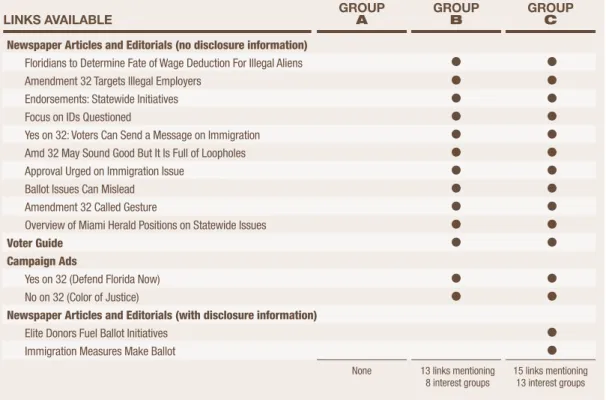
Groups B and C were then presented with headlines that linked to a series of newspaper articles, as well as links to a voter guide and two ad-vertisements.47 When a respondent clicked on any link, the entire document appeared on the screen. Figure 1: Information Available to Groups A, B and C
Figure 1 illustrates the information available to groups B and C. Group B was given access to 10 newspaper articles (randomly selected from
those in the Colorado ballot issue study)48, a voter guide based Colorado’s and fictitious ads from two interest groups. Group C could access Newspaper Articles and Editorials (no disclosure information)
Floridians to Determine Fate of Wage Deduction For Illegal Aliens Amendment 32 Targets Illegal Employers
Endorsements: Statewide Initiatives Focus on IDs Questioned
Yes on 32: Voters Can Send a Message on Immigration Amd 32 May Sound Good But It Is Full of Loopholes Approval Urged on Immigration Issue
Ballot Issues Can Mislead Amendment 32 Called Gesture
Overview of Miami Herald Positions on Statewide Issues Voter Guide
Campaign Ads
Yes on 32 (Defend Florida Now) No on 32 (Color of Justice)
Newspaper Articles and Editorials (with disclosure information) Elite Donors Fuel Ballot Initiatives
Immigration Measures Make Ballot
15 links mentioning 13 interest groups None 13 links mentioning
8 interest groups
GROUP
C
GROUP
B
GROUP
A
the same information as Group B, plus two addi-tional newspaper articles containing information that was almost surely obtained by the reporter through campaign finance disclosure (e.g., the amount of a particular contribution).49
Note that one-sixth of the articles avail-able to Group C are disclosure-related. This far exceeds the prevalence of disclosure-related articles in a typical campaign50 and therefore biases the study in favor of finding positive infor-mational effects of campaign finance disclosure. Thirteen interest groups and their positions on the ballot issue were mentioned in these documents. The names of the groups were usu-ally fictitious but typicusu-ally based on real groups in other states. As shown in Figure 1, Group B’s documents mentioned eight of these groups, while those in Group C could view documents mentioning an additional five.
Once individuals in groups B and C were done reviewing this information, they were prompted to vote on the ballot issue. After vot-ing, respondents were prompted as follows:
Below is a list of groups that have taken or could take a position on this ballot issue. Based on your existing knowledge of the issue, as well as any information obtained during this survey, please assess the likely position of each group on this ballot issue. For each group, the respondents were asked to indicate whether the group supported the initiative or opposed the initiative. Respon-dents could also indicate that they were unsure about the group’s position.
Little Interest in Information,
Particularly Disclosure Information
The first result of the experiment is that respon-dents with access to information about the ballot issue viewed very little of it. About 40 percent of respondents in groups B and C chose not to view any information at all. About 35 percent of those in groups B and C viewed one to three items. Of those who did view information, about
half viewed at least one news article, and about 30 percent viewed the voter guide—the most popular single item. Respondents in groups B and C behaved virtually identically on all of these dimensions. Table 1 provides further de-tails on the number of items viewed.
Since for most ballot issues voters have to make a greater effort to access information about the issue than in a survey setting, these re-sults most likely overestimate the extent to which voters gather information about a ballot issue.
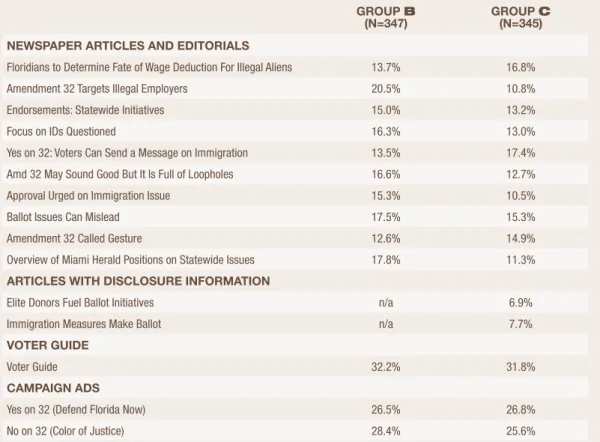
When we break down these actions fur-ther, we learn that campaign finance informa-tion, in particular, is not of much interest to respondents. Table 2 displays the percentage of respondents who viewed each item, by group. Of all items accessible by members of Group C, the two articles that contained campaign finance disclosure information were the least viewed. Since these articles were randomly in-serted into the article list for each respondent, this effect is almost surely not due to place-ment of the articles.
One of these articles was headlined, “Elite Donors Fuel Ballot Initiatives,” which clearly suggests that the story will discuss well-known donors. This is one of the most striking findings of the study. Respondents preferred to read any other material—another news article, a voter guide or an ad—rather than an article featur-ing campaign finance information. It is also telling that virtually no respondents , only about one percent, accessed only disclosure-related information.
Put another way, voters’ “revealed prefer-ences”—preferences shown through actions, not words—are for information that is not based on mandatory disclosure. As with the Carpenter survey, people may say they like information produced from disclosure, but their actions tell a different story. Moreover, respondents who read the “Elite Donors” article read three times more stories than those who did not (5.9 vs. 1.9), suggesting that voters who access campaign finance information are the least likely to need it to make informed choices.
16
GROUP B
(N=347) GROUP (N=345)C
TOTAL ITEMS 0 39.5% 38.7%
1 15.4% 16.5%
2-3 18.1% 20.7%
4 or more 27.0% 24.1%
Average viewed 2.5 2.3
TOTAL NEWS ARTICLES 0 52.1% 49.5%
1 16.6% 18.6%
2-3 17.8% 19.6%
4 or more 13.5% 12.3%
Average viewed 1.6 1.5
VOTER GUIDE Yes 32.2% 31.8%
No 67.8% 68.2%
CAMPAIGN ADS 0 68.5% 70.9%
1-2 31.5% 29.1%
Notes: Group B was provided access to no campaign finance information. Group C had access to this information. Figures, except for averages, are in percentages and sum to 100 within group for each category. Calculations are based on weighted figures.
Table 1: Survey Respondents View Very Little Information about Ballot Issues
Table 2: Survey Respondents are Not Interested in Articles Referencing Disclosure-Related Information
GROUP B
(N=347) GROUP (N=345)C NEWSPAPER ARTICLES AND EDITORIALS
Floridians to Determine Fate of Wage Deduction For Illegal Aliens 13.7% 16.8%
Amendment 32 Targets Illegal Employers 20.5% 10.8%
Endorsements: Statewide Initiatives 15.0% 13.2%
Focus on IDs Questioned 16.3% 13.0%
Yes on 32: Voters Can Send a Message on Immigration 13.5% 17.4% Amd 32 May Sound Good But It Is Full of Loopholes 16.6% 12.7%
Approval Urged on Immigration Issue 15.3% 10.5%
Ballot Issues Can Mislead 17.5% 15.3%
Amendment 32 Called Gesture 12.6% 14.9%
Overview of Miami Herald Positions on Statewide Issues 17.8% 11.3% ARTICLES WITH DISCLOSURE INFORMATION
Elite Donors Fuel Ballot Initiatives n/a 6.9%
Immigration Measures Make Ballot n/a 7.7%
VOTER GUIDE
Voter Guide 32.2% 31.8%
CAMPAIGN ADS
Yes on 32 (Defend Florida Now) 26.5% 26.8%
No on 32 (Color of Justice) 28.4% 25.6%
Notes: Group B was provided access to no campaign finance information. Group C had access to this information. Figures are the percentage of respondents in each group who viewed a given item. Calculations are based on weighted figures.
Figure 2 sums up the first two findings for Group C: Overall, nearly 40 percent of those with the opportunity to view information viewed none, while only 10 percent viewed disclosure information.
These results may explain why research by Carpenter and La Raja found that the media does not often supply voters with campaign finance information.51 Perhaps voters simply do not demand it.
Figure 2: Viewing Choices of Group C:
Little Interest in Disclosure Information
VIEWED ONLY NON-DISCLOSURE INFORMATION
51
% VIEWED DISCLOSURE INFORMATION10
% VIEWED NOTHING39
%Virtually No Marginal Benefit from
Disclosure
Now let’s see how participants did in iden-tifying the positions of interest groups. The simplest way to compare the success rates of groups A, B and C is to compare the average number of interest groups correctly identi-fied by each group. Examining all 13 interest groups, respondents in A and B were virtually identical, correctly identifying an average of 4.8 interest groups. Respondents in Group C, who had access to disclosure-related informa-tion, correctly identified 5.7 out of 13 interest groups.
Seven groups are mentioned in disclosure-related articles, and of these seven groups, five are mentioned only in disclosure-related articles. Examining the seven interest groups
mentioned in disclosure-related articles, respondents in Group A correctly identified 2.7 interest groups, with B respondents identify-ing 2.6 interest groups, and Group C members identifying 3.2 interest groups correctly.
Examining the five interest groups men-tioned only in disclosure-related articles, the as-sociated figures are 2.0, 1.8 and 2.3 for groups A, B and C, respectively. The general pattern, then, is that groups A and B look similar, with Group C having slightly more success.
These results are hardly an advertisement for disclosure laws. Still, disclosure proponents could say that Group C respondents were the best in identifying interest groups, and since Group C members were the only ones with ac-cess to disclosure-related information, it must be disclosure that is producing the results. This turns out to be incorrect.
The reason is simple. While only members of Group C had access to disclosure informa-tion, not all of them actually viewed it—in fact, most did not. To isolate the effect of viewing disclosure information, you have to account for differences in viewing behavior.52
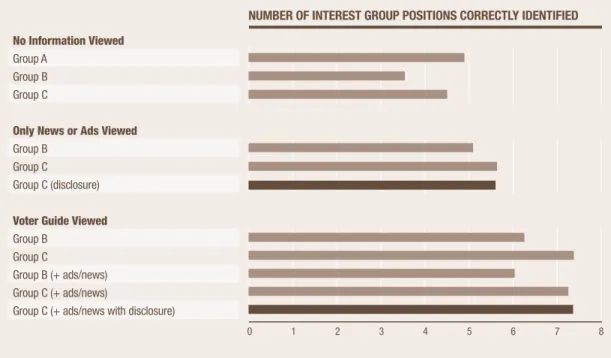
To do this, we can separate members of each group by the kind of information they viewed. In so doing, a very clear pattern emerg-es: Respondents who viewed the voter guide, regardless of what other information they viewed, did the best in identifying the positions of interest groups. Viewing disclosure informa-tion, by contrast, had virtually no impact.
In Figure 3, the first set of bars represents respondents who viewed no information. On average, they correctly identified 4.5 out of 13 groups. The second set of bars represents respondents who viewed only news or ads, and not the voter guide. They correctly identified 5.4 out of 13 groups. The third set of bars represents respondents who viewed the voter guide and possibly other information. They correctly identified 6.7 groups. These differ-ences are almost surely not due to chance. In the language of statistics, they are statistically significant.
18
Moreover, note how imperceptible an ef-fect disclosure information has on the success of Group C members, once the other informa-tion they view is taken into account. The two darker bars in Figure 3 refer to Group C mem-bers who viewed some disclosure-related infor-mation. They sometimes do slightly better, and sometimes slightly worse, than respondents who viewed comparable non-disclosure-related information, but these differences are trivial. In addition, the same pattern emerges if we look only at how well respondents identified
interest groups only mentioned in disclosure-related articles.
In short, once you look at news, ads or, most importantly, the voter guide, there are vir-tually no informational benefits from looking at disclosure-related data. If there are no infor-mational benefits from disclosure-related data, then logically this data cannot have an effect on voter competence. And since improvements in voter competence are the primary justifica-tion for disclosure laws, the case for disclosure is considerably weakened by these findings. Figure 3: Interest Group Position Identification by Information Viewed:
Voter Guide, Not Disclosure, Makes the Difference
No Information Viewed Group A
Group B Group C
Only News or Ads Viewed Group B
Group C
Group C (disclosure) Voter Guide Viewed Group B
Group C
Group B (+ ads/news) Group C (+ ads/news)
Group C (+ ads/news with disclosure)
NUMBER OF INTEREST GROUP POSITIONS CORRECTLY IDENTIFIED
0 1 2 3 4 5 6 7 8
What is the explanation for the minimal effect of articles referencing campaign finance disclosure information on the ability of respon-dents to correctly identify interest groups? First, it may be that news articles simply do not con-vey information in a manner conducive to re-calling the positions of interest groups. Second, and related, the voter guide, which focuses just on the issues and not on other aspects of a
campaign, such as the “horse race” (i.e., who is winning and who is losing), may provide voters with sufficient information to infer the location of many interest groups.
Regardless of the explanation, the results of the experiment should be no surprise, given everything we already know: Disclosure-related information is of little benefit for voters in bal-lot issue campaigns.53
Conclusion
The effects of campaign finance disclosure in ballot issue campaigns have not been exten-sively studied, in part because it is often taken as self-evident that disclosure must have positive informational consequences. This report, how-ever, has established that voters would be just as capable of voting in ballot issue elections if no disclosure of contributions and spending were required. The evidence discussed here includes research conducted by other social scientists, my own original research, and even a simple Inter-net search. The key findings include:
• Voters’ actions reveal that they are not interested in information about who contributes to ballot issue campaigns or the spending patterns of those campaigns.
• Disclosure information does little to help voters once all the other informa-tion available to them in a ballot issue campaign is taken into account. • This lack of informational benefits is
in contrast to the very real costs—in money, in time and in some cases per-sonal safety—disclosure laws impose on citizens who wish to speak out regarding ballot issues.
These findings provide strong justification for jettisoning mandatory disclosure laws for ballot issue campaigns. So, what would a world without mandatory disclosure for ballot issues
look like? Disclosure advocates fear a world of underground groups secretly controlling ballot issue campaigns and voters hamstrung by a lack of information about where interest groups stand on these issues. This report suggests oth-erwise.
There is wealth of information about ballot issues, and interest group positions on these is-sues, readily available to voters without recourse to disclosure information. This could be why vot-ers are uninterested in disclosure information and why the media covers it rarely compared with other stories on ballot issues. Moreover, in-terests have an incentive to reveal their positions voluntarily, in part because if they do not, oppos-ing interests will call their motives and identities into question.
Most importantly, Americans would benefit from the elimination of mandatory disclosure rules. Grassroots campaigns would be freed from burdensome red tape and the threat of legal sanctions for political activity. That means more participation and more debate. People would feel freer to give to their favorite causes without fear of unwanted exposure (or worse).
Surprising as it may seem, the current regime of government-forced disclosure does virtually nothing to improve public discourse on ballot issues. Indeed, disclosure stifles debate by making it harder for people to organize and participate in the process. If, as even disclosure proponents agree, the goal is a freer, more robust democratic process, lifting burdensome disclosure laws is the place to start.
20