P l a n n i n g
Planning for Town Centres
Practice guidance on need, impact and
December 2009
of the publication specified.
Any other use of the contents of this publication would require a copyright licence. Please apply for a Click-Use Licence for core material at www.opsi.gov.uk/click-use/system/online/pLogin.asp, or by writing to the Office of Public Sector Information, Information Policy Team, Kew, Richmond, Surrey TW9 4DU
e-mail: [email protected]
If you require this publication in an alternative format please email [email protected]
Communities and Local Government Publications Tel: 0300 123 1124
Fax: 0300 123 1125
Email: [email protected]
Online via the Communities and Local Government website: www.communities.gov.uk
December 2009
Product Code: 09 PD06151/PG
In March 2009 the Government announced its intention to integrate and streamline substantive national planning policy on economic development set out in draft PPS4 (sustainable economic development), PPS6 (planning for town centres), PPS7 (as it relates to the rural economy) and PPG5 (Simplified Planning Zones). The draft planning policy statement on Prosperous Economies was published for consultation on 5 May 2009. Practice guidance prepared by GVA Grimley was published alongside the draft PPS as a ‘living draft’ to invite comments and suggestions/examples of good practice to support delivery of the town centre policies in the draft PPS. This built on stakeholder consultation and input from leading practitioners. The most recent consultation feedback has been taken into account in the finalisation of this good practice guide.
The practice guidance does not constitute a statement of Government policy. It is guidance to help those involved in preparing or reviewing need, impact assessments and sequential site assessments, and to help the interpretation of town centre policies set out in the PPS. The use of examples in this practice guidance which may be taken from development plans prior to their adoption is without prejudice to the Secretary of State’s consideration of such a plan or her powers in relation to the determination of planning applications under the relevant statutory provisions.
Communities and Local Government is grateful for the contributions that leading practitioners and key stakeholders have made to inform the preparation of this guide, particularly the sounding board.
Part
1: Introduction
5
Part 2: Using evidence for positive planning
9
Part 3: Identifying needs
11
Part 4: Developing town centre strategies
22
Part 5: Supporting evidence in development management
31
Part 6: Sequential site assessments
33
Part 7: Assessing impact
47
Part 8: The effective use of conditions
61
Appendicies
Appendix A: Glossary of terms
63
Appendix B: Quantifying retail need
66
Appendix C: Assessing the scope for other town centre uses
80
Planning policy statement 4 on planning for sustainable economic growth sets out,
1.1
inter alia, the Government’s policy for town centres and main ‘town centre uses’, which include retail, leisure, offices, arts, tourism and cultural activities.
POLICy ObjECTIvES
The Government’s over arching objective is sustainable economic growth. To help
1.2
to achieve this, the Government’s objectives for planning are to build prosperous communities; reduce the gap in economic growth rates between regions; deliver more sustainable patterns of development and respond to climate change; and to promote the vitality and viability of town and other centres as important places for communities.
To do this the Government wants, among other things:
1.3
New development of main town centre uses to be focused in existing centres, •
with the aim of offering a wide range of services to the communities in an attractive and safe environment and remedying deficiencies and provision in areas with poor access to facilities.
Competition between retailers and enhanced consumer choice through the •
provision of innovative and efficient shopping, leisure, tourism and local services in town centres, which allow genuine choice to meet the needs of the entire community (particularly socially excluded groups).
To achieve these objectives, regional planning bodies (RPBs) and local planning
1.4
authorities (LPAs) should adopt a proactive approach to planning for town centres. This will involve identifying the needs of consumers and the requirements of retailers, leisure operators and others proposing development for main town centre uses. They should ensure that suitable sites are identified to accommodate current and anticipated future needs, adopting a sequential approach to selecting sites including, where appropriate, expansion of existing centres.
Too often, the focus has been on using the previous ‘PPS6 tests’ as a development
1.5
control tool. It is right that inappropriate development which is likely to lead to significant adverse impacts should not be permitted, and so the ‘sequential approach’ and the impact test remain key considerations when assessing new proposals. However, experience suggests that the best approach is for LPAs, in partnership with key stakeholders, to actively promote new development of the right scale, in the right place and at the right time as part of an overall strategy and vision for their town centres.
The Government has made a number of revisions to its town centre policy,
1.6
including the removal of the requirement for applicants to demonstrate there is ‘need’ for development proposals that are in edge or out of centre locations and which are not supported by an up to date development plan. However, ‘need’ remains an important consideration when developing of robust town centre strategies, and to the understanding and application of the sequential approach.
ObjECTIvES Of THE PRACTICE GUIDANCE
This practice guidance is not intended to be prescriptive or stifle innovation.
1.7
Rather, it explains an approach that LPAs could take to develop town centre strategies and identify appropriate sites; the role and scope of need and impact assessments and the methodologies that may be employed in carrying out such assessments and the key data inputs, and how to use these to help guide and inform policy and decision making.
The main objectives of the practice guidance are:
1.8
To promote the development of positive strategies to underpin the planning and •
development of town centres.
To provide advice on preparing and understanding need and impact •
assessments to guide the development of effective town centre strategies in plans, and assist in the determination of planning applications.
To illustrate how the sequential approach can be applied when allocating sites in •
plans and assessing planning applications, providing some illustrations of good practice.
To encourage a greater degree of consistency and transparency in terms of the •
approach and key data required to assist those preparing and reviewing need and impact assessments.
USING THE GUIDANCE
The guidance follows a similar structure to PPS4, in order to clearly differentiate
1.9
between the role of need, impact and sequential site assessment in plan making, and the application of the sequential approach and impact tests in the development management process, although in practice a number of the techniques and approaches outlined apply to both.
The guidance does not seek to repeat policy unnecessarily, but recites the relevant
1.10
parts of PPS4 which indicate the role of evidence, and the scope and range of issues which assessments are expected to cover in order to comply with its policies. Section 2 outlines the role of evidence in the plan making process to identify the
1.11
need for new development and prepare proactive town centre strategies. This identifies the main types of assessment likely to be undertaken at the regional and local level to provide the evidence base to support positive planning.
A key component of any positive strategy is to identify quantitative and qualitative
1.12
needs for retail and other key town centre uses. Section 3 considers alternative approaches to assessing needs, and is supported by a separate Appendix.
Section 4 covers the development of effective town centre policies and strategies for
1.13
individual centres.
The best way for local planning authorities to ensure that new development takes
1.14
place where it is needed and as part of a coherent overall strategy is to make positive provision through the regional spatial strategy (RSS)/local development framework (LDF) process. However, recognising the dynamic nature of the sector and the need to adopt a positive approach to new investment, PPS4 sets out clear policies for determining proposals involving town centre uses where these are not identified through an up to date development plan.
Section 5 summarises the supporting evidence which is needed to support
1.15
applications involving town centre uses in different locations. This considers the issue of proportionality, and the role for scoping the range of issues to be covered in studies. Section 6 sets out guidance on how to adopt a sequential approach, drawing on
1.16
examples of good practice to illustrate what is meant by the guidance in relation to the need for flexibility, and the consideration of suitability, viability and availability of alternative sites.
In Section 7 the guide sets out approaches to assessing impact, against the main
1.17
considerations identified in PPS4, again supported by a separate Appendix. Finally, Section 8 sets out practical guidance on the use of planning conditions for
1.18
WHO SHOULD READ THE PRACTICE GUIDANCE?
The guidance is intended to help applicants, RPBs and LPAs to develop their
1.19
evidence base and prepare town centre strategies. It will also assist developers, retailers and other key town centre users preparing applications involving town centre uses, and assist local planning authorities, government offices and planning inspectors when considering these types of applications. It is also intended to support other parties, including local communities and others affected by proposals to “De-Mystify” some of the approaches and terminology used in such applications. For those involved in preparing RSSs and LDFs, Sections 2, 3 and 4 will be
1.20
particularly relevant. However, if local authorities are considering allocating sites for new development involving main town centre uses, they should also adopt a
sequential approach, and may in some cases be required to consider the impact of such allocations (i.e. Sections 6 & 7).
For applicants, the starting point for any assessment should be the development
1.21
plan. However, where proposals are not in a town centre, and are not in accordance with an up to date development plan, Sections 5, 6 & 7 set out guidance on the key evidence which will be required to support their application, and provide more detailed guidance on how to adopt a sequential approach and assess the impact of proposals where an assessment is required.
THE STATUS Of THE PRACTICE GUIDANCE
This practice guidance supports the implementation of national policy. However,
1.22
the guidance does not constitute a statement of government policy, nor does it seek to prescribe a single methodology, or data sources. Alternative approaches may be equally acceptable, provided they are compliant with national policy objectives and clearly justified, transparently presented and robustly evidenced. However, as a guide to interpreting how policy should be applied, this practice guidance may also be material to individual planning decisions.
The practice guidance is supported by a number of technical appendices. It
1.23
incorporates case studies throughout to illustrate some of the points made, although these are not necessarily the best only examples, and every case should be assessed on its own merits based on local circumstances. A glossary of terms used in the practice guidance is provided in Appendix A, which is intended to supplement the key definitions set out in Annex B of PPS4.
Policy EC1 of PPS4 highlights the crucial role of an up to date and sound evidence
2.1
base to plan positively for town centre uses.
At the regional level, the evidence base should assess, inter alia; the overall need for
2.2
main town centre uses, focusing on comparison retail, leisure and office development for five year periods, having regard to the need for major town centre development of regional or sub regional importance and to the capacity and accessibility of centres. The evidence at the regional level should identify any deficiencies in the network of ‘higher order’ centres where a need for growth has been established, and identify locations of deprivation to prioritise for remedial action.
At the local level, Policy EC1 advises that the evidence base should be informed by
2.3
regional assessments, and should assess the detailed need for floorspace for main town centre uses. This includes identifying any deficiencies in the provision of local convenience shopping and other facilities which serve peoples day to day needs. The evidence base should also assess the capacity of existing centres to accommodate new town centre development, taking account of the role of changes in the hierarchy and identifying in centres in decline where change needs to be managed.
When assessing the need for retail and leisure developments, LPAs are advised to:
2.4
Take account of the quantitative and qualitative need for different types of retail •
and leisure developments.
In deprived areas, which lack access to a range of services and facilities, give •
additional weight to meeting these qualitative deficiencies.
When assessing quantitative need, have regard to relevant market information •
and economic data.
When assessing qualitative need, assess whether there is provision and •
distribution of shopping and other services which allow genuine choice to meet the needs of the whole community; and take into account the degree to which shops may be overtrading and whether there is a need to increase competition and retail mix.
Policy EC3 deals with planning for centres. This sets out the respective roles of
2.5
RPBs and LPAs, as part of their economic vision for their area, to set out a strategy for the management and growth centres over the plan period. RPBs should focus on higher level centres and provide a strategic framework for planning centres at local level.
Policy EC3 clearly differentiates between the role of regional/sub-regional
2.6
assessments, undertaken to address strategic issues, and the more locally based assessments typically undertaken by LPAs to assist in the preparation of their LDF. The policy provides a useful checklist to determine the scope of such assessments, although they should be tailored to the specific circumstances and issues facing the area.
Reflecting the importance attached to developing positive strategies, and promoting
2.7
choice and competition, Policy EC4 reinforces the government’s key policy objectives, and sets out some of the issues which should be taken into account in preparing and evaluating alternative town centre strategies and translating these into their LDF.
A key component of the town centre strategy is the identification of sites to
2.8
accommodate new development, where needed. This includes opportunities to expand the centre, which may entail expansion of the primary shopping area, as well as opportunities for redevelopment and replacement of outdated facilities. Policy EC5 sets out the approach which LPAs should adopt to identify sites. The next section of the guidance describes how to assess the need for retail and
2.9
other town centre uses, which is central to the requirements of Policy EC1, and should underpin the detailed policies of the RSS and LDF addressing the range of issues (where relevant) identified in Policies EC3 and EC4. Practice guidance on the identification of sites in accordance with Policy EC5 is set out in Section 4.
As Policies EC1 and EC3 make clear, an up to date assessment of the need for
3.1
additional, or replacement floorspace to accommodate key town centre uses is a fundamental component of the evidence base to underpin policy making at the regional and local levels.
Conventionally, the need for town centre uses is considered in terms of ‘quantitative
3.2
need’ and ‘qualitative need’. Both have a role to play in reaching an overall
judgement about the scale and form of development which should be planned for and facilitated through development plans:
Quantitative need
• is conventionally measured as expenditure capacity, i.e. the balance between the turnover capacity of existing facilities and available expenditure in any given area. Expenditure capacity, or ‘quantitative need’ can arise as a result of forecast expenditure growth (either through population growth or increases in spending), or by identification of an imbalance between the existing facilities and current level of expenditure available in an area. Qualitative need
• , on the other hand, includes more subjective measures. These include, for example, consumer choice, the appropriate distribution of facilities and the needs of those living in deprived areas. ‘Over trading’ is also identified as a measure of qualitative need, although evidence of significant over crowding etc. may also be an indicator of quantitative need.
When assessing town centre needs, ‘quantitative’ and ‘qualitative’ needs are therefore
3.3
closely related and in the case of non retail needs, (considered later), the focus tends to be on qualitative considerations. In the case of retail needs, reflecting common practice, the approach to assessing each element of need is considered separately. ‘Quantitative’ needs tend to be expressed as ‘additional’ floorspace, although in practice, in order to promote the objectives of an efficient, innovative retail sector, it may be equally or more important in some cases to secure replacement of outdated facilities which would be a ‘qualitative’ need.
QUANTITATIvE RETAIL NEED
A detailed description of the key steps common to most quantitative need
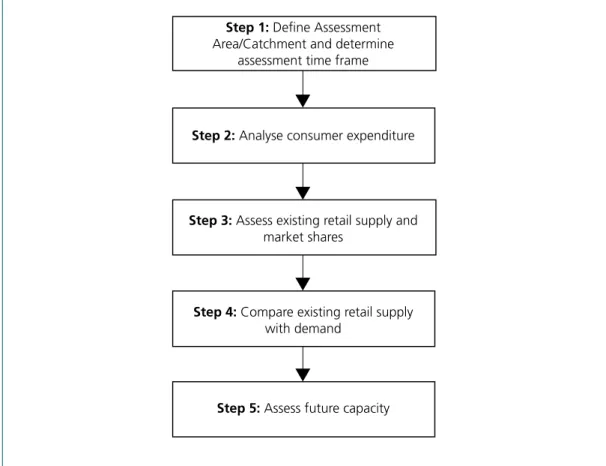
3.4
assessments is set out in Appendix B. While it is mainly used in respect to retail needs, the general principles can be applied to many types of leisure provision and other ‘town centre’ uses (see later). The five key steps are:
Definition of the catchment/study area. •
Assessment of current/future spend. •
Assess current shopping patterns/market shares. •
Compare current/forecast turnover with existing floorspace. •
Identify future expenditure capacity and need for new floorspace. •
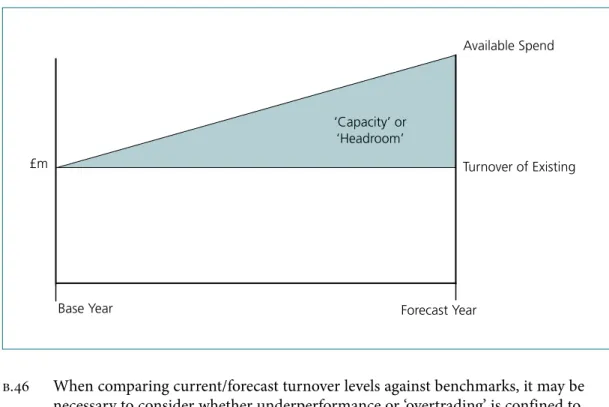
It is evident from the indicative approach outlined in Appendix B that three key
3.5
variables, each involving judgements, will influence what if any need is likely to arise over the study period:
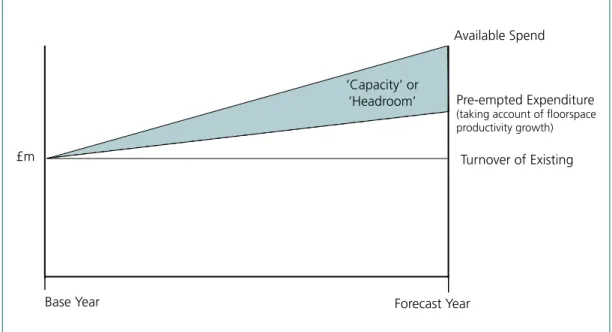
Apportioning growth
• . When assessing future needs, based on forecast spending growth, a judgment is needed as to what (if any) proportion of forecast
spending growth (after deductions likely to be accounted for by special forms of trading) is likely to be available to support more floorspace, and how much can or should be safeguarded to enable existing floorspace to increase sales per sqm. This may have a bearing on the potential to refurbish and replace existing stock as an alternative to new development.
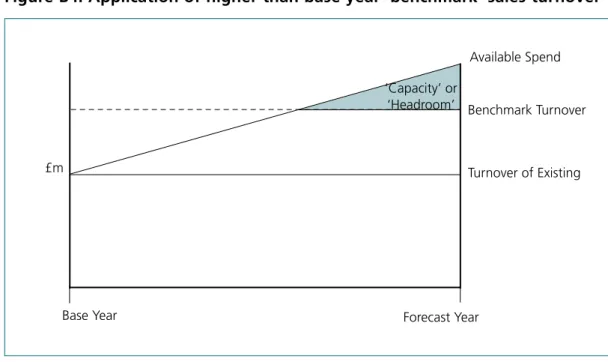
Existing ‘baseline’ performance
• . A judgment must be reached based on the
current balance between the turnover of existing facilities and their floorspace (i.e. in retail terms, their turnover per sqm) to determine whether (at current sales) there is any need for more floorspace. In practice at the base year existing facilities may be underperforming or trading at high levels suggesting an existing surplus, which has a key bearing on whether any further need arises. Changes to market share
• . In the case of any centre, when considering alternative strategies it may be relevant to examine the implications of a declining market share, or to test the potential to increase market share. Forecasts are often based on the assumption that all centres simply retain their current market share, to preserve the ‘status quo’, but if a new development secures an increased share of available spend, in theory more floorspace would be supportable.
Where there are significant development opportunities identified, there may be
3.6
scope to increase the market share of an existing centre, or to plan for new/ expanded centres in order to recapture a higher proportion of current/future spending generated in an area. This may apply in circumstances where there are major new residential developments planned, and/or existing under-served markets, or where a particular centre has potential to expand to enhance its role within the wider hierarchy. This may be justifiable in order to deliver a more sustainable network of ‘higher order’ centres, and ‘claw-back’ arguments are frequently used to underpin strategies for different centres/areas.
However, in developing the appropriate approach a number of factors need to be
3.7
borne in mind:
There is a substantial body of research to suggest that the UK has seen a •
polarisation of activity to fewer, larger centres, which the ‘status quo’ approach may perpetuate. It may be more appropriate in some cases to seek to redirect growth to smaller centres (where they have the capacity/demand) to achieve a more sustainable network of centres to serve local needs. However, this depends on the availability of suitable opportunities in such centres.
Infrastructure capacity and the availability of central sites will determine the •
extent to which different centres are capable of accommodating future retail and other main town centre uses. This may suggest that a more sustainable
alternative is to elevate the role of an existing centre within the network or hierarchy to accommodate growth where a suitable central opportunity exists. The maintenance of current market shares may perpetuate deficiencies in the •
retail network, particularly in underserved markets. A low market share (or expressed differently, a significant expenditure ‘leakage’) may be indicative of a need for more or better shopping provision. An appropriate retail strategy may be to seek to enhance the market share of some centres, and to relieve pressure on others where there are limited opportunities for further development. This illustrates the importance of qualitative factors (see later).
Existing out of centre developments may account for a significant share of •
available expenditure, but it would not necessarily be appropriate to plan for further growth at existing successful out of centre locations where these locations do not meet other key policy objectives e.g. accessibility etc. In these circumstances, it may be appropriate to proactively plan to reinforce the offer of other existing centres in order to ‘recapture’ market share from less sustainable retail locations.
There may be circumstances where it is appropriate to plan for a new town, •
district or local centre; for example where new housing development is planned, where it will be necessary to judge the scale of new developments appropriate and level of market share it would be expected to capture. An approach based on constant market shares would simply assume that this additional demand would be met by the existing network of centres and facilities, which may be less sustainable.
What these points illustrate is that while it may be appropriate to factor in changes
3.8
to market shares when judging future needs, to achieve potential benefits, the impact of such changes (both positive and negative) needs to be considered carefully.
A similar approach could be applied at the local level, for example, to evaluate the
3.9
implications of defining a new district centre or of focusing growth in a key town centre. At the more local level, it will be necessary to look in more detail at local shopping patterns as well as forecasting spending growth over shorter periods, together with considering carefully the phasing of planned housing growth.
Case Study: RSS1 Phase 1 Review of black Country Strategic Centres Assessing Shopping Needs at the RSS Level
Following the unplanned evolution of Merry Hill as an out of town regional shopping centre during the 1980s, it became apparent that as the centre continued to evolve it was supplanting the role of Dudley as a strategic town centre within the sub-regional hierarchy. Proposals to extend the shopping centre were considered at a planning inquiry in the mid 90s and rejected on the basis that any new development of the centre should be considered as part of a review of its role, through the regional spatial strategy.
This issue, and the wider role of the other strategic Black Country Centres; Walsall, West Bromwich and Wolverhampton, was considered in detail in a study of the Black Country Strategic Centres which informed a review of the regional spatial strategy. The study identified global forecasts of comparison retail and other key town centre needs over the period up to 2021 and beyond, and evaluated alternative options for accommodating development within the strategic and other centres. This study set out the evidence base to inform the RSS strategy to develop a polycentric network of four strategic centres, including the designation of Brierley Hill (formerly Merry Hill) as a new strategic centre. This issue was discussed at an examination in public and is now incorporated into the RSS.
Subsequently, a Phase II review of the West Midlands RSS has included updated capacity projections for higher order comparison floorspace needs in the defined strategic centres, and an additional updated needs assessment has been undertaken jointly by the four Black Country Authorities, building on the strategic ‘Black Country Centres’ Study to set out the evidence base for developing detailed town centre strategies and policies for the other i.e. non strategic town centres in a joint core strategy and individual AAPs.
QUALITATIvE RETAIL NEED
Qualitative need is a more subjective concept. Five factors are frequently identified,
3.10
although others may be relevant.
Deficiencies or ‘gaps’ in existing provision •
Consumer choice and competition •
Overtrading, congestion and overcrowding of existing stores •
Location specific needs such as deprived areas and underserved markets, and •
The quality of existing provision •
(a) Deficiencies or ‘gaps’ in existing provision
This involves identifying the existing pattern of retail provision, taking account of
3.11
retail catchments and levels of accessibility so as to identify ‘gaps’ in the network of centres or the provision of different types of facilities (e.g. local shops, food
superstores, department stores or other key shopping facilities). A good example is in London, where this type of analysis was used to identify ‘gaps’ in the network of metropolitan centres.
This type of exercise can form an important component of a needs assessment,
3.12
particularly for establishing standards of accessibility to different types of key facility. For example, it can be useful in identifying deficiencies in local food shopping or other local facilities e.g. post offices etc. However, it is of limited value when considered in isolation, as it takes no account of demand or expenditure capacity. The realism and impact of achieving predetermined standards of provision also needs to be considered.
Case study: London metropolitan centres – gap analysis
The plan below illustrates the primary and secondary retail catchment areas of defined metropolitan centres as originally identified in the London Plan, based on household survey data. This graphically illustrates the extensive catchments of Bromley, Croydon and Kingston, and the much more narrowly defined catchments of centres like Ealing and Wood Green. It is evident that Brent Cross, in Northwest London, is strategically located within a gap in the existing network, which reinforces the case for the centre becoming a new metropolitan centre.
Similarly, in East London the relatively limited catchment of Ilford and the strategic gap in the catchment of defined metropolitan centres supports the development of Stratford into a new metropolitan centre. This type of analysis can be undertaken at various levels, for example to identify the catchment areas of market towns or district centres, or even local convenience stores, to highlight areas which are relatively poorly served.
(b) Consumer choice and competition
The Government is strongly committed to promoting consumer choice and
3.13
competition as part of its approach to town centre development. Competition between firms increases choice for consumers, and can result in productivity and efficiency gains, which in turn lowers the price of goods and services. Competition for consumer expenditure and investment between centres (and between centres and out-of-centre retail development) is a key challenge when planning for new development in town centres and making strategic choices about where to allocate new floorspace.
Healthy town centres need to have a ‘critical mass’ and diversity of retail
3.14
development to attract consumers on a regular basis throughout the year. To remain competitive, they need a good mix of different types of multiple and independent retailers. This can include specialist shops and niche retailers, providing quality retail space that offers sufficient product ranges to meet the requirements of the local catchment. This core retail offer may be reinforced by a range of tourism, leisure and cultural activities.
LPAs can use their LDFs to support the diversification of town centres by providing
3.15
more choice and competition. However, there are three important considerations: Whilst planning can secure specific sizes of unit or types of use, it cannot be •
used to give preference to one retailer over another. Similarly, it should not be used to restrict competition or preserve existing commercial interests. This includes restricting occupancy of premises to specific retailers; restricting the rent of premises; controlling the price of goods sold or the change of use from one type of shop to another within the same use class.
The positive effects of providing more choice and competition should always be •
balanced against any adverse impacts. For example, where a development is on the edge or out-of-centre, care needs to be taken not to promote new or
improved facilities simply on the basis of fostering choice or competition where there is insufficient quantitative need and the development may undermine investment or harm the vitality and viability of a nearby town centre.
Conversely, there may be circumstances where a lack of quantitative need may •
be offset by choice and competition considerations. For example, a development on the edge of an existing centre may provide additional choice and
competition, be consistent with sustaining and enhancing the vitality and viability of the centre, and be supported by a robust impact assessment which shows a diversion of expenditure from less accessible out-of-centre locations to a more accessible edge-of-centre location. This is exemplified by the Beverley case study.
Case study: beverley – Cattle Market site – promoting choice and competition
In Beverley, the principal town of East Yorkshire, a new 3,000 sqm Tesco superstore with shoppers’ car park was built in 2002 on the site of the old cattle market, a well-integrated edge-of-centre site. The town centre had an out-dated Safeway foodstore, and a large Morrisons at an out-of-centre location was causing significant leakage of convenience expenditure from the town out-of-centre. Qualitative need was demonstrated on the basis that there was already a strong out-of-centre foodstore provision and that a more centrally located option would reduce the need to travel and provide more choice in the town centre.
Following the store opening the Council commissioned the Beverley Retail Study in 2003 to assess the positive and negative impacts
of the new store and the health of the town centre. The study found that the new store had made a positive contribution to the health of the town centre, increasing the attraction of Beverley as a place to shop and reducing the leakage of trade out of the town centre. This is an example of a successfully well-integrated edge-of-centre development (aided by the use of the store car park for town centre shopping), located within walking
distance of the town centre that has encouraged linked-trips to other shops and services, increasing choice and competition in the town centre.
(c) ‘Overtrading’ congestion and overcrowding of existing stores
The extent to which the turnover of existing stores significantly exceeds benchmark
3.16
turnovers may be a qualitative indicator of need, and can in some cases inform quantitative need considerations. For example it may be an expression of the poor range of existing facilities or limited choice of stores and a lack of new floorspace within a locality.
Overtrading is often regarded as an indicator of qualitative need as it is
3.17
demonstrated by overcrowding/congestion. However, as the Kidlington case involving an extension to an overtrading Sainsbury’s store established, it is also an indicator of quantitative need. The case established that overcrowding/congestion indicates the existing provision is unable to cope adequately with consumer demand. In other words ‘overtrading’ occurs when there is an imbalance between demand (i.e. available spend) and supply (i.e. existing floorspace capacity).
Case study: Kidlington – Issues of overtrading
The concept of overtrading has been the subject of significant debate, and was a key issue in the proposal to extend a busy out of centre Sainsbury Superstore on the edge of Kidlington in
Oxfordshire. At the planning inquiry, it was agreed that the store was trading significantly above the company average, and was experiencing congestion and overcrowding, both of which were felt to be indicators of overtrading.
After a series of legal challenges, it was agreed that overtrading can be a measure of both qualitative need, and quantitative in as far as it can be an indication of an imbalance between demand and supply of floorspace in an area. However, the term overtrading is still frequently misunderstood, and where existing services are claimed to be overtrading this should be backed up by corroborating evidence such as overcrowding and congestion rather than simply by comparison with a retailer’s company average turnover.
(d) Location specific needs-deprived area considerations
National policy encourages local planning authorities to promote social inclusion
3.18
and address deficiencies in the existing network of centres, and areas with poor access to local shops and services while key deprivation indicators in the catchment area the proposal is intended to serve, including unemployment levels, mobility and incomes, are not necessarily in themselves indicators of retail need. However, when considered together with other indicators, such as a limited choice of facilities, these may reinforce need for improved facilities in the area. Particular attention should be given to this measure where proposals are likely to bring significant
improvements to the range, choice and quality of everyday shopping to serve the needs of those living in deprived areas. The Indices of Multiple Deprivation provide a useful measure of deprivation.
Case study: Retail-led regeneration
BITC and BCSC have recently published research into Retail-led regeneration: Why it matters to our communities which provides a useful examination of the role of retailing in revitalising communities. The research is based upon five case studies which indicate that retailing is improving communities with the following main impacts:
Accessibility to jobs and training for local people
Living in neighbourhoods
Better quality of life
Improved pride of place Accessibility Connectivity
Better integration and cohesion
Cleaner and safer environment
Opportunity for/supporting SMEs and local business
In measuring impact each of the case studies examines three key areas: economy, people, and place and infrastructure. Each includes different measures as follows:
Economy
• Employment – Number of new jobs created, proportion from local area. • Skills – Training and work experience schemes offered.
• Visitor spend – Extent to which development will reduce trade leakage
• Opportunities for supporting local businesses – Scope for securing commercial opportunities for local businesses.
• Inward investment – Extent to which additional new development will be encouraged.
People
• Quality of life – Type of retailers to be introduced to an area, range of uses to be provided, employee initiatives such as job aftercare service, child care provision.
• Community – Range of initiatives engaging the community in the new development, investment in community projects, healthcare improvements.
• Living in neighbourhoods – Extent to which new development will encourage population growth. • Young people – Activities offered for young people.
Place and infrastructure
• Environment, cleanliness and safety – Extent to which new development involves re-use of derelict land, recycling, innovative design, improvements to public realm.
• Accessibility – Amount of new infrastructure provided by new development. • Connectivity – Linkages and integration with existing facilities.
• Pride of place – Introduction of crime partnership, CCTV. • Public image – Improvement in the public perception.
(e) The quality of existing provision
While the quality of existing provision is highly subjective, and may include
3.19
management issues which are outside the scope of planning, the age, condition and layout of existing facilities are relevant considerations. This may include assessing whether existing facilities meet operators’ requirements or consumer expectations. For example, modern retailers often require longer units, with good servicing and regular, efficient trading floors. Where the quality of existing provision does not match occupier requirements, this will usually be corroborated by indicators, such as high levels of vacancy and significant ‘leakage’ of trade to other (more distant) centres.
There has tended to be a preoccupation with quantitative forecasts of need for
3.20
additional floorspace, based on expenditure growth. In practice, the evidence suggests that even during the recent years of sustained spending growth, there has been a contraction of retail floorspace and shop numbers in many centres. Retail activity, in particular, has continued to shift towards new efficient floorspace, both out of town and in town, which is capable of meeting modern retailer requirements. In these circumstances, even if there is limited quantitative need for additional floorspace, it is important that town centres continue to provide modern, quality retail and other facilities in order to remain competitive, innovative and efficient.
OTHER TOWN CENTRE USES
National policy recognises the contribution which other (non-retail) main town
3.21
centre uses make to vital and viable centres, and local authorities are urged to adopt positive strategies to promote commercial leisure and other main town centre uses within their existing centres. Many of the quantitative and qualitative considerations outlined above can be applied to assessing the potential for promoting leisure and entertainment, offices and arts, culture and tourism.
The requirement for new hotels, bars/restaurants, cinemas, bowling alleys,
3.22
commercial health and fitness clubs and casinos all relate to the level of available spending/demand, and include both quantitative and qualitative considerations. The scope to support existing and new development of these types of uses is ultimately governed by available expenditure and consumer demand. Local planning authorities should consider the scale of new development likely to be supportable and the most appropriate location, and wherever possible proactively plan to accommodate new development.
Appendix C sets out in more detail some of the considerations which apply when
3.23
assessing the scale and form of new leisure and other main town centre uses likely to be supportable, to assist in the preparation of positive planning strategies. In addition to considering quantitative measures, local planning authorities should also consider the quality of facilities currently available, and new trends and market opportunities to provide for more choice, quality and accessibility.
Residential uses and commercial offices can also both perform an important role in
3.24
maintaining and enhancing the vitality and viability of town centres, and should be considered as part of a proactive planning approach for town centres. Encouraging people to live and work in existing centres reinforces local demand and provide additional vitality during the day and in the evening. However, local planning authorities need to recognise and balance the scale and nature of demand for residential and office uses within existing town and city centres, and the
requirements for other land uses. There is existing national guidance in respect to assessing the availability of sites for housing and economic development purposes.
There are many examples of the benefits which positive planning for retail led and
4.1
other mixed use developments in town centres have delivered. A common feature of most of these projects is that they have formed part of an overall strategy, promoted through the planning process and other parallel initiatives. In most cases, they have been promoted by a public/private partnership and have involved the development of a supportive planning framework, and proactive measures to secure developer interest and assemble the site.
Not all of the successful town centre regeneration projects have been retail led, or
4.2
involved significant new development. Experience suggests a range of measures, including active management and promotion, public realm improvements, and access and public transport improvements and other measures promoted through partnerships and in some cases business improvement districts can all play a key role. Bodies such as the Association for Town Centre Management (ATCM) have produced extensive work in this field. London First recently produced good practice guidance on securing diversification in London’s centres.
Guidance on the preparation of effective town centre strategies is beyond the scope
4.3
of this practice guidance. Existing good practice guidance such as Vital and Viable Town Centres – Meeting the Challenge provides a good starting point. The research programme of bodies such as Business in the Community (BiTC) and the British Council for Shopping Centres (BCSC) provide good practice on retail led town centre regeneration.
This section of the practice guidance explains how LPAs and key stakeholders can
4.4
plan positively and promote new retail-led and other town centres uses through their LDFs. Building on the assessment of needs, outlined in the last section, it sets out the ‘tools’ needed to prepare effective town centre strategies, including how to identify appropriate locations, and how to assess the effects of alternative policy options and specific proposals. Exeter provides a good example of the benefits of adopting a clear strategy, to facilitate new development.
Case study: Princesshay, Exeter – Positive planning for town centre development
Exeter City Council had long-term aspirations for the redevelopment of the Princesshay area of the city. This was taken forward through the development plan which stipulated that Princesshay was to be redeveloped for mixed-use. When Land Securities demonstrated their intention to press ahead with a scheme the project proceeded along a development partnership approach with frequent and regular meetings between the council and Land Securities’ design team. These meetings sought input from the consultation bodies such as English Heritage.
Firm redevelopment principles were set out including enhancing Exeter’s unique and historic character, commitment to encouraging high quality architecture, promoting a fully pedestrian environment, and achieving satisfactory access for all transport modes. This approach ensured the scheme was policy compliant and designed to meet the council’s vision for the development of the area.
The scheme opened for trading in
September 2007 and was 95 per cent let. It is a sophisticated scheme built within the established grain of the city. Debenhams anchors the southern end of the scheme while a cluster of established fashion retailers with large floorplates combine to anchor the northern end. The scheme inlcuded 14 retail units set aside for independent retailers, for which there was much competition. The scheme has won several awards, including awards from the RTPI and BCSC.
DEvELOPING AN APPROPRIATE STRATEGy
To be appropriate and deliverable, the strategy needs to be based on sound
4.5
evidence, which demonstrates an understanding of the existing situation, and the potential and opportunities for change. Building on the assessment of need for retail and other key town centre uses, four common steps can be identified:
An audit of existing centres, to identify their current role, their vitality and •
viability, and their potential to accommodate new development and/or change, having regard to identified needs.
Consideration of alternative centres and/or sites and development opportunities •
to accommodate new development (in existing centres or in new/expanded centres) and to consider the potential roles of different centres.
Based on the above, an evaluation of alternative policy options to accommodate •
growth and/or plan for change.
Developing the strategy and policy formulation through the RSS/LDF in •
accordance with the principles set out in PPS12.
AUDIT Of ExISTING CENTRES
It is a prerequisite for any town centre strategy to have a clear understanding of the
4.6
scale and quality of existing provision of retail and other key town centres uses; the network and role of different centres; and their vitality and viability and how it has changed over time. National policy sets out how town centre ‘health checks’ can be used to measure vitality and viability. Linked to this, Vital and Viable Town Centres; Meeting the Challenge (DoE 1994) provides useful additional guidance for assessing the role and potential of centres. Other useful sources include Looking after our town centres (DCLG) and Vitality and Viability: The Role of the Healthchecks (NRPF). One of the key objectives of regular monitoring and town centre health checks (in
4.7
addition to providing important baseline data for retail/town centre assessments) is to consider a centre’s performance over time. It will also be relevant to consider how the centre has performed relative to national trends, and to similar sized centres elsewhere. This type of analysis provides an important insight into whether the centre is improving, stable or declining, and will have a bearing when considering the potential/need for new development and the likely impact of new developments. Retailing and leisure are particularly dynamic sectors, and a range of factors,
4.8
including economic and social trends and new technology can have a significant impact on the current and future role of existing centres and the scope for new ones. These factors need to be taken into account when considering future needs, identifying sites and strategies, and assessing the impact of new development. However, it is also relevant to consider long term trends and to provide robust, policies to provide investor confidence and certainty given the complexity and scale of many town centre development projects.
ALLOCATING SITES TO ACCOMMODATE TOWN CENTRE
NEEDS
A key component of a proactive approach to meeting town centre needs is the
4.9
identification of appropriate sites together with policies to bring forward new development. Where local authorities have identified quantitative and/or qualitative needs for retail and other main town centre uses, they should activelyexamine existing and potentialsites within centres, or on the edge of defined town centres. Also, they should consider the scope to expand existing centres and promote new ones.
Complex town centre sites can take 10-15 years to bring forward or even longer in
4.10
some cases. Local planning authorities should identify sites that are (or are likely to become) available by adopting proactive approaches, which may involve examining where existing town centre developments are under-used or approaching the end of their economic life. Older premises are often unsuited to modern retailing
requirements. This may be apparent from high vacancy levels, and evidence that centres are failing to maintain their market share relative to competing destinations. A good example is Festival Place in Basingstoke, where the former New Market
4.11
Square area was redeveloped as part of a seamless extension to the Walks Shopping Centre. More examples, and further detailed guidance is set out in Section 6.
Case study: festival Place, basingstoke
In the early 1990s Basingstoke and Dean Borough Council commissioned a retail study which identified scope for new development, and highlighted the ‘New Market Square’ area of the town centre as a potential opportunity to meet the need for additional better quality comparison shopping and leisure facilities. New Market Square was an outdated open precinct, originally developed in the 1970s and was characterised by poor quality, under used buildings and high levels of vacancy.
Following a development competition, the council appointed the Grosvenor Estate as its development partner to redevelop the New Market Square area, and Grosvenor subsequently acquired the adjoining Walks Shopping Centre in order to develop a seamlessly integrated extension to the centre, attracting new anchor retailers and leisure facilities which have transformed the performance of Basingstoke Town Centre, attracted new retailers and recaptured trade which was leaking from Basingstoke’s core catchment to competing centres.
IDENTIfy AND EvALUATE ALTERNATIvE TOWN CENTRE
POLICy OPTIONS
Having identified the expenditure capacity/demand which exists within the area or
4.12
centre in question, considered qualitative needs, and reviewed current and potential sites, the next critical stage of preparing an effective town centre strategy is to identify the policy options for development. This will involve identifying different
centre’s strengths/weaknesses, opportunities and threats. The outcome of this exercise will be to identify what scale and form of development is likely to be supportable in different locations, including the scope to enhance the role of existing centres, to expand or create new centres, and where appropriate, to plan for diversification and manage decline.
A key element of developing and evaluating policy options is to understand the
4.13
implications of alternative policy choices. For example, where potential exists to expand the role of a particular centre, and to seek to increase its market share and reduce ‘leakage’ of expenditure, it will be necessary to understand the implications for neighbouring centres in terms of their current or potential role. If there is insufficient expenditure capacity or demand to support development of all the identified opportunities, it may be necessary to review the pros and cons of each option, and to weigh their relative merits in reaching a decision. This may involve choices between the development of one opportunity or another, or may lead to a strategy to phase new development, and to identify priorities.
In every case, it is essential that in reviewing alternative options, careful regard is
4.14
had to their suitability, viability and deliverability. This will normally involve early engagement with retailers and other key town centre occupiers, developers, investors and other key stakeholders. Experience suggests that the most effective town centres strategies are able to harness the value created by main town centre uses, in particular retail, to deliver a wider range of regeneration benefits including improvements to accessibility, public realm and the ongoing management and promotion of the centre.
At the policy formulation stage, it may be useful when evaluating options to prepare
4.15
a matrix, as a means of ‘scoring’ alternative options against national, regional and local policy objectives and priorities. For example, having identified a ‘need’ for new development in its area, a local planning authority may wish to evaluate how best to plan to accommodate this need within a network of centres. In this example a simple matrix may be useful to assess different options having regard to, for example:
Which option secures the maximum investment within existing centres, and the •
wider socio-economic benefits of different options.
What distribution of new development is likely to contribute to an effective •
network and hierarchy of centres, and promote sustainable shopping patterns. Which centres(s) are most likely to be able to accommodate new development •
in sequentially preferable locations, and are likely to be most accessible to their current/potential catchments.
Which options are likely to be most consistent with sustaining and enhancing •
At the sub-regional level, the matrix approach was used as part of the West
4.16
Midlands RSS Phase 1 review to develop a number of alternative strategic policy options for a network of strategic centres. This involved exploring the pro’s and cons of maintaining the status quo in terms of the existing network, or seeking to
concentrate development in a number of identified strategic centres. At this level, relevant considerations which might be taken into account in this type of impact evaluation include:
The extent to which alternative policy options are able to accommodate identified •
needs and maximise the scale of new investment within the sub-region. The consequences of concentrating development in a number of centres in •
terms of impact upon other smaller centres within the network.
The range, choice and quality of provision likely to be secured by focusing new •
development into a limited number of key strategic centres, compared with the benefit of focusing growth in a larger number of smaller centres.
The overall effects upon the economic and physical regeneration of the sub-•
region and scale of new development and investment likely to be secured by alternative options.
The overall effect on travel patterns and the extent to which new development •
would be genuinely accessible to the catchment by alternative means of transport.
A similar impact evaluation approach could be applied to LDF preparation to
4.17
provide a more detailed framework for assessing alternative policy options, where appropriate. At this level, it may be appropriate to consider specific allocations and to measure the effects (both positive and negative) of planning to accommodate identified needs in different locations. The designation of Sport City in Manchester, as a new district centre serving an area of high social economic deprivation
provides a good example of using retail demand as a catalyst to meet wider policy objectives.
In evaluating alternative options, RPBs and LPAs will need to reach their own
4.18
judgements as to the weight to be attached to national policy objectives reflecting their own local circumstances. For example, it may be relevant to attach significant weight to the benefits of new development in respect to deprived areas and their contribution to social inclusion and employment, which could outweigh minor impacts on the vitality and viability of a nearby centre. Whatever approach is taken, authorities will need to be transparent as to how they reached their judgements in terms of the weighting to be applied.
DEvELOPING AND IMPLEMENTING THE STRATEGy
Having identified and evaluated the various policy options, RPBs and LPAs should
4.19
develop a clear vision and strategy for the network of centres, and strategies for individual centres. At the regional/sub-regional level this may take the form of a high level policy overview, defining an appropriate hierarchy of centres and setting broad guidelines as to the scale of the floorspace likely to be required.
In terms of the LDF, and in particular the core strategy and area action plans, the
4.20
strategy needs to provide a very clear policy framework to support and actively promote new development. This is likely to include:
Clear guidance on the scale and form of new retail, leisure and other •
development involving main town centre uses which is likely to be appropriate in the centre and/or site in question.
Allocation of sufficient sites to meet identified need for at least the first five •
years of an LDF from its adoption.
Identification of the extent of any key development opportunities, including key •
highway and access arrangements and measures to secure effective integration. A clear statement of the approach to be taken to bringing forward the
•
development, including proposed phasing arrangements and site assembly e.g. compulsory purchase orders (CPO).
The local authority’s attitude to other competing developments, including, for •
example, the approach to ‘piecemeal’ proposals within key development sites, and competing proposals in other locations.
There are numerous examples of successful strategies where local authorities, in
4.21
partnership with developers, have actively promoted major new mixed use
developments through the planning process, supported by the use of CPO powers. In addition to Basingstoke and Exeter, Cabot Circus (Bristol) and High Cross (Leicester) are both award winning exemplar schemes. Liverpool ONE is also a strong example of a successfully planned and implemented strategy for a declining city centre.
Case Study: Liverpool ONE
Liverpool City Centre had experienced a protracted period of decline during the 1980s and 90s which prompted the City Council to commission a study in early 1999 to assess the scale of new development needed, to identify the appropriate location to accommodate new development, and to deliver a clear planning and implementation strategy to bring forward development to reverse the decline of the city centre.
The study identified the need for a significant scale of new development, and evaluated a range of alternative options including a number of then current proposals for edge of centre development. The study concluded that in order to meet the identified needs within the city centre, it would be necessary to extend the main retail area, and identified a site known as the Paradise Street Area which was actively promoted through a planning framework which subsequently fed into a series of urban development plan (UDP) modifications to bring forward a clear policy basis to support a planning application and Compulsory Purchase Order following the council’s appointment of Grosvenor as its development partner.
The award winning Liverpool ONE scheme opened at the end of 2008 and provides an exemplar of seamless extension to the previously tightly defined primary shopping area of Liverpool, linking the retail core to the Albert Dock. The scheme includes retail, cinemas, hotel, offices, cultural facilities and a major new urban park, built over a car park, and has transformed the performance of the centre and formed a catalyst for regeneration of adjoining areas.
Strategies for individual centres can be prepared at any time but they should be
4.22
incorporated into the LDF at the earliest opportunity. This is likely to be important where key site allocations are involved, either through strategic allocations in the core strategy, or through sites allocated in an area action plan or other document. Promoting town centre strategies through the LDF process ensures that the evidence base which underpins the strategy will be properly tested. A strategy which has been progressed through the LDF process, and been subject to effective public and stakeholder consultation and tested through independent examination will carry the weight accorded by S 38(6) of the 2004 Planning Act. In this situation, proposals must be determined in accordance with the plan unless material
As such, the strategy will provide a much sounder basis for potential occupiers,
4.23
developers and investors to make decisions and develop long term plans for the centre. However, the absence of an up to date strategy is not a reason to delay approving applications for appropriate forms of development, in the right locations, and which meet national policy objectives. In these circumstances, proposals involving new town centre uses should be encouraged and supported where they comply with the sequential approach and do not give rise to unacceptable impacts.
MONITORING
PPS4 highlights the importance of monitoring. Policy EC9 advises RPBs and LPAs
4.24
to use their annual monitoring reports to include consideration of the network and hierarchy of centres, the need for further development and the vitality and viability of centres. Regular health checks of centres provides one means of forming
judgements about the impact of policies and developments.
Quantitative need assessments should ideally be updated every five years, to take
4.25
into account changing economic circumstances. However, it is important that these assessments are not used over prescriptively and, taking together with qualitative judgements, they should be used to inform long term decisions. In reality major new development projects in town centres such as Liverpool ONE take many years to reach fruition. They are not based on five or even 10 years growth projections, but once in a generation opportunities for the centres in question. Accordingly, the planning case for such developments is unlikely to be affected by short term fluctuations in growth rates etc.
The use of regular health checks provides a means of monitoring changes over time,
4.26
and provides the local planning authority with a good understanding of the resilience of its centres to change, and to gauge the significance of the impact of new developments. Regular health checks can also help to inform decisions about the extent of the primary shopping and primary/secondary frontages area, for example recognising where the role and function of different parts of the centre have changed over time.
PPS4 says that local planning authorities should adopt a positive and constructive
5.1
approach towards planning applications, and applications that secure sustainable economic growth should be treated favourably. The guidance identifies a number of considerations which will apply to all applications for economic development including, inter alia; their effect on carbon dioxide emissions and climate change; accessibility; whether the proposal secures a high quality and inclusive design, the impact on economic and physical regeneration of the area; and impact on local employment.
This guidance focuses specifically on the additional supporting evidence which will
5.2
be required for planning applications involving town centre uses. This is set out in policies EC14 (Supporting evidence for planning applications for town centre uses), EC15 (The consideration of sequential site assessments) and EC16 (The
consideration of impact for applications that are not in centre and not in accordance with an up to date development plan).
THE KEy POLICy REQUIREMENTS
The policy requirements for supporting evidence to accompany applications for
5.3
proposals involving main town centre uses of different scales and in different location are set out in Policy EC14.
THE SEQUENTIAL APPROACH
Where a sequential site assessment is required by Policy EC14, the policy
5.4
requirements for that assessment are set out in Policy EC15. The same general principles will apply if local planning authorities are proposing to allocate sites for main town centre uses which are not in an existing centre. Detailed guidance on the application of the sequential approach as required by Policy EC15 is set out in Section 6.
It is evident that significant weight is attached to the outcome of the sequential site
5.5
assessment and impact assessment. However, it is still for the decision maker to judge the extent to which the applicant has demonstrated compliance with the sequential approach, and what constitutes a ‘significant’ adverse impact, based on the circumstances of each case.
The sequential approach forms a key policy consideration, and can in itself be a
5.6
clear reason for refusal. As such it is critical that applicants carry out a thorough assessment to explore alternative options, and that if more central opportunities are rejected, it is for sound reasons which are clearly explained and justified. As the onus rests on the applicant to demonstrate compliance with sequential approach,
failure to undertake such an assessment would constitute a reason for refusal, although as a matter of good practice applicants and the LPA should seek to agree the scope of such assessments and clearly identify any areas of difference.
If the LPA proposes to refuse an application involving town centre uses on the basis
5.7
of the sequential approach, it should be on the basis that it considers there is, or maybe, a reasonable prospect of a sequentially preferable opportunity coming forward which is likely to be capable of meeting the same requirements as the application is intended to meet. More details on the application of the sequential approach are set out in Section 6.
THE IMPACT TEST
In the circumstances described in Policy EC14 where an impact assessment is
5.8
required, the key policy test is set out in Policy EC16. Practical guidance on preparing and reviewing impact assessments to address these ‘town centre’ impacts is set out in Section 7.
Policy EC17 sets out the Government’s policy position on how planning
5.9
applications for town centre uses which are not in an existing centre which are not in accordance with an up to date development plan should be determined having regard to the results of these assessments.
Under Policy EC17, it will be expected that the LPA will refuse planning permission
5.10
where there is clear evidence of a significant adverse impact against one of the impacts identified in EC10.1 or EC16.1. In assessing whether an impact is significant, it should be remembered that any new development involving town centre uses will lead to an impact on existing facilities, and as new development takes place in one town centre this will enhance its competitive position relative to other centres. This is a consequence of providing for efficient modern retailing and other key town centre uses, and promoting choice, competition and innovation. Where the evidence shows there is no significant adverse impact it will be necessary
5.11
to balance the positive and negative effects of proposals against the criteria and policies EC10 and EC16, together with any other local considerations and other wider material considerations in reaching an overall planning judgement. In such cases it may be appropriate to devise a matrix as a means of evaluating different impacts against national and local policy objectives and priorities. Further guidance on the preparation of impact assessments is set out in Section 7.