©2011 NTT DOCOMO, INC. Copies of articles may be reproduced only for per-sonal, noncommercial use, provided that the name NTT DOCOMO Technical Journal, the name(s) of the author(s), the title and date of the article appear in the copies.
† Currently Frontier Services Department †† Currently Credit Card Business Division *1 Open source: A generic term for a software
license that allows source code to be published while protecting the copyright of the software
author, or source code that has been published in this way.
*2 Reverse engineering: A process of analyz-ing the configuration and operation of software or hardware to clarity manufacturing methods and operating principles.
1. Introduction
Smartphones have grown in popu-larity and some of them now use OSs that have been published as
open-source*1. Although the publication of an
OS as open source software helps it to become more mature and more widely used and encourages the development of applications for this OS, open source may place the OS at risk of being attacked based on the discovery of vul -nerabilities by techniques such as
reverse engineering*2. A new system
architecture is needed to ensure that credit services using our Osaifu-Keitai mobile payment system are no less
secure on terminals with this sort of open-source OS than on conventional feature phones (conventional i-mode terminals in this case). Also, when adapting an existing system built for feature phones so that it can run on this sort of new architecture, it is essential to consider how to mitigate the impact of system revisions and reduce the costs and development time associated with these improvements. We have therefore developed a credit service for open OS terminals that mitigates the impact on existing systems while maintaining the security level achieved by feature phones. In this article we describe how the service was implemented.
2. Architecture of Feature
Phones and Open OS
Terminals
The most important function for the implementation of credit services in Osaifu-Keitai is the function for secure-ly writing credit card information to the
contactless IC chip*3(FeliCa®*4
chip) in OsaifuKeitai. When writing informa -tion, a secure communication channel between a contactless IC chip server (FeliCa server) and the FeliCa chip is used to minimize the risk of tampering or eavesdropping. After the card infor -mation has been written into the FeliCa chip, the hardware security configura -tion of the FeliCa chip is designed to
Credit Services for the Osaifu-Keitai Mobile Payment System
on Open OS Terminals
Nobuyuki Miura†0
Jin Hoshino†0
Jin-ichi Hirose†0
Takashi Fukuzono††
Smartphones have grown in popularity and their OSs have been published as opensource. Although opensource soft ware is useful, it is at risk of being attacked based on the dis covery of vulnerabilities by techniques such as reverse engi -neering. To run credit services based on our Osaifu-Keitai mobile payment system on an open-source OS terminal, a different architecture from that of conventional feature phones must be used. We have therefore developed a credit service for open OS terminals that mitigates the impact asso -ciating with revisions of existing systems while maintaining the security level achieved by feature phones.
Credit Card Business Division
Services Platform Department
NTT DOCOMO Technical Journal
prevent the credit card information from being tampered with.
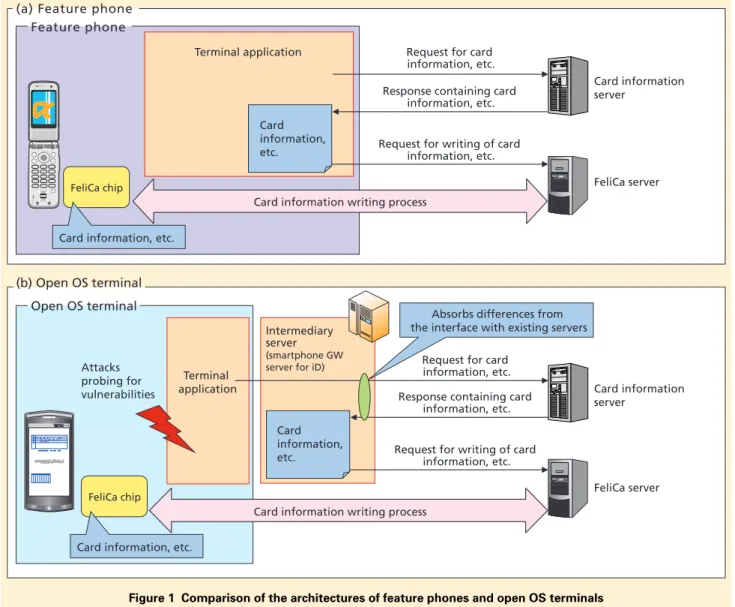
Figure 1compares the architecture of a feature phone with that of an open OS terminal. In a feature phone, the card information written to the FeliCa chip is downloaded from a server that manages card information and the like (hereinafter referred to as “card infor -mation server”), and is temporarily held in memory. Furthermore, the credit card
information is also written to the FeliCa chip by issuing a write request to the FeliCa server. On the other hand, the terminal application memory on an open OS terminal is liable to be exploit-ed in an attack, and if it is usexploit-ed for the temporary storage of credit card infor -mation on an open OS terminal then this information is at risk of being forged or tampered with so that unau thorized credit card information is writ
-ten to the FeliCa chip. We therefore adopted an architecture where an inter -mediary server that is less susceptible to attack is placed between the terminal application and the FeliCa server or other server used for the storage of card information, so that the card informa -tion and other such data is temporarily stored on the intermediary server. Since the existing servers for card information and the like have been built for use with
*3 Contactless IC chip: A semiconductor inte-grated circuit that exchanges information by radio communication with an IC card reader/writer.
*4 FeliCa®
: A contactless IC card technology
mark of Sony Corp.
Credit Services for the Osaifu-Keitai Mobile Payment System on Open OS Terminals
FeliCa chip
(a) Feature phone
(b) Open OS terminal Feature phone Open OS terminal Terminal application Terminal application Card information server FeliCa server FeliCa server Card information, etc.
Card information writing process
Card information writing process
Request for writing of card information, etc. Response containing card
information, etc.
Response containing card information, etc. Request for card information, etc.
Request for writing of card information, etc. Request for card information, etc.
Card information server
Absorbs differences from the interface with existing servers
Card information, etc.
FeliCa chip
Card information, etc.
Intermediary server
(smartphone GW server for iD)
Attacks probing for vulnerabilities Card information, etc.
Figure 1 Comparison of the architectures of feature phones and open OS terminals
NTT DOCOMO Technical Journal
interfaces differences of terminal appli -cations running on open OS terminals so as to minimize the impact on exist -ing servers.
3. Implementing the
Intermediary Server and
Terminal Applications
3.1 Smartphone GW Server for iD
The smartphone GW server for iD*5
is an intermediary server for securely writing credit card information to a Fel iCa chip mounted in an open OS termi
-nal. Figure 2 shows the functional
configuration of the smartphone GW
chiefly provides four functions: 1) FeliCa Chip Update/referencing
Function
A framework for securely writing to the FeliCa chip is offered as a FeliCa server. In the smartphone GW server for iD, the FeliCa server is used to write credit card information directly to the FeliCa chip, thereby eliminating the deployment of credit card information into the memory of the open OS termi -nal and securing the information against forgery or tampering. In the same way, this framework is also used when credit card information that has been set in the
2) Interface Conversion Function Communication to card information servers (DOCOMO credit card system (Credit Mobile Gateway System (CREMO)), card information download center, brand download center) that is next to the smartphone GW server for iD, is all collected into a single session when card information is written to a FeliCa chip. And, interface messages between the systems are issued accord ing to requests from the terminal appli -cation.
In the smartphone GW server for iD, interface messages from the termi -nal application for open OS termi-nals are converted into the same format as interface messages for the feature phone interface, thereby minimizing the scope of revisions that need to be made to the system that replaces the smart -phone GW server for iD. In this way, we aim to reduce the costs and develop-ment time associated with introducing the new system.
3) Sequence Management Function Requests from open OS terminals
are stored as session*6 information to
prevent the generation of interrupts from fraudulent terminals. When opera-tions to write credit card information are configured by multiple interface messages from a terminal application, coordinating information about man -agement information (IP addresses, passwords, etc.) is stored on the smart
-*5 iD: “iD” and the “iD” logo are trademarks or registered trademarks of NTT DOCOMO.
*6 Session: A meaningful episode of communi-cation between a server and client. Here, the sequence of communication involved in writ -ing card information is treated as a session.
FeliCa server Card information server
Smartphone GW server for iD
FeliCa chip update/ referencing function
Interface conversion function
Sequence management function
Access control function
sp-mode
Open OS terminal
Figure 2 Configuration of smartphone GW server for iD
NTT DOCOMO Technical Journal
phone GW server for iD, and is carried around until one session has ended. When interface messages from the ter -minal application are not coordinated in the prescribed order, a sequence error is deemed to have occurred and the fraud -ulent application is prevented from issuing interrupts.
4) Access Control Function
Since the smartphone GW server for iD is a system that can be accessed from open OS terminals, it is at risk of being subjected to Denial of Service
(DoS) attacks*7. Although common
security defenses are in place, it also has an access control blacklist function to prepare for security attacks from spe-cific users. To allow the functionality of a service to be checked before it is launched, there is also a whitelist func tion that only allows access from spe -cific open OS terminals.
3.2 Terminal Application The terminal application is used to secure an area in the FeliCa chip and manage multiple cards. It can manage up to two cards, and has functions for tasks such as issuing areas, adding cards and deleting cards.
As mentioned in chapter 2, the characteristics of the open OS terminal application are provided via an interme-diary server, and security is maintained by temporarily storing card information and the like on the intermediary server.
The terminal application has the following two main functions.
1) FeliCa Chip Update/referencing Function
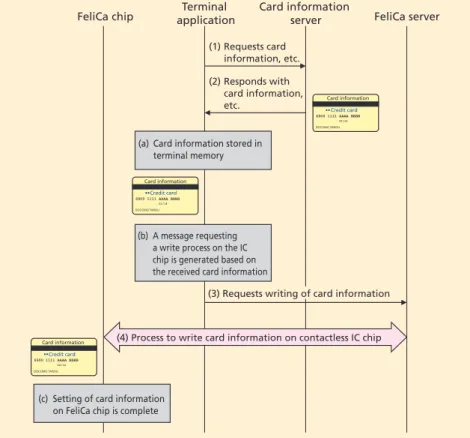
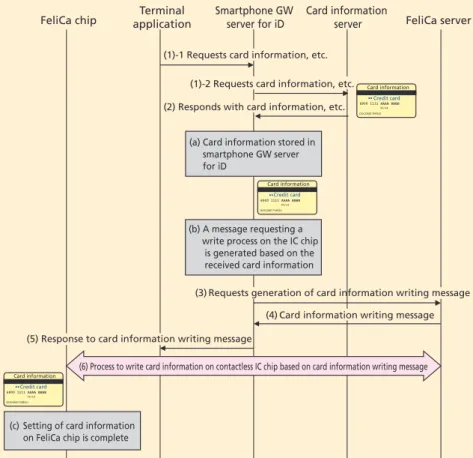
With this function, users are able to settle payments with an open OS termi nal by allowing the FeliCa chip to per -form all access tasks such as issuing and deleting areas, adding, deleting and updating card information, updating the main card, and storing/removing card information. In the implementation of this function, card information is trans -mitted to the terminal in a feature phone, where the terminal application performs processing to write this infor -mation to the FeliCa chip, whereas in an open OS terminal as described in chapter 2 and section 3.1, the informa
-tion stored in the terminal’s memory is liable to be tampered with. Consequent-ly, instead of transmitting credit card information to the terminal application, this information is terminated at the smartphone GW server for iD so that it can be written directly to the FeliCa chip without being deployed in the memory of the open OS terminal. The specific sequences are compared in
Figure 3and 4.
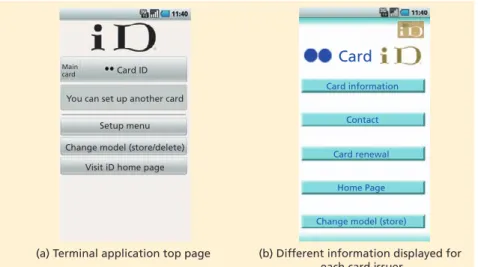
2) Unique Information Display Func-tions for Each Card Issuer It is possible to manage the infor-mation of up to two cards in the termi-nal application, but the messages, company logos and the like displayed
*7 DoS attack: A malicious attack that can cause a service to stop.
Credit Services for the Osaifu-Keitai Mobile Payment System on Open OS Terminals
Card information Credit card Card information Credit card Card information Credit card FeliCa server Terminal application
FeliCa chip Card information server
(1) Requests card information, etc.
(a) Card information stored in terminal memory
(4) Process to write card information on contactless IC chip (3) Requests writing of card information (2) Responds with
card information, etc.
(b) A message requesting a write process on the IC chip is generated based on the received card information
(c) Setting of card information on FeliCa chip is complete
Figure 3 Card information writing sequence in a feature phone
NTT DOCOMO Technical Journal
function for displaying different infor-mation for each card issuer is imple-mented by acquiring data such as mes-sages and images specific to each card issuer from the card information serv-er when the card information is set. To make the best possible use of systems that have already been provided for feature phones, we suppressed the scope of revisions to the bare mini -mum by converting the format of interface messages from the applica-tion into the same format as interface messages for feature phones as described in section 3.1 2).
3.3 Other Security-related Issues
To configure iD from a terminal application, it currently has to be accessed via an sp-mode 3G network.
Access from other bearers*8 such
as wireless LAN is restricted because applications for open OS terminals operate via an intermediary server (smartphone GW server for iD). If a
Domain Name System (DNS)*9server
spoofs the IP address of this interme-diary server, then a rogue server will be able to steal passwords and the like that could be used to set fraudulent credit card information.
4. Service Image
Figure 5shows the service image of credit services implemented on an
*8 Bearer: A communication circuit that trans -mits information.
*9 DNS: A system that associates host names and IP addresses on IP networks. Card information Credit card Card information Credit card Card information Credit card
(1)-1 Requests card information, etc.
(a) Card information stored in smartphone GW server for iD
(6) Process to write card information on contactless IC chip based on card information writing message (3) Requests generation of card information writing message (b) A message requesting a
write process on the IC chip is generated based on the received card information
(c) Setting of card information on FeliCa chip is complete
(1)-2 Requests card information, etc.
(4) Card information writing message (5) Response to card information writing message
(2) Responds with card information, etc.
Figure 4 Card information writing sequence in a smartphone
Main card
You can set up another card Setup menu Change model (store/delete)
Visit iD home page Card ID Card issuer Participating merchant Payment terminal Open OS terminal Bleep!
(1) Apply for service
(2)Download application and set up card information
(4) Bill
(5) Payment (3) Wave and pay
※“iD” and the “iD” logo are trademarks or registered trademarks of NTT DOCOMO. Figure 5 Service image
NTT DOCOMO Technical Journal
open OS terminal, and Figure 6
shows a screenshot of the terminal application. People are able to use this contactless IC credit service in exactly the same way regardless of whether they are using a feature phone or an open OS terminal.
5. Conclusion
In this article, we have described the development of a credit service compatible with open OS terminals that mitigates the impact of upgrading existing systems while maintaining the same level of security offered by feature phones. In the future, we hope
to study and implement services that exploit the flexibility of applications
on open OS terminals.
Credit Services for the Osaifu-Keitai Mobile Payment System on Open OS Terminals
(a) Terminal application top page (b) Different information displayed for each card issuer
Main
card Card ID
You can set up another card
Card information Contact Card renewal
Home Page Change model (store)
Card
Setup menu Change model (store/delete)
Visit iD home page
Figure 6 Terminal application screenshots