Analysis of the New Hampshire
Comprehensive Health Information System (NH CHIS)
Final Report
Contract-‐RRG-‐06
Prepared for the State of New Hampshire Insurance Department November 7, 2012
Prepared by Patrick Miller, Amy Costello, and Ashley Peters New Hampshire Institute for Health Policy and Practice
Table of Contents
Executive Summary ... 3
1. Introduction ... 4
2. Overview ... 4
3. Findings ... 4
3.1. Benefit Coding Standard Observations ... 4
3.2. Utility of SERFF with NH CHIS ... 5
3.3. Gap Analysis of Rate Review Elements With Standard Transaction Sets ... 6
3.4. NH CHIS Enhancement Recommendations ... 6
3.4.1. Data Collection Standards Adoption ... 6
3.4.2. Data Sources ... 9
3.4.3. Temporal Issues ... 11
3.4.4. Supplemental Fiscal Transaction File ... 12
3.4.5. Premium Information ... 13
3.4.6. Collection of Benefits Information ... 14
3.4.7. Other Data Collection Recommendations ... 14
4. Conclusions ... 17
5. Appendices ... 17
5.1. Appendix A: NH CHIS Rate Review Field Attribute Comparison (spreadsheet) ... 17
5.2. Appendix B: NH CHIS/Standards Field Attribute Comparison (spreadsheet) ... 17
5.3. Appendix C: SERFF API Elements Guide (PDF) ... 17
5.4. Appendix D: Workers’ Compensation Survey Summary (PDF) ... 17
5.5. Appendix E: Glossary of Terms ... 17
5.6. Appendix F: Staff Bio Statements ... 17
Executive Summary
Over the past year, the New Hampshire Insurance Department (NHID) has been implementing improvements to their rate review process. As part of this work, the New Hampshire Institute for Health Policy and Practice (NHIHPP) at the University of New Hampshire (UNH) was contracted to assist NHID with understanding the feasibility of utilizing New Hampshire’s all-‐ payer claims database (APCD), the NH Comprehensive Health Information System (NH CHIS), to further improve the NHID rate review process.
The principal tasks accomplished by this project included an examination of current NH CHIS data elements; a review of national APCD standards for data collection; an examination of the existing rate review process, as well as the Gorman-‐proposed revised rate review process; and, discussions with NHID stakeholders, other states, and National Association of Insurance
Commissioners (NAIC) to understand the landscape of rate review in NH.
Based on this work, it appears that the NH CHIS’ ability to support an enhanced rate review process is limited in some areas in its current form; however, several modifications to NH CHIS would increase the ability of the system to support an enhanced rate review process, primarily an auditing function to start. Recommendations for modifications include:
• The creation of a common benefit coding structure that carriers, NAIC, US Department
of Health and Human Services (HHS), and state insurance departments can mutually adopt in order to bring detailed benefit information from carriers on the NH CHIS eligibility feeds into the rate review process. This would enable electronic tools, such as NAIC’s System for Electronic Rate and Form Filing (SERFF) rate review application, to become more integrated within NHID’s workflows.
• A supplemental fiscal file needs to be provided by the carriers to the NH CHIS to capture
those carrier expenditures not captured within claims data. This file will provide a more comprehensive picture of expenditures. Further, if the supplemental fiscal transaction file could be received and the temporal issues resolved, then there may be an
opportunity to increase the effectiveness of using NH CHIS as an auditing tool for rate review versus serving as the rate review tool itself. There would be value in NH CHIS to NHID as a proactive monitoring mechanism.
• Carriers will need to augment their NH CHIS eligibility submissions with premium
amounts, or premium-‐equivalent amounts for self-‐funded accounts. This will enable NHID to see both the expenditure and revenue components of carrier transactions.
• The current monthly data collection for NH CHIS with quarterly consolidation and
release using a 90-‐day lag would need to be addressed. Consideration for more timely receipt and processing of claims data would benefit the rate review process.
1. Introduction
With external assistance and internal resources, the New Hampshire Insurance Department (NHID) has made ongoing improvements in its rate review process in the past year.
Additionally, New Hampshire has one of the country’s first all-‐payer claims databases (APCDs) called the NH Comprehensive Health Information System (NH CHIS) (www.nhchis.org) that was launched in 2005. The APCD includes both commercial and Medicaid claims. Medicare data will be added in the future. This project was initiated to determine if NH CHIS could be
modified in order to support enhancements within the current and future planned rate review processes.
2. Overview
There were three primary activities performed as part of the review of NH CHIS to enhance the rate review process for New Hampshire. Each of the following will be discussed in depth in Section 3:
1. UNH examined current NH CHIS data elements, national APCD standards for data collection, the existing rate review process, the Gorman-‐proposed revised rate review process, and held discussions with other states and NAIC.
2. Based upon its work leading the national APCD Council (www.apcdcouncil.org), UNH was asked to make recommendations in terms of other enhancements to NH CHIS that would make it more useful for the state beyond rate review. Many of the
recommendations will benefit both rate review and other business requirements.
3. At the request of the NH Department of Health and Human Services (NH DHHS), UNH was also tasked with examining the feasibility of adding workers’ compensation data to NH CHIS. UNH conducted a brief survey of existing APCD states, spoke with NH DHHS to understand their needs, and provided advice to NH DHHS on how to advance the effort.
3. Findings
3.1.Benefit Coding Standard Observations
NHID has two processes, rate review and supplemental reporting, that could benefit from a standardized benefits coding system that all carriers would use. Benefits of such a system are fairly straightforward. Currently, each carrier has a benefits module within its claims processing system. This is where the coding is done to develop benefits packages that would be assigned to an employer group identifier. Today, the carriers all have different internal coding systems for co-‐pays, deductibles, co-‐insurances, etc. So, if NHID wanted to have a feed from NH CHIS’ eligibility file delineating the benefit package detail, today they would get a different internal code description from each carrier (e.g., for a $10 office visit co-‐pay).
A standard for coding types of benefits might be similar to procedure codes (CPT, HCPCS) or diagnosis codes (ICD-‐9, ICD-‐10) or other typologies. This would not only benefit NHID’s work for supplemental reporting and rate review automation, but would be a significant benefit for health services researchers who use NH CHIS and wish to understand utilization, cost, and quality patterns for different benefit packages (i.e., a high deductible plan versus a richer benefit package).
The other area that could benefit from a benefit coding standard would be health insurance exchange (HIX), as carriers will be loading benefits packages into each state (or the Federal) exchange. Today, carriers report that they expect to offer relatively few benefit packages via the HIXs and expect states to load the packages manually using their own coding systems. This seems inefficient at a national level, and discussions with NAIC and HHS are likely warranted.
Further, there is no such national coding system that we can determine through NAIC, other states, national standards organizations, or via the carriers. In discussions with HHS and New York State, there does not appear to be any bandwidth for creation of such a coding system, currently. It will be difficult to mandate a NH-‐specific benefit coding system due to resource constraints. It may be more cost-‐effective to support national partners (e.g. NAIC and Data Standards Maintenance Organizations [DSMO]) in such an effort.
3.2.Utility of SERFF with NH CHIS
UNH examined the NAIC System for Electronic Rate and Form Filing (SERFF) (www.serff.com) in terms of whether or not the utility of SERFF by NHID could be improved with NH CHIS. SERFF is used today by carriers to submit rate filing applications to NHID, for tracking by NHID, and for approval by NHID. At a high level:
• Carrier logs into SERFF and enters/submits application • Application reviewed by NHID
o Data from SERFF
o Supplemental data sheets required by NHID submitted separately from SERFF
Initially, it was posited that the SERFF submission process could be modified with NH CHIS data using their system APIs, but it has been determined that this is unlikely to be feasible in the short run. Minimally, the current SERFF data dictionary does not contain the benefit code data elements discussed in Section 3.1. There are additional elements specific to eligibility and claims that are also not collected. Significant planning and coordination with NAIC and the carriers, in addition to internal NHID resources, would be required in order to modify SERFF and its workflows in order to benefit NHID in an automated way. Ideally, SERFF would be able query NH CHIS in an automated fashion to verify carrier-‐submitted data.
3.3.Gap Analysis of Rate Review Elements with Standard Transaction Sets
UNH compared data elements from the plan-‐specific Gorman templates (A1 – D3) to the current NH CHIS. Worksheets related to Historical Administration, Administrative Charges, Retention Charges, Illustrative Rates, Rating Factors (smoking etc.), Base Rate Per Member Per Month (PMPM) Development, Company Financial Info, and Loss Ratio were not included in the comparison because the data elements in these sheets are dependent on the previous sheets A1 – D3, or the information is not related to NH CHIS (not member or claims-‐based). Where NH CHIS has data elements related to the Gorman templates, the spreadsheet indicates the specific NH CHIS data element numbers next to the Gorman data elements.
Some observations:
• NH CHIS is particularly limited in terms of the detail at the particular plan level. NH CHIS
only captures Product Type at a high level (HMO, PPO, etc.); collecting a plan index from the carrier would allow the NHID to dig deeper into the detail behind those product types. Additionally, as detailed in Section 3.1, the benefits detail information is unavailable due to lack of standards.
• In addition, many of the formulas used in the Gorman templates and calculations
require the availability of premium information, which NH CHIS does not capture. This is discussed in Section 3.4.5.
• Similarly, the Gorman templates and calculations require an understanding of the
volume of incurred and IBNP claims that NH CHIS does not capture. There are no current plans to address this within NH CHIS that UNH is aware of.
3.4.NH CHIS Enhancement Recommendations
Because NH has new vendor for NH CHIS data consolidation that is contracted to revise and update the submission manual for submitters, NH is in a good position to adopt recently published national standards for claims and eligibility data submission.
The APCD Council has been actively engaged with national DSMOs since 2009 on the
development of standards for the reporting of health care claims data and information to state and federal agencies. Two specific DSMOs, ASC X12 (www.x12.org) and the National Council for Prescription Drug Programs (NCPDP, www.ncpdp.org), are responsible for developing and maintaining industry standards for insurance claims and eligibility transactions. These
organizations have formal processes for maintaining standards, including input, discussion, and publication.
In October 2011, NCPDP published the Uniform Healthcare Payer Data Standard
Implementation Guide Version 1.0. NCPDP guide provides direction for the standardized submission of pharmacy claims data for APCDs.
In June 2012, ASC X12 and the industry approved a set of 3 implementation guides. Three implementation guides are expected to be published in October 2012: ASC X12 Version 005010 Post-‐adjudicated Claims Data Reporting: Professional (837) Technical Report Type 3, ASC X12 Version 005010 Post-‐adjudicated Claims Data Reporting: Institutional (837) Technical Report Type 3, and ASC X12 Version 005010 Post-‐adjudicated Claims Data Reporting: Dental (837) Technical Report Type 3.
While there is much discussion about the eligibility and enrollment standards in the industry because of HIX activity, there is no Post-‐Adjudicated Reporting Guide for this standard yet. One will likely be available in 2013.
As part of this project, through APCD Council research and interviews with NH CHIS
stakeholders, UNH has developed a list of specific field recommendations for NH CHIS that would bring the current NH CHIS rules in compliance with the national standards. Appendix A includes a summary of these recommendations, and Appendix B includes a column R with this detailed information. A summary of these findings by file type is described in Table 1 below.
Table 1: NH CHIS Recommendations by File Type
File Type Recommendations
Eligibility Of the 39 NH CHIS data elements reviewed in the member eligibility file, there are
8 elements (or 21% of elements) that require revision. There is also a
recommendation that a Usual Source of Care data element be added to the file. As national standards are developed for the reporting of eligibility transaction data to state and federal reporting agencies, NH should consider migrating to those standards.
Medical Of the 86 NH CHIS data elements reviewed in the medical claims file, there are 62
elements (or 72% of elements) that require revision; of those, 54 elements (or 87% of elements) specifically need to be remapped to the most recent standard transaction file. There is also a recommendation that a Health Plan Name data element be added to the file.
Pharmacy Of the 55 NH CHIS data elements reviewed in the pharmacy claims file, there are
48 elements (or 87% of elements) that require revision; of those, 48 data elements (or 100% of elements) specifically need to be remapped to the most recent
standard transaction file. There is also a recommendation that 17 new elements (see NHCHIS Summary Recommendations in Appendix A) be added to the file.
Dental Of the 51 NH CHIS data elements reviewed in the dental claims file, there are 51
elements (or 100% of elements) that require revision; of those, 51 data elements (or 100% of elements) specifically need to be remapped to the most recent standard transaction file and also need to be added to the administrative rule.
When the NH CHIS administrative data collection rules are updated, 66% of mappings will need to be updated to align with the national standards. The initial alignment with the national standards will take effort on the part of the State, the payers, and the NH CHIS vendor. Once done, there will be incremental changes as revisions of the standards occur.
NH CHIS can move forward currently with the NCPDP and X12N claim standards, if
administrative rules are updated and vendor resources are applied. The impetus for doing so is several-‐fold:
• As neighboring states adopt these standards, it will enable New Hampshire data to be
more comparable;
• There will be national pressure for carriers to move states to adoption in order to create
a more administratively efficient system;
• As a whole, whether for claims payment or transmission of laboratory results, the
healthcare industry is steadily migrating (or has migrated in many cases) to standards;
• There is likelihood that CMS will enable these standards over time for Medicare data in
• There is current contractual language within the NH CHIS vendor contract to support
this migration effort.
3.4.2. Data Sources
3.4.2.1. Current New Hampshire landscape
NH CHIS started with the collection of commercial claims (fully insured and self-‐funded) and Medicaid claims. It then added dental claims. Section 4.4.2.4 contains discussion regarding the future addition of workers’ compensation claims.
3.4.2.2. Addition of Data Sources
While NH CHIS has proved very useful for the data it holds, there are other data sources that could be added. Primarily, various forms of Medicare data would provide NH CHIS and its users a more complete picture of the New Hampshire population. NH DHHS acquired several years of Medicare data files (2007-‐2010) in April 2012. NH DHHS plans to incorporate the Medicare data with NH CHIS.
In June of this year, a new process was developed jointly between the Centers of Medicare and Medicaid Services (CMS) and the APCD Council that provides a new mechanism for states to acquire Medicare data. The CMS State Research Request data application process can be found at: http://www.resdac.org/Medicare/requesting_data_StateResearch.asp. NH DHHS will be applying for future years of this data, with the assistance of UNH. The following data will be requested:
• Medicare Part A claims; hospital claims. • Medicare Part B claims; physician claims. • Medicare Part D claims; pharmacy claims.
There is currently no provision to request Medicare Part C (Medicare Advantage) claims from CMS, because CMS does not currently collect these data due to their processing by commercial insurance carriers. Rhode Island’s APCD is currently attempting to request these data directly from the carriers; however, one carrier has pushed back stating that they are prohibited from providing it to the state of Rhode Island due to CMS regulation. CMS is currently investigating the issue. Minnesota and Maine have been successfully collecting these data since their APCD began operating. It is expected that NH CHIS could mandate the collection of these plans and that the data could be received via the existing carrier feed process.
In addition to Medicare Advantage plans, there are a multitude of Medigap plans. These plans are offered by commercial carriers, and are licensed by NHID. It is expected that NHCHIS could mandate the collection of these plans, and that the data could be received via the existing carrier feed process.
There are also Federal employees in New Hampshire, ranging from Forest Service to active military personnel. Their claims are managed through programs such as Federal Employees Health Benefits Program (FEHB), the Veterans Administration, and TRICARE. To date, no state has collected data from these sources within their APCD, but there is increasing pressure to do so. The APCD Council will work with these states in the future, similar to the way the Council worked with CMS to provided Medicare A, B, and D data. Both FEHB and TRICARE claims are processed via the same commercial carriers that currently provide data to state APCDs, which should make data acquisition possible. Part of this conversation regarding the addition of additional Federal data sources into state APCDs should revolve around not just providing states with information, but also providing Federal agencies with information. If, for instance, states could provide CMS with information regarding the health status of 55-‐64 years olds, or TRICARE with benchmarking information on the commercial population, there might be a “win-‐ win” for Federal participation in state APCD efforts.
3.4.2.3. Additional Data Collection Issues
While much work has been done in New Hampshire regarding the harmonization of data elements between the other northern New England states, it has been several years since formal work has been done to examine the thresholds for data collection (i.e., the number of covered lives or the annual carrier premium thresholds that trigger the reporting requirements) across each of the states. Doing this exercise would a) provide consistency for bordering states that wish to compare data and b) provide consistency for carriers who operate in these states. This would be a straightforward review process. Any potential “controversy” would likely be the result of a determination that by lowering thresholds, it increased the number of carriers to be collected, and, in turn, raised the cost of operating the NH CHIS.
The final issue regarding data collection has to do with cash payments. Similar to that of the uninsured that do not generate claims, cash payments are seldom recorded. No studies have been done to date in New Hampshire that UNH is aware of that have attempted to quantify this category. One could posit that given the wealthy nature of our population that there might be a significant amount of cash payments for non-‐covered services such as massage therapy or alternative treatments; often, these providers do not accept insurance. Similarly, many behavioral health providers in private practice either do not accept insurance, or their clients choose to pay cash due to privacy concerns. In addition to these examples, there are also the
“Wal-‐Mart $4” prescriptions, whereby the prescription costs less than the co-‐payment and the consumer pays cash.
3.4.2.4. Workers’ Compensation Data
The Principal Investigator for the Occupational Health Surveillance Program, Bureau of Public Health Statistics and Informatics at NH DHHS has a desire to add workers’ compensation carrier data to NH CHIS. There are about a half dozen primary carriers in the New Hampshire
marketplace according to NH DHHS. The primary issue with collection of this data would be how it would be linked to medical claims where coordination of benefits (COB) or subrogation occurs.
For this report, UNH conducted a review (See Appendix D) of existing APCD states and demonstrated that none were currently collecting this information. A total of nine states responded to the survey. Colorado statute does allow for collection, but the Colorado APCD effort is currently focused on medical and pharmacy claims for the commercial and Medicaid lines of business. Colorado is expected to collect these claims at some point in the future. Connecticut passed their APCD legislation this spring. Their legislation does not specifically preclude the collection of workers’ compensation, and they think they can collect it in the future if there is an appropriate business case. Minnesota’s statute specifically exempts collection. Potentially, Minnesota would like to do so if they were able to change their statute. Maryland also indicated that they would like to add workers’ compensation data.
UNH has recommended to the Principal Investigator for the Occupational Health Surveillance Program that the business case be formulated that would support the collection of these claims. This business case would then be submitted to Andrew Chalsma (NH DHHS) and Tyler Brannen (NHID) for review and comment. Ultimately, there would be a cost to the state for processing the data of the additional carriers supplying workers’ compensation data. New Hampshire has once before modified its collection rules to acquire a new line of business: dental data.
The APCD Council is interested in further exploration of the addition of workers’ compensation claims to APCDs nationally. The development of business requirements by New Hampshire could be used to accelerate the national conversation.
3.4.3. Temporal Issues
Currently, NH CHIS data is collected monthly and processed quarterly, with nearly a ninety day lag. For retrospective analysis and audit purposes, there do not appear to be any temporal issues as it relates to rate review.
Other benefits of more current data release would include being able to support Accountable Care Organization (ACO) reporting requirements. This could improve provider stakeholder support for NH CHIS as well.
It is recommended that once the current migration of vendors for NH CHIS is complete, representatives from NHID, NH DHHS, UNH, and other key stakeholders meet to evaluate the issue of data collection and release timing.
3.4.4. Supplemental Fiscal Transaction File
APCDs capture charges, allowed amounts, payment amounts, and patient liabilities from claims data. However, carriers routinely have fiscal transactions, both debits and credits, between themselves and providers outside of claims for a multitude of purposes. APCDs do not currently capture these transactions and their amounts, thus leaving state APCDs with an incomplete picture of the total costs and pricing.
The following are examples of these non-‐claims-‐based fiscal transactions:
• Pay-‐for-‐performance (P4P) payments;
• Per member per month (PMPM) medical home payments; • Capitation fees;
• Contractual settlement debits or credits supporting risk contracts; and • Pharmacy benefit manager rebates.
In the future, state APCDs should develop an additional file transaction type (beyond claims) that would capture these non-‐claims-‐based fiscal transactions and report it to the APCD in order to more accurately report on the total cost of services. This transparency will be
increasingly important as ACO arrangements are developed, along with other forms of payment reform that may rely on capitation, bundling, bonus, or incentive payments.
A proposed file layout would need to follow a similar format as the other CHIS data files (ensuring that all elements are consistent across files). The file should minimally need to include the following elements:
• Carrier ID; would tie to the medical, pharmacy, or dental carrier submitting claims.
• Provider ID; would tie to the provider identifier from the carrier to which the debit or
credit was made.
• Line of Business or Product; would allow for the attribution to the correct line of
business or product (HMO, PPO, POS, etc.) for the specific carrier.
• Employer Group ID; would allow for the attribution of a debit or credit to an employer
group within the line of business or product (HMO, PPO, POS, etc.).
• Transaction Date; this is the date in which the debit or credit took place (MM/DD/YYYY).
• Effective Date (in addition to transaction date)
• Debit or Credit Amount Between the Carrier and Provider; this is the dollar amount.
• Transaction Reason Code; this would need to be developed to account for the various
types of transactions that could be reported (i.e., contract settlement payment, P4P payment, quality bonus payment, primary care centered medical home payment, capitation fee, other payment).
The file specifications will require input from carriers, because the information will likely be stored in financial systems not normally queried for external purposes, and may be difficult to extract. There will also need to be guidelines established for how the data may be used in various analyses. It may not be possible for these transactions to be attributed to a specific subscriber or member for instance, but it could be attributed to a line of business/product or carrier analysis. Ideally, there would be a member or subscriber field on the above-‐proposed file layout. This will require discussions between the state and the carriers.
This proposed file still does not resolve the issue of payments by those without insurance, or those paying out of pocket for services not covered by insurance products. This latter point has less to do with rate review and more with the collection of a complete claims set for NH CHIS.
3.4.5. Premium Information
APCDs contain one side of the fiscal health care equation, namely expenditures. What they do not currently contain on the current eligibility files is the premium collected at the employee or employer level. Some states such as New Hampshire have collected these data in supplemental reports in order to create a “benefit index” that compares the value of plans sold within the commercial marketplace (www.nhhealthcost.org).
Currently, by only capturing expenditures, APCDs do not provide policy makers with any information regarding medical loss ratios, nor more obviously, the simple total amounts of premiums collected by carriers and paid by employers. In addition to policy makers, employer coalitions who are accessing this data more frequently will be one of the largest potential beneficiaries of this information.
One way to collect this information would be on the eligibility file submitted by the payers. Some payers collect premiums and “premium equivalents” (for self-‐funded accounts) at the benefit tier level (single, two-‐person, family) so that the total premium amount would be provided as well as a “premium equivalent” on each eligibility record, taking into account the
number of tiers. Another option would be to require the reporting of premium information “rolled up” at the subscriber level if it is too tedious for carriers to break it out by benefit tier.
Some insurance departments require premium reporting, but if it was embedded within the APCD eligibility files, insurance departments and HIXs could more easily access this information, and it would be available at a granular level which could be rolled up by group, line of business, etc.
3.4.6. Collection of Benefits Information
There are no recognized standards today for how carriers should submit benefit information about enrollees. Benefit packages vary within products and within and across carriers. This paper defines “benefits information” as co-‐payments; coinsurances; deductibles; out-‐of-‐pocket maximums; lifetime maximums; and the detailed medical or pharmacy benefits, such as the number of physical therapy visits or whether certain, specific therapies are covered. The Gorman report (November 2011) to the NHID described in the “B” tabs of their spreadsheet this information in more detail.
From a health services research perspective, benefits information is important, because there is evidence that benefits can impact utilization as costs continue to rise and more cost is shifted to the consumer. Understanding the relationships between benefits and utilization will become even more important as employers continue to shift financial responsibility to members. From a rate review perspective, this information must be provided in an electronic format if the rate review process is to be automated. From an HIX perspective, if there are relatively few benefit plans from each carrier, then automation may be less important.
The APCD Council has been looking to the NAIC and America’s Health Insurance Plans (AHIP) for further direction in this area of benefit information standards. To date, progress has not been made in this area in such a way that we can make recommendations for New Hampshire.
HIXs will need to solve for this problem, likely working with organizations such as the NAIC and AHIP. Once solved for, the APCD community can adopt the HIX standards, or as outlined in the linkage section of this paper, link directly to the HIX to pull the information. This would be helpful information to capture in order to make better cost and utilization comparisons across groups or lines of business.
3.4.7. Other Data Collection Recommendations
3.4.7.1. Collection of Patient Identifiers for Linkage Purposes
This is a topic of increasingly critical importance, given the rise of health information exchange (HIE), electronic health records (EHR), clinical registries, population health datasets, HIXs, payment reform efforts such as ACOs, and accuracy of linking commercial payer carve outs such as pharmacy benefit manager (PBM) data with medical claims data. Currently, about half of the state APCD efforts collect direct patient identifiers and have addressed the patient privacy and security protection issues.
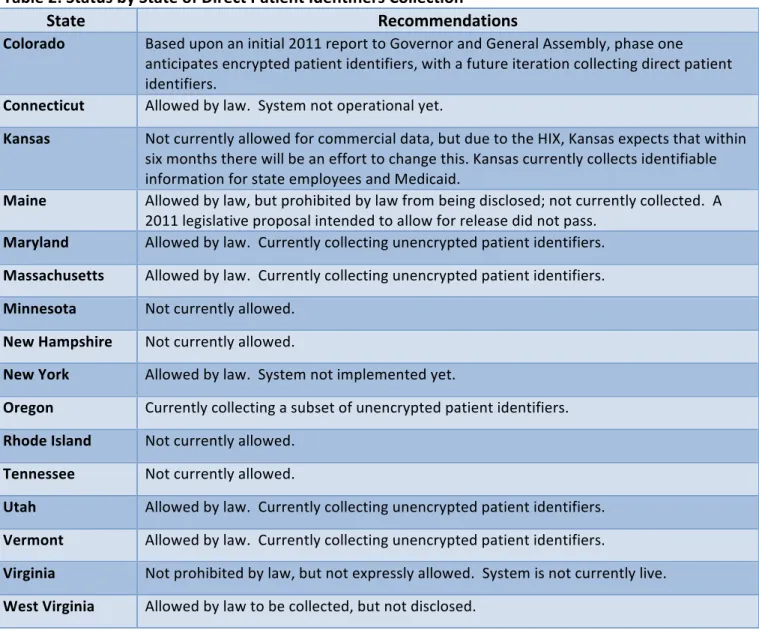
The anticipated trend is for most states to eventually allow for the collection of full patient identifiers for linkage purposes. Table 2 contains the status of each state’s APCD:
Table 2: Status by State of Direct Patient Identifiers Collection
State Recommendations
Colorado Based upon an initial 2011 report to Governor and General Assembly, phase one anticipates encrypted patient identifiers, with a future iteration collecting direct patient identifiers.
Connecticut Allowed by law. System not operational yet.
Kansas Not currently allowed for commercial data, but due to the HIX, Kansas expects that within six months there will be an effort to change this. Kansas currently collects identifiable information for state employees and Medicaid.
Maine Allowed by law, but prohibited by law from being disclosed; not currently collected. A 2011 legislative proposal intended to allow for release did not pass.
Maryland Allowed by law. Currently collecting unencrypted patient identifiers. Massachusetts Allowed by law. Currently collecting unencrypted patient identifiers. Minnesota Not currently allowed.
New Hampshire Not currently allowed.
New York Allowed by law. System not implemented yet.
Oregon Currently collecting a subset of unencrypted patient identifiers. Rhode Island Not currently allowed.
Tennessee Not currently allowed.
Utah Allowed by law. Currently collecting unencrypted patient identifiers. Vermont Allowed by law. Currently collecting unencrypted patient identifiers.
Virginia Not prohibited by law, but not expressly allowed. System is not currently live. West Virginia Allowed by law to be collected, but not disclosed.
Additionally, some states, such as Maine and West Virginia, allow for collection but not
disclosure of identifiers. These states, however, can use the data for linkage purposes prior to a release of data.
In order to perform linkage accurately to HIE, EHR, registries, and other data sources, states will either need to collect direct patient identifiers and have strict controls on linkage and release, or will need to work with HIEs and clinical sources to use the same encryption algorithms provided to carriers who generate the currently de-‐identified data. The latter is more unlikely due to the technical effort required and more prone to error in matching algorithms.
Additionally, some carriers are phasing out collection of social security number, which is the primary field used by states to encrypt today. It is expected that those states who are just embarking upon APCD development and have robust HIE capacity will lean toward collection of direct identifiers.
3.4.7.2. Development of Linkage Policies and Practices
As states enhance their data collection and data release policies, there is an increasing need to support linkage of APCD information to HIEs, registries, and other sources, in addition to HIXs. Currently in New Hampshire, there is an application process to the State for anyone who wishes to obtain NH CHIS data. There is no formal part of the application process or policies, which specifically addresses linkage, albeit a requestor might cite linkage as part of a study’s
requirements.
Best practices amongst states would suggest that the NH CHIS request process and policy should be augmented in the future to address linkage specifically. There might be a “linkage review” function added to the current application review process. There would also need to be a determination made as to where the linkage would take place (the State or the requestor), and under what conditions (legal, policy, ethical); stipulations about limitations for data linkages may be defined in statute and state regulations.
In most cases, it would be expected that the final, linked file would be released without patient identifiers, thus ensuring privacy. Release governance processes today take into account what fields are requested, purpose of release, compliance with state laws and regulations, and implement data use agreements with the requestor.
Should New Hampshire begin to collect direct patient identifiers for linkage (both to improve NH CHIS such as being able to link self-‐funded medical and pharmacy claims, as well as for external linkages to other databases), this issue of linkage policies and practices will become more urgent. New Hampshire is encouraged to work with the APCD Council and its members
on this issue. Maine, Vermont, and West Virginia are among a current list of states actively addressing this issue.
4. Conclusions
• New Hampshire has an opportunity to put in place a process to update the NH CHIS data
collection rules based upon the NCPDP and X12N national data collection standards. This will take time, but is not a technically difficult task. Several of the concepts discussed in this document, such as collection of direct patient identifiers and a
supplemental fiscal transaction file will require more resources – both political and fiscal – to address properly and in a timely fashion.
• If the supplemental fiscal transaction file could be received and the temporal issues
resolved, then there may be an opportunity to maximize NH CHIS as an auditing tool for rate review. New Hampshire is not developing rates, but using NH CHIS to help
determine whether or not increases or decreases in rates are appropriate. There would be value in NH CHIS to NHID as a proactive monitoring mechanism.
• There are clear opportunities for improvement of NH CHIS. Some will help to enhance
the rate review audit function, but the current system can be improved and made more reliable if additional data elements are added, temporal issues are addressed, and data are added (such as a supplemental fiscal file). Other improvements recommended in this report will enhance the public policy uses and overall utility of NH CHIS.
5. Appendices
5.1.Appendix A: NH CHIS Rate Review Field Attribute Comparison (PDF) 5.2.Appendix B: NH CHIS/Standards Field Attribute Comparison (PDF) 5.3.Appendix C: SERFF API Elements Guide (PDF)
5.4.Appendix D: Workers’ Compensation Survey Summary (PDF) 5.5.Appendix E: Glossary of Terms
5.6.Appendix F: Staff Bio Statements