Accepted: 2020.03.11 Published: 2020.04.13
Outcome of 24 Weeks of Combined Schroth
and Pilates Exercises on Cobb Angle, Angle of
Trunk Rotation, Chest Expansion, Flexibility and
Quality of Life in Adolescents with Idiopathic
Scoliosis
ABCDEF 1,2
Shkurta Rrecaj-Malaj
ACE 2Samire Beqaj
BCD 1
Valbona Krasniqi
ACDE 1,2Merita Qorolli
ACD 3
Aleksandar Tufekcievski
Corresponding Author: Samire Beqaj, e-mail: [email protected] Source of support: Departmental sources
Background: This study aimed to quantify the outcomes of combining Schroth and Pilates exercises on the Cobb angle, an-gle of trunk rotation (ATR), chest expansion, flexibility (trunk flexion), and quality of life (QoL) in adolescents with mild and moderate idiopathic scoliosis.
Material/Methods: Sixty-nine adolescents with idiopathic scoliosis aged 10–17 years, presenting with a Cobb angle of 10–45º were enrolled in this study. The treatment protocol, including selected exercises from Schroth and Pilates methods, was performed over 24 weeks and consisted of 2 periods of 2-week treatment regimens performed daily for 60 minutes. Each of treatment periods was then followed by the same home program treatment for 10 weeks. Cobb angle (x-rays), ATR (Scoliometer), chest expansion (cm), trunk flexion (cm, distance between C7 to S2 with measuring tape), and QoL (SRS-22r Scoliosis Research Society Questionnaire) were assessed pre-treatment, at 12 week, and at 24 weeks.
Results: Significant improvements (P<0.05) were found in both groups of patients wearing and not wearing a brace for Cobb angle (from 21.97±4.99° to 18.11±6.39°; from 14.19±3.11° to 11.66±2.73°), angle of trunk rotation (from 7.19±1.36° to 5.36±1.66°; from 4.72±1.04° to 3.58±0.94°), chest expansion (from 2.56±0.84 cm to 3.46±0.72 cm; from 2.57±0.87 cm to 3.52±0.72 cm), trunk flexion (from 9.55±1.95 cm to 14.33±2.40 cm; from 9.82±2.61 cm to 13.98±2.18 cm) and QoL (from 3.50±0.27 to 3.82±0.2; from 3.42±0.24 to 3.78±0.23) respectively.
Conclusions: This study showed that combined exercises provided benefit on the Cobb angle, ATR, chest expansion, trunk flexion and QoL in adolescents with mild and moderate idiopathic scoliosis.
MeSH Keywords: Angle of Rotation • Cobb Angle • Exercise • Quality of Life • Scoliosis
Full-text PDF: https://www.basic.medscimonit.com/abstract/index/idArt/920449 Authors’ Contribution: Study Design A Data Collection B Statistical Analysis C Data Interpretation D Manuscript Preparation E Literature Search F Funds Collection G
1 Department of Physiotherapy, Clinic of Physical Medicine and Rehabilitation, University Clinical Center of Kosovo, Pristina, Kosovo
2 Department of Physiotherapy, Faculty of Medicine, University of Pristina, Pristina, Kosovo
3 Faculty of Physical Education, Sport and Health, Ss. Cyril and Methodius University in Skopje, Pristina, Kosovo
Background
Scoliosis is a spine deformity, quite common worldwide and is frequently found in adolescents with a prevalence of 0.47– 5.2% [1,2]. Scoliosis can cause several problems such as body asymmetry, muscle imbalance, loss of flexibility, back pain, and negative impacts on psychological aspects and quality of life [3]. Some researchers have reported that for many con-secutive years there has been a paucity in research on meth-ods of exercise regarding treatment of scoliosis [4–6]. In 2003, Hawes stated there exist some studies reporting that patients who had moderate scoliosis and who had undergone conser-vative treatment, more precisely exercise methods, which were classified as a group of patients who did not undergo thera-py [6]. Additionally, in North America, exercises are usually not recommended to treat scoliosis [7,8]. In the last 2 centuries, physical therapy exercises have been applied in some parts of Europe [9]. By reviewing the literature, we found many stud-ies that identified conservative treatments, more precisely application of physical therapy and various exercise methods (Scientific Approach to Scoliosis [SEAS], Schroth, Dobomed, Pilates, Side-shift, Lyon, etc.), as effective in altering scoliosis symptoms [10–18], are all methods supported by papers cit-ed in our study.
According to Lenssinck et al. [8], the effect of exercises is prom-ising in conservative treatment for scoliosis. Negrini et al. [19] reported that physical exercises should be considered as a specific program of exercises developed by physiotherapists; they also concluded that exercises in the context of scolio-sis have an effect in preventing the progression of deformity. Furthermore, according to the Society on Scoliosis Orthopedic and Rehabilitation Treatment (SOSORT), physiotherapy is con-sidered a therapeutic intervention which can be used solely or combined with other procedures such as orthopedic manage-ment and surgical correction [20]. The treatmanage-ment depends on several factors including patient age, Cobb angle, Risser scale, and region of deviation [1]. The main aim of our study was the evaluation of the effect of selected combined Schroth and Pilates exercises in prevention of development of deformity, the decrease in the Cobb angle, the decrease in the angle of trunk rotation (ATR), improvement of flexibility (trunk flexion), and improvement of back posture and quality of life (QoL).
Material and Methods
Study design
This prospective research involved 69 consecutive adolescent patients with idiopathic scoliosis during their outpatient vis-it at the Physical Therapy and Rehabilvis-itation Clinic, Universvis-ity Clinical Center of Kosovo (UCCK)-Pristine, from December 2016
to December 2017. Participants enrolled in this study includ-ed males and females aginclud-ed 10 to 17 years old, with a Cobb angle between 10° and 45°. There were 18 participants who were using a brace and 51 participants who were not using a brace. Patients were excluded from this study if they had a Cobb angle over 45°, accompanying mental problems, neuro-muscular or neurological problems, congenital malformation, trauma-related comorbidity, cervical scoliosis, non-idiopathic scoliosis or previous spinal surgery. The physiatrist (VK) deter-mined the diagnoses and the Cobb angle, while the evaluation of other variables such as ATR, chest expansion (N1-in sub axil-lary, N2-nipple line, and N3-around the waist), flexibility (trunk flexion, distance between C7 to S2) and QoL were determined by an experienced physiotherapist (ShM) who also implement-ed the rehabilitation program. The Ethical Committee of UCCK issued a formal approval of this study (Protocol no. 368/17). Each participant (child) and parent were informed about the purpose and exercise methods used in the research. All ents were asked to sign the consent form agreeing to the par-ticipation of their child in the study.
Exercise program
The treatment program was performed over 24 weeks and in-cluded a combination of Schroth [21] and Pilates exercises [22] that were analyzed and selected based on the qualitative bio-mechanical analysis method using algorithm ALPROBI [23]. The algorithm analysis was performed separately for Schroth and Pilates exercises. For both exercise approaches, there were several exercises incorporating the same groups of muscles. Exercises that activated more groups of muscles responsible for maintenance of correct posture and correction of curva-ture were selected for application in this study.
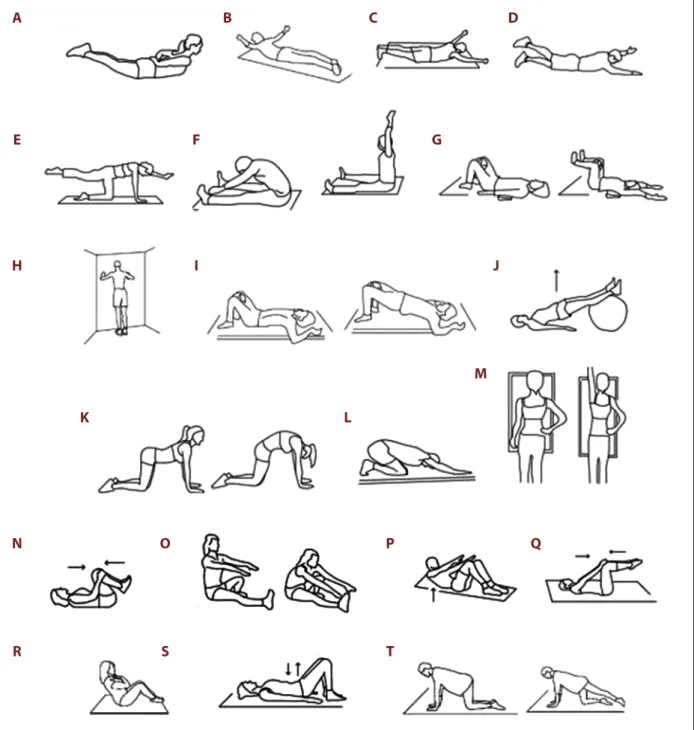
The first stage lasted for 2 weeks, with a treatment regime consisting of 1-hour daily exercises (Figures 1, 2), followed by the same home program treatment for 10 weeks. After re-evaluation, patients continued with the second part of daily exercises for 2 weeks, followed by the same home program treatment for 10 weeks. The application of exercises was per-formed depending on the patient’s diagnosis and examina-tion results. The following exercises from the Schroth method were selected. The session for patients with thoracic scolio-sis conscolio-sisted of thoracic spine correction, hanging, stretching of the weak side (concave side of the scoliosis curve), sitting on the Swiss ball, strengthening the back muscles and side stretching (concave side) (Figure 1A, 1E, 1H, 1I, 1J). The exer-cises for the patients with lumbar scoliosis included lumbar spine correction, lifting the pelvis laterally, hanging, stretching the weak side (concave side of the scoliosis curve), strength-ening the back muscles and side stretching (concave side) (Figure 1B, 1E, 1G, 1H, 1J). The session for the patients with thoracolumbar scoliosis or double scoliosis, including thoracic
and lumbar scoliosis, consisted of the following exercises: ba-sic correction sitting, self-correction exercise in front of the mirror, hanging, stretching the weak side (concave side of the scoliosis curve), strengthening the back muscles, and thora-columbar spine correction (Figure 1C, 1D, 1E, 1H, 1I, 1J). The duration of the Schroth exercise session was 30 minutes, and the session continued with the Pilates exercises, which were also applied over a duration of 30 minutes. Pilates exercises were grouped as follows: spine and trunk strengthening exer-cises, spine and trunk stretching exerexer-cises, and limb strength-ening and stretching exercises (Figure 2). After 24 weeks of completing the exercises, patients were evaluated and advised on how to continue with the same exercise program at home. Measurements
General information including age and gender were obtained through subjective examination. X-ray was used to evalu-ate the Cobb angle [24] at pretreatment and 24 weeks after
treatment (x-ray was done in posterior and lateral position, with the patient standing in an anatomical position). All patients wearing a brace had been wearing the brace before being in-cluded in the study and continued wearing it after the end of treatment. For patients wearing a brace, the time they stayed out-of-brace before x-ray was within the limits they were al-lowed to be out of brace. The same procedure was folal-lowed for both evaluations, at beginning and end of treatment. The ATR was measured by the bending forward test (Adam’s test) using the Bunnell scoliometer (MIZUHO OSI, USA, Union City, CA, USA) [25] as follows: if scoliosis was in the thoracic, tho-racolumbar, or lumbar regions, the most prominent part of the respective region was measured, while in double scolio-sis, ATR was measured in the 2 most prominent regions, the thoracic and lumbar regions. Chest expansion was evaluated at the end of deep inspiration in 3 levels, the sub-axillary (N1), nipple line (N2), and around the waist (N3), using a measur-ing tape, and for the measurement of this variable, the pa-tient was standing in an anatomical position [26]. Additionally,
A
G
E
F
B
H
C
I
D
J
Figure 1. Schroth exercises examples: (A) thoracic spine correction, (B) lumbar spine correction, (C) basic correction sitting, (D) self-correction exercise in front of mirror, (E) hanging, (F) thoracolumbar spine correction, (G) lift the pelvis laterally, (H) stretch weak side, (I) thoracic spine correction sitting on the sews boll, (J) strength the muscle of the back and stretch side.
A
E
H
N
R
O
S
P
T
Q
K
L
M
F
I
J
G
B
C
D
Figure 2. Pilates exercises examples: (A) back hyperextension, (B) back hyperextension from T prone position, (C) back hyperextension from Y prone position, (D) arm and leg rise in prone position, (E) quadruped arm/leg rise, (F) back hyperextension with hands forward, (G) flex the shoulder/raise the leg in supination, (H) scapula pushups in standing position, (I) body bridge, (J) body bridge with ball, (K) cat and camel exercise, (L) Mohammedan prayer, (M) Stretch side, (N) lower back muscle stretch, (O) runner’s stretch, (P) Abdominal crunch, (Q) double-leg abdominal press, (R) cross arm/hip flex – abdominal strength, (S) finding your pelvic floor, (T) swimming level.
flexibility was evaluated with a measuring tape (distance be-tween C7 to S2) from vertical posture until a maximum for-ward bend was achieved, avoiding compensation with other parts of body, such as flexion of knees [27].
QoL was evaluated using the SRS-22r questionnaire which was utilized with the permission of the Scoliosis Research Society and translated into Albanian language by a certified translator. The SRS-22r questionnaire is a QoL scoliosis questionnaire that assesses 5 domains: function, pain, self-image, mental health, and satisfaction (5 questions each, except satisfaction with treatment, which included 2 questions) [28,29]. The interview-er administinterview-ered questionnaire was utilized. All of these vari-ables were evaluated at pretreatment and at 12 weeks and at 24 weeks of treatment.
Statistical analysis
The statistical analysis was performed using SPSS22.0. Descriptive analyses were presented using means and stan-dard deviations for normally distributed variables. The Shapiro-Wilk test was used for testing of sample normality with an alpha level of.05. After meeting the assumptions of normal distribu-tion, the following analyses were carried out: the differences in the Cobb angle from the beginning and end of treatment were assessed with a paired-samples t-test, while the exercise impact on the Cobb angle was calculated using Cohen’s d. To define differences in ATR, chest expansion, trunk flexion, and
QoL, we used repeated measures ANOVA with post-hoc anal-ysis using LSD (least significant difference) test. Statistical sig-nificance was set P<0.05.
Results
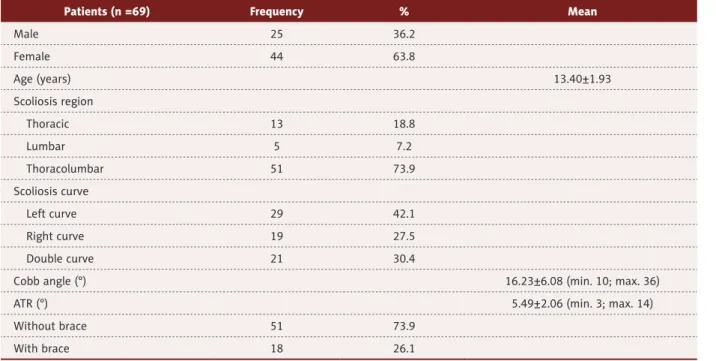
Characteristics of patients are presented in Table 1. Table 2 shows the significant difference in the mean value of the Cobb angle in patients wearing a brace and patients not wearing a brace. Improvement was seen in the thoracic region (t=7.96,
P=0.00), and in the lumbar region (t=4.80, P=0.00) of patients wearing a brace. In the group of patients not wearing a brace, a significant positive difference was found in thoracolumbar (t=5.46, P=0.00) and thoracic region (t=5.85, P=0.00). Also, the total average of the Cobb angle in both groups had signif-icantly improved after 24 weeks of treatment (t=5.80, P=0.00; t=7.07, P=0.00). The exercise impact on the Cobb angle out-comes using Cohen’s d was medium-large after 24 weeks of treatment (Table 2).
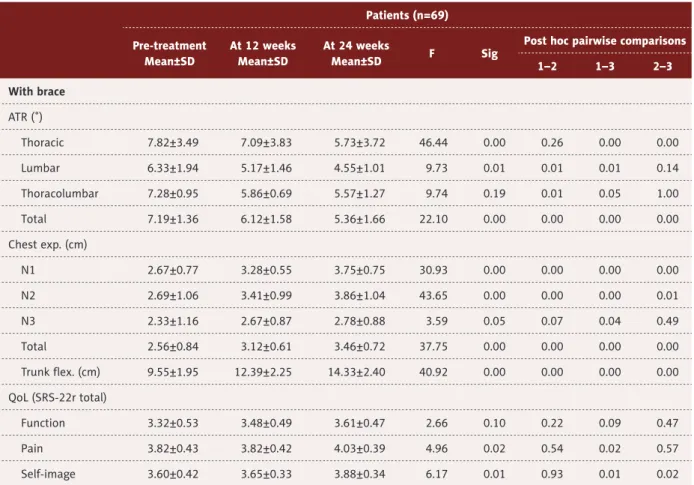
Table 3 shows the statistical differences in the mean value of the ATR, chest expansion, trunk flexion, and QoL from before the treatment, after 12 weeks and after 24 weeks of treatment separately for the groups of patients with and without a brace. In patients wearing a brace, improvement was seen in the tho-racic (F=46.44, P=0.00), lumbar (F=9.73, P=0.01), and the av-erage of the ATR total (F = 22.10, P = 0.00). Improvement was
Patients (n =69) Frequency % Mean
Male 25 36.2 Female 44 63.8 Age (years) 13.40±1.93 Scoliosis region Thoracic 13 18.8 Lumbar 5 7.2 Thoracolumbar 51 73.9 Scoliosis curve Left curve 29 42.1 Right curve 19 27.5 Double curve 21 30.4
Cobb angle (°) 16.23±6.08 (min. 10; max. 36)
ATR (°) 5.49±2.06 (min. 3; max. 14)
Without brace 51 73.9
With brace 18 26.1
Table 1. General characteristics of patients at the start of treatment.
Cobb angle (°) S curve (%) C curve (%) Patients (n=69) Pre-treatment Mean±SD After 24 weeks
Mean±SD T Df Sig Cohen’s d
With brace Thoracolumbar 22.71±3.49 18.57±6.29 2.53 6 0.45 0.81 Thoracic 20.54±8.78 17.09±8.96 7.96 10 0.00 0.39 Lumbar 22.44±6.44 18.44±6.73 4.80 8 0.00 0.61 Total 50 50 21.97±4.99 18.11±6.39 5.80 17 0.00 0.67 Without brace Thoracolumbar 15.00±3.33 12.54±2.65 5.46 21 0.00 0.82 Thoracic 13.80±2.50 10.80±2.61 5.85 19 0.00 1.17 Lumbar 12.71±4.29 11.36±3.91 1.54 13 0.15 0.33 Total 28 72 14.19±3.11 11.66±2.73 7.07 48 0.00 0.86
Table 2. Mean change in Cobb angle, pre-treatment and after 24 weeks of treatment presented separately for patients with and without a brace.
Mean±SD, Significant difference from before intervention, and after 24 weeks, P<0.05. SD – standard deviation.
Patients (n=69) Pre-treatment Mean±SD At 12 weeks Mean±SD At 24 weeks Mean±SD F Sig
Post hoc pairwise comparisons
1–2 1–3 2–3 With brace ATR (˚) Thoracic 7.82±3.49 7.09±3.83 5.73±3.72 46.44 0.00 0.26 0.00 0.00 Lumbar 6.33±1.94 5.17±1.46 4.55±1.01 9.73 0.01 0.01 0.01 0.14 Thoracolumbar 7.28±0.95 5.86±0.69 5.57±1.27 9.74 0.19 0.01 0.05 1.00 Total 7.19±1.36 6.12±1.58 5.36±1.66 22.10 0.00 0.00 0.00 0.00 Chest exp. (cm) N1 2.67±0.77 3.28±0.55 3.75±0.75 30.93 0.00 0.00 0.00 0.00 N2 2.69±1.06 3.41±0.99 3.86±1.04 43.65 0.00 0.00 0.00 0.01 N3 2.33±1.16 2.67±0.87 2.78±0.88 3.59 0.05 0.07 0.04 0.49 Total 2.56±0.84 3.12±0.61 3.46±0.72 37.75 0.00 0.00 0.00 0.00 Trunk flex. (cm) 9.55±1.95 12.39±2.25 14.33±2.40 40.92 0.00 0.00 0.00 0.00 QoL (SRS-22r total) Function 3.32±0.53 3.48±0.49 3.61±0.47 2.66 0.10 0.22 0.09 0.47 Pain 3.82±0.43 3.82±0.42 4.03±0.39 4.96 0.02 0.54 0.02 0.57 Self-image 3.60±0.42 3.65±0.33 3.88±0.34 6.17 0.01 0.93 0.01 0.02
Table 3. Mean change of angle of trunk rotation, chest expansion, flexibility and quality of life (SRS-22r measurements data) Presented separately for patients with and without a brace.
Patients (n=69) Pre-treatment Mean±SD At 12 weeks Mean±SD At 24 weeks Mean±SD F Sig
Post hoc pairwise comparisons
1–2 1–3 2–3 Mental health 2.95±0.31 3.11±0.34 3.35±0.42 7.9 0.00 0.38 0.01 0.01 QoL-subtotal 3.36±0.25 3.53±0.21 3.72±0.21 21.45 0.00 0.01 0.00 0.00 Satisfaction 4.58±0.57 4.80±0.35 4.92±0.19 3.23 0.07 0.36 0.69 0.31 QoL-total 3.50±0.27 3.63±0.19 3.82±0.2 18.68 0.00 0.02 0.00 0.00 Without brace ATR (˚) Thoracic 4.62±0.86 3.81±0.87 3.38±0.92 21.67 0.00 0.00 0.00 0.17 Lumbar 4.07±1.14 3.57±1.16 3.71±1.32 6.15 0.01 0.01 0.72 1.00 Thoracolumbar 5.09±1.15 4.27±1.03 3.72±0.93 24.08 0.00 0.00 0.00 0.07 Total 4.72±1.04 3.94±1.01 3.58±0.94 42.33 0.00 0.00 0.00 0.42 Chest exp. (cm) N1 2.92±0.91 3.54±0.92 3.97±0.81 44.90 0.00 0.00 0.00 0.00 N2 2.84±0.95 3.60±0.98 3.95±0.83 64.41 0.00 0.00 0.00 0.00 N3 1.94±1.13 2.48±0.97 2.63±0.81 19.96 0.00 0.00 0.00 0.17 Total 2.57±0.87 3.20±0.83 3.52±0.72 73.91 0.00 0.00 0.00 0.17 Trunk flex. (cm) 9.82±2.61 12.26±2.52 13.98±2.18 78.23 0.00 0.00 0.00 0.00 QoL (SRS-22r total) Function 3.19±0.41 3.38±0.31 3.49±0.41 11.63 0.00 0.00 0.00 0.11 Pain 3.47±0.58 3.78±0.43 3.89±0.48 13.81 0.00 0.00 0.00 0.03 Self-image 3.48±0.50 3.60±0.49 3.85±0.40 20.43 0.00 0.18 0.00 0.00 Mental health 3.09±0.41 3.18±0.39 3.32±0.39 9.03 0.00 0.36 0.00 0.00 QoL-subtotal 3.31±0.27 3.47±0.26 3.74±0.56 17.85 0.00 0.00 0.00 0.00 Satisfaction 4.59±0.61 4.80±0.42 4.94±0.19 10.85 0.00 0.01 0.00 0.03 QoL-total 3.42±0.24 3.59±0.24 3.78±0.23 74.37 0.00 0.00 0.00 0.00
Table 3 continued. Mean change of angle of trunk rotation, chest expansion, flexibility and quality of life (SRS-22r measurements data) Presented separately for patients with and without a brace.
Mean±SD, ATR – angel of trunk rotation; N1 – chest expansion in subaxilary; N2 – chest expansion in nipple line; N3 – chest expansion around the waist; SRS-22r – Scoliosis Research Society 22r; Questionnaire, satisfaction – satisfaction with management; QoL – quality of life.
also seen in chest expansion at the level of N1-in sub axillary (F=30.93, P=0.00), N2-nipple line (F=43.65, P=0.00), and N3-around the waist (F=3.59, P=0.05). The total average of chest expansion had significantly improved after 24 weeks of treat-ment (F=37.75, P=0.00). Regarding the trunk flexion, signifi-cant statistical improvement was observed (F=40.92, P=0.00), compared pre-treatment, 12 weeks and after 24 weeks of treatment. Also we found significant improvement in most of components of QoL: pain (F=6.17, P=0.01), self-image (F=6.17,
P=0.01), mental health (F=7.9, P<0.00), QoL subtotal (F=21.45,
P=0.00), and the QoL total (F=18.68, P=0.00). Post hoc analysis with the LSD test showed improvement in ATR total, chest ex-pansion total, flexibility, and QoL total when comparing data from pretreatment with 12 weeks of treatment and 12 weeks of treatment with 24 weeks of treatment (Table 3).
In patients not wearing a brace, significant positive changes were found in ATR values, thoracic (F=21.67, P=0.00, lumbar (F=6.15, P=0.01), thoracolumbar (F=24.08, P=0.00), and ATR total (F=42.33, P=0.00). Chest expansion improvement is also seen on all 3 levels N1 (F=44.90, P=0.00), N2 (64.41, P=0.00), N3 (N=19.96, P=0.00), and N total (N=7 3.91, P=0.00). Similarly, trunk flexion underwent statistically significant change across the treatments (F=78.23, P=0.00). To our positive surprise, all QoL components including QoL total showed significant im-provement in patients not wearing a brace (P=0.00).
Discussion
The success of different methods of exercise in decreasing or stopping the increase in the Cobb angle, improving the ATR, QoL and other outcomes has been documented in numerous studies performed all over the world.
The Schroth 3-dimensional exercise approach was shown to have significant effects on decreasing the Cobb angle and pain in patients with scoliosis, improving the cosmetic appearance in children, improving waist asymmetry, and decreasing the height of the hump. Additionally, Pilates exercises have been reported to change the trunk flexibility through the backbone segmentation movement, decrease non-structural scoliosis patients’ Cobb angle, improve their flexibility and pain, posi-tively affect posture, and improve quality of life [5,15,30–34]. Since our sample consisted of patients with various degrees of Cobb angle, different regions and orientations of the curve, and some of the patients also showed movement limitation, we decided to combine Schroth and Pilates methods for which we expected to find positive effects based on the existing lit-erature. Hence, the aim of this study was to verify the effec-tiveness of a combination of exercises from the Schroth and
Pilates methods on the Cobb angle, ATR, flexibility, chest ex-pansion, and QoL in adolescent idiopathic scoliosis.
Otman et al. [35] applied the Schroth method in patients with adolescent idiopathic scoliosis and reported a reduction in the Cobb angle. Kuru et al. [5] showed that patients who partici-pated in Schroth exercises in the clinic showed improvement in reducing the Cobb angle compared with a group of patients following a home Schroth program or the control group that did not participate in exercises. Schreiber et al. [11,36] also reported that the Schroth PSSE methods combined with stan-dard care is more effective in the treatment of scoliosis com-pared with standard care alone. Another study that comcom-pared the effects of Schroth exercises and back braces in adolescent idiopathic scoliosis patients reported that the group of pa-tients who participated in Schroth exercises showed better re-sults in improving the Cobb angle [14]. Kim and Hwangbo [17] showed that Schroth exercises also have good results in pa-tients who had Cobb angles of 40° or higher. However, Kim and Hwangbo [17] in another study reported that both meth-ods, Schroth and Pilates, were effective in changing the Cobb angle, but Schroth exercises were significantly more effective than Pilates exercises. As we mentioned, our study showed a decrease in the Cobb angle in patients with adolescent idio-pathic scoliosis who were treated with a combination of Schroth and Pilates exercises. These results were similar to those of the aforementioned studies and other studies that also reported a decrease in the Cobb angle after application of the Schroth method [12,24,37,38]. It should be emphasized that most of the studies complying with our study results involved partic-ipants with moderate scoliosis curves, while the majority of our patients had mild scoliosis curves. Being aware of the fact that Schroth exercises were initially developed for patients with large Cobb angle, we wanted to evaluate the effect of com-bined Schroth and Pilates exercises in patients with mild and moderate curves, which as a result caused a positive effect. Similar findings were also reported by the study of Park et al. who found that Schroth exercises could be beneficial for tients with a Cobb angle from 10° to 30° rather than for pa-tients with a Cobb angle larger than 30° [39].
In our research, improvement in the Cobb angle of the thoraco-lumbar curve in patients with a brace was not statistically sig-nificant. It is important to note that the group of patients with a brace was comprised of 50% of patients with double scoli-osis, whereas in the group without a brace the rate was 28% (Table 2). Double scoliosis is known to present with a great-er risk of progression in comparison to single scoliosis, and in addition, thoracolumbar and lumbar scoliosis are at greater risk of progression compared to thoracic scoliosis [40]. In re-lation to the latter, we also found significant improvement in the Cobb angle in thoracic scoliosis compared to non-signifi-cant result in lumbar scoliosis in patients without a brace. It is
unknown whether worse prognosis in lumbar scoliosis might be responsible for this finding or if perhaps the exercises were not sufficiently effective. To address this uncertainty, more re-search is needed.
Besides the Cobb angle, another very important variable in determining scoliosis severity is the ATR. In our study, we ob-served significant improvement in the total ATR when com-paring pretreatment measurements to those obtained after 24 weeks of treatment. Many studies have obtained similar results in the improvement of ATR after the application of dif-ferent treatment exercise methods, especially Schroth exer-cises [5,17,18,41–43].
In this study we reported that these exercises also have pos-itive effects on other variables, such as chest expansion, vital capacity, flexibility and QoL. There is insufficient evidence that chest expansion and flexibility are reliable and valid examina-tion tools in patients with scoliosis. However, our results were in line with other studies [5,17,26,32,42,44] that reported im-provements in chest expansion and other variables, such as trunk deviation, vital capacity and waist asymmetry, after the application of conservative treatment, especially after Schroth and Pilates exercises [5,35]. It should be noted that besides treatment, improvement in chest expansion could have been affected by patients’ growth over the treatment period. In lation to flexibility, our study results were similar to the re-sults of the study by Alves de Araujo et al. [15] that report-ed a significant increase in flexibility after the application of Pilates exercises.
Real idiopathic scoliosis causes deformity of the spinal col-umn, and as a consequence of this deformity, physical and psychological problems can arise in patients; these problems can have a negative impact on QoL [45]. Some studies have reported that different protocols of exercises have no impact on the improvement of QoL, while some studies have report-ed positive effects in the improvement of QoL for patients with idiopathic scoliosis. Vasiliadis and Grivas [46] reported that health related QoL (HRQoL) was negatively affected after conservative treatment of patients with idiopathic scoliosis.
Kuru et al. [5] reported that there were no significant differ-ences in QoL from before to after treatment of patients with scoliosis. Atanasio et al. [47] showed that the application of exercises in patients with idiopathic scoliosis did not have an effect on overall QoL but had a positive effect on the cosmet-ic appearance score. The results of our study were similar to the results of other studies that have reported the positive impact of the application of different methods of conserva-tive treatment, especially the influence of the application of the Schroth method on the QoL of scoliosis patients. Some of those studies have concluded that the application of the Schroth method alone or in combination with other methods of exercise improves self-image as well as function and QoL in general [14,48,49].
This study had a few limitations. We are aware that having a control group is desirable. Knowing that scoliosis requires long-term treatment, a longer follow-up is needed. The com-prehensive literature also uses the Risser scale to determine skeletal maturation, which we did not use in this study and consider it as another limitation.
Conclusions
Although Schroth exercises were initially developed for pa-tients with severe scoliosis curve, our study demonstrated that the treatment of adolescent idiopathic scoliosis patients with mild and moderate curve with a combination of Schroth and Pilates exercises was proven to be statistically significant in decreasing the Cobb angle and ATR, improving chest ex-pansion and trunk flexion, and increasing QoL. However trolled studies with longer follow-up periods, taking into con-sideration skeletal maturity using the Risser scale, are needed to provide more solid conclusions about the efficacy of this ap-proach and about its potential to improve scoliosis over time. Acknowledgements
We would like to thank all parents and adolescents who par-ticipated in this study.
References:
1. Janicki JA, Alman B: Scoliosis: Review of diagnosis and treatment. Pediatr Child Health, 2007; 12: 771–76
2. Konieczny MR, Senyurt H, Krauspe R: Epidemiology of adolescent idiopath-ic scoliosis. J Child Orthop, 2013; 7(1): 3–9
3. Yagci G, Ayhan C, Yakut Y: Effectiveness of basic body awareness therapy in adolescents with idiopathic scoliosis: A randomized controlled study. J Back Musculoskelet Rehabil, 2018; 31(4): 693–701
4. Solberg G: Postural disorders and musculoskeletal dysfunction. diagnosis, prevention and treatment. 2nd ed. Philadelphia, Elsevier, 2008
5. Kuru T, Yeldan İ, Dereli EE et al: The efficacy of three-dimensional Schroth exercises in adolescent idiopathic scoliosis: A randomised controlled clin-ical trial. J Clin Rehabil, 2016; 30(2): 181–90
6. Hawes MC: The use of exercises in the treatment of scoliosis: An evidence – based critical review of the literature. J Pediatr Rehabil, 2003; 6(3–4): 171–82
7. Fusco C, Zaina F, Atanasio S et al: Physical exercises in the treatment of adolescent idiopathic scoliosis: an updated systematic review. J Physiother Theory Pract, 2011; 27(1): 80–114
8. Lenssinck ML, Frijlink AC, Berger MY et al: Effect of bracing and other conser-vative interventions in the treatment of idiopathic scoliosis in adolescents: A systematic review of clinical trials. J Phys Ther, 2005; 85(12): 1329–39
9. Weiss HR: The method of Katharina Schroth – history, principles and cur-rent development. J Scoliosis, 2011; 6: 17
10. Park JH, Jeon HS, Park HW: Effects of the Schroth exercise on idiopathic scoliosis: A meta-analysis. Eur J Phys Rehabil Med, 2018; 54(3): 440–49 11. Schreiber S, Parent EC, Khodayari Moez E et al: Schroth
physiotherapeu-tic scoliosis-specific exercises added to the standard of care lead to better Cobb angle outcomes in adolescents with idiopathic scoliosis – an asses-sor and statistician blinded randomized controlled trial. PLoS One, 2016; 11(12): e0168746
12. Yang J-M, Lee J-H, Lee D-H: Effects of consecutive application of stretching, Schroth, and strengthening exercises on Cobb’s angle and the rib hump in an adult with idiopathic scoliosis. J Phys Ther Sci, 2015; 27(8): 2667–69 13. Negrini S, Donzelli S, Lusini M et al: The effectiveness of combined bracing
and exercise in adolescent idiopathic scoliosis based on SRS and SOSORT criteria: a prospective study. BMC Musculoskelet Disord, 2014; 15: 263 14. Kwan KYH, Cheng ACS, Koh HY et al: Effectiveness of Schroth exercises
dur-ing bracdur-ing in adolescent idiopathic scoliosis: Results from a preliminary study – SOSORT Award 2017 Winner. Scoliosis and Spinal Disord, 2017; 12: 32
15. Alves de Araújo ME, Bezerra da Silva E, Bragade Mello D et al: The effective-ness of the Pilates method: Reducing the degree of non-structural scolio-sis, and improving flexibility and pain in female college students. J Bodyw Mov Ther, 2012; 16(2): 191–98
16. Bas P, Romagnoli M, Gomez-Cabrera M-C et al: Beneficial effects of aero-bic training in adolescent patients with moderate idiopathic scoliosis. Eur Spine J, 2011; 20(3): 415–19
17. Kim KD, Hwangbo PN: Effects of the Schroth exercise on the Cobb’s angle and vital capacity of patients with idiopathic scoliosis that is an operative indication. J Phys Ther Sci, 2016; 28(3): 923–26
18. Negrini S, Fusco C, Minozzi S et al: Exercises reduce the progression rate of adolescent idiopathic scoliosis: Results of a comprehensive systematic re-view of the literature. Disabil Rehabil, 2008; 30(10): 772–85 19. Negrini A, Verzini N, Parzini S et al: Role of physical exercise in the
treat-ment of mild idiopathic adolescent scoliosis review of the literature. Europa Medicophysica, 2001; 37(3): 181–90
20. Negrini S, Hresko TM, O’Brien JP et al: Recommendations for research stud-ies on treatment of idiopathic scoliosis: Consensus 2014 between SOSORT and SRS non-operative management committee. J Scoliosis, 2015; 10: 8 21. Lenhart-Schroth C: Three-dimensional treatment for scoliosis: A
physio-therapeutic method for deformities of the spine. 1st English Ed. California,
Martindale Press, 2007
22. Valant J: Pilates exercises for scoliosis. Available from: http://www.jessicav-alantpilates.com/home-workout-program- scoliosis
23. Tufekcievski A, Aceski A: Biomechanics. 2nd ed. R. Macedonia, Faculty of
Physical Education, 2009
24. Lee HJ, Seong HD, Bae Y-H et al: Effect of the Schroth method of emphasis of active holding on Cobb’s angle in patients with scoliosis: A case report. J Phys Ther Sci, 2016; 28(10): 2975–78
25. Patias P, Grivas BT, Kaspiris A et al: A review of the trunk surface metrics used as Scoliosis and other deformities evaluation indices. J Scoliosis, 2010; 5: 12
26. Lebel A, Lebel AV: Severe progressive scoliosis in an adult female possi-bly secondary thoracic surgery in childhood treated with scoliosis specific Schroth physiotherapy: case presentation. Scoliosis Spinal Disord, 2016; 11(Suppl. 2): 41
27. Norkin C, White D: Measurement of joint motion: A guide to goniometry. 3rd ed. Philadelphia: F.A., Davis Company, 2003
28. Kotwicki T, Chowanska J, Kinel E et al: Optimal management of idiopathic scoliosis in adolescence. Adolesc Health Med Ther, 2013; 4: 59–73
29. SRS 22r Patient Questionnaire. Milwaukee: Scoliosis Research Society; c2006 Available from: https://www.srs.org/UserFiles/file/outcomes/srs-22.pdf
30. Kim G, HwangBo PN: Effects of Schroth and pilates exercises on the Cobb angle and weight distribution of patients with scoliosis. J Phys Ther Sci, 2016; 28: 1012–15
31. Emery K, Serres SJ, McMillan A et al: The effects of a pilates training pro-gram on arm-trunk posture and movement. Clin Biomech, 2010; 25(2): 124–30
32. Watanabe K, Hosogane N, Chiba K et al: Anterior chest hump in adolescent idiopathic scoliosis- questionnaire evaluation. Scoliosis 2012; 7(1): O11 33. Yu JH, Lee GC: Influence of pilates on physical factors related to exercise
performance. J Kor Phys Ther, 2011; 23(3): 57–63
34. HwangBo PN. Psychological and physical effects of Schroth and pilates ex-ercise on female high school students with idiopathic scoliosis. J Kor Phys Ther, 2016; 28(6): 364–68
35. Otman S, Kose N, Yakut Y: The efficacy of Scrothʻs 3-dimensional exercise therapy in the treatment of adolescent idiopathic scoliosis in Turkay. Saudi Med J, 2005; 9: 1429–35
36. Schreiber S, Parent EC, Hill DL et al: Schroth physiotherapeutic scoliosis-specific exercises for adolescent idiopathic scoliosis: How many patients require treatment to prevent one deterioration? Results from a random-ized controlled trial “SOSORT 2017 Award Winner.” Scoliosis Spinal Disord, 2017; 12: 26
37. Rigo M, Quera-Salvá G, Villagrasa M et al: Scoliosis intensive out-patient re-habilitation based on Schroth method. Stud Health Technol Inform, 2008; 135: 208–27
38. Schreiber S, Parent EC, Hedden DM et al: Effect of Schroth exercises on curve characteristics and clinical outcomes in adolescent idiopathic sco-liosis: Protocol for a multicenter randomized controlled trial. J Physiother, 2014; 4: 234
39. Park, JH, Jeon HS, Park HW: Effects of the Schroth exercise on idiopathic scoliosis: A meta-analysis. Eur J Phys Rehabil Med, 2018; 54(3): 440–49 40. Berdishevsky H, Ashley Lebel V, Bettany-Saltikov J et al: Physiotherapy
sco-liosis-specific exercises – a comprehensive review of seven major schools. Scoliosis Spinal Disord, 2016; 11: 20
41. Yilmaz H, Kuru T: Conservative treatment results of 39 patients with ado-lescent idiopathic scoliosis. J Scoliosis, 2012; 7(1): O47
42. Borysov M, Borysov A: Scoliosis short-term rehabilitation (SSTR) according to ‘Best Practice’ standards – are the results repeatable? J Scoliosis, 2012; 7: 1
43. Ko KJ, Kang SJ: Effects of 12-week core stabilization exercise on the Cobb angle and lumbar muscle strength of adolescents with idiopathic scolio-sis. J Exerc Rehabil, 2017; 13(2): 244–49
44. Berdishevsky H: The effectiveness of the Schroth method of physical ther-apy for treating an adult with adolescent idiopathic scoliosis (AIS) in an outpatient clinic in the United States with third-party payer constraints: A case report. J Scoliosis, 2013; 8(2): O10
45. Freidel K, Reichel D, Steiner A et al: Quality of life in women with idiopath-ic scoliosis. Spine J, 2002; 27(4): E87–91
46. Vasiliadis E, Grivas TB: Quality of life after conservative treatment of ado-lescent idiopathic scoliosis. Stud Health Technol Inform, 2008; 135: 409–13 47. Atanasio S, Dulio M, Zaina F et al: Effect of conservative treatments on QoL
according to the SRS-22. J Scoliosis, 2009; 4(1): O62
48. Rivett L, Stewart A, Potterton J: The effect of compliance to a Rigo System Cheneau brace and a specific exercise program on idiopathic scoliosis cur-vature: A comparative study: SOSORT 2014 award winner. J Scoliosis, 2014; 9: 5
49. Anwer S, Alghadir A, Abu Shaphe M et al: Effects of exercise on spinal de-formities and quality of life in patients with adolescent idiopathic scolio-sis. Biomed Res Int, 2015; 2015: 123848