Tertiary Education Commission
Performance-Based Research Fund – Definitions and Rules, March 2014 i
Performance-Based Research Fund
Measuring research degree completions
Definitions and rules
Version 3.3 – March 2014
Tertiary Education Commission
Performance-Based Research Fund – Definitions and Rules, March 2014 ii
Version control
Draft July 2010 1 September2010
Changed order of steps in 2.2 to address course completions before course enrolments
Clarified where information is taken from for VRF, Ethnicity and Category
Expanded exclusion of course completions (2.2 v second bullet point) to explain treatment of duplicate course completions with the same start date
Added section 2.5 to discuss the reason for exclusion of course completions and planned future changes to the rule
2 March 2011 Remove the rule excluding course completions where there are subsequent enrolments in PBRF eligible courses in the same qualification. This has been done as a result of feedback in 2010 that there can be multiple research degree completions for the same qualification code
Introduce the rule of counting all completions with a completion code of 2 and a VRF value
Add section 2.3 to provide guidance on how to report completions via the SDR
3 August 2011 Change rule 2.2 paragraph 8, iii second bullet point. Criteria for selecting enrolment record.
3.1 September 2011
Clarification of wording. Paragraphs 5,8 (iii) and 11 (i – iii)
3.2 November 2012
Submission of Thesis written in Te Reo
3.3 March 2013 Clarification of Weighting for Te Reo Courses
Tertiary Education Commission
Performance-Based Research Fund – Definitions and Rules, March 2014 iii
Table of contents
1
Introduction and background ... 4
2
Research Degree Completions (RDC) ... 6
2.1
What it reports ... 6
2.2
Rules for calculating RDC ... 6
2.3
Which data to report ... 7
2.4
Rules for calculating Weighted RDC ... 8
2.5
Which data to use ... 10
List of tables
Table 1: RDC funding allocations ... 10
Table 2: Data used for RDC verification and funding allocations ... 10
Document version history
Date
Version
July 2010
DRAFT
September 2010
1
March 2011
2
August 2011
3
September 2011
3.1
November 2012
3.2
March 2014
3.3
Version 3.3 – March 2014 4
1 Introduction and background
1 The primary goal of the Performance-Based Research Fund (PBRF) is to ensure that excellent research in the tertiary education sector is encouraged and
rewarded. This entails assessing the research performance of eligible tertiary education organisations (TEOs) and funding them on the basis of this
performance.
2 The PBRF is a “mixed” performance-assessment regime that employs both peer review processes and performance measures. The three assessment elements are:
A “Quality Evaluation” measure: this is a periodic assessment of the research performance of eligible TEO staff, undertaken by expert peer review panels. This element makes up 60 percent of the fund.
A postgraduate “research degree completions” (RDC) measure: this is a measurement of the number of PBRF-eligible postgraduate research-based degrees completed in participating TEOs, assessed on an annual basis. This element makes up 25 percent of the fund
An “external research income” (ERI) measure: this is a measurement of the amount of income for research purposes received by participating TEOs from external sources, assessed on an annual basis. This element makes up 15 percent of the fund.1
3 The RDC measure was introduced in 2003 along with the PBRF. Between 2003 and 2010, Single Data Return (SDR) data was collated and sent to TEOs for verification. Any resulting changes to this data were managed outside the SDR system.
4 This document sets out the definitions and rules that will be used to extract data for the Research Degree Completions measure going forward.
5 This is Version 3.3 of the PBRF RDC definitions and rules. Version 1 of this document was released in September 2010. Version 2 in March 2011 included changes based on feedback from a workshop held in September 2010. Both these versions used the latest enrolment record to identify the values to be used for ethnicity and category codes. Feedback has revealed that there are
instances where enrolment records have also been submitted in years after the year in which the course ended and for which, therefore, the latest record may not have the correct values for ethnicity and category codes.
6 Version 3 corrects for this by using the latest enrolment that is on or before the year in which the course end date ends where these exist. Details of the
1
Refer to the Performance-Based Research Fund User Manual for full descriptions and funding rules.
Version 3.3 – March 2014 5 changes between versions are set out in the version control panel at the front of this document.
7 Version 3.1 and version 3.2 make minor changes to clarify the meaning of the rules and incorporate the strategic weighting of 4.0 on these completed in te reo Māori. This weighting has been introduced based on the recommendation of the Sector Reference Group that reviewed the PBRF during 2008-2010.
Version 3.3 – March 2014 6
2 Research Degree Completions (RDC)
2.1 What it reports
9 RDC is a count of qualification completions with an externally assessed research component of greater than or equal to 0.75 EFTS that meet the criteria set out in the PBRF User Manual and the 2006 Quality Evaluation Guidelines pp. 185-190. We use the successfully completed PBRF-eligible course associated with the qualification to determine the research degree completion.
2.2 Rules for calculating RDC
10 The following rules are used in calculating RDC.
i.
Use the ‘master’ National Student Number (NSN) if there are multiple NSNs for the same student.ii.
All valid submitted course completions with a completion year in year n are included. The completion year is identified in the course completion file by the PBRF_CRS_COMP_YR field. If this field is blank then the course end date from the course enrolment file is used.2iii.
The following course enrolment records are used: 3 Records that are in the last SDR return for the return year per TEO.4
Enrolment records are selected using the following criteria:
1. The enrolment record is from the last return year that is less than or equal to the year in which the course ends..5
or
2. If all enrolment records are in return years after the year of the course end date, then the enrolment record from the latest return year is selected.
Records where the course is eligible for PBRF funding (where the PBRF_eligible field for the enrolment is one of: M, D, L or C).
2
This rule is only required for historical records. From 2011, error 552 was introduced to the SDR: “PBRF_CRS_COMP_YR is blank when complete indicator is 2 or 3”.
3
An enrolment record is a unique combination of TEO Code, course code, NSN and start date.
4
The last return for the year is usually the December SDR. 5
For a course enrolment which starts in 2005 and ends in 2006, the enrolment record is taken from the last SDR submitted for the 2006 return year. If the last time the 2006 SDR is submitted is in 2008, then the enrolment record from the 2008 version of the 2006 SDR will be used.
Version 3.3 – March 2014 7
iv.
The following course completion records are included:
Course completion records that have been identified as beingcompleted successfully (where the SDR complete field value is 2 or 8).6
The most recent completion (the latest submission for the latest return, if more than one) based on identical NSN, start date, course code and TEO code.
Course completion records with a VRF value greater than or equal to 0.75.7v.
Each course completion record must be matched with an enrolment record in order to be counted.8vi.
The following attributes are taken from the course register at the time of the submission of the matched enrolment:
PBRF eligibility
Category
VRFvii.
The following attributes are taken from the student record associated with the matched enrolment:
Ethnicity2.3 Which data to report
11 The TEC understands that a variety of practices are used across the sector to organise research courses and to report completions and that one approach may not suit all TEOs. The rules below outline practices that can be utilised to report completions.
12 Only one successful completion per course code is to be reported.9 13 Either:
(i) The qualification has only one PBRF eligible course, which is
assigned a VRF value and reported as being successfully completed
6
Refer to the description of COMPLETE in the SDR manual. 7
The VRF in the course register was made available in STEO in December 2010. 8
Matching is done to ensure accuracy, as completion records are stored in their own datasets, separate from enrolment records, in the SDR. The matching process has to be done carefully, as the SDR is continuously updated and there could be multiple enrolment records for a single completion. Completions are matched to enrolments using TEO code, NSN, course code, and course start date.
9
The Ministry of Education has confirmed that it no longer requires successful completions to be recorded every year for multi-year courses.
Version 3.3 – March 2014 8 (where the SDR complete field value is 2 or 8).10 This completion should only be reported once.11
(ii) The qualification has more than one PBRF eligible course but only one of these courses is assigned a VRF value.12 All the courses within the qualification are reported as being successfully completed. The course carrying a VRF should only be reported once.
(iii) The qualification has more than one PBRF eligible course and a VRF value is assigned to all of these courses. Only one of the courses is reported as successfully completed.
14 The PBRF Data Accuracy Report (DAR) identifies course completions with subsequent enrolments in the same qualification and those with multiple
completions per qualification. The DAR is produced in conjunction with the RDC list and additional DARs can be supplied on request.
15 Where a student completes two distinct pieces of research with the same qualification code, the completions should be reported as per 11 (iii) but with the two final courses reported as completed successfully. It is expected that the completions would be in different years.
2.4 Rules for calculating Weighted RDC
16 The following are the rules used in deriving a weighted RDC count used for the PBRF funding calculation. For more detail on funding calculations, refer to the PBRF User Manual and the 2006 Quality Evaluation Guidelines.
i.
A VRF weighting is applied to each valid matched course completion record.ii.
A cost-weighting is applied to each matched course enrolment-completion record, using the CATEGORY field. The category from the course record associated with the matched enrolment is used. The weighting is applied as follows:
1.0 = A, I, J
2.0 = B, L, V
2.5 = C, G, H, M, Niii.
An ethnicity weighting is applied to each matched course completion record, based on the student ethnicity from the student file associated with10
Refer to the description of COMPLETE in the SDR manual. 11
A PBRF Data Accuracy Report (DAR) has been developed that highlights where these conditions are not being met.
12
VRF values are at least 0.75. Courses not assigned a VRF value are PBRF eligible but with a zero or null VRF.
Version 3.3 – March 2014 9 the matched enrolment. Up to three ethnicity codes can be entered into the ethnicity field.
A weighting of 2 is given if any of the ethnicities are Māori or Pacific Peoples.13iv.
If none of the ethnicities are Māori or Pacific Peoples, then the record will get a weighting of 1.v.
A weighting of 4 is given for all RDCs successfully completed where the theses meets the agreed definition of being written in Te Reo Maori (SDR complete field value is 8).14vi.
The weighted count of each successfully completed course is summed to derive the weighted RDC measure.13 Note, a maximum weighting of 4 will apply should the thesis be written in Te Reo, regardless of the students ethnicity, refer to Point v.
Version 3.3 – March 2014 10
2.5 Which data to use
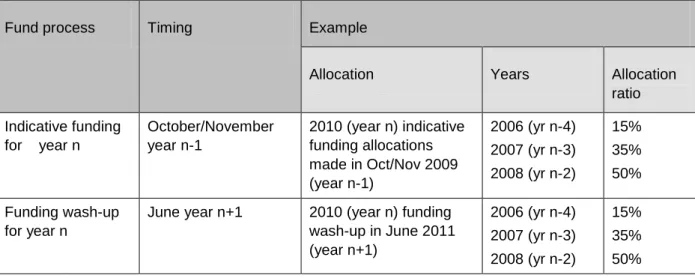
17 The tables below describe the data used by the TEC to calculate the Research Degree Completions for RDC funding allocations.
18 The PBRF funding allocations are based on a three-year weighted average.
Table 1: RDC funding allocations
Fund process Timing Example
Allocation Years Allocation
ratio Indicative funding for year n October/November year n-1 2010 (year n) indicative funding allocations made in Oct/Nov 2009 (year n-1) 2006 (yr n-4) 2007 (yr n-3) 2008 (yr n-2) 15% 35% 50% Funding wash-up for year n
June year n+1 2010 (year n) funding wash-up in June 2011 (year n+1) 2006 (yr n-4) 2007 (yr n-3) 2008 (yr n-2) 15% 35% 50%
Table 2: Data used for RDC verification and funding allocations
Fund process Data source/Timing Example Indicative data
produced for
verification using data up to and including:
August SDR year n-1
[for data from years n-2, n-3, n-4]
2011 indicative data for years 2009, 2008 and 2007 is produced from data up to and including the August 2010 SDR
Indicative data finalised for funding allocation using data up to and including:
Cut-off date as advised by TEC in indicative funding year n-1 [After August SDR year n-1 and before funding allocation in Oct/Nov year n-1]
Any data discrepancies in 2011 indicative data will be corrected by SDR updates between the August 2009 SDR and the cut-off date for 2009 as advised by the TEC
Wash-up data produced for
verification using data up to and including:
December SDR year n
[for data from years n-2, n-3, n-4]
2011 wash-up data for years 2009, 2008 and 2007 is produced from data up to and including the December 2011 SDR Wash-up data finalised
for funding allocation using data up to and including:
Cut-off data as advised by TEC in wash-up funding year n+1
[After December SDR year n and before funding allocation in June year n+1]
Any data discrepancies in 2011 wash-up data will be corrected by SDR updates between the December 2011 SDR and the cut-off date for 2012 as advised by the TEC
Version 3.3 – March 2014 11