by Phil Mackintosh
The crib sheet
More than 18 months ago, BATS CEO commented that the
proliferation of
order types
had resulted because the market
structure was very complex. In turn, the creation of new order
types also contributed to more complexity. More recently the
ICE CEO has joined the fray,
calling
for a moratorium on new
order types. However, there have been no
industry-wide
efforts
to simplify order types, despite the NYSE’s recent
filing
to
eliminate 15 order types.
We find that order type complexity is driven by a number of
things:
1. Exchange proliferation
2. Order combinations and permutations 3. Efforts to comply with rules and minimize costs 4. Exchanges having the freedom to innovate
When we list out all the order types, we see that:
• Many perform similar functions• Order types have been created to benefit retail, institutional and high frequency traders
• Many have been designed to make trading simpler
Order types are intertwined with other features of the market
structure, including bans on locked markets, the maker taker
model and latency. Simplifying order types is easier said than
done. Done on its own, it may do more harm than good.
September 2014
Demystifying
Order Types
CONTENTS
Another order of complexity 2 Exchange proliferation perpetuates
the problem 3
What do all these order types do? 6 Order combinations create more
permutations 7
How many order types do we need? 8 Dark order types don’t get a lot of fills 10 What about market makers? 11 The problem is complex! 13
Another order of complexity
Order types have been in the news recently. But that doesn’t make the
issue new. Back in January 2013 BATS COO said they had
“more than 2,000”
order types. At that time, BATS CEO
said:
“I think you could do away with a significant amount of
complexity by simplifying some of the regulatory guidelines.”
In BATS’s case, the slide order types contributed to their problem.
That helped support a market wide belief that new order types are
a result of
exchanges catering to HFT
—at the expense of long-term
investors.
More recently, the ICE CEO has voiced similar
concerns,
and recently
called
for a moratorium on new order types and suggested that
exchanges
work together
to eliminate many order types, saying:
“I am uncomfortable with having all of these order types.
I don’t know why we have them.”
New orders have slowed, but deletions have been few
Despite comments from exchanges,
SEC filings
show that exchanges
have eliminated few order types. There have been no
industry-wide
efforts to simplify or reduce order types.
NYSE has recently moved to eliminate 15 order types (see sidebar on
page 3). However, even these changes have met with
criticism.
We couldn’t find anywhere near 2,000 order types
We searched exchange websites and SEC filings to see what order
types they disclosed. What we found was less than 160 different
order types.
exhibit 1: SEC Order type filings have fallen dramatically from their peak in 2012.
Source: KCG Data 20 18 16 14 12 10 8 6 4 2 0 Ne w or amended or der types Year released 2006 2007 2008 2009 2010 2011 2012 2013 2014 Exchange Direct Direct BATS-Y BATS-X NYSE NSX NASDA Direct CHX BATS
NYSE to eliminate
15 order types
NYSE recently took the initiative with a filing to eliminate 15 order types.
Exchange proliferation perpetuates the problem
The fact that we have 11 exchanges perpetuates the problem.
For example, we found around 12 order types that are broadly used
by exchanges (see top section of Table 1 on page 4) and around five
more that are used in auctions by primary exchanges.
However, as each exchange is its own SRO, it can modify details of
even simple order operations, as NYSE does
here
for market orders.
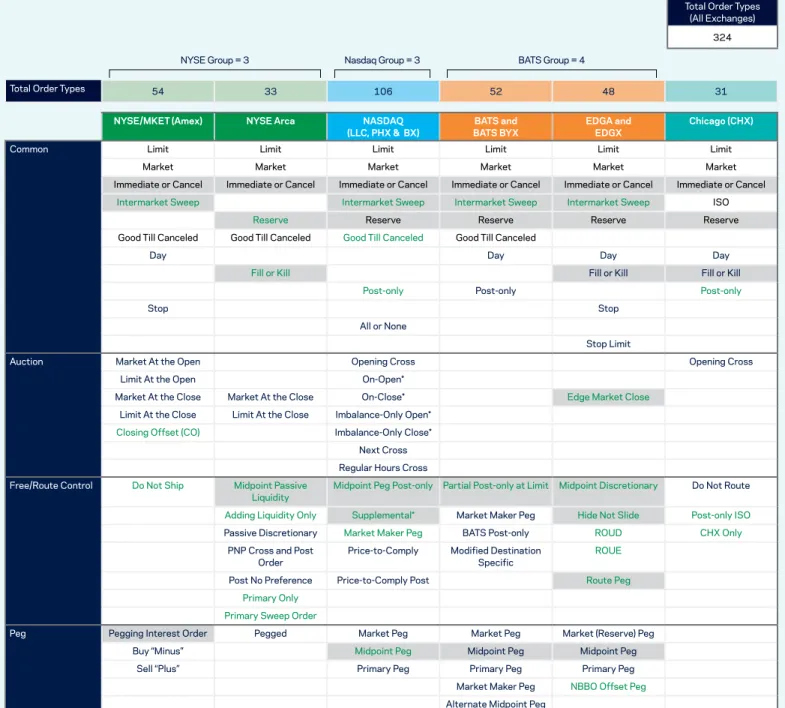
If we add the order types for each venue, we get 324 different
order types. Exchange fragmentation is a big part of the
order complexity problem.
Recent consolidation has left us with three exchange groups that
control 98% of exchange volume. Despite
strong criticism
(from
exchanges) who say the multiple dark venues make the market
opaque,
little has been done to reduce exchange fragmentation. In fact, there
are still 11 exchanges, even though the top five control 82% of
exchange trading. And almost as soon as the
NSX & CBSX
announced
they would close,
IEX
announced plans to become an exchange.
1. Passive discretionary 2. Discretion limit 3. Sweep reserve 4. Random reserve 5. Passive liquidity select 6. Undisplayed price 7. Midpoint cross 8. IOC cross 9. PNP cross
10. PNP cross and post 11. Portfolio crossing
service order
12. Day cross (cross with day time-in-force) 13. Market to limit
14. Now orders with reserve modifier (no longer accepted)
15. Market orders with a now or IOC modifier (no longer accepted)
exhibit 2: Exchange fragmentation adds to the number of order types available and the complexity they create.
N
um
be
r o
f o
rd
er t
yp
es l
is
te
d o
n
co
m
pan
y w
eb
si
te
pe
r e
xchan
ge
350 300 250 200 150 100 50 0 NYSE MKT NYSE NYSE Arca NASDAQ NASDAQ BX BATS BATS BYX EDGA EDGX NASDAQ PHX CHICAGO (CHX)table 1:
Order types vary by exchange
We searched exchange websites for details of the order types they have.Total Order Types 54 33 106 52 48 31
NYSE/MKET (Amex) NYSE Arca NASDAQ
(LLC, PHX & BX) BATS BYXBATS and EDGA and EDGX Chicago (CHX)
Common Limit Limit Limit Limit Limit Limit
Market Market Market Market Market Market
Immediate or Cancel Immediate or Cancel Immediate or Cancel Immediate or Cancel Immediate or Cancel Immediate or Cancel
Intermarket Sweep Intermarket Sweep Intermarket Sweep Intermarket Sweep ISO
Reserve Reserve Reserve Reserve Reserve
Good Till Canceled Good Till Canceled Good Till Canceled Good Till Canceled
Day Day Day Day
Fill or Kill Fill or Kill Fill or Kill
Post-only Post-only Post-only
Stop Stop
All or None
Stop Limit
Auction Market At the Open Opening Cross Opening Cross
Limit At the Open On-Open*
Market At the Close Market At the Close On-Close* Edge Market Close
Limit At the Close Limit At the Close Imbalance-Only Open*
Closing Offset (CO) Imbalance-Only Close*
Next Cross Regular Hours Cross
Free/Route Control Do Not Ship Midpoint Passive
Liquidity Midpoint Peg Post-only Partial Post-only at Limit Midpoint Discretionary Do Not Route
Adding Liquidity Only Supplemental* Market Maker Peg Hide Not Slide Post-only ISO
Passive Discretionary Market Maker Peg BATS Post-only ROUD CHX Only
PNP Cross and Post
Order Price-to-Comply Modified Destination Specific ROUE Post No Preference Price-to-Comply Post Route Peg
Primary Only Primary Sweep Order
Peg Pegging Interest Order Pegged Market Peg Market Peg Market (Reserve) Peg
Buy “Minus” Midpoint Peg Midpoint Peg Midpoint Peg
Sell “Plus” Primary Peg Primary Peg Primary Peg
Market Maker Peg NBBO Offset Peg
Alternate Midpoint Peg
Total Order Types (All Exchanges)
324
Total Unique Order Types
133
NYSE Group = 3 Nasdaq Group = 3 BATS Group = 4
We have grouped orders by key feature. We have also highlighted:
• New order types green: Since 2006 most new order types are focused in the fee and route control category. • Dark order types are highlighted gray. Note that a number of these are also new.
table 1:
Order types vary by exchange – Continued
NYSE/MKET (Amex) NYSE Arca NASDAQ
(LLC, PHX & BX) BATS BYXBATS and EDGA and EDGX Chicago (CHX)
Peg Pegging Interest Order Pegged Market Peg Market Peg Market (Reserve) Peg
Buy “Minus” Midpoint Peg Midpoint Peg Midpoint Peg
Sell “Plus” Primary Peg Primary Peg Primary Peg
Market Maker Peg NBBO Offset Peg
Alternate Midpoint Peg
Other Dark/
Anonymous Midpoint PLO Discretion Limit Order Anonymous Hidden Discretionary Cross Minimum Display
Reserve Discretionary Discretionary Modified Directed ISO Hidden Cross With Size
Minimum Trade Size IOC IOC Cross Order Minimum Quantity Non-Attributable Midpoint Match Do Not Display
Non-Displayed Reserve Passive Liquidity Non-Attributable Non-Displayed IOC Market
NYSE IOC PNP Blind Non-Displayed Midpoint Cross
Passive Liquidity Tracking Limit Order Market Hours IOC
Midpoint Cross Order System Hours IOC Sweep Reserve
Random Reserve Undisplayed Price
Automate
compliance NOW Day Intermarket Sweep ISO Cross
ISO for Post Cross Order Outbound ISO
ISO IOC Price-Penetrating ISO
ISO IOC Cross Order BBO ISO
ISO PNP Cross With Satisfy
Short Exempt
Other Auto Ex Order Cross Order Attributable* Attributable Benchmark
Inside Limit Directed Cancel and Replace Cancel on Halt
Market To Limit Retail Price Improvement Cross With Yield
Marketable Limit Primary After 3:55 Non-Regular Way Cross
Not Held Primary Until 9:45 Price-to-Display* Qualified Contingent Cross
Retail Modifier Unpriced Sell Short
Retail Price Improvement
Time to expiry Good Till Market Close Extended Day Good Till Time Time in Force Market Hours Day Good Till Day Good Till Date Market Hours GTC
System Hours Day System Hours Expire
Time System Hours GTC
Source/Info Order Type guide
NYSE, NYSE MKT ARCA Routing Strategy guide BATS EDGE *Nasdaq only
What do all these order types do?
As we looked at the list of order types, we realized that there were
some similarities across exchanges, and between order types.
Grouping order types simplifies the problem
Order types are built with specific features or functions in mind.
Most fall into five major categories (although many fit into more than
one category):
1. Common:
Order types like market, limit, fill or kill, IOC and stops
are used by most exchanges.
2. Auction:
Order types for the open and close auctions (or to restart
halted stocks) are fairly similar for primary venues.
3. Regulatory and fee control:
Many of the new order types
(post-2006 and highlighted
green
in Table 1) were developed to
deal with Reg NMS.
Reg NMS, in an effort to ensure all orders were routed to the “best”
price displayed in the market, bans locked or crossed markets. It
also forces exchanges to route orders away if a better price exists
on another venue. This eliminates venue mispricing concerns for
investors and venue arbitrage profits for traders.
However, combined with maker-taker fees, these routing dynamics
hurt market makers who would unintentionally pay take fees that
were far more than the expected return on their trade. Order types
were built that stopped exchanges routing away to venues with
higher fees on the same priced trade, as well as those designed to
never take liquidity (by posting only and by price sliding).
4. Simplify order handling:
Peg, reserve and slide order types
delegate order amending to exchanges and so simplify routing
and order management. They also reduce complexity by reducing
message traffic from cancel and replacing.
Other order types like ISO allow liquidity takers (both Institutional
and HFT) to improve fill rates.
A similarity of many complex order
types is (ironically) that they simplify
other aspects of the market.
Either by reducing message traffic or
reducing order handling or helping
with fee control and routing.
Fee control is important to long-term
investors, too.
Take fees are typically absorbed by
broker dealers. But if broker dealers can
keep exchange fees down and increase
rebates, they can pass these benefits to
investors via low commission rates.
5. Improve shortfall:
A sub-category of order types that seem
primarily designed for investors are the dozens of dark order types
(highlighted
gray
in Table 1).
They include mid-peg and reserve order types, which help large
traders avoid posting bids and offers out loud. Many of these
orders also execute at prices better than the current best bid or
offer.
Also included are retail specific order types, which allow for price
improvement even though they are traded on exchange.
IOC’s also help hide orders because they capture as much liquidity
as possible but don’t post residuals, which would create a new
price level that could increase permanent impact.
What about the rest?
What stands out about the other order types is that what each
exchange calls an order type can vary, such as for time-in-force
instructions.
Order combinations create more permutations
The way BATS gets from 52 to 2,000 order types is from the possible
combinations of one or more order types.
You can also see from the NYSE’s order type elimination filing, that
some of the list of 15 are just order type “combinations,” like market
with now or IOC and cross with time-in-force.
Importantly, the SEC requires that each permutation is tested
before approval.
Most orders don’t get a lot of use
One of the best arguments for simplification is that many order types
hardly get used.
However, some of the most popular order types are also complex
order combinations (see Exhibit 3: NYSE ARCA share for ISO PNP
IOC and ALO PNP Blind). The fact that the most popular order types
in each exchange are dark order types also doesn’t help exchanges’
argument that transparency is important for price discovery.
How many order types do we need?
Is order type proliferation a WMD?
From 2006 to 2014, over 170 order type filings were sent to the
SEC. That’s even more than the total types we count in Table 1.
However, around 100 of the filings were amendments to existing
order types and some were even meant to eliminate existing order
types
(see the
SEC filing pages
).
Amendments still add to market complexity, because they change the
way an existing order type works, requiring participants to relearn and
modify trading strategies.
Let’s talk about simplification…
exhibit 3: Order type usage0 10% 20% 30% 40% 50% 60% 70% 80% 90% 100%
Other
Non-Displayed (Includes Pegs)
Non-Displayed Limit Non ISO Displayed Limit – Post Only ISO Displayed Limit – Price to Comply
Non ISO IOC Non ISO Intermarket Sweep Post No Preferences Immediate or Cancel Limit Limit Reserve
Displayed – Post Only Displayed Non-Diplayed (Includes Pegs) – Post Only
Diplayed – Post Only Non-ISO IOC(Includes
Market Order)
Displayed Non-ISO IOC (include Market Orders) Non-ISO Add Liquidity Only Post
No Preferences Blind Limit Immediateor Cancel InsideLimit
Other Non ISO Displayed Limit – Attributable Non ISO
Displayed Limit – Attributable ISO Tracking Limit Limit Now Midpoint Passive Liquidity Passive Liquidity Add Liquidity Only Midpoint Passive Liquidity Intermarket Sweep
Add Liquidity Only Post No Preferences
Post No Preferences Immediate or Cancel
Display Limit – Price to Comply ISO Displayed Limit – Post Only ISO
Non-Displayed Limit ISO Other ISO Post No
Preferences Intermaket SweepMarket Post No Preferences Post No
Preferences Blind Add Liquidity Only
Post No Preferences Post No PreferencesReserves Market On
the Close
BATS Order Type Usage Summary (March ‘14)
NASDAQ OMX Equity Order Type Usage Summary (March ‘13) NYSE Arca Order Type Usage
Complexity for the sake of complexity is rarely a good thing, as it can
add to cost and operational risk. But a simplification of order types is
more complex than you think.
Perhaps you think the market should have just a few really simple
order types—say we start with market and limit orders.
1. Market orders cause mini crashes
Just because an order type is old and simple doesn’t mean it’s good.
Arguably the “market” order is one of the least suited to today’s
electronic markets. On the floor, a market buy order had to find a
human seller to interact with, and large market orders needed to trade
with a single price level at a time.
In modern (electronic) markets, the expectation is that market orders
instantly execute with all levels of liquidity. This gives no time for
liquidity to backfill or even for the order book to build at higher or
lower
price levels.
With the average touch for most stocks around 500 shares
(see Exhibit 4), market orders can sweep through the book and
“air pockets,” where no bids or offers exist, ultimately causing mini
flash crashes. Typically this leads to cries that the market is too
complex (thank you simple order type)!
Ironically, this is something the NYSE
amendment for market orders
(that we discussed earlier) was designed to fix. (Did you know that
now NYSE market orders trade only with far touch volume and leave
residuals posted at the touch?)
2. Limit is better
Modern ISO orders work almost the same way as a market order—but
exhibit 4: A majority of stocks have less than 500 shares on the bid at any time. Even moderate sized market or ISO orders can take out multiple levels of the book.
Source: KCG Data Liquidity (ADVshares/day) 10,000,000 10,000 5K 4K 3K 2K 1K 0 Quote Depth 10M 100M 1,000M 10,000M 100,000M ABT AIG BLIN BPO BPZCHS CMS CNQ CVX EDS FB G JNJ LSG MGM MM MRK NE PEP PG POT SO SVLC MKTCAP ($)
KCG takes care of this for you.
We receive “market” orders into our algos all the time. However when we route the child orders, we put a limit on each child. Effectively, we are working the order in the electronic markets in much the same way as a floor broker would have in the old days.
they’re required to have a limit price. Exchanges have also introduced
order types designed to sweep the NBBO but then post residual at
the old touch (IOC market, market to limit, unpriced). But these are all
complex versions of a simple limit order type.
3. And for your last order type…
If you only had one more pick, what would it be?
• IOC or fill and kill?
An order type that doesn’t post residuals, or set a new price level,
probably makes sense. It should help investors to manage impact
and signaling. But which one? And do you want the ability to
ISO that?
• MOC, LOC, MOO, LOO?
We need an auction order type. Indexers prefer MOC orders to
make sure they hit their benchmark, but LOC is critical for those
who are price sensitive, like market makers.
• Or maybe a hidden order type?
Hidden order types are hardly simple—or good for price
discovery—but they’re the most popular across all exchanges (see
Exhibit 3). That shows that investors need to hide their orders from
prying traders, even when they’re on lit venues.
But which would you prefer? Peg touch, peg mid, reserve, minimum
display reserve, minimum quantity?
Dark order types don’t get a lot of fills
Interestingly, popularity of an order type doesn’t translate into a lot of
trades. Exchange disclosures show that:
• IOC and market order types
are used relatively little—despite that
they are the bulk of executions.
• Dark (non-displayed) order types
are most popular, even though
these orders are on exchange—however, they get relatively low
execution rates.
exhibit 5: Order type usage vs executions.
Source: BATS, Nasdaq
Total Trades Total Orders BATS IOC (Includes Mark et Or der s) Displa yed Displa yed Limit – P ost-only Non-Displa yed (Includes P egs) Displa
yed Limit (Includes Pegs) – P ost-only 40% 35% 30% 25% 20% 15% 10% 5% 0% Order Type Ex ecutions Immediate or Cancel Displa yed Limit – Price to ComplyDispla
yed Limit – P ost-only Non-Displa yed Limit Displa yed Limit – A ttributable Other NASDAQ 40% 35% 30% 25% 20% 15% 10% 5% 0% Ex ecutions Order Type
• Post-only
order and trade percentages are pretty consistent.
This may indicate that market makers are mostly getting
executions in line with their routing of orders.
Is a modifier an order type?
Quite a few order instructions manage time-in-force or price
modification around corporate events. They make orders more
complex, but are they order types? The approach seems to differ by
exchange. With electronic EMSs, do these order modifiers even need
to be the responsibility of an exchange any more?
What about market makers?
Should exchanges make special order types for market makers?
It’s easy to say “they should use limit orders like everyone else”—but
is that even fair? Not really, if long-term investors get peg and hidden
order types for themselves.
The reality is limit order types wouldn’t work very well in today’s
markets, for a number of reasons.
• Market makers
need
to be at the top of book, with good queue
priority, if they’re to make any money at all. This makes latency very
important to them.
• Liquidity providers also need to earn rebates, not pay take fees.
The fee differential for getting this wrong is over 1/2 a cent—
typically a multiple of the expected return from spread capture.
• In addition, market makers need to quote in most of the 11
exchanges, to be sure not to miss liquidity.
In short, market makers need to route very quickly, at marketable
limits, to all 11 venues—which themselves are miles apart—at the
same time complying with regulations that ban locked and crossed
markets, and prevent accidentally trading with themselves.
This is not easy without a special order type.
Hide not side order types get a lot of press. This is primarily because
people claim they can be used (typically by market makers) to “jump
to the front of the queue.” In reality they should be second, behind the
liquidity taker whose residual sets the new price level.
Price-slide order types, because they solve many of the problems
market makers face at once, are an interesting way to study
interconnections and cross-currents of today’s market structure:
1. A post-only feature to avoid paying maker taker fees.
Trading at the touch across 11 markets at once, and always
trying to be at the top of the book, from your server in Weehawken
(or Carteret), you are likely to route orders that would cross the
spread—resulting in take fees, instead of spread capture.
A post-only component stops orders from trading at the far touch.
2. Order handling should reduce message spikes.
Post-only orders get rejected if they would trade at the far touch.
A market maker with direct exchange feeds would typically try
again (and again, and again, and again) at least until the NBBO in
both the market maker and the exchange fell back into sync. This
would create unnecessary spikes in message traffic. This in turn
may risk hampering exchange matching engines.
Instead of rejecting, price-slide order types automatically
re-price orders back to the near touch, and post them (or hide them
for hide not slide).
How price sliding algorithms work
Price-slide order types automatically slide back to the current near touch—in an effort to comply with Reg NMS and avoid paying take fees. They then float on the touch in an effort to capture spread, much like a pegged order. As the exchange re-prices the order back to its limit price, the order typically gets good queue priority. This result is similar to what a “float” algo does to a human trader trying to capture spread.
BATS has a good example of single exchange price sliding here. Then try to imagine a world where the NBBO (legally) comes from the SIP, but each of the 11 markets receives new bids and offers directly from investors and every investor’s order starts a different distance from the SIP and the market. Locked markets are inevitable.
$10.12 $10.11 $10.10 Price-slide Bid NBO NBO NBB NBB Price-slide Bid
1. When the order is entered 2. When the market ticks up
3. Price-slide feature to comply with Reg NMS.
Price sliding also helps these orders to comply with Reg NMS bans
on locked and crossed markets.
Orders that would lock or cross the market are re-priced to what
the exchange sees as the near touch NBBO.
4. Pegging feature helps market makers to capture spread,
simplify order handling and reduce technology spend.
Once a price-slide order is at the NBBO, it acts like a peg order
type. It floats as the NBBO moves back toward the original limit.
Studies
have shown that it is critical for market makers to be
close to the top of the book—so their spread collection isn’t
overwhelmed by negative selection from large investor trades.
Without price sliding, market makers would need to cancel and
replace their orders—as fast as possible—to retain priority in the
queue. Price-slide orders typically help market makers be near the
top of book—reducing the “technology arms race.”
Functionally, this is similar to a float algorithm with an upper price
limit that is held in the algo and not used in child routes.
The problem is complex!
Today’s markets are undeniably complex. But so are today’s cars,
planes and the phones in our pockets. That doesn’t make them bad. In
fact, it gives us a lot of useful features.
It’s also why simplifying the market is a complex problem itself.
The interactions of order types with maker taker pricing, Reg NMS,
message ratios and exchange innovation make simplifying order
types just one piece of a larger puzzle.
Price-slide orders are passive.
The post-only component means they
don’t cross the spread—ever.
So although they are typically used
by market makers (who can also be
high frequency traders) they don’t suit
predatory HFT.
A
Adding Liquidity Only (ALO) Order
Limit order that is posted to the NYSE Arca book in order to add liquidity. The order assists users in controlling their costs. Once accepted and placed in the NYSE Arca book, ALO orders will not route to away market centers. They are day only orders, and may not be designated as good till canceled.
Adjustable Stop Order You can attach one-time adjustments to stop, stop limit, trailing stop and trailing stop limit orders; when you
attach an adjusted order, you set a trigger price that triggers a modification of the original order, instead of triggering order transmission.
All or None (AON) Order Only fill if the entire order quantity can be matched.
Alternate Midpoint Peg Order
Pegs to the less aggressive of the midpoint of the NBBO or 1 tick inside the same side of the NBBO as the order.
Anonymous Order Orders leverage NASDAQ’s anonymous MPID allowing you to be displayed in the marketplace without
revealing your MPID.
Attributable Order Orders that are designated for display (price and size) next to the participant’s MPID.
Auction Order Entered into the electronic trading system during the pre-market opening period for execution at the
Calculated Opening Price (COP). If your order is not filled on the open, the order is re-submitted as a limit order with the limit price set to the COP or the best bid/ask after the market opens.
Auto Ex Order Order in a security that initiates an automatic execution immediately upon entry into Exchange systems.
B
Basket Order Create a “basket” of individual securities or commodities orders that can be managed and submitted as a
package execution.
BATS Only BOLT Order Will display unfilled portions of marketable orders through the BATS proprietary data feeds for a limited
period of time. This will provide opportunity for additional executions on marketable orders before either cancelling those orders or routing to other markets. BATS only BOLT orders allow up to 500 milliseconds of additional order exposure on the BATS data feeds while routable BOLT orders expose an order to BATS members for up to 25 milliseconds before routing to away markets.
BBO Intermarket Sweep (ISO)
Executes without regard to the NBBO because the firm sending the order has satisfied the protected quotations of other markets. If the order is marked IOC, any unexecuted balance of the order is canceled back to the sender; if the order is not marked IOC, any unexecuted balance of the order is placed in the Matching System.
Benchmark Order Sends a limit order with a price that equals the current bid or offer.
Best Bid or Offer Order A strategy that requires the placing of two calendar spreads in opposite directions with the center delivery
month common to both spreads.
Appendix
Bid Order Order will be sent as a limit order with a price equal to the current NBB.
Butterfly Spread Order A strategy that requires the placing of two calendar spreads in opposite directions with the center delivery
month common to both spreads.
Buy “Minus” Order Market order to buy a stated amount of a stock provided that the price to be obtained is not higher than
the last sale if the last sale was a “minus” or “zero minus” tick, and is not higher than the last sale minus the minimum fractional change in the stock if the last sale was a “plus” or “zero plus” tick. A limited price order to buy “minus” would have the additional restriction of stating the highest price at which it could be executed.
C
Calendar Spread Order A strategy that entails buying one delivery month of a contract and simultaneously selling another delivery
month of the same contract on the same exchange.
Cancel and Replace Order Allows users to change price, size and/or side of a working order and change a limit order to a market order.
Cancel on Halt Order An order that should be automatically canceled by the Matching System if a trading halt is declared on the
Exchange in that security.
CHX Only Order A CHX only order will be assigned a Reg NMS and Reg SHO compliant match price and a Reg NMS and Reg
SHO compliant display price by the Matching System; i.e., the order price will “slide” to accommodate the current state of the market. The match price will always be equal to or better than the orders limit price and, once assigned on order receipt, will not change. The display price assigned on receipt will either equal the match price or be one trading increment better than the match price. Subsequent NBBO changes may cause the order’s display price to adjust so that it equals the match price. CHX only orders must be fully displayed limit orders. Hidden and reserve orders cannot be designated as CHX only orders.
Closing Offset (CO) Order Provides liquidity to offset imbalances at the close and executes at the closing price.
Conditional Order An order that attaches conditions that state that the order will automatically be submitted or canceled only if
specified criteria for one or more defined contracts are met.
Cross Order An order to buy and sell the same security at a specific price that is better than the Exchange’s displayed
BBO and, where required, equal to or better than the NBBO.
Cross With Satisfy Order An order designed to provide a participant with an efficient mechanism for clearing out displayed orders in
the Matching System that would otherwise have time or price priority and then effecting a cross transaction at
that price.
Cross With Size Order A cross for at least 5,000 shares and for a value of at least $100,000 that is at a price equal to or better than
the Exchange’s displayed BBO, where size of the cross transaction is one round lot larger than the aggregate size of all interest displayed in the Matching System at that price.
Cross With Yield Order Like a cross with satisfy, but for use when a participant wants to yield interest in an order to displayed orders that would otherwise have time or price priority, or to all interest in the Matching System.
D
Day Order If not executed, canceled at 4:00 pm ET.
Day ISO Same as a day order, with ISO features.
Deferred Order Sit in the book until triggered (must be manually triggered before it is sent).
Destination Route Order Entered at a specified price and is routed to a specified market center/destination. This order always
executes against the NSX book first and then routes to the specific destination. Destination Specific
Order
Market or limit orders that are routed by BATS to an away trading center after first being exposed to the BATS order book.
Destination Sweep Order Will execute against the NSX book first then sweep an away market center. NSX routes this order as an ISO
to the specified destination.
Directed Order Orders sent by order sending firms; designed to interact with quotes and orders entered by MMs.
Discretion Limit Order Order that is displayed at your specified price, not your discretionary price, along with a share quantity
minimum requirement for routing discretionary prices outside the book.
Discretionary Order Have a working visible price and a non-displayed “discretionary” price (discretionary price is a hidden upward
offset, which users are willing to buy, or a hidden downward offset, which users are willing to sell).
Do Not Display Order An order for at least 1,000 shares when entered that should not be displayed in whole or in part, but that is
eligible for execution within the Matching System.
Do Not Increase Order A limit order to buy or a stop order to sell, which is not to be increased in shares on the ex-date as a result of a
stock dividend or stock distribution.
Do Not Reduce Order A limit order to buy or a stop order to sell, which is not to be reduced by the amount of an ordinary cash
dividend on the ex-dividend date.
Do Not Route Order An order that can be executed or displayed within the Matching System, but cannot be routed elsewhere.
Do Not Ship Order A limit order that is to be executed in whole or in part by the NYSE only.
Double Play Order Market or limit order that instructs the system to route the order to a specified away trading center as approved by the exchange from time to time.
E
Edge Market Close Order EDGX will pair off matching buy and sell EMC orders received until a published cut-off time, which will be a
designated period prior to the cut-off times that NASDAQ and the NYSE have established for the submission of market-on-close orders. EDGX will then route the unmatched portion of any EMC orders that could not be paired on EDGX to the primary listing market as market-on-close orders in advance of their respective cut-off times (i.e., orders in NASDAQ-listed stocks will be routed to NASDAQ and orders in NYSE-listed stocks will be routed to the NYSE). After their respective closing processes are complete, EDGX will execute the paired shares of EMC orders at the official closing prices published by NASDAQ and the NYSE.
Extended Day (GTX) Order
If not executed, canceled at 5:00 pm ET.
F
Fill and Kill Order An order to buy or sell that can be filled partially or canceled.
Fill or Kill Order Market or limit orders that are to be immediately executed in its entirety, or canceled (not routed to other
exchanges).
Flash and Cancel Order A way for professional traders to gain advance knowledge of order flows. The order is displayed for only a
fraction of a second on certain exchanges, and thus invisible to most market participants.
G
Good After Time (GAT) Order
An order that is held in the system and submitted to the market on the date and time that you specify (note: these orders are canceled automatically at the end of business on the last day of the following calendar quarter).
Good Till Canceled (GTC) Order
Remain live until the order is filled/canceled or the option contract expires.
Good Till Date (GTD) Order
Allows you to select an expiration date and time up until which an order will continue to work (note: if you only select a GTD, the unfilled order will cancel at the close of the market on that specified day).
Good Till Day Order If not executed, canceled at expire time or 5:00 pm ET.
Good Till Delta Order User may place an order that will expire after a user-specified period of time.
Good Till Market Close Order
Executable between 7:00 am to 8:00 pm; if entered after the closing cross will be treated as IOC; if entered prior to the closing cross any unexecuted orders will be returned to entering party after the cross.
Good Till Time Order Same as good till date.
H
Hidden Order Allows users to hide the limit order on the order book (lower priority than visible orders at same price).
Hide Not Slide Order An order that is displayed one MPV away from the locking price if an order locks or crosses the market. It
allows traders to hide orders that were originally submitted as display-eligible and adjust their price while keeping their place in the order book queue (Direct Edge unique).
I
Imbalance-Only Close Order
Provides liquidity intended to offset on-close orders during the closing cross. They are the same as imbalance-only open orders, except for the 4:00 pm bid/ask.
Imbalance-Only Open Order
Provides liquidity intended to offset on-open orders during the opening cross. Imbalance-only buy/sell orders only execute at or above/below the 9:30 am offer/bid.
Immediate or Cancel (IOC) Order
Market or limit orders that are immediately executed, in whole or part, with the unexecuted amount canceled (not routed to other exchanges).
Inside Limit Order Marketable inside limit orders will be matched within the book at the best obtainable price or routed to the
market participants at the NBBO. Any residual volume will not be routed to the next price level until all quotes at the current best bid or offer are exhausted. Non-marketable inside limit orders will be posted in the book at the limit price.
Intermarket Sweep Order (ISO)
Designation on an IOC limit order that allows the order to sweep the book without regard to any external quotes.
ISO Cross Order Any type of cross that is to be handled as an ISO (executed without regard to the NBBO, because the
participant sending the order has satisfied the protected quotations of other markets).
ISO for PNP Order A designation on a PNP limit order that allows the order to sweep the book and post any balance without
regard to any external quotes.
ISO IOC Order A designation on an IOC limit order that allows the order to sweep the book without regard to any external
quotes.
Intraday Cross Order Can include the next cross only, the next cross and all subsequent crosses excluding the post-close cross at
4:30 pm, or the next cross and all subsequent crosses including the post-close cross. Please note: Intraday cross orders do not participate in the opening or closing crosses.
IOC Cross Order Two-sided order with both a buy and sell component combined that trades at a price specified by the user. An IOC cross will not interact with the book or protected quotes, and will be rejected if order interaction would occur. Orders will never be broken up and will always execute as clean crosses.
IOC Market Order IOC orders will be executed against any orders at or better than the Exchange’s BBO, including any reserve
size or other undisplayed orders at or better than that price, with any unexecuted balance to be immediately canceled.
ISO for IOC Cross Order A designation on an IOC limit order that allows the order to sweep the book without regard to any external
quotes.
ISO for Post Cross Order A designation on a post cross order that allows the order to sweep the book, cross the balance and post the
takeout amount without regard to any external quotes.
J
K
L
Limit Order An order to buy or sell at a specified price or better; ensures that if the order fills, it will not fill at a price less
favorable than your limit price, but it does not guarantee a fill.
Limit At the Close Order Limit order in a security that is entered for execution at the closing auction price of the security on the
Exchange provided that the closing price is at or within the specified limit. Limit If Touched (LIT)
Order
An order to buy (or sell) a contract at a specified price or better, below (or above) the market. It is held in the system until the trigger price is touched. It is similar to a stop limit order, except that a LIT sell order is placed above the current market price, and a stop limit sell order is placed below.
Limit IOC Order Entered at a specified price and seeks immediate execution at that price or better.
Limit NSX only Order Entered at a specified price seeking execution at that price or better only within NSX.
Limit On the Open Order Orders that are executable only within the opening auction (balance is canceled if the order is not executed).
Limit Post-only Order Seeks to be a liquidity provider. It has a specified price and this order will reject upon entry if marketable.
M
Market Order An order to buy or sell at the market bid or offer price. A market order may increase the likelihood of a fill and
the speed of execution, but unlike the limit order a market order provides no price protection and may fill at a price far lower/higher than the current displayed bid/ask.
Market At (On) the Close Order
Market order in a security that is to be executed in its entirety at the closing price (during closing auction).
Market Hours Day Order Executable between 9:30 am to 4:00 pm on the day the order is entered.
Market Hours GTC Order Executable between 9:30 am to 4:00 pm on the day the order was submitted until canceled.
Market Hours IOC Order 9:30 am to 4:00 pm.
Market If Touched Order Order to buy (or sell) a contract below (or above) the market. It is held in the system until the trigger price is
touched, and is then submitted as a market order. It is similar to a stop order, except that a MIT sell order is placed above the current market price, and a stop sell order is placed below.
Market Maker Peg Order Limit order that, upon entry, the bid or offer is automatically priced by the System at the Designated
Percentage away from the then current National Best Bid and National Best Offer, or if no National Best Bid or National Best Offer, at the Designated Percentage away from the last reported sale from the responsible single plan processor in order to comply with the quotation requirements for MMs.
Market NSX only Order Entered to execute against the opposite side of the NSX market at the best price available, within the NBBO,
immediately. This order will not route out. Market On the Open
Order
Orders that are executable only within the opening auction (canceled if it is not executed in the auction).
Market Peg Order Pegged to the NBBO on the opposite side of the market (must contain an offset to be priced less aggressively
than NBO for buy orders and NBB for sell orders).
Market to Limit Order Submitted as a market order to execute at the current best market price. If the order is only partially filled,
the remainder of the order is canceled and re-submitted as a limit order with the limit price equal to the price at which the filled portion of the order was executed.
Marketable Limit Order Order on the exchange that can be immediately executed; that is, an order to buy priced at or above the
exchange best offer or an order to sell priced at or below the exchange best bid.
Midpoint Order Can buy or sell at the midpoint between the best bid and best offer.
Midpoint Cross Order This order will execute at the midpoint between the NBBO. If the NBBO is locked at the time this order is
received, the order will execute at the locked NBBO, and if the NBBO is crossed when the order is received, the order will automatically be canceled.
Midpoint Discretionary Order
Displayed and pegged to the prevailing NBB (for buy orders) or NBO (for sell orders) with a non-displayed, discretionary range that can extend to the midpoint of the NBBO, depending on the order’s limit price. It is used to extend price range to access midpoint liquidity (EDGA only; unique Direct Edge order type).
Midpoint Match Order A non-displayed order that is executed only at the midpoint of the NBBO. It can be entered as market or limit
orders, it is non-routable and has a minimum order size of one round lot (EDGX only).
Appendix – Continued
Appendix – Continued
Midpoint PLO (PassiveLiquidity Order)
An undisplayed limit order that will provide price improvement by executing at the mid-point of the protected BBO.
Midpoint Peg Order Floats at the NBBO midpoint and can be entered as a market order (float at midpoint without a boundary
price) or as a limit order (floats at midpoint, but will not execute when the midpoint is outside of the limit price boundary) (EDGA only).
Midpoint Peg Post-only Order
Non-displayed order type that is priced at the Midpoint between the National Best Bid and Offer (NBBO) and only adds liquidity, except when the economics are in the interest of the investor to remove liquidity.
Midpoint-Seeker Order Undisplayed orders that are pegged to midpoint between the protected best bid or offer in subpennies.
Minimum Display Reserve Order
Limit order with a minimum published amount of 100 shares that replenishes at the minimum or at a different amount set by the user after each execution.
Minimum Life Order Cannot be canceled by the entering party until 100 milliseconds have elapsed, but the order can be executed
before this time expires.
Minimum Quantity Order Orders are entered for execution with a minimum share quantity.
Minimum Trade Size (MTS) IOC Order
Any IOC order may include a MTS instruction, which Exchange systems will evaluate whether contra-side displayable and non-displayable interest on the Exchange system can meet the MTS and will reject such incoming IOC-MTS order if Exchange contra-side volume cannot meet the MTS.
Modified Destination Specific Order
Market or limit order that instructs the System to route the order to a specified away trading center(s), as approved by the Exchange from time to time, without first exposing the order to the BATS book.
Modified Directed ISO Order that bypasses the System and is immediately routed by the Exchange as an IOC ISO to an away
trading center specified by the user for execution, provided that the away trading center must be displaying a protected quotation, as that term is defined in the Exchange’s rules. If the ISO is not executed in its entirety at the away trading center, the modified directed ISO returns to the Exchange as an IOC ISO and any portion not executed at the Exchange will be canceled back to the user.
N
NBBO Offset Peg Order Pegged to NBBO for a stock.
Next Cross Order Eligible for the next intraday cross only. Unexecuted shares are canceled back to the entering party.
Non-Attributable Order Orders that are entered by a participant that is designated for display (price and size) on an anonymous basis
in the order display service of the System.
Non-Displayed Order Hidden from the marketplace, but all incoming order flow can interact with hidden orders until hidden size is
Appendix – Continued
Appendix – Continued
Non-Displayed Reserve Order
A limit order with zero published quantity that is not displayed to the designated market makers or in NYSE OpenBook.
Non-Regular Way Cross Order
A cross designated for non-regular way settlement. This order will execute without regard to the NBBO or any other orders in the Matching System and can represent the interest of one or more participants in the Exchange.
Not Held Order Market or limited price order marked “not held,” “disregard tape,” “take time,” “buy or sell on print,” or which
beats any such qualifying notation.
NOW Order Limited price order that is executed in whole or in part that will be routed to one or more NOW recipients
(those venues that respond immediately with a fill or a cancel) that are protected quotes for immediate execution if the order cannot be executed on NYSE Arca. Orders are immediately canceled if not executed at the quoted price or better.
NYSE IOC Order A market or limited price order designated immediate or cancel that will be automatically executed against
the displayed quotation up to its full size and sweep the Display Book system, to the extent possible, with portions of the order routed to other markets if necessary in compliance with Reg NMS and the portion not executed will be immediately canceled.
O
Offer Order Order will be sent as a limit order with a price equal to the current NBO.
On-Close Order Specifically request an execution at the closing price; it can be limit on close or market on close.
One Cancels All (OCA) Order
Comprises a group of orders linked by a customer-created title entered in the OCA field for each order. By default, once an order in the group fills, all other linked orders are canceled. If an order is partially filled, the remaining orders will be reduced proportionately to the remaining quantity of the unfilled order. If an order is canceled by the customer before execution, all remaining orders in the OCA group will automatically be canceled, but if one of the orders is rejected or canceled by the system, the remaining order(s) will not automatically be canceled.
On-Open Order Specifically request an execution at the opening price; it can be limit on open or market on open.
Opening Cross Order A cross transaction that executes at the opening price; for any exchange other than NASDAQ, the opening
price will be the primary market opening price (for NASDAQ, the opening price will be the midpoint of the first unlocked, uncrossed market that occurs on or after 8:30 am).
Order Cancel Links two orders together so that if one order is filled, the other order automatically cancels.
Order Send Links two orders together: a trigger order and a dependent order; the fill of the trigger order places the
Appendix – Continued
Outbound ISO Allows an Exchange participant to execute an order on the Exchange without regard to the protected
quotations at other markets while simultaneously routing ISOs to those other markets to execute against their protected quotations.
P
Partial Order An order that can be filled partly instead of in its entirety.
Partial Post-only At Limit Order
Offers liquidity removal with price improvement while allowing users to designate a maximum remove percentage to allow for removal of liquidity at the limit price.
Passive Discretionary Order
Displayed at your specified price and is not eligible to route. When a bid or offer appears in the book at or within your discretionary price range, it will be executed against the book as long as it does not trade through a protected quote.
Passive Liquidity Order (PLO)
A non-displayed order type that allows participants to provide liquidity to the market place without publicly divulging their trading intentions.
Pegged Order Order with a price that will track the PBBO, but may also make use of offsets from the same side bid (offer) or
offsets from the contra side (peg buy offset from offer).
Pegged to Stock Order Continually adjusts the option order price by the product of a signed user-defined delta and the change of
the option’s underlying stock price. The delta is entered as an absolute and assumed to be positive for calls and negative for puts. A buy or sell call order price is determined by adding the delta times a change in an underlying stock price to a specified starting price for the call. To determine the change in price, the stock reference price is subtracted from the current NBBO midpoint. The stock reference price can be defined by the user, or defaults to the NBBO midpoint at the time of the order if no reference price is entered. You may also enter a high/low stock price range, which cancels the order when reached. The delta times the change in stock price will be rounded to the nearest penny in favor of the order.
Pegging Interest Order Either displayable or non-displayable interest to buy or sell at a price set to track the best protect bid (PBB) or
the best protected offer (PBO) (collectively the PBBO) as the PBBO changes.
Post ISO Order Will post to the NSX book regardless of the PBBO. These orders can be marked as post-only or NSX only. They
are eligible to be canceled or cancel/replaced. A “post-only” post ISO will reject if marketable at NSX upon entry. A “NSX only” will execute if marketable within the NSX upon entry.
Post No Preference (PNP) Limit order to buy or sell that is to be executed in whole or in part on NYSE Arca. The portion not executed is
posted in the book without routing any portion of the order to another market center. Post No Preference (PNP)
Blind Order
Undisplayed limit order priced at or through the PBBO, with a tradable price set at the contra side of the PBBO. When the PBBO moves away from the price of the PNP B and the prices continue to overlap, the limit price of the PNP B will remain undisplayed and its tradable price will be adjusted to the contra side of the PBBO. When the PBBO moves away from the price of the PNP B and the prices no longer overlap, the PNP B shall convert to a displayed PNP limit order.
Appendix – Continued
Post No Preference(PNP)+ Complex Order
Guarantee the sender price improvement over the screen markets.
Post No Preference (PNP) Cross and post order: cross order to buy or sell that is to be executed in whole or in part on NYSE Arca. Any
residual share balance that has been broken up and not crossed initially is immediately posted in the book without routing any portion of the order to another market center.
Post-only Order Allows users to make a market and specify not to remove liquidity unless adequate price improvement is
accessible.
Post-only ISO Order A type of ISO order that will be immediately canceled without execution if it is marketable against a
contra-side order in the Matching System when entered. If a post-only ISO is not immediately canceled as described in the previous sentence, it will be posted on the Exchange at the entered limit price. By entering a post-only ISO, a participant represents that such participant has simultaneously routed one or more additional limit orders marked “ISO,” as necessary, to away markets to execute against the full displayed size of any protected quotation for the security with a price that is superior or equal to the limit price of the post-only ISO entered in the Matching System. Consequently, a post-only ISO order will be quoted by the Exchange regardless of whether it will lock or cross another market center’s quote.
Price-Penetrating ISO Order
An ISO that can execute against any eligible orders in the Matching System, through multiple price points.
Price-to-Comply Order Complies with the Reg NMS Order Protection Rule and Locked and Crossed market rule by re-pricing and
converting into a non-displayed order. Buy orders will be priced at the inside offer and sell orders will be priced at the inside bid. If the market moves, the order will be re-priced to the new inside. In addition, if the market moves such that the display of the original entered price would not result in a locked market, the order will be displayed at its original entered price.
Price-to-Comply Post Order
Orders that, if, at the time of entry, a price-to-comply post order would create a violation of Rule 610(d) of Reg NMS under the Act by locking or crossing the protected quotation of an external market or would cause a violation of Rule 611 of Reg NMS under the Act, the order will be re-priced and displayed by the System to one minimum price increment (i.e., $0.01 or $0.0001) below the current low offer (for bids) or to one penny above the current best bid (for offers). Price-to-comply post orders will not be routed outside of the System.
Price-to-Display Order Used by market makers to post displayed orders in their own MPID on the book.
Primary After 3:55 Order Allows users to submit an order to the NYSE Arca book where it will remain until 3:55 pm ET. If the order
remains unexecuted at 3:55 pm ET the order will then be canceled from the NYSE Arca book and routed to the primary listing market for execution.
Primary Only Order Market order that is to be routed as a market-on-open order to the primary market for participation in the
primary market opening or re-opening process. A PO entered after the primary market opens is processed as a normal market order.
Appendix – Continued
Primary Peg Order Pegged to the NBBO on the same side of the market and track NBBO/move as the NBBO moves (buy orders
are pegged to bid, sell orders pegged to offer).
Primary Sweep Order A market or limit order that sweeps the NYSE Arca book and routes any remaining balance to the primary
listing market. All orders with PSO designation should be marketable, and non-marketable orders will function as regular limit orders.
Primary Until 9:45 Order Allows users to route orders directly to the primary listing market for the first fifteen minutes of the trading
day. It is canceled from the primary market if it is not executed by 9:45 am ET, and a new order will be entered in the NYSE Arca book with a new time priority).
Q
Qualified Contingent Cross Order
Comprised of an order to buy/sell at least 1,000 contracts that is identified as being part of a qualified contingent trade, where one component is an NMS Stock and the execution of one component is contingent upon the execution of all other components at or near the same time, with the transaction being fully hedged, coupled with a contra-side order to buy or sell an equal number of contracts and all components.
R
Random Reserve A reserve order that will have a random reserve value (as expressed in share quantity), which, as a range of
round lots, will vary the displayed size of the reserve order. A random reserve value set to zero will permit the displayed size of the reserve order to vary within 20% of the original specified displayed size.
Random Reserve Order Vary the display size on a reserve order.
Recurring Order Users may place an order that will cancel and then replace a live order every 4 minutes and 30 seconds (only
available on routes that support the expiration type). Regular Hours Cross
Order
Eligible to participate in all intraday crosses. Any remaining shares after a cross are eligible for subsequent intraday crosses but not eligible for opening/closing/post-close crosses.
Reserve Order Limit order with a portion of the size displayed and with a reserve portion of the size that is not displayed.
Retail Modifier Order An order designated with a “retail” modifier is an agency order or a riskless principal order that meets the
criteria of FINRA Rule 5320.03 that originates from a natural person and is submitted to the Exchange by a member organization, provided that no change is made to the terms of the order with respect to price or side of market and the order does not originate from a trading algorithm or any other computerized methodology.
Retail Price Improvement Non-displayed limit order that is better priced than the protected best bid/offer (PBBO) and provides price
improvement only on incoming retail take order flow.
ROUD/ROUE Order Routing strategy that provides efficient access to liquidity by simultaneously accessing liquidity from the
displayed markets before routing to select markets if the order is not filled by the originating exchange.
Appendix – Continued
S
Scale Order Helps to ensure that larger sized trades, including combinations, are not subject to increasingly deteriorating
prices. ScaleTrader uses price and size determinants that you specify to automatically scale your large volume order into smaller, incrementally-priced components, and submits them as limit orders.
Sell “Plus” Order Market order to sell a stated amount of a stock provided that the price to be obtained is not lower than
the last sale if the sale was a “plus” or “zero plus” tick, and is not lower than the last sale plus the minimum fractional change in the stock if the last sale was a “minus” or “zero minus” tick. A limited price order to sell “plus” would have the additional restriction of stating the lowest price at which it could be executed.
Sell Short Order Allows a trader to profit from a stock’s decline. In a short sale, a trader borrows shares of stock that he does
not own from his broker and sells them right away. The amount he owes to the broker is determined by the number of shares sold short, not the sales price. When the stock declines, the trader buys back the same number of shares he/she previously sold short and returns them to the broker.
Short Order Borrowing a security from a broker and selling it, with the understanding that it must later be bought back and
returned to the broker.
Short Exempt Order A short sale order in which the uptick rule does not apply to the trade. The trade can go through on a
downward move in price, where a traditional short order trade has to be done on an uptick (upward move in price).
Stop Order Becomes an active buy or sell market order if and when the stop trigger price is reached.
Stop Limit Order Becomes an active buy or sell limit order when the stop trigger price is reached. When a trade has occurred
at or through the stop price, the order becomes executable and enters the market as a limit order, which is an order to buy or sell at a specified price or better.
Stop Market Order You can decide a specific price at which you want your order to be triggered; it then turns into a market order
and is executed at the market price.
Supplemental Order Post-only order type that is non-displayed and restricted to interacting with routable orders. It provides a final
chance for routable orders to execute on NASDAQ before being routed away, and an opportunity for liquidity providers to interact with attractive order flow (only available on NASDAQ).
Sweep and Cancel Order Sweeps the NSX book and all the protected market centers, up to the order quantity and limit price. Any
residual shares will be canceled.
Sweep and Post Order Sweeps the NSX book and all the protected market centers, up to the order quantity and limit price. Any
Appendix – Continued
Sweep Reserve A limit order with a portion of size displayed with a reserve portion of the size that is not displayed that if
marketable against an away market will be routed serially as component orders, such that each component corresponds to the displayed size, or only once in its entirety, including both the displayed and reserve portions.
System Hours Day Order Executable between 7:00 am to 8:00 pm on the day the order is entered.
System Hours Expire Time Order
If not executable upon entry any unexecuted shares shall remain available for execution for the amount of time specified by the entering party.
System Hours GTC Order Executable between 7:00 am to 8:00 pm on the day the order was submitted until canceled.
System Hours IOC Order 7:00 am to 8:00 pm.
T
Time-In-Force Order An order that is eligible for execution within a specified time period, with any unexecuted balance to be
immediately canceled when this period expires.
TOP Order The TOP price allows you to join the top of the book quote for the symbol you are trading. With TOP orders,
buys are sent as limit orders at the current NBB, and sells are sent as limit orders at the current NBO.
Tracking Limit Order An undisplayed, priced round lot that is eligible for execution in the tracking order process against orders
equal to or less than the aggregate size of the order if interest is available at that price. Orders may be entered at any price. Orders will only execute at the NBBO. Incoming ISO orders will not interact with tracking orders.
Trailing Limit If Touched Order
Entered on the same side of the market as a limit order. This order will initially be set at a price level that is favorable to the current market. As the market moves away from the initial trigger price, the user-defined trailing amount and limit offset amount will adjust the trigger price and the limit price to follow the market. If the initial market movement is in a favorable direction and reaches the initial trigger price, the order will be triggered and submitted as a limit order. If the market moves in an unfavorable direction, the order will trail the market movement and will trigger only if there is retracement by the defined trailing amount (for falling markets, retracement is when the market declines followed by an increase to levels previously traded; for rising markets, retracement is when the market rises followed by a decrease to levels previously traded). Trailing Market If Touched
Order
Entered on the same side of the market as a limit order. This order will initially be set at a price level that is favorable to the current market. As the market moves away from the initial trigger price, the user-defined trailing amount will adjust the trigger price to follow the market. If the initial market movement is in a favorable direction and reaches the initial trigger price, the order will be triggered and submitted as a market order for execution. If the market moves in an unfavorable direction, the order will trail the market movement and will trigger only if there is retracement by the defined trailing amount.
Appendix – Continued
Trailing Stop Order “Sell” trailing stop order sets the stop price at a fixed amount below the market price with an attached
“trailing” amount. As the market price rises, the stop price rises by the trail amount, but if the stock price falls, the stop loss price doesn’t change, and a market order is submitted when the stop price is hit. This technique is designed to allow an investor to specify a limit on the maximum possible loss, without setting a limit on the maximum possible gain. “Buy” trailing stop orders are the mirror image of “Sell” trailing stop orders, and are most appropriate for use in falling markets.
Trailing Stop Limit Order Designed to allow an investor to specify a limit on the maximum possible loss, without setting a limit on the
maximum possible gain. A “Sell” trailing stop limit moves with the market price, and continually recalculates the stop trigger price at a fixed amount below the market price, based on the user-defined “trailing” amount. The limit order price is also continually recalculated based on the limit offset. As the market price rises, both the stop price and the limit price rise by the trail amount and limit offset respectively, but if the stock price falls, the stop price remains unchanged, and when the stop price is hit a limit order is submitted at the last calculated limit price. A "Buy" trailing stop limit order is the mirror image of a “Sell” trailing stop limit, and is generally used in falling markets.
U
Unpriced Order Any order types permitted by the System to buy or sell shares of a security at the national best bid (best
offer) (“NBBO”) at the time when the order reaches the System.
V
W
WAIT Order Order modifier that will allow a firm interested in facilitating their customer orders to enter both an agency
order and a facilitation WAIT order at the same price.
X
Y
Z
Zero Display NSX only Order
Entered with a valid order quantity and a display quantity of zero. They only participate on the NSX Blade and are not routed.
Zero Display Pegged Order
Has display quantity of zero and is priced based on the pegging instructions.
Zero Display Post-only Order
Entered with a valid order quantity and a display quantity of zero. They can be marketable upon entry, and only execute on the NSX Blade as liquidity providers.