FEATURES
● VERY LOW NOISE: 4.5nV/√Hz at 10kHz
● FAST SETTLING TIME:
OPA627—550ns to 0.01% OPA637—450ns to 0.01% ● LOW VOS: 100µV max ● LOW DRIFT: 0.8µV/°C max ● LOW IB: 5pA max
● OPA627: Unity-Gain Stable ● OPA637: Stable in Gain ≥ 5
OPA627
OPA637
DESCRIPTION
The OPA627 and OPA637 Difet operational amplifi-ers provide a new level of performance in a precision FET op amp. When compared to the popular OPA111 op amp, the OPA627/637 has lower noise, lower offset voltage, and much higher speed. It is useful in a broad range of precision and high speed analog circuitry. The OPA627/637 is fabricated on a high-speed, dielec-trically-isolated complementary NPN/PNP process. It operates over a wide range of power supply voltage—
±4.5V to ±18V. Laser-trimmed Difet input circuitry provides high accuracy and low-noise performance comparable with the best bipolar-input op amps.
High frequency complementary transistors allow in-creased circuit bandwidth, attaining dynamic perform-ance not possible with previous precision FET op amps. The OPA627 is unity-gain stable. The OPA637 is stable in gains equal to or greater than five. Difet fabrication achieves extremely low input bias currents without compromising input voltage noise performance. Low input bias current is maintained over a wide input common-mode voltage range with unique cascode circuitry.
The OPA627/637 is available in plastic DIP, SOIC and metal TO-99 packages. Industrial and military temperature range models are available.
Difet®, Burr-Brown Corp.
®
Precision High-Speed
Difet
®
OPERATIONAL AMPLIFIERS
APPLICATIONS
● PRECISION INSTRUMENTATION
● FAST DATA ACQUISITION
● DAC OUTPUT AMPLIFIER
● OPTOELECTRONICS
● SONAR, ULTRASOUND
● HIGH-IMPEDANCE SENSOR AMPS
● HIGH-PERFORMANCE AUDIO CIRCUITRY
● ACTIVE FILTERS Trim 5 Trim 1 +In 3 –In 2 Output 6 7 +VS –VS 4
©1989 Burr-Brown Corporation PDS-998H Printed in U.S.A. March, 1998
International Airport Industrial Park • Mailing Address: PO Box 11400, Tucson, AZ 85734 • Street Address: 6730 S. Tucson Blvd., Tucson, AZ 85706 • Tel: (520) 746-1111 • Twx: 910-952-1111 Internet: http://www.burr-brown.com/ • FAXLine: (800) 548-6133 (US/Canada Only) • Cable: BBRCORP • Telex: 066-6491 • FAX: (520) 889-1510 • Immediate Product Info: (800) 548-6132
OPA627
SPECIFICATIONS
ELECTRICAL
At TA = +25°C, and VS = ±15V, unless otherwise noted.
OPA627BM, BP, SM OPA627AM, AP, AU OPA637BM, BP, SM OPA637AM, AP, AU
PARAMETER CONDITIONS MIN TYP MAX MIN TYP MAX UNITS
OFFSET VOLTAGE (1)
Input Offset Voltage 40 100 130 250 µV
AP, BP, AU Grades 100 250 280 500 µV
Average Drift 0.4 0.8 1.2 2 µV/°C
AP, BP, AU Grades 0.8 2 2.5 µV/°C
Power Supply Rejection VS = ±4.5 to ±18V 106 120 100 116 dB
INPUT BIAS CURRENT (2)
Input Bias Current VCM = 0V 1 5 2 10 pA
Over Specified Temperature VCM = 0V 1 2 nA
SM Grade VCM = 0V 50 nA
Over Common-Mode Voltage VCM = ±10V 1 2 pA
Input Offset Current VCM = 0V 0.5 5 1 10 pA
Over Specified Temperature VCM = 0V 1 2 nA
SM Grade 50 nA
NOISE
Input Voltage Noise
Noise Density: f = 10Hz 15 40 20 nV/√Hz
f = 100Hz 8 20 10 nV/√Hz
f = 1kHz 5.2 8 5.6 nV/√Hz
f = 10kHz 4.5 6 4.8 nV/√Hz
Voltage Noise, BW = 0.1Hz to 10Hz 0.6 1.6 0.8 µVp-p
Input Bias Current Noise
Noise Density, f = 100Hz 1.6 2.5 2.5 fA/√Hz
Current Noise, BW = 0.1Hz to 10Hz 30 60 48 fAp-p
INPUT IMPEDANCE
Differential 1013 || 8 * Ω || pF
Common-Mode 1013 || 7 * Ω || pF
INPUT VOLTAGE RANGE
Common-Mode Input Range ±11 ±11.5 * * V
Over Specified Temperature ±10.5 ±11 * * V
Common-Mode Rejection VCM = ±10.5V 106 116 100 110 dB
OPEN-LOOP GAIN
Open-Loop Voltage Gain VO = ±10V, RL = 1kΩ 112 120 106 116 dB
Over Specified Temperature VO = ±10V, RL = 1kΩ 106 117 100 110 dB
SM Grade VO = ±10V, RL = 1kΩ 100 114 dB
FREQUENCY RESPONSE
Slew Rate: OPA627 G = –1, 10V Step 40 55 * * V/µs
OPA637 G = –4, 10V Step 100 135 * * V/µs
Settling Time: OPA627 0.01% G = –1, 10V Step 550 * ns
0.1% G = –1, 10V Step 450 * ns
OPA637 0.01% G = –4, 10V Step 450 * ns
0.1% G = –4, 10V Step 300 * ns
Gain-Bandwidth Product: OPA627 G = 1 16 * MHz
OPA637 G = 10 80 * MHz
Total Harmonic Distortion + Noise G = +1, f = 1kHz 0.00003 * %
POWER SUPPLY
Specified Operating Voltage ±15 * V
Operating Voltage Range ±4.5 ±18 * * V
Current ±7 ±7.5 * * mA
OUTPUT
Voltage Output RL = 1kΩ ±11.5 ±12.3 * *
Over Specified Temperature ±11 ±11.5 * * V
Current Output VO = ±10V ±45 * mA
Short-Circuit Current ±35 +70/–55 ±100 * * * mA
Output Impedance, Open-Loop 1MHz 55 * Ω
TEMPERATURE RANGE
Specification: AP, BP, AM, BM, AU –25 +85 * * °C
SM –55 +125 °C Storage: AM, BM, SM –60 +150 * * °C AP, BP, AU –40 +125 * * °C θJ-A: AM, BM, SM 200 * °C/W AP, BP 100 * °C/W AU 160 °C/W
* Specifications same as “B” grade.
NOTES: (1) Offset voltage measured fully warmed-up. (2) High-speed test at TJ = +25°C. See Typical Performance Curves for warmed-up performance.
The information provided herein is believed to be reliable; however, BURR-BROWN assumes no responsibility for inaccuracies or omissions. BURR-BROWN assumes no responsibility for the use of this information, and all use of such information shall be entirely at the user’s own risk. Prices and specifications are subject to change without notice. No patent rights or licenses to any of the circuits described herein are implied or granted to any third party. BURR-BROWN does not authorize or warrant any BURR-BROWN product for use in life support devices and/or systems.
® PIN CONFIGURATIONS DIP/SOIC Top View Offset Trim –In +In –V No Internal Connection +V Output Offset Trim S S 1 2 3 4 8 7 6 5
Top View TO-99
Offset Trim –In Output Offset Trim +In –VS +VS No Internal Connection Case connected to –VS. 8 1 2 3 4 5 6 7
ABSOLUTE MAXIMUM RATINGS(1)
Supply Voltage ...±18V Input Voltage Range ... +VS + 2V to –VS – 2V Differential Input Range ... Total VS + 4V Power Dissipation ... 1000mW Operating Temperature M Package ... –55°C to +125°C P, U Package ... –40°C to +125°C Storage Temperature M Package ... –65°C to +150°C P, U Package ... –40°C to +125°C Junction Temperature M Package ... +175°C P, U Package ... +150°C Lead Temperature (soldering, 10s) ... +300°C SOlC (soldering, 3s) ... +260°C NOTE: (1) Stresses above these ratings may cause permanent damage.
ELECTROSTATIC
DISCHARGE SENSITIVITY
This integrated circuit can be damaged by ESD. Burr-Brown recommends that all integrated circuits be handled with appropriate precautions. Failure to observe proper handling and installation procedures can cause damage.
ESD damage can range from subtle performance degrada-tion to complete device failure. Precision integrated circuits may be more susceptible to damage because very small parametric changes could cause the device not to meet its published specifications.
PACKAGE/ORDERING INFORMATION
PACKAGE DRAWING TEMPERATURE
PRODUCT PACKAGE NUMBER(1) RANGE
OPA627AP Plastic DIP 006 –25°C to +85°C OPA627BP Plastic DIP 006 –25°C to +85°C
OPA627AU SOIC 182 –25°C to +85°C
OPA627AM TO-99 Metal 001 –25°C to +85°C OPA627BM TO-99 Metal 001 –25°C to +85°C OPA627SM TO-99 Metal 001 –55°C to +125°C OPA637AP Plastic DIP 006 –25°C to +85°C OPA637BP Plastic DIP 006 –25°C to +85°C
OPA637AU SOIC 182 –25°C to +85°C
OPA637AM TO-99 Metal 001 –25°C to +85°C OPA637BM TO-99 Metal 001 –25°C to +85°C OPA637SM TO-99 Metal 001 –55°C to +125°C NOTE: (1) For detailed drawing and dimension table, please see end of data sheet, or Appendix C of Burr-Brown IC Data Book.
TYPICAL PERFORMANCE CURVES
At TA = +25°C, and VS = ±15V, unless otherwise noted.
INPUT VOLTAGE NOISE SPECTRAL DENSITY 1k 100 10 1 1 Frequency (Hz) Voltage Noise (nV/ Hz) √ 10 100 1k 10k 100k 1M 10M
VOLTAGE NOISE vs SOURCE RESISTANCE
Source Resistance ( )Ω 1k 100 10 1 100 OPA627 + Resistor
Resistor Noise Only
Spot Noise at 10kHz Voltage Noise (nV/ Hz) √ 1k 10k 100k 1M 10M 100M Comparison with OPA27 Bipolar Op Amp + Resistor – + RS
OPA627 GAIN/PHASE vs FREQUENCY
Phase (Degrees) Gain (dB) 30 20 10 0 –10 –90 –120 –150 –180 –210 1 Phase Gain Frequency (MHz) 10 100 75° Phase Margin
OPA637 GAIN/PHASE vs FREQUENCY
Phase (Degrees) Gain (dB) 30 20 10 0 –10 –90 –120 –150 –180 –210 1 10 100 Phase Gain Frequency (MHz)
TOTAL INPUT VOLTAGE NOISE vs BANDWIDTH 100 10 1 0.1 0.01 1 10 100 1k 10k 100k 1M 10M Bandwidth (Hz)
Input Voltage Noise (µV)
Noise Bandwidth: 0.1Hz to indicated frequency.
RMS p-p
OPEN-LOOP GAIN vs FREQUENCY
Frequency (Hz) Voltage Gain (dB) 1 10 100 1k 10k 100k 1M 10M 100M 140 120 100 80 60 40 20 0 –20 OPA637 OPA627
®
TYPICAL PERFORMANCE CURVES
(CONT)
At TA = +25°C, and VS = ±15V, unless otherwise noted.
OPEN-LOOP GAIN vs TEMPERATURE
Voltage Gain (dB) Temperature (°C) 125 120 115 110 105 –75 –50 –25 0 25 50 75 100 125
OPEN-LOOP OUTPUT IMPEDANCE vs FREQUENCY
Frequency (Hz) Output Resistance ( Ω ) 100 80 60 40 20 0 2 20 200 2k 20k 200k 2M 20M
COMMON-MODE REJECTION vs FREQUENCY
Frequency (Hz)
Common-Mode Rejection Ratio (dB)
140 120 100 80 60 40 20 0 1 10 100 1k 10k 100k 1M 10M OPA627 OPA637 COMMON-MODE REJECTION vs INPUT COMMON MODE VOLTAGE 130 120 110 100 90 80 Common-Mode Rejection (dB) Common-Mode Voltage (V) –15 –10 –5 0 5 10 15
POWER-SUPPLY REJECTION vs FREQUENCY
Frequency (Hz) Power-Supply Rejection (dB) 140 120 100 80 60 40 20 0 1 –VS PSRR 627 and 637 +VS PSRR 627 637 10 100 1k 10k 100k 1M 10M
POWER-SUPPLY REJECTION AND COMMON-MODE REJECTION vs TEMPERATURE Temperature (°C) CMR and PSR (dB) 125 120 115 110 105 –75 PSR CMR –50 –25 0 25 50 75 100 125
TYPICAL PERFORMANCE CURVES
(CONT)
At TA = +25°C, and VS = ±15V, unless otherwise noted.
SUPPLY CURRENT vs TEMPERATURE
Temperature (°C)
Supply Current (mA)
8 7.5 7 6.5 6 –75 –50 –25 0 25 50 75 100 125
OUTPUT CURRENT LIMIT vs TEMPERATURE
Output Current (mA)
100 80 60 40 20 0 –75 –50 –25 0 25 50 75 100 125 Temperature (°C) –IL at VO = –10V –IL at VO = 0V +IL at VO = +10V +IL at VO = 0V
OPA627 GAIN-BANDWIDTH AND SLEW RATE vs TEMPERATURE Temperature (°C) Gain-Bandwidth (MHz) 24 20 16 12 8 –75 Slew Rate GBW 60 55 50 Slew Rate (V/µs) –50 –25 0 25 50 75 100 125
OPA637 GAIN-BANDWIDTH AND SLEW RATE vs TEMPERATURE Temperature (°C) Gain-Bandwidth (MHz) 120 100 80 60 40 –75 Slew Rate (V/µs) 160 140 120 100 80 Slew Rate GBW –50 –25 0 25 50 75 100 125
OPA627 TOTAL HARMONIC DISTORTION + NOISE vs FREQUENCY Frequency (Hz) THD+N (%) 20 100 1k 10k 20k 0.1 0.01 0.001 0.0001 0.00001 G = +10 G = +1 Measurement BW: 80kHz – + – + 100pF 100pF G = +1 G = +10 VI VI 549 5k 600 600 V = ±10VO V = ±10VO Ω Ω Ω Ω
OPA637 TOTAL HARMONIC DISTORTION + NOISE vs FREQUENCY Frequency (Hz) THD+N (%) 20 100 1k 10k 20k 1 0.1 0.01 0.001 0.0001 G = +10 G = +50 – + 100pF G = +10 VI 549 5k 600 V = ±10VO Ω Ω Ω – + 100pF G = +50 VI 102 5k 600 V = ±10VO Ω Ω Ω Measurement BW: 80kHz
®
TYPICAL PERFORMANCE CURVES
(CONT)
At TA = +25°C, and VS = ±15V, unless otherwise noted.
INPUT BIAS AND OFFSET CURRENT vs JUNCTION TEMPERATURE
Junction Temperature (°C)
Input Current (pA)
10k 1k 100 10 1 0.1 –50 –25 0 25 50 75 100 125 150 IB IOS
INPUT BIAS CURRENT vs POWER SUPPLY VOLTAGE
Supply Voltage (±VS)
Input Bias Current (pA)
20 15 10 5 0 ±4 ±6 ±8 ±10 ±12 ±14 ±16 ±18 NOTE: Measured fully
warmed-up.
TO-99 with 0807HS Heat Sink TO-99
Plastic DIP, SOIC
INPUT BIAS CURRENT vs COMMON-MODE VOLTAGE
Common-Mode Voltage (V)
Input Bias Current Multiplier
1.2 1.1 1 0.9 0.8 –15 –10 –5 0 5 10 15 Beyond Linear Common-Mode Range Beyond Linear Common-Mode Range
INPUT OFFSET VOLTAGE WARM-UP vs TIME
Time From Power Turn-On (Min)
Offset Voltage Change (µV)
50 25 0 –25 –50 0 1 2 3 4 5 6
MAX OUTPUT VOLTAGE vs FREQUENCY
Frequency (Hz) Output Voltage (Vp-p) 30 20 10 0 100k 1M 10M 100M OPA627 OPA637
SETTLING TIME vs CLOSED-LOOP GAIN 100 10 1 0.1 –1 –10 –100 –1000 Closed-Loop Gain (V/V) Settling Time (µs) Error Band: ±0.01% OPA637 OPA627
TYPICAL PERFORMANCE CURVES
(CONT)
At TA = +25°C, and VS = ±15V, unless otherwise noted.
FIGURE 1. Circuits with Noise Gain Less than Five Require the OPA627 for Proper Stability.
SETTLING TIME vs ERROR BAND 1500 1000 500 0 0.001 0.01 0.1 1 10 Error Band (%) Settling Time (ns) OPA637 G = –4 OPA627 G = –1 – + CF RI RF 2kΩ +5V –5V OPA627 OPA637 RI 2kΩ 500Ω RF 2kΩ 2kΩ CF 6pF 4pF
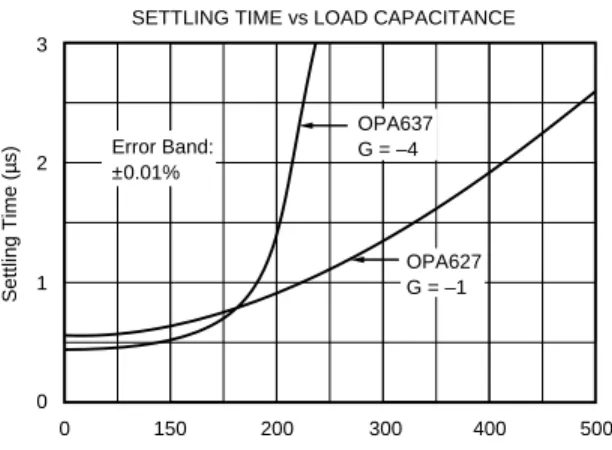
SETTLING TIME vs LOAD CAPACITANCE
0 150 200 300 400 500 Load Capacitance (pF) 3 2 1 0 Settling Time (µs) Error Band: ±0.01% OPA637 G = –4 OPA627 G = –1
APPLICATIONS INFORMATION
The OPA627 is unity-gain stable. The OPA637 may be used to achieve higher speed and bandwidth in circuits with noise gain greater than five. Noise gain refers to the closed-loop gain of a circuit as if the non-inverting op amp input were being driven. For example, the OPA637 may be used in a non-inverting amplifier with gain greater than five, or an inverting amplifier of gain greater than four.
When choosing between the OPA627 or OPA637, it is important to consider the high frequency noise gain of your circuit configuration. Circuits with a feedback capacitor (Figure 1) place the op amp in unity noise-gain at high frequency. These applications must use the OPA627 for proper stability. An exception is the circuit in Figure 2, where a small feedback capacitance is used to compensate for the input capacitance at the op amp’s inverting input. In this case, the closed-loop noise gain remains constant with frequency, so if the closed-loop gain is equal to five or greater, the OPA637 may be used.
– + – + – + – + – + – + Buffer Bandwidth Limiting Integrator Filter RI RF < 4R Inverting Amp G < |–4| RI RF < 4RI Non-Inverting Amp G < 5 OPA627 OPA627 OPA627 OPA627 OPA627 OPA627
® – + C2 C1 R2 R1 OPA637 C1 = CIN + CSTRAY C2 = R1 C1 R2
OFFSET VOLTAGE ADJUSTMENT
The OPA627/637 is laser-trimmed for low offset voltage and drift, so many circuits will not require external adjust-ment. Figure 3 shows the optional connection of an external potentiometer to adjust offset voltage. This adjustment should not be used to compensate for offsets created elsewhere in a system (such as in later amplification stages or in an A/D converter) because this could introduce excessive tempera-ture drift. Generally, the offset drift will change by approxi-mately 4µV/°C for 1mV of change in the offset voltage due to an offset adjustment (as shown on Figure 3).
FIGURE 2. Circuits with Noise Gain Equal to or Greater than Five May Use the OPA637.
amp contributes little additional noise. Below 1kΩ, op amp noise dominates over the resistor noise, but compares favorably with precision bipolar op amps.
CIRCUIT LAYOUT
As with any high speed, wide bandwidth circuit, careful layout will ensure best performance. Make short, direct interconnections and avoid stray wiring capacitance—espe-cially at the input pins and feedback circuitry.
The case (TO-99 metal package only) is internally connected to the negative power supply as it is with most common op amps. Pin 8 of the plastic DIP, SOIC, and TO-99 packages has no internal connection.
Power supply connections should be bypassed with good high frequency capacitors positioned close to the op amp pins. In most cases 0.1µF ceramic capacitors are adequate. The OPA627/637 is capable of high output current (in excess of 45mA). Applications with low impedance loads or capacitive loads with fast transient signals demand large currents from the power supplies. Larger bypass capacitors such as 1µF solid tantalum capacitors may improve dynamic performance in these applications.
NOISE PERFORMANCE
Some bipolar op amps may provide lower voltage noise performance, but both voltage noise and bias current noise contribute to the total noise of a system. The OPA627/637 is unique in providing very low voltage noise and very low current noise. This provides optimum noise performance over a wide range of sources, including reactive source impedances. This can be seen in the performance curve showing the noise of a source resistor combined with the noise of an OPA627. Above a 2kΩ source resistance, the op
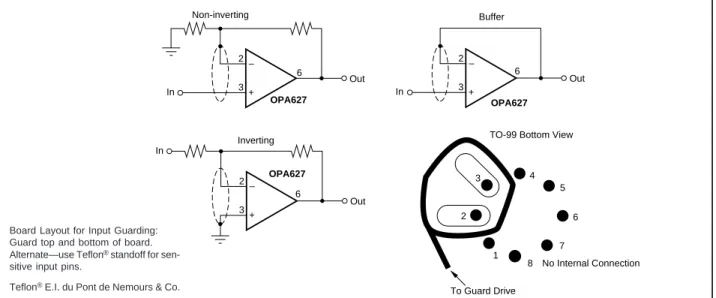
FIGURE 4. Connection of Input Guard for Lowest IB.
Board Layout for Input Guarding: Guard top and bottom of board. Alternate—use Teflon® standoff for
sen-sitive input pins.
Teflon® E.I. du Pont de Nemours & Co.
– + 2 3 In Non-inverting 6 OPA627 Out – + 2 3 In Inverting 6 OPA627 Out – + 2 3 In Buffer 6 OPA627 Out 3 2 4 5 6 7 8 No Internal Connection 1
TO-99 Bottom View
To Guard Drive – + 2 3 7 1 5 6 +VS –VS OPA627/637 100kΩ 10kΩ to 1MΩ Potentiometer (100kΩ preferred) ±10mV Typical Trim Range 4
takes approximately 500ns. When the output is driven into the positive limit, recovery takes approximately 6µs. Output recovery of the OPA627 can be improved using the output clamp circuit shown in Figure 5. Diodes at the inverting input prevent degradation of input bias current.
INPUT BIAS CURRENT
Difet fabrication of the OPA627/637 provides very low input bias current. Since the gate current of a FET doubles approximately every 10°C, to achieve lowest input bias current, the die temperature should be kept as low as pos-sible. The high speed and therefore higher quiescent current of the OPA627/637 can lead to higher chip temperature. A simple press-on heat sink such as the Burr-Brown model 807HS (TO-99 metal package) can reduce chip temperature by approximately 15°C, lowering the IB to one-third its warmed-up value. The 807HS heat sink can also reduce low-frequency voltage noise caused by air currents and thermo-electric effects. See the data sheet on the 807HS for details. Temperature rise in the plastic DIP and SOIC packages can be minimized by soldering the device to the circuit board. Wide copper traces will also help dissipate heat.
The OPA627/637 may also be operated at reduced power supply voltage to minimize power dissipation and tempera-ture rise. Using ±5V power supplies reduces power dissipa-tion to one-third of that at ±15V. This reduces the IB of TO-99 metal package devices to approximately one-fourth the value at ±15V.
Leakage currents between printed circuit board traces can easily exceed the input bias current of the OPA627/637. A circuit board “guard” pattern (Figure 4) reduces leakage effects. By surrounding critical high impedance input cir-cuitry with a low impedance circuit connection at the same potential, leakage current will flow harmlessly to the low-impedance node. The case (TO-99 metal package only) is internally connected to –VS.
Input bias current may also be degraded by improper han-dling or cleaning. Contamination from hanhan-dling parts and circuit boards may be removed with cleaning solvents and deionized water. Each rinsing operation should be followed by a 30-minute bake at 85°C.
Many FET-input op amps exhibit large changes in input bias current with changes in input voltage. Input stage cascode circuitry makes the input bias current of the OPA627/637 virtually constant with wide common-mode voltage changes. This is ideal for accurate high input-impedance buffer applications.
PHASE-REVERSAL PROTECTION
The OPA627/637 has internal phase-reversal protection. Many FET-input op amps exhibit a phase reversal when the input is driven beyond its linear common-mode range. This is most often encountered in non-inverting circuits when the input is driven below –12V, causing the output to reverse into the positive rail. The input circuitry of the OPA627/637 does not induce phase reversal with excessive common-mode voltage, so the output limits into the appropriate rail. OUTPUT OVERLOAD
When the inputs to the OPA627/637 are overdriven, the output voltage of the OPA627/637 smoothly limits at ap-proximately 2.5V from the positive and negative power supplies. If driven to the negative swing limit, recovery
+VS 5kΩ (2) HP 5082-2811 1kΩ 5kΩ –VS VO Diode Bridge BB: PWS740-3 ZD : 10V IN9611 Clamps output at VO = ±11.5V RI VI – + RF ZD1 OPA627
FIGURE 5. Clamp Circuit for Improved Overload Recovery.
CAPACITIVE LOADS
As with any high-speed op amp, best dynamic performance can be achieved by minimizing the capacitive load. Since a load capacitance presents a decreasing impedance at higher frequency, a load capacitance which is easily driven by a slow op amp can cause a high-speed op amp to perform poorly. See the typical curves showing settling times as a function of capacitive load. The lower bandwidth of the OPA627 makes it the better choice for driving large capaci-tive loads. Figure 6 shows a circuit for driving very large load capacitance. This circuit’s two-pole response can also be used to sharply limit system bandwidth. This is often useful in reducing the noise of systems which do not require the full bandwidth of the OPA627.
FIGURE 6. Driving Large Capacitive Loads.
R1 – + RF 1kΩ OPA627 CF G = +1 BW 1MHz 200pF
For Approximate Butterworth Response:
CF =2 RO CL RF RF >> RO G = 1+RF R1 ≥ Optional Gain Gain > 1 f–3dB = 1 2π √ RF RO CF CL CL 5nF RO 20Ω
® INPUT PROTECTION
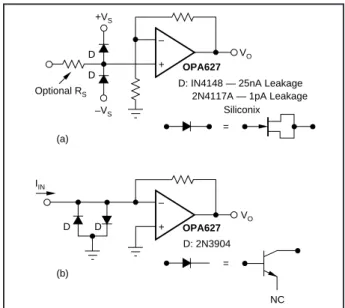
The inputs of the OPA627/637 are protected for voltages between +VS + 2V and –VS – 2V. If the input voltage can exceed these limits, the amplifier should be protected. The diode clamps shown in Figure 7a will prevent the input voltage from exceeding one forward diode voltage drop beyond the power supplies—well within the safe limits. If the input source can deliver current in excess of the maxi-mum forward current of the protection diodes, use a series resistor, RS, to limit the current. Be aware that adding resistance to the input will increase noise. The 4nV/√Hz theoretical thermal noise of a 1kΩ resistor will add to the 4.5nV/√Hz noise of the OPA627/637 (by the square-root of the sum of the squares), producing a total noise of 6nV/√Hz. Resistors below 100Ω add negligible noise.
Leakage current in the protection diodes can increase the total input bias current of the circuit. The specified maxi-mum leakage current for commonly used diodes such as the 1N4148 is approximately 25nA—more than a thousand times larger than the input bias current of the OPA627/637. Leakage current of these diodes is typically much lower and may be adequate in many applications. Light falling on the junction of the protection diodes can dramatically increase leakage current, so common glass-packaged diodes should be shielded from ambient light. Very low leakage can be achieved by using a diode-connected FET as shown. The 2N4117A is specified at 1pA and its metal case shields the junction from light.
Sometimes input protection is required on I/V converters of inverting amplifiers (Figure 7b). Although in normal opera-tion, the voltage at the summing junction will be near zero (equal to the offset voltage of the amplifier), large input transients may cause this node to exceed 2V beyond the power supplies. In this case, the summing junction should be protected with diode clamps connected to ground. Even with the low voltage present at the summing junction, common signal diodes may have excessive leakage current. Since the reverse voltage on these diodes is clamped, a diode-connected signal transistor can be used as an inexpen-sive low leakage diode (Figure 7b).
FIGURE 7. Input Protection Circuits.
– + –VS +VS Optional RS VO
D: IN4148 — 25nA Leakage 2N4117A — 1pA Leakage
(a) = – + IIN VO D D D (b) D D: 2N3904 = NC Siliconix OPA627 OPA627
FPO
When used as a unity-gain buffer, large common-mode input voltage steps produce transient variations in input-stage currents. This causes the rising edge to be slower and falling edges to be faster than nominal slew rates observed in higher-gain circuits.
(A) (B)
SMALL SIGNAL RESPONSE LARGE SIGNAL RESPONSE
FIGURE 8. OPA627 Dynamic Performance, G = +1.
–
+
OPA627 G = 1
When driven with a very fast input step (left), common-mode transients cause a slight variation in input stage currents which will reduce output slew rate. If the input step slew rate is reduced (right), output slew rate will increase slightly.
FIGURE 9. OPA627 Dynamic Performance, G = –1.
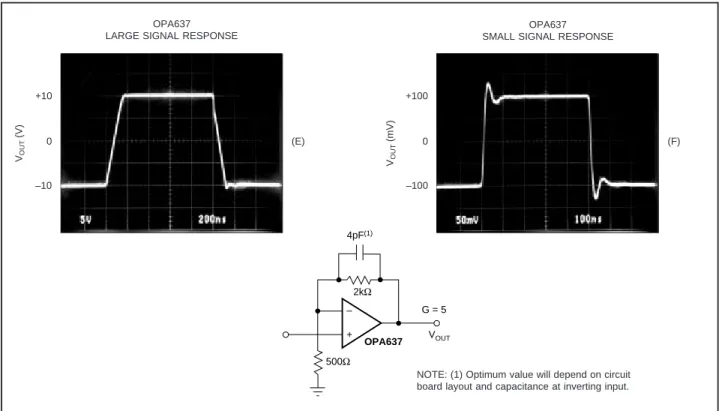
NOTE: (1) Optimum value will depend on circuit board lay-out and stray capacitance at the inverting input. LARGE SIGNAL RESPONSE
+10 0 –10 VOUT (V) +10 0 –10 (C) (D) OPA637 LARGE SIGNAL RESPONSE
OPA637 SMALL SIGNAL RESPONSE
FPO
FIGURE 10. OPA637 Dynamic Response, G = 5. –10 0 +10 –100 0 +100 (F) (E) VOUT (V) – + OPA627 G = –1 2kΩ 2kΩ 6pF(1) VOUT – + OPA637 G = 5 2kΩ 500Ω 4pF(1) VOUT
NOTE: (1) Optimum value will depend on circuit board layout and capacitance at inverting input.
VOUT
(V)
VOUT
® OPA627 OPA637 RI, R1 2kΩ 500Ω CF 6pF 4pF Error Band ±0.5mV ±0.2mV (0.01%)
NOTE: CF is selected for best settling time performance depending on test fixture layout. Once optimum value is determined, a fixed capacitor may be used.
FIGURE 12. High Speed Instrumentation Amplifier, Gain = 100.
–In
+In
+
–
OPA637
Differential Voltage Gain = 1 + 2RF/RG 2 3 – + – + INA105 Differential Amplifier 1 6 5 Output Gain = 100 CMRR 116dB Bandwidth 1MHz OPA637 25kΩ 25kΩ 25kΩ 25kΩ Input Common-Mode Range = ±5V ≈ ≈ 3pF RF 5kΩ RF 5kΩ RG 101Ω – + ±5V Out +15V 2kΩ CF 2kΩ Error Out RI RI 51Ω –15V HP- 5082-2835 High Quality Pulse Generator /
FIGURE 11. Settling Time and Slew Rate Test Circuit.
FIGURE 14. Composite Amplifier for Wide Bandwidth.
This composite amplifier uses the OPA603 current-feedback op amp to provide extended bandwidth and slew rate at high closed-loop gain. The feedback loop is closed around the composite amp, preserving the precision input characteristics of the OPA627/637. Use separate power supply bypass capacitors for each op amp.
GAIN A1 R1 R2 R3 R4 –3dB SLEW RATE
(V/V) OP AMP (Ω) (kΩ) (Ω) (kΩ) (MHz) (V/µs)
100 OPA627 50.5(1) 4.99 20 1 15 700
1000 OPA637 49.9 4.99 12 1 11 500
NOTE: (1) Closest 1/2% value. *Minimize capacitance at this node. FIGURE 13. High Speed Instrumentation Amplifier, Gain = 1000.
+ – OPA603 – + A1 R3 R1 R4 R2 VI VO * RL≥ 150Ω for ±10V Out –In +In + – OPA637
Differential Voltage Gain = (1 + 2RF/RG) • 10 2 3 – + – + INA106 Differential Amplifier 1 6 5 Output Gain = 1000 CMRR 116dB Bandwidth 400kHz OPA637 10kΩ 10kΩ 100kΩ 100kΩ Input Common-Mode Range = ±10V ≈ ≈ 3pF RF 5kΩ RF 5kΩ RG 101Ω
PACKAGING INFORMATION
Orderable Device Status(1) Package Type
Package Drawing
Pins Package Qty
Eco Plan(2) Lead/Ball Finish MSL Peak Temp(3)
OPA627AM NRND TO-99 LMC 8 20 Green (RoHS &
no Sb/Br)
AU N / A for Pkg Type
OPA627AP ACTIVE PDIP P 8 50 TBD Call TI Call TI
OPA627APG4 ACTIVE PDIP P 8 50 TBD Call TI Call TI
OPA627AU ACTIVE SOIC D 8 75 Green (RoHS &
no Sb/Br)
CU NIPDAU Level-3-260C-168 HR
OPA627AU/2K5 ACTIVE SOIC D 8 2500 Green (RoHS &
no Sb/Br)
CU NIPDAU Level-3-260C-168 HR
OPA627AU/2K5E4 ACTIVE SOIC D 8 2500 Green (RoHS &
no Sb/Br)
CU NIPDAU Level-3-260C-168 HR
OPA627AUE4 ACTIVE SOIC D 8 75 Pb-Free
(RoHS)
CU NIPDAU Level-3-260C-168 HR
OPA627AUG4 ACTIVE SOIC D 8 75 Green (RoHS &
no Sb/Br)
CU NIPDAU Level-3-260C-168 HR
OPA627BM NRND TO-99 LMC 8 20 Green (RoHS &
no Sb/Br)
AU N / A for Pkg Type
OPA627BP ACTIVE PDIP P 8 50 TBD Call TI Call TI
OPA627BPG4 ACTIVE PDIP P 8 50 TBD Call TI Call TI
OPA627SM NRND TO-99 LMC 8 20 Green (RoHS &
no Sb/Br)
AU N / A for Pkg Type
OPA637AM NRND TO-99 LMC 8 20 Green (RoHS &
no Sb/Br)
AU N / A for Pkg Type
OPA637AM2 OBSOLETE TO-99 LMC 8 TBD Call TI Call TI
OPA637AP ACTIVE PDIP P 8 50 Green (RoHS &
no Sb/Br)
CU NIPDAU N / A for Pkg Type
OPA637APG4 ACTIVE PDIP P 8 50 Green (RoHS &
no Sb/Br)
CU NIPDAU N / A for Pkg Type
OPA637AU ACTIVE SOIC D 8 75 Green (RoHS &
no Sb/Br)
CU NIPDAU Level-3-260C-168 HR
OPA637AU/2K5 ACTIVE SOIC D 8 2500 Green (RoHS &
no Sb/Br)
CU NIPDAU Level-3-260C-168 HR
OPA637AU/2K5E4 ACTIVE SOIC D 8 2500 Green (RoHS &
no Sb/Br)
CU NIPDAU Level-3-260C-168 HR
OPA637AUE4 ACTIVE SOIC D 8 TBD Call TI Call TI
OPA637AUG4 ACTIVE SOIC D 8 75 Green (RoHS &
no Sb/Br)
CU NIPDAU Level-3-260C-168 HR
OPA637BM NRND TO-99 LMC 8 20 Green (RoHS &
no Sb/Br)
AU N / A for Pkg Type
OPA637BM1 OBSOLETE TO-99 LMC 8 TBD Call TI Call TI
OPA637BP ACTIVE PDIP P 8 50 Green (RoHS &
no Sb/Br)
CU NIPDAU N / A for Pkg Type
OPA637BPG4 ACTIVE PDIP P 8 50 Green (RoHS &
no Sb/Br)
CU NIPDAU N / A for Pkg Type
OPA637SM NRND TO-99 LMC 8 20 Green (RoHS &
no Sb/Br)
AU N / A for Pkg Type
(1)The marketing status values are defined as follows:
ACTIVE: Product device recommended for new designs.
LIFEBUY: TI has announced that the device will be discontinued, and a lifetime-buy period is in effect.
PACKAGE OPTION ADDENDUM
www.ti.com 16-Apr-2009
NRND: Not recommended for new designs. Device is in production to support existing customers, but TI does not recommend using this part in
a new design.
PREVIEW: Device has been announced but is not in production. Samples may or may not be available. OBSOLETE: TI has discontinued the production of the device.
(2)Eco Plan - The planned eco-friendly classification: Pb-Free (RoHS), Pb-Free (RoHS Exempt), or Green (RoHS & no Sb/Br) - please check
http://www.ti.com/productcontentfor the latest availability information and additional product content details.
TBD: The Pb-Free/Green conversion plan has not been defined.
Pb-Free (RoHS): TI's terms "Lead-Free" or "Pb-Free" mean semiconductor products that are compatible with the current RoHS requirements
for all 6 substances, including the requirement that lead not exceed 0.1% by weight in homogeneous materials. Where designed to be soldered at high temperatures, TI Pb-Free products are suitable for use in specified lead-free processes.
Pb-Free (RoHS Exempt): This component has a RoHS exemption for either 1) lead-based flip-chip solder bumps used between the die and
package, or 2) lead-based die adhesive used between the die and leadframe. The component is otherwise considered Pb-Free (RoHS compatible) as defined above.
Green (RoHS & no Sb/Br): TI defines "Green" to mean Pb-Free (RoHS compatible), and free of Bromine (Br) and Antimony (Sb) based flame
retardants (Br or Sb do not exceed 0.1% by weight in homogeneous material) (3)
MSL, Peak Temp. -- The Moisture Sensitivity Level rating according to the JEDEC industry standard classifications, and peak solder temperature.
Important Information and Disclaimer:The information provided on this page represents TI's knowledge and belief as of the date that it is
provided. TI bases its knowledge and belief on information provided by third parties, and makes no representation or warranty as to the accuracy of such information. Efforts are underway to better integrate information from third parties. TI has taken and continues to take reasonable steps to provide representative and accurate information but may not have conducted destructive testing or chemical analysis on incoming materials and chemicals. TI and TI suppliers consider certain information to be proprietary, and thus CAS numbers and other limited information may not be available for release.
In no event shall TI's liability arising out of such information exceed the total purchase price of the TI part(s) at issue in this document sold by TI to Customer on an annual basis.
PACKAGE OPTION ADDENDUM
www.ti.com 16-Apr-2009
TAPE AND REEL INFORMATION
*All dimensions are nominal
Device Package Type Package Drawing Pins SPQ Reel Diameter (mm) Reel Width W1 (mm) A0 (mm) B0 (mm) K0 (mm) P1 (mm) W (mm) Pin1 Quadrant OPA627AU/2K5 SOIC D 8 2500 330.0 12.4 6.4 5.2 2.1 8.0 12.0 Q1
PACKAGE MATERIALS INFORMATION
www.ti.com 11-Mar-2008
*All dimensions are nominal
Device Package Type Package Drawing Pins SPQ Length (mm) Width (mm) Height (mm)
OPA627AU/2K5 SOIC D 8 2500 346.0 346.0 29.0
PACKAGE MATERIALS INFORMATION
www.ti.com 11-Mar-2008
IMPORTANT NOTICE
Texas Instruments Incorporated and its subsidiaries (TI) reserve the right to make corrections, modifications, enhancements, improvements, and other changes to its products and services at any time and to discontinue any product or service without notice. Customers should obtain the latest relevant information before placing orders and should verify that such information is current and complete. All products are sold subject to TI’s terms and conditions of sale supplied at the time of order acknowledgment.
TI warrants performance of its hardware products to the specifications applicable at the time of sale in accordance with TI’s standard warranty. Testing and other quality control techniques are used to the extent TI deems necessary to support this warranty. Except where mandated by government requirements, testing of all parameters of each product is not necessarily performed.
TI assumes no liability for applications assistance or customer product design. Customers are responsible for their products and applications using TI components. To minimize the risks associated with customer products and applications, customers should provide adequate design and operating safeguards.
TI does not warrant or represent that any license, either express or implied, is granted under any TI patent right, copyright, mask work right, or other TI intellectual property right relating to any combination, machine, or process in which TI products or services are used. Information published by TI regarding third-party products or services does not constitute a license from TI to use such products or services or a warranty or endorsement thereof. Use of such information may require a license from a third party under the patents or other intellectual property of the third party, or a license from TI under the patents or other intellectual property of TI.
Reproduction of TI information in TI data books or data sheets is permissible only if reproduction is without alteration and is accompanied by all associated warranties, conditions, limitations, and notices. Reproduction of this information with alteration is an unfair and deceptive business practice. TI is not responsible or liable for such altered documentation. Information of third parties may be subject to additional restrictions.
Resale of TI products or services with statements different from or beyond the parameters stated by TI for that product or service voids all express and any implied warranties for the associated TI product or service and is an unfair and deceptive business practice. TI is not responsible or liable for any such statements.
TI products are not authorized for use in safety-critical applications (such as life support) where a failure of the TI product would reasonably be expected to cause severe personal injury or death, unless officers of the parties have executed an agreement specifically governing such use. Buyers represent that they have all necessary expertise in the safety and regulatory ramifications of their applications, and acknowledge and agree that they are solely responsible for all legal, regulatory and safety-related requirements concerning their products and any use of TI products in such safety-critical applications, notwithstanding any applications-related information or support that may be provided by TI. Further, Buyers must fully indemnify TI and its representatives against any damages arising out of the use of TI products in such safety-critical applications.
TI products are neither designed nor intended for use in military/aerospace applications or environments unless the TI products are specifically designated by TI as military-grade or "enhanced plastic." Only products designated by TI as military-grade meet military specifications. Buyers acknowledge and agree that any such use of TI products which TI has not designated as military-grade is solely at the Buyer's risk, and that they are solely responsible for compliance with all legal and regulatory requirements in connection with such use. TI products are neither designed nor intended for use in automotive applications or environments unless the specific TI products are designated by TI as compliant with ISO/TS 16949 requirements. Buyers acknowledge and agree that, if they use any non-designated products in automotive applications, TI will not be responsible for any failure to meet such requirements.
Following are URLs where you can obtain information on other Texas Instruments products and application solutions:
Products Applications
Amplifiers amplifier.ti.com Audio www.ti.com/audio Data Converters dataconverter.ti.com Automotive www.ti.com/automotive DLP® Products www.dlp.com Broadband www.ti.com/broadband
DSP dsp.ti.com Digital Control www.ti.com/digitalcontrol
Clocks and Timers www.ti.com/clocks Medical www.ti.com/medical Interface interface.ti.com Military www.ti.com/military Logic logic.ti.com Optical Networking www.ti.com/opticalnetwork Power Mgmt power.ti.com Security www.ti.com/security Microcontrollers microcontroller.ti.com Telephony www.ti.com/telephony RFID www.ti-rfid.com Video & Imaging www.ti.com/video RF/IF and ZigBee® Solutions www.ti.com/lprf Wireless www.ti.com/wireless
Mailing Address: Texas Instruments, Post Office Box 655303, Dallas, Texas 75265 Copyright © 2009, Texas Instruments Incorporated