Distributed Systems, Spring 2003 1
Basics
Distributed Systems, Spring 2003 2
Topics to be covered
Definitions and Examples
Goals
Models (architectural, fundamental)
Hardware and Software Concepts
The Client-Server Model
Distributed Systems, Spring 2003 3
Historical
Two developments from mid 50s • 100 million dollars -- 1 instr per sec1000 dollars -- 10 million instr per sec 1012price/performance gain
Rolls Royce cost 1 dollar -- a billion miles per gallon (200-page manual to open the door)
• Local and Wide Area networks (LANs)
Distributed Systems, Spring 2003 4
Definition of a Distributed System
A distributed system is:
A collection of
independent
computers
that appears to its users as a
single
coherent system
Two aspects:
(1) Independent computers (2) Single system ⇒middleware
Distributed Systems, Spring 2003 5
Definition of a Distributed System
Issues (1) Concurrency (2) No global clock (3) Independent failures Characteristics (1) Heterogeneity hidden
(2) Interact with a consistent and uniform way (3) Availability
(4) Scale
Distributed Systems, Spring 2003 6
A Distributed System as Middleware
Note that the middleware layer extends over multiple machines.
Distributed Systems, Spring 2003 7
Examples of Distributed Systems
The Internet
Intranets
Mobile and Ubiquitous Computing
The Web
p2p systems (such as Napster)
File systems (SUN, CODA, Adrews)
Storage Systems (Occean)
Object-based Systems (CORBA, DCOM, etc)
Groupware
Distributed Systems, Spring 2003 8
intranet ISP desktop computer: backbone satellite link server: network link:
A typical portion of the Internet
ISPs: Internet Service Providers Backbone links the Intranets together
Distributed Systems, Spring 2003 9
A Typical Intranet the rest of email server Web server Desktop computers File server router/firewall print and other servers
other servers print Local area network email server the Internet
• A portion of the Internet separately administrated • Several LANs linked by backbone connections • Connected to the Internet via a router
•Firewallsprotects an intranet by preventing unauthorized messages leaving or entering; implementing by filtering messages
Distributed Systems, Spring 2003 10
Portable and handheld devices in a distributed system
Laptop Mobile Printer
Camera Internet
Host intranet WAP Home intranet Wireless LAN
phone gateway
Host site
• Devices: laptop computers, handheld devices (e.g., PDAs, video cameras), wearable devices, devices embedded in appliances
• Mobile computing, ubiquitous computing, location-aware computing • In the figure above: 3 different forms of wireless connections: wireless LAN, mobile phone through WAP, infra-red link
Resource sharing on the Web
Internet Browsers Web servers www.google.com www.cdk3.net www.w3c.org Protocols Activity.html http://www.w3c.org/Protocols/Activity.html http://www.google.comlsearch?q=kindberg http://www.cdk3.net/ File system of www.w3c.org
• WWW a system for publishing and accessing resources and services across the Internet
• Web browsers act as client
• Request resources (e.g., web pages) from web servers • CERN , 1989
• Hypertext structure among documents
Computers in the Internet
Date
Computers
Web servers
1979, Dec. 188 0
1989, July 130,000 0
Distributed Systems, Spring 2003 13
Computers vs. Web servers in the Internet
Date
Computers
Web servers
Percentage
1993, July 1,776,000 130 0.008
1995, July 6,642,000 23,500 0.4
1997, July 19,540,000 1,203,096 6
1999, July 56,218,000 6,598,697 12
Distributed Systems, Spring 2003 14
Goals
1. Connecting Users and Resources
2. Transparency
3. Openness
4. Scalability
Distributed Systems, Spring 2003 15
Connecting Users and Resources
Why sharing? Typical resources
Printers, computers, storage facilities, data, files
Economics
Collaboration, Information Exchange (groupware)
Problems with sharing Security
Unwanted Communication
Distributed Systems, Spring 2003 16
Transparency in a Distributed System access transparency
Hide differences in data representation and how a resource is accessed
Intel (little endian format)/Sun SPARC (big endian) (order of bytes)
OS with different file name conversions
Distributed Systems, Spring 2003 17
Transparency in a Distributed System location transparency
Hide where a resource is located importance of naming, e.g., URLs migration transparency
Hide that a resource may move to another location relocation transparency
Hide that a resource may move to another location while in use
example, mobile users
Distributed Systems, Spring 2003 18
Transparency in a Distributed System replication transparency
Hide that a resource is replicated
subsumes that all replicas have the same name (and thus location transparency)
concurrency transparency
Hide that a resource may be shared by several competitive users
leave the resource in a consistent state more refined mechanism: transactions
Distributed Systems, Spring 2003 19
Transparency in a Distributed System failure transparency
Hide the failure and recovery of a resource
persistent transparency
Hide whether a (software) resource is in memory or disk
L. Lamport: You know you have one [distributed system] when the crash of a computer you ‘ve never heard of stops you for getting any work done
Important problem: inability to distinguish between a dead resource and a painfully slow one
Distributed Systems, Spring 2003 20
Different Forms of Transparency in a
Distributed System (summary)
Hide whether a (software) resource is in memory or on disk
Persistence
Hide the failure and recovery of a resource Failure
Hide that a resource may be shared by several competitive users
Concurrency
Hide that a resource may be shared by several competitive users
Replication
Hide that a resource may be moved to another location while in use
Relocation
Hide that a resource may move to another location Migration
Hide where a resource is located Location
Hide differences in data representation and how a resource is accessed
Access
Description Transparency
Distributed Systems, Spring 2003 21
(Coulouris et. al.)
Access transparency:enables local and remote resources to be accessed using identical operations. (same)
Location transparency:enables resources to be accessed without knowledge of their location. (same) – also migration and relocation
Mobility transparency:allows the movement of resources and clients within a system without affecting the operation of users or programs.
Replication transparency:enables multiple instances of resources to be used to increase reliability and performance without knowledge of the replicas by users or application programmers.
Concurrency transparency:enables several processes to operate concurrently using shared resources without interference between them.
Failure transparency:enables the concealment of faults, allowing users and application programs to complete their tasks despite the failure of hardware or software components. – also persistent transparency
Performance transparency:allows the system to be reconfigured to improve performance as loads vary.
Scaling transparency:allows the system and applications to expand in scale without change to the system structure or the application algorithms.
Distributed Systems, Spring 2003 22
Degree of Transparency
Not always desirable
Examples?
Trade-off between a high degree of transparency
and the performance of a system
Users located in different continents (contex-aware)
Not always possible
Examples?
Hiding failures (you can distinguish a slow computer from a failing one/whether an action was performed)
Keep web caches exactly up-to-date Immediately flushing write operations to disk Retry to access a web page to mask a failure
Goals
1. Connecting Users and Resources
2. Transparency
3. Openness
4. Scalability
Openness
Open distributed system
Be able to interact with services from other open systems, irrespectively of the underlying environment
Offers services according to standard rules that describe the syntaxand the semanticsof these services
• Rules formalized in protocols
• Services specified through interfaces(described in an Interface Definition Language (IDL) (but only the syntax part)
• Neutral and complete specifications (with regards to a potential implementation)
Distributed Systems, Spring 2003 25
Openness
•Interoperability: to what extend can work together •Portability: to what extend an application developed for A can be executed on B that implements the same interface with A
Distributed Systems, Spring 2003 26
Openness
• Separate
Policy
from
Mechanism
• A system organized as a collection of relatively small and easily replaceable or adaptable components
•Provide definitions of the internal parts of the system as well
A distributed system provides only mechanisms Policiesspecified by applications and users Example policies:
• What level of consistency do we require for client-cached data? • Which operations do we allow downloaded code to perform? • Which QoS requirements do we adjust in the face of varying bandwidth?
• What level of secrecy do we require for communication?
Distributed Systems, Spring 2003 27
Scalability
• size (number of users and/or processes) • geographical (maximum distance between nodes) • administrative (number of administrative domains)
Along three different dimensions:
The (non) solution: powerful servers
Distributed Systems, Spring 2003 28
Scalability Problems
Decentralized algorithms
• No complete information about the system state • Make decision only on local information
• Failure of one machine does not ruin the algorithm • No assumption of a global clock
Doing routing based on complete information Centralized algorithms
A single on-line telephone book Centralized data
A single server for all users Centralized services
Example Concept
Distributed Systems, Spring 2003 29
Scalability
Synchronous communication In WAN, Unreliable and point-to-point Geographical scalability:How to scale a distributed system across multiple, independent administrative domains: conflicting policies with respect to resource usage (and payment), management and security Expand to a new domain
• Protect itself against malicious attacks from the new domain
• The new domain has to protect itself against malicious attacks from the distributed system
Distributed Systems, Spring 2003 30
Scaling Techniques
• hiding communication latencies • distribution
• replication Three techniques:
Distributed Systems, Spring 2003 31
Scaling Techniques
try to avoid waiting for responses to remote service requests as much as possible
• asynchronous communication (do something else) • moving part of the computation to the client process
Hiding communication latencies
Distributed Systems, Spring 2003 32
Scaling Techniques
The difference between letting: a) a server or
b) a client check forms as they are being filled
Distributed Systems, Spring 2003 33
Scaling Techniques
Taking a component, splitting into smaller parts, and spreading these parts across the systemDistribution
Example:
(1) The World Wide Web (2) Domain Name Service (DNS)
hierarchically organized into a tree of domains
Each domain divided into non overlapping zones
The names in each domain handled by a single name server
Distributed Systems, Spring 2003 34
Scaling Techniques
An example of dividing the DNS name space into zones.
nl.vu.cs.flits
Scaling Techniques
• increase availability • balance the load
• reduce communication latency • but, consistency problems Replication
Caching (client-driven)
Distributed Systems, Spring 2003 37
System Models
Examples include the client-server model and the p2p model An architectural model of a distributed system is concerned with the placement of its parts and the relationships between them
• determine the distribution of data and computational tasks amongst the physical nodes of the system
• useful when evaluating the performance, reliability, scalability and other properties of distributed systems
1. Architectural models 2. Fundamental models
Distributed Systems, Spring 2003 38
System Models
Fundamental modelsare concerned with a more formal description of the properties that are common in all of the architectural models Models:
•Interaction model deals with performance and with the difficulty of setting time limits in distributed systems, for example for message delivery
•Failure model gives a precise specification of the faults that can be exhibited by processes and communication channels. Defines reliable communication and correct processes.
•Security model discusses the possible threats to processes and communication channels.
Distributed Systems, Spring 2003 39
Interaction Model
• Distributed systems are composed of multiple interacting processes
• Their behavior and state can be described by a distributed algorithm: a definition of the steps to be taken by each process including the transmission of messages between them
•Messagesare transmitted between processes to transfer information among them and to coordinate their activity
Distributed Systems, Spring 2003 40
Interaction Model
Communication performance characteristics:Latency: delay between sending a message by one process and its receipt by another
Bandwidthof a computer network: total amount of information that can be transmitted over it in a given time
Jitter: the variation in the time taken to deliver a series of messages
Computer clocks:
Clock drift rate: relative amount that a computer clock differs from a perfect reference clock
Distributed Systems, Spring 2003 41
Variants of the Interaction Model
Based on whether they set time limits (lower and upper bounds) on:• Process execution speeds • Message transmission delays • Clock drift rates
Synchronousdistributed systems (can set timeouts, can be built) Asynchronousdistributed systems (e.g., Internet, web) Despite the lack of accurate clocks, the execution of a system can be described in terms of eventsand their ordering
Distributed Systems, Spring 2003 42
Failure Model
Classification of failures:•Omissionfailures:
when a process or communication channel fails to perform actions that is supposed to do
Process omission failure: crash
Fail-stop crashis other processes can detect certainly that the process has crashed
Distributed Systems, Spring 2003 43
process p process q
Communication channel
send
Outgoing message buffer Incoming message buffe
receive m
Communication omission failures: send-omission, channel-omission, and receive omission
Failure Model
Distributed Systems, Spring 2003 44
Failure Model
Classification of failures:• Arbitrary orByzantinefailures
Arbitrary failures of processes and channels
Distributed Systems, Spring 2003 45
Omission and arbitrary failures
Class of failure Affects Description
Fail-stop Process Process halts and remains halted. Other processes may detect this state.
Crash Process Process halts and remains halted. Other processes may not be able to detect this state.
Omission Channel A message inserted in an outgoing message buffer never arrives at the other end’s incoming message buffer. Send-omission Process A process completes a send,but the message is not put
in its outgoing message buffer.
Receive-omission Process A message is put in a process’s incoming message buffer, but that process does not receive it. Arbitrary
(Byzantine)
Process or channel
Process/channel exhibits arbitrary behaviour: it may send/transmit arbitrary messages at arbitrary times, commit omissions; a process may stop or take an incorrect step.
Distributed Systems, Spring 2003 46
Timing failures
Class of Failure Affects Description
Clock Process Process’s local clock exceeds the bounds on its rate of drift from real time.
Performance Process Process exceeds the bounds on the interval between two steps.
Performance Channel A message’s transmission takes longer than the stated bound.
In synchronous systems:
Security Model
Securing the processes and the channel and protecting the objects
Protecting the objects: access rights(specify who is allowed to perform each operation of an object) Associate with each invocation and each result the authority on which it is issued called a principal
Security Model
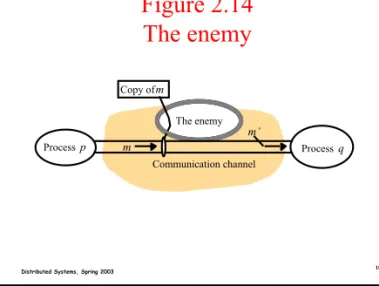
To model security threats, we postulate an enemy (or adversary)
Send any message to any process and reading/copying any message between a pair of processes
1. Threats to processes (cannot identify the identity of the sender: holds for both clients and servers)
2. Threats to communication channels
Distributed Systems, Spring 2003 49
Hardware Concepts
Distributed Systems, Spring 2003 50
Classification of Multiple CPU Computer Systems
Into two groups:Multiprocessors(shared memory): there is single physical address shared by all CPUs
Multicomputers: each machine has its own private memory. Either Homogeneousor Heterogeneous
Further divided based on the architecture of the interconnection network:
Bus: a single network that connects all machines Switch
Distributed Systems, Spring 2003 51
Hardware Concepts
Distributed Systems, Spring 2003 52
Overload the bus ⇒cache memory High hit rate drops the amount of bus traffic But incoherency
Multiprocessors
Scalability
Different method to connect the memory with the CPU ⇒ divide the memory in modules
Distributed Systems, Spring 2003 53
Multiprocessors
n2 crossbar switches Omega network
Problem: many switches between the CPU and the memory
NUMAmachine: some memory is associated with each CPU
Distributed Systems, Spring 2003 54
Homogeneous Multicomputer Systems
CPU-to-CPU communicationaka System Area Networks (SANs)
Bus-based connected through a multi-access network such as Fast Ethernet, problem?
Switch-based: routed instead of broadcast Different topologies
Distributed Systems, Spring 2003 55
Homogeneous Multicomputer Systems
Grid Hypercube (n-dimensional cube)
4-dimensional Massively parallel processors (MPPs) Clusters of Workstations (COWs)
Distributed Systems, Spring 2003 56
Heterogeneous Multicomputer Systems
Heterogeneous machines, interconnection networks ScaleLack of global view
transparency is harder
Distributed Systems, Spring 2003 57
Software Concepts
Distributed Systems, Spring 2003 58
Software Concepts
• DOS (Distributed Operating System) • NOS (Network Operating System) • Middleware
Provide distribution transparency Additional layer atop of NOS implementing
general-purpose services Middleware
Offer local services to remote clients Loosely-coupled operating system for
heterogeneous multicomputers (LAN and WAN)
NOS
Hide and manage hardware resources Tightly-coupled operating system for multi-processors and homogeneous multicomputers
DOS
Main Goal Description
System
• Much like an OS (resource managers, hides underlying hardware) •Tightly-coupled (maintain a global view) – loosely coupled
Distributed Operating Systems
• Two types: multiprocessor OS and multicomputer OS Multi-processor OSShared memory
Functionality similar to traditional OSs but handle multiple CPUs • Aim at supporting high performance through multiple CPUs, make their number transparent to the application
• Similar to multitasking uniprocessor OS:
o All communication done by manipulating data at shared memory locations.
o Protection is done through synchronization primitives
Multicomputer Operating Systems
Harder than traditional (multiprocessor) OS: Because memory is not sharedEmphasis shifts to processor communication by message passing
• OSs on each computer knows about the other computers • OS on different machines generally the same
• Services are generally (transparently) distributed across computers
Distributed Systems, Spring 2003 61
Multicomputer Operating Systems
General structure
Each node has each own kernel: modules for managing local resources (memory, local CPU, local disk, etc) + handling interprocess communication (sending and receiving messages to and from other nodes)
Common layer of software: implements the OS as a virtual machine supporting parallel and concurrent execution of tasks.
Facilities: assigning a task to a processor, providing transparent storage, general interprocess communication
Distributed Systems, Spring 2003 62
Multicomputer Operating Systems
Processor communication by message passing • Often no simple global communication• No simple system-wide synchronization mechanisms • Virtual (distributed) shared memory requires OS to maintain global memory map in software (Distributed Shared Memory (DSM) vsOnly message passing
• Inherent distributed resource management: no central point where allocation decisions can be made
Practice: only very few truly multicomputer OS exist
Distributed Systems, Spring 2003 63
Multicomputer Operating Systems
Semantics of message passing
Buffering of messages at the sender or the receiver
Four possible synchronization points:
S1 (block the sender when its buffer is full)
S2(message has been send) S3 (message has arrived at the receiver)
S4(message has been delivered to the receiver)
Distributed Systems, Spring 2003 64
Multicomputer Operating Systems
Semantics of message passing (continued)
Is the communication reliable?
Necessary No
Block sender until message delivered
Necessary No
Block sender until message received
Not necessary No
Block sender until message sent
Not necessary Yes
Block sender until buffer not full
Reliable comm. guaranteed? Send buffer
Synchronization point
Distributed Systems, Spring 2003 65
Multicomputer Operating Systems
Distributed Shared Memory Systems (DSMs) The address space is divided up into pages with the pages being spread over all the processors in the system
When a processor references an address that is not present locally, a trap occurs, and the OS fetches the pafe
Distributed Systems, Spring 2003 66
Network Operating System
Do not assume that the underlying hardware is homogeneous and that it should be managed as if it were a single system
Provide facilities to allow users to make use of services provided on a specificmachine (rlogin, rcp)
Distributed Systems, Spring 2003 67
Network Operating System
Some provide a shared global file systemDistributed Systems, Spring 2003 68
Network Operating System
Different clients may mount the servers in different places.
Distributed Systems, Spring 2003 69
Network Operating Systems
Some characteristics:• Each computer has its own OS with networking facilities • Computers work independently (i.e, they may even have different OS)
• Services are to individual nodes (ftp, telnet, www) • Highly file oriented (basically, processors share only files)
• Compared to distributed OSs
• Lack of transparency (harder to use; need to be managed independently)
• Easier to add/remove a machine (scalability, openness)
Distributed Systems, Spring 2003 70
• Middleware itself does not manage an individual mode • OS on each computer need not know about the other computers • OS on different computers need not be the same
• Services are generally (transparently) distributed across computers
Middleware
Middleware Models
Based on some model or paradigm, such as: • all resources are treated as files (UNIX and Plan 9) • Distributed file systems• Remote Procedure Calls (RPCs): allow a process to call a procedure whose implementation is located on a remote machine
• Distributed objects: transparently invoke objects residing on remote machines
• Distributed documents
Middleware Services
Communication services(offer high-level communication facilities to hide low-level message passing)
• Procedure calls across networks • Remote-object method invocation • Message-queuing systems • Advanced communication streams • Event notification service
Distributed Systems, Spring 2003 73
Middleware Services
Information system services(help manage data)• Large scale system-wide naming services • Advanced directory services (search engines) • Location services for tracking mobile objects • Persistent storage facilities
• Data caching and replication
Distributed Systems, Spring 2003 74
Middleware Services
Control services (giving applications control over when, where and how they access data)
• Code migration
• Distributed transaction processing Security services
• Authentication and authorization services • Simple encryption services
• Auditing service
Distributed Systems, Spring 2003 75
Middleware and Openness
In an open middleware-based distributed system, the protocols used by each middleware layer should be the same, as well as the interfaces they offer to applications.
Distributed Systems, Spring 2003 76
Comparison between Systems
Open Open Closed Closed Openness Varies Yes Moderately No Scalability Per node Per node Global, distributed Global, central Resource management Model specific Files Messages Shared memory Basis for communication
N N N 1 Number of copies of OS No No Yes Yes
Same OS on all nodes
High Low High Very High Degree of transparency Multicomp. Multiproc. Middleware-based OS Network OS Distributed OS Item
Distributed Systems, Spring 2003 77
The Client-Server Model
Distributed Systems, Spring 2003 78
Clients and Servers
Process are divided inServer: implementing a specific service
Client: requesting a service from a server by sending it a request and subsequent waiting for the server’s reply Distributed across different machines
Distributed Systems, Spring 2003 79
Application Layering
Traditional three-layered viewUser-interface layer: programs that allow end users to interact with the application; differ in their sophistication Processing layer: contains the functions of an application Data layer: contains the data that a client wants to manipulate through the application components
Distributed Systems, Spring 2003 80
Application Layering
The general organization of an Internet search engine into three different layers
Distributed Systems, Spring 2003 81
Multitiered Architectures
Alternative client-server organizationsDistributed Systems, Spring 2003 82
Server Client Client invocation result Server invocation result Process: Key: Computer:
Multitiered Architectures
An example of a server acting as a client.Multitiered Architectures
An example of a server acting as a client.Alternative Architectures
Vertical distribution: placing logically different components on different machines
Horizontal distribution: a client or server may be physically split up into logically equivalent parts; each operating on its own share of the complete data
Distributed Systems, Spring 2003 85
Alternative Architectures
Cooperating servers: service is physically distributed across a collection of services:
• Traditional multi-tiered architectures • Replicated files systems
• Network news services • Large-scale naming systems, etc
Cooperating clients: distributes applications exist by virtue of client collaboration:
• Teleconferencing • Publish/subscribe
Distributed Systems, Spring 2003 86
Server Server Server Service Client Client Collaborating servers
Distributed Systems, Spring 2003 87
Modern Architectures
An example of horizontal distribution of a Web service.
Distributed Systems, Spring 2003 88
Extra Slides
Distributed Systems, Spring 2003 89
Uniprocessor Operating Systems
Separating applications from operating system code through a microkernel.
1.11
Distributed Systems, Spring 2003 90
Multiprocessor Operating Systems
A monitor to protect an integer against concurrent access.
monitor Counter { private:
int count = 0; public:
int value() { return count;} void incr () { count = count + 1;} void decr() { count = count – 1;} }
Distributed Systems, Spring 2003 91
Multiprocessor Operating Systems
A monitor to protect an integer against concurrent access, but blocking a process. monitor Counter { private: int count = 0; int blocked_procs = 0; condition unblocked; public:
int value () { return count;} void incr () { if (blocked_procs == 0) count = count + 1; else signal (unblocked); } void decr() { if (count ==0) { blocked_procs = blocked_procs + 1; wait (unblocked); blocked_procs = blocked_procs – 1; } else count = count – 1; } }
Distributed Systems, Spring 2003 92
Distributed Shared Memory Systems
a) Pages of addressspace distributed among four machines b) Situation after CPU 1
references page 10 c) Situation if page 10
is read only and replication is used
Distributed Systems, Spring 2003 93
Distributed Shared Memory Systems
False sharing of a page between two independent processes.
1.18
Distributed Systems, Spring 2003 94
An Example Client and Server (1)
The
header.h
file used by the client and server.
An Example Client and Server (2)
A sample server.
An Example Client and Server (3)
Distributed Systems, Spring 2003 97
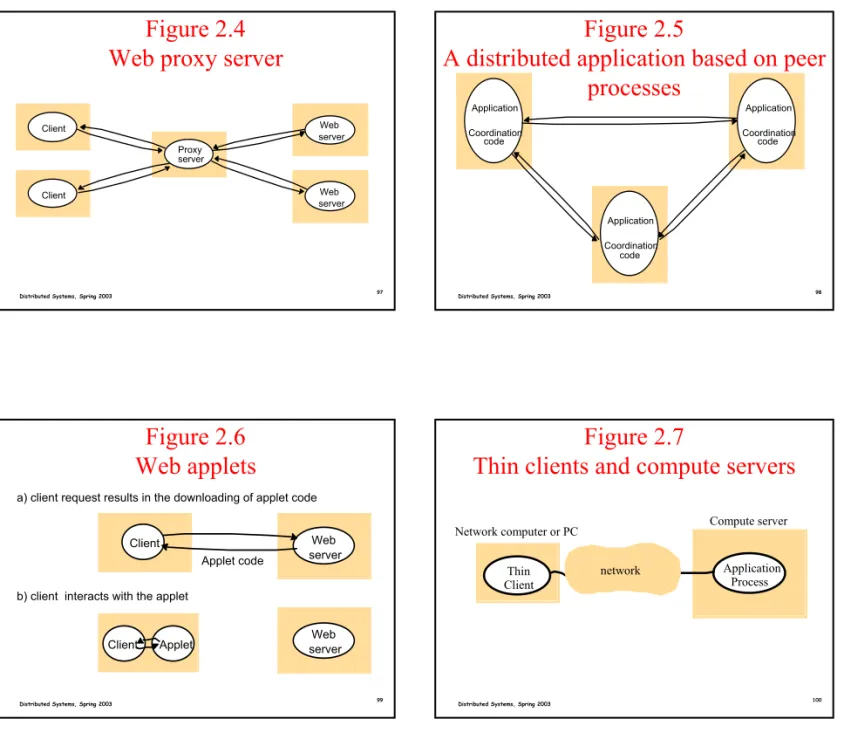
Figure 2.4
Web proxy server
Client Proxy Web server Web server server Client
Distributed Systems, Spring 2003 98
Figure 2.5
A distributed application based on peer
processes
Coordination Application code Coordination Application code Coordination Application codeDistributed Systems, Spring 2003 99
Figure 2.6
Web applets
a) client request results in the downloading of applet code
Web server
Client Applet serverWeb
Applet code Client
b) client interacts with the applet
Distributed Systems, Spring 2003 100
Figure 2.7
Thin clients and compute servers
Thin Client
Application Process Network computer or PC Compute server
network
Distributed Systems, Spring 2003 101
Figure 2.8
Spontaneous networking in a hotel
Internet gateway PDA service Music service service Discovery Alarm Camera Guests devices Laptop TV/PC Hotel wireless networkDistributed Systems, Spring 2003 102
Figure 2.9
Real-time ordering of events
send receive send receive m1 m2 2 1 3 4 X Y Z Physical time A m3 receive receive sendreceive receive receive
t1 t2 t3
receive
receive m2
Distributed Systems, Spring 2003 103
Figure 2.13
Objects and principals
Network invocation
result Client
Server
Principal (user) Principal (server) Object Access rights
Distributed Systems, Spring 2003 104
Figure 2.14
The enemy
Communication channel Copy of m Process p m Process q The enemy m’Distributed Systems, Spring 2003 105