9-1
CHAPTER 9
SAMPLERS AND SAMPLING PROCEDURES
GENERAL
A sample is a small portion of a substance used to inspect or to determine the quality of the substance. Samples of petroleum products are to be taken as described in ASTM Method D 4057.
TYPES OF SAMPLES
Various types of samples are explained be-low.
• Top Sample. A top sample is one taken 6 inches below the top surface of a tank's contents.
• Upper Sample. An upper sample is taken with a weighted bottle or beaker sampler from the middle of the top third of a tank's contents.
• Middle Sample. A middle sample is taken from the middle of the tank's contents. (A point halfway between the upper and lower sam-pling point.)
• Lower Sample. A lower sample is taken from the middle of the bottom third of a tank's contents.
• Bottom Sample. A bottom sample is taken on the bottom of a tank.
• All-Level Sample. An all-level sample is taken by submerging a closed bottle or beaker sampler to a point as near as possible to the tank draw off point. Then the sampler is opened and raised to a constant rate so that it is between 75 and 85 percent full when it emerges from the liq-uid.
• Average Sample. A sample that consists of proportionate parts from all levels of the prod-uct. For example, an average sample from a hori-zontal, cylindrical, or a spherical tank should con-tain more material from the middle of the tank where the diameter is greatest.
• Composition Sample. A sample combining individual samples that represent the bulk from
which they were taken. A single-tank composite sample is a blend of the upper, middle, and lower samples from a tank's contents. A multiple-tank composite sample is a blend of individual, all-level samples taken from the compartments of a tanker or barge containing the same product. The sample consists of parts proportionate to the volume of product in each compartment sampled.
• Outlet Sample. An outlet sample is taken with a bottle or beaker sampler at the level of a tank outlet, whether fixed or swingline.
• Drain Sample. A drain sample is taken from the drawoff or discharge valve.
• Continuous Sample. A continuous sample is taken from a flowing pipeline by allowing a slow trickle of the product to collect in a sampler during the entire flow time. This sample is representative of the stream of product during the period of sam-pling.
• On-Line Sample. An on-line sample is taken from a flowing pipeline by opening the valve and collecting the sample during the flow of the product. These samples are used mostly for the water separometer index and particulate contami-nant tests.
SAMPLERS
The four most frequently used samplers are the weighted beaker, weighted bottle, Bacon bomb thief, and drum thief (see Figure 9-1, page 9-2). A fifth type is the vacuum pump sampler (see Figure 9-2, page 9-3). Its use is generally restricted to drawing samples in a petroleum laboratory.
Weighted Beaker (Copper Cylinder). The weighted copper beaker sampler (NSN 6640-00-946-3600) consists of a copper bottle permanently attached to a lead base. A drop cord is attached to the handle through a ring in the stopper so that a
short, quick pull on the cord opens the beaker at any desired point beneath the surface of the liquid. This sampler is used to take upper, middle, lower, or all-level samples of liquid products of 16 psi or
less RVP. It is used in tanker or barge compart-ments, shore tanks, tank cars, and tank trucks.
9-3
Figure 9-1. SamplersFigure 9-2. Vacuum-pump sampler
.
Weighted Bottle (Glass Cylinder). The glass-cylinder sampler (NSN 6640-00-946-3601) con-sists of a glass bottle within a square, weighted metal holder. A drop cord is attached through a ring in the stopper so that a short, quick pull on the cord opens the bottle at any desired point under the surface of the liquid. This sampler has the same application as the weighted beaker sampler, but because of its wider mouth, can be used for sampling heavier products.
Drum Thief (Plastic Cylinder). The plastic-cylinder (tube type) sampler (NSN 6695-00-496-9624) consists of a two-piece, plastic tube, 39 1/2 inches long and 1 1/2 inches at maximum diame-ter. The tube is fitted with two finger rings at the upper end and three supporting legs at the
bot-tom. Both ends are tapered and have openings. The top
opening of the sampler is closed with the thumb until the sampler is submerged in the liquid. Then the thumb is removed from the opening, allowing the liquid to fill the sampler. This sampler is used to take samples of liquid products of 12 psi or less RVP and samples of semi-liquid products. It is used in drums, barrels, or cans.
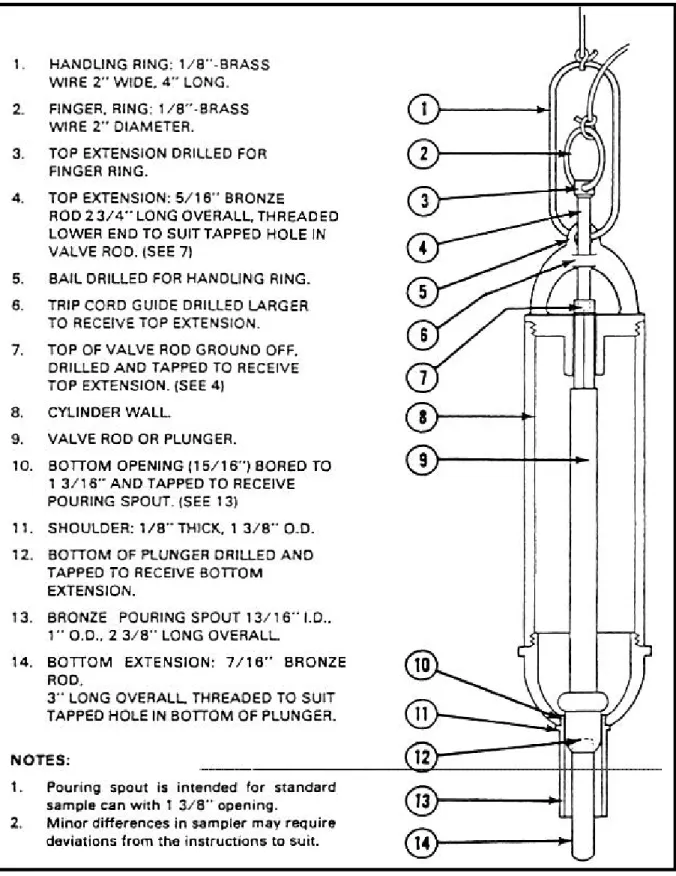
Bacon Bomb Thief (Tank Car Thief). The Bacon bomb thief sampler (NSN 6695-00-946-3602) consists of a nickel-plated brass cylinder tapered at both ends and fitted with an internal, plunger-type valve. The valve opens automatically when the sampler strikes the bottom of a container and closes when lifted. A drop cord is attached to a ring at the top of the sampler: A trip cord can also be attached for the purpose of opening the sampler at any level. This sampler is used to take bottom samples of liquid products of 2 psi or less RVP and samples of semi-liquid products. The Bacon bomb thief can be modified to provide han-dling and finger rings and pouring spout for use with the standard sample can with 1 3/8-inch opening (see Figure 9-3, page 9-4). Minor differ-ences in the sampler may require deviations from the instructions.
Vacuum-Pump Sampler. The vacuum pump sampler (No NSN, manufactured by the Daigger Company of Chicago) is made of brass or alumi-num except for its neoprene valve and neoprene O-rings. It consists of a tube, plunger handle, and tubing. It has an outside diameter of 1 1/4 inches and is 7 inches long. A brass sampler weighs 1 pound and an aluminum sampler 6 ounces. The sampler can lift about 25 feet of water at sea level. With 1/4-inch inside diameter tubing, the sampler will fill a pint bottle with water in less than 10 seconds. Fittings include a 1/8-inch female pipe tap in the pump base, permitting use of standard fittings. The sampler can be attached to a con-tainer and the tubing dropped into the liquid to be pumped. Air is extracted from the empty container on the upward stroke of the plunger. The sample
liquid is drawn or siphoned from the source into the container through the tubing and base of the sampler.
9-5
SAMPLE CONTAINERS
Containers may be clear or brown glass bot-tles, or they may be cans. Clear glass bottles per-mit visual examination of the sample. Brown glass bottles protect light sensitive samples. Only those cans that have been soldered on the outside with a rosin flux may be used. Minute traces of flux may contaminate samples and interfere with tests for dielectric strength, resistance to oxidation, and sludge formation. The sample container should be of the type best suited to the product and to the purpose of the test. It must also be clean, dry, and lint-free. When necessary, sample container should be rinsed with a solvent. Discard the sol-vent as prescribed by local environmental laws and regulations, or local SOP.
Approved Sample Containers. A list of ap-proved sample containers with stock numbers is given below:
• Can, sample, 1/2-sBal (metal), 8115-01-090-0660
• Can, sample, 1-gal (metal), 8110-00-879-7182
• Can, sample, 1-gal (metal, rectangle), 8115-00-2247935
• Can, sample, 1-gal (metal), 8110-00-128-6819
• Can, sample, 1-gal (metal, round), 8115-01-192-0935
• Can, sample, 1-qt (metal), 8110-00- 178-8281
• Screwcaps, polypropylene, 1-gal, 6640-00-410-4461
• Bottle, screw, clear-glass, 16-oz, 6640-00-4040660
• Bottle, screw, clear-glass, 32-oz, 6640-00-4040661
• Bottle, screw, amber-glass, 16-oz, 6640-00-4040658
• Bottle, screw, amber-glass, 32-oz, 6640-00-4040659
Cleaning. The sample container should be cleaned by the following procedures.
• Step 1. Rinse with a solvent. Discard the solvent as prescribed by local environmental laws and regulations or local SOP.
• Step 2. Wash with a strong soap solution. • Step 3. Rinse with tap water and then distilled water.
• Step 4. Dry in a dust-free cabinet at 104°F or warmer.
• Step 5. Close container immediately after it is dry.
Filling. Before a sample is taken, the con-tainer should be rinsed with a small quantity of the product being sampled, except for sediment (millipore) samples. Discard the rinsing material. The sample container should not be filled to more than 80 percent of its capacity to allow for thermal expansion. Samples submitted in 1-quart con-tainers for vapor pressure testing will be filled to the 70 to 80 percent level. Use only those tops that are supplied with the container to seal it. Close the container tightly immediately after filling.
Tagging. Each sample container should be tagged immediately after sampling. Com-plete identifying information should be in-cluded on the sample tag. DA Form 1804 (see Figure 9-4, page 9-6). It should be filled out to the maximum extent possible as directed by the instructions (see Table 9-1, page 9-7). Assign a sample number to the tag, and record data in a sample log.
SAMPLING PROCEDURES A simple set of sampling procedures cannot be given because products are different, the media of transportation and storage differ, and sampling requirements for some tests are different. General guidelines for sampling are provided in this section.
9-7
Table 9-1. Instructions for preparing DA Form 1804
ITEM ENTRY
Petroleum sample tag section Product
From (Installation) Sample No. Laboratory No Specification
Amt Produced Sample Represents Manufacturer/Supplier
Source of Sample Sampled By
Armed Services Procurement No Stock No
Date Sampled Qualification No Batch No Fill Date
Shipment Delivery Date Contract Bulletin No Item No
Program Type Sample Reverse Side
Applicable entry on petroleum sample tag
Specification nomenclature of the product represented by the sample. Installation submitting sample.
Applicable sample identification number of installation submitting sample. Reserved for use by the petroleum laboratory.
Applicable specification of product sampled.
Gallons of product within the container (such as storage tank, tank car and tank truck) represented by the sample.
Company that supplied the product.
Source of sample, truck number, tank number, or other (such as tank car nu m-ber, cans, drums, and pails.
Signature of person that obtained sample. Applicable contract number.
Applicable national stock number. Date sample was taken.
Applicable qualification number (for certain type lubricants only). Applicable batch number.
Date container was filled with product (applies only to cases, cans, pails, and drums).
Date delivery of shipment was made.
Applicable Defense Fuel Supply Center contract bulletin number (if any). Applicable Defense Fuel Supply Center contract bulletin item number (if any). X in the applicable box.
X in the applicable box. When an X is entered in the box titled “Other”, specify the type of sample taken, for example average, all-levels, and random).
Weather conditions and any remarks necessary to accomplish and expedite the analysis of the sample. Also, telephone number, address, and name of person to contact for sample information.
9-9
Representative Sample. A sample must rep-resent the entire quantity of product sampled. Oth-erwise, the resulting analysis can only reflect the quality of a part of the whole substance, and the quality reflected may be better or worse than the true quality.
Size of Sample. The normal size of a sample is 1 gallon for liquids and 5 pounds for semisolids. Special samples and gasoline samples submitted for testing performance numbers by the super-charge method should be 5 gallons. Samples of jet fuel to be tested for thermal stability should be 5 gallons.
Standard Sampler. The sampler should be one of the standard types and the one best suited to the product and to the container. If a standard sampler is not suitable because of small openings through which the sample must be taken, an improvised sampler may be used. In any case, the sampler must be clean and be made of a material that will not contaminate the sample.
Drum Thief. A tube sampler or drum thief should be used to take samples from a drum or similar container. The container should never be tipped, and the product should never be poured through a funnel. The area around the closure should be cleaned before removing the cap or plug.
Cleaning Sampler. Rinse sampler with the product being sampled.
Protecting Samples. All sample containers should be protected for shipment. Samples of gasoline, jet fuel, and kerosene should be protected from direct sunlight by using brown bottles or cans or by covering clear bottles with paper or foil. Samples of gasoline and JP-4 should be kept cool (30° to 40°F if possible) to prevent loss of light ends. Samples of products containing lead addi-tives must be protected from sunlight.
Serial Numbers. A serial number should be assigned to each sample. This number is made up
of the last two digits of the calendar year and the sample number for that year. For example, the first sample from an activity for 1996 is numbered 96-1. A station log should be kept with a record of the samples submitted and the designated testing laboratory.
Laboratory Log. A permanent record should be kept of the samples received by a laboratory. For each sample, this log should contain the fol-lowing.
• Record of the date of receipt and labora-tory sample number.
• Product, unit's sample number. • Source of sample.
• Quantity sample represents. • Sampler's name.
• Date sampled.
• Date of completion of tests.
Sample Storeroom. A sample storeroom should be prepared apart from the laboratory to protect samples from extreme heat or cold. Sam-ples that have been tested and reported should be stored for an appropriate length of time, tightly stoppered or capped, and segregated from samples that are awaiting tests.
SPECIAL PROCEDURES FOR MILLIPORE TESTING
All containers and their caps, sampling lines, and other equipment used in obtaining the sampler for analysis must be thoroughly cleaned as de-scribed in ASTM D 2276, Preparation of Appara-tus and Sample Containers.
Sampling Loading Line. The sample will be extracted from the loading rack fill line during fill-ing of aviation refueler trucks. Before the sample is taken, at least 300 gallons of fuel must be cir-culated or dispensed into a refueling truck. The container is then filled to within 1 inch of the top. The container is immediately capped and sealed to prevent evaporation and leakage.
Sampling Aviation Refueling Trucks. Fuel will be circulated through the piping, filter/separator, hose, and nozzle for a minimum of one half the rated volume of the truck at normal operating pressure. The sample will be taken directly from the nozzle. Immediately after the container is filled,
the cap and seal are secured to prevent evapora-tion and leakage.
Sample Tag. DA Form 1804 should be filled out as indicated in Table 9-1. However, when laboratory analysis for filter effectiveness is re-quired, the appropriate block must be marked on the sample tag.