CAUSATION AND OTHER ASYMMETRIES IN TIME
Christian Loew
A dissertation submitted to the faculty of the University of North Carolina at Chapel Hill in partial fulfillment of the requirements for the degree of Doctor of Philosophy in the Department of Philosophy.
Chapel Hill 2013
Approved by:
L.A. Paul
Robert M. Adams
John T. Roberts
Marc Lange
iii ABSTRACT
CHRISTIAN LOEW: Causation and other asymmetries in time (Under the direction of Laurie Paul)
iv
ACKNOWLEDGMENTS
Thanks go first and foremost to my committee. Bob Adams has encouraged me to think deeper about the issues in this dissertation than I would have otherwise. The depth and breadth of his thinking as well as his passion for philosophy and his kindness will continue to inspire me. John Roberts kept providing me with detailed and insightful comments as well as vital
encouragement. Marc Lange and Matt Kotzen have been extremely helpful, especially at later stages of the project. Above all, I like to thank my adviser, Laurie Paul. Laurie was the best adviser I could have wished for, giving me the space to develop my own ideas and helping me do so in every possible way. She will continue to be one of my role models as a philosopher and as a person.
I have been fortunate to be part of several wonderful philosophical communities. I like to thank the philosophy departments at the University of North Carolina and the University of Arizona, and the people who make them such fantastic places for doing philosophy. At the University of Arizona, Richard Healey was like an additional adviser for me. I like to thank him for the excitement and patience with which he taught me the foundations of physics. I have learned much about the art of thinking things through from observing him do so. I also like to thank the departments at MIT and ANU for being wonderfully supportive and welcoming during my visits. Special thanks go to Mike Bertrand, Finnur Dellsén, Luke Elson, Geoff
v
vi
TABLE OF CONTENTS
LIST OF FIGURES ... VIII
CAUSATION AND ITS PLACE IN THE PHYSICAL WORLD ... 9
1 MOTIVATION AND OVERVIEW ... 9
2 CAUSATION AND THE PHYSICAL WORLD ... 13
3 CHARACTERIZING BI-DIRECTIONAL CAUSATION ... 19
4 BI-DIRECTIONAL CAUSATION AND CAUSAL PLURALISM ... 22
5 REDRAWING THE ARROW OF CAUSATION ... 24
BLUNTING THE ARROW OF CAUSATION ... 32
1 INTRODUCTION ... 32
2 TIME-SYMMETRIC LAWS AND BI-DIRECTIONAL CAUSATION ... 36
3 BI-DIRECTIONAL CAUSATION DEFENDED ... 44
4 THE TIME-ASYMMETRY OF CONTROL ... 53
5 THE TIME-ASYMMETRY OF EXPLANATION... 62
6 CONCLUSION ... 66
WHY WE CANNOT CONTROL THE PAST ... 70
1 INTRODUCTION ... 70
2 TWO NOTIONS OF CONTROL ... 72
3 AGENT-CONTROL, SENSITIVITY, AND KNOWLEDGE ... 76
vii
5 THE SENSITIVITY OF BACKWARD CAUSATION ... 88
6 OUR MAKE-UP AS AGENTS ... 96
7 CONCLUSION ... 101
CAUSATION, PHYSICS, AND FIT ... 105
1 INTRODUCTION ... 105
2 CAUSAL MODELS AND THE PHYSICAL WORLD ... 109
3 LOCALITY, DIRECTIONALITY, AND FIT ... 111
4 LOCALITY AND INVARIANCE ... 118
5 EXPLANATION AND TEMPORAL DIRECTIONALITY... 125
6 AGENCY AND TEMPORAL DIRECTIONALITY ... 137
viii
LIST OF FIGURES
Figure 1 - Physical Realization of Decisions...………78
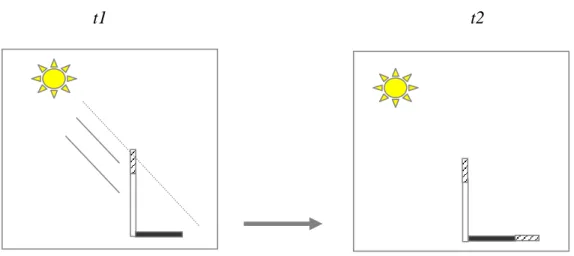
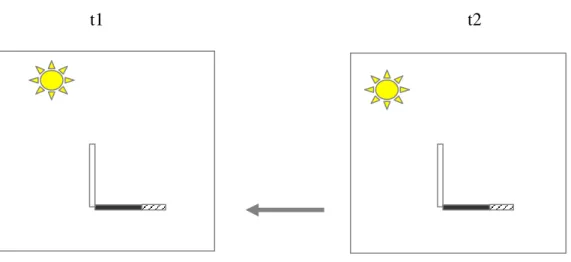
Figure 2 - Flagpole Intervention………128
9
CAUSATION AND ITS PLACE IN THE PHYSICAL WORLD
Introduction
1 Motivation and overview
The dissertation is about causation, its temporal direction, and its relationship to control and explanation. I defend the view that causation is bi-directional, meaning causation runs both forwards and backwards. This view might sound absurd and far-fetched, but I shall argue that it follows from taking fundamental physics seriously and that it is also compatible with our ordinary experience. Moreover, I will show that my view leads to a deeper
understanding than previously had of why we can control the future but not the past and why scientific explanations are time-asymmetric.
My view revises our ordinary understanding of the temporal direction of causation. I will argue that causation goes in both temporal directions but that it nonetheless is time-asymmetric because it has a different character in the forward than in the backward direction. This difference in character grounds the practical asymmetries associated with causation. In particular, I will argue that causation can come apart from control and explanation, and that forward causation supports our practices of control and explanation but backward causation does not.
10
metaphysics. According to this approach, rather than imposing our ordinary experience and intuitions onto a theory of causation, we develop our theory of causation in accordance with the structure and features given to us by fundamental physics, and only add features (like a privileged temporal direction) if there is some outstanding need to do so. I shall argue that causation is governed by the fundamental physical laws and that my bi-directional view of causation best fits the structure of these laws while, at the same time, it is compatible with our ordinary experience.
Second, my view resolves the puzzle of how causation fits into the physical world. Many philosophers have noted that our ordinary concept of causation fits poorly with how fundamental physics describes the world.1 The most striking mismatch concerns temporal directionality. According to our ordinary view of causation the past determines the future in a deeper or more important sense than the future determines the past. But in accordance with the fundamental physical laws, the future determines the past in the exact same sense in which the past determines the future.2 Thus there is a puzzle about how fundamental physics leaves room for forward-directed causation.
The literature contains several proposals for how the temporal directionality of causation can be grounded in fundamental physics despite this apparent mismatch. But while there are important time-asymmetries in fundamental physics (in particular, in the boundary conditions), no theory has shown how these differences vindicate the strict intuitive time-asymmetry of causation (cf. Price 1996 and Weslake 2006). My theory turns this failure into a virtue. The reason why we find no strict time-asymmetry of causation in fundamental
1 Cf. Earman (1976a), Field (2003), Lockwood (2005), Norton (2007), Russell (1913), Price (1996), van Fraassen (1993).
2
11
physics is that the direction of causation is not strict but merely gradual. I will show that bi-directional causation fits naturally with fundamental physics and thus secures a place for causation in the physical world.
Third, my bi-directional view of causation brings into sharp focus certain issues about control and explanation. It is natural to explain the time-asymmetries of control and
explanation in terms of the causal asymmetry. Ordinarily, we think that we can control the future but not the past and that earlier events explain later events but not vice versa because causes precede but do not succeed their effects. This explanation only works, however, if we can justify why causes are relevant to control and explanation while non-causes are not. For instance, if the laws are deterministic in both temporal directions, then earlier events are lawfully determined by later events. So why can we not control or explain earlier events in terms of these later events? What is it about causes that makes them exclusively privileged for control and explanation?3 Without an answer to such questions the account is not
particularly explanatory because it treats causation as a 'black box' without a further story of what features that causes have and non-causes lack make them relevant to these practices.
My theory provides an illuminating story of why we can control the future but not the past and why earlier events explain later events but not vice versa. The key point is that causation is not as closely associated with control and explanation as we sometimes assume. For example, my arm movement causes very specific movements of certain air molecules but I have no control over the exact nature of these movements. My theory isolates the features that qualify some causal relations for control or explanation and shows that causal relations in the backward direction lack these features. While someone could endorse this account of
3
12
the time-asymmetry of explanation and control without accepting that causation is bi-directional, my view of causation helps us see these features more clearly.
The dissertation has three chapters. The first chapter (“Blunting the arrow of causation”) argues that the view of causation that best fits with fundamental physics is one where causation is bi-directional. Ordinarily, we think that causation has a strict temporal arrow. We think that the past shapes, produce, or brings about the future, but not vice versa. But the fundamental physical laws equally determine the evolution of our universe in both temporal directions. I argue that causation is governed by the fundamental physical laws such that the nature of causation is determined by the structure of these laws. So it is reasonable to think that lawful evolution in both temporal directions also grounds causation in both
temporal directions. I defend this bi-directional view of causation and show that it is compatible with the time-asymmetries of control and explanation.
The second chapter (“Why we cannot control the past”) gives a deeper account of our inability to control the past that is compatible with my bi-directional theory of causation. If I want to spend my next vacation in Paris, there is a lot I can do. I can make a hotel
reservation, book a flight, etc. But if I want to have spent my last vacation in Paris, there is nothing I can do about it now. In general, our limited control over the future contrasts with a complete lack of control over the past. But why can we not control the past? Intuitively, we cannot control the past because our decisions do not cause past outcomes. A careful
13
would lack this knowledge even if our decisions did cause past outcomes. My account thus provides a richer model of what control is and what it would take to control the past.
In the third chapter (“Causation, physics, and fit”) I focus on explanation to give an account of why our ordinary notion of causation that we use in the special sciences is useful despite its poor fit with fundamental physics. Recent work on causal modeling has deepened our understanding of causation and explanation. There is, however, a puzzle of why these causal models are successful, in particular given their time-asymmetry and locality. These models explain outcomes by showing how they depend on a relatively small number of localized, earlier variables. Yet, fundamental physics allegedly describes the world in terms of lawful determination between very global states and does not distinguish between the way in which the past determines the future and the way in which the future determines the past. I argue that, despite this apparent mismatch, we can explain why causal models are successful from the structure of fundamental physics. In particular, the same physical features of the world that explain the success of our local causal models also explain why it is a good idea for us to build time-asymmetric causal models.
2 Causation and the physical world
14
(i) Causal Direction. Causal relations are directed from cause to effect such that c causing d is different from d causing c.
(ii)Temporal Direction. Causes often precede their effects, but effects do not (or at least not typically) precede their causes.4
Causal Direction says that each token of the causal relation has a direction, but it says nothing about their temporal orientation. For example, if all cause-effect pairs occurred simultaneously, then each token of causation would still point from cause to effect but causation would have no temporal direction. Temporal Direction adds temporal orientation by saying that causal relations often point in the forward direction but never (or not typically) in the backward direction.
This ordinary view of causation, however, allegedly fits poorly with how fundamental physics describes the world. Many philosophers of physics have held that not only does fundamental physics not contain any relation that corresponds to our ordinary concept of causation, but it does not even leave room for such a relation. The classic articulation of this view is Russell (1913), who argues that there is a drastic mismatch between our ordinary notion of causation and how fundamental physics describes the world.
This mismatch is most striking for the temporal directionality of causation. On our ordinary conception of causation, which involves both Causal Direction and Temporal Direction, the past determines the future in a way that has no analog in the backward
direction. In contrast, Russell argues that fundamental physics does not distinguish between how the past determines the future and how the future determines the past. Specifically, most
4
This formulation is meant to leave open the possibility that our ordinary causal concept allows for
15
candidates for the fundamental physical laws are deterministic in both temporal directions. That is, a full specification of the universe at any one time, together with the laws, entails both a unique future and a unique past. For instance, for a billiard ball that is sufficiently isolated from its environment, its position and momentum at any one time together with the laws entails its position and momentum at both later and earlier times.
Moreover, the problem does not significantly change if the laws are probabilistic as long as these laws have the same probabilistic character in both temporal directions; that is, if a complete specification of the universe at any one time, together with the laws, entails a probability distribution over all earlier and later times.
More generally, the problem is that physical determination seems to be a matter of the physical laws, and the laws provide the same kind of determination (probabilistic or strict) in either temporal direction. This bi-directional determination by the fundamental physical laws is allegedly incompatible with our ordinary, forward-directed conception of causation for the following reason. The fundamental laws, qua being fundamental, tell us the complete and exceptionless story of how our universe evolves over time. It is hard to see what room there could be for a causal asymmetry where the past determines the future more fundamentally than vice versa. It seems that if there were an asymmetry of determination, then it should show up in the laws. But since the laws contain no such asymmetry, fundamental physics leaves no room for causation.
16
that passes muster among philosophers, is a relic of a bygone age, surviving, like the monarchy, only because it is erroneously supposed to do no harm.” (Russell 1913, 1)
Getting rid of causation, however, seems neither feasible nor desirable. In an important paper, Cartwright argues that objective causal facts are indispensable for underwriting the objective distinction between effective and ineffective strategies (cf. Cartwright 1979). She points out that it is an objective fact that, for instance, quitting
smoking is an effective strategy for avoiding lung cancer but that having one's teeth whitened is not. This objective distinction is grounded in causal facts, viz., smoking causes lung
cancer, whereas having yellow teeth is merely correlated with lung cancer. Cartwright argues that we therefore need objective causal facts to ground the objective distinction between effective and ineffective strategies.
Causation plausibly underlies other practices besides effective strategies, such as prediction, explanation, and control. One could similarly defend causal facts based on these practices. However, Cartwright's approach of bringing in effective strategies is particularly compelling for three reasons. First, the distinction between effective and ineffective
strategies appears completely objective. Although what ends we desire depends on our interests, what strategies are or are not effective toward a desired end is a matter of fact that holds regardless of our interests. Second, it is entirely unclear how else to ground the distinction if not in causal facts. Effective strategies require a non-accidental dependence between events that goes beyond mere correlation, and it is hard to see what that dependence could be if not causation. Moreover, we do not know how to pick out this dependence in a way that does not already presuppose knowledge of causal facts.5
17
Third, effective strategies are closely related to the goals of the special sciences. Effective strategies require the same distinction that also underlies the law-like regularities discovered by the special sciences. For instance, the same fact that accounts for why taking a certain drug is an effective strategy toward recovery also accounts for why drug intake explains the recovery. So causal facts are not just related to our everyday practices but also to scientific explanation. Because of this centrality, “abandoning the concept of causation would cripple science.” (Field 2003, 435)
Cartwright and Russell's respective insights are in tension and thus create a puzzle. On the one hand, Russell argues that fundamental physics has no place for causal facts. On the other hand, Cartwright argues that “causal laws cannot be done away with, for they are needed to ground the distinction between effective strategies and ineffective ones.”
(Cartwright 1979, 420) So something has got to give. In a recent survey article, Hartry Field assesses that “the problem of reconciling Cartwright's points about the need of causation in a theory of effective strategy with Russell's points about the limited role of causation in
physics […] is probably the central problem in the metaphysics of causation.” (Field 2003, 443)
The puzzle has received significant attention in the recent literature.6 Responses fall into one of three camps. First, Pragmatists agree with Russell that there is a poor fit between our ordinary notion of causation and fundamental physics. But they argue that our causal concept can be central to science and everyday life even if causal relations are not part of the
18
objective physical world (cf. Price 1996, 2007; and van Fraassen 1993). Pragmatists thus deny that the distinction between effective and ineffective strategies is fully objective.7
Second, Primitivists take causal facts to be objective fundamental constituents of our world that are not reducible to more basic entities. Some Primitivists argue that a proper understanding of fundamental physics shows that causal facts are a part of it after all (cf. Frisch 2005). Other Primitivists admit that causal facts are not part of fundamental physics but hold that we can consistently add them and that we have reason from outside
fundamental physics to do so.8 These primitive causal facts can underwrite effective
strategies. Primitivists, however, face the challenge of showing how exactly the existence of these causal facts is compatible with the limited role of causation in fundamental physics.
Third, Reductionists hold that Russell was partly right insofar as there are no causal facts in fundamental physics. However, Russell was wrong in thinking that there is no causation. Rather, causation reduces to fundamental, non-causal facts. In particular,
Reductionists argue that the temporal directionality of causation can be grounded by bringing in statistical facts from the boundary conditions in addition to the fundamental physical laws.9 The emerging relation is supposed to closely fit our intuitive notion of causation.
In the dissertation, I defend a solution to the puzzle that is reductionist but in a new way. I argue that objective causal facts are grounded in fundamental physics, but to secure fit between causation and fundamental physical facts we need to revise our ordinary conception
7 Price (1996, 2007) is the most developed such account. Price argues that the distinction between effective and ineffective strategies is “objective from our perspective” as agents (cf. Price 2007, 286).
8 Cf. Cartwright (1979) and Tooley (1987). Maudlin (2007) argues that there are grounds for forward-directed causation in fundamental physics but that even otherwise we would have reasons from outside physics to assume causal facts.
19
of the temporal direction of causation. The metaphysics of causation that arises from fundamental physics is one where causation is not sharply directed but one where causation goes in both temporal directions and the difference between the directions is merely a difference in degree.
The mismatch between the fundamental physical laws and our time-asymmetric concept of causation is so bewildering because causation and the fundamental laws are closely related. We used to think of all laws as causal laws. So fundamental physics already contains something very much like causation, except that it runs in both temporal directions, viz., lawful evolution. I will argue that the most natural understanding of causation in light of fundamental physics is therefore that the fundamental laws ground causation in both
temporal directions. On the face of it, this bi-directional causation is at odds with the time-asymmetry of effective strategies, as well as numerous other asymmetries that are associated with causation. However, I will argue that these asymmetries, properly understood, are compatible with bi-directional causation.
3 Characterizing bi-directional causation
20
Bi-directional causation holds that each token of the causal relation has a direction and is therefore different from a view where causation is a symmetric relation, which would also deny Causal Direction. For example, the relation occurring two seconds apart is
symmetric. This relation lacks direction because for an event c to occur two seconds apart from d is the same fact as for d to occur two seconds apart from c.
In contrast, causation on my view behaves logically like the loving relation. Billy loving Suzy (luckily) allows for Suzy to also love Billy. Still, loving is not a symmetric relation because each token of loving is directed. Billy’s love is directed at Suzy, and Suzy’s love is directed at Billy. In a situation where Billy loves Suzy and Suzy loves Billy back, the lovers instantiate two distinct and oppositely-directed tokens of the relation. The one token is directed from Billy to Suzy; the other token is directed from Suzy to Billy. Moreover, the two tokens are distinct because each token consists in a different fact: Billy’s loving Suzy
consists in a mental state in Billy’s mind and Suzy’s loving Billy consists in a mental state in Suzy’s mind.
Analogously, my bi-directional view of causation allows for situations where an event
c causes another event d, and d also causes c. In these situations c and d instantiate two
distinct and oppositely-directed tokens of the causal relation: one token points from c to d and one token from d to c. So each token of causation is directed and causation is bi-directional rather than time-symmetric.
21
in general faster and more reliable than east-bound trains, then there is an important spatial asymmetry in the railway network despite the fact that trains run in both spatial directions. This asymmetry has important practical implications, making, for example, traveling westwards much easier than traveling eastwards.
Analogously, I argue that the perceived asymmetries associated with the arrow of causation are due to gradual differences between forward causation and backward causation. The two most important asymmetries associated with causation are control and explanation:
Time-asymmetry of control. We have some limited control over the future but absolutely
no control over the past.
Time-asymmetry of explanation. Earlier events often explain later events but usually not
vice versa.
I shall argue that causation can come apart from control and explanation, and that these asymmetries arise because, though causation goes in both temporal directions, causation in the backward direction lacks the very features that make causation in the
forward direction suited for control and explanation. This divergence is important because an important reason for why backward causation strikes us as absurd is that we associate
22 4 Bi-directional causation and causal pluralism
What does it mean that causation is bi-directional? Many philosophers have observed that it does not seem that we have a uniform concept of the causal relation. Earman puts this point most poignantly, when he says that “causation is not a single, unary notion, but a multi-faceted concept which begs for distinctions to be drawn among various kinds of causal interaction.” (Earman 1976b, 390)
Fortunately, my view that causation is in an important sense bi-directional is compatible with pluralism about our causal concept. Following Hitchcock (2003), we can think of theories of causation in two stages. The first stage of analysis “involves the identification of some privileged class of entity, and the discrimination of the members of this class from various impostors.” (Hitchcock 2003, 5) The goal at this stage is to identify a non-accidental, directed dependence that can ground effective strategies and to distinguish it from mere correlation. We are familiar with this dependence from paradigmatic cases, such as when two billiard balls collide. Call this dependence “causal dependence.”
As Hitchcock (2003) points out, the most common theories of causation can be seen as converging toward isolating causal dependence by trying to distinguish it from other relations (of the kind Hitchcock calls “impostors”). For example, counterfactual theories distinguish genuine counterfactuals from backtrackers; process theories distinguish causal processes from pseudo-processes; regularity theories distinguish lawlike from accidental regularities; and probabilistic theories distinguish real from spurious probabilities. All of these distinctions can plausibly be seen as isolating causal dependence.
23
dependence is such that it goes in both temporal directions. We still have to distinguish causal dependence from impostors, but I argue that lots of dependencies in the backward direction are legitimate rather than impostors. This is a substantial metaphysical claim that most philosophers deny.
This view about causal dependence still leaves room for causal pluralism, which comes in at the second stage of analysis. The second stage concerns how these basic building blocks of causal dependence can be put together to make-up interesting relations. As
Hitchcock points out, there is room for pluralism here because causal dependence can be put together in different ways. For instance, Lewis identifies causal dependence with
counterfactual dependence but then goes on to identify causation with the ancestral of this relation, thus making causation a transitive relation (cf. Lewis 1986, 167). Other philosophers have denied that causation is transitive, and Hall (2004) argues that there are two distinct kinds of causation: one that is transitive and one that is not. Similar debates concern whether causation is intrinsic and how many relata it has.10
My view allows me to stay neutral on whether there is a single causal relation or whether there are several relations differing in these properties, as pluralists claim. I am only concerned with the basic building blocks of causation that are needed for a theory of
effective strategies. None of the prominent arguments for causal pluralism suggest that there is pluralism at this level. Insofar as my thesis about bi-directional causation concerns the
24
basic building blocks of causation, it is compatible with pluralism about our concept of
causation. My thesis is only that there are more building blocks than we thought there were.11
5 Redrawing the arrow of causation
Widespread backward causation is contrary to our ordinary notion of causation. So it is not clear how a relation could be causal if it does not run at least predominantly in the forward direction. But drastic revisions of ordinary phenomena are familiar from other areas of science and metaphysics. I will look at two such cases to motivate the feasibility of a revisionary stance toward the direction of causation.
The first case concerns the nature of light.12 Ordinarily, we think of light as the agent that makes things visible to us. However, there is a scientifically informed conception of light, where light covers all forms of electromagnetic radiation, even those that are not 'visible.' For instance, the dictionary lists the following as one definition of light:
“electromagnetic radiation of any wavelength that travels in a vacuum with a speed of about 186,281 miles (300,000 kilometers) per second.”13 This conception revises our ordinary understanding because there is lots of electromagnetic radiation that does not make things visible to us. So physics shows that the familiar instances of light are a subset of a much broader phenomenon. The same agent that allows us to see things also comes in guises where it lacks the capacity to make things visible to us.
11 My project is thus at least to some extent independent of semantic questions because “causal dependence” is a technical term picking out the metaphysically basic building blocks of causal relations that underlie effective strategies and that contrast with correlations.
12 See Ney (2009, 760) for the analogy between causation and light.
25
The second case concerns the direction of time. On our ordinary conception, time has an intrinsic direction that grounds its transitory character. We think that present events continuously become past as they give way to future events. But many philosophers have argued that time has no intrinsic direction. These philosophers argue that time is one dimension of a four-dimensional manifold which has the same character in either temporal direction. Although this view of time drastically revises our ordinary conception of the nature of time, many philosophers and physicists take it extremely seriously.
The cases of light and time provide a blueprint for how to think of a revision of our understanding of causation in light of fundamental physics. There are important analogies between my views on causation and the case of light. Causal relations in the forward direction are familiar to us because they figure prominently in control and explanation. I argue that, just as there is light that is not visible, there are causal relations in the backward direction that are irrelevant to control and explanation. Our evidence for these causal relations is indirect and comes from the structure of the fundamental laws. As in the case of light, the revision does not concern the nature of the known instances of causation but merely shows that these instances belong to a broader class than we previously thought that also includes instances in the backward direction.14
The analogy to time is even closer. My argument for why causation is bi-directional closely parallels an argument in the literature for why time has no direction. Many of our best candidates for the fundamental physical laws are time-symmetric, which means that these
26
laws operate exactly the same way in the forward direction as they operate in the backward direction.
A popular argument says that it is reasonable to draw inferences about the nature of time from the structure of the fundamental laws.15 After all, the fundamental physical laws fully describe all possible behaviors of systems in our universe. If the laws are
time-symmetric such that the evolution of systems in the forward direction falls under the exactly same constraints as their evolution in the backward direction, then it is reasonable to assume that time, as the arena in which systems evolve, has the same character in both directions.16 This argument is not indefeasible because there might be overriding reasons for thinking that time has an intrinsic direction, but the inference is reasonable (cf. North 2008).
My argument for bi-directional causation closely parallels this argument. Causation concerns how events evolve over time, and the fundamental physical laws completely describe how events at one time evolve into events at other times. If the laws are such that earlier events constrain later events in the exact same way as the other way round, then it is reasonable to think that there is no difference between how systems in our universe evolve forward and how they evolve backwards. It is thus reasonable to infer that causation runs both in the forward and in the backward direction. (See chapter 1 for further defense of this inference.)
My revisionary view of causation therefore has close precedents in other debates, and I argue that revision is as plausible in the case of the causal direction as in these other cases. I
15 This inference is widely made in physics. For example, Greene (2005) takes the structure of the laws to indicate the nature of spacetime without even acknowledging that this step takes any kind of justification. See North (2008) for an explicit discussion of this argument.
16
27
think the main reason why philosophers have not seriously considered revisionary accounts of the temporal direction of causation is that directionality seems to be a more central feature of causation than the revised features in the two other cases.
As seen earlier, the main reason for endorsing objective causal facts is in service of a theory of effective strategies. Effective strategies, however, appear to be firmly temporally directed in that our actions are never effective strategies for earlier ends. So it seems that bi-directional causation could not ground effective strategies and thus would miss the point of a theory of causation. In response, I argue that bi-directional causation leads to a plausible theory of effective strategies. (I will only sketch the argument here, which is further developed in chapters 1 and 2.)
There is an important practical distinction between effective strategies that are
accessible to agents like us and ones that are inaccessible. For example, taking antibiotics is
an effective strategy for recovery from infection, and the strategy is also accessible because we can in fact bring about recovery via this course of action. In contrast, though decreasing the radius of a massive star is an effective strategy for creating a black hole, this strategy is inaccessible to us. The strategy does not in fact allow us to create a black hole because we cannot decrease a star’s radius to the required extent.
One might object to calling these latter courses of action “effective strategies” because they are not action-guiding. But that is mere terminology.17 The important point is that strategies, such as collapsing a star to create a black hole, are still grounded in causal relations. Decreasing the radius of a star would cause a black hole. It is merely that these
28
causal relations do not have the same practical relevance for us because they do not allow us to control our environment. Moreover, we cannot directly experience or test these causal relations but have to infer them from observed data and the laws of nature.
I shall argue that the causal relations in the backward direction that my theory of bi-directional causation posits do ground effective strategies—but these effective strategies are inaccessible to agents like us. Though our actions cause past events, we cannot control past events. There are however important differences between the inaccessibility of backward-looking effective strategies and the collapsing star case. First, backward-backward-looking effective strategies are inaccessible for a different reason. In chapter 2, I will argue that the
inaccessibility is not due to a lack of muscle power or technological ingenuity (as in the star case) but due to lack of a certain kind of knowledge. Second, the inaccessibility of backward-looking effective strategies is more extreme than in the star case. In the collapsing star case, we can easily imagine agents relevantly like us to whom these strategies are accessible, such as technologically advanced humans, gods, or superheroes. Agents who could exploit
effective strategies in the backward direction, in contrast, would have to be different from us in a more fundamental way. They would need a different cognitive make-up.
My theory of causation is thus compatible with a plausible theory of effective
29
backward-looking effective strategies are in principle inaccessible to agents like us. So my theory still explains the facts about effective strategies that we care about, viz., why certain courses of actions are irrational and others are not. In addition, I will show that causation in the backward direction is irrelevant to the kinds of explanations the special sciences seek.
However, my theory is revisionary with regard to what metaphysical facts underlie these normative facts about our practices. I argue that backward-looking effective strategies are not impossible but merely inaccessible. Because of the time-symmetry of the
fundamental physical laws, the distinction between past and future is metaphysically less deep than we ordinarily think. Just as we learn from the fundamental laws that, for example, decreasing the radius of a star would create a black hole, so we also learn that there are effective strategies in the backward direction.
30
REFERENCES
Albert, D. (2000) Time and Chance. Cambridge: Harvard University Press.
Carroll, S. (2010) From Eternity to Here: the quest for the ultimate theory of time. New York: Dutton.
Cartwright, N. (1979) “Causal Laws and Effective Strategies,” Nous 13: 419-437. Dowe, P. (2000) Physical Causation. Cambridge: Cambridge University Press.
Earman, J. (1976a) “Causation: a matter of life and death,” Journal of Philosophy 73: 5-25. Earman, J. (1976b) “The Cement of the Universe by J. L. Mackie,” The Philosophical Review
85: 390-394.
Field, H. (2003) “Causation in a Physical World,” in: Loux, M. and D. Zimmerman (eds.)
Oxford Handbook of Metaphysics. Oxford: Oxford University Press, 435-460.
Frisch, M. (2005) Inconsistency, Asymmetry, and Non-Locality. Oxford: Oxford University Press.
Greene, B. (2005) The Fabric of the Cosmos. New York: Alfred A. Knopf.
Hall, Ned (2004) “Two Concepts of Causation,” in: Collins, J., N. Hall, and L.A. Paul (eds.)
Causation and Counterfactuals. Cambridge: MIT Press.
Hitchcock, C. (2001) “The Intransitivity of Causation Revealed in Equations and Graphs,”
Journal of Philosophy 98: 273-299.
Hitchcock, C. (2003) “Of Humean Bondage,” British Journal for the Philosophy of Science 54: 1–25.
Lewis, D. (1986) “Causation,” in: Philosophical Papers: Volume II. Oxford: Oxford University Press, 159-213.
Lockwood, M. (2005) The Labyrinth of Time. Oxford: Oxford University Press.
Maudlin, T. (2007) The Metaphysics Within Physics. Oxford: Oxford University Press. Ney (2009) “Physical Causation and Difference-Making,” British Journal for the Philosophy
of Science 60: 737-764.
31
Norton, J. (2007) “Causation as a Folk Science,” in: Price and Corry (2007), 11-44.
Papineau, D. (1985) “Causal Asymmetry,” British Journal for the Philosophy of Science 36: 273-289.
Price, H. (1996) Time’s Arrow and Archimedes’ Point. Oxford: Oxford University Press. Price, H. and R. Corry (2007) Causation, Physics and the Constitution of Reality. Oxford:
Oxford University Press.
Reichenbach, H. (1956) The Direction of Time. Berkley: University of California Press. Russell, B. (1913) “On the Notion of Cause,” Proceedings of the Aristotelian Society 13:
1-26.
Schaffer, J. (2008), “The Metaphysics of Causation,” The Stanford Encyclopedia of
Philosophy (Fall 2008 Edition), E. N. Zalta (ed.), URL =
<http://plato.stanford.edu/archives/fall2008/entries/causation-metaphysics/>. van Fraassen, B. (1993) “Armstrong, Cartwright, and Earman on Laws and Symmetry,”
Philosophy and Phenomenological Research 53: 431-444.
Weslake, B. (2006) “Common Causes and The Direction of Causation,” Minds and Machines 16: 239-257.
32
BLUNTING THE ARROW OF CAUSATION
Chapter One
1 Introduction
According to our ordinary view, causation has a strict temporal direction such that the world causally evolves forwards but not backwards. We think that the past brings about, produces, or shapes the future but not vice versa. But this forward-directed view of causation is in tension with how fundamental physics describes the world. In particular, most
candidates for the fundamental physical laws determine the evolution of the universe in both temporal directions.18 These laws determine the evolution of the world in the forward
direction, but they equally determine its evolution in the backward direction.
Though we naturally interpret the laws as describing the causal evolution of systems in the forward direction, this interpretation is superimposed upon the laws, not derived from them. The fundamental physical laws describe how the state of the world at any one time depends on its state at other times. But nothing about these laws makes it any more apt to view the world as evolving forwards rather than as evolving backwards. Instead, earlier states lawfully depend on later states in the same way as earlier states lawfully depend on later
18
33
states, and in this sense the fundamental laws determine the evolution of the world in both temporal directions. Let us call such laws time-symmetric laws.19
This time-symmetry is most familiar from the Newtonian laws, but it is equally part of contemporary laws such as Schrödinger’s equation in quantum mechanics and the field equations in General Relativity. These laws are all deterministic in both temporal directions. That means, given the state of the world at any one time these laws fix a unique future and a unique past. Moreover, the problem does not significantly change if the laws are probabilistic as long as they have the same probabilistic character in both temporal directions. In this case, a complete specification of the universe at any one time, together with the laws, entails a probability distribution over all earlier and later times. These laws would still determine the evolution of the universe in either temporal direction by specifying probabilities.20
Much recent debate concerns how to reconcile causation with this bi-directional lawful evolution. One way of seeing the tension is by considering counterfactuals:
(C1) If the earlier momentum of the ball had been different, then its later momentum would have been different.
(C2) If the later momentum of the ball had been different, then its earlier momentum would have been different.
19
I use “time-symmetric” for lack of a better word. Time-symmetry is also often used to describe time-reversal invariance, which means, roughly, that for every sequence of events which is in accordance with the laws, the time-reverse of that sequence is also in accordance with the laws. The relevant sense here, however, is that the laws connect earlier to later states in the same kind of way they connect later to earlier states (cf. Field 2003, 436). Time-reversal invariance is neither necessary nor sufficient for the laws having this feature.
34
Causation and counterfactuals are closely related. Intuitively, C1 is true but C2 is false because the ball's earlier momentum causes its later momentum, whereas its later momentum does not cause its earlier momentum. But counterfactuals are also law-governed, and time-symmetric laws underwrite both C1 and C2. Given that the ball is sufficiently isolated from its environment, a counterfactual state in which the antecedent of C1 is true and the momentum of the ball is different lawfully entails a later state where its momentum is different. However, a counterfactual state in which the antecedent of C2 is true equally lawfully entails an earlier state where its momentum is different.
Philosophers tend to respond to this puzzle in one of three ways. First, Compatibilists argue that our common-sense view of causation as forward-directed is compatible with bi-directional laws and bring in facts other than the laws to ground the direction of causation.21 Eliminativists, in contrast, argue that our commonsense view of causation is incompatible with the fundamental physical laws and that causal relations are therefore not part of the objective physical world.22 Both views, however, take our ordinary conception of the causal direction at face value and merely disagree on whether it latches on to anything in the physical world.
In this paper, I defend a new response to the problem: bi-directional causation. I argue that causation is compatible with fundamental physics but that we have to revise its temporal direction in light of the time-symmetry of the fundamental laws. Bi-directional causation is
21
I will later in the paper distinguish reductive Compatibilist theories, which try to reduce the direction of causation to non-causal physical features, from primitivist theories, which that take the direction of causation to be primitive. Reductive theories include Dowe (2000), Field (2003), Lewis (1986a), Papineau (1985), and Reichenbach. Primitivists comprise Frisch (2005), Maudlin (2007), and Tooley (1987).
22
35
the view that causation runs both forwards and backwards. The causal arrow on this view is not strict, as causation also runs in the backward direction, but it is due to differences in character between causation in the forward and in the backward direction.
This view might sound absurd, but it follows from taking fundamental physics seriously. Rather than impose our ordinary experience and intuitions onto a theory of causation, we should develop our theory of causation in accordance with the structure and features given to us by fundamental physics, and only add features (like a privileged temporal direction) if there is some outstanding need to do so. I shall argue below that causation is law-governed and that time-symmetric fundamental laws ground causation in both temporal directions. Moreover, I will show that bi-directional causation is consistent with our experience.
My theory thus resolves the tension between causation and fundamental physics by revising the temporal arrow of causation. Comparably drastic revisions to our everyday understanding are familiar from other phenomena. For example, many philosophers argue that the perceived passage of time is merely a feature of our experience and that fundamental physics teaches us that time has no intrinsic direction. I will defend an analogous revision in the case of the temporal direction of causation.
I think that philosophers have not taken bi-directional causation seriously because it seems out of touch with our experience. If causation goes backwards, then, for example, it seems we should be able to control the past just as we can control the future. But I shall argue that causation can come apart from control as well as explanation, and that backward
36
because it allows for differences between the character of causation in the two temporal directions and hence for an important respect in which causation is time-asymmetric.
In the rest of the paper, I first argue that it is very natural to assume that causation is bi-directional if the laws are time-symmetric (Section 2). Second, I defend bi-directional causation against the main objections to the view (Section 3). Third, I show how
bi-directional causation is compatible with our experience, in particular the time-asymmetries of control and explanation (Sections 4 and 5).
2 Time-symmetric laws and bi-directional causation
Causation and the laws of nature are closely related in that both concern how events evolve over time. Moreover, because the fundamental physical laws tell the complete and exceptionless story of how our universe evolves over time, it is natural to think that the structure of the laws has implications for causation. In this section, I argue that it is extremely plausible that causation is bi-directional if the laws are time-symmetric.
The fundamental physical laws determine how systems evolve over time by
constraining, given the events at any one time, which events have to happen at other times. For instance, the position and momentum of a billiard ball at some time, plus a specification of all forces acting on it within some interval of time, together with the laws constrains its position and momentum over the interval.
37
laws equally constrain both its earlier and later states. Time-symmetric laws therefore do not single out any direction in which the universe evolves.23
Think of the states of the world at different times as the frames of a movie. Given a full specification of any one frame, the laws fully constrain all later and earlier frames. And given a partial specification of any one frame, they partially constrain all other frames. The laws thus determine the evolution of the movie in both temporal directions by specifying how the content of any one frame constrains the content of all later and earlier frames.
Given time-symmetric laws, describing a sequence of events as a window breaking into pieces is no more apt than describing it as glass pieces forming a window. We can say, for example, that a stone hitting a window evolves forwards into glass pieces and a stone lying on the floor because the earlier events lawfully entail the later events. But we can equally say that the glass pieces and the stone lying on the floor evolve backwards into a stone flying away from an intact window because these later events lawfully entail the earlier events.
I will argue that, given this bi-directional lawful entailment, causation also goes in both temporal directions. This inference does not require that causation is identical to lawful entailment. In fact, there are good reasons for thinking that it is not. For instance, the
complete state of the world S1 at some time t1 lawfully entails that there is a window shattering at some later time t2, but not all parts of S1 are causes of the window shattering. Nonetheless, I will argue that there is a sufficiently close tie between causation and lawful
38
entailment to make it plausible that if lawful entailment goes in both temporal directions, then causation also goes in both directions.
It is plausible that the structure of the fundamental laws determines the nature of causation, as the following cases illustrate. First, we justify causal claims by referencing the fundamental laws. If asked why its collision with another ball causes the billiard ball to move, it is natural to say that given the momentum of the incoming ball and the fundamental laws of physics the ball had to move. Moreover, we can use the fundamental laws to infer causal relations in circumstances where we cannot do experiments. For example, we can derive from the fundamental laws that the motions of the moon cause the tides because we can compute how changing the moon's orbit would change the forces on the tides and how the tides would behave given these forces.
Second, we take the structure of the laws to determine general features of the causal relation. For instance, we think that if the laws are chancy such that events lawfully constrain other events by fixing objective chances, then causation is also chancy, i.e., causes fix the objective chances of their effects (cf. Lewis 1986a). Moreover, it is plausible that if the laws were non-local, then causation would be non-local. Laws are temporally non-local, just in case: possibly, there is some event d whose occurrence is lawfully determined by the events at some time t, but there are no events that lawfully determine the occurrence of d at some time t* that is in-between t and the time of d. In other words, temporally non-local laws act across a temporal gap. It is reasonable that in such circumstances causation would also be non-local in that d would lack intermediate causes at t*.
39
relation. Getting clearer on the nature of this determination will show that it is equally plausible that the fundamental laws determine the temporal direction of causation. After all, the temporal direction of causation concerns both particular causal relations (viz., whether there are any in the backward direction) and a global feature of causation (viz., its temporal orientation). At least pre-theoretically, we expect that the direction of causation is written into the fundamental laws of physics.
The defining feature of causes is their efficiency: causes make their effects happen. That is, given the causes, the occurrence of the effect is not an accident; the effect has to occur.24 For instance, given that the stone hits the window (and the circumstances), the window has to shatter. But what grounds this entailment? Why do effects have to occur given their causes?
It is extremely plausible that causes entail their effects because of facts about lawful entailment. Given that the cue ball bumps into it, the eight ball has to move because given the collision, and suitable background conditions, the fundamental physical laws entail the moving of the eight ball. It is unclear how else to understand causal efficiency. A complete specification of a physical system plausibly incorporates three elements: a description of its actual state at the time, static laws governing what possible states it could be in, and laws of temporal evolution. Of these elements, the laws of temporal evolution are the only entities that are relevant to how events at one spacetime region evolve into events at another spacetime region. So it is extremely plausible that causal efficiency consists in facts about
24
I am assuming that the laws are deterministic, but the claim could be rephrased to take into account
40
lawful entailment. Furthermore, causal efficiency is both necessary and sufficient for causation. An event c causes d, just in case c makes d happen.
The claim that causation holds in virtue of facts about lawful entailment leaves open important questions about how exactly relations of lawful entailment ground causation. As said, it is not plausible that lawful entailment is identical to causation. But for present purposes, we can set these details aside. How exactly lawful entailment grounds causation will not matter for the temporal direction of causation because lawful entailment works the same in both temporal directions. So if it grounds causation in the forward direction, it is equally plausible that it grounds causation in the backward direction.25
Take an event such as the collision between two billiard balls at some time t1. There are events at some time t0, a few milliseconds earlier, that lawfully entail the collision, such as the positions and momenta of the two balls. These events are earlier causes of the
collision. But if the laws determine the evolution of systems in both temporal directions, then there are also events at some time t2, a few seconds later, that lawfully entail the collision of the balls at t1. For example, the later positions and momenta of the ball at t2 also lawfully entail their earlier collision. For that reason, the same kinds of facts about lawful entailment obtain in both temporal directions, and it is therefore plausible that they ground causal relations in the backward direction just as they do in the forward direction.
41
Though unfamiliar, it is in fact rather natural to describe these later events at t2 as causes. After all, they make a difference to the earlier collision. Given the positions and momenta of the balls at t2, the collision at t1 has to occur. But had the position and momentum of one ball or both balls been different, the laws would entail that a different collision or no collision would have occurred. Later events thus make a difference to earlier events in that different later events would lawfully entail different earlier events. It is extremely plausible to think of causation as a difference-making relation. Hence, it also comes natural to say that the collision depends on these later events; that these later events are responsible for the earlier collision; and that the collision happened because of these later events.
Such relations between later events and earlier events have all the features we typically associate with causation, apart from temporal precedence. Imagine watching a movie of the billiard game that is run in reverse, and suppose you see a sequence where two balls are colliding. Seeing the eight ball bumping into the cue ball, you would have no trouble in describing this interaction as causal and to identify the momentum of the eight ball as a cause of the momentum of the cue ball. The interaction appears to have all the features that we typically associate with causation: it is spatiotemporally contiguous, momentum is transferred, the cue ball's movement counterfactually depends on the eight ball's movement, and the eight ball's movement makes the cue ball's movement more probable. You would not even notice that the movie is played in reverse if you see just this sequence.
42
how temporal precedence by itself could make such a difference, especially because the fundamental physical laws treat evolution in the two temporal directions exactly the same. Some philosophers have argued that such interactions are not causal because of relations the eight ball's and the cue ball's movement bear to other events, such as the heating up of the table and the movements of air molecules. However, it is implausible that causation is extrinsic in this way.26
For these reasons, it is very natural to assume that if the laws are time-symmetric, then later events cause earlier events just as earlier events cause later events. I will further defend this directional view of causation in the next section. But first I will look at how bi-directional causation revises our ordinary understanding of the temporal direction of
causation.
We can separate out two ways in which we ordinarily regard causation as directed:
(i) Causal Direction. Causal relations are directed from cause to effect (i.e., c causing d is different from d causing c).
(ii) Temporal Direction. Causes often precede their effects, but effects do not (or at least not typically) precede their causes
Causal Direction says that each particular token of causation has a direction. It does, however, not entail that causation is time-asymmetric. For example, if all cause-effect pairs were simultaneous, tokens of causation could still be directed but causation would not be
26
43
time-asymmetric. The common-sense view of the causal direction thus, first, requires
individual instances of causation to be directed; and, second, it requires causes and effects to be distributed in time such that causes (typically) precede their effects.
My bi-directional view maintains Causal Direction: Each particular causal relation has a direction. But it denies Temporal Direction: Our world contains, in addition to the known causal relations in the forward direction, also numerous tokens of causation that point in the backward direction. So causation is widespread both in the forward and in the
backward direction of time.
Because it maintains Causal Direction, causation on the bi-directional view is not a symmetric relation. Tokens of symmetric relations, such as occurring two seconds apart, lack direction. For instance, for a to occur two seconds apart from b is the same fact as for b to occur two seconds apart from a. On my view, each token of the causal relation has a direction, and so causation is not a symmetric relation. If the stone hitting the window causes the shattering, and the shattering also causes the stone hitting the window, then the two events instantiate two distinct and oppositely directed tokens of the causal relation. The one causal relation is grounded in lawful evolution in the forward direction; the other causal relation is grounded in lawful evolution in the backward direction. These two facts are logically distinct. Similarly, when Billy loves Suzy and Suzy loves Billy, there are two tokens of the loving relation pointing in opposite directions.
44
extremely rare) in the backward direction. But causation can be time-asymmetric without being strictly time-asymmetric, as the following analogy illustrates.
A railway network that operates trains only westwards is strictly spatially asymmetric. But a network can be asymmetric even if it operate trains both east- and westwards because there can be qualitative differences in the two directions. West-bound trains might, in general, be more reliable and faster that east-bound trains, making it much easier to travel west than east. Analogously, I will argue that causal relations in the backward direction are different in character from causal relations in the forward direction, which makes for a drastic practical difference in their availability for control and explanation.
I thus argue that causation is qualitatively time-asymmetric: there are numerous tokens of causation pointing forwards and numerous tokens pointing backwards, but there are qualitative differences between causation in the forward and in the backward direction. (I will point out some important differences in sections 4 and 5.) So rather than denying that causation has a temporal direction my view re-conceives what that direction is in a
accordance with the time-symmetry of the fundamental physical laws.
3 Bi-directional causation defended
I have argued that it is extremely natural to develop our theory of causation in
accordance with the structure of the fundamental physical laws and that the resulting view of causation is one where causation is directional. In this section, I will further defend this bi-directional theory of causation.
45
bound up with a number of important time-asymmetric practices. So the charge is that if there were massive backward causation, we would lack a reasonable account of the time-asymmetries of these practices. It seems we should then be able, for example, to control the past and causally explain earlier events by citing their later causes, which is absurd.
Objection from practical relevance. Bi-directional causation is incompatible with
important practical time-asymmetries that are associated with causation, such as control and explanation. Therefore, bi-directional causation is untenable.
In reply, I will argue that my bi-directional theory of causation is compatible with these time-asymmetric practices. In sections 4 and 5, I show that my bi-directional view can account for the two most prominent time-asymmetries, viz., control and explanation. Because we typically associate causation with control and explanation, my theory can explain why we overlook causation in the backward direction and thus think that causation goes only
forwards. Backward causation is under our radar because it is irrelevant to control and explanation.
46
Objection from Compatibilism. Bi-directional causation focuses exclusively on the fundamental laws of temporal evolution but ignores the relevance of other physical
asymmetries to the direction of causation. The forward-direction of causation, however, is determined by time-asymmetries from these other sources, which are compatible with the time-symmetry of the fundamental laws. Therefore, bi-directional causation is false.
Compatibilist theories deny that causation is determined by the structure of the laws in the way I have defended in the last section. Call this claim they reject
“Law-governedness.”
Law-governedness. The structure of the fundamental physical laws determines the nature of
causation.
I will respond to the objection by defending Law-governedness. We can see the plausibility of Law-governedness by considering an analogous principle for the nature of spacetime. In constructing a theory of spacetime, it is reasonable to assume that its nature is determined by the structure of the fundamental physical laws. For instance, if the fundamental laws are completely time-symmetric (such that they treat past and future entirely on par), then spacetime itself has no temporal direction. This inference is reasonable because the
47
This inference is not indefeasible as there might be overriding reasons for adding a temporal direction to spacetime. For instance, an intrinsic direction of time might be needed to account for our experience of time's passage. The argument shows, however, that it is reasonable to construct our theory of spacetime in accordance with the structure of the fundamental physical laws and only add further features if there is some outstanding need for them.27
Law-governedness is the analogous claim for causation. The fundamental physical laws fully specify how events at one time evolve into events at other times. So we should develop our theory of causation in accordance with the structure of the laws and only add further features if there is some outstanding need to do so. In particular, if the laws determine the evolution of events the same way in each temporal direction, then we can reasonably assume that causation works the same way in each direction. This inference from the
character of lawful determination to the nature of causation is reasonable because (as shown earlier) there is a clear connection between the physical laws and causation. Causation and the laws both concern why specified events at one time evolve into particular events at a different time. Moreover, the fundamental physical laws tell us all the facts about this
evolution; otherwise, they would not be complete. So it is hard to see what other facts should matter to the character of causation.
Compatibilists, in contrast, deny Law-governedness by holding that other features, besides the laws of nature, also determine the nature of causation. Most Compatibilists hold that these features come from the boundary conditions. In physics, the total state of the world
48
is accounted for by the fundamental laws together with temporal (and on some theories spatial) boundary conditions. Given the boundary conditions, the laws entail the state of the world at all other times.
Even if the fundamental laws are time-symmetric, there can still be time-asymmetries due to the boundary conditions. The dominant time-asymmetry in our universe is that many types of processes happen in the forward direction but never in the backward direction. For instance, apples fall from trees, but they never spontaneously jump upwards and fasten themselves to tree boughs; windows shatter, but shards on the floor never form windows; humans grow older but never younger; cigarettes burn to ashes, but ashes never reconstitute cigarettes, etc. These so-called “irreversible processes” are associated with an increase in entropy. The Second Law of Thermodynamics says that entropy in our universe never decreases and typically increases toward the future.
Most physicists think that the thermodynamic asymmetry is grounded in the boundary conditions (cf. Albert 2000 and Carroll 2010). In addition, there are several other systematic time-asymmetries in our universe that are closely related to the thermodynamic asymmetry. Many Compatibilists have argued that the direction of causation is grounded in such time-asymmetries from the boundary conditions, such as independence (Hausman 1998), forking (Dowe 2000, Papineau 1993, and Reichenbach 1956), or overdetermination (Lewis 1986a).
49
backwards, however, is different from the world evolving only forwards. The Second Law merely says that certain sequences of events in the forward direction (entropy-increasing ones) are incredibly more likely than other sequences (entropy-decreasing ones). But there is nothing inherent in entropy-increase that suggests that it, rather than entropy-decrease, should be associated with the direction of causation. Therefore, the fact that there is an entropy-gradient gives us no reason to think that causation goes forwards but not backwards.
This point generalizes to all asymmetries from the boundary conditions. For some feature to ground the forward-directedness of causation, its presence in the forward-direction would need to explain why earlier events make later events happen, and its absence in the backward-direction would need to explain why later events do not make earlier events happen. However, we can seamlessly make sense of causation even in situations where asymmetric features that arise from the boundary conditions are absent. So the absence of these features in the backward direction cannot explain why causation does not run backwards since we can equally make sense of causation without these features.
One such case concerns microscopic interactions that involve only very few particles, such as a collision between two electrons. Time-asymmetries in the boundary conditions do not show up in such cases, yet we think of such interactions as causal (cf. Price 1996, 151). Another case concerns hypothetical worlds that manifest no asymmetries in the boundary conditions at all, such as a world that only contains two colliding electrons. Again, we think that such worlds can contain causal interactions despite the absence of asymmetric boundary conditions (cf. Tooley 1987, 227).
In response, Compatibilists might argue that causation is only a macroscopic