TRANSATLANIC INTELLIGENCE SHARING AND THE FIGHT AGAINST TERRORISM
Andrea Lynne Drabot
A thesis submitted to the faculty of the University of North Carolina at Chapel Hill in partial fulfillment of the requirements for the degree of Master of Arts in the Department of Political Science, Concentration TransAtlantic Studies.
Chapel Hill 2013
Approved by:
Don Searing
Graeme Robertson
ii
©2013
iii ABSTRACT
ANDREA LYNNE DRABOT: Transatlantic Intelligence Sharing and the Fight Against Terrorism (under the Direction of Don Searing)
The 9/11 attacks against the United States shed light on the growing threat of
international terrorist networks. Before 9/11, the US and its European allies were ill prepared
to deal with the international nature of today’s terrorist organizations, which utilize modern
technologies such as the internet, advanced communication networks, and social media to
finance, plan and execute attacks. Although traditional US-European alliances remain
strong, they are unable to adequately combat global terrorism. As a result, intelligence
sharing and counterterrorism coordination between the US and Europe has increased
significantly since the 9/11 attacks. The US and the EU are developing complex, and
sometimes controversial, intelligence sharing and counterterrorism relationships. This paper
addresses the dynamic nature of the US-EU counterterrorism and intelligence sharing
relationship. In addition to US-EU relations, this paper also addresses the “special” US-UK
relationship in relation to intelligence sharing and counterterrorism coordination in the post
iv
Acknowledgements
This thesis is dedicated to my parents, whose endless love and support have made my
education possible, and my sister, who has always been there to make me laugh and give me
hugs even though I’m her pesky little sister. I would also like to thank the University of
North Carolina, and the faculty and staff of the TransAtlantic Masters Program, who have an
unparalleled dedication to education and creative thinking. Last but not least, I would like to
thank my classmates whose drive to excel and sense of humor have made TAM an
v
TABLE OF CONTENTS
List of Tables………...………...………...…….. vi
List of Abbreviations………..…………...…. vii
Introduction………... 1
9/11, Counterterrorism, and the US Intelligence Machine………... 2
Past EU Terrorism Policy………. 8
Post 9/11 Policy Changes in the EU……….….... 9
US-EU Counterterrorism and Intelligence Sharing Policy and Practice……… 17
The Evolving US-UK Special Relationship………...… 29
Conclusions……… 36
vi List of Tables
Table
1. Department of Homeland Security Organizational Chart……….……… 5
2. US Intelligence Community Organizational Chart………... 7
vii
List of Abbreviations
ASG Abu Saayaf Group
BBC British Broadcasting Corporation
BND Bundesnachrichtendienst
BRUSA British-American SIGINT Agreement
CIA Central Intelligence Agency
CTG Counter Terrorism Group
DGSE General Directorate for External Security
DHS Department of Homeland Security
EMCDDA European Monitoring Center for Drugs and Drug Addiction
ESS European Security Strategy
ETA Euskadi Ta Askatasuna
EU European Union
FBI Federal Bureau of Investigation
FTO Foreign Terrorist Organization
HUMINT Human Intelligence
IAEA International Atomic Energy Agency
IC Intelligence Community
IRA Irish Republican Army
JHA Justice and Home Affairs
MI5 British Security Services, Military Intelligence 5
NATO North Atlantic Treaty Organization
viii
ODNI Office of the Director of National Intelligence
OSINT Open Source Intelligence
PNR Passenger Name Record
SIGINT Signals Intelligence
SIS/MI6 Secret Intelligence Service/Military Intelligence 6
SitCen Joint Situation Center
SOCA Serious Organised Crime Agency
SWIFT Society for Worldwide Interbank Financial Telecommunications
TFTS Terrorist Finance Tracking System
TREVI Terrorisme, Radicalisme, Extrémism, et Violence Internationale
UK United Kingdom
UKUSA United Kingdom- United States Agreement
UN United Nations
US United States
WMD Weapons of Mass Destruction
Introduction
Since the 9/11 terrorist attacks the United States has combatted terrorism aided by
allies in the West. In the wake of the 2001 attacks global terrorist networks have become an
area of growing concern for western governments. Historically, the main terrorist threat in
Europe has derived from the presence of political, social, and religious groups operating
within the borders of a single state. For example, groups such as the Irish Republican Army
(IRA) in Northern Ireland and the Euskadi Ta Askatasuna (ETA) in the Basque region of
Spain have been traditionally viewed as ethnic or nationalist terrorist groups. The IRA, ETA
and other similar groups have caused massive damages in their respective countries. In the
last 30 years, there have been over 5,000 deaths due to terrorist activities in Spain, Ireland
and the United Kingdom alone (Lugna 2006, 103). The main target of groups such as the
IRA and ETA is usually a single nation, confining terrorist activities within that nation.
However, in recent years there has been a growing threat from international terrorist
organizations. The 2004 attacks in Madrid highlighted the international nature and structure
of terrorist organizations such as al Qaeda. On July 7, 2005 three bombs tore through the
London Underground, followed an hour later by a fourth bomb on a bus. Although preceded
by attacks in Madrid, the London “7/7” bombs were the first time Islamist attacks in Europe
utilized suicide bombers, marking a grave escalation in both the threat level and damage
created from the attacks. The frequency and escalation in the complexity of the attacks
solidified the need for Europe to combat international terrorism (Svendson 2010, 39). With
2
communications networks, terrorist organizations exist within a complicated international
network which allows them to obtain weapons and supplies, finance their organizations, and
recruit new members from all over the globe. To combat these international terrorist
organizations, and the attacks they plan, constant investigation and monitoring are necessary.
Although maintaining traditional alliances have been essential to combating
terrorism, the pre-9/11 approaches to counterterrorism have proven to be insufficient in
combatting emerging and growing terrorist networks. As a result there has been an
increasing level of counterterrorism cooperation and intelligence sharing between the US and
the European Union. The US and the EU are responding to the challenge of growing global
terrorist networks with complex, though sometimes controversial, counterterrorism and
intelligence sharing agreements and legislation. The sharing of counterterrorism information
and related intelligence has been a hot button topic in negotiations between the US and the
EU over the last few years. This paper will address the dynamic and controversial nature of
the US-EU counterterrorism and intelligence sharing relationship. Furthermore, I will
examine US-UK intelligence sharing “special relationship” that has existed since World War
II as a case study of the dynamic nature of the counterterrorism and intelligence sharing
relationship between the US and the EU.
9/11, Counterterrorism, and the US Intelligence Machine
The US is no stranger to global terrorism. While its European allies were battling
domestic terrorism, such as ETA and IRA, the US was experiencing the beginning of its
3
diplomatic buildings abroad have been the target of terrorist groups. While attacks against
US diplomatic buildings have occurred worldwide in response to various US policies,
multiple attacks by Islamist groups have occurred in Pakistan, Libya, Lebanon, and deadly
attacks have also been carried out in Kenya, India, Saudi Arabia, Syria, Kuwait and various
other locations. In response to these attacks, and additional threats to national security, the
US developed a complex intelligence community designed to monitor, analyze, and act upon
threats to the US homeland, and American interests abroad. Despite the efforts of US
intelligence agencies, they were unable to stop the catastrophic events of September 11,
2001. As a result, the US launched into what President Bush labeled a “War on Terror.” As a
foreshadowing of the decade to come, the US’s 2002 National Security Strategy stated that
“The presence of American forces overseas is one of the most profound symbols of the U.S. commitments to allies and friends. Through our willingness to use force in our own defense and in defense of others, the United States demonstrates its resolve to maintain a balance of power that favors freedom. To contend with uncertainty and to meet the many security challenges we face, the United States will require bases and stations within and beyond Western Europe and Northeast Asia, as well as temporary access arrangements for the long-distance deployment of U.S. forces.” (The White House 2002, 29).
Since 9/11, and the subsequent National Security Strategy, the US intelligence
community has expanded drastically- both domestically and internationally. Perhaps one of
the most important changes made to the US intelligence community was the creation of an
entirely new division- the Department of Homeland Security (DHS). DHS was a created
through the absorption of all, or part of, 22 different federal departments and agencies,
including Customs and Border Protection, the Transportation Security Administration, and
parts of the US Coast Guard, Federal Bureau of Investigation, Department of Defense, and
4
Homeland Security). The DHS’s number one purpose is to prevent terrorist attacks within
the US, reduce vulnerability to attacks, minimize damage from attacks, and aid in the
5
Table 1. Department of Homeland Security Organizational Chart
6
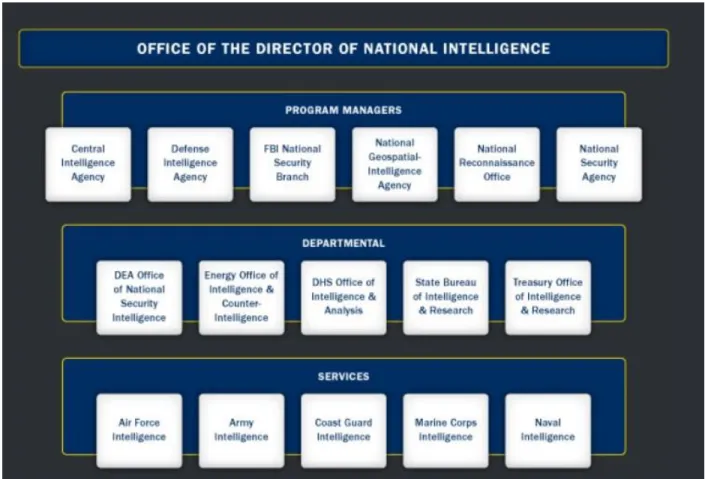
Although DHS may seem like a comprehensive agency, it is only one of seventeen
agencies in the US Intelligence Community (IC). In 2004 the Intelligence Reform and
Terrorism Prevention Act organized and unified the various agencies under the Office of the
Director of National Intelligence (ODNI). As demonstrated in in Table 2it is easy to see the
complexity and reach of the IC. Despite its breadth, the DHS is often overshadowed by its
more established and active counterparts such as the Central Intelligence Agency (CIA),
National Security Agency (NSA), Federal Bureau of Investigation (FBI), and National
Geospatial-Intelligence Agency (Intelligence.gov). All members of the US intelligence
community may take actions in regard to specific threats at the request of the President of the
United States, and regularly collect and assess information regarding “international terrorist
and narcotic activities; other hostile activities by foreign powers, organizations, persons, and
their agents; and foreign intelligence activities directed against the United States (U.S.)”
7
Table 2. US Intelligence Community Organizational Chart
Image Source: Intelligence.gov: http://www.intelligence.gov/about-the intelligence-community/structure.html
While the US is unmatched in military spending and has a formidable and seemingly
omnipotent intelligence community, it still relies heavily on allies throughout the world. The
US had little choice but to respond to 9/11 with drastic actions, such as creating DHS, but
many of its allies were slow to address the changing threats of a globalized world. With the
ongoing battle against insurgencies in Afghanistan and Iraq, the US relies on allies that are
not only geographically closer to foreign enemies, but have access to intelligence that the US
does not through social, political, and historical connections. For this purpose, Europe has
8 Past EU Terrorism Policy
Although preceded by the intelligence sharing organization of the Berne Club, the
EU’s first real policy on terrorism was its 1975 TREVI forum (TREVI forum (Terrorisme,
Radicalisme, Extrémism, et Violence Internationale), which focused on creating an open
dialogue between member states. Although there was little need for supranational
counterterrorism policy, a forum through which member states could discuss problems and
solutions and exchange information regarding terrorism and other international criminal
activities such as a drug and weapons trafficking was necessary (Casale 2008, 50). TREVI
was the primary method of counterterrorism coordination among member states until 1992,
when it was replaced with Pillar 3 of the Maastricht Treaty (Casale 2008, 50).
The 1992 Maastricht Treaty brought significant changes to counterterrorism policy in
the EU. The third Pillar of the Maastricht Treaty covers areas including immigration and
asylum, policing, customs, and legal cooperation among member states. Perhaps the most
important counterterrorism institution that came out of the Maastricht Treaty was the creation
of the EU’s office of Justice and Home Affairs (JHA), which functions as a forum for
monthly meetings for national ministers to discuss policies that facilitate cross-border
cooperation law-enforcement authorities and intelligence agencies. A European police force,
known as Europol, was also initiated with the Maastricht Treaty. In addition to JHA and
Europol, a Working Group on Terrorism and a Counter Terrorism Group were created in
1993 (Casale 2008, 50). However, although there was significant structural change with
Maastricht, beyond Europol and several working groups there was very little coordination
9
ability to have control over their internal security and foreign affairs were, and continue to
be, an important part of sovereignty. Eventually, the Pillar system of Maastricht was
completely replaced by the office of JHA (Lugna 2006, 106).
Post 9/11 Policy Changes in the EU
After the 9/11 attacks in the United States, international terrorism moved to the top of
the EU agenda. Although the attacked was aimed specifically at the US, the EU recognized
that international terrorist groups posed a threat to the free and democratic western world.
During a meeting of the European Council on September 21, 2001, the Council stated that
“Terrorism is a real challenge to the world and to Europe and that the fight against terrorism
will be a priority objective of the European Union” (Casale 2008, 51). In addition to the
increased awareness that came with the 9/11 attacks, the elimination of many national border
controls and creation of common security and defense policies has left the EU vulnerable to a
distinct set of threats unique to its circumstances. The “free circulation of goods, capital and
people” is a matter of pride for members of the EU. Easing border restrictions served as a
catalyst for unprecedented levels of trade and cooperation among EU member states and
serves as a force for integration. However, despite the plethora of benefits that reduced
border restrictions allows, one negative effect is that open borders and a common currency
benefits criminal and terrorist groups as well as law abiding citizens. Organized criminal
groups have been able to increase the scale and intensity of their operations with a reduced
risk of detection at international borders (Walsh 2010, 90). As a result of the increased levels
of general criminal activities there has been a corresponding increase in criminal activities
10
goods, and the possible transport of weapons of mass destruction (WMD). As the EU moved
to a single currency it became easier for terrorists, and those supporting terrorist activities, to
move funds and launder money for illicit activities. Finally, free movement of people and
capital allows easier communication between criminal and terrorist cells, and easier passage
between countries to avoid arrest, prosecution, and extradition (Walsh 2010, 90). These
challenges, along with the increased awareness of the threat of terrorism, thrust the EU into a
rush of new policies and practices for counterterrorism coordination and intelligence sharing.
In addition to recognizing al Qaeda as a common threat, the EU was expected to respond
to the 9/11 attacks accordingly- as part of the Coalition of the Willing, as individual members
of NATO, and as individual allies to the US. As a result of the threat of terrorism, and the
EU’s role as an ally to the US, the 2002 Framework Decision was adopted. Whereas it had
previously been undefined, the 2002 Framework Decision specifically defines terrorism as a
criminal act that is committed with
“the aim of seriously intimidating a population, unduly compelling a government or international organization to perform or abstain from performing any act, or seriously destabilizing or destroying the fundamental political, constitutional, economic or social structures of a country or international organization” (Terrorist Offences 2010).
The 2002 Framework Decision also defined specific acts as terrorist offences such as “public
provocation to commit a terrorist offence; recruitment and training for terrorism; aggravated
theft, extortion and falsification of administrative documents with the aim of committing a
terrorist offence” (Terrorist Offences 2010). The 2002 Framework Decisions sets standards
that require EU members to establish jurisdiction over terrorist offences, establish
jurisdiction over indictment and extradition of terrorist offenders in EU or non-EU states, and
11
country, even when several member states are involved (Terrorist Offences 2010).
Compared with pre-9/11 EU policy, the 2002 Framework Decision presented broad and
sweeping changes to EU policy on terrorism. Previously, each member state had its own
definition of terrorism and plan of action to combat terrorist activity within its borders. After
the 2002 Framework Decision EU member states had finally begun to truly integrate policy
and to work together in defining, investigating, and prosecuting terrorist activity.
Within the EU, there are four main counterterrorism institutions - Europol, Eurojust,
The European Monitoring Center for Drugs and Drug Addiction (EMCDDA), and the border
control agency Frontex. Combatting terrorism is not the primary goal of any one of these
organizations, but crimes related to terrorism fall within their jurisdictions. For example,
EMCDDA and Frontex play a crucial role in monitoring and preventing drugs from Central
Asia from being trafficked into Eastern Europe. According to the UN Office on Drugs and
Crime’s 2007 Report, Afghanistan’s 2006 opium harvest had an estimated value of
$3.1billion. Just a fraction of the profits from an opium harvest could fund the planning and
execution of many terrorist attacks. In fact, during the planning of the 2004 Madrid
bombings, drugs were used as currency during the initial planning stages (United Nations
Office on Drugs and Crime 2013). Each of these agencies is vital to combatting terrorism
within the EU, and one of the first changes the EU made immediately after 9/11 was provide
more funding to Europol so that it could set up a counterterrorism task force. Together,
EMCDDA, Frontex, Europol, and Eurojust cover the bulk of EU counterterrorism strategy.
12
voluntary cooperation and coordination between member states. Thus, there are few
repercussions for non-compliance.
Another major institution through which member states share intelligence and
counterterrorism information is the Joint Situation Center (SitCen), which was established in
2002. SitCen is based in Brussels, and is staffed with over 100 people including
approximately 20 analysts. SitCen operates 24/7 to monitor and assess global events and
situations, focusing on potential crisis regions, terrorism and WMD proliferation. Not all
member states participate in SitCen, though all receive the intelligence reports it generates.
Formally, SitCen does not participate in operations or policy formation but it collects and
analyzes the intelligence it receives from member states. Although the specifics are not public,
SitCen is known to receive information from French, German and Italian spy satellites,
diplomatic reports, US commercial satellite imagery, and open sources such as internet chat
rooms, media, and on the ground reports (Davis Cross 2011, 5). SitCen is an excellent example
of member states successfully coming together to share intelligence through formal EU
structures. Although SitCen has no formal legal status and participation is voluntary, many
scholars have suggested that the SitCen could eventually be transformed into a single EU
intelligence service mirroring the CIA (Davis Cross 2011, 4). While this notion is both
controversial and unlikely in the near future, it presents an interesting perspective on the future of
EU counterterrorism strategies.
In addition to the aforementioned policies, the EU issued the European Security
Strategy (ESS) - A Secure Europe in a Better World in 2003.The ESS labels Europe as both
13
several initiatives for increasing the international security of the EU by emphasizing the
importance of the EU’s participation in multi-lateral organizations such as the United Nations
(UN), World Trade Organization (WTO), and the International Atomic Energy Agency
(IAEA), the importance of the relationships between the EU and the US, and the role that
international trade plays in maintaining positive relationships with allies. In doing so, ESS
also recognizes the connection between the illicit trade markets for drugs, weapons, and
human trafficking and the roles they play in funding terrorism (European Security Strategy
2003). Much like SitCen, ESS provides an example of the EU offering suggestions and
options for coordination among the member states in the realm of counterterrorism rather
than actual enforceable policy or integration.
Although there was progress in counterterrorism strategy in the EU in the immediate post
9/11 era, it was not sufficient enough to prevent further attacks. On March 11, 2004 four
commuter trains exploded in Madrid in coordinated attacks. Ten backpack bombs, spread
over four crowded trains, killed 191 people and injured an additional 1,800. Spanish
investigators originally suspected its known domestic enemy, the Basque separatist
movement, ETA. However, ETA denied responsibility for the bombings, and ongoing
investigations produced evidence pointing towards radical Islamist groups. The group al
Qaeda in Europe later claimed credit for highly coordinated attacks. By the time Spanish
police tracked down the specific source of the bombs almost a month had passed. As the
seven bombing suspects were surrounded by Spanish police, they blew up their apartment,
killing themselves and a nearby Special Forces soldier. By mid -April, 29 people were
14
nine Spaniards, two Syrians, one Algerian, and one Lebanese (Associated Press 2007). As
previously mentioned, drugs were used as currency in the planning of the Madrid train
attacks. This fact, and the international origins of the attack suspects, highlights the failures
of the EU’s counterterrorism policy. In response, EU adopted the European Action Plan. The
EU Action Plan identifies measures such as joint investigation teams, routine exchange of
counterterrorism information between member states and establishes strategic objectives for
combating and preventing terrorism (Casale 2008, 52). Its purpose is to address the
international nature of terrorism with an expansive and international approach- targeting not
only the execution of terrorist attacks, but their planning and financing as well.
Unfortunately, however comprehensive and seemingly applicable the measures of the EU
Action Plan are, its purpose is merely to identify measures and objectives, and it does not
create policy through which the EU can take real counterterrorism action. It wasn’t until
2005 after the London 7/7 bombings that several of the EU Action Plan initiatives were acted
upon and a European Arrest Warrant was created. Additionally, the border controls under
the Schengen agreement were reviewed and revised, biometric data was added to EU
passports, and trade restrictions on hazardous materials were strengthened (Casale 2008, 53).
Later in 2005, yet another EU counter-terrorism initiative was passed, the EU
Counter-Terrorism Strategy. The main goals of the EU Counter-Counter-Terrorism Strategy are to protect EU
citizens, prevent terrorist attacks and the recruitment of EU citizens by terrorist groups,
pursue and prosecute those involved in terrorist activities, and to prepare for and respond to
Counter-15
Terrorism Strategy, more than 200 separate measures for meeting these goals are identified
(Casale 2008, 53).
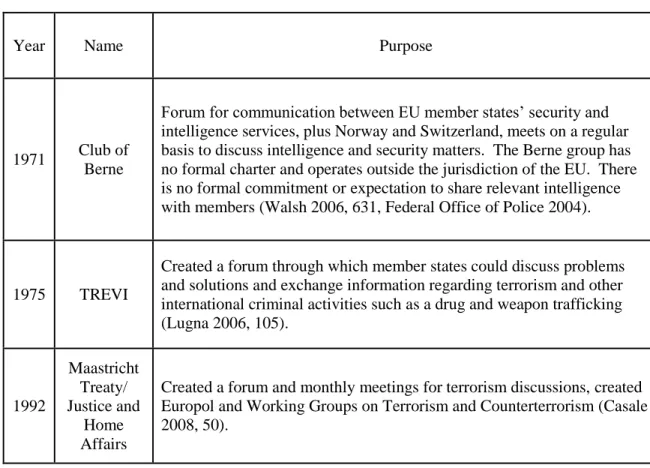
Table 3 details the history of counterterrorist and intelligence sharing policy within the
EU, both before and after the 9/11 attacks. As briefly discussed above, the post 9/11 policies
and practices enacted provide a more stable basis from which EU member states can actually
operate and act upon counterterrorism initiatives, rather than simply creating a forum for
communication between states. 9/11, and the attacks in Madrid and London, led to more
actionable practices between EU members.
Table 3. Major EU Counterterrorism and Intelligence Structures and Policies
Year Name Purpose
1971 Club of Berne
Forum for communication between EU member states’ security and intelligence services, plus Norway and Switzerland, meets on a regular basis to discuss intelligence and security matters. The Berne group has no formal charter and operates outside the jurisdiction of the EU. There is no formal commitment or expectation to share relevant intelligence with members (Walsh 2006, 631, Federal Office of Police 2004).
1975 TREVI
Created a forum through which member states could discuss problems and solutions and exchange information regarding terrorism and other international criminal activities such as a drug and weapon trafficking (Lugna 2006, 105).
1992 Maastricht Treaty/ Justice and Home Affairs
16
1993 EMCDDA
European Monitoring Center for Drugs and Drug Addiction was first created to provide EU members with a factual overview of European drug problems, now it also provides information about drug trafficking
information in relation to financing of terrorist activities (EMCDDA 2010).
1995 Europol
European Police force priorities include: illegal trafficking in drugs, human beings and vehicles; illegal immigration; terrorism; and forgery, money-laundering and cybercrime that cross national borders. Europol’s objective is to improve intelligence sharing in regards to these matters, rather than engaging in directly in security, intelligence, and
counterterrorism operations (Walsh 2006, 632).
2001 EU Military Staff
Contains an intelligence division of about 30 people who are responsible for early warning, assessment and operational support on external security matters including terrorism. Reports to the Military Committee, the High Representative for foreign policy and other EU bodies with risk assessments (European Union 2006).
2002 Framework Decision
Specifically defined terrorism and defined acts that facilitate or promote terrorism as crimes eligible for prosecution (Terrorist Offences 2010).
2002
Joint Situation
Center
Created to monitor and assess events and global situations 24/7, focuses on potential crisis regions, terrorism and WMD proliferation. The Joint Situation Center has no formal legal status, member states participate voluntarily (Davis Cross 2011, 2).
2002 Eurojust
Facilitates coordination of investigations, prosecutions and extraditions between member states concerning cross border crimes, including terrorist activities (European Union 2012).
2003
European Security Strategy
Recognized Europe as a base for and target of terrorist activity,
emphasized relationships with international organizations (UN, WTO), recognized the crime-terror nexus, offered suggestions for coordination among member states (European Security Strategy 2003).
2003
Counter Terrorism
Group (CTG)
Part of the Club de Berne, EU member States and the US produce and share common threat assessments between the membership and with some EU committees (Van Buuren 2009).
17
2004 Frontex
European Agency for the Management of Operational Cooperation at the External Borders of the Member States of the European Union, main goal is to reinforce and streamline coordination between national border authorities. Frontex often assists in tracking illicit criminal activities such as drug and/or human trafficking as well as terrorist activities (Frontex 2012).
2004 European Action Plan
Goals included: Deepened international consensus on measures to combat terrorism, reduction of terrorist financing, maximize members' abilities to detect, investigate and prosecute terrorists and prevent terrorist attacks, identifies measures an objectives which the EU and the international community can act upon to reduce the risk of terrorism (Casale 2008, 52).
2005
EU Counter terrorism
Strategy
Focused on the EU's ability to protect, prevent, pursue, and respond to terrorist activities and attacks, identified over 200 measures to enable meeting aforementioned goals (Casale 2008, 53).
US-EU Counterterrorism and Intelligence Sharing Policy and Practice
As demonstrated above in Table 3,counterterrorism and intelligence sharing within
the EU consists of a complex web of policies and institutions that are meant to facilitate
greater cooperation between the member states. However, even with official common
policies on security and defense, these institutions merely facilitate coordination and do not
necessarily make intelligence sharing mandatory. None of the institutions listed Table 3
dictate what kind and how much intelligence member states are required to share with each
other or enforce counterterrorism coordination. None have mechanisms for enforcing
intelligence sharing, and none have ways through which to punish a lack of sharing or the
sharing of incorrect or biased intelligence (Walsh 2010, 97). As with most EU policies, the
ability of member states to control their own counterterrorism and intelligence is a grave
matter of sovereignty. That being said, many states within the EU seek external intelligence
18
within the EU, states coordinating intelligence activities with the US must carefully weigh
the pros and cons of tying their intelligence services to another state. Participating states
must carefully decide what information to share, and what intelligence must remain
confidential. Furthermore, when participating in coordination or exchange of intelligence,
both within the EU and elsewhere, states accept that their counterparts may not abide by the
same standards of quality control, security standards, or human rights conventions.
Additionally, some states invest more heavily in intelligence and counterterrorism actions
than others, bringing the question of burden sharing to light (Walsh 2010, 90). These
tensions have routinely risen to the surface during EU intelligence sharing operations as well
as in trans-Atlantic relationships between EU states and the US. Despite these issues, the US
and EU states cannot ignore the enormous benefits they receive from transatlantic
intelligence sharing and counterterrorism coordination.
The US and EU member states have long been bound together by trade agreements
and military alliances. The 9/11 attacks and the subsequent attacks in Madrid and London
brought the threat of international Islamic terrorism into the spotlight. As the ESS
highlighted, Europe was not only a target of terrorist activities, but it also served as a base for
the strategic planning of terrorist activities. After the 9/11 attacks, European law
enforcement tracked down suspects in Belgium, France, Germany, Italy, Spain who were
involved in the planning of the attacks (Archick 2012, 2). As a new era of global threats and
terrorism became more apparent the US, the EU, and individual member states significantly
increased their levels of intelligence sharing and counterterrorism cooperation and
19
the US and the Europe remain classified and therefore unavailable to the public, the increase
in intelligence sharing and counterterrorism coordination has been publicly acknowledged by
government officials and well documented in the media. In his testimony before the Senate
Joint Intelligence Committee Deputy Secretary of State Richard Armitage stated that
“Probably the most dramatic improvement in our intelligence collection and sharing has come in bilateral cooperation with other nations – those we considered friendly before 9/11, and some we considered less friendly. This is a marked change, and one that I believe results not just from collective revulsion at the nature of the attacks, but also the common recognition that such groups present a risk to any nation with an investment in the rule of law” (Armitage 2002)
While many of the details and specifics of intelligence sharing remain classified, the
official acknowledgement of cooperation represents a distinct increase in the level of
intelligence sharing and counterterrorism coordination between the US and the EU. Foreign
intelligence services in Britain, France and Germany, along with several smaller states,
regularly collect and share information with the US. With colonial ties in South Asia, Africa,
and ties with the Arab world, the British and French intelligence services have a distinct
advantage over US intelligence agencies in collecting intelligence regarding Islamic terrorist
organizations such as al Qaeda. In return, the US exchanges information and intelligence
from other parts of the world (Walsh 2010, 115). Since 9/11 the coordination between
American and European intelligence services has steadily increased, despite hotly contested
political debates such as opposition to the US invasion of Iraq in 2003 (Walsh 2010, 11).
Although the US often establishes a hierarchy and control over intelligence sharing in
bilateral relationships, it has yet to do so with its European bilateral relationships. The
20
and European intelligence agencies has left them on essentially equal footing and operating
bilaterally as needed (Walsh 2010, 115).
The level of contact and communication between US and EU officials regarding
police, judicial, and border control policy as significantly increased since 9/11 (Archick
2012, 18). Coordination that has traditionally been bilateral has shifted towards multilateral
and new dialogues between law enforcement and security agencies have opened. There have
been numerous developments in the realm of US-EU intelligence and counterterrorism
agreements, including information sharing agreements between EU and US police and
judicial bodies, two treaties on extradition and legal assistance, and accords regarding
maritime security and airline data, including Passenger Name Records (PNR) (Archick 2012,
19).
In 2001 and 2002 new agreements legalized strategic information sharing between
US law enforcement agencies and Europol. With these new accords, US law enforcement
and Europol can now share strategic information such as tips on threats, criminal patterns,
statistics and risk assessments as well as personal information which was previously
unavailable, such as names, addresses, and criminal records. Negotiations for the exchange
of personal information provided a distinct challenge, as many European states view the right
to privacy of personal information as a human right. However, an agreement was eventually
reached and now the US and EU share personal information, including PNRs. Personal data
is not transferred on a bulk scale, but rather on an as needed basis. The accords on
information sharing between Europol and US law enforcement were later followed in 2007
21
arrangements and agreements had been made, the US and EU then moved forward towards
two new treaties on extradition and mutual legal assistance in 2010 (Archick 2012, 4). By
clarifying and simplifying legal proceedings, the US and EU have made it easier to share
information, protect classified information, and track and investigate terrorist suspects.
When the suspects have been apprehended, new US-EU arrangements facilitate legal
proceedings including the extradition process and prosecution. Through these arrangements
the US and EU have raised the bar on the quality and efficacy of international intelligence
sharing and counterterrorism cooperation. With greater levels of transatlantic cooperation,
combatting terrorism and international crimes such as drug trafficking and financial fraud is
streamlined (Archick 2012, 4).
Since 2001 the US and EU have worked together a great deal in harmonizing their
lists of foreign terrorist organizations (FTO). Currently, the US Department of State has over
50 groups formally recognized as terrorist organizations on its Foreign Terrorist organization
list. By naming and recognizing these groups as terrorist organizations the US hopes to 1)
curb the financing of terrorism 2) stigmatize and isolates the groups internationally 3) deter
donations, contributions and financial transactions with the named organization 4) heighten
public awareness of the organization and 5) signal foreign governments about the named
organization (US Department of State 2012). According to EU laws, all EU member states
must freeze the assets of organizations listed and ensure that supporting financial resources
are cut off. Harmonizing the list of FTOs allows the US and EU to combat terrorist threats
deriving from these organizations more effectively and in unison (Archick 2012, 5). While
22
are several notable exceptions, including Lebanese based Hezbollah and Hamas related
charities (Archick 2012, 5). Although the differences in groups named on the FTO list
persist, US and EU regularly communicate and work together on combatting and disrupting
listed terrorist groups and networks.
In addition to the aforementioned coordination and cooperation between the US and
EU, a controversy erupted in 2006 when it was revealed that the US had been granted access
to data in the Society for Worldwide Interbank Financial Telecommunications, known as
SWIFT. SWIFT serves as a medium through which banks and various other financial
institutions worldwide exchange messages regarding financial transactions, which often
contain sensitive information. After 9/11, SWIFT managers had covertly granted the US
access to secretly exchanged messages regarding worldwide financial transfers. US access to
SWIFT was eventually exposed. After a fair amount of public uproar, the EU and Belgian
governments ruled that the US’s access to SWIFT violated privacy laws. Although it is
likely that most EU governments were aware of message sharing between SWIFT and the
US, most recognized its importance in disrupting the finances of terrorist and organized
crime networks and therefore allowed it to continue. However, after it was made public they
had no choice but to demand concrete legislation and specific regulations on what
information could legally be shared. Following its public exposure the US and EU took steps
to place the US-SWIFT Accord on secure legal footing (Walsh 2010, 118). A series of
negotiations occurred between 2006 and 2010, when the European Parliament approved the
most recent form of the agreement. As part of the new arrangement the US pledged to
23
possible renegotiations of the US-SWIFT Accord in the future. Since then, the EU has taken
steps towards creating a European Terrorist Finance Tracking System (TFTS) with the main
objectives of limiting data transferred to the US under the SWIFT Accord, and stemming
terrorist financing worldwide (Archick 2012, 8). Thus far, both the US and EU have
benefitted immensely from the US-SWIFT Accord, as more than 1,550 leads regarding
terrorist financial activity have been shared and investigated (Archick 2012, 5)
The intelligence sharing and counterterrorism coordination between the US and EU
has increased steadily since 9/11. In 2004 US and the EU signed and adopted a joint
“Declaration on Counterterrorism” which aims to deepen preexisting counterterrorism and
intelligence sharing relationships between the US and EU member states. In President
Obama’s 2011 National Strategy for Counterterrorism he asserted the importance of bilateral
relationships with European states, and with European governing bodies, in maintaining
mutual security and protecting the citizens of all nations (Archick 2012, 3). Although the
collaboration between the US and EU is impressive and rapidly deepening, there are many
critics of US-EU collaboration. Although the list of common policies and practices is
growing daily it must be noted that, as with many EU institutions, Europol and other EU
counterterrorism and intelligence mechanisms lack enforcement capabilities. EU
counterterrorism institutions rely on the participation of member states and their respective
national services. As Belgian Justice Minister Laurette Onkelink phrased it,
24
Sharing Must Be Mandatory”, BBC Monitoring Service, as quoted in Walsh 2010, 99)
Additionally, some EU members have complained that while they share information with EU
institutions, and therefore with 26 other member states and the US, the US does not always
readily hand over its intelligence. While EU states are essentially normatively bound to
sharing with each other within the confines of the EU, the US can readily withhold
intelligence and information as it sees fit (Archick 2012, 5). However, regardless of what
intelligence sharing occurs within the boundaries of governing EU bodies, the US maintains
a high level of bilateral relationships with European states that are outside the bounds of EU
institutions.
Although there are not many specific details on what and how intelligence is shared,
transatlantic intelligence sharing has become so routine that the CIA and FBI have several
European liaison offices, and the US has access to law enforcement and intelligence data and
analysis collected by Europol. The transatlantic intelligence sharing and counterterrorism
relationship deepens even further upon delving into the NATO alliance and operational
abilities (Walsh 2010, 115). In numerous cases, transatlantic intelligence sharing and
counterterrorism coordination has foiled active terrorist plots and led to the arrest of both
terrorists and their enablers. For example, in 2006 British authorities discovered a plan to
blow up transatlantic flights between the UK and the US. All 24 arrested on terrorism
charges surrounding the plot were British born men with ties to al Qaeda. British
intelligence, in coordination with the FBI, then pursued additional leads within Europe and
25
and emails from a terrorist cell planning an attack in Germany. Using emails and phone calls
between Germany, Turkey, and Pakistan US intelligence agencies tipped off German
intelligence services and law enforcement of the plot (Schmitt 2007).
Perhaps one of the most complex and effective examples of transatlantic intelligence
sharing and counterterrorism coordination is the existence of the Alliance Base in Paris. As
early as 2002, a top secret facility in Paris called Alliance Base was set up by the French
intelligence agency General Directorate for External Security (DGSE) and the CIA (Baylis
and Roper 2006, 134). The primary function of the Alliance Base is to analyze the
movement of terrorist suspects and to plan and execute operations to spy on and capture them
(Priest 2005, 1). Although the base is predominately funded by the CIA it has officers from
Britain, France, Germany, Canada, Australia and the US. In order to downplay the CIA’s
financier role and encourage cooperation between the various intelligence offices the spoken
language at Alliance Base is French, rather than English. (Priest 2005, 2) In addition to its
international nature Alliance Base is extraordinarily unique because it not only serves as a
way to share intelligence, but because the case officers working there plan and execute
operations. As Dana Priest states,
“Alliance Base demonstrates how most counterterrorism operations actually take place: through secretive alliances between the CIA and other countries' intelligence services. This is not the work of large army formations, or even small special forces teams, but of handfuls of U.S. intelligence case officers working with handfuls of foreign operatives, often in tentative arrangements.” (Priest 2005, 1)
In keeping with Alliance Base’s tradition of cooperation, cases are chosen carefully and each
operation has a “lead country” whose intelligence service takes the lead in the current
26
In addition to hosting the Alliance Base, France has stepped up its aggressive
counterterrorism role in the post-9/11 era and has played an integral part in US
counterterrorist operations abroad. The French Justice Department has extensive powers,
and intelligence sharing among government sectors is highly encouraged. Anti-terrorism
units can legally detain people suspected of “conspiracy in relation to terrorism” before
official charges are filed and while evidence against them is gathered (Priest 2005, 2).
Jean-Louis Brugiere, a top anti-terrorism magistrate, has regularly coordinated with US authorities
to arrest terrorist suspects and has publicly stated “I have good connections with the CIA and
FBI,” (Priest 2005, 2). France’s aggressive counterterrorism tactics do not stop with the
Justice Department. France has coordinated with the US and other European intelligence
agencies to lure terrorist suspects into its sovereign territory so they can be arrested. Most
notably, an operation out of Alliance Base lured German Islam convert and al Qaeda
operative Christian Ganczarski into Paris for a layover on a trip to Germany. French
authorities, in coordination with the CIA, whisked him into custody (Priest 2005, 1).
Additionally, despite the international controversy surrounding Guantanamo Bay, France has
previously sent interrogators to interrogate detained French citizens. In several cases, French
authorities continued to detain prisoners from Guantanamo Bay when they were turned over
to French custody. France also allowed the CIA to launch its controversial Predator Drone
from French territory in order to kill al Qaeda operatives living in the Djibouti. While
France’s aggressive behavior may seem somewhat at odds with French public opinion, it has
long practiced extensive intelligence sharing with its western allies. After a failed 1994 plot
to crash a plane into the Eiffel Tower, then President Jacques Chirac made clear that he
27
were instructed to share terrorism information with the US “as if they were your own
service” (Baylis and Roper 2006, 134). France’s intelligence sharing and counterterrorism
coordination has aided the US in making some of its biggest arrests, including Ahmed
Ressam, who was attempting to blow up Los Angeles International Airport, and Zacarias
Moussaoui, the only person in the US to have pleaded guilty to aiding in the 9/11 attacks
(Priest 2005, 3).
Although many European governments have publicly criticized the war in Iraq,
declassified reports reveal that the US’s decision to wage war in Iraq was based on
intelligence from German source named Rafid Ahmen Alwan, also known as Curveball.
Curveball provided evidence that Saddam Hussein was in the possession of, and in the
process of making more, WMDs. According to a 2005 report to the President of the US by
the Commission on the Intelligence Capabilities of the US Regarding Weapons of Mass
Destruction “Virtually all of the Intelligence Community’s information on Iraq’s alleged
mobile biological weapons facilities was supplied by a source, code- named “Curveball”
(Silberman et al. 2005, 48). The German intelligence service, Bundesnachrichtendienst
(BND), made it clear that there were numerous reasons why intelligence from Curveball was
considered risky. Although Curveball’s intelligence proved to be devastatingly faulty, it is
representative of the complex intelligence sharing between the US and Germany. Ultimately,
a German source was key to a major a US foreign policy decision. Despite the fact that he
provided faulty intelligence, Curveball highlights the intelligence and counterterrorism
cooperation between the US and Germany. Intelligence from a German source was passed
smoothly to the US intelligence community, and that intelligence helped formulate the US’s
28
In addition to the traditional military powers of Great Britain, France, and Germany,
smaller and newly accepted EU members have played key roles in transatlantic intelligence
sharing and counterterrorism cooperation. Poland, the Czech Republic, and Hungary have
transformed from mere struggling Soviet States to functioning members of NATO and the
EU. By taking active roles in world and regional politics smaller states are also responsible
for global intelligence coordination and cooperation with allies in NATO and the EU.
Although these small states may not have the intelligence infrastructure of their larger
European neighbors, they have played a complicated but vital role in the transatlantic
intelligence and counterterrorism relationship. Numerous European countries played an
active part in the US’s controversial and much disliked rendition program. The UK,
Germany, Ireland, Spain, Portugal, Austria, Denmark and Italy aided the rendition program
by allowing CIA rendition operations to utilize airports or pass through sovereign air space,
participating in interrogations or torture of prisoners, or assisted in or allowed renditions to
take place within their sovereign territory. Involvement in the US’s rendition program goes
even deeper for Poland, Lithuania and Romania, which all hosted secret CIA prisons and
detention centers (Open Society Foundations 2013, 61-119). The CIA’s rendition program is
under intense fire from the international human rights community. However, regardless of
legality, these actions are highly demonstrative of the increased intensity and frequency of
transatlantic intelligence sharing and counterterrorism coordination between the US and
29 The Evolving US-UK Special Relationship
In addition to the rest of the average US-European bilateral relationships, one of the
longest standing and most well-known intelligence sharing and counterterrorism
relationships in the world is between the US and the UK. Rooted in the US’s entrance into
World War II, Churchill and Roosevelt began cultivating a relationship that would last
through the war and into the reconstruction of Europe. As an odd foreshadowing of the
US-UK relationship that continues to deepen and grow more than 60 years later, Churchill once
privately stated that “No lover ever studied the whims of his mistress as I did those of
President Roosevelt” (Wallace and Phillips 2009, 264). As American troops withdrew from
their European posts, and the world entered into the beginning stages of the Cold War,
Churchill called for a revival of the US-UK relationship that began during the battles of
World War II. In a 1946 speech in Missouri, Churchill
“Neither the sure prevention of war, nor the continuous rise of world organization will be gained without what I have called the fraternal association of the English-speaking peoples. This means a special relationship between the British
Commonwealth and Empire and the United States … Fraternal association requires not only the growing friendship and mutual understanding between our two vast but kindred systems of society, but the continuance of the intimate relationship between our military advisers … It should carry with it the continuance of the present facilities for mutual security by the joint use of all naval and air force bases in the possession of either country all over the world.” (Churchill 1946)
As Churchill so eloquently explained, the US and English speaking nations of the British
Commonwealth were nations with common interests, values and goals the US and UK
together could begin to secure an everlasting peace. After the 1946 speech, the US and UK
nailed down their special relationship in the form of the UKUSA Agreement, which also
includes the British Empire states- Canada, Australia, and New Zealand (also known as Five
30
sovereignty for West Germany it fortified its place as the US’s most important ally (Wallace
and Phillips 2009, 265).
The special UKUSA relationship was heavily tested in its early years, through the
UK’s economic struggles, the creation of the European Economic Community, and a shift in
US foreign policy to a focus on East Asia. However, the relationship persisted and the
substructure of the UKUSA Agreement remained in place (Wallace and Phillips 2009, 266).
Ties between the UK and US moved closer during yet another war, the first Gulf War, when
Britain provided a higher level of support for the US than any other European nation. In fact,
the British have led Europe in wooing American favor and maintaining the special UKUSA
relationship by throwing support behind the first Gulf war, the intervention in Afghanistan,
and the 2003 invasion of Iraq. Throughout this period, British military staff continued to
reiterate the importance of maintaining the special relationship with the US. During 1990’s
the US began to focus on jihadist terrorism, and the UK was dealing with the IRA in
Northern Ireland. Although their target groups were different, the US and UK found unique
ways to work together for mutual benefits. The FBI monitored and reported on
Irish-Americans suspected of providing financial support to the Real IRA, and the UK passed
along 30 years of counterterrorism experience and advice on dealing with terrorism to US
organizations (Svendson 2010, 48). A 2003 British White Paper outlined the importance of
maintaining the special UKUSA relationship to British military forces.
31
Cm. 6041-I (London: SO, Dec. 2003), 8. as quoted in -Wallace and Phillips 2009 277).
One of the most important and lasting creations of the initial stages of the UKUSA
Agreement is the practice of sharing signals intelligence (SIGINT). What started as the
British-American SIGINT Agreement (BRUSA) during the World War II era as a
collaboration to intercept, decode, and analyze German and Japanese electronic
communications has evolved over the decades into a modern day “spy network” known as
Echelon (Rudner 2004, 571). Although Echelon is not formally recognized by participating
governments, it is known to consist of an advanced network of electronic spy stations that
eavesdrop on electronic communication such as phones, computers, faxes and satellites.
Based at Fort Meade in Maryland, Echelon also has a headquarter office in Cheltenham,
England (Perrone 2001). Echelon, a modern epitome of “intelligence sharing” has come
under fire several times from the European Parliament as an invasion of the privacy of
ordinary citizens. However, the Echelon system, which is not formally recognized by any of
the participating governments, remains primarily unchanged (Perrone 2001). The
participating governments effectively diffuse the accusations of the European Parliament by
denying Echelon’s existence. Almost like a common internet search engine, to use Echelon,
a user requests data within the network by entering keywords and the information is
transmitted to the requester. Although it seems simple enough, Echelon was created before
most of the world had internet access, and the ability to search for and request specific
information was revolutionary. With millions, perhaps billions, of emails being sent every
32
struggling to keep up with modern technology and avoid an “information overload”
(Svendsen 2010, 14).
On a similarly large scale, the US and UK share a large amount of open source
intelligence (OSINT). In fact, majority of intelligence shared between the US and UK is
OSINT. The British Broadcasting Corporation (BBC) and CIA’s information broadcasting
branch, along with a large number of private organizations, constantly monitor and translate
foreign media and news sources (Svendson 2010, 19). Given the aforementioned colonial
ties between the UK and its commonwealth and former colonies, OSINT is vital to US
intelligence agencies for the large volume of translated intelligence it provides. As a an
interesting and more international side note, both the US and UK contribute to the
International Open Source Working Group with more than 160 countries including Germany,
Denmark, the Netherlands, Canada, Italy, Austria, Sweden, Israel, Australia, Norway,
France, and Belgium. Through the International Open Source Working Group an enormous
amount of open source intelligence, translated into more than 80 languages, is organized
quite simply, through an online portal- opensource.gov, which is managed by the US
intelligence community (Svendson 2010, 20).
While SIGINT and OSINT represents a high volume of intelligence transfer between
the US and the UK, as well as the Five Eyes, human intelligence HUMINT represents a more
guarded exchange of intelligence on a significantly smaller scale. Whereas SIGINT includes
the Commonwealth, HUMINT exchanges are almost exclusively on a case by case basis
33
Service (SIS/MI6). Although HUMINT sharing occurs on a smaller scale, it is recognized
that although there is a low volume of intelligence, it is generally considered to have an
extremely high value (Svendson 2010, 15).
Significant levels of cooperation and coordination have also occurred between US
and UK law enforcement agencies. In 2006 the UK formally launched its Serious Organised
Crime Agency (SOCA), dubbed the “British FBI.” As a combination of the UK National
Crime Squad, National Criminal Intelligence Service, and Her Majesty’s Customs and Home
Office Immigration Service, SOCA is a “single UK agency with which the various US
agencies can liaise” (Svendson 2010, 20). Cooperation also occurs regularly between various
other law enforcement agencies, such as the FBI, British Security Services (MI5), US and
UK customs agencies and port authorities, and US and UK police forces (Svendson 2010,
21).
Despite the in depth coordination between the US and UK, it is not without its
tensions. Given the enormity of the US military and intelligence machine, its budget and
technological developments, maintaining close ties affords the British military access to US
technologies. Although operations in Afghanistan and Iraq have dangerously overstretched
UK budgets, the benefits of such coordination with the US are tenfold. British civilian forces
have access to US defense planning, Ministry of Defense teams have played active roles in
developing the US’s defense reviews and strategies, and the British have maintained
positions at the US Central Command in Afghanistan, US Naval headquarters in Norfolk
34
also the sole “Level One” partners in the F-35 Joint Strike Fighter program, and the largest
foreign investors and beneficiaries in the US Defense industry (Wallace and Phillips 2009,
268).
In addition to budgetary restrictions, the UK has competition in maintaining a place
as an American ally. Although the UK has long been a trusted ally, it is not alone. In recent
years the US has propagated its relationships with allies that are geographically and
politically closer to its jihadist enemies such as Saudi Arabia and the Philippines. The US
has had a relationship with Saudi Arabia based on the mutual interests of oil production and
the containment of communism. Although the rise of al Qaeda activity in Saudi Arabia has
produced extreme strain on the relationship, Saudi Arabia continues to be a vital ally to the
US in the Middle East. President Obama has emphasized the increasing importance of an
alliance with Saudi Arabia, and signaled engagement with Saudi Arabia as a strategic ally.
In 2010, Saudi Arabia arrested over 110 people suspected of al Qaeda activities. Additional,
energy exports have strengthened Saudi Arabia’s global position, making them a vital ally
against Iran (Blanchard 2010, 3).
The Philippines have been a vital resource for the US, even allowing the US to use
Philippine as a base for military operations and to provide support for US operations
throughout Asia (Lum 2012, 14). As a base for violent South East Asian Islamist
organizations such as Abu Sayyaf Group (ASG), Jemaah Islamiyah, and the Moro Islamic
Liberation Front the Philippines have taken part in joint operations with the US and reduced
35
Philippines, the US also maintains delicate but highly valuable alliances with Malaysia,
Russia, and Pakistan (Steinberg 2002, 5). With allies in the Middle East and Asia, the UK
becomes less important as a US ally. The US no longer relies solely on UK and Five Eyes as
strategic allies and competition from nations such as Saudi Arabia and the Philippines
effectively dilute the “specialness” of the UKUSA relationship.
The UKUSA special relationship does not end with generic military and intelligence
support. After the 2006 Mutual Agreement for Cooperation on the Uses of Atomic Energy
for Mutual Defense Purposes the UK was granted access to US warhead designs, has access
to over 50 missiles held at the US Strategic Weapons Facility at King’s Bay, Georgia
(Wallace and Phillips 2009, 269). To tally up the benefits, the UK has gained exclusive
access to US technology, nuclear designs, and US missiles at enormously discounted rates
(Wallace and Phillips 2009, 270). However when examining the UK-US special relationship
it becomes glaringly apparent that the UK depends on the special relationship for security
and defense cooperation more than the US. The US intelligence machine dwarfs the UK’s,
with a greater number of organizations, employees, and resources. Although the UK
arguable benefits more from the relationship, both definitely benefit from the relationship.
The US gains a strong European ally, support on international missions, and a firm ally in the
EU and the UN, and the UK gains access vital defense resources such as new technologies
and advanced weaponry. Although the US continues to propagate allies throughout the
world, the value of the UK as a strategic ally is still far greater than any new ally. Over the
years the UK-US alliance has continued to deepen exponentially. In fact, some have argued
36
comes from the UK. While this creates democratic obstacles, such as the ability to hold
intelligence activities to account, the increasing intensity of the relationship is unquestionable
(Svendson 210, 31).
Conclusions
Since 9/11 the world has drastically changed. Technology and globalization have
been driving factors in the modernization of society, as well as the growth of terrorism. The
pre-9/11 approaches to combatting terrorism, both in the US and abroad, were insufficient to
handle the emergence and growth of international terrorist networks. As a result, both the
US and its Western allies have made sweeping changes. Although some methods are
controversial, such as the sharing of personal information, counterterrorism and intelligence
sharing arrangements in and between the US and the EU have increased tenfold to meet the
challenges of modern terrorism. As former Director of MI5 Stella Rimington stated:
“Secret services are not usually associated with cooperation and sharing. It sounds like a contradiction. But in a world where the threats get more sophisticated and more global, the intelligence task gets more difficult, and cooperation between intelligence allies is vital and grows ever closer” (Rimington 2002, 205)
This sentiment is echoed both in secretive practice and in public by notable figures such as
Robert Mueller, former director of the FBI, who stated that “In this era of globalization,
working side-by-side is not just the best option, it is the only option” (Mueller 2005).
Despite the political tensions and the numerous other obstacles that strain the relationship
between US and its European allies, the dynamic nature of intelligence sharing and
counterterrorism coordination has become a complex and integral part of today’s
37 Sources Cited:
Archick, K. (2012). U.S.-EU Cooperation Against Terrorism. Congressional Research Service, RS22030. Armitage, R. (2002, September 19). Testimony before Senate Joint Intelligence Committee. Retrieved from
http://2001-2009.state.gov/s/d/former/armitage/remarks/2002/13566.htm
Associated Press. (2007, October 31). The 2004 Madrid bombings. The Guardian. Retrieved from http://www.guardian.co.uk/world/2007/oct/31/spain.menezes
Baylis, J., & Roper, J. (2006). The United States and Europe: Beyond the Neo-Conservative Divide? New York, NY: Routledge.
Blanchard, C. M. (2010). Saudi Arabia: Background and U.S. Relations. Congressional Research Service, June 14. Retrieved from http://fpc.state.gov/documents/organization/145596.pdf
Casale, Davide. "EU Institutional and Legal Counter-terrorism Framework." Defense Against Terrorism Review 1.1 (2008): 47-78. Print.
Churchill, Winston S. (1946, March 5). The Sinews of Peace. Speech to Westminster College, Fulton, Missouri. Retrieved from http://www.nato.int/docu/speech/1946/s460305a_e.htm
Cowell, A., & Filkins, D. (2006, August 11). Terror Plot Foiled; Airports Quickly Clamp Down . New York Times. Retrieved from
http://www.nytimes.com/2006/08/11/world/europe/11plot.html?pagewanted=all&_r=0
Davis Cross, M. K. (2011). EU Intelligence Sharing & The Joint Situation Centre: A Glass Half-Full. Biennial Conference of the European Union Studies Association.
EMCDDA. (2010). Mission:Background. Retrieved from http://www.emcdda.europa.eu/about/mission European Union. (2006). Military Staff of the European Union (EUMS). Retrieved from
http://europa.eu/legislation_summaries/foreign_and_security_policy/cfsp_and_esdp_implementation/r 00006_en.htm
European Union. (2012). Background: History of Eurojust. Retrieved from http://eurojust.europa.eu/about/background/Pages/History.aspx
European Security Strategy: A Secure Europe in a Better World. European Union, 12 Dec. 2003. Web. 19 Nov. 2011 <http://www.consilium.europa.eu/uedocs/cmsUpload/78367.pdf>. Federal Office of Police. (2004). “Club de Berne” meeting in Switzerland. Retrieved from
http://www.ejpd.admin.ch/content/ejpd/en/home/dokumentation/mi/2004/ref_2004-04-28.html Frontex. (2012). Mission and Tasks. Retrieved from http://www.frontex.europa.eu/about-frontex/mission-and
tasks
Homeland Security Act of 2002, Pub. L. no 107–296, 116 STAT. 2135 (2002). Retrieved from http://www.dhs.gov/xlibrary/assets/hr_5005_enr.pdf
Intelligence.gov. (n.d.). Seventeen Agencies and Organizations United Under One Goal. Retrieved from http://www.intelligence.gov/about-the-intelligence-community/