ii ABSTRACT Christina Farrell
Innovation’s Changing Landscape:
Do Innovative Firms Engage in Sustainability-Inspired Innovation? (Under the direction of Dr. Carol Hee)
Innovation fuels new horizon growth. However, little research exists on
whether firms that are innovative engage in sustainability-oriented innovation
compared to sustainability-centered firms. Through content analysis of
sustainability reporting, this study provides information on how many B Corps
and Forbes Most Innovative companies (Forbes companies) use proxies that could
indicate the presence of sustainability-oriented innovation in their sustainability
reporting.
From our research, it is clear that many companies that are traditionally
good at sustainability may not be expanding this core competency into an
innovation driver. More than half B Corps did not have proxies indicating the
interaction of innovation and sustainability within their sustainability reporting.
Comparatively, more of the Forbes companies had proxies indicating interactions
between sustainability and innovation. From our results, innovation capabilities
among a firm type seemed to indicate that firm type would display larger
iii
TABLE OF CONTENTS
ABSTRACT ... ii
TABLE OF CONTENTS ... iii
LIST OF TABLES ... vi
LIST OF FIGURES ... vii
I. INTRODUCTION ... 1
A. Research Question... 2
B. Importance of the Research Question ... 4
C. Key Takeaways from the Research ... 5
D. Defining B Corps ... 5
II. LITERATURE REVIEW ... 6
A. Defining Value in Business ... 6
B. How Sustainability-Oriented Innovation Creates Value ... 9
III. METHODOLOGY ... 18
A. Study Design ... 21
B. Limitations ... 22
iv
A. Average frequency of proxy words in a company’s sustainability communication ... 25
B. Average frequency of words indicating sustainability and words indicating innovation per sentence. ... 26
C. Average frequency of innovation words in a sentence surrounded by sustainability words in the sentence above or below ... 29
D. Average frequency of sustainability words in a sentence with nearby innovation words in the sentences above or below ... 31
E. Overall percentages by firm type... 33
V. DISCUSSION ... 35
A. Presence of proxy words among firm types ... 35
B. Limitations of Current Research and Recommendations for Further Academic Research ... 37
C. Implications for Firms ... 39
CONCLUSION ... 41
APPENDIX ... 42
Exhibit 1 ... 42
Exhibit 2 ... 43
Exhibit 3 ... 43
Exhibit 4 ... 44
Exhibit 5 ... 45
Exhibit 6 ... 47
Exhibit 7 ... 48
v
Exhibit 9 ... 55
vi
LIST OF TABLES
Table 1: Words selected as sustainability proxies, innovation proxies, and S-I proxies. ... 20
Table 6: Percentage of B Corps and Forbes Companies with innovation and sustainability proxies present. ... 34
Table 2: Original list of B Corps considered ... 44
Table 3: List of B Corps Analyzed in Content Analysis ... 45
Table 4: Original list of Forbes companies considered ... 47
vii
LIST OF FIGURES
1
I. INTRODUCTION
Sustainability offers firms different paths to achieve innovation that creates
shareholder value. Sustainability relates to our ability to maintain environmental and
social conditions that will support the economic, social, and environmental value of the
future (Network for Business Sustainability, 2012). Understanding how sustainability and
innovation relate can create insights on new ways to grow business revenue. Since
innovation aims to build new businesses, improve processes, and improve products,
“smart companies now treat sustainability as innovation’s new frontier” (Nidumolu,
Prahalad, & Rangaswami, 2009). Because of this, it is important to understand how
companies communicate about sustainability and innovation.
Innovation makes sustainability more likely to succeed and sustainability provides
new ways to innovate (Nidumolu et al., 2009). However, when it comes to defining how
the two come together, there have traditionally been some gaps. In 2007, The Centre for
Sustainable Design stated that “there [was] no precise or established definition for
sustainable innovation, reflecting the more general difficulty in defining the concepts of
sustainability and sustainable development” (Charter & Clark, 2007). Some have
recognized openly that sustainability is the next space where innovation will drive profits.
2
compliance. It is about innovation and opportunity to simultaneously achieve excellence
in sustainability and financial performance” (2015).
Thus, it is pivotal that we understand how innovation and sustainability are being
connected. Language provides us the ability to observe the presence or dearth of this
integrative and innovative mindset. For firms trying to be more intentional about
sustainability and innovation, looking at the distribution of innovation and sustainability
rhetoric for these sample firms provides a way to understand future strategies to tackle
innovation and sustainability in tandem.
Using sustainability to innovate could create competitive advantages for firms that
use sustainability to plan ahead. Therefore, connecting sustainability and innovation
could be important for predicting future firm success. Innovative sustainability that is
forward thinking can push firms towards ideas that create future revenues. These
concepts matter now more than ever. In order to mitigate divisive consumers, many firms
who have previously viewed sustainability as a PR management strategy or toed the line
with a do no harm philosophy will need to find new ways to be transformative with their
sustainability to achieve robust customer capture.
A. Research Question
If the sustainability lens is a key driver of innovation, one may hypothesize that
companies focused on sustainability would be innovative and that companies renowned
for their innovation prowess are focused on sustainability. To explore this hypothesis, we
examined publically available sustainability-related communications of companies
3
certified by B Lab as “B Corps” were selected as companies focused on sustainability; a
subset of the Forbes 100 Most Innovative companies for 2016, (referenced as “Forbes
companies”), were selected as companies with innovation proficiency. As an indication
of whether the companies were connecting the concepts of sustainability and innovation,
we looked to see the extent to which their sustainability-related communications also
included concepts related to innovation.
Specifically, this research sought to answer the following questions:
1. In their sustainability communications, do B Corps include language that
indicates they are focused on innovation?
2. In their sustainability communications, do Forbes Most Innovative companies
include language that indicates they are focused on sustainability and innovation?
In order to address these questions, a subset of companies certified as B Corps by B
Lab were selected as the firms focused on sustainability, due to their certification of
sustainability, and a subset of the Forbes 100 Most Innovative companies for 2016 were
selected due to their recognition for innovation. Communication of sustainability
reporting was selected as a means to determine whether or not these companies report on
sustainability-oriented innovation in order to gain insights on how they present these
concepts to stakeholders. In the case companies analyzed did not publish a standalone
report, the companies online reporting of sustainability was used for the purpose of this
comparison. The goal of the study overall was to look for potential differences in the
presentation of sustainability and innovation. Once the sustainability-related
4
related to sustainability proxies were present in more of the Forbes companies than the B
Corps.
B. Importance of the Research Question
Social sustainability is a focus for many actors in today’s business arena and
pressure on firms to be socially proactive will only continue to grow. In fact, rather than
becoming obsolete, “the social and environmental issues at the center of today’s agenda
will still be relevant – and probably more prominent or intense – in the next decade”
(Global Reporting Initiative, 2015).
This research is focused on specifically examining how B Corps approach
sustainability and innovation compared to Forbes companies. The study aims to create
value for firms looking to innovate through sustainability and help academics better
understand the presentation of these two concepts to the public. The combination of
sustainability and innovation are increasingly important in business as successful
implementation of innovative sustainability concepts will be of vital future significance
to business strategy in competitive firms. We see that “[the quest for sustainability] has
already begun to transform the competitive landscape, as companies redesign products,
technologies, processes, and business models. By equating sustainability with innovation
today, enterprises can lay the groundwork that will put them in the lead…” (Nidumolu et
al., 2009). A competitive, innovative, stance on sustainability has the added benefit of
helping firms innovate in new growth areas. A relevant consideration given that “more
than 70% of [these] senior executives… say innovation will be at least one of the top three
5 C. Key Takeaways from the Research
This research study concludes that though some companies are “equating
sustainability with innovation” (Nidumolu et al., 2009), for the innovative-centered firm
types sampled, more firms presented sustainability and innovation proxies together
compared to sustainability-focused firms. Additionally, among innovation-centered firms,
more of them displayed innovation proxies than the sustainability-focused firms sampled.
D. Defining B Corps
A company can become a B Corp through assessment and certification by the
non-profit B Lab, the company that delivers B Impact assessments and is responsible for
the B Corp firm type (B Lab, 2017). The certification process starts with the B Impact
assessment, contains a meeting with B Lab staff, then “the company…agrees to meet the
expectations of a Certified B Corp, which includes the fee structure” (Wilburn &
Wilburn, 2015). The audit process includes “10 per cent of B Corps [that] are randomly
selected each year for an on-site review” (Wilburn & Wilburn, 2015).
B Corp assessment “requires companies to have goals in five Impact areas:
accountability, employees, consumers, community and environment” (Wilburn &
Wilburn, 2015). This tailors the certification process to the individual firm. These
expectations are designed to be monitored by B Lab in order to create a more explicit
6
II. LITERATURE REVIEW
The following chapter provides a focused overview of the importance of
sustainability-oriented innovation, followed by background on the development of
academic sustainability concepts.
A. Defining Value in Business
Porter and Friedman represent two of the strongest, yet opposing voices on the
type of corporate value businesses should exhibit. Friedman famously argues that “there
is one and only one social responsibility of business - to use its resources and engage in
activities designed to increase its profits so long as it stays within the rules of the game”
(2002, p. 133). For Friedman, value is profit, where value of the firm is driven by
exchange of goods and services. Conversely, strategist Michael Porter, contends that
benefit or value exists when companies work actively on solving social problems. Porter
highlights how frequently, synergistic value is abandoned by elucidating on the
timeframe constraint that executives evaluate decisions within:
The deeper work, the new work, the new thinking on the interface between
business and social problems is actually showing that there’s a fundamental deep synergy, particularly if you’re not thinking in the very short run. In the very short run, you can sometimes fool yourself into thinking that there's fundamentally opposing goals.
7
fundamental problems that we face? Imagine if we could do that. Because if we could do, we could scale. We could tap into this enormous resource pool and this organizational capacity (Porter 2013).
Innovative Definitions of Value
While Porter and Friedman defined value through well-known business practices,
in their respective time frames, other authors have defined value based on the business
practices they would like to see in the future. Additionally, it is worth noting that during
the 1990s, “corporate responsibility…arose in its modern form” (Goldschein & Miesing,
2016). During this time, we see a great deal of optimism in evaluating sustainability
solutions. In 1997, Hart presented the statement that businesses would one day be
generating solutions and positive impacts instead of negative externalities and mitigation
strategies (p. 68). Hart’s definition of value derives from both the actions a firm takes
presently to reduce impact, as well as the actions they should take in the future, to elicit
positive returns environmentally and economically. During this pivotal era of corporate
responsibility reframing, McDonough and Braungart, who also define long-term business
value as more than sustainability harm reductions, also posited the notion that
“Eco-efficiency…is not a strategy for success over the long term” (1998, p. 2). For
McDonough, sustainability is integral to the continued use of the environment for
business value. McDonough and Braungart actually define eco-efficiency as an “illusion
of change,” warning that it will satisfy our need to change, without practically doing so
(1998, p. 2).
Though McDonough and Braungart cautioned complacency with eco-efficiency
8
work into the well-known “cradle to cradle” concept in 2002, which focused on
leveraging the waste of one outcome as the input of another (McDonough & Braungart,
2002). In the same span of a few years, Lovins, Lovins, and Hawkens postulated in 1999,
that the method of delivering business value to customers should shift to place customer
needs over customer purchasing desires (Lovins et al., 1999). Similar to the argument that
Porter and Kramer would make twelve years later, Lovins and Lovins defined a new
method where “value is instead delivered as a flow of services – providing illumination
for example, rather than selling lightbulbs” (1999, p. 5). Interestingly, one method of
value creation that Lovins et al. suggest, biological innovation models, is highly related to
McDonough’s later work on “cradle to cradle,” a methodology which derives value by
mirroring biological production systems in business production (Lovins et al., 1999, p. 5;
McDonough 2002).
Porter and Kramer’s definition of value, while futuristic, relies less on
revolutionary technology such as Hart and McDonough discuss (Hart, 1997, p. 71;
McDonough & Braungart, 1998, p. 5) and more on strategic alignment of business and
profits within the strategy of the firm. Twelve years later, Porter and Kramer notably
contended that the way we define value is changing, that we are on the cusp of a shift,
and that “shared value,” the idea of aligning business and social value as one, “opens up
many new needs to meet, new products to offer, new customers to serve, and new ways
to configure the value chain.” (Porter & Kramer, 2011, p. 76).
The most futuristic definitions of business value in this research stem from the era
of the 90s, an unsurprising reality due to the lasting significance this period had in
9 Sustainability as a Defensive Strategy
Attitudes about the role of sustainability as a reputation maintenance issue vary by
firm almost as much as the nomenclature surrounding green practices. In discussing
green strategies, Ginsberg and Bloom discuss customer segmentation and perception
management as an integral part of any sustainability strategy (2004). They segment
customer percentages based on interest or lack of interest in sustainability and discuss
reasons why companies choose to strategically position themselves as more or less green,
including “the risk that all [a firm’s] products would be pigeonholed as green.” (Ginsberg
& Bloom, 2004, p. 81). Other strategists are highly critical of using sustainability “as a
precautionary measure” or what Ginsberg and Bloom would refer to as “defensive green”
firms, that are only engaged with sustainability insofar as it protects them from backlash
(2004, p. 81). Even as far back as 2011, Porter and Kramer challenged this notion of
reputation-driven sustainability, specifying in their nomenclature, the distinction between
“creating shared value” and “CSR programs [that] focus mostly on reputation and have
only a limited connection to the business” (2011, p. 76). Porter and Kramer contrast CSR
which they deem as “hard to justify and maintain over the long run” with shared value
which “leverages the unique resources and expertise of the company to create economic
value by creating social value.” (2011, p. 76).
B. How Sustainability-Oriented Innovation Creates Value
The process of integrating sustainability and innovation together holds high
rewards in terms of cross-fertilization of ideas as well as strong financial implications. As
10
It’s a virtuous cycle. Whether you produce a bicycle made of 100 per cent post-consumer content that biodegrades at the end of its useful life (innovation motivated by sustainable goals) or develop a clean-burning fuel additive in an effort to improve vehicle performance (sustainability motivated by innovation), the result is the same: financial gain for your organization and better
relationships with people and the natural environment (Network for Business Sustainability, 2012).
Moreover, it is important for both stakeholders and firms alike to pay attention to
when and where companies are combining innovation and sustainability as the firms that
are doing could be poised for better financial and intellectual capital returns. For
companies looking to maintain or position themselves competitively in the market, a
focus on intentionally thinking about sustainability and innovation together can be a
helpful way to move sustainability strategy, as well as other pieces of the firm, forward.
One of the reasons innovation in sustainability can yield new innovation at large
ties back to the concept of strategic innovation. When we think of creative ideas, they are
frequently a combination of other ideas, so the more diversity of thought we are exposed
to, the more our ideation process (and business) thrives. This concept is well documented
in “The Innovator’s DNA” by Jeffrey H. Dyer, Hal Gregersen, and Clayton M.
Christensen. In the HBR article based on their book of the same title they state that:
11
Thus, we can see that the association of innovation and sustainability benefits
companies not only by helping them communicate with their stakeholders in a more
positive way, but by actually drives the innovation found within their firm by allowing
them to think about sustainability outside of constraints and in a context likely to generate
profits.
When connecting business to sustainability, many firms and academic authors
have focused on mitigating the negative rather than using sustainability to build their
business. Sustainability is sometimes narrowly viewed as a balancing act of reducing
waste or achieving cost savings, but still creating enough waste to achieve profitability.
This focus on sustainability excludes the social element inherent in sustainability in
addition to neglecting the value that sustainability drives when companies employ
oriented innovation. The following section will discuss
sustainability-oriented innovation and the different avenues through which it can create value.
Sustainability-oriented innovation (SOI) offers firms pathways to achieve future
returns by “making intentional changes to an organization’s philosophy and values, as
well as to its products, processes or practices, to serve the specific purpose of creating
and realizing social and environmental value in addition to economic returns.” (Adams,
Jeanrenaud, Bessant, Denyer, & Overy, 2016). At first glance, innovation driven by
sustainability seems no different than normal business innovations. Innovation is a
critical yet elusive element of business. In a fast-paced global economy, innovation is key
for companies to create revenue generating activities for future revenue streams. The
close connection between innovation and SOI has been noted by researchers. “SOI and
12
involve evolutions in processes, practices, and business models” (Network for Business
Sustainability, 2012). Sustainability-oriented innovation has the potential create revenue
streams of the future for businesses willing to invest in the cultivation of its returns
(Network for Business Sustainability, 2012). A strong sustainability strategy, like a
strong business strategy, must take into account current practices and innovating for
future growth to insulate the firm from obsolescence. However, “because the
sustainability orientation incorporates social and environmental dimensions alongside
economic ones, it introduces new challenges. Especially as it progresses, SOI requires
more integrated thinking.” (Network for Business Sustainability, 2012). Because of this
increased complexity, businesses looking to reap the benefits of sustainability-oriented
innovation (SOI), should be strategic. They should consider whether or not they are
integrating sustainability into existing innovation, supplementing innovative processes
with sustainability, or looking to bridge isolated innovation and sustainability efforts.
Smart firms are already capitalizing on this way of thinking and “more progressive firms
are looking to ensure that sustainability practices are embedded in all decisions and
processes throughout the business.” (Network for Business Sustainability, 2012).
Products
Incorporating SOI into product design takes into account both reducing harm and
contributing to innovations that revolutionize product use. Such innovations include
things such as using less packaging, creating services for things that were once sold as
products, and taking into consideration what the product will be when it is no longer used
for its primary function. (Network for Business Sustainability, 2012). Incorporating SOI
13
the firm to achieve better products for their consumers and products that are better for the
world. One example of this is the shared ride economy. While the car sales business is
still producing individual products for sale, the rise of companies like Uber, Lyft, and
even Zipcar have changed what used to be a predominately product-based economy into
one focused on shared services. When looking at examples like this, it is easy to see that
value added to the business by the nature of SOI. “Zipcar isn’t a car rental company with
environmental objectives – sustainability is at the root of the value it provides” (MIT
Sloan Management Review and The Boston Consulting Group, 2013). Rather than
designing a product and then thinking about how to make it slightly less harmful,
companies like Zipcar are tackling the inherent pain point of hurting the environment
with a service that provides both short term and long term solutions. In order to create
solutions such as this when designing products, “many firms adopt sustainability-oriented
design tools (SODTs), integrating them into existing processes to ensure environmental
and social considerations become routine” (Network for Business Sustainability, 2012).
Academically, the idea of considering a product’s full life cycle is not new. Lovins et al.,
and McDonough both focused on the importance of creating self-sustaining value as part
of the business strategy, with Lovins et al., focusing on the importance of “closed loop
production systems” and McDonough discussing the importance that the resources we
use are returned to the production process. (Lovins et al., 1999, p. 5; McDonough, 2002).
Lovins et al., also focused on the strategic importance of a solution-driven business
model in achieving this closed loop system, and underscored the need to replace
technology with more productive methods (1999, p. 7). Firms that are proactively
14
of products that used to be valuable only for their short term usefulness. By extending
product life cycles, companies take on an economic and social stewardship advantage.
Processes and Practices
SOI has the ability to impact the processes firms undertake as part of their
everyday business operations. Innovating processes can help firms improve both their
efficiency and their sustainability. Attention to sustainability pain points in these areas
can also provide new ways for firms to undertake their typical processes in an improved
manner. Firms can use “such tools as eco-design, environmental management systems
and life cycle analysis…to integrate SOI into their organizational thinking and practice
(Network for Business Sustainability, 2012). By using such tools, sustainability becomes
integrated within the firm’s processes and creates value for the firm that will help them to
continue thinking about how to improve their processes in the future, which can be a
significant driver of performance improvement and profit.
SOI has the opportunity to create transformational value within everyday
businesses practices, but also within the larger resource and consumer market value
chain. SOI is a priority for preserving the basic supply and demand conditions necessary
for businesses to exist as “sustainability innovation ultimately contributes to preservation
and restoration of… nature’s carrying capacity” (Larson, 2010). While this type of value
is considered outside the immediate interest of some firm’s motivations by some, it
ensures the success of businesses in the long term by ensuring the health of product and
15 Business Models
Companies that apply SOI to their business model have opportunities to see
synergistic results. SOI applied to the business model can help companies find new
business opportunities and new ways to help customers. Creating a business model
founded on SOI principles seamlessly integrates sustainability into the business, therefore
navigating the aforementioned complexity of combining sustainability and innovation
practices. This area sees great returns because “business-model innovation is the crux of
sustainability profits. Companies reporting that [sustainability] adds to their bottom lines
leverage these innovations to translate sustainability opportunities and pressures into
business value” (MIT Sloan Management Review and The Boston Consulting Group,
2013). Therefore, the business model represents a value transformation opportunity that
impacts both profits and processes directly. Within the existing business models,
companies that are considered traditionally innovative are set up well to expand their
innovation to include sustainability drivers, as “their already-developed innovation
capability is an important antecedent of their capability for SOI” (Network for Business
Sustainability, 2012). Because of the complexity associated with the integration of
sustainability and innovation, a previous focus on innovation might make the
implementation of SOI easier for firms.
What makes a product, process, or business model change SOI?
While these tactics can also be used to simply reduce sustainability harms, the
distinction between normal business changes and SOI is whether or not the sustainability
16
what SOI value looks like compared to other social value creations, let’s examine three
different examples of business changes and how they were able to drive future business.
A strong example of product improvement as a driver of business value is the
Grameen Bank’s partnership with Danone to create yogurt that met the needs of the
children of Bangladesh (Coster, 2010). The food company partnered with the Grameen
bank in order to provide yogurt with micronutrients to a market with different
preservation requirements and customer needs (Coster, 2010). This is obviously a
social-driven innovation but it was also a way of accessing a new market that would previously
not be consumers of yogurt.
An example of SOI process improvement can be found in how Ben and Jerry’s
sources their brownies and baked goods. Ben and Jerry’s sources from Greyston Bakery
in New York “which… hire[s] ex-convicts, the homeless, recovering addicts, and anyone
with a rough past who has had trouble finding work.” (Bertrand, 2015). This provides
social value because in many cases the company is giving new purpose to the lives of
these workers. This social benefit then contributes to the bottom line because of the
loyalty, productivity, and strong brand promotion power found in these employees.
An example of SOI and business model transformation can be found with Xerox.
Xerox “advises companies on how to save money on document handling”, a change
which, though different than their traditional model, gives them inroads to new business
models and builds lasting customer relationships (Winston, 2011). This switch to services
ties into sustainability and creates social value by increasing the lifespan of their products
17
in a new way that creates closer engagement with customers and increases customer
satisfaction.
Due to the focus on sustainability as a tool for innovation by some but the
continued focus on sustainability as a defense mechanism by others, the interaction of
sustainability and innovation requires further research. Hence, there is great value to be
found in examining whether or not a schism between academic ideas and innovative
implementation exists and whether or not B Corps have been able to combine innovation
18
III. METHODOLOGY
To examine how the two company types of firms communicate with their
stakeholders about innovation within the context of sustainability communications, we
compared the sustainability-related communications of companies known for innovation
with those known for a commitment to sustainability.
For insight into how innovative companies communicate about
sustainability-related innovation, we looked at the freestanding sustainability reporting (most
commonly available as Portable Document Format files accessible through a
sustainability page accessible through the company’s website) for companies listed on
Forbes list of the 100 Most Innovative Companies for 2016. As a point of comparison,
we also examined the sustainability reporting of sustainability-focused companies.
Companies certified by B Lab for their “social and environmental performance,
accountability, and transparency” and referred to as “B Corps” were examined as an
example of companies focused on sustainability (B Lab, 2017). Globally there are
around 2,064 B Corps, a number too large for the type of analysis employed by this study
(B Lab, 2017). Consequently, this study focused on the same subset of B Corps that were
analyzed in the research of Pileika (2012).
For each company, the content of the sustainability report or online sustainability
19
with innovation occurred and the number of times words associated with sustainability
occurred. This was used to determine whether and how frequently words associated with
innovation occurred within the same sentence or nearby sentence as words associated
with sustainability. The list of innovation-related words (referred to herein as
“innovation-proxy words”) was created based on a review of the literature associated
with sustainability-oriented innovation and specifically, and in depth review of Hamel &
Tennant, (2015). Similarly, the list of sustainability-related words (referred to herein as
“sustainability proxy words”) was created by drawing on a review of the sustainability
literature. The resulting two lists of proxy words are presented in Columns 1 and 2 of
Table 4.1 below. Also identified was a third set of terms comprised of concepts that
specifically describe sustainability-oriented innovation in one term. These words are
classified herein as “S-I proxies” and listed in Column 3 of Table 4.1. The list of S-I
words was likewise created based on a review of the literature on sustainability-oriented
innovation. The frequency of S-I words was searched for within the sustainability
communications of both business types and was counted as the presence of both an
innovation proxy word and a sustainability proxy word. Matches of all proxies were
divided by the total number of sentences in the document in order to standardize given
different document lengths and provide the relative frequency with which a certain type
20 Content Analysis Proxy Words
Sustainability Proxy Words Sustainability Proxy Words Innovation Proxy Words S-I Proxies
sustain fossil fuels innovative social innovation
environment greenhouse gases innovation social
entrepreneurship
green renewable innovate cradle to cradle
ecovision footprint entrepreneur c2c
ecofriendly bop1 intrepreneur remanufacture
eco friendly b o p non-traditional the circular economy
ecosystem life cycle creation industrial ecology
shared value lohas2 groundbreaking closed loop
triple bottom line l o h a s ground breaking waste equals food corporate social
responsibility
environmental justice
disrupting restorative business
stewardship biodiversity disruptive industrial symbiosis
earth green building disruptor sustainable
consumption
planet social equity disruption collaborative
consumption natural resources social enterprise smart failure the shared economy
water social business trailblazer green bonds
carbon social economy retooling social impact bonds
fair trade microcredit experiment net positive
fair-trade microfinance hackathon biomimicry
waste reduction microfranchising revolution
recycl base of the
pyramid
visionary
pollution gender diversity nontraditional energy efficiency resource
efficiency
Table 1: Shows the words selected as sustainability proxies, innovation proxies, and S-I proxies. In many cases, root words were selected as proxy terms in order to make sure that all combinations of the word would show up. For example, the root “sustain” would find both instances of sustainable and sustainability.
1 Bottom of the Pyramid
21 A. Study Design
Natural Language Toolkit
The frequency of innovation proxy and sustainability proxy words were
enumerated through a series of code run in Python that relied on the imported python
Natural Language Toolkit to separate sentences within the program. The program was
coded to index the files from the working directory, then create buckets for each of the
different proxy categories listed above. A small series of code was included to account
for any overlaps in the terms so that no similarities across individual words within the
proxy terms would cause counted overlaps in the final data output. Using a with open
function, the program opened every text file found within the corpus of texts and then ran
a for loop for that text that would: 1.) Split the blocks of text into sentences through the
tokenization portion of the Natural Language Toolkit 2.) Strip out any unnecessary
punctuation 3.) Create dictionaries in order to store data in the Comma Separated Values
master file 4.) Enumerate the proper dictionaries for innovation proxies, sustainability
proxies, and S-I proxies using nested if statements. 5.) Enumerate the proper dictionaries
if these proxies were found in the sentences above or below the current lens through if,
elif, and else statements to accommodate for the variation present in beginning and
ending sentences. 6.) Print the output file and all the related fields.
Data Analysis
From these outputs, we compared the frequency of occurrence of innovation
proxy words in the sustainability reports of innovative companies with the same counts
22
between company types. The frequency of occurrence was normalized by the number of
sentences in a company’s sustainability communication to take into account the varying
lengths. For S-I proxy words, the final presence of sustainability proxies and innovation
proxies was enumerated to reflect their dual representation of an innovation proxy and a
sustainability proxy.
We compared the averages of sustainability and innovation proxies being present
within the same sentence for both companies. As an additional element of examining
both of our research questions, we wanted to include research evaluating the presence of
innovation surrounded by sustainability within sustainability communication. In order to
do this, we assessed how frequently innovation proxies were present in sentences with
sustainability proxies in sentences above or below them. We examined the average again
to standardize and keep varying communication lengths from interfering with our data
interpretation. We similarly wanted to examine how sustainability is presented in context
of innovation for both firm types. Therefore, we looked at how frequently sustainability
proxies appeared with innovation proxies in the sentence above or below. Again, we
standardized on sentences.
B. Limitations
Companies Without Reports
This research only holds true for companies that engage in sustainability
communication. Because companies without sustainability communication were unable
to be analyzed, these results are limited to those with sustainability communication.
Companies that were not analyzed in this study may be engaging in SOI but the
23
with limited sustainability communication. Therefore, this study could be influenced by a
lack of representation of firms not engaging in sustainability communication.
Data Format
When examining this study, it is important to acknowledge that many companies
maintain their corporate social responsibility reports or sustainability reports in different
formats and some do not provide this information in a report format all, but rather report
it in another format or include this information in an annual report. For example, some of
the B Corps preliminarily examined in this study did include their sustainability
information within the annual report. This format might indicate how B Corps’ ideation
on financial and social value are intertwined or it might simply reflect how key metrics
for the firm are best represented in a different format than standard reporting practices
found within other companies.
Firm Selection
In selecting the firms for data analysis in this research, the entire population of B
Corps were not analyzed in order to minimize complexity and so that the two firm type
samples would complement one another. However, this has the potential to introduce
error due to the fact that this subset of B Corps is not a completely random subset.
Additionally, the sample size from the selected subset was constrained by the availability
of public sustainability reports or text publications. The constraint of communication has
the potential to introduce error, however, this is somewhat mitigated by the relative size
of the analysis pool and the fact that firms excluded could be excluded because their
24
excluded because they do not have strong accessible sustainability information. Where
sustainability communication was not available in text form, firms were excluded from
analysis.
Sentence Splits
The sentence splits were generated through the Natural Language Toolkit
extension for Python because splitting and analyzing the thousands of sentences
generated by hand would have taken far too long. Because of this, each “sentence” herein
represents the language breaks that the software selected. Of all the methods tested for
sentence splitting, this method produced the cleanest sentence splits. Yet, because this
software does not have the ability to process sentences in the same way that human
writers and readers do, there are some instances of longer and shorter sentences in the
raw data outputs. However, this variance is unlikely to impact outcomes as variations
occurred randomly throughout and all words included were still analyzed.
Self-Reporting Bias
Within the sustainability-related communication there is the possibility of bias
due to the fact that companies are voluntarily reporting on their own sustainability
activities in these reports. Comparing between different firm types and across a relatively
large sample of firms helps to mitigate this but there is the potential that the data
represented would represent a slight bias towards sustainability-oriented innovation that
might not necessarily be recognized in firm implementation. Though it is outside the
scope of this study, further research comparing firm communication of
25
IV. RESULTS
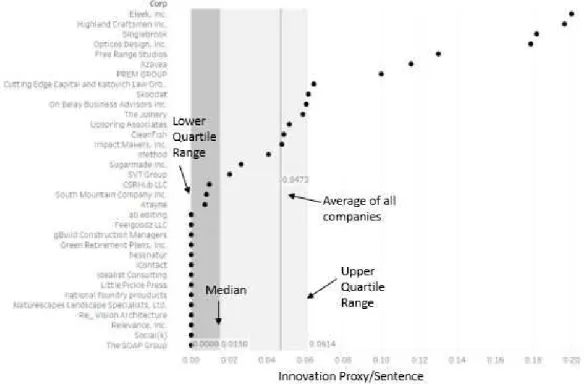
A. Average frequency of proxy words in a company’s sustainability communication Only 59%, of the B Corps in our sample had innovation proxies present,
compared with 97%, of the Forbes companies. Only 20 out of 34 sampled B Corps
contained innovation proxies; the average number of the innovation proxies/sentence was
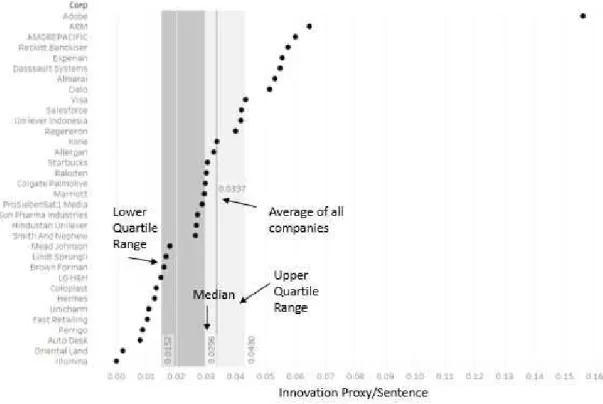
0.0473 proxies/sentence. 33 out of 34 of the sampled Forbes companies had innovation
proxies present; the average of the innovation proxies was 0.0337 proxies/sentence.
Average Frequency of Innovation in Sentences Per Company – B Corps
26
Average Frequency of Innovation in Sentences Per Company – Forbes
Figure 2: The average innovation proxy words per Forbes company. Each dot represents the innovation proxies for that firm standardized on communication length.
B. Average frequency of words indicating sustainability and words indicating innovation per sentence.
We found that roughly 44% of B Corps in our sample were communicating using
both innovation and sustainability proxies in the same sentence, compared to 85% of the
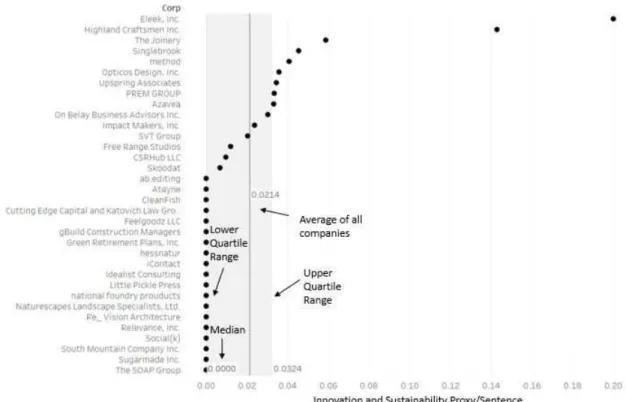
Forbes companies. Only 15 out of the 34 sampled B Corps contained any sustainability
and innovation matches; the average number of sustainability and innovation matches
was 0.0214 matches/sentence. 29 of the 34 sampled firms Forbes companies had
sustainability and innovation matches present; the average of the sustainability and
27
When comparing the combination of innovation and sustainability proxies
between B Corps and Forbes companies, the following graphs also display different
distributions around the median. For the B Corps, we see a larger concentration around
the median and the bottom half of the interquartile range is condensed due to this
clustering. However, for the Forbes companies, we see a much wider interquartile range.
Additionally, we see a larger spread of companies within the lower half of the
interquartile range due to the fact that less of these companies had no proxy match
present.
The fact that fewer of the B Corps included innovation concepts in their
sustainability communications as compared to the Forbes companies is reflective of the
observation in the literature that innovation-oriented firms often have innovation
competencies to support the integration of sustainability-oriented innovation in their
28
Average Frequency of Innovation and Sustainability Matches Per Company – B Corps
29
Average Frequency of Innovation and Sustainability Matches Per Company – Forbes
Figure 4: The average matches of sustainability proxy words to innovation proxy words within sentences per Forbes company. Each dot represents the matches for that firm standardized on communication length.
C. Average frequency of innovation words in a sentence surrounded by sustainability words in the sentence above or below
We found that 44% of the sample B Corps had proxies of innovation with nearby
sustainability, compared with 88% of the Forbes companies sampled. Only 15 out of the
34 did have matched innovation and sustainability proxies; the average of sustainability
and innovation matches was 0.0214 matches/sentence. For the Forbes company samples,
30 of the 34 sampled firms did have proxies of innovation with nearby sustainability; the
average number of matches/sentence was 0.0152.
Similar to the combination of innovation and sustainability proxies between B
30
sustainability proxies show a condensed bottom half of the interquartile range for B
Corps, represented below by the lack of the darker shaded region present in the Forbes
company graph.
Average Frequency of Innovation and Nearby Sustainability Per Company – B Corps
31
Average Frequency of Innovation and Nearby Sustainability Per Company – Forbes
Figure 6: The average innovation proxy matches with nearby sustainability words per Forbes company. Each dot represents the innovation proxy matches with nearby sustainability for that firm standardized on communication length
D. Average frequency of sustainability words in a sentence with nearby innovation words in the sentences above or below
We found that 41% of the B Corps sampled communicated using sustainability
proxies with nearby innovation, compared with 88% of the Forbes companies. Only 14
out of the 34 B Corps sampled had sustainability proxies with nearby innovation
matches; the average number of sustainability and nearby innovation matches was 0.0218
matches/sentence. 30 out of the 34 sampled Forbes companies had sustainability proxies
matched with nearby innovation; the average of the sustainability with nearby innovation
32
Like the combination of innovation and nearby sustainability proxies the graphs
for sustainability and nearby innovation proxies also show a condensed bottom half of the
interquartile range for B Corps, represented below by the lack of the darker shaded region
present in the Forbes company graph.
Average Frequency of Sustainability and Nearby Innovation Per Company – B Corps
33
Average Frequency of Sustainability and Nearby Innovation Per Company – Forbes
Figure 8: The average sustainability proxy matches with nearby innovation words per Forbes company. Each dot represents the innovation proxy matches with nearby sustainability for that firm standardized on communication length
E. Overall percentages by firm type
The following provides a comprehensive overview of the percentage of each firm
type with the given proxy combination present.
34
Percentage of firm type with different proxy combinations
B Corps
Forbes Companies Occurrence of innovation proxy words within
sentences
59% 97%
Occurrence of innovation and sustainability proxy within same sentence
44% 85%
Occurrence of innovation proxy words and nearby sustainability proxies
44% 88%
Occurrence of sustainability proxy words and nearby innovation proxies
41% 88%
35
V. DISCUSSION A. Presence of proxy words among firm types
When examining the average frequency of our innovation proxy words, we found
that innovation proxies were present in a larger percentage of the Forbes companies
compared with the B Corps, indicating that sustainability focused companies do not
integrate innovation within their sustainability literature as frequently as firms known for
their innovation. That B Corps do not include language indicating they are focused on
innovation as frequently as highly innovative firms such as the Forbes companies
indicates that, while B Corp certification is a relatively new and innovative process,
companies obtaining this certification may not be focused on sustainability as a driver of
innovation—or, at least, they are not explicating making this connection in their
sustainability-related communications.
That almost twice as many of the Forbes companies had sustainability proxies
matched in the context of nearby innovation proxies, compared to B Corps, indicates a
larger amount of Forbes companies may closely associate sustainability concepts with
innovation concepts. This finding could be reflective of a closer association between the
Forbes companies’ strategic approach to sustainability and their approach to innovation.
The analysis of their sustainability communication may imply that Forbes companies do
36
Rather than separating sustainability, they may see the potential for their innovation
competencies to advance sustainability objectives, and by doing so, also generate value.
This implies that these firms are not viewing sustainability as a simply a risk mitigation
or reputation management strategy. One may conclude that innovative companies more
frequently represent sustainability in the context of innovation. The relative consistency
between these two outcomes and the percentages of both firm types with innovation and
sustainability proxies bolsters the conclusion that more innovative companies integrate
innovation and sustainability in their sustainability communication than B Corps. The
consistent discrepancies in B Corps and Forbes companies between different proxy
combinations taken together, may indicate that more innovative companies have
sustainability-oriented communication than sustainability focused firms.
Multiple different things could be driving these findings. Companies that are
innovative may be using language of innovation to discuss sustainability because that is
the language they are familiar with. B Corps may also not be using language of
innovation to discuss their sustainability because they don’t feel like they need to explain
that they are innovative about sustainability because they are a firm type certified for
their sustainability. However, this disparity may also indicate that the lack of SOI
communication stemming from B Corps is reflective of a lack of sustainability-oriented
innovation within those firms. A lack of focus on innovation in B Corps may be reflective
of their overall smaller size, lack of diversity of revenue streams, or age. These
differences may impact B Corps’ capacity to invest in innovation. If they are not focusing
on innovation, mission-oriented companies such as B Corps may miss opportunities to
37
B. Limitations of Current Research and Recommendations for Further Academic Research
At this point the results do not have a strong enough p-value to claim with 95%
confidence that the average of normalized instances of the proxies (sustainability and
innovation matches, sustainability and nearby innovation, and innovation and nearby
sustainability) are distinctly different between firm types. Therefore, we can point to the
percentages of firms without any proxies and draw conclusions based on their lack of
integrated communication, but we cannot determine causation from the comparison of the
proxy distributions themselves. If we were to conduct a second study on this topic, it
could be worthwhile to expand the sample to a larger group of companies and then
randomly select samples within those companies from which to analyze measures of
sustainability and innovation. Additionally, it would be valuable to include performance
metrics to measure the impact of sustainability and innovation efforts in order to draw
stronger conclusions on implementation.
From these findings, there is the possibility of additional research to explore the
impact of SOI on profits. This study may be used to inform an actionable academic –
based guide for executives and marketing teams that helps them understand how to
effectively discuss innovation and sustainability with their stakeholders in a more robust
manner as well as informing their sustainability strategy to include high innovation
capital.
Or, alternative sustainability-oriented and innovation-oriented firm types could be
used. One additional way of comparing sustainability-oriented firms with
38
with Forbes Most Innovative Companies. This would have the added benefit of
containing a standardized third party measure of sustainability and innovation oriented
companies.
Research could also explore implementation of SOI. In order to examine
implementation, case studies and in depth analysis of B Corps and Forbes Most
Innovative Companies could occur through on site visits and practice observation. Given
that in general, the B Corps were younger companies, additional research could follow B
Corps in their implementation of SOI over time in a case study format to see how SOI
changes over the firm’s development. Companies could be compared by their financing
in order to examine how financial structure of firms impacts SOI. Research could also
explore expanding the sample size to include N-30 samples for different companies and
then sectioning them by industry and comparing for the presence of different types of
SOI such as product, process, and business model transformation. This would help
provide insights into different industry areas in addition to different implementation areas
of SOI.
Changes in content analysis could also provide new research opportunities. For
example, this study could be modified to focus on either a more expansive or more
constricted word list. Or, research could center on only the most common words that
showed up in this word list. Additionally, one could analyze different types of corporate
communication such as annual reports or email communications for the presence of SOI
rhetoric. Comparisons could be made between internal and external facing corporate
39 C. Implications for Firms
Further academic research on a toolkit for executives could have implications for
companies looking to reevaluate their sustainability communication in the context of
sustainability-oriented innovation. A toolkit could clarify actionable steps for executives
to engage in sustainability-oriented innovation.
B Corps
One potential implication for B Corps could be that they are not communicating
with their stakeholders with the same efficacy as the Forbes companies. This could imply
that they are not driving profits from their sustainability initiatives compared to Forbes
companies. However, it could also mean that they are simply not communicating in the
same way about their sustainability, but are engaging in sustainability-oriented
innovation nonetheless. Thus, B Corps could be acting in innovative ways but not
necessarily talking about the ways that their commitment to sustainability drives their
innovation. A reconsideration of the rhetoric they use may help B Corps better convey
their sustainability-oriented innovation to stakeholders. Alternatively, a reconsideration
of the relationship between sustainability and innovation may improve their profits if this
relationship has been previously neglected.
Forbes Companies
One potential implication of this study for Forbes companies could be that they
are communicating and effectively engaging in sustainability-oriented innovation. This
could imply that the profits of these companies are being driven by their sustainability
initiatives. On the other hand, it could mean that the Forbes companies are effectively
communicating about sustainability-oriented innovation but not engaging in it. Moreover,
40
are used to it, but not applying it to their sustainability initiatives. Consideration of
whether or not their communication matches their sustainability actions could help these
Forbes companies determine if their sustainability actions are driving profits or identify
41
CONCLUSION
In 1997, Hart lamented that “few companies have incorporated
sustainability into their strategic thinking” (p. 27). We have progressed from
1997, yet still face a dearth of intentional innovation guiding business
sustainability. Sustainability has the potential to be a juggernaut of innovation.
Yet, current research has not yet explored whether or not firm types with
capabilities in sustainability or innovation communicate about
sustainability-oriented innovation in their sustainability reporting. Through content analysis of
sustainability reporting, this study provides information on how many companies
from each sampled firm type use proxies that would tend to indicate the presence
of sustainability-oriented innovation in their sustainability reporting.
From our research, it is clear that many companies that are traditionally
good at sustainability may be failing to expand this core competency into an
innovation driver. Sustainability-oriented innovation is a great opportunity for
firms to learn how to better ideate for the future of sustainability, and achieve
42
APPENDIX Exhibit 1
Method of Identifying Proxies Example
Green – Sustainability Proxy Word
Purple – Innovation Proxy Word
43 Exhibit 2
Project Example of a Sentence with Both Innovation and Sustainability Counts Starbucks_Forbes42
Sentence 17
Sentence Text: “While some environmental targets have been more difficult to achieve than expected, we have learned from these challenges and are working to find innovative environmental solutions.”
Counts:
Innovation, Sustainability, S-I, Nearby Innovation, Nearby Sustainability, Nearby S-I
1 1 0 0 2 0
Exhibit 3
Original List of B Corps
Firm Name PREM GROUP
gBuild Construction Managers Pivotal Production LLC Green Retirement Plans, Inc.
Cutting Edge Capital and Katovich Law Group DeniseLawrence.Com, LLC (Pandora's Pantry) Impact Makers, Inc.
On Belay Business Advisors Inc. IPSOOFACTO, LLC
Rockstar CPA Idealist Consulting Azavea
Eleek, Inc.
Re: Vision Architecture
Praxis|Building Solutions, LLC Singlebrook
Rally Software Opticos Design, Inc. Green Design, Inc.
South Mountain Company Inc.
Naturescapes Landscape Specialists, Ltd. Skoodat
The Joinery iContact
Relevance, Inc.
44 Social(k)
Highland Craftsmen Inc. C-Level Management, Inc. The SOAP Group
Springleaf Strategies
CREATIVE ECONOMY ENTERPRISES TriLibrium
Parsons Public Relations Free Range Studios ab.editing Sugarmade Inc. Feelgoodz LLC SVT Group EcoNexus Hessnatur CleanFish VeeV Spirits Atayne Method
Little Pickle Press IdeaEncore Network national foundry products CSRHub LLC
Table 3: Original list of B Corps considered Exhibit 4
List of Firms Analyzed
Firm Name PREM GROUP
gBuild Construction Managers Green Retirement Plans, Inc.
Cutting Edge Capital and Katovich Law Group Impact Makers, Inc.
On Belay Business Advisors Inc. Idealist Consulting
Azavea Eleek, Inc.
Re: Vision Architecture
Praxis|Building Solutions, LLC Singlebrook
Opticos Design, Inc.
South Mountain Company Inc.
45 Skoodat
The Joinery iContact
Upspring Associates (formerly Social Enterprise Associates) Social(k)
Highland Craftsmen Inc. The SOAP Group
Free Range Studios ab.editing Sugarmade Inc. Feelgoodz LLC SVT Group hessnatur CleanFish Atayne method
Little Pickle Press
national foundry prouducts CSRHub LLC
Table 4: List of B Corps Analyzed in Content Analysis Exhibit 5
Original Forbes Companies
Company Tesla Motors Salesforce.com Regeneron Pharmaceuticals Incyte Alexion Pharmaceuticals Under Armour Monster Beverage Unilever Indonesia Vertex Pharmaceuticals BioMarin Pharmaceutical Amazon.com ARM Holdings Naver FleetCor Technologies Netflix
Shanghai RAAS Blood Products Rakuten
Asian Paints
46 Verisk Analytics Amorepacific Coloplast Marriott International Illumina Red Hat AmerisourceBergen Visa Sysmex Baidu Mastercard Hindustan Unilever Hermès International TransDigm Group Perrigo
The Priceline Group Adobe Systems Cerner
Ulta Salon Cosmetcs & Fragrance Chipotle Mexican Grill
Almarai
Fast Retailing Starbucks Unicharm
Sirius XM Radio Iliad
Magnit Autodesk
Tencent Holdings BesTV New Media Lindt & Sprungli
Reckitt Benckiser Group Cielo
Ctrip.com International Mead Johnson Nutrition Shimano
Kone
Dassault Systemes Expedia
47 Brown-Forman SBA Communications Essilor International Allergan Keyence Oriental Land
Tata Consultancy Services Intuitive Surgical
Fastenal
Roper Industries Smith & Nephew
Experian
Colgate-Palmolive Sun Pharma Industries
Table 5: Original list of Forbes companies considered Exhibit 6
List of Forbes Companies Used for Analysis
Company Salesforce.com Regeneron Pharmaceuticals Unilever Indonesia ARM Holdings Rakuten
LG Household & Health Care Amorepacific Coloplast Marriott International Illumina Visa Hindustan Unilever Hermès International Perrigo Adobe Systems Almarai Fast Retailing Starbucks Unicharm Autodesk
Lindt & Sprungli
48 Mead Johnson Nutrition
Kone
Dassault Systemes ProSiebenSat1 Media Brown-Forman Allergan Oriental Land Smith & Nephew Experian
Colgate-Palmolive Sun Pharma Industries
Table 6: List of B Corps Analyzed in Content Analysis Exhibit 7
54 Exhibit 8
Presence of S-I Proxies Graphs – B Corps
55 Exhibit 9
Presence of S-I Proxies Graphs – Forbes Companies
56
REFERENCES
Adams, R., Jeanrenaud, S., Bessant, J., Denyer, D., & Overy, P. (2016). Sustainabililty-oriented Innovation: A Systematic Review. International Journal of Management Reviews, 180-205. doi:10.1111/ijmr.12068
B Lab. (2017). bcorporation.net. Retrieved from bcorporation.net: https://www.bcorporation.net/ B Lab. (2017). What Are B Corps? Retrieved from bcorporation.net:
https://www.bcorporation.net/what-are-b-corps
Barsh, J., Capozzi, M. M., & Davidson, J. (2008). Leadership and Innovation . McKinsey Quarterly. Retrieved from http://www.mckinsey.com/business-functions/strategy-and-corporate-finance/our-insights/leadership-and-innovation
Bertrand, N. (2015, February 10th). The inspiring story behind the brownies in Ben & Jerry's most popular flavors. Retrieved from Business Insider:
http://www.businessinsider.com/ben-and-jerrys-greyston-bakery-workers-2015-2 Brown, S. (2016). Benefit Corporations: A Case Study in the. Business & Professional Ethics
Journal 35:2–3,, pp. 199–216. doi:10.5840/bpej2016122151
Charter, M., & Clark, T. (2007). Sustainable Innovation: Key conclusions from Sustainable Innovation. The Centre for Sustainable Design. Retrieved from
http://cfsd.org.uk/Sustainable%20Innovation/Sustainable_Innovation_report.pdf Coster, H. (2010, May 21st ). Danone and Grameen Bank: Partners In CSR And Marketing.
Retrieved from Forbes: The CSR Blog:
https://www.forbes.com/sites/csr/2010/05/21/danone-and-grameen-bank-partners-in-csr-and-marketing/#3795bce35a38
Dyer, J. H., Gregersen, H., & Christensen, C. M. (2009, December). The Innovator's DNA.
Harvard Business Review. Retrieved from https://hbr.org/2009/12/the-innovators-dna Epstein, M. J., & Buhovac, A. R. (2015, April 14th). How Sustainability Leaders are
57
Forbes. (2016). The World's Most Innovative Companies. Retrieved from Forbes: https://www.forbes.com/innovative-companies/list/#tab:rank
Friedman, M. (2002). Capitalism and Freedom (40th Anniversary Edition ed.). Chicago and London: University of Chicago Press.
Ginsberg, J. M., & Bloom, P. N. (Fall 2004). Choosing the Right Green Marketing Strategy.
46(1)
Global Reporting Initiative. (2015). Sustainability and Reporting Trends in 2025, Preparing for the Future. Global Reporting Initiative. Retrieved from
https://www.globalreporting.org/resourcelibrary/Sustainability-and-Reporting-Trends-in-2025-1.pdf
Goldschein, P., & Miesing, P. (2016). How Benefit Corporations Effectively Enhance Corporate Responsibility. Business & Professional Ethics Journal 35:2–3, pp. 109–128.
doi:10.5840/bpej2016121947
Hamel, G., & Tennant, N. (2015). The 5 Requirements of a Truly Innovative Company. Harvard Business Review.
Hart, S. L. (1997, January/February). Strategies for a sustainable world. Harvard Business Review.
Hiller, J. S. (2012). The Benefit Corporation and Corporate Social Responsibility. Journal of Business Ethics, 287–301. doi:10.1007/s10551-012-1580-3
Larson, A. (2010, January 20). Sustainability and Innovation: Frameworks, Concepts, and Tools for Product and Strategy Redesign. Retrieved from https://ssrn.com/abstract=1585607 Lovins, A. B., Loving, L. H., & Hawken, P. (1999). A road map for natural capitalism. (reprint
published 2000)
McDonough, W., & Braungart, M. (1998, October). The next industrial revolution. Atlantic Monthly.
McDonough, W., & Braungart, M. (2002). Cradle to cradle: Remaking the way we make things. New York: North Point Press.
MIT Sloan Management Review and The Boston Consulting Group. (2013). The Innovation Bottom Line: Findings from the 2012 Sustainability and Innovation Global Executive Study and Research Report. MIT Sloan Management Review.
Network for Business Sustainability. (2012). Innovating for Sustainability: A Systematic Review of the Body of Knowledge. Network for Business Sustainability. Retrieved from