Population Mobility and Livelihood Diversification among Indigenous Peoples of
the Ecuadorian Amazon
Jason Lee Bremner
A dissertation submitted to the faculty of the University of North Carolina at Chapel Hill in partial fulfillment of the requirements for the degree of Doctor of Philosophy in the Department of City and Regional Planning.
Chapel Hill 2013
Approved by:
Richard E. Bilsborrow
Clark Gray
Chiryath Suchindran
Pamela Jagger
ABSTRACT
Jason Lee Bremner: Population Mobility and Livelihood Diversification among Indigenous Peoples of the Ecuadorian Amazon
(Under the direction of Richard Bilsborrow)
Throughout the Amazon, new roads, infrastructure, oil pipelines, colonist settlements,
and mechanized agriculture, however, suggest an uncertain future for indigenous peoples.
Indigenous communities of the Amazon are undergoing intense socio-economic, demographic,
and cultural changes. There has been limited quantitative inquiry, however, into the determinants
of change occurring among indigenous populations. The primary objective of this research is to
examine the determinants of two important aspects of change occurring in indigenous
populations: the adoption of non-farm employment (often referred to as livelihood
diversification) and out-migration. Non-farm employment and out-migration may have
unforeseen impacts, both positive and negative, on families, communities, and resource
management institutions, and as such on the well-being of indigenous people and their lands. This research addresses the question, “What are the individual, household, and contextual factors
that lead indigenous households to decide to diversify livelihoods and participate in non-farm employment, or to have a member of the household move away temporarily or permanently?”
The research draws upon livelihoods and migration theories to examine population mobility
among the indigenous. Household and community survey data and multi-level models are
employed to make inferences about determinants of these important behaviors and their link to
ACKNOWLEDGEMENTS
This work is based on a project of the Carolina Population Center (CPC) at the University
of North Carolina in Chapel Hill, Richard E. Bilsborrow principal investigator. Funding for the
data collection was provided by the National Institutes of Health (HD038777-01-03) and was
conducted by Bilsborrow, co-investigator, Flora Lu, and a dedicated team of Ecuadorian
interviewers coordinated by Ana Oña, Ecuadorian anthropologist and Ecociencia. The Centro de
Estudios de Población y Desarrollo Social (CEPAR) in Quito processed data from the household
survey and community surveys. These data were further cleaned and analyzed at CPC with the
assistance of graduate students supported by traineeships funded by the National Institute for
TABLE OF CONTENTS
LIST OF TABLES………..ix
LIST OF FIGURES……….x
LIST OF ABBREVIATIONS……….xi
Chapter 1: Introduction .……..……….………...1
1.1 Motivation ……….1
1.2 Scope and method …...………..3
1.3 Organization ...………...4
Chapter 2: Indigenous populations and environmental change in the Amazon ...…...…..………..6
2.1 Introduction ...………...6
2.2 History of indigenous populations in the Amazon ………...7
2.3 Resurgence of indigenous populations ...………..…8
2.4 Indigenous peoples and environmental discourse ….………9
2.5 Markets, changing livelihoods, and out-migration ..………...11
Chapter 3: Conceptual framework ...………..15
3.1 Introduction ...………..15
3.2 The livelihoods framework ……….……15
3.2.1 Definitions and concepts ……….….15
3.2.2 Livelihood diversification ………20
3.3 Population mobility and livelihoods .………..25
3.3.2 Definitions and concepts ………..……27
3.3.3 Conceptual links between migration and the livelihoods framework ... 29
3.4 Challenges of adapting the livelihoods framework to Amazonian indigenous ....….31
3.5 Hypotheses ...………...32
Chapter 4: Research setting and data collection …..………...………..42
4.1 Introduction ...………..42
4.2 Research setting- Northern Ecuadorian Amazon ………42
4.3 The study population ...………47
4.4 Data collection and sampling ………..51
4.4.1 Ethnographic study ...………...52
4.4.2 Survey sampling ………...52
4.4.3 Survey data collection ………..54
4.4.4 Spatial data ………...56
Chapter 5 Methods ...……….57
5.1 Introduction ...………..57
5.2 Data processing ...………57
5.3 Methods for the study of livelihood diversification ………..…..58
5.3.1 Model of non-farm employment ………..………..…..59
5.3.2 Dependent variable …………...…………...………....60
5.3.3 Household independent variables ...………...…...61
5.3.4 Operational framework for livelihood diversification ...………..63
5.3.5 Variable construction ..……….66
5.4 Method for studying out-migration ...………..76
5.4.1 Data structure for event-history analysis of out-migration ...………...77
5.4.2 Model of out-migration ………...………...79
5.4.3 Dependent variable ……...………..….79
5.4.4 Independent variables ..……….………...80
5.5 Caveats and limitations related to data and methods …….……...………..82
Chapter 6 Descriptive results: demography, livelihoods, and migration ….……….84
6.1 Introduction ……….84
6.2 Household and community characteristics …………...………..84
6.3 Characteristics of alternate natural resource based livelihoods ...………...90
6.4 Characteristics of livelihood diversification ………...………95
Chapter 7 multivariate models of non-farm employment ...………101
7.1 Introduction ...………101
7.2 Exploratory analysis related to the dependent variable ...……….101
7.3 Construction of models of participation in non-farm employment ………...…...…103
7.4 Results of participation model ...………...106
7.5 Results of model of time allocated to non-farm employment ...………110
7.6 Discussion of non-farm employment results ...……….114
Chapter 8: Descriptive and multivariate analysis of out-migration ………...………...120
8.1 Introduction ...………120
8.2 Exploratory descriptive analysis of out-migration ………...……….120
8.3 Construction of models of outmigration ………...………126
8.5 Discussion of the out-migration results ...……….133
Chapter 9: Conclusion, policy implications, and limitations ...………...135
9.1 Summary of key findings …...………...135
9.2 Policy implications ………...……….138
9.3 Limitations ...……….139
LIST OF TABLES
Table 1. Hypothesized relationships between independent variables and outcomes ………33
Table 2. Population distribution of the NEA by province in 2001 ……….….…...46
Table 3. Deforestation estimates for South America 1990-2010 ….………...47
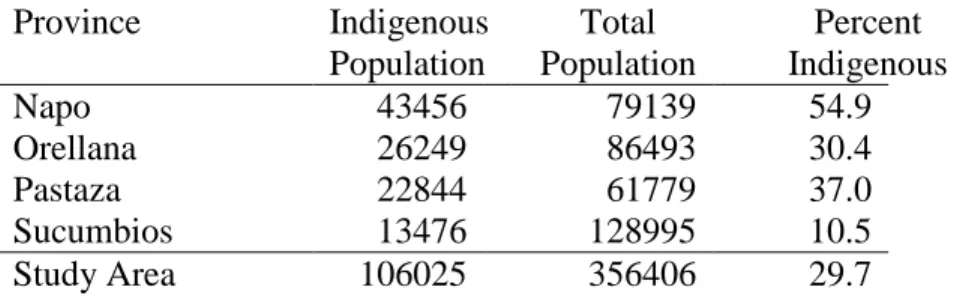
Table 4. Indigenous populations of the NEA by province in 2001 ………...48
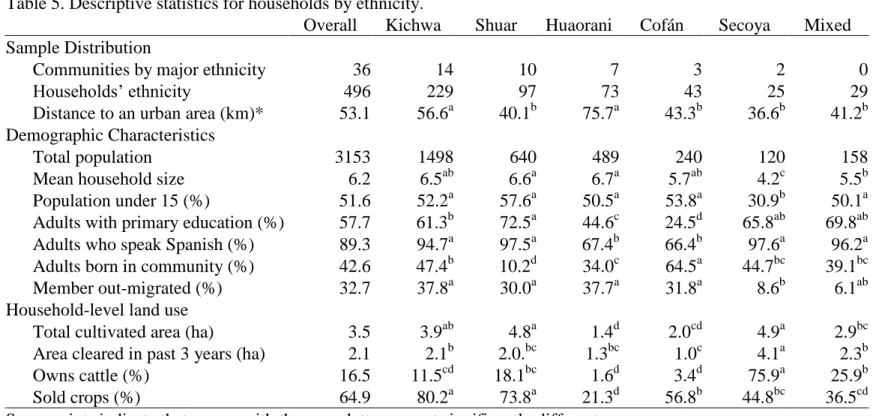
Table 5. Descriptive statistics for households by ethnicity .………..………86
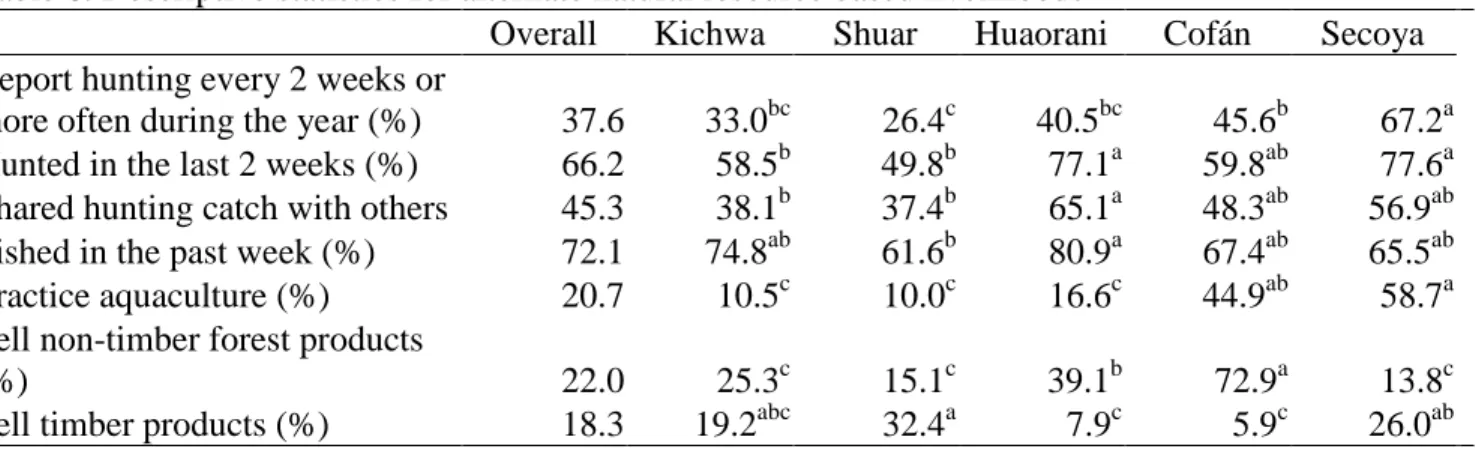
Table 6. Descriptive statistics for alternate natural resource based livelihoods ……….…...92
Table 7. Descriptive statistics for household livelihood diversification ……...96
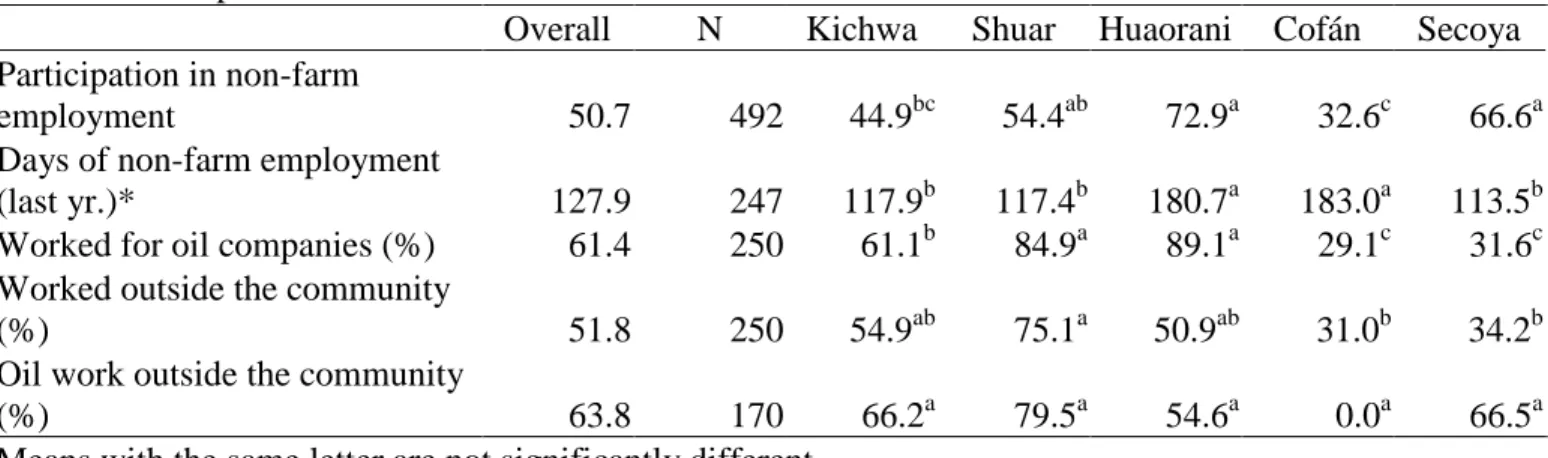
Table 8. Descriptive statistics for individuals participating in non-farm employment ………...100
Table 9. Characteristics of households by participation in non-farm employment ………102
Table 10. Results of model of participation in non-farm employment …….………..107
Table 11. Results of model of time spent in non-farm employment ………..112
Table 12. Characteristics of out-migrants by gender ,……….122
Table 13. Characteristics of the migration event …….………...125
LIST OF FIGURES
Figure 1. A conceptual framework of livelihood diversification .……...18
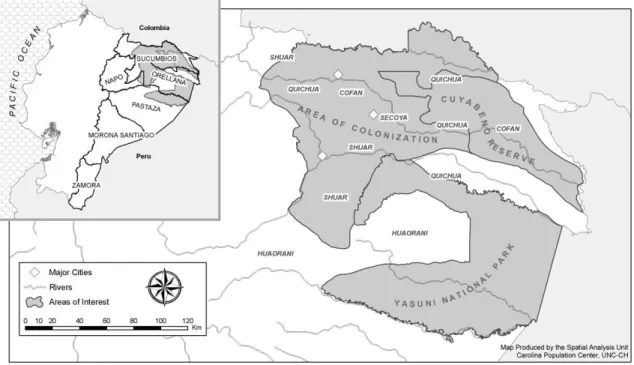
Figure 2. Map of the study area showing locations of indigenous populations ………..……...43
Figure 3. Operational framework for model of non-farm employment ………..………...65
LIST OF ABBREVIATIONS
CEPAR- Centro de Estudios de Población y Desarollo Social
DIFD – Department for International Development
FAO – Food and Agriculture Organization of the United Nations
GPS- Global Positioning System
GIS- Global Information System
GLLAMM – Generalized Linear Latent and Mixed Models
INEC- Instituto Nacional del Census
NEA - Northern Ecuadorian Amazon
NELM- New Economics on Labor Migration Theory
NFTPs- Non-Timber Forest Products
TFR - Total Fertility Rate
Chapter 1
Introduction
1.1 Motivation
The Upper Amazon Basin remains largely undeveloped and is part of the larger Amazon
Major Tropical Wilderness Area, one of the largest remaining continuous tropical forests left on
the planet (Mittermeier 2003; Myers et al. 2000). Conservation of the Amazon Basin is of
international significance for several reasons. First, the Amazon likely contains the greatest
amount of plant and animal biodiversity on the planet; second, the Amazon is important for
global climatic processes and carbon cycles, and finally, indigenous and traditional forest people
depend on the forest for their livelihoods.
Since the 1970’s, however, the Amazon basin has experienced rapid development and
deforestation. Despite more than a decade of effort by local and international conservation
groups and governments, annual rates of forest loss in the Amazon during the last decade were
among the highest on record (INPE 2011). Deforestation in much of the Brazilian Amazon
appears to follow a path of logging, pasture for cattle ranching, and conversion to agriculture for soybean production (Brown et al 2005), and Brazil is now the world’s largest producer of
soybeans and second largest producer of beef behind the United States (USDA/FAS 2012a;
USDA/FAS 2012b). The conservation of remaining forests becomes increasingly important as
agricultural landscapes in the Amazon grow and increasingly threaten the functioning of the
Indigenous populations have inhabited the Amazon for millennia, and still populate most
of the remaining areas of tropical forest. After decades of population decline, indigenous
populations of the lowland tropics of Latin America are experiencing an apparent demographic
turnaround and are now increasing in size (Bremner et al., 2008; Kennedy and Perz 2000;
McSweeney and Arp 2005, Perz et al, 2008). At the same time indigenous populations in many
parts of Latin America have become increasingly prominent actors in local, national, and
international politics (Laurie et al. 2005; Perreault 2001; Perreault 2003; Valdivia 2007; Yashar
2004; Yashar 1999; Yashar 1998). There has also been a trend in international environmental discourse favoring “traditional knowledge” and indigenous agroforestry as models for
environmental conservation (Valdivia, 2005).
Together, the population growth, political activism, and increased attention from
environmentalists can be thought of as a resurgence of indigenous populations. At the same time
indigenous groups have gradually gained legal land rights to their lands, and are considered a
critical barrier to future deforestation (Fearnside 2003; Nepstad et al. 2006; Schwartzman and
Zimmerman 2005;).
Throughout the Amazon, new roads, infrastructure, oil pipelines, colonist settlements,
and mechanized agriculture, however, suggest an uncertain future for indigenous peoples. Case
studies reveal that indigenous communities of the Amazon are undergoing intense
socio-economic, demographic, and cultural changes (Godoy et al 2009; Godoy et al 2005; Rudel et al.
2002a; Lu 2001; Godoy et al 1997; Heinrich 1997). There has been limited quantitative inquiry,
however, into the determinants of change occurring among indigenous populations at the
household level. Existing studies typically suffer from small samples of communities and
1997; for exceptions see Godoy et al 2009; Godoy et al 2005; and Godoy et al 2001; Gray et al
2008). Successful conservation/development policies that conserve biodiversity, promote
sustainable livelihoods, and improve the lives of indigenous peoples depend on a better
understanding of the complex dynamic of demographic, ecological, socio-economic, and cultural
factors influencing indigenous resource use and livelihoods. Furthermore, such knowledge must
be gathered at multiple scales including the individual, household, and community.
1.2 Scope and method
The primary objective of this dissertation is to examine the determinants of two important
aspects of change occurring in indigenous populations: the adoption of non-farm employment
(often referred to as livelihood diversification) and out-migration. Non-farm employment and
out-migration may have unforeseen impacts, both positive and negative, on families,
communities, and resource management institutions, and as such on the well-being of indigenous people and their lands. This research addresses the question, “What are the individual,
household, and contextual factors that lead indigenous households to decide to diversify
livelihoods and participate in non-farm employment, or to have a member of the household move away temporarily or permanently?”
Prior research related to livelihood diversification and migration has not specifically
examined indigenous populations. In the Ecuadorian Amazon, non-farm employment is now an
important livelihood strategy for indigenous households. Approximately, 50% of households
surveyed for this research had participated in non-farm employment during the past year, and
among one particular ethnic group, more than 80% of households had participated in wage
Out-migration of young members of the household to urban areas or to other rural areas
for employment is also a common livelihood strategy for individuals and households. Among
the indigenous households surveyed for this research, approximately one third reported that a
member of the household had out-migrated from the community. Approximately one third of the
out-migrants had moved to cities in the region, with the majority of these being young people
seeking employment or education.
Because past research has shown that livelihoods vary greatly according to location,
assets, social relations, and opportunity (Ellis 1998), proper understanding of the livelihood
diversification process among indigenous populations requires analysis at multiple levels. I
suspect that indigenous households respond to changes in different ways related to their assets,
capabilities, and available opportunities, and that these responses are mediated at the community
level by social institutions and local context. Furthermore, I expect that different ethnic groups
will show different levels of participation in non-farm employment and out-migration even when
controlling for household and community-level determinants. As such, this study will highlight
the importance of multi-level and cross-cultural analysis when studying livelihoods.
1.3 Organization
This dissertation is organized into chapters and subsections. The second chapter is a
review of select literature on the history of indigenous populations in the Amazon and a more
complete review of literature on recent social and environmental change among Amazonian
indigenous people. Purposefully omitted from this review is the rich ethnographic literature
coming from cultural anthropology focused on the character of indigenous societies of the
introduces the livelihoods framework as a useful approach, reviews the bodies of literature on
livelihood diversification and population mobility and finds commonalities between the two, and
presents a conceptual framework and hypotheses for the research question of this dissertation.
Chapter 4 describes the study area and study population, as well as the sampling and data
collection. Chapter 5 describes the methods used for this research, the data processing that was
required and resulting data structure, and the specific models used for the study of livelihood
diversification and out-migration. Chapter 6 presents descriptive results for the study population,
their livelihoods, and their migration. Chapter 7 contains multivariate statistical results and
discussion related to livelihood diversification, and Chapter 8 contains the statistical results and
discussion related to out-migration. Chapter 9 compares the results from the two different
models of livelihood strategies, draws conclusions from the findings, assesses policy
Chapter 2
Indigenous populations and environmental change in the Amazon
2.1 Introduction
Cultural anthropologists have studied indigenous populations for decades and there is a
rich body of ethnographic literature that documents the cultural practices and resource use of
many of the ethnic groups of the Amazon. While valuable in its own right, a literature review of
Amazonian ethnography is beyond the scope of this dissertation. The goal of the chapter is to
provide context for the current socio-political environment facing indigenous populations in the
Amazon and to discuss recently observed changes occurring among these populations.
Chapter 2 is divided into four parts. The first section discusses the history of early
contact of indigenous populations in the New World and the rapid changes and decline that
occurred as indigenous populations succumbed to exploitation and disease. The second section
discusses the resurgence of indigenous populations both politically and demographically. The
third section focuses on past and present environmental discourse regarding indigenous peoples.
The final section reviews literature more specific to recent changes occurring among indigenous
populations, focusing specifically on literature related to market integration, migration, and land
2.2 History of indigenous populations in the Amazon
Relatively little is known about Pre-Columbian Indigenous Amazonian populations, but
estimates of the size of the indigenous population in all of Latin America prior to 1492 range
widely from a low end of just under 10 million to a high end estimate of over 100 million
(Denevan 1972). The validity of these estimates (particularly the high end) has been called into
question (Henige 1998), but regardless of the estimate, the rapid decline of indigenous
populations in the Americas following contact with Europeans is well documented. During the
sixteenth and seventeenth century, disease, enslavement, and conflict ravaged indigenous
populations (Cook 1998; Sánchez-Albornoz 1974; Verano and Ubelaker 1992; Whitmore and
Turner 1992), and by the late eighteenth century indigenous populations in many areas likely
reached their historic low points (Denevan 1972). Because of the variability of initial estimates
of the indigenous population, it is difficult to assess the overall scale of this population decline; hence it is difficult to compare today’s indigenous population with past figures.
The spiraling decline in numbers was accompanied by other gradual but radical changes,
including: the coerced or forced settlement of nomadic groups, the adoption of Christianity, the
amalgamation of some groups, and the adoption of a lingua franca. These changes resulted in an
indigenous population that by the mid-twentieth century was largely disenfranchised and
powerless locally, regionally, and nationally. Indigenous populations have now experienced
changes spanning centuries and as such contemporary research should think of current changes
2.3 Resurgence of indigenous populations
Data from the censuses throughout Latin America indicate that after decades of
population decline, indigenous populations of the lowland tropics of Latin America are
experiencing a demographic turnaround (Kennedy and Perz, 2000; McSweeney and Arps, 2005,
Perz et al., 2008). The demographic growth appears to be caused by high fertility rates and
declining mortality rates as well as an increase in the numbers of people who report themselves
to be indigenous (McSweeney and Arps, 2005; Perz et al., 2008). A recent study of fertility rates
among 15 indigenous populations in the Amazon reported a mean total fertility rate of 7.5 (TFR)
with groups ranging from 3.9-10.5 (McSweeney and Arps, 2005). In the Northern Ecuadorian
Amazon (NEA) the TFR in 2001 for the indigenous population was estimated to be 8.31
(Bremner et al., 2008), which is substantially higher than the rate in rural Ecuador (4.4) or among
rural mestizos in the NEA (5.0) (Carr et al., 2006). The reasons for this high fertility have not
yet been explored, however it is likely that declines in mortality rates along with this high
fertility have contributed to a large proportion of indigenous population growth.
At the same time, Perz et al. found that people in Brazil are now more likely to report
themselves as indigenous when asked about ethnicity in the national census than they were ten
years ago (2008). The reasons for this phenomenon are not yet entirely clear. Valdivia reports
that neoliberal reforms and struggles for social justice and environmental conservation have led
to changes in indigenous identity (Valdivia, 2005), which perhaps impacts the legitimacy of
representing oneself as indigenous.
This resurgent indigenous identity and the accompanying struggles for social justice and
environmental conservation have led to growing roles for indigenous people in local, national,
and international politics (Laurie et al., 2005; Martin, 2003; Perreault, 2001; Perreault, 2003;
Valdivia, 2007; Yashar, 2004; Yashar, 1999; Yashar, 1998). This indigenous resurgence has
been accompanied by increased legal recognition of indigenous land rights. Throughout the
Amazon, indigenous groups are increasingly gaining legal rights to their ancestral lands. These
rights have generally taken the form of three main tenure types: indigenous reserves under which
an indigenous group is given legal communal land title to large areas containing multiple
communities; community tenure in which communities are given legal title through customary
land tenure laws established for colonists; and finally protected areas, under which the state
maintains public ownership of land in protected areas but grants legal use rights to indigenous
inhabitants (Richards, 1997). Through these different tenure types, indigenous lands now
encompass the single largest category of protected area in the Amazon, and indigenous lands
have been touted as a critical barrier to future deforestation (Fearnside, 2003; Nepstad, 2006;
Schwartzman and Zimmerman, 2005).
2.4 Indigenous peoples and environmental discourse
While some see indigenous peoples as key to the future of Amazon forests, the role of
indigenous peoples in conservation has long been highly debated in the conservation literature.
This debate has tended to dwell on whether or not indigenous peoples are inherently
conservationists (Alcorn, 1993; Carneiro da Cunha, 2000; Colchester, 2000; Peres, 1994;
Redford and Stearman, 1993a, 1993b; Terborgh, 2000). Critics of indigenous lands as
conservation areas assert that dispersed and small population size; small-scale agriculture,
hunting, fishing, and gathering of non-timber forest products; “traditional” technologies; and
van Schaik, 1997; Oates, 1999; Smith, 2001; Terborgh, 2000). They claim that as these
characteristics change, so too will indigenous environmental stewardship. In contrast,
proponents of indigenous lands emphasize that indigenous peoples have strong connections to
and knowledge of ecosystems (Posey & Balée, 1989); that they deter encroachment by outsiders
(Alcorn, 1993); and that they are key conservation allies (Brechin et al, 2002). Despite this
debate, many conservation organizations now recognize the importance of working with
indigenous people, and several of the largest international organizations have created specific
indigenous peoples programs or explicitly focus on the role of indigenous peoples in
conservation, including but not limited to: World Wildlife Fund for Nature, Conservation
International, Wildlife Conservation Society, and the International Union for the Conservation of
Nature.
For the most part, environmental discourse on indigenous peoples, however, has tended
to rely on little empirical data, in part because of limited empirical studies comparing indigenous
land uses and livelihoods with other users. Recent research, however, has begun to shed light on
indigenous land use. Using an extensive collection of satellite imagery, researchers confirmed
that indigenous areas have, over the last several decades, been protective overall of forests
(Nepstad et al., 2006). Recent research comparing colonist and indigenous land use through a
combination of satellite imagery and household surveys in the Ecuadorian Amazon, also found
that deforestation and forest fragmentation are significantly greater for colonists than indigenous
households (Lu et al., 2010).
There is still relatively little understanding, however, of how indigenous lives,
livelihoods, and social structures are changing, and whether these changes will impact
structures, such as communal tenure arrangements and indigenous federations that shape
Amazonian indigenous peoples’ patterns of resource use. Also largely absent from the discourse
are discussions about changing mobility patterns among indigenous peoples, and the impacts
these changes might have on households, institutions, and indigenous lands.
2.5 Markets, changing livelihoods, and out-migration
Changing livelihoods and changing mobility patterns may have unforeseen impacts, both
positive and negative, on families, community institutions, and the well-being of indigenous
peoples. The most commonly cited definition of a livelihood is the following:
“A livelihood comprises the assets (natural, physical, human, financial, and social capital), the activities, and the access to these (mediated by institutions and social relations) that altogether determine the living gained by the household or individual.” (Ellis, 2000)
Prior research on livelihoods has not specifically examined indigenous populations, though there
is a body of literature focused on the concept of market integration, which overlaps conceptually
with the literature on changing livelihoods. Cultural anthropologists have examined the socio-cultural, demographic, and economic impacts of indigenous people’s interaction with markets.
Some of the many changes occurring as indigenous peoples increasingly interact with markets
include: changes in land use (Godoy, et al., 2000; Godoy et al., 1997; Henrick, 1997; Rudel et
al., 2002), dependence on forest-products (McSweeney, 2004), food sharing (Lu, 2001),
settlement patterns (Rudel et al., 2002), and consumption preferences (Henrich, 1997). In
general the process of market integration has been depicted as negative for indigenous peoples,
and some of the suggested impacts have included: loss of cultural traditions, knowledge, and
Only more recently have anthropologists become concerned with questions of why, if
faced with these negative consequences, indigenous peoples participate in markets (Godoy,
2001). The process through which indigenous people increasingly interact with markets is often
referred to as market integration. The concept of market integration however, is measured in
variable ways and is inconsistently defined (Lu, 2007). Godoy et al. (2005) conceptualize a
linear continuum of market integration, with autarky or complete self-sufficiency at one end of
the spectrum and complete dependence on markets at the other. Importantly, they note that
people often shift in both directions along this spectrum as opportunities and limitations come
and go (Godoy et al., 2005). The idea of shifting along a spectrum of market integration fits well
with the dynamic nature of livelihoods in which seasonally and annually, livelihoods may change
according to available assets, opportunities, and mediating contextual factors.
There have been some notable works in the anthropological literature that have explored
the determinants of market integration (Gross et al, 1979; Henrich, 1997). Gross et al. (1979)
looked specifically at circumscription or the pressure of outsider encroachment on subsistence
production as the factor forcing indigenous people to seek sources of food in markets. Henrich
(1997) argued that market participation by the Machiguenga in the Peruvian Amazon was not
compelled by external forces but instead that the Machiguenga were eager participants in the
market and seeking opportunities to participate. Godoy et al. (2005) propose that both push
factors (population pressure and circumscription) and pull factors (desire to increase
consumption, the desire to diversify and thus smooth consumption, and the allure of
foreign/modern goods) be considered in the study of the determinants of market integration.
Godoy (2001) explores a few prominent theoretical explanations on why people
the Gross et al model. He suggests that theory on the determinants of market integration should
borrow from each of these while also incorporating ideas of comparative advantage from
macroeconomics and household economic behavior from microeconomics (Godoy 2001).
Unfortunately, while Godoy discusses the importance of an integrated theory on the determinants
of market integration, he does not clearly lay out a conceptual framework.
Godoy (2001) in his research on market integration makes important contributions to our
understanding of livelihood diversification among indigenous peoples. First, as mentioned
above, he conceptualizes market integration as a bi-directional process, suggesting that
indigenous households may respond to market opportunities (non-farm employment
opportunities and changing agricultural prices) when they are present, and return to subsistence
when those opportunities cease to exist. Second, he proposes several hypotheses related to the
determinants of market integration, which overlap with ideas of risk management, seasonality,
labor markets, and coping behavior from the livelihoods framework. Third, he focuses on
households as his unit of analysis, which is in contrast to much past work among anthropologists,
which has tended to focus on communities or at a larger scale, particular indigenous groups
(Chagnon, 1997; Early and Peters, 1990; Gross et al, 1979; MacDonald, 1999; Ziegler-Otero,
2004). This is important because it recognizes heterogeneity within communities in terms of
diversification, and allows us to consider the social and political context in which household
decisions are made. As has been noted, social relations and institutions at the household level,
community level, ethnic group level, or higher level may all play a role in mediating livelihood
decisions.
This dissertation contributes to the literature on indigenous livelihoods because to date
may be that by participating in non-farm employment, indigenous households are able to
experiment with markets and gain access to capital through minimal monetary investment. Other
market activities such as cash cropping, timber, and cattle ranching may require greater initial
costs in terms of financial capital (cash or credit), physical capital (equipment), and human
capital (in terms of labor and knowledge of new agricultural systems). Thus we might
hypothesize that local non-farm employment is seen as a low cost way to generate cash income
in comparison with intensification or extensification of land uses. Conversely, non-farm
employment might be an activity with high costs since it could require an extended absence from
the household as well as Spanish language skills, and makes individuals vulnerable to
exploitation by employers.
Another form of diversification not explored in the market integration literature is
permanent out-migration. Similar to non-farm employment, we might hypothesize that the
financial, physical, and human capital costs for out-migration might be less than those required
for shifts in land use, but the costs must exceed those of non-farm employment. Thinking in this
manner of different activities (subsistence and market agriculture, hunting and fishing, non-farm
employment, etc.) as a group of dynamic strategies that shift in importance according to changes
in assets and opportunities demands a closer examination of the livelihoods concept. Chapter 3
will focus on the livelihoods concept and livelihoods literature, which is useful for
Chapter 3
Conceptual framework
3.1 Introduction
This chapter is divided into four parts. First, a more specific definition for the concept of
a livelihood is introduced and a conceptual framework for livelihood analysis is presented. The
second section reviews literature on the determinants of livelihood diversification. The third
section reviews the literature on population mobility and its determinants, and discusses
commonalities between that literature and the livelihoods literature. The final section presents a
conceptual framework for the research question of this dissertation.
3.2 The livelihoods framework
3.2.1 Definitions and concepts
The rural livelihoods approach is a conceptual framework that holds promise for
improving understanding of the changes occurring among indigenous populations, and
potentially for answering the research question of this dissertation, ““What are the individual,
household, and contextual factors that lead indigenous households to decide to diversify
livelihoods and participate in non-farm employment, or to have a member of the household move
away temporarily or permanently?”. The livelihoods concept was originally developed and
defined by Chambers and Conway (1992) and was further developed by Scoones (1998) and
“A livelihood comprises the assets (natural, physical, human, financial, and social capital), the activities, and the access to these (mediated by institutions and social relations) that altogether determine the living gained by the household or individual.” (Ellis, 2000)
A household in this context is defined as those individuals forming a social group that resides
together in the same residence or dwelling and can be considered to be pooling resources for
daily consumption2. The focus on the household as the primary unit of analysis, however, does
not preclude considering characteristics of individuals living within households as well as
higher-level contextual characteristics (Ellis, 2000).
In the definition of a livelihood, natural capital refers to the natural resources available
for livelihood activities. Physical capital refers to assets created through the economic
production process, such as tools, machinery, or land improvements such as roads or irrigation
canals. Human capital refers to the education level, work skills, and health status of individuals.
Financial capital refers to available financial resources (cash, credit, or collateral) that can be
accessed in order to purchase production or consumption goods. Finally, social capital refers to
the social networks and associations that people participate in and that can support or inhibit
livelihoods (Ellis, 2000). Not explicit in this definition, but an important aspect of the livelihood
concept, is the idea that a livelihood is a dynamic set of activities that may change seasonally
according to available opportunities and available assets, or change from year to year in relation
to economic trends, exogenous shocks, and changing social institutions (Ellis 1998; 2000;
Scoones, 1998).
The terms livelihood and income are linked but not synonymous. The concept of a
livelihood refers to both the cash earning component of income and the non-monetary
contributions to income that come from subsistence production, payments received in kind, and
transfers and exchanges between households. The combination of cash income and
non-monetary income, which constitutes a livelihood, can be subdivided into different sources or
activities. The list of livelihood activities that rural households depend upon is lengthy and may
include: agriculture and other natural resource activities (cash crops, subsistence crops, cattle
ranching, hunting, fishing, logging, and collecting of non-timber forest products), farm
employment (working as an agricultural laborer on someone else’s farm), non-farm work (wage
employment and self-employment not related to agriculture), and migrant remittances. In the
simplest conceptualization, households are thought of as constructing livelihoods through
decisions about farm intensification and extensification, by deciding to diversify and include
non-farm employment activities, or by migrating away temporarily or permanently to seek a
livelihood elsewhere.
Common in the literature is the idea of diverse livelihoods, which addresses the fact that
it is common for rural households to develop diverse sets of livelihood activities. Reviews of the
livelihoods literature from Africa (Barrett et al, 2001; Ellis, 1998; Reardon, 1997) and Latin
America (Reardon et al, 2001; Swinton et al, 2003) suggest that diverse rural livelihoods are the
norm. A diverse livelihood directly conflicts with past tendencies by rural development
professionals to categorize rural households according to a single occupation (e.g.
agriculturalists, fisherman, agricultural laborers, etc.) (Chambers, 1995).
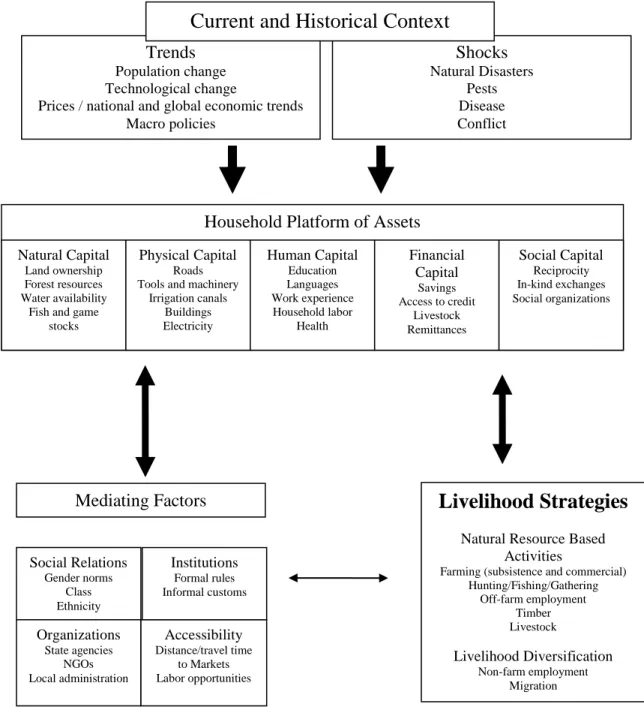
A graphical representation of the livelihoods framework is useful for organizing key
concepts. The framework depicted in Figure 1 was developed by Scoones (1998) and later
adapted by Ellis (2000). I have adapted the framework slightly to include livelihood
diversification and migration as possible livelihood activities.
Figure 1. A conceptual framework of livelihood diversification. Adapted from Ellis (2000)
Household Platform of Assets Trends
Population change Technological change
Prices / national and global economic trends Macro policies Shocks Natural Disasters Pests Disease Conflict
Current and Historical Context
Natural Capital
Land ownership Forest resources Water availability
Fish and game stocks
Physical Capital
Roads Tools and machinery
Irrigation canals Buildings Electricity Human Capital Education Languages Work experience Household labor Health Financial Capital Savings Access to credit
Livestock Remittances Social Capital Reciprocity In-kind exchanges Social organizations Social Relations Gender norms Class Ethnicity Institutions Formal rules Informal customs Organizations State agencies NGOs Local administration Accessibility Distance/travel time to Markets Labor opportunities
Mediating Factors
Livelihood Strategies
Natural Resource Based Activities
Two aspects of the figure not yet discussed are current and historical context and
mediating factors. Both historical and contextual factors may play an important role in
determining the livelihood strategies chosen by households. As such, research on livelihoods
should consider both household variables and higher-level variables at the community and
regional levels. Moreover, ideally livelihoods research should include longitudinal data or
retrospective data to account for historical factors that may play a role in determining current livelihood activities. Additionally, it is important to note that a household’s livelihood activities
may be mediated by other factors. Gender norms for women, for example, might preclude the
adoption of certain livelihood activities by women in spite of opportunities and the platform of
available household assets. Similarly, social institutions such as common property regimes could
create formal rules limiting forest resource use that could influence a household’s decision to
adopt forest-based livelihood activities. Other important considerations are the role of external
organizations and accessibility in determining livelihood activities. Hence, mediating factors
also suggest the need for data from multiple levels, but also point to the challenge of considering
the role of complex social relations and institutions in livelihood models.
The livelihoods framework currently dominates development discourse. Bilateral,
multilateral, and non-governmental development organizations such as the United Kingdom
Department for International Development (DIFD), the United Nations Development Program
(UNDP), the Asian Development Bank , and CARE all have missions or approaches that
specifically focus on sustainable livelihoods as a means of alleviating poverty. The livelihoods
framework has also become a prominent topic of academic research. A simple literature search using the term “livelihoods” in Web of Science results in over 1500 articles and spans a diverse
Geographers, Food Policy, and Marine Policy, to name a few. Some of this research has focused
on the value of the framework for analyzing rural poverty (Bebbington, 1999; Chambers, 1995).
Another focus of livelihoods research has been the analysis of changes in livelihoods, most
specifically the diversification of rural livelihoods to include non-farm income (Barrett et al.,
2001; Ellis, 2000; Reardon, 1997; Reardon et al. 1992). Environmental discourse and research
have also focused on the livelihoods framework, and there are many studies analyzing the
creation of sustainable livelihoods as a means of mitigating environmental impacts of rural
livelihoods while alleviating rural poverty (Coomes and Barham, 1997; Coomes et al., 2004;
Sunderlin et al., 2005; Takasaki et al., 2001)
3.2.2 Livelihood diversification
Livelihood diversification refers to the process by which households adopt a new
portfolio of livelihood activities in order to better their standard of living or minimize their risk
(Ellis 1998). In practice, however, livelihood diversification is most frequently used to imply
diversification away from farming as the predominant means of rural survival (Ellis, 2000;
Reardon, 1997). Studies of rural households in Africa have identified non-farm employment as
the most prominent form of livelihood diversification (Ellis, 1998; Reardon, 1997). Likewise,
studies in Latin America in the 1990’s indicated that rural non-farm income on average
accounted for 40% of household income (Swinton et al, 2003). A study in Peru from 1985-1997
found that non-farm income accounted for 51% of total rural household income (Escoval, 2001).
found that 55% of colonist households engaged in off-farm employment (Bilsborrow et al.,
2004).3
One necessary clarification is that the process of diversification away from farm activities
may not necessarily lead to a more diverse livelihood. For example, a household receiving 80%
of its income and subsistence from farm activities and 20% from non-farm sources may decide to
change livelihood activities to obtain only 20% from farm activities and 80% from non-farm
activities. In this case, it can be argued that livelihood diversification is used as a substitute for
farm activities but does not lead to a more diverse livelihood. Thus, livelihood diversification
should be clarified as simply referring to the shifting away from farm and natural resource based
activities, which does not always lead to a more diverse livelihood.
Further clarification is also needed regarding the use of the terms non-farm employment
and off-farm employment. These terms are often interchanged in the literature, though
conceptually are not necessarily equivalent. A complete discussion of the differences between
non-farm and off-farm employment can be found in reviews of livelihood diversification (Ellis
1998, 2000; Reardon, 1997). Non-farm employment is most often defined as all activities
outside of the agricultural sector regardless of location. These activities include: employment in
rural non-farm labor, self-employment in the local non-farm sector, rental income from leasing
land or property, and migrant remittances. Off-farm employment as defined by Ellis (2000)
refers only to employment as a farm laborer. Part of the confusion related to these definitions is
that Barrett et al. (2001) define off-farm employment very differently in their conceptual review
of livelihood diversification. Barrett et al (2001) define off-farm employment according to
location; hence an activity of any type that takes place away from the home farm is considered
off-farm employment. While in past research myself and others working on the NEA project
have relied on the spatial aspect of the off-farm employment definition (Barbieri, 2005; Bremner
et al, 2005; Pan et al, 2004), for this research I have returned to the definitions of non-farm and
off-farm employment originally proposed in the livelihoods framework. The specific operational
definition of non-farm employment used for modeling in this dissertation is described in greater
detail in Chapter Five, but in brief, I conceptualize non-farm employment as a shift away from
natural resource based-livelihoods regardless of location.
As was mentioned above, many studies have analyzed the shift away from agrarian
livelihoods and towards non-farm employment. In general, findings from studies on the
determinants of livelihood diversification attribute the decision to both push and pull factors
(Barrett et al. 2001). Similarly, the decision is conceptualized as being associated with factors
related to necessity versus choice (Ellis, 2000). Push or necessity factors might include
diminishing returns of an activity, financial or agricultural policies, environmental crisis, land or
credit constraints, and absence of markets, while pull or choice factors might include emerging
labor markets, seasonality of production activities, availability of new technologies and/or skills,
or changing consumption preferences (Scoones, 1998). This dichotomy, while useful as a
conceptual tool, does not expose the complexity of local circumstances that contribute to
livelihood diversification (Ellis, 1998).
As an alternative to this conceptualized dichotomy, Ellis proposes three main theories to
explain livelihood diversification: seasonality, labor markets, and risk management/coping
behavior (2000). The theory of seasonality is based on the idea that the seasonality of agriculture
households diversify their livelihoods in order to reduce income instability and smooth
consumption. Additionally, households are able to easily diversify since labor expenditures may
be low during off-peak periods. A relationship between seasonal agriculture and livelihood
diversification suggests that at the household-level one should not see a relationship between
cultivated land and participation in non-farm employment, since labor expenditures in agriculture
would not preclude participation in the other.
Alternatively, the labor market theory surmises that when marginal returns to time spent
laboring in agriculture fall below the gains attainable through the wage rate or self-employment,
the household will choose to diversify to non-farm activities (Ellis, 2000). Both human capital
factors (education and work experience) and mediating factors (gender norms, ethnic norms, and
accessibility of labor opportunities) are likely to impact labor market returns and thus have an
important impact on decisions regarding livelihood diversification. Furthermore, factors that
impact returns from farm-based activities such as access to markets, crop prices, availability of
credit, and land constraints should also be correlated with decisions regarding livelihood
diversification.
Finally, the risk management theory is based on the idea of diversifying activities in
anticipation of or to mitigate a threat to any single livelihood activity. Risk management should
be distinguished from coping behavior. The key distinction is that risk management is related to
diversification that occurs before an actual crisis has occurred whereas coping behavior occurs in
response to some crisis that affects the household livelihood. Both of these theories depend upon
the concepts of vulnerability, resilience, and sensitivity. Vulnerability is defined as a high
degree of exposure to risk, shocks, or stresses (Davies, 1996), and resilience refers to the ability
Vulnerability and resilience are expected to be associated with the assets available to households,
including all of the forms of capital: natural, human, physical, financial, and social.
Most empirical research has focused on the risk management theory of livelihood
diversification, and the theory leads to a number of seemingly contradictory predictions. In
relation to household assets and land holdings, theory predicts that wealthy households will be
less risk averse and therefore more open to experimenting with new livelihoods. At the same
time, however, poor households might also be compelled to diversify as a risk dispersal strategy
in order to smooth potential fluctuations in consumption (Reardon et al., 1992). Another
ambiguous prediction is related to financial and human capital. Access to credit and education
are hypothesized to be barriers to diversification. Hence, those who have more education and
access to financial capital should have a greater ability to diversify into new activities. At the
same time, however, diversification is often hypothesized to be a means of attaining capital in
underdeveloped credit markets, meaning that those with limited access to credit may be more
inclined to diversify, though they may be less able to do so due to capital constraints (Ellis,
2000).
Empirical research has revealed that both the determinants and the impacts of livelihood
diversification are highly context dependent (Ellis, 1998). Findings on household characteristics
such as household size, household composition, and household life cycle, for example, have not
revealed consistent findings (Barrett et al. 2001; Murphy 2001; Reardon et al, 1992). Two key
findings, however, that are repeatedly supported in studies of the determinants of diversification
are: first, there is a positive relationship between education and diversification; and second,
greater physical access to markets is consistently positively associated with diversification
3.3 Population mobility and livelihoods
3.3.1 Theory of the determinants of migration
A brief review of the main theories of the determinants of population mobility is
important for illustrating the similarities found in the livelihoods and migration literatures. This
is not meant to be a complete discussion of the theories of migration (these can be found in other
comprehensive reviews- see Massey, 1993; Skeldon, 1990, DeJong and Gardner, 1981), but
rather the aim here is to illustrate the commonalities between the two fields.
Early theories of the determinants of migration focused principally on rural-urban
migration in developed countries. Initial theories focused on differential wage rates in urban and
rural areas. Migration scholars theorized that wage differentials between rural and urban areas
were determined by different factors of production (land, labor, and capital) between rural and
urban areas. It was believed that wage differentials were ultimately related to differences in
supply and demand of labor, which would lead to the departure of excess labor from rural areas
to cities where demand for labor was high (Sjaastad, 1962). Furthermore, Sjaastad theorized
migration to be an individual investment decision related to the potential for improved income
minus the expected costs of moving (1962). The theory is based on microeconomic theories
related to the individual rational actor and utility maximization. Todaro later suggested that
decisions to move were based not just on wage differentials in origin and destination areas, but
also on expected income differentials based on the probability of employment in the destination
area (1969). Empirical studies based on these theories have tended to focus on the importance of
individual human capital assets such as education and work experience, and additionally have
The new economics on labor migration theory (NELM) proposes that migration is a
calculated strategy by households seeking to diversify income opportunities (Stark and Bloom,
1985; Taylor, 1999). Root and DeJong also argued for the conceptualization of a
family-migration system in which households make decisions about the family-migration of individual
members (1991). The NELM view of families as decision-making units suggests a rational
calculation of the monetary costs and benefits of a member of the household migrating. An
important linkage between the livelihoods concept and this theory is the idea of remittances
serving as a means of stabilizing income through the diversification of sources (Ellis, 2000; Stark
and Lucas, 1988). Empirical studies of migration and remittances have shown that cash transfers
from migrants to origin households can be an important contribution to the origin household
income (Stark, 1980; Stark and Lucas, 1988; Taylor, 1999).
Theoretical approaches to population mobility have not focused solely on individual and
household determinants, but have also explicitly addressed the larger context in which migration
decisions are made. Labor markets (Harris and Todaro, 1970; Lewis 1954) and regional
environmental conditions (Gray 2009; Henry et al. 2004; Findley 1987) have been theorized to
be important determinants of migration as well. Land scarcity has also frequently been
hypothesized to be an important contributor to out-migration (Findley, 1987; Shaw 1974;
VanWey, 2003; Wood, 1982).
Theories related to social networks and social institutions suggest that social relations
may play an important role in initiating and perpetuating migration. These theories hypothesize
that migrants will share information with members of the household and others about their move
and the destination area (Carrington et al, 1996). This information is likely to increase the
migrants may provide financial and/or material support for other members of their household
wishing to move, thus lowering the moving costs (Carringon et al, 1996). Empirical studies have
observed that migrants usually maintain close social ties with their households in origin areas,
and that these ties are important conduits for information about culture, technology, and the
migration experience (Curran and Rivero-Fuentes, 2003; VanWey, 2004). It has also been
theorized that institutions (social, private, and voluntary) develop to facilitate and perpetuate the
migration stream (Massey, 1993).
Finally, political-economy theories on migration have viewed migration as a part of the
structure of the capitalist system. The dual-market and world system theories focus on migration
as a product of the disruptive forces of capitalism (Massey, 1993). The livelihoods framework
because of its focus on smaller units of analysis does not directly address the ideas within these
theories. It is important, nonetheless to contrast political-economist’s negative view of migration
with that of the livelihoods framework, which generally views migration as a positive strategy,
intended to reduce risk (deHaan, 1999; Ellis, 2003; Ellis, 1998).
3.3.2 Definitions and concepts
One problem with migration within the livelihoods framework is that the definition is usually ambiguous, and the term “migration” is often used to refer to diverse types of mobility.
This is in part due to the fact that population mobility is characterized by both spatial and
temporal dimensions. Several authors have reviewed this problem and suggested different
typologies and conceptualizations of migration (Bell et al. 2002; Bilsborrow et al, 1984; Skeldon,
The physical movement of people has been conceptualized most broadly as population
mobility (Skeldon, 1990) or territorial mobility (Bilsborrow et al, 1984). Population mobility
encompasses all spatial and temporal dimensions of movement and thus captures all of the
diverse types of migration. The spatial dimension may range from a move across international
boundaries to a residential change within a neighborhood or community. The temporal
dimension may range from a permanent lifetime move (i.e., moving from your place of birth and
never returning) to daily commuting for work. Internal migrants in developing countries (the
focus of this research) can in general be grouped into three main categories: long-term migrants,
temporary migrants, and transients. Each type of migrant can be further divided into
sub-categories. Long-term migrants may be defined as those who change their place of residence and
their activity space for long periods of time and may include: working-life migrants (those who
move to a place for all of their working life with the intention of returning to their place of birth
when they retire), lifetime migrants (those who leave their place of birth with no intention of
ever returning), target migrants (those who move to attain a specific goal, usually to accumulate
human or financial capital with the intention of then returning), and step migrants (those who
make multiple moves before settling in a destination for a long amount of time) (Bilsborrow et
al, 1984).
Temporary migrants may be defined as people who change their activity space for a
period of time but do not change their place of residence. Temporary migrants may include:
seasonal migrants (those who move regularly with the seasons to take advantage of opportunities
in different areas- labor, education, or production activities), and compensatory migrants who
move irregularly (those who move for labor or other income opportunities when the need or
Transients can be defined as those people who have no usual place of residence. This
group can include nomadic people who either constantly move their place of residence within a
very large activity space and wanderers who have neither a usual place of residence nor a
regularly used activity space. While many Amazonian indigenous groups once lived
nomadically or periodically moved their village settlement, a combination of factors, including
pressure from missionaries, availability of services at fixed locations such as schools, airstrips,
and radios, and smaller territory sizes have led to the current situation in which the majority of
Amazonian indigenous people live in permanent settlements (Chagnon, 1997; Early and Peters,
1990; MacDonald, 1999; Ziegler-Otero, 2004).
A proper understanding of the role of migration in the livelihoods framework requires a
more precise specification of where different types of migration fit within the livelihoods
framework. I suggest that in the livelihoods framework, migration most often refers to long-term
migration and the remittances that migrants send to origin households as a means of livelihood
diversification. Temporary labor migration however, falls within the non-farm employment
category of livelihood diversification, and in many cases may be difficult to distinguish from
local non-farm employment. This distinction may be difficult because it relies upon the
researcher to arbitrarily decide what distinguishes temporary labor migration from commuting
for employment. As such, in this dissertation both of these types of employment (temporary
labor migration and local employment) are included in the concept of livelihood diversification.
3.3.3 Conceptual links between migration and the livelihoods framework
Migration is consistently included as an important part of the livelihoods framework
migration literature, however, have developed independently from the livelihoods framework.
Several authors have discussed conceptual linkages between the two bodies of literature
(deHaan, 1999; Ellis, 2003; Vanwey 2003), but there are few published empirical studies of
migration that explicitly use the livelihoods framework (for exceptions, see DeHaan, 2002;
Waddington, 2003; Vanwey, 2003).
The most common linkages made between the two bodies of literature relate to risk
management. For example, Vanwey, in her study of the determinants of temporary migration in
Thailand, integrates theories of livelihood diversification with those of temporary migration
(2003). She suggests that theories of diversification are consistent with the NELM theory.
Similar to the livelihoods framework, NELM considers population mobility to be one strategy in
a set of risk diversification options available to rural households (Stark and Bloom 1985; Stark
and Taylor 1989). This approach suggests that mobility decisions may be a way for households
to accumulate resources for agricultural investment and to minimize risks to household
subsistence.
The theory of multiphasic response also discusses the linkages between agricultural
livelihoods, livelihood diversification, and migration (Bilsborrow 1987; Bilsborrow and Ogendo,
1992). In an assessment of household responses to population growth, Bilsborrow and Ogendo
(1992) suggest four phases of response: changes in tenure arrangements, extensification, changes
in technology (usually intensification of land use and adoption of new technologies), and
demographic change (postponement of marriage, reduction of fertility, and out-migration. The
authors suggest that tenure changes will usually happen first, but may happen concurrently with
extensification and intensification, and that demographic change is likely the last response.
decisions about livelihoods and mobility. However, the idea of household “responses” implies
that livelihood and mobility decisions are coping behaviors rather than proactive risk
diversification strategies.
The idea of “pull” and “push” factors discussed in the migration literature (Lee, 1966)
implies both household agency as well as behavioral response. Pull factors are thought of as
positive conditions in areas of destination that attract people to move there, whereas push factors
are thought of as events, conditions, or trends in areas of origin that stimulate individuals or a
household to leave (Lee, 1966). The concept of risk diversification suggests that a household
makes livelihood and migration decisions based on information available in the home
community as well as in potential labor markets or migration destination areas. Conversely,
coping behavior suggests that livelihood decisions and migration decisions are made principally
as a result of conditions in the home community.
Additionally, both the migration literature and the livelihoods literature theorize about the
importance of the labor market in determining decisions regarding livelihoods and mobility. The
wage gap between urban and rural areas is theorized to result in rural-urban migration.
Similarly, in terms of local employment, the difference between wages and returns from
agriculture are thought to determine decision regarding participation in non-farm employment.
3.4 Challenges of adapting the livelihoods framework to Amazonian indigenous
The adaptation of the livelihoods framework to the indigenous context presents several
challenges. First, the livelihoods concept has been developed principally in the context of
households whose primary source of income and subsistence is agricultural production. As a
as hunting, fishing, and the gathering of non-timber forest products (NTFPs). Activities such as
hunting, fishing, and the gathering of non-timber forest products are an important aspect of
indigenous and forest peoples livelihoods (Byron and Arnold, 1999; Lu and Bilsborrow, 2010;
Takasaki et al., 2004). Within the livelihoods framework NTFP activities are often aggregated
together with wage and self-employment activities in the non-farm category despite being
conceptually very different. Because I see these activities as being commonly a traditional
aspect of indigenous livelihoods, I leave them out of the definition of non-farm employment and
do not consider them as a form of livelihood diversification for indigenous peoples.
In the Amazon context, research examining the relationships between demographics,
livelihoods, and the environment has focused principally on frontier colonists rather than
long-established indigenous populations, and it is likely that indigenous livelihood decisions are not
motivated by the same factors as colonist households (de Sherbinin et al., 2008). Indigenous
communities are likely to have tighter kin networks and long established social networks, and
risk, labor-requirements, and knowledge requirements for different livelihood activities may be
shared more at the community-level or kin-group level than at the household level (de Sherbinin
et al., 2008). As this research includes multiple ethnic groups, it will be important to include
both ethnicity variables and institutional variables to control for ethno-cultural differences as
well as institutional context.
3.5 Hypotheses
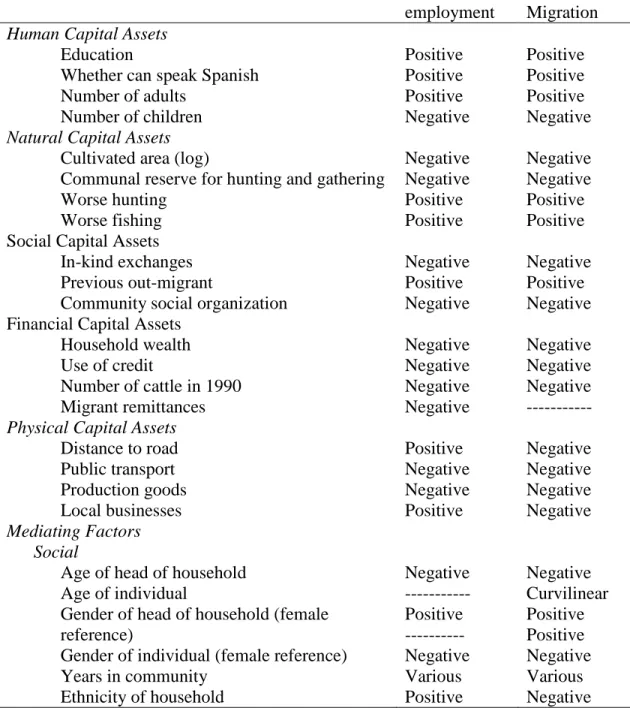
The modeling approach that is used in this dissertation allows for a multivariate
comparison of different types of capital in relation to the outcomes of interest. I expect that the
household and community assets, social relations, and institutions. A list of the hypothesized
associations is presented in Table 1. These hypotheses are principally based on the livelihoods
and migration literature discussed above, and, more specifically, the theories related to labor
market returns and risk mitigation.
Table 1. Hypothesized relationships between independent variables and outcomes
Non-farm employment
Out-Migration Human Capital Assets
Education
Whether can speak Spanish Number of adults
Number of children
Positive Positive Positive Negative Positive Positive Positive Negative Natural Capital Assets
Cultivated area (log)
Communal reserve for hunting and gathering Worse hunting Worse fishing Negative Negative Positive Positive Negative Negative Positive Positive Social Capital Assets
In-kind exchanges Previous out-migrant
Community social organization
Negative Positive Negative Negative Positive Negative Financial Capital Assets
Household wealth Use of credit
Number of cattle in 1990 Migrant remittances Negative Negative Negative Negative Negative Negative Negative --- Physical Capital Assets
Distance to road Public transport Production goods Local businesses Positive Negative Negative Positive Negative Negative Negative Negative Mediating Factors Social
Age of head of household Age of individual
Gender of head of household (female reference)
Gender of individual (female reference) Years in community
Ethnicity of household