WHY FRANCE AND NOT GERMANY? A CASE STUDY OF THE FAR-RIGHT
Jonathan Miguel Buechner
A thesis submitted to the faculty of the University of North Carolina at Chapel Hill in partial fulfillment of the requirements for the degree of Master of Arts in the Department of Political
Science, Concentration European Governance.
Chapel Hill 2019
© 2019
ABSTRACT
Jonathan Miguel Buechner: Why France and not Germany? A case study of the far-right (Under the direction of Gary Marks and Javier Astudillo)
The conflicts structuring European society since the 1980s such as identity and
immigration have affected countries in a parallel manner in response to globalization, known as the emerging transnational cleavage. However, why do far-right parties find great success in some countries related to this new cleavage and limited or no success in similar countries? Examining France and Germany, this comparative study deservedly draws national
ACKNOWLEDGEMENTS
TABLE OF CONTENTS
LIST OF TABLES ... vi
LIST OF ABBREVIATIONS ... vii
Theory/Background- Literature Review ... 4
Why France and Germany? ... 9
Social Framework Conditions ... 13
The 2008 Eurocrisis and 2015 Refugee Crisis ... 18
Electoral Systems and Gains ... 20
Party Leadership and Organization ... 27
Discussion ... 31
Conclusion ... 34
LIST OF TABLES
LIST OF ABBREVIATIONS
AfD Alternative für Deutschland (Alternative for Germany)
ALFA Allianz für Fortschritt und Aufbruch (Alliance for Progress and Change) CDU Christlich Demokratische Union Deutschlands (Christian Democratic Union
of Germany)
CSU Christlich-Soziale Union in Bayern (Christian Social Union in Bavaria) DVU Deutsche Volksunion (German People’s Union)
EU European Union
FPD Freie Demokratische Partei (Free Democratic Party) FPÖ Freiheitliche Partei Österreichs (Freedom Party of Austria) LPF Lijst Pim Fortuyn (Pim Fortuyn List)
NPD Nationaldemokratische Partei Deutschlands (National Democratic Party of Germany)
OAS Organisation Armée Secrète (Secret Armed Organization) REP Die Republikaner (The Republicans)
RN Rassemblement National (National Rally)
INTRODUCTION
Under what conditions do far-right parties emerge? This question is the focus of much ongoing academic research, especially since the emergence of ‘post-industrial’ far-right parties in the mid-1970s and beyond. Across Europe, these parties have experienced electoral success in the Netherlands, Switzerland, and Austria to name a few prominent cases. In general terms, far-right parties can be characterized by “an emphasis of natural community and hostility towards foreigners…a distrust for democratic individual representation…a call for unbounded authority and the recasting of a strong state” (Ignazi 2003, 18). These common features help to provide a base through which to analyze the similarities and differences between countries in which these kinds of parties emerge or attempt to emerge.
Concurrent with the ‘third-wave’ of right-wing extremism during the 1970s and 1980s, the conflicts of the post-industrial society which include multiculturalism, identity, globalization and supranationalism have become prevalent matters of political contestation (Ignazi 2003, 20). Far-right parties fuel political discourse with Islamophobia, xenophobia, and outright racism in a capacity that mainstream parties are unable to, making their position on these issues relevant for established parties if they are to compete in the political landscape (Rippeyoung 2007, 381; Meyer and Rosenberger 2015, 2). The increasing success of far-right parties has sparked debate about the future stability of Western European democracies as well as issues related to
Cleavage theory, developed by Lipset and Rokkan in 1967, provides a frame of reference to understand political contestation and how parties react to societal cleavages or conflicts that emerged from industrial revolutions in Europe. The theory is useful in understanding not only how these cleavages came to form, but also how challenger parties, such as the far-right, stake their claim in the existing political structure in response to new lines of conflict regarding post-material values. In recent years, political scientists have observed the emergence of a new transnational cleavage based largely on cultural issues that has shaped competition between parties in the 21st century. Far-right parties fit into this new line of conflict by taking hold of this transnational cleavage and challenging existing parties on these cultural issues.
However, the emergence and subsequent success of far-right parties and their ability to compete along this new cleavage varies greatly across Europe. This begs the question – if European countries in the 1970s were experiencing the same social phenomena with similar transformations in the dimensions structuring the political space, why do these parties become firmly rooted in the political landscape in some countries while they have limited success in others?
The far-right party family is complex and research has been devoted to not only
in others (Norris 2005, 9). In order to overcome these shortcomings, the cases focus on France and Germany. While France has been the prototype for the far-right in Europe since the 1980s, Germany has not had a successful contender until 2017. Thus, my research will fill a gap in the literature by focusing on a controlled systematic comparative analysis of two case countries. This narrow focus will illuminate the complexities of the far-right party family and shed insight into the history of these parties in both countries as well as the differences in the emergence of new challenger parties.
By exploring these relationships, a contribution to the broader literature on far-right parties will be made by complementing and adding to existing knowledge about this party family. By looking in detail at two countries, country-specific factors – which are often overlooked in cross-national examinations- are easier to analyze. This will lead to a greater explanation about the emergence of far-right parties. Furthermore, the analysis will help to further develop research regarding the transnational cleavage, since it is the newest and deserves more scholarly attention.
My guiding research question throughout the thesis will be: What determines the time of emergence of far-right parties in France and Germany? By using cleavage theory to help answer the puzzle set out above, I formulate two expectations regarding far-right parties in France and Germany: 1) the Rassemblement National (RN) in France was able to be a stronger actor on the political stage than the Alternative fur Deutschland (AfD) in Germany due to a less
comparison of the case countries using second hand literature on the topic will be conducted under three main categories: a) social framework conditions, b) electoral systems and gains, and c) party leadership and organization. The similarities of both countries will be taken into account while placing emphasis on the differences in the key variable: the timing of emergence of far-right parties.
Results show that the transnational cleavage was present in both countries and that parties were responding to the same issues of this cleavage. The difficulty in the case of Germany was more institutional, meaning that parties had to not only pass the 5 percent threshold for
representation, but also had to establish a wide network of national organizations. France was successful in crafting a message that appealed to many in response to the transnational cleavage, and continues to modernize its platform.
Theory/Background- Literature Review
The study of far-right parties has evolved since the post-war period and its focus has shifted to answer new questions. Art lays out a short summary of the four main stages of political science research on the topic to include: a) why far-right parties emerged in advanced industrial societies b) why their emergence has varied across different countries c) how their party
programs are constructed to appeal to middle and working class voters and d) how far-right parties interact with existing political parties (2007, 331-332). These classifications are similar to the supply and demand factors developed to explain how far-right parties gain success.
Demand factors are those that make far right parties appealing such as modernization grievances, economic grievances exemplified by slogans such as “Eliminate Unemployment: Stop
factors are more structural and include electoral rules (how seats are translated into votes), party competition (how mainstream parties converge), the media, political cleavage structure, party organization (the existence of local branches), and a winning ideology (stressing ideological rationalizations of national belonging) (Golder 2016, 486-490). Research on the far-right has adapted in its approach to understand these complex parties and continues to seek a multifaceted approach to the puzzle. Cleavages are part demand and part supply factors and give a helpful framework to analyze the ongoing progression of far-right parties.
What shapes political contestation in Europe and where do far-right parties fit in to the existing structure? Based on Lipset and Rokkan’s seminal article (1967), cleavages are defined as the boundaries of how political parties react to societal pressures. The authors present cleavage theory as a way to understand parties as “alliances in conflicts over policies and value commitments within the larger body politic” (1967, 5). They describe the postwar national party system as the result of underlying social, territorial and functional cleavages that grew out of national and industrial revolutions in Europe. The four main cleavages include: center vs. periphery, state vs. church, owner vs. worker and land vs. industry which all translate into political competition in the way political parties responded to these issues. The cleavages all build on one another and are the outcome of repeated conflict. As such, parties became solidified based on their response to these cleavages and collective identities played a large part in how citizens responded to these issues. Social cleavage theory has been influential in providing a framework to understand how political parties respond and adapt to new issues that arise in society.
has effects for new challenger parties and the political system as a whole. This process is important to consider in understanding the emergence of the far-right and how it has become an institutionalized actor in France and an outlying actor in Germany.
The traditional class and religious cleavages present in Lipset and Rokkan’s original work have accommodated new dimensions that currently undergird party interactions. The religious cleavage has been transformed into “a new cultural dimension of conflict” while the state-market cleavage still plays a role in shaping the political landscape (Bornschier 2012, 123). This shift corresponds to social movements and the diffusion of new ideals and values which in turn have created new objects of political conflict. The change can be observed in the spread of conflict over postmaterialist values which has reconstructed the traditional political alignments present in society. Resultingly, new concerns such as national identity and security have become prevalent and established parties must come up with an adequate response or risk being
overshadowed by challenger parties that can meet citizen demand on these issues sufficiently (Veugelers 1997, 31-32, 45).
How can we conceptualize of this radical shift in the cleavages underlying political contestation? Consistent with the changes previously mentioned, a new cleavage has been identified: the transnational cleavage. This new transnational cleavage stems from conflict regarding the “defense of national political, social and economic ways of life against external actors who penetrate the state by migrating, exchanging goods or exerting rule” (Hooghe and Marks 2018, 110). This cleavage is concurrent with the phenomenon of globalization, the intensification of the European integration process since the 1993 Maastricht Treaty, and the creation of supranational institutions such as the World Trade Organization (Hooghe and Marks 2018, 113-114). With the increase of transnational mobility of capital, goods, labor and services across the Schengen area, highly specialized jobs with mobility became prioritized over manual labor. The continuing integration process also raises questions regarding national identity as member states continue to cede sovereignty to supranational institutions and collaborate transnationally, which has struck fear in conservatives that national sovereignty would be unjustly given away. Thus, many who felt as if they were losing status within these new developments, sought refuge in nationalism and traditional values.
With knowledge of this new cleavage in mind, how are far-right parties able to stake their claim in an altered political contestation space? The essential point regarding far-right parties and new cleavage structures is that when established parties are unable to react to the new demands of the transnational cleavage, a new space emerges for far-right parties to exploit and gain support based on emerging conflicts. Research emanating from cleavage theory has shown that parties do not change their stance on issues such as integration ‘to any great degree’ and they stay within their own ‘bounded rationality’ which leaves space for new challengers to take advantage of this new space on the political landscape (Backes 2018, 19). Furthermore, these ‘challenger’ parties emphasize their extreme positions on salient issues such as immigration more than parties who take moderate positions. Far-right parties occupy space along this cleavage by taking “more extreme positions on these issues, placing more salience on them, and exhibiting greater internal unity than mainstream parties” (Hooghe and Marks 2018, 111). In doing so, far-right parties are able to take ownership of issues that directly relate to the transnational cleavage and feelings of alienation by some members of society. With this
ownership, established parties could be forced into competition over these new issues. However, this pressure depends on the strength of their far-right challenger, with more stable far-right parties able to alienate voters from mainstream parties (Meyer and Rosenberger 2015, 3). This has implications for our case countries since the RN was able to insert itself on the political scene earlier and gain more stability through the years, unlike Germany. Far-right parties have carved out a space on the political landscape that can be successfully exploited and have solidified themselves as the main actor on that end of the spectrum.
(LPF) in 2002, the Swiss People’s Party (SVP) which became the strongest party in 1999, the Austrian Freedom Party (FPO) which won 27 percent of the vote in the 1999 elections and became part of a coalition government, and more recently Vox in Spain winning 10.3 percent of the vote in the 2019 general elections and 12 seats in the 2018 regional elections in Andalusia (Meyer and Rosenberger 2015, 1; Otero-Iglesias). The breakthrough and ensuing success of far-right parties since the 1980s sheds new light on the assumption that Lipset and Rokkan made in their original 1967 article that party systems in Europe were largely ‘frozen’ , meaning that once a cleavage structure was well established in society, it provided a strong basis for conflict and voters grew attached to established political parties (von Schoultz 2017, 32-33). With challenges from the far-right, party systems have changed which further complicates the puzzle surrounding their emergence. Thus, the emergence of new social cleavages can be seen as “necessary but not sufficient conditions” (Norris 2005, 3) that allow minor parties to breakthrough and become more established eventually. Cleavage theory can be used as a structural framework to understand the emergence of these parties. The subsequent success depends heavily on how a party frames its ideological appeals within the electoral system and landscape of political
contestation. While cleavages are not necessarily specific to far-right parties - and could function to explain the rise of any minor party along the political spectrum- for the purposes of this paper they provide a compelling explanation to provide more clarity on a party family that is
complicated and diverse. Why France and Germany?
this area of research. As Skocpol and Somers describe, comparative research as macro-analysis is worthwhile because it allows causal hypotheses about macro-phenomena to be tested (1980, 88). This approach seeks to “contrast cases in which the phenomenon to be explained and the hypothesized causes are present to other cases in which the phenomenon and the causes are both absent, although they are as similar as possible to the “positive” cases in other respects – known as Mill’s Method of Difference” (Skocpol and Somers 1980, 79). In the two countries chosen, both share many overall similarities and one crucial difference: the timing in emergence of a right contender party. While it may not be generalizable to the entirety of the phenomenon of far-right parties across Europe, it provides context to understand the underlying dimensions and processes that drive and motivate far-right parties. More importantly, it allows for the culture and historical context of each country to be kept of importance and factored into the analysis at a deeper level.
The goal with this method of analysis is to make causal inferences about macro-level occurrences and processes. The two countries are similar in many aspects – both democracies, with similar levels of immigration in recent years, affected by issues of the new transnational cleavage, and similar electoral systems- but with contrasting cases – the emergence of far-right parties at drastically different periods in time. Both France and Germany are considered to have ‘two-dimensionality’ in regards to the structure of the political space meaning it has an economic and cultural dimension (Kriesi et al 2006, 949). In a similar way, both countries have
As mentioned before, the political landscape across Europe shifted in response to conflict over new post-materialist values. Isolated populist movements had been present in France such as the Poujadistes in the Fourth Republic, but this took place in a specific place in a certain time frame. The conflicts over modernization in the 21st century are so interconnected that the
economic, cultural and political problems that affect one country likely affect more and more countries at once (Decker 2008, 123). This adds to the explanation of the ‘parallel nature’ of the changes in the political landscapes in many European countries and sheds light on why ‘new populists’ have not disappeared from the political scene as observers had expected they would (Decker 2008, 123). France and Germany both underwent these transformations, but the ways in which far-right parties integrated themselves into the shifting dimensions of the political space varies.
Since the French far-right party is one of the longest lasting in Europe, comparing it with Germany allows for the possibility of understanding its effect on the emergence of similar parties in other countries. Parties such as the Republican Party (REP) in Germany have stated the
explicit desire to turn themselves into a right-wing populist party inspired by the French Front National (Bornschier 2012, 125). Furthermore, previous research has found that far-right parties in Europe use the RN as a model to construct a ‘master frame’ through which they express their ‘perception of the societal sphere’ with a compelling party platform (Van Hauwaert 2019, 132-134).
Another valuable point of comparison is that Germany was never thought to be a
many, we see the AfD emerge in 2013. On the other hand, since Germany underwent the same transformation of the political space as other European countries did in response to
modernization, it is surprising that a far-right party did not emerge sooner especially in the East where many areas experienced social insecurity following the collapse of the Communist regime (Decker 2008, 120). Interestingly, the National Democratic Party (NPD), with neofascist
tendencies received 4.9% of the vote in 1969 following the first grand coalition between the CDU-CSU/SPD, which points to Germany’s past experience with far-right parties and their failure to institutionalize, which further complicates the puzzle. In a similar vein, large parts of the German electorate were “just as sympathetic to various racist appeals as electorates in other countries” which coincides with the rise of Islamophobia and anti-immigrant attitudes that form part of the transnational cleavage (Berbuir et al 2015, 158). This paradox coupled with the early and permanent emergence of a far-right party in France makes it a compelling case worth further investigation.
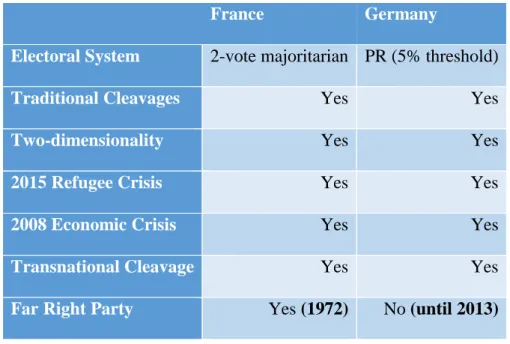
All of the above factors such as cleavages, immigration, and culture may end up leading in the same direction and thus cause the final outcome of emergence to be overdetermined. However, with this in mind as one of the potential limitations of this research, there are still valuable conclusions that can be drawn from the comparison. Additionally, the analysis could fall short since I am comparing a well-established party (RN) to a relatively young party (AfD). To remedy this, I have included a discussion of two older far-right parties in Germany that never gained much electoral success to set a context for the struggles of this party family in Germany. Table 1 below summarizes the comparative aspects of the two case countries to visually present the basis for the comparison.
France Germany
Electoral System 2-vote majoritarian PR (5% threshold)
Traditional Cleavages Yes Yes
Two-dimensionality Yes Yes
2015 Refugee Crisis Yes Yes
2008 Economic Crisis Yes Yes
Transnational Cleavage Yes Yes
Far Right Party Yes (1972) No (until 2013)
Table 1: Comparative aspects of case countries
Social Framework Conditions
cleavage to include conflict over immigration, identity and multiculturalism. Of utmost
importance for these parties is how they respond to the transnational cleavage by “constructing their strategic ideological appeals around cultural protectionism, within the constraints set by the broader electoral system and the distribution of public opinion” (Norris 2005, 8).
Both the RN and the AfD respond to new conflicts of the transnational cleavage. In the case of the RN, their electoral breakthrough is multifaceted and a result of both internal and external factors. The AfD is similar although its main ideological appeal in the early stages was economic rather than cultural. Within the RN, its early radical elements (direct association with Nazi and fascist parties) were removed and it began to promote a broader populist message focused on law and order and immigration. In the external landscape, economic and social determinants led to the emergence of the RN on the French political scene.
A major political issue of the 1970s and 1980s when the RN was founded was decolonization in Algeria. From this debate stemmed the subsequent terrorist attacks by the
Organisation Armée Secrète (OAS) and the migration of one million French pieds noirs settlers from Algeria back to France. During this time, anti-Arab feelings also began to mount as well as aversion to foreigners spurred in part by the 400,000 Algerians who were to receive French citizenship in the 1970s; public opinion was divided as to whether the state should consider them French or something different (Cincu 2017, 36). Soft policies on law and order instituted by the left-wing Mitterrand government as well as an increase in public sensitivity towards
immigration, namely of Muslims, and multiculturalism laid the ground for an increased salience of these issues in the political arena.
and social insecurity into their political discourses (Stockemer and Amengay 2015, 373). This inclusion further legitimized the RN and helped to broaden their base. In the wake of the oil crisis in 1973, France was grappling with high unemployment and voters were dissatisfied with the present state of the economy. Additionally, fears over the continuing process of European integration and uncertainties in the post-communist era played a role. In a more covert sense, a ‘silent counter revolution’ that promoted traditional values such as family and religion in protest of the post-materialist values of the sixties was underway which adds another layer of appeal to the RN’s message. Jean-Marie Le Pen constructed immigration as a key issue and was successful in “linking it to public insecurity, national identity, social security and the labor market” in an effort to gain electoral appeal from those who felt concerned over these issues (Stockemer 2017, 29).
Many of the debates surrounding multiculturalism and anti-immigration policies in France are highly gendered and also involve the interplay of religion and secularism. As the RN has begun to modernize itself under new leadership with the election of Marine Le Pen as president of the party in January 2011, there are still linkages with the past (Mayer 2015, 391). These are prevalent in an appeal to the issue of cultural differences framed in a new way to appeal to a generational shift. The RN has shifted its discourse on two main issues – the defense of the family and the difficulty of new immigration. Previously the RN had constructed a
victims of patriarchal practices which they condemn. On the contrary, Le Pen’s proposals on women claim rights for women of her own ‘community’ (based on nationality and culture) and opposes these same rights for female ‘others’ such as immigrants (Scrinzi 2017, 137). Gender has been placed in the spotlight to give credibility to anti-immigrant position in defense of feminism and preserving national culture against outsiders. In a similar way, we can observe the platform of the party under Marine to be more restrictive regarding immigration, but recast as “strongly populist” by proposing Chauvinistic welfare measures such as the elimination of pensions for foreigners (Stockemer 2017, 32-33).
Understanding all of the above factors, the RN shifted its rhetoric from an ‘us vs. them’ discourse to allow for the inclusion of new political ‘enemies’ such as the elite driven European Union and international political institutions that were seen as encroaching on French
sovereignty (Stockemer and Amengay 2015, 373). The French ideal of souverinisme
encapsulates this idea with a longing for a return to the “old religion of tightly controlled borders and the unfettered sovereignty of nation-states” which the RN has evoked in its platform
(Heisbourg 2015, 10).
The far-right parties that emerged in Germany responded to many of the same issues as France, however they drew on different historical contexts. Of the right-wing parties in
similar assemblage of right-wing extremism and populism, with a much more charismatic leader, but was not successful.
The AfD was able to mobilize voters on its comparably moderate platform as opposed to previous far right parties and the eurocrisis allowed it to attract disenchanted middle-class voters from the established parties who felt the need to vote in protest of the current system. They present themselves as socially protective and are skeptical of capitalism while on the whole advocating for neoliberal policies. The main focus of its campaign has been its
anti-establishment and anti-Euro positions (Berbuir et al 2015, 155).
From the outset, AfD party leaders made a conscious effort to avoid any sort of
One of the main issues they see as plaguing modern Germany is immigration and they advocate for a strict control of migration and that those who come in must “adjust to Germany society, not the other way around” (Backes 2018, 6). Immigration is a key issue along the new transnational cleavage and far-right parties take extreme positions on it. They also invoke traditional Christian values and reject Islam as a religion that belongs to another culture, but it does not rule out the possibility that Muslims could be accepted if they “live with us and are peacefully integrated” (Backes 2018, 7). Unlike the NPD, they are not overtly disloyal to the existing political structure and keep a safe distance from radical anti-capitalism and the overt anti-Semitism that other far right parties have promoted in the past, which worked to their success.
The 2008 Eurocrisis and 2015 Refugee Crisis
The impact of the eurozone crisis of 2008 and the refugee crisis of 2015 presented both parties with a space in the political contestation landscape to capture as their own. In the case of the RN, both conflicts added salience to popular arguments about leaving the EU and the effects of immigration on national identity. For the AfD, the financial crisis was one of the primary reasons the party came to be and the refugee crisis proved to be a significant event the party could galvanize even more voters with and eventually reach an electoral breakthrough.
The eurozone crisis affected Europe as a whole, but the focus and frame of the issue surrounded Greece (Decker 2016, 7). The effects of this crisis led to doubts about the European Union, as a growing supranational entity, to resolve issues in an efficient manner which came to be known as Euroscepticism. The economic crisis led to a rise in Euroscepticism and backlash against the centrist parties that had advocated for its creation, resulting in an identity crisis
71). Central messages from the parties such as the potential for the “Islamization” of Europe became more and more salient. During the refugee crisis, primarily Muslim refugees hoping to escape the escalating violence of the war in Syria, sought refuge in Europe. It is estimated that Germany registered 1.1 million refugees during this time and France also received many, although Germany was the target destination (Polyakova and Shekhovtsov 2016, 71; Heisbourg 2015, 8). Furthermore, terrorist attacks in Paris and Cologne as well as debates surrounding asylum laws, politicized the issue in a way that allowed the RN and AfD to attract voters based on these issues (Decker 2016, 10). The combined force of the eurozone crisis, rising
Euroscepticism, and the refugee crisis provided a turning point for the RN to experience a rise in support similar to 2002 and allowed the AfD to break past the 5 percent electoral threshold and gain credibility as a legitimate political party.
The refugee crisis turned out to be an “unexpected gift” for the AfD and their electoral trajectory (Decker 2016, 10). The party took up the space along the political contestation
structure to frame themselves as the “sole medium of protest for a population deeply unsettled by uncontrolled migrant streams” which mainstream parties were unable to take a stance on (Decker 2016, 10). In the case of the RN, the refugee crisis could provide the party with further pretext “not only to instrumentalize its immigration leitmotif but also to recruit followers” (Stockemer 2017, 97).
Electoral Systems and Gains
Structural supply factors such as electoral systems and party competition also play a role in the timing and emergence of far-right parties. The importance of electoral rules shapes not only the degree of party fragmentation, but also how competition plays out. The electoral system is a crucial component because it determines how votes are translated into seats.
France has a 2-vote majoritarian system while Germany has a proportional
representation system with a 5 percent threshold for representation in the Federal Bundestag. Previous literature on electoral systems and far-right parties posits that in proportional
representation systems, far-right parties can gain seats by adopting a “bonding” strategy in which they emphasize the “signature ideological appeals which distinguish them most clearly from mainstream competitors on the center-right and center-left” (Norris 2005, 7). In this electoral system, competition is spread across the ideological spectrum and issue space and does not convene around a central point. In majoritarian systems, to be successful far-right parties must expand their party platform “beyond cultural protectionism to encompass a broader range of issues on the social and economic agenda and advocate for more conservative policies and constructing populist appeals based on vague rhetoric…largely devoid of any substantive policy content” (Norris 2005, 8). The French majoritarian system would suggest that there is a higher barrier for representation since parties require a simple plurality or majority of votes in each district in order to win. However, when we look at our cases, we can see that they present
The trajectory of the RN is considered to have two stages in its path to
institutionalization: change and continuity (Veugelers 1997, 36). The first stage lasts about a decade when the RN saw weak gains, and mostly at the local level. It began to shift from a more marginal to more relevant party which could be seen in higher gains in local elections and in the 1986 legislative elections where it won 35 seats in the National Assembly (Veugelers 1997, 36). The party began in 1972 under the auspices of the Ordre Nouveau and was meant to bring together the scattered groups of the extreme right to build electoral success in the 1973
legislative elections. Jean-Marie Le Pen led the group with his reputation as a man of action who “was involved in all the battles of the extreme right, yet politically respectable;” he had founded the National Veterans Front, was a former president of a nationalist student association and took a hard stance of pro-French Algeria matters. However, the electoral success in the beginning was abysmal: in the May 1975 presidential elections Le Pen garnered a mere 0.62 percent of the votes, and it was not until the 1980s that things began to change (Stockemer and Amengay 2015, 372). In the 1983 municipal elections the RN was able to ally itself with the moderate right, specifically the Gaullists, which allowed them to gain political legitimacy and visibility and more than ten RN town councilors were elected.
shift in the growing expressed support for the extreme right. After achieving relevance in the 1980s, it did not revert back to the first stage but rather established itself as a firm actor in the political arena.
While the success of the 2002 elections brought the RN to the attention of voters on a much wider scale, it also led to resistance which weakened its democratic legitimacy that it had tried hard to achieve. A strong anti-RN mobilization came about from established parties and the public, which led to dismal results in the years after. The party only received 10.4 percent of the vote in the 2007 presidential election and 4.3 percent in the following legislative elections (Mayer 2018, 8). After this, many believed this was the nail in the coffin for Le Pen, but the succession of the party leadership to his daughter Marine Le Pen would reinvigorate and
Table 2: Electoral gains of far-right in France 1973 – 2019 (percentage of votes cast)
The electoral trajectory of the far-right in Germany has not reached as considerable success as it has in France. Previous nationalist populist right-wing parties in Germany include the National Democratic Party (NPD), the Republikaner (REP), and the DVU (German People’s Union), but neither reached significant electoral support to surpass the five percent threshold for representation at the federal level. The weakness of these older parties was due in part to the violence of extremist action-oriented groups such as neo-Nazis and skinheads whose influence expanded into the Eastern federal states after reunification. The movements were mostly local and they grew to become an essential element in the growth of right-wing extremism (Backes 2018, 3). The mostly local presence of the parties combined with the federal structure of the country, poor organization of internal party dynamics, and resistance to Nazism made it difficult for these parties to find support at the national level.
The NPD gained 4.3 of the electoral votes in the 1969 federal elections and was the only contender from the right that somewhat succeeded on a national level until the AfD (Berbuir et al 2015, 158). The 1969 election ‘success’ was due in part to growing frustration with the economy
0 5 10 15 20 25 30 73 Leg 74 Pres 78 Leg 81 Leg 84 EP 86 Leg 88 Pres 88 Leg 89 EP 93 Leg 94 EP 95 Pres 97 Leg 99 EP 02 Leg 02 Pres 04 EP 07 Leg 07 Pres 09 EP 12 Leg 12 Pres 14 EP 17 Leg 17 Pres 19 EP
Far-right in France
as well the grand coalition of the CDU/CSU and the SPD that was formed prior. The grand coalition was considered the “sore spot” of Germany politics at the time and the NPD presented themselves as the only authentic (right-wing) opposition party” (Mudde 2000, 27-28). However, since the NPD’s message of a credible opposition party did not translate into any seats in the Bundestag, potential voters for future elections began to shy away and internal struggles divided party leaders in the years following (Mudde 2000, 28). While the NPD was hopeful in its
campaign, it was unable to establish itself early on the German political scene.
The NPD formed in 1964 during the ‘second wave’ of right-wing extremism, but saw its electoral successes diminish into the 1970s and into the 2000s never getting above 3 percent of votes (Decker 2008, 119-120). It achieved very slight success in local elections which grew with the increase of asylum seekers in the 1990s connected with a rise in xenophobic violence during this time. The party found a stronghold in Eastern Germany as well. After a steady decline in support, only gaining 1 percent of the vote in the 2014 European Parliament elections, the NPD began to become insignificant. The party underwent financial struggles and a leadership shift within the party that led the party chairman and other long-term members to resign after the realization that the NPD had lost its power to mobilize support (Backes 2018, 4-5).
elections (Decker 2008, 119; Art 2007, 338). Following that moment, politicians from mainstream parties in Berlin adopted a strategy of “marginalization, de-legitimation and
stigmatization” known as ausgrenzung, which significantly reduced any chances the REP had to make a lasting impact on the political scene (Art 2007, 338).
Ausgrenzung went into effect immediately following the 1989 elections with the CDU prohibiting “personal contact with REP politicians, reliance on REP votes to pass legislation and support for any REP candidate or proposal” (Art 2007, 339). The media followed a similar strategy painting the party as akin to the Nazis and stated that the Berlin election was a “protest vote and horrible mistake” (Art 2007, 339). This led the party to be characterized as politically illegitimate and helped to change public opinion on perception of the party. Finally, citizens took to the streets in protest which made it hard for party leaders to not only hold meetings but also to increase their political recruitment as the party was considered extreme. It is estimated that in the year following 1989, the REP lost 40 percent of its membership (Art 2007, 341). This strategy pursued by mainstream parties resulted in wasted votes, a characterization that the REP was politically illegitimate, and made it almost impossible to recruit new members. Despite issues of the transnational cleavage such as high unemployment, massive immigration, and EU integration pressures being on the forefront of contestation, political elites succeeded in rejecting the REP from cementing itself on the political scene.
The success of the AfD is due to many factors including its local organization, party platform and leadership. In the midst of all the turmoil following the breakdown of the NPD, the AfD was able to emerge in 2013 in the aftermath of the eurocrisis. Fueled by populist sentiment and the aftermath of the financial crisis, the AfD became a protest party through which
the vote and in September 2014 it gained around 10 percent of the vote in the eastern states of Saxony, Thuringia and Brandenburg (Backes 2018, 4-5). It also began to make small gains in West German states. As the party evolved internally and with the onset of recent terror attacks in 2016, they gained 20.8 percent of the vote in Saxony-Anhalt and 14.2 percent in Berlin (Backes 2018, 5). Its greatest success came in the 2017 federal elections where the AfD won 12.6 percent of the votes and gained 94 seats in the Bundestag.
Table 3: Electoral gains of far-right in Germany 1965 – 2019 (percentage of votes cast)
Party Leadership and Organization
The way in which parties are organized effectively translates into how strong of a political contender they will be. Parties in general must have strong leadership, sufficient party organization and party elites in order to project a good image. In the case of far-right parties, emphasis on a “highly exalted, personalist style of leadership” is key (Stockemer 2017, 43). In the case of the RN, a strong leader has always been at the head of the party and in the case of the AfD, its leadership suffered from internal disputes which led to its weakness. Both parties take advantage of conflicts surrounding the transnational cleavage and meld it into a coherent strategy.
Jean Marie Le Pen, armed with his charismatic leadership and party control, navigated the RN from its humble beginnings to the established party we can recognize today. He succeeded in uniting the far-right groups that clung to different issues such as Vichy,
decolonization and the Second World War. He was authoritative enough to act as a spokesperson for these various groups and with his past political experience in the 1950s with the Poujadiste movement, he became known as a “highly qualified orator as a tribune of the people”
0 2 4 6 8 10 12 14 65 Fed 69 Fed 72 Fed 76 Fed 83 Fed 84 EP 87 Fed 89 EP 90 Fed 94 EP 98 Fed 99 EP 02 Fed 04 EP 05 Fed 09 Fed 09 EP 13 Fed 14 EP 17 Fed 19 EP
Far-Right in Germany
(Stockemer 2017, 44). As with most far-right parties, immigration was a key component. Jean Marie excelled in melding this with other aspects of far-right ideology such as “authoritarianism, anti-egalitarianism and a focus on national sovereignty” (Stockemer 2017, 28).
Jean Marie’s daughter Marine had been a part of the party leadership since 1997 as part of the central committee and worked to represent the RN in several national and local elections. She was elected president of the RN in 2011 with 67.6 percent of the vote and
implemented an ambitious strategy to modernize the party (Mayer 2018, 9). Aside from the main goal of uniting the party and gaining new support from upper middle-class voters, her strategy of
“political representative of the people, the embodiment of the popular will, the savior of France” (Stockemer 2017, 34-35).
When Jean Marie continued to make anti-Semitic comments despite this new strategy, Marine took a bold move and had him officially removed from the party he helped to start in 2015 signaling a break with the past and a move to repaint the party in a more acceptable image. She also infused the party with some radical leftist elements such as the defense of public services and increases in modest incomes and pensions which further revitalized the party and expanded its voter base (Stockemer and Amengay 2015, 374). These changes translated into never before seen electoral success for the RN. The party gained 17.9 percent of the votes in the 2012 presidential election, an astounding 25 percent in the 2015 European Parliament elections, 6.8 million votes in the second round of the 2015 regional elections, and Marine made it to the second round of the 2017 presidential elections which garnered international attention (Mayer 2018, 11).
The AfD suffered from leadership power struggles and internal disputes, like most previous far-right parties in Germany. With the financial crisis as a backdrop, there was a window for a new Eurosceptic party who rejected the further deepening of European integration to rise up and play a part in the contestation landscape. The AfD had unique structural
CDU was dealing with the Eurozone crisis as well as its gradual move to the center on sociocultural issues such as the support of a modern immigration law and the recognition of same-sex civil unions.
Primarily, its basis as a Eurosceptic party led it to attract a wide range of voters who were concerned about increasing integration at the EU level. Another crucial element of its success was its establishment of sub-national structures. In May of 2013, the AfD had regional branches is all 16 Bundeslander which led it to stabilize and grow a nation-wide organization, which previous far-right parties had failed in doing (Berbuir et al 2015, 155). In contrast to parties like the NPD, the AfD won over “disappointed middle-class voters from the established parties” and not just in regional strongholds (Backes 2018, 8). In a policy sense, the AfD is not all that different from established conservative agendas in Germany. The difference is that they have “filled a gaping hole on the German political right cause by Merkel shifting her ruling
conservative Christian Democrats to the left” (Lees 2015, 11).
serving to further establish the AfD as a successful far-right party. It is estimated that before the split the party had approximately 20,000 members and in subsequent years the membership was estimated to be 16,400 in 2015 (Decker 2016, 7). These numbers indicate that even after the split, the party was still able to retain and attract new members in order to further modernize the party.
The AfD’s new 2017 Bundestag breakthrough could not only have a potential increase on the effective number of parties, but also could alter the political contestation space. Previous studies have found that the appeal of the AfD is stronger in Eastern Germany which could potentially reignite the territorial East-West cleavage on a stronger level (Lees 2015, 8-9). This has implications for the development of cleavage theory as well as the alignment of the German political system and should be examined in further research.
Discussion
While France and Germany did experience many of the same structural transformations in the political space in the post 1970s, the timing of their emergence stands in contrast to how we would expect a far-right party to fare given the conditions. While prominent issues such as immigration create “pressures that benefit right-wing parties, these pressures themselves do not create success” (Art 2007, 334). This informs us that while far-right parties did use immigration as their main line of issue in their platforms, it does not explain the whole picture. To further unravel the puzzle, we must look to cleavages as well as structural factors such as party
In the face of conflict emanating from the transnational cleavage including growing integration at the EU level, the financial crisis, Euroscepticism, and the refugee crisis, far-right parties have presented themselves as the “defenders of ‘true’ European values against the encroachment of both non-European foreigners and the EU elite in Brussels” (Polyakova and Shekhovtsov 2016, 71). The refugee crisis has revealed “new EU faults lines cutting across those already laid by the economic crisis” (Heisbourg 2016, 10) which relates to the theme of cross cutting cleavages.
While the transnational cleavage was present in both countries, Germany was hindered not only by a strong institutional resistance to National Socialism but also rife with internal party disputes. Furthermore, its federal structure made it difficult for far-right parties to find success past the local level and the turning point came when the AfD established a network of regional chapters to broaden their electoral message. A combination of historical, cultural and structural factors contributed to making Eurosceptic parties a ‘dark matter’ in German politics, despite there being dissatisfaction among the German population with the issues of the transnational cleavage (Lees 2015, 3). In the case of France – which theoretically should have a more restrictive electoral system for allowing small parties – we see the RN emerge as a model of a new party family. This is due in part to its strong leadership and coherent platform in which a strong master frame was able to be developed from which other emerging parties took notice. The similarity of these master frames and differences in their adoption give insight into
“developmental interdependence” meaning that the trend of far-right parties in Europe is distinct and closely related (Van Hauwaert 2019, 148).
contenders in the past such as the NPD and the REP, they never reached much success due to the process of marginalization implemented by mainstream parties. In addition, the resistance to a party that was somewhat similar to the Nazis is a strong factor that impeded the growth of similar movements before. No similar institutional or cultural resistance to Vichy existed in France. In a similar vein, party leadership plays into this. The RN had a strong leader with Jean Marie and power was successfully transferred to his daughter Marine. They both were
advantageous in creating a cult of personality around them, something which the AfD was unable to do because of its internal disputes and financial issues.
We can consider the second expectation regarding the presence of the transnational cleavage in both countries to be partially confirmed. Yes, we do see how far-right parties respond to issues of the transnational cleavage including immigration and national identity however, this cannot be the sole factor that explains the difference in timing of emergence. I would argue that institutional factors affected the ways in which parties could respond to and stake a claim to the transnational cleavage in contestation. This can be seen in the organizational difficulty in Germany to start a new party and the sentiment of aversion to anything akin to National Socialism.
Knowledge of the transnational cleavage is enhanced through the analysis of France and Germany. Far-right parties do indeed take extreme positions on issues of the new cleavage by advocating for stricter immigration controls, denying multiculturalism and favoring nationalist retreat. The conflicts can be seen very clearly in the economic and refugee crisis which
the fears that voters had over societal transformations in a stronger way than mainstream parties (Heisbourg 2019, 10).
Conclusion
The extreme right in France has a long history, and the Rassemblement National (RN), formerly the Front National, emerged as a product of political revolution, party organization, and cleavage structures. When thinking of the far-right in Europe, the RN is usually thought of as the prime example due to its permanence on the French political scene since the 1970s and its use of a ‘winning formula’ that combined “an appeal to vigorous state authority and paternalism in the family with an endorsement of free market capitalism in the economy (Mayer 2018, 2). Its internal shift in leaders and consequently ideology that has propelled it to considerable electoral success. As a prototype of far-right parties in Europe, it has set a foundation and rooted itself firmly on the extreme pole of the transnational cleavage.
The success of the AfD in Germany came as a surprise to many as the threat of the far-right was perceived to be less extreme due to the legacy of Nazism and the way in which nationalist discourse was treated in the public sphere. However, with the refugee crisis in 2015, the party was able to gain significant electoral success which raised questions about the stability of the current party system and its response to the challenges that the electorate found to be mobilizing. The development of far-right parties previous to the AfD that were never able to make significant electoral gains such as the NPD and REP were hindered by poor leadership, financial hardships and a concentration of support and mobilization at the local level that did not translate to the national level.
mainstream center parties to lose support (“Graphic Detail”). The results show that issues of the transnational cleavage such as immigration and identity will continue to play a large part in the conflict structure as the long-term effects of the economic and refugee crisis will still need to be addressed.
REFERENCES
Almeida, Dimitri. "Towards a post-radical Front National? Patterns of ideological change and dédiabolisation on the French radical right." Nottingham French Studies 52.2 (2013): 167-176.
Art, David. "Reacting to the radical right: Lessons from Germany and Austria." Party Politics 13.3 (2007): 331-349.
Backes, Uwe, “The Radical Right in Germany, Austria and Switzerland.” Edited by Jens Rydgren. Oxford Handbook of the Radical Right, (2018): 1-30.
Berbuir, Nicole, Marcel Lewandowsky, and Jasmin Siri. "The AfD and its sympathisers: Finally a right-wing populist movement in Germany?." German Politics 24.2 (2015): 154-178. Bornschier, Simon. "Why a right-wing populist party emerged in France but not in Germany:
cleavages and actors in the formation of a new cultural divide." European Political Science Review 4.1 (2012): 121-145.
Cincu, Adina-Elena. "FAR RIGHT POPULIST CHALLENGE IN EUROPE. ALTERNATIVE FOR GERMANY AND THE NATIONAL FRONT." Europolity 11.1 (2017): 21-49 Decker, Frank. "Germany: Right-wing populist failures and left-wing successes." Twenty-First
Century Populism. Palgrave Macmillan, London, (2008): 119-134.
Decker, Frank. THE "ALTERNATIVE FOR GERMANY": Factors behind its emergence and profile of a new right-wing populist party. German Politics and Society, (2016): 1-16. Golder, Matt. "Far right parties in Europe." Annual Review of Political Science 19 (2016):
477-497.
“Graphic Detail: Europe’s Elections.” The Economist 1 June 2019. Web. 5 June 2019.
Hansen, Randall. "Globalization, embedded realism, and path dependence: The other immigrants to Europe." Comparative Political Studies 35.3 (2002): 259-283.
Heisbourg, François. "The strategic implications of the Syrian refugee crisis." Survival 57.6 (2015): 7-20.
Hooghe, Liesbet, and Gary Marks. "Cleavage theory meets Europe’s crises: Lipset, Rokkan, and the transnational cleavage." Journal of European Public Policy 25.1 (2018): 109-135. Ignazi, Piero. Extreme right parties in Western Europe. Oxford University Press on Demand,
2003.
Lees, Charles. "The AfD: what kind of alternative for Germany." University of Bath, UK (2015): 1-21.
Lipset, Seymour M. and Rokkan, Stein (1967) ‘Cleavage structures, party systems and voter alignments: An introduction’. In Lipset, Seymour M. and Rokkan Stein (eds.) Party Systems and Voter Alignments: Cross-National Perspectives, New York: Free Press Mayer, Nonna. "The closing of the radical right gender gap in France?." French Politics 13.4
(2015): 391-414.
Mayer, Nonna, “The Radical Right in France.” Edited by Jens Rydgren. Oxford Handbook of the Radical Right, (2018): 1-21.
Meyer, Sarah, and Sieglinde Rosenberger. "Just a shadow? The role of radical right parties in the politicization of immigration, 1995–2009." Politics and Governance 3.2 (2015): 1-17. Mudde, Cas. The ideology of the extreme right. Oxford University Press, 2000.
Norris, Pippa. Radical right: Voters and parties in the electoral market. Cambridge University Press, 2005.
Otero-Iglesias, Miguel. “What’s next for the Spanish Far Right.” POLITICO 6 May 2019. Web. 2 June 2019.
Polyakova, Alina, and Anton Shekhovtsov. "On The Rise: Europe’s Fringe Right." World Affairs 179.1 (2016): 70-80.
Rippeyoung, Phyllis LF. "When women are right: the influence of gender, work and values on European far-right party support." International feminist journal of politics 9.3 (2007): 379-397.
Scrinzi, Francesca. "A ‘new’national Front? Gender, religion, secularism and the French populist radical right." Gender and Far Right Politics in Europe. Palgrave Macmillan, Cham, (2017): 127-140.
Skocpol, Theda, and Margaret Somers. "The uses of comparative history in macrosocial inquiry." Comparative studies in society and history 22.2 (1980): 72-95.
Stockemer, Daniel and Abdelkarim Amengay. "The Voters of the FN Under Jean-Marie Le Pen and Marine Le Pen: Continuity Or Change?" French Politics 13, no. 4 (12, 2015): 370-390.
Stockemer, Daniel. The Front National in France: Continuity and Change Under Jean-Marie Le Pen and Marine Le Pen. Springer, 2017.
Veugelers, John. "Social cleavage and the revival of far right parties: The case of France's National Front." Acta Sociologica40.1 (1997): 31-49.