1
PSYCHOLOGICAL AND BEHAVIORAL OUTCOMES ASSOCIATED WITH STRESSFUL OR TRAUMATIC LIFE EVENTS AMONG HIV-INFECTED PERSONS WITH DEPRESSION
Julie K. O’Donnell
A dissertation submitted to the faculty at the University of North Carolina at Chapel Hill in
partial fulfillment of the requirements for the degree of Doctor of Philosophy in the
Department of Epidemiology in the Gillings School of Global Public Health.
Chapel Hill
2015
Approved by:
Brian Pence
Bradley Gaynes
Stephen Cole
Nathan Thielman
iii
ABSTRACT
Julie K. O’Donnell: Psychological and behavioral outcomes associated with stressful or traumatic
life events among HIV-infected persons with depression
(Under the direction of Brian W. Pence)
Stressful or traumatic life events (STLEs) are common among HIV-infected individuals (particularly individuals who also have depression) and may affect both behavioral outcomes such as adherence to antiretroviral (ARV) therapy, and psychological outcomes such as suicidal ideation. The associations between 1) STLEs and ARV adherence, and 2) STLEs and suicidal ideation were examined among 289 US-based participants active in the SLAM DUNC study between 7/1/2011 and 9/1/2013, a randomized controlled trial of the effect of evidence-based decision support for depression treatment on ARV adherence. Participants received monthly telephone calls to assess STLEs and pill count-based ARV adherence, and three-monthly telephone calls to assess suicidal ideation, for up to 12 months. Inverse-probability-of-observation weighting was combined with multiple imputation to address missing data.
iv
of ARV doses. This level of adherence has a critical role in regimen effectiveness and prevention of resistance.
v
ACKNOWLEDGMENTS
This dissertation was the culmination of nearly five years of work on the SLAM DUNC
study. I am so grateful to my advisor, dissertation committee chair, and mentor, Dr. Brian
Pence, for giving me the chance to work with him on this study, and to the SLAM DUNC study
for providing funding for me for several years (NIMH/NINR grant # R01MH086362). I’m worlds
ahead of where I was five years ago as an epidemiologist, researcher, Stata programming, and
student in general for having worked with Brian, and I know I will be finding and appreciating
new ways in which he has helped me for many years to come. I am also grateful to the rest of
my dissertation committee. I was fortunate to work with Drs. Bradley Gaynes and Nathan
Thielman in the context of the SLAM DUNC study in addition to my dissertation work, and they
provided invaluable substantive knowledge and general enthusiasm for our work over the past
few years. Drs. Stephen Cole and Andrew Edmonds were key resources for all things
methods-related in my dissertation work, and I learned a great deal through working with both of them.
In addition to funding support by the SLAM DUNC study, I was supported by the
National Institutes of Health training grant # 5T32AI070114-08 while carrying out the majority
of my dissertation work. I am extremely grateful to both of these funding sources for allowing
me to complete this work.
I am deeply appreciative of the support of the administrative staff in the Department of
vi
been instrumental in keeping me apprised of deadlines and requirements, and I would not have
made it through coursework and the work on this dissertation in any reasonable time frame
without their help.
My peers within the Department of Epidemiology have provided me with invaluable
support, both academically and socially. So much learning happens outside of the classroom
through collaboration and discourse among fellow students, and I have benefited greatly from
having very intelligent, eloquent, and generous friends within the department. Brian also
developed an incredibly supportive environment within his group of student advisees, and I am
grateful for the help and encouragement of the very inspiring women that made up that group.
Finally, I would like to thank my family for all of their support over the years. I can’t
imagine there existing two more supportive parents than Charles and Kathleen O’Donnell. They
have encouraged me to do anything and everything I have ever wanted, and given me so much
support in doing so. I don’t think I could ever properly express the level of gratitude I have for
the example they have always given me, for their encouragement, and for everything they’ve
done for me along the way to help me get here. I am also very thankful for the support of my
sister Christine and my brother Patrick. I am fortunate to have siblings that I enjoy and that I
consider to be among my best friends, and I cannot thank them enough for providing humor
vii
TABLE OF CONTENTS
LIST OF TABLES ... xi
LIST OF FIGURES ... xii
LIST OF ABBREVIATIONS ... xiii
CHAPTER 1: INTRODUCTION AND SPECIFIC AIMS ... 1
CHAPTER 2: BACKGROUND AND SIGNIFICANCE ... 4
CHAPTER 3: RESEARCH DESIGN AND METHODS ... 12
Overview ... 12
Conceptual Model/Causal Diagram ... 12
Study overview and intervention description ... 13
Study timeline and sample size ... 13
Inclusion and exclusion criteria ... 14
Analysis Plan for Aim 1: Stressful life events and antiretroviral adherence ... 14
Exposure Assessment/Definition ... 15
Outcome Assessment/Definition ... 16
Covariate Assessment/Definition ... 17
Secondary Outcomes ... 19
Statistical Analyses ... 20
General Analysis Approach ... 20
Secondary Analyses ... 21
viii
Sensitivity Analyses ... 24
Statistical Power ... 25
Limitations... 26
Analysis Plan for Aim 2: Stressful life events and suicidal ideation ... 28
Exposure Assessment/Definition ... 28
Outcome Assessment/Definition ... 29
Covariate Assessment/Definition ... 30
Potential Modifier Assessment/Definition ... 31
Statistical Analyses ... 31
General Analysis Approach ... 31
Secondary Analyses – Modification Assessment ... 32
Handling Missing Data ... 33
Sensitivity Analyses ... 33
Statistical Power ... 34
Limitations... 34
CHAPTER 4: RESULTS ... 38
Aim 1: Stressful and traumatic life events as disruptors to antiretroviral therapy adherence ... 38
Introduction ... 38
Methods ... 39
Study sample ... 39
Measures ... 40
Statistical analysis ... 42
ix
Study population ... 43
Missing data ... 44
Primary outcomes ... 45
Secondary outcomes ... 45
Sensitivity analyses ... 46
Discussion ... 46
Aim 2: Suicidal Ideation after Stressful or Traumatic Life Events ... 54
Introduction ... 54
Methods ... 55
Study Sample ... 55
Measures ... 56
Statistical Analysis ... 58
Results ... 60
Study Population ... 60
Missing Data ... 60
Exposure and Full Weights ... 61
Primary Outcomes ... 61
Discussion ... 62
CHAPTER 5: DISCUSSION AND CONCLUSIONS ... 70
Summary of Findings... 70
Interpretation of Findings ... 73
Future Research Directions ... 76
x
APPENDIX 1 ... 79
xi
LIST OF TABLES
3.1. Example of 1st three observations for two participants……….37
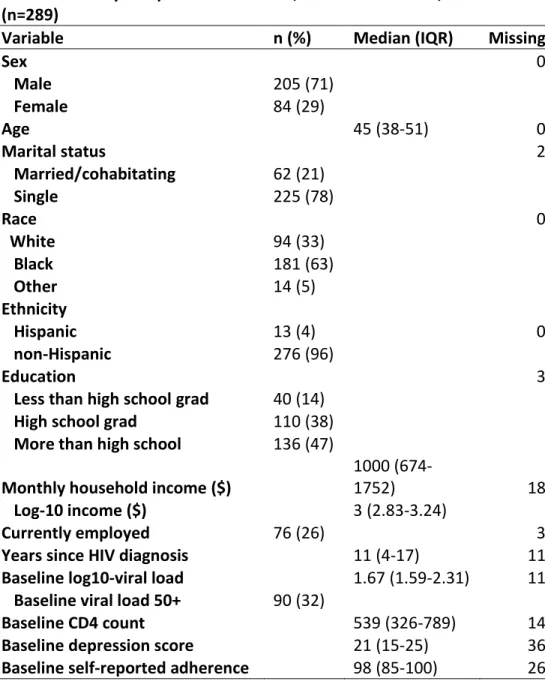
4.1. Study Sample Characteristics, Southeastern USA, 2010-2013 (n=289)………50
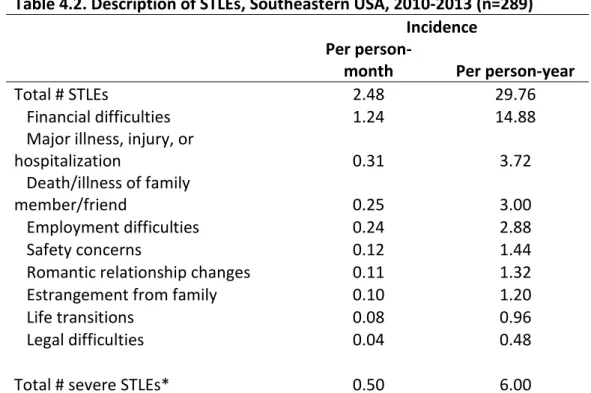
4.2. Description of STLEs, Southeastern USA, 2010-2013 (n=289)………51
4.3. Associations Between STLEs and ARV Adherence, Pill Count-Based and Self-Reported, US, 2010-2013……….52
4.4. Study sample characteristics………66
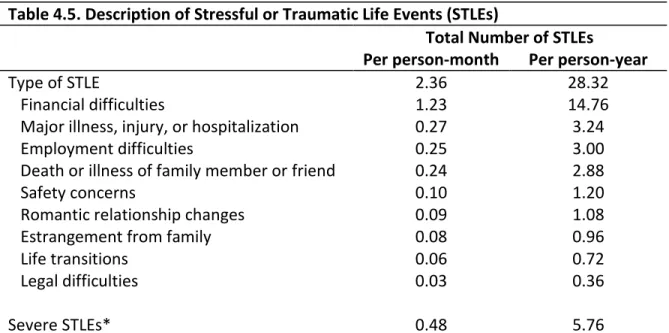
4.5. Description of Stressful or Traumatic Life Events (STLEs)……….67
4.6. Weight Distribution………...67
xii
LIST OF FIGURES
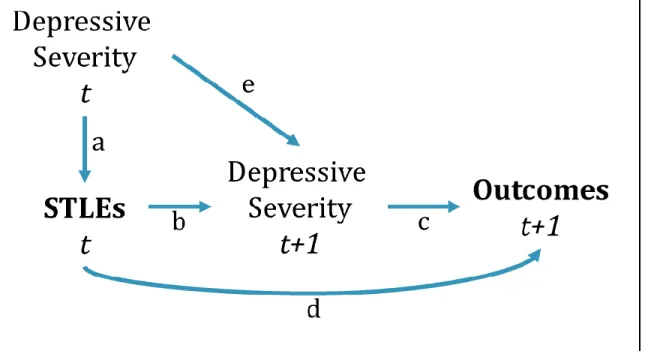
3.1. Simplified directed acyclic graph for the associations between STLEs
and 1) ARV adherence and 2) SI……….36
3.2. Effective sample size over varying correlation values: Aim 1……….36
3.3. Power to detect varying mean difference over different ESS: Aim 1……….36
3.4. Effective sample size over varying correlation values: Aim 2……….37
3.5. Power to detect varying mean difference over different ESS: Aim 2……….37
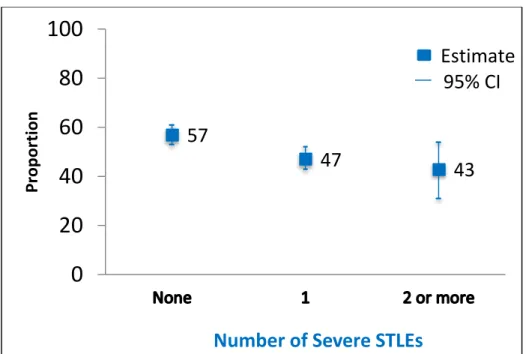
4.1. Proportion with ≥95% ARV Adherence by Number of STLEs………..53
4.2. Proportion with ≥95% ARV Adherence by Number of Severe STLEs……….53
xiii
LIST OF ABBREVIATIONS
AIDS
Acquired Immune Deficiency Syndrome
ARV
Antiretroviral
CHASE
Coping with HIV/AIDS in the Southeast Study
CI
Confidence Interval
DAG
Directed Acyclic Graph
DE
Design Effect
ESS
Effective Sample Size
HAM-D
Hamilton Rating Scale for Depression
HIV
Human Immunodeficiency Virus
LES
Life Events Survey
MINI
Mini International Neuropsychiatric Interview
MSM
Marginal Structural Model
NNRTI
Non-nucleoside Reverse Transcriptase Inhibitor
NOC
Northern Outreach Clinic
OR
Odds Ratio
PI
Protease Inhibitor
PLWHA
Persons Living with HIV/AIDS
PR
Prevalence Ratio
SI
Suicidal Ideation
SLAM DUNC Strategies to Link Antidepressant and Antiretroviral Management at Duke, UAB,
NOC, and UNC
STLE
Stressful or Traumatic Life Event
UAB
University of Alabama
1
CHAPTER 1: INTRODUCTION AND SPECIFIC AIMS
Persons living with HIV/AIDS (PLWHA) face a number of challenges related to their infection, including but not limited to life-long use of antiretroviral (ARV) medications, HIV-related stigma, and opportunistic infections. Depression is also very common, affecting upwards of 20% of PLWHA,1-5 in comparison to 12-13% of the general population.6 More attention has been paid recently to stressful or traumatic life events (STLEs) among PLWHA, which are common in this population,7,8 and may have important implications for various psychological and behavioral outcomes. STLEs include moderately and severely stressful events such as death or illness of family or friends; difficulties with relationships, finances, or employment; legal trouble; threats to personal and/or home safety; and housing instability, as well as more traumatic events such as physical or sexual assault. Both types of events are
experienced more often by PLWHA than by the general population, in part due to the overlap of HIV infection and economic and other disadvantages that are often related to such events.9
2
diseases, such as HIV, than among the general population.1-5,13,14 In a population of individuals with both depression and HIV, therefore, SI can be a major concern, and quantifying its association with STLEs would be informative for targeted interventions aimed at preventing completed and attempted suicide.
The overall goal of this research was to examine the association between STLEs and a behavioral and a psychological outcome among persons with both HIV infection and depression. Data from the Strategies to Link Antidepressant and Antiretroviral Management at Duke, UAB, NOC, and UNC (SLAM
DUNC)Study, a multi-site randomized controlled trial of a depression management intervention for HIV patients, was used to look specifically at the longitudinal association between STLEs and (1)
antiretroviral adherence and (2) suicidal ideation. The central hypotheses were that STLEs would be positively associated with: (1) poor ARV adherence and (2) suicidal ideation. Specifically, the following aims were addressed:
Aim 1: Assess the association between STLEs and ARV adherence, measured using telephone-based
pill counts, among PLWHA with depression.
Rationale: Previous studies have investigated the association between STLEs and poor self-reported ARV adherence, but most have used cross-sectional information or long recall periods for both stressful events and adherence, and no studies have used pill count data to measure adherence.
Hypothesis: Increasing number and severity of STLEs would be positively associated with poorer ARV adherence.
3
Aim 2: Examine the association between STLEs and SI among PLWHA with depression.
Rationale: This association has not been studied extensively, especially in this population, and given the prevalence of both STLEs and SI, the results could provide important information for providers hoping to intervene on predictors of suicide.
Hypothesis: Increasing number and severity of STLEs would be positively associated with SI.
4
CHAPTER 2: BACKGROUND AND SIGNIFICANCE
BackgroundStressful or traumatic life events (STLEs) are common among persons living with HIV/AIDS
(PLWHA), and present challenges for their care and treatment.7-9,15 Childhood and lifetime trauma, abuse, and stress,7,16 as well as ongoing traumatic and stressful experiences and life chaos,8,9,15 are commonly reported among PLWHA and are associated with negative HIV-related clinical and behavioral outcomes. STLEs include moderately and severely stressful and traumatic events such as death or illness of family or friends; difficulties with relationships, finances, or employment; legal trouble; threats to personal and/or home safety; housing instability; and physical and sexual assault. Both types of events are experienced more often by PLWHA than by the general population, in part due to the overlap of HIV infection and economic and other disadvantages that are often related to such events.9
Studies have described the high burden of stressful and traumatic life events experienced by
PLWHA. Data from the Coping with HIV/AIDS in the Southeast (CHASE) Study has been used in several analyses to assess the frequency of these events and their association with adverse outcomes. In this study, both lifetime history and incidence of moderately and severely stressful events, as well as more traumatic events, were fairly common. More than half of the participants had experienced some form of sexual or severe physical abuse in their lifetime; 30% experienced such abuse before the age of 13.7 In the same sample, during 27 months of follow-up, participants reported medians of nine incident stressful events and three incident severely stressful events; incident stressful events were associated with both antiretroviral (ARV) non-adherence and virologic failure.9 Also in the CHASE sample,
5
Finally, 91% of CHASE participants reported experiencing at least one incident stressful event over a nine-month period and 61% reported experiencing at least one incident severely stressful event; it was predicted that 100% and 97% of participants would experience at least one incident stressful and severely stressful event, respectively, during three years of follow-up.15 A secondary, cross-sectional analysis of data from a randomized trial found HIV-infected participants at 13 clinical sites throughout the US experienced a mean of 5.6 STLEs per month; financial problems were the most common STLEs, followed by unemployment.17 A small, cross-sectional study of 105 HIV-infected men and women in a southern US state found that participants had experienced a mean of 3.15 STLEs in the prior six months.10
The experience of moderate to severe STLEs is associated with negative outcomes. In the CHASE study, increasing numbers specifically of traumatic events were associated with increased mortality rates.16 Associations between STLEs and other negative clinical and behavioral outcomes, such as decreased ARV adherence, virologic failure, and increased risky sexual behavior, have been identified among PLWHA.18,19 A different study, of HIV-uninfected young men who have sex with men, found that increased risk of substance use was associated with recent financial and health-related stressful events, and sexual risk-taking was associated with recent health- and partner-related stressors.20
A health-related behavior that is critical for HIV-related outcomes among PLWHA is adherence
6
current boosted PI and non-nucleoside reverse transcriptase inhibitor (NNRTI)-based regimens suggest that virologic suppression can be reliably sustained at lower adherence levels,29,30 and that the
adherence-virologic suppression relationship is monotonic, especially for NNRTI-based regimens.27,31 Regardless of the definition of “adequate” adherence, however, it is clear that high ARV adherence is necessary to achieve viral suppression, maintain health, and avoid developing drug resistance.27,29-31
As ARV treatment is initiated earlier in the course of infection, and life expectancies for
PLWHA increase, people are taking ARVs for longer periods of time; it is therefore increasingly
important to understand barriers to long-term adherence. For many years, initiation of treatment was determined by clinical indicators; CD4 count has been the most commonly-used indicator.
Recommendations have been to initiate ARV therapy at CD4 counts ranging from ≤200 cells/mm3 in 2006 to ≤350 cells/mm3 in 2010, for example.32 More recently, however, even earlier initiation of ARVs has been shown to reduce sexual transmission of the virus, in addition to contributing to improved clinical outcomes for the individual receiving treatment.24 The WHO has updated its guidelines regarding the timing of ARV therapy initiation, now recommending that it be initiated at a CD4 count ≤500
7
STLEs can cause disruptions to the routines of those experiencing them, and for PLWHA, this
may result in interruptions in their ARV adherence. The association between STLEs and ARV adherence has been investigated; higher numbers and greater severity of events are associated with poorer adherence.9,10,18,35 Studies assessing this association, however, have exclusively used self-reported ARV adherence, which may be subject to misclassification due to poor recall and social desirability bias; it is often biased upward.36 As a result of the upward bias, it is likely to be less variable and therefore it can be more difficult to assess changes over time and factors associated with such changes. Unannounced, telephone-based pill counts have been shown to provide valid, accurate measures of adherence,11 and are more sensitive to changes in adherence over time;36 they may thus allow for a more accurate assessment of the relationship between STLEs and ARV adherence. Studies have also predominantly used lifetime measures of STLEs, or long recall (≥9 months) for incident or more proximal
events.7,9,10,15,35,37 This may weaken associations with STLEs, if study participants fail to accurately report their experiences. Cumulative lifetime STLEs and STLEs in the distant past have demonstrated
associations with HIV-related outcomes, in particular ARV adherence, but more recent and ongoing STLEs might be more strongly related to certain outcomes.
An important psychological outcome of concern among PLWHA is suicidal ideation (SI). SI, which encompasses passive thoughts that life is not worth living and that an individual wishes to be dead, and active plans to act on such thoughts,38,39 is one of the strongest and most proximal risk factors for suicide attempts and completions. As a leading cause of death worldwide, suicide presents a
HIV-8
infected population was 26%,45 in comparison with an estimated 16% in the general US population.46 Given its relative high prevalence in a population of HIV-infected individuals with depression, SI is an important outcome to understand in order to both improve quality of life and prevent suicide attempts and completions.
STLEs may serve as triggers for suicidal thoughts and may therefore lead to an increase in SI in
an HIV-infected population with depression that is already susceptible to such thoughts. Many studies have assessed the relationship between STLEs and SI; however, they have mainly been conducted among children or adolescents, or in countries other than the US. In a 2014 review, 38 studies of the relationship were identified; 27 of those found a positive association between STLEs and SI.47 The strength and precision of the estimates of association varied widely, however, and several
methodological differences were present. The authors concluded that no firm inferences could be made from the results of the various studies, and that future research including longitudinal assessments of STLEs in brief time frames immediately preceding measurements of SI would greatly benefit the existing literature. Neither the studies included in the review, nor any other identified studies of the association between STLEs and SI, have been carried out among PLWHA with depression. Quantifying this
association in such a population would provide important information for health care providers, in order to intervene on important predictors of SI in this population that may not have been otherwise assessed during routine appointments.
Interventions could be targeted to increase provider awareness of STLEs, and to improve
9
with greater cognitive engagement, fewer days of activity restriction, and improved health status.49,50 Similar interventions, focused on reducing the incidence of and/or developing skills to cope with STLEs, could be developed and targeted to HIV-infected populations.
In summary, STLEs are commonly experienced by persons with HIV and depression, and they
may be associated with important behavioral and psychological outcomes such as ARV adherence and
SI. Interventions have been shown to be effective in reducing the incidence and mitigating the effects
of STLEs in other populations and could therefore be targeted for a population of HIV-infected persons
with depression.
Significance
As described, stressful or traumatic life events are common among HIV-infected individuals,7-9,15 and have been associated with negative HIV-related clinical and behavioral outcomes such as ARV adherence9,10 and SI.47,51 ARV adherence and SI are outcomes with important implications for the health and well-being of PLWHA with depression. This research is therefore significant because it adds to the existing literature about the associations between STLEs and both ARV adherence and SI, using data from the SLAM DUNC study, which comprises HIV-infected individuals with depression. The most accurate, relevant, and sensitive measurements of STLEs, ARV adherence, and SI were used, and
10
InnovationPrior studies have demonstrated that STLEs are negatively associated with ARV adherence; however, they have exclusively used self-reported ARV adherence.9,10,35 Self-reported adherence tends to be biased upwards,36 and is by definition capped at 100%, leading to reduced variability; associations may therefore be underestimated. Using a self-reported outcome introduces the possibility of
dependent measurement error as well, when the exposure is also self-reported, as in the case of STLEs.52 Unannounced, telephone-based pill counts have been shown to provide adherence measurements that are not only valid,11 but also more sensitive than self-report to changes in adherence over time.36 As it comes from an actual medication count, there is no upper limit on the adherence value, and the possibility of both upward bias and dependent measurement error is reduced. While participants counted the pills themselves, adherence was calculated later and not shared with participants, making it difficult to falsify their counting in order to maintain higher adherence. This research used unannounced, telephone-based pill counts to obtain more accurate, sensitive
measurements of ARV adherence than have been used in prior studies of its association with STLEs, thus leading to more valid, precise estimates of association.
11
This research provides information about the relationship between STLEs and SI, which has largely gone unstudied in populations of HIV-infected individuals with depression. In all identified studies of the relationship, there are concerns about long recall periods for both STLEs and SI, and about temporality of the measures due to the often cross-sectional nature of the analyses.47,51 The identified studies also presented mixed results, with some finding evidence of a positive relationship and others finding no such evidence. Methodology varied widely among studies, and none of the existing studies were in HIV-infected populations. Given the relatively high prevalence of both STLEs and SI in individuals with both HIV and depression, in comparison with the general population, the association is of potential concern and likely more pronounced than that found in the identified studies. Our study provides the first assessment, to our knowledge, of this relationship in this population.
12
CHAPTER 3: RESEARCH DESIGN AND METHODS
Overview
The overall objective of this research was to examine the relationships between stressful and traumatic life events (STLEs) and a psychological and a behavioral outcome among HIV-infected patients with depression. Data from the SLAM DUNC study, a randomized controlled trial testing the effect of measurement-based depression treatment on antiretroviral (ARV) adherence among HIV-infected individuals,54 were used to quantify the associations between STLEs and (1) ARV adherence and (2) suicidal ideation (SI) over up to 12 months of longitudinal follow-up. A repeated-measures approach was used to examine the hypotheses that STLEs are associated with poor ARV adherence (measured
continuously) and with SI (measured dichotomously), accounting for correlation between measures taken on the same individuals over time. For both aims, the need for inverse probability weights to account for time-varying confounding of the associations by depressive severity was assessed, and weights were applied to analysis models when necessary.
Conceptual Model/Causal Diagram
13
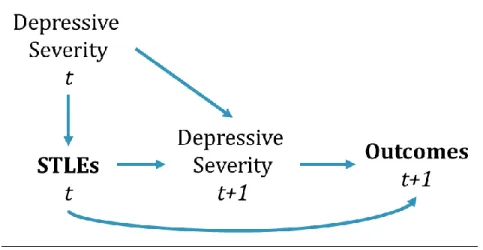
severity may also be associated with the outcomes of ARV adherence and SI, it may be acting as a confounder of the relationship between STLEs and these outcomes. STLEs that are experienced at a given point in time can also affect depressive severity at later time points, however, putting depressive severity on the causal pathway between STLEs and the outcomes and making it a potential time-varying confounder that is affected by prior exposure.
Study overview and intervention description
Data for this research came from the Strategies to Link Antidepressant and Antiretroviral Management at Duke, UAB, NOC, and UNC (SLAM DUNC) Study, a randomized, controlled trial that tested the effect of evidence-based decision support for depression treatment on ARV adherence.54 The study population comprised HIV-infected patients with depression attending the infectious disease clinics at Duke University; the University of Alabama at Birmingham (UAB); Northern Outreach Clinic (NOC) in Henderson, North Carolina; and the University of North Carolina (UNC) at Chapel Hill.
Participants enrolled in the intervention arm had regular contact with a depression care manager who assessed their depression using standardized metrics and made evidence-based antidepressant treatment recommendations to the treating HIV medical provider.55 Participants in the control arm for the study received depression treatment as usual by their HIV providers. As study arm was randomized (and therefore independent of the exposure, STLEs), the proposed research did not need to take study arm into account, although the analyses did adjust for some factors that were expected to be affected by study arm. Variables that were considered for adjustment are shown in the full DAGs in Appendix 1.
Study timeline and sample size
14
through April 2014. Participants enrolled between April and September 2013 were therefore followed for less than a full year. The STLE assessment was added to data collection for new and existing
participants after the first year of the study, in July 2011; only participants still active in the study at that time or enrolled subsequently had data on STLEs and were eligible for inclusion in the current research. Out of the total 304 participants enrolled in the SLAM DUNC study, 289 were eligible to have data on STLEs and were followed for varying lengths of time of up to 12 months.
Inclusion and exclusion criteria
To enroll, individuals had to be adult patients (age 18-65 years at enrollment) with HIV attending the infectious disease clinics at Duke, UNC, NOC, or UAB who scored >9 on the Patient Health
Questionnaire-9 (PHQ-9) depression screening instrument56 and also had a diagnosis of a current major depressive episode or dysthymia confirmed by the Mini International Neuropsychiatric Interview (MINI), a widely used psychiatric diagnostic instrument.57 Patients with a lifetime history of bipolar disorder or psychotic depressive, schizophrenic, schizoaffective, or other psychotic disorders (as determined by the MINI), who had current substance dependence that required inpatient detoxification or treatment, or who required immediate hospitalization for psychiatric disorders and/or acute suicidality, were ineligible for study participation. Patients who failed at least two adequate antidepressant trials, defined as ≥6 weeks at a moderate to high antidepressant dose for their current depressive episode, were also ineligible for the study.58
Analysis Plan for Aim 1: Stressful life events and antiretroviral adherence
15
adherence. Secondary analyses focused on the alternative outcome of self-reported ARV adherence. Previous studies demonstrated the negative association between STLEs and self-reported ARV adherence.9,10,18 Self-reported adherence is likely to be biased upward,36 however, with participants over-reporting adherence due to social desirability bias, resulting in less variability in the outcome. It was hypothesized that the strength of the association between STLEs and self-reported ARV adherence would be attenuated relative to the association between STLEs and pill count-based adherence.
Exposure Assessment/Definition
STLEs were the exposure of interest for both Aim 1 and Aim 2. STLEs were assessed during the monthly ARV pill count telephone calls using a modified version of the Life Events Survey (LES).10,59 Only those events from the LES considered moderately or severely stressful or traumatic based on prior research were included in this assessment.60,61 Participants were asked whether they had experienced any of 46 events, from within nine different categories, during the prior month. The categories were: romantic relationship changes; estrangement from family; death or major illness of a family member or close friend; major illness, injury, or hospitalization; employment difficulties; legal trouble; financial difficulties; life transitions; and safety concerns. Participants were also able to report additional STLEs that had not been covered by the LES; any event reported in this way was hand-reviewed and inclusion in the exposure was based on classification of the event as moderately or severely stressful or traumatic. The total number of STLEs reported at each time point was summed for each participant and coded discretely.
16
this secondary analysis the exposure measure was defined as the average number of STLEs per month reported over each three-month period.
Outcome Assessment/Definition
The primary outcome for Aim 1 was ARV adherence, measured by unannounced, telephone-based pill counts and recorded as a continuous percentage variable, with, for example, 0%
corresponding to zero adherence, or having taken no pills since the last count, and 100% corresponding to perfect adherence, or having taken all pills expected since the last count. Unannounced, telephone-based pill counts have been validated as an objective measure of adherence11 and have been shown to be more sensitive than self-report or pharmacy refill data to changes in adherence over time.36
17
could have been greater than one month. This adherence value was then applied to each month over which the value was calculated.
Calculated adherence in theory should range from 0-100%; however, in practice it is possible to obtain estimates both above and below this range. Adherence values >100% could be due to 1) taking more pills than prescribed or 2) measurement error in the pill count. Values <0% can only be due to measurement error with the pill count. Measurement error could be due to losses and/or gains of pills that were not reported, entire bottles that were missed in between counts, or pills that the participant had in possession but did not report at either the prior or current count, for example. The data
collection protocol included extensive probes about these issues in order to reduce measurement error, but error remains a possibility. The SLAM DUNC study discarded calculated adherence values <0% or >200% but did not discard values <200%; the same was done in the current research.
Studies of ARV adherence have mainly used a threshold of 95% adherence to indicate
“adequate” adherence (i.e. adequate to suppress viral load and prevent ARV resistance); this threshold was largely defined during the early era of un-boosted PI-based regimens.23 More recent evidence with the current boosted PI- and NNRTI-based regimens suggest that virologic suppression can be reliably sustained at lower adherence levels,29,30 and that the adherence-virologic suppression relationship is monotonic, especially for NNRTI-based regimens.27,31 Therefore in primary analyses ARV adherence was kept as a continuous measure. Sensitivity analyses considered dichotomous adherence measures based on various thresholds to indicate adherent vs. non-adherent.
Covariate Assessment/Definition
18
detail below). It was measured with the Hamilton Rating Scale for Depression (HAM-D) at baseline and then every three months thereafter, during scheduled, telephone-based interviews with trained research interviewers. The HAM-D, the most widely used depressive severity measure in research settings, is a validated depression screening tool consisting of 17 open-ended sections assessing different facets of depressive symptoms, and refers to experiences during the past seven days.62-64 Scoring ranges from 0 to 50, and clinical categorization is as follows: 0-7 is normal, 8-13 is mild
depression, 14-18 is moderate depression, 19-22 is severe depression, and 23 and above indicates very severe depression.63 Depressive severity was coded in this analysis as a discrete variable. Change in the total HAM-D score has been shown to correspond to clinically relevant changes in the underlying depression construct,65 and keeping the discrete coding (rather than categorizing) helped retain all of the information contained in the variable. Because it was only assessed every three months, with the exposure and outcome both assessed monthly, in order to use the most representative value for this time-varying confounder, the score closest in time to the measures of adherence and STLEs was used, even if it came from measurements taken after adherence and STLEs were obtained (e.g. for adherence at the two-month mark, the depression score from the three-month interview was used if it was closer in time than the baseline interview).
Other covariates that were assessed as potential confounders or effect measure modifiers included sex, age, drug and/or alcohol abuse, HIV care self-efficacy, stress coping style, HIV-related physical symptoms, HIV status disclosure, and employment status. Sex, as assessed at baseline, was used as a time-fixed dichotomous variable (male, female). Date of birth was obtained at the baseline interview, and used to calculate age at study entry; as all participants by definition aged one year or less during study participation, age at study entry was used as a time-fixed continuous variable.
19
frame assessed at each time point was within the past twelve months. These sections resulted in ordinal scoring of no abuse/dependence, abuse, or dependence on alcohol and non-alcoholic psychoactive substances.57 The HIV Self-Efficacy scale was used to measure self-efficacy in, for example,
avoiding/controlling depression, loneliness, and discouragement; taking medications properly;
discussing/working out issues with medical providers; controlling physical symptoms; and dealing with fatigue.66 The scale consists of 34 examples of tasks, and participants rate how sure they feel that they could do each task on a scale from 1-10, with lower scores corresponding to feeling less sure and higher scores corresponding to feeling more sure. Stress coping style was assessed with the Brief COPE
instrument, which contains 18 examples of coping strategies; participants use a four-point Likert scale to rate how often they use each strategy: “Not at all,” “A little bit,” “A medium amount,” or “A lot.”67,68 Self-efficacy and stress coping style were measured at baseline and at each three-monthly telephone interview; both were updated over time. Physical symptoms (HIV Symptom Inventory),69 employment status and extent of HIV status disclosure to friends, family, and acquaintances were also obtained at baseline and every three months. Physical symptoms were included as a discrete variable indicating the total number of symptoms reported, which was updated over time. Employment status was
dichotomized to indicate employed vs. unemployed. Disclosure of HIV status both to close
friends/family and to everyday acquaintances was measured separately with a four-point Likert scale for each inquiry: “All”, “Most”, “Some”, or “None” and was included as an ordinal variable that was allowed to change over time.
Secondary Outcomes
20
adherence. Self-reported adherence was measured at baseline and every three months thereafter during structured research interviews (in-person at baseline and over the telephone for the rest), with the following questions: 1) “Over the past month, how much of the time have you taken all of your HIV/AIDS medications?” and 2) “Over the past month, how much of the time have you missed or skipped taking your HIV/AIDS medications?” Participants were instructed to respond using a scale from 0% to 100%. The responses to these two questions were averaged (after reverse-coding the second question) as a measure of self-reported adherence ranging from 0-100%.
Statistical
Analyses
General Analysis Approach
To examine the hypothesis that STLEs are negatively associated with continuously-measured ARV adherence, a linear model with robust variance was used to account for repeated observations on participants, yielding an estimate of the mean difference in percent adherence. Under the hypothesis that the association between STLEs and ARV adherence is affected by time-varying confounding by depressive severity (Figure 3.1), standard approaches (e.g. inclusion on the right hand side of the regression equation) could not be used to control for depressive severity, since by doing so it would block part of the causal pathway of interest (from exposure to outcome through depression, see Figure 3.1). To deal with this time-varying confounding, inverse-probability-of-exposure weights could be applied to the model to estimate the parameters of a marginal structural model (MSM).53 The assumption that a MSM was necessary was examined by comparing models with and without the exposure weights, as well as by assessing the associations between STLEs and depression, and
21
quantile.70 For total STLEs, the exposure was coded into deciles, and for severe STLEs into tertiles (due to the smaller range). For the dichotomously coded STLE exposures, logistic regression was used. In all cases, the weights were stabilized by the marginal probabilities of exposure. The stabilized weights were calculated according to Equation (1):
𝑠𝑤𝑖 =𝑝(𝑆𝐿𝐸𝑝(𝑆𝐿𝐸𝑘𝑖)
𝑘𝑖|𝐷𝑘𝑖) (1)
where sw=stabilized weight, p=probability, D=depression, k indexes over time periods, and i indexes across individuals.
The estimates obtained from models with and without inverse-probability-of-exposure weights were nearly identical, suggesting that a MSM was not necessary to yield valid estimates. Analyses therefore proceeded under the assumption that the STLE-adherence relationship was not being affected by time-varying confounding by depression, and exposure weights were not used. The analysis model yielded an estimate of the mean percentage change in ARV adherence, given a one-unit increase in the number of STLEs experienced, while controlling for all potential confounders and adjusting for clustering due to making repeated observations on individuals over time.
Secondary Analyses
Secondary analyses focused on the alternative outcome of self-reported ARV adherence. Analyses for self-reported ARV adherence were conducted in largely the same way as analyses using pill count-measured ARV adherence, as both outcomes were on the same scale. Self-reported ARV
22
given a one-unit increase in the number of STLEs experienced, while controlling for all covariates and for time-varying confounding by depression, and adjusting for clustering due to making repeated
observations on individuals over time.
Handling Missing Data
The amount of missing data in the SLAM DUNC study was non-trivial, and was not expected to be missing completely at random; a complete-case analysis would therefore have likely introduced bias, in addition to being inefficient due to losing power by excluding participants with partial data. To deal with missing data, inverse-probability-of-observation weights were combined with multiple imputation, therefore taking advantage of the efficiency of imputation,71 while avoiding the need to impute data from completely missed study contacts. This utilized a three-step process: (1) calculation of weights, (2) multiple imputation for observations to be included in the analysis, and (3) application of the weights to each imputed dataset.
23
In the second step, for each observation with a completed pill count contact (e.g. rows 1 and 3-5 in Table 3.1), any missing data points were imputed.72 In the hypothetical data in Table 3.1, therefore, STLEs were imputed for the first record for ID 1, ARV adherence was imputed for the last record for ID 1, and both depressive severity and various other covariates were imputed for the first record for ID 2. To impute missing data points, multiple imputation using chained equations was used, which is a flexible way to implement multiple imputation when there is a non-trivial amount of missing data among variables of several different forms. It does not assume multivariate normal distribution of the variables being imputed; by imputing a series of sequential univariable models separately for each variable with missing data, it can accommodate different variable types (e.g. continuous, binary, ordinal, nominal).73
To implement multiple imputation by chained equations, all missing values were first filled in by a simple random sampling, with replacement, from the observed values of each variable. The first variable, X1, was then regressed on all other variables. This regression was limited to participants with observed values of X1; simulated draws from the posterior predictive distribution of X1 were then used to fill in missing values of X1. The process was then repeated on the next variable, X2, and in turn for each variable with missing data. Imputation models included all variables that were considered for inclusion in the analysis model, i.e. both the exposure and outcome, as well as all covariates. Also included in imputation models were predictors of each variable being imputed, and predictors of missingness in each variable. To impute continuous variables, linear regression was used, after
assessment of the functional form and potential transformation of the variables. Logistic regression was used to impute binary variables and multinomial regression was used for both nominal and ordinal variables.
24
are imputed in increasing order of the number of missing values they contain.73 For this research, ten cycles were used per imputed dataset, and 50 datasets were imputed.
Finally, in the third step, the inverse-probability-of-observation weights were applied to the analysis model in each of the imputed datasets. The weighting rebalanced the data to ensure it was representative of the full sample, since the model was run only for the observations with completed pill counts.
In summary, only observations with completed pill count contacts were included in the analysis model. Any missing data points for included participants were imputed using multiple imputation by chained equations. Data points imputed were the exposure (STLEs), the outcome (ARV adherence), and all covariates (depressive severity, sex, age, drug/alcohol abuse, HIV care self-efficacy, stress coping style, HIV-related physical symptoms, HIV status disclosure, and employment status). In the assessment of the necessity of a MSM, the observation weights were combined with the exposure weights to generate one final set of weights, which was applied to the included sample to rebalance it to represent the full sample while adjusting for time-varying confounding by depressive severity.
Sensitivity Analyses
25
Different dichotomous coding schemes for the outcome of ARV adherence were explored, in addition to the continuously-coded primary outcome. Adequate vs. inadequate adherence was defined using a threshold of 95%. We also explored the effect of truncating the continuously-measured
adherence outcome at 100%, as the theoretical upper plausible limit.
Different classifications of exposure were explored. The primary analysis incorporated all the STLEs assessed with the modified LES, to generate a discrete variable. Events were also limited, however, to determine whether results were sensitive to the severity of stressors experienced. By including only those STLEs considered “severe” (divorce or separation, death or major illness of an immediate family member, major financial problems, time in jail or prison, and sexual and physical assault), a second discretely coded exposure variable was created and assessed. Finally, both the primary exposure that included all STLEs and the severe-only STLE exposure were dichotomized into variables indicating at least the population mean number of events vs. less than the mean, and any event experienced vs. no events, respectively. The use of dichotomous exposures changed the calculation of weights for the MSM as described above.
Statistical Power
Statistical power was assessed using PROC POWER in SAS 9.3 (SAS Institute, Cary, NC). A 5% Type I error probability, with a two-tailed test, was used. The exposure was dichotomized (at the median value for number of STLEs per month) for power calculations; 65% of the study population was assumed to be exposed. Power to detect a 10-percentage point difference in adherence, based on an assumed pooled standard deviation of 25-29%,74 was calculated for the expected sample size.
26
𝐸𝑆𝑆 = (𝑚 ∗ 𝑘)/𝐷𝐸 (2)
In Equation (2), m refers to the number of observations per cluster, k is the number of clusters (here, participants), and DE is the design effect (a correction factor applied that takes into account the correlation between observations within a cluster). DE is calculated with Equation (3):
𝐷𝐸 = 1 + ((𝑚 − 1) ∗ 𝜌) (3)
In Equation (3), 𝜌 is the intracluster correlation coefficient, which can vary from 0 to 1.75
The number of clusters (participants), k, was expected to be 240. The average number of observations per cluster, m, was assumed to be 5, to account for missed pill counts (resulting in fewer than the maximum 12 observations), and for the 40 expected participants with less than a year of follow-up (by design, fewer than 12 observations). Allowing 𝜌 to vary between 0.5 and 0.9, assuming fairly high correlation of adherence measures among individuals, the ESS for this aim ranged from 261 to 400 (Figure 3.2). The upper and lower bounds of ESS were input into PROC POWER to represent the best- and worst-case scenarios.
Under these assumptions, the power to detect percent difference in adherence ranging from 0.07-0.13 is shown in Figure 3.3 for effective sample sizes of 261, 316, and 400, corresponding to sample sizes using the maximum, median, and minimum values of 𝜌 that were assessed (0.9, 0.7, and 0.5), respectively. Even under the worst-case scenario of an ESS of 261, there was expected to be >80% power to detect 10% or greater change in adherence.
Limitations
27
error due to poor recall, as participants were asked to report on events experienced over the past month; events that happened at the beginning of the month might have been forgotten, or thought by the participant to have occurred in the previous month. The assessment of STLEs in the SLAM DUNC study improved upon similar exposure assessment in other studies by using a shorter recall period (one month).9,19 The trained interviewers repeatedly mentioned the timeframe while asking about each event, in order to anchor the period of recall only to the month preceding the assessment.
Participants might also have chosen not to report STLEs if they did not wish to disclose them, due to embarrassment, a wish for privacy, or other reasons.
The heterogeneity of the exposure may also have led to some measurement error, as the Life Events Survey (LES) that was used to measure STLEs comprised a diverse set of events. It is possible that associations with modifiers, confounders, and the outcome could have been of different strengths or even in different directions for different events. Sensitivity analyses addressed some of these limitations by varying the types of events included in the exposure. In addition, the exposure was measured
discretely, as the total number of events experienced. This implied that each different type of event had the same marginal association with the relevant outcome. To make this more plausible, only events considered to be moderately to severely stressful or traumatic, based on prior studies, were included in the LES version used.60,61 In order to ensure greater consistency, the number of events experienced, rather than participants’ ratings of the severity of events, was used to measure the exposure, making for a more objective and consistent measurement.
28
number, the date that it was filled, and the number of refills remaining, was collected in an effort to track the continuity of bottles received. Participants were also asked to obtain refill histories from their pharmacy and provide them to study staff; information provided in the pill counts was verified and supplemented with these histories when available. Data collectors were trained not to provide feedback to participants during the call about their calculated adherence, in order to reduce any motivation to intentionally misreport pill counts.
The amount of missing data in the SLAM DUNC study was non-trivial. The missing data plan described above helped address this issue.
Analysis Plan for Aim 2: Stressful life events and suicidal ideation
The overall goal of Aim 2 was to examine the association between STLEs and suicidal ideation (SI). The hypothesis was that STLEs would be positively associated with report of suicidal thoughts. Secondary analyses focused on evaluation of modification of the relationship between STLEs and SI by variables identified a priori, including stress coping style and self-efficacy. Hypotheses for secondary analyses were that the positive association between STLEs and SI would be stronger among those with less adaptive coping styles and among those with low self-efficacy.
Exposure Assessment/Definition
29
period. If more than three measures of STLEs were taken in a given time period, the three measures closest in time to the SI assessment were used. The mean number of STLEs was coded continuously and also dichotomized to indicate experiencing at least the population mean number of events vs. less than the mean. STLEs were also limited to the most potentially severe, coded both continuously and
dichotomized as any vs. none.
Outcome Assessment/Definition
The outcome for Aim 2 was SI, measured with the Hamilton Rating Scale for Depression (HAM-D) during telephone interviews conducted every three months. The HAM-D, the most widely used depressive severity measure in research settings, consists of 17 open-ended sections assessing different facets of depressive symptoms experienced during the past seven days.62-64 The third section addresses SI with the following questions:
“During this past week, did you have thoughts that life is not worth living?” “Did you think that you would be better off dead?”
“Have you had thoughts of hurting or killing yourself?” “Have you actually tried to hurt yourself?”
Additional probes were asked based on the participant’s responses to these questions. Trained interviewers administered the HAM-D, and a protocol was in place to address active SI that was reported during interviews, if the safety of the participant was in question. Scores for the SI section range from 0-4 as follows: (0): No symptoms; (1): Feels that life is not worth living; (2): Wishes that s/he were dead, or had thoughts about hurting self; (3): Suicidal ideas of gesture (has a plan, or begins suicide attempt but stops); (4): A suicide attempt during the past week. Responses falling between two scores were scored conservatively (given the lower score) by the interviewers. For the primary analysis, the outcome was dichotomous: any suicidal ideation (score >0) vs. none (score of 0).
30
with or without a definite plan).38 Using a dichotomous outcome of any SI vs. no SI introduced the assumption that STLEs affect all types of SI in the same way. This assumption might not be plausible in all cases, as active SI might be expected to be associated with more extreme exposures. The vast majority of SI, however, was passive; it should therefore have posed minimal issues to have included all SI as one outcome, while retaining the greatest statistical power as a result of having more overall outcomes. Sensitivity analyses explored sensitivity of results to different coding of the outcome, including separation of passive and active SI.
Covariate Assessment/Definition
Depressive severity was assumed to function as a time-varying confounder of the association between STLEs and SI, in the same way as described for Aim 1. For Aim 2, however, since it was measured every three months at the same time as SI, the HAM-D score from each three-monthly interview was used; it was not necessary to “borrow” scores from other time points. The HAM-D score was recalculated to exclude the section that covers SI, in order to avoid overlap with the outcome; resulting in a possible range of 0 to 46.63
31
Form-12, scored continuously on a 0–100 scale (with higher numbers indicating greater functionality; US
population mean=50, one standard deviation=10).76,77
Potential Modifier Assessment/Definition
Modification of the relationship between STLEs and SI was assessed in secondary analyses. Potential modifiers included stress coping style and self-efficacy. Measurement and scoring of these variables were described above. Both potential modifiers were dichotomized in order to assess the exposure-outcome relationship within strata of the modifier. The Brief COPE instrument for measuring stress coping style includes items related to adaptive (e.g. acceptance, getting emotional support) and maladaptive (e.g. drug/alcohol use, denial) strategies for coping with stress. A dichotomous variable was created to indicate high adaptive vs. low adaptive coping style, using a score of 2.5, which is the
midpoint of the scoring range, as the cut-off. Scores of 2.5 or above indicated high adaptive coping while scores below 2.5 indicated low adapting coping. Likewise, self-efficacy on the module relating to mood, support, and fatigue was dichotomized at a score of five (the midpoint of the scoring range); scores of five or above indicated high self-efficacy and below five indicated low self-efficacy.
Statistical Analyses
General Analysis Approach
To examine the hypothesis that STLEs are positively associated with dichotomously-measured SI, we used Poisson models with robust variance (instead of a log-binomial model due to model
32
the assumption that they were necessary was examined in sensitivity analyses. This model yielded an estimate of the increase in prevalence of SI, given a one-unit increase in the number of STLEs
experienced, while controlling for all covariates and for time-varying confounding by depression, and adjusting for clustering due to making repeated observations on individuals over time.
The same assumptions, and justifications for making the assumptions, that are necessary to make when using MSMs, described in Aim 1, hold for this aim: assumptions of exchangeability, consistency, and positivity.79
Again with this aim, there was the same continuously-modeled exposure of STLE, and thus as described in Aim 1, total STLEs were coded into deciles, and severe STLEs into tertiles (due to the smaller range), and ordinal logistic regression was used to obtain probabilities of exposure for calculating the weights.70 For the dichotomously coded STLE exposures, logistic regression was used. In all cases, the weights were stabilized by using the marginal probabilities of exposure for the numerators. The
denominators included the probabilities of exposure conditional on baseline, lagged, and current values of SI and depressive severity; current and lagged values of STLEs; baseline and current values of HIV-related symptoms and drug/alcohol use; baseline age, gender, and psychiatric comorbidities; and interview month. Restricted cubic splines were used for modeling the continuously-measured variables (lagged STLEs, depressive severity, HIV-related symptoms, and age), and interview month was modeled using indicator variables for each of the 3-, 6-, 9-, and 12-month interview periods.
Secondary Analyses – Modification Assessment
33
Differences in the estimates of effect obtained were compared across strata of each potential modifier qualitatively, and Wald chi-square homogeneity tests were conducted with a term for interaction between STLEs and the given modifier included in the model.
Handling Missing Data
The same general approach to handling missing data that is described in Aim 1 was followed for this aim. A different inclusion rule was used, however, to determine which observations were included in the analyses (and therefore for which observations missing data were imputed). Observations in which the quarterly interview (during which the outcome, SI, is measured) was completed were included; the data were weighted to account for the exclusion of other observations. Any missing data for included observations were imputed. The variables included in imputation models differed slightly from those in Aim 1; variables included the exposure of STLEs and the outcome of SI, as well as the covariates and potential modifiers described above. For further stabilization of the inverse-probability-of-observation weights, a lagged variable for the exposure (continuously-measured STLEs) was included in both the numerator and denominator.
Sensitivity Analyses
As described in Aim 1, the necessity of a MSM to assess the relationship between STLEs and SI was examined.
Alternate coding of the outcome of SI was explored. This included nominal coding that
34
Statistical Power
Statistical power was assessed using PROC POWER in SAS 9.3 (SAS Institute, Cary, NC). A 5% Type I error probability, with a two-tailed test, was used. The exposure was dichotomized (at the median value for number of STLEs per month) for power calculations; 65% of the study population was assumed to be exposed. Twenty percent of the unexposed are assumed to experience the outcome, suicidal ideation, based on available data to date. Power to detect a prevalence ratio ranging around 2.0, a conservative estimate based on the only similar study available,51 was calculated for the expected sample size. The effective sample size (ESS) was calculated based on Equations 2 and 3 above; here, however, the number of observations per participant, m, was assumed to be three on average (out of four possible observations, corresponding to the interviews conducted at three, six, nine, and 12 months post-enrollment). Again using 240 expected clusters (participants) and allowing the intracluster
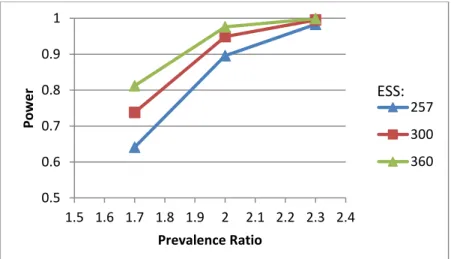
correlation coefficient, ρ, to vary between 0.5 and 0.9, the ESS ranged from 257 to 360 (Figure 3.4). These sample sizes were input into PROC POWER.
Under these assumptions, the power to detect prevalence ratios (PRs) ranging from 1.7-2.3 is shown in Figure 3.5 for effective sample sizes of 257, 300, and 360, corresponding to the minimum, median, and maximum sizes obtained with the given range of ρ. At least 80% power was expected with each ESS for a PR of at least 2.0, and for an ESS of 360 at all PR values of at least 1.7.
Limitations
35
36
Figure 3.1. Simplified directed acyclic graph for the associations between STLEs the outcomes
Figure 3.2. Effective sample size over varying correlation values: Aim 1
Figure 3.3. Power to detect varying mean difference over different ESS: Aim 1 100 150 200 250 300 350 400 450
0.4 0.5 0.6 0.7 0.8 0.9 1
Eff e ctiv e N Rho 0.5 0.6 0.7 0.8 0.9 1
0.05 0.07 0.09 0.11 0.13 0.15
Pow
e
r
Mean Difference in Adherence
261
316
37
Figure 3.4. Effective sample size over varying correlation values: Aim 2
Figure 3.5. Power to detect varying prevalence ratios over different ESS: Aim 2 100 150 200 250 300 350 400
0.4 0.5 0.6 0.7 0.8 0.9 1
Eff e ctiv e N Rho 0.5 0.6 0.7 0.8 0.9 1
1.5 1.6 1.7 1.8 1.9 2 2.1 2.2 2.3 2.4
Pow e r Prevalence Ratio 257 300 360 ESS:
Table 3.1. Example of 1st three observations for two participants
ID Month Pill Count
Contact
STLEs status Adherence
status
Depressive severity status
Other covariate status
1 1 1 Missing Available Available Available
1 2 0 Missing Missing Available Available
1 3 1 Available Missing Available Available
2 1 1 Available Available Missing Missing
2 2 1 Available Available Available Available
38
CHAPTER 4: RESULTS
Aim 1: Stressful and traumatic life events as disruptors to antiretroviral therapy adherence
Introduction
Persons living with HIV/AIDS (PLWHA) face a number of challenges related to their HIV infection, including life-long use of antiretroviral (ARV) medications, HIV-related stigma, and opportunistic
infections. Depression is also common, affecting upwards of 20% of PLWHA in the US,1-5,69 in comparison to 12-13% of the general population.80 More attention has been paid recently to stressful and traumatic life events (STLEs) among PLWHA, which are common in this population,7,8 and may have important implications for psychological, behavioral, and other outcomes. STLEs include moderately or severely stressful or traumatic events such as death or illness of family or friends; difficulties with relationships, finances, or employment; legal trouble; threats to personal or home safety; housing instability; and physical or sexual assault. STLEs are experienced more often by PLWHA than by the general population, in part due to the predominance of HIV infection among populations experiencing economic and other difficulties that are often related to such events.9
39
recent financial and health-related stressful events were associated with increased risk of substance use, and recent health and partner-related stressors were associated with sexual risk-taking.20
Adherence to ARV medication is one important HIV-related outcome that STLEs may affect. STLEs can cause disruptions to routines, and for PLWHA, such disruptions may result in decreased ARV adherence. Adequate ARV adherence is necessary to achieve viral suppression, maintain health, and avoid developing drug resistance.27,29-31 Two prior studies examined the association between STLEs and self-reported ARV adherence and found that increased frequency and greater severity of events were associated with poorer adherence.9,10 Both studies relied on self-reported ARV adherence and long recall periods for STLEs, which may have affected the accuracy of exposure and outcome measurements.
The current study examined the longitudinal association between STLEs and ARV adherence, as measured monthly by pill counts, among adults in the Southeastern USA with HIV and depression. Unannounced, telephone-based pill counts have been shown to provide valid, accurate measures of adherence,11 and are more sensitive than self-report to changes in adherence over time.36 Pill counts may, therefore, allow for a more accurate assessment of the relationship between STLEs and ARV adherence. Likewise, recent STLEs may be more strongly related to current ARV adherence than STLEs measured over longer recall periods. We hypothesized that higher numbers and severity of STLEs would be associated with poorer ARV adherence, and that improved measurements of both STLEs and
adherence would yield stronger associations than those found in prior studies.
Methods
Study sample
Data for this study came from the Strategies to Link Antidepressant and Antiretroviral Management at Duke University, the University of Alabama-Birmingham, Northern Outreach Clinic
40
adherence, which has been described previously.54 The study population comprises adult (age 18-65 years) HIV-infected patients with depression attending infectious disease clinics at the study sites. Participants enrolled between July 1, 2011 and September 30, 2013 were eligible for the current analysis; data on STLEs were collected during this period. Participants were followed for up to one year following enrollment, receiving up to 12 monthly pill count calls. The number of calls completed depended on attrition and timing of enrollment relevant to collection of STLE data and the end of the study. Study procedures were approved by the Institutional Review Boards at the University of North Carolina at Chapel Hill, Duke University, and the University of Alabama at Birmingham.
Measures
Stressful or Traumatic Life Events. STLEs were assessed during monthly telephone calls with participants, using a modified version of the Life Events Survey (LES).10,59 Events from the LES considered moderately or severely stressful or traumatic based on prior research are included in this