THE FACE OF INVESTIGATIVE NEWS: A MIXED-METHOD ANALYSIS OF LOCAL TELEVISION INVESTIGATIVE JOURNALISM CONTENT, PERCEPTIONS, AND
INFLUENCES
Jesse Abdenour
A dissertation submitted to the faculty of the University of North Carolina at Chapel Hill in partial fulfillment of the requirements for the degree of Doctor of Philosophy in the School of
Journalism and Mass Communication.
Chapel Hill 2015
Approved by: Daniel Riffe
Francesca Dillman Carpentier C.A. Tuggle
ABSTRACT
JESSE ABDENOUR: The Face of Investigative News: A Mixed-Method Analysis of Local Television Investigative Journalism Content, Perceptions and Influences
(Under the direction of Daniel Riffe)
Investigative journalism is seen as the most important form of news reporting, but many fear it has declined because of economic considerations. This dissertation addresses gaps in the literature by empirically analyzing the quantity and quality of investigative journalism
production within the most popular news format, local television. The project also examines organizational and market factors that influence investigative productivity.
A content analysis of local TV newscasts showed that investigative quantity and quality were generally low. Of the long-form stories coded (N=398), about one in five was presented as investigative by the producing station, and approximately one in nine was actually investigative by definition (less than half the stories presented as investigative were investigative by
definition). In addition, a majority of the stations sampled (N=80) produced no investigative journalism of any kind during the sample week of newscasts. However, an accompanying survey showed that more than half of local television investigative reporters thought investigative production was increasing at their stations.
privately owned stations. This finding is in stark contrast to literature touting the negative effect of corporations on news, and has ramifications for future study of news organizations.
A station’s perceived emphasis on profit predicted less perceived station emphasis on investigative reporting, but profit emphasis was not related to stations’ actual investigative productivity in the content analysis. Larger news staffs also predicted greater investigative emphasis, but staff size was not related to actual investigative productivity. Market size and competition level did not significantly predict investigative productivity or investigative emphasis.
This dissertation provides support to those who charge that local television is providing little quality “watchdog” reporting, but also indicates that investigative journalists are optimistic about their craft, which has borne the brunt of newsroom cutbacks in recent years. It also
ACKNOWLEDGEMENTS
Although a PhD is technically an individual degree, it wouldn’t have been possible without the help of many others, especially my dissertation committee members.
First and foremost, I would like to thank my advisor, Daniel Riffe, who was also my first news writing teacher fifteen years ago. Dr. Riffe encouraged me to enter the research world, and has been invaluable in helping me explore the world of journalism and pursue my research interests. He has pushed me to be my best, and has helped me prepare for life as an academic. Most importantly, he convinced me that I can be a scholar and still live a normal life. For this I will always be grateful.
I would like to thank Francesca Dillman Carpentier for showing me that numbers are not something to fear, and can in fact be exhilarating. Her introduction to statistics class helped convince me to pursue quantitative research. I have learned much from her expertise.
C.A. Tuggle has set the bar high for broadcasters-turned-professors, and provides an example to follow as I head into the academic profession. I appreciate his guidance, and hope to have a fraction of the success that Dr. T has had in developing young television reporters.
Richard Blackburn helped introduce me to the world of organizational study. His outlook on large-scale issues in media organizations has been a valued resource on this project.
I couldn’t have completed the survey for this study without Nancy Pawlow and Linda Peterson, who were always willing to help, and the many envelope-stuffers who worked late nights to make it a reality. I’d like to thank the three coders who helped with this dissertation’s content analysis: Diane Francis, Justin Blankenship, and Laura Marshall. Along with doing some of the “dirty” work, these three helped shape the project by providing perspective on what
worked and what didn’t.
During my time at UNC-Chapel Hill, Cindy Morton and Heidi Hennink-Kaminski were great to work with and were always willing to take time out to help me with administrative issues and funding. I’d also like to thank Rhonda Gibson for her advice, and for providing some levity in Carroll Hall. I owe a debt of gratitude to my friends and mentors in media law, who were instrumental in my development as a scholar. I very much appreciate the help of Michael Hoefges, Tori Ekstrand, Brooks Fuller, and Kevin Delaney, the “law dogs” who helped me produce my first academic journal publication. I also couldn’t have made it to this point without help from my UNC classmates, including Joe Cabosky, Karen McIntyre, Meghan Sobel, Dave Bockino, Suzannah Evans, Creighton Welch, Emery Rogers, and Jaya Mathur. Thanks for being there.
I am indebted to Rob Wicks, Jan Wicks, and Jack Zibluk, three mentors who saw potential in me and helped me start along this path. Thanks for your insight and guidance.
TABLE OF CONTENTS
LIST OF TABLES...ix
Chapter I. INTRODUCTION...1
II. INVESTIGATIVE JOURNALISM...5
Definition and Classification...5
Original Work...7
Concealed Information...7
Public Interest...8
The State of Investigative Journalism...10
Local TV Trends...10
Hard News Trends in Local TV...11
Investigative Trends in Local TV...13
III. INVESTIGATIVE INFLUENCES...18
Routines...19
Discovery...19
Selection...21
Reporting...22
Organizations...23
Corporate Governance Influence...28
Social Institutions...32
Television Markets and Competition...32
Institutionalism and Investigative Journalism...35
Measuring Competition...39
Station Size...41
IV. RESEARCH QUESTIONS AND HYPOTHESES...44
V. METHODS...48
Survey...48
Survey Measures...50
Content Analysis...54
Reliability...57
Content Analysis Measures...58
Organizational and Market Measures...62
VI. FINDINGS...65
VII. DISCUSSION, CONCLUSION AND RECOMMENDATIONS...74
Discussion...74
Conclusion and Recommendations...84
APPENDICES...95
LIST OF TABLES Table
1. Results of Principal Components Analysis of Survey Respondent Scores/Ratings...88
2. Presence of Investigative Characteristics in Content-Analyzed Stories...88
3. Investigative Scores for All Stories in Content Analysis...89
4. Investigative Branding for All Stories in Content Analysis...89
5. Investigative Scores for Branded Stories in Content Analysis...89
6. Length of All Stories in Content Analysis...90
7. Length of Investigative-Branded Stories in Content Analysis...90
8. Means and Bivariate Correlations for Key Variables...91
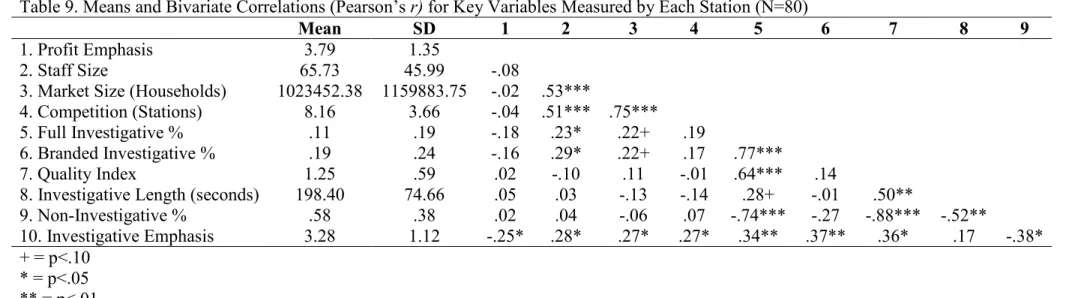
9. Means and Bivariate Correlations for Key Variables Measured by Station...91
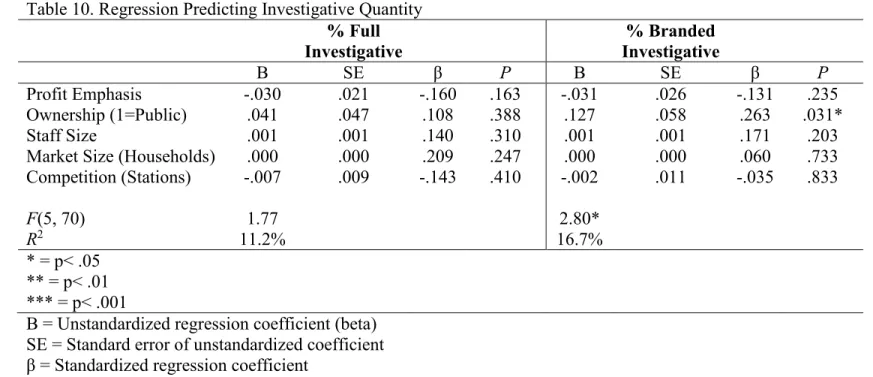
10.Regression Predicting Investigative Quantity...92
11.Regression Predicting Investigative Quality...93
CHAPTER ONE
INTRODUCTION
Locally televised investigative journalism has helped countless communities learn the truth about their leaders. Investigators at local TV stations have taken on every aspect of society – from government and politics to education and sports – and their stories often help create positive change (Downie, 2012). The significance of local investigations can be felt in Cincinnati, where last year WCPO revealed that 9-1-1 operators were putting lives at risk by working without proper medical training (RTDNA, 2014); in Tampa, where WFTS showed that state workers were declaring elderly people “incapacitated” so officials could sell their homes for big profits; in smaller markets like Columbia, SC, where WLTX found widespread negligence in the department of social services that coincided with the death of one foster child (duPont Award Winners, 2015); and in Wilmington, NC, where last year WECT discovered that county
prosecutors were dismissing almost half of their DWI cases, often putting dangerous repeat offenders back on the road (Evans, 2014). These investigative stories, like many others, led to firings, resignations, policy changes, new laws, trials, and convictions.
Watergate, an expectation that the press would hold accountable those with power and influence over the rest of us” (Downie, 2012). The “watchdog” ethos that investigative news represents is extremely important to consumers (Jones, 2013; Rowe, 2011), journalists (Willnat & Weaver, 2014), and news managers (Jones, 2013). It is seen as the standard for excellence in American journalism, against which all other reporting is judged (Aucoin, 1997).
Local television investigations in particular have great potential for impact, due to the medium’s popularity. Local TV is the top news source for adults in America, reaching the broadest audience in terms of size, diversity, and socioeconomic status (“Local News Interest,” 2015; Mitchell, 2014; Olmstead, Jurkowitz, Mitchell, & Enda, 2013; Potter, Matsa, & Mitchell, 2013; Waldman, 2011). Audiences turn to local television first for local political news
(Rosenstiel, Mitchell, Purcell, & Rainie, 2011), and often trust local TV presenters more than print journalists (Graber & Dunaway, 2015).
But many fear investigative journalism has declined sharply because of the recent economic downturn and profit considerations (Coronel, 2013; Lozano, 2010; Walton, 2010; Waldman, 2011). Though journalists and news managers highly value investigations, most think their news outlets are not getting the proper resources to conduct them (Jones, 2013; Holcomb, Mitchell, & Purcell, 2015). Scholars (Higgins-Dobney & Sussman, 2013), media critics
(Downie, 2012; Lewis, 2014), and even television news directors (Jessell, 2012) think local TV investigative reporters are doing a poor job. Former investigative television reporter Joe
Bergantino said investigative cutbacks at local stations deprive citizens of valuable information: “they’re not getting the kind of information they need from television news to hold the
The apparently tenuous status of investigative journalism on local television raises certain questions: first, how much investigative journalism is being produced on local TV? Second, what is the quality of that journalism? And third, of the investigative reporting that is being done, what factors contribute to its production? These are empirical questions that largely have not been answered. The current project addresses these gaps in the literature by analyzing the amount and quality of investigative journalism at local television stations across the U.S., and how certain ownership and market variables affect investigative productivity. This examination utilizes a survey of investigative reporters, a content analysis of local TV newscasts, and a market and organizational analysis to address these issues.
The second chapter of this dissertation explains why investigative journalism is
particularly useful to society and democracy, examining definitions of investigative journalism and larger trends in its production. The third chapter looks at the investigative news process through the prism of Shoemaker and Reese’s (2014) hierarchy of news influences, predicting how various micro- and macro-level dynamics might constrain investigative news. While an organizational emphasis on profit might limit investigative journalism, organizational structure and size might encourage its production. Additionally, exogenous factors like competition and market size may stimulate investigative reporting. The fourth chapter lists the project’s specific research questions and hypotheses, and the fifth chapter describes the methods of analysis. Chapter six presents analysis results, and chapter seven discusses these results along with final conclusions and recommendations for researchers and journalists.
Because there is a limited body of academic knowledge concerning television news, especially television investigative news, several studies of print and online journalism are
CHAPTER TWO
INVESTIGATIVE JOURNALISM
Definition and Classification
Investigative news provides surveillance of powerful interests, including public entities, such as governments, and private entities, such as corporations (de Burgh, 2008; Protess, Cook, Doppelt, Ettema, Gordon, Leff, & Miller, 1991). It embodies the traditional “watchdog” function of the press integral to the First Amendment (Blasi, 1977). The Founding Fathers sought to establish the press as an independent entity capable of providing a “check” on government forces (Blasi, 1977; McManus, 1990; Siebert et al., 1956). The press’ primary duty was to be the
“watchdog over the workings of democracy, ever vigilant to spot and expose any arbitrary or authoritarian practice” (Siebert et al., 1956, p. 56). Legal scholar Vincent Blasi (1977) said speech that “checks” the abuse of official power, such as investigative journalism, is the most valuable form of free expression and should receive the highest legal protection.
Investigative reporters often seek to enact political or social change through their reporting (Ettema & Glasser, 1998; Protess et al., 1991).
Good investigative journalism “afflicts the comfortable and comforts the afflicted” (Houston, 2009; Kovach, Rosenstiel, & Kohut, 2001), and its reporters are often guided by an ethical duty to expose wrongdoing (Aucoin, 2006; Houston, 2009). Driven by moral “outrage” (Ettema & Glasser, 1998; Protess et al., 1991), investigative reporters “champion the weak” and “accuse the guilty” (de Burgh, 2008, p. 19). Ettema and Glasser (1998) identified three properties of successful investigative journalism: “publicity,” whereby reporters bring an issue to light with the intent of fixing the problem; “accountability,” in which those responsible for the problem are held accountable and given an opportunity to reply; and “solidarity,” in which the reporter establishes an empathetic link between the “victim” of the story and the media consumer (p. 189).
Most official definitions of investigative journalism are variations on a description written in 1983 by Robert Greene, former assistant managing editor of Newsday:
Those three themes (original work, public importance, and concealed information) have been used frequently in subsequent definitions of investigative reporting (see, e.g., Aucoin, 2006; Bernt & Greenwald, 2000; Blevens, 1997). Ullmann (1995) called Greene’s definition the “best” description of investigative journalism (p. 2), and a similar definition is used today by the
Investigative Reporters and Editors organization: “The reporting, through one’s own initiative and work product, of matters of importance to readers, viewers or listeners. In many cases, the subjects of the reporting wish the matters under scrutiny to remain undisclosed” (Investigative Reporters and Editors, 2015). Each of Greene’s three themes is described in detail in the following section.
Original Work. Many scholars take this to mean that the reporter did his or her own “digging” to get the story (Cordell, 2009; Houston, 2009; Ullman, 1995). Aucoin (2006) held that investigative reporting reveals information “through the original, time-consuming ‘digging’ of the reporter for the purposes of inspiring reform” (p. 91). Inherent in this process is that the reporter did not simply accept information offered through the typical authoritative channels; he or she went beyond allegation or denial to establish facts that either substantiate or refute official claims (Blevens, 1997; de Burgh, 2008; Knight, 2007; Protess et al., 1991; Spark, 1999;
Williams, 1978). Ettema and Glasser (1998) postulated that it is the investigative journalist’s job to “look beyond what is conventionally acceptable, behind the interpretations of events provided for us by authorities and the authoritative” (p. 3). An example of this would be an investigative reporter’s interviewing of enlisted men and women to establish that rape and sexual harassment within the armed forces is tolerated, despite denials by military officials.
2006; Cordell, 2009; Houston, 2009; Ullman & Honeyman, 1983). Benjaminson and Anderson (1990) declared that concealed information is the sine qua non of investigative reporting; without this element, reporting is not investigative. Greene’s definition specified that someone must be actively trying to hide the information that is revealed (Ullman & Honeyman, 1983). This
requirement of deliberate suppression is also stipulated by Williams (1978) and de Burgh (2008), but has mostly fallen out of favor with researchers. A more common and less strict definition of the “concealed information” characteristic is that the information was hidden from the public, but was not necessarily suppressed (Blevens, 1997; Knight, 2007). Several investigative scholars have held that the revelation of concealed information could be from a reporter’s original discovery of patterns in complex records or public data (Bernt & Greenwald, 2000; Defleur, 1997; Knight, 2007). An example of this would be an investigative reporter looking through hundreds of hours of police dashboard camera videos in order to establish a pattern of racial profiling (Berry, 2009).
Investigative reports that are important to audiences almost always involve harm – the reporter reveals that the “villain,” or “target,” of the story has caused harm to a “victim” (Bernt & Greenwald, 2000; de Burgh, 2008; Protess et al., 1991; Ruehlman, 1977; Ullman 1995). Truly investigative stories involve villains who are in authoritative positions and have abused that authority (Northmore, 1996; Protess et al., 1991). Conflicts between individuals are usually not investigative, whereas conflicts between individuals and the state often are (Northmore, 1996). An example of the former is a consumer-centered story, such as when a small company charges a customer for services not rendered. Northmore (1996) maintains that individual conflicts often result in “trite foot-in-the-door TV investigations,” and that truly investigative reporting should be “a little alarming to anyone in power” (pp. 10-11). Impactful investigations can also be alarming to the news outlets that produce them because of potential lawsuits (Ullman, 1995).
Building from the preceding literature, the present project defines an investigative news story as one that: a) is a piece of original work by the presenting news organization; b) reveals information that was either purposely suppressed, concealed by law, or was public but was compiled by the reporter in a way that exposes a widespread pattern; and c) is in the public’s interest because a powerful entity caused harm to a citizen or citizens.
The State of Investigative Journalism
Because this dissertation looks for clues in determining the state of local television investigative journalism, trends associated with this type of reporting are analyzed. The
following section looks at broad patterns in local television news, investigative journalism, and the related “hard” news genre.
Local TV Trends. Local television is the number one news source for Americans (“How Americans Get”, 2014; Lewis, 2014; “Local News Interest,” 2015; Mitchell, 2014; Olmstead et al., 2013; Waldman, 2011). About 90% of U.S. adults watch local TV news at least occasionally (Mitchell, 2014), more than 70% watch it over the course of a month (Olmstead et al., 2013), and about 50% watch it regularly (“In Changing News,” 2012). When polled last year, 82% of adults said they had watched local television in the past week – more than any other news source (“How Americans Get”, 2014). Local TV viewership declined steadily from 2009 to 2012 (Mitchell, 2014), but has increased each of the past two years (Matsa, 2015). As a comparison, only 20 to 30% of the U.S. population has access to an all-news cable channel (Lewis, 2014).
revenue for local stations (including advertisements for news shows and non-news shows) reached $20 billion in 2014, up 7% from the year before (Matsa, 2015). News shows generate the lion’s share of that money. In 1994, the typical local TV station got about 16% of its revenue from sales of commercials that aired during newscasts (McManus, 1994). By 2014, that number had more than tripled; Papper (2014b) reported that the average station got 50% of its revenue from news, the highest percentage ever recorded in the yearly RTDNA/Hofstra University survey. Additionally, the number of local stations that experienced news budget increases went from 38% in 2012 to 52% in 2014 (Papper 2014b).
News content has increased along with news revenue. Local TV news now produces a large amount of content on a variety of platforms (Potter, Matsa, & Mitchell, 2013; Reinardy & Bacon, 2014). In 2014, the number of U.S. stations producing original local news increased from the previous year for the first time in a decade, and the amount of local news produced per station had increased to five hours on an average weekday (Papper, 2014a). Additionally, the percentage of local TV news directors who expected news staff increases went from 43% in 2013 to 52% in 2014 (Papper, 2014b).
government action and politics, while soft news examples include stories on celebrities and leisure activities.
In its early stages, television news was generally of the hard variety. News programs were a way for stations to fulfill Federal Communications Commission (FCC) performance regulations requiring fair and balanced coverage of issues of public importance. Newscasts were seen as “loss leaders,” generating prestige but little revenue (Westin, 2000, p. 3; see also,
Barnouw, 1993; Friendly, 1967). Beginning in the 1970s, however, television managers realized that local news could be highly profitable if sensational and visual stories were highlighted, often at the expense of public service reporting (Jacobs, 1990; McManus, 1994; Westin, 2000). By the 1980s, broadcast deregulation had stripped the FCC’s “public service” mandate of much of its power, although its ethos still pervades the profession (Baran, 2011; Graber & Dunaway, 2015).
A large body of research in the past 20 years indicates that hard news on local TV has been in decline (see, e.g., Coulson, Riffe, Lacy, & St. Cyr, 2001; Hamilton, 2004; “Informing Communities,” 2009; Jurkowitz et al., 2013; Lacy, Wildman, Fico, Bergan, Baldwin, & Zube, 2013; McManus, 1994; Riffe & Abdenour, 2015; Riffe & Holm, 1999). Waldman (2011) said TV coverage of local elections is weak, and posited that a lack of local accountability reporting could cause a deterioration of local communities: “The independent watchdog function that the Founding Fathers envisioned for journalism—going so far as to call it crucial to a healthy
democracy—is in some cases at risk at the local level” (p. 5). A decline in hard news on local TV would be significant because of the medium’s popularity as a source for public affairs
In an analysis of local TV newscasts in 2002, Yanich (2012) concluded that the amount of public affairs coverage was small across the board; just 8-12% of stories involved government or politics (Yanich, 2012). Jurkowitz et al. (2013) reported a 50% decrease in local TV coverage of politics and government during an eight-year span – in 2005, those topics constituted 6% of local TV news airtime; by 2013, that number was 3%. During the same time period, local TV coverage of weather, traffic, sports, accidents and disasters increased. If hard news is indeed declining, local television investigative journalism, which is mostly hard news, may be suffering as well.
However, Belt and Just (2008) found that local TV news was not entirely the “vast wasteland” critics assumed it to be (p. 200). About 25% of stories in their national sample were considered “important,” focusing on significant political and community issues. The authors also found local news to be “very local,” with more than 60% of TV stories being relevant to their respective communities (Belt & Just, 2008, p. 200). Although Waldman (2011) cited an overall lack of substance in local television news, he did acknowledge that a few stations were still producing high-quality journalism of “tremendous value” to their communities, including, for example, WFAA in Dallas and WKRN in Nashville (p. 79).
jeopardizing the public’s ability to hold government, business and civic leaders accountable (pp. 2-3).
A 1991 survey of more than 900 print and television investigative journalists showed that a majority thought the news media had become less committed to investigative journalism (Protess et al., 1991). Membership in the Investigative Reporters and Editors (IRE) organization dropped more than 30% from 2003 (5,391) to 2009 (3,695), although the organization now claims to have more than 5,000 members (“Job Listings,” 2015). This year, 88% of IRE members listed decreasing newsroom resources as their number-one concern (Holcomb et al., 2015).
Many point to the recent emergence of “nonprofit muckraking organizations” such as ProPublica or the New England Center for Investigative Reporting as proof that investigative journalism in traditional media has declined (Coronel, 2013; Jurkowitz, 2014; Graber & Dunaway, 2015; Rowe, 2011). These nonprofit online outfits help fill the investigative void when budgets are cut, but are less sustainable than commercial outlets because they generate less revenue (Waldman, 2011). In the newspaper realm, Ide and Vashisht (2006) found that
investigative staffing was very low; more than 60% of newspapers had no investigative editor and almost 40% had no full-time investigative reporters.
stations did an “average” or “poor” job of investigative journalism. More than 80% of news directors said that criticism of local TV investigative reporting was “fair,” and less than 40% expected to see more investigative work at their stations in the next three to five years (Jessell, 2012).
A study by Jurkowitz et al. (2013) suggested a recent dip in local television enterprise journalism (high-effort reporting that can be similar to investigative work). Local TV airtime dedicated to pre-edited “package” stories, which take more effort and tend to be longer, decreased by 20% from 2005 to 2012, and the proportion of stories lasting more than a minute dropped from 31% in 2002 to 20% in 2012 (Jurkowitz et al., 2013). Scott, Gobetz, and Chanslor (2008) determined that the amount of local news produced was an indicator of quality; thus, a drop in the length of local stories could mean a drop in quality.
One reason stories might be getting shorter is because stations have to do more with fewer reporters (Higgins-Dobney & Sussman, 2013; Jurkowitz et al., 2013). The amount of TV news has increased, while staffing has remained largely the same or decreased slightly in recent years (Papper, 2014b). Shorter stories and overworked staffs are not conducive to investigative reports, which tend to be long and take time to build (Houston, 2009). Higgins-Dobney and Sussman (2013) found lack of staffing to be a major problem for investigative reporting at television stations in Portland, OR. In what the authors believed to be a nationwide trend,
Barnhurst (2011) found that the time crunch had hit television news especially hard, “where competitive pressures to go live have left journalists without time to investigate or even edit their work” (p. 99).
However, there is hope for investigative journalism, which is highly valued by audiences, journalists, and news managers (Jones, 2013; Rowe, 2011; Willnat & Weaver, 2014). A 2013 national poll found that news consumers ranked investigative reporting as the second-most important of 15 news categories (Jones, 2013). More than half the consumers in the survey had a “high interest” in investigative journalism. In the same study, a majority of news executives said their organizations were “very committed” to investigative reports (Jones, 2013). Several top local television ownership groups, including Gannett, Post-Newsweek, and Raycom Media, have publicly stated the importance of investigative reporting (Waldman, 2011).
Willnat and Weaver’s (2014) latest American Journalist survey found that journalists valued the government “watchdog” role more than ever. When asked about the importance of different media roles, 78% of journalists said “investigating government claims” was extremely important, which was the highest level of perceived importance for that role since the surveys began 40 years ago (Willnat & Weaver, 2014, p. 14). Many journalists realize their strengths lie in providing investigative reports, especially now that they are competing with online sources that can distribute information instantly (Willnat and Weaver, 2014). Marci Burdick, an
responding to consumer demand for investigative journalism, and if journalists are
CHAPTER THREE
INVESTIGATIVE INFLUENCES
Berkowitz (2007) described investigative reporting as an illustration of the tension between different news influences, including professional values, community values, and business demands. One way to view these influences is through the prism of Shoemaker and Reese’s (2014) hierarchical model. The model describes how individual differences, professional routines, organizational factors, social institutions, and social systems affect news production. In explaining the model, the authors acknowledged that media phenomena have a variety of causes, and that all five levels help explain the creative process (Shoemaker & Reese, 2014). Their approach chiefly examines the interplay between structure and agency – between “the actions people take and the conditions under which they act that are not of their own making”
Routines
Most organizations want to increase income and decrease expenses — in other words, they want to make a profit. This leads firms to create and enforce processes, or routines, that make the organization more efficient. The routines of the news worker often take the form of unwritten rules prescribed by the organization’s work environment and culture (Shoemaker & Reese, 2014). Television news routines enforce efficiency to facilitate the production of quick, short stories (Kaniss, 1991; McManus, 1994, 2009), but these routines serve to limit time-intensive investigative reporting. The following section looks at how the three routine stages of news production (discovery, selection, and reporting) affect television investigations.
Discovery. This is a news station’s “surveillance” activity, during which journalists search for story ideas. It is the most important production stage because subsequent news production steps can come only after an idea is discovered (McManus, 1990, 1994). It is especially important in investigative journalism, which provides “watchdog” surveillance of powerful figures. If a journalist’s search routines involve a low level of effort, surveillance of the environment suffers and many important stories could fall by the wayside (McManus, 1990, 1994).
Active discovery is a key component in investigative journalism because the most significant investigative stories are hard to find. Often, powerful people want these stories to remain hidden (de Burgh, 2008; Ullman & Honeyman, 1983). Therefore, discovering a worthwhile story is frequently the most time-consuming activity in the investigative process (Houston, 2009).
Unfortunately, time is often lacking in the day-to-day routines of television journalists (Barnhurst, 2011; Higgins-Dobney & Sussman, 2013; Kaniss, 1991; McManus, 1994). In a landmark study, McManus (1994) found that passive discovery dominated active discovery in four local television newsrooms. Both McManus (1994) and Kaniss (1991) found that much of the discovery power in local TV newsrooms lay in the hands of the assignment editor, who had a number of “go-to” passive story sources: police and fire scanners, calls to government
departments, tips from viewers, pre-planned events, and other news media. A large portion of TV stories came from these passive sources, diminishing the prospect of investigative “digging,” although the largest station in McManus’ (1994) study had an investigative unit and was slightly more active than the smaller stations. Passive discovery in local television, which is still common (Higgins-Dobney & Sussman, 2013; Lewis, 2014), has the potential to negatively affect
investigative journalism.
Coulson and Lacy (2003) found that 75% of local TV reporters said newspaper competition prompted them to cover city hall stories they otherwise would have missed. Because ideas for investigative journalism often come from beat assignments (Houston, 2009; Williams, 1978), a lack of beats could limit television investigations.
Selection. Once potential stories are uncovered, a limited number are selected for
inclusion in a newscast. News management has a tendency to value stories with entertaining, visual and emotional aspects (Higgins-Dobney & Sussman, 2013; Jacobs, 1990; Kaniss, 1991; McManus, 1994, 2009). These elements take on even more prominence during “sweeps” ratings periods, when advertising prices are set for the coming fiscal quarter, and business managers are likelier to dictate story selection (Jacobs, 1990). Stories involving sensational elements such as accidents, crimes, fires, and disasters are often preferred during sweeps (Higgins-Dobney & Sussman, 2013). Jacobs (1990) recalls a particularly callous local television promotion of a story called the “Million Dollar Martini.” After a prominent actor who was drinking at a party lost two limbs in a subsequent motorcycle accident, there were calls for tougher penalties for anyone serving alcohol to a DUI motorist; the station previewed the story by saying, “serving alcohol can cost you an arm and a leg!”
produce and are thought to be popular (Belt & Just, 2008; Coulson et al., 2001; Hamilton, 2004; Kaniss, 1991; Waldman, 2011). McManus (1994) concluded that local TV news directors value quickly paced and highly visual newscasts because they believe viewers have short attention spans. This idea seems to have gained traction, with local television stories getting shorter during the past decade (Jurkowitz et al., 2013). Investigative reports often contain story elements that are seen as less entertaining, such as document analysis (Bernt & Greenwald, 2000; DeFleur, 1997; Houston, 2009), and are lengthy, which could limit their selection potential.
Reporting. In addition to conducting interviews and writing a story, a television
journalist typically must drive to a location to deliver multiple “live” reports (Barnhurst, 2011; Jacobs, 1990; McManus, 1994). Television reporters often write and edit stories for several newscasts in the same day, and because of budget cutbacks, it is increasingly common for reporters to shoot their own stories (Higgins-Dobney & Sussman, 2013). In addition, broadcast journalists must write web versions of their stories for station websites and post links and previews of their stories on social media, such as Facebook and Twitter. Thus, a TV reporter’s particular technical and logistical duties can diminish time that might otherwise be spent on background activities such as source development and document analysis (Barnhurst, 2011; Higgins-Dobney & Sussman, 2013; Kaniss, 1991; McManus, 1994). In general, TV reporters appear to have less time than they once did for in-depth journalism, including investigative reporting (Barnhurst, 2011; Waldman, 2011).
who represent business concerns and emphasize entertaining aspects such as sensationalism and “tabloid” news rather than more traditional journalistic content. Further, many newscasts look the same because stations use the same consulting companies (Jacobs, 1990; McManus, 1994).
Consultants stress the importance of on-air personalities, who ostensibly can increase audience loyalty to a certain station (Jacobs, 1990; Kaniss, 1991). Thus, television managers tend to focus on news anchors, at the expense of local policy issues. The more a station pays its anchors, the less it has to pay the people who actually generate the news, such as producers, reporters, and assignment editors (Jacobs, 1990; Kaniss, 1991). In these situations, quality news, such as investigative journalism, might suffer because of an emphasis on superficial elements.
The daily routines that are prominent in local television newsrooms can provide an environment in which investigative journalism is not valued (Barnhurst, 2011; Higgins-Dobney & Sussman, 2013; McManus, 1994, 2009). Therefore, a case could be made that news routines limit investigative news. However, television newsrooms are heavily influenced by
organizational priorities, and routines often change in response to upper management pressure (Shoemaker & Reese, 2014). In addition, the investment necessary to conduct proper
investigative journalism is dependent on management support. Thus, organizational structure and priorities appear to be more influential than routines are in the production of investigative
journalism. Organizations
arrived” (Shoemaker & Reese, 2014, p. 11). The effects of media ownership deserve special attention because of increased concern about news consolidation and corporatization (Grimes, 2014; Higgins-Dobney & Sussman, 2013; Mitchell, 2014; Smith, 2009). Despite these concerns, there has been little research on how media ownership affects news content (Dunaway, 2008). This section shows how attributes such as corporate governance and organizational emphasis on profit might affect television investigative journalism.
Profit Emphasis. The primary motive of most organizations is profit, and local TV news is a highly profitable business. In recent years, news organizations have faced intense pressure to make a profit due to the recession and an increased desire for news to be profitable (Shoemaker & Reese, 2014). In this environment, media managers might not see investigative reporting as a profitable enterprise.
Local television news is governed by a unique economic structure. Because they compete in four markets simultaneously, TV stations are beholden to but also positioned to take
garner the greatest exposure for ads, instead of content that is high in quality (McManus, 1994; Hamilton, 2004). If the most important criterion for news selection is popularity, citizens are likely to receive less information for democratic self-governance because public affairs news often has lower entertainment value. Thus, television’s dependence on advertisers can produce negative societal outcomes, such as an ill-informed electorate (McManus, 1994; Hamilton, 2004).
Business concerns and journalistic concerns are often seen as dueling forces within a news organization (see, e.g., Belt & Just, 2008, Berkowitz, 2007; Higgins-Dobney & Sussman, 2013; McManus, 1994, 2009). Most local TV network affiliates are private firms that must provide a return on their investments, but they also conduct business by using airwaves owned by the public (Hamilton, 2004; Yanich, 2012). A market-driven news model recommends delivering news that produces the highest possible ratings at the lowest possible cost, with the least amount of harm to sponsors. Alternatively, the journalistic model recommends
disseminating the greatest amount of significant knowledge and learning possible to the most people, regardless of cost (Hamilton, 2004; McManus, 1994). Yanich (2012) describes this tension as the “perennial balancing act” between what will sell and what the public needs (p. 339).
produce a story was seen as more important than whether a story was newsworthy. McManus (1994) showed that business concerns dominated journalistic concerns throughout the TV newsgathering process, and concluded that the local TV product he witnessed was not news, but “an illusion,” corrupted by regard for profit (p. 164). Similarly, Kaniss (1991) discovered that Philadelphia TV newscasts emphasized inexpensive stories with commercial appeal such as isolated crimes and accidents, and de-emphasized local government stories. In a national study of local television stories from 2002, Yanich (2012) discovered that stations overwhelmingly chose less expensive stories and concluded that “news selection and presentation processes have becoming increasingly a struggle to achieve economies of scale” (p. 340).
There is perhaps no form of journalism as dependent on newsroom resources as is
investigative journalism. Investigative reporters must be curious and persistent, so they need time to conduct their work properly, but time is not always available (Barnhurst, 2011;
Higgins-Dobney & Sussman, 2013; Houston, 2009). In general, investigative reporters spend more time poring over documents, meeting with sources, researching, and generally thinking about a story, as compared to daily journalists (de Burgh, 2008; Ettema & Glasser, 1998; Houston, 2009). Investigative reporter Jonathon Calvert described the time commitment this way: “some stories you make five calls on, some twenty. When you are making a hundred, that’s investigative journalism” (de Burgh, 2008, p. 17). In Houston’s (2009) The Investigative Reporter’s
Handbook, the author mentions veteran Paul Williams’ 11 steps of investigative reporting, which
the daily news cycle, limiting a firm’s daily production. Thus, reports that are truly investigative tend to go against the normal TV news workflow, in which reporters are expected to turn short stories each day (Dunaway, 2008; Higgins-Dobney & Sussman, 2013; McManus, 1994; Waldman, 2011).
In addition to being a time-intensive endeavor, investigative journalism is expensive. Osnos (2013) reported that the online investigative news outlet ProPublica spent at least
$750,000 and two years working on a story about the dangers of acetaminophen. Investigations can be costly for legal reasons as well; some stations pay lawyers to vet each investigative story for potential libel (Westin, 2000). Finally, investigative journalism that angers sponsors can cost money in lost advertising dollars; a nationwide study found that about half of local television news directors had been pressured by sponsors to avoid certain investigative stories (Just et al., 2002).
For these reasons, investigative journalism is frequently viewed as not profitable (Higgins-Dobney & Sussman, 2013; McManus, 1994, 2009). Raphael (2005) posits that the quest for profitability has caused a steady decline in investigative journalism at the network television level for decades. Jones (2013) found that 70% of media executives said they were highly committed to investigative journalism, and that it was a big part of their organizations’ future. But about half of the 76 executives who were polled also said their organizational leaders weren’t supporting investigative journalism as much as they could have. In other words, many news outlets had the desire to conduct investigations, but lacked the economic means to do so properly (Jones, 2013). Berkowitz (2007) similarly discovered that reporters at smaller
However, higher quality, expensive news has been linked to larger audiences (Belt & Just, 2008; Enda & Mitchell, 2013; Patterson, 2000). Newspapers that emphasize profit publish more investigative journalism (Beam 2003), and local TV stations that produce more
investigative reporting get higher ratings (Belt and Just, 2008). Despite these findings, local television managers often think investigative reporting is not worth the investment (Belt & Just, 2008; McManus, 1994). Investigative journalists are often the highest paid reporters in the newsroom, and are the first to get fired when organizations reduce their budgets (Anderson, 2010; Graber & Dunaway, 2015; Waldman, 2011). In their ominously titled study, “The Growth of TV News, the Demise of the Journalism Profession,” Higgins-Dobney and Sussman (2013) concluded that most TV reporters have little time for investigative reporting because profit-minded news organizations have severely cut back on station resources. Veteran news executive Fred Young said local television investigative units are not financially feasible: “investigative people, in the eyes of some of the people who looked at the bottom line of (certain) stations, were not as productive as the reporters turning a story a day. Investigative has suffered”
(Waldman, 2011, p. 87). Based on the preceding literature, it seems likely that a local television station that places a high emphasis on profit will not highly emphasize investigative reporting.
day-to-day news operation of the firm (Dunaway, 2008, 2013; Hamilton, 2004). Compared to corporate bosses, private news owners are viewed as more likely having journalistic goals that compete with economic goals (Bagdikian, 2004; Baker, 2007; Dunaway, 2008, 2013). Hamilton (2004) assumed profit maximization was the primary motive of local television news outlets because of widespread corporate ownership, which has increased in recent years (Matsa, 2015; Mitchell, 2014).
According to what Demers (1996) called the “critical model,” corporate owners, who do not live near their news outlets, will replace valuable local reporting with cheaper news that is of lower quality and is less useful to the public (Bagdikian, 2004; Baker, 2007; Higgins-Dobney & Sussman, 2013; Meyer, 2009; Shoemaker & Reese, 2014). Critics fear public corporations might also tamp down views that are critical of business for fear of alienating sponsors (Bagdikian, 2004; Hamilton, 2004; McManus, 1994, 2009). Brant Houston (2006), speaking about a decline in investigative journalism, said, “When it comes to quality public service journalism or profits at a corporation, profits come first” (p. 4).
analyses suggest that public corporations hurt journalism quality. If this is the case, corporations might also limit investigative reporting, which is generally seen as high quality (Aucoin, 1997; Berkowitz, 2007).
However, other research suggests corporations might have a positive effect on journalism quality. Demers (1996) pointed out that corporate news outlets are often located in complex communities with greater diversity, and thus they are more critical of established groups and elites. According to Demers (1996), the very nature of the corporate structure that is supposed to harm local news is actually a benefit. With news corporation heads far from the newsroom, middle-management news directors and editors are freer to conduct time-intensive, quality news without being watched closely by an executive. Thus, they have more editorial freedom to produce substantive local news and challenge the status quo (Demers, 1996; Kim, 2009), as investigative journalism often does.
The journalistic benefits of decentralization are supported by the bureaucracy theory of organizations. As firms get bigger, power and decision-making become decentralized. This gives more power to middle managers (e.g., TV news directors) to conduct business as they see fit (Donaldson, 2001). Thus, larger, often publicly traded, corporations might actually provide news editors with more autonomy. Kaniss (1991) maintains that local television advertisers hold more sway over local news owners, as opposed to non-local owners. Non-local corporate owners would theoretically be more isolated from the influence of local advertisers, and therefore freer to allow a station to conduct public service journalism with less commercial interference. Proponents of bureaucracy theory also predict that increased organizational size leads to increasing specialization at lower levels (Donaldson, 2001). In television news, this
provides for more journalistic freedom and more specialization, investigative reporting at local TV stations owned by publicly traded corporations could benefit.
Several studies show a link between corporate governance and higher-quality journalism (see, e.g., Akhavan-Majid & Boudreau, 1995; Akhavan-Majid, Rife, & Gopinath, 1991; Demers, 1996, 1998; Kim, 2009). Publicly traded corporations that own news properties often own multiple local stations, and Hamilton (2004) found that group TV ownership was associated with increased local mayoral coverage. On the print side, newspapers that exhibit more “corporate” characteristics often are more critical of government and power structures, publish more local content, and emphasize quality journalism more than profit (Demers, 1996, 1998; Kim, 2009). Beam (2008) reported that newspapers owned by publicly traded corporations covered local civic stories slightly more than privately owned newspapers did, and Donohue, Olien, and Tichenor (1989) found that corporate newspaper ownership did not increase advertising pressure at the expense of news.
Kim (2009) suggested that the growth of corporate media in the 20th century helped create social change by fostering a news environment that challenged the status quo. If this is true, corporate ownership may promote the kind of investigative journalism that challenges those in power. Publicly owned newspapers are less likely to be neutral in tone (Dunaway, 2013), and more likely to contain critical, activist, analytical, and investigative reporting, compared to privately owned newspapers (Akhavan-Majid & Boudreau, 1995; Akhavan-Majid, Rife, & Gopinath, 1991; Demers, 1996, 1998; Kim, 2009). Akhavan-Majid and Boudreau (1995)
levels are higher if reporters believe their organizations place a high emphasis on journalism (Beam, 2006; Stamm & Underwood, 1993; Weaver, Beam, Brownlee, Voakes, & Wilhoit, 2007). Therefore, television stations owned by publicly traded companies might be placing a higher value on critical, investigative reporting.
Although there is evidence that corporations are hurting news quality because of a higher emphasis on profit, there is also evidence that corporations help create a news environment in which journalists are freer to pursue critical and investigative reporting. Thus, investigative journalism might be particularly suited to the corporate news environment.
Social Institutions
The social institutional perspective focuses on how media are affected by institutional power centers in society, and sees journalism largely as a homogenous social practice in which news outlets have similar concerns about legitimacy and commercial success (Shoemaker and Reese, 2014). Within this realm, competitive factors in television markets are likely to influence the quantity and quality of investigative journalism that is produced.
markets often do not fluctuate rapidly, making market shares fairly stable. Finally, with a small number of competitors, firms can agree on a general fee for TV advertising, and price
coordination is easily achieved (Litman, 1980; Powers, 1990).
But starting in the 1980s, competition changed the oligopolistic nature of local television markets (Powers, 1990; 1993; 2001). According to microeconomic theory, competition causes an oligopoly to move closer to a state of monopolistic competition, in which there are a large
number of sellers with differentiated products (Nicholson 1979; Powers, 1990). Thirty years ago, the popularity of the VCR and cable news channels gave local TV viewers more choices and weakened the traditional oligopolistic structure (Powers, 1990). More recently, the Internet has caused an explosion of video alternatives for consumers, so it is likely that media competition in local markets is currently at an all-time high (Jurkowitz, 2014; Powers, 2001; Waldman, 2011). Local television competition has been linked to improved news quality and quantity (see, e.g., Belt & Just, 2008; Napoli & Yan, 2007; Yan & Napoli, 2006). Yan and Napoli (2006) examined on-air content in 2003 from a random sample of 285 U.S. local television stations and concluded that as the number of stations in a local TV market increased, there was an increased likelihood that a station would provide quality local public affairs programming. However, there was no connection between competition and the amount of quality public affairs programming at each station. Using the same data set, Napoli and Yan (2007) found a connection between the number of commercial TV stations in a market and the amount of local news produced,
quality. Competition has also been shown to increase news budgets (Coulson & Lacy, 2003), which could theoretically lead to improved quality if that money is spent on personnel. However, Powers (1990) found that competition did not lead to larger news staffs.
Powers (1990, 1993, 2001) showed that local TV competition was associated with newscast differentiation – newscasts became longer, stories became longer, and more newscasts were implemented, especially in larger markets. It is possible that in a competitive market, stations might look to differentiate themselves by producing longer, unique, “exclusive”
investigative pieces. If competition increases the amount of local news, the quality of news, the length of stories, and news budgets, then competitive markets might allow for more and better investigative stories, which tend to be longer, more expensive, and of higher quality.
market, news outlets “position” themselves to serve the most possible consumers. Because more viewers prefer soft news to hard news, and because advertisers prefer soft news (Hamilton, 2004; McManus, 1994, 2009), TV stations will meet this demand by producing more soft news. Thus, according to Hamilton (2004), smaller audiences that prefer public affairs reporting will not be served in a competitive market. This reduces the amount of relevant public affairs information available to citizens. But Hamilton’s (2004) spatial model received only minimal support in his analysis of newscasts in the top 50 local TV markets; stations in more competitive markets produced more soft news, but also produced more hard news, including more stories about state and local officials. Therefore, competition was associated with higher-quality local hard news, but increased the overall story count, likely causing stations to run shorter stories on average (Hamilton, 2004). If competition lowers quality, as some suggest, then competitive markets may restrict investigative production.
Institutionalism and Investigative Journalism. The institutionalist theory of
organizations has been used to explain how news outlets behave in competitive environments (Lowrey, 2005; Lowrey & Woo, 2010). Institutionalism emphasizes that an organization’s environment limits the strategic choices managers can make, and focuses on the power of symbolic environmental forces, including shared values, beliefs, norms, and rules (Scott, 2014; Scott & Davis, 2007).
& Powell, 1983; Lowrey, 2005; Meyer & Rowan, 1977; Scott, 2014). According to Scott (2014), legitimacy is like “oxygen” for an organization: it is necessary for social survival (p. 72).
Even though local television is the top news source in America (Lewis, 2014; “Local News Interest,” 2015; Mitchell, 2014), the TV news business as a whole is uncertain because Internet sources have taken away market shares from television stations, and young adults are increasingly turning away from television news (“In Changing News”, 2012; Jurkowitz, 2014; Lowrey & Woo, 2010; Potter, Matsa, & Mitchell, 2013). Highly competitive news markets add to this environmental uncertainty (Lowrey & Woo, 2010). Because organizations are more likely to seek legitimacy in unstable environments, TV stations in competitive markets may seek legitimacy through increased production of investigative journalism.
An organization in an unstable environment is more likely to become “loosely coupled,” allowing for gaps between formal work structures and actual work practices (Meyer & Rowan, 1977, p. 341). These gaps can detract from an organization’s efficiency, but may improve credibility, allowing a firm to maintain access to needed resources that enhance survival prospects. Loose coupling takes focus away from the end result and allows a company to focus more on ambiguous goals (Meyer & Rowan, 1977). For instance, a hospital might ignore data on how many patients it cures, focusing instead on how many patients it treats. Likewise, a
television station in a competitive market might focus less on the economic efficiency of its reports, and more on simply churning out investigative stories that increase legitimacy.
2011). Graber and Dunaway (2015) argue that investigative pieces have the potential to achieve three major news objectives: they appeal to audiences, they trigger political action, and they gain praise from fellow journalists. From an institutionalist standpoint, firms that are more in sync with their institutional environments become more dependent on outside assessments of their credibility (Meyer & Rowan, 1977). One form of assessment in journalism is awards, which often go to investigative stories (Downie, 2012). Many TV stations tout the awards they have won, so it is likely that news managers desire the credibility that comes from award-winning investigative pieces.
Investigative stories are also “exclusives,” meaning that no other outlet has the same story. Exclusives provide competitive value, meaning that they make the reporting outlet look reputable in comparison to competitors (McManus, 1994). Stations can thus use teams of investigative reporters as branding tools, helping viewers associate investigative reporters with station quality. From an economic perspective, news is a “credence good,” meaning that consumers cannot easily decipher the value of the product and must rely on reputation (McManus, 1994). Therefore, the branding associated with investigative journalism could be crucial in helping consumers assess news quality. Indeed, Waldman (2011) reported that, despite recent cutbacks, several stations preserved their investigative teams because investigative news was “important to their brand” (p. 83). Further, Meyer and Rowan (1977) pointed out that in highly institutionalized environments, business leaders devote more time to their organizations’ images.
Competition might also cause a television station to brand a story as “investigative,” even if it is not truly investigative by definition. Organizations in uncertain situations become
legitimate, professional, and successful (Lowrey, 2005; DiMaggio & Powell, 1983). For example, news outlets in competitive situations have been found to imitate credible journalism organizations (Lowrey, 2005; Lowrey & Woo, 2010). Lowrey (2005) discovered that news managers pursued partnerships between newspapers and television stations not because there was a need for it, but because credible rival organizations were doing it. Lowrey and Woo (2010) showed that competition predicted imitation of online news content; rather than responding to audience demand, newspaper managers in competitive markets sought to improve their online legitimacy through mimicry of other papers’ websites. In the same way, television news mimicry could take the form of reports that at first appear investigative, and are promoted as such, but do not meet the high standard required for these types of stories.
Media critics have pointed out the overall proliferation of “fluff,” or “soft,” investigative pieces on television, a medium that generally has a weaker reputation for investigative and public affairs news compared to print sources (Kaniss, 1991; Kovach et al., 2001; McManus, 1994; Waldman, 2011). In a national sample, Just et al. (2002) found that about one-third of local TV stations were producing stories on “soft” investigative topics such as illegal silicone
injections at parties and dangerous garage doors. Waldman (2011) highlighted the widespread practice of local television stations applying the “investigative” label on “increasingly frivolous exposes” (p. 87). Higgins-Dobney and Sussman (2013) found that at some local television outlets, journalists defined investigative reporting as “taking more than an hour to investigate something” (p. 857).
marijuana by asking children if they could tell the difference between pot brownies and regular brownies (Marchetta & Shelley, 2014). Veteran television investigative reporter Joe Bergantino said superficial investigations such as these have hurt the practice’s reputation (Waldman, 2011). “They are using ‘investigative reporting’ more as a label rather than a real thing,” Bergantino said. “The trend is that stations call promotable stories ‘investigative,’ while shrinking or disbanding their investigative units. Serious, in-depth investigative reporting happens on rare occasions in local television news” (Waldman, 2011, p. 87-88). These “fluff” investigations might improve a station’s credibility with audiences because reporters appear to be working hard to uncover the truth. Although the subject material may be superficial and not truly investigative, consumers often cannot tell the difference between high-quality and low-quality news
(McManus, 1994). Therefore, news managers could believe that these stories will transmit an “air of legitimacy.”
In summary, there is evidence suggesting that competition lowers news quality because managers will respond by increasing production of popular content that is often superficial. Conversely, competition has been shown to increase news quality and news differentiation. Further, competitive environments increase the need for legitimacy, which can be satisfied by investigative journalism. For these reasons, television station managers in markets with high levels of competition might increase their investigative productivity, but might also increase the production of investigative news that is lower in quality.
Measuring Competition. Lacy and Vermeer (1995) called news competition a “complex concept,” and held that some measures of competition are more appropriate than others
depending on the situation (p. 58). Compared to newspaper competition, television news
a greater number of sellers. Television news competition is likely even more complex in today’s media environment due to Internet news choices (Jurkowitz, 2014; Lowrey & Woo, 2010) and an increasing number of news-producing stations (Papper, 2014a).
The two most oft-used competition measures for local TV are the number of stations in a market (see, e.g., Hamilton, 2004; Napoli & Yan, 2007; Yan & Napoli, 2006) and similarity in market share among competitors (see, e.g., Dominick & Moffett, 1993; Powers, 1990, 2001). Using the number of stations in a market as an operationalization of competition has several advantages: it is simple and obtainable, it accounts for differences in the number of firms within a market, and it is preferable to nominal measures of competition (Lacy & Vermeer, 1995). On the other hand, it treats all firms equally, failing to distinguish between stations that compete for news audiences and stations that do not. Further, it does not account for the fact that some stations have larger market shares than others. In a meta-analysis of competition measurement, Lacy and Vermeer (1995) found that the number of stations in a market did not correlate well with other competition measures, such as those that measured market share. Thus, the number of stations measure may not be appropriate for some studies. Nonetheless, this measure has been used extensively as a proxy for television competition, especially in more recent studies (see, e.g., Hamilton, 2004; Napoli & Yan, 2007; Wang, 2012; Yan & Napoli, 2006). In her study of political coverage, Dunaway (2008) used a combined measure of competition that accounted for the number of television stations in a market and potential television households in each market.
shares) from the leading competitor’s share: 0 would represent a station’s perfect competition with the leading firm, and 100 would represent a complete lack of competition with the leading firm (Lacy & Vermeer, 1995; Powers, 1993). For example, if a station’s market share were 30, compared to a share of 50 for the leading competitor, that station’s competition index number would be 20. Belt and Just (2008) used a similar concept that measured the standard deviation of market shares for all stations in the market; in their study, a lower standard deviation indicated a more competitive market.
Measuring market share similarities has several benefits: it uses interval data, and it takes into account a manager’s perspective, i.e., how managers might respond to the level of
competition they are facing (Lacy & Vermeer, 1995). However, there are several disadvantages. One drawback is that the competition index might not work well in markets with three or more competitors, which is very common in local TV. Additionally, similar market share does not necessarily mean that the products produced by two stations are similar (Lacy & Vermeer, 1995). Finally, recent Nielsen ratings for local TV stations are expensive and difficult to obtain.
Because of the relative advantages detailed the preceding literature, the current project will use the number of commercial stations in a television market to measure competition.
2008), and because news investigations at local stations mostly focus on local events, the size of a television station could relate to the amount and type of investigative reporting produced.
Many studies found that smaller television markets produced more hard news, along with more local news (see, e.g., Carroll, 1985; 1989; Coulson et al., 2001; Hamilton, 2004; Yanich, 2012). Carroll (1989) found that enterprise stories in small markets were more likely to feature hard news elements, and thus were more “legitimately enterprising,” compared to enterprise stories in medium and large television markets (p. 56). Hamilton (2004) found that at local TV stations, national news and local hard news both decreased significantly as market size increased. Yanich (2012) analyzed local televsion content from 2002 and found that larger stations focused less on local government and politics, and more on crime. Smaller market stations also placed more emphasis on public interest issues such as health, education, housing and the economy. Other studies, however, found that local television market size had little or no effect on news quality (Belt & Just, 2008; Reinardy & Bacon, 2014). McManus (1994) postulated that TV news stations in large markets produce more hard news because consumer demand is great enough to make it marketable to advertisers. In other words, good journalism “pays” in big markets. McManus (1990, 1994) found that reporters at larger local TV stations were more enterprising and produced more investigative journalism.
influence within the organization. Editors at larger papers have been shown to place higher value on “editorial courage,” “editorial independence,” “staff enterprise,” and “news interpretation” (Gladney, 1990, p. 67-68), all of which can be components of investigative journalism. Akhavan-Majid and Boudreau (1995) discovered that editors of larger newspapers were significantly more likely to subscribe to “activist” editorial values, emphasizing an “active, interpretive,
CHAPTER FOUR
RESEARCH QUESTIONS AND HYPOTHESES
Literature indicates an overall decrease in local television investigative journalism in recent years (Higgins-Dobney & Sussman, 2013; Jessell, 2012), but investigative reporting is highly valued by reporters (Willnat & Weaver, 2014), news managers, and news consumers (Jones, 2013). Absent directional hypotheses, the following research questions are proposed regarding investigative quantity and quality:
RQ1: Based on a content analysis of local television newscasts, how much investigative journalism is being done?
RQ2: Based on a content analysis of local television newscasts, what is the overall quality of the investigative journalism being done?
H1: Taking other ownership and market variables into account, a television station’s perceived profit emphasis will negatively predict that station’s investigative: (a) quantity, (b) quality, and (c) emphasis.
Several studies show a link between staff size and quality (Dunaway, 2008; Lacy & Blanchard, 2003). Because investigative journalism is seen as a high-quality product (Berkowitz, 2007; Curtin, 1995), and because larger news organizations are often more critical and
investigative (Akhavan-Majid & Boudreau, 1995; Gladney, 1990), size should relate positively to investigative production. Therefore, the following hypothesis is proposed:
H2: Taking other ownership and market variables into account, a television station’s newsroom staff size will positively predict that station’s investigative: (a) quantity, (b) quality, and (c) emphasis.
Although some literature suggests that stations in smaller markets produce more hard news (Hamilton, 2004; Yanich, 2012), investigative news, which can be critical of those in power, appears to have more of a home in larger markets, where news managers often have more editorial independence and are more critical (Akhavan-Majid and Boudreau, 1995; Berkowitz, 2007; Gade, 2008; Weaver et al., 2007). Therefore, the following hypothesis is proposed: