VISION DISSONANCE IN LATIN AMERICAN TRANSIT REFORM
Gwen Averill Kash
A dissertation submitted to the faculty at the University of North Carolina at Chapel Hill in partial fulfillment of the requirements for the degree of Doctor of Philosophy in the
Department of City and Regional Planning.
Chapel Hill 2018
ABSTRACT
Gwen Averill Kash: Vision Dissonance in Latin American Transit Reform (Under the direction of Daniel Rodríguez)
When planners and policymakers fail to understand community needs, they risk harming vulnerable people. This dissertation examines the disconnect between transit users’ self-identified needs and city planners’ assumptions about those needs in two sustainable transit reforms in Latin America: (A) TransMilenio BRT in Bogotá and Soacha, Colombia and (B) El Alto, Bolivia’s attempt to regulate and formalize transit. I analyze the gulfs that can separate planners from the perspectives of the planned-for through a theoretical lens I refer to as Vision dissonance.
A stakeholder’s Vision of a policy situation encompasses their definition of both the substance of an issue and the processes viewed as appropriate for learning about and solving it. Conflicts can occur not only due to overt differences in priorities or goals, but also due to latent factors such as incompatible assumptions and norms about what information is considered valid evidence. Vision dissonance builds an previous theoretical constructs such as paradigms, framing, and ideology by analyzing how these components, often discussed individually, act in concert to shape people’s overarching visions.
The three papers that compose this dissertation illuminate how vision
In El Alto, Bolivia, vision dissonance lead to the failure of an attempt to replace a
dysfunctional informal transit network with Bus Sariri, a more sustainable municipal bus service. Because planners devalued local knowledge, they excluded community members from planning. As a result, a conflict over goals was revealed too late to resolve it. Bus Sariri collapsed in just four months, leaving alteños in poorly-served neighborhoods stranded.
Colombia’s TransMilenio, the highest capacity Bus Rapid Transit (BRT) system in the world, is often considered a successful example of sustainable transportation reform. However, where planners viewed full buses as a sign of efficiency, users protested extreme crowding. Left unaddressed, this dissonance lead to a crisis: TransMilenio became so unpopular that planners had difficulty securing funding to improve service.
Finally, I examine vision dissonance in a single, socially-complex issue: transit sexual assault. Sexual violence is common in both transit systems, but more prevalent in the
overcrowded TransMilenio. Unsafe transit restricts women’s freedom of movement and reduces the wellbeing of sexual assault victims, with effects that may last years after an assault.
ACKNOWLEDGMENTS
My dissertation process, which spanned continents, was made possible by the support of countless people. I would first like to thank my advisor, Dr. Daniel Rodriguez, for challenging me, providing support and guidance, and posessing an almost uncanny ability to know which was needed at any given moment. I am grateful to my committee members. Dr. Dario Hidalgo provided mentorship and was always ready to help move my data collection forward, connect me with local planners, and make sure my findings reached policymakers. Dr. Noreen McDonald furthered my development as both a researcher and teacher. Dr. Nichola Lowe was always ready to talk – and walk – through analytical challenges. Dr. Nina Martin challenged me to think beyond the disciplinary boundaries of planning.
I also like to thank Paul Mihas of the Odum Institute for uncounted hours of mentorship in qualitative analysis techniques, and Chris Wiesen for helping me untangle my statistical analysis. Philip McDaniel provided GIS Support. Had Dr. Allie Thomas arrived at UNC sooner, I have no doubt she would have been on my committee. Even in the short time we have
overlapped, I have benefitted from her insight, initiative, and organization of a faculty-student writing group. Dr. Marc Howlett has also been an invaluable resource. Raleigh McCoy went above and beyond as a research assistant to this project. I started out as Raleigh’s teacher, but I am grateful for everything I learned from her.
Oscar Diaz, Bibiana Salamanca, Juan Pablo Bocarejo, Renan Cabezas, Daniel Fernandez, and Ramon Muñoz-Raskin. Ramon, along with Holger Dalkmann and Sam Zimmerman, also provided support and feedback in his capacity as a member of the advisory board for the Lee Schipper Memorial Scholarship for Sustainable Transport and Energy Efficiency.
In addition to the Schipper Scholarship, I would also like to acknowledge the financial support of The Carolina Transportation Program and Carolina Center for Public Service at the University of North Carolina at Chapel Hill; EMBARQ, a program of the World Resources Institute; and the Van Huyck Fellowship from the Department of City and Regional Planning at UNC Chapel Hill. The Secretaría Municipal de Movilidad Urbana Sostenible (SMMUS) of El Alto, Bolivia and TRANSMILENIO S.A. provided in-kind support that was critical to data collection. I owe additional thanks to the Federación de Juntas Vecinales (FEJUVE) of El Alto, Bolivia; LaPazBus; the Inter-American Development Bank; and the Secretariat of Mobility for the district of Soacha.
The support and friendship of my fellow PhD students has been invaluable, particularly Andy Guinn, Dr. Lindsay Maurer, Dr. Louis Merlin, Mathew Palmer, Dr. Ke Peng, Dr. Erik Vergel Tovar, Mary Wolfe, and A. Rachid El-Khattabi. I would also like to thank Dr. Arturo Ardila, Dr. Clara Irazabal Zurita, Dr. Bill Lester, and my reviewers at JPER for their feedback on my findings.
TABLE OF CONTENTS
LIST OF TABLES ... XI LIST OF FIGURES ... XII
INTRODUCTION... 1
CHAPTER 1: VISION DISSONANCE: CONFLICTING CONCEPTIONS OF BUS SARIRI ... 15
1.1 INTRODUCTION ... 15
1.2 BACKGROUND ... 16
1.2.1 Public involvement in Latin American transport planning ... 16
1.2.2 Vision dissonance ... 18
1.2.3 Case background: El Alto, Bolivia ... 21
1.3 METHODS ... 24
1.4 PRE-IMPLEMENTATION PERSPECTIVES ... 25
1.4.1 The problem of transport ... 26
1.4.2 The purpose of Bus Sariri ... 30
1.4.3 The routes are announced ... 33
1.5 THE LAUNCH AND COLLAPSE OF BUS SARIRI ... 35
1.6 DISCUSSION ... 38
1.6.1 Vision dissonance and public involvement ... 38
1.6.2 Directions for future research ... 41
CHAPTER 2 ALWAYS ON THE DEFENSIVE: THE EFFECTS OF TRANSIT
SEXUAL ASSAULT ON THE TRAVEL BEHAVIOR AND WELLBEING OF VICTIMS
IN COLOMBIA AND BOLIVIA ... 46
2.1 INTRODUCTION ... 46
2.2 BACKGROUND ... 49
2.2.1 Defining Sexual Assault ... 49
2.2.2 Describing Transit Sexual Assault ... 50
2.2.3 The effects of fear ... 53
2.2.4 The effects of sexual assault on victims ... 55
2.2.5 Case Background: Informal Transit in El Alto, Bolivia ... 60
2.2.6 Case Background: TransMilenio Bus Rapid Transit ... 61
2.3 METHODS ... 62
2.4 RESULTS ... 65
2.4.1 BEHAVIORAL RESPONSES TO INSECURE TRANSIT ... 69
2.4.2 EFFECTS OF SEXUAL ASSAULT ON VICTIMS... 71
2.5 DISCUSSION ... 74
2.5.1 Policy Implications ... 76
2.5.2 Directions for future research ... 82
2.6 CONCLUSION ... 84
CHAPTER 3 PLANNERS’ VISIONS OF TRANSIT SEXUAL ASSAULT: THE PROBLEM OF DEPROBLEMATIZING BELIEFS ... 92
3.1 INTRODUCTION ... 92
3.2 BACKGROUND ... 95
3.2.1 Sexual Assault in Public Space and Public Transit ... 95
3.2.2 Case Backgrounds ... 99
3.3 METHODS ... 105
3.4 RESULTS ... 108
3.4.1 Disbelief ... 111
3.4.2 Victim-blaming ... 113
3.4.3 Limited and Conditional Empathy ... 115
3.4.4 Naturalization ... 116
3.4.5 “Not my job” ... 117
3.4.6 Deproblematizing beliefs, attitudes, and inaction ... 119
3.5 DEPROBLEMATIZING BELIEFS IN THE CONTEXT OF TECHNOCRATIC PLANNING ... 121
3.6 GENDERED AND GENDERLESS FRAMING ... 127
3.7 DISCUSSION ... 132
3.7.1 Re-problematizing sexual assault ... 134
3.7.2 Beyond Crime and Punishment ... 139
3.7.3 Directions for future research ... 141
3.8 CONCLUSION ... 142
CHAPTER 4 CONCLUSION ... 151
APPENDIX A: RESEARCH METHODOLOGY ... 160
LIST OF TABLES
TABLE 1.1 Perspectives on existing public transit ... 28
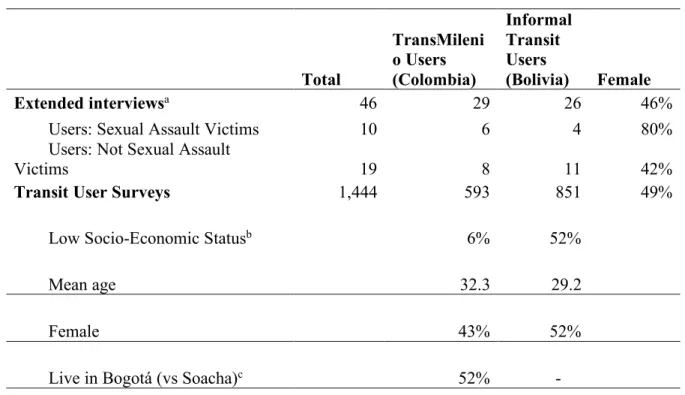
TABLE 2.1 Sample Characteristics ... 63
TABLE 2.2 Personal Experience with Transit Crime in TransMilenio and El Alto ... 66
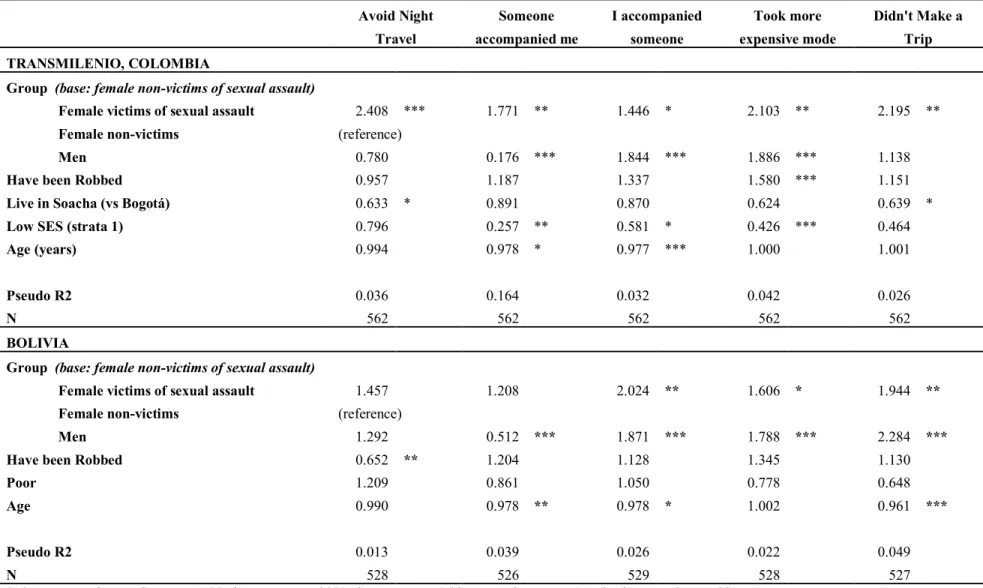
TABLE 2.3 Behavior changes due to the risk of transit crime (Logistic Regression) ... 70
TABLE 2.4 A Situational Crime Prevention analysis of anti-sexual assault policies ... 78
LIST OF FIGURES
INTRODUCTION
Efforts to improve the lives of marginalized people often fail when decision-makers incorrectly assume that they understand community members’ needs. The failure to consult community stakeholders has been strongly criticized for depriving people of the right to advocate on their own behalf. However, exclusionary planning has an additional toll: it deprives planners of a learning opportunity to replace incorrect assumptions with a meaningful understanding of the challenges marginalized stakeholders face. Planners cannot address needs that they do not know exist.
I analyze the gulfs that can separate planners from the perspectives of the planned-for through a theoretical lens I refer to as Vision dissonance (Chapter 11). A stakeholder’s Vision is a mental model that converts a planning situation (Schön and Rein 1994) into a comprehensible problem and solution. Visions define both the content of a perceived problem and the processes viewed as appropriate for learning about and solving it. Conflicts can occur not only due to conflicting priorities, but also due to latent factors such as incompatible assumptions and norms about what information is considered valid evidence. While it may not always be possible, or even desirable, to fully overcome “deep divides” (Watson 2003) between Visions, exclusionary
1 This chapter first appeared in the Journal of Planning Education and Research: Kash, Gwen. 2017. “Vision Dissonance: Conflicting Conceptions of Bus Sariri.” Journal of Planning Education and Research, December, 0739456X1774597.
planning virtually guarantees that community members’ self-identified needs will be a low priority (Ardila 2004, Arnstein 1969).
One arena in which the costs of exclusionary planning are evident is Latin American transportation planning. Though Latin American cities have been consistently recognized as leaders in sustainable transportation, internationally-emulated transit systems in countries such as Mexico, Brazil, and Chile have been subject to harsh criticism and protests at the local level. This apparent contradiction stems from the fact that planning practice in the region is still dominated by the rational planning paradigm, imported from the United States in the 1950s (Vasconcellos 2001, Bassett 2013). Even planners with progressive ends pursue their goals using techniques and practices that exclude community voices. As a result, the pursuit of sustainable transit systems has sometimes come at the expense of transit users (Ardila 2004). Examining two cases of Latin American transit reform, I ask the following questions: • How consonant/dissonant are planners’ and users’ priorities for transport reform? • How are underlying elements of stakeholder visions (such as framing, paradigms, and
beliefs) creating dissonance?
• How does vision dissonance affect planning practice and outcomes in arenas such as
communication, perceived legitimacy, efficacy, and equity?
• How do stakeholders overcome or fail to overcome Vision dissonance barriers?
The evolution of Vision dissonance
Bogotá, Colombia’s TransMilenio BRT, one of the cases for this dissertation, epitomizes the threat Vision dissonance poses to the social sustainability of ecologically sustainable
influence industry evaluation criteria for BRT projects (ITDP et al 2016). To take one example, in 2005 TransMilenio was honored as the inaugural winner of the Sustainable Transport Award.
However, ten months before the award ceremony in Washington DC, five hundred TransMilenio users blockaded the busway for four hours. They demanded service
improvements, and that TransMilenio stop treating passengers “like animals” (El Tiempo 2004). More protests erupted in the months and years after the award ceremony. By the time I first visited TransMilenio in 2011, more than 200 protests had occurred (El Tiempo 2010). However, planners were still largely unaware of the conflict between their priorities and those of most users (Kash and Hidalgo 2014). Though planners and public officials routinely dismissed the blockades as not representative of ‘real’ transit users, surveys consistently found that satisfaction with TransMilenio was plummeting, largely due to crowding and other quality of service issues identified by protestors (e.g. BCV 2017).
evaluation standard (ITDP et al 2016), TransMilenio was once again honored internationally with inclusion in the BRT Awards Showcase.
Over the four years between my visits, most planners had become aware of users’ main complaints. However, the Vision dissonance between planners and the planned-for had not evaporated; it had simply evolved. Originally, planners were unaware that their perspectives differed from users. Now, they were aware of this difference, but interpreted it in two ways. Some planners concluded that users were simply wrong about their needs. This type of Vision dissonance is strongly encouraged by the technocratic paradigm, which devalues local
knowledge and user perspectives. Planners’ understanding of crowding is a good example of the evolution between these two types of dissonance. In 2011, planners described pointed to high occupancy levels with pride; as one put it, “we’re moving the city.” By 2014, planners had stopped describing the crowding as a sign of success and concluded that TransMilenio was instead a victim of success. Planners using this narrative sometimes came to the conclusion that despite users’ complaints, the fact that so many people chose TransMilenio indicated that users were not nearly as bothered by crowding as they claimed. (Users, in contrast, expressed frustration that, much as they disliked TransMilenio, other options were even worse).
The third type of Vision dissonance is more subtle because the planners displaying it had accepted the validity of many user complaints, and to varying degrees, agreed that they were high policy priorities. However, while planners agreed with users’ assessment of specific problems with TransMilenio (increasing travel times, excessive crowding, insufficient supply to accommodate growing demand), many planners embedded these complaints in a narrative about the overarching problem of TransMilenio that continued to put them at odds with users:
wherever, because they’re sacred places to them… But since the quality of service has deteriorated, the people disrespect it, and then we start to disrespect each other. We have a big job to recover and make it so people love the system, so they feel proud, so they see that they can do things to make the city better. -Planner, Bogotá
This lyrical description of a lost golden age typifies a narrative that punctuated the otherwise prosaic comments of the planners and engineers interviewed. Though the story has a few variations, it is remarkably consistent, crossing years, academic backgrounds, and areas of expertise. The fundamentals are as follows:
When TransMilenio first opened, it was beloved to the people. They felt a sense of pride and ownership of the system. That love has evaporated. Users no longer feel the system belongs to them. They no longer respect it. This disrespect causes behaviors that pose an existential threat to the system, particularly fare evasion. Users also behave disrespectfully towards each other. To move forward, planners feel they must convince users to claim ownership for TransMilenio, to love it once again. In other words, the goal is to get users to see the truth that planners already see.
Given that many users dispute the idea that such a golden age ever existed, the quest to convince them to love TransMilenio is perhaps a bit quixotic. However, among planners who view service improvements as the path to redemption, the dissonance of the “lost love” narrative may not necessarily lead to conflict. Others, however, viewed the loss of love as cause of TransMilenio’s decline rather than the effect.
For political, technical, and social reasons, people have stopped appreciating
TransMilenio. How does this manifest? In a large number of people evading the fare, in an invasion of pedestrians, cyclists, motorcycles, and cars in our exclusive lanes, in the growing number of ambulatory vendors in the system… and so this discrediting, this loos of reputation of the system has made users have bad behaviors that make operations difficult. Because fare evasion [by running across the busway] isn’t a financial
appreciate the service and combat these bad behaviors in the system. -Planner, Bogotá
Users, in other words, are not responding only to technical problems. Rather, planners argue that their views have been shaped by outside forces, such as a mayoral candidate who characterized TransMilenio as beholden to the financial interests of the “families” who operate it. The bad behavior sparked by these forces lead to a sort of tipping point, sending the service into free fall. As one put it:
Sometimes the users themselves are the ones who are in charge of the deterioration of the system, the ones who are in charge of breaking the rules, the ones who are in charge of taking actions against the system, and [then] they complain!
For planners who attribute bad service to bad behavior, and bad behavior to a loss of love, the solution is not to improve the service, at least not directly. The solution is to make users love TransMilenio so that they will stop making service bad. This belief, that users should learn to see what planners see, but not the other way around, is at the heart of most of the conflicts discussed in this dissertation.
About this dissertation
have information about each other’s views, but also when a failure to agree on the nature of the problem leads to a rejection of other people’s perspectives.
The three papers are built on a shared mixed-methods dataset collected between 2014-2016. In each country, I studied a pair of cities: the capital and an adjacent “overflow” city that has expanded in recent years due to a lack of space in the capital. As detailed in Appendix 1, the data collected in each country includes an intercept transit user survey; qualitative ‘in transit’ field interviews conducted with transit users; extended interviews with transit users; extended interviews with transit planners; and heterogeneous focus groups mixing users and planners. This data, some of which was collected collaboratively with local organizations, is supplemented by participant-observation of interactions with planners. These multiple sources reinforce each other, maximizing both breadth and depth. Each chapter lists only the portion of the dataset used in formal analysis for that chapter, but analysis is informed by the more comprehensive dataset.
In Chapter 1, I describe the Vision dissonance frame and use it to explain the failure of El Alto’s Bus Sariri. The strength of the framework is that it allows us to account for the multiple elements that shape people’s perspectives both independently and by influencing each other. Bus Sariri stalled because of a conflict over route design. However, underneath this concrete disagreement, planners and community leaders also had incompatible framings of what the problem with transportation ‘really’ was (Schön and Rein 1994) and theorizations about who transit users ‘really’ are (Strang and Meyer 1993).
those questions” (Morgan 2007, 63). Alteño Planners operated within a technocratic paradigm, which privileged the results of technical, ‘rational’ studies above all other kinds of information. Community leaders were frustrated because they felt the studies were incomplete, and wanted to extend them by incorporating local knowledge that the planners dismissed as anecdotal and irrelevant (Corburn 2005).
Bus Sariri is an unusual case because El Alto’s planning agency was relatively weak, while the interests of transit users were represented by a strong grassroots organization. This is the inverse of a more typical Latin American transit planning process, including TransMilenio. However, the unusual circumstances throw into sharp relief a problem that manifests more quietly in many other cases: the views of the planners and the planned for were incompatible (Scott 1998).
The remaining chapters focus on transit sexual assault, which is both an urgent policy issue and an exemplar of a complex issue where the divides between stakeholders are sharp and shaped by multiple components of Visions simultaneously.
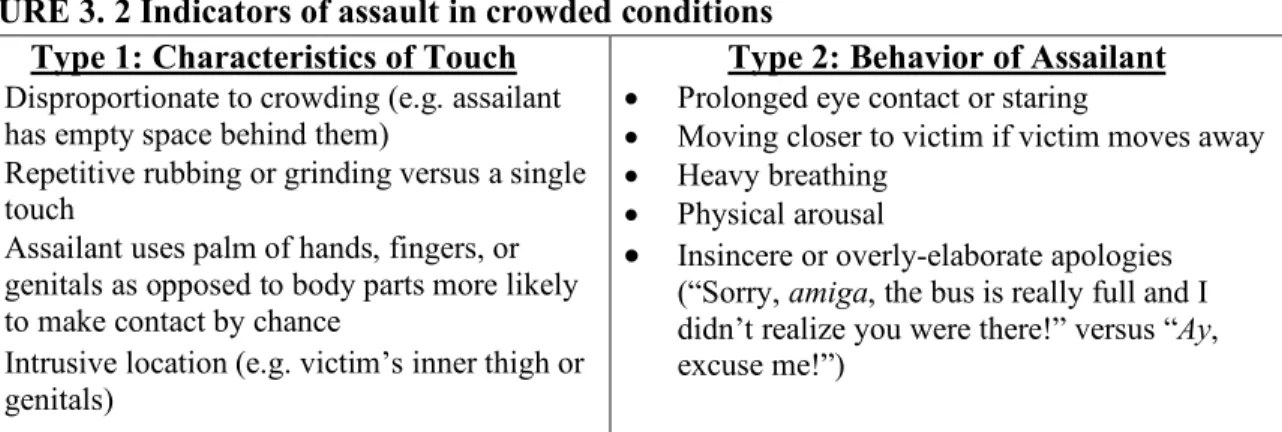
assaults occur on crowded vehicles and platforms, often at rush hour (Ceccato and Paz 2017, Ball and Wesson 2017).
Studies of the fear of crime focus on improving women’s mobility in isolated
environments, largely following Jacobs’ (1961) recommendation to encourage more ‘eyes on the street’ (e.g. Loukaitou-Sideris 2014). While this approach is effective for easing women’s fear at isolated transit stops, women who have been assaulted at rush hour surrounded by hundreds of potential witnesses are painfully aware that numbers are far from ‘safe.’
Chapter 2 does not directly address Vision dissonance. The needs of transit sexual assault victims are urgent, and their perspectives are so poorly understood that it is worth devoting an entire paper to documenting victims’ experiences and analyzing their Visions not in comparison to planners, but to transit users who have not been victimized. This helps
differentiate the effects of sexual assault from the more general fear of insecure transit.
evidence rejected statistics about sexual assault on the grounds that victims’ self-reports cannot be trusted.
Despite the evidence that planners’ views, like those of every human, are shaped by gender and other social factors, technocratic planners view themselves as immune to such
subjective forces as values, personal experience, and pre-existing beliefs. Herein lies the greatest danger of the technocratic paradigm: planners who are convinced of their own objectivity
dismiss the lived experiences of the most vulnerable community members not just as
unimportant, but as untrue. Accordingly, they react to complaints about transit sexual assault as if the problem were imaginary, leaving women vulnerable to real, measurable harm.
Having established that planners’ pre-existing Visions of transit sexual assault are a serious obstacle to addressing the problem, I consider how advocates can make progress nevertheless. I suggest that researchers and advocates should present information to planners with consciousness of their audiences’ likely pre-existing beliefs and biases.
skepticism and increase the likelihood that they will accept statistical data and other information about the problem.
Together, the three papers of this dissertation document the damage planners can do by failing to listen to and learn from the people they hope to help. A planning project might fail and the proposal or implementation stage. A reform might be enacted and prove unpopular. Even a ‘successful’ project may contribute to injustice if planners fail to identify and meet the needs of vulnerable minorities. The technocratic paradigm plays a prominent role in Vision dissonance conflicts discussed here for two reasons. First, because it discourages planners from seeking, hearing, or heeding community perspectives, the technocratic paradigm is a major source of dissonance between planners and communities. Technocracy encourages planners to consider their own assessments to be objectively true, delegitimizing any objections as factually incorrect. Additionally, the technocratic preference for quantitative evidence predisposes planners to
devalue local knowledge, which typically fails to conform to technocratic norms. Technocratic planners are less likely to view community members as legitimate sources of information. They are therefore less likely to see value in seeking public input, insulating them from the
information needed to bridge the divide between planners and the communities that many genuinely want to help. In sum, if planners hope to improve understanding of community needs, it is critical to address technocracy’s contributions to Vision dissonance.
REFERENCES
Ardila-Gómez, Arturo. 2004. “Transit Planning in Curitiba and Bogotá. Roles in Interaction, Risk, and Change.” Dissertation, Cambridge Mass.: Massachussetts Institute of Technology. Arnstein, Sherry R. 1969. “A Ladder of Citizen Participation.” JAIP 35 (4): 216–24.
Ball, Krista S., and Caroline J. Wesson. 2017. “Perceptions of Unwanted Sexual Behaviour on Public Transport: Exploring Transport Density and Behaviour Severity.” Crime Prevention and Community Safety 19 (3–4): 199–210. https://doi.org/10.1057/s41300-017-0026-3.
Bassett, Thomas E. 2013. “Top-Down Bottom-Up: Seeking Solutions in Highly Urbanized Latin America.” Planning: The Magazine of the American Planning Association, 2013.
Bogotá, ¿Cómo Vamos? 2017. “Encuesta de Percepción Ciudadana 2017.”
http://www.bogotacomovamos.org/documentos/encuesta-de-percepcion-ciudadana-2017/. Corburn, Jason. 2005. Street Science : Community Knowledge and Environmental Health Justice. Cambridge, MA, USA: MIT Press.
Dunckel-Graglia, Amy. 2013. “Women-Only Transportation: How ‘Pink’ Public Transportation Changes Public Perception of Women’s Mobility.” JOURNAL OF PUBLIC TRANSPORTATION 16 (2): 85–105. https://doi.org/10.5038/2375-0901.16.2.5.
El Tiempo. 2004. “PROTESTA COLAPSÓ A TRANSMILENIO,” March 10, 2004. http://www.eltiempo.com/archivo/documento/MAM-1536432.
———. 2010. “¿Qué hay detrás de las protestas de TransMilenio?,” November 25, 2010. http://www.eltiempo.com/archivo/documento/CMS-8447022.
Gekoski, Anna, Jacqueline M. Gray, Joanna R. Adler, and Miranda A. H. Horvath. 2017. “The Prevalence and Nature of Sexual Harassment and Assault against Women and Girls on Public Transport: An International Review.” JOURNAL OF CRIMINOLOGICAL RESEARCH POLICY AND PRACTICE 3 (1): 3–16. https://doi.org/10.1108/JCRPP-08-2016-0016.
Horii, Mitsutoshi, and Adam Burgess. 2012. “Constructing Sexual Risk: `Chikan’, Collapsing Male Authority and the Emergence of Women-Only Train Carriages in Japan.” HEALTH RISK & SOCIETY 14 (1): 41–55. https://doi.org/10.1080/13698575.2011.641523.
Institution for Transportation and Development Policy (ITDP), Rockefeller Foundation, Barr Foundation, ClimateWorks Foundation, despacio, GIZ, The International Council on Clean Transportation (ICCT), UN-Habitat, UNEP, and World Resources Institute Ross Center for Sustainable Cities. 2016. “The BRT Standard 2016 Edition.”
https://www.itdp.org/library/standards-and-guides/the-bus-rapid-transit-standard/.
Jubainville, Hugo d’Arbois de, and Camille Vanier. 2017. “Women’s Avoidance Behaviours in Public Transport in the Ile-de-France Region.” CRIME PREVENTION & COMMUNITY SAFETY 19 (3–4): 183–98. https://doi.org/10.1057/s41300-017-0023-6.
Kash, Gwen, and Dario Hidalgo. 2014. “The Promise and Challenges of Integrating Public Transportation in Bogotá, Colombia.” Public Transport, March. https://doi.org/10.1007/s12469-013-0083-7.
Kuhn, Thomas S. 1962. The Structure of Scientific Revolutions. Chicago: The University of Chicago Press.
Loukaitou-Sideris, Anastasia. 2014. “Fear and Safety in Transit Environments from the Women’s Perspective.” SECURITY JOURNAL 27 (2, SI): 242–56.
https://doi.org/10.1057/sj.2014.9.
Morgan, D. L. 2007. “Paradigms Lost and Pragmatism Regained: Methodological Implications of Combining Qualitative and Quantitative Methods.” Journal of Mixed Methods Research 1 (1): 48–76. https://doi.org/10.1177/2345678906292462.
Schön, Donald A, and Martin Rein. 1994. Frame Reflection : Toward the Resolution of Intractable Policy Controversies. New York: BasicBooks.
Strang, David, and John W. Meyer. 1993. “Institutional Conditions for Diffusion.” Theory and Society 22 (4): 487–511. https://doi.org/10.2307/658008.
Stringer, Scott. 2007. “Hidden in Plain Sight: Sexual Harassment and Assault in the New York City Subway System.” New York, NY: Office of the Manhattan Borough President.
Suzuki, Hiroaki, Robert Cervero, and Kanako Iuchi. 2013. Transforming Cities with Transit: Transit and Land-Use Integration for Sustainable Urban Development. Urban Development Series. Washington, D.C: World Bank.
Tripathi, Kartikeya, Herve Borrion, and Jyoti Belur. 2017. “Sexual Harassment of Students on Public Transport: An Exploratory Study in Lucknow, India.” CRIME PREVENTION & COMMUNITY SAFETY 19 (3–4): 240–50. https://doi.org/10.1057/s41300-017-0029-0. Vasconcellos, Eduardo Alcântara de. 2001. Urban Transport, Environment, and Equity: The Case for Developing Countries. London, UK ; Sterling, VA: Earthscan.
Watson, Vanessa. 2003. “Conflicting Rationalities: Implications for Planning Theory and Ethics.” Planning Theory & Practice 4 (4): 395–407.
CHAPTER 1: VISION DISSONANCE: CONFLICTING CONCEPTIONS OF BUS SARIRI2
1.1 INTRODUCTION
On March 10, 2015, the mayor of El Alto (EA), Bolivia met with leaders from a local civic organization to discuss Bus Sariri, a municipal mass transit system that had launched the previous week. The community representatives were unhappy with the routes chosen by municipal planners. They presented the mayor with a paper map on which they had drawn an alternate route proposal. The mayor agreed to adopt the proposal, and two days later, all the Sariri buses convened in front of city hall. The representatives boarded the buses and guided drivers along their new routes. Municipal planners were excluded from the process, only learning the specifics of the new routes the following day by driving behind the Sariri buses. This
dramatic overnight change sent a shock wave through an already-struggling system, contributing to Bus Sariri’s total collapse within four months.
Local planners attributed the system’s failure in large part to this “interference” from the community leaders. However, I argue that Bus Sariri’s failure was driven not by too much public involvement, but by too little. While there was basic agreement about the necessity of transit reform, the municipal Vision and goals for Bus Sariri diverged strongly from those of transit users and the civic organization representing them. Because the municipality declined to include meaningful opportunities for participation in planning, these incompatible visions remained submerged until it was too late to reconcile them, destabilizing Sariri’s implementation.
The sudden pivot from listening only to planners to listening only to community leaders
makes Bus Sariri an unusual case. In most Latin American transport reforms, there is no strong actor representing the views of transit users (Ardila 2004, Bassett 2013). However, the unusual circumstances throw into sharp relief a problem that manifests more quietly in many planning and policy processes: the views of the planners and the planned-for were incompatible (Scott 1998).
To analyze the conflict, I construct a theoretical framework I refer to as Vision
dissonance (Kash and Hidalgo 2014). A stakeholder’s Vision3 of a policy situation is their mode of seeing and articulating a problem and its solution. Though the conflict in Bus Sariri
manifested as a disagreement over routes, it was rooted in latent differences in stakeholders’ framings of the problem, paradigmatic assumptions about appropriate methods for identifying a solution, and theorizations about who alteños (residents of El Alto)‘really’ are.
I begin by discussing public involvement in developing cities. I next explain the Vision dissonance framework and its relationship to existing theory, particularly communicative planning. I use the framework to analyze how incompatible municipal and community Visions precipitated the conflict that overwhelmed Bus Sariri. I argue that in cases characterized by stark divisions between stakeholders and their perspectives, reaching full understanding may not be possible. We therefore need theory that allows for the possibility of identifying solutions without requiring Visions of the problem to fully align. The Vision dissonance framework provides a lens for constructing a non-idealized account of communication within actual planning processes, diagnosing problems and identifying ways forward.
1.2 BACKGROUND
1.2.1 Public involvement in Latin American transport planning
As in much of the global south, “rational planning” tools, imported to Latin American cities in
the 1950’s, still dominate planning processes in the region, especially in the transport sector (Watson 2009, Vasconcellos 2001, Bassett 2013). Rational planning has been criticized for being undemocratic, camouflaging political decisions under a veneer of objectivity by treating complex social issues as empirically solvable problems (Jacobs 1961; Rittel and Weber 1973; Krumholtz 1982).
The inherent weaknesses in the rational planning model are magnified by the weak democracy and stark inequality characterizing many Latin American countries (Vasconcellos 2001). While transit users remain the majority in most Latin American Cities, many cities have been reshaped to benefit auto users (Vasconcellos 2001). Even in public transit planning, as compared to more powerful stakeholders such as transport operators, transit users often shoulder a disproportionate share of the burdens of reform relative to the benefits they receive (Ardila 2004).
These problems can best be addressed by bringing the perspectives of users, particularly marginalized subgroups, into the planning process through some form of public involvement, used here as an umbrella term for techniques that solicit the perspectives of community stakeholders in a planning or policy process (Wekerle 2005, Hook 2011). Under the dominant theoretical approach to public involvement in planning, communicative action, planners help stakeholders overcome communication distortions in order to reach shared understanding and consensus, transforming relationships in the process (Forester 1989, Innes 1996, Healey 2006, Willson 2001).
may be unable to overcome entrenched interests and power dynamics (Flyvbjerg 1999, Huxley 2000, Abram 2000). In many cases, stakeholders have strong incentives not to act in accordance with the communicative process, protecting real interests by communicating in strategic or dramaturgical fashions (Phelps and Tewdwr-Jones 2000); this reinforces existing power imbalances (Fainstein 2010, Higdem and Hanssen 2014). Because communicative planning underestimates the magnitude and complexity of these problems, it does not provide adequate theoretical or practical guidance for understanding communication barriers.
Communicative planning also assumes that planners are the ones to initiate and guide participation (Willson 2001), which may not always be an appropriate role (Huxley 2000). Because many planners in developing countries are skeptical of the benefits of public
involvement (Dotson 2011), it is important to recognize that protests and organizing by excluded stakeholders are legitimate forms of participation (Vasconcellos 2001, Ardila 2004, Alinsky 1971).
1.2.2 Vision dissonance
Theorists from many disciplines have examined communication barriers using a number of often-overlapping constructs, including framing (Schön and Rein 1994), ways of knowing (Corburn 2005, Irwin 1995), paradigms (Kuhn 1962), and conflicting rationalities, logics, and storylines (Watson 2009, Stark 2009, Peters 2003). The Vision dissonance framework synthesizes and builds on these threads.
A stakeholder’s Vision is their mental model of a policy situation. Dissonance between Visions can prevent an effective exchange of views by shaping how participants speak,
dissonance framework is that it facilitates analysis of how these multiple elements
simultaneously shape a stakeholder’s Vision, both independently and jointly. For this study, I focus on three elements of Visions.
1. Frames. Frames are tacit “underlying structures of belief, perception, and
appreciation” on which explicit policy positions rest (Schön and Rein 1994, 23). A frame is a story that transforms a situation into a problem into a solution (though not necessarily in that order). While each individual’s frame may be slightly different, organizations play a large role in shaping the frames employed by their members.
Visions and speech are not synonymous. Frames can also be used to convince other actors. These ‘rhetorical frames’ (Schön and Rein 1994) may accord with privately expressed Visions, or may reflect strategic choices (Phelps and Tewdwr-Jones 2000, Peters 2003, Higdem and Hanssen 2014). My analysis here focuses on frames in their capacity for private meaning-making.
2. Paradigms. Whereas frames are content-oriented (what is the ‘right’ answer?), paradigms focus on process (how do we identify the ‘right’ answer?). Paradigms (Kuhn 1962) are “shared beliefs within a community… about which questions are most meaningful and which procedures are most appropriate for answering those questions.” (Morgan 2007, 53). They define what methods and information are considered legitimate. Rational planning, for instance, is guided by a positivist, ‘technocratic’ paradigm that privileges quantifiable data.
Paradigms are inherently value-laden; a question worth asking denotes a problem worth solving. Technocratism generally venerates modernity. Particularly in developing countries, this can feed what Watson (2009) refers to as a “conflict of rationalities – between the logic of
governing and the logic of survival” (p. 2268).
local knowledge, the expertise of members of an affected community (Corburn 2005). As compared with technical ways of knowing, local knowledge tends to explicitly rely on first-hand experience, narratives, and other forms of information often rejected as “unscientific” by
technocratic stakeholders. Local knowledge advocates are not anti-empirical, but argue that technical studies are incomplete when they exclude relevant local knowledge.
3. Theorizations. When considering the needs of transit users, planners, like their peers in other policy sectors, necessarily rely on simplified theoretical abstractions, or theorizations positing similarities among categories of actors (Strang and Meyer 1993). For example, when planners consider the needs of the people who will use a transit system, their point of reference is not thousands (or millions) of unique individuals, but a theorized Transit User, perhaps
subdivided into further categories such as Captive versus Choice Rider. Other actors in the process, including users themselves, will have their own theorizations.
Theorizations often “substitute for close, inductive examination of the experiences of others” (Strang and Meyer 1993, 499). Especially in professions that prioritize international best practices, theorizations of the local may be based largely on international examples.
Incorporating information from local stakeholders can make theorizations more accurate and “socially robust” (Gibbons 1999).
Visions and their constituent elements rest on non-empirical assumptions and values; some of these are incommensurable, or irreconcilable (Kuhn 1962, Schön and Rein 1994). As a result, a conclusion that seems obvious when following the logic of one Vision may be
impossible to prove within the boundaries of another. Some suggest that communication across Visions can be accomplished through a form of world-view translation (Kuhn 1962, Schön and Rein 1994, MacCallum 2008). Others feel that in situations of ”deep difference” (Watson 2003), full mutual understanding may be impossible, and suggest that dissonance could actually
improve outcomes (Stark 2009, Mouffe 1999, Phelps and Valler 2016). Unfortunately, in the following case, neither mutual understanding nor cooperative action were achieved.
1.2.3 Case background: El Alto, Bolivia
The center of EA’s economic and cultural life is the La Ceja neighborhood. La Ceja is home to many universities, civic organizations, and one of the largest outdoor markets in Latin America. Because EA is bisected by the region’s airport, La Ceja is also the main connection point for transport between the north and south sides of the city and the primary transport hub to LP. The streets are permanently congested. As we will see, La Ceja’s dual role as city
center/transport problem is critical for understanding the conflict over Bus Sariri. Before Sariri, all public transport in EA was provided by informal operators
(transportistas), who either own their vehicle or lease it from a small company. Drivers derive their incomes from the fares they collect. The system is one of the most atomized in Latin America, dominated by what the locals call minibuses: vans that have been modified with foldout seating to legally hold 14 people, including the driver. A minority of service is provided by 36-passenger “microbuses” (Pando Solares 2012).
Alteños suffer from many problems common to informal transit (Pando Solares 2012, Cervero and Golub 2011). In search of profit, drivers allow an excess of passengers to board and neglect vehicle maintenance. They abandon unprofitable routes, leaving residents of some marginalized neighborhoods without transport. Additionally, the transportistas are organized into powerful unions. They have successfully resisted many government attempts at reform by staging strikes that paralyze the entire city. However, the unions’ power has occasionally been overcome when the municipality has allied with a powerful civic organization, The Federation of Neighborhood Associations (FEJUVE).
turn around to collect more passengers (illegal short turning), but some continue on the same route after illegally collecting additional fares.
The whole metropolitan area is working to modernize the transport system. In early 2014, LP began operating PumaKatari, an intra-city surface bus service named for an indigenous mythical creature. A teleférico (aerial tram), operated by the national government, began linking EA and LP a few months later. However, due to the inconvenient locations of terminals and the relatively high cost (twice that of a minibus), many residents view itas a tourist project.
Bus Sariri, from the Aymara word for “traveler,” was EA’s entry into transit reform. Like PumaKatari, Sariri was a municipally run surface bus service, with the goal of eventually enabling the implementation of Bus Rapid Transit (BRT). Though it would operate only within EA, Bus Sariri was also expected to connect alteños with transit options to LP. After several delays, the first two lines began operating on March 3rd, 2015. However, despite strong support from both government and community stakeholders, in less than four months, Bus Sariri
collapsed. Plagued by low ridership and maintenance and budget issues, only ten of the original sixty buses were still in service as a new mayoral administration contemplated Sariri’s fate.
Four groups of stakeholders are relevant to analysis:
1. The Municipal Secretary of Sustainable Urban Mobility (SMMUS4), the government organization tasked with regulating existing public transport and planning and operating Bus Sariri. During Sariri’s planning phase, the head of SMMUS was Daniel Fernández. 2. The Federation of Neighborhood Associations (FEJUVE), a grassroots organization with representatives from each neighborhood in the city. Their goal is to represent the needs of ordinary alteños. FEJUVE’s transport committee, headed by Renán Cabezas, was vocal and active during Sariri’s planning and implementation.
3. Unaffiliated users and potential users of Bus Sariri, the intended beneficiaries of the project. This group did not participate directly in Sariri’s planning, but as I will establish, FEJUVE’s platform closely matched users’ self-identified needs.
4. Informal transport operators, who viewed Sariri as a threat to their livelihood.
1.3 METHODS
I conducted fieldwork in EA in two visits totaling 6.5 months. The first (2014) was during the late stages of planning for Sariri . The second (2015) began three months after Sariri’s launch, by which point the system was already encountering serious difficulties. I conducted 36 extended interviews with transport planners (mostly SMMUS staff), members of FEJUVE’s transport committee, and unaffiliated transit users. Informal transport operators were not directly interviewed. With a research assistant, I also conducted 62 semistructured “in-transit” interviews of approximately 5-15 minutes with users as they waited for or took public buses, a technique drawing from sociological mobile methods (Buscher and Urry 2009).
I also collaborated directly with SMMUS for a survey of 851 public transit users in 2014. The collaboration created an opportunity to engage in supplementary participant observation, providing additional insight into the work and challenges facing local planners. Uncited information in this paper is drawn from these data sources.
I begin analysis by comparing the perspectives of SMMUS, FEJUVE, and unaffiliated transit users on the problem of transport and goals for Sariri. The Visions of users are
summarized by selecting the most common issues mentioned in the survey and in-transit interviews. To describe the visions of SMMUS and FEJUVE’s transport committee, I focus on the views of the head of each organization. Fernández and Cabezas serve as official
respects: both grew up working-class in El Alto and went on to obtain advanced degrees and assume leadership roles in influential organizations. The differences between them, then, cannot be attributed merely to differences in power or level of education.
While perspectives within each organization were not monolithic, the tendencies
discussed below were also found in interviews with colleagues and subordinates, whose voices I incorporate where appropriate. Though focusing on the leadership minimizes the ability to discuss intragroup differences, it facilitates analysis of intergroup differences.
As I delineate the municipal and community Visions of transportation and describe the process of planning and implementing Sariri, I draw attention to the conflicting frames,
paradigms, and theorizations underlying stakeholder Visions. I illuminate how these elements of Vision shaped each organization’s platform, their process of arriving at it, and the two groups’ increasingly conflictual interactions.
1.4 PRE-IMPLEMENTATION PERSPECTIVES
In the months before Sariri launched, most stakeholders, including many transportistas (Pando Solares 2012), agreed that the quality of transit service was unacceptable. Though some transportistas viewed Sariri as a threat to their livelihood, all other stakeholders believed
transport reform should include municipally-run transit. Despite this broad agreement, SMMUS and FEJUVE differed sharply on their views about what Sariri should accomplish.
Both SMMUS and FEJUVE claimed to speak on behalf of transit users and, as the implementation became increasingly contentious, sought to discredit each other. I assess these claims of representing ‘the people’ by evaluating how participatory each organization was, and how closely their positions matched unaffiliated transit users’ preferences.
However, it suffered from the weakness identified by Arnstein (1969): officials were under no obligation to act on the findings. Rather than using the survey to learn about user preferences, findings were used in statements to the press to bolster SMMUS’s pre-existing positions. While SMMUS occasionally held public meetings, staff described them as opportunities to secure cooperation with pre-set plans.
FEJUVE, in contrast, is open to all alteños, and has members of all income levels from across the city. It is an amalgamation of several hundred independent Neighborhood Councils, which have varying procedures for choosing representatives and making decisions. Measures are in place to encourage women’s leadership, though indigenous women are still somewhat underrepresented. While FEJUVE does not always achieve its aim of fully democratic representation, it is a strong grassroots advocacy organization.
Because of FEJUVE’s power, it is also sometimes able to demand meetings with SMMUS. In the face of a municipal body that actively avoided providing opportunities for public involvement, FEJUVE was virtually the only vehicle by which community perspectives penetrated the otherwise closed planning process for Bus Sariri. As we will see, FEJUVE’s participatory procedures generated a platform that closely matched public opinion about the problems with transport.
1.4.1 The problem of transport
Interviews and surveys of transit users began with the same open-ended question: What are the main problems with public transport in EA today? Results from the two methods largely coincided (Figure 1.1)5. The four main concerns as measured with both instruments are route partitioning, travel times, cost, and mistreatment by bus operators (including discrimination).
Partitioning, it should be noted, is deeply entwined with the other problems listed. Users must pay multiple fares, greatly increasing user costs. It increases travel time and unpredictability by adding transfers, and is viewed as an egregious form of mistreatment.
FIGURE 1.1 Principal problems with public transit in El Alto according to users
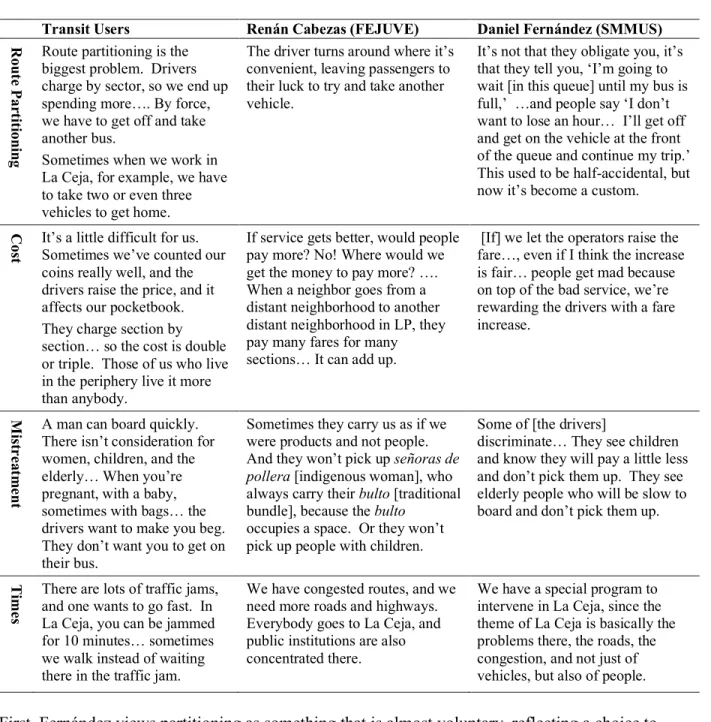
Table 1.1 displays excerpts of in-transit interviews chosen to represent typical user perspectives and contrasts them with the views of Cabezas (FEJUVE) and Fernández (SMMUS).
Quantitatively, both Fernández and Cabezas addressed most of users’ principal concerns6. However, on two critical issues, Fernández’s views clash with those of most users.
6% 6% 10% 11% 16% 19% 23% 27% 29% 55% Disorder/Chaotic User Behavior State of Vehicles Road Safety Lack of Control Too Few Buses Mistreatment Cost Times Route Partitioning
Top Problems according to In-Transit Interviews
(N = 62)
6% 8% 10% 10% 14% 34% 45% 49% Uncomfortable Road Safety Too Few Buses State of Vehicles Cost Mistreatment Times Route Partitioning
TABLE 1.1 Perspectives on existing public transit
Transit Users Renán Cabezas (FEJUVE) Daniel Fernández (SMMUS)
R ou te P ar tit ion in g
Route partitioning is the biggest problem. Drivers charge by sector, so we end up spending more…. By force, we have to get off and take another bus.
Sometimes when we work in La Ceja, for example, we have to take two or even three vehicles to get home.
The driver turns around where it’s convenient, leaving passengers to their luck to try and take another vehicle.
It’s not that they obligate you, it’s that they tell you, ‘I’m going to wait [in this queue] until my bus is full,’ …and people say ‘I don’t want to lose an hour… I’ll get off and get on the vehicle at the front of the queue and continue my trip.’ This used to be half-accidental, but now it’s become a custom.
C
os
t It’s a little difficult for us. Sometimes we’ve counted our coins really well, and the drivers raise the price, and it affects our pocketbook. They charge section by section… so the cost is double or triple. Those of us who live in the periphery live it more than anybody.
If service gets better, would people pay more? No! Where would we get the money to pay more? …. When a neighbor goes from a distant neighborhood to another distant neighborhood in LP, they pay many fares for many sections… It can add up.
[If] we let the operators raise the fare…, even if I think the increase is fair… people get mad because on top of the bad service, we’re rewarding the drivers with a fare increase. Mi strea tm en t
A man can board quickly. There isn’t consideration for women, children, and the elderly… When you’re pregnant, with a baby, sometimes with bags… the drivers want to make you beg. They don’t want you to get on their bus.
Sometimes they carry us as if we were products and not people. And they won’t pick up señoras de pollera [indigenous woman], who always carry their bulto [traditional bundle], because the bulto
occupies a space. Or they won’t pick up people with children.
Some of [the drivers]
discriminate… They see children and know they will pay a little less and don’t pick them up. They see elderly people who will be slow to board and don’t pick them up.
Ti
m
es
There are lots of traffic jams, and one wants to go fast. In La Ceja, you can be jammed for 10 minutes… sometimes we walk instead of waiting there in the traffic jam.
We have congested routes, and we need more roads and highways. Everybody goes to La Ceja, and public institutions are also concentrated there.
We have a special program to intervene in La Ceja, since the theme of La Ceja is basically the problems there, the roads, the congestion, and not just of vehicles, but also of people.
point of reference is choice riders while Cabezas’s is captive riders.
Cabezas’s views aligned with those of transit users. He spontaneously focused on the main user concerns described above, framing the problem around Serving the Citizens by meeting these needs. In keeping with the democratic paradigm, Cabezas and his colleagues explicitly based their views on meetings and conversations with individual residents. Because of FEJUVE’s broad membership, they are regularly exposed to the opinions of a cross-section of alteños, and this influence is readily apparent. In fact, even Cabezas’ emphasis on crime, which users did not mention as frequently, demonstrates how his views are informed by his contact with ‘neighbors’: many victims of transit crime, mistrusting the police, report their experiences to Cabezas instead.
Fernández, in contrast, had little contact with transit users in his professional life. Furthermore, because SMMUS operates within a technocratic paradigm, he does not believe users’ self-identified needs represent the ‘true’ problem. Rather, these quality of service issues are merely symptoms of a larger problem:
“[Users] don’t understand the problem of growth… 10, 15 years ago, the city was
smaller, but as it’s grown, it’s spread out in an unintelligent way…. because the density is very low in areas of new growth.... I think what we’re missing here is that when we talk about transport, we can’t just talk about streets, vehicles, pedestrians. We have to talk about growth, land use, how we can densify the city… I think this will be the long-term method to solve the problem of transport.”
1.4.2 The purpose of Bus Sariri
Both SMMUS and FEJUVE were passionate about the need for Bus Sariri, but their Visions for it were incompatible. The differences can be summarized as follows:
• FEJUVE embraced a democratic paradigm: the solution should be identified by
consulting ‘the people.’ SMMUS embraced a technocratic paradigm: the solution must be found in technical analysis rather than ‘uninformed’ community views.
• FEJUVE framed the problem of transportation around Serving the Citizens, asserting
Sariri should meet the current needs of the poorest alteños. SMMUS framed the problem around Shaping the City: Sariri should be used to manage future growth and congestion by reshaping the movement patterns of alteños.
• FEJUVE viewed La Ceja as the heart of EA, while SMMUS viewed it as the heart of the
problem.
FIGURE 1.2 Conceptual Diagram of Envisioned Routes for Bus Sariri
Cabezas, who emphasized that Sariri should be implemented according to “the criteria of necessity,” described his aspirations as follows:
We will ask that Sariri arrive to the most distant neighborhoods in the city, that it benefits people with scarce resources. The fare should be the most economical in EA…. [T]he routes… have to go to La Ceja because if not, what good is it? The people go to La Ceja. That’s the reality.
Accordingly, FEJUVE wanted Sariri to provide service between the periphery of the city and La Ceja, connecting poor people to currently-available opportunities in EA and LP. This addresses the needs voiced by current users. As one explained, “we always have to go [to La Ceja], and… we always have to suffer for transport.”
Fernández, in contrast, viewed La Ceja as a problem to be circumvented and eventually solved. For him, La Ceja is primarily a place people pass through to go somewhere else.
congested to accommodate Bus Sariri. SMMUS’ Sariri route proposal was intended to relieve congestion in La Ceja by circumventing it, connecting north to south via the less-congested west side of the airport. Even if Sariri might fail to mitigate congestion, officials were determined not to add more vehicles.
Regardless of the rigor of the ensuing alternatives analysis,7 the actual seed of conflict was that this normative precept was incorporated into the study parameters as if it were a
statement of fact. As a result, any route that could have addressed FEJUVE’s goals was excluded from consideration before alternatives analysis began.
In some ways, the conflict over whether to help users access La Ceja or circumvent it is a clash between present versus future orientation. For Fernández, Sariri should not serve what is, but rather guide what will be. For instance, informal transit to LP is available in a few locations besides La Ceja. SMMUS’ Sariri route intentionally avoided these sites on the ideological grounds that the new service should connect with other “modern” systems, even if those systems were not yet ready (such as a PumaKatari line still in the planning stage).
Cabezas does not reject the importance of shaping future travel patterns, but he is unwilling to defer meeting alteños’ present needs:
We have to make a structural plan and decongest La Ceja. But even so… it’s La Ceja that makes it possible for peripheral neighborhoods to connect to LP, to universities and public and private institutions.
The conflict over whether to help users access La Ceja or circumvent it is a clash between goals, but it also reveals a conflict between traditional ways of interacting with space and the ethos of modernity. Consider this statement from Fernández:
A pedestrian in La Ceja… attracts informal commerce, so where we have enough people walking, we also have a social problem. People say “I have the right to survive and I can vend, let me survive!” Maybe they’re right, but they do it in such a disorganized
form! ….This generates chaos.... We’re taking advantage of Sariri to free La Ceja of this
oversaturation, this pressure that exists from the quantity of vehicles there, from people who go to La Ceja to get to someplace else.
Fernandez does not simply want to reduce traffic congestion; he wants to remake La Ceja so that it more closely aligns with ideals of modernity, which have no space for informality (Watson 2009). Like Le Corbusier, he is calling for “the death of the street” (Scott 1998).
It is here that Fernández’s views diverge most sharply from those of most alteños. Informal commerce is central to La Ceja’s economic functioning and neighborhood identity. It is also closely identified with indigenous Bolivians, who are celebrated as the center of Bolivia’s cultural heritage but commonly face discrimination.
1.4.3 The routes are announced
While FEJUVE was outspoken about their goals for Sariri, SMMUS did not publicly present Sariri as a way to restructure EA. Though studies had been completed in September, SMMUS kept route plans secret in an attempt to reduce opposition. Public communications focused instead on the comfort and safety of the Sariri buses. This strategy failed spectacularly. The latent conflict between SMMUS’s and FEJUVE’s visions for Sariri remained bottled up until SMMUS presented their plan for Sariri’s routes in mid-January 2015, only weeks before the planned opening. When FEJUVE saw the routes, they immediately expressed concern that Sariri was not serving low-income, peripheral neighborhoods or reaching La Ceja.
Ostensibly, the public was invited to “validate” the planning process. In practice, SMMUS was less than receptive to criticism, as Fernández revealed in a statement to the press:
“The residents can’t impose routes. They should respect our work. Nobody likes it when someone invades their space…. We’ve already finished the study…. It received the support of knowledgeable professionals… [and] it’s for users’ common good.8”
This dismissal of public involvement is a predictable result of the technocratic paradigm, which rejects the possibility that laypeople might have valuable information. The municipality insisted their routes were objectively the best without addressing what they were the best for. Because technocratism positions technical study as disparate from “politics,” the value judgment that La Ceja was too congested for Sariri was never publicly acknowledged. This left
community members mystified as to how routes avoiding the city’s main demand points were the “best” for meeting their urgent needs.
The conflict was revealed so late in the planning process that it was impossible to resolve before implementation. Though SMMUS made some minor adjustments, Sariri began operating free “promotional service” on February 23rd with routes that avoided La Ceja. Meanwhile FEJUVE, still dissatisfied, crafted an alternate route plan. In a bottom-up process in keeping with FEJUVE’s democratic paradigm, hundreds of neighborhood representatives met to select routes for their district by consensus processing9. These routes were then amalgamated into one city-wide map. One transport committee member explained,
“Serving everybody was impossible…, so we tried to serve the largest quantity of people possible…. Sariri doesn’t arrive here [to my neighborhood]. I can’t think of myself, but I have to think about the majority of people.”
All committee members interviewed focused on meeting the needs of either the most or the neediest alteños. The emphasis on collective benefit and the fact that at least four of ten committee members did not directly benefit from the chosen routes contradicts SMMUS staff’s frequent accusation that the leadership was acting out of self-interest. Nevertheless, there is a tension in democratically selecting routes for a project that could not serve all alteños. Another committee member, an indigenous ambulatory vendor, noted that “if you ask people where they
want the route, they’ll always say ‘I want it in my neighborhood…’ [But] I have to think of my brothers; I have to think like a representative, and I know the peripheral zones have bad service.”
The processes by which SMMUS and FEJUVE identified routes also underscore differences in their theorizations of transit users. For FEJUVE representatives, alteños were “neighbors,” “compañeros,” sources of expertise. If FEJUVE classified users as “us,” SMMUS viewed “them” as uninformed and refractory; modernist projects often involve the
transformation not only of urban space, but of urban subjects (Watson 2009).
1.5 THE LAUNCH AND COLLAPSE OF BUS SARIRI
FEJUVE’s concerns might not have had much of an effect on Bus Sariri’s trajectory if it had not been for another stakeholder: the powerful unions representing the traditional transportistas. They had an economic incentive to derail Sariri. Within ten days of opening, transportistas had twice paralyzed the city – and Sariri - by staging strikes. Fernández, unable to overcome their opposition, was fired on March 9th.
Sariri reached a pivotal moment the next day. FEJUVE met with the mayor and Fernández’s replacement. They requested that the municipality adopt their alternate route proposal. The mayor was facing mounting pressure from the strikes and an upcoming election. Needing allies, he decided to adopt FEJUVE’s proposal wholesale. Virtually overnight, six new routes were added to the two already in operation.
In the short term, FEJUVE’s now-enthusiastic support for Sariri literally cleared the path for its continuing operation. The day after the meeting, FEJUVE delegates and allies worked with the police to dismantle blockades set up by the transportistas, reopening the streets. Once this was accomplished, the Sariri buses were brought together in front of City Hall. FEJUVE representatives boarded the buses to demonstrate the new routes. As Cabezas recounts,
Sariri’s technical team at SMMUS, already reeling from the sudden change in leadership, was excluded from this process entirely. One planner complained:
They imposed the routes on us…. There wasn’t planning or signage or anything. In fact, the next day, we had to get in one of the municipal trucks and follow the buses... That’s the only way we found out what the routes were.
In the coming months, the chaos introduced by this sudden, drastic policy change sent Sariri into a downward spiral from which it never recovered. Five months after Sariri launched, its technical director acknowledged, “we are not offering good service.” SMMUS continued to provide skeletal service on two routes, conducting studies in preparation for what they hoped would be a more organized relaunch10.
Even without the conflict with FEJUVE, SMMUS would have faced an uphill battle. El Alto is a poor city, and despite strong political support from the highest levels of municipal government, severely limited resources were available for the Sariri project. An overworked staff of fewer than a half-dozen individuals, mostly early-career professionals, was pressured to launch Sariri prematurely. Despite the formidable challenges, it is conceivable that the small but committed team could have addressed them. Alteños were used to bus routes without marked stops, for instance, so installing signage gradually might have been an incremental path towards successful implementation.
It was the overnight route change, which could have been prevented if SMMUS had collaborated with FEJUVE earlier in the planning process, that proved insurmountable. With a fleet of buses intended for two routes now spread out over six, frequencies were as low as once every two hours. Adding to the confusion, routes continued to be changed or discontinued with
http://www.la-little warning. Struggling to adapt to the changes, SMMUS could not advance on installing signage and other basic infrastructure. Many alteños did not know if they could rely on Sariri, or even how to access it. Ridership was lower than projected. Since many of the new routes
followed unpaved roads, buses were damaged without sufficient resources available to repair them. Bus Sariri disintegrated.
Arguably, SMMUS could have better implemented Sariri with more rigorous technical planning, even if the process was exclusionary. For instance, if physical infrastructure was installed prior to rollout, it would have been harder for FEJUVE to demand a route change. However, it is important not to confuse successful implementation with success as an instrument of public policy. FEJUVE would have viewed a fully-operational Sariri that followed SMMUS’s ring route as an egregious waste of public resources on a service that benefited very few alteños. The success of Sariri as a project can only be evaluated with respect to broader policy objectives, and one major failure of the Sariri process is that the municipality and community did not agree on what those objectives were.
Sariri service was not the only casualty of its troubled implementation process. The relationship between SMMUS and FEJUVE was severed, perhaps irreparably. Many SMMUS staffers viewed the FEJUVE leadership as at best misguided and at worst active saboteurs. The head of the technical team refused to allow a meeting between his staff and FEJUVE
representatives, believing that even a conversation was dangerous. One staff member voiced this resentment: