THE PSYCHOLOGY OF SOCIAL GROUP ISSUE RELATIONS
Amy I. Sentementes
A dissertation submitted to the faculty of the University of North Carolina at Chapel Hill in partial fulfillment of the requirements for the degree of Doctor of Philosophy in the Department
of Political Science in the College of Arts and Sciences.
Chapel Hill 2019
Approved by:
ABSTRACT
Amy I. Sentementes: The Psychology of Social Group Issue Relations (Under the direction of Pamela Johnston Conover)
This dissertation examines the relationships that develop between social groups and political issues and how these connections affect the credibility of groups who speak about these topics. In this research program, I create an original psychological construct called issue
authority, which shapes the ability of groups who try to speak about politics. Issue authority is comprised of two dimensions, the Associative Dimension and the Competence Dimension. I argue that groups with issue authority are able to speak convincingly on an issue to a majority of the public, not simply to members of their own group. This construct contributes to our
understanding of group stereotypes because I find that groups with authority can speak powerfully and produce persuasive messages regardless of their general societal reputation.
In the first study, I explore the first dimension of issue authority, as I analyze how individual factors like group identity influence the associations people form between groups and political issues in the context of immigration and gun control. In the second study, I examine the Competence Dimension by evaluating the groups a majority of the public perceives as the most qualified to discuss the #MeToo Movement, immigration, and gun control. Finally, in the third study, I employ the results from the second study to investigate whether or not issue authority produces expert source cues in these three issue domains. The findings point to the importance of context, as groups the public deems qualified to speak about these issues can speak
ACKNOWLEDGMENTS
This project would not have been possible without the endless support and guidance from my advisor, Pam Conover. From her engaging seminars to her compassionate advice during our frequent meetings, Pam has encouraged me to pursue my passions, both professionally and personally. With a stroke of a red pen, Pam passed on her wisdom and demonstrated her
commitment to the field of political psychology, which has been a constant source of inspiration for my lectures and future classes. Additionally, this dissertation has improved significantly over time thanks to the helpful feedback and suggestions from my committee members: Frank
Baumgartner, Marc Hetherington, Michael MacKuen, and Timothy Ryan.
Many thanks to my undergraduate advisor and forever mentor Joanne Connor Green for motivating me to pursue graduate school in the first place. I would not have survived this program without her constant advice about academia and about life. Additionally, my friends also have been instrumental in my remaining partially sane throughout this experience. Lucia Bird, Hailey Sherman, Caroline Carlson, Amanda Aziz, Leah Christiani, Izzy Laterzo, Stephanie Shady, Ryan Williams, and Lucy Britt, thanks for making graduate school the best six years of my life and for helping me finish this project.
TABLE OF CONTENTS
LIST OF TABLES………...viii
LIST OF FIGURES………xi
CHAPTER 1: INTRODUCTION……….………...1
Social Groups and Political Issues……….………..2
Overview of Dissertation…….………4
CHAPTER 2: MAKING THE CONNECTION: OBSERVING SOCIAL GROUP ISSUE ASSOCIATION………...7
A Theory of Social Group Issue Authority………..8
The Origin of Associations between Groups and Issues……...………..9
Variation in Perception of Group-Issue Linkages…..………...15
Data and Methods………..………18
Immigration…..………...………..20
Gun Control…..………...………..29
Discussion…..………...……….37
CHAPTER 3: CULTIVATING COMPETENCE: AN EXAMINATION OF SOCIAL GROUP ISSUE AUTHORITY………..………..41
Understanding Social Group Issue Authority………….……...………42
The Competence Dimension……….…..………...44
Issue Authority in Context……….46
Variation in Perceptions of Issue Authority …….…………...……….49
Results…….…..………...……….59
Discussion…..………...……….72
CHAPTER 4: LEAVE IT TO THE EXPERTS? THE EFFECTS OF SOCIAL GROUP ISSUE AUTHORITY………..………..77
The Components of Social Group Issue Authority…….……...………78
Experiential Competence….……….…..………...80
Issue Authority as a Source Cue. ……….….82
The Threshold of Expertise………..…….…………...………..86
Data and Methods….………...………..89
Results…….…..………...………..92
Discussion…..………...………...106
CHAPTER 5: GENERAL DISCUSSION.………..110
APPENDIX 2A …….………..114
APPENDIX 2B …….………..123
APPENDIX 3A …….………..127
APPENDIX 3B …….………..129
APPENDIX 3C …….………..133
APPENDIX 3D …….………..144
APPENDIX 4A…….………...146
APPENDIX 4B …….………..151
APPENDIX 4C …….………..156
LIST OF TABLES Table
1. Study 1 Immigration Issue-Group Associations Table……….……….21
2. Study 2 Immigration Issue-Group Associations……….………...23
3. How Group Membership Influences Study 1 Immigration Associations……….……….26
4. How Group Membership Influences Study 2 Immigration Associations……….……….27
5. How Group Identity Influences Study 1 Immigration Associations……….……….29
6. Study 1 Gun Control Issue-Group Associations……….……….…………..30
7. Study 2 Gun Control Issue-Group Associations……….……….…………..31
8. How Group Membership Influences Study 1 Gun Control Associations……….……….33
9. How Group Membership Influences Study 2 Gun Control Associations……….……….34
10. How Group Identity Influences Study 1 Gun Control Associations……….……….37
11. Assessed Competence for the #MeToo Movement……….……….……….55
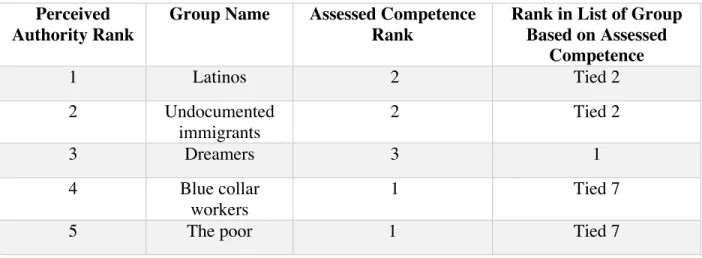
12. Assessed Competence for Immigration……….……….………...56
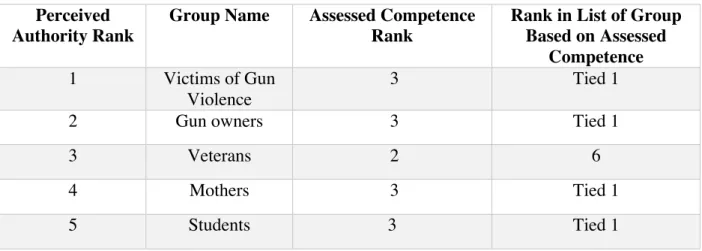
13. Assessed Competence for Gun Control……….……….………...57
14. The Most Qualified Groups to Talk about the #MeToo Movement……….……….60
15. The Most Qualified Groups to Talk about Immigration……….……….…..61
16. The Most Qualified Groups to Discuss Gun Control……….……….……...62
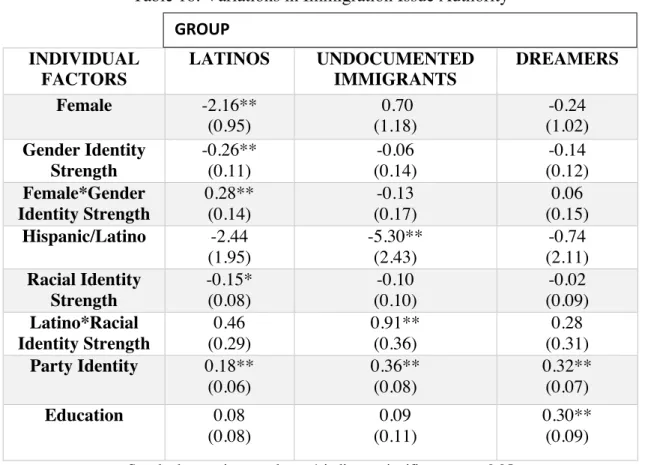
17. Variations in #MeToo Issue Authority……….……….………64
18. Variations in Immigration Issue Authority……….……….……….66
19. Variations in Gun Control Issue Authority……….……….………..71
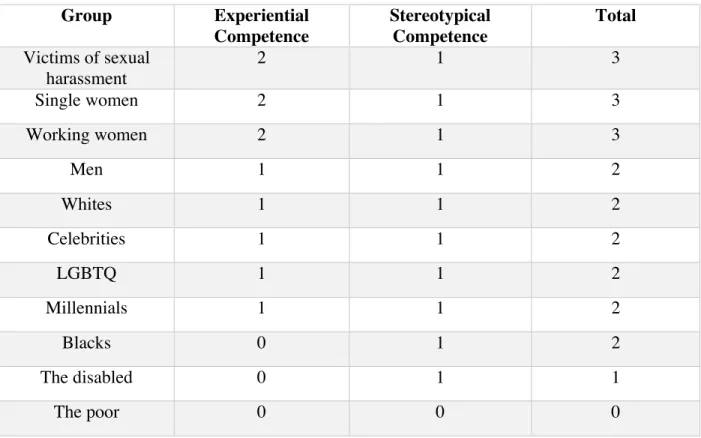
20. Comparing Stereotypical and Experiential Competence……….……….….72
22. How Individual Characteristics Influence Source Credibility
in the context of the #MeToo Movement……….……….95
23. Comparing Source Cues for Immigration……….……….………...99
24. How Individual Characteristics Influence Source Credibility in the context of Immigration……….……….………100
25. Comparing Source Cues for the Gun Control……….……….………103
26. How Individual Characteristics Influence Source Credibility in the Context of Gun Control…….……….………...104
27. Sample Characteristics……….……….……….………..114
28. Immigration Other Categories……….……….……….……..115
29. Gun Control Other Categories……….……….……….……..115
30. Immigration Study 1 Number of Groups Mentioned……….……….……116
31. Immigration Study 2 Number of Groups Mentioned……….……….……117
32. Gun Control Study 1 Number of Groups Mentioned……….……….……118
33. Gun Control Study 2 Number of Groups Mentioned……….……….……119
34. Sample Information……….……….……….…………..127
35. Full Rankings for the #MeToo Movement……….……….………133
36. Full Rankings for Immigration……….……….……….…….134
37. Full Rankings for Gun Control……….……….……….…….135
38. OLS Regression Models for the #MeToo Movement……….……….……136
39. OLS Regression Models for Gun Control……….……….……….137
40. OLS Regression Models for Immigration……….……….………..138
41. #MeToo Movement Average Perceived Authority……….……….………141
42. Immigration Average Perceived Authority……….……….………142
44. First Pretest Sample Summary……….……….……….……..144
45. Second Pretest Sample Summary……….……….……….….145
46. Sample Characteristics……….……….……….………..146
47. #MeToo Movement T-Test……….……….……….………...147
48. Immigration T-Test……….……….……….………...147
49. Gun Control T-Test……….……….……….………...147
50. Full OLS Model for the #MeToo Movement……….……….………148
51. Full OLS Model for Immigration……….……….……….….149
52. Full OLS Model for Gun Control……….……….……….….150
LIST OF FIGURES Figure
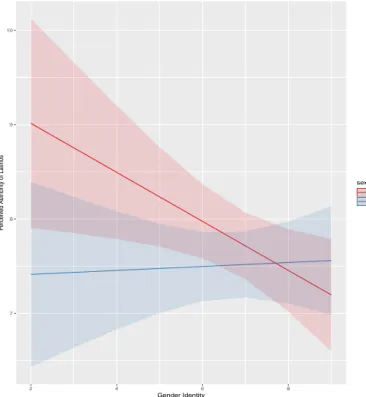
1. Predicted Perception of Latino Authority by Sex and Gender Identity Strength………..68 2. Latinos’ Perception of Undocumented Immigrants’ Authority by Racial Identity
CHAPTER 1: INTRODUCTION
“Gay Issues Enter the World of Philanthropy,” “What Would It Take to Replace the Pay Working-Class Americans Have Lost?,” “Job Growth Isn’t Just a Women’s Issue,” “Asian-Americans Face Battle over Affirmative Action,” “Disability and the Right to Choose,” “Older Women and Medical Marijuana: A New Growth Industry,” “Latino Groups Warn Congress to Fix Immigration, Or Else,” and “Obama, Pushing Criminal Justice Reform, Defends ‘Blacks Lives Matter” (The New York Times).
These New York Times headlines confirm that ties to social groups are a common occurrence in American politics. From political campaigns to political news coverage, we observe that social groups are often linked to specific sides on policy issues by political leaders, the media, and everyday citizens. Indeed, identifying a political issue that is not associated in some way with a social group would be a difficult task. Sometimes, these associations may invoke implicit connections to social groups, while the headlines also identify that explicit ties between groups and issues exist. For example, Hillary Clinton’s 2016 presidential campaign largely centered around “women’s issues” like equal pay, access to contraception, and education (Bischoff, 2015). Though ties between social groups and political issues are pervasive
In this dissertation, I explore the links that develop between social groups and political issues and how these connections influence the credibility of groups who speak about these concerns. I create an original psychological construct called issue authority, and I argue that groups with authority are able to speak convincingly on an issue. Using original survey data, I first examine the factors that influence these associations between groups and issues to develop. Then, I evaluate the groups that have authority on political issues and whether or not this issue authority produces expert source cues. Ultimately, the concept of issue authority broadens our understanding of social group stereotypes because I find that groups can speak powerfully and deliver persuasive messages on specific issues regardless of their overall reputation in society.
SOCIAL GROUPS AND POLITICAL ISSUES
Individuals strive to develop a sense of belonging, so they identify with social groups that provide positive self-esteem. Not only do these groups contribute to our self-concept, but they also provide lenses through which we perceive incoming information. Social groups help us process our surroundings, including the political environment (Tajfel and Turner, 1986). After
individuals acknowledge and internalize their membership, the identity with the group does not
merely function as an “aspect” of their self-concept, but as an “extension” of their self-concept
(Brewer, 1991). Thus, individuals evaluate the environment in terms of group perspectives and
group interests, rather than individual attitudes and interests (Tajfel and Turner, 1986; Brewer,
1991). When group identities are salient, we think on behalf of our social groups, so we should naturally form connections between these groups and particular political issues.
Political scientists have studied the relationship between political parties and various
issue domains. Issue Ownership Theory suggests that parties not only form connections with
able to “handle” (Petrocik, 1996; Walgrave, Levere, and Tresch, 2012). Importantly, this theory
suggests that members of the public who may not identify as Democrats or Republicans still
regard one of the two major parties as more qualified to speak about a particular issue. Political
parties are important social groups in the political environment, and they function as a social
identity that is chronically salient in a political context (Greene, 1999). However, parties do not
provide the only group identity that helps people process incoming political information.
Other scholars have explored the ties between social groups and political issues in the
context of political campaigns. They have investigated how the mass public responds to
candidates across different contexts, noting that some candidates enjoy an advantage in certain
domains due to general stereotypes associated with their social groups (Shapiro and Mahajan,
1986; Huddy and Terkildsen, 1993). Specifically, scholars have explored the gendered
component of traits and issues, as voters associate traditional notions of masculinity and
femininity with “force and violence” issues (e.g. war, crime, etc.) and “compassion issues” (e.g.
healthcare, welfare, etc.), respectively (Huddy and Terkildson, 1993; Herrnson, Lay, and Stokes,
2003; Meeks and Domke, 2015).
However, I argue that general appraisals of social groups are not the only factors that
influence how individuals respond to political issues. A group’s relationship to a specific issue
should also affect public perception of the group’s credibility. For example, women undergo
abortions, which suggests they may be more knowledgeable on policies related to abortions and
pre-abortion procedures like sonograms (Conover, 1988). I combine two foundations—our
current conception of partisan issue ownership and the psychology of social groups—in order to
construct a new theory of social group issue authority that reveals the consequences of these
OVERVIEW OF DISSERTATION
In the proceeding chapters, three studies investigate how individuals form connections between social groups and in turn how these linkages translate into a new psychological construct: issue authority. Groups with issue authority are able to speak convincingly on a particular issue. These three studies employ different methods and themes, but they ultimately combine to provide an outline of the origins of this construct and its effects in three issue areas: the #MeToo Movement, immigration, and gun control. Social groups may advocate for policy changes in particular issue areas due to their unique experiences with them. Thus, this research contributes to our understanding of how the public responds to these connections and whether these relationships allow the groups to speak credibly on these issues.
In Chapter 3, I examine the second dimension of issue authority, the Competence
Dimension, which directly translates into issue authority. I distinguish between stereotypical and experiential competence in order to broaden our understanding of why some groups may suffer from overall negative stereotypes yet still be able to convince the public they are qualified to speak about certain political issues. I evaluate the groups a majority of the public perceives as most qualified to discuss the #MeToo Movement, immigration, and gun control. In this analysis, I present respondents with a list of commonly stereotyped groups along with a list of issue-specific groups for these three areas. Based on the results of a nationally representative public opinion survey, I conclude that a majority of the public regards victims of sexual harassment, Latinos, and victims of gun violence as the most qualified social groups to discuss the #MeToo Movement, immigration, and gun control, respectively. However, salient group and partisan identities still moderate perceptions of authority. Finally, I find that respondents with higher education levels perceive groups higher in experiential competence as more qualified to speak about these three issues than groups who only score high on stereotypical competence. The results from this chapter demonstrate that people may perceive a group as “cold” or
“incompetent,” yet these general stereotypes do not preclude a group from speaking convincingly on an issue.
However, multivariate analysis indicates that individual-level factors influence perceived credibility along with the experimental condition. Party identity prevents issue authorities from delivering expert source cues in the context of immigration. Once again, these results explain the importance of context, and they point to the limits of expertise, which contributes to our
CHAPTER 2: MAKING THE CONNECTION: OBSERVING SOCIAL GROUP ISSUE ASSOCIATION
A mass shooting occurred at Marjorie Stoneman Douglas High School in February 2018. After 17 of their peers died, students who survived united and marched in favor of gun control (Rozsa, Epstein, and Mettler, 2019). This school shooting along with others have recently inspired students to take a stand on the issue, transforming them into a social group that the public thinks of in the context of gun policies.
In the summer of 2018, John Moore’s photograph of a young Honduran girl crying for her mother garnered wide-spread attention and placed President Trump’s immigration policy in the national spotlight (Selk, 2018). Although the child was not actually one of thousands of immigrant children separated from their parents at the U.S. southern border, she still tugged at the heartstrings of the public, motivating people to consider how the president’s zero tolerance strategy affected children.
group’s perceived competence in a given issue domain. But, the association between a group and an issue is a necessary prerequisite to evaluating which groups are qualified to discuss a particular political topic.
It is difficult to identify an issue in American politics that is not linked to a social group. Nonetheless, we know little about the particular groups that people link to many political issues. To understand how the public perceives political issues themselves, we must identify which groups they associate with them and why. Associating positively stereotyped groups with certain issues should reinforce general group stereotypes and contribute to people’s appreciation of those issues. Conversely, linking disliked groups to other issues should trigger negative conceptions of those issues and reinforce negative views of the groups themselves.
In this chapter, I explore these ideas by studying the groups the public associates with two issues, immigration and gun control. I also examine how individual factors influence these perceived connections. In the past, scholars have assumed that specific groups and issues are connected, yet I demonstrate that variation in association exists. For this analysis, I draw upon data collected from a university sample as well as a student sample. The results of this study identify the groups much of the public connects to immigration and gun control and provide insight into how individual characteristics influence differences in perceptions of association.
A THEORY OF SOCIAL GROUP ISSUE AUTHORITY
between social groups and political issues exist on two dimensions: association and competence (Walgrave, Levere, and Tresch, 2012). First, a person forms an association or link between a social group and a political issue. For example, many citizens likely associate abortion with women or link welfare to the poor. Sometimes, issues are so closely tied with a group that they are often referred to by their affiliation with the group (e.g. “women’s” issues, “black” issues, “environmentalist” issues, etc.). However, the public likely varies in the groups that they connect to specific issues. Second, once a group is associated with an issue, its competence to act as an authority on the issue can be evaluated. Therefore, before explaining what determines a group’s competence to speak as an authority on an issue, a closer examination of association, a necessary condition for competence, is essential.
THE ORIGIN OF ASSOCIATIONS BETWEEN GROUPS AND ISSUES
The psychological process of recognizing a relationship between a specific group and political issue logically occurs prior to evaluations of the group’s competence on the issue (Petrocik, 1996). Thus, we must develop an understanding of the factors that influence an individual’s propensity to connect a social group to a political issue. When forming attitudes about a problem, people may have a certain group in mind when assessing its different aspects. The groups individuals link to an issue fundamentally influence their perceptions of the issue itself.
yet political scientists have not specifically studied how these connections psychologically originate.1
The simple linking of a group and an issue can activate powerful stereotypes of the group and powerful images of the issue (Cuddy, Fiske, and Glick, 2007; Cuddy, Fiske, and Glick, 2008; Brambilla, Hewstoe, and Colucci, 2013). Sometimes, these associations can be beneficial for the groups involved, as a result of their maintaining positive stereotypes about the group and its relationship to the issue. For example, middle class Americans who have worked tirelessly to pursue higher education now struggle to pay off student loans, but their connection to this particular kind of debt has motivated 2020 presidential candidates to discuss potential remedies to this issue (Kim and Thottam, 2019). However, these links can also potentially harm the group if the public’s perceived association produces negative feelings about the group and the issue. In the height of the AIDS epidemic in the 1980s, the connection between this disease and gay men prevented the general public from acknowledging its severity (Fitzsimons, 2018).
General group stereotypes should influence the development of associations between groups and issues. People develop stereotypes of groups along two overarching dimensions: warmth and competence (Cuddy, Fiske, and Glick, 2007; Cuddy, Fiske, and Glick, 2008; Brambilla, Hewstone, and Colucci, 2013). Both current group activities and historical knowledge of group performance contribute to the stereotypes that form. Likewise, socialization entrenches pervasive stereotypes in society that affect the experiences of both members and non-members of social groups (Hyman, 1959; Tajfel, 1981). Importantly, individuals may not recognize the
influence of deeply rooted stereotypes on their perceptions of political issues; the effects of implicit bias are as invidious as those of explicit bias (Knoll, 2013).
General perceptions of the political topics themselves can also shape individual associations between groups and issues. Issue framing and priming affect how individuals form connections between social groups and political issues because they influence an issue’s valence, whether the public assesses it as a positive or negative concern (Nelson and Kinder, 1996). But, existing scholarship does not focus enough on how qualities of social groups influence the manner in which the public connects particular groups and issues. While studies acknowledge that frames that include mentions of social groups can alter public opinion on issues (Rose and Baumgartner, 2013), they do not evaluate why some groups develop connections to issues in the first place. They explain that the groups who benefit from policies related to an issue affect public opinion of that policy, but they approach their analyses from the perspective of specific political events or issues like a KKK rally and affirmative action rather than the social groups involved with these concerns (Nelson and Kinder, 1996; Nelson, Clawson, and Oxley, 1997). In this paper, I address this gap by incorporating literature from the psychology of intergroup relations to provide insight into how group stereotypes and experiences can contribute to group-issue connections that feed into the overall framing of an issue.
highlight issues alongside groups with negative stereotypes to draw attention to the group’s lack of expertise (Cuddy et al., 1999). Thus, groups sometimes struggle to control individual perceptions of issues in a political environment.
Ultimately, stereotypes of groups evolve as issues evolve. For example, many initial victims that spoke out about sexual harassment were positively viewed celebrities who revived the national discussion on this issue via the #MeToo Movement. In turn, they helped develop positive stereotypes about sexual harassment victims and about the issue of sexual harassment (Johnson and Hawbaker, 2018). As time passed, more people continued to speak about the pervasiveness of sexual harassment, which motivated some individuals to develop a sense of doubt regarding the sincerity of the testimonies. The stereotypes of victims of sexual harassment started to change, and public opinion on this issue began to divide (Conroy, 2019).
Implicit bias against stigmatized groups is likely to prevent the public from associating popular issues with them. Because individuals strive to conserve cognitive effort, they unconsciously ignore information that conflicts with preexisting stereotypes (Tajfel, 1981; Kunda, 1990). When individuals view an issue as a pressing political concern, they might not recognize the linkage between it and a group they do not wish to assist. Additionally, emerging new issues might become unpopular simply by virtue of their “natural” linkages with negatively stereotyped groups (e.g. gays & AIDS). Thus, some groups that wish to establish a connection to an issue will struggle to do so, while others should face little to no challenges based on their generally positive stereotypes. Finally, the associations the public forms between groups and issues should reinforce their overall opinions about the groups and issues themselves. Taken together, then, I posit: The Issue Valence Hypothesis:
a. Individuals will be more likely to form associations between positively stereotyped groups and issues with a positive valence.
b. Inversely, individuals will be more likely to form associations between negatively stereotyped groups and issues with a negative valence.
those the public supports. For example, in the context of immigration, the public does not support President Trump’s proposed border wall, so this issue takes on a negative valence (Brownstein. 2018).
Previous research on immigration highlights the variety of frames that exist about this issue in political discourse. Citizens form distinct opinions based on whether or not coverage of immigration involves legal or illegal entry into the country (Merolla, Ramakrishan, and Haynes, 2013). Moreover, the images of the immigrants, namely their race and gender, portrayed in the media can influence support for or opposition to immigration-related policy proposals (Farris and Mohamed, 2018). Perceptions of an immigrant’s deservingness, often as a result of their occupation, can also motivate people to develop opinions in favor or against increased immigration (Yoo, 2008; Peterson, Slothuus, Stubager, and Togeby, 2010; Holmes and Castaneda, 2016).
The images and frames evoked around the issue of gun control should also influence the connections the public forms between social groups and this issue. The politicization of gun control occurred later in our country’s history than that of the immigration issue, which has existed since the country’s founding. Beginning in the 1930s, however, gun-related policies occupied a place on the political agenda, as fear of crime and specific types of gun owners intensified (Gray, 2018). Although the National Rifle Association has existed since 1871, it established its hardline opposition to gun control policies in tandem with the Southern partisan realignment, in an attempt to court former Southern Democrats (Elving, 2017).
involved in a mass shooting, the public may develop a different perspective on gun control, one based on the links that form between this issue and related social groups (Schneider and Ingram, 1993; Cuddy et al., 1999). Hence, the fluctuating national dialogue surrounding gun control, much like immigration, likely shapes the groups that the public associates with this issue.
VARIATION IN PERCEPTIONS OF GROUP-ISSUE LINKAGES
Overtime, specific links likely develop between social groups and political issues as a result of the historical relationship between groups and issues, issue framing, and general stereotypes. But, the public is not homogeneous; so, there should be individual variation in the perceived associations between groups and issues, produced by several factors. In particular, I argue that individuals are guided by their social identities when they process information related to political issues, and thus spontaneously connect specific groups to particular issues. (Tajfel and Turner, 1986; Kam, 2005; Goren et al., 2009; Hartman and Weber, 2009; Nicholson, 2011).
Individuals belong to multiple social groups. But, when they identifywith a group, they become more likely to evaluate information from the perspective of the group and its interests, rather than individual attitudes and self-interest (Tajfel and Turner, 1986; Brewer, 1991). Their group identities also serve as lenses through which they perceive political information (Conover, 1984). Therefore, when group identities are salient, people should recognize and form cognitive links between their groups and issues that affect their group’s interests. When an identity is salient, individuals with a strong attachment to a group will perceive their environments as an “us vs. them” situation, where they will view their ingroup favorably compared to other outgroups (Brewer, 1991).
group-issue associations on race and gender identities, as previous research has pointed to the importance of these identities in shaping opinions on these issues (Citrin, Green, Muste, and Wong, 1997; Farris and Mohamed, 2018; Goss and Heaney, 2010; Enten, 2017). Because salient social identities motivate individuals to think on behalf of particular social groups, I posit the following: The Group Identity Hypothesis: Individuals who identify with a social group will be more likely to perceive that group as associated with a particular issue.
While individuals belong to multiple social groups, they should be more likely to use their partisan identities to make sense of incoming political information (Bartels 2002). Political parties are the most omnipresent group in the political environment. This makes party identification a social identity that is chronically salient to individuals confronted with political issues, leading them to approach issues from a partisan perspective (Greene, 1999).
Unlike issues like education and national defense, immigration and gun control are not issues that the majority of the public perceives as owned by Democrats or Republicans (Petrocik, 1996). While Egan’s (2014) framework on issue ownership may imply Republicans have an advantage over the Democrats in this area, we do not have any recent assessments of who owns immigration in the last five years. Since 2014, real world developments and political attitudes on immigration have changed. Dreamers have emerged as a social group that enjoys support from a majority of the public (CNN, 2018), and immigration policies promoted by the Trump Administration (e.g. a Southern border wall) are also off-putting to a majority of Americans (Gramlich, 2019). Taken together, recent discourse on immigration has made this issue up-for-grabs.
Nonetheless, people likely perceive these issues differently based on their partisanship because certain considerations about these areas (e.g. the deservingness of some immigrants, the necessity to regulate guns) may be more or less easily accessible to people depending on the information they receive from their copartisans in office and the media (Zaller and Feldman, 1992). The issue frames of immigration and gun control also likely differ across sources, which may motivate partisans to associate different groups with these issues (Druckman, 2001). For all of these reasons, I posit:
The Party Identification Hypothesis: Republicans and Democrats will associate different groups with different political issues.
develop general stereotypes among the public, which should influence group issue associations. The public should be more likely to connect positively stereotyped groups with positive issues and negatively stereotyped groups with negative issues (Feldman, 1966). However, perceptions of association should vary based on individual’s identities that moderate how they process information (Cuddy, Fiske, and Glick, 2007; Cuddy, Fiske, and Glick, 2008; Brambilla, Hewstone, and Colucci, 2013).
DATA AND METHODS
Two studies were conducted to test these hypotheses. The first study is based on data from an original public opinion survey created using Qualtrics, an online survey software company, and distributed in the fall of 2017 to a sample of the population of a large public research university in the South. The sample (N=708) includes students, faculty, and staff. Respondents were recruited via a university-wide mass email. The survey was live for a week. Participants who completed the survey were redirected to a separate survey where they could fill in their information to be entered to win one of ten $20 Amazon gift cards.
In both studies, respondents were presented a list of the same ten social groups: women, men, whites, blacks, the rich, the poor, the middle class, the elderly, the disabled, and the homeless. These groups represent many of the most common social groups that are stereotyped about in the United States (Cuddy et al., 1999). A plethora of social groups exist outside of this chosen list, some of which may be more salient in the contexts of immigration and gun control. Additionally, these findings concerning the overall placement of group stereotypes are summary measures, so individual variation in beliefs about a group’s warmth or competence could exist. But, my goal was not to identify all possible groups, or even necessarily the most important ones. Instead, to provide a reasonable test of the Issue Valence Hypothesis, I included these ten groups to have a broad representation of the general stereotype types to compare across issue areas.2 This allowed me to examine whether the public associates powerful groups with positive issues and weak groups with negative issues. Specifically, I assessed the public’s perceptions of group-issue associations by asking which of the aforementioned ten groups they thought of in the contexts of immigration and gun control.
In the first study, the dependent variable, perceptions of association, was measured using responses to an open-ended question that asked, “Please list which of the following groups (if any) immediately come to mind when you hear the following political issues mentioned.” This chapter focuses on responses to the questions about the immigration and gun control issue areas. Respondents had the option to write-in other groups if one outside of the ten listed came to mind when they thought of the issue. In the second study, perceptions of association, was measured in
a similar fashion. However, instead of an open-ended question, this survey included a close-ended question that asked respondents to “Please check which of the following groups immediately come to mind when you hear the following political issues mentioned.” Responses to these close-ended questions for the immigration and gun control issue areas supplement the findings in the first study.
To test the hypotheses related to group and partisan identities, I first measured group membership with standard survey questions that asked respondents to provide demographic information about race, sex, income, and partisanship. See the Appendix A for frequency tables of respondents’ demographic information. The strength of party identity is measured using the standard ANES seven-point scale, ranging from Strong Republican to Strong Democrat. In Study 1, based on the group membership questions for race and gender, respondents were asked two additional questions tapping the strength of their racial and gender identities. Specifically, identity strength scales were created by adding responses to questions that ask “How important is being a [gender group or racial group] to your identity?” and “Do you think what happens generally to [racial group or gender group] in this country will have something to do with what happens in your life?” Study 2 does not include identity strength measures.
IMMIGRATION Groups the Public Associates with Immigration
result of common stereotypes surrounding their deservingness (Cuddy, Fiske, and Glick, 2007; Cuddy, Fiske, and Glick, 2008; Cuddy et al., 1999). They also may evaluate immigrants in terms of deservingness, so this association may reinforce perceptions of the poor as a social group and the issue of immigration. Additionally, the racial and ethnic groups that comprise the poor may influence the development of this connection, as other disliked groups may shape public understanding of the broader “poor” social strata.
Table 1: Study 1 Immigration Issue-Group Associations Group Associated Not Associated Total
Poor Whites Homeless Women Men Middle Class Other Blacks Rich Elderly Disabled 62% (315) 10% (50) 10% (53) 10% (52) 9% (46) 8% (41) 8% (39) 5% (27) 4% (21) 2% (11) 2% (10) 38% (191) 90% (459) 90% (452) 90% (456) 91% (463) 92% (465) 92% (466) 95% (482) 96% (484) 98% (494) 98% (495) 506 509 505 508 509 506 505 509 505 505 505
issue-specific groups. Specifically, 22 people wrote “None” when selecting from the list of ten groups, and 7 people mentioned Hispanic/Latino individuals as the groups they associated with this issue area. Thirty-four percent of respondents selected none of these groups in the context of immigration, while 29% of respondents chose only one of the groups when answering this close-ended question (see Table A4 Appendix A). These results suggest that if respondents were presented with alternative groups, they may regard them as more appropriate choices in this issue area than the ten I selected for this study.
Table 2: Study 2 Immigration Issue-Group Associations Group Associated Not Associated Total
Poor Homeless Middle Class Men Whites Women Rich Elderly Blacks Disabled 48% (137) 18% (51) 17% (50) 16% (46) 14% (40) 11% (31) 9% (27%) 6% (18) 5% (15) 3% (10) 52% (150) 82% (236) 83% (237) 84% (241) 86% (247) 89% (256) 91% (26) 94% (269) 95% (272) 97% (277) 287 287 287 287 287 287 287 287 287 287
with President Trump’s commentary on “bad hombres,” reinforcing the issue’s negative valence (Farris and Mohamed, 2018).
How Identities Shape Associations of Groups with Immigration
The above analysis suggests that the valence of a political issue is related to which social groups come to mind when the public thinks about the issue. A majority of respondents in both Study 1 and Study 2 associate the poor with the issue of immigration. However, I argue that perceptions of association are heterogenous because members of the public belong to different social groups, which could lead them to have different experiences that might influence their perceptions. Here, I first analyze the impact of basic group differences in terms of sex, race, income level, and partisanship on perceptions of immigration. However, I anticipate that group membership alone will not be enough to drive differences. Instead, I expect that individuals will need to identify with the group for it to influence their perceptions. By “identify,” I mean that they recognize their group membership and hold an affective attachment to the group (Tajfel, 1981; Tajfel and Turner, 1986).
Prior to testing how social identities influence group-issue associations, a series of logistic regression models were employed to evaluate whether or not membership in social groups inspires differences. To construct the independent variables for these models, I employed dichotomous measures of sex (male/female), race (white/non-white), and party
(Democrat/Republican). Because the middle class, the rich, and the poor were options
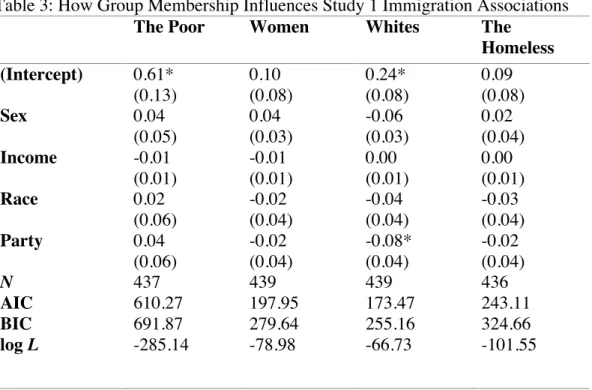
Table 3: How Group Membership Influences Study 1 Immigration Associations
The Poor Women Whites The
Homeless (Intercept) Sex Income Race Party N AIC BIC log L
0.61* (0.13) 0.04 (0.05) -0.01 (0.01) 0.02 (0.06) 0.04 (0.06) 437 610.27 691.87 -285.14 0.10 (0.08) 0.04 (0.03) -0.01 (0.01) -0.02 (0.04) -0.02 (0.04) 439 197.95 279.64 -78.98 0.24* (0.08) -0.06 (0.03) 0.00 (0.01) -0.04 (0.04) -0.08* (0.04) 439 173.47 255.16 -66.73 0.09 (0.08) 0.02 (0.04) 0.00 (0.01) -0.03 (0.04) -0.02 (0.04) 436 243.11 324.66 -101.55
Standard errors in parentheses *indicates significance at p < 0.05
For Table 3, Sex is dichotomous, where 0 represents male and 1 represents female. Race is dichotomous, where 0 represents non-whites, and 1 represents whites. Party is also dichotomous where 0 represents Democrats, and 1 represents Republicans. Income is scaled from 1-8, with 1 representing “Less than $20,000” and 8 representing
“More than $200,000.”
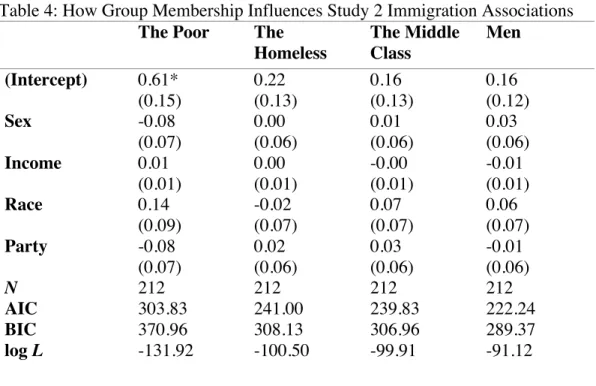
Table 4: How Group Membership Influences Study 2 Immigration Associations The Poor The
Homeless The Middle Class Men (Intercept) Sex Income Race Party N AIC BIC log L
0.61* (0.15) -0.08 (0.07) 0.01 (0.01) 0.14 (0.09) -0.08 (0.07) 212 303.83 370.96 -131.92 0.22 (0.13) 0.00 (0.06) 0.00 (0.01) -0.02 (0.07) 0.02 (0.06) 212 241.00 308.13 -100.50 0.16 (0.13) 0.01 (0.06) -0.00 (0.01) 0.07 (0.07) 0.03 (0.06) 212 239.83 306.96 -99.91 0.16 (0.12) 0.03 (0.06) -0.01 (0.01) 0.06 (0.07) -0.01 (0.06) 212 222.24 289.37 -91.12
Standard errors in parentheses *indicates significance at p < 0.05 See Table 3 for information about how variables are coded.
Although respondents belong to a variety of gender, racial, class, and partisan groups, my hypotheses focus on how social identities with these groups affect the groups linked with immigration. Thus, an evaluation of identity strength is necessary to assess fully whether meaningful social group attachments affect the associations participants make between the ten groups and immigration.
Table 5: How Group Identity Influences Study 1 Immigration Associations
Other Blacks The Rich
(Intercept) Sex Income Race Party Gender ID Race ID Sex*GenderID Race*RaceID N AIC BIC log L
-0.47 (0.26) 0.35** (0.14) 0.01 (0.01) 0.01 (0.12) 0.01 (0.01) 0.06* (0.04) -0.01 (0.12) -0.04** (0.02) -0.00 (0.00) 493 101.76 252.98 -14.88 0.05 (0.22) 0.11 (0.11) -0.01** (0.01) -0.10 (0.10) 0.01 (0.01) 0.00 (0.03) -0.01 (0.01) -0.01 (0.02) 0.02 (0.01) 497 -94.48 57.03 83.24 0.15 (0.20) 0.03 (0.10) -0.00 (0.00) -0.13 (0.09) 0.02*** (0.01) -0.01 (0.03) -0.13 (0.09) -0.01 (0.02) 0.02 (0.01) 493 -175.49 -24.27 123.75
Standard errors in parentheses *indicates significance at p < 0.10 ** at p<0.05 ***at p<0.01 Gender identity strength is scaled from 2-9, with 2 representing “Not at all Important” and 9 representing
“Extremely Important.” Party identity is scaled from 1-7, with 1 representing a value of “Strong Republican” and 7 representing “Strong Democrat.” See Table 3 for more information about how other variables are coded.
GUN CONTROL Groups the Public Associates with Gun Control
round out the top four groups associated with this issue. Unlike on immigration, the “Other” option was the least popular in this study for gun control; only three respondents chose this option to name the NRA as a group that they thought of for gun control.
Table 6: Study 1 Gun Control Issue-Group Associations Group Associated Not Associated Total
Men Whites Rich Middle Class Blacks Women Poor Elderly Disabled Homeless Other 47% (244) 45% (238) 16% (86) 15% (80) 14% (74) 10% (52) 10% (51) 4% (21) 4% (23) 3% (17) 3% (13) 53% (278) 55% (286) 84% (437) 85% (441) 86% (450) 90% (472) 90% (472) 90% (473) 96% (503) 96% (501) 97% (510) 522 524 523 521 524 524 524 524 524 524 524
Overall, these data suggest that the public associates positive groups with gun control. These links may be the result of existing issue framing; but regardless of their origins, they should produce more positive perceptions of gun policy itself. While opinions on gun control may differ, the connections that form between this issue and stereotypically positive groups convey that it is an issue the public should view as worthy of attention.
groups remain in the top four selected. Twenty-two percent of respondents selected three groups from the list of ten, but 22% of respondents also did not select any of the groups (See Table A7 Appendix A). The data from this study convey the same trend as Study 1: namely, the public links positively stereotyped groups to the gun control issue area. While this analysis does not trace the origins of these associations, the data do provide support for the Issue Valence Hypothesis. The context of gun control and immigration differ, and the groups the public connects to these areas may be a product or a driver of the disparate coverage of them by elites and the media.
Table 7: Study 2 Gun Control Issue-Group Associations Group Associated Not Associated Total
Men Whites Middle Class Rich Blacks Poor Women Elderly Homeless Disabled 51% (133) 49% (128) 34% (89) 29% (74) 19% (50) 17% (45) 12% (32) 8% (21) 4% (10) 3% (8) 49% (126) 51% (131) 66% (170) 71% (185) 81% (209) 83% (214) 88% (227) 92% (238) 96% (249) 97% (251) 259 259 259 259 259 259 259 259 259 259
How Identities Shape Associations of Groups with Gun Control
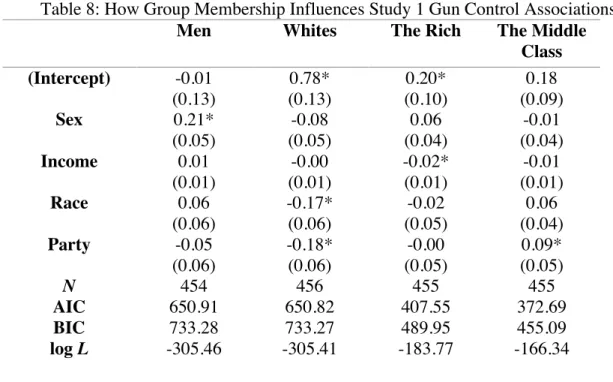
this issue area, I first explore the Group Identity and Partisan Identification Hypotheses by analyzing the effects of sex, race, income, and party on the associations people form between social groups and gun control. Then, I compare the effects of group membership with those of identity. Table 8 displays a series of logistic regression models that were used to evaluate if simple group differences influenced the associations respondents formed between the top ranked groups and the issue of gun control. Individual differences exist in perceptions of all of the top four groups in the context of gun control. Men and women differ in their perceptions of whether or not men come to mind when they think of gun control. Female respondents are more likely to associate men with this issue than male respondents. Race and party shape the association of whites with gun control. Non-whites are more likely to perceive whites as connected to this issue. Democrats are also more likely to link whites to gun control than Republicans, and Republicans are more likely to connect the middle class to this issue than Democrats. Finally, the higher the respondent’s income, the less likely they are to think of the rich in this issue area.
Table 8: How Group Membership Influences Study 1 Gun Control Associations
Men Whites The Rich The Middle
Class (Intercept) Sex Income Race Party N AIC BIC log L
-0.01 (0.13) 0.21* (0.05) 0.01 (0.01) 0.06 (0.06) -0.05 (0.06) 454 650.91 733.28 -305.46 0.78* (0.13) -0.08 (0.05) -0.00 (0.01) -0.17* (0.06) -0.18* (0.06) 456 650.82 733.27 -305.41 0.20* (0.10) 0.06 (0.04) -0.02* (0.01) -0.02 (0.05) -0.00 (0.05) 455 407.55 489.95 -183.77 0.18 (0.09) -0.01 (0.04) -0.01 (0.01) 0.06 (0.04) 0.09* (0.05) 455 372.69 455.09 -166.34
Standard errors in parentheses *indicates significance at p < 0.05 See Table 3 for information about how variables are coded.
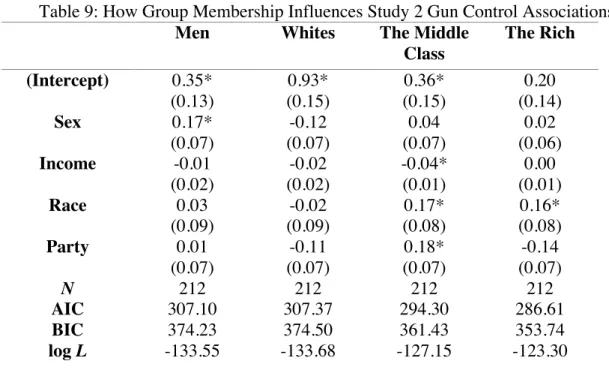
Table 9 displays a series of logistic regressions used to evaluate how group differences shape associations between social groups and gun control in Study 2. Similar to the models in Table 8, these models convey how demographic factors like sex and income influence whether respondents mentioned the poor, the homeless, the middle class, and men when responding to the close-ended question that asked them to identify the groups that came to mind when they thought about gun control. Although the differences were not as great as those in Study 1, individual demographics continue to shape perceptions of association in this study. Sex differences exist when evaluating the association of men and gun control. Income, race, and party influence whether respondents selected the middle class when they thought of gun control. Finally, whites are more likely than non-whites to perceive the rich as connected to gun control.
influence whether people form connections between class groups and gun control. The bases of the Democratic and Republican Parties are comprised of different class groups, which may motivate people to develop alternative outlooks on this issue area. Individuals with higher levels of socioeconomic status tend to support the Republican Party at higher rates than those with lower socioeconomic status. However, without examining social identity strength, I cannot determine what particular effect of belonging to these groups inspired differences in perceptions of association.
Table 9: How Group Membership Influences Study 2 Gun Control Associations
Men Whites The Middle
Class The Rich (Intercept) Sex Income Race Party N AIC BIC log L
0.35* (0.13) 0.17* (0.07) -0.01 (0.02) 0.03 (0.09) 0.01 (0.07) 212 307.10 374.23 -133.55 0.93* (0.15) -0.12 (0.07) -0.02 (0.02) -0.02 (0.09) -0.11 (0.07) 212 307.37 374.50 -133.68 0.36* (0.15) 0.04 (0.07) -0.04* (0.01) 0.17* (0.08) 0.18* (0.07) 212 294.30 361.43 -127.15 0.20 (0.14) 0.02 (0.06) 0.00 (0.01) 0.16* (0.08) -0.14 (0.07) 212 286.61 353.74 -123.30
Standard errors in parentheses *indicates significance at p < 0.05 See Table 3 for information about how variables are coded.
Although respondents’ demographic groups certainly separated respondents in their associations of groups with gun control, a further examination of their social identities is
group attachments affect the associations participants make between the ten groups and gun control.
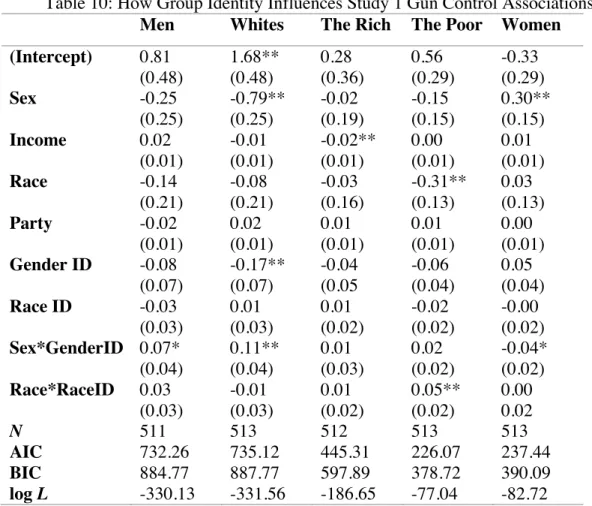
Table 10 conveys how individual identities shape group-issue associations for gun control. In this context, the identities examined in this analysis affect whether respondents perceive men, whites, the rich, the poor, and women as connected to the issue of gun control. Gender identity moderates whether respondents associate men and whites with gun control (See Figures A2, A3, and A5 for the marginal effects plots for the interaction between sex and gender identity strength). As gender identity strength increases, women are more likely to associate men with gun control, while men are less likely. Additionally, as gender identity strength increases, women are more likely to associate whites with gun control, while men are less likely. Finally, as gender identity strength increases, men are more likely than women to think of women in the context of gun control.
Other identities also influence the associations individuals form between the listed groups and the gun control issue area. Racial identity influences whether respondents connect the poor to gun control. As their racial identity strength increases, whites are more likely than nonwhites to associate the poor with gun control (See Figure 9 for the marginal effects plot for the interaction of race and racial identity strength). Although income level does not measure class identity strength, it does still influence the connections respondents form between the rich and gun control when controlling for the other identities examined. As income levels increase, respondents are less likely to associate the rich with gun control.
and racial identity strength influence respondents’ propensity to connect whites and the poor to gun control. As gender identity strength among women increases, they are more likely to associate whites with gun control. As racial identity strength among whites increases, they are more likely to associate the poor with gun control. However, these trends do not comport with the original hypothesis that asserts respondents are more likely to think of their own groups when their identities are salient. Their group identities may provide a unique lens through which they make connections between these specific groups and gun control, despite these identities apparently not motivating them to think of this issue in terms of their own groups.
Table 10: How Group Identity Influences Study 1 Gun Control Associations Men Whites The Rich The Poor Women (Intercept) Sex Income Race Party Gender ID Race ID Sex*GenderID Race*RaceID N AIC BIC log L
0.81 (0.48) -0.25 (0.25) 0.02 (0.01) -0.14 (0.21) -0.02 (0.01) -0.08 (0.07) -0.03 (0.03) 0.07* (0.04) 0.03 (0.03) 511 732.26 884.77 -330.13 1.68** (0.48) -0.79** (0.25) -0.01 (0.01) -0.08 (0.21) 0.02 (0.01) -0.17** (0.07) 0.01 (0.03) 0.11** (0.04) -0.01 (0.03) 513 735.12 887.77 -331.56 0.28 (0.36) -0.02 (0.19) -0.02** (0.01) -0.03 (0.16) 0.01 (0.01) -0.04 (0.05 0.01 (0.02) 0.01 (0.03) 0.01 (0.02) 512 445.31 597.89 -186.65 0.56 (0.29) -0.15 (0.15) 0.00 (0.01) -0.31** (0.13) 0.01 (0.01) -0.06 (0.04) -0.02 (0.02) 0.02 (0.02) 0.05** (0.02) 513 226.07 378.72 -77.04 -0.33 (0.29) 0.30** (0.15) 0.01 (0.01) 0.03 (0.13) 0.00 (0.01) 0.05 (0.04) -0.00 (0.02) -0.04* (0.02) 0.00 0.02 513 237.44 390.09 -82.72 Standard errors in parentheses *indicates significance at p < 0.10 ** at p<0.05
See Table 3 for more information about how other variables are coded.
DISCUSSION
competence, the most detrimental combination of group stereotypes (Cuddy, Fiske, and Glick, 2007; Cuddy, Fiske, and Glick, 2008; Cuddy et al., 1999). This association of a weak group with this issue likely reinforces the anti-immigrant sentiment highlighted in the media (Farris and Mohamed, 2018). It should also affect how the public perceives policies related to immigration. If they connect negative groups to this issue, they may not approve of increased immigration and instead prefer stricter immigration policies. Their preconceptions about the issue of immigration and the prototypical immigrant may also affect the groups they selected in the two studies.
Both studies also reveal that a majority of respondents link men to the issue of gun control. While the poor suffer as a result of their general stereotypes, individuals generally perceive men as high on the competence dimension and medium to high on the warmth dimension (Cuddy et al., 2009). Unlike the immigration context where a clear majority mentioned the poor, respondents in both Study 1 and Study 2 mentioned whites almost as frequently as they mentioned men in the context of gun control. However, whites also benefit from generally positive stereotypes, which suggests that respondents may develop distinct perspectives on this issue.
The groups that the public associates with issues are important apart from their potential effects on group stereotypes and issue opinions. These connections fundamentally alter the manner in which people consume and process information about these issues, which contributes to a deeper understanding of public opinion. Additionally, these connections directly influence the groups the public deems qualified to speak about these issues, as the psychological process of associating groups and issues occurs prior to any evaluation of authority.
to shape respondents’ understanding of the links between groups and issues, some simple group differences between the sexes, races, and income groups also shape individual associations. Though identities as a whole contribute to more differences in individual perceptions of the groups they connect to both immigration and gun control. The results support the Party Identification Hypothesis, as party identity strength inspires different group-issue associations between Republicans and Democrats.
While group identity also inspires the same trends, producing differences in perceptions of the groups respondents connect to immigration and gun control, the findings did not show that these group identities motivate individuals to perceive their own groups as connected to these areas. Further analysis is necessary to examine the Group Identity Hypothesis. An evaluation of different issue areas may provide more insight into the role of group identity in shaping the particular groups people associate with political concerns.
A few noteworthy limitations of this study exist and should be addressed in future research. First, I only focused on prompting people with a list of 10 social groups, which restricted the ability for respondents to deliberate fully on the issues and name the groups that immediately came to mind when they thought of them. This abridged selection of groups proved especially problematic in the context of immigration where I did not include Latinos. The 10 groups that I selected do not possess noteworthy experiences within these two issue areas; yet in this initial examination, I needed to construct a concise list in order to facilitate comparisons between the types of groups that people associate with different issue areas to test the Issue Valence Hypothesis.
However, these student samples should have the greatest impact on the particular groups respondents select as connected to the two issues, but not the type of group people select. Thus, the samples do not impede my ability to test the Issue Valence Hypothesis. Additionally, this issue should not affect whether or not the identities of the respondents affect the group-issue associations they form.
CHAPTER 3: CULTIVATING COMPETENCE: AN EXAMINATION OF SOCIAL GROUP ISSUE AUTHORITY
In 2015, an Ohio proposal to ban abortions to terminate Down syndrome pregnancies drew national attention because the plan pitted the disabled community, who favored the ban, against women, who felt their rights to abortion access were threatened (Lewin, 2015). To the public at large, it was clear which side of the bill was championed by each side. Critically, both groups appeared authoritative and informed, which only heightened the controversy and made it difficult for the public to know which side of the bill to favor. Ultimately, citizens must decide whose voice—activists speaking for the disabled or women—carries the most weight on this issue.
This is a common occurrence. Social groups are often associated with specific sides on policy issues by political leaders, the media, and citizens. For example, during her 2016 presidential campaign, Hillary Clinton made pay equity a priority stressing that it was an issue that women championed (Bischoff, 2015). Likewise, recently the mainstream media has devoted greater attention to the racial inequities in the criminal justice system and policing because the #BlackLivesMatter Movement has made those issues salient (Jones, 2015).
factor that I explore in this chapter. In addition to shaping issue perceptions in the mass public, the presence of issue authority should affect if an issue is viewed as important and worthy of action. So, because issue authority likely has important consequences, it is important to understand variations in perceptions of issue authority.
In this chapter, I explain how citizen characteristics like education levels, as well as overall group competence, shape a group’s perceived issue authority. Theoretically, I argue that groups that have authority are qualified to speak about an issue and shape the broader societal discussion of it. Then, on three different issues—the #MeToo Movement, gun control, and immigration—I apply this theoretical framework to explain how issue authority varies across citizens and groups. These issues are similar in important ways, as they currently have inspired social movements among the mass public. Further, they exist in relatively fixed realms due to related Supreme Court cases that provide legal precedent that may interfere with attempts to implement policy change.
Based on my analysis, I conclude that a group’s issue authority is context-specific, and importantly the life experiences of group members—victimhood, for example—matter to the public. In specific terms, these findings reveal the groups people regard as issue authorities on the #MeToo Movement, gun control, and immigration. More generally, our understanding of the role social groups play in politics is advanced by moving beyond general group stereotypes. Additionally, this research enriches our understanding of how social groups influence the perception of salient political issues.
UNDERSTANDING SOCIAL GROUP ISSUE AUTHORITY
Glick, 2007; Cuddy, Fiske, and Glick, 2008; Cuddy et al., 1999). Groups that have issue authority are viewed as qualified sources of information. To understand the origins and qualities of a group’s issue authority, I propose that the relationship between the group and the issue exists on two dimensions: association and competence (Walgrave, Levere, and Tresch, 2012). Prior to evaluating a group’s qualification to speak about an issue, a person must form a link or an association between the group and the issue. Once a group is associated with an issue, its competence can be assessed, where competence is a group’s ability to be an effective political actor on the issue. Competence is a product of a group’s general stereotypes and its unique experiences with an issue. Stereotypical and experiential competence combine to translate into a group’s issue authority.
Recognizing the existence of both group-issue linkages and the influence of group issue authority deepens our understanding of the issues involved, and how the public takes cues from sources in their environment. People often process information about political issues based primarily on how they will influence their social groups: they tend to follow ingroup or identity-based cues and support policies that benefit their groups (Tajfel and Turner, 1986; Kam, 2005; Goren et al., 2009; Hartman and Weber, 2009; Nicholson, 2011). But, group members do not only or always follow ingroup sources (Chaiken, 1980; Conover, 1988; Kunda, 1990).
interests, though my analysis centers on the public’s perception of social groups instead of politicians or political institutions. Specifically, I argue that expert source cues are contextual in nature: the public perceives particular groups as authorities in specific issue domains.
Groups may have multiple issue areas of perceived authority—or none. Thus, the public is likely to perceive a specific group as the most qualified to discuss a particular political issue, resulting in it possessing authority over a given issue domain. Critically, often much of the public may not belong to the group recognized as having expertise on an issue. Yet, the public’s trust in this “expert” group should allow it, nonetheless, to serve as an authoritative source of information that can wield significant power in shaping perceptions of an issue.
THE COMPETENCE DIMENSION
The perceived competence of a social group is central to determining its “issue authority.” I argue that the perceived “competence” of a social group in a particular issue domain depends upon two group characteristics: its stereotypical competence, and its experiential competence.
intelligent and friendly should be even more likely to be seen as competent in an issue area; conversely, groups stereotyped as both unintelligent and cold should be perceived as especially incompetent. Still, even disliked groups can maintain reputations as being generally competent members of society (Cuddy et al., 1999).
Beyond a group’s stereotypical competence, a second key factor contributing to issue authority is whether a group is perceived to have a first-hand involvement with and understanding of the issue, or experiential competence. To explain, the effects of social problems on group members create distinct experiences that develop an appreciation of an issue’s complexity and its human consequences. Typically, this understanding cannot be replicated by non-group members because they have not had—and cannot have—the same experiences. For example, women exclusively breastfeed, providing them with a wealth of experience on the issue. Consequently, some view women themselves as more credible sources on policies surrounding breastfeeding in the workplace (Bridges, Frank, and Curtin, 1997; Galtry, 2000; Tuhus, 2001; Polston Mills, 2009). Thus, groups perceived as having experiential competence on an issue effectively possess resources over that given issue domain giving them “competence in context.”
People learn about experiential competence through exposure to group narratives via the news, through social media, etc. Narratives are more persuasive than impersonal reports, so they are important for convincing people in general, and they are particularly important for stigmatized groups (Slater and Rouner, 2002; Oliver et al., 2012; Shen, Ahern, and Baker, 2014). In sum, I argue that the public perceives some groups as having greater experiential competence: more experience with and therefore a better understanding of an issue.
competence and especially it’s stereotypical competence. Indeed, empirical attempts to unravel the causal effects of group affect and stereotypes have shown that it is difficult to untangle the causality between the two. The key meta-analysis examining the causal relationship between the two concludes that causality more likely runs from stereotypes to affect; but some studies find the opposite (see Riek, Mania and Gaertner 2006; Hamilton, Stroessner, and Mackie, 1993 also, Jackson et al., 1997; Aberson and Gaffney 2008). From my perspective, it is not essential for understanding a group’s authority on certain issues to focus either theoretically or empirically on parsing out the effects of group affect from those of stereotypical competence and experiential competence. Thus, for the sake of parsimony, I focus on competence, assuming group affect is interwoven with it.
ISSUE AUTHORITY IN CONTEXT
“Issue authority” is produced by the combination of experiential competence and stereotypical competence. Importantly, then, “issue authority” is domain-specific. Groups that have “issue authority” have power in a particular context that shapes how individuals perceive incoming information about a constellation of related issues. For example, women may have “issue authority” in the area of educational policies; but their issue authority in that domain has no necessary bearing on their authority in other domains like defense policy.