HEALTH INFORMATION TECHNOLOGY: CAREGIVERS’ CHARACTERISTICS AFFECTING USE AND PREFERENCES
Maggie W. Fetner
A thesis submitted to the faculty at the University of North Carolina at Chapel Hill in partial fulfillments of the requirements for the degree in Master in Science in the School of Dentistry
(Pediatric Dentistry).
Chapel Hill 2013
Approved by:
iii ABSTRACT
Maggie W. Fetner: Health Information Technology: Caregivers’ Characteristics Affecting Use and Preferences
(Under the direction of Jessica Y. Lee)
BACKGROUND: Social media and information technology offer a potential avenue to communicate positive messages regarding young children’s health, but little is known about
caregivers’ information-seeking behaviors and preferences.
METHODS: Caregivers of healthy children ages 6 and younger in a community clinic completed
an in-person, verbally-administered interview that assessed information-seeking behaviors and
preferences, health literacy, and other domains. Differences in preferred methods of receiving child
dental health-related information were examined according to caregivers’ characteristics by comparing methods’ rank of preference.
RESULTS: Caregivers (mean age=28.5 years) reported a high level of access to electronic
communications including computer access (93%), cell phones (91%), email (91%), and Facebook
(75%). When asked to rank their preferred method for receiving child dental health-related
information, 31% preferred email, 24% phone, 21% US mail, and 21% text-messages.
CONCLUSIONS: It is important to consider caregiver characteristics and caregiver’s preference
iv
TABLE OF CONTENTS
LIST OF TABLES……….….….v
INTRODUCTION………...1
METHODS………..3
RESULTS………6
CONCLUSIONS……….8
TABLES……….13
v
LIST OF TABLES
Table 1 - Sociodemographic Characteristics of the Study Participants ...……….13
Table 2 - Caregiver Access to Electronic Media ………..…………..………...14
Table 3 - Caregivers’ Reported Use of Online Resources ………....15
Table 4 - Preferred Methods of Receiving Child-related Dental Health
Information and Corresponding Health Literacy (REALD-30) Estimates
Introduction
Messages tailored to the characteristics of one’s audience are more effective at changing
health behavior than generic messages.1 In an environment of cellular phones and rapid, instant
communication, it is important to tailor communication mode in addition to content. 2 Without
attention to mode, we risk that a message will be missed, deleted, or skipped for another that more
effectively captures the attention of the receiver. As pediatric health care providers, it is important
to understand the communication preferences, health literacy levels, and other characteristics of
caregivers of young children in order to better design preventive health messages and improve
adoption of positive health behaviors. Due to widespread use of the internet, text messaging, social
networking, and other information technologies, there are potential opportunities for conveying
health information to caregivers of young children in innovative ways.
The internet and mobile technology have revolutionized methods of communication and
created new modes for message delivery. In 1995, only 10% of US adults had internet access, but
currently this figure is 85% for adults and 95% for teenagers.3,4 Because of ongoing and rapidly
evolving trends in electronic communication, most Americans today rely upon the internet for
information about many aspects of life, including health care. As one example, approximately 60%
of American adults obtain health information online.5 Similarly, social networking is a concept
that has followed the emergence of wide-spread internet access. Roughly three quarters of online
2
are women aged 18-29, a significant finding because it is this demographic group that includes a
significant number of those who care for young children.7
The increased use of text messaging is another recent change in the communication culture
of people in the United States. Recent surveys show that 31% of cell phone users prefer a text,
versus a phone call.8 Young adults are the primary demographic group currently utilizing text
messaging; indeed, 97% of cell phone owners aged 18-24 use texting and rely heavily upon this
technology.8 In further describing the demography of text message use, non-whites, particularly
African Americans, use texting more often than whites, as do those with lower levels of income
and education.8 DeMartini and colleagues recently discovered that a majority of caregivers of
young children in an urban pediatric primary care setting used home internet, email, Facebook,
and smartphones. Accordingly, over 70% were open to receiving digital health care information.9
Understanding communication behaviors and preferences of child caregivers will enable
dentists and pediatricians to create more effective outreach with public health messages. We
sought to understand access to digital technologies and caregiver characteristics, such as age and
3 Methods
We used an IRB-approved, cross-sectional study design to examine the primary caregivers’
health information-seeking behaviors and preferences, as well as their association with caregivers’
characteristics, such as health literacy and age. We recruited 149 caregiver/child dyads that
presented to WIC Clinic and enrolled them using a consecutive convenience sample. We defined
primary caregiveras the adult responsible for coordinating the child’s oral health. When multiple
individuals accompanied the child for the visit, we identified the individual who considered himself or herself the child’s primary caregiver for oral health-related matters.
Eligible caregivers had to speak English because the instrument used to measure health
literacy at the time of the study had been validated in English only. Eligible children were healthy
(American Society of Anesthesiologists Physical Status Classification I or II) and ages 2-6.
Trained interviewers invited caregivers to participate. After providing written informed consent,
eligible caregivers were asked to complete in-person verbally-administered surveys by the study
interviewers in a quiet waiting room or private setting. If the caregiver experienced any difficulty
reading the consent or HIPAA forms, the interviewer read them aloud. Each interview took
approximately 20 minutes.
Information-seeking preferences and behaviors were examined using a survey instrument
covering 12 domains. Health Information Technology (HIT) use was captured by asking caregivers
to rank various methods of communication, including phone, email, Facebook, Twitter, and U.S.
4
method. Among other HIT questions, caregivers were also questioned about the nature of their
social media use by asking, “How often do you read others’ posts on Facebook?” and “How often
do you write (post) on Facebook?” Each caregiver also completed surveys that included questions to assess caregivers’ oral health knowledge (6 items, 1-5 scale), children’s oral health behaviors
(7 items), reported oral health status of the child (one item taken from the National Health and
Nutrition Examination Survey10), and socio-demographic characteristics (age, education, race, and
marital status). The survey questions have been derived from previously developed and tested
questionnaires used in pediatric oral health research.10-12
We measured caregiver health literacy using the Rapid Estimate of Adult Literacy in
Dentistry (REALD-30).13 This previously validated instrument includes 30 words arranged in
order of increasing difficulty. Using REALD-30, the words were read aloud by the caregiver to
the interviewers. Because REALD-30 is a word recognition test, subjects were asked not to try and
pronounce unknown words but rather skip the words they did not know. For REALD-30 scoring,
one point is given for each word pronounced correctly and summed to get an overall score; thus
REALD-30’s range is 0 (lowest literacy) to 30 (highest literacy). In previous studies, it has been
noted that a REALD score of 13 or above delineates adequate literacy level.14, 15 After the
completion of the interview, an incentive ($10 gift card) was given to the caregiver.
Descriptive methods were used to report percentages and frequency distributions of
socio-demographic characteristics, sources of oral health information, and preferences. To examine the
association between caregivers’ health literacy and age with their preferred methods of receiving
child dental health-related information, we examined ranks and differences in rank order of these
methods between corresponding caregiver strata, specifically low (REALD-30 score <13) vs.
5
older (27 years or older) participants. We additionally explored the variation in preferences by children’s reported oral health status contrasting better (excellent or very good) vs. worse
(good/fair/poor) oral health. Data analyses were conducted using the STATA 13.1 statistical
6 Results
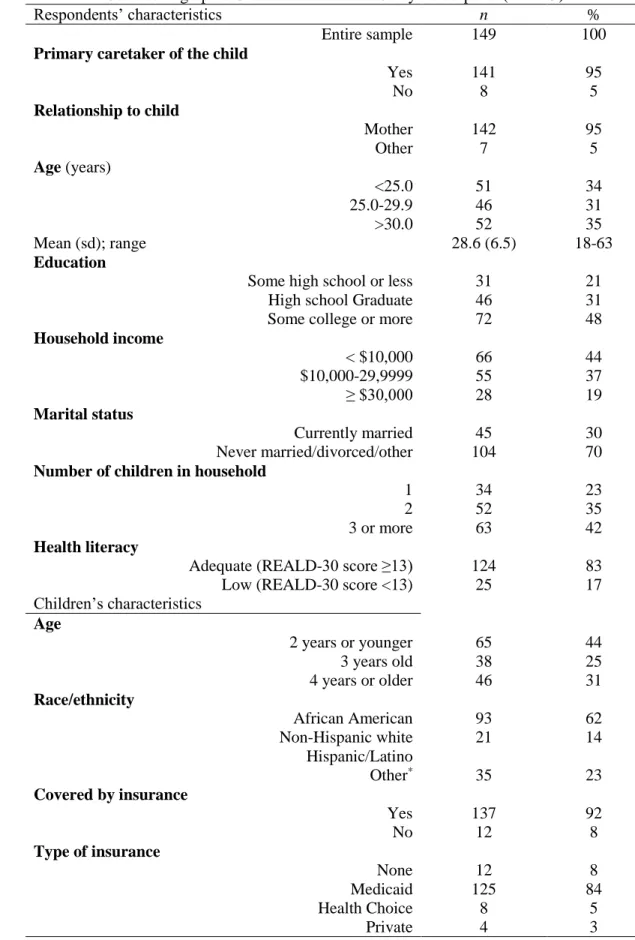
Our sample included 74 female and 75 male children. African American was the
predominant racial/ethnic group (n=93, 62%), followed by Whites (n=21, 14%) and Hispanics
(n=11, 7%). The majority (84%) of the children were covered by Medicaid insurance.
Approximately half (52%) of the caregivers had a high school education or less, and the majority
(70%) was single or never married. Virtually all (n=142/149) of the caregivers were mothers. Other
caregiver types included father and grandmother (Table 1).
Over 90% of the caregivers reported having computer access (93%), owned a cell phone
(91%) and had an email account (91%). Notably, 80% had a Facebook account and 75% used
texting daily (Tables 2, 3).
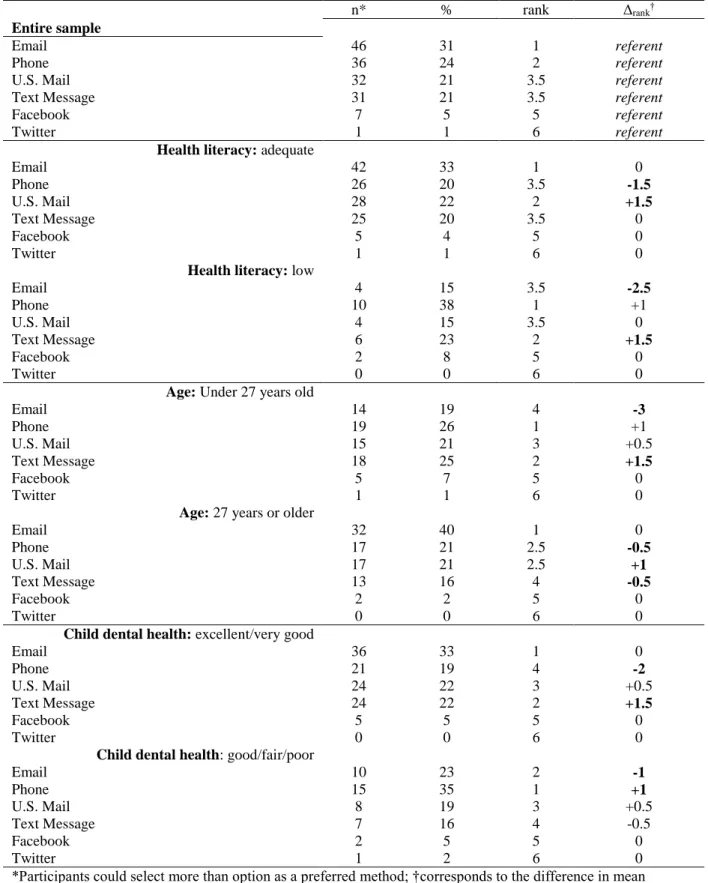
We assessed caregiver preference for receipt of dental health information for their child by asking caregivers to rank all the methods of communication in the order of preference, with “1”
being the method most preferred. 31% of caregivers ranked email first, followed by 24% who
chose phone, 21% who chose US mail, and 21% who chose text message. Those who preferred
receiving dental health information through Facebook, Twitter, or blog post made up less than 5%
of the sample (Table 4).
We examined caregivers’ preferred means of communication stratified by their literacy
level (adequate or not). This analysis showed that caregivers with adequate literacy levels preferred
7
4). A similar pattern emerged for caregivers’ age, with older participants preferring email vs.
younger participants who preferred phone, as well as children’s reported oral health, with caregivers’ of children with better oral health preferring email vs. those of children with worse
oral health preferring phone.
The survey instrument assessed how frequently caregivers used the Internet to search for
general health and dental health information. The majority (83%) of the caregivers use the
Internet to search for general health information, but just over half (54%) reported searching for
dental health information online. Caregivers who reported using the internet to search for dental
health information almost always also sought general health information online. However, 6
caregivers reported only searching for online dental health information and not general health
information. Similarly, of those caregivers who owned computers (n=110), a great majority
8 Discussion
Our findings indicate that caregivers who were younger and had low literacy were most
likely to choose receiving a phone call, which we considered a more traditional option, as their
preferred method of communication. This contrasted findings among older and higher literacy
caregivers, who most frequently chose email as their preferred means of communication.
Interestingly, although many caregivers reported using the popular social networking site,
Facebook, few noted that they would like to use the site as a vehicle for oral health information.
Overall, this population of low-income caregivers of young children had a high level of oral health
knowledge and many of the caregivers reported regular use of technology; most of the sample
reported having computer access, owning a cell phone, and/or having an email account.
This information is useful for all health care providers, as they seek to communicate with
patients in the most effective manner possible. It is especially important to communicate
successfully with high-risk groups, such as the one studied here. When opportunities for delivery
of positive health messages are rare, one must capitalize on chances to share information with an
attentive patient. As we better understand patient and caregiver preferences for receiving
information, we can work to design general and oral health interventions that are tailored to their
literacy level and current communication habits.
As Americans develop more and more virtual connections, they are also finding other ways
to integrate technology and electronic media into their everyday lifestyles and evidence is
9
describe using texting to remind patients of appointments or educate them about medical topics of
interest.16,17 Medical electronic devices are relied upon for tracking daily personal health
information, such as blood sugar levels for diabetics.18 Finally, an abundance of websites19,20 are
available to search for health information. Collectively, this technological platform use is a part of
the HIT umbrella.
A 2010 systematic review examined how current HIT interventions are affecting the care
of low-income children, concluding that despite great improvements in HIT in recent years, some
low-income groups have been negatively affected because of barriers to accessing HIT.21
Provider-patient communication is challenged in low-income populations by frequent language barriers,
differences in cultural beliefs, differing understanding of illness, differing education levels of
provider and patient, and low health literacy.21
Successful pediatric HIT interventions have been described, including a web-based asthma
video game that reduced hospitalizations, and an interactive website for families and physicians to
help families understand results and prognosis after their child’s admission to a pediatric intensive
care unit.22,23 Office-based kiosks offer promise in educating children and parents interactively.21
Also promising are television and mobile phones, which are often more accessible than traditional
communication methods to low-income children, adolescents, and their families.21
Although still a rather new concept, there have been several reports related to dental health
information-seeking behaviors. In one study24, focus groups of low-income mothers suggested that
distributing oral health information using sources like email, text messaging, and Facebook could
be effective to reach pregnant women, mothers, and their children. These parents reported that
10
advice from family and friends, and participation in social and health programs. Nelson25
compared voicemails versus texting for appointment reminders, finding that voicemails were more
effective at increasing appointment attendance; however, this study was reported in 2011 and may be behind the curve for today’s caregivers. At the same time, the caregivers in the Nelson study
did not choose the type of reminder they preferred, a factor that may have affected the study
outcome.25 Sharma26 compared text messaging with printed brochures among 143 caregivers,
finding that texting was more effective in improving oral health knowledge, education, and
self-reported practices among the caregivers. Plaque scores were reduced by both interventions, but
there was not a significant difference between the printed brochure and the text message groups. Caregivers’ adoption of positive oral health behaviors is critical to improving their
children’s oral health status. Although there is evidence that oral health education can be effective
in reducing dental disease in young children, these studies were completed in controlled
environments and were time-intensive for both families and providers. The considerable time
commitment required with traditional educational methods of sharing information and
communicating with caregivers may be impractical for daily provider-patient interactions.
Until now, studies have investigated practitioners’ use of technology but few have
investigated patient preferences for receipt of oral health information. This report describes the
preferences of caregivers of young children regarding the receipt of information related their child’s oral health. We were surprised that even with the accelerated development of mobile
technologies and the recent advent of social media, many caregivers still preferred traditional
methods of communication, such as a phone call or a mailed letter. A similar finding was noted by
Stephens et al., who studied a group of adolescent orthodontic patients, finding that participants
11
reported use of the internet for social networking.27 Perhaps healthcare providers and educators
can better serve their patient audiences by asking how they would like to receive information.
Hopefully, this tailored approach to information delivery would in turn be more effective in
changing health outcomes.
The major limitation of this study is our reliance on a sample of predominantly female,
low-income, English-speaking caregivers, who were clients of one NC-WIC Clinic. To address
the issue of limited generalizability of our findings, future studies could assess communication
preferences of Spanish-speaking caregivers of young children, and consider multiple data
collection sites. Future studies could be designed to track communication preferences over time to
follow-up study participants over time longitudinally. Despite these limitations, our study was
enhanced through face-to-face interviews with caregivers, a design feature that is essential in
12 Conclusion
Low income caregivers are frequent users of information technology, including email, cell
phones, and text messaging; therefore, these communicative-concepts offer potential for the
provision of dental health information about children. When conceptualizing and developing
methods of communication related to children’s oral health, it is important to consider caregiver
characteristics, including age, health literacy level and the individual caregiver’s preference for
13
TABLE 1 Sociodemographic Characteristics of the Study Participants (n = 149)
Respondents’ characteristics n %
Entire sample 149 100
Primary caretaker of the child
Yes 141 95
No 8 5
Relationship to child
Mother 142 95
Other 7 5
Age (years)
<25.0 51 34
25.0-29.9 46 31
>30.0 52 35
Mean (sd); range 28.6 (6.5) 18-63
Education
Some high school or less 31 21
High school Graduate 46 31
Some college or more 72 48
Household income
< $10,000 66 44
$10,000-29,9999 55 37
≥ $30,000 28 19
Marital status
Currently married 45 30
Never married/divorced/other 104 70 Number of children in household
1 34 23
2 52 35
3 or more 63 42
Health literacy
Adequate (REALD-30 score ≥13) 124 83 Low (REALD-30 score <13) 25 17 Children’s characteristics
Age
2 years or younger 65 44
3 years old 38 25
4 years or older 46 31
Race/ethnicity
African American 93 62
Non-Hispanic white 21 14
Hispanic/Latino
Other* 35 23
Covered by insurance
Yes 137 92
No 12 8
Type of insurance
None 12 8
Medicaid 125 84
Health Choice 8 5
Private 4 3
14
TABLE 2 Caregiver Access to Electronic Media
n %
Computer access
Yes 138 93
No 11 7
Computer access at home
Yes 108 72
No 41 28
Computer access at work
Yes 20 13
No 129 87
Computer access at library
Yes 29 19
No 120 81
Computer access at a relative’s or friend’s home
Yes 21 14
No 128 86
Computer ownership
Yes 110 74
No 39 26
Type of computer (among owners)
Desktop 32 29
Laptop 57 52
Both 21 19
Cell phone ownership
Yes 136 91
No 13 9
Smart phone ownership
Yes 105 71
15
TABLE 3 Caregivers’ Reported Use of Online Resources
n %*
Use Internet to Obtain General Information
Yes 142 95
No 7 5
Use Internet to Obtain General Health Information
Yes 123 83
No 26 17
Use Internet to Obtain Dental Health Information
Yes 81 54.4
No 68 46.0
Email Account
Yes 135 91
No 14 9
Facebook Account
Yes 118 80
No 30 20
Twitter Account
Yes 25 17
No 124 83
16
TABLE 4 Preferred Methods of Receiving Child-related Dental Health Information and Corresponding Health Literacy (REALD-30) Estimates among the Study Participants (n = 149), Overall and Stratified by Health Literacy, Age, and Children’s Reported Oral Health Status.
n* % rank Δrank†
Entire sample
Email 46 31 1 referent
Phone 36 24 2 referent
U.S. Mail 32 21 3.5 referent
Text Message 31 21 3.5 referent
Facebook 7 5 5 referent
Twitter 1 1 6 referent
Health literacy: adequate
Email 42 33 1 0
Phone 26 20 3.5 -1.5
U.S. Mail 28 22 2 +1.5
Text Message 25 20 3.5 0
Facebook 5 4 5 0
Twitter 1 1 6 0
Health literacy: low
Email 4 15 3.5 -2.5
Phone 10 38 1 +1
U.S. Mail 4 15 3.5 0
Text Message 6 23 2 +1.5
Facebook 2 8 5 0
Twitter 0 0 6 0
Age: Under 27 years old
Email 14 19 4 -3
Phone 19 26 1 +1
U.S. Mail 15 21 3 +0.5
Text Message 18 25 2 +1.5
Facebook 5 7 5 0
Twitter 1 1 6 0
Age: 27 years or older
Email 32 40 1 0
Phone 17 21 2.5 -0.5
U.S. Mail 17 21 2.5 +1
Text Message 13 16 4 -0.5
Facebook 2 2 5 0
Twitter 0 0 6 0
Child dental health: excellent/very good
Email 36 33 1 0
Phone 21 19 4 -2
U.S. Mail 24 22 3 +0.5
Text Message 24 22 2 +1.5
Facebook 5 5 5 0
Twitter 0 0 6 0
Child dental health: good/fair/poor
Email 10 23 2 -1
Phone 15 35 1 +1
U.S. Mail 8 19 3 +0.5
Text Message 7 16 4 -0.5
Facebook 2 5 5 0
Twitter 1 2 6 0
17
REFERENCES
1) Noar SM. Does tailoring matter? Meta-analytic review of tailored print health behavior change interventions. Psychol bull. 2007; 133(4):673-693.
2) Webb TL, Joseph J, Yardley L, & Michie S. Using the internet to promote health behavior change: a systematic review and meta-analysis of the impact of theoretical basis, use of behavior change techniques, and mode of delivery on efficacy. J Med Internet Res. 2010; 12(1): E4. doi: 10.2196/jmir.1376.
3) Pew Research Center’s Internet & American Life Project 2012. Trend Data (Adults). Available at http://www.pewinternet.org/Static-Pages/Trend-Data-(Adults).aspx. Accessed October 29, 2013.
4) Pew Research Center’s Internet & American Life Project 2012. Trend Data (Teens). Available at http://www.pewinternet.org/Static-Pages/Trend-Data-(Teens).aspx. Accessed October 29, 2013.
5) Pew Internet & American Life Project. Health Online 2013.
http://www.pewinternet.org/Static-Pages/Trend-Data-(Adults)/Online-Activites-Total.aspx. Published January 15, 2013. Accessed October 29, 2013.
6) Pew Internet & American Life Project. 72% of Online Adults are Social Networking Users. http://pewinternet.org/Reports/2013/social-networking-sites.aspx. Published August 5, 2013. Accessed October 29, 2013.
7) Pew Internet & American Life Project. The Demographics of Social Media Users-2012. http://pewinternet.org/Reports/2013/social-media_users.aspx. Published February 14, 2013. Accessed October 29, 2013.
8) Pew Internet & American Life Project Americans and Text Messaging.
http://www.pewinternet.org/Reports/2011/Cell-Phone-Texting-2011.aspx. Published September 19, 2011. Accessed October 29, 2013.
9) DeMartini T, Beck A, Klein M, Kahn R. Access to digital technology among families coming to urban pediatric primary care clinics. Pediatrics. 2013; 132; e142. doi: 10.1542/peds.2013-0594.
10)Oral health questions included in National Oral Health Surveys. NIDCR Data Resource Center Website. http://drc.hhs.gov/SurveyQ/index.htm. Published March 2010. Accessed October 29, 2013.
11) Douglass JM, Tinanoff N, Tang JM, Altman DS. Dental caries patterns and oral health behaviors in Arizona infants and toddlers. J Community Dent Oral Epidemiol.
18
12)Shick EA, Lee JY, Rozier RG. Determinants of dental referral practices among WIC nutritionists in North Carolina. J Public Health Dent. 2005;65(4):196-202.
13)Lee JY, Rozier RG, Lee SY, Bender D, Ruiz RE. Development of a word recognition instrument to test health literacy in dentistry: the REALD-30—a brief communication. J Public Health Dent. 2007;67(2):94-98.
14)Vann WF Jr, Lee JY, Baker D, Divaris K. Oral health literacy among female caregivers: impact on oral health outcomes in early childhood. J Dent Res. 2010;89(12):1395-400. 15)Vann WF Jr, Divaris K, Gizlice Z, Baker AD, Lee JY. Caregivers' health literacy and
their young children's oral-health-related expenditures. J Dent Res 2013; 92(7 Suppl):55S-62S.
16)Downer SR, Meara JG, Da Costa AC. Use of SMS text messaging to improve outpatient attendance. Med J Aust. 2005;183(7):366-8.
17)Gold J, Lim MS, Hocking JS, Keogh LA, Spelman T, Hellard ME. Determining the impact of text messaging for sexual health promotion to young people. Sex Transm Dis. 2011;38(4):247-252.
18)tudiabetes.org. http://www.tudiabetes.org/. Accessed October 29, 2013. 19)MedlinePlus. http://medlineplus.gov. Accessed October 29, 2013.
20)WebMD. http://www.webmd.com/default.htm. Accessed October 29, 2013. 21)Ngo-Metzger Q, Hayes GR, Yunan Chen, Cygan R, Garfield CF. Improving
communication between patients and providers using health information technology and other quality improvement strategies: focus on low-income children. Med Care Res Rev. 2010;67(5 Suppl):246S-267S.
22)Braner DA, Lai, S, Hodo R, Ibsen LA, Bratton SL, Hollemon D, Goldstein B. Interactive web sites for families and physicians of pediatric intensive care unit patients: A
preliminary report. Pediatr Crit Care Med. 2004;5(5):434-439.
23)Krishna S, Francisco BD, Balas EA, König P, Graff GR, Madsen RW; Randomized trial. Internet-enabled interactive multimedia asthma education program: a randomized trial. Pediatrics. 2003;111(3):503-510.
24)Buerlein JK, Horowitz AM, Child WL. Perspectives of Maryland women regarding oral health during pregnancy and early childhood. J Public Health Dent 2011;71(2):131-135.
19
26)Sharma R, Hebbal M, Ankola AV, Murugabupathy V. Mobile-phone text messaging (SMS) for providing oral health education to mothers of preschool children in Belgaum City. J Telemed Telecare. 2011;17:432-436.