SPECIES DIVERSITY PATTERNS AT ECOTONES
Amanda Ruth Senft
A thesis submitted to the faculty of the University of North Carolina at Chapel Hill in partial fulfillment of the requirements for the degree of Masters of Science in the Department of Biology
Chapel Hill 2009
ABSTRACT
AMANDA RUTH SENFT: Species Diversity Patterns at Ecotones (Under the direction of Robert Peet)
iii
ACKNOWLEDGEMENTS
I thank the members of my committee who gave me sound advice over the course of my graduate career: Drs. Robert Peet, Peter White and Dean Urban. Thanks also to my funding sources: the UNC Department of Biology Coker and Beers Fellowships and the UNC Smith Fellowship. Jason Fridley, Johnny Randall, Alan Weakley, Caroline Bernard and Captain Joel Gramling gave me much needed data gathering guidance and shared key plant identification expertise. No good ecology thesis would be quite complete without the guidance of statistical guru Jack Weiss, who I thank for his contributions to my work.
There are many past and present members of the Chapel Hill community who made graduate school an adventure. Those deserving special mention are: Brooke Wheeler, Lee Anne Jacobs, Sarah Marcinko, Andrea Jones Gramling, Dane Kuppinger, Dave Vandermast, Andy Gerschutz, Liz Matthews, Todd Jobe, Jeff Ott, Kristin Taverna, Forbes Boyle, Gayle Shimokura, Jen and Adam Costanza, and the yoga instructors of the UNC Student Recreation Center.
I would like to thank my thesis advisors at Cornell University, Dr. Monica Geber and Dr. Peter Marks, for their encouragement and patience. Thanks also to the EPA/NCER officemates who sent me off to UNC with school supplies and well wishes.
iv
TABLE OF CONTENTS
LIST OF TABLES………...……..v
LIST OF FIGURES ………...…..vi
INTRODUCTION……….1
Chapter I. FACTORS INFLUENCING SPECIES RICHNESS AT ECOTONES…...…7
Introduction………...7
Evidence for ecotone diversity………..8
Two types of enhanced ecotone diversity……….………9
Mechanisms causing enhanced diversity……….13
Ecotone properties that confound diversity……….17
Recommendations for future studies of ecotone diversity……….23
Discussion and Conclusions………...……….25
v
II. SPECIES TURNOVER AT COMMUNITY LEVEL ECOTONES: AN EXPLORATORY ANALYSIS
OF DETERMINANTS OF DIVERSITY………...…….31
Introduction……….…….……31
Methods………...……….33
Results……….…….44
Discussion and Conclusions………51
vi
LIST OF TABLES
Table
1.1 Ecological mechanisms that might influence diversity
patterns at ecotones………..…….13 2.1 Characteristics of the 17 ecotone transects. ………36
2.2 Species richness relative to transect position………..………….45
2.3 Ecotonal species found on each transect within the ecotone
zone………..……..47 2.4 Percentages and average numbers of exotic
species in the forest, ecotone and field sections of each transect………..…………49 2.5 Percentage of species in the ecotone which
vii
LIST OF FIGURES
Figure
1.1 Two hypothetical transects across a boundary
showing higher diversity within the ecotone zone………….………..………10
1.2 Four types of geometry of adjacency adapted from Strayer et al. 2003………….…20
2.1 Plot locations of the 17 ecotone transects at Mason Farm Biological Reserve…..…35
2.2. Transect layout……….…….38
2.3 The moving window approach to ecotone delineation………..….41
2.4 Lifeform change along transect 17………42
2.5. Number of species per meter along each transect……….………46
INTRODUCTION
Scientists have found little empirical evidence for universal emergent properties of ecotones (Lloyd et al. 2000, Walker et al. 2003), although many have given detailed accounts of such characteristics (e.g., Holland et al. 1991, Gosz 1993, Risser 1995). For example, many ecologists have made sweeping statements claiming there is higher species richness at ecotones, concluding that ecotones are areas of high conservation concern due to their
2 Ecotone Concepts
It is important to touch upon what exactly is meant by the term ecotone, as this concept is often confused with related concepts, and may be used differently by other researchers. The ecotone concept is difficult to grasp because it has been and still is referred to in numerous frameworks. In this introductory section, I highlight some of the major points in the history of the application of the term ecotone and present a working definition for this paper.
The Ecotone Concept
The ecotone concept began as visually based and narrow in scope. Clements (1905) was the first to use the term, defining ecotones as stable delineations between distinct
vegetation communities. This definition implies two things: firstly that ecotones refer only to vegetation and not other taxonomic groups and secondly that ecotones occur at a visually perceptible change, implying a change in physiognomy. However, it has become clear that not every taxonomic group responds similarly to ecotones. For example, Dangerfield et al. (2003) found that insects do not show the same community boundaries as plants. Walker et al. (2003) found that ecotones based on a rapid change in species composition do not always accompany changes in plant physiognomy.
3
southwestern Wisconsin. Those interested in application of ecotone versus ecocline often use this definition of an ecotone. Van der Maarel (1990) discusses ecotones in terms of
ecological transition zones: narrow, stochastic, unstable ecological zones possessing a mixture of two different homogenous community types. Inherent in the ecotone’s sharpness is its instability; although stable ecotones are possible, they are usually man made. This tension zone concept is broader than the Clementsian definition. An ecocline, by contrast, is a stable gradient zone with relatively gradual species turnover (sensu Whittaker 1960).
With the advent of landscape ecology, scientists started to use ‘ecotone’ to refer to the boundary enclosing a relatively homogenous landscape patch. In this landscape view
ecotones are still steep gradients between more homogenous patches of vegetation (Risser 1995, Fortin et al. 2000), but these ecotones and the patches they surround can be viewed as landscape elements. As ecologists became interested in edge effects, first for wildlife
management (Leopold 1933) and then as contributors to biodiversity (reviewed in Baker and Dillon 2000), the dynamic nature of ecotones in time and space was recognized; ecotones can shift location or grow weaker or stronger. Ecotones were defined by the Scientific Committee on Problems in the Environment –Man and Biosphere Program as transitions between
patches (Holland et al. 1991), the patch dynamics type concept resulting from disturbance theory (e.g., Pickett and White 1985). Thus, the ecotone concept went from being viewed as a small zone between communities to a dynamic, multidimensional landscape element.
4
from cell membranes to lake shores to glacial margins (Strayer et al. 2003). Changes at the boundaries of life zones are where the ecological or environmental gradients are relatively steep. It is useful to think of ecotones as a specific type of boundary: an envelope of physical, chemical and biotic constraint around community types (Gosz 1992), or as zones between contrasting habitat patches that delimit the spatial heterogeneity of a landscape (Fagan et al. 2003). Boundaries are human constructs and may not have any physical properties of their own; lines on a map drawn between ecoregions may or may not correspond with any obvious physical discontinuities in nature (Strayer et al. 2003). In contrast, ecotones can be
statistically determined based on species turnover rates.
5 References
Baker, W.L. and G.K. Dillon. 2000. Plant and vegetation responses to edges in the Southern Rocky Mountains. In Forest Fragmentation in the Southern Rocky Mountains. Ed. Knight, R.L., Smith, F.W., Buskirk, S.W., Romme, W.H. and W.L. Baker. University Press of Colorado, Boulder.
Clements, F.E. 1905. Research methods in ecology. University of Nevada, Lincoln. Curtis, J.T. 1959. The vegetation of Wisconsin. An Ordination of plant communities. The
University of Wisconsin Press, Madison.
Dangerfield, J.M., Pik, A.J., Britton, D., Holmes, A., Gillings, M., Oliver I.A.N., Briscoe, D. and A.J. Beattie. 2003. Patterns of invertebrate biodiversity across a natural edge. Austral Ecology 28: 227-236.
Fagan W.F., Fortin M.J. and C. Soykan. 2003. Integrating edge detection and dynamic modeling in quantitative analyses of ecological boundaries. Bioscience 53:730-738. Fortin M.J., Olson R.J., Ferson S., Iverson L., Hunsaker C., Edwards G., Levine D., Butera
K. & Klemas V. 2000. Issues Related to the Detection of Boundaries. Landscape Ecology 15, 453-466.
Gosz, J.R. 1992. Gradient analysis of ecological change in time and space: Implications for forest management. Ecological Applications 2(3):248-261.
Gosz J.R. 1993. Ecotone Hierarchies. Ecological Applications 3: 369-376.
Holland, M.M., Risser, P.H., and R.J.Naiman. 1991. Ecotones: The Role of landscape boundaries in the management and restoration of changing environments. Chapman and Hall. New York.
Leopold, A. 1933. Game management. Charles Schribner’s Sons. New York. Leeuwen, C. G. van. 1966. A relation-theoretical approach to pattern and process in
vegetation. Wentia 15:25-41.
Livingston, B.E. 1903. The distribution of the upland societies of Kent County, Michigan. Botanical Gazette 35:36-55.
6
Maarel, E. van der .1990. Ecotones and ecoclines are different. Journal of Vegetation Science 1:135-138.
Pickett, S.T.A. and P.S. White. 1985. The ecology and natural disturbance and patch dynamics. Academic Press. New York.
Risser, P.R. 1995. The Status of the science examining ccotones - A Dynamic aspect of landscape is the area of steep gradients between more homogeneous vegetation associations. Bioscience 45(5):318-325.
Strayer, D.L., Power, M.E., Fagan, W.F., Pickett S.T.A. and J. Belnap. 2003. A Classification of ecological boundaries. Bioscience 53: 723-729.
Walker, S.,Wilson, J. B.,Steel, J. B.,Rapson, G. L.,Smith, B.,King, W. M. and Y.H. Cottam. 2003. Properties of ecotones: Evidence from five ecotones objectively determined from a coastal vegetation gradient. Journal of Vegetation Science 14(4): 579-590. Whittaker, R. H. 1960. Vegetation of the Siskiyou Mountains, Oregon and California.
Ecological Monographs 30:279-338.
Chapter 1: FACTORS INFLUENCING SPECIES RICHNESS AT ECOTONES
Introduction
Ecotones are zones of relatively high vegetation turnover between two relatively homogenous areas. They can be conceptualized as acting at various scales such as boundaries between ecoregions, landscape patches or vegetation communities. As ecological boundaries, they have been credited with mediating flows of energy, nutrients and organisms across landscapes, and thus are important in regulating disease transmission, gene flow, and community composition (Fagan et al. 2003, Hansen et al. 1988; Wiens 1992). They are regarded as dynamic components of a landscape, supporting higher levels of productivity and providing habitat for many transient organisms. Recently, they have been shown great
consideration as important for assessing climate change (Risser 1995), ecosystem health and forest patch sustainability. However, for all the grandiose characteristics attributed to
ecotones, they are relatively understudied and not well understood.
8
In this chapter, I address questions of if, why and when. Is there higher diversity at ecotones? What are the underlying processes controlling change in richness? When would we expect to find these patterns of diversity? To meet these goals, I first review the current evidence on diversity patterns to determine if higher richness is a universal, or at least frequent, property. To explain the results found in the literature, I present two patterns of ecotone richness, as well as ecological mechanisms that could cause these patterns. I then discuss the challenges to measuring diversity at ecotones in the field that may confound studies of ecotone diversity. Finally, I present recommendations for identifying diversity patterns at hypothetical ecotones.
Evidence for ecotone diversity
There are few studies that clearly show high diversity at ecotones. Shmida and
Wilson (1985), Wolf (1993) and Kernaghan and Harper (2001) found higher species richness between predetermined altitudinal zones. Kirkman et al. (1998) and Carter et al. (1994) found higher species richness in wetland/upland boundaries. Brothers (1993) found higher species richness at anthopogenic forest edges. Other studies looking at grassland/forest ecotones have found species diversity at ecotones to be intermediate between the two bounded communities (Harper 1995; Turton and Duff 1992; Meszaros 1990; Meiners et al. 2000).
9
invertebrate composition at an ecotone between a riparian community and a semi-arid saltbush habitat in Australia and found that most taxa were either in both habitats or were faithful to one but leaked across into the other. Very few species were unique to either habitat and there was not higher richness at the ecotone.
Many studies have found that species diversity is higher than in adjacent vegetation at some ecotones but lower in others. Burk (1977) looked at a zonation from water, through wetland, to upland, with ecotones at the upland/wetland boundary, and at the wetland/water boundary. He found the highest richness within the upland/wetland ecotone and the lowest in the wet/water ecotone. Lloyd et al. (2000) found that species composition and richness at three different types of ecotones was intermediate between that of the adjacent communities of interest and suggested that these ecotones are more of a transition zone between a low and high richness community than a blending zone mixing species from both.
Thus, the literature suggests that enhanced diversity at ecotones is not a universal property, but depends on the properties of the ecotone in question. The remainder of this chapter is dedicated to exploring why we might find these conflicting patterns in the literature so as to provide a foundation for future studies of ecotones.
Two types of enhanced ecotone diversity
10
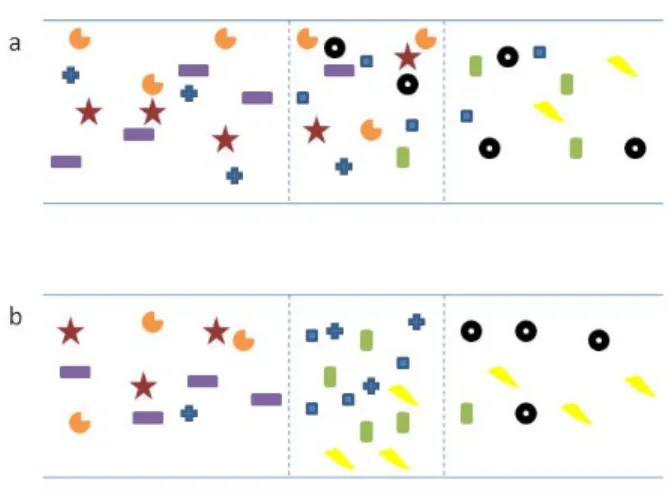
occur, and consequently, the ecotone has more species by virtue of being a blending or mixing zone. Secondly, ecotones could possess unique environmental conditions that are favorable to a certain group of species generally not found in the adjacent communities. Such species, here called ecotonal species, will either only be present at the ecotone, or will reach peak abundance there, increasing diversity within the ecotone.
Figure 1.1: Two hypothetical transects across a boundary showing higher diversity within the ecotone zone (within dashed lines). a) illustrates additive blending, in which the species within 2 communities coexist within the ecotone. b) illustrates ecotonal species, in which species achieve higher abundance within the ecotone.
Additive blending
11
higher than in the centers of the biomes (Risser 1995). In this sense, ecotones can be thought of as “biodiversity crossroads”: places where multiple species ranges overlap. At these crossroads, species habitats can be patchier and have higher heterogeneity, thus leading to more species per unit area (Nekola and White 1999, Risser 1995). At the landscape scale, ecotones may have representatives from both communities as well as from other patch types. For example, a forest edge might have interior forest species, field species, as well as shade intolerant species from nearby edges.
Not all studies support the occurrence of higher richness through additive blending. Firstly, the zone of blending could also be a death trap for some species that are not able to withstand marginal conditions. Here, ecotones serve as population sinks (Woodroffe and Ginsberg1998). At large biogeographical scales, some species in the ecotone are near the edges of their ranges, and it is likely that their fitness is lower than it is nearer to the range center with the consequence that survival is lower relative to establishment (Temple 1998). At a smaller scale, edge effects can reduce fitness of species adapted to the primary patch conditions. Populations of species near the edges of their ranges are often sink populations that require subsidies of dispersing immigrants. This reasoning follows the previously mentioned ecotone concept of van der Maarel (1990), who suggested lower richness at ecotones because of environmental fluctuations making the region unfavorable for plant growth; thus leading to lower species richness. Although the additive blending type of diversity enhancement makes intuitive sense, there is not a lot of observational evidence supporting its occurrence.
12
Richness could be higher at ecotones if there are many species particularly or uniquely suited to the conditions there. Numerous species have been reported as being ecotone specialists. For example, Weakley (2006) lists 60 species native to the Southeastern United States as occurring predominately in ecotones.
Ecotonal species would be expected to occur if environmental conditions in ecotones were intermediate between those of the adjacent communities and there were species adapted to these conditions (Jose et al. 1996). They may also occur if there are unique environmental conditions at the ecotone or if species need resources from both sides of the ecotone.
Ecotonal species can be detected by finding those species reaching peak abundance or frequency in the ecotone (Walker et al. 2003).
Ecotonal species are commonly reported in sharp, anthropogenically defined ecotones between forests and fields; edges where the composition of the edge zone differs from the core areas. Baker and Dillon (2000) were the first to characterize species along patch interior to field gradient as being edge-restricted, edge-oriented, interior-restricted, or ubiquitous. Edge-restricted and edge-oriented species are typically easily dispersed, or else they would not successfully disperse to these small areas of habitat. Consistent with this prediction, Boutin et al. (2002) found higher numbers of more transient species in
13
1951, Watkins et al. 2003, Burke and Nol 1998, Fraver 1994, but see Williams- Linera 1990). Note, however, that Walker et al. (2003) found that even though they identified ecotonal species, there was no ecotone in their study in which the number of species reaching their maximum in the ecotone was greater than expected at random.
Mechanism/Pattern Additive Blending Ecotonal Species
Environmental Heterogeneity Higher species packing at the ecotone Unique environmental conditions
present is conducive to a set of uniquely adapted species
Spatial Mass Effect Seedlings from neighboring
communities establish at the ecotone
Seedlings from neighboring ecotones establish at the ecotone of interest
Animal Densities Animals increase pollination success
and dispersal of species from adjoining communities
Animals bring in propagules from nearby ecotones
Exotics Exotics from neighboring
communities establish at the ecotone
Exotics specifically predicted to be more successfully at ecotones
Hybridization Genes from adjacent communities
forming hybrids at the ecotone
New species evolve at ecotone
Table 1.1: Ecological mechanisms that might influence diversity patterns at ecotones.
Mechanisms causing enhanced diversity
As described above, enhanced richness in ecotones can take the form of taxa from both core areas overlapping, leading to additive blending, or can derive from ecotonal species relatively unique to the boundary zone. Below, I describe some of the ecological mechanisms that could lead to these two types of enhanced diversity at ecotones (also, see Table 1.1).
14
Ecotones have unique environmental and structural characteristics that may
contribute to higher species richness (Risser 1995, Gosz 1992). For example, riparian zones, the transition between aquatic and terrestrial communities, are characterized by a diversity of soil types, physiognomic classes and moisture conditions. Reservoir and lake shores also have high topographic diversity, leading to higher recruitment and diversity than either the benthic or upland communities (Harper and Macdonald 2001). This high microenvironmental diversity provides more niches, leading to higher species numbers.
If single species’ distributions are constrained to fewer microhabitats of smaller size, more species will be able to pack into the ecotones. The response of one species to
environmental factors is amplified or attenuated across the transition zone. Conditions will be marginal for some species and species occurrences will be more sensitive to environmental heterogeneity, resulting in small-scale mosaicity (Gosz 1992; Anand and Li 2001). This is termed the mosaic effect: habitats divided into smaller patches near ecotones. However, these microsites are highly sensitive to change and disturbance, which could lead to higher
mortality and thus lower richness (Gosz 1992, Hansen et al. 1998; Neilson et al. 1992). Environmental heterogeneity could lead to diversity through additive blending if species are more tightly packed in the ecotone, but still occur on either adjacent community. If the environment at the ecotone is unique, new species might occur there, causing higher diversity via ecotonal species.
Spatial mass effect
15
propagules into an area where the species is not able to form a self-sustaining population (Shmida and Ellner 1984). Clearly the degree of dispersal and resultant propagule pressure is key to the importance of mass effect. Seeds may gather at forest edges, for example, because the wind speed may change at a transition, depositing airborne propagules. Seeds in
transition zones and edges may have higher chance of germination than seeds in the forest due to lower predation pressure (Sork 1983). Some studies have found more species represented in ecotone seed banks, although they did not examine seed germination (Landenberger and McGraw 2004; Devlaeminck et al. 2005).
Although spatial mass effect can be important, the variation in its importance with ecotone type and setting is little known. At least one study of natural ecotones, found little evidence for spatial mass effect at edges (Walker et al. 2003). More studies are needed to document the importance of spatial mass effects in driving ecotone diversity.
Animal densities
Animal-abundance has the potential to influence additive blending at ecotones in numerous ways. For example, anthropogenic edges often have higher numbers of animal pollinators and seed dispersers (Burgess et al. 2005), which increase dispersal rates and viability at edges. An example is higher diversity of fleshy-fruited, bird-dispersed species at edges (Kollmann and Schneider 1999). Mammals, another dispersal agent, also show higher richness in edges (Pasitschniak-Arts and Messier 1998, Gates 1991).
16
not others. Pfeiffer et al. (2003) found particularly high ant species richness in the ecotone between steppe and dessert in Mongolia. Animal species richness, like plant species richness, appears to be dependent on the ecotone’s ecological properties.
Higher animal densities could also lead to more herbivory and actually lower plant species richness. For example, the rings around sagebrush stands in chaparral are caused by an interaction of herbivory and allelopathy (Swank and Oechel. 1991).
Exotic species
Exotic plant species have been purported to occur disproportionately in ecotones and thus fit the pattern of ecotone specialists, (Fox et al. 1997, Lloyd et al. 2000, Watkins 2003). Ecotones can be marginal environments for the species in adjacent communities. As many exotic species tend to be generalists, they would be expected to be at a higher abundance within the boundary zone (Allen and Knight 1984), at least in the absence of a seed source for ecotone specialists. In addition, ecotones, being of smaller spatial extent than their adjacent communities, would favor well dispersed species such as exotics. However, this higher exotic species richness may be due to the exclusion of native species richness, leading to the same or lower richness. Matlack (1994) found an opposite effect at anthropogenic edges: they were not consistently more species rich nor did they serve as entry points for ruderals or invasives. Walker et al. (2003) also found that exotics were not significantly higher at
ecotones than in two adjoining communities. Thus, there is not yet strong evidence that the prevalence of exotics at ecotones makes a significant contribution to species richness, and it is clear that there are many circumstances where exotics do not contribute to the ecotonal diversity pattern.
17
The juxtaposition of species from different habitats at an ecotone has the potential to lead to hybridization. These hybrids may be better adapted to the intermediate conditions present at an ecotone, and may persist, increasing species richness by creating new ecotonal species. This has been shown to occur in a few isolated cases such as hybrids between Iris fulva and hexagona (Arnold 1994), between two subspecies of Artemesia tridentata (Wang et al. 1997) and between Eucalpyus melanophloia and E. creba (Drake 1980). However, these are isolated cases only involving 1-2 species. Hybridization’s influence on diversity at any single ecotone appears to be insignificant.
Ecotone properties that confound diversity
Although many authors have asserted that there is often higher species richness at ecotones, the literature I have reviewed above leads to the conclusion that enhanced species richness at ecotones is not a universal property, but rather results from the particular
ecological condition at the site, as well as properties of the surrounding landscape. In addition there are other factors related to measurement methods that can also bias such research results. Below, I present four major factors that directly influence the outcome of any experiment, observational study or model investigating patterns of richness at ecotones.
Type of ecotone
Causal factors provide the most conventional method for categorizing ecotones. Wilson et al. (unpublished), list 6 types of ecotone: environmental, switch, threshold,
18
(Dangerfield et al. 2003). At a biome scale, sharp changes in climate are a major factor while at the patch level, it could be soil moisture or geologic discontinuity. The switch ecotone is caused or maintained by a positive feedback loop that sharpens a gradual environmental change (Wilson and Agnew 1992). At the community scale these can include plant root growth inhibiting grasses from invading a floodplain forest or sphagnum moss lowering the pH of soil and thereby excluding competitors (Odum 1990), whereas at the biome scale the change in albido between tundra and boreal forest leads to a switch ecotone. Threshold ecotones represent a sharp biotic response to a gradual environmental gradient (Lloyd et al. 2000, Risser 1995) such as the point along an elevation gradient where trees can no longer compete with shrubs and grasses. Anthropogenic ecotones are caused and maintained by human disturbance. Human disturbance often causes sharp, easily observable ecotones: forest-field edges, road cuts, and powerline right of ways. Community coadaptation ecotones assume stable, climax communities with coevolved species on either side. Lastly, invasion ecotones occur at the front of a dominant invading species.
It should be noted that the forces forming an ecotone may not necessarily be the ones maintaining it; the ecotone may be relict or contemporary (Strayer et al. 2003). For example, an anthropogenic ecotone may be caused by plowing but maintained by a switch based on certain animals avoiding the field. To further complicate matters, it is often the case that multiple causes contribute to the formation of an ecotone. For example, edaphic patterns may cause the formation of boundaries, but physical disturbance can alter boundary location (Wiens et al. 1985).
19
lack of a strong taxonomy of ecotones, general difficulties determining ecotone causation in the field, and shifting causation patterns, as discussed above. Still, some studies do suggest that the type of ecotone is an important factor in generation of diversity patterns (Walker et al. 2003, Lloyd et al. 2000). More studies are needed that explicitly link causation with ecotone richness.
Age
Another factor influencing richness at boundaries is age and stability. Boundaries that fluctuate in space and time are predicted to have lower richness than stable, long-term
boundaries (Delcourt and Delcourt 1992). Ecotones that are stable over long periods of time have had more opportunities for dispersal and colonization of ecotone specialists (Gosz 1992). Boundaries can also become shaper or more diffuse over time. For example, forest edges may become less permeable over time and reinforce their own boundaries while others may disappear if they are dependent on constant disturbance. Studying ecotones of different ages without consideration of the effect of age will preclude separation of ecotone and age effects.
Sharpness
20
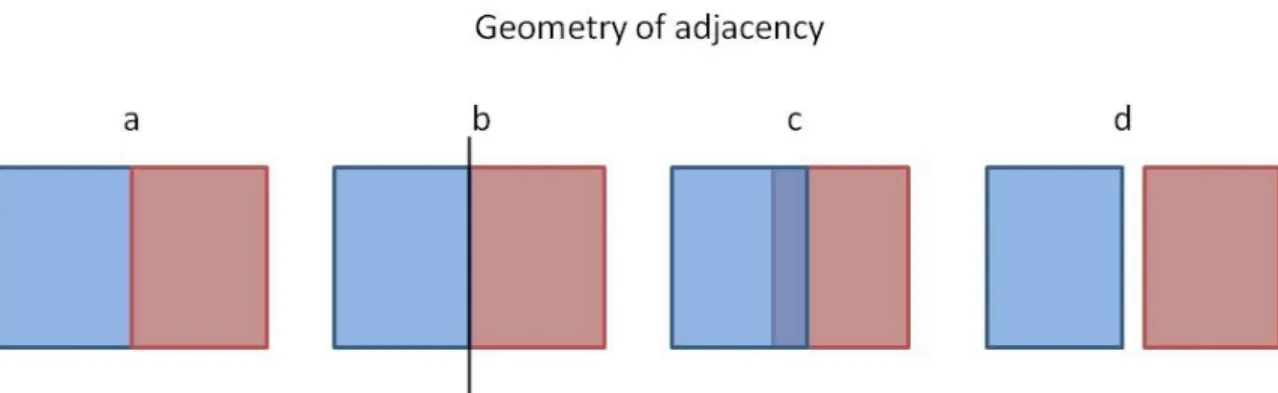
ecotonal species to colonize this zone and richness will increase (Figure 1.2d). An example of this is shown in human-created edges where north- and south-facing edges have different widths and therefore may harbor different numbers of species, (Fraver 1994).
Figure 1.2: Four types of geometry of adjacency adapted from Strayer et al. 2003: a) A boundary between two adjoining patches; b) A boundary formed by a distinct structure; c) a boundary between two overlapping patches; d) a boundary between two disjunct patches.
User-defined factors
When designing an ecological study, there are a number of decisions that need to be made regarding the study area and sampling methods. Below, I give examples of how these sampling decisions might affect results of studies at ecotones.
21
Ecotones can be defined at many spatial scales, with the decision dependent on the system and question of interest. Gosz (1993) described five levels of spatial extent and the environmental gradients most influential at each: 1. biome level: climate and topography; 2. landscape level: local weather, topography and soil; 3. patch level: the movement of vectors, species interactions, microclimate and microtopography; 4. population level: interspecies interactions, physiological controls, population genetics and microtopography; and 5. individual level: influenced by soil and physiology. The first three of these are appropriate for study of ecotones, whereas the last two are not particularly relevant. Each of the three scales of ecotones will have different causation, and thus different properties, making it difficult to draw parallels between ecotones measured at different spatial extents.
Along with spatial extent, the spatial grain size used during sampling will influence perception of ecotone richness. Although ecotone detection itself may not depend on spatial grain size (Walker et al. 2003), patterns of richness are scale dependent. Strayer et al. (2003) argue that as different grain sizes are used in observation, the perception of the same physical structure will change. As an extreme example, the grain size has to be smaller than the width of the ecotone itself, or the patterns may be meaningless. When the sample area includes not only the ecotone but the two adjacent communities, species richness will be higher as it will combine taxa from both core community types. At each grain size smaller than this, the ecotone may or may not have higher diversity per unit area, depending upon size of
22
individual might fit into that area. Transect designs need to take individual size into consideration to capture an accurate picture of diversity.
Patterns of species richness at ecotones might be relatively scale-independent. Stowe et al. (2003) did find that species richness at a Nothofagus treeline is scale independent. Still, there has not been much focus on studying the pattern of richness of ecotones at multiple scales of grain or extent, and species richness cannot simply be assumed to be scale independent (Lloyd et al. 2000).
2. Taxonomic group
Although some suspect that animal species respond to vegetation patterns in the same manner that vegetation responds to environmental gradients ( Risser 1995), there is evidence showing marked incongruity in the richness patterns between different taxonomic groups (Dangerfield et al. 2003). The taxonomic range investigated (sea birds vs. all birds vs. all vertebrates) will also affect the results. Sisk and Battin (2002) found that bird responses to anthropogenic edges tended to vary noticeably among families and among edge types so that no simple pattern emerged regarding diversity for birds as a whole. Likewise, Rusek (1992) found that microfaunal soil organisms show an increase in diversity at the ecotone, but the same is not true for soil mesofauna. Life history traits, range size and demographic
characteristics of the species group of interest will influence the patterns of diversity exhibited at ecotones. For example, if an ecotone is characterized by small-scale
heterogeneity, it may be more likely to affect richness for invertebrates, which are more sensitive to microtopography, and less likely to affect the diversity of vertebrates.
23
Recommendations for future studies of ecotone diversity
There are many factors that influence diversity patterns at ecotones, making it
difficult to tease out diversity patterns and possible underlying mechanisms. In this section, I describe three types of study ecotones, as well as research questions that should to be
answered in order to better understand the patterns and processes occurring at each.
Ecoregional ecotones
An ecotone separating two ecoregions is influenced mostly by climatic and topographic change and its boundary often follows gradients on soil, topographic, and climatic maps. The ecoregion itself is defined by an observable change in vegetation
associations. Richness patterns will be influenced by two competing mechanisms: increasing environmental heterogeneity at the ecotone, which will increase diversity, and lower fitness of species at the limits of their ranges, which will lower diversity. Thus, to study diversity at ecotonal boundaries, one needs to integrate range maps, data on species occurrences, and environmental data in order to answer several critical questions. 1) Is there higher
environmental heterogeneity near the ecotone? 2) If so, does vegetation respond directly to this heterogeneity? 3) Do species range limits coincide with the ecoregion boundary? 4)Is there is a higher number of species per unit area at the ecotone than in either ecoregion. Richness patterns for other taxa may or may not follow the same pattern; larger predators, for example, may respond to an ecoregion boundary very much influenced by a sharp elevation gradient but may not respond to an ecoregion boundary influenced by an edaphic gradient.
24
An anthropogenic ecotone separating a forest and a field is caused primarily by human disturbance. Secondarily, the change in species composition is caused by soil moisture differences, light gradients, microtopography, microclimate, and the movement of dispersal vectors. There may be ecotonal species enjoying the unique edge environment. There may be additive blending of forest and field species (i.e., field species occurring in the forest and forest species occurring in the field, as a result of spatial mass effect). An opposing force is the possibility of high mortality if the ecotone represents a marginal environment for many species. To study diversity at forest/field boundaries, one should investigate species turnover at the edge, measure dispersal and establishment at the ecotone, and collect information on multiple environmental gradients. Pertinent diversity related research questions include the following. Are there specific ecotonal species at this edge, or an
additive blending of field and forest individuals? Do invasive species significantly contribute to edge diversity? Does the species turnover occur at the same location as environmental turnover? How does width of edge influence diversity?
Upland-wetland boundaries
An upland-wetland boundary is primarily caused by a gradual environmental
25
species supplied by high propagule pressure from water transport, and ecotonal species adapted to a specific elevation zone, such as ecotonal species adapted to strong fluctuations in moisture at a water boundary. Important questions here include the following: How does ecotone stability relate to diversity? Is ecotone diversity at wetland ecotones scale
dependent? And, does vegetation change at wetland boundaries respond directly to changes in soil moisture, or is there a threshold effect causing the turnover to be higher than
expected?
Discussion and Conclusions
The question of whether diversity is higher at ecotones is complicated by numerous factors. The simple answer is “sometimes”, but a more complete answer takes into account ecotone cause, sharpness, stability, landscape position, as well as user-defined factors such as taxa of interest and sampling techniques. It is not sufficient to describe the patterns of species turnover at an ecotone; one must think about the underlying causes of that turnover, how species are responding to the environment and the relative distributions of these species along the gradient.
26 References
Allen, E.B. and Knight, D.H. 1984. The effects of introduced annuals on secondary succession in sagebrush-grassland, Wyoming. Southwestern Naturalist 29: 407-421.
Anand, M and Li, B.L. 2001. Spatiotemporal dynamics in a transition zone: patchiness, scale, and an emergent property. Community Ecology 2: 161-169.
Arnold, M.L. 1994. Natural hybridization and Louisiana irises. Bioscience 44: 141-147.
Backeus, I. 1993. Ecotone versus ecocline: Vegetation zonation and dynamics around a small reservoir in Tanzania. Journal of Biogeography 20: 209-218.
Baker, W.L. and Dillon, G.K. 2000. Plant and vegetation responses to edges in the Southern Rocky Mountains. In Forest Fragmentation in the Southern Rocky Mountains. Ed. Knight, R.L., Smith, F.W., Buskirk, S.W., Romme, W.H. and W.L. Baker. University Press of Colorado, Boulder.
Boutin, C., Jobin, B., Belanger, L.U.C. and Choiniere, L. 2002. Plant diversity in three types of hedgerows adjacent to cropfields. Biodiversity and Conservation 11:1-25.
Brothers, T.S. 1993. Fragmentation and edge effects in central Indiana old-growth forests. Natural Areas Journal 13:268-275.
Burgess, V.J., Kelly, D., Robertson, A.W. and Ladley, J.J. 2005. Positive effects of forest edges on plant reproduction: literature review and a case study of bee visitation to flowers of Peraxilla tetrapetala (Loranthaceae). New Zealand Journal of Ecology 30(2): 179-190.
Burk, C.J. 1977. A four year analysis of vegetation following an oil spill in a freshwater marsh. Journal of Applied Ecology 14:515-522.
Burke, D.M. and Nol, E. 1998. Edge and fragment size effects on the vegetation of deciduous forests in Ontario, Canada. Natural Areas Journal 18: 45-53.
Carter, V., Gammon, P.T. and Garrett, M.K. 1994. Ecotone dynamics and boundary determination in the Great Dismal Swamp. Ecological Applications 4:189-203. Chapman, V.J. 1960. Salt marshes and salt deserts of the world. Leonard Hill, London.
27
Delcourt, P.A. and Delcourt, H.R.1992. Ecotone dynamics in space and time. In Landscape Boundaries: Consequences for biotic diversity and ecological flows. Ed. A. J. Hansen and F. di Castri, 19-54.
Devlaeminck, R., Bossuyt, B. and Hermy, M. 2005. Inflow of seeds through the forest edge: evidence from seed bank and vegetation patterns. Plant Ecology 176: 1-17.
Drake, D.W. 1980. Contrasting success of natural hybridisation in two Eucalyptus species pairs. Australian Journal of Botany. 28:167-191.
Fagan, W.F., Fortin, M.J. and Soykan, C. 2003. Integrating edge detection and dynamic modeling in quantitative analyses of ecological boundaries. Bioscience 53:730-738. Fox, B.J., Taylor, J. E., Fox, M.D. and Williams, C. 1997. Vegetation changes across edges
of rainforest remnants. Biological Conservation 82:1-13.
Fraver, S. 1994. Vegetation responses along edge-to-interior gradients in the mixed
hardwood forests of the Roanoke River Basin, North Carolina. Conservation Biology 8: 822-832.
Gates, J.E. 1991. Powerline corridors, edge effects, and wildlife in forested landscapes of the central Appalacians. In: Rodiek, J.E. & Bolen, J.E. (eds), Wildlife and habitats in managed landscapes. Island Press, Washington, pp. 13-32.
Gosz, J.R. 1992. Gradient analysis of ecological change in time and space: Implications for forest management. Ecological Applications 2(3):248-261.
Gosz J.R. 1993. Ecotone Hierarchies. Ecological Applications 3: 369-376.
Gysel, L.W. 1951 . Borders and openings of beech-maple woodlands in southern Michigan. Journal of Forestry 49:13-19.
Hansen, A.J., di Castri, F. and Naiman, R.J. 1988 . Ecotones: what and why? Biology International special issue 17 [A new look at ecotones: Emerging international projects on landscape boundaries]: 9-46.
Harper, K.A. 1995 . Effect of expanding clones of Gaylussacia baccata (black huckleberry) on species composition in sandplain grassland on Nantucket Island, Massachusetts. Bulletin of the Torrey Botanical Club:122, 124-133.
Harper, K. A. and Macdonald, S.E. 2001. Structure and composition of riparian boreal forest: New methods for analyzing edge influence. Ecology 82:649-659.
28
Kernaghan, G. and Harper, K.A. 2001. Community structure of ectomycorrhizal fungi across an alpine/subalpine ecotone. Ecography 24:181-188.
Kirkman, L.K., Drew, M.B., West, L.T. and Blood, E.R. 1998. Ecotone characterization between upland longleaf pine/wiregrass stands and seasonally-ponded isolated wetlands. Wetlands 18:346-364.
Kollmann, J. and Schneider, B. 1999. Landscape structure and diversity of fleshy-fruited species at forest edges. Plant Ecology 144:37-48.
Landenberger, R.E. and McGraw, J.B. 2004. Seed-bank characteristics in mixed-mesophytic forest clearcuts and edges: Does ''edge effect'' extend to the seed bank? Canadian Journal of Botany 82:992-1000.
Laurance W.F., Lovejoy T.E., Vasconcelos H.L., Bruna E.M., Didham R.K., Stouffer P.C., Gascon C., Bierregaard R.O., Laurance S.G. and Sampaio, E. 2002. Ecosystem decay of Amazonian forest fragments: a 22-Year investigation. Conservation Biology 16:605-618.
Leopold, A. 1933. Game management. Charles Schribner’s Sons. New York.
Lloyd, K.M., Mcqueen, A.A.M., Lee, B.J., Wilson, R.C.B., Walker, S. and Wilson, J.B. 2000. Evidence on ecotone concepts from switch, environmental and anthropogenic ecotones. Journal of Vegetation Science 11: 903-910.
Maarel, E. van der. 1990. Ecotones and ecoclines are different. Journal of Vegetation Science 1:135-138.
Matlack G.R. 1994.Vegetation dynamics of the forest edge-Trends in space and successional time. Journal of Ecology 82: 113-123.
Meszaros, I. 1990. Spatial changes in herb layer in a beech forest / clear-cut area ecotone from northern Hungary. In: Spatial processes in plant communities (Eds: Krahulec, F., Agnew, A.D.Q., Agnew, S. and Willems, J.H.). SPB Academic.The Hague: 59-69.
Meiners, S.J., Handel, S.N., and Pickett, S.T.A. 2000.Tree seedling establishment under insect herbivory: edge effects and interannual variation. Plant Ecology 151:161-170. Neilson, R.P., King, G.A., DeVelice, R.L. and Lenihan, J.M. 1992 . Regional and local
vegetation patterns: the responses of vegetation diversity to subcontinental air masses. In: Landscape Boundaries: Consequences for Biotic Diversity and Ecological Flows (Ed. by A.J. Hansen and F. di Castri), pp. 129-149. Springer-Verlag, New York.
Nekola, J.C. and White, P.S. 1999. The Distance decay of similarity in biogeography and ecology. Journal of Biogeography 26(4): 867-878.
29
Odum, W.E. 1990. Internal processes influencing the maintenance of ecotones: Do they exist? In The Ecology and Management of Aquatic-Terrestrial Ecotones. Ed. RJ. Naiman and Decamps, H. United Nations Educations, Scientific and Cultural Organization. Paris, France.
Pasitschniak-Arts M. and F. Messier. 1998. Effects of edges and habitats on small mammals in a prairie ecosystem. Canadian Journal of Zoology 76:2020-2025.
Petts, G.E. 1990 . The role of ecotones in aquatic landscape management. In: The Ecology and management of aquatic-terrestrial ecotones (Ed. by R.J. Naiman and H. Décamps), pp. 227-261. UNESCO, Paris.
Pfeiffer, M., Chimedregzen, L. and Ulykpan, K. 2003. Community organization and species richness of ants (Hymenoptera/Formicidae) in Mongolia along an ecological gradient from steppe to Gobi desert. Journal of Biogeography 30:1921-1935.
Prous, X., Ferreira, R.L., and Martins, R.P. 2004.Ecotone delimitation: Epigean-hypogean transition in cave ecosystems. Austral Ecology 29:374-382.
Risser, P.R. 1995. The Status of the science examining ecotones - A Dynamic aspect of landscape is the area of steep gradients between more homogeneous vegetation associations. Bioscience 45(5):318-325.
Rusek, J. 1992. Distribution and dynamics of soil organisms across ecotones. In Landscape Boundaries: Consequences for Biotic Diversity and Ecological Flow. Ed. A.J. Hansen and F. di Castri. Springer-Verlag, New York.
Shmida, A. and Ellner, S. 1984. Coexistence of plant species with similar niches. Vegetatio 58: 29-55.
Shmida, A. and Wilson, M.V. 1985 . Biological determinants of species diversity. Journal of Biogeography 12:1-20.
Sisk, T.D and Battin, J. 2002. Habitat edges and avian ecology: Geographic patterns and insights for western landscapes. Studies in Avian Biology: 30-48.
Sork, V.L.1983. Distribution of Pignut Hickory (Carya glabra) along a forest to edge transect, and factors affecting seedling recruitment. Bulletin of the Torrey Botanical Club 110: 494-506.
Stowe, C.J., Kissling,W.D., Ohlemuller, R. and Wilson, J.B. 2003. Are ecotone properties scale-dependent? A test from a Nothofagus treeline in southern New Zealand. Community Ecology 4:35-42.
30
Swank, S.E. and W.C. Oechel. 1991. Interactions Among the Effects of Herbivory,
Competition, and Resource Limitation on Chaparral Herbs. Ecology 72(1): 104-115. Temple, S.A. 1998. Surviving where ecosystems meet: Ecotonal animal communities of
Midwestern Oak Savannas and Woodlands. Transactions of the Wisconsin Academy of Sciences Arts and Letters 86:207-222.
Terrell-Nield, C.E. 1986. Ecotones and community boundaries: analysis by pitfall trapping. Field Studies. 6:407-428.
Turton, S.M. and Duff, G.A. 1992 . Light environments and floristic composition across an open forest-rainforest boundary in northeastern Queensland. Australian Journal of Ecology 17:415-423.
Walker, S.,Wilson, J. B.,Steel, J. B.,Rapson, G. L.,Smith, B.,King, W. M. and Cottam, Y.H. 2003. Properties of ecotones: Evidence from five ecotones objectively determined from a coastal vegetation gradient. Journal of Vegetation Science 14(4): 579-590.
Wang, H., McArthur, E.D., Sanderson, S.C., Graham, J.H. and Freeman, D.C.1997. Narrow hybrid zone between two subspecies of big sagebrush (Artemisia tridentata: Asteraceae . 4. Reciprocal transplant experiments. Evolution 51:95-102.
Watkins, R.Z., Chen, J.Q., Pickens, J. and Brosofske, K.D. 2003. Effects of forest roads on understory plants in a managed hardwood landscape. Conservation Biology 17:411-419.
Weakley, A. 2006. Flora of the Carolinas, Virginia, and Georgia and Surrounding Areas, working draft of August 2006. University of North Carolina Herbarium, N.C. Botanical Garden, Chapel Hill, NC.
Wiens, J.A., Crawford, C.S. and Gosz, J.R. 1985. Boundary dynamics: A conceptual framework for studying landscape ecosystems. Oikos 45: 421-427.
Wiens, J.A. 1992 . What is landscape ecology, really? Landscape Ecology 7:149-150.
Williams-Linera, G. 1990.Vegetation structure and environmental conditions of forest edges in Panama. Journal of Ecology 78:356-373.
Wilson, J.B. and Agnew, A.D.Q. 1992. Positive feedback switches in plan communities. Advances in Ecological Research 23:263-336.
Wolf, J.H.D. 1993. Diversity patterns and biomass of epiphytic bryophytes and lichens along an altitudinal gradient in the northern Andes. Annals of the Missouri Botanical Garden 80:928-960.
Chapter 2: SPECIES TURNOVER AT COMMUNITY LEVEL
ECOTONES: AN EXPLORATORY ANALYSIS OF DETERMINANTS
OF DIVERSITY
Introduction
Disturbance events are often responsible for creating and maintaining ecotones. They may reinforce existing boundaries, as in the case of a fire strengthening a pocosin/savannah boundary. Disturbance may create a new ecotone, as in the case of a mown field/forest boundary. Regardless of whether a disturbance is natural or human-created, we can predict that the immediate effects of an intense disturbance on an ecotone and adjoining disturbed communities will be loss of species richness, lower numbers of ecotonal species and increased sharpness. As time passes, we would expect to see an increase in richness,
evidence of mass effect as propagules become established and higher numbers of exotics as they establish at the boundary.
32
planet has a different species pool, disturbance regime, landscape position, age, and sharpness.
In this chapter I look at species diversity patterns across a series of disturbance-maintained edges that are similar in species composition, climate and topographic position so that I may specifically focus on the mechanisms causing species richness at these edges. These edges differ only in age (0-3 years), sharpness and aspect. This design allowed me to address the following research questions:
1. Is species richness consistently higher at these edge ecotones? Ecotones are often cited as zones of high diversity, and there is no reason to believe at the onset that forest edges are an exception (Leopold 1986, Petts 1990, Risser 1995). Species richness at ecotones is thought to be directly related to their stability (Delcourt and Delcourt 1992). A stable ecotone will have allowed species to disperse to and establish at the boundary between two
communities. In contrast, an ecotone that has been very recently disturbed is not predicted to have higher richness than adjacent communities as more time is needed for species to arrive. It is unknown, however, whether an ecotone may rebound from the event faster than
adjoining disturbed communities.
2. What are the relative contributions of additive blending and ecotonal species to the species composition at these edges? Are the species present in the ecotone zone the same as the species in adjacent communities or are there species that are unique to the edge
environment. In this paper, I define ecotonal species as those that are exclusive to the ecotone, rather than those that just reach peak abundance there.
33
the degree of this turnover may occur over hundreds of meters or just a few. I predict that the abruptness of change at an ecotone will be higher at recently disturbed ecotones, where many of the forest species that might have been established in the field will have been lost. Sharper, younger ecotones should have few species, and north-facing ecotones will have more species due to a more gradual light and temperature gradient throughout the day.
4. Are there more exotic species in these edge ecotones than in adjacent
communities? Exotic species may be more prevalent at anthropogenic ecotones (Allen and Knight 1984). Exotics tend to be generalists, making them suited for the heterogeneous and often marginal environment that ecotones provide.
Methods
Study site
The Mason Farm Biological Preserve of the North Carolina Botanical Garden, Chapel Hill, NC, provides a patchwork of stands representing various successional stages. The preserve, located in the outer Piedmont of North Carolina, is maintained for botanical and wildlife protection and diversity, as well as to provide research and recreational
34
shrublands were eliminated from this study as their disturbance history was unknown. Some fields were not sampled because of an existing hedgerow or a mixed mowing pattern.
35
36 Plot Date
Sampled
Plot Location
Time since last
Disturbance
Type Aspect UTM E UTM N
1 18-Apr-07 Mid Outer 2006 Mown 274 678993 3973426
2 08-May-07 Mid Inner 2004 Burned 190 679132 3973303
3 21-Jun-07 West Outer 2004 Burned 130 678956 3973222
4 02-Jul-07 South Inner 2005 Mown 194 678940 3972840
5 04-Jul-07 Mid Outer 2006 Mown 100 678984 3973352
6 13-Jul-07 West Inner 2006 Mown 254 678990 3973183
7 21-Jul-07 Mid Inner 2004 Mown 8 679089 3973306
8 24-Jul-07 South Outer
2006 Burned 100 678900 3972747
9 26-Jul-07 West Outer 2004 Burned 64 678880 3973092
10 23-Aug-07 South Inner 2005 Mown 289 679026 3972774
11 30-Aug-07 South Inner 2005 Mown 210 679035 3972822
12 03-Sep-07 South Outer
2006 Burned 316 679030 3972636
13 06-Sep-07 South Outer
2006 Burned 30 678987 3972651
14 12-Sep-07 West Outer 2004 Burned 108 678882 3973154
15 13-Sep-07 Mid Outer 2006 Mown 216 678997 3973495
16 18-Sep-07 West Inner 2007 Mown 315 678991 3973095
17 19-Sep-07 West Inner 2007 Mown 334 678933 3973035
Table 2.1: Characteristics of the 17 ecotone transects. Plot location indicates whether the plot was within the nature trail loop or outside of it.
Sampling
The sampling protocol is adapted from Walker et al. (2003) and Peet et al. (1998). Prior to sampling, the protocol was tested across a diverse set of ecotones in the Francis Marion National Forest, S.C., Croatan National Forest, N.C. and Pea Island, N.C. I recorded transects across pocosin/pine savannah ecotones as well as across two salt marsh types. These sample data were then used to test the rigorousness of the approach used.
37
approximately 45 meters in length and was subdivided into 45 contiguous, 1x10 meter belts arrayed perpendicular to the transect. Each belt was further subdivided into a 1x1 m block (Level 1), an overlapping 1x4 m block (Level 4) and the overall 1x10 m block (Level 10) (Figure 2.2). Subblocks of 0.5 meters have given similar results to 1 meter subblocks in previous studies (Walker et al. 2003). The subblock size also makes it easy to lump into larger blocks for determining scale dependent properties. For the purposes of this study, only the 1x10 belt size was used, as this provided the least amount of noise and resulted in the most robust ecotone boundary positions, as described below.
38
Figure 2.2: Transect layout. The area between the purple lines corresponds to a hypothetical ecotone zone.
Ecotone Detection
39
One approach to ecotone detection is to find the location of the highest rate of change in species spatial co-occurrence (Fortin et al. 2000). The first detection method employed was the traditional moving split-window technique: blocking sampling points along a gradient into windows, splitting the window into two groups, finding the difference between groups, while moving the window along the gradient and finally finding the location(s) of the largest differences within a window (Whittaker 1960).
The moving split-window technique in some cases has been superseded by computationally intensive lattice and triangulation wombling methods that are especially appropriate for two dimensional sampling (not just a linear gradient) (Fortin et al 2000). Some suggest a multivariate split moving window is superior to newer techniques (Ludwig and Cornelius 1987). One can also define the midpoint of the boundary as the position of maximum rate of change in ordination scores along a length of a transect (Walker et al. 2003). This rate of change technique is argued to be more appropriate because ecotones are zones of rapid change rather than points of instantaneous change. Using the Walker et al. 2003 technique, sharpness in composition can be determined by ordination scores of individual subblocks, averaged along each meter of the transect.
40
of the ecotone, as well as the locations of the upper and lower boundaries. To do this, the Axis 1 scores from the NMS ordination were plotted against position along the transect. The first derivative of this plot determined the point of maximum change in vegetation
41
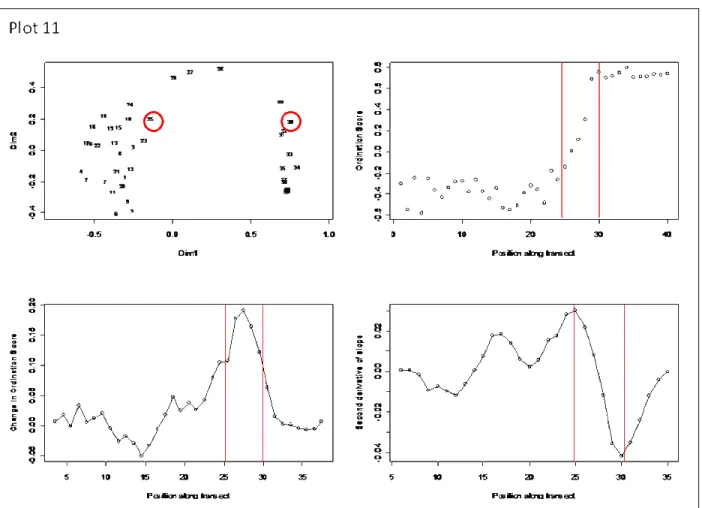
Figure 2.3: The moving window approach to ecotone delineation illustrated using transect 11. The top left graph shows the NMS ordination, treating every belt of the transect as an ordination “plot”. The red circles and lines indicate the boundaries of the ecotone. This transect started in the forest and ended in the field. The top right graph is the plot of the belt location along the transect against the Axis 1 ordination score. The bottom left graph is the first derivative of the top right graph, the peak indicating a high rate of change in the
ordination score. The bottom right graph is the second derivative of the top right graph. The maximum and minimum points on this graph determine the ecotone boundaries.
42
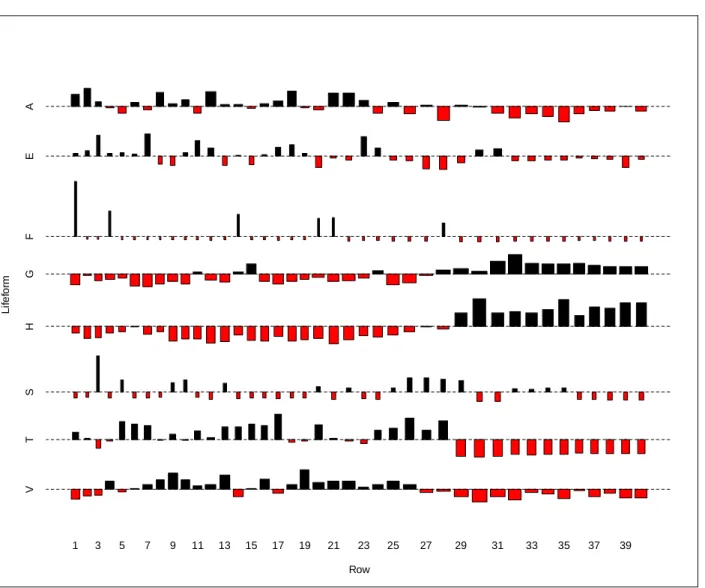
this approach. The moving window approach tells us that the ecotone boundaries in that plot were between positions 25 and 32.
1 3 5 7 9 11 13 15 17 19 21 23 25 27 29 31 33 35 37 39
V
T
S
H
G
F
E
A
Row
L
if
e
fo
rm
Figure 2.4: Lifeform change along transect 17. Lifeform codes are A=Sapling, E=Seedling, F=Fern, G=Graminoid, H=Herb, S=Shrub, T=Tree, V=Vine. In this association plot, the area of each box is proportional to its deviation from the expected values when the lifeform variables are assumed to be independent from each other. Red boxes indicate that the lifeform is less frequent than expected, while black indicates that it is more.
Statistical Analysis
43
using Kruskal’s Non-metric Multidimensional Scaling. The matrix used in the ordination was formed using the vegdist function in the VEGAN package (Oksanen et al. 2007), which uses the Jaccard similarity index. The first ordination was performed using only the forest data for all 17 transects. The purpose of this ordination was to explore the ecological differences between sites as a possible factor in our results. This ordination was performed using presence/absence data, using the Biodiversity R NMSRandom function (Kindt and Coe 2005), which displays the ordination with the lowest stress value, given an inputted number of permutations. The second round of ordinations was performed on belts within each transect, as part of the ecotone detection method, using species abundance data (Figure 2.3).These ordinations were performed using the isoMDS function (MASS package,
Venables and Ripley 2002), also using distance values from the vegdist function included in the VEGAN package.
44 Results
Species Richness
45 Plot Ecotone
Start Point Ecotone End point Length of Ecotone Total Species in the Forest Total Species in the Ecotone Total Species in the Field Average Forest Average Ecotone Average Field Average Highest
1 25 35 10 47 43 40 11.68 16.45 20.31 Field *
2 15 24 9 50 57 51 16.00 24.90 22.93 Ecotone
3 21 25 4 59 47 43 19.14 28.00 23.62
Ecotone *
4 16 27 11 37 58 51 16.63 22.83 23.93 Field
5 23 28 5 32 39 52 11.43 14.66 25.08 Field *
6 24 30 6 44 54 43 13.67 24.86 23.73 Ecotone
7 21 30 9 50 57 45 17.14 24.20 24.82 Field
8 24 29 5 49 29 42 11.79 12.00 21.55 Field *
9 23 34 11 34 50 25 9.73 14.00 13.71 Ecotone
10 30 35 5 61 26 14 17.33 9.66 5.33 Forest
11 25 30 5 38 38 36 12.16 17.50 20.09 Field
12 23 34 11 43 66 36 16.65 27.00 23.00
Ecotone *
13 20 31 11 37 50 39 10.40 17.50 26.25 Field *
14 26 34 8 37 38 32 7.69 14.44 14.57 Field
15 26 32 6 37 35 28 9.77 16.29 15.44 Ecotone
16 27 32 5 42 41 26 9.11 17.50 12.44
Ecotone *
17 25 32 7 45 51 40 14.52 28.13 22.56
Ecotone *
Table 2.2: Species richness relative to transect position. For each transect, the ecotone zone length, the total number of unique species found in each zone, and the average number of species per meter in each zone is reported.
46
0 10 20 30 40 50
1
0
2
0
Distance along Transect (Forest to Field)
S p e c ie s p e r ro w
0 10 20 30 40
1 0 2 0 3 0
Distance along Transect (Forest to Field)
S p e c ie s p e r ro w
0 5 10 15 20 25 30 35
1 5 2 0 2 5 3 0
Distance along Transect (Forest to Field)
S p e c ie s p e r ro w
0 10 20 30 40
1
5
2
5
Distance along Transect (Forest to Field)
S p e c ie s p e r ro w
0 10 20 30 40
1
0
2
0
Distance along Transect (Forest to Field)
S p e c ie s p e r ro w
0 10 20 30 40
1 0 2 0 3 0
Distance along Transect (Forest to Field)
S p e c ie s p e r ro w
0 10 20 30 40
1 0 2 0 3 0
Distance along Transect (Forest to Field)
S p e c ie s p e r ro w
0 10 20 30 40
5
1
0
2
0
Distance along Transect (Forest to Field)
S p e c ie s p e r ro w
0 10 20 30 40
5 1 0 1 5 2 0
Distance along Transect (Forest to Field)
S p e c ie s p e r ro w
0 10 20 30 40
5
1
5
2
5
Distance along Transect (Forest to Field)
S p e c ie s p e r ro w
0 10 20 30 40
1
0
2
0
Distance along Transect (Forest to Field)
S p e c ie s p e r ro w
0 10 20 30 40
1 5 2 5 3 5
Distance along Transect (Forest to Field)
S p e c ie s p e r ro w
0 10 20 30
5
1
5
2
5
Distance along Transect (Forest to Field)
S p e c ie s p e r ro w
0 10 20 30 40
5
1
5
Distance along Transect (Forest to Field)
S p e c ie s p e r ro w
0 10 20 30 40
6 1 0 1 4 1 8
Distance along Transect (Forest to Field)
S p e c ie s p e r ro w
0 10 20 30 40
5 1 0 1 5 2 0
Distance along Transect (Forest to Field)
S p e c ie s p e r ro w
0 10 20 30 40
1 0 2 0 3 0
Distance along Transect (Forest to Field)
S p e c ie s p e r ro w
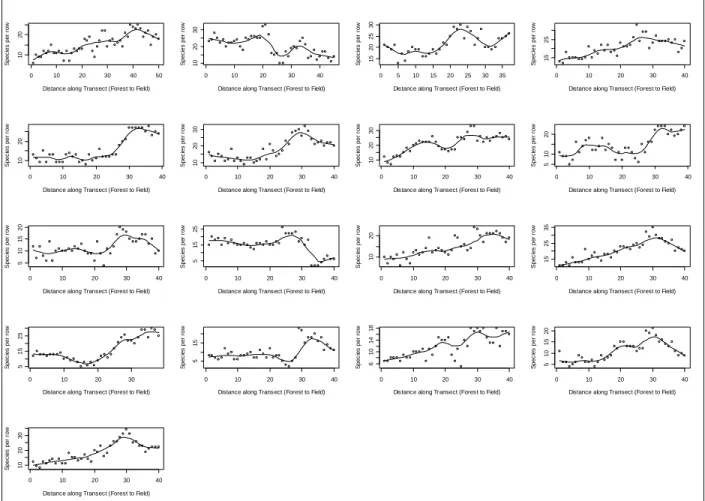
Figure 2.5: Number of species per meter along each transect (1-17 in order). Lines show a lowess smoothing function, f=0.25.
Ecotonal Species
All transects had at least 1 and up to 16 ecotonal species (Table 2.3). Species
considered ecotonal in more than one transect include: Quercus phellos, Ligustrum sinense, Cornus florida, Sisyrinchium albidum, Rhus copallinum, Festuca obtusa, Potentilla
47
correlation with age, it is interesting to note that Plot 9, which had not been disturbed for 3 years, had the highest number of ecotonal species.
Transect Number of Ecotonal Species
Species
1 2 MIMUALA QUERPHE
2 1 LIGUSIN
3 2 AMBRART CARYGLA 4 4 CERCCAN CORNFLO LACT1S1 SISYALB 5 4 ASPLPLA ELYMVIR HYPEPRO QUERPHE 6 5 ALLIVIN OENOFSS PENSLAE PHYSVRG PTILCAP 7 5 HYPEHYP LIGUSIN POLYACS RHUSCOP TRACDIF 8 2 FESTOBT GNAPOBT 9 16 POTECND ROSAMUL QUERFLC ROSAMUL SCUTINT SISYALB SMILBON TRIPDAC VITICINB LESPBCL OXALDIL PINUTAE CAREDIG CORNFLO DIOSVIR EUPAHYS FESTOBT
10 1 SOLACAR
11 3 CYPE1S1 PINUECH RUMECRI 12 8 ASTEPIL EUPASER HYPEHYP HYPEPUN HYPEVRG JUNCEFF QUERMCH SYMPPAT
13 6 ERIGANN JUNIVIR OXALDIL PIPTAVE PYRRCAR QUERSTE 14 4 ANDRVIR JUNCBIF OENOFSS POTECND
15 2 CHAMNIC MELALIN 16 4 ALBIJUL QUERFLC RHUSCOP RUMEACE
17 1 OXALDIL
Table 2.3: Ecotonal Species found on each transect within the ecotone zone. Highlighted species were found on more than one transect.
Ecotone Sharpness
p-48
value = 0.7005) or aspect (cor=0.3230495, t = 1.3221, df = 15, p-value = 0.2060). There was no correlation between length of the ecotone and species richness at the ecotone (cor= 0.182722, t = 0.7198, df = 15, p-value = 0.4827) nor whether highest species richness was found in the field or ecotone. However, the number of ecotonal species was significantly correlated with length of ecotone (cor=0.5305421, t = 2.4241, df = 15, p-value = 0.02845), which one might expect from normal species-area relationships.
Exotic Species
For most of the transects there were not more exotics species at the ecotone (Table 2.4). In 16 of 17 transects, theaverage number of exotics was either highest in the field, or not significantly different from the number in the ecotone. Similarly, the percentage of all
49 Transect % Forest
Species that are Exotic % Ecotone Species which are Exotic % Field Species that are Exotic Mean Number of Exotics in Forest Mean Number of Exotics in Ecotone Mean Number of Exotics in Field
1 10.88% 15.76% 28.99% 1.28* 2.64 6.13*
2 9.04% 17.60% 23.63% 1.45* 4.4 5.47
3 10.64% 13.51% 11.40% 2.05* 4 2.69*
4 16.48% 17.15% 27.46% 2.75 3.92 6.57*
5 2.28% 9.09% 12.29% 0.26* 1.33 3.08*
6 9.45% 13.71% 21.46% 1.29* 3.43 5.09*
7 14.40% 17.77% 17.22% 2.48* 4.3 4.27
8 1.41% 11.11% 23.21% 0.17* 1.33 5.00*
9 1.33% 19.64% 32.29% 0.13* 2.75 4.43*
10 15.13% 20.69% 28.13% 2.63 2 1.5
11 8.22% 9.43% 21.62% 1 1.67 4.36*
12 21.15% 21.91% 31.06% 3.52* 5.92 7.14*
13 11.54% 20.37% 26.42% 1.2* 3.67 7*
14 3.50% 19.23% 35.29% 0.27* 2.78 5.14*
15 18.75% 28.95% 33.81% 1.85* 4.71 5.2
16 4.86% 13.33% 16.96% 0.44* 2.33 2.1
17 6.34% 14.22% 18.23% 0.92* 4 4.11
Table 2.4: Percentages and average numbers of exotic species in the forest, ecotone and field sections of each transect. Asterisks indicate that the average number of exotics in the forest or field was significantly different from that in the ecotone.
Transect Position
50
previous analyses, site hydrology was taken into consideration, labeling transects 3, 10, 12, 13 and 15 as mesic sites and the remainder as upland sites. However, mesic sites did not show evidence of a wider ecotone (r=-0.03, p=0.9), did not have significantly more total species at the ecotone 0.08, p=0.75), nor did they have more ecotone-specific species (r=-0.08, p=0.76).
-4 -2 0 2 4 6
-2
0
2
4
6
NMS Axis 1
N M S A x is 2 1 2 3 4 5 6 7 8 9 10 11 12 13 14 15 16 17 AESCSYL CARE1S2 CARECPH CARYGLA CARYOVT CYPEOVA DICH1S2 ILEXOPA JUNCEFF LYSICIL OXALDIL OXALVIO PINUECH PLATOCC POTECND QUERRUB QUERSTE SISYALB SOLI1S1 SYMPPAT VIOL1S1
Figure 2.6: Nonmetric multidimensional scaling ordination of the 17 transects- Indicator
51 Discussion and Conclusions
Species richness was not consistently higher at these edges, although species per meter did appear to peak at the ecotone in most plots (Figure 2.5). This contradicts the results of studies that have specifically focused on the abundance of ecotonal species (Gysel 1951, Watkins et al. 2003, Burke and Nol 1998), though many studies have found a result similar to mine of overall intermediate species richness ((Harper 1995; Turton and Duff 1992). There are a few potential biotic explanations for my result. The first is that the field zone had
species with small individual size with the consequence that more individuals, and therefore species, were able to pack into a single belt of a transect than in the forest or ecotone. The fields had high numbers of small ruderal species, which were adapted to the drier, sunnier conditions there. Species could also be poorly adapted to the edge conditions, as they are not stable nor do they represent optimal conditions for species adapted either to cooler forest condition or the sunnier field condition.
A visual interpretation of the species per 1x10 meter plots reveals that species
richness does eventually decrease as one travels further into the field. Some of the fields had a surprisingly homogenous mixture of species once one was far enough from the edge.