Daver
Cuneyt Kahvecioglu
A dissertation submitted to the faculty of the University of North Carolina at Chapel Hill
in partial fulfillment of the requirements for the degree of Doctor of Philosophy in the
Department of Economics
Chapel Hill
2006
Approved by
Advisor: David Blau
Reader: Tom Mroz
Reader: Donna Gilleskie
2006
Daver Cuneyt Kahvecioglu
DAVER CUNEYT KAHVECIOGLU:
Two Essays on Life Cycle Models
(Under the direction of David Blau)
This dissertation consists of two essays. In “A Life-Cycle Model: Retirement, Savings, and Portfolio
Allocation”, I analyze the interrelationships among retirement, saving, and asset allocation. I show that optimal
portfolio allocation can be very sensitive to plans about retirement timing and to the presence and characteristics
of Social Security. I also show how portfolio decisions have impact on when to retire. In order to take into
account these important effects, Social Security reform proposals should be evaluated with models that
incorporate portfolio choice.
In the second essay, “Asset Allocation, Bequests, and Wealth Dynamics of the Elderly”, I build and estimate a
life cycle model of asset allocation and saving with a fixed cost of stock market entry, medical expenditure risk,
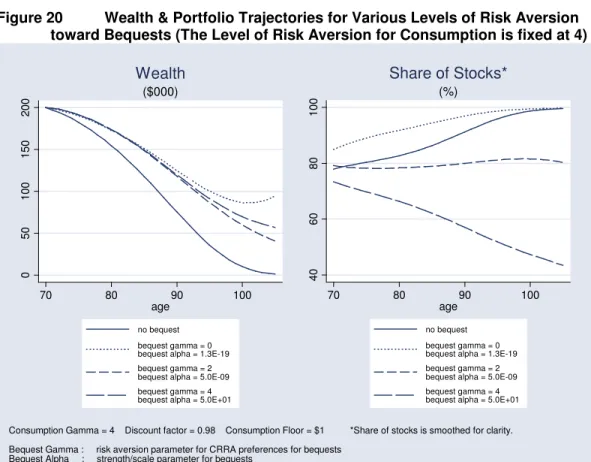
and a general bequest function that captures risk preferences over bequests. The estimates imply that there is no
operative bequest motive, and that medical expenditure risk is a very strong motivation for saving at older ages.
Even though the model explains reasonably well both the observed average age profiles and the heterogeneity in
saving and portfolio allocation, the cross-equation restrictions that are required for internal consistency are
strongly rejected. This is mainly due to the fact that, in constant relative risk aversion utility, a single parameter
- coefficient of relative risk aversion - governs both wealth and portfolio paths. While a very high level of risk
aversion is required to explain portfolio choices, a very low level of risk aversion is required to explain wealth
dynamics. Despite its internal inconsistency, the model is one of the richest versions of the standard model and I
use the estimates to do some policy simulations with caution. I used the estimates to simulate the impact of
reducing the Social Security benefit of a 70-year old female retiree by a specific amount, and giving her a lump
sum equal to the expected present discounted value of the benefit cut, which is to be invested in her individual
account. I find that this reform would be undesirable. Main reason behind this is that, most retirees are either
To mom and dad, Melahat and Sabri Kahvecioglu...
I have been very lucky to be around some excellent faculty at the University of North Carolina. I am indebted to
David Blau for his encouragement and excellent guidance and advice. I have also benefited tremendously from
discussions with Wilbert van der Klaauw over the years. For helpful comments and discussions, I thank Donna
Gilleskie, Tom Mroz, Helen Tauchen, and Eric Renault. Ron Gallant provided crucial help on the estimation
technique whenever I needed. Mike Hurd has been very helpful in refining my dissertation topic.
I would also like to express my appreciation to Information Technology Services of UNC for maintaining and
administering UNC’s excellent high-performance computing infrastructure. I especially want to thank Shubin
List of Figures...ix
Chapter I: A Life Cycle Model: Retirement, Savings, and Portfolio Allocation...1
1 Introduction...2
2 Literature Review... 3
3 Theoretical Model...6
3.1 Solving the Model...10
4 Simulations... 14
4.1 Simulations without Social Security...16
4.1.1 Retirement...18
4.1.2 Consumption and Assets...20
4.1.3 Portfolio Allocation... 21
4.1.4 Behavior of Groups of Various Retirement Ages...22
4.2 Simulations with Social Security... 27
5 Analyzing the Solution in More Detail... 29
6 Conclusion... 42
Chapter II: Asset Allocation, Bequests, and Wealth Dynamics of the Elderly... 43
1 Introduction...44
2 The Model... 48
2.1 For Retirees Who Have Already Paid the Entry Cost...48
2.2 For Retirees Who Have Not Paid the Entry Cost... 50
2.3 Preferences and Asset Returns...51
2.4 Out-of-Pocket Medical Expenditure... 52
4 Data... 57
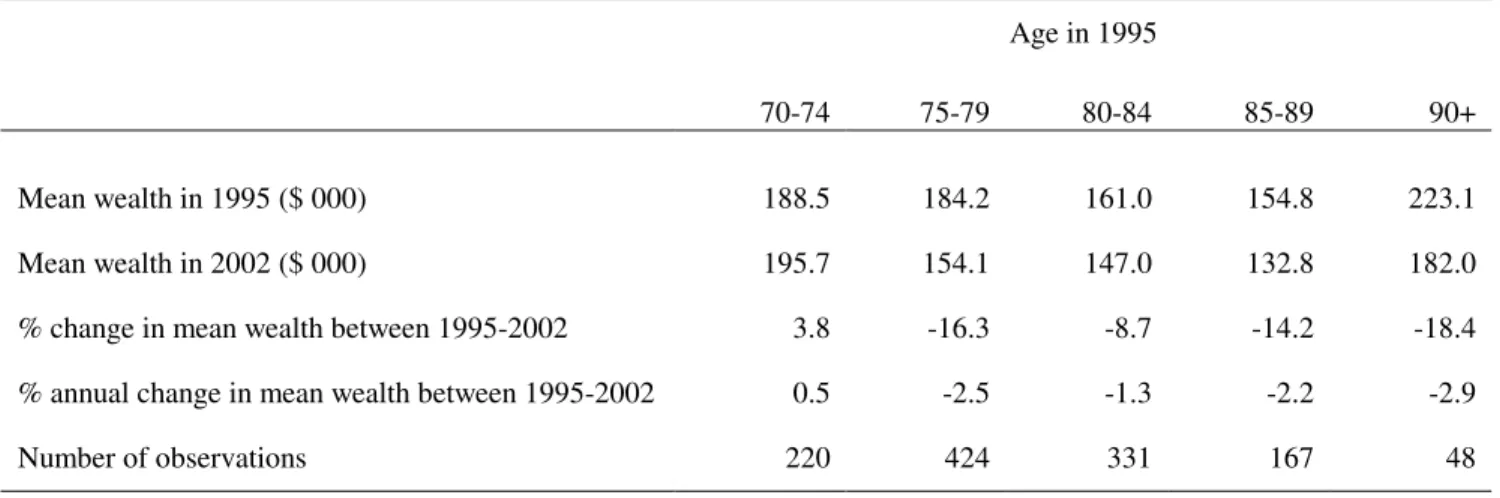
4.1 Are the Assets of the Elderly “Melting Down”?... 59
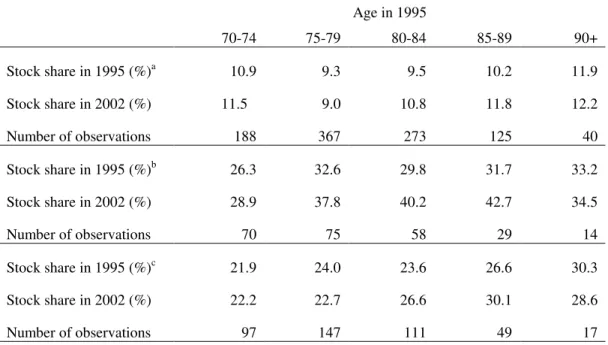
4.2 How Do the Stock Shares Vary with Age?...60
4.3 Stock Returns... 61
5 Estimation... 62
5.1 Prorating Predicted Variables... 65
6 Results...66
6.1 Risk Aversion and Discount Factor... 66
6.2 Fixed Stock Market Entry Cost... 69
6.3 Is There A Bequest Motive?... 70
6.4 Behavioral Implications of Medical Expenditure... 71
6.5 Model's Fit... 72
6.6 Policy Simulations... 73
6.1.1 No Access to the Private Annuity Market... 74
6.1.2 Private Annuity Market Is Available... 76
7 Conclusions...76
Appendix...97
Table 1 How the Simulation Is Done...16
Table 2 Timing of Retirement without Social Security... 19
Table 3 Timing of Retirement with Social Security... 27
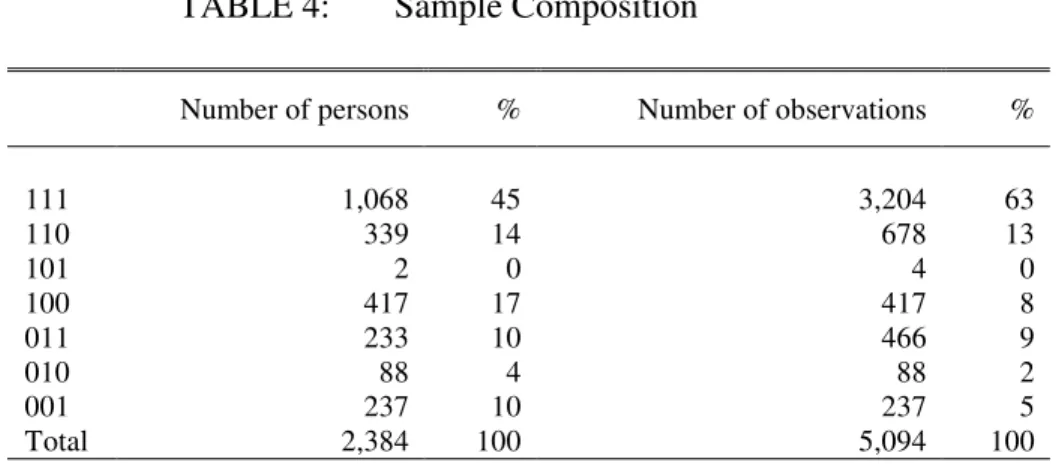
Table 4 Sample Composition...79
Table 5 Selected Averages for Successive Panels of the AHEAD Data... 79
Table 6 Change in Mean Wealth by Age between 1995 and 2002...80
Table 7 Change in Median Wealth by Age between 1995 and 2002...80
Table 8 Change in Mean Stock Share by Age between 1995 and 2002... 81
Table 9 S&P500 Returns over the Interview Years...81
Table 10 Estimates of the Structural Parameters... 82
Table 11 Welfare Effects of the Social Security Reform on a 70-Year Old Female Retiree Who Has the Median, Mean, and the 90th Percentile Wealth and Income of the Sample... 83
Table 12 Probabilities of Being in the Low, Medium, and High Expenditure Categories... 97
Figure 1 Employment Rate by Age... 19
Figure 2 Average Consumption, Income, and Assets by Age... 20
Figure 3 Average Portfolio Allocation by Age...22
Figure 4 Average Consumption by Age by Groups of Various Retirement Ages... 24
Figure 5 Average Wealth by Age by Groups of Various Retirement Ages...25
Figure 6 Average Incomes by Age by Groups of Various Retirement Ages... 25
Figure 7 Average Returns on Risky Asset Holdings by Age by Groups of Various Retirement Ages...26
Figure 8 Average Portfolio Allocation by Age by Groups of Various Retirement Ages... 26
Figure 9 Average Consumption and Assets by Age with and without Social Security...28
Figure 10 Average Portfolio Allocation by Age with and without Social Security... 29
Figure 11 9th Period Consumption and Value Function vs Cash-on-Hand... 30
Figure 12 9th Period Consumption and Portfolio Allocation vs Cash-on-Hand... 30
Figure 13 8th Period Consumption and Portfolio Allocation... 31
Figure 14 7th Period Consumption and Portfolio Allocation... 31
Figure 15 Probability of Next Period Employment vs Cash-on-Hand in Period 9...36
Figure 16 Probability of Next Period Employment at t=9 vs Possible Values of Consumption and Portfolio Allocation... 37
Figure 17 t=9 Value Function as a Function of C and X... 38
Figure 18 Portfolio Allocation vs Cash-on-Hand for Selected Periods... 41
Figure 19 Wealth & Portfolio Trajectories for Various Levels of Risk Aversion when There Are No Bequests... 84
Figure 20 Wealth & Portfolio Trajectories for Various Levels of Risk Aversion toward Bequests (The Level of Risk Aversion for Consumption is fixed at 4)... 84
Figure 21 The Variation in S&P Returns Caused by Having Different Interview Dates for a Given Individual and a Given Wave... 85
Figure 22 AHEAD Field Periods vs. S&P500 Index...85
Figure 23 The Simulated Impact of Bequests for the "Median" Retiree Who Has Already Paid the Stock Market Entry Cost...85
Figure 26 The Simulated Impact of Bequests for the "Median" Retiree Who Has Already Paid the Stock Market Entry Cost...87
Figure 27 The Simulated Impact of Bequests for the "Mean" Retiree Who Has Already Paid the Stock
Market Entry Cost...87
Figure 28 The Simulated Impact of Bequests for the "Wealthy" Retiree Who Has Already Paid the Stock Market Entry Cost...88
Figure 29 The Simulated Impact of Medical Expenses for the "Median" Retiree Who Has Already Paid
the Stock Market Entry Cost...88
Figure 30 The Simulated Impact of Medical Expenses for the "Mean" Retiree Who Has Already Paid
the Stock Market Entry Cost...89
Figure 31 The Simulated Impact of Medical Expenses for the "Wealthy" Retiree Who Has Already Paid the Stock Market Entry Cost...89
Figure 32 The Simulated Impact of Medical Expenses for the "Poor" Retiree Who Has Already Paid
the Stock Market Entry Cost...90
Figure 33 Predicted vs. Actual Mean and Median Wealth for the Estimation Sample by YEAR, AGE,
AND INCOME... 91
Figure 34 Predicted vs. Actual Mean Stock Share for the Estimation Sample by YEAR, AGE,
AND INCOME... 92
Figure 35 Forecasted vs. Actual Mean and Median Wealth for Out-of-Sample Males by
INTERVIEW YEAR, AGE, AND, INCOME...93
Figure 36 Forecasted vs. Actual Mean Stock Share for Out-of-Sample Males by INTERVIEW YEAR,
AGE, AND, INCOME...94
Figure 37 Comparison of the Distributions of Predicted and Actual Conditional Stock Shares... 95
Figure 38 Simulated Impact of the Social Security Reform on the "Median" Retiree Who Has Already
Paid the Entry Cost... 95
Figure 39 Simulated Impact of the Social Security Reform on the "Mean" Retiree Who Has Already
Paid the Entry Cost... 96
Figure 40 Simulated Impact of the Social Security Reform on the "Wealthy" Retiree Who Has Already
1. Introduction
There is a large and growing literature in finance on life-cycle household portfolio allocation. Even
though this literature1 recently acknowledges that labor income may have a big role to play, it ignores the fact
that retirement is a choice and treats it as given. On the other hand, in the economics literature, the portfolio mix
has been treated as given or has been ignored altogether in the models of labor supply and retirement behavior.2
In this paper, I analyze the interrelationships among retirement behavior, savings, and portfolio mix by
modeling these decisions as being made jointly. In particular, I am interested in how the optimal patterns of
life-cycle portfolio allocation are affected by introducing retirement as a choice variable. That information will help
assess the validity of asset allocation advice provided by portfolio managers to the people who are saving for
retirement. Another interesting question that I will explore is whether and to what extent the presence and
characteristics of Social Security affect optimal household portfolio allocations. This is quite important in view
of the current debate about incorporating individual accounts into Social Security. The model proposed in this
paper could be used to analyze the impact of a Social Security reform that introduces individual accounts, while
models that treat the timing of retirement or asset allocation as given would be poorly suited for such an
analysis. Predicting baby boomers' portfolio allocations will also be helpful in forecasting the future trends in
the stock market since they will be holding a significant amount of national wealth.
I have solved and simulated a relatively simple version of the model. I find similar results to the
previous literature when I consider retirement as given. However, if retirement is a choice, I demonstrate that
the model predicts richer and different life-cycle patterns. It is shown that the optimal portfolio allocation can be
very sensitive to expectations about the timing of retirement. Additionally, I show that the presence and
characteristics of Social Security can be very influential on optimal portfolio allocations as well.
1Gomes and Michaelides, 2003; Bertaut and Haliassos, 1997; Cocco, Gomes, and Maenhout, 2001; Svensson 1988; Viceira
2001; Vissing-Jorgensen 1999 to name a few.
2
The rest of the paper is as follows: In section 2, I review the previous work done on the household
life-cycle portfolio allocation. The theoretical model is described in section 3. Model’s solution and its implications
are presented and discussed in the same section. Section 4 concludes.
2. Literature Review
I summarize the relevant literature below. Note that none of the papers discussed here treats retirement,
savings, and portfolio choice as decisions being made jointly.
Addressing the problem of portfolio choice over the life-cycle dates back to the seminal papers,
Samuelson (1969) and Merton (1969). They showed that optimal portfolio allocation is independent of both age
and wealth. The agents in their model should hold a positive fraction of their wealth in risky assets and this ratio
is fixed over the lifetime and over the level of wealth. It is now known that this result is sensitive to the papers'
assumptions (some of them were implicitly assumed in the papers). As explained in Ameriks and Zeldes (2001),
among those assumptions are: (1) asset returns are independently and identically distributed over time, (2)
households have utility functions that exhibit constant relative risk aversion (CRRA) and that are time-invariant
and additively separable over time, (3) markets are frictionless and complete.
There was no labor income in Samuelson's (1969) model. However, without violating any of the above
3 assumptions Merton (1971) adds a labor income process to the model and the qualitative results do not
change. Introduction of labor income to portfolio choice models was somewhat trivial if the following two
conditions are satisfied as in Merton (1971): 1) Labor income is treated as income from traded3 human wealth,
that is investors are allowed to borrow against their human capital. 2) Human wealth is assumed to be nontraded
but traded assets provide perfect hedges against labor income. In other words, investors are able to fully insure
3
their labor income risk. Note that labor supply was not endogenous in Merton (1971). Bodie, Merton and
Samuelson (1991) extend that model by including leisure as a second good and hence endogenizing labor
supply, but they assume that retirement occurs at a fixed age and that households can borrow against their future
labor income. As I will explain below, both of these assumptions are dropped in this dissertation since they are
unrealistic. They focus only on the relationship between labor supply flexibility and portfolio choice.4 They find
that flexibility of labor supply leads to higher shares of the risky asset in the optimal portfolio allocation.
The more recent articles solve for optimal portfolio allocation patterns with at least one of those
assumptions relaxed. Some articles assess whether the observed household behavior is attributable to the more
realistic models. Cocco, Gomez and Maenhout (2001) points out that many households cannot capitalize future
labor income and hence face borrowing constraints due to moral hazard issues. Moreover, they also face
uninsurable labor income risk since explicit insurance markets for labor income risk are not well-developed.
The authors consider a finitely-lived investor facing mortality risk, borrowing and short-sale constraints, and
receiving labor income. The agent can invest in a risky asset or a riskless asset. Using the PSID they estimate
the labor income profile and its risk characteristics and then calibrate and solve numerically for the optimal
portfolio and savings decisions. Stock returns are allowed to be correlated with labor income shocks. They find
that the optimal share of stocks in the portfolio goes down as agents age and as wealth increases, in contrast to
the findings of Samuelson and Merton. This is very similar to my model except in my model retirement is
endogenous. I will show that if I take retirement as given then I obtain similar results as theirs, but treating
retirement as a choice variable changes the monotonicity of the share of risky assets with respect to wealth and
age.
Ameriks and Zeldes (2001) examine the empirical relationship between age and portfolio choice using
new panel data from TIAA-CREF and pooled cross-sectional data from the Surveys of Consumer Finances.
They document significant non-stockownership, wide-ranging heterogeneity in allocation choices, and the
infrequency of active portfolio allocation changes.
4They propose that labor supply flexibility can be measured by the number of adults in the household, or having an
Most of the rest of the literature describing and analyzing the dependency of portfolio allocation on age
has a common motivation: Solving the micro-level equity premium puzzle. There are patterns in data that are
inconsistent with portfolio theory: There is a very sizable fraction of the U.S. population5 that does not hold any
equities. Papers in this literature have added uninsurable labor income (which may or may not be correlated
with asset returns), permanent and temporary wage shocks, non i.i.d. asset returns, borrowing constraints, short
selling constraints, fixed costs for stock market entry, transaction costs for stock trading, and others in attempts
to try to solve the puzzle.
Using data from the PSID and other data sets Vissing-Jorgensen (2002) estimates a dynamic panel data
model of stock market participation and equity share in portfolios controlling for unobserved heterogeneity and
the endogeneity of initial conditions. She focuses on the effects of the first and second moments of
non-financial income and costs of stock market participation on stock market participation and on equity shares in
household portfolios. She finds that both of them contribute to the explanation of the puzzle. She finds evidence
of a positive effect of mean non-financial income on the probability of stock market participation and on the
proportion of wealth invested in stocks conditional on being a participant. Variance of non-financial income is
found to have the opposite effect on those two variables. She also finds evidence of state dependence in the
stock market participation decision, a result that is consistent with the theory that small fixed costs for stock
market entry may deter stockholding. In her study, labor income is treated as given.
Haliassos and Michaelides (2001) show that the puzzle is robust to relaxations of the benchmark
assumptions of Samuelson (1969). They find that assuming that there is a relatively small fixed costs for stock
market participation may help explain the puzzle. They state that such costs can arise from informational
considerations, sign-up fees, and investor inertia.
The timing of retirement, and thus, to some extent, labor income is not given. Households may adjust
their labor supply as events unfold over the life-cycle. Social insurance programs such as Social Security,
5
Disability Insurance, Medicaid, Medicare and the others have the potential to influence savings, retirement
timing, and portfolio choice behavior because they affect the riskiness and amount of current and future income.
Hence it is crucial to model these three decisions jointly. As I will demonstrate in the next section, optimal
portfolio allocation can be very sensitive to plans about retirement timing and to the presence and characteristics
of the Social Security.
3. Theoretical Model
The agent in the model has a finite horizon, T with discrete time t = 1,...,T. Each period corresponds to
one year. The agent dies at T+1 with certainty and there is no risk of death prior to T+1. There is no bequest
motive. Suppose T is 10.
There are three decision variables: Employment, consumption/saving, and portfolio allocation. There is
one risk-free, and one risky asset over which the portfolio decision is made. Wage offers and portfolio returns
are stochastic.
At the beginning of each period, the agent observes the return shock that applies to his assets carried
over from the previous period and so determines his beginning-of-period assets. At the same time he observes
the wage offer for current period employment. He then decides whether to be employed or not, how much to
consume, and if he decides to hold financial assets, what the portfolio allocation is. Note that I do not consider
the hours of work decision. Since there is one risky and one risk-free asset, I define his portfolio decision to be
simply the ratio of his financial wealth held in the risky asset to his total financial wealth.
Choice Variable 1: Employment
=t period in employed not
0
t period in employed
1
Choice Variable 2: Consumption
*
t
A
t
I
t
A
t
C
=
+
−
where Ct is consumption, It is income, At is assets at the beginning of period t,and
A
*
t
is assets at the end of t.Choice Variable 3: Portfolio Allocation
In the following definition, xt is the fraction of financial wealth held in the risky asset. That is a measure of the
riskiness of the portfolio.
* t A t Z t M t Z t Z t x = + =
where Zt = xt At* is the amount of risky asset held and Mt = (1-xt)At* is the amount of risk-free asset held.
RETURNS:
*
1
-t
A
t
R
]
1
-t
x
t
z
)
1
-t
x
(1
t
[r
t
A
4
4
4
4
3
4
4
4
4
2
1
−
+
=
The returns on the risky asset (z) and on the risk-free asset (r) are realized at the beginning of the next period.
θ
t
z
t
z
=
+
2
)
θ
σ
i.i.d.N(0,
~
t
θ
For simplicity, I assume that return shocks and wage shocks are uncorrelated.
INCOME:
If the agent works, he earns labor income that depends on experience. If the agent does not work, he
may be eligible for pension payments that depend on his labor market experience. In the current model, an agent
cannot collect benefits and work simultaneously. Hence income is
t
)B
t
j
(1
t
W
t
j
t
I
=
+
−
where labor income is
W
t
=
β
0
+
β
1
e
t
+
η
t
where et is experience at the beginning of periodt, and ηt ~ i.i.d. N(0,ση2).
Social Security/Pension Income is deterministic and collected only if not employed:
t)
,
t
B(e
t
B
=
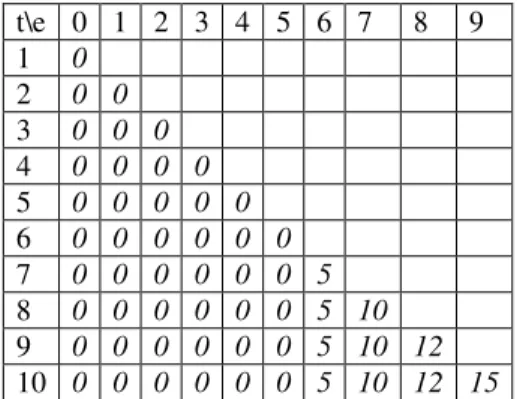
In the simulations, I set B(e,t) = 0 for e<6; B(6,t) = 5, B(7,t) = 10, B(8,t) = 12, and B(9,t) = 15.
Benefits are in $000’s. Note that this schedule is a crude approximation to the Social Security benefit rules by
requiring a minimum number of work periods for any benefit, providing a relatively low benefit for early
retirement (t = 7, e = 6), and increasing benefits with experience beyond the experience required for normal
retirement (t=8, e=7). Social Security taxes are not modeled.
There is a consumption floor
C
, which is provided by welfare programs to guaranteeC
units ofif
A
t
+
I
t
<
C
, then0
*
t
A
C
t
C
=
=
Hubbard, Skinner, Zeldes (1995) show that the presence of means-tested social insurance policies
designed to maintain consumption has a large negative effect on saving for lower-lifetime-income groups.
CONSTRAINTS:
x in [0,1]: no short-selling of the risky asset; no borrowing
⇒ Z ≥ 0, and M ≥ 0.
where Z is the amount of the risky asset and M is the amount of the risk-free asset.
A in the above equations is a given constant. I used A = 0 in my simulations, hence I assume that
individuals start period 1 with no assets.
UTILITY FUNCTION: t 1 0 α 1 jt
jt
(γ
γ
t)j
α
1
C
U
+
+
−
=
−
CRRA with parameter α
Most of the studies use CRRA utility functions including the seminal article of Samuelson in 1969.
Choosing the same type of function facilitates the comparison of my results to the other results documented in
the literature.
C
I
A
For
+
≥
For
A
+
I
<
C
Being employed gives a negative utility to the agent (γ0 < 0), which increases with age (γ1 < 0). Dislike
for work is the reason agents retire in this model. Inclusion of disutility of work provides a motive for the agents
to save: saving for retirement. At some point in time they will choose not to work anymore because of the
disutility of working, and they will save for retirement since they are forward-looking. They will also save some
amount due to precaution and intertemporal substitution.
The utility function is additively separable in utility from consumption and leisure. It is straightforward
to modify the function so that it becomes non-separable.
Agents maximize the expected present discounted value of lifetime utility by choosing j (employment),
C (consumption), and x (portfolio mix) at each period t from 1 to T. They discount the future with the discount
factor δ.
3.1. Solving the Model
The model is solved by backward recursion starting from the last period, T. Since there is no analytic
solution of the model I solve it numerically. There are 3 state variables: t (age), et (beginning-of-period
experience), and COHt (beginning-of-period cash-on-hand). Cash-on-hand is defined as assets plus income
(either labor or non-labor). If both of them were serially correlated, then we would have to have 2 additional
state variables: the wage shock and return shock. As a special case, I also solve the model assuming that there is
no Social Security and that wages do not depend on experience. Then, experience is no longer a state variable.
Starting in period T, going backwards to period 1, the model must be solved at every point in the state
space, that is, for every feasible combination of t, e, COH, and j6. However, since COH is a continuous variable,
6Note that, actually, j is not a state variable, yet it is treated as if it is one. That is done to save computation time. Instead of
looping over beginning-of-period assets and labor income, I only loop over cash-on-hand. The downside is that I have to
I discretize it as COH[n], n = 1,...,N. I partitioned the interval of feasible cash-on-hand into 200 subintervals.
The lower end point of the interval is 0. To calculate the other end point of the grid, I calculate the maximum
possible cash-on-hand. I find this number by assuming that the agent receives the highest wage shock (out of
10,000 draws) at current and all previous periods, then saves it all in the form of risky assets and gets the
highest possible return (out of 10,000 draws) in the current and all previous periods. Then I divide this range
into 200 intervals that are smaller towards the lower end but get larger towards the upper end.
It is very unlikely that the agents will have cash-on-hand that is close to the maximum possible one. Hence the
grid is set in such a way that there are more intervals close to the left end point, 0, that is, the grid is coarser
toward the end. Whenever I need to calculate the value of a variable (for example, value function) at some COH
value, which is not at one of COH grid points, I use interpolation.
Period T:
In the last period, the model is solved at every point in the state space (that is, for all feasible
combinations of t, e, n, and j). Since there is no bequest and the agent is going to die at the end of this period
with certainty, there is neither a savings nor portfolio decision to make. Optimal consumption equals
cash-on-hand.
Period T-1:
For each e, n, and j we calculate the consumption and portfolio mix that maximizes the value function:
)]}
(
max
[
)
(
{
max
)
,
(
1 1 1] 1 , 0 [ ] , 0 [ 1 1 1 1 1 1 1 T j T j T T j T x I A C j
T
e
n
U
C
E
U
C
V
T T T T T T T T − − − ∈∈ + −=
−+
− − − − −δ
where,}
,
max{
A
I
C
C
T
=
T
+
T
,A
T=
[
r
T(
1
−
x
T−1)
+
z
Tx
T−1]
A
T*−1,T
T
T
T
T
j
W
j
B
I
=
+
(
1
−
)
,A
T
*
−
1
=
A
T
−
1
+
I
T
−
1
−
C
T
−
1
.The last term in the above optimization expression is the discounted expected value of last period value
function in T-1. It is,
θ
η
θ
η
d
d
f
V
V
E
V
E
T
j
T
T
j
j
T
j
T
T
T
TT T
T
∫∫
=
=
−
−
1
1
max
max
{
}
(
,
)
where f(.,.) is a joint probability density function. This integral is evaluated using monte carlo simulation.
T
j
T
V
is a function of the period-T shocks, and the previous period consumption and portfolio mix decisions.Once those decisions are made, we know the value of end-of-period assets that is carried over to period T. Then
for a number of random draws from the distributions of wage and return shocks, we can calculate the amount
available for consumption. Since agents consume all cash-on-hand in period T, we calculate the period-T-value
function by plugging cash-on-hand in place of C. Averaging over all of the random draws of shocks, we obtain
an approximation of the expected value of the period-T-value function. As the number of draws increases, the
approximation converges to the true value.
The above algorithm is applied for an equally partitioned two-dimensional grid of consumption and
portfolio mix values. 7 Then we search for the pair for which the T-1 value function is maximized. Hence, we
obtain optimal consumption and portfolio decisions for each point in (eT-1 ,nT-1 ,jT-1 ) space. I also calculate the
percentage saved (variable sper) out of cash-on-hand using the consumption values. The variable sper will be
7
used in order to interpolate for consumption during simulation. The results are saved to be used in period T-2
calculations and in simulations.
Although in similar studies the number of draws used in evaluating integrals is less than 100, I used
10,000 draws. Particularly, the portfolio decision is very sensitive to the number of draws used. There were
substantial differences between the portfolio allocation solutions (not consumption or employment solutions)
when I used 100, 1,000, or 10,000 draws.
Periods T-k, k = 2, … ,T-1:
As in period T-1, for each e, n, and j we calculate the consumption and portfolio mix that maximizes
the value function:
)]}
1
(
1
1
1
max
[
)
(
{
]
1
,
0
[
]
,
0
[
max
)
,
(
−
−
+
+
−
+
+
−
−
+
−
−
−
∈
−
−
+
−
∈
−
=
−
−
T
k
C
T
k
j
k
T
V
k
T
j
k
T
E
k
T
C
k
j
k
T
U
k
T
x
k
T
I
k
T
A
k
T
C
n
e
k
T
j
k
T
V
δ
In contrast to value function calculations in T-1, for periods T-k, k>1, we do not readily know what the
next period optimal choices are given current period optimal choices. In period T-1, next period is the last
period, and we already know that optimal consumption is all of cash-on-hand and there is no portfolio allocation
decision. In periods T-2 and earlier, however, we do not know the next period optimal decision for all the
possible current period decisions. We have calculated and saved only a grid of them. We use an interpolation
algorithm to find the values that are not on the grid points but somewhere in between. For the value function
(especially for power utility functions), an interpolation algorithm based on weighted geometric mean proves to
be “accurate”. For given trial values of consumption and X in T-k, I first find the cash-on-hand available in the
next period. Then find the subinterval that includes this value. Then I interpolate for the value of the value
function at this point by using the already calculated and saved function values at the end points of this interval.
I have tried a number of interpolation algorithms, and found out that this is most appropriate. This method is
better than interpolation based on weighted arithmetic means because for power utility functions it can be
shown that the absolute error for weighted geometric mean is always smaller than the one for weighted
arithmetic mean. I have tried all the interpolation routines in the IMSL package and found out that none of them
are “true” enough to the shape of this kind of utility function.
4. Simulations
Simulation of the solution of the model will be useful to get a sense of what kind of behavior the
agents exhibit during their life courses. Analyzing the solution at each period separately will of course reveal
the most amount of information about the model, but this is more tedious. So I left analyzing the solution to the
next section. In this section, I only focus on the simulation of the solution keeping in mind that we get a limited
insight into the model but a good overview of the model. I present 2 sets of simulation results: One without
Social Security and one with Social Security. In the simulations, I tried to choose all the parameters in a way
such that we have a chance to observe the roles played by the main features of the model.
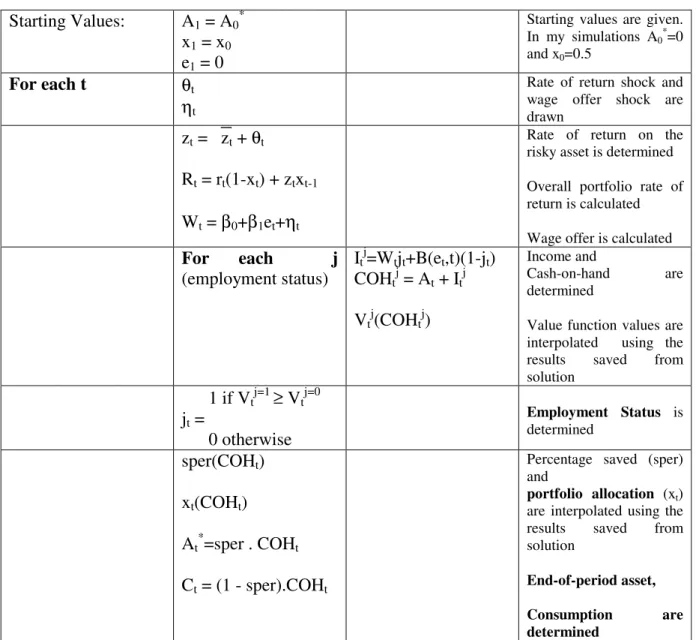
Using the solution that is described above, the model is simulated for 10,000 agents who are identical
at the beginning of the first period. I describe and explain the solution path for the decision variables over the
life cycle.
During simulation, for the values of state variables that fall somewhere in between the grid points that
were used in the solution, appropriate interpolation methods are used. First, given the beginning-of-period
assets, return shock, and wage offer, cash-on-hand is calculated for both for employment and non-employment.
Value functions are calculated for both values of employment. I use the same weighted geometric average
interpolation algorithm that I used in the solution. Then, the employment value that gives a higher value to the
optimal sper, i.e. percentage saved out of cash-on-hand) and portfolio decisions were calculated for the grid of
all feasible cash-on-hand values. The sper value corresponding to the closest point on the cash-on-hand grid is
the interpolated sper. As will be explained later, true sper may display “jumps” at some cash-on-hand values.
Those jumps are important (they are presented and explained below) and by interpolating sper using the simple
scheme described above we preserve the jumps. Had I used a weighted average of the 2 closest points, I may
have undermined the size of the jumps. We do not need to worry about the size of the error this method causes
because sper is smooth except at those “jump” points, I use a fine grid, and using percentages instead of values
already has a smoothing effect. Given sper, we calculate optimal consumption. To find the interpolated
portfolio mix, we find the portfolio mix value corresponding to the closest point on the cash-on-hand grid. That
value is assigned as the optimal portfolio mix. The same method is applied in calculating the probabilities of
future employment sequences.
Table 1: How the Simulation Is Done
Starting Values:
A
1= A
0*x
1= x
0e
1= 0
Starting values are given. In my simulations A0
*
=0 and x0=0.5
For each t
θ
tη
tRate of return shock and wage offer shock are drawn
z
t=
z
t+
θ
tR
t= r
t(1-x
t) + z
tx
t-1W
t=
β
0+
β
1e
t+
η
tRate of return on the risky asset is determined
Overall portfolio rate of return is calculated
Wage offer is calculated
For
each
j
(employment status)
I
tj=W
tj
t+B(e
t,t)(1-j
t)
COH
tj= A
t+ I
tjV
tj(COH
tj)
Income and
Cash-on-hand are determined
Value function values are interpolated using the results saved from solution
1 if V
tj=1≥
V
tj=0j
t=
0 otherwise
Employment Status is determined
sper(COH
t)
x
t(COH
t)
A
t*=sper . COH
tC
t= (1 - sper).COH
tPercentage saved (sper) and
portfolio allocation (xt)
are interpolated using the results saved from solution
End-of-period asset,
Consumption are determined
4.1. Simulations without Social Security
Horizon: T = 10
Constant relative risk aversion parameter: α = 4
Consumption floor: C = 1 (this is set to a very small value in order to concentrate on understanding how the
model works without the complication that the consumption floor introduces.)
Wage function: β0 = 20, β1 = 0, ση= 1 (Average wage is $20,000, wages do not depend on experience, and the
standard deviation of wages is $1,000. I am modeling the decisions of 50+ year olds and since their
wage-experience profile should be relatively flat β1=0 is not a bad assumption. Besides, I get rid of one state variable
(experience) in the case where there is no social security since nothing depends on experience.)
Disutility of work: γ0 = -0.0004, γ1 = -0.00002 (These values are selected to be able to see realistic life-cycle
patterns among the agents. If these were too high in absolute value, then the agent would work only if he
receives an unrealistically big wage shock. In this case almost of them will be on welfare. On the other hand, if
these were too low in absolute value then almost all of the agents would work all the time.)
Risky asset returns: z = 1.04, σθ= 0.2 (hence, most of the time: z is in [0.54,1.54]. There were a total of
100,000 draws in the simulations (t=10)x10,000, and the maximum realized asset return was 186% and the
minimum realized asset return was –85%.
Risk-free asset return: r = 1.03 (The values selected for the asset returns are somewhat atypical compared to the
similar studies. Usually the average rate of return is taken to be around 8% for the risky asset and around 2% for
risk-free asset. I have chosen the returns of these assets to be unrealistically close to each other. Had I chosen
them to be further away from each other almost all the agents would be investing 100% of their portfolios in the
risky asset with such a low value for the constant relative risk aversion parameter (4). That is the equity
premium puzzle. I get similar "puzzling" results if I set the equity premium high. Since analyzing life-cycle
patterns for portfolio allocation is the main objective of this study, I set the means of the two assets to be close
to each other.
Number of points in the cash-on-hand grid: 200
Since I have searched for the optimum for consumption and portfolio allocation in an equally partitioned grid
(201 grid points for consumption in the interval (0,Cash-on-hand], and 101 grid points in the interval [0,1] for
portfolio allocation, we know that the errors cannot be greater than twice the distance of neighboring grid
Maximum possible error for consumption solution (C): 0.5% of cash-on-hand
Maximum possible error for portfolio allocation solution (X): 0.01 (1%)
Number of draws for monte carlo simulations: 10,000
Initial Assets: 0
There is no serial or cross-sectional correlation within or among the error terms.
Below, Figures 1,2, and 3 show the paths of the important variables: employment rate, average
consumption, assets, income, and portfolio allocation by age.
4.1.1. Retirement
Retirement patterns show a great deal of variation although most of the simulated agents follow a
"normal" life-cycle employment sequence: They work until a certain age and they do not work thereafter. Some
of the agents, however, become temporarily unemployed after they work for a while, and then they go back to
employment to retire at a later age. This pattern is mostly seen after period 5, because in the early periods, no
matter how low wages they draw, they do not have the "luxury" not to work for a while since they have not yet
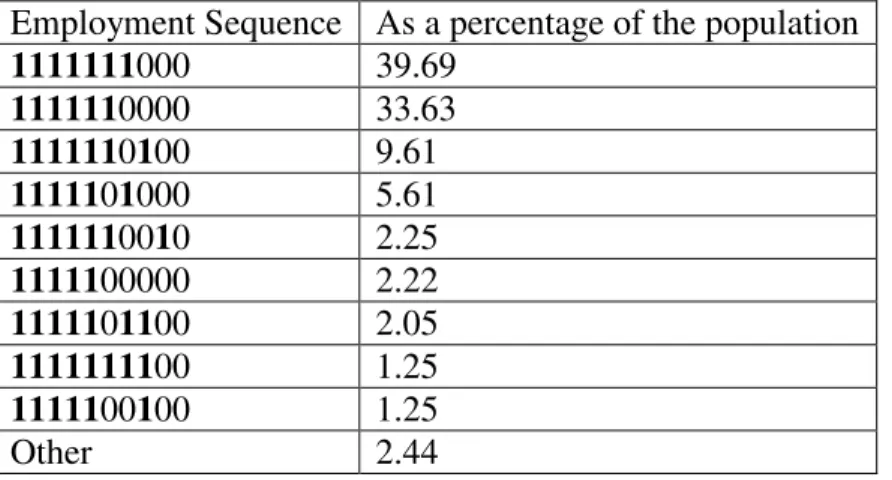
accumulated assets to be substituted for labor income. As Table 2 shows, around 40% retire at period 8, 34%
retire at period 7. 9.61% of them are temporarily unemployed at period 7, employed the next period, and then
retire at period 9. The agents are all identical except that they may realize different wage and return shocks
along their lives, and hence retire at different ages. In the finance literature studying household portfolio
choices, it is always assumed that retirement age is fixed. As we can see in this model (and in the real data), it is
not true. As will be made clear shortly, portfolio allocation decisions are sensitive to plans about retirement. If
the agents' retirement patterns show such variability then a significant amount of variation in the household
portfolios in data could be attributed to different retirement patterns. Hence assuming retirement age to be given
Table 2: Timing of Retirement without Social Security
Employment Sequence As a percentage of the population
1111111
000
39.69
111111
0000
33.63
111111
0
1
00
9.61
11111
0
1
000
5.61
111111
00
1
0
2.25
11111
00000
2.22
11111
0
11
00
2.05
11111111
00
1.25
11111
00
1
00
1.25
Other
2.44
In Figure 1, we see that employment rate is 100% in the first 3 periods, and then it falls gradually to
88% in period 6. Then we see a sharp decline: 50.3% in period 7, 14.6% in period 8, 3.6% in period 9, and 0.1%
4.1.2. Consumption and Assets
Consumption grows with age since the average rate of return on assets (between 1.03 and 1.04,
depending on the portfolio composition) is higher than the rate of time preference (1.02). As a typical life-cycle
model would suggest, the agents accumulate wealth while they are working and decumulate wealth during
4.1.3. Portfolio Allocation
As we will see more clearly in the next section where solution results are presented, portfolio
allocation depends on current cash-on-hand and expected future labor income. If cash-on-hand is very low, then
the agents may prefer not to save, and we have no portfolio decision. If the agent decides to save, then there are
a couple of ways the magnitude of cash-on-hand affects portfolio choice. As explained in Bodie, Merton,
Samuelson (1991), total wealth can be thought of as the sum of human wealth and financial wealth. Human
wealth is the expected total future labor income and financial wealth is the financial assets held. The relative
magnitudes and risks of these two portions of wealth determine current portfolio choice.8
Figure 3 shows the evolution of the average percentage share of risky assets in total financial wealth.
Portfolios are composed of 100% risky asset in the first 3 periods. Starting with the 4th period, we see a
continuous decline until death. This is consistent with the well-known advice given by portfolio managers to
individual investors: Hold a higher percentage of risky assets before retirement, and monotonically decrease the
percentage of risky assets after retirement. The rationale behind that advice is the following: If the expected
future labor income is relatively less risky compared to risky assets held, or if the correlation between future
labor income shocks and return shocks is not significantly positive, then in the earlier stages of life total
expected lifetime wealth has a big less risky component. As the agent approaches the end of the life cycle,
expected labor income, that is, his less risky component of total expected financial wealth, shrinks. Hence the
agents should hold riskier portfolios early in the life cycle and less risky portfolios towards the end of the life
cycle. In the earlier periods of the life-cycle the agents can mitigate the effect of any big adverse return shock
by dissipating its effect to longer future time periods (i.e. by working longer). On the other hand, in the later
stages of life, there are not many periods left.
8
4.1.4. Behavior of Groups of Various Retirement Ages:
I have picked the most populous groups in Table 2 and graphed their consumption, saving, income,
and portfolio allocation paths. These groups are named as follows:
Ret8: The group that consists of simulated agents who work for the first 7 periods, then retire at period
8 and never return to work. This group constitutes around 40% of the population.
Ret7: The group that consists of simulated agents who work for the first 6 periods, then retire at period
Ret7Back8: The group that consists of simulated agents who work for the first 6 periods, then
temporarily retire at period 7, go back to work at period 8, and finally retire at period 9. This group constitutes
around 10% of the population.
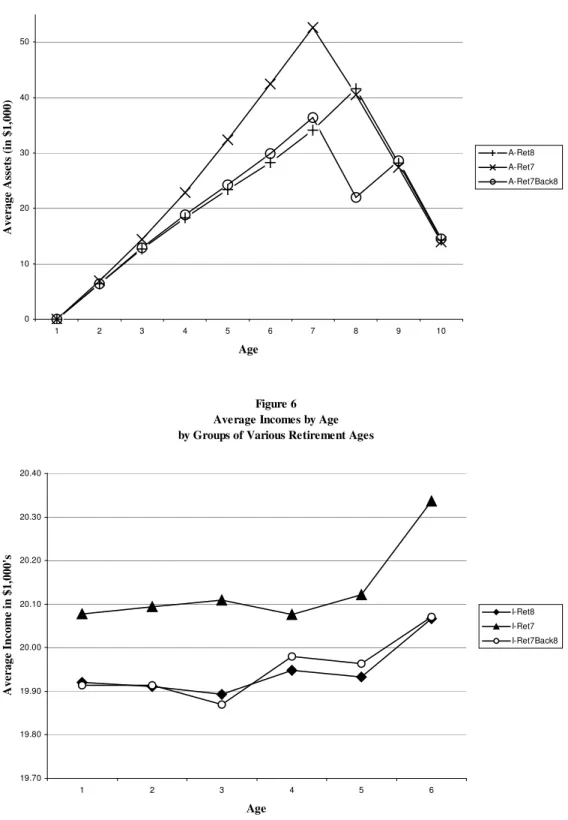
In the Figures 4, 5, 6, 7 and 8 below, I depict consumption, assets, income, return shocks, and portfolio
allocation in order to demonstrate how identical agents exhibit different behaviors depending on the shocks
(particularly on return shocks since I have kept the standard deviation of wages very small).
In Figure 4, we see that consumption drops in the period where Ret7 agents retire. This is not because
of a strong adverse shock (See Figure 7). These agents are lucky in the sense that they received big positive
return shocks throughout the first 6 periods, and they were able to save more than the other groups (see Figure
5). Having a lot of savings, realizing an above average return shock in period 7, and the desire not to work
contributes to their decision that they would sacrifice some current consumption in order not to work thereafter.
Almost the opposite scenario applies to Ret8 and Ret7Back8 so that they cannot afford to retire, and they have
to work one more period. Once they decide to work, they have around 20 thousand dollars more, and hence we
see a big increase in consumption. The difference between Ret8 and Ret7Back8 is that the latter group has a
little more assets and they temporarily retire at period 7 only to receive a big adverse return shock in period 8
and go back to employment.
In Figure 8 we see that the Ret7Back8 group has a higher share of risky assets in their portfolio at
period 6, and especially at period 7. Even though Ret7Back8 group has almost same amount of cash-on-hand as
the Ret7 group, they decide to hold more risky financial wealth in period 7 compared to the Ret7 group. Why?
That is because they are more likely to work in period 8 than the Ret7 group. They do not have enough assets
saved to withstand a big adverse return shock in period 8. But it is worth putting a little bit more money on the
risky asset with the hope that a good return will allow them to retire sooner (if they get a good return they would
Figure 5 Average Wealth by Age by Groups of Various Retirement Ages
0 10 20 30 40 50
1 2 3 4 5 6 7 8 9 10
Age A v er a g e A ss et s (i n $ 1 ,0 0 0 ) A-Ret8 A-Ret7 A-Ret7Back8 Figure 6 Average Incomes by Age by Groups of Various Retirement Ages
19.70 19.80 19.90 20.00 20.10 20.20 20.30 20.40
1 2 3 4 5 6
Figure 7
Average Returns on Risky Asset Holdings by Age by Groups of Various Retirement Ages
-4 -2 0 2 4 6 8 10 12
1 2 3 4 5 6 7 8 9 10
Age
A
v
er
a
g
e
%
R
et
u
rn
Return-Ret8 Return-Ret7 Return-Ret7Back8 Return for All
Figure 8
Average Portfolio Allocation by Age by Groups of Various Retirement Ages
0 20 40 60 80 100
1 2 3 4 5 6 7 8 9
Age
%
W
ea
lt
h
H
el
d
i
n
R
is
k
y
A
ss
et
4.2. Simulations with Social Security
I use the same parameters as simulation 1 other than the social insurance parameters. I used the
following benefit schedule:9
t\e 0 1 2 3 4 5 6 7 8 9 1 0
2 0 0
3 0 0 0
4 0 0 0 0
5 0 0 0 0 0
6 0 0 0 0 0 0
7 0 0 0 0 0 0 5
8 0 0 0 0 0 0 5 10
9 0 0 0 0 0 0 5 10 12
10 0 0 0 0 0 0 5 10 12 15
Table 3: Timing of Retirement with Social Security
Employment Sequence Percent
1111111000
9.54
1111110000
90.10
1111110100
0.36
Table 3 shows that employment patterns are more regular with Social Security because of the
incentives to retire at certain times provided by the system. Around 90% of the agents retire at period 7, when
they are eligible for a relatively small early retirement benefit.
Figure 9 shows average consumption and saving paths. We see that this social insurance program
depresses savings, and average consumption in the Social Security case is higher by about $1,000 at every point
in time compared to the one with no Social Security.
9
Figure 10 shows that until period 8, optimal portfolios are more risky without the social insurance
system. One factor contributing to this should be that for 90% of the simulated agents future income in the
simulation with Social Security is 5 for every period after 6, and that is small relative to assets held. Hence the
inherent risk in total wealth is bigger in simulations with Social Security, and thus less risky portfolios are
optimal. In the last 2 periods optimal portfolios in the SS case are a little more risky than the ones in no SS case.
That could be because there is almost no chance to be working in the last 2 periods in no SS case. Hence there is
less non-risky human wealth remained in no SS case compared to SS case. Thus agents may be holding less
risky portfolios in no SS case compared to SS case.
Figure 9
Average Consumption and Assets by Age with and without Social Security
0 5 10 15 20 25 30 35 40
1 2 3 4 5 6 7 8 9 10
Age
A
v
er
a
g
e
in
$
1
,0
0
0
's
Figure 10
Average Portfolio Allocation by Age with and without Social Security
0.0 20.0 40.0 60.0 80.0 100.0 120.0
1 2 3 4 5 6 7 8 9
Age
%
W
ea
lt
h
h
el
d
i
n
R
is
k
y
A
ss
et
(
A
v
er
a
g
e)
Portfolio Portfolio with SS
5. Analyzing the Solution in More Detail
Analyzing the solution of the model we can get a more detailed idea about how the model works. In
the literature, generally simulations are presented but examining the solution patterns gives the most detailed
information on the model dynamics.
The following 3 graphs depict how the solution (optimal consumption and portfolio allocation)
changes with respect to cash-on-hand in the last three periods (period 9, 8, and 7 respectively). For period 9, I
Figure 11
Figure 13
When we examine the graphs we make the following observations:
1) Consumption: There are abrupt consumption drops. The number of consumption drops is equal to
the number of periods left.
2) Portfolio Allocation: There is a general downward trend, and there are some spikes in between. The
number of spikes is same as the number of periods left.
I will show that the reason behind the jumps in the portfolio allocation and consumption is the
"sudden"10 changes in expected future income.11
The following two factors have important roles in the sudden big drops in consumption: 1) The strong
desire not to work: Individuals either work or don’t work. Once they decide to work, they face a big negative
utility loss due to the additive marginal disutility of work component of the utility function. 2) The utility
function, which is very steep at low levels of consumption and flat at higher levels of consumption. So,
although the benefit of working (through increased income) can be very low at relatively higher levels of
consumption, the utility cost of working may be very high, which does not depend on consumption level.
Hence, the agents are willing to forego a big chunk of consumption today in order to afford not to work next
period.
To illustrate that reasoning let us consider Figure 12 and trace optimal consumption relative to
cash-on-hand. For small values of cash-on-hand (up until about $19,500) the agent does not save at all. He consumes
everything. That is because the cash-on-hand he has is too small to maintain minimal consumption levels in
period 9 and period 10. Since the utility function is very steep at those relatively small levels of consumption,
10
The word "sudden" is used in the sense that for a small change in cash-on-hand, we may see abrupt changes in optimal consumption and portfolio allocation.
11We will see that the sudden changes in portfolio allocation and also in consumption happen at the points where the
he realizes that he will have to work next period: The penalty for not working next period (that is, getting very
low levels of utility from consumption in this and the future period) is even worse than the stiff utility penalty
for working next period. Since he knows he will be working next period, there is no need to save now. Enjoy
consumption today, and tomorrow's consumption will be completely financed by tomorrow's labor income.
If we keep increasing cash-on-hand, at some point the agent will have enough cash-on-hand to afford not to
work next period. At that point savings has to jump from 0 to a not-so-small positive number since, due to the
shape of the utility function, miniscule levels of next period consumption cannot be optimal.
To help understand the patterns in portfolio allocation solutions consider the following two possible
cases:
Case 1: Corner Solution. Financial wealth can be a very small fraction of total wealth (especially in
early periods). Then the total wealth is dominated by human wealth. If future labor earnings are not very risky,
then the overall riskiness of total wealth may be too low and the agents may find it optimal to invest all their
financial wealth in the risky asset.
Case 2: If the share of financial wealth in total wealth gets bigger, and we keep everything else equal,
then we would expect a smaller percentage of risky assets held compared to the previous case.
If we examine the solutions carefully, we can see these two effects in play both within a period and
across periods.
Within a given period, changing cash-on-hand changes the share of financial wealth in total wealth.
For the moment let's focus on each smooth part of the portfolio allocation that are between the spikes
separately. All of them are smoothly declining. Explanation: If the expected future employment sequence is
roughly constant, then increasing cash-on-hand (hence increasing the more risky component of wealth, financial
Now notice that the lowest point of each smooth part (in between the spikes) is lower than its
counterparts, which are to the left. Explanation: The magnitude of cash-on-hand determines the probabilities of
expected future employment sequences. If we keep increasing cash-on-hand, at some point, the forward looking
agent will realize that he may have enough cash-on-hand to retire one period early. At this point we may
observe a fast change of probabilities of future employment sequences. Portfolio allocation responds to this
change of future employment probabilities: If it is likely now that the agent is going to work for one less period,
then he has to hold a less risky portfolio since the share of risky wealth in total wealth has grown.
Across periods: The same level of cash-on-hand implies different portfolio allocations in different
periods simply because the composition of the total changes over time.
Now it is time for the spikes: Above, I have described some of the main channels through which
portfolio allocation is affected. The results that we see are far richer than that. The interaction between the
magnitude of cash-on-hand and probabilities of future employment creates possibilities for optimal portfolio
allocation to vary a lot. For example in addition to the cases described above, think of the "gray" areas where
the agent has such an amount of cash-on-hand such that he is neither very likely to work nor very unlikely to
work in a future period. In those cases the agent may gamble now for a chance to avoid working next period. He
may prefer to hold a riskier financial portfolio hoping that, next period, he may get returns high enough that he
will not have to work. If he is lucky he will get a huge utility boost. If not, he may not "suffer" too much in the
sense that it was already probable that he would work next period, and now he will have more cash-on-hand
(because of the labor income) to be spent on consumption.
In the light of the explanations above, now let's reexamine the portfolio allocation decisions by looking
at the above 3 figures: Portfolio allocation (x) versus cash-on-hand in period 9, period 8, and then 7:
In period 9, x is constant just the way it is in the simplest form of dynamic portfolio choice model of
the risky asset. Our model is more general than his, but period 9 is a special case since the future horizon is only
1 period and the agents are certain that they are not going to work if they decide to save.
Note that for all periods the number of consumption drops is same as the number of periods left. That
is not a coincidence. At those points where consumption drops abruptly, probabilities of future employment
change abruptly too. Once the agent thinks that saving more aggressively allows him to retire one period earlier,
he is willing to take a big consumption drop. This is very clear in period 9 since only 1 period is ahead. But, the
earlier periods we analyze are more complicated since there is now interaction between possible future
employment sequences.
In periods 8 and 7 we see two things: The optimal share of risky assets is a monotonic decreasing
function of cash-on-hand, and the optimal share suddenly jumps to a higher value two times in period 8 and 3
times in period 7. Again, this is because of the way the probabilities of future employment sequences change.
Consider period 8: For small values of cash-on-hand agents do not save. For a little higher value agents save
and plan to work for the next 2 periods. If they have a little more cash-on-hand they may plan to work for 1
period less, and finally if they have a huge amount of savings they figure they will never work. These are where
we see the jumps in x.
To see whether the jump in consumption is the result of using a "not fine enough" grid, I solve the
model with 10 times more grid points for cash-on-hand, that is I use 2,000 grid points rather than 200. We still
see the jumps in consumption and portfolio choice.
To better understand the reason behind the jump, I calculate and report the probability of next period
employment at period 9. I report this for period 9 because at this period there are only two possible future
employment patterns: work and not work. If I were to use previous periods, then the number of possible future
employment patterns increase exponentially. As I have explained previously, the reason of the jump is the
"sudden" big changes in the probability of next period employment. I report the relationship between the
it is calculated after the agents optimally choose consumption and portfolio allocation given cash-on-hand. We
will see below that as cash-on-hand increases, at some point the probability jumps down from 100% to 0%. To
help visualize how that probability jumps, I also present the relationship between the probability of next period
employment and consumption-portfolio allocation pairs at a given cash-on-hand. There we will see, in some
regions, how extremely sensitive that probability is to changes in either consumption or portfolio choice.
The way I calculate the probabilities is simple: Due to the nature of dynamic programming, we already
had to take into account every possible future event in calculating optimal decisions. I just modified the
program to keep track of whether the agent works or not in every case. Then I simply calculate the ratio of the
number of cases in which the agent works to the number of total cases. The number of total cases is 10,000
since it is the number of draws I use in Monte Carlo integrations.