THE ROLE OF CROSS SECTIONAL GEOMETRY IN THE PASSIVE
TRACER PROBLEM
Manuchehr Aminian
A dissertation submitted to the faculty at the University of North Carolina at Chapel Hill in partial
fulfillment of the requirements for the degree of Doctor of Philosophy in the Department of
Mathematics in the College of Arts and Sciences.
Chapel Hill
2016
Approved by:
Roberto Camassa
Richard McLaughlin
David Adalsteinsson
Laura Miller
ABSTRACT
Manuchehr Aminian: The role of cross sectional geometry in the passive
tracer problem
(Under the direction of Roberto Camassa and Richard McLaughlin)
This dissertation is concerned with how the longitudinal moments (mean, variance, skewness)
of a tracer distribution undergoing an advective-diffusive process in Poiseiulle flow depend in a
nontrivial way upon the cross section of the pipe.
ACKNOWLEDGEMENTS
I would like to recognize the significant role my friends played in motivating me to get to work,
and the patience of my advisors when I didn’t work.
On a more serious note, the significant progress we’ve made in the work related to this dissertation
would not have happened if not for the support of the others in our research group: Francesca
Bernardi, Dan Harris, and my advisors, Rich McLaughlin and Roberto Camassa.
TABLE OF CONTENTS
LIST OF FIGURES . . . .
xii
LIST OF TABLES . . . .
xv
CHAPTER 1: INTRODUCTION . . . .
1
CHAPTER 2: NOTATION AND SETUP . . . .
3
2.1
Derivation of the model equations . . . .
3
2.2
Flow solution in the infinite channel
. . . .
4
2.3
Flow solution in the circular pipe . . . .
5
2.4
Flow solution in the rectangular pipe . . . .
5
2.5
Flow in elliptical pipes . . . .
7
2.6
Advection diffusion equation . . . .
8
CHAPTER 3: ASYMPTOTICS OF THE ARIS EQUATIONS . . . .
9
3.1
The Aris equations. . . .
9
3.2
Short time asymptotics of the Aris equations. . . .
11
3.2.1
Exact moments without diffusion. . . .
11
3.2.2
Pointwise statistics of a passive tracer with advection alone. . . .
12
3.2.3
Averaged statistics of a passive tracer with pure advection. . . .
13
3.2.4
Short time asymptotics with diffusion. . . .
16
3.2.5
Comparison of short time asymptotics and simulation. . . .
20
3.3
Long time asymptotics of the Aris equations.
. . . .
22
3.3.1
Long time asymptotics of with a polynomial time driver. . . .
24
3.3.2
Long time behavior of the Aris equations. . . .
25
3.3.4
Exact calculation of long time asymptotics in any ellipse.
. . . .
28
3.3.5
Calculation of long time coefficients in the rectangular duct. . . .
31
CHAPTER 4: POISSON SUMMATION OF CHANNEL FORMULAE . . . .
35
4.1
Motivation . . . .
35
4.2
Derivation of the seed identity . . . .
36
4.3
Poisson summation of
T1
. . . .
40
4.3.1
The
p
= 2
case . . . .
40
4.3.2
The
p
= 4
case . . . .
42
4.3.3
Poisson summation for the first moment in the channel . . . .
43
4.3.4
Verifying conserved quantities . . . .
45
4.3.5
Summary . . . .
47
4.4
Poisson summation of the second moment in the channel . . . .
47
4.4.1
The
p
= 6
case . . . .
48
4.4.2
The
p
= 5
case . . . .
49
4.4.3
The
p
= 8
case . . . .
50
4.4.4
The
p
= 7
case . . . .
51
4.4.5
Expression for
T
2. . . .
51
4.5
Third moment in the channel and comparison for centered statistics
. . . .
52
4.6
Summary of identities . . . .
57
CHAPTER 5: MONTE CARLO SIMULATION . . . .
60
5.1
Brownian motions and their connection to advection-diffusion problems
. . . .
60
5.2
Implementation of the Monte Carlo method . . . .
63
5.2.1
Specifying the initial conditions . . . .
63
5.2.2
Calculation of the flow . . . .
65
5.2.3
Implementation of diffusion and enforcing boundary conditions . . . .
65
5.2.4
Calculation of statistics . . . .
69
5.3
Validation and convergence of numerics
. . . .
71
5.3.1
Validation in the infinite channel . . . .
71
5.3.3
Validation through long time asymptotics . . . .
75
5.4
Results in the rectangular and elliptical domains
. . . .
77
CHAPTER 6: NUMERICS AND ASYMPTOTICS IN OTHER DOMAINS . . .
79
6.1
Introduction . . . .
79
6.2
Racetrack cross sections . . . .
79
6.2.1
Derivation of the flow
. . . .
79
6.2.2
Monte Carlo simulation for the racetrack . . . .
82
6.3
Triangular cross section
. . . .
84
6.3.1
Calculation of the flow . . . .
84
6.3.2
Calculation of asymptotics . . . .
85
6.3.3
Modification of Monte Carlo code . . . .
85
6.3.4
Asymptotics in the regular polygons . . . .
87
APPENDIX A: SOLUTIONS TO ASYMPTOTICS IN THE ELLIPSE. . . .
90
A.1 Explicit solution of the
g
1(ξ, η)
problem in the ellipse . . . .
90
A.2 Solution of the
g
2(ξ, η)
problem in the ellipse
. . . .
91
APPENDIX B: SOURCE CODE FOR MONTE CARLO SIMULATIONS. . . . .
95
B.1 Necessary packages and compilers . . . .
95
B.2 ./ . . . .
96
B.2.1
./makefile
. . . .
96
B.2.2
./parameters_mc.txt
. . . .
97
B.2.3
./batch_submit.py
. . . .
98
B.3
./monte/
. . . 100
B.3.1
./monte/channel_mc.f90
. . . 100
B.3.2
./monte/duct_mc.f90
. . . 108
B.3.3
./monte/ellipse_mc.f90
. . . 118
B.3.4
./monte/racetrack_mc.f90
. . . 128
B.3.5
./monte/triangle_mc.f90
. . . 137
B.4.1
./utils/buffer_op_channel.f90
. . . 147
B.4.2
./utils/buffer_op_duct.f90
. . . 148
B.4.3
./utils/channel_mc_messages.f90
. . . 148
B.4.4
./utils/check_ic_channel.f90
. . . 149
B.4.5
./utils/check_ic_duct.f90
. . . 150
B.4.6
./utils/correct_tstep_info.f90
. . . 150
B.4.7
./utils/duct_mc_messages.f90
. . . 151
B.4.8
./utils/findcond.f90
. . . 152
B.4.9
./utils/generate_internal_timestepping.f90
. . . 153
B.4.10
./utils/generate_target_times.f90
. . . 153
B.4.11
./utils/get_pts_in_ellipse.f90
. . . 155
B.4.12
./utils/get_pts_in_triangle.f90
. . . 156
B.4.13
./utils/get_racetrack_area.f90
. . . 158
B.4.14
./utils/hdf_add_1d_darray_to_file.f90
. . . 159
B.4.15
./utils/hdf_add_2d_darray_to_file.f90
. . . 160
B.4.16
./utils/hdf_add_3d_darray_to_file.f90
. . . 162
B.4.17
./utils/hdf_create_file.f90
. . . 163
B.4.18
./utils/hdf_read_1d_darray.f90
. . . 164
B.4.19
./utils/hdf_write_to_open_2d_darray.f90
. . . 165
B.4.20
./utils/interp_meshes.f90
. . . 167
B.4.21
./utils/linear_interp_2d.f90
. . . 168
B.4.22
./utils/make_filename_direct.f90
. . . 171
B.4.23
./utils/make_histogram.f90
. . . 171
B.4.24
./utils/make_histogram2d.f90
. . . 173
B.4.25
./utils/my_normal_rng.f90
. . . 174
B.4.26
./utils/print_parameters.f90
. . . 176
B.4.27
./utils/progress_meter.f90
. . . 178
B.4.28
./utils/read_inputs_direct.f90
. . . 179
B.4.29
./utils/read_inputs_mc.f90
. . . 179
B.4.31
./utils/save_the_rest_duct.f90
. . . 184
B.4.32
./utils/set_initial_conds_channel_mc.f90
. . . 186
B.4.33
./utils/set_initial_conds_duct_mc.f90
. . . 188
B.4.34
./utils/set_initial_conds_ellipse_mc.f90
. . . 190
B.4.35
./utils/set_initial_conds_racetrack_mc.f90
. . . 192
B.4.36
./utils/set_initial_conds_triangle_mc.f90
. . . 194
B.4.37
./utils/solve_quadratic_eqn.f90
. . . 197
B.4.38
./utils/sortpairs.f90
. . . 197
B.4.39
./utils/uniform_bins_idx.f90
. . . 199
B.4.40
./utils/vector_ops.f90
. . . 199
B.4.41
./utils/walkers_in_bin_1d.f90
. . . 201
B.4.42
./utils/walkers_in_bin_2d.f90
. . . 202
B.4.43
./utils/write_outputs_direct.f90
. . . 203
B.4.44
./utils/write_outputs_mc.f90
. . . 203
B.4.45
./utils/zeroout.f90
. . . 204
B.5
./computation/
. . . 205
B.5.1
./computation/Alpha_eval.f90
. . . 205
B.5.2
./computation/Beta_tilde.f90
. . . 205
B.5.3
./computation/accumulate_moments_1d.f90
. . . 206
B.5.4
./computation/accumulate_moments_2d.f90
. . . 208
B.5.5
./computation/apply_advdiff1_chan.f90
. . . 211
B.5.6
./computation/apply_advdiff1_duct.f90
. . . 212
B.5.7
./computation/apply_advdiff1_ellipse.f90
. . . 213
B.5.8
./computation/apply_advdiff1_racetrack.f90
. . . 215
B.5.9
./computation/apply_advdiff1_triangle.f90
. . . 216
B.5.10
./computation/apply_advdiff2_chan.f90
. . . 218
B.5.11
./computation/asymp_st_channel_moments.f90
. . . 219
B.5.12
./computation/impose_reflective_BC_ellipse.f90
. . . 220
B.5.13
./computation/impose_reflective_BC_polygon.f90
. . . 223
B.5.15
./computation/impose_reflective_BC_rect.f90
. . . 232
B.5.16
./computation/matvec.f90
. . . 233
B.5.17
./computation/moments.f90
. . . 234
B.5.18
./computation/precalculate_Alpha.f90
. . . 235
B.5.19
./computation/precompute_uvals.f90
. . . 236
B.5.20
./computation/precompute_uvals_ss.f90
. . . 237
B.5.21
./computation/racetrack_bdist.f90
. . . 238
B.5.22
./computation/u_channel.f90
. . . 239
B.5.23
./computation/u_duct.f90
. . . 239
B.5.24
./computation/u_duct_precomp.f90
. . . 240
B.5.25
./computation/u_duct_ss.f90
. . . 240
B.5.26
./computation/u_dummy.f90
. . . 242
B.5.27
./computation/u_ellipse.f90
. . . 242
B.5.28
./computation/u_racetrack.f90
. . . 242
B.5.29
./computation/u_triangle.f90
. . . 243
B.6
./modules/
. . . 244
B.6.1
./modules/mod_ductflow.f90
. . . 244
B.6.2
./modules/mod_duration_estimator.f90
. . . 244
B.6.3
./modules/mod_readbuff.f90
. . . 246
B.6.4
./modules/mod_time.f90
. . . 246
B.6.5
./modules/mod_triangle_bdry.f90
. . . 246
B.6.6
./modules/mtfort90.f90
. . . 247
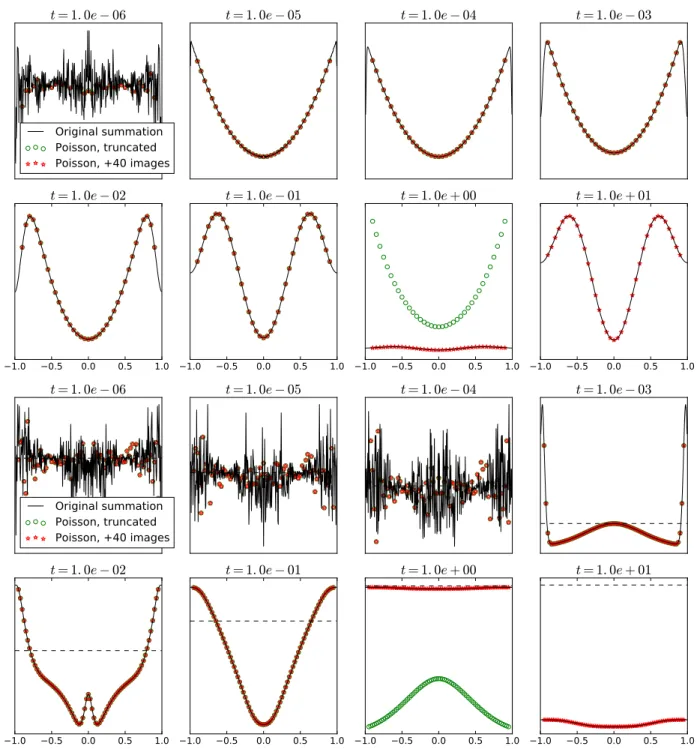
LIST OF FIGURES
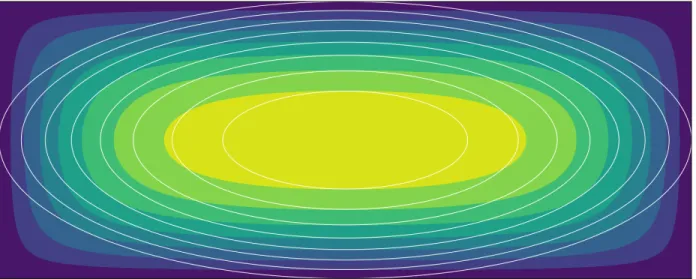
3.1
Flow profiles for the rectangular (solid colors) and elliptical duct (white lines) of
aspect ratio
λ
= 0.4, scaled to match the peak velocity.
. . . .
21
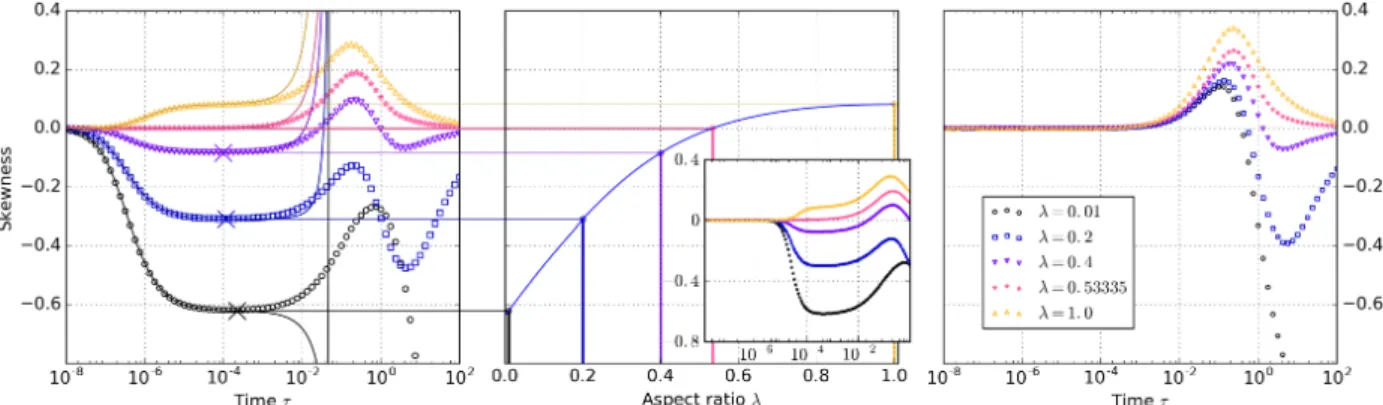
3.2
Evolution of skewness for the rectangles (left panel) and ellipses (right panel) of varying
aspect ratio. Geometric skewness is plotted (center panel) as a function of aspect
ratio, with aspect ratios corresponding to the simulations indicated. Simulations done
using a finite width initial condition
σ
≈
0.115
in the rectangles (inset) are done with
the same aspect ratios. In all cases, Pe
= 10
4.
. . . .
22
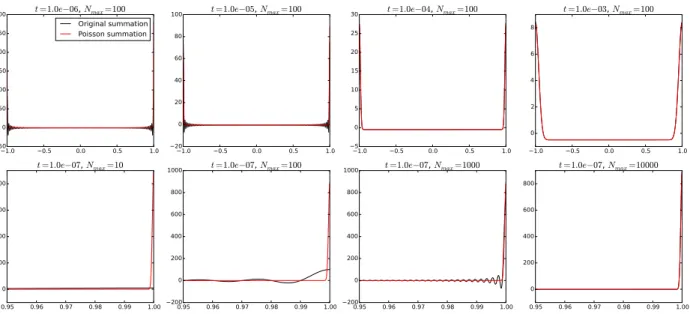
4.1
Comparison of the original summation to the expression recast via Poisson summation
in (4.12). Top row: both original and Poisson versions truncated to
100
terms for
times
t
= 10
−6, ...,
10
−3on the
y-interval
[−1,
1]. Bottom row: demonstration of the
terms needed for convergence scaling like
N
max∼
√
t
in the boundary layer. Here,
t
= 10
−7, and
Nmax
is varied from
10
to
10
4.
. . . .
38
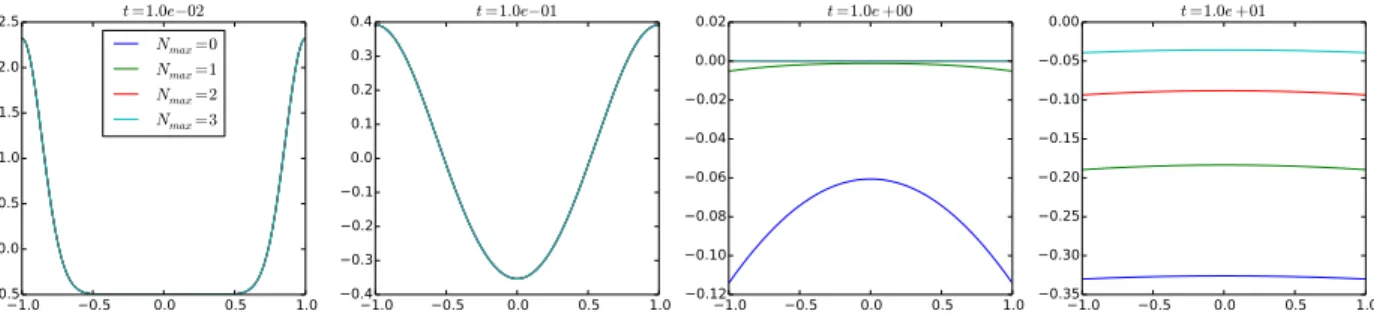
4.2
Behavior of (4.14) when keeping a small number of images at small to intermediate
time. The effect of the extra images is not seen until order one time. . . .
39
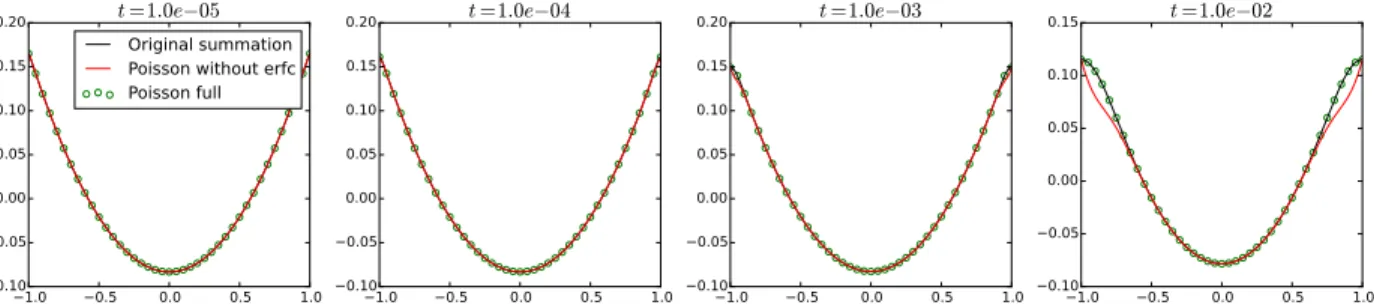
4.3
Evaluation of the left and right-hand sides of (4.23) and (4.24) with
N
max= 10
4for
the original summation. The effect of neglecting the
Er(·)
terms is seen by
t
= 10
−2.
42
4.4
Evaluation of the left and right-hand sides of (4.30) with
N
max= 10
4for the original
summation (black), no extra images as in (4.31) (green), and two extra images kept
(red).
. . . .
43
4.5
Evaluation of the left and right-hand sides of (4.47) with
N
max= 10
4for the original
summation (black), only the
±1
images (green), and the
±1,
±3
images (red). As
with previous cases, only two images are needed until order one time.
. . . .
49
4.6
Evaluation of (4.64) with
Nmax
= 10
4for the original summation (black), and the
Poisson summation equivalents keeping only the
±1
images (green circles), and the
first forty images centered around
[−1,
1]
(red stars). Green circles not shown in the
final panel.
. . . .
52
4.7
Evaluation of the channel variance (top rows) and skewness (bottom rows) with
5.1
Illustration of a reflecting boundary condition in one dimension (left panel) and two
dimensions in the case of the duct near the corner (right panel). The exterior of the
domain is indicated with hatches. The channel reflections have a simple formula for
preserving the total distance traveled. The rectangle requires dealing with corner
cases, where one needs to find the minimum of intersection times
{s
0, s
1}
(green
circles) and multiple reflections. The right panel illustrates that the domain can be
implicitly defined where a function
u(y, z)
>
0.
. . . .
68
5.2
Left panel: Time evolution of the numerical (shades of red) and exact skewness (black)
of the averaged distribution in the channel for Péclet values Pe
= 10
2,
10
4,
10
6and
number of particles
N
= 10
6. Right panels, clockwise from top left: snapshots of
the numerical and exact pointwise mean, variance, and skewness for Pe
= 10
4, at
t
= 10
−2. Dashed black lines indicate the zero line of the mean, variance, and skewness.
72
5.3
Analyzing convergence of numerics with increasing
N
. Left panel: absolute error
in the averaged skewness
|Sk(t)
−
Skexact(t)|
in the channel for Péclet values Pe
=
10
2,
10
4,
10
6and numbers of particles
N
= 10
3, ...,
10
8. Right panel: the corresponding
average error of
|Sk(ti)
−
Skexact(ti)|
is plotted versus the number of particles, with a
power law fit. The expected scaling of error as
1/
√
N
is generally observed. . . .
72
5.4
Analyzing convergence of numerics with
N
= 10
7and Pe
= 10
4fixed, with decreasing
∆tmax
. Ten simulations are run for each
∆tmax
, and the range of errors is shown. The
error behaves nonrandomly for
∆t
max≥
10
−4, growing at an approximately linear
rate in time until the hard cap is hit. The error then decays as both the numerics
and exact solution begin decaying to zero around
t
≈
10
−2.
. . . .
73
5.5
Time evolution of the numerical (shades of red) and exact (black) skewness in the
circular pipe for Péclet values Pe
= 10
2,
10
4,
10
6and number of particles
N
= 10
6.
General agreement is seen across a range of Péclet values, except at short time, where
the exact formulae have numerical cancellation issues, and a deviation near
τ
≈
10
−3.
74
5.6
Analyzing convergence of numerics in the circular pipe with increasing
N
. Left panel:
absolute error in the averaged skewness
|Sk(t)
−
Sk
exact(t)|
in the pipe for Péclet
values Pe
= 10
2,
10
4,
10
6and numbers of particles
N
= 10
3, ...,
10
8. Right panel: the
corresponding average error of
|Sk(t
i)
−
Sk
exact(t
i)|
is plotted versus the number of
particles, with a power law fit. The expected scaling of error as
1/
√
N
is generally
observed.
. . . .
75
5.7
Behavior of the skewness
Sk
in the numerics for various geometries. Top row: skewness
evolution for ellipses (left) and rectanges (right) of varying aspect ratio with Pe
= 10
4.
Bottom row: log-log plot of
|Sk|
versus time for the ellipses (left) and rectangles
(right).
. . . .
76
5.8
Snapshots of the pointwise skewness in the ellipses and rectangles. Aspect ratios
6.1
Illustration of the racetrack for the choices of parameter pairs shown. Note that for
s < λ
it is common for the domain to be come non-convex, as can be seen with
(λ, s) = (0.5,
0.35). The hatched regions indicate the exterior of the domain, and red
and blue indicate regions where
u >
0
and
u <
0
respectively. . . .
81
6.2
Averaged skewness over a range of parameter pairs
(λ, s)
which satisfy a convexity
criterion at
(y, z) = (1,
0), plotted at nondimensional times (from left to right)
t
≈
0.015,
0.97, and
6.28. Positive (negative) skewness is red (blue), with white being
zero. An approximate zero skewness contour is overlaid in black. Long time behavior
is seen to be nearly independent of the shape parameter.
. . . .
84
6.3
Demonstration of the reflection algorithm for some convex polygons. An extremely
long trajectory is taken, then the reflection algorithm is applied iteratively until the
final position
(y
1, z
1)
is in the domain. The number of reflections is illustrated in the
changing color. Left: equilateral triangle with eight reflections. Center: Reflection
in a rectangle
λ
= 1/2
whose initial outward trajectory has a rational slope. Right:
demonstration in a non-regular octagon of the same aspect ratio. . . .
87
6.4
Results in the triangular geometry. Left: schematic of the flow profile, with
y
= 0
and
z
= 0
lines. Center: skewness in fifty simulations (black) and short time (red)
and long time (blue) asymptotics, with Pe
= 10
4. Right: the same simulations and
long time asymptotics with log-scaled axes.
. . . .
88
6.5
Visualization of the numerically computed flow profile in the regular
n-gons for
LIST OF TABLES
4.1
Absolute error of the “mass" for the truncated Poisson summations (4.34), and the
truncation when dropping
Er(·)
terms, (4.35) evaluated at different times. Dropping
the
Er
terms is seen to violate the total mass condition in a quadratic fashion.
. . .
46
4.2
Polynomials
q
(p),
p
= 0,
1, ...,
12
necessary for Poisson summation of the solutions for
the first three moments in the channel. . . .
59
6.1
Geometric skewness and the long time coefficient
3hug2
i/(2hug1
i)
3/2calculated
nu-merically for the regular
n-gons. The coefficients monotonically approach the circle
(n
=
∞) value, disproving the conjecture that there may be an even/odd parity in
CHAPTER 1
Introduction
The study of passive tracers under the influence of laminar fluid flow was first brought to the
limelight by G.I. Taylor, whose paper in 1953 [1] demonstrated with experiment and theory how
the effective diffusivity, as measured by the rate of growth of mean squared displacement of tracer
relative to its mean, is much more rapid than would be expected due to draw molecular diffusion
when put under the influence of laminar pipe flow. The fundamental result is that the enhancement
of diffusivity is proportional to
R
2U
2/κ, where
R
is the pipe radius,
U
is the characteristic speed of
the fluid flow, and
κ
the molecular diffusivity.
Dynamically, the tracer is asymptotically Gaussian at both very short times and very long times,
as measured relative to the diffusive timescale
t
d∝
R
2/κ. However, he observed that at intermediate
times the distribution of tracer was highly non-Gaussian.
Since then, many others have studied this result. One main tool came from Aris [2], who showed
that the tracer
T
, whose evolution is modeled by the advection diffusion equation, can more readily be
studied by the evolution of its longitudinal (flow-wise) moments, which themselves obey a hierarchy
of driven diffusion equations. He, along with many others [3, 4, 5], derived results, both exact and
asymptotic in time, for the case of the circular pipe and infinite parallel plate (“channel") flow. In
another vein, the long time effective diffusivity was studied for a pipe of general rectangular or
elliptical cross section [2, 6].
More recently, the problem has been revisited with the tools of homogenization theory, which
have been used to derive more detailed predictions in the channel and circular pipe cases with
arbitrary point source release [7, 8], and in the case of pulsatile (time-oscillatory) flows [9].
of the influence of the cross section on the distribution of the tracer. Several papers have addressed
this, but are usually only interested in effective diffusivity [10, 11, 12, 13]. Attention has also been
paid in the arena of blood flow and drug delivery [14], despite the necessary assumptions of laminar,
Newtonian fluid flow being dubious for blood.
However, very little attention has been paid since the early papers of Aris [2], Chatwin [3], and
Barton [5] towards the asymmetry induced by the fluid flow. In the two simplest cases of circular
pipe and infinite channel, it turns out that the tracer exhibits opposite signs of the skewness (the
centered, normalized third moment) when examining the cross-sectional average.
In other words, despite the flow solutions being mathematically similar, they produce opposite
asymmetries in the distribution! This was in fact the original motivation for this dissertation work.
Following from this original question, we were motivated to examine how the skewness behaves
for different classes of cross sections to see if we could connect the purely positive skewness of the
circular cross section to the purely negative skewness in the channel. To do this, we first examined
the family of rectangular and elliptical cross sections, establishing both short time and long time
1asymptotics of the Aris moment equations. This revealed that the short time skewness is in fact
zero for all ellipses, and sign-indefinite for the rectangles, with a “golden" aspect ratio (the ratio
of short to long sides) of
λ
≈
0.53335
which has similar statistical behavior to the ellipses. We
followed through with the long time analysis to demonsrate that both the rectangles and ellipses
have sign-indefinite skewness at long time, separated by an aspect ratio
λ
≈
0.49. We wrote a Monte
Carlo method, which shows strong agreement across a wide range of benchmarks, yielding additional
support to our results. Finally, we considered a number of extensions to other cross sections which
permitted analysis and/or simulation, such as the equilateral triangle, the class of regular polygons,
and perturbations of the ellipses, which exhibit a wide range of behaviors.
In broad strokes, the main results of this dissertation work are that the longitudinal skewness of
a passive tracer in a laminar fluid flow has strong dependence on the shape of the cross section of
the pipe. Depending on the application of interest, this permits a degree of control in how the tracer
is delivered to its final destination.
1
CHAPTER 2
Notation and Setup
In this chapter, we derive the partial differential equation for the fluid velocity in a generic
domain and give the solution in a few classes of domains. We also introduce the advection diffusion
equation for the tracer.
Derivation of the model equations
First we derive the partial differential equations for the fluid flow. In general, the Navier-Stokes
equations describes the evolution of the fluid velocity field
u
= (u, v, w)
in space and time:
ρ
∂
u
∂t
+
u
· ∇
u
=
−∇p
+
µ∇
2u
,
(2.1)
with density
ρ, pressure field
p, and dynamic viscosity
µ. Nondimensionalizing the variables as
x
=
a
x
0,
u
=
U
u
0,
t
= (a/U
)t
0,
p
= (µU/a)p
0, with characteristic length and velocity scales
a
and
U
respectively, and using a constant density
ρ
=
ρ0
results in the nondimensionalized form
Re
∂
u
0∂t
0+
u
0· ∇
0u
0=
−∇
0p
0+
∇
20u
0∇
0·
u
0= 0.
(2.2)
The coefficient Re
=
ρ0aU/µ
is the Reynolds number. We assume Re
1
and work with the reduced
equations (dropping primes)
∇
2u
=
∇p,
∇ ·
u
= 0.
(2.3)
pipe, that is,
u
=
0
on the boundaries. Explicitly we have
∇
2u
=
px,
u|
∂Ω= 0,
(2.4a)
∇
2v
= 0,
v|
∂Ω= 0,
(2.4b)
∇
2w
= 0,
w|
∂Ω
= 0,
with
(2.4c)
ux
+
vy
+
wz
= 0.
(2.4d)
It is a fact that Laplace’s equation with zero boundary conditions only has the zero solution, so
v
=
w
= 0. Incompressibility gives us that
u
x= 0, so that
u
=
u(y, z). We need only to solve
∂
2u
∂y
2+
∂
2u
∂z
2=
px,
u|
∂Ω= 0,
px
constant.
(2.5)
We note that, while the equations are nondimensional here, an almost identical derivation holds for
the dimensional flow, with an extra factor of
1/µ
multiplying the pressure gradient. The justification
for dropping the inertial terms in the Navier-Stokes equations comes down to a Reynolds-number-like
argument, where one would assume inertial effects are negligible compared to the viscous and pressure
effects. Functionally the two forms are essentially the same, and we may use the dimensional or
nondimensional form as appropriate.
Flow solution in the infinite channel
Working in dimensional variables with a cross section of infinite parallel plates (a “channel")
Ω =
{(y, z
) :
−a
≤
y
≤
a},
(2.6)
the boundary conditions for the flow problem
∂
2u
∂y
2+
∂
2u
∂z
2=
p
xµ
,
u|
y=±a= 0
(2.7)
imply there is no
z
dependence, so we have an ordinary differential equation for
u(y):
d
2u
dy
2=
p
xwhich has the solution
u(y) =
−
a
2px
2µ
1
−
(y/a)
2.
(2.9)
We set
U
=
−a
2px/µ
and include an extra factor of 2 in nondimensional form (for convenience) to
get a nondimensional flow
u(y) = 1
−
y
2.
(2.10)
Flow solution in the circular pipe
Working in dimensional variables with a circular cross section
Ω =
{(y, z) :
y
2+
z
2≤
a
2},
(2.11)
the flow problem is easiest solved using polar coordinates
(y, z
)
→
(r, θ). Additionally assuming a
radially symmetric solution
u(r)
(justified after the fact by uniqueness of solution to the PDE) the
problem reduces to an ODE for
u(r):
1
r
∂
∂r
r
∂u
∂r
=
p
xµ
,
u(a) = 0.
(2.12)
This has a functionally similar solution to the parallel plate case:
u
=
−
a
2p
x
4µ
1
−
(r/a)
2=
−
a
2p
x
4µ
1
−
(y/a)
2
−
(z/a)
2.
(2.13)
Letting
U
=
−a
2px/µ
and multiplying by a factor of two gives the nondimensional flow
u
=
1
2
(1
−
r
2
) =
1
2
(1
−
y
2
−
z
2).
(2.14)
Flow solution in the rectangular pipe
In this case, the dimensional domain is
The flow problem does not reduce as much as in the previous cases:
∂
2u
∂y
2+
∂
2u
∂z
2=
p
xµ
,
u|
y=±a=
u|
z=±b= 0.
(2.16)
In this case, the solution can be written either as an eigenfunction expansion in the form
u(y, z
) =
∞
X
m,n=1
umn
cos((m
−
1/2)πy/a) cos((n
−
1/2)πz/b)
(2.17)
or in a single series, as a correction of the channel flow. The rough interpretation here is that the
channel flow
u
c(y)
is the limit of the rectangular case if we send the far walls to infinity, that is,
b
→ ∞. This form of the solution is
u(y, z) =
uc(y) +
∞
X
k=1
ck
cos((k
−
1/2)πy/a) cosh((k
−
1/2)πz/a).
(2.18)
This second form is more convenient in nearly all cases, so we derive the formulae for the coefficients
ck
.
First, the Poisson equation itself is satisfied, since the PDE is linear,
u
c(y)
satisfies the equation, and
the terms in the summation
cos((k
−
1/2)πy/a) cosh((k
−
1/2)πz/a)
are harmonic. The boundary
conditions at
y
=
±a
are satisfied independently by every term in the expression. Requiring
u|
z=±b= 0,
0 =
uc(y) +
∞
X
k=1
c
kcos((k
−
1/2)πy/a) cosh((k
−
1/2)πb/a).
(2.19)
For convenience define
φ
k= cos((k
−
1/2)πy/a. Multiplying both sides by
φ
j, integrating over
[−a, a], and using the smoothness of the solution to allow the exchange of integration and summation
leads to the formula for the coefficients:
−
Z
a −au
c(y)φ
jdy
=
Z
a −aφ
j ∞X
k=1c
kcosh((k
−
1/2)πz/a)φ
k(2.20a)
−
Z
a −au
c(y)φ
jdy
=
∞
X
k=1
c
kcosh((k
−
1/2)πb/a)
Z
a −aφ
kφ
jdy
(2.20b)
−
R
a−a
u
c(y)φ
jdy
R
a −aφ
2jdy
=
cj
cosh((j
−
1/2)πb/a)
(2.20c)
⇒
cj
=
−a
2px
µ
2(−1)
jThe form of the coefficient gives rapidly converging series, especially for small aspect ratios
λ
=
a/b
1
even without the factor of
(j
−
1/2)
−3.
To analyze the behavior for large aspect ratios, let
ζ
=
z/b,
α
= (j
−
1/2)πb/a. Then the aspect
ratio dependence in the sum is written as
cosh(αζ)
cosh(α)
,
−1
≤
ζ
≤
1,
(2.21)
and for
α
→ ∞
(i.e., sending the inverse aspect ratio
b/a
→ ∞) this converges pointwise to zero for
ζ
∈
(−1,
1)
and to one for
ζ
=
±1. (This can be shown with standard analysis techniques.)
Multiplying by two and setting
U
=
−a
2p
x
µ
gives the nondimensional form (λ
=
a/b)
u(y, z) = 1
−
y
2+
∞
X
k=1
˜
c
kcos((k
−
1/2)πy) cosh((k
−
1/2)πz/λ),
˜
c
k=
4(−1)
kπ
3(k
−
1/2)
3cosh((k
−
1/2)π/λ)
.
(2.22)
Flow in elliptical pipes
With an elliptical cross section, the domain is defined as
Ω =
(y, z) :
y
2a
2+
z
2b
2≤
1
.
(2.23)
The flow solution will take the form
u
=
k1
1
−
(y/a)
2−
(z/b)
2,
(2.24)
which enforces the boundary conditions. To find the scaling, substitute into the PDE and solve:
k1(−2/a
2−
2/b
2) =
px
µ
⇒
k1
=
−a
2px
µ
1
2(1 + (a/b)
2)
.
(2.25)
Multiplying by two and setting
U
=
−a
2p
x
/µ
yields the nondimensional form for arbitrary aspect
ratio
λ
=
a/b:
u(y, z) =
1
1 +
λ
2(1
−
y
Advection diffusion equation
A general tracer density
T
(
x
, t)
can possibly influence the fluid flow, and would enter the
Navier-Stokes equations through additional forcing terms. A key assumption behind this field is that the
tracer is
passive
: that is, it has no affect on the fluid flow itself, and is only advected along by it.
This allows us to separately solve for the fluid flow
u
, then use this to analyze the tracer distribution.
If we also assume a simple molecular diffusion, one can derive the advection diffusion equation
∂T
∂t
+
u
· ∇T
=
κ∇
2
T.
(2.27)
In our case with steady laminar flow
u
=
u(y, z)
i
, this reduces to
∂T
∂t
+
u(y, z)
∂T
∂x
=
κ∇
2
T.
(2.28)
A reasonable assumption in the case of pipe flow is that no tracer exits the pipe; this are no-flux, or
Neumann, boundary conditions. If we consider an arbitrary point on the boundary of the pipe, the
directional derivative of
T
in the direction perpendicular to the boundary must be zero:
DnT
=
n
· ∇T
= 0.
(2.29)
In the case of the channel, circular pipe, and rectangular this boundary condition is:
∂T
∂y
y=±a
= 0
(Channel)
∂T
∂r
r=a= 0
(Circular pipe)
∂T
∂y
y=±a
=
∂T
∂z
z=±b
= 0
(Rectangular pipe)
y
a
2∂T
∂y
+
z
b
2∂T
∂z
(y,z)∈∂Ω
= 0
(Elliptical pipe)
(2.30)
CHAPTER 3
Asymptotics of the Aris equations
The Aris equations.
To rigorously describe and predict the phenomenon of effective diffusivity in pipe flow, Aris
showed in [2] that found that one could write down a recursive system of partial differential equations
for the
x-moments of the tracer
T
. Define the moments
Tn(y, z, t)
≡
R
∞−∞
x
nT
(x, y, z, t)dx
R
∞−∞
T
(x, y, z, t)dx
,
n
= 1,
2, ...
(3.1)
The equations are derived by taking the advection-diffusion equation, multiplying by
x
n, and
integrating (similarly for the initial condition). For
n
= 0,
Z
∞ −∞"
∂T
∂t
+
u(y, z)
∂T
∂x
=
κ∇
2
T
#
dx
(3.2a)
∂T0
∂t
+
u(y, z)
Z
∞ −∞∂T
∂x
dx
=
κ
Z
∞ −∞∂
2T
∂x
2dx
+
∂
2T0
∂y
2+
∂
2T0
∂z
2,
giving
(3.2b)
∂T0
∂t
=
κ∇
2⊥
T0,
T0(y, z,
0) =
f0(y, z
),
∂T0
∂
n
∂Ω= 0,
(3.2c)
where
∇
2⊥
is the Laplacian in the transverse directions
y
and
z. Averaging through the cross section
and applying the boundary conditions with the divergence theorem gives a conservation equation:
1
|Ω|
Z
Ω"
∂T0
∂t
=
κ∇
2 ⊥
T0
#
dA,
1
|Ω|
Z
Ω"
T0(y, z,
0) =
f0(y, z)]
#
dA
(3.3a)
⇒
dM
0dt
= 0,
M
0(0) =
1
|Ω|
Z
Ω
A similar argument can be done to arrive at the equation for
T
1, using an integration by parts along
the way:
∂T
1∂t
−
κ∇
2
⊥
T
1=
u(y, z
)T
0(y, z, t),
T
1(y, z,
0) =
f
1(y, z),
∂T
1∂
n
∂Ω
= 0.
(3.4)
In the special case of an initial distribution uniform in the cross section (a function of
x
only),
T0(y, z, t) =
const.
and the
T1
equation simplifies to (setting
T0(y, z, t) = 1)
∂T
1∂t
−
κ∇
2
⊥
T
1=
u(y, z),
T
1(y, z,
0) =
f
1(y, z),
∂T
1∂
n
∂Ω
= 0.
(3.5)
The
n-th moment equation can be derived generally by the same arguments, arriving at
∂T
n∂t
−
κ∇
2
⊥
T
n=
n u(y, z)T
n−1+
n(n
−
1)T
n−2,
T
n(y, z,
0) =
f
n(y, z),
∂T
n∂
n
∂Ω
= 0,
(3.6)
for any
n
= 0,
1, .... Generically denoting the average
hgi ≡
R
Ω
gdA/|Ω|, the equations for the
cross-sectionally averaged moments
M
n(again taking advantage of the divergence theorem) are
dM
ndt
=
κ n(n
−
1)M
n−2+
n
hu T
n−1i,
M
n(y, z,
0) =
hf
ni.
(3.7)
Explicitly, the first few full moments equations for the case of cross-sectionally uniform initial data
are (with
M
0≡
1)
∂T1
∂t
−
κ∇
2
⊥
T1
=
u
(3.8a)
∂T
2∂t
−
κ∇
2
⊥
T
2= 2κ
+ 2uT
1(3.8b)
∂T
3∂t
−
κ∇
2
⊥
T
3= 6κT
1+ 3uT
2,
(3.8c)
[5] equations are
∂M
1∂t
= 0,
(3.9a)
∂M
2∂t
= 2κ
+ 2huT1
i,
(3.9b)
∂M
3∂t
= 6κM
1+ 3huT
2i.
(3.9c)
We often nondimensionalize using the timescale
t
= (a
2/κ)t
0,
x
=
a
x
0,
u
=
U u
0, in which case the
Aris equations written above are modified by dropping
κ
and inserting a factor of the Péclet number
wherever
u
is seen.
Short time asymptotics of the Aris equations.
Exact moments without diffusion.
When we work with advection-diffusion in the limit of large Péclet number, there is a range
of timescales in which the behavior is essentially advective alone. This can be seen by
nondimen-sionalizing the advection diffusion equation as
x
=
a
x
0,
t
= (a/U
)t
0,
u
=
U u
0, which results in the
equation
∂T
∂t
0+
u
0
(y
0, z
0)
∂T
∂x
0=
1
Pe
∆
0
T,
T
(
x
0,
0) =
f
(
x
0),
∂T
∂
n
0∂Ω0
= 0,
(3.10)
with Pe
=
U a/κ
the Péclet number. In the infinite Péclet limit, the right hand side drops out, and
this reduces to an advection equation
∂T
∂t
0+
u
0
(y
0, z
0)
∂T
∂x
0= 0,
T
(
x
0
,
0) =
f
(
x
0),
∂T
∂
n
0∂Ω0
= 0,
(3.11)
If we neglect the boundary conditions, the advection equation can be solved with method of
characteristics
T
(
x
0, t
0) =
f
(
x
−
u
0(y
0, z
0)t
0i
).
(3.12)
coordinate
ξ
=
x
0−
u
0(y
0, z
0)t
0, drop primes, and calculate the
n-th pointwise moment:
m
0(y, z, t) =
Z
∞ −∞T
(
x
, t)dx,
m
n(y, z, t) =
1
m0
Z
∞ −∞x
nf
(
x
−
u(y, z)t
i
)dx
=
1
m0
Z
∞ −∞(ξ
+
u(y, z)t)
nf
(ξ, y, z)dξ
=
nX
j=0
n
j
(ut)
n−jR
∞ −∞ξ
j
f
(ξ, y, z)dξ
m0
= (ut)
n+
nX
j=1
n
j
(ut)
n−jmj(y, z,
0),
n
≥
1.
(3.13)
In words, due to pure advection, the pointwise moments
mj
(y, z, t)
are carried by linear combinations
of the moments of the initial conditions. Additionally, the
n-th moment only depends on the intial
moments up to and including itself.
Pointwise statistics of a passive tracer with advection alone.
Denote
m
n(y, z,
0) =
m
n|
0. Then for the first few moments we have
m0(y, z, t)
=
m0
|
0,m
1(y, z, t)
=
m
1|
0+
ut,
m
2(y, z, t)
=
m
2|
0+ 2(ut)
m
1|
0+ (ut)
2,
m
3(y, z, t)
=
m
3|
0+ 3(ut)
m
2|
0+ 3(ut)
2m
1|
0+ (ut)
3.
(3.14)
Define the pointwise central moments
µn(y, z, t) =
1
m
0Z
∞ −∞The second and third central moments can then be computed:
µ2
=
1
m0
Z
∞ −∞(x
−
m1)
2T
(x, y, z, t)dx
=
m2
−
2m
12+
m
21=
m2
−
m
21(3.16a)
=
m2
|
0+ 2(ut)m1
|
0+ (ut)
2−
[m1
|
0+
ut]
2(3.16b)
=
m
2|
0−
m
1|
20(3.16c)
=
µ
2(y, z,
0),
(3.16d)
and
µ
3=
1
m0
Z
∞ −∞(x
−
m
1)
3T(x, y, z, t)dx
=
m
3−
3m
1m
2+ 2m
31(3.17a)
=
h
m
3|
0+ 3(ut)
m
2|
0+ 3(ut)
2m
1|
0+ (ut)
3i
(3.17b)
−
3
h
m
1|
0+
ut
ih
m
2|
0+ 2(ut)m
1|
0+ (ut)
2i
+ 2
h
m
1|
0+
ut
i
3=
m3
|
0−
3m1
|
0m2|
0+ 2m1
|
30(3.17c)
=
µ
3(y, z,
0).
(3.17d)
The pointwise skewness is then
Sk(y, z, t) =
m3
|
0−
3m1
|
0m2
|
0+ 2m1
|
3 0m
2|
0−
m
1|
20 3/2=
Sk(y, z,
0).
(3.18)
In short, this says that the pointwise central statistics of the initial condition do not change in the
absence of diffusion. This is perhaps unsurprising, since the diffusionless system can be interpreted
as an infinite system of independent constant coefficient advection equations, which for each
(y, z
)
only shifts the initial distribution at a constant rate
u(y, z)t. The story is not as simple for the
distribution after averaging in the cross section, which we show below.
Averaged statistics of a passive tracer with pure advection.
Denote angle brackets
h·i
the average in
y
and
z
in the cross section:
hg(y, z)i
=
R
Ω
g(y, z)dA
R
Ω
1dA
Then we can look at the behavior of the cross-sectionally averaged distribution in a similar manner:
¯
mn(t)
≡
1
¯
m0
Z
∞ −∞x
nhf
(x
−
ut, y, z)idx
(3.20)
Exchanging the order of integration and taking the total mass
m
¯
0≡
1
gives
¯
mn
=
Z
∞ −∞x
nf
(x
−
ut, y, z)
=
hmn
i
(3.21)
=
*
(ut)
n+
nX
j=1n
j
(ut)
n−jm
j(y, z,
0)
+
(3.22)
=
h(ut)
ni
+
nX
j=1n
j
h(ut)
n−jm
j|
0i.
(3.23)
The first few moments of the averaged, diffusionless tracer distribution are
¯
m
1=
huti
+ ¯
m
1|
0,
(3.24a)
¯
m2
=
h(ut)
2i
+
hut m1
|
0i
+ ¯
m2
|
0,(3.24b)
¯
m
3=
h(ut)
3i
+ 3h(ut)
2m
1|
0i
+ 3hut m
2|
0i
+ ¯
m
3|
0,
(3.24c)
and the corresponding central statistics
µn
¯
are
¯
µ
2= ¯
m
2−
m
¯
21=
hu
2it
2+
hut m
1|
0i
+ ¯
m
2|
0− huti
2−
2huti
m
¯
1|
0−
m
¯
1|
20=
h
hu
2i − hui
2i
t
2+
h
hu m1
|
0i
+ 2hui
m1
¯
|
0−
2huim1
|
0i
t
+
h
¯
m2
|
0−
m1
¯
|
20i
,
(3.25a)
¯
µ
3= ¯
m
3−
3 ¯
m
1m
¯
2+ 2 ¯
m
31=
h
hu
3i −
3hu
2ihui
+ 2hui
3i
t
3+
h
3hu
2m1
|
0i −
3hu
2i
m1
¯
|
0−
3huihu m1
|
0i
+ 3hui
2m1
¯
|
0i
t
2+
h
3hu m
2|
0i −
3hu m
1|
0i
m
¯
1|
0−
3hui
m
¯
2|
0+ 3hui
m
¯
1|
20i
t
+
h
m
¯
3|
0−
3 ¯
m
1|
0m
¯
2|
0+ 2 ¯
m
1|
30i
.
(3.25b)
The resulting skewness can be examined at short and long times. For
t
1, we get
Sk(t)
∼
m3
¯
|
0−
3 ¯
m1
|
0m2
¯
|
0+ 2 ¯
m1
|
3 0¯
m
2|
0−
m
¯
1|
20perturbing off the skewness of the initial condition. For
t
1, the
t
2and
t
3terms dominate the
second and third central moments respectively, giving a constant, generally non-zero result
Sk(t)
∼
hu
3
i −
3hu
2ihui
+ 2hui
3(hu
2i − hui
2)
3/2+
O(1/t),
t
→ ∞,
(3.27)
and if we take
hui
= 0
by working in a reference frame of the average velocity, this simplifies to
Sk(t)
∼
hu
3i
hu
2i
3/2+
O(1/t),
t
→ ∞.
(3.28)
This quantity depends only on the flow, which in turn is given by the solution to the Poisson problem,
which is a function of the cross sectional geometry of the pipe. We have termed this the
geometric
skewness
as a result. While this derivation was as an infinite time limit, in reality it is seen on
advective timescales, which will be much shorter than the diffusive timescale if Pe
1.
If we assume the initial condition
f
(x, y, z)
is uniform in the cross section, symmetric about
x
= 0, with variance
σ
2, we get
m
¯
1|
0=
m
1|
0= 0,
m
¯
2|
0=
m
2|
0=
σ
2, and
m
¯
3|
0=
m
3|
0= 0. Taking
this with
hui
= 0
greatly simplifies the central moments and skewness:
¯
µ2(t) =
hu
2it
2+
σ
2,
(3.29a)
¯
µ
3(t) =
hu
3it
3,
(3.29b)
Sk(t) =
hu
3it
3(σ
2+
hu
2it
2)
3/2.
(3.29c)
Dividing the numerator and denominator of the skewness by
t
3gives
Sk(t) =
hu
3i
(σ
2/t
2+
hu
2i)
3/2.
(3.30)
Then the onset to geometric skewness will occur at on a timescale when
σ
2/t
2hu
2i,
or
t
σ/
p
hu
2i.
(3.31)
Short time asymptotics with diffusion.
Now we introduce a generic process discussed in [15] to calculate the short time behavior for
the moments in the presence of diffusion. The method is based on modifying a two term series in
time for
Tn
to asymptotically obey the averaged moments equations for
M
n. In this context, the
equations for
M
ncan be thought of as a net conservation equation for
Tn
. In this section, we work
with a strip initial condition
δ(x)
unless stated otherwise.
Given the exact formulae for the moments in the channel, and the equivalent Poisson summed
version, we have done a study of the behavior on short timescales to inform the type of correction
necessary.
The Poisson summation shows the structure of the pointwise moment
T
1(y, t)
at short time can
be interpreted as a lattice of scaled heat kernels
G(x
−
x
k, t), with lattice
{x
k= 2k
−
1, k
∈
Z
}.
With this in mind, a formal approach to the short time for general cross section can be formed.
We demonstrate this in the channel and will generalize to generic domain after. We would like a
short time approximation for the problem
∂T1
∂t
−
∂
2∂y
2T
1=
u(y),
∂T1
∂y
y=±1
= 0,
T
1(y,
0) = 0.
(3.32)
Start with a generic time expansion of the first moment
T1
(y, t)
and seek appropriate coefficients:
T
1(y, t)
∼
a
1(y)t
+
a
2(y)
t
22
.
(3.33)
Substitution into the Aris equation and matching in powers of
t
gives
a
1=
u,
a
2=
−
∂2
∂y2
u
=
const.
(3.34)
However, this solution violates the conservation of
R
−11T
1dy
required of the full solution:
Z
1 −1∂T1
∂t
−
Z
1 −1∂
2∂y
2T1dy
=
Z
1 −1udy
d
R
1−1
T
1dA
dt
−
h
∂T
1∂
y
1 −1i
= 0
⇒
d
R
1 −1T
1dy
dt
= 0,
whereas
d
dt
Z
1 −1a
1t
+
a
2t
2/2
dy
=
Z
1 −1u
+ (−
∂
2∂y
2u)t
dy
= 2(−
∂
2∂y
2u)t
6= 0.
We seek a term
k(y)
to add which corrects the conservation requirement, but preserves the short
time dynamics, which are primarily advective:
t
22
Z
1 −1k(y) +
−
∂
2∂y
2u
dy
= 0
(3.36)
Z
1 −1k(y)
dy
=
Z
1 −1∂
2∂y
2u dy
=
h
∂u
∂y
1 −1i
.
(3.37)
While any choice of
k(y)
satisfying the integral requirement will restore conservation, analysis of
the channel solution reveals boundary layers which evolve characteristically like heat kernels for
t >
0, and in the limit
t
→
0, form a sequence converging to delta functions. Therefore, one choice
of correction in this small, but positive time regime would be
˜
k(y, t) =
c1G(y
−
1
−, t) +
c2G(y
+ 1
+, t) =
c1
e
−(y−41t−)2
√
4πt
+
c2
e
−(y+1+)24t√
4πt
.
(3.38)
For
t
1, each heat kernel integrates to
1
up to exponentially small corrections. Let
k(y) =
lim
t→0+˜
k(y, t), so
Z
1 −1k(y)dy
=
c1
+
c2
=
h
∂u
∂y
1 −1i
.
(3.39)
An appropriate choice is then setting
c
1=
∂u
∂y
1,
c
2=
−
∂u
∂y
−1,
(3.40)
and if
u
= 1/3
−
y
2, this gives
c1
=
c2
=
−2. Finally, we can verify the modified quadratic term
obeys conservation at short time (using
−∇
2u
= 2):
t
22
Z
1 −1a2(y)dy
=
t
22
tlim
→0+Z
1 −1−
∂
2∂y
2u
−
2(G(y
−
1
−
, t) +
G(y
+ 1
+, t))
dy
(3.41a)
=
t
22
[(1
−
(−1))(2)
−
2 [1 + 1]] = 0.
(3.41b)
The formal asymptotics at
t
= 0
are
T1
∼
u(y)t
+
−
∂
2∂y
2u
−
2(δ(y
−
1
−



![Figure 4.6: Evaluation of (4.64) with N max = 10 4 for the original summation (black), and the Poisson summation equivalents keeping only the ±1 images (green circles), and the first forty images centered around [−1, 1] (red stars)](https://thumb-us.123doks.com/thumbv2/123dok_us/8256794.2187593/67.918.117.807.111.267/evaluation-original-summation-poisson-summation-equivalents-circles-centered.webp)