Knowledge Platform on Inclusive Development Policies
(INCLUDE)
Concept note for phase II (2019-2022)
May 2019
Leiden, the Netherlands
Nicholas Awortwi
Contents
Introduction: moving forward from the 2013 concept note ... 3
Investing in global prospects: an ambitious new policy which raises new knowledge questions ... 4
Theme 1. Economic growth with structural transformation ... 6
Theme 2. Work and income for women and youth ... 11
Theme 3. Access to, and use of, basic services especially education and cash transfers ... 17
Theme 4. Political empowerment ... 22
Conclusions and suggestions for the way forward... 26
Focus regions and countries ... 26
Research for policy dialogue ... 26
Approaches/modalities for conducting research and promoting policy engagement ... 29
Supporting research and policy dialogue ... 29
Introduction: moving forward from the 2013 concept note
The Knowledge Platform on Inclusive Development Policies (INCLUDE) was conceived in 2012 by the Dutch Ministry of Foreign Affairs to promote evidence-based policymaking for inclusive development in Africa. It was initiated as a response to the failure of two decades of high economic growth in Africa to address poverty and inequality among large sections of the population. Its members consist of 24 African and Dutch researchers, academics, policymakers, diplomats and representatives of non-governmental organizations (NGOs) and the private sector. The Secretariat of INCLUDE is coordinated by the African Studies Centre at Leiden University and run together with the African Economic Research Consortium in Nairobi and The Broker in The Hague.
In 2013, INCLUDE produced a concept note called Strategic Actors for the Implementation of Inclusive Development Policies (ECDPM, 2013) to anchor its work. That concept note coincided with the publication of the policy note of the Dutch Minister for Foreign Trade and Development Co-operation, Lilianne Ploumen, A World to Gain: A New Agenda for Aid, Trade and Investment (Ploumen, 2013). The 2013 concept note defined inclusive development as a development agenda that is broader than economic and income growth and includes other dimensions of wellbeing, such as healthcare and education, and recognizes the importance of including issues of inequality. The concept note recognized the distinction between inclusive development as an outcome, where the performance of countries is assessed based on indicators such as levels of poverty, employment, and inequality, and as a process, assessed according to citizens’ participation in the design and implementation of policies, the quality of democratic governance, the existence of a public sphere for citizens’ voices and accountability, and respect for the political, social and economic rights of citizens.
The concept note identified six inter-related policy themes: economic growth with structural transformation; productive employment; social protection; basic services provision; territorial development and spatial equity; and quality of governance. These themes were considered drivers of inclusive development in Africa, because of how policies in this area are conceived and implemented. Using the concept note as the basis of its first five-year work plan (2013–2018), INCLUDE reasoned that inclusive development requires policies for economic transformation, productive employment and social protection to ensure that vulnerable groups, especially young people and women, benefit from economic growth. However, such inclusive policies can only be realized if they are supported by coalitions of strategic actors across state and society that can overcome resistance to change among ruling political and commercial elites.
Since its inception, INCLUDE has supported 17 multi-country research projects on inclusive development1, produced evidence-based knowledge, and shared this knowledge with Dutch and African policymakers and practitioners, while engaging them in policy dialogues. INCLUDE has also encouraged its platform members to initiate concrete action at the country level to promote inclusive development. Towards this, INCLUDE currently supported seven African Policy Dialogues in Kenya, Uganda, Nigeria, Rwanda, Ghana and Mozambique.
Based on a review of the current literature on inclusive development, the findings of the research groups from the Research on Inclusive Development in Sub-Sahara Africa (RIDSSA) programme, and the results of the African Policy Dialogues, INCLUDE concluded at its November 2018 Platform meeting that its conceptual focus and knowledge agenda on employment, social protection and strategic actors remains relevant for Phase II, but needs revision. Furthermore, in 2018, the new Minister for Foreign Trade and Development Co-operation, Sigrid Kaag, formulated a policy paper, Investing in Global Prospects: For the World, For the Netherlands (Kaag, 2018),which contains major changes from the earlier policy note of Ploumen. In addition, rapid changes are taking place in Africa
and the world, including the launch of the Sustainable Development Goals (SDGs), an increase in migration to Europe, the shrinking space for civil society organizations and the emergence of ‘post-truth’ politics2, among other things. These developments led the INCLUDE Steering Committee to request the preparation of a new concept note, which was discussed at an INCLUDE Platform meeting in Harare in March 2019. This is the final product of these efforts and sets out the new thematic areas for Phase II of INCLUDE, which will run from 2019 to 2022.
Investing in global prospects: an ambitious new policy which raises
new knowledge questions
The 2018 policy note of the Dutch Minister for Foreign Trade and Development Co-operation, Investing in Global Prospects (Kaag, 2018), calls for interventions to reduce poverty and social inequality, which are considered the root causes of armed conflict, instability and irregular migration. The policy note is guided by the SDGs and geared towards the prevention of insecurity by providing people with better prospects. This ambitious agenda, with a new emphasis on, among other things, education and work for youth (especially girls) and women, is being tailored to specific regional contexts, with a focus on the Sahel, West Africa, the Greater Horn, North Africa, and some countries in Western Asia. It raises important knowledge questions about the assumptions and theories of change underpinning the policy note, their validity and their interactions, as well as more specific knowledge questions. There is an emphasis on fragile contexts and security risks in Africa, the Middle East and Europe3. The renewed interest in education and (vocational) training for girls and young women, after 10 years of neglect and a diminished knowledge infrastructure in the Ministry and its embassies abroad, also implies a considerable investment in these areas.4
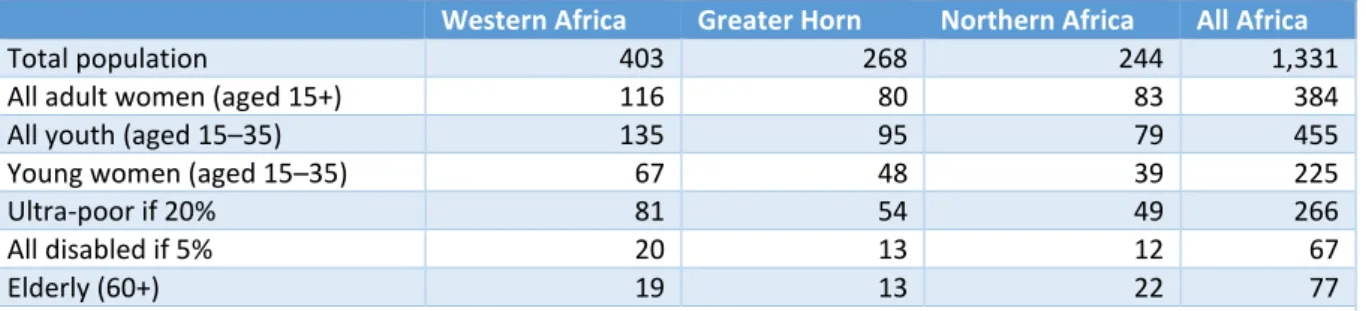
For INCLUDE, the new regional and thematic emphasis means expanding the list of countries covered during its first phase and adopting a broader (and changed) regional approach, in which issues of inclusive development, climate change, food and business, and security need to be considered together, with more collaboration between INCLUDE and the knowledge platforms on Food and Business and Security and the Rule of Law. This regional re-focus seeks to expand Dutch development co-operation. However, as Table 1 shows, covering the total number of vulnerable people in these regions is a huge task. The vulnerable population groups include the ultra-poor (‘leave no-one behind’, estimated at 20% of the population), people with a disability (estimated at 5% of the population, often overlapping with the ‘ultra-poor’, but a specific category), and the elderly. What should be kept in mind behind all these issues is the continuing demographic growth in Africa and what this means in terms of current and future demands for employment creation and basic social services (see INCLUDE blog post, Cilliers, 2019).
2 Following the BREXIT Referendum, and the US Presidential Elections, this term refers to how facts have become less influential in shaping
public opinion than emotions and personal beliefs.
3 See the earlier policy notes of ministers Pronk (1993) and Koenders (2008), which also emphasised insecurity.
4INLCUDE and the Ministry of Foreign Affairs should make use of the investments in knowledge development about education in the 1990s
and 2000s, when the Ministry funded a knowledge academy about education, co-ordinated by the University of Amsterdam, as well as the knowledge accumulated at EP-NUFFIC, based on its many programmes supporting higher education and vocational training and
Table 1. Inclusive development: 2020 estimates (in million people)
Western Africa Greater Horn Northern Africa All Africa
Total population 403 268 244 1,331
All adult women (aged 15+) 116 80 83 384
All youth (aged 15–35) 135 95 79 455
Young women (aged 15–35) 67 48 39 225
Ultra-poor if 20% 81 54 49 266
All disabled if 5% 20 13 12 67
Elderly (60+) 19 13 22 77
Notes:
For ‘Africa’, ‘Western Africa’, and ‘Northern Africa’ the definitions from www.populationpyramid.net are used. The ‘Greater Horn’ consists of Ethiopia, Eritrea, Djibouti, Sudan, South Sudan, Kenya, Uganda, Rwanda and Burundi, although some prefer to also include Tanzania.
For ‘ultra-poor’ the PADev approach (www.padev.nl) is followed: ‘ultra-poor’ is a relative concept, defined by focusing on the 20% least affluent people in a society, also called the ‘poorest of the poor’, or ‘extreme poor’. Obviously, the ultra-poor in Northern Africa might be considerably more affluent than those in Western Africa or the Greater Horn. Policies to include the ultra-poor need to combine a HDI approach to inclusion, with a relational and cognitive approach (Altaf, 2019).
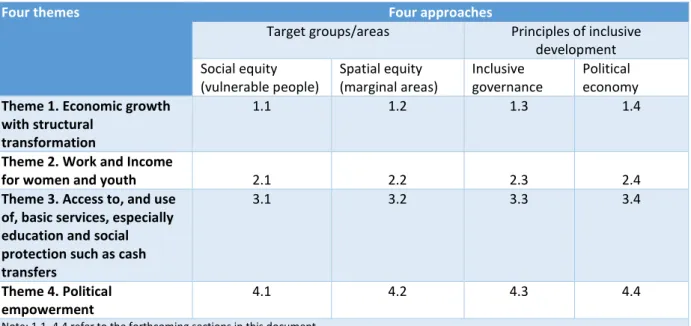
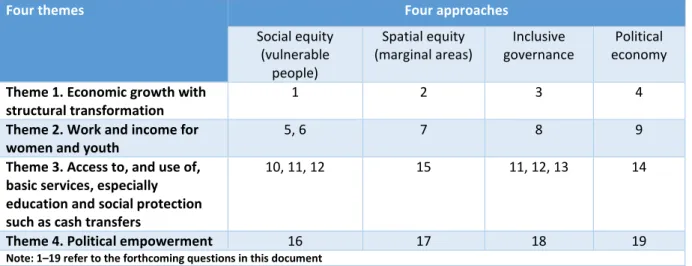
Based on the above, and the convergence of Dutch policy positions and needs, the six themes of the 2013 INCLUDE concept note have been reorganized and adjusted to form a matrix of four themes and four approaches (see Table 2):
Themes:
- economic growth with structural transformation
- work and income for women and youth
- access to, and use of, basic services, especially education and including social protection such as cash transfers
- political empowerment
Analytical and policy engagement interests/approaches:
- social equity
- spatial equity
- inclusive governance
- political economy
Table 2. INCLUDE’s new focus: four themes and four approaches
Four themes Four approaches
Target groups/areas Principles of inclusive development Social equity
(vulnerable people)
Spatial equity (marginal areas)
Inclusive governance
Political economy 1. Theme 1. Economic growth
with structural transformation
1.1 1.2 1.3 1.4
2. Theme 2. Work and Income
for women and youth 2.1 2.2 2.3 2.4
3. Theme 3. Access to, and use of, basic services, especially education and social protection such as cash transfers
3.1 3.2 3.3 3.4
4. Theme 4. Political empowerment
4.1 4.2 4.3 4.4
Note: 1.1–4.4 refer to the forthcoming sections in this document
Theme 1. Economic growth with structural transformation
Africa’s economy is growing, but has not followed the usual pattern of structural transformation, in which agricultural labour moves to industry and later to services as a result of productivity gains (see ACET, 2017; Badiane & McMillan, 2015). The service sector is the largest contributor to GDP in many African economies and has become far more important in creating new jobs than manufacturing. We know from the INCLUDE synthesis report on productive employment, Boosting youth employment in Africa: what works and why? (Dekker et al., 2018), that a large part of the services sector in Africa is made up of low-value services in the informal economy (Hollander & Van Kesteren, 2016; Van Kesteren, 2016; Floridi & Wagner, 2016)5. The majority of people engaged in the provision of services in the informal sector barely earn enough for a decent living, which affects the economy as a whole (‘survival informality’). Manufacturing is missing in the structural transformation process in Africa. Governments in Africa have begun to favour structural transformation fostering industrial development as an effective, socially responsible and sustainable means of economic and social transformation (ACET, 2018; Akbar & Stiglitz, 2015; Yong, 2014). An important step towards this was taken at the Africa-EU Summit in Brussels (EU-Africa Summit, 2014), where the two continents recognized industrialization as a priority for Africa’s development. As the INCLUDE synthesis study on productive employment (Dekker et al., 2018) emphasizes, investment in manufacturing is needed for economic transformation, but significant effects can only be expected in the long term, given that industrialization, particularly in Sub-Sahara Africa north of South Africa, comes from such a low base, and much of what once existed has been the victim of cheap imports from the world market (not only China, but also second-hand clothes and ‘dump food’ from Europe), supported by global trade liberalization (Kassim, 2015; Winters, 2015). It is important to study the current state and recent developments in manufacturing in Africa and the contribution of this sector to structural transformation processes (and employment creation).
Developing an industrial policy is an important first step to stimulating structural transformation, but should be linked to agriculture and mining, and an overall value chain approach. In recent times Kenya6, Ethiopia7, Ghana8 and other African countries have developed new industrial policies, but
5
With the majority of the economy consisting of the informal sector, and the formal sector also full of ‘informal’ arrangements and heavily dependent on the informal economy, it is arguable that formality is the norm and informality the exception.
how do these policies and their implementation differ from past? And, how have the benefits and the trade-offs been shared among various socio-demographic and economic groups? Given the political, social and institutional context, processes of structural transformation (for example, the expropriation of subsistence farmland for commercial agriculture or large-scale extractive mining) can cause tension and disrupt the existing economic livelihoods of poor and marginalized people. How have agricultural and industrial policies taken these dilemmas and trade-offs into consideration to avoid worsening the plight of poor and marginalized people? And have (agro-)industrial policies provided a structural shift to high-value products and services in sectors that have a high concentration of women to improve their income?
1.1 Economic growth and transformation with social equity
For INCLUDE, a basic issue is how economic growth and transformation can be linked to poverty alleviation (SDG 1, ‘No poverty’), and (together with the Knowledge Platform on Food and Business) food security (SDG 2, ‘No hunger’). Despite the recent two decades of relatively high economic growth in Africa (EIbadawi, Ndulu & Ndung’u, 2017), this growth has not translated into real economic transformation or shared increases in wellbeing for the majority of the African population.
Among the 17 SDGs formulated as targets for 2030, ‘Reduce inequality’ (within and among countries) is the tenth, while ‘Gender equality’ is the fifth (United Nations, 2015). Since Thomas Piketty’s ground-breaking book, Capital in the Twenty-First Century (Piketty, 2014), the measurement of ‘inequality’ (in income, capital ownership, and opportunities) has received a lot of attention, further spurred by publications like the World Inequality Report 2018 (Alvaredo et al., 2018). However, for Africa, a long tradition of studying inequality and its consequences already exists (Gyimah-Brempong, 2002; Seekings & Nattrass, 2008; Van Bergeijk & Van der Hoeven, 2017). Four of the five most unequal societies in the world, according to World Bank Gini Index of 2018 (World Bank, 2018; Guardian, 2017), are in Africa: South Africa, Namibia, Botswana and the Central Africa Republic. Some of the relevant knowledge questions are partly related to conceptual and measurement issues. What data exists or could be developed? Which policies could reduce inequality between and within countries? Is there any evidence of wealth ‘trickling down’ or is it important to redistribute upfront? And, if so, under what conditions? There are also questions related to the most effective ways to improve opportunities for the ultra-poor, and even about defining the term ‘ultra-poor’, if the aim ‘leave no one behind’ is taken seriously (Bicaba, Brixiová & Ncube, 2017). As the INCLUDE synthesis reports (Reinders et al. 2019, Dekker et al., 2018; Van Kesteren et al., 2018; Hollander et al., 2018) conclude, failure to recognize sub-groups within marginalized groups may have detrimental effects. Yet, in current discussions, the emphasis is on ‘women and youth’, but specific categories of very vulnerable people, such as people with disabilities, street children, and socially-isolated elderly people, should also receive attention, as well as the ‘depth of poverty’. Despite all good intentions, reaching the ultra-poor has proven to be very difficult, as the work of Ellis, McGregor & Pouw (2016), PADev (n.d.), and Altaf (2019) illustrate (see also Ellis, 2012).
A positive impact on growth and wellbeing can be achieved through investments in adequate service infrastructure: water, (green) energy, transport, housing, finance, and access to markets, in addition to basic services like education/training and health care (see Theme 3). For a long time, Dutch development assistance has emphasized water infrastructure and, until about 2010, also the ‘soft side’ of service infrastructure: education and health care (with specific attention to sexual and reproductive health and rights). Major improvements in social infrastructure resulted in a substantial improvement of Human Development Index (HDI) scores for most of Africa, with the exception of war-torn countries like Somalia and South Sudan. The improvements in physical and economic
7
See Ethiopia’s Agricultural Development-Led Industrialization (ADLI) 1994 and Industrial Development Strategy 2003.
infrastructure in large parts of Africa have resulted in better business opportunities and the better connection of hinterlands with economic hubs, which has supported economic growth. This also assisted in forming macro-regional markets within Africa and supported dreams of an integrated market on a continental scale. For the African Development Bank, “the overarching twin objectives of the TYS [Ten-Year Strategy, 2013–2022] are the achievement of inclusive growth and the transition to green growth through five operational priorities: infrastructure development, regional economic integration, private sector development, governance and accountability, and skills and technology. In addition, the TYS highlights three areas of special emphasis: gender, fragile states, and agriculture and food security” (African Development Bank, n.d.). The flagship projects of the African Union for its ‘Agenda 2063’ also include plans to improve service infrastructure (African Union, 2015)9.
As part of the modernization agenda, governments are investing a substantial part of public funds in economic infrastructure, especially investments that can enhance productivity and inclusivity, e.g. bus-rapid transit systems, rail infrastructure, fibre optic cabling, road construction, real estate for the middle- and upper-class, and energy grids. SDG 11 ‘Make cities and human settlements inclusive, safe, resilient and sustainable’ and SDG 9 ‘Industry, innovation and infrastructure’, which are related to resilient infrastructure and inclusive industrialization are likely to reinforce public infrastructure investments.
Infrastructure services promote access to economic opportunities, decisions on investment locations, and the expansion of productive capacity, and lower transaction costs spur growth, raise incomes, create employment, and reduce household poverty and vulnerability to shocks. For property owners, infrastructure provision improves the value of their investments. But the success of infrastructure investments in promoting inclusive growth depends on institutional partnerships between multiple state and non-state actors in planning, designing, financing, and construction, through to operating, managing, and monitoring, within an enabling environment (Musahara, 2016). In African urban systems, how has the improvement of infrastructure, like for water and spatial planning, impacted on the economic livelihoods of different groups of people and on enterprise development in different geographical areas (rural and urban)?
It is clear that there has been a lot of elite capture of economic growth and infrastructure improvements: parts of these gains have left Africa in the form of profits, royalties and other service payments for foreign capital; other parts have become monopolized by national elites, both political and economic. Africa has become the continent with the most severe disparities between rich and poor, with Gini coefficient rates for income distribution beyond 0.6 in extreme cases (and even higher for assets) (UNDP, 2017; Index Mundi, n.d.). Special attention needs to be paid to the fact (as, for instance, concluded from INCLUDE’s research on infrastructural development in Ethiopia) that the positive effects of infrastructure development are not equally distributed – neither socially, nor spatially – as people and regions that are already better off tend to benefit more (Rammelt et al., 2017). Therefore, an inclusivity lens should be adopted when investing in infrastructural projects, meaning that who benefits from infrastructural projects and who does not (or is worse off), and why, needs to be recognized. It also means that additional investment, for example, in affordable and reliable rural transport, is required to accommodate the diverse needs of men, women, the elderly, disabled and youth. We should differentiate between the infrastructure needs of urban and rural communities, because it does not follow that those in urban areas are all served by adequate infrastructure, and spatial inequalities and inequities differentiate access for those in accessible and remote rural areas. Second, we need to acknowledge that landlocked countries have different infrastructure challenges than countries near the sea. Third, we need to focus on energy when
9
talking about infrastructure and this has gender and spatial dimensions that we need to factor in. A more macro-level policy issue is the way ‘northern policies’ (e.g. to enable tax havens) negatively impact on the lives and opportunities of the (ultra-)poor, and the financial possibilities for governments and societies to improve social protection, health care and education for the poor and vulnerable sections of the population, which is one of the major issues in the recent Oxfam report on inequality (Oxfam, 2018).
1.2 Economic growth and transformation and territorial development/spatial equity
Globalization is sometimes perceived to have ‘deterritorialized’ human relations and economic processes. However, recent debates on what is called the ‘new political geography’ and ‘global history’ strongly contest this perception (Engel, 2010). It is probably better to perceive a shift from states to ‘economic hubs’ around metropolises (or ‘world cities’) and the conglomeration of business interests in those economic hubs (UN Habitat & HIS-Erasmus University Rotterdam, 2018; Netherlands African Business Council, 2019). Colin Flint and Peter Taylor show the importance of this shift in their study Political Geography: World-Economy, Nation-State, and Locality (Flint & Taylor, 2007). For Africa, it means a double shift away from thinking in terms of states and governments: with, first, more emphasis on larger regional entities and their institutions, like the Economic Community of West African States (ECOWAS) (Lange, Dietz & Rau, 2016)10 and the emerging ‘single market policy’ of the African Union, and, second, on the rising importance of (big) cities, municipal governments, and the businesses located in these cities. The rapid emergence of many African cities is having a major impact on the market and innovation opportunities in and around these hubs, and will change the rural hinterlands around these cities. For many rural areas connected to world markets (for export crops, livestock, mining and tourism) this may mean a greater economic orientation towards nearby cities. For even more isolated rural areas, it may mean new connections to rural-urban value chains and the growing importance of secondary cities, or the continuation of their geographical marginality and their role as areas of labour expulsion and security threats as harbours for terrorism and political contestation.
Map 1 shows that Northern Africa has a considerable number of these hub cities, and for Western Africa the Abuja-Lagos-Accra-Abidjan axis is a major one. In the Greater Horn of Africa the leading role of Nairobi is obvious, but there are various smaller hubs as well. However, with the exception of Dakar, the Sahel has none, which is a reason to avoid taking the Sahel as a focus region on its own: it should always be considered in its relationship with Western Africa as a whole and with Northern Africa.
In the past, the Netherlands has supported many regional development programmes focused on marginal areas in Africa and elsewhere. Lessons learnt are that regional development projects have improved local conditions and created better access to services (also, in some cases, for the poor), but have not necessarily connected these marginal areas to far-away markets, unless macro-level developments (and external demand) created the impulse for value-chain development. However, where this has happened it has not automatically resulted in inclusive growth and adequate local job opportunities. In many cases the (often strong) population growth in marginal areas has resulted in high outmigration, particularly of those who had benefited from better education opportunities (Sterkenburg & Van der Wiel, 1999). When and where integration into urban and foreign markets began to be perceived locally as adverse integration (with negative connotations like unwanted cultural change, land grabs or local elite capture), it created opportunities for local politicians and warlords to recruit disgruntled youth into violent militias and criminal gangs, with or without reference to ‘jihad’ or other forms of identity-based contestation.
Map 1. Africa’s economic hubs
Source: Map by Levering and Wall, in UN Habitat & HIS-Erasmus University Rotterdam (2018)
African cities provide hope for many young people, who migrate to these cities for better economic and social opportunities. Slum-dwellers account for around 62% of Africa’s urban population (UN Habitat, 2013). Despite these challenges, until recently, studies on urban development in Africa have traditionally focused on physical infrastructure and single-sector problems, while ignoring the interconnectedness between institutions, actors and the processes through which people interact with city systems. How do current urbanization trends in Africa constrain the ability of the poor, women and other vulnerable groups from participating in, and benefiting from, the economic opportunities that cities provide? In the context of the limited devolution of power and authority, how can sub-national actors activate the transformative potential of local governance to promote inclusiveness? Recently, the activities of the African Centre for Cities in Cape Town show more innovative and pro-poor and holistic approaches (Pieterse & Simone, 2013; Pieterse & Parnell, 2014). When infrastructure services are supported by effective policies and regulations, urban systems perform well to promote economic opportunities for all (Lall, Henderson & Venable, 2017).
There is also a need to analyse the interconnectedness of rural and urban sectors. For example, as decline sets into rural areas, the subsequent problems are transferred to urban sectors through migration, leading to the proliferation of slums and increases in urban poverty. But the decline of rural areas is also a result of the negative activities of actors in urban areas, such as the control of markets and prices, which aggravate poverty and impoverishment in rural areas.
1.3 Inclusive governance of economic growth and transformation
what kind of politics, political organizations and processes, and what degree of citizens’ participation is needed to ensure the wellbeing of the poor and other excluded groups?
In the context of economic structural transformation, private corporations play a major role: they create employment, are important for knowledge transfer, and involve local businesses in their value chain. They also have a legal obligation to pay the requisite tax to governments and a duty to exercise corporate social responsibility (CSR) to the communities that they work with. But literature on how corporations have responded to their legal requirements and CSR suggest that without active citizen demands for accountability, these obligations are not fulfilled and attempts at reducing poverty and inequalities are often reactive, short term and cosmetic. There are huge differences in the ways corporations deal with being or becoming ‘SDG-conscious’ and ‘socially responsible’. One, thus, needs to determine which forms of social and political action by citizens and pro-accountability institutions have been successful in promoting the accountability of both the state and private corporations in the context of structural transformation.
1.4 Political economy of economic growth and transformation
Building on existing literature on the politics of economic transformation in Africa (Kelsall, 2013; Ansu, 2013), INCLUDE should endeavour to better understand the underlying power structures and incentive systems that facilitate or hinder the design and implementation of agricultural and industrial policies for economic transformation in Africa. What conditions compel ruling elites to support agriculture and industrial policies that are key to economic transformation and sustainable growth? Political economy and political settlement analyses may help explain why ‘good’ industrial and inclusive policies often fail to achieve their intended outcomes, why ineffective policies (or exclusive policies) can persist, and why potentially effective inclusive policies are not adopted or, when adopted, not fully or effectively implemented (World Bank, 2017). Issues like deeper understanding of the political economy and political settlements of a country, particularly insights into the nature of the state bureaucratic agencies and their relationship with political and economic organizations and other interest groups, the distribution of power, the strength of the ruling coalition relative to internal and external oppositional factions, and the composition of elite groups at national and sub-national levels and other influential groups including street-level bureaucrats, will be key to designing effective inclusive policies and policy engagements (Hollander et al., 2018).
Across Africa, roughly four types of political settlements can be distinguish: development, competitive clientelism, dominant party, and autocratic, although some states have transitioned from one political settlement to another (Khan, 2010). How has the nature of political settlements informed the design and implementation of agricultural and industrial policies or other reforms for economic inclusiveness? The Tracking Development studies (Van Donge & Henley, 2012; Vlasblom, 2013; see also Berendsen, Dietz, Schulte Nordholt & Van Der Veen, 2013) suggest that policy commitment, coordination, and cooperation are essential institutional functions for an effective economic transformation and development. These studies point out that Asian countries became committed to structural transformation under conditions of existential threat. In what ways are widening inequalities recognized by ruling elites as an existential threat that could trigger consensus on policies for economic inclusiveness? How can advocacy for industrial policies be designed to ensure that strategic actors, especially ruling elites and multinational corporations, find it in their economic interest to promote economic inclusiveness?
Theme 2. Work and income for women and youth
growth of employment and income, particularly for women and youth, has become one of the leading policy goals of recent development policies, both in Africa (African Development Bank, 2018; Mihyo, 2014) and among development agencies. This is also true in relation to the Netherlands’ external development policies. Such policies are aligned with SDG 8, ‘Decent work and economic growth’. The academic and policy issues related to work and income generation in general, women and youth in particular, and the ‘decency’ of this work, have become major concerns in inclusive development.
2.1 Work and income for women and youth and social equity
Generating work and income for youth and women are challenges for which governments in Africa will have to find solutions. Although structural transformation is on the agenda of many leading agencies, from the ‘High 5’ approach of the African Development Bank, to Agenda 2063 of the African Union, the debate on the future of work (Malone, 2004; Cook, 2017; Harari, 2016) has not really been connected to those transformation discussions: the likely impact of the clean energy transition, digitalization, artificial intelligence, and the information revolution (e.g. digital design, 3D printing) on types of work and on the stability of working conditions. Who is likely to benefit from the new opportunities, and who is likely to lose their jobs, income, assets and security? What types of skills are needed to support the transition of young women and men to the current and future demands of the labour market? These questions also have important gender, spatial and age dimensions. It is wise to include attention for strategic actors in the formation of these new skills and go beyond formal training institutions in technical and vocational education and training (TVET) and tertiary education. There are dynamic actors based in think tanks, management consultancy firms and skill development programmes, such as those organized by DOT, MasterCard Foundation, TECHNOSERVE, and McKinsey, as well as management and auditing firms, that provide work-related skills, which also need to be included (Brookings Institution, 2019).
It is estimated that by 2020 the youth population (15–35 year olds) in Africa will be half a billion and young women will constitute about half of that. Every year about 12 million youth join the labour force. Where will Africa find work for its youth population? We know from the INCLUDE synthesis report on productive employment (Dekker et al., 2018) that, in the short term, most jobs in low and middle-income Africa will be created in the informal sector, both in agriculture (including the off-farm food system) and household enterprises. Continued public and private investment in formal wage job creation in industry and high-value services and high-value agriculture is needed for Africa’s structural economic transformation, but this will only yield wage employment effects in the long term. Currently three in five of Africa’s unemployed are youth. Many youth are also underemployed or employed in jobs beneath their qualification level. The political and social consequences of large numbers of frustrated unemployed and underemployed young men and women can be devastating for stability and undermine state legitimacy. In countries emerging from conflict, access to work and income for youth are key elements of the transition process. How can women and youth adequately reap the benefits of economic growth and transformation? What works, and why, in scaling up job opportunities, especially with regard to employment for youth and women? And what does it mean for the links between education, training and the job market? 11
Both the INCLUDE synthesis report on productive employment (Dekker et al., 2018) and the African Policy Dialogues tell us that there is a mismatch between the skills that many youth and women have and the skills that the labour market demands, and that the involvement of the private sector is important to bridge this gap. More context-specific knowledge is needed on what skills are needed for which youth and women in which particular sectors, as well as on the specific role the private
11
sector can play. And ‘skills’ should be more than job skills – they should lead to ‘life skills’. More emphasis is also needed on determining which sectors have the potential to lead to economic transformation, work, and greater income for youth and women, while avoiding negative impacts on the ecology and climate. In the absence of good prospects for manufacturing jobs, work opportunities in tourism, ICT-based services, and high-value agricultural exports and horticulture are promising, because they share similar characteristics with manufacturing. The potential for these sectors to promote jobs in Ghana, Kenya, Ethiopia, South Africa, and Senegal are substantial and they could become the source of structural transformation in Africa (Page, 2019). However, there are concerns about the ‘decency’ of some of these jobs, workers’ rights, and job precariousness. It is, therefore, important for INCLUDE to connect to policy research environments working with rights-based approaches12.
2.2 Work and income for women and youth and territorial development/spatial equity
There is a major debate going on about the consequences of the geographical disparities in access to jobs and income for women and youth. The INCLUDE synthesis report on productive employment (Dekker et al., 2018) emphasizes the importance of differentiating between different types of youth and women, depending on where they live and work. The report distinguishes four groups of African youth: rural youth from modest farming families working on the family farm; low-skilled, self-employed youth in urban and rural survival enterprises; young apprentices in rural and urban individual enterprises or in search of wage employment; and young urban graduates seeking formal wage employment. We need more context-specific knowledge about the size, proportion, and employment aspirations of different groups of youth and women in different regions and countries. Most new opportunities can be expected in the urban hubs and one can, therefore, expect further migration from rural areas to cities, particularly by the youth of Africa, both boys and girls, although often with different job orientations. In a recent analysis of country-to-country migration data, intra-African migration gets a lot of attention. Map 2 shows the areas of expulsion and attraction (Dietz, Kaag & De Vink, 2017).
Map 2. Major intra-African migration flows (until 2015) Source: Dietz, Kaag & De Vink (2017)
It is possible to refine this analysis by adding a gender dimension. This ‘drain’ of people from rural to urban areas can be valued both positively and negatively. The positive side is that it relieves marginal areas of surplus population, particularly where population growth seems to outstrip the area’s economic growth potential. In addition , demographically, it probably results in lower fertility rates, which are generally lower in cities than in rural areas. Economically, it may also create productive linkages (inclusion in value chains, remittances, innovation) between those who have migrated and those who remain. In the long run, it may create ‘brain circulation’ and return migration after local circumstances in areas of origin have improved. And, socially, this movement to urban areas may create better chances for boys and girls to escape cultural barriers to emancipation and wellbeing; this is certainly true for people with a sexual orientation that is not accepted locally. The negative side is that often the most productive, educated and innovative people migrate, and rural areas where these migrants have been raised and educated, thus, subsidize urban economic growth elsewhere. The balance of pros and cons is a matter for further study. Policy debates should go beyond the local and include the regional perspective. However, there is a serious problem connected to rural-urban migration aspirations: few youth are willing to invest in an agricultural future for themselves and their children. For future food production, it is crucial that young people, men and women, see a future in agriculture, and invest in agricultural innovations that make it both profitable and ‘sexy’ to be a farmer (Van Rijn, Bulte & Adekunle, 2012). What can be learnt from examples where this has been successfully done? What relationship exists between agricultural innovation and social capital?
INCLUDE also needs to analyse how rural sectors can be transformed to promote reverse migration (i.e. urban to rural). For instance, in Kenya, to some degree, devolution has led to people moving back to their urban counties from bigger urban areas of Nairobi, Mombasa, Kisumu, Nakuru and Eldoret. But what needs to be advocated for is rural transformation that can encourage the semi-urbanization of rural areas through rural cottage industries and increased off-farm activities. Research indicates that smallholder farming households with off-farm activities tend to invest in agricultural innovation and engage in conservation and water harvesting, and this has increased incomes for such households. We need a much better understanding of recent internal migration practices in Africa, both rural-urban, but also reverse and rural-rural migration.
Poverty and lack of work opportunities, but also a feeling of being excluded politically and socially (Richards, 2005), compel many young men and women to migrate to places where they see better opportunities: mainly in Africa itself, some to the Middle East or Asia, and some decide to make the perilous voyage across the Sahara desert and the Mediterranean Sea to Europe in search of jobs, income and better living conditions. In the absence of a common EU policy on immigration and recognition of the importance of immigrants, EU member countries have fashioned policies to deal with immigration issues individually. In recent times, some EU countries have signed bilateral accords with governments in Africa to accept the repatriation of migrants in exchange for financial support for the integration of returning migrants. However, for many African governments and societies, migration to far away destinations has become an important source of remittances, knowledge and new networks, and the areas with higher HDI scores and families with more capabilities tend to ‘send’ higher proportions of their youth to Europe and other far-away destinations – and this trend seems to be increasing (Dietz, Kaag & De Vink, 2017)13. In addition, the ongoing population growth in Africa, as a result of the relatively slow demographic transition, is resulting in higher numbers of people migrating (Dietz & Akinyoade, 2018). In addition, regular humanitarian crises result in refugee waves, mostly to neighbouring areas, but also to Europe. For host communities in Africa this can have considerable consequences. A big issue is the need to facilitate jobs and income for the youth of
13
host communities, next to (international) support for refugee communities. In addition, there is often a considerable impact on the local ecology and existing services.
2.3 Inclusive governance of work and income for women and youth
The informal sector accounts for between 30–60% of Africa’s economy and 85.5% of employment (ILO, 2018b). A large proportion of those in the informal sector are women, who also occupy the lowest, most vulnerable and least paid jobs in the sector. If the economic growth trend continues (without sufficient structural transformation), new jobs in agriculture and (non-farm) household enterprises will continue to be in the informal sector (Dekker & Hollander, 2017). This means that the income and conditions of work in the informal sector will be important determinants of the degree of inclusiveness. The International Labour Organization’s (ILO’s) ‘decent work’ agenda focuses on guaranteeing people’s rights at work, extending social protection and promoting social dialogue. How can these inclusive approaches to work be guaranteed in the informal sector? The feminization of poverty, combined with discrimination according to gender and age also means that the most vulnerable and marginalized groups tend to end up in the informal economy, because there is no alternative (ILO, 2014). The struggle for work and income also means that little attention is paid to the quality of jobs and gender disparities in wages. A study on inclusive growth in Nigeria’s agro-processing sectors showed that women were paid in broken rice while men received cash wages (Aremu et al., 2016). Gender disparities in wages and other forms of inequality are widespread in the informal economy and may worsen in newly-industrial sectors or export enclaves. How do wage policies and other conditions of work in the informal sector take into consideration women’s productive and reproductive roles? What are the successful reforms (or transitions) in the informal sector that improve the conditions of work and income for women and youth? Are young people, especially women, adequately included in these political processes, and, if not, what should be done to increase their involvement? A ‘political settlement’ approach to employment creation is needed, as is well articulated in a recent study about Ethiopia (Admassie, Berhanu & Admasie, 2016)
a clearer understanding is needed of the sector in order to see how the objectives of the decent work agenda can be achieved.
Empowering women in the informal economy is key to expanding their choices, improving their livelihoods and advancing gender equality (ILO, 2018a), but what forms of education, skills development and training are needed for the future of work for women in Africa? A broader understanding of the linkages between youth, their education and skills training, and work will provide a new perspective that will inform the design and implementation of policies and programmes. How can (vocational) training be better connected to businesses (e.g. how to avoid ‘internships’ pushing out existing labourers and undermining income levels and job decency)? How can work-based learning and training on-the-job be better connected to innovations, and how can lessons learnt be shared more equally? How can leaders in innovation also become leaders in social inclusion? Addressing the skills mismatch is crucial for inclusive development, and more needs to be known about the demand and supply side of the labourmarket.
While Africa’s youth population is growing rapidly, it is also getting better educated14, even if there are serious concerns about the quality and usefulness of that education15. It is estimated that by 2030, about 59% of the 20–24year olds will have had secondary education, compared to 42% in 2012. However, to be integrated into the labour market, young people need relevant and quality skills training, adequate and accurate labour market information, career guidance (mentoring) and effective skills forecasting. Part of the reason for youth unemployment is a mismatch between skills among the youth and the nature of the work available. In Africa, because of the large informal sector, young people with inadequate skills find work in places that do not pay good wages, help them de-velop skills or provide a measure of job security.
For many youth, working in the informal sector may be the only chance of acquiring work experience. Support for youth entrepreneurship ranges from measures that provide them with financial and technical assistance to create their own business, including microcredit and entrepreneurship training and mentoring, through to measures that improve their chances of expanding. In spite of some positive examples of well-functioning programmes that offer comprehensive support to young entrepreneurs, far too little is known about how to promote innovative young entrepreneurs through networks of business hubs and so-called accelerators, especially in fragile contexts where the start-up capacity remains low. Furthermore, the governance mechanisms involved in supporting young entrepreneurs in Africa remain under-researched. What labour market reforms and initiatives have proven particularly successful in removing the barriers for youth employment?
2.4 The political economy of work and income for women and youth
If the informal sector continues to dominate the labour market and the future of work in Africa, why have policies not been directed towards regulating the precarious working conditions in the sector? Why have regulatory institutions failed to reform the informal sector in many countries? And, if informalization is the new norm, does this really matter to the ruling elite, beyond recognition in policy statements? These are the questions that require political economy analysis, but have not been adequately addressed since ILO coined the term ‘informal economy’ in 1973. African ruling elites have made a ´fetish´ of the informal sector, as if it cannot be reformed or regulated by any means. Some countries in the region have managed to reduce the pervasiveness of informality in their economy, and it is important to know where and how that happened. Recent studies by the International Monetary Fund have found significant heterogeneity, with informality ranging from a
14
Some writers talk about the (expected) ‘demographic dividend’ (see, for instance, Admassie et al., 2015).
15
low of 20–25% in Mauritius, South Africa and Namibia to a high of 50–65% in Benin, Tanzania and Nigeria (Leandro, Jonelis & Cangul, 2017). There appears to be a reverse correlation between the size of the informal economy and the quality of governance. Could one further assume that the larger the size of the informal economy, the higher the precariousness of work and income conditions for women. A better understanding of the actors, institutions and incentive structures that have enabled the informal sector to resist reforms and regulations in some contexts, but not others, would be helpful in designing policies on inclusive development in Africa.
INCLUDE’s prior work on the informal sector highlights the role of the informal sector in keeping the labour and other costs of the formal sector low. The informal sector is an important part of the formal sector, and vice versa. Most of the commodities that are sold by unprotected informal sector workers are from the formal sector and these underpaid workers help the formal sector to reduce storage, formal wages and tax costs. The state loses revenue and the informal sector workers get minimal pay, on which in many countries they do not pay taxes. The sole traders and contract workers in the transport sector, however, while also subsidizing the formal sector, still pay licence fees and taxes from their meagre earnings. In addition, they are responsible for all costs related to maintenance of the vehicles and other machinery they are contracted to use. These characteristics of the sector need to be understood and the gender, age and even ethnic specializations of various groups factored into any analysis aimed at producing evidence-informed policy engagement and dialogue.
Theme 3. Access to, and use of, basic services especially education
and cash transfers
For a long time, the provision of basic services was regarded as the cornerstone of development assistance in the Netherlands, and particularly during the period of the Millennium Development Goals (MDGs) (2000–2015), they dominated the development agenda of many agencies. A lot of attention was given to basic education, basic health care, and drinking water and sanitation. The shift to ‘’ownership, alignment, harmonization, managing for results, and mutual accountability” (OECD, 2005) was very much focused on improving basic services. And indeed, the results of the MDGs are impressive for many African countries, although a lot more should be done. In more recent times, the Netherlands has drastically reduced its support for those basic services, as a result of ‘development fatigue’ and budget cuts between 2010 and 2018, with the exception of supporting the provision of water services, which, next to support for ‘food and business’, became the core area for Dutch development assistance during those years. However, the new Dutch policy note (Kaag, 2018) brings back the urgency of supporting basic services. Among the SDGs (2015–2030), four explicitly mention basic services: ‘Good health and wellbeing’ (SDG 3), ‘Quality education’ (SDG 4), ‘Clean water and sanitation’ (SDG 6), and ‘Affordable and clean energy’ (SDG 7). Recently, there has also been a growing awareness of the importance of supporting African governments and civil society in improving social protection approaches as part of basic services, and as part of a new social contract between African states and its diverse populations. Recent work by INCLUDE supports the urgency of and the ‘business case’ for supporting social protection (Van Kesteren et al., 2018). It shows that social protection is not only a powerful tool to alleviate poverty and prevent people from falling into poverty, but also an important instrument to address economic, social and political exclusion and vulnerability.
3.1 Basic services (especially education and cash transfers) and social equity
private universities and schools, private clinics), who mainly serve the wealthy upper and middle class. The urban poor are often left to their own fate, with very limited government support for providing and maintaining services in their shantytowns and ‘urban grey zones’ (Ammann & Förster, 2018). Major research-for-policy questions relate to the linkages between service investments and the distribution of social benefits, both in rural areas and cities. Private versus state provisioning of these services, and the impact on social equity, also raises questions.
The more than 250 million ultra-poor people in Africa (see Table 1) are mostly excluded from life-improving initiatives to increase labour market participation as entrepreneurs or as workers and, as such, from earning an income through jobs and profits. The ultra-poor without jobs completely lack assets for self-help and are, moreover, often excluded from making use of community social assistance systems. Many people are incapacitated by old age, disease, or physical, mental and social disabilities, sometimes as a result of alcohol and drugs or stigma after prison sentences or psychiatric treatment. The INCLUDE synthesis report on social protection (Van Kesteren et al., 2018) recommends that more emphasis be placed on recognizing and alleviating the hidden costs and obstacles involved in participating in such initiatives. Even if structural transformation creates more jobs, many of the ultra-poor people cannot participate through work in the transformation process. They need to be covered by social policies and assistance programmes (basic income subsidies, old age pensions, childcare, support for widows, and support for people with disabilities). Coverage is a worldwide debate, but there are many innovative policies in Africa worth monitoring and comparing. There is also a growing awareness of the success of group formation of, and lobbying and advocacy for, the ultra-poor, e.g. based on the experiences of the savings and micro-investment schemes of BRAC and the Grameen Bank, also in Africa16, although there is a fierce debate about the approaches used and results achieved.
A different field of enquiries concerns the dynamics of poverty and the debates about ‘being trapped in poverty’ or ‘becoming trapped in poverty’. Vulnerability studies lead the way and partly deal with the consequences of natural disasters (or broader issues of climate change and ecological destruction), and of disease and disability. Knowledge about insurance mechanisms (by private and state agencies, UN agencies, NGOs like the Red Cross, or through community or religious mechanisms) is crucial here, as well as the impact of adaptation and prevention mechanisms17. However, studies on chronic poverty should go beyond vulnerability and insurance issues and also address issues of access and power (Beegle et al., 2016; Legwegoh & Fraser, 2015). And as experiences from India clearly show: a dynamic approach is crucial to understand movements in and out of poverty (Krishna, 2001; Krishna, 2004)18.
INCLUDE needs to promote a holistic approach to social development, rather than just social protection. An example is the one adopted by SEWA in India, in collaboration with the Food and Agriculture Organization (FAO, 2018).
3.2 Basic services (especially education and cash transfers) and territorial development/spatial equity
The Global Data Lab publishes sub-national HDI figures, combining assessments of a region’s income levels, education levels and health status, for all sub-regions of the world, and for each year between 1990 and 2017 (Permanyer & Smits, 2018). These indices enable us to identify the sub-national areas (regions and countries) in the new Dutch development policy with the lowest HDI scores. Because of the importance of education and health achievements in the HDI scores, the regional indices show
16
For BRAC, for instance, see Banks, et al. (2018); for Grameen Bank, for instance, see Oladele & Ward (2016).
17
There is a lot of information available: e.g. Dercon (2005) and Linnerooth-Bayer & Mechler (2015).
the areas with the least impact of global improvements in two major elements of service infrastructure: education opportunities and health care. Map 3 shows the sub-national HDI in 2017; the Data Lab allows a dynamic analysis. In phase II, INCLUDE should consider sub-national HDI as one of the outcome indicators for assessing the degree of inclusiveness in a country. Every development (or lack of it) is local, and so is inequality and poverty.
Map 3. Sub-national HDI, world map, 2017 Source: Permanyer & Smits (2018)
The map shows that, with the exception of Afghanistan, the lowest sub-national HDI scores can be found in a belt from Guinea, via Mali, Niger, Chad, the Central African Republic and the Democratic Republic of Congo, to parts of South Sudan, Eritrea, Ethiopia and Somalia, and with a pocket of very low scores in parts of Mozambique. The pockets with the lowest HDI scores in 2017 can be found in some of Somali (e.g. Middle Juba 0.224, down from 0.231 in 1990), the Sahel-region of Burkina Faso (0.271, up from 0.215 in 2005), and Borhou in Chad (0.287, up from 0.211 in 2000).
the difference widened (West from 0.315 to 464, an increase of 47%; North from 0.280 to 0.373, an increase of only 33%).
Including hitherto marginal areas in inclusive social contracts often depends on the ‘nuisance value’ of activists in these areas in preventing foreign and national elites from exercising their interests. So attention to policies and practices in order to politically and economically include marginal areas should also include attention to perceived or actual threats posed by the people living in these marginal areas. In an African setting these people are often ‘different’ from leading elites in terms of ethnicity, language, history, and sometimes religion. Often they are also located in border zones, at a great distance from capital cities. ‘Nuisance’ can take the form of smuggling, criminal behaviour (killing and kidnapping traders and travellers, theft from lorries, drug trafficking, human trafficking, terrorism), or undermining access to minerals and other assets perceived as valuable by elites. Sometimes the threats are a result of (ethnic or religious) violence or radical identity politics, and can escalate to war-lordism, secession or civil war. Massive streams of refugees and displaced people resulting from such insecurity are a potential threat to stability as well (and are also perceived to be a threat in Europe if refugees come to Europe in great numbers). Another type of threat, often voiced by nature conservationists and tourism entrepreneurs, is that political insecurity in valuable landscapes can damage nature and biodiversity and undermine the tourist industry19.
3.3 Inclusive local governance in the provision of basic services (especially education and cash transfers)
The devolution of political power to local governments, who depend on voters to survive politically, probably results in greater demands on local governments to bring basic social services closer to the people and make them more accessible. The most prominent demands are usually for education, basic health care, water provision, and some form of social security. Current social protection policies in Africa have mainly focused on health insurance schemes20 and unconditional social assistance (cash transfers) to vulnerable people (older persons, orphans and vulnerable children, people with disabilities, and the chronically poor). By 2015, about 40 countries in Africa were already implementing cash transfers (World Bank, 2015), but less than 25% of all eligible poor have access to these transfers, because of poor design, targeting errors, corruption, and inadequate financing of interventions (Awortwi & Aiyede, 2017). The argument in Africa is no longer about whether social protection improves the social and economic conditions of the poor and excluded people, as the evidence supporting this is now overwhelming positive, but under what conditions key policymakers and ruling elites will devote substantial national and local resources to support its expansion.
INCLUDE’s African Policy Dialogue in Kenya shows that, given their closer proximity to the poor, some local governments are not only supporting central or provincial governments to provide social assistance services, but are actually delivering them as localized services, with or without a clear central government mandate (Partnership for African Social and Governance Research & Africa Institute for Health and Development, 2016). Some local governments are also linking and coordinating social protection services and programmes across policy sectors and to NGOs and community-based organizations (CBOs). How is the participation of local governments, the poor themselves, and community structures improving the design, effectiveness and expansion of social assistance to excluded poor people?
Informal social assistance through CBOs, religious organizations and family network systems have
19
Sometimes nature conservation itself is perceived to be a threat to security, particularly in Southern Africa, see: Massé (2016); Büscher (2018) and Gewald, Spierenburg & Wels (2018).
20
enabled the poor to survive destitution. These informal systems are prevalent in Africa (Awortwi, 2017). Recent attempts by governments and international development partners to expand social assistance or safety net programmes in Africa seem to have bypassed these ubiquitous organizations and systems. As formal social assistance expands in Africa, is there evidence that informal social assistance is at risk of collapse, or is this a myth? What contextual factors, including risk, should be considered in the design of integrated formal and informal safety nets to ensure that more poor people are reached without replacing or collapsing informal systems?
3.4 Political economy issues of basic services provision (especially education and cash transfers)
Compared with Latin America and Asia, the social assistance programmes in Africa demonstrate substantial donor involvement in design, funding and implementation, with clear consequences for redistribution issues and for reducing inequality through redistribution. African governments have generally taken a cautious or uncommitted approach to broad social protection for a number of reasons: uncertainty about fiscal space, the sustainability of Africa’s long-term economic growth, and the continuity of development assistance. However, where there has been expansion of social protection programmes, electoral politics have played a key role. This suggests that as African countries consolidate multi-party politics, social protection will expand in competitive clientelistic states, as opposition political parties try to get more support from the poor to unseat ruling governments.
Historically, progressive social policy has seldom happened without the pressure of organized people to support it. A universal social protection floor needs more than just political commitment, it also needs fiscal capacity. So the remaining question is what strategy (however pragmatic) will work to make social protection acceptable? Who will make that decision? What will encourage decision makers to make that choice soon? Is there support from Africa’s elites (politicians, bureaucrats and middle class) to finance extensive social protection nationally through taxation? What alternative sources of funding are available to expand social protection without donor support?
One also needs to know whether current social protection is improving the state-society contract (Hickey, 2011). The social contract approach recognizes the right of the poor to social protection (shelter, education, security, health, insurance, cash transfers), empowers beneficiaries to actively demand their rights as an entitlement and provides space for civil society organizations (e.g. parent-teacher associations) to hold governments accountable for their delivery. In return citizens agree to the legitimacy of the state over individual rights, in addition to assuming some duties. This includes the payment of taxes and submission to state laws. As the state retreats from its welfare responsibilities, citizens have generally resorted to other coping mechanisms, leading to what appears to be a breakdown of the social contract between the state and its citizens. This includes refusal to pay taxes, disregard for government rules, informal processes, social unrest and, in extreme cases, armed conflict with the state (including terrorism).